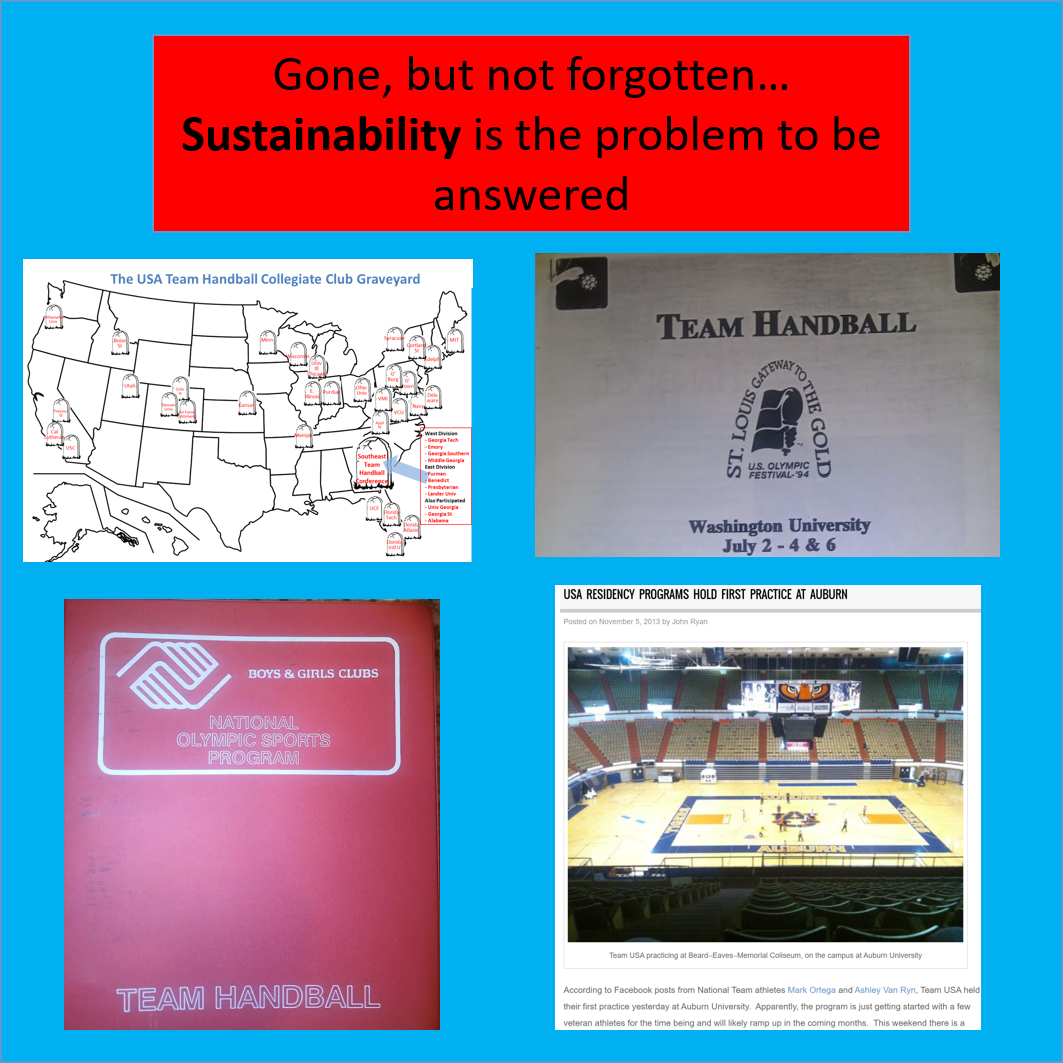
(Clockwise: College clubs that have disappeared over the years, 1994 US Olympic Festival Handball Packet, 1980’s Southern California Boys & Girls Club Team Handball Binder, November 2013 Post on the 1st Residency Program practice at Auburn University)
I’ve spent a lot of time and energy advocating and writing about strategic planning. Sometimes, I’ve gotten the message across. But, at other times, I’ve been ignored. In particular, the last few years have been downright depressing. I’ve been told there is a plan in place, but if there is… I’m bewildered by some of the activities and initiatives that are taking place. I’ll eventually explain my bewilderment, but before I do that I’ll first breakdown why strategic planning is important.
Many Possibilities… but, Limited Resources
Virtually every handball related effort that has ever been undertaken in this country has had some value. Whether it was starting a new club, conducting a youth clinic or establishing a residency program for elite athletes. Even if an effort ultimately failed someone was exposed to the sport and something was learned from merely trying. There’s no shortage of worthy things to do, but as anyone who’s been around awhile knows we are critically short in terms of resources. We can’t do everything and sometimes even focusing on just one or two things is challenging. I first wrote about this challenge back in 2014 and proposed several options for consideration. Over time, some of the options have even been implemented to one degree or another.
How to Select the Best Options
In 2019 I rebooted the series and in the introduction I outlined a process that can aid decision making.

The point of emphasis here is that before you decide on your initiatives you really, really need to take stock of what you have before you decide what you should do. This is because… what you want to do might not even be possible given your current starting point. I then continued the series with a fairly deep dive look at our overall demographics, national team player pool, club status and finances. (Spoiler Alert: Not much has changed in the plast 6 to 7 years; we’re still starting from the same point)
Understanding and Defining Sustainability
When I take stock of “What We Have” the number of reasonable courses of action dwindles considerably. At least they do for me, anyway. But, what’s obvious to me… isn’t so obvious to others because I now see quite a bit of time and energy being directed towards some efforts that have very little chance of being sucessful in the near term and practically no chance whatsoever of long term sustainability.
Why do I think that? What do I mean? Well, let’s start with the definition of sustainability. Merriam-Webster defines sustainbility as “capable of being sustained” and then defines sustained as “maintained at length without interruption or weakening.” AI and Wikipedia expand on these definitions and highlight how the term has more recently emphasized enviromental issues. In a handball sense, and particularly as it relates to handball in the USA, I’ll go with the Merriam-Webster definition of being “maintained at length without interruption or weakening.”
However, while I appreciate the simplicy of the definition it’s lacking a discussion at to how much resources should be applied to sustain an effort. Because, if you think about it, just about anything can be maintained if you keep throwing enough money at it. Conversely, if the money declines or runs out the program is in immediate jeapordy. So, from a financial standpoint, the sustainbility objective or gold standard would be for an effort to eventually become mostly self funded.
The other primary resource is people and their willingness to be involved whether as an athlete, volunteer or compensated staff. Similar to money, if you have enough people engaged in an effort… that effort can also be maintained. And conversely, if people lose interest for whatever reason an effort can quickly fail. This can even be true if just the one key person loses interest in supporting an effort.
Why Sustainability?
A desire for sustainability is somewhat self-evident. Just about everybody likes to see something they were involved in continue to function or work. In 2001, I helped get the DC Diplomats club get established and while surely someone else would likely have done the same thing sooner or later, I take a little pride in that club still being around. And, then in 2010, I helped establish the Las Vegas Scorpions. I like what I helped start there, but there’s less personal satisfaction with a club that’s faded away, even if it’s now showing some signs of life.
But, beyond pride and feeling good, sustainability is really important for a stuggling sport trying to gain a foothold in the U.S. I’ve been around 40 years and in that time I’ve seen far too many efforts start with promise, but then disappear. Here are a few:
- Major youth progams in Los Angeles (80s/90s) and Atlanta (90s/00s).
- Dozens of college clubs and adult clubs. Fun fact: Denver is on its 4th handball club (Pioneers, Rockies, a no-nickname team and today’s Wolves).
- The multi sport Olympic Festivals that served as a stepping stone from clubs to the national teams in the 70s, 80s and 90s
- National Team Residency programs in Colorado Springs it(80s-93), Philadelphia (93-94), Atlanta (94-96), Cortland (04-07) and Auburn (13-18).
Expending scarce resources on efforts that aren’t sustainable isn’t quite the same as throwing money down the drain… but, it’s really questionable. And, if one factors in the lost opportunity costs… The reality that even just redirecting a tiny amount of resources towards something sustainable and contemplates how over time that could make a difference… Well, you can see why I shake my head in frustration and become a little depressed.
Because there are some efforts that have been fairly sustainable. Some examples include:
- CalHeat’s Middle School and High School programs
- Collegiate clubs like West Point, Air Force, North Carolina and the relative new kid on the block, Ohio State. And, adult clubs like NYC, Chicago Inter and CalHeat
Questions that Should be Asked and Answered
This leads to a lot of questions that should be asked to include:
- Why have some efforts fizzled out?
- Why have some efforts stuck around?
- Can we distill what’s worked and what hasn’t and apply those lessons learned to new efforts?
- Can we ask hard questions about sustainability before efforts get approved?
- So that efforts can be restructured to improve their prospects for sustainability
- So that efforts that can’t adequately address sustainability concerns never see the light of day
I’ll try tackling these questions and more in the coming weeks.