post

Charting a Way Forward for USA Team Handball: Part 1: Introduction: Many Options + Limited Resources = Hard Choices

Many options for developing handball in the U.S.  Which way is the right path?

Many options for developing handball in the U.S. Which way is the right path forward?

Previous commentaries have focused on the shortcomings of National Team Residency Programs, why I felt it was too soon and unwise to start a program up in Auburn and the historical debate between supporting grass roots and national team programs.  With this new series I turn the page to focus on some programs and initiatives USA Team Handball should consider as it charts its way forward.

Many Options

The old saying goes that there are many ways to skin a cat.  And, when it comes to charting a way for USA Team Handball there are indeed a number of possibilities.  For the most part this series will focus on initiatives that will help “enable United States athletes to achieve sustained competitive excellence“.  This was pulled directly from the USA Team Handball mission statement.  Granted, this is just one part of the mission statement, but as you go through the initiatives, proposed programs and broad overarching strategies you’ll see that many of them have a grass roots flavor.  But, Grass Roots with a focus on identifying and developing talent with National Team potential.

1) Modify the National Team Residency Programs to focus strictly on player development: Link
2) Increase the emphasis and support to National Team recruiting: Link
3) Develop or participate in a European based residency program to provide athletes more competition: Link
4) Upgrade College Team Handball:  Following the rugby club model to nationwide participation (Part 1; Part 2)
5) Upgrade College Team Handball:  Seeking NCAA status on the heels of the O’Bannon Ruling
6) The “Title IX Field Hockey Strategy”:  Focus 90% of USA Team Handball’s resources on Women’s Programs: Link
7) The “Iceland Strategy”:  Focus a large percentage of USA Team Handball’s resources on one geographical location (Part 1; Part 2; Part 3)
8) The “Alberta Strategy”:  Fully assess Alberta’s successful development program and fund a U.S. version in one region of the U.S.:  Link
9) Youth and Junior Teams Emphasis:  Fund U.S. participation for up and coming athletes first
10) Funding direct to clubs:  Reward high performing club programs with real and tangible financial support
11) High School Team Handball:  Following in Lacrosse and Flag Football’s footsteps
12) True Youth Movement:  Follow the AYSO soccer model to develop a massive player and fan base at even younger ages
13) U.S. Olympic Handball Festivals:  Bridging the gap between club and national teams

(Editor’s Note:  As this series evolves this list will likely see several modifications.  The intent, however, is to keep this as a home page for future reference.)

Limited Resources

Unfortunately, while a good case can be made for each of these options, the harsh truth is that USA Team Handball has very limited resources.  The last published IRS Form 990 from (July 2011 – Jun 30, 2012) lists only $512,000  in total revenue and last December former CEO Matt Van Houten indicated that USA Team Handball was literally counting every penny.  USA Team Handball’s new  Board Chairman, Dr Harvey Schiller, has many connections in the corporate sports world so there’s room for optimism that fundraising efforts will become more successful.  That instead of choosing one possible initiative soon USA Team Handball will be able to choose several options working in tandem.

Hard Choices

It goes without saying that if you have many options, but limited resources you can’t do as much as you would like to.  Inevitably, this should lead to some hard choices.  Hard choices that often no one wants to make.  Case in point, was NYAC Coach and legend, Laszlo Jurak response when I asked what should be done if you don’t have the resources to support both National Teams and Grass Roots?  His response:  “Then you have to quit.”  (Audio:  Link  (around the 21:00 minute mark)

While tongue in cheek, this is the resignation that many old timers feel.  And, unless you are on the USA Team Handball Board of Directors it’s pretty much a theoretical question, so most of us can simply refuse to contemplate such an unpleasant question.  Well, I guess Board Members could also quit, but the reality is that they are indeed making these hard choices even if, (and, this is very important) their choice is simply to continue with the status quo and not fully consider other possibilities.

There’s no getting around it.  All one has to do is follow the money and the man hours expended.  Where time and money is spent is the answer to what’s been decided.  These decisions should be tough ones to make.  Decisions based on a careful analysis of the merits of several good options.  Decisions based on a review of current programs and metrics that measure success and failure.

Could of, Would of, Should of and Moving Forward

As you read through this series chances are you might get some light bulbs turned on.  And, those light bulbs will be some revelations along the lines of:

  • The U.S. should have pursued some of these initiatives prior to starting and focusing so much of its resources on residency programs.
  • That a particular initiative is definitely worthy, but we just don’t have the funding for it.  And, the reason we don’t, at least in part, is because our residency programs are taking too big a chunk of resources.
  • That many initiatives should probably be co-located with our residency program.  And, that there are quite a few places in this country that would be better suited for implementation than a college town in rural Alabama.

Unfortunately, though, the die have been cast.  A commitment of some level has already been made to the residency programs at Auburn.  It would have been better to first methodically assess and weigh these initiatives (and others) prior to this commitment, but you can’t change the past.  You can only plan for the future.

And, in the hopes of influencing the decisions being made regarding that future the follow on parts to this series will assess each initiative, program and broad strategy by taking a top level look at its overall objective, pros/cons, risks, costs and timing for implementation as part of a coherent, long term strategic plan.  While some might think that this is an exercise in futility I’ll take the optimist’s point of view.  It’s only a matter of time before the sport of Team Handball gains traction in this country.  With good planning, though, it can happen sooner and that traction will be so much greater.

post

Handball and Development in Australia: A New Path

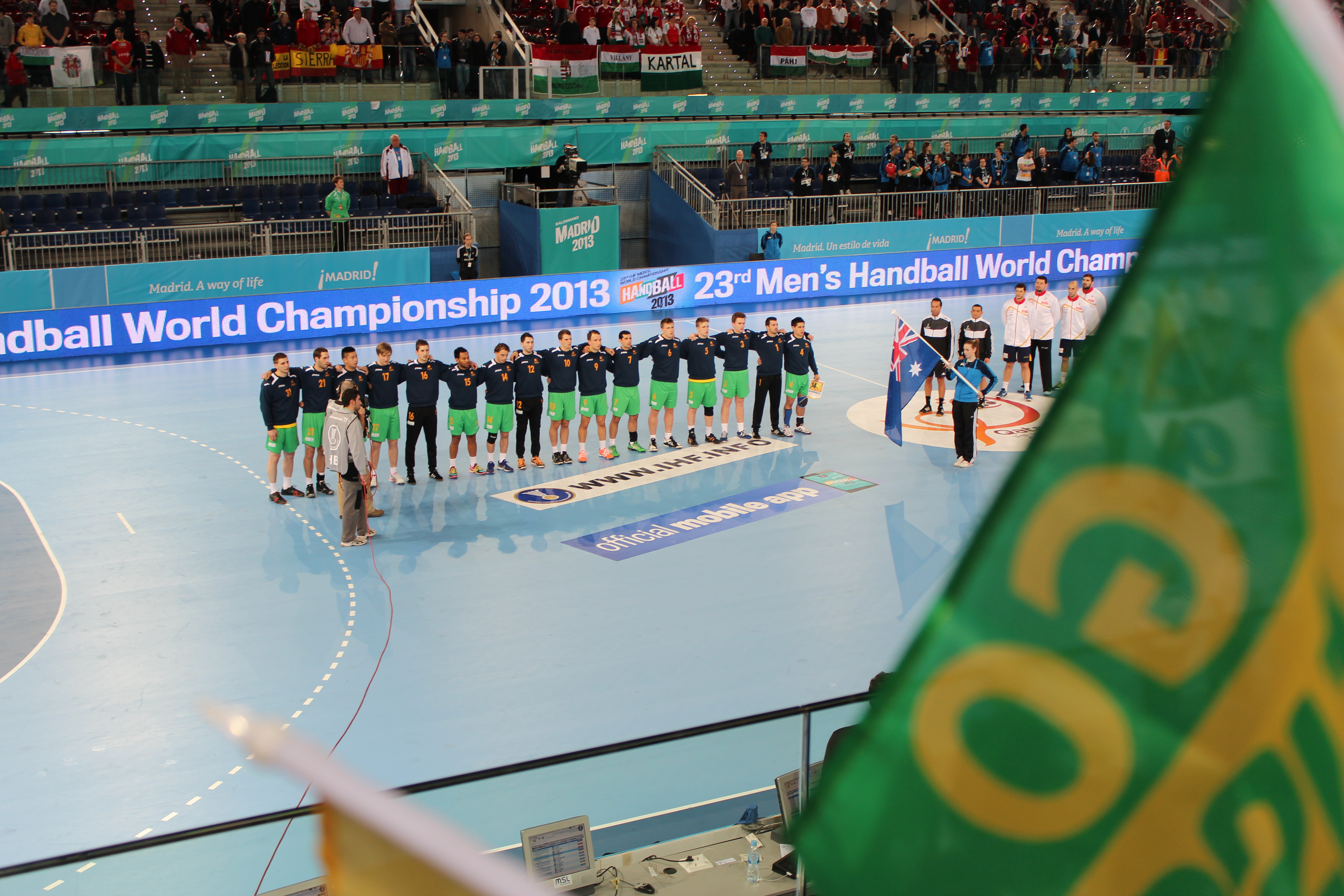
The Australian men's team sing the national anthem before facing Spain at the 2013 Men's World Championship in Spain

The Australian men’s team sing the national anthem before facing Spain at the 2013 Men’s World Championship in Spain

Former Australian national team player now journalist Courtney Gahan weighs in on the IHF decision to exclude Oceania from the 2015 World Championship and just how important international competitions like the WC are to developing handball nations like Australia.

The initial shock felt by the athletes, officials and the Australian and Oceania handball communities at large following the IHF’s decision to withdraw Australia from the 2015 Men’s World Championship in Qatar may have lessened, but the decision brings with it potentially far greater long-term consequences for the development of handball in a region that has always been working against the odds – and what happens next will determine the fate of not only all the athletes, coaches, officials and countless other volunteers who have dedicated years to seeing their sport grow, but of the sport itself.

Despite the rather late nature of the action by the IHF, the decision to remove Oceania’s compulsory spot could be seen as a blessing rather than a curse – provided alternatives for the teams in the region are put into place. Now is a crucial time for handball in Oceania, and it is important that the countries in this region have the support and assistance of the IHF in finding the path that will not be an easy or short one, but will likely take handball in the area to a much better place.

As someone who has been involved in Australian handball for many years, in almost every capacity there is – from national representative to coach to helping start a new club, not to mention a sibling now part of the men’s national team, I have a great deal of experience and care deeply about handball in this region. I also have experience with handball in Europe, having played in the region myself and now as a contributor to the EHF media. These two regions are almost complete opposites when it comes to handball, a fact that has helped me gain a unique point of view of the current status and future of handball.

The question of development

Handball is not alone when it comes to the difficult question of development in Australia, Oceania or even the world. Countless team sports are ahead of handball in terms of participation, spectators and even any sort of basic knowledge of the game. Then there are a number of sports that have traditionally experienced more of a fight for participation, funding and recognition – sometimes only facing one of these problems but oftentimes a combination. And handball is one that suffers from all three of these issues in the Oceania region.

Sadly, there is little that can be done to increase handball’s funding in Australia. The Australian Sports Commission allocates funding to each sport based on performance history and immediate potential – essentially, a sport has to be able to prove it has a chance of winning a World Championship or equally challenging equivalent. Anyone familiar with Australia’s handball results will be aware this is not an immediate possibility for our teams, so we must move on to other options if we hope to develop – greater levels of participation to increase the pool of players from which to draw and more development opportunities for our current athletes.

The question of increased participation is, in my mind, linked to exposure. I feel certain the level of handball knowledge possessed by most of the Australian public would shock those that grew up with it – I guarantee any Australian involved in handball would be unable to count the number of times they have had to explain the sport to someone.

It is not that handball has no place in Australia; almost any sport can be successful in any country provided it has the opportunity to grow. There is no doubt handball can be loved and participated in enthusiastically by Australians – and it is, by those that have already been lucky enough to stumble across it.

Experience is key

In the end, the question of exposure and funding comes back to the performance of our current national teams. When we begin to record results, handball will gain exposure in Australia and bring with it more participants. There are many factors that contribute to the success of a sporting team, but I would like to isolate one key difference between the Australian and Oceanic teams in comparison with other nations that perhaps can be helped – international experience.

The statistics make it easy to see the crucial gap here – a significant discrepancy exists in number of international matches between players of different countries, especially those between teams from Europe and teams from Oceania. At the end of the 2013 Men’s World Championship, Australia team captain, Bevan Calvert, had recorded 39 matches in the national team – almost ten years after his national team debut in 2004. At just 28 years of age, Calvert is also one of the most experienced and long-serving on the team, a fact which highlights the excessively high turnover in our national squads, due in large part to funding concerns for our athletes.

Comparing Calvert’s number of games, which far outnumber most of the other members of the national squad, to players of the same age from other nations is telling. Take Croatia’s Marko Kopljar and Hungarian Kornel Nagy as examples. Both are Calvert’s age, but each has played upwards of 90 matches for their country. Kopljar debuted on the senior Croatia team at the end of 2008, which puts his average number of international games per year at 15.5, versus Calvert’s 3.9. Obviously there are other factors to consider here, but the fact remains that the only international experience Australia’s players get before they board the plane to the World Championship, where they face a completely different level of play on court, is at the Oceania Handball Nations Championship.

The other relevant question is how long each Australian player can persist in pursuing this difficult endeavour; funding has already been mentioned as a major concern for many Australian handball players, but there is also no denying the challenging experience our athletes undergo through a World Championship tournament is another contributor, as beneficial and extremely meaningful as this experience obviously is. This has meant the core group of athletes continually changes as players decide, for one reason or another, to leave the team. Such high turnover prevents our teams from travelling through the various stages of development together or gaining a comparable amount of cumulative individual experience.

Minority sports and their development in Australia

It is not only handball in Australia that faces the problem of gaining experience for its athletes. Australia’s geographical situation puts it in a region where its national teams tend to dominate most sports. This has meant that many of our teams have had to either become competitive on the world stage in isolation or find an alternative way to gain the experience their athletes need to develop.

There are a number of team sports where Oceania is granted a direct qualification spot or two for the World Championship or equivalent, including basketball, water polo and field hockey, but these are sports where Australia is already on the world map in terms of rankings and results. It is those that are or once were minority sports, such as baseball, volleyball and football, which had to forge a new path for their athletes to gain experience.

Football was played in Australia for over fifty years before the first successful attempt at qualifying for the World Cup in 1974. Location made continued improvement difficult and following the 1974 World Cup, Australia did not qualify again until Germany hosted in 2006. In the meantime Australia began participating in the FIFA Confederations Cup, a position they achieved as Oceania Champions. This tournament enabled the Australian players to gain significant experience and opportunity for development.

In 2006, Australia left the Oceania Football Confederation to join the Asian Football Federation. Australia has qualified for the two World Cups that have taken place since they joined the AFF, and despite not yet being widely recognised as a footballing nation, have contributed to the impressive fan base for the sport that continues to grow within Australia.

Australian volleyball has travelled a long road to get where they are now also, participating in the Asian Championships since the 1970s and only beginning to qualify for Olympic Games and World Championships around the 2000s. Whilst the Australian volleyball team may not be one of the world’s strongest, they have certainly found the road to development and have recorded some encouraging results along the way – namely when they upset winners of the 2012 World League, Poland, by recording a 3-1 victory at the London Olympics against a nation that is considered one of the strongest in the sport.

Baseball in Australia began to increase in popularity in the late 70s-early 80s thanks to the outside influence of coaches coming from the USA that helped develop the national championship into a highly competitive event. The national team recorded victories here and there, but achieved their first notable success in 1997 with a bronze medal at the Intercontinental Cup followed by the gold medal at the same competition in 1999. Perhaps the national team’s biggest achievement was their silver medal at the 2004 Olympic Games in Athens, but there have also been a number of individual successes that have helped the sport gain interest in Australia and encouraged young players who dreamed of the impossible.

Though each of these stories are different, they draw interesting parallels and their lessons can be extremely beneficial to the potential development of handball in Australia, Oceania and the rest of the world. The most common factor of importance that comes from developing each and every one of these sports is experience – it was only when the national teams and athletes across the country started to gain more experience that Australia began to climb global rankings. No matter which path was taken to gain this experience, another undeniable factor is that the respective organisations received assistance and support from neighbouring federations, international expert coaches or the sport’s global governing body.

It is unfortunate for countries that desire to develop in handball that funding and greater awareness of the sport are of such importance, but surely experience is the one area in which handball federations can work together to give all athletes the opportunity to develop. Playing in more international matches would be invaluable for the Australian players, as it would be for our friends within the region and those countries in other regions that share our hopes and likely are full of the same passionate people we have in Australia.

The most positive outcome of the ‘Qatar incident’ is that it highlights the need for development in minority handball regions. Now is the time to consider how further development in Oceania and across all continents can be achieved. Upon first hearing of the IHF’s decision I admit I was concerned it would prove too discouraging for many within the Australian handball community and the sport might suffer dramatically, but I have been inspired to see each part of the organisation – from the board of the Australian Handball Federation to the athletes, become even more motivated by the possibilities that now lie in front of us. I can only hope our motivation and refusal to be forgotten will lead to opportunity, and that our teams will one day earn their place at the World Championships again.

post

Grass Roots vs National Team Focus: Part 4: Both Can be Done, but there are no Shortcuts

14 years ago Germany implemented a long range plan to fix its soccer development programs. It appears to have worked well.  Should USA Team Handball do the same?

14 years ago Germany implemented a long range plan to fix its soccer development programs. It appears to have worked well. Should USA Team Handball do the same?

In part 3 I addressed the competing “National Team First” and “Development First” philosophies USA Team Handball has had over the years.  In this latest installment I highlight how both can be done with a long range plan built around a once in a generation opportunity.  Part 1 Part 2

Lessons from German Soccer:  Focus on Development and be Patient

In handball circles the news lately has been about how the Men’s German Handball side has been gifted a qualification slot for the upcoming World Championship.  The German National Team has fallen on hard times lately and what couldn’t be accomplished on the court through qualification matches to the detriment of Australia has been accomplished with the stroke of a pen. What a strange contrast that presents with the recent German soccer World Cup triumph.  14 years ago German soccer was humbled by a very poor performance at the European Championships and came up with a plan to address systematic problems with youth development.  A World Cup title and a very deep talent pool of up and coming players strongly suggests the plan was a good one and this short article in Business Week and this longer article in the Guardian highlight what the German Federation has done.    In a nutshell, Germany revamped its youth programs to find and train talent as early as possible.  One would think the German Handball Federation would be taking a close look at the German Soccer model to see if it could be applied to German Handball.   And, come to think of it, maybe USA Team Handball should take a look as well.

Unfortunately, though, what the Germans implemented didn’t come cheap and I don’t think USA Team Handball is going to find 85 Million Euros (on a yearly basis) lying around to duplicate the German Soccer development program.  Heck, $850,000 would be awesome.  That being said there are a number of initiatives that could be enacted at lower funding levels.  And, each of those initiatives or programs should ask and answer a basic question:

How does this initiative or program help USA Team Handball find and develop more quality athletes with great potential (e.g. younger ages) for our National Teams?  

If we start to implement initiatives that successfully answer this question the U.S. will gradually grow a talent pool from which a competitive National Team can be fielded.  The key word is gradually.   This won’t happen overnight and we could debate how long it will actually take.  For German soccer it took 14 years and it wasn’t like they were starting from scratch.  But, then again I don’t think we’re talking about world domination here.  We’re talking fielding competitive U.S. National Teams.  Teams that can win a Pan American title and can compete with the Europeans.  Heck, even start to beat them.  Rosters with plenty of talent and several players playing in Europe on some of the world’s best club teams.  It’s going to take awhile, though and it’s going to take more resources then what USA Team Handball has right now.   Still if you’re planning for the future it’s best to not have an open ended time frame on a difficult challenge, but a target to shoot for.   USA Team Handball has often planned in 4 year blocks focused on the upcoming Olympics.

The U.S. Olympic Goal

For the world handball community the handball tournament at the Olympic Games is a big deal.  For countries where handball is a significant sport it’s an opportunity to compete for a medal.  For the top players in the game it’s a capstone career opportunity to showcase their skills on a big stage.  For countries like the United States where the sport is less popular or virtually unknown, though it’s even a bigger deal.  Having a men’s or women’s (or ideally both) participating in the Olympic Games provides exposure and access to funding opportunities that is hard to match.  It can truly be a game changer and could ultimately be the vehicle to propel the sport from virtually unknown to a significant niche sport with a significant fan and player base.  This is why the U.S. Federation has almost always made qualifying for the Olympic Games the top priority and accordingly directed the bulk of its resources to making it happen.

Olympic Prospects

Unfortunately, though, there’s very little to suggest that the U.S. can make it happen anytime soon.  I’ve highlighted U.S. prospects for 2016 previously and there’s been little progress in the past year.  Honestly, it’s probably about a 50-50 chance as to either the U.S. Men or Women can beat Uruguay and will even qualify for the PANAM Games.  (If the 2nd chance tourneys are hosted by the U.S. those odds improve; if either the men or women have to travel to Uruguay they drop.) And then placing either 1st or 2nd (if Olympic hosts Brazil wins either the men’s or women’s title) at the PANAM Games is even a longer shot.  Probably, around 40-1 for the men and 20-1 for the women.  Some might think based on recent results that I’m being overly generous, but with the resources being invested there’s actually a chance the U.S. could become competitive enough for a long shot bid in a year’s time.  So, despite a long trail of dismal results there’s still a chance, albeit slim, of Olympic qualification.  Also, the women’s pool (minus Brazil) is somewhat weak and injuries to say Argentina could make the tourney wide open.

I haven’t addressed 2020 prospects specifically before, but the prospects are also pretty bleak, particularly for the women.  Brazil’s hosting of the Olympics in 2016 presented a one time opportunity for the other PATHF nations to avoid the likely necessity of defeating that world class side.  Heck, strike “world class”, they’re the World Champions!  Come the 2019 PANAM Games in Peru I doubt that the Brazilian Women will be as strong as they are now, but it’s foolhardy to expect that they will have an epic drop in quality.  Undoubtedly, there will be several player retirements, but there will still be some holdovers.  Additionally, they must have some upcoming talent based on their Junior Team’s 29-19 defeat of Team USA recently.  This Junior Team (athletes no more than 20 years of age) actually blitzed the USA to a 19-4 half time lead, suggesting the outcome could have been worse.  For the USA Men, Brazil will also again factor into the qualification mix, but the real class side is Argentina with its standout centerback Diego Simonet.  Arguably, at age 24 now he is already the best male player to ever come from a PATHF nation and he will likely be in peak form four years from now.  Injuries can always play a role, though, and Argentina, Brazil and Chile do not have overwhelming pools of talent.  The USA Men are significantly below those 3 sides now, but it’s feasible that a full fledged residency program could field a team within shouting distance in 4 years time.   With some of the USA Men’s top players pushing 30 or greater, however, several new players would have to come on strong.  Even with this happening, though, 2020 is still a long shot.

Which leads us to 2024 and a sudden huge increase in USA qualification prospects.  Of course, this qualification prospect has nothing to do with the quality of Team USA 10 years from now and everything to do with USA prospects for hosting the 2024 Olympics.  We won’t actually know whether the USA will host the 2024 Olympics until 2017, but the stars appear to be aligning for this to happen.  The USOC decided to forego a 202o bid and has been strategically positioning for 2024 now for several years. Stung by defeats to win several Olympic bids they’ve mended fences and built repoire with IOC members.  I wouldn’t bet the farm on Los Angeles, San Francisco, Boston or Washington,D.C. hosting in 2024, but I would feel far more comfortable on that bet then a USA Olympic slot in 2016 or 2020.  Overall, reading the tea leaves, there’s maybe an 80% chance that USA Team Handball will be taking the floor at the 2024 Olympics in Los Angeles, San Francisco, Boston or Washington D.C.

A Logical Long Range Goal

So, if you couple the long odds for Olympic qualification with the time requirements related to player development there’s a logical long range goal staring USA Team Handball in the face.  And that goal is to field competitive USA National Teams at the 2024 Olympics.  More broadly, it’s how best to maximize the opportunity the 2024 Olympics will present in terms of exposure and continued sustained growth for the sport.  Anyone who was around for the 1984 or 1996 Olympics saw the bump the sport got when the U.S. hosted those Olympics.  Recruiting was easier, sponsorship was easier and interest in the sport increased.  Actually, this happens with every Olympics, but when that Olympics is also in the U.S. the effect is tremendously magnified.

As sure as the sun comes up in the east a big bump is coming.  The thinking now should be what can be done to turn this big bump into a massive bump?  A bump that starts a couple of years earlier than it did in either Los Angeles or Atlanta, a bump that rises higher and is sustained long after the Olympics.  A bump that results in a “tipping point” that makes team handball a nationally recognizable sport with a real following and opportunities for continued growth.  It should not be lost on anyone that the Los Angeles and Atlanta bumps were not as big as they could have been as interest was not sustained and growth did not materialize.

Some might argue that this is all well and good, but this opportunity is 10 years away.  USA Team Handball has got lot to be done in the mean time.  True as well, but I would argue that current efforts can and should be accomplished with both eyes squarely focused on the future.  Programs to support National Teams today can be structured to smartly build for the future.  And grassroots programs can be developed so that they maximize opportunities to identify and train future National Team prospects.

In short, USA Team Handball should look at everything it spends time and money on and ask a simple question:

How does this initiative or program help USA Team Handball field competitive teams at the 2024 Olympic Games?

And, if the answer is that the initiative or program doesn’t do much, if anything.  Well, then the next questions should be why are we doing it and can we modify it so it does support this long term goal.

This concludes my series tackling the grass roots vs national team debate.  Next, I’ll start addressing initiatives and programs that USA Team Handball should consider implementing.  First up, I’ll address the Residency Program at Auburn and how they could be modified to better focus on the future.


post

Oceania Disappears from the IHF’s Atlas

Australian men's team at the 2013 World Championships... Their last appearance?

Australian men’s team at the 2013 World Championships… Their last appearance?

Team Handball News contributor, Altay Atli, addresses the recent IHF decision to retroactively give Australia’s World Championship’s slot to Germany

The recent decision of the International Handball Federation (IHF) to exclude Australia from the upcoming 2015 World Championships in Qatar (despite the fact that it has won the Oceania Handball Nations Cup in April thus officially qualifying for the big event) and replacing it with Germany (which has failed to qualify by losing both play-off games in the European competition against Poland) has drawn significant criticism, and rightfully so. The official statement released by the IHF attempts to justify the decision on the grounds that “There is currently no Continental Confederation in Oceania recognized by the International Handball Federation. Hence, the IHF Council decided to allocate the spot reserved for this continent to another National Federation on the principle of a wild card.”

This is an extremely weak argument and hardly legitimate as it leaves many questions unanswered: If there was a problem with the status of Oceanian handball organization, why was the decision taken after all the continental qualifiers have been completed? If there was no recognized continental confederation in Oceania, how is it possible that Australian teams have been participating in world championships since 1999? Did it take the IHF sixteen years to realize that there is no continental confederation in Oceania? How can one explain to a national federation, which is a member of IHF since 1988, that there is no way for them to go to the world championships even if they win all of the qualifier matches? The IHF’s decision is plain wrong, and agonizingly disappointing, not only for the Australians, but also for the entire world handball community, as it is a serious blow against the efforts to develop handball into a world sport. It seems that Oceania does not appear in IHF’s world atlas any more.

There is, however, another side of the coin; and no matter how wrong IHF’s decision appears to be, we need to think about the rationale behind it. Handball in Oceania is far from being competitive at the world level. Beating New Zealand is usually enough for the Australians to make their way to the world championships; and they do so easily, in April they won the qualification games with 22:18 and 32:18. With all due respect to the efforts of Oceania’s handballers, who work very hard to develop the game in their part of the world, we must accept that it should not be that easy to earn a ticket to the world championships.

This is, of course, not the Australians’ fault; and also, this does not by any means justify the decision to strip the Australia’s handballers from their well-earned right to play in Qatar in 2015. The Australian Handball Federation can see the situation; in its official statement after the IHF decision the governing body of handball in the land down under announced: “We welcome proposals from the IHF in terms of the development of the Oceania region to ensure that our Continent achieves full recognition by the IHF and that a competitive team from Oceania can take its place at the World Championships in the quickest possible time.”

In other words, it is not about giving back Australia its place in Qatar, but about ensuring that Australia (and other Oceanian nations) make a stronger entry into the world stage, playing more games, having the opportunity to improve their capabilities, and achieve progress, so that when Australia or any other team from the region goes to the world championship, it will be “competitive” against the teams from other continents. Australia’s handballers have been training very hard and doing the best they can, but to be honest, their world championship record remains abysmal. For example, the men’s team has participated in all world championships since 1999 (with the exception of 2001), it has played a total of 42 games in seven events, and with the exception of a win against Greenland in 2003, they have lost all their games. The scores do not indicate any progress either. In 1999, the Australian team’s average goal difference was minus 18.2 per game; in 2013 it was minus 26.1. For the women’s team of Australia, the picture is similar. 43 games in six world championships since 1999, lost all games, the average goal difference was minus 18.2 in 1999, rising to 31.3 in 2011, with a relatively successful 2013 event at minus 14.0 per game. In general, the gap is not narrowing, it is widening.

Australians do not want to go to world championships just for the sake of playing there; they want to make progress. The author of this article knows this very well, as he himself played in Australia for two years, supported the women’s team during its preparation phase before the Sydney Olympics, and witnessed how determined and serious Australians are to improve their standing in the handball world. They are currently on unstable ground: they can easily get out of Oceania, but they find it very difficult to compete against other continents. They need a balanced platform, and, in this author’s opinion, it can be achieved by integrating Oceania into the Asian competition for world championship qualifications. Oceanian events can be maintained and improved as this is the venue where progress can be achieved for Pacific island nations, but instead of going directly to the world event, Oceanian winners can be admitted into the Asian qualification round. In this way, they can play more games, gain more experience, and then if they can make their way to the world championships they will be in a more competitive position. In the meantime, efforts to establish a fully fledged and fully recognized Oceanian handball confederation will be helpful for establishing the administrative framework of handball development in the continent.

The IHF’s decision was wrong. It is unacceptable to retroactively strip a team from a right it has legitimately earned. But it is also not sustainable from the perspective of world handball, to have an Oceanian team to make its way to the world championships after winning one or two easy games at a regional competition. The Australian Handball Federation has already made it clear that what they want is a “competitive team from Oceania” to take part at the world stage, and there is no doubt that other national federations agree. It is now the IHF’s turn, to correct its mistake by ensuring that Oceanians can play more matches, in a more adequate competitive environment, so that they can build and improve their own competitive capacity. If we want to turn handball into a world sport, Oceania has to return to the IHF’s world atlas.

For more information check out the ” Give Australian Handball its Rightful Place at Qatar 2015″ Facebook page:  Link

post

Grass Roots vs National Team Focus: Part 3: What’s the Right Level of National Team Support?

Pendulum

In part 1 I addressed the recent Women’s National Team results and in Part 2 I highlighted the weak club system in the U.S.  In this part I take a step back and philosophize a bit about how to go about determining the appropriate level of support for U.S. National Teams.

Both the U.S. Men’s and Women’s Team recently traveled to South America for competition.  The Women played several friendly matches in Brazil while the Men played a couple of preparatory matches in Brazil prior to traveling on to Uruguay for the Men’s Pan American Championships where they placed 6th out of 8 teams.  Both trips weren’t free and as a proponent of more spending on developmental efforts you might think that I would argue against them being made; but, you would only be half right.  For reasons, I’ll elaborate on I think the Men’s trip was warranted while the Women’s trip was not.

History Lesson: A Swinging Pendulum of Support

First off, a brief history lesson in regards to the level of support that has been provided to U.S. National Teams in the past is warranted if you want to better understand contextually what could or should be done.  The graphical picture at the top of the page is a simple depiction of the level of support that has been provided in the past.  It’s simplistic in that the actual level of support varied from year to year.  At some points the residency programs were more austere than full fledged.  The competition trips overseas varied and at times funding and resources were shifted towards different development programs.   In general, however, overall I think the years depicted on the pendulum accurately reflect an overall philosophy in regards to funding and support towards National Teams.

And, if you look at the depiction, you’ll note that the philosophy and focus most of the time has been towards National Team support.  In fact, you could argue that except for the Dieter Esch era (2007-2011) it’s always been National Teams first.  It’s just that since the USOC dramatically reduced funding support after the 1996 Olympics there hasn’t been sufficient funding to support them properly.

For the purposes of discussion I’ll first highlight the arguments for the 2 viewpoints on the opposite end of the spectrum:

Philosophy 1: National Teams First 

Here’s 3 arguments as to why USA Team Handball should have a “National Teams First” philosophy:

1) It’s the raison d’etre.  Fundamentally it can be argued that this is primary reason for sports federations to exist at all.  National Teams simply have to have a Federation providing the logistical and administrative structure backing their existence.  The USA has the best basketball players in the world, but somebody has to hire the coaches, organize the training camps and logistically set up the trips for competition.  What’s true for USA Basketball is true for USA Team Handball.

2) It’s the best platform for recruitment and development.  The performance of our National Teams has been downright dismal of late and in reality never very good, but undeniably a legitimate National Team program is a beacon for recruitment and development.  I speak of this first hand from my own experience as an athlete.  The possibility of training and playing for the U.S. National Team was a tremendous motivator for me.  Absent this carrot I doubt that I would have invested the time and energy to become a decent player.  What was true for me 25 years ago is still true today.  Also, a National Team regularly training and competing (even a weak team) will help promote the sport and spur development.

3) The USOC forces this upon the Federation.  The primary source of USA Team Handball’s funding historically has been the USOC and the USOC has been fairly clear that the bulk of it’s funding support needs to be spent on High Performance Programs (HPP).  The Federation might prefer to direct funds towards development efforts, but the USOC won’t allow it.

Philosophy 2: Development First 

Here’s 3 arguments as to why USA Team Handball should have a “Development First” philosophy:

1) It’s also the raison d’etre.  While it is undeniably true that only a Federation can provide the structure for National Teams it’s also undeniably true that development is part and parcel to the purpose of a sports federation.  One just has to read the Federation mission statement:

The mission of USA Team Handball shall be to develop, promote, educate and grow the sport of Team Handball at all levels in the United States and to enable United States athletes to achieve sustained competitive excellence to win medals in international and Olympic competition.

Why, one could even read this mission statement and it’s initial emphasis on development and conclude that it has primacy over the afterthought, second part of the sentence.

2) Grass roots programs are in a deplorable state.  Many other sports federations in the U.S. put very little emphasis on development.  Thing is, however, to varying degrees those sports already have robust grass roots development in this country.  For instance, USA Basketball doesn’t even have to lift a finger in regards to development as nationwide programs already exist.  For USA Basketball, all they have to do is pick which athletes they want from a pool of thousands.  By contrast, USA Team Handball has only a few legitimate prospects from a handful of programs.   Focusing on National Teams without establishing a credible foundation is foolhardy and a recipe for continued failure.

3) USA National Teams aren’t currently competitive and won’t be anytime soon.  Both the Women’s and Men’s National Teams haven’t been competitive for several years.  I’ve highlighted this lack of competitiveness several times and depressingly we are not only regressing we’re getting older.  There’s a handful of new prospects with long term potential, but far too few to justify the resources currently being dedicated to our National Teams.  Anyone who things either the U.S. Men or Women have a legitimate shot at qualifying for the 2016 Olympics is in a state of denial.  Why, even with dramatically improved recruiting 2020 is a huge long shot.

Is There a Middle Ground?

In many cases the proponents on the opposite ends of the spectrum will state that they they value both grass roots and national teams, but with limited resources money talks and philosophies become entrenched.  At times it seems as if many in the National Teams First crowd take comfort in the clarity of purpose a National Teams focus provides.  It might be a difficult objective to field a competitive National Team, but the basic tasks are straightforward and concrete.  Hire some coaches, find a place for teams to train and send them to competition. Ignore the low prospects for success and adopt a Don Rumsfeld like philosophy that can be characterized by his infamous response to a soldier that complained about inadequately armored vehicles: “You go to war with the army you have, not the army you might want or wish to have at a later time.”

Rumsfeld was critiqued pretty strongly for this cavalier response, but in some respects there was some legitimacy to his point.  After all in WW2, the U.S. didn’t wait around to build up its forces after Pearl Harbor.  But, as critics pointed out that legitimacy gets pretty weak when the war you’re talking about is not a necessity, but a war of choice.  Meanwhile on the other end of the spectrum, the grass roots crowd often gets caught in a perpetual building for the future mindset.  They dramatically don’t realize the extent of the problem they want to fix and the fact that it might never be fully solvable in a country as vast is the U.S.

A Middle Ground, but Where to Draw the Line?

Obviously, there’s a middle ground between the two extremes and even if your feet are squarely in one camp or the other, I’d like to think that most folks at least recognize the legitimacy of the basic arguments presented.  And, everyone with an opinion should also be able to take a step back and acknowledge any biases that might be unduly weighing where they stand.  For instance, I’ll draw upon my own experiences and unequivocally state that I was squarely in the National Teams First camp from ages 20-30.  (Not, coincidentally, I was also of National Team athlete age.)  Ever since then, however, I’ve steadily moved more to the other camp.  Lots of things have undoubtedly influenced this besides getting older such as struggling to start new clubs and seeing first hand what the U.S. is up against in terms of European structure.  I suppose if either of my daughters get the handball bug, maybe I’ll non-coincidentally switch camps as they enter their 20’s.

But, despite being for more development, I still see the need for a National Team program.  Back in 2011 I was outraged by the Federation’s decision to essentially abandon the National Teams and not even attempt to qualify for the Olympics.  Not that I thought the U.S. had a snowball’s chance in hell.  It’s just that I felt a line should be drawn somewhere and that a Federation should as a minimum roll out a team every two years for Pan American Championship or PANAM Games qualification.  In my mind’s eye those events were the equivalent of “going to war” and regardless of how weak our teams were we needed to show the flag and benchmark where our nation stood in comparison to other teams.  Of course, that’s just my opinion.  It wasn’t the Federation’s opinion at the time and now I see myself on the other side of the argument.  Sending an aging Women’s team with little chance at 2016 Olympic qualification on overseas trips for friendly competition while our development cupboard is bare is pretty hard to justify in my opinion.  And, I’ll state the same thing if I see the Men’s team being sent abroad for friendlies now too.  Of even more importance is taking a very critical look at the Residency Program at Auburn and assessing how it matches the long term goals and objectives of USA Team Handball.

Finally, to beat the dead horse into even more senseless submission I’ll reiterate that this will require some strategic planning and actually stating what USA Team Handball’s long term goals and objectives are.  And then, doing the same thing for the near term and mapping programs and initiatives to those goals and objectives along with benchmarks to assess whether those programs are being successful.  Such a process was started two years ago and abruptly stopped.  It’s time to quit pretending that this never happened and USA Team Handball has a well thought out plan in place.

Yikes.  Easier said than done. This is complicated.  Where should USA Team Handball start?  If only there was a way to get our arms around all that’s needed to be done with some resources and within a reasonable time frame.   But, maybe there is a once in a generation event on the horizon that just might make it feasible.  In the next part I’ll discuss that event and the 10 year plan that should be developed.

post

Grass Roots vs National Team Focus: Part 2: Aging Veterans and Expats vs. Up and Coming, Homegrown Talent

Club contrast

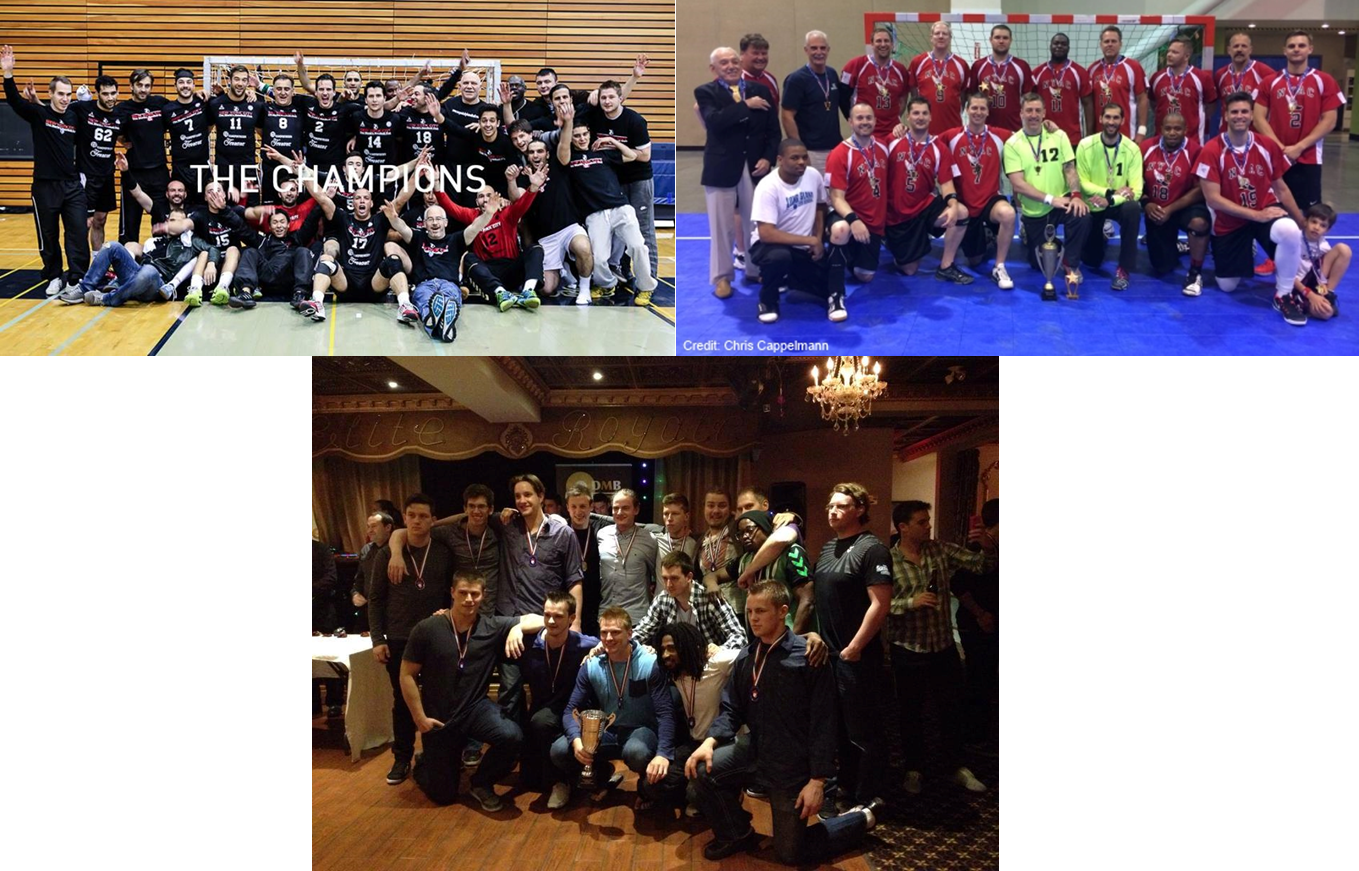
USA with two national club titles. NYC takes Canadian title while NYAC repeats as American champions. But, the real winner in terms of development is Alberta: the Canadian runners-up:

In part 1, I highlighted that recent national team performances should at least call into question the U.S. Federation’s focus on National Teams.  In this part, I address the state of club handball and the development of home grown talent in the U.S. and whether the Federation should prioritize improving it.

Last month U.S. club teams pulled off a double championship. NYC Team Handball skipped the U.S. National Championships and instead went to Toronto and took the Canadian title.  Meanwhile, NYAC held down the fort in Reno, and repeated as U.S. Champions.  On the surface one might look at those results and come to the conclusion, “Not too shabby.  Our clubs won two titles and  New York City must be the epicenter for grass roots development in the U.S.”

Of course, anyone with even a casual interest in Team Handball in the U.S. knows that statement would have little basis in reality.  The NYC Team Handball Club is almost entirely comprised of expats and naturalized U.S. citizens who learned the game in another country.  I would also guestimate that the average age of the club’s members is around 33 years of age.  Meanwhile, NYAC does consist mostly of home grown talent, but the average age of the club is an eye-popping 39.7 years old!  As an old timer I take a little satisfaction in that guys that I played with and against in the 80’s and 90’s can still do it.  Why, it almost makes me want to round up the old Condors and take the title away from them next year.  Don’t laugh, with Gary Hines playing for us I wouldn’t count us out. I also haven’t seen Darrick Heath in years, but something tells me that at age 49 he could probably still  make the U.S. National Team roster if he wanted to.  And why stop there, if we want to truly go old, old school I bet the the Sushi Masters with several players pushing 60 could do pretty well.  (Perhaps an update to this 18 year old video is in the offing?) In all seriousness, though, the fact that I am only half jokingly entertaining these thoughts, speaks volumes about the state of club handball in the U.S.   There’s something seriously wrong with our club system if the best team in our country has an average age of 40.

Meanwhile, up north in Canada, most of the teams participating featured rosters dramatically different in composition.  Runners up, Alberta, for example was entirely composed of home grown athletes and had an average age of 22 years old.  With the exception of collegiate participants like West Point, Air Force and North Carolina, the U.S. has no club teams that are comparable.  Heck, most club teams don’t even comes close to those demographics.

Before I continue on, I’d like to make something perfectly clear:  I’ve got nothing against expat and old timer teams.  As I’ve written numerous times before, having these teams around is great for development in our country as they can show newcomers how to play the game.  Nothing perhaps motivated me more as a newcomer to the game then getting beaten by somewhat older, often a little out of shape, Euro players who knew the game.  The problem is not those teams.  The problem is that there are very few newcomers around that are benefiting from playing those teams.

Clearly an Issue, but is Fixing this Problem a Priority?

I’m fairly certain that virtually everyone who cares about the sport in this country would assess that our lack of up and coming, homegrown talent is an issue of concern.  More teams with younger players enthusiastically playing and improving their handball skills is something in principle everybody can get behind.  Even if you are wholeheartedly convinced that National Teams should always get the lion’s share of the budget, you still need players for that roster and it sure would be nice to get even a few trained up internally via a vibrant club system.

When push comes to shove, however, and decisions have to be made on where to spend limited funds and where to direct staff man hours something’s gotta give.  And, you don’t have to do much forensic analysis to quickly come to the conclusion that the U.S. Federation has decided over the past couple of years to mostly direct funds and man hours towards near term performance of our National Teams.  Hiring full time coaches, setting up the residency program at Auburn, and trips to Puerto Rico and Brazil are obvious indications of this.  Lacking recent budget information or recent documentation of Board of Director decisions it’s not possible to know exactly how much is being spent, but I would guess that around 80% of the current Federation budget is being directed towards our National Teams.  And, at the same time I would estimate that the Federation staff is probably spending around 80% of their time addressing issues related to the National Teams.  Residency programs don’t run on autopilot and trips abroad undoubtedly require a lot of coordination and legwork.

A Quiet Cancellation

This is not to say that nothing is being considered or done in terms of development, but it clearly is getting the short end of the straw.  Probably nothing demonstrates this more than the very quiet cancellation of the Summer Handball Festival that was originally planned to take place early in July at Auburn.  Announced in January this event was to be focused on identifying athletes aged 17-22 and appeared to be similar in concept to the Olympic Sports Festivals that were staged by the USOC from 1978 to 1995.  At those 2 week long events four regional men’s and women’s team usually composed of current National Team and up and coming players practiced and played several matches.  Having participated in 3 festivals I can tell you first hand what a great event they were and how important they were to USA Team Handball in terms of recruitment and player development.

I was pleasantly surprised by the January announcement, but immediately noticed the glaring omission as to costs for prospective participants.  In correspondence with the Federation I found out that prospective athletes were going to be expected to pay around $400 plus their travel costs to Auburn.  Doesn’t take a rocket scientist to immediately assess that finding new blue chip recruits willing to pay those costs was going to be challenging.  (In contrast, everything (room, board, travel)  was paid for at Olympic Festivals.)  In order for this good idea to be feasibly implemented it surely was going to need either an influx of cash or some motivated prospective athletes to come out of the woodwork.  I’m guessing that neither materialized, necessitating it’s cancellation, but perhaps it’s still on the drawing board for future implementation since it’s still being advertised on the Federation webpage.

How is USA Team Handball Prioritizing?

When an organization like USA Team Handball has constrained resources it’s impossible to do all the things that need to be done.  Heck, it’s tough to do even a few of the things that need to be done.  Faced with this reality USA Team Handball needs to carefully think through what it wants to do and what it hopes to accomplish.  What will get the best bang for the buck?  What are the critical needs?  Are funds being directed towards efforts that stand a good chance of succeeding? I’ve got real doubts as to whether these questions are being fully considered and whether enough alternative options are being weighed on their merits.

Case in point are the USA Women’s trips to Puerto Rico and Brazil.  I don’t know how much those trips cost, but for sure those funds and resources could have been spent elsewhere.  And, if a summer handball festival was already being planned, funds could have gone towards making the Summer Festival less austere.  If viable recruits were in short supply than manpower could have been redirected towards aggressive recruiting of younger athletes as opposed to training athletes that are nearing the end of their national team careers.  And, this is but one possibility as there are many more possibilities worthy of consideration.

Alternatives for National Team Success

What are some of these alternatives?  Well two years ago in Salt Lake City, USA Team Handball hosted a Strategic Planning Conference where a whole host of possibilities were discussed.  In a commentary I wrote last year I highlighted some of those initiatives and added a few of my own.  Here’s the list:

– Establish regional Centers of Excellence
– Establish a European based training center in collaboration with the IHF and other developing nations
– Provide stipends for overseas training with clubs to the nation’s top 30 players
– Provide funding to 10 U.S. based clubs to support player identification and training
– Designate one metropolitan area in the U.S. for Elite competition and apply funding to make it happen
– Identify national team coaches for an extended period of time, but pay them only part time wages
– Hire a full time recruiting coordinator and have them focus on expanding the player pool at ages 18-22
– Hire a full time youth development coordinator and have them focus on developing a model program in one U.S. metropolitan area
– Work with a designated school district to implement a sanctioned High School Team Handball League to serve as a model for other school districts.
– Work with the NCAA to identify one Division 1 conference to support a Team Handball League
– Conduct a 10 day U.S. Olympic Festival style training camp for 120 elite NCAA athletes.
– Sharply curtail current expenditure on U.S. Senior teams and focus entirely on Under 21 development in hopes of improving odds for 2020 qualification
– Sharply curtail Men’s National Team funding and focus on the brighter prospects (weaker competition/Title IX) for Women’s team development .
– Sharply curtail funding and resources related to adult club teams and focus efforts on college and youth teams. (i.e., Don’t waste time organizing competition and national championships for predominantly Expat players or athletes over the ages of 25)

Perhaps it’s wishful thinking on my part, but I think it’s only a matter of time before the Federation takes a critical look at its current programs and reassesses its options going forward.  Not that I would envision a dramatic shift away from the current National Team focus, but surely there’s some potential for tweaking and modification of the Residency Program to more closely align with long term development.  Even better, maybe some additional funding through new sponsors will come available meaning that instead of choosing between competing alternatives the Federation will have the means to implement multiple initiatives.

In the hopes of influencing those upcoming decisions I plan to assess these alternatives in terms of their pros/cons, feasibility, risks and costs involved with implementation.  And, I’ll also be adding a few new possibilities that come to mind:  Like figuring out what the heck is going on in Alberta in terms of development and whether that success can be duplicated in the U.S.

But, before I start delving into the alternatives I’ll take a closer look at the rationale behind the Auburn Residency Program.  The one alternative that was summarily chosen.  It’s not the “no brainer” way ahead for USA Team Handball that some people think it it, but there’s actually some decent rationale that even a die hard grass roots proponent can get behind.


post

Christer’s Corner

Christer's Corner

Congratulations to Team Handball News contributor Christer Ahl who has a new featured column with Play the Game organization.  “Play the Game” is an international conference and communication initiative aiming to strengthen the ethical foundation of sport and promote democracy, transparency and freedom of expression in sport. “Christer’s Corner” will tackle issues related to fair play and corruption in sports.  His first column addresses whether the expectation for fair play in the realm of sports is realistic or any different from other aspects of society.

Christer’s Corner: Corruption in sports – are we too naïve, and who cares?:  Link

post

I “HEART” Flensburg

Bold Prediction Comes True.

Bold Prediction Comes True.

This past weekend Flensburg pulled off one of the more unlikely Champions League victories in the history of the sport.  On Saturday in the Semifinals they came back from a 6 goal deficit late in the 2nd half against highly favored Barcelona to send the game into overtime.  Following overtime they then knocked off Barca in penalty shots.  Then on Sunday against favored Kiel they came back again from a 6 goal lead, this time in the first half.  They then built a 4 goal lead and held off Kiel to win their first Champions League Title.  Going into the Final Four they were 10-1 underdogs; the afterthought team just happy to be there.  Who would have thought they could win it all?

Bold Prediction Comes True

Last September I participated in a Champions League Preseason EHF Google Hangout.    During the discussion the moderator noted that teams like Flensburg hadn’t even mentioned.  Seizing the moment, I put on my hat and boldly predicted, “I’ll go on record:  It’s Flensburg’s year.”  (The prediction is at 27:18 LINK)  A little while later we were asked to name our Final Four and I went with Barca, Kiel, Veszprem and Flensburg.

If you’ve ever been in the predicting business, you know how fraught with peril it is.  Listen to any Sunday talk show or sports radio show.  You’ll hear the politician or blabbermouth run for cover when asked to make a prediction.  Either that or they hedge their bets in a big way.  But, forced to make a prediction I used a little logic and a little bit of what I wanted to have happen and voila I nailed it.  And, this was way back in September…  Why it reminds me of the 1995 NBA playoffs when I made a little bet in Las Vegas on the Houston Rockets when they were down 3 games to 1 to the Phoenix Suns.  Or the time when I predicted that Troy Calhoun would some day become the Head Football Coach at the AF Academy… when he was still a cadet.  Alright, enough gloating.  In the dustbin of my memory there’s surely countless predictions that have been entirely and totally wrong.  Still, for sure, it is still incredibly satisfying to be so entirely and totally correct.

How did an American become a Flensburg Fan anyway?

But, if my bold prediction was partly based on wishful thinking, why on Earth would I be pulling for Flensburg anyway?  I’ve never stepped foot there.  I might never even visit that little city on the Germany-Denmark border.  I don’t speak German or Danish.  I’ve never seen the club play in person.  Why that particular club and not some other?  Heck, I lived in France and I’ve got no particular allegiance to any club there.  Why does this American wear his Flensburg hat all over town and why does he care?  Why did I have the biggest smile on my face yesterday afternoon as they hoisted that trophy?

As often is the case with fandom it’s a combination of historical circumstances, personality and perceived identification.  Here’s some elements as to why I’m a Flensburg fan:

Historical Context:  Back in 2005 as I was just learning about club handball in Europe I had the pleasure to witness the most oddly compelling and dramatic match I’ve ever seen in any sport, let alone handball.  This was the 2nd leg of the Montpellier – Flensburg match where Montpellier scored on a free throw with no time remaining to lose by “only 13” and advance on aggregate.  I wrote about this 9 years ago and I’m still shaking my head as I recall that match.  I was already a fan of handball, but that match really ignited a passion to follow the sport more closely.  It was also my first introduction to the Flensburg club.

An Iconic Star:  After you watch a team play quite a bit and see how individual players carry themselves on the court you start to identify with certain players.  Quite often you see a player’s demeanor, their ability to score in the clutch and their attitude.  If you identify with those characteristics you can’t help but root for those players and their team.  Such a player for me was Lars Christiansen.  Even though he hasn’t worn a Flensburg jersey in four years, some of my fandom surely still can be attributed to him.

Blue Collar Team:  Rightly or wrongly, I perceive Flensburg as a blue collar team of hard working players.  Don’t get me wrong they’ve got some world class players, but they are a notch down from the Barca’s and Kiel’s of Europe.  And, while they’ve got a few hired guns they just don’t feel like a mercenary team.  They play together as a team, not as a team of individual stars.  When they win as they did yesterday it has the feel of a real team celebration and a collective victory.

So, hats off to “my boys” from Flensburg.  Looks like I’ll need a 2014 EHF Champions tournament T-Shirt to go along with my hat.

But, if you want to know who’s going to the Final Four in 2015 and who’s going to win it all there’ll be no more freebies.  You’re going to have to subscribe to my betting service.

post

Part 1: Grass Roots vs National Team Focus: Recent National Team Losses Should Raise Doubts on National Team Focus

Intrepide Youth

How does a club team in Guadeloupe beat a national team from the U.S.? Answer: It’s start with superior youth development programs.

This past April the USA Women’s National Team traveled to Puerto Rico where they played several matches.  They lost twice to the Puerto Rican national team, beat the Puerto Rican junior national team and lost twice to French Guadeloupe’s top club team, Intrepide.  Depending on your perspective these results could be considered as either totally disheartening or a sign of mild progression.  If your perspective is that of an old timer you’re disappointed as Puerto Rico is a team that the U.S. would typically beat by 10 goals or more.  If your perspective is more recent it’s a sign of mild progression as the Puerto Rican team is roughly equal to the U.S. and we were able to play competitively against them in their home country.

More interesting to me, however, are the the two losses against, Club Intrepide, and the contrast it presents.  Most Americans probably don’t know much about France’s Overseas Departments: Guadeloupe, Martinique and Reunion Island.  I, for one, was fairly ignorant about them until I lived in France and started following French sports more closely.  France’s national handball and basketball teams have several players from these Islands far removed from France.  And athletes from from these islands also play on a number of club teams in France.  I saw this first hand in the over 35 basketball league I played in while living in Paris. Trust me, those guys from the Caribe can play ball and this tall American player knew he was in for a workout, but also thankfully for some Ti’ Punch after the match.

Still, Guadaloupe has only around 400,000 inhabitants and the town of Sainte-Anne where Club Intrepide is based has 23,000 residents.  How does a small town with very modest living conditions put together a club that can beat the U.S. National Team?  Well, there are probably a number of reasons, but I would argue that the underlying reason is that the tiny town of Sainte-Anne has a better organized and structured youth program than what the entire U.S.has put together coast to coast.  Most likely the players on Club Intrepide have been playing since their early teens, if not earlier.  Whereas most of the players on the U.S. weren’t introduced to the sport until their 20’s.

U.S. Women’s Team:  Modest Progress or Regression?

In theory, with 318 million people the U.S. can overcome its lack of developed youth programs by finding and training top notch athletes regardless of age.  And, superior athleticism can indeed trump skill and experience if the athleticism gap is big enough.  But, that’s a big “if” and these recent results are a pretty strong indication that the U.S. isn’t overwhelming it’s competition athletically.  Instead it is simply a continuation of less than satisfactory results seen in 2011 and 2013.  And, while Rome wasn’t built in a day there should be an expectation of better results.

Even more concerning is a not widely advertised loss that the U.S. Women suffered against West Point at the Collegiate nationals.  (I did not see this match, but heard one of the commentators mention it during one of the other matches.)  I suspect that the U.S side had some very recent additions to the U.S. Residency program, but there’s still no excuse for ever losing to a collegiate team. Residency athletes are supposed to be the cream of the crop, training on a daily basis and should be able to overwhelm a collegiate side.  Still, I will say it’s not the first time a Service Academy side has played a National Team close:  When I was a cadet at the Air Force Academy we narrowly lost a close match vs the U.S. National Team.  Thing is, though:  I was on the Men’s club team and we lost to the Women’s National Team.  (Maybe, this gives you some perspective as to where I’m coming from when I make an assessment that not one single player on the current USA Women’s team would have made any of our Olympic rosters from 84 to 96!)

Don’t Blame the Athletes

I’d like to make some perfectly clear.  I do not, nor should anyone else, blame the athletes for their lack of success.  They are a hard working bunch making a lot of sacrifices to improve their game.  They’ve been given the opportunity to train full time at a Residency Program and they’re doing their best to make the most of it.  Heck, in many respects as a former national team player with modest skills I really identify with them and their dreams.

Taking Stock: Are Residency Programs the best place to spend limited resources?

No, if blame is to be assigned that blame goes straight to the decision makers.  And, basically the fundamental question is whether it is better to direct resources towards athletes chasing the 2016 dream or towards efforts that will improve chances for U.S. success in 2020 or 2024.  As someone who’s a already expended quite a bit of time and energy addressing this question it’s fairly clear where I stand.  Although, written a year ago little has changed to alter my position.  In fact, it’s hardened as 2016 Olympic Qualification seems more unlikely now, the Auburn program seems to be a bit on the austere side and the prospect of a U.S. hosted 2024 Olympics seems even more likely.

Some might argue that resources directed towards 2016 also helps the out years, but the reality is that there’s minimal overlap at this point in time.  This is especially true if you look at the ages of both the men’s and women’s team.  The women’s program at Auburn is especially long in the tooth with many players in their late 20s.  Even worse in what I’ll generously call highly questionable recruiting the U.S. has brought in several rookies that probably range in age from 24-29.  (I say probably, because the U.S. Federation doesn’t list the ages of it’s athletes on its website and ages were deduced by internet searches for their last year of college.)  If out year success is desired it goes without saying that this sort of recruit should be the very rare exception instead of the norm.

The U.S. Federation hasn’t provided much in terms of rationale for this spending decision other than that previous residency programs have resulted in most successful national teams for the U.S.  A true statement, but one that neglects a number of “Yes, buts” to include:

  • That previous success wasn’t all that successful:  No Olympic medals and zero victories over top European sides in Olympic or WC competition.
  • European leagues are far more professionalized now:  Virtually every top athlete in the world is now training and competing regularly in a professional environment superior to the club and national team regimens of the past, further widening the gap between what the U.S. can do with a residency program.
  • Our competition in Pan America is now much stiffer: Grass Roots development in Latin America has resulted in stronger national teams, both technically and athletically.  And, their top players are now playing for top European clubs.
  • More post college opportunities for collegiate athletes:  Playing opportunities with decent salaries abound for 2nd and 3rd tier athletes in many sports making recruiting crossover athletes even more challenging.

Quite frankly, I am totally perplexed that smart people don’t look at these stark realities and come to the same conclusion that I have:  That a Residency Program focused on crossover athletes in their mid to late 20’s has very little chance of success.  That it is a huge drain on very limited resources.  And, that other paths and possibilities need to be considered, carefully assessed and pursued.

What are some of those possibilities?  In part 2 I will identify some options for consideration but, only after I first take a closer look at the current club situation and the state of grass roots development in the U.S.

post

The legend, now in bookstores

Svetlana Kitic in action, and the cover of her biography

Svetlana Kitic in
action, and the cover of her biography

By Altay Atli

Handball biographies are a rare commodity, probably because publishers do not see any profits in this genre, or also because retired world-class handball players do not bother to put into writing their experiences and reflections on the sports. A recent exception provides a gem of story of a life devoted to handball.

The biography of Svetlana Kitic, a former Yugoslav handball player who is officially designated by the International Handball Federation as the “world’s best female handball player of all times”, is a must read for all handball enthusiasts. Titled “Ceca” after Kitic’s nickname, the biography written by Svetlana Vujcic, journalist and former teammate of Kitic, tells us the story of a woman who rose to the top against all odds, gave her all for the sports she loved and played at the competitive level for more than three decades. “There were good and bad days, tears, broken fingers, noses, jaws, but I would go through all that again”, says Kitic, “Handball is simply my life, the thing which fulfills me the most and makes me happy. If I wasn’t like that I wouldn’t have played it until I was 49. Yes, if I was born again, I would live my life exactly the same.”

The biography tells us actually two stories that are interwoven throughout. First there is the story of Kitic the legend, a handball player par excellence, who won a total of 21 club titles; silver and gold medal in the Olympic Games, Moscow 1980 and Los Angeles 1984 respectively; gold, silver and bronze medals in world championships; and played a total of 202 games for the Yugoslav national team scoring more than 900 goals. Throughout the book, we trace her path, from the very early days in the Bosnian town of Tuzla when she “irresistibly resembled Pippi Longstocking”, to her beloved club Radnicki in Belgrade and on to clubs in Germany, Italy (where she was known as “Maradona in skirt”) and Spain before moving back home. We watch her developing a style, with her feints that break down the defense, her blind passes and bullet-like shots from the knee level sharply to the upper corners of the goal. We watch her perfecting her games, winning games and hearts, sometimes also making “the dumbest mistake, ruin the game, miss a goal many times” but “never tolerating surrender and lack of competitiveness.” Her exploits with the Yugoslav national team provide us with an in-depth overview of not only a successful athlete’s career, but of the history of European handball itself.

Then there is the other story: Kitic the human. What is a perfectly functioning and merciless goal-scoring machine on the handball court has a human face on the outside, with all her desires, fears, frustrations and, well, love affairs. Kitic got married four times and we see in the book that her relationship with her partners have frequently gone through turbulent times. Adding to this, the problems she had with clubs and the federation, with individuals in the handball world, financial troubles and externally induced situations such as the NATO bombing of Belgrade in 1999, we see Kitic trying to stand on her feet, never giving up, and surviving to score another round of goals in the next match. Whenever she needs solace she finds it in two places: her children and handball: “Handball didn’t take anything from me, fooled or deceived me, like people are capable of doing. It gave me everything in the world, and by making magic, it made… me.”

Kitic’s is a life of ambition, struggle and endurance. It is a life of handball. As Serbian coach Milorad Milatovic wrote, hers is a “story about the greatest female handball player of all times, the mother of three, wife and grandmother, the story about a great woman.”

A personal note: Zhongshan, southeast China, the year is 1999. The World Junior Women’s Handball Championship is in progress. Turkey and Yugoslavia are in the same group. Svetlana Kitic is the manager of the Yugoslav team, and the author of this article has the same job with the Turkish team… A talk I had with her, over a cup of rice wine, has been an amazing lesson for me on handball and life. It has been a real privilege, but for those who haven’t had it, the book, which is available in both English and Serbian, is recommended.

And a question to readers: Handball biographies, though they do not exist in large numbers, are/can be a source of both knowledge and inspiration for handball lovers, especially for young players. So, dear reader, whose biography would you like to read the most?

post

Pivotal USA – Puerto Rico Match likely to determine nonqualifier

PATHF-logo-grande

The North American and Caribbean Men’s Handball Championships will qualify 4 teams for this summer’s Pan American Handball Championships in Uruguay.  With 5 nations participating this means only 1 nation won’t punch their ticket for Uruguay.  There’s still quite a few games to be played, but with Puerto Rico having lost their first two matches by large margins they appear to be the weakest team.  Mathematically, there best hope is a win today against the U.S. which is the only other team without a victory.  The U.S. lost 21-15 against Cuba in its only match so far.  Following a 13-5 deficit in the first half the U.S. played much better in the 2nd half, actually outscoring the Cubans 10-8.  Based on that performance the U.S. should be able to get a win and all but punch their ticket for Uruguay.

Match time is 5:00 PM (U.S. Eastern Time) and will be streamed live at the link below.

Tournament Standings: Link

Webstreaming website:  Link

post

Youth action in the Mediterranean


Egypt won the Mediterranean title, beating Tunisia

Egypt won the Mediterranean title, beating Tunisia

Guest columnist, Altay Atli, is a lecturer in international relations and economics based in Istanbul, Turkey.  Altay is a former handball player, a former handball manager, a former handball journalist and forever, a handball fan.  His work involves a considerable amount of travel and the opportunity to see handball played in many parts of the world.  In this article he reports on the recently completed Mediterranean Handball Championship and its emphasis on youth development.

Last week, Chieti, a small town in Central Italy a few miles away from the Adriatic Sea, hosted the Mediterranean Men’s Handball Championship. Eight countries littoral to the Mediterranean, namely Cyprus, Egypt, France, Italy, Libya, Montenegro, Tunisia and Turkey, took part in the event, which was won by Egypt after a penalty shootout thriller against Tunisia (36:34). The championship went largely unnoticed in international sports media, something that can be attributed to the fact that the championship was for under 17s. However thanks to the live streaming provided by the organizers a large audience could enjoy the quality of handball played in Chieti.

This championship makes us rethink the feasibility and the merits of regional events that include participants from more than one continental federation. At professional level international handball, each continental federation has its own busy schedule, which, when global events such as the world championships and the Olympic Games are also taken into consideration, seldom leave any space for regional events in a tightly packed calendar. This is why events like the quadrennial Mediterranean Games fail to attract the crème of the region’s handball to their ranks. Given the hectic schedule of professional sports, developed handball countries either prefer to take their reserve teams to such events or they do not participate at all. The most recent version of the Mediterranean Games, held in June 2013 in Mersin, Turkey, illustrates this trend. In the men’s competition, which was won by Egypt, handball giants like France and Spain did not even take part, while in the women’s competition, which was won by Serbia, developed countries (such as France) either did not participate or competed with junior teams. For instance, from the 16 players Serbia had in Mersin, only five made it to the roster that played the final of the World Championships in December.

In other words, at the senior/professional level, regional events such as those organized in the Mediterranean, do not offer a bright prospect. However, at a lower level, they can be meaningful. The Mediterranean Handball Confederation, which operates since 2003, organizes the Mediterranean Championships on an annual basis for both men and women, and these events are, as the web site of the confederation suggests, “preferably reserved to young athletes.” If the focus had been on senior teams, both the confederation and the championship could have been doomed to irrelevance in the face of the increasingly competitive and commercialized environment of professional handball. By targeting the youth, however, they can serve the sports in other, more purposive ways

First and foremost, the Mediterranean Championship can help the development of handball by providing talented young players with the opportunity to gain international experience. In Chieta, all the players, and particularly those from countries like Libya and Cyprus which do not have strong national competitions, gained high level competitive experience, while some of them including Egypt’s Hassain Anis, Tunisia’s Ghachem Oussama and Turkey’s Halil Ibrahim Ozturk, managed to win international recognition thanks to their successful performance. In the meantime, the championship also offered a platform for young referees to make a debut in international handball. The final match was umpired by the young Italian couple Francesco Simone and Pietro Monitillo, who are on EHF’s candidate referees list, and together with two more couples from Italy, two from France and one each from Turkey and Tunisia, they have taken an early important step in their careers. In brief, the Mediterranean Championship contributed and is likely to continue to do so for the development of handball by giving young players and referees the opportunity to perform at the international level and enter the spotlight.

Youth handball development in the Mediterranean is also important at a different level. The region in question has been going through a difficult period. Southern Europe is still suffering from a financial crisis and youth unemployment is a painful fact of this region. Northern Africa is undergoing a transformation in the post-Arab spring period and the youth is at the center of this process as well. The Asian coast of the Mediterranean, not represented in Chieti, is currently the most problematic part, with the civil war going on in Syria without an end in sight. Empowerment of the youth is a vital requisite for restoring stability in the region, and youth interaction through sports, culture and education, both within and between countries, is the key here. Handball cannot create miracles in this respect, but its contribution can be useful.

post

Handball in Hong Kong

"Hong Kong team taking on China in the Hong Kong International Handball Championships

Hong Kong
team taking on China in the Hong Kong International Handball
Championships

Today’s guest columnist is Altay Atli, a lecturer in international relations and economics based in Istanbul, Turkey.  Altay is a former handball player, a former handball manager, a former handball journalist and forever, a handball fan.  His work involves a considerable amount of travel and the opportunity to see handball played in many parts of the world.  Hence, this article on handball in Hong Kong.

Hong Kong appears to be all about skyscrapers, financial centers and noodle shops, yet there are many other faces to the city-state, including its citizens’ keenness on and its government’s support for Olympic sports. Although handball is not a crowd drawer, at least for now, growing interest in our sports makes it likely for Hong Kong to be more visible on the international handball scene in the near future.

Handball arrived in Hong Kong during the early 1970s with students returning home from Taiwan. The league was launched and the national teams were formed in the 80s. It was in this period that both men’s and women’s national teams have competed in the Asian Handball Championship finals, an achievement that could not be repeated after 1989. After a period of hibernation, handball in Hong Kong is now back on the rise. National teams do not make it to the Asian finals, which are significantly more competitive compared to the 1980s, but they are recently obtaining good results in the international events they are taking part. One such event is the National Games of the People’s Republic China, which is kind of mini Olympic games where the provinces of China compete. Hong Kong, as a special administrative region within the People’s Republic, is taking part in these games, and in last year’s version held in Liaoning, the men’s handball team was ranked seventh, an important achievement considering the improving quality of handball in the mainland. The Hong Kong International Championships, held annually since 2001, provides another platform for the national teams to compete against international opponents, and so far strong handball countries such as Germany, Slovenia, Korea, Japan and China, as well as developing ones like Iran, Mongolia and the French region of La Reunion have taken part in this competition, enabling the teams of Hong Kong to gain international experience.

Handball leagues in Hong Kong are well organized providing the athletes with the opportunity to play as many matches as possible. There are currently four divisions in the men’s competition, and three divisions in the women’s, each division being composed of ten teams. A total of seventy teams for a small city-state of the size of Hong Kong is a significant number. Teams are made up of amateur players from Hong Kong, as well as expatriates and exchange students from European countries. Leagues run from October to April, and they are played in multifunctional indoor sports facilities as well as an outdoor court used solely for handball games. Having adequate facilities is important in Hong Kong, where space is one of the most precious commodities.

The Handball Association of Hong Kong, China (HAHKC) is the organization responsible for the development of the sports in the city-state. The association is funded by the government and its plans for the development of handball are based on two main pillars. One is the development of the player base through a systemized and well structured plan for different age groups, and the other is the attraction of larger audiences through beach handball.

The development plan of HAHKC starts with the elementary training program for kids aged 12 and younger, and the intermediate training program for under 15s. Around one hundred school children are enrolled in these programs each year through a scheme financed by the Hong Kong government. Successful athletes are promoted to district programs from where they are selected into the young athletes training program for the age group between 16 and 19. After a competitive process, better players are taken into regional squads, which undertake overseas training camps every year, such as the one in Korea in 2013 and the one in Taiwan in February 2014. These squads form the player base from which the junior and senior national teams are selected.

This hierarchical structure offers a well-designed system for choosing talents and developing capabilities and skills. On the other side of the coin, beach handball is the instrument used to breed interest for the sports among Hong Kong’s citizens. In 2013, Asian Men’s and Women’s Beach Handball Championships were held in Hong Kong, not on the sandy beaches of the Lantau island, but on a sand filled court right at the center of the buzzling town. It was a wise decision by the HAHKC, which chose to take the game to the people. A total of two thousand spectators watched the event, where the men’s competition was won by Qatar, and the women’s competition by Thailand. Hong Kong ranked fifth in both competitions.

This year the team of Hong Kong was invited to the Asian Men’s Handball Championship in Bahrain, but it could not make it there due to financial problems. Similarly, funding is needed for Hong Kong’s handball teams to compete in the XVII Asian Games to be held in Incheon, South Korea this October, but so far prospects seem bleak. HAHKC officials point out that the government’s priority is to finance “sports for all” instead of competitive events. But perhaps, at the current stage of development, this approach serves handball better. Financing young players’ build-up is definitely more crucial for the future of the sports in Hong Kong and in time sponsors can be expected to enter the scene. Until then, Hong Kong needs to continue to implement its development plan and to gain more supporters through attractive events like beach handball. “We want to play more games with teams from other countries” says Chan Ming Hong, sports executive of HAHKC, “we want to learn more.” So far it has been a successfully pursued learning process for the handball community in Hong Kong. Expect them to do more.