post

Commentary:   USA Team Handball Fails to Qualify for the Olympic Qualifier: An Opportune Time for a Status Check and to Set Plans for the Future

Gut Check Time:  Does USA Team Handball have a plan to hike its way out of the forest or is it just walking in circles?

Gut Check Time: Does USA Team Handball have a plan to hike its way out of the forest or is it just walking in circles?

This past Saturday, the USA Women and Men lost to Uruguay in the 2nd Leg matches for the Last Chance Qualifier for the PANAM Games.  The Women lost 24-22 and the Men lost 28-20. The USA Women ended up with a 7 goal aggregate loss and the USA Men ended up with a 4 goal aggregate loss. Match Recap: Link

These results simply cannot be sugar coated. Failing to qualify for the Olympics is one thing. Anyone familiar with our National Team’s results the past few years knew it was going to be tough to beat Argentina. But, losing to Uruguay and not even qualifying for the Olympic Qualifying Event (i.e.; the PANAM Games)? Without a doubt this is an unavoidably stark reminder as to where our National Programs stand.

Let’s be honest: The U.S. is not even close to the level it needs to be to qualify for an Olympics. We don’t just need a couple more players, or a few more months of training or a few more games. Maybe if we had qualified for the PANAM Games and gone toe to toe with Argentina and/or Brazil in the semifinals this summer before falling short we could rationalize that we’re almost there, but that didn’t happen. Not even close.

With Failure Comes Opportunity

Failure, however, can also be an opportunity. Olympic qualification for the Men is no longer possible and the Women now only have a very, very remote chance. (The U.S. Women’s would need to qualify for the World Championships and then finish in an unprecedented 7th place.) While there are other goals for our National Teams for a variety of reasons Olympic Qualification is without question the main target. With 2016 gone as a possibility the U.S. will now not play another match related to Olympic Qualification until December, 2018, at the earliest. With no immediate pressing need it’s therefore an opportune time to step back, take stock and plan for the way ahead.

2020 Olympic Prospects

Part of that taking stock is an assessment of what the U.S. prospects are for 2020 qualification. And, taking a look at our current teams and our Pan American competition reveals a very tough road ahead. For the Women, it’s particularly bleak. The average age of the 2nd chance roster is 28 and the bulk of the scoring is coming from athletes 30 and older. The U.S. needs a roster overhaul and it’s debatable as to whether there are enough quality prospects joining the program with the right age/athletic ability combination to take the U.S. to the next level. Seriously, there would have to be several already on the team making key contributions before we could even realistically contemplate the monumental task of taking down the current World Champions, Brazil. Brazil will likely not be as strong in 2019, but it’s unlikely they will drop down near as much a we need to go up. With the men’s team it’s much the same story. The Argentine and Brazilian Men aren’t as good as the Brazilian Women, but there’s still a huge gap. And, the U.S. Men aren’t very young either with the roster for the 2nd chance tourney having a guestimated average age of 27. A couple of players are on the younger side, but several players are pushing 30 or have passed it.

I’m not suggesting that the U.S. shouldn’t even try to qualify for the 2020 Olympics, but a real hard look should be taken at how resources are to be expended towards 2020 qualification. For example, if expenditures for a residency program and/or full time coaching are only going to improve our chances of qualification from 2% to 5% are they still worthwhile expenditures? Might it be better to expend resources towards a development initiative that would improve qualification chances in 2024 from 10% to 40%?   Those are questions that should be asked.

Planning for Today vs. Planning for Tomorrow

With many efforts there is an inherent conflict between either planning for today or tomorrow. Or, perhaps more accurately, the “near term” or “long term.” Or, even more accurately planning for a “defined” near term” or a “defined” long term. I say defined, because sometimes people would just as soon not define what their time frame is because in doing so they will be forced to make decisions they’d prefer to avoid having to make.

And, sometimes folks will like to argue (or worse, just assume) that near term efforts are by default also supporting long term plans. This, however, is often a bad assumption and one that has all too often been true for USA Team Handball. Case in point: Have the efforts of the past 3 years (hiring full time coaches, rushing to build a residency program and in the case of the women populating that program almost entirely with athletes over the age of 25 really paved the way for long term success? Or, has it been overly focused on questionable, short term goals? For sure, I’ve got my opinion, but what’s done is done.

Instead, it’s best to start fresh and ask some tough questions regarding what makes sense going forward. Here are just a few questions that should be asked:

Full time head coaches: Despite limited resources, 3 years ago the decision was made to hire full time coaches. Have these hires produced satisfactory results? How is their performance being measured? Can the U.S. continue to afford this expenditure or should the funds and man-hours be spent on other critical needs? Will having full time head coaches significantly improve U.S. performance or would the U.S. have similar results with just part time coaches?

Recruiting: Is USA Team Handball successfully recruiting the types of athletes it needs to build long term success? Or, is it recruiting too many athletes that are in their mid 20s with limited raw athletic skills? Is it even realistic for USA Team Handball to recruit the types of athletes that were more readily available in the 70s, 80s and 90s? Even if these athletes can be recruited can they be trained quickly enough to beat quality teams like Argentina and Brazil that have developed through their youth programs?

Residency Programs: In the fall of 2013 the U.S. established a residency program at Auburn University. Is this program producing satisfactory results? What are the established metrics being used to assess performance? Is the program too austere to attract the types of athletes desired? Can the program be effectively focused on both near term National Team performance and individual player development? Is Auburn the best location for this program or should other locations like Boston be pursued? Or, would USA Team Handball be better off sending its handful of top notch prospects to an overseas location like the Aarhus Handball Academy where they could get weekly match competition?

Some More Prognostication

It’s my own personal opinion that asking and answering these questions and others will logically lead USA Team Handball into a different direction than the path it’s been on the past couple of years. At the very least it would lead to some major tinkering with the structure and goals of the Residency Program at Auburn. And, it could depending on more detailed analysis lead to radical changes such as closing or mothballing the program at Auburn, pumping resources into targeted youth programs, an arrangement with an overseas entity like the Aarhus Academy or even going all-in on the likelihood of a Boston Olympics.

My fear, however, is that little such introspection will take place and the U.S. will muddle about for the next few years with a program at Auburn that looks much like it does now. Our national teams will continue to struggle, but hopefully show some signs of marginal improvement. Perhaps improving to the point where we can beat other 2nd tier nations in PATHF and qualify for the World Championships, but not progressing to the point where we can beat Argentina and Brazil. And, then when we fail to qualify in 2019 there will be a changing of the guard. Dozens of players will have already come and gone and several more will retire. And then a new batch of crossover athletes will be brought in. If there’s an Olympics in Boston we may even finally decide to move the Residency Program there. Recruiting and funding will naturally tick up and the U.S. will field some respectable sides that won’t embarrass. We’ll also have an uptick in grass roots interest like that which was seen in LA and Atlanta, but we’ll again slide back into to the same 3rd tier status the sport has always had in America.

Stay the Course? Are We Really, Really Sure that Makes Sense?

Maybe those are satisfactory results for some. With several years of “nothing” going on for our national teams under the Esch regime, the common refrain has been “at least we’re doing “something” now.” And, to many old timers I think the idea of setting up a Residency Program similar, if but a little more austere, brings back nostalgia for the good old days. That the program will soon be back to the level of the 80s and 90s.  And, maybe just maybe, we’ll somehow even exceed expectations this time around.

Believe it or not, I fully understand why some folks have this outlook. Heck, occasionally I even find myself guilty of such nostalgia. I guess I’m just a bit too analytical, though, to keep the rose colored glasses on very long. The bitter reality is that those good old days weren’t nearly as good as we like to remember them. The historical results are an epic pile of losses. The Men’s Olympic record is 4-24-1; The Women’s Olympic record is 4-19-0. In World Championship competition the men are 0-16-0 and the women 4-24-0.

And, keep in mind those are the “great” results are from a different era. We haven’t even been good enough to qualify for those events for several years otherwise we’d be adding quite a few more “L’s to those dismal records. Further compounding the problem is that handball is way more professionalized today and our competition is much stiffer in Pan America. Time was that we could take some great athletes in the 22-25 age range, spend 2 or 3 years training them up and qualify for an Olympics. The new reality is that even if, and it’s a big if, we can recruit the same quality of athletes post college we recruited in the past it’s doubtful that we could now even qualify a team for the Olympics, let alone come close to beating a European team.

Maybe what’s been started at Auburn is going to be truly different. That this past weekend’s stumble in Uruguay was just a momentary hiccup on the road to slow and steady improvement. That it’s only a matter of time till our Residency Program at Auburn starts building teams that will make short work of sides like Uruguay, Chile and Greenland. And, just a bit more time till we’re beating Argentina and Brazil, qualifying for the Olympics and even knocking off some European sides.

I guess anything is truly possible. The thing is, though, I’ve seen this movie before and I’ve yet to read or hear anything that articulates just how this movie’s going to have a different ending. We may be doing “something” but so is a lost hiker in the woods walking around in circles.

Time to Start Focusing on 2024

As I see it, the alternative is to develop a long term strategic plan with 2024 as a target and focus point for both National Team and Grass Roots development. Why 2024? Two reasons:

  • There’s no quick fix to our National Teams that will dramatically improve our chances for 2020 Olympic Qualification. Focusing on 2024 will buy more time to identify, recruit and develop talent. Still a challenge, but a more realistic one.
  • There’s a significant chance that Boston will host the 2024 Olympics meaning that the U.S. will not have to qualify. And, a hosted Olympics could be the vehicle to build some sustainable grass roots that can keep the U.S. competitive for years to come.

How exactly would this be done? Just how would it be different than what is being set up at Auburn? Very good questions. I know that perhaps, I come off as a “Mr. Know It All” sometimes, but, I’ll be up front and state, I don’t know the answers to those questions. Sure, I’ve got some ideas and I’ve started to flesh out some possibilities, but it’s not a simple problem with an obvious solution.

What I do know, though, is this. A comprehensive plan is needed. The sooner, the better.  But, that’s just what I think. The real question is what USA Team Handball leadership thinks. If there ever was a time to take stock and potentially change course, that time is now.

post

Preview: USA vs. Uruguay Last Chance Qualification (2nd Leg)


Newcomer, Greg Inahara, helped spark Team USA to a 25-21 in the first leg.  Up next:  The return leg in Uruguay.

Newcomer, Greg Inahara, helped spark Team USA to a 25-21 in the first leg. Up next: The return leg in Uruguay.

The 2nd legs of the Last Chance Qualification series between the USA and Uruguay will take place this Saturday in Canelones, Uruguay. The Women’s match starts at 6:30 PM (Local) and the Men’s match starts at 8:30 PM (Local). Uruguay is currently GMT-3 or 1 hour ahead of U.S. East Coast Time.

Livestream site: Link

Results of the First Leg and What Each Team Needs in Order to Qualify for the PANAM Games

These matches are the second matches of a two match playoff. If a team wins both matches they, of course, win the playoff, 2 wins to 0. If, however, there is a split with both teams winning one match, the winner will be determined by overall aggregate goal differential for both matches. Then, in the event that the goal differential is equal, the total number of away goals is the next tiebreaker. Finally, in the unlikely event that the score of the 2nd match is identical to the 1st match a coin flip will determine the overall winner.

Women’s Numbers: Uruguay won the first leg at Auburn by a score of 30-25.  Here’s the practical breakdown of what the U.S. Women need to do in order to qualify for the PANAM Games:

  • Win by 6 goals or more
  • Win by 5 goals and score at least 31 goals in the match on Saturday

Here’s the breakdown of what Uruguay needs to do in order to qualify for the PANAM Games:

  • Lose by 4 goals or less
  • Lose by 5 goals and don’t let the U.S. score more than 29 goals on Saturday

If the U.S. wins by the score (30-25) there will be a coin flip to determine the overall winner.

Men’s Numbers: The U.S. Men won the first leg in Auburn by a score of 25-21.  Here’s the practical breakdown of what the U.S. Men need to do in order to qualify for the PANAM Games:

  • Lose by 3 goals or less
  • Lose by 4 goals and score at least 22 goals in the match on Saturday

Here’s the breakdown of what Uruguay needs to do in order to qualify for the PANAM Games:

  • Win by 5 goals or more
  • Win by 4 goals and don’t let the U.S. score more than 20 goals on Saturday

If Uruguay wins by the score (25-21) there will be a coin flip to determine the overall winner.

Women’s Game: Can the USA nibble away at Uruguay’s 5 goal lead?

Last Saturday’s match was pretty much an even affair until midway through the second half at which point Uruguay took control of the game enroute to a 5 goal victory.  One could summarily conclude that it’s pretty unlikely that the U.S. can return the favor with a 5 or 6 goal in Uruguay. However, the U.S. can take some comfort in that several of their players pulled off a similar turnaround just 4 years ago against Canada. In that 2 match series to qualify for the 2011 PANAM Games the U.S. lost it’s first match in Lake Placid by 5 only to beat Canada on the road in Montreal by 5 goals a few days later. And, the U.S. scored more away goals to win the tiebreaker.

Also, working in the U.S.’s favor is that they can undoubtedly play better than they did last Saturday. The U.S. failed to finish many prime scoring opportunities, had far too many turnovers and allowed way more goals (30) than they normally do against teams of Uruguay’s level.

Working against the U.S. however will be the long road trip and a vocal crowd in Uruguay. On top of that, the U.S. style of play is more methodical and they are less likely to rattle off a string of quick goals to change the game in just a few minutes. Instead, if they are to pull off the turnaround it’s more likely that it will be done by nibbling away at Uruguay’s lead over the course of 60 minutes. So, a doable task, but the U.S. will have to shoot a higher percentage and really avoid the turnovers.

Men’s Match: Can the USA hold on to its 4 goal lead and can Uruguay handle the defensive pressure?

For about 3/4 of the match last Saturday, Uruguay had a slight edge, but then Team USA applied some aggressive pressure defense that rattled Uruguay leading to turnovers and fast breaks. In the end, the U.S. won 25-21 to give them a 4 goal lead heading into the return leg. (See video of open defense compiled by Mundo Handball: Link)

All due credit to Coach Javier Cuesta and the U.S. side for applying this aggressive strategy successfully, but one has to truly wonder how Uruguay was seemingly unprepared for this tactic. This is because the USA had already used a similar tactic against Uruguay last June after falling behind 15-5 in a pivotal Group match.   Uruguay struggled and the U.S. came within striking distance of a miraculous comeback only to fall short. To be surprised once is somewhat understandable, but to be unprepared twice is unconscionable.

Further defining the extent of this failure is the reality that such a defense can generally be easily defeated with simple preparation. There’s a reason why you only see this type of defense used by high level professional clubs and national teams towards the end of a match. It’s a high risk defense that more often then not leads to further disaster with a goal scoring barrage.

It will be interesting to see, if and when the U.S. applies this defensive tactic again. I suspect that the U.S. will try and hold on to its 4 goal lead with standard play. After all, the two sides were relatively even for much of the game in Auburn. Should this aggregate lead start to slip, however, it surely will be applied and then we will find out whether Uruguay will get rattled again or whether they have prepared and are ready to learn from their mistakes.

But, to be honest, it’s the U.S. that could be in more danger of getting rattled. 3 relative newcomers (Greg Inahara, Chris Morgan and Carson Chun) made significant contributions in the friendly confines of Auburn, but this will be the first big road match wearing a U.S. uniform. They’ll need to play well again and the U.S. will also likely need big games in the backcourt from veterans Gary Hines and Martin Clemons Axelsson, who was a non-factor in the first match.

post

USA vs. Uruguay Last Chance Qualification to be Live Streamed: What to Look for

The USA Women had a much needed offensive outburst against Puerto Rico last weekend.  Can they repeat that performance tonight against a better Uruguay side?

The USA Women had a much needed offensive outburst against Puerto Rico last weekend. Can they repeat that performance tonight against a better Uruguay side?

The USA Women and Men will be taking on Uruguay in the first match of a two game series tonight in Auburn, Alabama. The Women’s match starts at 5:30 PM (Local) and the Men’s match starts at 8:00 PM (Local). (Auburn is located in the U.S. Central Time Zone which is GMT-6.)

Livestream site: Link

USA Team Handball also indicates that the full match will be posted to Youtube a couple hours after the matches,

Taped Delay: Link

Understanding the 2 Game Playoff Format

These matches are only the first matches of a two match playoff. If a team wins both matches they, of course win the playoff, 2 wins to 0. If, however, there is a split with both teams winning one match, the winner will be determined by overall aggregate goal differential for both matches. For example if the USA Women wins the first match by 6 goals, but loses the second match by 5 goals, the USA Women will still advance due to having a “plus 1” aggregate goal differential.

Another way to look at it, is that the USA and Uruguay are playing a very long game with the first half being played tonight and the second half being played next Saturday in Uruguay. Because of this format it’s very important to note that simply winning the match by a narrow margin at home could be a unsatisfactory result. The goal is instead to win the first match by as many goals as possible. Or to put it another way, there is no “garbage time” at the end of the game as every goal counts in the end.

Finally adding to the home court advantage for both teams is the travel time required to and from Auburn, AL and Montevideo, Uruguay. Depending on the flights taken it could be anywhere from 17-25 hours of total travel time. And, on top of that there’s a four hour time difference, meaning that the Uruguay Men’s body clocks will be on Midnight when their match starts at 8:00 PM in Auburn.

A Closer Look at the Women’s Game

On paper the Uruguay Women appear to have an edge in this contest. This is primarily based on the last match between the USA and Uruguay played in July, 2013 at the Pan American Championships in the Dominican Republic.  The match was close for a half (14-12), but Uruguay totally dominated the U.S. in the second half en route to a 30-17 victory.

The rosters, however, have changed significantly for both teams. Notably, Uruguay is missing 7 players that scored 16 of Uruguay’s 30 goals in the 2013 match. The USA is also missing 7 players, but only 1 of them, Stephanie Hesser was a significant contributor in the 2013 match. And, Hesser who is perhaps injured and unavailable appears to have slipped on the depth chart anyway.

Also, the recent 3 game series against Puerto Rico might have been a breakthrough performance for the USA Women. For months the USA Women have struggled to put points on the board usually scoring in the low 20s.   This past weekend, however, they scored 29, 30 and 31 goals and if they can match that goal total against Uruguay it may be enough to put them over the top.

On paper, though, Uruguay is a stronger team than Puerto Rico and plays an aggressive 3-3 defense that has given the USA Women problems in the past. It will be interesting to see how the U.S. handles that pressure.

A Closer Look at the Men’s Game

Uruguay and the USA Men have an even more recent match that provides a window of what to expect. This past summer they met in a pivotal Group Play match at the 2014 Pan American Championships to decide which of the two teams would make the semifinals. In that match the USA played very poorly at the start and ended up being down 15-5 at halftime.   An aggressive defense surprised Uruguay in the second half allowing the U.S. to catch up and make the final score a more respectable 27-23, but the outcome was never really in doubt.

The rosters for both teams have changed some and both teams are missing a key player due to injuries. The U.S. is missing Adam El Zogby who plays professionally in Egypt and Uruguay is missing Massimo Cancio who plays in Spain’s Professional league.

The U.S. will surely be relying on its 2 veterans playing professionally in Europe, Gary Hines and Martin Clemmons Axelsson to provide the scoring punch, but it will be interesting to see how well coach Garcia Cuesta can integrate those players with his inexperienced residency program athletes. And, the U.S. has also called up several players who play on club teams in the U.S. to include Jordan Fithian, Justin Key and a trio of naturalized players from the former Yugoslavia, Serbians Vladimir Andjelic and Djorde Radovanovic and Croatian Vladimir Bicvic.

Uruguay’s side counts just 1 professional on its roster, Alejandro Velazco, who plays in Spain while 2 other players Gaston Ruddich and Sebastian Abdala play in the Argentine club league which while mostly amateur is fairly well established. The rest of Uruguay’s side plays club handball in Uruguay.

On paper based on last June’s match Uruguay is the the favorite.  That one match, however, was played in Uruguay and it seems unlikely that the U.S. will play as poorly as it did last June again.  The U.S., however, will have to make up for the loss of El Zogby at Left Back and the Uruguay side may also benefit from the greater familiarity their players have with playing with each other.

post

Charting a Way Forward for USA Team Handball: Option 8: The Alberta Strategy


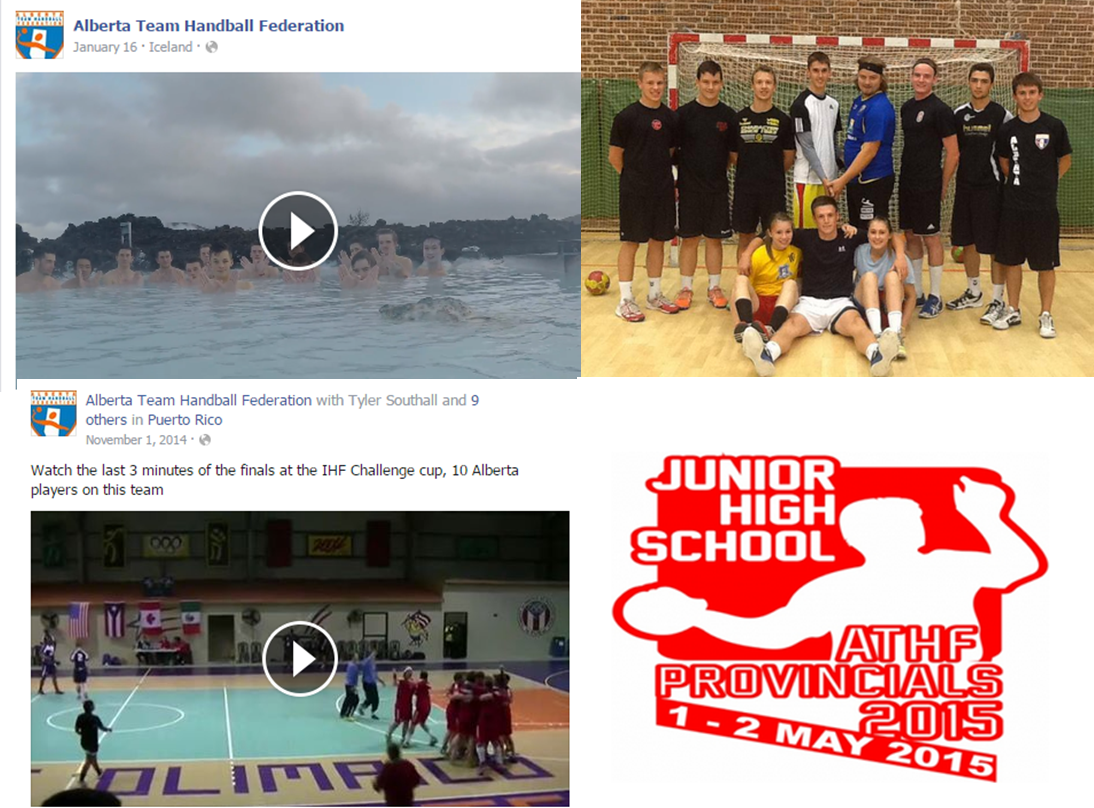
42 Alberta youth athletes at the Blue Lagoodn in Iceland, 11 Albertans at the Aarhus Academy, 10 Albertans on the Canadian Team that took Gold over the primarily Expat American Team,  Legitimate HS and MS championships.   What the heck is going on with Alberta Grass Roots Development?

Some of the 42 Alberta youth athletes who recently toured Iceland relax at the Blue Lagoon, 11 Albertans training full time in 2013 at the Aarhus Academy in Denmark, 10 Albertans on the Canadian Jr Team that took Gold over an American Team composed primarily of dual citizens living in Europe, Legitimate HS and MS championships. Just what the heck is going on in the foothills of the Canadian Rockies?  Have they cracked the development code and quietly created a Little Iceland?

Background

This past weekend the U.S. Men’s Team played 3 matches against the Alberta Sr Men’s team, winning 2 and drawing one.  The U.S. was clearly the better side this weekend, but Alberta proved to be a worthy opponent and a good tuneup for next weekend’s critical match vs Uruguay.  But, it does beg the question:  Why play Alberta and how did Alberta get good enough to take on the American National Team, albeit one without some of its top overseas based players?

The answer is that somehow Alberta has arguably developed the best grass roots program in the country.  Here’s some background on how far that province has come and what’s been developed there in the past 10 years or so.

Flashbacks to the 80s and 90s

I was first introduced to handball in Alberta in the late 1980s when a provincial team from Alberta came to play at the Copa Ventura tournament in California. (Nothing against Swim & Sport’s annual summer classic, but I’ll take the California Sun and the nearby ocean any day of the week over the swamp in Flanders.) The side from Alberta was a good one, but the old Ventura Condors was still able to best them in those tournaments.   Also, around that time frame I played in a couple of tournaments in Vancouver. Can’t remember if the Alberta teams were there, but the British Columbia teams were comparable to the U.S. club team I played for.

A few years later in 1993, a provincial team from Manitoba came down to Colorado Springs to play in the Falcon Cup. And, this was a beefed up Falcon Cup as the U.S. National Team used it as prep for the World Championships not unlike the current National Team did this past weekend. As, I recall the Manitoba side even played the National Team close for a while before we eventually blew them out. Then, a year later in 1994 while coaching the Air Force Academy I took the team up to Calgary for a mini-tournament. We arranged the trip with the Calgary reps on short notice, so the sides we played were shorthanded and Air Force was able to come away with the title.

What’s the point of this trip down memory lane? Well, the point is that from my perspective there wasn’t a whole lot of difference between the club programs in Western Canada and the clubs in the Western USA. Some decent players and teams, but primarily a bit on the older side with many players in their late 20s and early 30s. And, organizationally everything seemed a bit rag tag with dedicated volunteers doing the best that they can.

Flash Forward to Today

Some 20 years later in terms of club development and organization it’s more or less the same story in the U.S.   A few clubs still remain, some new clubs have sprung up while a number of others have come and gone. Demographically, there’s seems to have been a bit of a shift in terms of the greater percentage of Expats populating club teams, but other than that it all seems familiar. And, perhaps it’s a bit of a stretch for an American who hasn’t visited western Canada since 1994, but I suspect that club handball hasn’t changed a whole lot in British Columbia, Manitoba and Saskatchewan as well.

In Alberta, however, something is going on. I haven’t been on the ground there, but what I’ve read and heard suggests that somehow this province has cracked the development code that has long frustrated handball devotees in North America. In 2013, I was surprised to learn that 11 Albertans recently graduated from High School were headed to the Aarhus Handball Academy in Denmark. I spoke with Mike Nahmiash, the Exec Dir of Alberta Handball in this podcast interview and this is some of the information that I gleaned:

  • In grades 3-6 around a thousand athletes on 15-60 teams compete in provincial mini-handball championships
  • In grades 7-9 around 25-30 teams compete in Jr. High provincial championships
  • In High School handball is a sanctioned sport in Alberta just like basketball or volleyball
  • In grades 10-12, 3,000 athletes are playing on 120 teams; and teams play around 30-40 games a season

The last bullet seems to good to be true. I’m not calling Mr Nahmiash a liar, but numbers in handball development circles are often inflated. There are solid established teams, temporary teams, fully devoted hard core athletes and athletes that have picked up a handball once in their life. And sometimes those numbers are all added together to make things sound a bit better. That being said there’s no denying the solid evidence which includes:

  • Multiple youth teams of varying ages traveling to Denmark, Sweden, Norway, Iceland and surely other locations as well. Those trips aren’t cheap and are clearly a sign of dedication in significant numbers. Comparatively, youth players from Alberta have probably made more trips abroad in the past few years than all youth players from the entire U.S. in the past 20 years.
  • Real high school championships are taking place. Take a look at these programs and websites.  2014 Rosters:  Link Link Mike Nahmiash indicated in my interview that former U.S. Olympian, National Team Coach and NBC Olympics commentator, Dawn Lewis attended one HS competition and was blown away by the numbers of players and the quality of the competition.   Comparatively almost nothing exists at the HS level in the U.S.  As far as I know the Ocean, NJ girl’s team is the only HS age team in the entire U.S. regularly competing in events.
  • This past fall a junior Canadian team beat an American team for the Gold Medal at an IHF Challenge Tournament in Mexico.  The Canadian team had 10 Albertans on the roster while the U.S. team was primarily composed of dual citizens living in Europe.  Honestly, the U.S. would struggle to even field a team without those athletes who learned the sport in Europe.  For certain, we could not field a competitive team without them.
  • This past weekend an Alberta Provincial Team played the U.S. National Team toe to toe on American home turf in Auburn. The U.S. team is training together on a daily basis and is likely on average older than the Alberta side.  Could any state in the U.S. even field a competitive team of athletes in their younger 20s?

How has Alberta gone from a typical backwater region with very modest handball participation to the hotbed of North America? It’s hard to fully ascertain without being on the ground, but it would seem that a growing cadre of volunteers have been ably managed and led by Exec Director Nahmiash over the course of the past 10 years. And, more importantly it has apparently been done with almost zero outside funding from the Canadian Federation. Seriously, if you think the USA Team Handball Federation is fiscally challenged, realize that our neighbors to the North can only dream of having salaried staff members.

Analysis

For previous options I have included some top level analysis of pros, cons, risks, costs, and timelines for implementation. At this point, however, I’ll be the first to say that I’ve only scratched the surface as to what’s going on in Alberta and how some of the initiatives that they’ve successfully undertaken could be implemented in the U.S. The key takeaway, though, is that Alberta has been wildly successful in its development efforts. How successful?

Arguably, more new development has taken place in Alberta in the last 10 years than has occurred in the entire history of USA Team Handball. And, having been 10 years or so it’s most likely sustained growth that’s not going away anytime soon.

Certainly at the High School level there is no debate as to the accuracy of that statement. Perhaps at younger ages it is less true, thanks to past programs like at the Boys & Girls clubs in California/Georgia and Rock Handball and current programs like the one Craig Rot has started in Chicago. Still, the fact that such an argument can legitimately be made should get people wondering why a similar effort hasn’t been put in place in the U.S.

But, before I put too much sunshine on the Alberta efforts I’ll throw on a bit of cold water. In particular, it’s not clear if this grass roots development is going to translate to success at the National Level. While Canadian National Teams have started to see the placement of more Alberta players there’s rough parity with Quebec, Canada’s traditional handball stronghold. And while a few players have played professionally in Europe there doesn’t appear to be any breakthrough world class players yet from Alberta. Logically, one could argue that it’s only a matter of time before greater success happens at the Senior Level, but the reality is that it hasn’t happened yet.

Another consideration is that what works in Canada won’t necessarily work in the U.S. Yes, the two countries have a great deal in common, but there are organizational and structural differences in our schools that might make it difficult to duplicate Alberta’s success in an American location.

But, getting back to the key takeaway, Alberta has clearly developed a successful model for development. I’m not a big believer in the concept of “no brainer” decisions that don’t require any due diligence analysis first, but I’ll make an exception in this case.

USA Team Handball should expend some significant time and energy to better understand just what’s happening in that corner of the Great White North. Then perform a full assessment as to how some of that success can be translated to the States.

post

Charting a Way Forward for USA Team Handball: Option 7: The All the Eggs in One Basket “Iceland Strategy” (Part 2)

The Greater Boston metropolitan area has the population equivalent of 14.5 Iceland’s.  Boston also has a pretty decent chance of hosting the 2024 Olympics which would result in substantial opportunities for local sponsorship.  The Auburn-Opelika metro area is the equivalent of less than half an Iceland.  Which location would be a better candidate for focusing limited resources in the hopes of creating a “home for handball” in the U.S.?

The Greater Boston metropolitan area has the population equivalent of 14.5 Iceland’s. Boston also has a pretty decent chance of hosting the 2024 Olympics which would result in substantial opportunities for local sponsorship. The Auburn-Opelika metro area is the equivalent of less than half an Iceland. Which location would be a better candidate for focusing limited resources in the hopes of creating a “home for handball” in the U.S.?

Part 1 of this option highlighted the potential benefits of focusing resources in one geographical area and the historical limited success the U.S. has had in doing so. This part explores how the U.S. might learn from the past should it decide to try and create a “Home for Handball” in the U.S.

Building a Better Mousetrap

One could infer from the lack of success highlighted in part 1 that you simply can’t artificially create a Little Iceland. But, maybe the lesson is just that it wasn’t done the right way.   That to execute such a strategy successfully, better planning, more resources and more patience are needed. It’s certainly debatable. One thing is for sure, though: The potential benefits of creating a Little Iceland or Home for Handball in the U.S. merits a further investigation. An investigation that would first take a long hard look at what’s worked and what hasn’t. A full assessment of the failures of the past and some real thought into how it might conceivably work in the future. I haven’t fully assessed those failures, but have a fairly solid understanding of what happened and what could be done differently. Here are some thoughts on building a better mousetrap:

  1. Very Carefully Select your Location. Ask any real estate professional what the 3 key issues are for selling a house and they’ll tell you: Location, location, location. It’s no different in assessing where best to focus limited resources. Here are some key factors that should go into making the all important location decision.
    • Population: In general, the more people living in the location that’s selected, the better chance you are going to have in reaching critical mass. It’s simply a numbers game with the acknowledgment that your conversion rate (i.e. converting someone who doesn’t care about handball to a truly devoted participant/fan) could be really, really small.  After all, a good portion of the population at-large doesn’t care about any sports, let alone one they’ve never heard of. Converting 1 out of every 100 people would be a pretty darn good conversion rate. 1 out of 500 or 1,000 might be more realistic. This reality means that choosing a large metropolitan area will greatly improve your chances of creating converts.

      For example take a metro area like Boston with a population of 4,684,300 people. To create 5,000 handball fans/participants you would need a conversion rate of .11% or roughly 1 out of every 1,000 people. Now contrast that to the Auburn-Opelika metro area and its population of 135,800 people. To create 5,000 handball fans/participants you would need a conversion rate of 3.68% or roughly 37 out of every 1,000 people. Ouch. Those are some tough numbers. I’m not saying that it’s impossible to reach critical mass at a college town in rural Alabama. But, I will say that without a doubt the smaller population base means it will be way more challenging there than in a major metropolitan area.

    • Job opportunities: Athletes are far more likely to move to a location where there are varied job opportunities including professional positions for recent college graduates
    • Education Opportunities: Athletes for both the residency program and collegiate league would be interested in quality education opportunities.
    • College League Possibilities: The potential to develop a collegiate league in the regional area should be an important factor. And a league with reasonable driving distances for competition.
    • School District Pilot Program Possibilities: The potential to engage local high schools and middle schools to adopt team handball as a sanctioned sport
    • Cost: The costs of setting up a handball academy and supporting leagues and other development initiatives will be substantial. Some locales will be more suitable and cheaper for a number of reasons.
    • Sponsorship Opportunities: The likelihood of obtaining local community support for a handball academy and other development initiatives.
    • Existing local handball support: Ideally, there would already be at least some dedicated supporters of the sport in the local area. Having a ready group of dedicated volunteers will facilitate implementation of several development initiatives.
  2. Fully integrate all aspects of regional development: It’s important to highlight that focusing resources in one location would be a lot more than simply establishing a residency program/development academy. Such a high performance training environment would be a key part, but just one part in a true regional development effort. And, all those parts (youth development, a high school league, college league, club league, development academy) would need to work closely in tandem to maximize the success of this initiative. This would mean maximizing staffing to support all these elements. In particular, athletes could be justifiably compensated for their support to youth and high school league support.
  3. Fully commit and prioritize this regional development effort: Make no mistake, this would be a major effort and for it to work it might well be required to substantially decrease support to many other Federation activities. Doing a regional effort, “on the cheap” with only partial commitment/funding support also lessens the potential synergy possible with a multi-pronged effort.
  4. Give the effort time to blossom and mature. This effort could very well take several years to fully bear fruit. Pulling the plug or lessening support prematurely due to the lack of immediate results will defeat the purpose of such a concentrated effort.


Pros


Establishment of a recognized “Home for Handball”: Having a recognized home for the sport will help in a number of tangible and somewhat intangible ways. Name recognition and identity in one concentrated geographical area has value. With it comes media exposure, sponsorship opportunities, greater public awareness and “buzz”. All of those could even mean real crowds and eventual TV broadcasts.


Improved Recruiting Prospects:  Co-locating youth, high school, college and a Residency Program/Development Academy efforts together will create a pathway/pipeline that athletes can see and join. Critically, this will make it far more feasible to recruit athletes from ages 10-18. An age group that has been very difficult to recruit for a variety of reasons.


Cons


Lessens the possibility of broad based nationwide growth:  A very strong focus on one regional area will by default result in less support to other regions. Correspondingly, there will likely be less chance for growth on a broad coast to coast basis. Rather than taking advantage of it’s huge population, the U.S. will be restricting itself due to a de facto self-imposed restriction.


Shows favoritism to one “blessed” region:  Handball supporters in other parts of the country getting less support will likely voice their disfavor with an intentional and pronounced unequal sharing of resources. For sure, historically there has been grumbling at even minor appearances of favoritism towards a club or region. And this time the grumbling would be somewhat justified because their efforts will indeed be getting fewer resources.


Risks


If the basket breaks, so will all the eggs.   It’s important to remember the cautionary basis for the “all the eggs in one basket” saying. Namely, that is a warning not to do it, because you won’t have any eggs if you drop that basket. And, just like that basket of eggs if the region you choose to focus on fails to pan out then you will have nothing to show for. This could be a spectacular failure. But, then again there have been far too many failures with many of the other piecemeal strategies that have been tried in the past.


Costs


In theory, a regionally focused strategy will save significant money and resources. This is because staff, athletes and volunteers would be concentrated in one location and could readily focus on multiple, integrated development efforts without significant travel costs. Keep in mind, however, that this only works if the effort is truly focused on a particular region. If you spread efforts such as a residency program, High School Pilot Program and collegiate league to different regions of the country it will be less feasible to share staff and funding to support multiple efforts.


Creating a Little Iceland or Home for Handball in the U.S. is certainly an enticing prospect, but also a risky one. In part 3, I’ll tackle the timing for implementing such a strategy should USA Team Handball decides that it’s a risk worth taking.


post

Charting a Way Forward for USA Team Handball: Option 7: The All the Eggs in One Basket “Iceland Strategy” (Part 1)

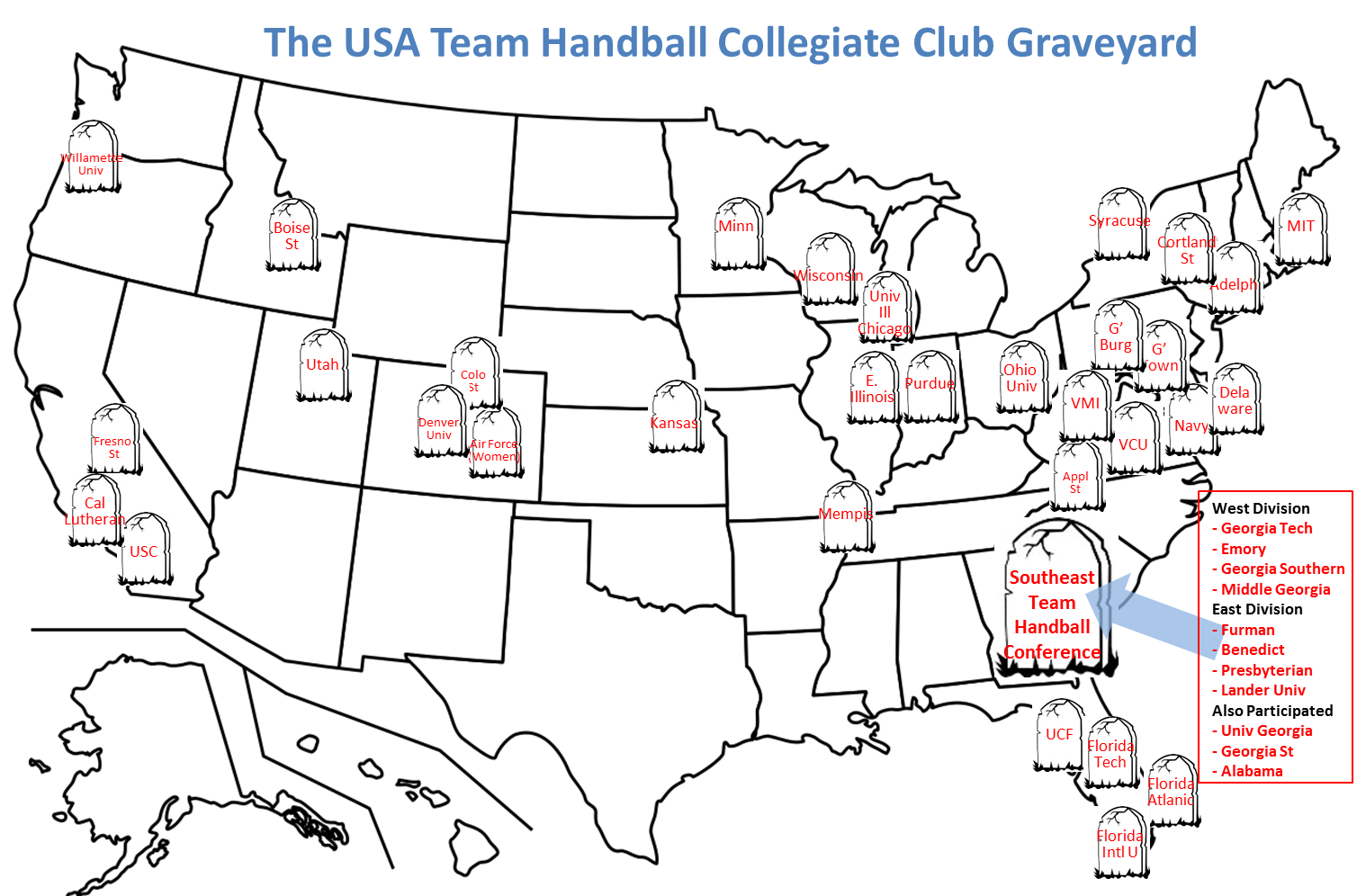
All the eggs in one basket: What if all of the major handball clubs in the U.S. were in one regional area?

All the eggs in one basket: What if all of the major handball clubs scattered to the 4 corners of the U.S. were instead focused in one metropolitan area?

Would the U.S. be wise to develop a very focused development strategy around one metropolitan area? In part 1, I lay out the arguments for doing so and review historical efforts to spark development regionally. Part 2 will focus on the pros/cons, costs, risks and timing for doing so.

Iceland: 1,000 Times Smaller

Ever since I had the opportunity to play against Iceland at the 1993 World Championships I’ve been a little bit fascinated with Iceland and it’s national handball program. I even remember getting out my world almanac (yeah, this is a little bit before widespread internet and Wikipedia) because I was asking myself, “How many people live there, anyway?” Not sure what it was 22 years ago, but the current population is roughly 323,000 people. Coincidently, the population of the U.S. is approximately 323,000,000. This disparity inevitably leads to the question: How does a country roughly 1/1,000th the size of the U.S. kick our butts in handball?

Obviously, in terms of handball national team performance, there’s a lot more at play than total population. And, the key difference is that a significant portion of Iceland’s very small population is very focused on handball, whereas in the U.S. a very miniscule percentage has the same dedication. Seriously, depending on how you want to define it, it’s really small. I would argue that there are only around 300 really dedicated handball followers or around 1/1 millionth of the U.S. population. Bump it up to a 1,000 if you want, but you’re still talking about 1/300,000th of the U.S. population.

Creating a Little Reykjavik

Compounding the U.S. struggle is the reality that the handful of folks that really care about the sport are scattered throughout a huge nation, making it a struggle to work together to grow the sport.

Over the years I’ve found myself thinking about this problem, relating it to Iceland and playing a little numbers games of population comparison. I grew up on a farm in the state of Iowa (around 10 Iceland’s) and not too long ago lived in Las Vegas (6 Iceland’s). I remember driving across town and looking over towards the sprawling suburbs next to the mountains and thinking, “Hey, I just drove past a couple of Iceland’s.” And, now I live in Colorado Springs with a metropolitan area a bit bigger than 2 Iceland’s.

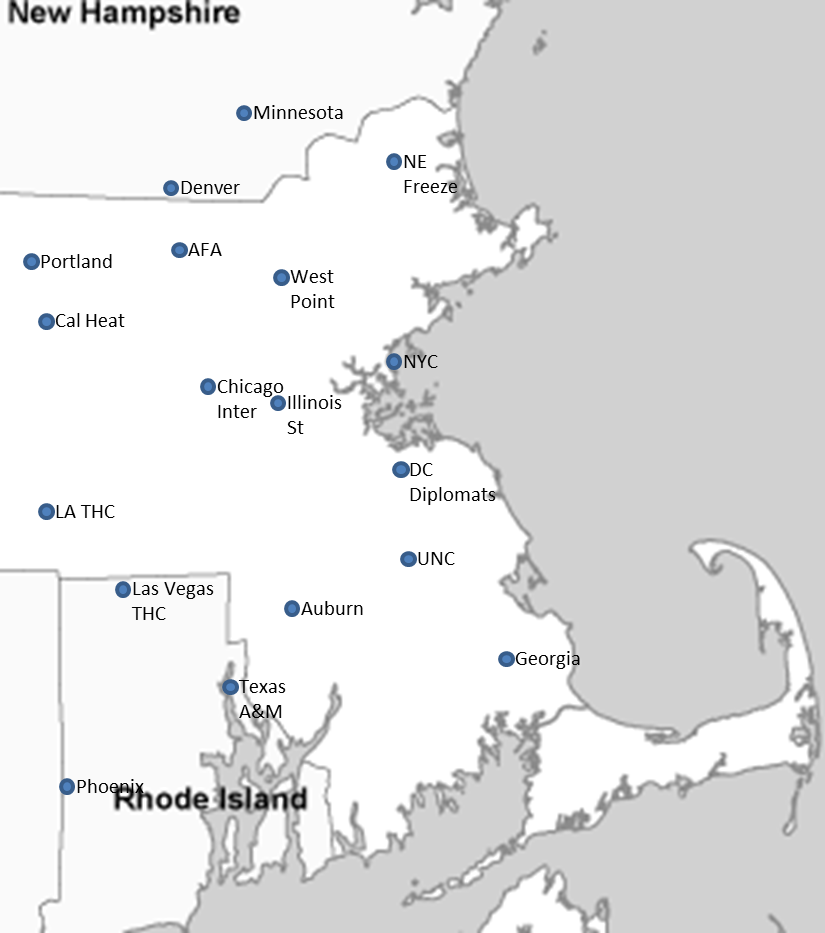
As, I’ve played this little game I’ve thought about what could be done if everyone who cared about the sport of team handball lived in the same place. Be it Iowa, Las Vegas, Colorado Springs, Boston or even Auburn, Alabama.  In short, I’ve asked myself:

What if we could throw all the eggs in one basket?

What if…..

  • Instead of top clubs scattered throughout the country they all resided in one compact area?
  • In one metro area, there were 10 top senior club teams regularly playing each other in a league competition?
  • There were 20 collegiate teams feeding those programs.
  • There was a Handball Development Academy training the top players in those colleges on a regular if not daily basis?
  • There was a sanctioned High School sports program in that city feeding those college programs with new recruits?
  • There were 50 youth clubs training and playing games, feeding the high school program?

Why, if all this were true and somehow came to pass it would be, as if, the U.S. had a little Reykjavik all its own. Or, as I like to call it the “All the Eggs in One Basket, Iceland Strategy.”

Organic Success

To some extent such a strategy has indeed been implemented to varying degrees in other sports. In most cases, though, it wasn’t actually a strategy. It just happened organically or naturally without artificial help. Case in point, are a couple of sports that for many years were essentially Californian, water polo and volleyball. Yes, there was a time not that long ago when competitive volleyball was very California centric. And, it still pretty much is when you’re talking men’s volleyball. And, although water polo has spread it’s wings some, all one has to do is look at where the bulk of the collegiate programs are to see that it is still very California centric.

The advantage to this regionalism is that the sport had critical mass in terms of local competition and development. Critical mass in that there were plenty of teams to play each other and create development at younger age levels. However, if that interest had been spread out evenly across the vast United States there would have been no critical mass. Clubs would have had to travel vast distances for competition. Isolated clubs might have sprung up, but these pockets of growth would be susceptible to periodic collapse of clubs and lack of interest.  Youth teams with no one to play would struggle to even get started. Why volleyball might never have become what it is today. Water polo might even be the equivalent of what Team Handball is in this country. A non-relevant sport from coast to coast.

Non-Organic Experiments with Limited Success

But, can such a regional massing of clubs and interest be created nonorganically? Can a federation take steps to proactively create a little handball Reykjavik? The answer is yes: steps can be taken. In USA Team Handball’s case the primary tools for doing so has been national team residency programs and investment to capitalize on the Olympic host city exposure.

Since the mid 1980s residency programs have been located in Colorado Springs, CO; Philadelphia, PA; Atlanta, GA; Cortland, NY and most recently Auburn, AL. In each case the massing of athletes in one spot has had some development effect on the local area. First off, just simply practicing an unfamiliar, but cool looking sport inevitably attracts a few onlookers to try it. Some of those athletes even became national team players. The athletes based at those locations also often did community outreach to facilitate development. Finally, for a variety of personal reasons some athletes settled in the residency program location and still live there today.

Unfortunately, none of these locations have had much success in terms of sustainable impact. Today, Colorado Springs has a local club mostly comprised of aging veterans that gathers occasionally to provide competition for the AF Academy. Over the past decade or so there have also been some decent youth programs in the Colorado Springs area, but no program is currently active. To the best of my knowledge pretty much nothing exists handball wise in either Philadelphia or Cortland, NY, but neither or those locales were residency sites sufficiently long enough for any side benefits to take effect.

In terms of an Olympic boom, both Los Angeles and Atlanta clearly benefitted from the exposure that an Olympics can bring. In the case of L.A. the 1980s were clearly the high tide for the sport there. At one time there was as many as 5 clubs in the LA area and the Boys & Girls clubs had dozens of programs throughout the area. But the buzz was not sustained and by the mid 1990s there was just one club, LA THC which still exists today.

And then we have the test case of Atlanta, which benefitted from an Olympics, a Residency Program and even having the Federation HQ co-located there in the late 1990s. For a time, Atlanta was indeed the closest the U.S. has ever come to having a little Reykjavik.   Atlanta had two solid clubs (ATH and the Condors), a development program with the Boys & Girls Club and the South East Team Handball Conference, the largest collegiate league the U.S. has ever had. Years later, however, there is little to show for. Gary Hines who rose up through the ranks is a mainstay on the national team, but the youth programs and ATH and the Condors are no more. All Atlanta has now is a newish club, Georgia Team Handball which has little link with the past.

What’s to be learned from these experiments? On the one hand, you could look at all of these experiments simply as failures and proof that you can’t artificially create a little Iceland.  I would argue, however, that position doesn’t take into account the limited planning that went into these experiments. In LA’s case the growth that occurred was pretty organic. There was funding from the 84 Olympic Foundation, but there were also dozens of firm believers willing to put in the work. The same can be said, as well, in Atlanta. There was funding support, but there were also plenty of dedicated volunteers. Colorado Springs may be somewhat of a disappointment, but that fails to account for its smaller size. Finally, the programs in Philadelphia and Cortland never were around long enough to take root. And Cortland was also probably hampered by its smaller size and location.

So, maybe the problem wasn’t so much with the concept, but with the choice of locations and with the lack of overall planning to make it a truly focused integrated effort. Maybe the U.S. could learn from it’s past mistakes and modest successes to build a better mousetrap? In part 2, I’ll lay out what could be done with a very focused regional effort.

post

IHF and Qatar ruin the big event

Qatari Referee Saleh Jamaan Bamurtef issues a yellow card warning against Croatia.   Officiating was inconsistent to say the least in Qatar.

Qatari Referee Saleh Jamaan Bamurtef issues a yellow card warning against Croatia. Officiating was inconsistent to say the least in Qatar.

Former chair of the IHF Playing Rules and Referees (PRC) Commission, Christer Ahl, takes the IHF and Qatar to task for inconsistent officiating and unfair advantages for the host nation.

This should have been the exciting, biennial competition, where all the focus would be on the star players and the entertainment and excitement they are able to offer.   There would be an expectation of fair play and evenhanded refereeing, in the spirit of ‘let the best team win!’ But this time, the IHF and the Qatari host conspired in various ways, so that the focus instead was on the mercenaries of what purported to be a Qatari national team, the many advantages they obtained, and the totally inconsistent refereeing which often was the deciding factor in key games.

Can everything be bought?

It all started in 2011, when to the surprise of many, the IHF Council decided to award the hosting of the 2015 event to Qatar.   Especially against the background of the more publicized affairs around the awarding of the 2022 football World Cup to Qatar, there have also been many suspicions and accusations surrounding the IHF decision for handball. It is ironic that the country favored to be awarded this event in 2015 was precisely France, the opponents of Qatar in the final, who now had to deal with the extra burden of being up against the home team and all that this implies.

But the main topic for many observers was that Qatar had imported eleven players to fill all the key positions on their team, taking advantage of their own rules for awarding ‘half citizenship’ in Qatar, in combination with the very lenient rules of the IHF regarding changes in citizenship. (By contrast, FIFA has much stricter rules in football). We find it normal that wealthy club teams use their resources to acquire the best players in the world, but we have come to expect, until now, that national teams are genuine national teams.

Another aspect, unrelated to the Qatari team that instead became a problem for many other teams in important games, were the incredible nominations given to the incompetent Qatari referees. They were allowed to ruin several important games, and in one game the clearly affected the result, unfairly preventing Brazil from getting a sensational win against Croatia in the ‘round of 16’. It is difficult to imagine that the iHF Referee Chief was so oblivious to this problem, so one must assume that the instructions must have ‘come down from above’.

Referees under pressure

With their imported team, it was no surprise that Qatar advanced from the group stage to the elimination matches.   And here it soon began to look as if the path towards a possible final was being paved for the home team. It was conspicuous that all the referee couples who have a reputation for being particularly capable of standing up to pressure were kept away from the games of Qatar in the ‘round of 16’, the quarterfinal and the semifinal. And in all cases, ‘less resistant’ referees were seen by neutral observers as having had a lot to do with the Qatari wins in very narrow games. In turn, Austria, Germany and Poland left the court fuming about mysterious decisions in critical moments, and also totally neutral observers found it to be a bit too much.

During my own time as the person ultimately responsible for the refereeing and the fair play on the court in IHF events, I am only too familiar with the situation.   In 2007 in Germany, the IHF somehow seemed to ‘owe’ the gold medals to the host country, and many aspects were set up to favor the hosts. This included the situation in the quarterfinal and semifinal, where all tickets had been sold to German fans, and where IHF bosses even prevented me and my colleagues from taking warranted action against the home team. At least we tried to offset the pressure by assigning referees who were known to be courageous, but not even that helped. And in 2009, when the Croatian home team lost the final against France, I received threats for having assigned referees who were known to stay neutral and resistant. Here in Qatar, amazingly the situation was instead exacerbated through questionable nominations.

Irresponsible changes in rules interpretations and instructions

Many handball fans who follow European top level competition are likely to agree that the intentions of the 2010 rule book to clamp down on cynical and dangerous action have never really been realized. The IHF and the EHF have not been willing or able to insist on a closer adherence to the spirit of the rules, so the cynicism and dirty tricks have flourished.   Therefore, I applaud the intentions of the IHF, as discussed and agreed in a conference of all stakeholders, including top coaches, a few months ago, to make a more concerted effort in the context of the next set of rules changes and instructions.

But, what the IHF president then suddenly decided, was totally crazy and irresponsible! The IHF Referee Commission and Coaching Commission were ordered to implement new, stricter interpretations with immediate effect in Qatar.   Moreover, this was done without any forewarning to the team, who normally would be fully informed about major changes 6-12 months ahead of time in order to be able to adapt and prepare. Instead, they got a brief explanation the day before the event started….! No wonder that media around the world have been filled with shocked reports from the flood of punishments given out to unsuspecting players and teams, who cannot understand what has happened.

However, it seems that one specific team, namely Qatar, must have been extremely well informed about the new, stricter rules interpretation and completely ready to adjust to it, so that they actually deserved by far many fewer punishments than all the other teams. Because it is not very pleasant to think of other possible explanations as to why the referees, in game after game, found very few reasons to give 2-minute suspensions against Qatar…

The referees put in an impossible position

Clearly, a sudden adaptation to new standards would have been difficult for the referees even if the team had been prepared and ready to cooperate. But now the referees were caught between protesting teams and an awareness that if they did not follow instructions, they would risk being sent home after the group stage.   Some referees handle this kind of adaptation and pressure better than others, but it is clear that inconsistencies are likely to arise both during matches and from one match to another.   Some referees got carried away, taking too tough a line in a not very rough match, while others fell back into their habits of recent years.

What is worse is that uncertainties around a new interpretation always serve to increase the scope for biases and one-sided treatment of teams. In other worse, there are more ‘opportunities’ for referees to fall for the pressures that I discussed above, simply because the number of ‘marginal’ decisions will increase.   Moreover, if the teams did not always manage, or want, to adapt to the new interpretations, it seems that they quickly saw an opportunity to gain unfair advantages instead. What I mean is that if the player knows that the referees will be more ready to punish conspicuous fouls, then they will resort to ‘theater’ and exaggerate the impact of a foul or even ‘nicely’ fall to the floor at the slightest touch.

Unfortunately it appears that the massive confusion and criticism was too much for the IHF leaders to handle in a level-headed and constructive way.   Horror stories about abusive criticism and confused feedback for the referees are floating around. And now, even before the event finished, my successor as IHF Referee Chief, who had my support when I was ‘exiled’ in 2009, has given a shocking interview in the main German handball web site:  Link

Essentially, he sees himself as blameless and instead declares half of the referee groups as idiots who are not talented and smart enough to understand their instructions.   So he states that they will be kicked out. These are the words from the person responsible for rules interpretations in recent years and for selecting the referees for Qatar. So if you want to blame the referees for some of the things you saw, perhaps you need to look elsewhere.   The behavior and attitude of the IHF president appears to be contagious! I can only feel sorry for the top referees who are asked to do a very demanding job.

Some conclusions

With all the problems indicated above, like the rules permitting ‘mercenary teams’, and the deliberate incompetence on the part of many IHF leaders, added to the scandalous process involving teams kicked out (Australia), given free places in the event (Germany, Iceland and Saudi Arabia), or inexplicably overlooked as candidates for available places (Hungary and Serbia), one wonders whether there is any basis for taking IHF’s ‘World Championships’ seriously any longer. (As you may have noticed, this is the only time that I have even used that label in this text).

Perhaps the time has come to eliminate these events, as they have lost their integrity. Perhaps it is better to let the individual continents arrange championships for national teams, including qualifications for the Olympic Games, and otherwise simply continents and nations concentrate on competitions for club teams, where there is no pretense that nationality matters. In that case, perhaps the time has also come to eliminate the IHF, because beyond the task of organizing fictitious championships the IHF does not really do much to justify its existence!

post

Breakthrough World Championship for PATHF: Argentina and Brazil Prove they belong with European Sides

Brazil vs Qatar on the opening day.  Qatar may be in the finals, but the real revelation in my opinion is the progress of Brazil and Argentina.

Brazil vs Qatar on the opening day. Qatar may be in the finals, but the real revelation in my opinion is the continuing progress of Brazil and Argentina.

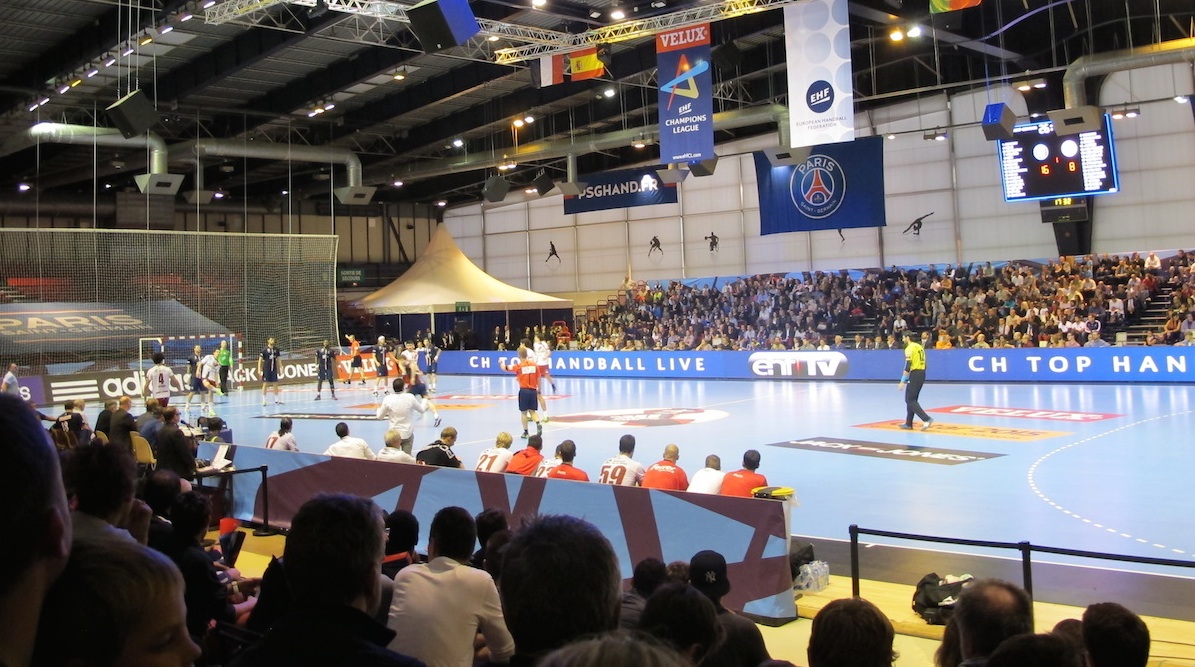
Eight years ago while living in France I saw Qatar play in a friendly tourney in Paris. I don’t think they won a game and as I recall their best player was a naturalized Bosnian playmaker. For sure, if someone had told me that Qatar would be playing in the World Championship Final in 2015 I wouldn’t have believed them.  So, on the surface such a development might be heralded as a major breakthrough for handball outside of Europe. But, with Qatar’s roster being largely an all-star team of European cast offs nothing has really changed. For all appearances, the World Championships are still largely a European party with a few annoying teams from other parts of the world to give the tourney a little color and to give European sides a breather game or two during group play.

But appearances can be deceiving and anyone who watched Brazil, Argentina, Tunisia and Egypt play surely knows what I’m talking about. Those 4 sides didn’t fully crash the European party, but they each showed that they belong making it to the round of 16 and making almost all of their group play games tight affairs. Probably, the most telling aspect of their performance was the banishment of a record 4 European sides to the President’s Cup. Once just the embarrassing end for one or two European sides, this year the battle for 17th was an all European affair contested by Russia, Belarus, Bosnia and the Czech Republic.

In the Round of 16, three of the four sides went quietly, but Brazil went toe to toe with Croatia for a full 60 minutes. A 2nd tier nation can occasionally keep pace for a half against a side like Croatia. And maybe sometimes it can be stretched for 45 minutes, particular if it’s part of Group Play. But, 60 minutes in the knockout stages? No, a side has arrived when it can do that.

How was this done and what does it mean? Here’s a closer look at Argentina and Brazil and what it means for the rest of PATHF.

The Argentine and Brazilian WC Resume

Both Argentina and Brazil have made it out of the Initial Group Phase before, but this is the first time both sides did so at the same time. And this time both sides were clearly in contention for every single match with the exception of Argentina’s loss to France in the Round of 16. Both sides also had signature matches against former World Champions. Argentina’s draw vs. Denmark and Brazil’s 1 goal loss to Croatia.

2015
Argentina: 4th in Group Phase; Lost to France in Round of 16 (12th Overall)
Brazil: 4th In Group Phase; Lost to Croatia in Round of 16 (16th Overall)

2013
Argentina: 5th In Group Phase (17th Overall)
Brazil- 3rd in Group Phase; Lost to Russia in the Round of 16 (13th Overall)

2011
Argentina: 3rd in Initial Group Phase; 6th in Main Round Group (11th overall)
Brazil: 6th in Initial Group Phase (21st overall)

2009
Argentina: 5th in Initial Group Phase (18th Overall)
Brazil: 5th in Initial Group Phase (21st Overall)

A Closer Look at the Roster Data

If one looks at Argentina’s and Brazil’s Official Rosters there are some key aspects worth highlighting

  • Several players are playing professionally in Europe. Argentina has 5 players playing in the French 1st Division (LNH), 3 in the French 2nd Division (D2) and 1 in the 3rd Division (N1). Brazil has 8 players in the Spanish 1st Division (Liga ASOBAL) and 1 player in the French 1st Division (LNH).

    It’s always a debate when it comes to the relative strength of the various professional leagues in Europe. The German Bundesliga is unquestionably the strongest, but I would argue that the French LNH is now the second strongest (top to bottom). The Spanish Liga ASOBAL has also slipped a bit with many of the top Spanish players playing abroad, but it may still be the 3rd strongest or slightly behind Denmark. Regardless, these players are getting paid to play and they are playing competitive matches on a regular basis.

  • Argentina’s roster is showing some age while Brazil’s is relatively a bit younger. Argentina’s average age is 28.6 and some of their key scoring punch is coming from some players on the north side of 30. Brazil’s average age is 26.1 and fewer of their key player are older. In fact, the core of this team could be solidly intact all the way through the 2020 Olympics.

The Visual Evidence

Data analysis is all well and good, but now having seen Argentina and Brazil play several times here’s a few observations I’ve made:

  • Neither Argentina nor Brazil is extraordinarily gifted with raw talent. Don’t get me wrong both sides have got some great athletes, but they are not so talented that they can overwhelm their opponents. Argentina’s Diego Simonet has great quickness and ball savvy. Brazil’s entire side can run and gun as well as any side.   Both sides, however, in my opinion are lacking a great leaper/scorer that can consistently score from 10 meters. Watching Argentina I couldn’t help but wonder what damage that side might have done with a young Eric Gull in the backcourt next to Simonet.
  • Both Argentina and Brazil are now very solid technically. How solid? As far as I’m concerned from a technical standpoint there’s virtually no difference between those two sides and the European sides. Wow! This is a hugely significant development and I can almost not believe that I wrote that last sentence. This has never happened before in Pan America. Sure, the U.S. and Cuba in the 1980s were competitive with European sides, but it was pretty much always due to great raw athletic talent overcoming technical shortcomings. More recently Argentina and Brazil have been pretty competitive, but one could sit back and wait for technical mistakes and turnovers that would be those sides undoing. Not any more.
  • Both Argentina and Brazil have big game composure. In addition to the technical skills, though, both sides now have the experience to win those big games in the critical last 5 minutes. Teams can only cross that bridge if they have the technical skills and the requisite experience. Brazil and Argentina have now played scores of meaningful game and at the same time many of their players are now getting week in, week out, professional experience. Argentina and Brazil didn’t win all their close games, but they played several that could have gone either way. And they won some for sure.

What it means for the rest of Pan America and the U.S.

What does it all mean? Well, in simple terms the rest of Pan America is going to be very hard pressed to beat either Argentina or Brazil anytime soon. Argentina’s roster is a little thin so some key injuries could provide an opening, but barring that they are virtually a lock to qualify for the 2016 Olympics.

Looking further out, both sides seem well poised to build upon their outstanding performance at the WC. Both will need to reload and integrate younger players, but it appears that they have the development programs in place to do so. Consistently Argentina and Brazil have continued to dominate PATHF youth and junior championships.

At one time qualifying for an Olympics from Pan America could be done with just a bit of short term planning. A team could be comprised of great athletes relatively new to the game with just a few years experience. Heck, the athletes didn’t even have to be professional, just a tight knit group of amateurs on a mission. Such a team could win a PANAM Games and then even play some European sides close at an Olympics before inevitably falling short.

Unfortunately, that now no longer is true. No, winning the PANAM Games and qualifying for the Olympics now means beating the equivalent of a “European side.”  And while a “European side” can be beaten by an American team, keep in mind that it hasn’t happened in a very long time and only in semi-meaningless friendly’s.  The U.S. in fact has only beaten one European side ever in a World Championship or Olympic match competition and that consolation round victory over Spain in 72 was in a different era altogether.

Something to contemplate as plans are developed to build a national team for a return to the Olympics….

post

Podcast: What can collegiate team handball learn from collegiate rugby’s success?

Iona College Rugby in action. Just 1 of 900 collegiate rugby clubs in the U.S. What can collegiate team handball learn from collegiate rugby?

Iona College Rugby in action. Just 1 of 900 collegiate rugby clubs in the U.S. What can collegiate team handball learn from collegiate rugby?

In my last post regarding the state of collegiate handball I mentioned collegiate rugby as a possible model to follow.  To find out more about collegiate rugby I reached out to Bruce McLane, the head coach at Iona and a panelist on the RuggaMatrix America podcast. In a wide ranging conversation we discuss the similarities and differences between the two sports, why collegiate rugby has been successful, what USA Rugby has done or hasn’t done to facilitate growth and what steps USA Team Handball might consider taking.

Be forewarned, it’s an hour and 30 minute discussion, but one worth listening if you’re interested in how team handball might follow in rugby’s footsteps.

post

Winter Classic Results

Winter-Classic

The USA Women’s team hosted Canada and Handball Club Intrepide from Guadaloupe from 17-20 December.  Handball Club Intrepide managed to go 3-0-1 with wins against both U.S. sides and a draw and a win against Canada.  The USA Blue team was the best national side with come from behind wins over both Canadian teams and a narrow loss to Intrepide.

Here are the results of the 8 games played

Wednesday, 17 Dec
Canada White USA Blue 14-18
Canada Red Guadaloupe 24-24 (Canada won penalties 4-3)
Thursday, 18 Dec
Guadaloupe USA Blue 24-23
Canada White USA Red 25-20
Friday, 19 Dec
Canada Red USA Red 24-14
Canada White Guadaloupe 14-27
Saturday, 20 Dec
Guadaloupe USA Red 23-14
Canada Red USA Blue 20-24

As there were no USA-USA or Canada-Canada matches a full round robin was not played.  As such, Guadaloupe was the only team that played 4 matches.  Here is a table, keeping in mind that caveat.

All Matches W L D Pts GF GA GD
Guadaloupe 3 0 1 7 98 75 23
USA Blue 2 1 0 4 65 58 7
Canada Red 1 1 1 3 68 62 6
Canada White 1 2 0 2 53 65 -12
USA Red 0 3 0 0 48 72 -24

Here’s the results just looking at USA vs Canada matches

USA-Canada Matches W L D Pts GF GA GD
USA Blue 2 0 0 4 42 34 8
Canada Red 1 1 0 2 44 38 6
Canada White 1 1 0 2 39 38 1
USA Red 0 2 0 0 34 49 -15


Finally, while a full round robin was not played it is possible to break down the matches into four, mini tournaments in which each side did play head to head.  Here are those results.

Tourney 1 W L D Pts GF GA GD
Guadaloupe 1 0 1 3 48 47 1
USA Blue 1 1 0 2 47 44 3
Canada Red 0 1 1 1 44 48 -4
Tourney 2 W L D Pts GF GA GD
Canada Red 1 0 1 3 48 38 10
Guadaloupe 1 0 1 3 47 38 9
USA Red 0 2 0 0 28 47 -19
Tourney 3 W L D Pts GF GA GD
Guadaloupe 1 0 0 4 51 37 14
USA Blue 1 1 0 2 41 38 3
Canada White 0 1 0 0 28 45 -17
Tourney 4 W L D Pts GF GA GD
Guadaloupe 2 0 0 4 50 28 22
Canada White 1 1 0 2 39 47 -8
USA Red 0 2 0 0 34 48 -14


Some Brief Analysis:  Having not seen the matches I can only infer a few things from the score lines and Federation write ups.  First off, it was good for the USA first team to get two wins over the Canadian sides.  Perhaps, a bit disappointing that they trailed both games at the half, but a win is a win.  The close loss to club Intrepide, however, is a disappointment as the U.S. defeated Intrepide in Guadaloupe this past August 30-22.  Perhaps, though, it illustrates the lack of regular competition problem inherent with a residency program.  When the U.S beat Intrepide it was just prior to the start of their season and I suspect that the club players were a bit rusty.  Now that their season is in full swing the rust has likely worn off with regular weekly competition.  It’s hard to say, but there’s probably more to that logic than the U.S. regressing that much since August. Perhaps, not coincidentally the leading scorer for the U.S. was Kathy Darling who is also playing matches on a regular basis for Le Pouzin in the French 3rd Division, a level of play that is probably comparable to the regional Guadaloupe league. (More on Club Intrepide and how the U.S. might want to emulate their grass roots program:  Link)

Overall, it’s just another data point along the way to a critical 2 game, home and home series the women will play in March against Uruguay to qualify for the PANAM Games.  That’s right, just like the Euros, Uruguay will first play a match at Auburn on the weekend of 5-9 March.  Then, the U.S. will travel to Montevideo the following weekend.  The winner on aggregate goals for both matches will advance.  PATHF Announcement:  Link

post

USA vs. Puerto Rico Series:  Women’s Results and Analysis:  An Older Team (for the Most Part) Running Out of Time

The USA Women are hard working, motivated and fired up, but results on the scoreboard are still lacking

The USA Women are hard working, motivated and fired up, but results on the scoreboard are still lacking.

Previously, I reviewed the Men’s program and their 3 game series against Puerto Rico in October.  This time around I take look at the Women’s team and the state of the Residency Program on its one year anniversary.  (Additional note:  The video for these matches is no longer available at the USA Team Handball Youtube channel)

Results of USA – Puerto Rico Series

Friday, 17 October
Final Score: PUR – USA  25-24 (12-11)
Goals – USA: Van Ryn (6), Levinkind & Gascon (5), Graham (3), Hardison & Taylor (2), Lewis (1)
Saves – USA: Self (11), Scherer (4)

Saturday, 18 October
Final Score: PUR – USA  26-21 (13-10)
Goals – USA: Rhoads (5), Abou-Zeida (4), Pierce (3), Hardison (2), Lewis (2), Farrar (2), Nguyen (1), Elder (1), Morrison (1)

Sunday, 19 October
Final Score: PUR – USA 22-22 (14-12)
Goals – USA: Graham (4), Dunn (4), Van Ryn (4), Gascon (3), Taylor (3), Hardison (1), Pierce (1)

Extrapolating Team Progress

To provide some context to those results, here’s how Puerto Rico, the U.S. and Uruguay have performed in recent competitions.  (Uruguay is included since that’s whom the U.S. Women must beat next March just to qualify for the PANAM Games.)  And, it’s also important to note that prior performance is no guarantee of future performance.   Teams can improve or decline substantially in the course of a year or two

2011 Pan American Championships
Puerto Rico: Did not participate in qualification
USA: Did not qualify (Lost to Venezuela and Cuba in North American and Caribbean tournament)
Uruguay: Finished 4th

2011 PANAM Games
Puerto Rico: Finished 6th out of 8 teams; Head to Head result: Beat USA 29-27 in consolation semifinal
USA: Finished 8th out of 8 teams
Uruguay: Finished 7th out of 8 teams; Head to Head results:  Beat USA 36-24 in group play; Beat USA 30-23 in 7th place match

2013 Pan American Championships
Puerto Rico: Did not participate in qualification
Uruguay: Finished 5th out of 8 teams; Head to Head result: Beat USA 30-17 in consolation semifinal
USA: 8th out of 8 teams

2014 South American Championships
Uruguay: Finished 4th out of 5 teams and was assigned to the 2nd Chance Tourney.

2014 Guadaloupe Tourney
Puerto Rico: Head to Head competition: Beat USA 24-21
USA: 23-13 win against Puerto Rican juniors

An assessment of these results from the past 4 years yields the same old story.  Scoreboard wise there’s nothing to report in terms of progress.  The USA women played Puerto Rico this past March on a neutral court in Guadaloupe and lost 24-21.  At home last month in Auburn they lost twice, 25-24; 26-21 and drew once, 22-22.  Going back further in time my records have the U.S. losing to Puerto Rico, 29-27 at the PANAM Games in 2011.  Teams change, rosters change, but with several months of practice at Auburn progress could only have been claimed with solid victories at home against a lower tier PATHF nation.  That didn’t happen- plain and simple.

The Visual Assessment

But, while the scoreboard is important it doesn’t always tell the full story.  This can be particularly true when you are talking about friendly matches where coaches often experiment with rosters to test different player combinations and to provide playing time and experience to newer players.

So, before I start my critique I would first like to point out that I think the athletes training at Auburn are a hard working group who’ve undoubtedly made some very significant personal, professional and financial sacrifices to better themselves as players.  “You know what?  How about I write that again with a little more emphasis.  I say again”:

I think the athletes training at Auburn are a hard working group who’ve undoubtedly made some very significant personal, professional and financial sacrifices to better themselves as players.”

Seriously, as a former national team player with modest skills who made quite a few sacrifices few people can say that bold faced statement with the credibility that I can.  So, if you happen to be an athlete at Auburn please don’t take this critique as a personal indictment on your efforts.

The offense is inept.   The U.S. currently has no backcourt player on its Auburn roster that can individually create scoring opportunities in a “1 vs. 1” matchup against an average defensive player.  And, only one backcourt player (Ashley Van Ryn) can score reliably when the opposing defense breaks down.  If you watch the video of the U.S. set offense here’s what you’ll see over and over:  The backcourts will play catch amongst themselves a few times at 12-14 meters, occasionally throwing to their wings.  At no time during this “playing catch” is there even a hint of a threat to attack. Then, if the ball hasn’t been turned over yet, one of the backs will head towards 10-11 meters where they might get a bad shot off.  It’s downright painful to watch.  For the uninitiated, this is what happens if a team doesn’t have a credible backcourt scoring threat.

In terms of wings, Julia Taylor is becoming technically sound, but I’m not so sure she has the quickness needed to play at a higher level.  Lisa Dunn is also doing her best, but really a lefty is what’s needed at right wing.  At circle runner inexperience also seems to be at play, and this surely exacerbates the backcourt’s ineffectiveness.

An adequate defense.  The defense is adequate when it’s allowed enough time to get set up.  The players appear to communicate well and in a 6-0 set they can be tough to shoot over, particularly, for an undersized team like Puerto Rico.  The team, however, lacks quickness and is very vulnerable to 1 on 1 offensive moves from quicker players.  These “quickness” mismatches led to several breakthroughs or passes to open players for easy shots.  Against a team with more experienced and even quicker players the U.S. defense would be severely tested.  In terms of goalie play I didn’t get a full read from the video to make much of an assessment one way or the other.

The team is way too old to be considered a “developmental team”.  A team, mostly composed of inexperienced players is bound to have technical shortcomings.  With good coaching, frequent competition and hard work, however, technical skills will improve.   Unfortunately, these improvements also take time.  Perhaps 3-5 years for real improvement and I would guestimate that the athletes training at Auburn have an average age of 26 or 27.  (It’s hard to say exactly how old as the Federation has decided to no longer list athlete ages for the past couple of years.)  It’s unlikely for a number of reasons that these athletes are going to stick around to age 31 or 32 and even if they did, they would also be seeing their athletic skills decline.  Maybe if the bulk of the athletes were in the 18-22 age range this lack of technical expertise could be justified, but that simply is not the case.

The team lacks significant raw athletic talent.  However, I’m not so sure that even if the Auburn based athletes were in the coveted 18-22 age bracket that this group has the raw athletic talent to get them over the hump. Judging talent is an inexact science, even more so via web stream.  Still, I just don’t see any “knock your socks off” talent.  The type of player that you just know will be great given the time and effort.

Near Term Lens:  In March 2015 the U.S. will play Uruguay and the Dominican Republic, the 4th place Central and Caribbean nation in a second chance tournament to determine the 8th and final qualification spot for the PANAM Games.  Based on recent results there is nothing to suggest that the U.S. is poised to win such a tournament.  There has been no progress on the scoreboard and the visual evidence supports and amplifies that reality. Even if the U.S. hosts, I would make Uruguay, a team that beat the U.S. by 13 goals in 2013 a big favorite.  And, that’s just to get to the PANAM Games.  In Toronto, they would be even bigger underdogs to Argentina.

Long Term Lens:  Peering out further into the future (Post 2015 PANAM Games) and the chances for 2020 Olympic qualification look pretty grim.  Even if the U.S. turns around its residency program and modifies it into a credible developmental program with younger and more gifted athletes they will face the enormous challenge of assembling a team that can beat Brazil, the current defending world champions.  Most likely the 2019 Brazilian side won’t be as strong as they are now, but they surely will still be a top notch team.  In short, the U.S. could do an unprecedented job of recruiting, find a windfall of funds for frequent overseas trips and substantial player stipends and it still wouldn’t be enough to close the gap against a weaker, but still good Brazilian team.  Yes, 2024 is the earliest that U.S. women will have a realistic chance of qualifying and if you do the math that means you need to add 9-10 years to the current ages of players in training at Auburn.  That means only a handful of players (if any) are chasing a realistic Olympic dream.

Déjà vu all over Again:  A Possible Coaching Change?

As I watched the matches and wrote this assessment I couldn’t help but notice the striking similarities between the Women’s team now and the situation it was in almost 8 years in the spring of 2007.  Following a string of disappointing performances in the Quebec Club League and with an all important PANAM Game 2nd chance tournament just weeks away the National Team Head Coach was either fired or perhaps forced to resign.  It was a surprise move and at the time I assessed it as either a desperate or decisive action.  In the end the move had no impact as the USA women failed to qualify for the 2007 PANAM Games.  Ancient history with no relevance, you might wonder?

Well, the USA Women’s coach back in 2007 is now the current USA Women’s coach: Christian Latullipe.  And the USOC administrative manager of American Team Handball interests (the Federation had been decertified) is now the current CEO of USA Team Handball:  Mike Cavanaugh.  Talk about a striking and unlikely repeat of circumstances.

So could this repeat of history continue and conclude with yet another coaching change?  It’s at least conceivable to contemplate such a change as the circumstances are so similar.  And this time around, Cavanaugh wouldn’t be firing the coach he hired, but simply the one he inherited. Often it’s quite a bit easier to fire someone else’s choice rather than tacitly admit that your hiring choice was wrong in the first place. Time will tell, but the USA Women clearly have a long way to go and a short time to get there.  Pure speculation on my part, but perhaps more is on the line than just pride for some upcoming friendly matches scheduled this December at Auburn against Canada and Guadaloupe?

One Last Thought

I guess I could idly sit by and not express an opinion.   Just sit back and watch.  But, I think it’s better to have some independent commentary about our National Teams, be it good or bad.  I’ll leave it to my readers to assess whether I’m just some Negative Nellie always seeing the dark side of things no matter what or just someone who’s objective and coming up with the dark side.

Trust me, I’d like to be dead wrong a bit more often.  Here’s hoping that this is a misguided commentary that gets pinned up on the National Team bulletin board and becomes the inspiration for a remarkable turnaround.

post

Charting a Way Forward for USA Team Handball: Option 4:  Upgrade and Expand Collegiate Team Handball (Part 1: Background)

The USA Team Handball Collegiate Club Graveyard:  Why have so many teams come and gone over the years?  And what could be done to prevent this from happening>

The USA Team Handball Collegiate Club Graveyard: Why have so many teams come and gone over the years? And what could be done to prevent this from happening?

This option for USA Team Handball requires a little more explaining than the other options for consideration.  Part 1 provides the background information.  Part 2 will tackle what could be done.

Background (Framing the Problem)

Last weekend Army beat Air Force 31-26 in what is surely USA Team Handball’s longest, continuous club rivalry, collegiate or otherwise.  It dates back to at least 1986 when I traveled to West Point as an AF cadet to play in my first of two collegiate handball matches.  The other match took place in the Spring of 1987 at the National Club Championship when our pool play game vs West Point also served as the Collegiate Championship.  Yes, back in 1987 there were just two collegiate men’s teams, Air Force and West Point. 27 years later there were 10 men’s colleges and 2 women’s colleges at the Collegiate Championship, but as anyone who follows the sport in this country knows this number has ebbed and flowed for years.  In reality there are just 3 firmly established men’s collegiate programs (West Point, Air Force and North Carolina) and 2 firmly established women’s programs (West Point and North Carolina).  Yes, if you’re looking for positive spin could say that collegiate Team Handball has almost doubled in size (from 3 to 5 programs) since I started playing.

First, a short aside from those who might want to point out that there are currently more than 5 collegiate clubs in the U.S.  This is true, but as the graveyard map above so ably demonstrates there’s a big difference between showing up at nationals for a couple of years and being a program that’s consistently there, year after year.  Maybe the Texas A&Ms and Illinois States of today won’t join that graveyard, but they’ve got to stick around for about 5 years before I’ll grant them “firmly established” status.

Still, even if you use a looser definition and counted every college that formed a club and played in one tournament we’d still be way short of where this country needs to be.  To be at 5 programs in 27 years is a huge disappointment to say the least.  Contrast those numbers to other club (non NCAA sports) like Rugby which claims to have 900 collegiate clubs and 32,000 players.  Or, Ultimate Frisbee which claims 700 clubs and 12,000 players.  I don’t know what the numbers were for those sports back in 1987, but Ulitmate, for sure, was in its infancy.

But, is a lack of collegiate growth an over-riding concern or just one development problem of many that USA Team Handball faces?  After all, this country doesn’t have many clubs in general.  And arguably, we have only one program currently at the High School level in New Jersey and just a couple at lower levels like the programs Craig Rot has started in Minnesota and suburban Chicago.  Does collegiate handball deserve extra attention.

Why Collegiate Handball is (or should be so) important for USA Development

Here are some arguments as to why collegiate handball is worthy of some extra attention:

  • It’s the first realistic opportunity the USA has to get some quality athletes to devote themselves full time to the sport: Sure, it would be nice to get younger athletes fully engaged, but the traditional American sports present very stiff competition.  Unless Team Handball can become a fully sanctioned sport in high school almost all (if not all) of the better athletes will gravitate to the traditional sports.  After, high school, however, a good portion of these athletes will see their careers end when they are not awarded a college scholarship.  These athletes may not be part of the “elite” in their chosen sport, but they may be strong candidates for elite status in Team Handball.  And, at the other end of the spectrum:  While it might be tempting to wait for some even better raw athletes after their collegiate careers are over, these athletes are older and may age out before they can be great club or national team players
  • Colleges have infrastructure that can more readily support club start up and sustainment: Starting a club requires a number of things to include a place to practice, athletes and organization.   Gym space can be an issue, but virtually every college has gyms that could be used for team handball.  Colleges are also chalk full young adults, mostly aged 18-22 and by default some portion are athletes making recruiting less challenging.  Finally, many colleges have policies in place that encourage and support clubs with funding and resources.  It doesn’t usually pay for everything, but it provides structure and a base for support.
  • College sports have tradition and name recognition: Team handball lacks recognition in this country and if you were to hype a TV broadcast between our nation’s best club teams, NYAC and NYC you would get some blank stares from many a sports fan.  However, if you were to talk about a match between Air Force and West Point, or say the acronym “UNC” the typical sports fan will immediately think, “Service Academy Rivalry” and “sky blue” uniforms. If you ever want to sell the sport the aesthetics of school colors and tradition will beat no name clubs with aging veterans.

The impact of having so few collegiate club handball programs

While few would argue that it’s not good to have so few collegiate programs is it really a big deal or just something that would be nice to have? Well, here’s some of the impact our low numbers have had on the development of the game and our national teams.

  • Fewer collegiate clubs means a dramatically smaller player pool for our National Teams: If you are an advocate of Residency Programs this reality surely hits home.  Over the years, collegiate clubs have been a primary recruiting source for our National Teams.  Army, Air Force and UNC have been the handball starting point for dozens of players.  It would be interesting to see a statistical breakdown of National Team players and how many started first with a collegiate club, but I’m guessing it’s somewhere in the neighborhood of 30%.  Higher for the men and lower for the women.  Imagine what that percentage might be with more clubs and then imagine how much higher the quality of players would be with a larger pool to draw from.
  • Fewer collegiate clubs means a dramatically smaller fan base and accompanying smaller revenue stream: Setting aside the National Team player pool aspect think about everyone who’s put on a collegiate jersey.  Everyone of those former players is a potential ardent fan of USA Team Handball, European Club Handball and the sport in general.  Someone that might purchase the upper tier cable package to get Champions League matches on beIN Sport, someone that might buy a USA Team Handball jersey, or attend a USA national team match.  Last weekend USA Rugby played the All Blacks of New Zealand in front of 61,000 fans at Soldier Field.  For sure there was more than a few New Zealand expats there, but I bet there were a sizable number of former collegiate rugby players in the stands.  Handball couldn’t even fill an arena if we had 100% attendance from every collegiate player from the past 3 decades.  And, another potential revenue stream:  The philanthropic billionaire former player.  The greater the number of former players, the better chance you have that someone like former collegiate rugby player Mark Cuban:  ready, willing and able to open their sizable wallets to help.
  • Fewer collegiate clubs means fewer youth coaches, referees and club leaders: And apart from the direct revenue aspect if there are more collegiate teams there were surely be more former players giving back to the sport.  Rugby for many years in the U.S. was mostly a collegiate sport with a few clubs consisting of expats and college graduates.  (Does that sound familiar USA handball followers?)  As more and more collegiate club programs got on solid ground and an alumni base grew into the thousands, though, the growth started occurring in youth programs.  Now there are even sanctioned high school programs and colleges that are recruiting those athletes.

Why there are so few collegiate club handball programs

So why has the “sport of the future” had such paltry growth at the collegiate level?  More importantly, what can be done to change this?  Answering the “why question” is fairly straightforward.  Here are the two main reasons why growth has been so minimal:

  1. It’s difficult to start a club program: Starting any team handball club in the U.S., collegiate or otherwise isn’t easy.  As I’ve pointed out before it’s drudgework that many (including dozens of former national team players) don’t want to go anywhere near.  Heck, in some respects it’s amazing that we’ve had several programs get started even if they inevitably flamed out.  Which alludes to the 2nd reason.
  2. Transitioning from a fledgling program to an established program isn’t easy: While starting a new club is challenging, there often is a level of energy which is invigorating and allows new clubs to overcome those challenges.  In most cases, however, that energy level wears off after a year or two and eventually the club encounters some new challenge that isn’t overcome.  That challenge could be dwindling numbers, the need for a new gym or as, often is the case, the departure of key individuals leading the charge.  All too often, in fact, in almost every case over the past 27 years, the new challenge is not met and the grave digger heads out to the cemetery to add another gravestone.

So, how can USA Team Handball turn things around for its collegiate programs?  In part 2 of the “college focused option” I take a closer look at what could be done and the pros/cons, costs and risks associated with doing so.

post

A Handball Night in Paris


Watching handball at Halle George Carpentier in Paris

Watching handball at Halle George Carpentier in Paris

Team Handball News contributor, Altay Atli, was in Paris a few weeks ago and had the opportunity to meet and watch Paris St. Germain in action.  Here’s his take on that experience.

Woody Allen’s 2011 film “Midnight in Paris” takes the protagonist on a phantasmagoric journey to the literary scene of 1920’s Paris, where he meets the giants of the written word within the mesmerizing setting of the City of Lights. He goes back and forth between reality and fantasy, enjoying at every step the company of the geniuses of the craft. Paris is a city, one of the very few of its kind in the world, where the real thing can be more exciting than imagination. And these days, she can offer a dreamlike experience for handball fans too, as the local team began to shine bright on the international scene with a number of world-class players recruited this year. The author of this essay had a “handball night in Paris”, an experience with some of the best handball players of the globe that was almost as surreal as Woody Allen’s lead character’s encounters with the likes of Jean Cocteau, Ernest Hemingway and Scott Fitzgerald.

Well, actually it was two nights. A visit to the training of Paris St. Germain, the French champions of 2013-2014, on a Saturday night, and the excitement of a EHF Champions League match between the Parisians and the Spanish Naturhouse La Rioja on Sunday night, with an obligatory indulgence of Paris in autumn between the two.

Paris St. Germain is an old club with a new handball team. The soccer side of Les Rouge-et-Bleu was founded in 1970 and it is now one of the most successful teams in Europe. The club launched its handball branch in 2012 through an acquisition of another club, Paris Handball, and it managed to win the French title in its first year. With serious investment in players and infrastructure, the clubs is already aiming to join the elites of European handball. This year’s squad includes stars like Daniel Narcisse, Mikkel Hansen, Thierry Omeyer, Luc Abalo, Robert Gunnarsson, William Accambray to name a few. If you have a team like this, you aim nothing less than the European throne.

Just like Woody Allen’s character went to Montmartre to meet with the giants of literature in what was half a dream and half fantasy, we went to the Halle George Carpentier in the 13th arrondissement to see the stars of handball practicing, and to conduct an interview with Daniel Narcisse for the Turkish handball journal Hentbol Magazin. It is indeed dreamlike if you sit together with Narcisse—Olympic, World, European Champion and IHF World Handballer of the Year—over a cup of coffee before the training and chat about handball. “We want to become a club like Barcelona and Kiel,” said the talented handballer who is known among fans as Air France due to his ability to jump high and score goals over the defensive block, “we want to finish every competition we are taking part at the top rank.” Watching the training of the team, seeing how professional they are, how they can combine their individual skills into smooth and efficient team play, one can clearly see that this team has the potential to achieve its objectives.

The idea of being a team is very much in the foreground here, and Narcisse’s words clearly show the mentality behind. This is a handballer who has won everything that is out there, yet you can see how strong the fire is burning in him. “It is about living the moment,” says he, “the moment of victory, and sharing it with your teammates on the field. The titles, the medals, they are all a part of the adventure that you want to live. And not only them, but also preparing for the competitions, this is an emotionally intensive process you want to live through with your teammates, and it is as a team that you are achieving your goals.” Narcisse reminds us “every competition is different, and there is always surprise, you always come across new things, and this is what adds beauty to our sports.” After talking to Narcisse, you understand how champions are made: it is about never having enough, keeping on working, keeping on winning, never giving up, and having the same excitement and same energy every time you step on the field. This is indeed an adventure, one that begins anew with every competition, with every match, and even every training session; an adventure that one goes through together with his or her mates.

A brief chat with goalkeeper Thierry Omeyer before the training started has been the icing on the cake. The French national goalie, who is also known as Titi, is one of the coolest players on the court, he is as cold as ice when he is expecting a shot. But when he saves the shot, he knows how to celebrate, sharing his victory with the bench and the spectators, with an explosive fist raised to the sky and a war cry, maintaining energy and the concentration at top level, sharing it with teammates and proving once again who is the best between the goal posts.

The next evening, we were back in the George Carpentier, to watch Paris St. Germain against Naturhouse La Rioja in a Champions League match. The two thousand spectators who filled stands enjoyed handball at its best. The Spaniards tried hard to keep the balance on the field, but the Parisians, led by the brilliant playmaking performance of the super-Dane, Mikkel Hansen, did not give them a chance. Hansen, Narcisse and Co. worked as a merciless scoring machine and at times when this machine slowed down, Titi was solid in goal, preventing the Spanish side from closing the gap on the scoreboard. At one point during the second half the gap had widened to twelve goals, and the coach, Philippe Gardent, threw in the youngsters to gave them to opportunity to gain experience. When the referee blew the final whistle it was 32:25 for the Parisians.

The quality of handball was accompanied by spectator entertainment in the hall, which made the whole thing a real fun experience for those who came to support to team. Songs, performances and NBA-like accompaniments like cheerleading and welcoming the players to the court one by one with flashing lights and fireworks definitely add to the mood in the hall. And of course the food and drinks; but here it was slightly different from the experience in the United States. When you are watching sports in Paris, you can actually get crêpes to munch on during the game!

Talking to Paris St Germain’s world-class players, listening to their thoughts on the meaning of handball, and watching them in action has truly been an unforgettable experience. Paris has a strong team, big ideals, and the potential to reach its objectives. When you are in Paris, there is something as exciting as climbing the Eiffel Tower or strolling through the Champs-Élyseés, that you can do: Watch world class handball; handball à la parisienne!