I’ve been running a little campaign against the (don’t call it the Super Globe) IHF Club World Championships Roster Rules (of lack, thereof). I know it’s a bit of hopeless cause, but I like to think if you point out the very obvious problems with something change is bound to happen. Shine the light of day and some decision makers will look at the totality of it and ask themselves, “Is this really what we want to do?”
I won’t fully reiterate some previous commentaries (Link 1, Link 2, Link 3) but, I will again highlight the composition of the North American & Caribbean Handball Confederation (NACHC) representative at the ongoing IHF Club World Championships. Here is a compilation of the California Eagles roster based on data from the Official Final Roster, Provisional Roster, their first match report and some quick internet searches. (Again, you can’t believe everything you find on the internet; there might be a few errors, but this provides a pretty accurate snapshot)
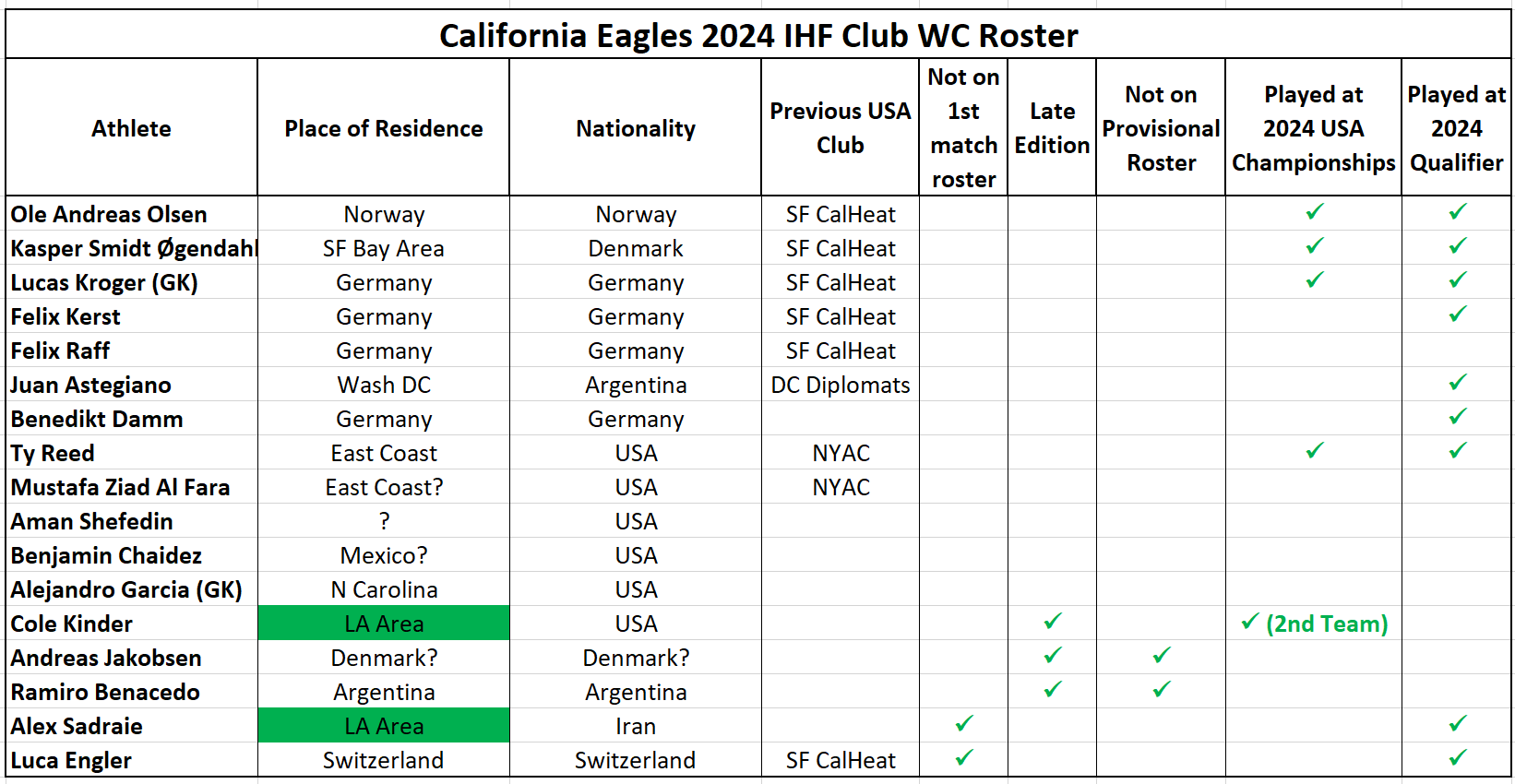
Here’s what’s problematic with this roster:
- Nationality: With the exception of Ty Reed all of the key players on the roster aren’t American. This is not to say that expats aren’t important to the development of the sport in the U.S. or that clubs shouldn’t have any expats playing for them. But, it does point out some underlying problems with the organizational structure of the sport in the U.S. That organizational structure inhibits the development of American athletes and the Super Globe “carrot” has further exacerbated the problem.
- Residency… where the club is actually located: There are only 2 athletes on the roster that actually live anywhere near where the club is located. This is very problematic if you think a “club” is a collection of athletes that regularly practice and play games together.
- Residency… in the country where the club is actually located. Over half the roster doesn’t even live in the United States. I do not have to explain how silly and absurd that is.
New Citizenship Requirement
It was brought to my attention that the IHF quietly installed a new citizenship requirement for the this year’s competition. Each club participating in the tournament is required to have six athletes with the same citizenship as the club’s location. (I don’t know if I should get any credit for this rule being added, but I’ll take a little.)
Best that I can tell this rule impacted three clubs: The California Eagles, Sydney Uni and Veszprem. With the California Eagles it appears they went on a little bit of an expedition to find American citizens that could be called up to meet the 6 athlete requirement. If you look at their preliminary roster its a mix of dual citizens and former national team athletes not playing club ball in Europe. Not surprisingly… the minimum 6 Americans were added to the roster. And, it appears that the the same thing happened with Sydney Uni and Veszprem. Yes, Veszprem, which has a roster jampacked with non Hungarians had to dip into it’s Academy roster to meet the requirement. And, amusingly this has resulted in a 7th American, Benjamin Edwards, getting to play at the Super Globe.
This is not a bad rule to have and, I think the U.S. should consider a similar requirement for it’s club teams. We probably should even consider a higher number or percentage to incentivize American athlete development.
Residency Requirements Next?
Similarily, the IHF, NACHC and USA Team Handball should take a long, hard look at adding some residency requirements. Obviously, it makes sense for clubs to consist of athletes who live in the same town. In fact, some Europeans reading this are probably shaking their heads and having a hard time contemplating how it would be otherwise. But, the reality is the U.S. is a very big country with a very small number of players. Not everyone has a nearby club to join and sometimes that nearby club is at a lower level then that athlete might want to play at.
But, again our existing structures and the Super Globe “carrot” are impeding the establishment of more clubs nationwide. Clubs have zero incentive to split off and create more clubs… because that would make the resultant clubs weaker. Athletes might prefer to play locally, but know they can only compete for a title if they join a bigger club in a bigger city that’s further away. This inevitably results in a few “super teams” loosely connected to a geographic area supplemented by Europeans flying in to further improve the team. A comical arms race to attend the Super Globe. This is not development.
To change the status quo… will require some new “carrots” and probably a few “sticks” to incentivize growth. That is… if we think we should take steps to incentivize growth and the development of American athletes.
Super Globe Future
While nationality and residency rules would crack down on some of the silliness with the current rosters it would create another problem. It would result in even weaker teams that simply can’t compete against professional teams. Or, to put it another way: The IHF can continue the charade of allowing fake teams so the matches are somewhat closer… or the IHF could recognize that the IHF Club World Championships should only be contested with professional sides.
I’m in favor of the latter. Let’s have four European clubs take on four non European pro teams. That’s a worthwhile measuring stick to see if the rest of the world is catching up. But, amateur sides? I just don’t see the point.