post

Pan America: Sorting out North, South, Central and Caribbean nations for team handball event qualification

PATHF and PANAM

I recently updated the World Championship and Olympic Qualification pages (See links on right hand side) and in doing so I got a bit of a geography lesson.  And that lesson is the following:

There is no definitive agreed upon standard for defining what countries are part of North America, Central America, South America and the Caribbean.

For sure, no one is ever going to place Canada in South America or Argentina in North America, but when you start talking about the countries in the middle of Pan America it’s wide open for debate.  Depending on the context and who’s talking Mexico is or isn’t part of Central America and the Caribbean nations can simply consist of the islands in the midst of that sea or those islands plus nations on the continent with coastlines on the sea.  Setting aside the generic debate, in the context of Team Handball those regions can be defined.  Albeit, it depends on what competition you’re concerned.  Confused?  So, was I.  So, here forthwith is an explanation that should help clear things up a bit.

1) The Pan American Team Handball Federation has administratively divided Pan America into 3 regions:  North & Caribbean, Central and South.  Those 3 regions are depicted in the top picture and qualification events for Pan American Championships are held every 2 years (Men) (Women) for the nations in those regions.  The Pan American Championships also serve as the qualification event for the World Championships, with typically 3 teams (and sometimes 4) earning slots.

2) The Pan American (PANAM) Games is a quadrennial event organized by the Pan American Sports Organization (PASO).  Qualification for the Team Handball Tournament at the PANAM Games is depicted in the bottom picture and is grouped into 3 regions: North, Central & Caribbean and South.  Qualification for the PANAM Games takes place every four years.

3) The Caribbean island nations (Barbados, Cuba, Dominican Republic, Haiti, Puerto Rico and Trinidad & Tobago) and Mexico swing back and forth.  They are grouped with with the North nations for Pan American Championship qualification and grouped with the Central nations for PANAM Games qualification

4) Greenland is recognized by PATHF and therefore can participate in Pan American Championships Qualification.  Greenland, however, is not recognized by the Pan American Sports Organization (PASO) and therefore cannot participate in PANAM Games Qualification.

5) For PANAM Games qualification Colombia and Venezuela can participate in either South American qualification or Central & Caribbean qualification.  Granted, give the current relative strengths of both regions it would be far more difficult to qualify through the South American Games, but they have that option

6) Some competitions can serve as qualification events for both Pan American Championships and PANAM Games competition.  For example, this is the case with the upcoming South American Games this March in Chile.  The top 3 nations at this event will earn slots for the 2015 PANAM Games and the top 5 nations will earn slots for the 2014 Pan American Championships.  And adding a little more confusion is the practicality that Colombia and Venezuela would likely participate in this event for Pan American Championship qualification purposes only.

Enlarged View of Pan American Championships Qualification Map: Link

Enlarged View of PANAM Games Qualification Map:  Link
post

American Gary Hines leads German club to big victory in battle for 1st place

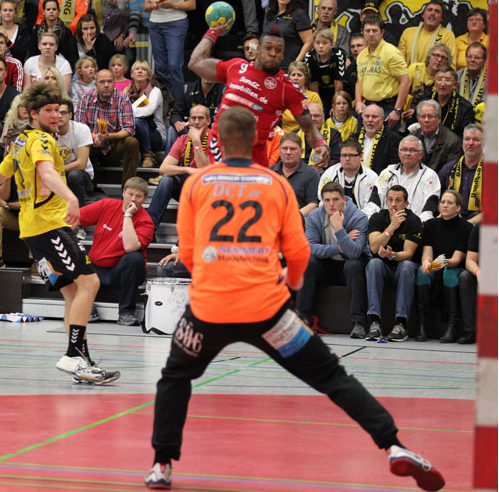
Gary Hines scoring one of his 7 goals for HSC Bad Neustadt this past weekend.

Gary Hines scoring one of his 7 goals for HSC Bad Neustadt this past weekend.

This past weekend Gary Hines led his German club, HSC Bad Neustadt to a pivotal, 22-20 early season victory over HSC 2000 Coburg.   Hines led all scorers with 7 goals in front of almost 1,000 fans in a highly charged atmosphere in Coburg.   Going into the match undefeated, 7-0-0 HSC Bad Neustadt had a 2 point lead in the 3rd Division Southern League standings over 7-1-0 Coburg.  With the victory on the road in front of nearly 1,ooo fans Coburg, Bad Neustadt is now solidly in first place, 4 points clear of the still, 2nd place Coburg.

Hines, 29, is now in his 4th season with Bad Neustadt.  Since first seeing Gary play 9 years ago at the U.S. National Championships I’ve been promoting him as a player who can and should be playing at a higher level.  Quite frankly, comparisons to France’s Luc Abalo are not much of a stretch in terms of raw athletic capability.  I’m not sure why some 2nd Division or even some 1st Division clubs haven’t gone after him, but with Bad Neustadt at the top of the table he may just travel with his current club there.

Interestingly, the club also has added another Pan American player, Emil Feuchtmann, 30, who has been a key player on the Chilean National Team for several years.  Could a showdown between the two Bad Neustadt players be in the offing for the 2014 Pan American players this summer in Uruguay?

Video:  HSC Coburg Report:  Link  (Pretty nice for the losing team to provide everyone a Gary Hines highlight video)

Video:  HangTime Hines Top 10:  Link

Match Report:  Link

German 3rd Division (Southern League) Standings:  Link

THN (May 2010):  Get this guy a contract!:  Link

post

LIVE VIDEO: Christer Ahl to highlight IHF governance issues at Play the Game Conference

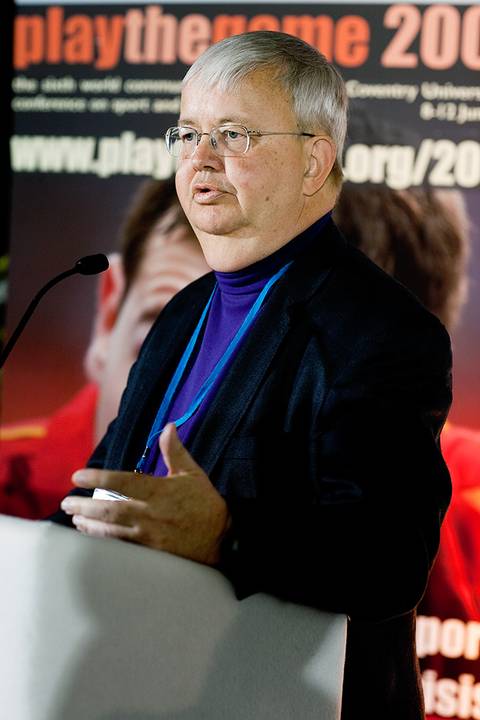
Christer Ahl speaking at the 2009 Play The Game Conference

Christer Ahl speaking at the 2009 Play The Game Conference

Former IHF Rules and Referees Commission President and Team Handball News contributor, Christer Ahl, will be participating in the International “Play the Game” Conference this week in Aarhus, Denmark.  The Play the Game Conference is the premier conference addressing sports corruption issues such as doping and match fixing and more than 300 attendees from over 40 countries are expected to attend this year’s event.

Christer will be taking part in the Wednesday (30 October) Evening Plenary Session, “Sports Reform:  How to change the tone at the top.”  His presentation is titled “The Despotic Regime of the IHF Just Continues” and as the title implies it will highlight several IHF governance issues that have surfaced in the past few years.   Other speakers during the session will highlight issues with the International Volleyball Federation (FIVB), the International Weightlifting Federation, Sponsor roles in sports Governance, the EU’s role and the International Sports Arbitration Council’s (CAS) role in sports reform.   The session starts at 7:45 PM (local time) and as the second speaker, Christer’s presentation will likely start around 7:55 PM (Local Time). The 1:45 session will also include questions for all speakers at the end of the session.  The session will also be live streamed around the world.


Live Stream:  Link 

(Important Note:  Daylight Savings Time ended this past Sunday in Europe, but doesn’t start in the U.S. until this Sunday, so Denmark is currently just 5 hours (vice, the normal 6 hours) ahead of U.S. Eastern Time.  I have also been informed that the Conference schedule is still subject to change so for up to the minute updates on his presentation time follow our Twitter and Facebook pages)

2013 Conference Program:  Link

Christer Ahl Profile Page at Play The Game:  Link

post

IHF President signals shift in development focus to India, China and U.S.

India, China and USA:  The main focus for the IHF?

India, China and USA: The new main focus for the IHF?

The Qatar based Gulf Times reported yesterday on the IHF Congress and noted that newly re-elected IHF President, Hassan Moustafa has indicated his main focus would be on development of handball in India, China and USA.  Specifically he’s quoted as saying:

“I want to develop the game in the big countries like India and China. My aim is to promote and spread handball and to groom more talent. It’s a big challenge and need full support of the community,”

If this comes to pass, it would be a significant change in policy when it comes to developing the sport.  Although hard data is not available, anecdotal evidence strongly suggests that support has diplomatically been spread roughly equally throughout the world regardless of the size of the country.

Cynically, in an interview with Team Handball News 3 years ago, then USA Team Handball Board Chairman, Dieter Esch, noted that it was his assessment that IHF aid was spread out equally in an effort to gather support from as many countries as possible for future elections.   Esch even voiced his frustration in the IHF’s failure to focus on key markets and specifically highlighted 3 countries:  India, China and the U.S.  Ever the businessman, Esch noted that there was nothing wrong with supporting all countries, but economically it made more sense to build the sport where the potential financial return was greatest.  I, for one, concur with this assessment, and in this commentary, I highlighted how European markets were starting to see the light in regards to the American market, even if they weren’t quite successful yet.

For those in other nations, who might see this change in policy as simply a siphon on their support, keep in mind the phrase, a rising tide lifts all boats.  For if this focus indeed results in turning India, China and the U.S. into nations that “care” about handball the financial windfall will eventually result in more aid for all.

It remains to be seen if the words at the Congress will be followed by concrete actions, but certainly this is a positive sign.  Up until now, the IHF has been far less engaged than the EHF, European National Federations, clubs and leagues.  An engaged IHF that seeks to better market the sport in the U.S. and further the develop the sport at the grass roots and National Team can only be a good thing.

post

Australian Bevan Calvert makes his mark in Germany’s 2nd Division

Calvert

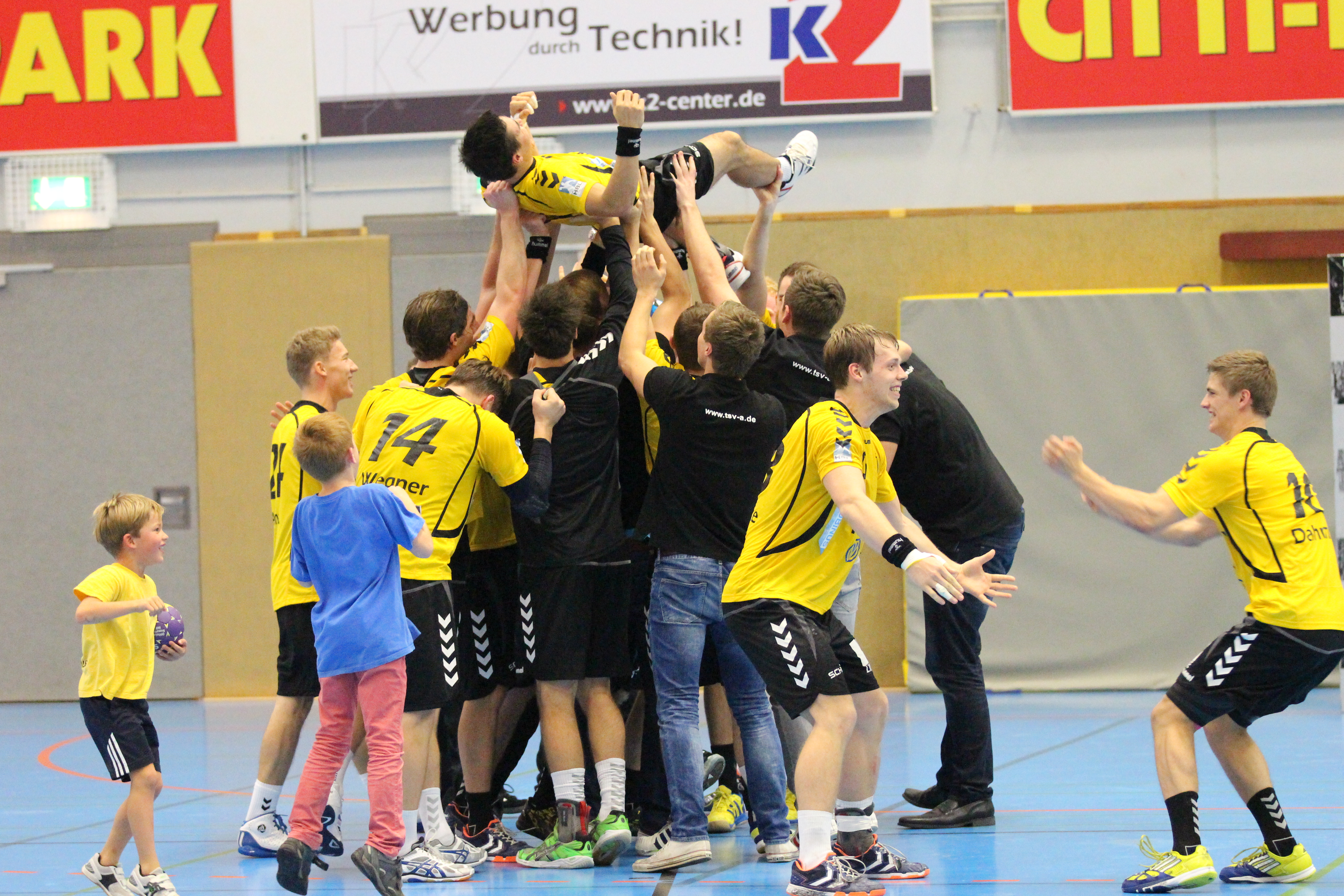
TSV Altenholz teammates hoist Australian, Bevan Calvert after he scores the match winner vs rival HSG Tarp/Wanderup

Last weekend, German 2nd Division side, TSV Altenholz narrowly defeated their nearby rivals HSG Tarp/Wanderup, 20-19.  Scoring the game winning 7 meter penalty shot was Australian, Bevan Calvert.  Calvert, 27 has been a mainstay on the Australian National Team since 2004 and has appeared in 5 consecutive World Championships.

Calvert, who plays right wing  is now in his 5th season with TSV Altenholz and with their promotion last season to the 2nd Division he’s now getting the opportunity to play competitively on a weekly basis in arguably the World’s strongest 2nd Division National League.  So far this season (through 8 matches) he is the team’s 4th leading scorer with 21 goals.

TSV Altenholz – HSG Tarp/Wanderup match writeup:  Link

Eurosport Video:  Link (Calvert is featured in this video on British Handball.  At around 7:30 he’s interviewed as the video examines what the British might learn from the Australian experience in 2004.)

Bevan Calvert Wikipedia page (German):  Link

Video of game winning shot is below.

post

IHF Congress Preview

IHFDOHA


The International Handball Federation (IHF) Congress throws off tomorrow, 25 October and concludes next Monday, 28 October.  Delegates from all around the world will meet at the Ritz-Carlton in Doha, Qatar.  Major items on the agenda include several elections, a presentation of the IHF’s plan for 2013-2017, several motions and the awarding of several junior and youth World Championship events.  Christer Ahl wrote 3 preview articles covering these major topics and links to those articles are below:

IHF Congress Preview
Part 1:  The Elections: Link
Part 2:  Budget, Planning, New Members, Events: Link
Part 3:  Proposed Changes in the IHF Statutes and other Motions: Link


The schedule of events for the Congress from the IHF Website:  Link

23 October: Meeting of IHF Executive Committee
24 October: IHF Council meeting
25 October: Meetings of the Continental Confederations including the Asian Handball Federation’s Electoral Congress
26 October: XXXIV Ordinary Congress of the IHF
27 October: XXXIV Ordinary Congress of the IHF including final banquet organized by the Organizing Committee of the 2015 Men’s World Championship in Qatar


post

USA Soccer’s turnaround; Hope for USA Team Handball

A low point for USA Soccer: Losing to Costa Rica at home and failing to qualify for the World Cup

A low point for USA Soccer: Losing to Costa Rica at home and failing to qualify for the World Cup

Yesterday, during his closing commentary on the Slate “Hang Up and Listen” Podcast, Josh Levin highlighted USA Soccer’s recent World Cup Qualification success and contrasted it with the U.S failure to qualify for the 1986 World Cup.  It’s an entertaining listen and a stark reminder of how far USA Soccer has come in the past 28 years.

Slate Podcast:  Link  (referenced commentary starts at 58:20)

In it’s final qualification match the U.S. lost 1-0 to Costa Rica in front of around 12,000 fans in Torrance, CA.  And most of those fans were Costa Rican Expats.  Shortly, thereafter the North American Soccer League (NASL) folded and the future didn’t look very bright at all for USA soccer.  But, as we all know things soon started to turn around.  The U.S. successfully hosted the World Cup in 1994 and restarted a professional league (MLS) which is now pretty stable and drawing decent crowds.  The Women’s team has won two world cups and youth soccer is played by millions across the country.  On TV just about every soccer match in Europe is available for viewing now on some network.  The U.S. is by no means anywhere near as soccer crazy as the rest of the world is, but the sport matters in this country and that is a remarkable success story.

It’s been common practice for many years to hold up soccer’s growth as the model for team handball to follow.   As I pointed out in this post several years ago, there are a number of flaws with this soccer analogy.   You simply just can’t photo copy soccer’s success or the successful growth in other sports like lacrosse, rugby and ultimate Frisbee.  What you can do, however, is take some pieces of their success and adapt them to a handball context.

And perhaps most importantly, you can take comfort in the fact that another sport was able to turn things around so dramatically.  I’m guessing if you were to ask the players and the handful of fans in Torrance cheering on Team USA, 28 years ago where they thought USA soccer was heading it would have been a lot of doom and gloom.  Yes, take some comfort in that it’s always darkest before the dawn.

America Soccer Now:  American Soccer in 1985:  The Failure in Torrance:  Link

post

Handball News Summary (21 October 2013)

Rafael Capote scored 10 goals on Saturday against Flensburg.  Will he play for Cuba again?

Rafael Capote scored 10 goals on Saturday against Flensburg. Will he play for Cuba again?

1) Cuban player scores 10 and makes EHF CL weekly Best 7 player list. Rafael da Costa Capote who plays for Naturhouse La Rioja in Logrono, Spain was on fire this Saturday against Flensburg. The 26 year old Capote defected while in Brazil for the 2007 PANAM Games and has apparently bounced around a little, first playing in Italy and now Spain.

ehfTV: Video (Best 7 of week 4): Link
ehftTV: Video (Match Highlights): Link
THN article from 2007 on his defection: Link

2) New Danish head coach advocates a shot clock for handball. Gudmundur Gudmundsson, following a Rhein-Neckar 23-22 loss to Luebbecke expressed his frustration with handball’s “passive play” rule and its inconsistent application. Even going so far as to advocate an NBA style shot clock.
Handball-World: Link
Original article in Mannheimer Morgen (German): Link

3) Alex Dujshebaev called up to Spanish National Team. In what will likely be the first of many International Games, 20 year old Alex Dujshebaev will play next month for Spain in two friendlies against Hungary.
Handnews.fr (French): Link

post

VIDEO: Champions League Group Play (Week 4)

Geipel/Helbig:  They handled the pressure in Reno.  Can they handle the PSG-Barca showdown?

Geipel/Helbig: They handled the pressure in Reno. Can they handle the PSG-Barca showdown?

ehfTV’s designated “Match of the Week” has two well known European soccer sides (Barcelona FCB and Paris St-Germain) meeting for the first time in EHF Champions League play.  Barca, of course, has also long been a handball power as well, but Paris St-Germain has only recently teamed up with Paris Handball.   And not only teaming up, but providing through their new Qatari owners an influx of cash and player signings to reportedly making it the highest player payroll team in Europe.  PSG, however, has stumbled a bit in CL playing, losing and drawing in Skopje to Metalurg and Vardar, respectively.   Barca also drew against Vardar in Skopje, but they are on top of Group C, thanks to their convincing wins at home against Wacker Thun and Metalurg.

A side note for U.S. fans watching the match:  The German referees assigned for the match, Lars Geipel and Marcus Helbig, were the same International officials on hand earlier this year in Reno, Nevada for the USA National Championships.  During the tournament I interviewed both officials and discussed their perspective on the quality of the American sides as compared to German clubs and their experiences in Reno.  The interview is a short 5 minutes and can be accessed at the bottom of this post.

Paris St-Germain vs. Barca (Sunday, 20 Oct 1700 CET/1100 U.S. Eastern Time)
Video: Link

If you can’t catch the match live it will also be available later “on demand”. Further, U.S. residents with beIN Sport can also catch a retransmission on Sunday at 1800 (Eastern Time).  (Thanks, beIN Sport, for not making me wait until Wednesday!)

The other big match this weekend will be a Group B showdown between Poland’s Kielce and Germany’s Kiel.  Last year both sides made it to the Final Four with Kielce beating Kiel, 31-30 for 3rd place.  This year both side are undefeated and Group B and it won’t be surprising if the two matches between these sides decides who gets 1-2 in the Group.

Kielce vs Kiel (Saturday, 19 Oct 1815 CET/1215 U.S. Eastern Time)
Video: Link

On paper, the other matches this weekend are of less interest, featuring either mismatches or battles for 3rd place on the table.   That being said, mismatches on paper sometimes end up being far more interesting in real life.  The times and links are easily accessible at the ehfTV web page.

(Note:  I will replace the live video links with on demand video links when they are available at the ehfTV website. If you go to the ehf website yourself click on the side arrows to get to the “Full Match” page. A word of caution, however, the EHF sometimes posts match interviews with revealing titles like “Jicha scores the decisive goal,” so you might want to use a sheet of paper to mask the screen if you want to watch the matches oblivious to the outcome.)

ehfTV Page: Link

EHF Week 4 Preview: Link (A written summary by Bjoern Pazen previewing all 12 matches)

Tom Ó Brannagáin’s latest blog post: Link

post

Handball News Summary (16 October 2013)

With lots of recent developments here's an all Pan American update.

With lots of recent developments here’s an all Pan American update.

With several articles of interest from the Mundo Handball and Handball Deprimera websites here’s an all Pan-America edition.

1) NOR.CA Championships to be played in Mexico. Citing a Handball Deprimera interview with PATHF Executive Director, Miguel Zaworotny, Mundo Handball reports that the tournament will be held in Mexico the last part of January. Separately, USA Team Handball CEO Matt Van Houten has indicated via email that the latest information he had been provided was for 23 February to 1 March 2014 in Mexico City.  (Note:  Historically, dates, times and location for PATHF related events have often changed multiple times before being confirmed.)
Mundo Handball (Spanish): Link

2) Cuba to compete for 2016 Olympic Qualification. In the same Handball Deprimera interview, Zaworotny indicated that Cuba intends to compete for 2016 Olympic qualification. (Note: I’ve inquired as to whether Cuba will also participate in the upcoming NOR.CA Champioship, but I haven’t received any confirmation yet.)
Mundo Handball: Link

3) Haiti to begin participation in PATHF Competitions. Again, from the Zaworotny interview. Haiti has not participated any events in a long time, if ever.
Mundo Handball : Link

4) Peru Handball Federation reaction to Lima’s selection as the 2019 PANAM Games host city. Ruben Gomez recaps an interview on the Handball Deprimera website with the Peruvian Federation and compares Peru’s situation to GBR and the London Olympics.
Mundo Handball (Spanish): Link

5) Argentina requests nearly a 1 month release for professionals playing in Europe. The South American Games in March 2014 will serve as the qualification even for the 2015 PANAM Games and the 2014 Pan American Championships. This is a key event for the Argentinian national team, but it remains to be seen whether their clubs will release them for that length of time.
Mundo Handball (Spanish): Link

post

AUDIO: Aarhus Handball Academy: Developing handball players through a combination of focused training and club competition

Aahus3

Athletes training at the Aarhus Handball Academy in Denmark.


Last month a notice that 11 players from Alberta, Canada were training at the Aarhus Handball Academy in Denmark took me by surprise.  To find out more about the program and why so many Canadians were trekking over to Denmark  I then interviewed, Alberta Team Handball Federation Executive Director Mike Nahmiash.

This time around I get the perspective from the staff at the Aarhus Handball Academy.  In this podcast interview with Headmaster, Aksel Nørgaard, and Coach Jesper Holmris we covered a number of topics including how the Handball Academy got started, the player experience at the Academy and playing with Danish club teams and whether age 22-23 is too late for a newcomer to start playing handball.

With Coach Holmris we also discussed his experience coaching the Great Britain Women’s National Team, the role the Handball Academy played in training British players in preparation for the 2012 London Olympics and what worked well and what in hindsight might have been done to better support the program.

We then close out the interview with a discussion of what could be done with a team of top athletes from the U.S. or another country could accomplish with a focused 2-3 year program there.

Aarhus Handball Academy website:  Link

Alberta player blogs: Link   (Several players at Aarhus are blogging about their experience)

post

VIDEO: Champions League Group Play (Week 3)


Talant Dujshebae will be in the stands in Skopje to see Vardar take on Paris SG.  Will he soon be the coach of either of those teams?

Talant Dujshebaev will be in the stands in Skopje to see Vardar take on Paris SG. Will he soon be the coach of either of those teams?

ehfTV’s designated “Match of the Week” has the two evenly matched foes with France’s Dunkerque hosting Denmark’s Kolding facing off in a Group B clash.  It’s still early in Group Play, but with two losses under its belt Dunkerque need’s a win badly if it still has plans on moving to the round of 16.   Dunkerque is a .5 goal favorite.  ehfTV’s Tom Ó Brannagáin’s will be on site with English language commentary.

Dunkerque vs. Kolding (Sunday, 13 Oct 1700 CET/1100 U.S. Eastern Time)
Video: Link

If you can’t catch the match live it will also be available later “on demand”. Further, U.S. residents with beIN Sport can also catch a retransmission on Wednesday, 16 October at 1700 (Eastern Time).

While Dunkerque vs. Kolding is the designated match of the week, in my opinion there are two far more interesting contest taking place on Sunday:

Vardar Skope vs Paris SG (Sunday, 13 Oct 1900 CET/1300 U.S. Eastern Time)
Video: Link

Two weeks ago Paris lost to the other Skopje team, Metalurg.  Now they return to play Vardar in the same arena.  Vardar already fought Barca to a draw there so could the world’s richest club lose again in Skopje to fall to 5th place in Group C?  Maybe Coach Philippe Gardent’s job is in jeopardy?  And what of Vardar?  They just sacked their coach and rumors are running rampant that former Madrid Coach, Talant Dujshebaev could be their next coach.  Dujshebaev will be in the stands to watch his son Alex play for Vardar and he swears that this trip was planned weeks in advance.  Who knows?  Maybe Dujshebaev will end up coaching who ever loses this match.  Has there ever been a match with so many questions?  All in the cauldron that is Boris Trajkovski Sports Center: perhaps the best place in the world to watch a handball match.

Nothing against the fine folks in Northern France, but Tom Ó Brannagáin and the rest of the EHF team should accidentally get on the wrong flight and head for Skopje. This is the real Match of the Week.   Quite frankly I don’t think I’ve ever been so eager to see a Group Play match.  Let’s hope it lives up to expectations. (Paris is a 2 goal favorite.)

Wisla Plock vs Kielce (Sunday, 13 Oct 1930 CET/1330 U.S. Eastern Time)
Video: Link

This all Polish clash should be entertaining.  Kielce has been the top Polish side for the past few years, but Wisla Plock with a few new roster additions would like to unseat them.  Kielce already beat Plock 32-28, so this will be a chance for them to make amends.  .

I will replace the live video links with on demand video links when they are available at the ehfTV website. If you go to the ehf website yourself click on the side arrows to get to the “Full Match” page. A word of caution, however, the EHF sometimes posts match interviews with revealing titles like “Jicha scores the decisive goal,” so you might want to use a sheet of paper to mask the screen if you want to watch the matches oblivious to the outcome.

ehfTV Page: Link

EHF Week 3 Preview: Link (A written summary by Bjoern Pazen previewing all 12 matches)

Tom Ó Brannagáin’s latest blog post: Link

post

Shuffling the Deck: Rethinking the IHF Olympic Qualification Tournaments

Shuffling the deck:  Rethinking the seeding of Olympic Qualification Tournaments

Shuffling the deck: Rethinking the seeding of Olympic Qualification Tournaments

Christer Ahl’s preview of the upcoming IHF Congress he noted that Japan and South Korea were proposing changes to Olympic qualification to add more slots for non-European nations.  As anyone who’s watched Olympic handball  knows with the exception of the South Korean women these tournaments have been very heavily weighted towards European nations.  And yes, that reflects actual relative strengths of the continents, but the optics of a mini European tournament on the Olympic stage are problematic.

I haven’t seen the exact proposals, but reportedly they would give Africa, Asia and Pan America 2 guaranteed slots each thus limiting Europe to a maximum of 6 of the 12 slots for the Olympics.  Christer concluded that this was going a bit too far and suggested that instead one of the 3 Olympic qualification tournaments be set aside for the non European nations.

This got me wondering just what exactly this might mean for the Olympic Qualification tournaments in terms of competition so I took a look at the 2012 tournaments and reshuffled them using Christer’s suggested compromise.

2012 Men’s Olympic Qualification (actual tournaments and results)

IHF Qualification Tournament #1
2nd at 2011 WC (Tournament Host): Spain
7th at 2011 WC: Poland
Europe (2nd place at 2012 EC): Serbia
Africa (2nd place at 2012 African Championships): Algeria

Results
1) Spain (3-0-0) 6 Points
2) Serbia (1-1-1) 3 Points +5 Goal Differential
3) Poland (1-1-1) 3 Points -10 Goal differential
4) Algeria (0-0-3) 0 Points

IHF Qualification Tournament #2
3rd at 2011 WC (Tournament Host): Sweden
6th at 2011 WC: Hungary
Pan America (2nd at 2011 PANAM Games):  Brazil
Europe (3rd at 2012 European Championships): Macedonia

Results
1) Sweden (3-0-0) 6 Points
2) Hungary (2-0-1) 4 Points
3) Brazil (1-0-2) 2 Points
4) Macedonia (0-0-3) 0 Points

IHF Qualification Tournament #3
4th at 2011 WC (Tournament Host): Croatia
5th at 2011 WC: Iceland
Asia (2nd at Asian Olympic Qualification Tournament): Japan
Pan America (3rd at 2011 PANAM Games): Chile

Results
1) Croatia (3-0-0) 6 Points
2) Iceland (2-0-1) 4 Points
3) Japan (1-0-2) 2 Points
4) Chile (0-0-3) 0 Points


2012 Men (with proposed alternative)

IHF Qualification Tournament #1
2nd at 2011 WC (Tournament Host): Spain
4th at 2011 WC: Croatia
6th at 2011 WC: Hungary
Europe (2nd place at 2012 EC): Serbia

IHF Qualification Tournament #2
3rd at 2011 WC (Tournament Host): Sweden
5th at 2011 WC: Iceland
7th at 2011 WC: Poland
Europe (3rd at 2012 European Championships): Macedonia

IHF Qualification Tournament #3
Pan America (2nd at 2011 PANAM Games) (Tournament Host): Brazil
Africa (2nd place at 2012 African Championships): Algeria
Asia (2nd at Asian Olympic Qualification Tournament): Japan
Pan America (3rd at 2011 PANAM Games): Chile

2012 Women’s Olympic Qualification (actual tournaments and results)

IHF Qualification Tournament #1
France (2nd at 2011 WC) Host
Montenegro (7th at 2011 WC)
Romania (Europe #2)
Japan (Asia #2)

Results
1) Montenegro (3-0-0) 6 Points
2) France (2-0-1) 4 Points
3) Romania (1-0-2) 2 Points
4) Japan (0-0-3) 0 Points

IHF Qualification Tournament #2
Spain (3rd at 2011 WC) Host
Croatia (6th at 2011 WC)
Argentina (Pan America #2)
Netherlands (Europe #3)

Results
1) Spain (2-0-1) 4 Points (+3 GD in head to head games vs Croatia and Netherlands)
2) Croatia (2-0-1) 4 Points (+0 GD in head to head games vs Spain and Netherlands)
3) Netherlands (2-0-1) 4 Points (-3 GD in head to head games vs Spain and Croatia)
4) Argentina (0-0-3) 0 Points

IHF Qualification Tournament #3
Denmark (4th at 2011 WC) Host
Russia (5th at 2011 WC)
Tunisia (Africa #2)
Dominican Republic (Pan America #3)

Results
1) Russia (3-0-0) 6 Points
2) Denmark (2-0-1) 4 Points
3) Tunisia (1-0-2) 2 Points
4) Dominican Republic (0-0-3) 0 Points

2012 Women (with proposed alternative)

IHF Qualification Tournament #1
2nd at 2011 WC (Tournament Host): France
4th at 2011 WC: Denmark
6th at 2011 WC: Croatia
Europe (2nd place at 2012 EC): Romania

IHF Qualification Tournament #2
3rd at 2011 WC (Tournament Host): Spain
5th at 2011 WC: Russia
7th at 2011 WC: Montenegro
Europe (3rd at 2012 European Championships): Netherlands

IHF Qualification Tournament #3
Pan America (2nd at 2011 PANAM Games) (Tournament Host): Argentina
Africa (2nd place at 2012 African Championships): Tunisia
Asia (2nd at Asian Olympic Qualification Tournament): Japan
Pan America (3rd at 2011 PANAM Games): Dominican Republic

Analysis

If one compares the actual tournaments that took place and the hypothetical tournaments that would have taken place a few trends can be discerned.  Here are the major impacts as I see it:

1) Every nation would have a shot at qualifying:  In theory, this was already the case, but in reality the prospect of any of the non-European teams knocking off 2 European teams at a tournament staged in Europe was pretty remote.  Intead those non-European teams would have legitimate chances with a tournament featuring evenly matched 2nd tier nations.  I suspect that Brazil and Algeria would have qualified in the Men’s tournament, but I wouldn’t have counted out Japan or Chile.  With the Women’s tournament I’m guessing that Tunisia and Japan would have qualified, but Argentina as the theoretical host would have been in the mix as would have been the athletic Dominicans.  And it goes without saying that any of the European sides could have envisioned themselves placing 2nd in the European tournaments.

2) Every nation would have a a very real possibility of not qualifying.   Conversely, those European nations would also face a very real prospect of slipping up and not qualifying.  Again, this was already the case, but pretty unlikely.  Most egregious are the 3rd qualification tournaments with 2 European and 2 non-European teams.  Those tournaments have been essentially glorified exhibitions that unfairly reward the 4th and 5th place WC qualifiers with all but free tickets to the Olympics.  With 4 European nations participating in the alternative setup even the host nations would have to be very wary of a slip up against 3 opponents each capable of beating them.

3) Tournaments worth watching:   A corollary of 1 and 2 above, from a fan perspective is that 3 tournaments with relatively predictable results would be replaced with 3 wide open tournaments.  Instead of perhaps 1 or 2 interesting matches among the 3 tournaments almost every match in the alternative setup will be competitive.  Heck, I would even bet that some of those tournaments would see a final day with every side still having a chance at qualification.  Talk about TV worth watching!

4) New nations qualifying for the Olympics.  Aside from the better qualification tournaments, opening up 2 spots provides an Olympic opportunity for nations like Japan, Algeria, Chile and the Dominican Republic.  Participating in an Olympics can provide a tremendous boost to the development of the sport in countries where the sport is less popular.  While, I’ve seen first hand how this boost wasn’t  sustained as much as I would have liked it to have been in the U.S. after the 84 and 96 Olympics it still was significant.  (For instance this website surely wouldn’t even exist.)  And while the U.S. example might not be a good one, take a look at what has happened in countries like Egypt, Tunisia, Brazil, Argentina and South Korea.  Creating more opportunities for more nations means more potential for making the sport truly global.

5) Two European nations would miss out.  Of course, this is the corollary to #4.  Is it fair to “punish” a better European side, perhaps a side that could beat the non-European side by 10 goals?  Should a professional player who’s devoted his/her life to the sport sit at home while an amateur player who’s played for a few years walks into an Olympic Stadium during the opening ceremonies?  It’s hard not to be sympathetic to the plight of those would be athletes.

6) The quality of the Olympic Tournament would decline.  Obviously, if you take out 2 of the top 9 nations of the world and replace them with 2nd tier nations the overall quality of the tournament will decline.  The question then becomes one of how serious of a decline would it be?   Realistically, at this point in time I don’t think any of the 2nd tier nations that would be capable of reaching the semifinals.  Whereas, the 8th and 9th European representative would have a legitimate outside chance of doing so.  So, we would be replacing a really long shot with just a long shot.   And there would likely be a couple more lopsided scores, but I think these 2nd tier nations are capable of playing competitively against the top nations maybe even getting an upset along the way.   In other words, losses of 5-10 goals instead of 20 goal shellackings.

Overall, I would argue that the benefits of  the proposed tweaking of the qualification system to allow more non-European nations outweigh the negative consequences.  As Christer suggested, balance is what’s desired.  Adding 2 non European nations seems about right at this point in time and it would help the growth of the game.