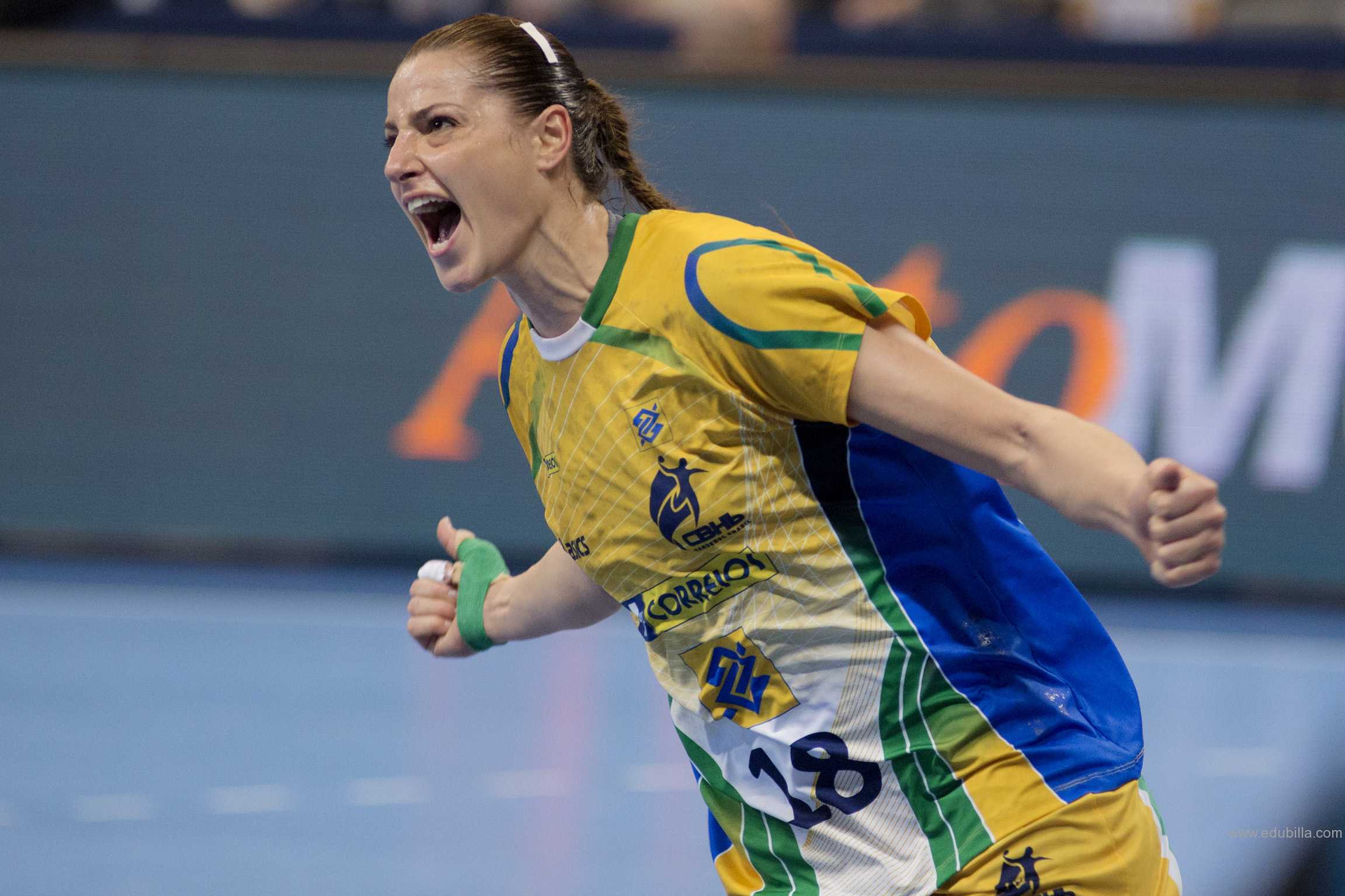
2019 Women’s Pan American (PANAM) Games Preview:  Can Anyone Stop Brazil?

Eduarda “Duda” Amorim and Brazil are Overwhelming Favorites to Take Gold

The 2019 Pan American (PANAM) Games officially open on Friday, 26 July, but the Women’s Team Handball competition will get started two days earlier.  Here’s some key information about the tournament and the nations that will be competing.

What’s at Stake:  The tournament winner will automatically qualify for the 2020 Olympic Games in Tokyo.  The runner up will be guaranteed a spot in an Olympic qualification tournament to be played in spring 2020.  Additionally, there’s a possibility that 3rd place will also get a ticket to an Olympic Qualification slot, but that won’t be known until after 2019 World Championships in December.

The Format:  The eight nations that qualified for the competition have been split into two groups of four.  Each group will play a round robin.  The top two nations from each group will then advance to the semifinals and the bottom two nations will advance to the consolations semis.  The winners of the semifinals will play for gold while the semifinal losers will play for bronze.

Schedule:

Wednesday, 24 July        Group Play
Thursday, 25 July              Group Play
Friday, 26 July                    <PANAM Games Opening Ceremonies>
Saturday, 27 July              Group Play
Sunday, 28 July                 <Rest Day>
Monday, 29 July               Semifinals
Tuesday, 30 July               Placement Matches

Details: Link
(Note: Lima, Peru is 1 hour behind US ET)

Where to Watch:  The Pan American Sports Organization has a new online channel, but it is not clear which matches will be broadcast.  An earlier notice indicated that handball matches would not be broadcast until the Women’s Semifinals.  In the U.S., ESPN owns the rights to all PANAM Games content and has signaled that they will show content on ESPN Deportes and their OTT platform, ESPN+.  Again, it is not clear if and when handball will be shown. (Check back here on on the Team Handball News Facebook or Twitter pages for updates)

PANAM Sports Channel: Link

Team Profiles (Group A)

Brazil
How qualified: 1st place at South American Games
Recent Pan American Results:
– 2015 Pan American Championship: 1st
– 2015 Pan American Games: 1st
– 2017 Pan American Championship: 1st
– 2018 South and Central American Championship: 1st
Key Player:  Left back, Eduarda “Duda” Amorim is considered one of the best players in the world.
Outlook:  To say that the Brazilian Women have dominated Pan American handball competitions is almost an understatement.  In multiple Pan American competitions over the past 10 years they are undefeated.  They are hands down the favorite to win the tournament.

Puerto Rico
How qualified: 2nd place at Central American and Caribbean Games
Recent Pan American Results:
– 2015 Pan American Championship: 4th
– 2015 Pan American Games: 6th
– 2017 Pan American Championship: 6th
– 2019 North American and Caribbean Championship: 2nd
Key Player:  Backcourt, Nathalys Ceballos, has been their primary offensive weapon.
Outlook:  Puerto Rico came within 3 goals of qualifying for the 2019 World Championships, losing to Cuba 27-24.  They’ll seek to avenge that defeat in Group Play in what will be a likely show down for 2nd place in the Group.

Cuba
How qualified: 3rd place at Central American and Caribbean Games
Recent Pan American Results:
– 2015 Pan American Championship: 2nd
– 2015 Pan American Games: 5th
– 2017 Pan American Championship: Did not participate
– 2019 North American and Caribbean Championship: 1st
Key Player:  Left Back Lizandra Lusson has been Cuba’s top scorer for the last several years.  She was the top scorer at the 2015 PANAM Games and led her nation in scoring at the 2015 World Championships.
Outlook:  Cuba’s up and down performance can be directly correlated to whether their top European based players show up or not.  If they do, Cuba may well have the 2nd best team at the tournament.

Canada
How qualified: 1st place at 2nd Chance Qualification Tournament
Recent Pan American Results:
– 2015 Pan American Championship: 10th
– 2015 Pan American Games: 7th
– 2017 Pan American Championship: Did not participate
– 2019 North American and Caribbean Championship: 7th
Outlook:  The Canadian women were soundly defeated by the U.S. in the North American qualifier, but bounced back to win the 2nd chance tournament.  They are a younger side and will be looking to improve upon their disappointing performance earlier this year at the North American Championship


Team Profiles (Group B)

Argentina
How qualified: 2nd place at South American Games
Recent Pan American Results:
– 2015 Pan American Championship: 3rd
– 2015 Pan American Games: 2nd
– 2017 Pan American Championship: 2nd
– 2018 South and Central American Championship: 2nd
Key Player:  Right Back, Luciano Mendoza, has been Argentina’s leading scorer for the past several years and Elke Karsten is an up and coming player who recently was signed by Hungarian club, Debrecen
Outlook:  The Argentine Women have been the perennial bridesmaid to Brazil in just about every Pan American competition for the past 20 years.  They are favorites to win Group B and if they do that could mean a semifinal match vs Cuba.

USA
How qualified: Beat Canada in North American Qualification Series
Recent Pan American Results:
– 2015 Pan American Championship: 10th
– 2015 Pan American Games: Did not qualify
– 2017 Pan American Championship: 5th
– 2019 North American and Caribbean Championship: 5th
Key Players:  Center back, Jence Rhoads, is the conductor of the U.S. attack.  Left back, Nicole Andersen is the top scoring threat.
Outlook:  The USA Women failed to qualify for the 2015 PANAM Games and following that disappointment they set their sights on returning in 2019.  Mission accomplished, but they would like to do more than just compete and are focused on a semifinal berth.  The U.S. Women will be under dogs to Argentina, but a strong defensive performance coupled with a consistent offensive attack could provide a surprise.  Barring an upset there they will need to beat the Dominican Republic to reach the semifinals.

Dominican Republic
How qualified: 1st place at Central American and Caribbean Games
Recent Pan American Results:
– 2015 Pan American Championship: Did not participate
– 2015 Pan American Games: Did not qualify
– 2017 Pan American Championship: 8th
– 2019 North American and Caribbean Championship: 4th
Key Players:  Wings, Nancy Pena and Yojaver Brito have done the bulk of the scoring for the Dominican Republic in their recent competitions.
Outlook:  In 2014 the Dominican Republic was banned from Pan American competition for having played over-age players at the Women’s Youth Championship that they hosted back in 2010.  Their program is on the rebound as evidenced by the title win at the Central American and Caribbean Games.  A potential show down with the U.S. for 2nd place looms Thursday.

Peru
How qualified: Host Nation
Recent Pan American Results:
– 2015 Pan American Championship: Did not participate
– 2015 Pan American Games: Did not participate
– 2017 Pan American Championship: Did not participate
– 2018 South and Central American Championship: Did not participate
Key Players:  Unknown
Outlook:  Peru qualified as host nation and until recently does not appear to have even had a women’s national team.  At the 2018 South American Games they lost by an average of 37 goals to Argentina, Chile and Uruguay.  This lack of experience will be hard to overcome so playing competitive matches and perhaps winning a match in consolation play is about the best outcome that could be expected

Podcast (Episode 57): Preview of Men’s 2019 NORCA Beach Handball Championships with USA Coach, Michael Hinson

Team USA’s Beach Handball Specialist/Reality TV show Icon, Jacobo Garcia, and the rest of Team USA are ready to take the gold.


The 2019 North American and Caribbean Beach Handball Championships will start today (Thursday, 11 July)  in Trinidad & Tobago.  USA Men’s coach, Michael Hinson called in from Trinidad last night to talk about their preparation, the USA Men’s roster and their competition at the tournament.

Tournament Live Stream: Link

USA Men’s and Women’s Roster Announcement: Link

Tournament Groups
Group A: USA, Barbados, Haiti, Trinidad & Tobago, Dominica
Group B: Mexico, Dominican Republic, Puerto Rico, St Kitts & Nevis

USA Men’s Schedule (All times are Local / US ET)

Thursday, 11 July
10:30 AM USA vs Barbados
3:30 PM USA vs Haiti

Friday, 12 July
10:30 AM USA vs Trinidad & Tobago
1:00 PM USA vs Dominica

(Note:  The format for the Men’s competition has the top 2 teams from each group qualifying for the semifinals.  Teams placing 3rd to 5th will play consolation matches.)

Saturday, 13 July
TBD Semifinal

Sunday, 14 July
TBD Placing Match

USA Beach Handball Links
Website: Link
Facebook: Link
Twitter: Link
Instagram: Link

During the podcast, Michael and I talked about Jacobo Garcia’s 2nd place finish on the Telemundo Reality TV show Exatlon.  Here’s a few links:

Jacobo Garcia on Telemundo show Exatlon: Link
Jacobo Garcia Instagram: Link

Podcast (Episode 56): Preview of NORCA Beach Handball Championships with USA Women’s Coach, Juliano de Oliveira

Coach de Oliveira expects big things from newcomer circle runner, Christine Mansour. (Photo: Jochen Korn)

The North American and Caribbean Beach Handball Championships will take place this week at Turtle Beach, Trinidad & Tobago.  USA Women’s coach, Juliano De Oliveira and I talk about his handball origin story, the USA Women’s roster and their competition at the tournament.

Thanks to Right Turn Media for their help with editing the podcast audio: Link

USA Men’s and Women’s Roster Announcement: Link

Tournament Groups
Group A: USA, Barbados, St Kitts & Nevis, Trinidad & Tobago
Group B: Mexico, Puerto Rico, Haiti, Dominica

USA Women’s Schedule (All times are Local / US ET)

Thursday, 11 July
11:20 AM USA vs St Kitts & Nevis
5:10 PM USA vs Trinidad & Tobago

Friday, 12 July
12:10 PM USA vs Barbados

Saturday, 13 July
TBD Quarterfinal

Sunday, 14 July
TBD Semifinal
TBD Placing Match

USA Beach Handball Links
Website: Link
Facebook: Link
Twitter: Link
Instagram: Link

Podcast (Episode 55) Kevin Gruzinsky and Joey Willams Discuss their Handball Adventures in Denmark

Kevin Gruzinsky and Joey Williams

Kevin Gruzinsky and Joey Williams recently spent several months in Denmark for extended handball training at the ISI Sports Academy in Ikast, Denmark.  In the podcast we discuss how they each discovered handball, how they decided to attend the ISI Sports Academy and their experience there.

ISI Sports Academy Handball Program Website: Link
ISI Sports Academy Handball Program Facebook Page: Link
Team Handball Academy (THA) Facebook Page:  Link (THA Director, Craig Rot, linked Joey and Kevin up with the ISI Academy)

Thanks to Right Turn Media for their help with editing the podcast audio: Link


Podcast (Episode 54): Texas A&M’s William Kennedy and North Carolina’s Aaron Hamm on Jr National Team Experience and the U.S. College Game

North Carolina’s Aaron Hamm and Texas A&M’s William Kennedy

Texas A&M’s William Kennedy and North Carolina’s Aaron Hamm are leaders on their respective collegiate teams and members of the U.S. Jr National Team that recently competed at the IHF Trophy Inter-Continental Championships.  I sat down with both of them at the conclusion of the USA Collegiate National Championships to discuss their experience in Kosovo and the state of collegiate handball in the U.S.

Men’s Results (Includes links to On Demand Video for several matches): Link

Women’s Results (Includes links to On Demand Video for several matches) Link

Team Handball News Collegiate Top 5: Army Keeps Rolling Along, Ohio State Takes Second at Arnold Classic


No movement at the top Since the last poll in February.  Army continued to stay undefeated in collegiate play with relatively easy wins over Auburn and Cincinnati at the Arnold Classic in Ohio.  North Carolina held on to the 2nd spot despite a mediocre showing at the Carolina Blue Cup.  They picked up collegiate victories over James Madison and Auburn, but didn’t pick up a win in their other matches vs at large clubs.   Ohio Stayed also held on their 3rd place ranking.  They took 2nd at the Arnold Classic and travelled to Denmark over spring break where they suffered some big losses to a couple of handball academies.  Still, they are hopeful that the experience will pay dividends next month at College Nationals.  West Virginia held on to their #4 spot while Air Force rode a respectable showing at the Valley of the Sun Tournament to move back into the rankings.

Here are the records for the remaining collegiate club teams (thru 20 March 2019)

Team Handball News Collegiate Top 5:  Army Retains Top Spot, but is No Longer the Unanimous #1 Pick


In a first, for the Collegiate Top 5, Army is no longer the unanimous top team, as North Carolina picked up a 1st place vote from one of the seven voters.  Army is still undefeated in collegiate play, but has struggled a bit vs non-collegiate clubs and has a .500 record (9-1-9).  While it can certainly be legitimately argued that this is reflective of competing against tougher competition, it can also be argued that this year’s squad is not as strong as Army has been in recent years.  And, maybe, just maybe they might be vulnerable to a North Carolina squad that is having a solid season

North Carolina is hosting the Carolina Blue Cup this weekend and a strong showing could well impress additional voters.  Also of note, this tournament will be the last for long time coach, Myles Bacon, who is moving to San Diego.  Bacon has coached the Men’s team for 11 years and the Women’s program for 6 years.  Mat Piec will be taking over the head coaching duties, with Johnny Massengale and Evan Gilbert assisting.

Rounding out the Top 5 are Ohio St, West Virginia and Virginia.  Slipping out of the Top 5 was Air Force which went 0-0-4, at the Cal Cup in January.  A poor performance, but arguably tougher competition than what Ohio St, West Virginia and and Virginia have faced.   We’ll see in April at the Collegiate Championship as to whether Air Force is being judged too harshly.

Below the top 5, Auburn and James Madison will also be participating in the Carolina Blue Cup so a relative pecking order amongst those teams should be known after the completion of the tourney.  James Madison, a relatively new program, even picked up a few votes and a solid performance could see them crack the top 5 next time.

W-D-L Records for Non-Ranked Clubs


Complete Database including all match results for the 2018-19 Season
All matches: Link
College Matches: Link

Team Handball News Collegiate Top 5 Poll (November 20, 2018)

North Carolina polls in at #2 after winning the Fall Buckeye Classic


The first Collegiate Top 5 Poll is out and it features some familiar teams and a few surprises.  To know one’s surprise defending national champions, Army, are a unanimous first choice selection.  They are undefeated in collegiate matches with victories over North Carolina in the American Classic Tourney and over Air Force in the annual Commander-In-Chief Trophy match.  North Carolina is ranked 2nd and voters likely awarded them that ranking based on their winning the Buckeye Fall Classic last weekend at Ohio St.  Air Force is ranked 3rd with their only match so far this year being a 45-32 loss vs Army.

The surprise team is West Virginia which is an entirely brand new program mostly composed of Kuwait expats studying Petroleum Engineering.  This past summer they easily defeated Ohio St in an exhibition match and they are off to a good start in the Northeast Team Handball League 2nd Division West with a 2-0-0 record.  Rounding out the Top 5 is the aforementioned Ohio St which took 2nd place this past weekend at the Fall Buckeye Classic/

North American & Caribbean IHF Trophy (Day 3 Results and Standings)

Youth (U18) Competition

Monday, 19 November Results
Canada 17×26 Martinique (Exhibition)
Mexico 28×19 Guadeloupe

Mexico easily defeated Guadeloupe to secure 2nd place in the pool play standings and they will take on Canada today in the Gold medal match.  Canada suffered a lopsided 26-17 loss to Martinique, but as the game was an exhibition it could very well be that they rested some of their players.

Canada scoring vs Martinique
Mamadu Guennady Barri, 5
Zachary Ouallouche, 3
Guillaume Palle-Lepine, 2
Mitchell Stephen Fodor, 2
Victor Laberge Faleiros, 2
Kevin Emeu Ngaleu, 1
Caleb Benjamin Baranyk, 1
Mohamed Auda, 1


Tuesday, 20 November Schedule
1:00 PM                Martinique vs Guadeloupe (Exhibition)
5:00 PM                Gold: Canada vs Mexico

Junior (U20) Competition

Monday, 19 November Results
Mexico 21×22 Martinique (Exhibition)
USA 24×23 Guadeloupe

The U.S. and Guadeloupe met last night in a showdown match to determine who would play in the final vs Mexico.  The teams fought a see-saw battle most of the way.  In the first half both teams struggled to score due to a combination of good defense and offensive miscues.  At the half the U.S. had a narrow 9-8.  The second half saw both teams cut down on the turnovers and a faster paced game.  With around 5 minutes to go the U.S. was able to pull away for a comfortable 4 goal lead.  Guadeloupe was able to chip away at that lead, but the U.S. hung on for 24-23 win.  The win sets up a rematch vs Mexico tonight at 7:00 PM.  The winner will qualify for the Intercontinental IHF Trophy tournament at a date and location TBD.

USA Scoring vs Guadeloupe
Amar Amitovic, 8
Giona Dobrani, 5
William Kennedy, 5
Logan Eriksson, 4
Austin Koury, 1
Nik Zarikos, 1


Tuesday, 30 November Schedule
5:00 PM                Martinique vs Guadeloupe (Exhibition)
7:00 PM                Gold: Mexico vs USA

Live Streaming: Link

North American & Caribbean IHF Trophy (Day 2 Results and Standings)

Youth (U19) Competition

Sunday, 18 November Results
Canada 24×22 Mexico
Guadeloupe 23×23 Martinique (Exhibition)

Canada finished pool play with a 24-22 victory over Mexico.  They have an unblemished record and will play in the Gold Medal match on Tuesday.  Today they will play an exhibition match vs Martinique while Guadeloupe and Mexico will play for 2nd place and a spot in the final vs Canada.

Canada Goals vs Mexico
Cazy de Dudley Gaspard, 5
Mamadu Guennady Barri, 4
Zachary Ouallouche, 4
Jean-Frederic Poulin, 4
Kevin Emeu Ngaleu, 2
Guillaume Palle-Lepine, 2
Caleb Benjamin Baranyk, 2
Mohamed Auda, 1


Monday, 19 November Schedule
1:00 PM                Canada vs Martinique (Exhibition)
3:00 PM                Mexico vs Guadeloupe

Junior (U21) Competition

Sunday, 18 November Results
Guadeloupe 18×27 Martinique (Exhibition)
Mexico 25×25 USA

USA Team Handball Report and Photos: Link

USA Scoring vs Mexico
Amar Amitovic, 9
Giona Dobrani, 6
Zachary Rietz, 4
Austin Koury, 3
Logan Eriksson, 1
William Kennedy, 1
Matt Reedy, 1

Mexico has finished pool play and will play in the gold medal match on Tuesday.  The U.S. and Guadeloupe will play today at 7:00 PM (U.S. Central Time) to determine who their opponent will be.  The U.S. will advance with a win or a draw while Guadeloupe must win to advance.


Monday, 19 November Schedule
5:00 PM                Mexico vs Martinique (Exhibition)
7:00 PM                USA vs Guadeloupe

Live Streaming: Link

North American & Caribbean IHF Trophy (Day 1 Results)

The North American & Caribbean IHF Trophy tournaments threw off yesterday, but not without a few logistical headaches.  The weather in Chicago/West Dundee resulted in every single team arriving late.  The Guadeloupe Jr Team even had to travel direct from the airport for their match vs Canada.

Further complicating both the Jr and Youth tournaments were eligibility issues with several players on the Martinique rosters.  The athletes in question had not been included on the previously submitted provisional rosters and therefore were declared ineligible.  As a result both the Martinique Jr and Youth teams will not officially compete in the tournament and their matches will be considered exhibition games.

Saturday 17 November (Youth Results)
1:00 PM                Canada 24×22 Guadeloupe
3:00 PM                Mexico 27×19 Martinique (Exhibition)

Zachary Ouallouche led Canada with 6 goals.  Mamadu Guennady Batri added 5 and Kevin Emeu Ngaleu scored 4.

Saturday 17 November (Jr Results)
5:00 PM                Guadeloupe 22×25 Mexico
7:00 PM                Martinique 16×18 USA (Exhibition)

The U.S. started very slowly against Martinique falling behind 4-0 early.  Following a time out they traded goals the rest of the first half and went into the break trailing 12-7.  The second half was all U.S. as excellent defense and stellar goalie play by Rene Ingram held Martinique to just 4 goals and the final score of 18-16.

USA Scoring: Giona Dobrani 6, Amar Amitovic 4, Logan Eriksson 3, Zachary Rietz 3, Elyese Batagi 1, Nik Zarikos 1

Today’s Schedule (Sunday 18 November)

Youth
1:00 PM                Canada vs Mexico
3:00 PM                Mexico vs Martinique (Exhibition)

Jr
5:00 PM                Guadeloupe vs Martinique (Exhibition)
7:00 PM                Mexico vs USA

Live Stream: Link


Colleges as a Jump Starter: Handball Inside’s interview with Jean Brihault, the IHF’s point man on U.S. development

Jean Brihault, the IHF’s point man for handball development in the U.S.

Colleges as a Jump Starter

The former EHF president, Jean Brihault (France), about his role as USA delegate for the IHF, the investments of the World Handball Federation and the central role of colleges and universities for the development of U.S. Handball.

How did the thought come about to foster Handball in the US?

JEAN BRIHAUT: It is an IHF tradition to meet the need to promote larger markets outside Europe. This is mainly about the markets in China and in the USA.  Also, because in 2028 – ten years from now – the Olympic Games will take place in Los Angeles.  And, if you want to know why I am in charge of it?: I am free, I have experience, I speak English, and because I have worked at universities in Europe, I have contacts with the presidents of American universities.  Besides, I’m not a danger to anyone.

The idea of helping handball in the US is not new.

BRIHAULT:  That’s right, but one crucial point was to split North and South America into two continental federations.  This means, among other things, that – unlike previous qualifications – the U.S. now has a realistic chance to qualify for international competitions and world championships. In addition, the Organizing Committee for LA 2028 was a very important factor in deciding future cooperation.  Until then, the United States Olympic Committee (USOC) and the US Handball Association hardly talked to each other.  Only gradually did the association, together with representatives of the USOC and with the support of a professional agency, come up with a convincing concept which has now been published. That is important because the USOC allocates funds to each of the national sports associations, and now Handball can receive support in the form of money, time and expertise.

And has the situation for the association improved a little?

BRIHAULT: As Dr. Hassan Moustafa and I were in the States in March, we met representatives of a foundation that immediately provided the Handball association with three fully furnished offices and a meeting room.  This is now the new home of the US Handball Federation and the North American Association.  There is enough space for both.  That way you can utilize synergy effects and save a lot of money.  The first six months are completely rent-free and after that the US federation only has to pay for electricity and heating.

That’s nice, but not that much. How does the IHF help?

BRIHAULT: The IHF is currently investing in a – let’s call it – a Development Manager, primarily responsible for finding sponsors for the US association.  The IHF pays him, but that can be confidently called an investment, as we firmly believe it will make a profit.  In addition, the USOC will pay for a Technical Director who is in charge of development, training and education programs.  You should know that the whole project is based on three pillars: high level performance, fundamentals and visibility.

This means?

BRIHAULT: For the performance, the association has hired Robert Hedin formerly coach of the Norwegian national team for the men.  For the women, there is an agreement with the French federation that the U.S. team can partake in one of their leagues on a non-competitive basis.  We are thinking about a start in the 3rd league for the season 2020/21.  In terms of visibility, I met with a manager from NBC to get handball on TV.  This is difficult because we do not have to address the classic Handball audience.  Thus, broadcasts of complete games are of little use.  Instead, we want to show sequences that will make our sport attractive to people in the US.  And, where contacts are concerned, we will try, among other things, to bring protagonists on board who are well-known in Europe and are in charge of the U.S. market.  Hans Vestberg, President of the Swedish Federation, is involved as is Xavier 0 ‘Callaghan, who is part of the management of FC Barcelona for the U.S.

How many players are we talking, when talking about Handball in the US?

BRIHAULT: That’s hard to say. That’s why I met with leaders of different colleges because they have to be involved if we want to give Handball a broad base. From there, the impetus has to start to make Handball popular.

And this project spans for the next ten years – so up to the Olympic Games in Los Angeles?

BRIHAULT: It should run as long as possible.  Part of this project will be to give the U.S. teams a wild card for the 2025 and 2027 World Cups so they can play handball at the absolute world level. I remember the people in Atlanta in 1996 were thrilled.  More than 30,000 spectators attended the final.  That is fantastic.

Interview by Arnulf Beckmann
Translation courtesy of Christa Ingram

Utopia des Handballs: Germany’s Handball Inside reports on the project to develop USA Handball

The German Handball Magazine, Handball Inside, reports on efforts to develop handball in the U.S.  Below is a translation of the article, courtesy of Christa Ingram.

Utopia des Handballs

By Erik Eggers

The World Handball Federation and European Top Clubs are working on a vision to make Handball popular in the USA, in order to unlock the most important market in the world. How thick this board is, shows a look at the many futile attempts in the past.

The two Handball spheres Rene Christian Ingram moves between could not be more different.  In everyday life the 19-year-old tends goal at TV 1861 Erlangen-Bruck II, National League North. His opponents are TV Helmbrechts, TG Beidingsfeld or ASV 1863 Cham.  In between, Ingram, who studies mechatronic in the third semester at the University of Erlangen takes off for a completely different world.  He boards a plane to the United States and slips on a US national team jersey:  Hardly noticed in the province of this country this teenager is considered a promise for the future of international handball there.

In early September Ingram with some major saves in goal helped to advance the development of US handball to another important stage.  In the knockout games against Canada for the Pan American Championship qualification 2019, a 36:24 home win in Auburn, Alabama, and in a 27-27 away rematch in Montreal, Quebec he was one of the strongest players on his team and was named MVG, Most Valuable Goalkeeper. “That was cool,” says Ingram in an interview with HANDBALL inside, in the two games against Canada, the team has shown “enormous development”.  Ingram now, just like his captain, Ian Hüter, who usually wears the jersey of TSV Dormagen, is looking forward to a longer excursion, the continental championships (PANAM Games) in July 2019, in Lima, Peru.  There the team, according to the wish of USA Team Handball CEO Mike Cavanaugh, will need to take at least third place in order to still have an chance to qualify for the Tokyo 2020 Olympic Games.  As will, the women, who also prevailed in the playoff against Canada.

“It is eight years ago now since we last qualified for the PANAM Games,” says Cavanaugh, “this is great for the athletes, coaches and USA team Handball. We want to send the signal now that we have the intention to stand on the podium in Lima.” For a long time what happened in the USA was not on the radar of the handball scene.

But, now that the 2028 Olympics will take place in Los Angeles a large-scale attempt has been started to establish handball in one of the most important sports markets in the world. “It’s one of the most important projects to develop handball there in the next few years,” Hassan Moustafa, president of the International Handball Federation (IHF) says. “There are a lot of ideas and concepts from people who think about it” says Gerd Butzeck, CEO of Forum Club Handball (FCH) which also supports the new initiative.

How valuable it would be to popularize handball in the US is obvious.  In order to economize the sport and not endanger the Olympic status further globalization is urgently needed.  In core markets like the USA, China and India, which accounts for more than a third of the world’s population, handball only plays a marginal role to date.  That is, of course, not new knowledge. The many attempts to establish handball in the USA have been a grand failure so far.

As early as 1931, a German gymnast named Ernst Lange, had founded a Handball department, the “German Sports Club New York.”  The “spread of handball in New York” is only the beginning, Lange said at the time.  The final aspirational goal would be “in the broadest sense to spread the game to 56 colleges and universities in the United States.  The future will show whether such a plan is feasible.”  At the field handball tournament of the 1936 Olympic Games in Berlin a US selection actually started.  Most players had German surnames such as Hemy and Otto Oehler or William Ahlemeyer and were of German descent.  They all played at the German Sport Club Brooklyn and in the German-American AC Queens, the two clubs in New York.  But, Langes’s idea to popularize the game by spreading it at US universities and colleges, could not be realized.

At the beginning of the 1960’s a new euphoria prevailed.  There could be “no doubt that the handball game also had a promising and successful care center in America,” cheered Siegfried Perrey, right hand man of Willi Daume.  (Perrey and Daume were both active in German handball and Olympic organization) “Indoor court games become increasingly popular” Perrey reported “there is already a championship round with four Canadian and US teams each, plus a “League of ten” in New York.

“The new sport has also caught the attention of the business people,” Perrey cheered: “In Canada, television is broadcasting big indoor handball games case-by-case.  This has called the promoters on scene in America.  They smell that Handball is a big business.  Right now is already the time that the clubs themselves risk venturing into the public on their own and thwart the plans of the professional managers.  Perry speculated about a handball tournament in Madison Square Garden, the most famous indoor area in the world.

Many officials, including the IHF at that time, put their hopes in Avery Brundage, the then president of the International Olympic Committee (IOC).  Since Brundage was very fond of anything German, one considered him as a friend of the handball.  But when the IOC in June 1961, voted against the inclusion of Handball for the 1964 Olympic Games in Tokyo, most IOC members from North and South America argued that they did not know that sport.

With this background, Dr. Peter Buehning proceeded with the founding of the US Handball Association and in 1962 the US was formally added as an official member of the IHF.  Buehning, a German-born entrepreneur, developed numerous initiatives during his tenure as President of the US Association to make Handball better known in North America.  One idea was to convert Europeans who studied or worked in the USA to US national team players.  At the Field Handball World Cup 1963 in Switzerland a US team with some German and Swiss nationals participated.  One year later in Czechoslovakia, the USA took part for the first time in an indoor world championship.  At both tournaments the president of the Association, Buehning, acted as captain of the Team and the Press spokeswoman was Buehning’s wife Renate.  Hans-Jürgen Hinrichs, President of the German Handball Federation (DHB) between 1989 and 1993, reported how Buehning recruited new players for his project at the time.  Before he started his career at the USA Volkswagen group Hinrichs had played with the DHB selection at the World Championships. “Completely unexpected” he got an invitation for USA national team training from Buehning. “I joined in and met a nice bunch, most of them from European descent.”

That’s the curious way Hinrichs got into the US selection for the World Cup 1964. “Buehning simply had, without asking me, requested a waiver for me and Fritz Hatting from the International Handball Federation” Hinrichs recounted.  Hattig who studied at Stanford had previously played for the West-German club TuS Wellinghofen.  Vincent Drake, the African-American star of the team, who stunned the opponents with his “windmill technique” had previously been a professional basketball player.

But, the World Cup participation didn’t really help to advance handball in New York, Chicago or San Francisco. That is why Buehning invented a new plan in the summer of 1969 and met at the height of the Vietnam War with four-star General William Westmoreland, the supreme commander of the US forces in Vietnam.  One of them, Buehning, wanted to popularize sport in the US.  The other, Westmoreland, was thinking about an image campaign.  The general wanted to demonstrate to the public that the US soldiers were not only trained to kill.  So, they decided on a joint campaign: a handball recruitment effort in the US Army for the 1972 Olympic tournament in Munich.

The first athlete to have been selected, in a sense the “Number One”, was Dennis Berkholtz, who became the captain of this team of Handball-Nobodys. “I played basketball.  What I heard was that Handball looks like water polo,” says fellow teammate Rick Abrahamson. “I had no idea what Handball is.  But, I thought it was better than serving in the Army, “says Brad Schlesinger, one of the US boys.  Machine guns or peace doves? Slaughter in Vietnam, always the Viet Cong in mind?  Or, at home playing handball?  These were the options offered to some soldiers in the US Army 1970.  The choice was not difficult.

The training motivation was high. “We were told: If the team does not qualify for Munich, then your next trip is over to Vietnam”, wing player Jim Rogers tells. “That’s why we all worked really hard”. “In the first two years, they lost almost every match. But then, also thanks to the help of their sports advisor, Bernhard Kempa, field handball world champion of 1955, in January 1972 they at least defeated Austria.  At the Olympics qualifier in February 1972 in Elkart, Indiana, they played in front of a crowd of over 7,000 fans.  The audience wanted to see Joe Voelkert, a local basketball hero, who had only played handball for half a year. After clear victories against Mexico and Argentina, the USA’s selection won the decisive game against Canada 15-11.  The plane did not go to Hanoi, but to Munich.

There they lost to Hungary, Yugoslavia and Japan. But, on September 7, 1972, the US sensationally won against Spain in the placement round (22-20).  “After that, I felt like I had won the gold medal,” Abrahamson says.  But, even with this “Pentagon project” Handball received no sustained attention in the USA.  Pioneers like Berkholtz tried their best after 1972.  But, even the 1984 Olympic Games in Los Angeles and 1996 in Atlanta did not change the shadowy existence of this sport.  Just as little as the go-getter Horst-Dieter Esch, the president of the US Handball Association, who in 2010, organized a remarkable international match between Germany and Poland in the US (“The Battle of Chicago”). While other nations on the continent such as Brazil and above all Argentina are making very good progress and are constantly improving, US handball is at best still third-league today.

These examples show that Handball is facing a Herculean task. On the other hand, a number of concrete initiatives have already been launched, organized by Jean Brihault, the former President of the European Handball Federation (EHF), as the IHF’s US representative (see interview).  The decision from the IHF Congress in Antalya 2017 to follow the pattern of football and divide the Pan-American Continental Confederation into separate North and South American federations has been ruled invalid by the International Court of Arbitration for Sport (CAS), but it is still unclear how this issue will eventually be resolved.  However, according to information from HANDBALL inside, the IHF will stick to qualifying for future World Cups with separate North and South qualification, which could make it easier for US teams to qualify for the World Cup tournaments or the Olympics. The US should also benefit from wildcards in the future.

One of the key short-term goals is to build strong national teams as without competitive US teams, US television’s interest in handball will not grow.  Therefore, US Team Handball has hired an experienced coach in Robert Hedin.  Hedin, once a coach in the Bundesliga (Melsungen) and in Norway, found his new job in a rather unorthodox way: “My wife found an ad on Facebook looking for a coach for the US national team,” he said in an interview the Hessian Lower Saxon General. “I thought for a moment, then I applied and after a telephone interview I got the job.”

United States handball boss Cavanaugh reported, though, that Hedin had been selected from a pool of 70 candidates. Hedin, he praised, sees the big story behind the project, and helps with his great expertise. “We’re talking about the US.  It’s still an extraordinary country with a great history of sports,” says Hedin.  Of course, the coach is just at the beginning.  In preparation for the playoff versus Canada he tested a number of players in training camps in Germany.  In particular, the nearly two-meter-tall halfback Abou Fofana, who was born in East Orange, New Jersey and plays for Nancy is a promising talent.

And, yet the Swede, who played in the Olympic Games in 1996, where he also played against the US, is also on the search for new players in Europe with US citizenship who could help his team short-term. For example, in the Bundesliga, according to Hedin, Christopher Bissei (HC Erlangen) or the Croatian Domagoj Srsen (TSV Hannover Burgdorf), who was born in New York, could be considered.

Other players who are identified in the US from other sports will be trained in large clubs.  For this purpose, the clubs organized in the Forum Club Handball want to invest a large sum; the plan is to let these players learn in France, Sweden, Germany, etc. The blueprint for this is the success of the women’s national teams from the Netherlands and Brazil, whose players developed the necessary competitive hardness in Denmark and Austria and thus advanced to the top of the world.  Brazil became a sensational world champion in 2013.  The Dutch women have been representing world-class quality for years.  It is intended that the US women will play in a French league starting 2020/21.

“It’s about a seven-figure sum that comes from the signing of a new TV-contract.”  But, such an investment only makes sense if it involves measures that promote sustainability.  “It would be less useful if a generation of players were well trained, but there was nothing to follow afterwards.  This is one of the reasons why the club representatives will be meeting with IHF President Moustafa on 12 November in Basel to discuss future models of handball promotion.

However, new structures have already emerged. For example, the US association, which sits in Colorado Springs, is already benefiting from cash flows from the US Olympic Committee.  Financial support is also provided by the IHF. The central task for the future, however, is to establish handball in the sports programs of high schools and colleges in order to recruit future national team players. That’s a long term plan, though, because to build a handball league at the universities, handball must be offered and operated at 40 universities.

The board that they have to drill is so thick, even if there are first delicate approaches outside the universities. “There are already 40 teams in the New York area,” says Hedin, “and, in Chicago a lot of young talent development is taking place”. “The first model region will be California, the Olympic host of 2028,” Brihault tells, followed by New York and Chicago.  One particularly promising influence is former Swedish Association President, Hans Erik Vestberg, who now acts as CEO of the US media giant Verizon.

And, then there was the already concrete idea to make handball known via a reality show on television throughout the country. It consisted of retraining athletes from other sports (Basketball, American football) to Handball and accompanying them with the camera till the Olympic Games, said pioneer Dennis Berkholtz last summer.  This show was planned on TV channel NBC.  For this reason, the channel’s executive producer, Alexander Katz, had already watched several major Handball games, such as the VELUX EHF FINAL4 in Cologne. This idea is currently on hold again.

However, according to information from HANDBALL inside, the station that will broadcast the 2028 Olympic Games in Los Angeles is considering showing the US Handball World Championships in the future.  That, too, would be a big step forward on the long road that handball still has to travel to make the Handball Utopia a reality.