post

USA vs. Uruguay Last Chance Qualification to be Live Streamed: What to Look for

The USA Women had a much needed offensive outburst against Puerto Rico last weekend.  Can they repeat that performance tonight against a better Uruguay side?

The USA Women had a much needed offensive outburst against Puerto Rico last weekend. Can they repeat that performance tonight against a better Uruguay side?

The USA Women and Men will be taking on Uruguay in the first match of a two game series tonight in Auburn, Alabama. The Women’s match starts at 5:30 PM (Local) and the Men’s match starts at 8:00 PM (Local). (Auburn is located in the U.S. Central Time Zone which is GMT-6.)

Livestream site: Link

USA Team Handball also indicates that the full match will be posted to Youtube a couple hours after the matches,

Taped Delay: Link

Understanding the 2 Game Playoff Format

These matches are only the first matches of a two match playoff. If a team wins both matches they, of course win the playoff, 2 wins to 0. If, however, there is a split with both teams winning one match, the winner will be determined by overall aggregate goal differential for both matches. For example if the USA Women wins the first match by 6 goals, but loses the second match by 5 goals, the USA Women will still advance due to having a “plus 1” aggregate goal differential.

Another way to look at it, is that the USA and Uruguay are playing a very long game with the first half being played tonight and the second half being played next Saturday in Uruguay. Because of this format it’s very important to note that simply winning the match by a narrow margin at home could be a unsatisfactory result. The goal is instead to win the first match by as many goals as possible. Or to put it another way, there is no “garbage time” at the end of the game as every goal counts in the end.

Finally adding to the home court advantage for both teams is the travel time required to and from Auburn, AL and Montevideo, Uruguay. Depending on the flights taken it could be anywhere from 17-25 hours of total travel time. And, on top of that there’s a four hour time difference, meaning that the Uruguay Men’s body clocks will be on Midnight when their match starts at 8:00 PM in Auburn.

A Closer Look at the Women’s Game

On paper the Uruguay Women appear to have an edge in this contest. This is primarily based on the last match between the USA and Uruguay played in July, 2013 at the Pan American Championships in the Dominican Republic.  The match was close for a half (14-12), but Uruguay totally dominated the U.S. in the second half en route to a 30-17 victory.

The rosters, however, have changed significantly for both teams. Notably, Uruguay is missing 7 players that scored 16 of Uruguay’s 30 goals in the 2013 match. The USA is also missing 7 players, but only 1 of them, Stephanie Hesser was a significant contributor in the 2013 match. And, Hesser who is perhaps injured and unavailable appears to have slipped on the depth chart anyway.

Also, the recent 3 game series against Puerto Rico might have been a breakthrough performance for the USA Women. For months the USA Women have struggled to put points on the board usually scoring in the low 20s.   This past weekend, however, they scored 29, 30 and 31 goals and if they can match that goal total against Uruguay it may be enough to put them over the top.

On paper, though, Uruguay is a stronger team than Puerto Rico and plays an aggressive 3-3 defense that has given the USA Women problems in the past. It will be interesting to see how the U.S. handles that pressure.

A Closer Look at the Men’s Game

Uruguay and the USA Men have an even more recent match that provides a window of what to expect. This past summer they met in a pivotal Group Play match at the 2014 Pan American Championships to decide which of the two teams would make the semifinals. In that match the USA played very poorly at the start and ended up being down 15-5 at halftime.   An aggressive defense surprised Uruguay in the second half allowing the U.S. to catch up and make the final score a more respectable 27-23, but the outcome was never really in doubt.

The rosters for both teams have changed some and both teams are missing a key player due to injuries. The U.S. is missing Adam El Zogby who plays professionally in Egypt and Uruguay is missing Massimo Cancio who plays in Spain’s Professional league.

The U.S. will surely be relying on its 2 veterans playing professionally in Europe, Gary Hines and Martin Clemmons Axelsson to provide the scoring punch, but it will be interesting to see how well coach Garcia Cuesta can integrate those players with his inexperienced residency program athletes. And, the U.S. has also called up several players who play on club teams in the U.S. to include Jordan Fithian, Justin Key and a trio of naturalized players from the former Yugoslavia, Serbians Vladimir Andjelic and Djorde Radovanovic and Croatian Vladimir Bicvic.

Uruguay’s side counts just 1 professional on its roster, Alejandro Velazco, who plays in Spain while 2 other players Gaston Ruddich and Sebastian Abdala play in the Argentine club league which while mostly amateur is fairly well established. The rest of Uruguay’s side plays club handball in Uruguay.

On paper based on last June’s match Uruguay is the the favorite.  That one match, however, was played in Uruguay and it seems unlikely that the U.S. will play as poorly as it did last June again.  The U.S., however, will have to make up for the loss of El Zogby at Left Back and the Uruguay side may also benefit from the greater familiarity their players have with playing with each other.

post

Charting a Way Forward for USA Team Handball: Option 8: The Alberta Strategy


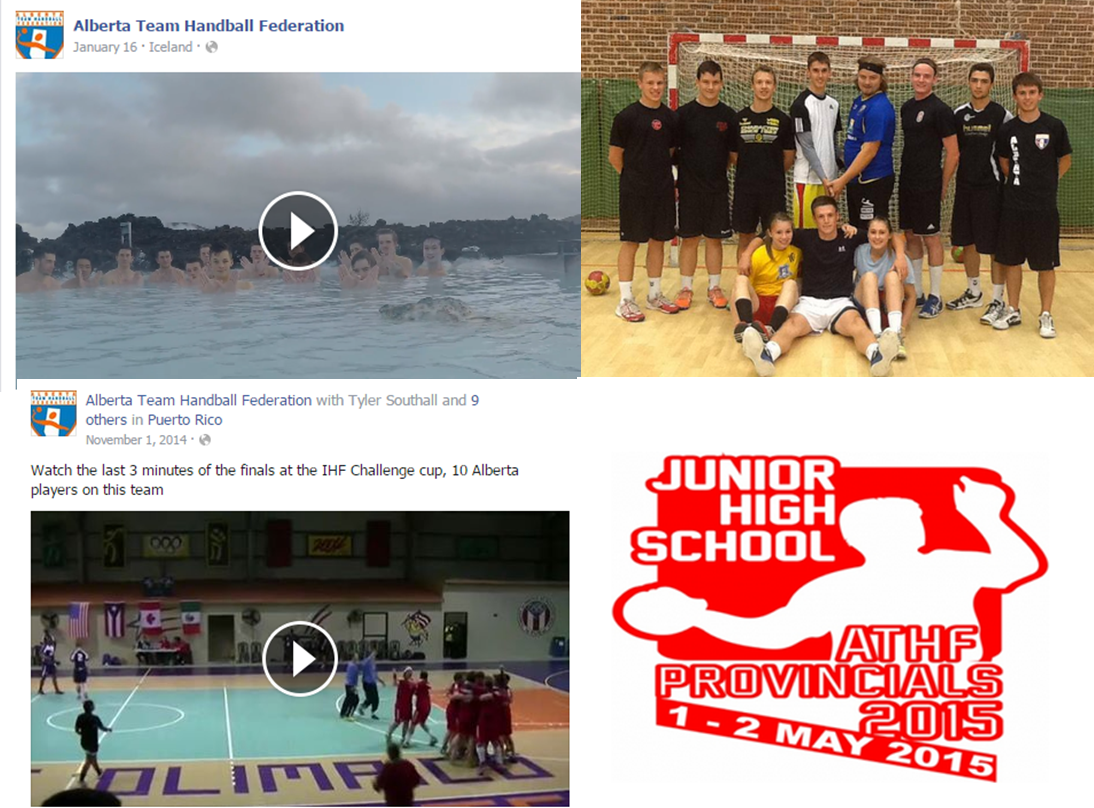
42 Alberta youth athletes at the Blue Lagoodn in Iceland, 11 Albertans at the Aarhus Academy, 10 Albertans on the Canadian Team that took Gold over the primarily Expat American Team,  Legitimate HS and MS championships.   What the heck is going on with Alberta Grass Roots Development?

Some of the 42 Alberta youth athletes who recently toured Iceland relax at the Blue Lagoon, 11 Albertans training full time in 2013 at the Aarhus Academy in Denmark, 10 Albertans on the Canadian Jr Team that took Gold over an American Team composed primarily of dual citizens living in Europe, Legitimate HS and MS championships. Just what the heck is going on in the foothills of the Canadian Rockies?  Have they cracked the development code and quietly created a Little Iceland?

Background

This past weekend the U.S. Men’s Team played 3 matches against the Alberta Sr Men’s team, winning 2 and drawing one.  The U.S. was clearly the better side this weekend, but Alberta proved to be a worthy opponent and a good tuneup for next weekend’s critical match vs Uruguay.  But, it does beg the question:  Why play Alberta and how did Alberta get good enough to take on the American National Team, albeit one without some of its top overseas based players?

The answer is that somehow Alberta has arguably developed the best grass roots program in the country.  Here’s some background on how far that province has come and what’s been developed there in the past 10 years or so.

Flashbacks to the 80s and 90s

I was first introduced to handball in Alberta in the late 1980s when a provincial team from Alberta came to play at the Copa Ventura tournament in California. (Nothing against Swim & Sport’s annual summer classic, but I’ll take the California Sun and the nearby ocean any day of the week over the swamp in Flanders.) The side from Alberta was a good one, but the old Ventura Condors was still able to best them in those tournaments.   Also, around that time frame I played in a couple of tournaments in Vancouver. Can’t remember if the Alberta teams were there, but the British Columbia teams were comparable to the U.S. club team I played for.

A few years later in 1993, a provincial team from Manitoba came down to Colorado Springs to play in the Falcon Cup. And, this was a beefed up Falcon Cup as the U.S. National Team used it as prep for the World Championships not unlike the current National Team did this past weekend. As, I recall the Manitoba side even played the National Team close for a while before we eventually blew them out. Then, a year later in 1994 while coaching the Air Force Academy I took the team up to Calgary for a mini-tournament. We arranged the trip with the Calgary reps on short notice, so the sides we played were shorthanded and Air Force was able to come away with the title.

What’s the point of this trip down memory lane? Well, the point is that from my perspective there wasn’t a whole lot of difference between the club programs in Western Canada and the clubs in the Western USA. Some decent players and teams, but primarily a bit on the older side with many players in their late 20s and early 30s. And, organizationally everything seemed a bit rag tag with dedicated volunteers doing the best that they can.

Flash Forward to Today

Some 20 years later in terms of club development and organization it’s more or less the same story in the U.S.   A few clubs still remain, some new clubs have sprung up while a number of others have come and gone. Demographically, there’s seems to have been a bit of a shift in terms of the greater percentage of Expats populating club teams, but other than that it all seems familiar. And, perhaps it’s a bit of a stretch for an American who hasn’t visited western Canada since 1994, but I suspect that club handball hasn’t changed a whole lot in British Columbia, Manitoba and Saskatchewan as well.

In Alberta, however, something is going on. I haven’t been on the ground there, but what I’ve read and heard suggests that somehow this province has cracked the development code that has long frustrated handball devotees in North America. In 2013, I was surprised to learn that 11 Albertans recently graduated from High School were headed to the Aarhus Handball Academy in Denmark. I spoke with Mike Nahmiash, the Exec Dir of Alberta Handball in this podcast interview and this is some of the information that I gleaned:

  • In grades 3-6 around a thousand athletes on 15-60 teams compete in provincial mini-handball championships
  • In grades 7-9 around 25-30 teams compete in Jr. High provincial championships
  • In High School handball is a sanctioned sport in Alberta just like basketball or volleyball
  • In grades 10-12, 3,000 athletes are playing on 120 teams; and teams play around 30-40 games a season

The last bullet seems to good to be true. I’m not calling Mr Nahmiash a liar, but numbers in handball development circles are often inflated. There are solid established teams, temporary teams, fully devoted hard core athletes and athletes that have picked up a handball once in their life. And sometimes those numbers are all added together to make things sound a bit better. That being said there’s no denying the solid evidence which includes:

  • Multiple youth teams of varying ages traveling to Denmark, Sweden, Norway, Iceland and surely other locations as well. Those trips aren’t cheap and are clearly a sign of dedication in significant numbers. Comparatively, youth players from Alberta have probably made more trips abroad in the past few years than all youth players from the entire U.S. in the past 20 years.
  • Real high school championships are taking place. Take a look at these programs and websites.  2014 Rosters:  Link Link Mike Nahmiash indicated in my interview that former U.S. Olympian, National Team Coach and NBC Olympics commentator, Dawn Lewis attended one HS competition and was blown away by the numbers of players and the quality of the competition.   Comparatively almost nothing exists at the HS level in the U.S.  As far as I know the Ocean, NJ girl’s team is the only HS age team in the entire U.S. regularly competing in events.
  • This past fall a junior Canadian team beat an American team for the Gold Medal at an IHF Challenge Tournament in Mexico.  The Canadian team had 10 Albertans on the roster while the U.S. team was primarily composed of dual citizens living in Europe.  Honestly, the U.S. would struggle to even field a team without those athletes who learned the sport in Europe.  For certain, we could not field a competitive team without them.
  • This past weekend an Alberta Provincial Team played the U.S. National Team toe to toe on American home turf in Auburn. The U.S. team is training together on a daily basis and is likely on average older than the Alberta side.  Could any state in the U.S. even field a competitive team of athletes in their younger 20s?

How has Alberta gone from a typical backwater region with very modest handball participation to the hotbed of North America? It’s hard to fully ascertain without being on the ground, but it would seem that a growing cadre of volunteers have been ably managed and led by Exec Director Nahmiash over the course of the past 10 years. And, more importantly it has apparently been done with almost zero outside funding from the Canadian Federation. Seriously, if you think the USA Team Handball Federation is fiscally challenged, realize that our neighbors to the North can only dream of having salaried staff members.

Analysis

For previous options I have included some top level analysis of pros, cons, risks, costs, and timelines for implementation. At this point, however, I’ll be the first to say that I’ve only scratched the surface as to what’s going on in Alberta and how some of the initiatives that they’ve successfully undertaken could be implemented in the U.S. The key takeaway, though, is that Alberta has been wildly successful in its development efforts. How successful?

Arguably, more new development has taken place in Alberta in the last 10 years than has occurred in the entire history of USA Team Handball. And, having been 10 years or so it’s most likely sustained growth that’s not going away anytime soon.

Certainly at the High School level there is no debate as to the accuracy of that statement. Perhaps at younger ages it is less true, thanks to past programs like at the Boys & Girls clubs in California/Georgia and Rock Handball and current programs like the one Craig Rot has started in Chicago. Still, the fact that such an argument can legitimately be made should get people wondering why a similar effort hasn’t been put in place in the U.S.

But, before I put too much sunshine on the Alberta efforts I’ll throw on a bit of cold water. In particular, it’s not clear if this grass roots development is going to translate to success at the National Level. While Canadian National Teams have started to see the placement of more Alberta players there’s rough parity with Quebec, Canada’s traditional handball stronghold. And while a few players have played professionally in Europe there doesn’t appear to be any breakthrough world class players yet from Alberta. Logically, one could argue that it’s only a matter of time before greater success happens at the Senior Level, but the reality is that it hasn’t happened yet.

Another consideration is that what works in Canada won’t necessarily work in the U.S. Yes, the two countries have a great deal in common, but there are organizational and structural differences in our schools that might make it difficult to duplicate Alberta’s success in an American location.

But, getting back to the key takeaway, Alberta has clearly developed a successful model for development. I’m not a big believer in the concept of “no brainer” decisions that don’t require any due diligence analysis first, but I’ll make an exception in this case.

USA Team Handball should expend some significant time and energy to better understand just what’s happening in that corner of the Great White North. Then perform a full assessment as to how some of that success can be translated to the States.

post

Charting a Way Forward for USA Team Handball: Option 7: The All the Eggs in One Basket “Iceland Strategy” (Part 2)

The Greater Boston metropolitan area has the population equivalent of 14.5 Iceland’s.  Boston also has a pretty decent chance of hosting the 2024 Olympics which would result in substantial opportunities for local sponsorship.  The Auburn-Opelika metro area is the equivalent of less than half an Iceland.  Which location would be a better candidate for focusing limited resources in the hopes of creating a “home for handball” in the U.S.?

The Greater Boston metropolitan area has the population equivalent of 14.5 Iceland’s. Boston also has a pretty decent chance of hosting the 2024 Olympics which would result in substantial opportunities for local sponsorship. The Auburn-Opelika metro area is the equivalent of less than half an Iceland. Which location would be a better candidate for focusing limited resources in the hopes of creating a “home for handball” in the U.S.?

Part 1 of this option highlighted the potential benefits of focusing resources in one geographical area and the historical limited success the U.S. has had in doing so. This part explores how the U.S. might learn from the past should it decide to try and create a “Home for Handball” in the U.S.

Building a Better Mousetrap

One could infer from the lack of success highlighted in part 1 that you simply can’t artificially create a Little Iceland. But, maybe the lesson is just that it wasn’t done the right way.   That to execute such a strategy successfully, better planning, more resources and more patience are needed. It’s certainly debatable. One thing is for sure, though: The potential benefits of creating a Little Iceland or Home for Handball in the U.S. merits a further investigation. An investigation that would first take a long hard look at what’s worked and what hasn’t. A full assessment of the failures of the past and some real thought into how it might conceivably work in the future. I haven’t fully assessed those failures, but have a fairly solid understanding of what happened and what could be done differently. Here are some thoughts on building a better mousetrap:

  1. Very Carefully Select your Location. Ask any real estate professional what the 3 key issues are for selling a house and they’ll tell you: Location, location, location. It’s no different in assessing where best to focus limited resources. Here are some key factors that should go into making the all important location decision.
    • Population: In general, the more people living in the location that’s selected, the better chance you are going to have in reaching critical mass. It’s simply a numbers game with the acknowledgment that your conversion rate (i.e. converting someone who doesn’t care about handball to a truly devoted participant/fan) could be really, really small.  After all, a good portion of the population at-large doesn’t care about any sports, let alone one they’ve never heard of. Converting 1 out of every 100 people would be a pretty darn good conversion rate. 1 out of 500 or 1,000 might be more realistic. This reality means that choosing a large metropolitan area will greatly improve your chances of creating converts.

      For example take a metro area like Boston with a population of 4,684,300 people. To create 5,000 handball fans/participants you would need a conversion rate of .11% or roughly 1 out of every 1,000 people. Now contrast that to the Auburn-Opelika metro area and its population of 135,800 people. To create 5,000 handball fans/participants you would need a conversion rate of 3.68% or roughly 37 out of every 1,000 people. Ouch. Those are some tough numbers. I’m not saying that it’s impossible to reach critical mass at a college town in rural Alabama. But, I will say that without a doubt the smaller population base means it will be way more challenging there than in a major metropolitan area.

    • Job opportunities: Athletes are far more likely to move to a location where there are varied job opportunities including professional positions for recent college graduates
    • Education Opportunities: Athletes for both the residency program and collegiate league would be interested in quality education opportunities.
    • College League Possibilities: The potential to develop a collegiate league in the regional area should be an important factor. And a league with reasonable driving distances for competition.
    • School District Pilot Program Possibilities: The potential to engage local high schools and middle schools to adopt team handball as a sanctioned sport
    • Cost: The costs of setting up a handball academy and supporting leagues and other development initiatives will be substantial. Some locales will be more suitable and cheaper for a number of reasons.
    • Sponsorship Opportunities: The likelihood of obtaining local community support for a handball academy and other development initiatives.
    • Existing local handball support: Ideally, there would already be at least some dedicated supporters of the sport in the local area. Having a ready group of dedicated volunteers will facilitate implementation of several development initiatives.
  2. Fully integrate all aspects of regional development: It’s important to highlight that focusing resources in one location would be a lot more than simply establishing a residency program/development academy. Such a high performance training environment would be a key part, but just one part in a true regional development effort. And, all those parts (youth development, a high school league, college league, club league, development academy) would need to work closely in tandem to maximize the success of this initiative. This would mean maximizing staffing to support all these elements. In particular, athletes could be justifiably compensated for their support to youth and high school league support.
  3. Fully commit and prioritize this regional development effort: Make no mistake, this would be a major effort and for it to work it might well be required to substantially decrease support to many other Federation activities. Doing a regional effort, “on the cheap” with only partial commitment/funding support also lessens the potential synergy possible with a multi-pronged effort.
  4. Give the effort time to blossom and mature. This effort could very well take several years to fully bear fruit. Pulling the plug or lessening support prematurely due to the lack of immediate results will defeat the purpose of such a concentrated effort.


Pros


Establishment of a recognized “Home for Handball”: Having a recognized home for the sport will help in a number of tangible and somewhat intangible ways. Name recognition and identity in one concentrated geographical area has value. With it comes media exposure, sponsorship opportunities, greater public awareness and “buzz”. All of those could even mean real crowds and eventual TV broadcasts.


Improved Recruiting Prospects:  Co-locating youth, high school, college and a Residency Program/Development Academy efforts together will create a pathway/pipeline that athletes can see and join. Critically, this will make it far more feasible to recruit athletes from ages 10-18. An age group that has been very difficult to recruit for a variety of reasons.


Cons


Lessens the possibility of broad based nationwide growth:  A very strong focus on one regional area will by default result in less support to other regions. Correspondingly, there will likely be less chance for growth on a broad coast to coast basis. Rather than taking advantage of it’s huge population, the U.S. will be restricting itself due to a de facto self-imposed restriction.


Shows favoritism to one “blessed” region:  Handball supporters in other parts of the country getting less support will likely voice their disfavor with an intentional and pronounced unequal sharing of resources. For sure, historically there has been grumbling at even minor appearances of favoritism towards a club or region. And this time the grumbling would be somewhat justified because their efforts will indeed be getting fewer resources.


Risks


If the basket breaks, so will all the eggs.   It’s important to remember the cautionary basis for the “all the eggs in one basket” saying. Namely, that is a warning not to do it, because you won’t have any eggs if you drop that basket. And, just like that basket of eggs if the region you choose to focus on fails to pan out then you will have nothing to show for. This could be a spectacular failure. But, then again there have been far too many failures with many of the other piecemeal strategies that have been tried in the past.


Costs


In theory, a regionally focused strategy will save significant money and resources. This is because staff, athletes and volunteers would be concentrated in one location and could readily focus on multiple, integrated development efforts without significant travel costs. Keep in mind, however, that this only works if the effort is truly focused on a particular region. If you spread efforts such as a residency program, High School Pilot Program and collegiate league to different regions of the country it will be less feasible to share staff and funding to support multiple efforts.


Creating a Little Iceland or Home for Handball in the U.S. is certainly an enticing prospect, but also a risky one. In part 3, I’ll tackle the timing for implementing such a strategy should USA Team Handball decides that it’s a risk worth taking.


post

Charting a Way Forward for USA Team Handball: Option 7: The All the Eggs in One Basket “Iceland Strategy” (Part 1)

All the eggs in one basket: What if all of the major handball clubs in the U.S. were in one regional area?

All the eggs in one basket: What if all of the major handball clubs scattered to the 4 corners of the U.S. were instead focused in one metropolitan area?

Would the U.S. be wise to develop a very focused development strategy around one metropolitan area? In part 1, I lay out the arguments for doing so and review historical efforts to spark development regionally. Part 2 will focus on the pros/cons, costs, risks and timing for doing so.

Iceland: 1,000 Times Smaller

Ever since I had the opportunity to play against Iceland at the 1993 World Championships I’ve been a little bit fascinated with Iceland and it’s national handball program. I even remember getting out my world almanac (yeah, this is a little bit before widespread internet and Wikipedia) because I was asking myself, “How many people live there, anyway?” Not sure what it was 22 years ago, but the current population is roughly 323,000 people. Coincidently, the population of the U.S. is approximately 323,000,000. This disparity inevitably leads to the question: How does a country roughly 1/1,000th the size of the U.S. kick our butts in handball?

Obviously, in terms of handball national team performance, there’s a lot more at play than total population. And, the key difference is that a significant portion of Iceland’s very small population is very focused on handball, whereas in the U.S. a very miniscule percentage has the same dedication. Seriously, depending on how you want to define it, it’s really small. I would argue that there are only around 300 really dedicated handball followers or around 1/1 millionth of the U.S. population. Bump it up to a 1,000 if you want, but you’re still talking about 1/300,000th of the U.S. population.

Creating a Little Reykjavik

Compounding the U.S. struggle is the reality that the handful of folks that really care about the sport are scattered throughout a huge nation, making it a struggle to work together to grow the sport.

Over the years I’ve found myself thinking about this problem, relating it to Iceland and playing a little numbers games of population comparison. I grew up on a farm in the state of Iowa (around 10 Iceland’s) and not too long ago lived in Las Vegas (6 Iceland’s). I remember driving across town and looking over towards the sprawling suburbs next to the mountains and thinking, “Hey, I just drove past a couple of Iceland’s.” And, now I live in Colorado Springs with a metropolitan area a bit bigger than 2 Iceland’s.

As, I’ve played this little game I’ve thought about what could be done if everyone who cared about the sport of team handball lived in the same place. Be it Iowa, Las Vegas, Colorado Springs, Boston or even Auburn, Alabama.  In short, I’ve asked myself:

What if we could throw all the eggs in one basket?

What if…..

  • Instead of top clubs scattered throughout the country they all resided in one compact area?
  • In one metro area, there were 10 top senior club teams regularly playing each other in a league competition?
  • There were 20 collegiate teams feeding those programs.
  • There was a Handball Development Academy training the top players in those colleges on a regular if not daily basis?
  • There was a sanctioned High School sports program in that city feeding those college programs with new recruits?
  • There were 50 youth clubs training and playing games, feeding the high school program?

Why, if all this were true and somehow came to pass it would be, as if, the U.S. had a little Reykjavik all its own. Or, as I like to call it the “All the Eggs in One Basket, Iceland Strategy.”

Organic Success

To some extent such a strategy has indeed been implemented to varying degrees in other sports. In most cases, though, it wasn’t actually a strategy. It just happened organically or naturally without artificial help. Case in point, are a couple of sports that for many years were essentially Californian, water polo and volleyball. Yes, there was a time not that long ago when competitive volleyball was very California centric. And, it still pretty much is when you’re talking men’s volleyball. And, although water polo has spread it’s wings some, all one has to do is look at where the bulk of the collegiate programs are to see that it is still very California centric.

The advantage to this regionalism is that the sport had critical mass in terms of local competition and development. Critical mass in that there were plenty of teams to play each other and create development at younger age levels. However, if that interest had been spread out evenly across the vast United States there would have been no critical mass. Clubs would have had to travel vast distances for competition. Isolated clubs might have sprung up, but these pockets of growth would be susceptible to periodic collapse of clubs and lack of interest.  Youth teams with no one to play would struggle to even get started. Why volleyball might never have become what it is today. Water polo might even be the equivalent of what Team Handball is in this country. A non-relevant sport from coast to coast.

Non-Organic Experiments with Limited Success

But, can such a regional massing of clubs and interest be created nonorganically? Can a federation take steps to proactively create a little handball Reykjavik? The answer is yes: steps can be taken. In USA Team Handball’s case the primary tools for doing so has been national team residency programs and investment to capitalize on the Olympic host city exposure.

Since the mid 1980s residency programs have been located in Colorado Springs, CO; Philadelphia, PA; Atlanta, GA; Cortland, NY and most recently Auburn, AL. In each case the massing of athletes in one spot has had some development effect on the local area. First off, just simply practicing an unfamiliar, but cool looking sport inevitably attracts a few onlookers to try it. Some of those athletes even became national team players. The athletes based at those locations also often did community outreach to facilitate development. Finally, for a variety of personal reasons some athletes settled in the residency program location and still live there today.

Unfortunately, none of these locations have had much success in terms of sustainable impact. Today, Colorado Springs has a local club mostly comprised of aging veterans that gathers occasionally to provide competition for the AF Academy. Over the past decade or so there have also been some decent youth programs in the Colorado Springs area, but no program is currently active. To the best of my knowledge pretty much nothing exists handball wise in either Philadelphia or Cortland, NY, but neither or those locales were residency sites sufficiently long enough for any side benefits to take effect.

In terms of an Olympic boom, both Los Angeles and Atlanta clearly benefitted from the exposure that an Olympics can bring. In the case of L.A. the 1980s were clearly the high tide for the sport there. At one time there was as many as 5 clubs in the LA area and the Boys & Girls clubs had dozens of programs throughout the area. But the buzz was not sustained and by the mid 1990s there was just one club, LA THC which still exists today.

And then we have the test case of Atlanta, which benefitted from an Olympics, a Residency Program and even having the Federation HQ co-located there in the late 1990s. For a time, Atlanta was indeed the closest the U.S. has ever come to having a little Reykjavik.   Atlanta had two solid clubs (ATH and the Condors), a development program with the Boys & Girls Club and the South East Team Handball Conference, the largest collegiate league the U.S. has ever had. Years later, however, there is little to show for. Gary Hines who rose up through the ranks is a mainstay on the national team, but the youth programs and ATH and the Condors are no more. All Atlanta has now is a newish club, Georgia Team Handball which has little link with the past.

What’s to be learned from these experiments? On the one hand, you could look at all of these experiments simply as failures and proof that you can’t artificially create a little Iceland.  I would argue, however, that position doesn’t take into account the limited planning that went into these experiments. In LA’s case the growth that occurred was pretty organic. There was funding from the 84 Olympic Foundation, but there were also dozens of firm believers willing to put in the work. The same can be said, as well, in Atlanta. There was funding support, but there were also plenty of dedicated volunteers. Colorado Springs may be somewhat of a disappointment, but that fails to account for its smaller size. Finally, the programs in Philadelphia and Cortland never were around long enough to take root. And Cortland was also probably hampered by its smaller size and location.

So, maybe the problem wasn’t so much with the concept, but with the choice of locations and with the lack of overall planning to make it a truly focused integrated effort. Maybe the U.S. could learn from it’s past mistakes and modest successes to build a better mousetrap? In part 2, I’ll lay out what could be done with a very focused regional effort.

post

Podcast: What can collegiate team handball learn from collegiate rugby’s success?

Iona College Rugby in action. Just 1 of 900 collegiate rugby clubs in the U.S. What can collegiate team handball learn from collegiate rugby?

Iona College Rugby in action. Just 1 of 900 collegiate rugby clubs in the U.S. What can collegiate team handball learn from collegiate rugby?

In my last post regarding the state of collegiate handball I mentioned collegiate rugby as a possible model to follow.  To find out more about collegiate rugby I reached out to Bruce McLane, the head coach at Iona and a panelist on the RuggaMatrix America podcast. In a wide ranging conversation we discuss the similarities and differences between the two sports, why collegiate rugby has been successful, what USA Rugby has done or hasn’t done to facilitate growth and what steps USA Team Handball might consider taking.

Be forewarned, it’s an hour and 30 minute discussion, but one worth listening if you’re interested in how team handball might follow in rugby’s footsteps.

post

Winter Classic Results

Winter-Classic

The USA Women’s team hosted Canada and Handball Club Intrepide from Guadaloupe from 17-20 December.  Handball Club Intrepide managed to go 3-0-1 with wins against both U.S. sides and a draw and a win against Canada.  The USA Blue team was the best national side with come from behind wins over both Canadian teams and a narrow loss to Intrepide.

Here are the results of the 8 games played

Wednesday, 17 Dec
Canada White USA Blue 14-18
Canada Red Guadaloupe 24-24 (Canada won penalties 4-3)
Thursday, 18 Dec
Guadaloupe USA Blue 24-23
Canada White USA Red 25-20
Friday, 19 Dec
Canada Red USA Red 24-14
Canada White Guadaloupe 14-27
Saturday, 20 Dec
Guadaloupe USA Red 23-14
Canada Red USA Blue 20-24

As there were no USA-USA or Canada-Canada matches a full round robin was not played.  As such, Guadaloupe was the only team that played 4 matches.  Here is a table, keeping in mind that caveat.

All Matches W L D Pts GF GA GD
Guadaloupe 3 0 1 7 98 75 23
USA Blue 2 1 0 4 65 58 7
Canada Red 1 1 1 3 68 62 6
Canada White 1 2 0 2 53 65 -12
USA Red 0 3 0 0 48 72 -24

Here’s the results just looking at USA vs Canada matches

USA-Canada Matches W L D Pts GF GA GD
USA Blue 2 0 0 4 42 34 8
Canada Red 1 1 0 2 44 38 6
Canada White 1 1 0 2 39 38 1
USA Red 0 2 0 0 34 49 -15


Finally, while a full round robin was not played it is possible to break down the matches into four, mini tournaments in which each side did play head to head.  Here are those results.

Tourney 1 W L D Pts GF GA GD
Guadaloupe 1 0 1 3 48 47 1
USA Blue 1 1 0 2 47 44 3
Canada Red 0 1 1 1 44 48 -4
Tourney 2 W L D Pts GF GA GD
Canada Red 1 0 1 3 48 38 10
Guadaloupe 1 0 1 3 47 38 9
USA Red 0 2 0 0 28 47 -19
Tourney 3 W L D Pts GF GA GD
Guadaloupe 1 0 0 4 51 37 14
USA Blue 1 1 0 2 41 38 3
Canada White 0 1 0 0 28 45 -17
Tourney 4 W L D Pts GF GA GD
Guadaloupe 2 0 0 4 50 28 22
Canada White 1 1 0 2 39 47 -8
USA Red 0 2 0 0 34 48 -14


Some Brief Analysis:  Having not seen the matches I can only infer a few things from the score lines and Federation write ups.  First off, it was good for the USA first team to get two wins over the Canadian sides.  Perhaps, a bit disappointing that they trailed both games at the half, but a win is a win.  The close loss to club Intrepide, however, is a disappointment as the U.S. defeated Intrepide in Guadaloupe this past August 30-22.  Perhaps, though, it illustrates the lack of regular competition problem inherent with a residency program.  When the U.S beat Intrepide it was just prior to the start of their season and I suspect that the club players were a bit rusty.  Now that their season is in full swing the rust has likely worn off with regular weekly competition.  It’s hard to say, but there’s probably more to that logic than the U.S. regressing that much since August. Perhaps, not coincidentally the leading scorer for the U.S. was Kathy Darling who is also playing matches on a regular basis for Le Pouzin in the French 3rd Division, a level of play that is probably comparable to the regional Guadaloupe league. (More on Club Intrepide and how the U.S. might want to emulate their grass roots program:  Link)

Overall, it’s just another data point along the way to a critical 2 game, home and home series the women will play in March against Uruguay to qualify for the PANAM Games.  That’s right, just like the Euros, Uruguay will first play a match at Auburn on the weekend of 5-9 March.  Then, the U.S. will travel to Montevideo the following weekend.  The winner on aggregate goals for both matches will advance.  PATHF Announcement:  Link

post

USA vs. Puerto Rico Series:  Women’s Results and Analysis:  An Older Team (for the Most Part) Running Out of Time

The USA Women are hard working, motivated and fired up, but results on the scoreboard are still lacking

The USA Women are hard working, motivated and fired up, but results on the scoreboard are still lacking.

Previously, I reviewed the Men’s program and their 3 game series against Puerto Rico in October.  This time around I take look at the Women’s team and the state of the Residency Program on its one year anniversary.  (Additional note:  The video for these matches is no longer available at the USA Team Handball Youtube channel)

Results of USA – Puerto Rico Series

Friday, 17 October
Final Score: PUR – USA  25-24 (12-11)
Goals – USA: Van Ryn (6), Levinkind & Gascon (5), Graham (3), Hardison & Taylor (2), Lewis (1)
Saves – USA: Self (11), Scherer (4)

Saturday, 18 October
Final Score: PUR – USA  26-21 (13-10)
Goals – USA: Rhoads (5), Abou-Zeida (4), Pierce (3), Hardison (2), Lewis (2), Farrar (2), Nguyen (1), Elder (1), Morrison (1)

Sunday, 19 October
Final Score: PUR – USA 22-22 (14-12)
Goals – USA: Graham (4), Dunn (4), Van Ryn (4), Gascon (3), Taylor (3), Hardison (1), Pierce (1)

Extrapolating Team Progress

To provide some context to those results, here’s how Puerto Rico, the U.S. and Uruguay have performed in recent competitions.  (Uruguay is included since that’s whom the U.S. Women must beat next March just to qualify for the PANAM Games.)  And, it’s also important to note that prior performance is no guarantee of future performance.   Teams can improve or decline substantially in the course of a year or two

2011 Pan American Championships
Puerto Rico: Did not participate in qualification
USA: Did not qualify (Lost to Venezuela and Cuba in North American and Caribbean tournament)
Uruguay: Finished 4th

2011 PANAM Games
Puerto Rico: Finished 6th out of 8 teams; Head to Head result: Beat USA 29-27 in consolation semifinal
USA: Finished 8th out of 8 teams
Uruguay: Finished 7th out of 8 teams; Head to Head results:  Beat USA 36-24 in group play; Beat USA 30-23 in 7th place match

2013 Pan American Championships
Puerto Rico: Did not participate in qualification
Uruguay: Finished 5th out of 8 teams; Head to Head result: Beat USA 30-17 in consolation semifinal
USA: 8th out of 8 teams

2014 South American Championships
Uruguay: Finished 4th out of 5 teams and was assigned to the 2nd Chance Tourney.

2014 Guadaloupe Tourney
Puerto Rico: Head to Head competition: Beat USA 24-21
USA: 23-13 win against Puerto Rican juniors

An assessment of these results from the past 4 years yields the same old story.  Scoreboard wise there’s nothing to report in terms of progress.  The USA women played Puerto Rico this past March on a neutral court in Guadaloupe and lost 24-21.  At home last month in Auburn they lost twice, 25-24; 26-21 and drew once, 22-22.  Going back further in time my records have the U.S. losing to Puerto Rico, 29-27 at the PANAM Games in 2011.  Teams change, rosters change, but with several months of practice at Auburn progress could only have been claimed with solid victories at home against a lower tier PATHF nation.  That didn’t happen- plain and simple.

The Visual Assessment

But, while the scoreboard is important it doesn’t always tell the full story.  This can be particularly true when you are talking about friendly matches where coaches often experiment with rosters to test different player combinations and to provide playing time and experience to newer players.

So, before I start my critique I would first like to point out that I think the athletes training at Auburn are a hard working group who’ve undoubtedly made some very significant personal, professional and financial sacrifices to better themselves as players.  “You know what?  How about I write that again with a little more emphasis.  I say again”:

I think the athletes training at Auburn are a hard working group who’ve undoubtedly made some very significant personal, professional and financial sacrifices to better themselves as players.”

Seriously, as a former national team player with modest skills who made quite a few sacrifices few people can say that bold faced statement with the credibility that I can.  So, if you happen to be an athlete at Auburn please don’t take this critique as a personal indictment on your efforts.

The offense is inept.   The U.S. currently has no backcourt player on its Auburn roster that can individually create scoring opportunities in a “1 vs. 1” matchup against an average defensive player.  And, only one backcourt player (Ashley Van Ryn) can score reliably when the opposing defense breaks down.  If you watch the video of the U.S. set offense here’s what you’ll see over and over:  The backcourts will play catch amongst themselves a few times at 12-14 meters, occasionally throwing to their wings.  At no time during this “playing catch” is there even a hint of a threat to attack. Then, if the ball hasn’t been turned over yet, one of the backs will head towards 10-11 meters where they might get a bad shot off.  It’s downright painful to watch.  For the uninitiated, this is what happens if a team doesn’t have a credible backcourt scoring threat.

In terms of wings, Julia Taylor is becoming technically sound, but I’m not so sure she has the quickness needed to play at a higher level.  Lisa Dunn is also doing her best, but really a lefty is what’s needed at right wing.  At circle runner inexperience also seems to be at play, and this surely exacerbates the backcourt’s ineffectiveness.

An adequate defense.  The defense is adequate when it’s allowed enough time to get set up.  The players appear to communicate well and in a 6-0 set they can be tough to shoot over, particularly, for an undersized team like Puerto Rico.  The team, however, lacks quickness and is very vulnerable to 1 on 1 offensive moves from quicker players.  These “quickness” mismatches led to several breakthroughs or passes to open players for easy shots.  Against a team with more experienced and even quicker players the U.S. defense would be severely tested.  In terms of goalie play I didn’t get a full read from the video to make much of an assessment one way or the other.

The team is way too old to be considered a “developmental team”.  A team, mostly composed of inexperienced players is bound to have technical shortcomings.  With good coaching, frequent competition and hard work, however, technical skills will improve.   Unfortunately, these improvements also take time.  Perhaps 3-5 years for real improvement and I would guestimate that the athletes training at Auburn have an average age of 26 or 27.  (It’s hard to say exactly how old as the Federation has decided to no longer list athlete ages for the past couple of years.)  It’s unlikely for a number of reasons that these athletes are going to stick around to age 31 or 32 and even if they did, they would also be seeing their athletic skills decline.  Maybe if the bulk of the athletes were in the 18-22 age range this lack of technical expertise could be justified, but that simply is not the case.

The team lacks significant raw athletic talent.  However, I’m not so sure that even if the Auburn based athletes were in the coveted 18-22 age bracket that this group has the raw athletic talent to get them over the hump. Judging talent is an inexact science, even more so via web stream.  Still, I just don’t see any “knock your socks off” talent.  The type of player that you just know will be great given the time and effort.

Near Term Lens:  In March 2015 the U.S. will play Uruguay and the Dominican Republic, the 4th place Central and Caribbean nation in a second chance tournament to determine the 8th and final qualification spot for the PANAM Games.  Based on recent results there is nothing to suggest that the U.S. is poised to win such a tournament.  There has been no progress on the scoreboard and the visual evidence supports and amplifies that reality. Even if the U.S. hosts, I would make Uruguay, a team that beat the U.S. by 13 goals in 2013 a big favorite.  And, that’s just to get to the PANAM Games.  In Toronto, they would be even bigger underdogs to Argentina.

Long Term Lens:  Peering out further into the future (Post 2015 PANAM Games) and the chances for 2020 Olympic qualification look pretty grim.  Even if the U.S. turns around its residency program and modifies it into a credible developmental program with younger and more gifted athletes they will face the enormous challenge of assembling a team that can beat Brazil, the current defending world champions.  Most likely the 2019 Brazilian side won’t be as strong as they are now, but they surely will still be a top notch team.  In short, the U.S. could do an unprecedented job of recruiting, find a windfall of funds for frequent overseas trips and substantial player stipends and it still wouldn’t be enough to close the gap against a weaker, but still good Brazilian team.  Yes, 2024 is the earliest that U.S. women will have a realistic chance of qualifying and if you do the math that means you need to add 9-10 years to the current ages of players in training at Auburn.  That means only a handful of players (if any) are chasing a realistic Olympic dream.

Déjà vu all over Again:  A Possible Coaching Change?

As I watched the matches and wrote this assessment I couldn’t help but notice the striking similarities between the Women’s team now and the situation it was in almost 8 years in the spring of 2007.  Following a string of disappointing performances in the Quebec Club League and with an all important PANAM Game 2nd chance tournament just weeks away the National Team Head Coach was either fired or perhaps forced to resign.  It was a surprise move and at the time I assessed it as either a desperate or decisive action.  In the end the move had no impact as the USA women failed to qualify for the 2007 PANAM Games.  Ancient history with no relevance, you might wonder?

Well, the USA Women’s coach back in 2007 is now the current USA Women’s coach: Christian Latullipe.  And the USOC administrative manager of American Team Handball interests (the Federation had been decertified) is now the current CEO of USA Team Handball:  Mike Cavanaugh.  Talk about a striking and unlikely repeat of circumstances.

So could this repeat of history continue and conclude with yet another coaching change?  It’s at least conceivable to contemplate such a change as the circumstances are so similar.  And this time around, Cavanaugh wouldn’t be firing the coach he hired, but simply the one he inherited. Often it’s quite a bit easier to fire someone else’s choice rather than tacitly admit that your hiring choice was wrong in the first place. Time will tell, but the USA Women clearly have a long way to go and a short time to get there.  Pure speculation on my part, but perhaps more is on the line than just pride for some upcoming friendly matches scheduled this December at Auburn against Canada and Guadaloupe?

One Last Thought

I guess I could idly sit by and not express an opinion.   Just sit back and watch.  But, I think it’s better to have some independent commentary about our National Teams, be it good or bad.  I’ll leave it to my readers to assess whether I’m just some Negative Nellie always seeing the dark side of things no matter what or just someone who’s objective and coming up with the dark side.

Trust me, I’d like to be dead wrong a bit more often.  Here’s hoping that this is a misguided commentary that gets pinned up on the National Team bulletin board and becomes the inspiration for a remarkable turnaround.

post

Charting a Way Forward for USA Team Handball: Option 4:  Upgrade and Expand Collegiate Team Handball (Part 1: Background)

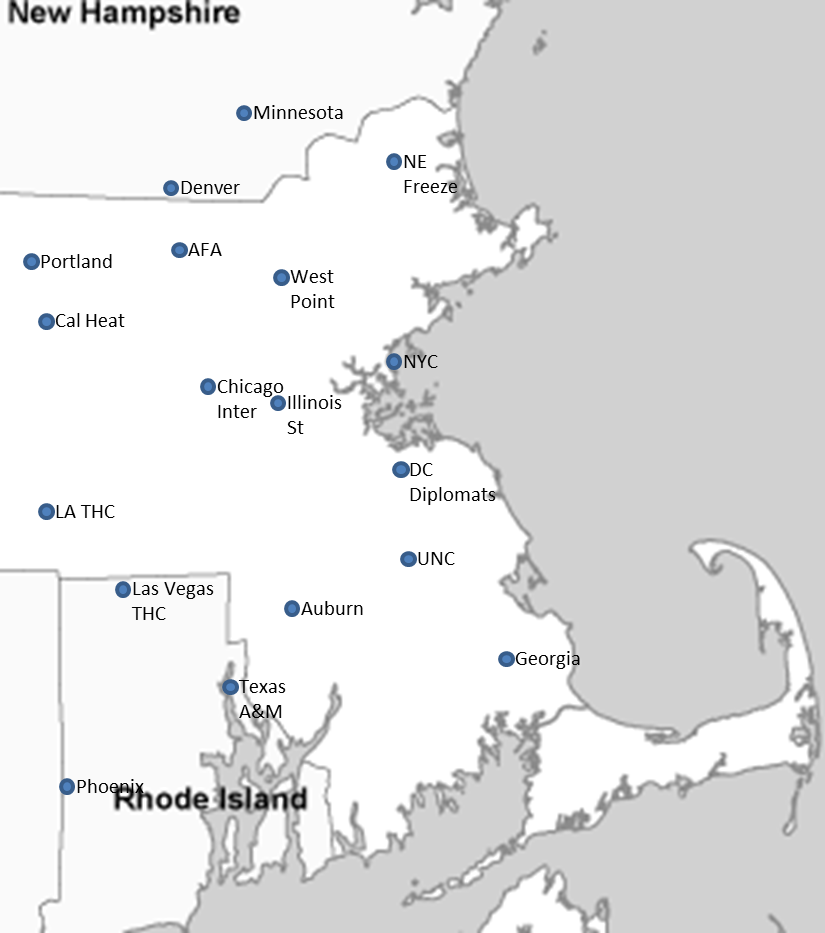
The USA Team Handball Collegiate Club Graveyard:  Why have so many teams come and gone over the years?  And what could be done to prevent this from happening>

The USA Team Handball Collegiate Club Graveyard: Why have so many teams come and gone over the years? And what could be done to prevent this from happening?

This option for USA Team Handball requires a little more explaining than the other options for consideration.  Part 1 provides the background information.  Part 2 will tackle what could be done.

Background (Framing the Problem)

Last weekend Army beat Air Force 31-26 in what is surely USA Team Handball’s longest, continuous club rivalry, collegiate or otherwise.  It dates back to at least 1986 when I traveled to West Point as an AF cadet to play in my first of two collegiate handball matches.  The other match took place in the Spring of 1987 at the National Club Championship when our pool play game vs West Point also served as the Collegiate Championship.  Yes, back in 1987 there were just two collegiate men’s teams, Air Force and West Point. 27 years later there were 10 men’s colleges and 2 women’s colleges at the Collegiate Championship, but as anyone who follows the sport in this country knows this number has ebbed and flowed for years.  In reality there are just 3 firmly established men’s collegiate programs (West Point, Air Force and North Carolina) and 2 firmly established women’s programs (West Point and North Carolina).  Yes, if you’re looking for positive spin could say that collegiate Team Handball has almost doubled in size (from 3 to 5 programs) since I started playing.

First, a short aside from those who might want to point out that there are currently more than 5 collegiate clubs in the U.S.  This is true, but as the graveyard map above so ably demonstrates there’s a big difference between showing up at nationals for a couple of years and being a program that’s consistently there, year after year.  Maybe the Texas A&Ms and Illinois States of today won’t join that graveyard, but they’ve got to stick around for about 5 years before I’ll grant them “firmly established” status.

Still, even if you use a looser definition and counted every college that formed a club and played in one tournament we’d still be way short of where this country needs to be.  To be at 5 programs in 27 years is a huge disappointment to say the least.  Contrast those numbers to other club (non NCAA sports) like Rugby which claims to have 900 collegiate clubs and 32,000 players.  Or, Ultimate Frisbee which claims 700 clubs and 12,000 players.  I don’t know what the numbers were for those sports back in 1987, but Ulitmate, for sure, was in its infancy.

But, is a lack of collegiate growth an over-riding concern or just one development problem of many that USA Team Handball faces?  After all, this country doesn’t have many clubs in general.  And arguably, we have only one program currently at the High School level in New Jersey and just a couple at lower levels like the programs Craig Rot has started in Minnesota and suburban Chicago.  Does collegiate handball deserve extra attention.

Why Collegiate Handball is (or should be so) important for USA Development

Here are some arguments as to why collegiate handball is worthy of some extra attention:

  • It’s the first realistic opportunity the USA has to get some quality athletes to devote themselves full time to the sport: Sure, it would be nice to get younger athletes fully engaged, but the traditional American sports present very stiff competition.  Unless Team Handball can become a fully sanctioned sport in high school almost all (if not all) of the better athletes will gravitate to the traditional sports.  After, high school, however, a good portion of these athletes will see their careers end when they are not awarded a college scholarship.  These athletes may not be part of the “elite” in their chosen sport, but they may be strong candidates for elite status in Team Handball.  And, at the other end of the spectrum:  While it might be tempting to wait for some even better raw athletes after their collegiate careers are over, these athletes are older and may age out before they can be great club or national team players
  • Colleges have infrastructure that can more readily support club start up and sustainment: Starting a club requires a number of things to include a place to practice, athletes and organization.   Gym space can be an issue, but virtually every college has gyms that could be used for team handball.  Colleges are also chalk full young adults, mostly aged 18-22 and by default some portion are athletes making recruiting less challenging.  Finally, many colleges have policies in place that encourage and support clubs with funding and resources.  It doesn’t usually pay for everything, but it provides structure and a base for support.
  • College sports have tradition and name recognition: Team handball lacks recognition in this country and if you were to hype a TV broadcast between our nation’s best club teams, NYAC and NYC you would get some blank stares from many a sports fan.  However, if you were to talk about a match between Air Force and West Point, or say the acronym “UNC” the typical sports fan will immediately think, “Service Academy Rivalry” and “sky blue” uniforms. If you ever want to sell the sport the aesthetics of school colors and tradition will beat no name clubs with aging veterans.

The impact of having so few collegiate club handball programs

While few would argue that it’s not good to have so few collegiate programs is it really a big deal or just something that would be nice to have? Well, here’s some of the impact our low numbers have had on the development of the game and our national teams.

  • Fewer collegiate clubs means a dramatically smaller player pool for our National Teams: If you are an advocate of Residency Programs this reality surely hits home.  Over the years, collegiate clubs have been a primary recruiting source for our National Teams.  Army, Air Force and UNC have been the handball starting point for dozens of players.  It would be interesting to see a statistical breakdown of National Team players and how many started first with a collegiate club, but I’m guessing it’s somewhere in the neighborhood of 30%.  Higher for the men and lower for the women.  Imagine what that percentage might be with more clubs and then imagine how much higher the quality of players would be with a larger pool to draw from.
  • Fewer collegiate clubs means a dramatically smaller fan base and accompanying smaller revenue stream: Setting aside the National Team player pool aspect think about everyone who’s put on a collegiate jersey.  Everyone of those former players is a potential ardent fan of USA Team Handball, European Club Handball and the sport in general.  Someone that might purchase the upper tier cable package to get Champions League matches on beIN Sport, someone that might buy a USA Team Handball jersey, or attend a USA national team match.  Last weekend USA Rugby played the All Blacks of New Zealand in front of 61,000 fans at Soldier Field.  For sure there was more than a few New Zealand expats there, but I bet there were a sizable number of former collegiate rugby players in the stands.  Handball couldn’t even fill an arena if we had 100% attendance from every collegiate player from the past 3 decades.  And, another potential revenue stream:  The philanthropic billionaire former player.  The greater the number of former players, the better chance you have that someone like former collegiate rugby player Mark Cuban:  ready, willing and able to open their sizable wallets to help.
  • Fewer collegiate clubs means fewer youth coaches, referees and club leaders: And apart from the direct revenue aspect if there are more collegiate teams there were surely be more former players giving back to the sport.  Rugby for many years in the U.S. was mostly a collegiate sport with a few clubs consisting of expats and college graduates.  (Does that sound familiar USA handball followers?)  As more and more collegiate club programs got on solid ground and an alumni base grew into the thousands, though, the growth started occurring in youth programs.  Now there are even sanctioned high school programs and colleges that are recruiting those athletes.

Why there are so few collegiate club handball programs

So why has the “sport of the future” had such paltry growth at the collegiate level?  More importantly, what can be done to change this?  Answering the “why question” is fairly straightforward.  Here are the two main reasons why growth has been so minimal:

  1. It’s difficult to start a club program: Starting any team handball club in the U.S., collegiate or otherwise isn’t easy.  As I’ve pointed out before it’s drudgework that many (including dozens of former national team players) don’t want to go anywhere near.  Heck, in some respects it’s amazing that we’ve had several programs get started even if they inevitably flamed out.  Which alludes to the 2nd reason.
  2. Transitioning from a fledgling program to an established program isn’t easy: While starting a new club is challenging, there often is a level of energy which is invigorating and allows new clubs to overcome those challenges.  In most cases, however, that energy level wears off after a year or two and eventually the club encounters some new challenge that isn’t overcome.  That challenge could be dwindling numbers, the need for a new gym or as, often is the case, the departure of key individuals leading the charge.  All too often, in fact, in almost every case over the past 27 years, the new challenge is not met and the grave digger heads out to the cemetery to add another gravestone.

So, how can USA Team Handball turn things around for its collegiate programs?  In part 2 of the “college focused option” I take a closer look at what could be done and the pros/cons, costs and risks associated with doing so.

post

USA vs. Puerto Rico Series:  Men’s Results and Analysis:  A Developmental Side (for the Most Part) Showing Some Signs of Progress

A bright spot for the U.S. Men's Team:  E.J. Udu-Udoma is developing into a decent left wing.

A bright spot for the U.S. Men’s Team: E.J. Udu-Udoma is developing into a decent left wing.

The USA Men’s and Women’s National Teams played a 3 game series against Puerto Rico from 17-19 October, 2014. Here’s a top level assessment of the Men’s Team performance and the state of the Residency Program as it nears its one year anniversary.

The Results

Friday 17 October
USA – PUR 24-24 (11-11)Goals – USA: Pickett (7), Inahara & Morgan (6), Mustafa (3), Udo-Udoma & Howes (1)

Saturday, 18 October
USA-PUR 24-23 (12-12)
Goals – USA: Morgan (6), Udo-Udoma (5), Pickett (5), Inahara (4), Howes (1), Recker (1), Dyke (1), Mustafa (1)

Sunday, 19 October
PUR-USA 29-24  (14-9)
Goals – USA: Morgan (7), Inahara (6), Udo-Udoma (3), Recker (2), Pickett (1), Mustafa (1), Evans (1)

Extrapolating Team Progress

To provide some context to those results, here’s how Puerto Rico, the U.S. and Uruguay have performed in recent competitions.  (Uruguay is included since that’s whom the U.S. Men must beat next March just to qualify for the PANAM Games.)  And, it’s also important to note that prior performance is no guarantee of future performance.   Teams can improve or decline substantially and rosters often vary quite a bit from competition to competition..

2011 PANAM Games
Puerto Rico: Did not Qualify (Finished 4th in Central American and Caribbean Qualifier)
USA: Finished 7th of 8 teams
Uruguay: Did Not Qualify (Finished 2nd to USA on Goal Differential in 2nd Chance Tourney Qualifier) Head to Head Result:  USA-URU 23-23 Draw

2012 Pan American Championships
Puerto Rico: Did not participate in qualification
USA: Finished 7th out of 9 teams
Uruguay: Finished 4th out of 9 teams  (No head to head match up with USA)

2013 Caribbean Cup
Puerto Rico: Finished 3rd out of 5 teams and qualified for the Central American and Caribbean Games (Puerto Rico’s qualifier for the PANAM Games)

2014 Pan American Championships
Puerto Rico: Did not qualify (Finished 5th at North American and Caribbean Championships (February)) Head to Head Result:  Lost to USA 29-26
USA: 6th out of 8 teams
Uruguay: Finished 4th out of 8 teams; Head to Head result: Beat USA 27-23 (15-5 at halftime) Also of note:  Narrowly lost to Chile, 25-24 in Bronze medal game; Tournament was hosted by Uruguay

If there was any doubt, these results from the past 3 years should make it fairly clear that Puerto Rico is a step below the USA in terms of quality.  On the surface one might look at USA’s 29-26 victory over Puerto Rico this past February and conclude that the 1-1-1 results this past weekend on home soil as a sign of regression.  This, however, neglects the fact that USA was playing without arguably its 3 best court players, Adam El Zogby, Gary Hines and Martin Clemons Axelsson.  All 3 are experienced backcourt players who play professionally in Egypt, Germany and Norway, respectively.  While Puerto Rico hasn’t qualified for a Pan American Finals event in several years their 3 goal loss this past February to a stronger, more experienced U.S. team might have signalled real trouble for the U.S.  Instead the U.S. held its own despite playing with a pretty inexperienced backcourt.

The Visual Evidence

While the inexperienced U.S. side fared well, it was alas, Puerto Rico.  A team, the U.S. in the past would dispatch by 10 goals or more.  After viewing the matches my assessment is that neither the USA or Puerto Rican teams were technically sound and the play was pretty sloppy.  Plenty of silly turnovers and the defenses were pretty porous.  Going further, I would assess that aging USA Club Teams, NYAC and NYC would both have been beaten the team wearing USA jerseys this past weekend had they been the competition instead or Puerto Rico.  Although, after playing 2 matches I would given the edge to the younger USA team in the 3rd match.  Old legs have a mighty hard time getting up on the 3rd consecutive day.

Near Term Lens:  Focusing on the near term and in particular, a March 2015 showdown vs. Uruguay to determine the 8th and final spot for the PANAM Games there are a few positives to take away.  It would appear that the U.S. has developed a couple of wings that can contribute in Greg Inahara and Ebi Udo-Udoma.  They may not yet be the first options for those positions on the depth chart yet, but come March they could be.  At the goalie spot both Moritz and Goodreau show promise.  I’d still go with veteran Danny Cappareli, but that may change at some point.

On the downside, help in circle position and the backcourt won’t be coming anytime soon from the program in Auburn.  Circle play with the backs was pretty limited and this could be chalked up to inexperience at both positions.  Veteran, Jordan Fithian, has little to worry yet regarding his playing time.  Regarding backcourt play, Chris Morgan, was the only Auburn based player to make any significant contribution.  He led the team in scoring with 19 goals in the 3 matches played, but he’s still a couple of rungs below El Zogby and Hines in terms of ability. Good progress on display against Puerto Rico, but he’s got quite a ways to go before he can be effective against better competition. The shortcomings at backcourt are so pronounced that the U.S. brought in a 3 U.S. based players that are not training at Auburn to bolster the lineup.  Ethan Pickett, who lives in Chicago scored 13 goals and is also a work in progress.  Notably, what skills he does have were mostly the result of a year in Denmark at the Aarhus Academy.  Rounding out the backcourt was 38 year old, Shkumbin Mustafa  and 29 year old Lewis Howes.  Mustafa, who learned the game in Kosovo only scored 5 goals at center back, but played a big role in the organizing and setting up the other backcourts.  Howes helped shore up the defense and scored 2 goals.  It doesn’t take much analysis to quickly conclude that  if the U.S. had relied solely on Auburn based players the backcourt would have been woefully ineffective and the results of all 3 matches would have been ugly double digit losses for the U.S.  This is to be expected, though, as it has always been the most challenging for the U.S. to find good prospects to play backcourt.  And, then they are the hardest positions to learn and master.

All told, USA qualification for the 2015 PANAM Games will have little to do with the athletes training in Alabama.  Instead it will hinge on Hines, El Zogby and Axelsson and whether this trio of athletes can muster some consistent backcourt scoring punch and extract some revenge for Uruguay’s 27-23 victory over the U.S. this past summer.  And mind you, that’s just to qualify for the PANAM Games.  Truth be told, the U.S. doesn’t have the guns to realistically beat Argentina should they somehow make it to a pivotal match against them in the semifinals.

Long Term Lens:  Peering out further into the future (Post 2015 PANAM Games) and the picture is pretty murky.  Assessing how raw talent will pan out is never easy and even more difficult via internet streaming, but I for one didn’t see any knock your socks off talent on display.   Instead, I saw a bunch of hard working athletes taking advantage of an opportunity presented to them to wear their nation’s colors.  How many of those athletes will be around 5 years from now when the U.S. seeks qualification for the 2020 Olympic Games?  That’s a long ways out, but I suspect that natural attrition and hopefully, a constant stream of new recruits will mean that only a few of the players taking the floor this past weekend will still be around when the U.S. makes another run at qualification.

To sum up, after nearly a year in Auburn, the Men’s program has made some modest progress.  The players there have shown steady improvement, and a few players can now even be counted on to contribute to qualification matches next year.  The program does, however, still seem to be a little thin in terms of recruits.  I suspect it’s tough to conduct a full scrimmage at Auburn without bringing in a few newbies at Auburn to fill out the sides.  This surely limits the quality of the practices and I can’t help but contemplate how some of the Auburn based athletes would probably be better off if they were based in Europe playing regularly in club competitions.   Goodreau and Moritz, in particular, would undoubtedly be better off with more time in goal under game conditions.  But, then if they left, who would play goalie at Auburn?  Inahara, Udo-Udoma and Morgan, in my opinion would also be excellent candidates for a program like the Aarhus Academy.   To it’s credit the Residency Program has developed their game to the point where a move to Europe can be contemplated.  The question is now, whether that will happen or not.  Or whether, they will remain at Auburn, reach a certain skill level and plateau out.

post

Charting a Way Forward for USA Team Handball: Option 3: Develop or participate in a European based residency program to provide athletes more competition and opportunity for professional contracts


A wishful thinking future headline?  Maybe, but arguably an overseas residency program has the best chance of making a headline like this a reality someday.

A wishful thinking future headline? Maybe, but arguably an overseas residency program has the best chance of making a headline like this a reality someday.

Background

Ask just about any athlete that’s ever participated in a U.S. National Team Residency Program what the biggest shortcoming to training in the U.S. was and the conversation will undoubtedly turn to the lack of regular competition.  Great training facilities and quality coaching instruction are vitally important, but if your competition opportunities for the most part consist of scrimmaging in practice against your teammates it will get real old, real fast.  For athletes new to the sport the lack of competition may not be such a big deal.  They’ve got their hands full learning the finer points of the game and keeping up with the veterans.  Couple that with the excitement and camaraderie with being part of a National Team program and they are usually just happy to be there.  For their more experienced teammates, though, who have reached a certain development level the lack of competition, particularly against more skilled players make it very difficult, if not impossible, to take their game to the next level.  Those athletes plateau and a grind sets it.
 
Of course, a national residency team can schedule competition, but if you’re living in a country with just a handful of amateur club teams scattered all over the map that means either traveling overseas or convincing teams to journey to America.  Traveling overseas can be done, but it’s not cheap.  Additionally, due to a crowded competition schedule in Europe there are only a few narrow windows during the year when it’s even possible for the U.S. to play matches against other national teams and top clubs.  And, it’s even tougher to get teams and clubs to journey to the U.S. as they have to bear the travel costs.
 
But, what if you moved your residency program to Europe?  Could you have your training and competition too?  This isn’t a newly discovered revelation.  Back in 1990-91, the U.S. Men even resided in Czechoslovakia and played an entire season in the top club league there.  Playing every match on the road they didn’t fare well, but the participants clearly improved as players.  I have no idea what that program cost, but it was surely an opportunity facilitated by the U.S. Men’s head coach at the time, Vojtech Mares, a legendary Czech player.
 
More recently, the Aarhus Handball Academy in Denmark has trained individual players and hosted the Great Britain national teams in the run up to the 2012 London Olympic Games.  As discussed in this podcast interview, athletes at the Aarhus Academy live in a college-like dorm setting and receive training both at the Academy and with a local club where they are placed based on skill level.  So, in addition to individualized skills training similar to what one might expect with a residency program these athletes also get the opportunity to compete in Danish club play.  Dozens of Canadians, mostly products from Alberta’s ever expanding youth program have gone to Aarhus after High School and four U.S. athletes, Julia Taylor, Sophie Fasold, Ethan Pickett and Ross Miner have paid their own way there to improve their game.
 
The U.S. is currently focused on a U.S. based residency program, but the potential advantages of an overseas based residency program merits further study.  Herewith, is some top level analysis that could be expanded upon at a later date.
 
Pros
 
More competition:  An overseas residency program will clearly provide more opportunities for competition.  Even a fully fledged residency program with a massive travel budget will be hard pressed to be able to match the competition opportunities available overseas.
 
Athlete exposure for professional opportunities: An added side benefit of a program like Aarhus would be the potential for a U.S. athlete to get noticed and secure a professional contract.  Heck, it’s not a side benefit.  Arguably, it’s the holy grail game changer that could forever redefine USA Team Handball.  As, I alluded to in my false news story it could be the pathway that realistically enables a U.S. athlete to start a significant pro career at a relatively young age.  Consider the possibility of a Darrick Heath like athlete playing for 10 years in the HBL or the next Leora Sam Jones playing 10 years in Denmark’s Liggen.  If the U.S. can get just 1 or 2 playing at that level we can realistically talk about qualifying for the Olympics.  Get a dozen playing and lookout Euros, the sleeping giant has awakened.
 
Cons
 
Loss of U.S. exposure and foothold:  Basing National Team Residency Programs in the U.S. establishes a foothold or hometown for the sport. Residency players can support development in the local community and a hub of activity and growth can ensue.  If an overseas residency program comes at the expense of a stateside program this opportunity will be lost.
 
Risks
 
Athletes may balk at an overseas program.   While living overseas presents athletes with better competition and opportunities for exposure to professional clubs, some athletes will surely prefer to live and train in the U.S.  This will be true for a number of reasons to include college opportunities, job prospects, family considerations and plain old homesickness.    Prior to make any major resource commitments the U.S. should do a full assessment as to whether it has or can recruit the athletes to populate the program.
 
Costs
 
At first glance it may seem cost prohibitive to even consider the possibility of an overseas residency program.  Intuitively, it’s simply cheaper for Americans to live in America.  This thinking, however, neglects some indirect benefits of a potential overseas program.
 
Outsourcing: If the U.S. relies on a residency program like Aarhus many existing costs centers will be dramatically reduced or even eliminated.  In particular, there would no longer be a need for full time coaches, freeing up $120,000/year which then could be spent on part time coaches, beefing up college programs and paying tuition for the Aarhus program.  Additionally, all of the other costs associated with maintaining a residency program would disappear.  While much of this is provided at “free” or dramatically reduced cost by Auburn there are surely incidental charges and plenty of man-hours being devoted to its operation.  
 
Lower Overall Travel Costs:  It’s counterintuitive, but an overseas location could actually lower the overall travel budget of the Federation.  The actual answer as to whether it would or not primarily hinges on where the bulk of USA Team Handball’s top players live and how much overseas competition is desired.  If most of the top players are playing professionally in Europe and if a lot of overseas competition is desired, the European option becomes more and more feasible.  The U.S. has already conducted training camps in Europe for this very reason.  The leap to doing it full time isn’t so far fetched, especially if more players can be placed with club teams with good training environments.
 
Cost Break Point and a Simple Calculation.  It should be readily feasible to come up with a per athlete cost for multiple residency possibilities, both stateside and overseas.  The Aarhus cost is relatively easy to determine and placing one athlete there for both the Fall and Spring currently costs around $12,000.  Determining the cost for an athlete at Auburn should also be relatively easy to determine.  This would be done by simply taking the total operating costs and dividing it by the number of players in residence.   A very simple determination ($120,000 in coaching salaries divided by the 20 or so players there) comes up with a cost of $6,000 per athlete.  While this is half the Aarhus cost it also doesn’t factor in that athletes at Auburn are currently responsible for room/board and even travel for some recent trips.  If you factor in those costs Aarhus is pretty comparable.  Not to mention that a package deal could probably be negotiated down a bit  Further, if you are a bit skeptical as to the long term potential of some of the athletes currently training at Auburn, the “20” number could be pared down to perhaps “5” or so at which point outsourcing residency programs to Denmark starts to look pretty good.  But, these are simple back of the napkin calculations based on limited information.  It would be interesting to perform the same calculations with better pricing data.
 
Timing for Implementation
 
The timing for implementation of an overseas residency program will depend on a number of variables.  These variables include:
 
2016 Olympic Qualification efforts:  USA Team Handball currently has around 20 athletes training on a daily basis at Auburn.  The Woman’s program has the bulk of its athletes training there as a unit and while qualification is a long shot it would be unfair to those athletes to substantially change development programs so close to the major qualification events in 2015.   After Olympic qualification runs its course, however, there will be a logical break point to re-evaluate what’s in the federation’s long term best interests.  The situation for the men’s program is significantly different as several key players are not based at Auburn and are already playing overseas.  In fact, with just a handful of promising, but inexperienced athletes training at Auburn a pretty strong case could be made to immediately enroll those players at the Aarhus Handball Academy.
 
U.S. Federation degree of control: The level of oversight USA Team Handball would have over an overseas residential program would impact how quickly a program could be set up.  If USA Team Handball wanted minimal oversight and decided to go with an existing programming like the Aarhus Academy implementation could proceed very quickly.  USA Team Handball, however, may prefer greater oversight to include hiring its own coach or coaches to run the program.  Such an arrangement, while desired, will require some negotiation and coordination may delay implementation.
 
Program location:  Again, going with an existing location, like Aarhus could proceed quickly.  The U.S. may, however, prefer other locations for a variety of reasons and setting up a new program at a TBD location will likely include several logistical obstacles.
 
Size of program:  Sending a handful of athletes can be done fairly quickly, but if the U.S. intends to set up a program that will allow the U.S. to train regularly as a team this will likely take more time and coordination.
 
Overall:  In a nutshell the timing for implementation would hinge mostly on available funding and desired level of effort.  A simple transfer of athletes to an existing program like Aarhus could be done immediately or wait to the conclusion of 2016 Olympic Qualification.  A more extensive program would likely take a couple of years to implement and probably couldn’t be implemented until 2016 at the earliest.  The best course of head may be to review the different possibilities and how an overseas program might be integrated with U.S. based programs.  At the same time USA Team Handball could begin discussions with European based entities and the IHF as to how they might support such a program.
post

Charting a Way Forward for USA Team Handball: Option 2: Increase the Emphasis and Support to National Team Recruiting


Simply putting out the welcome mat isn't sufficient for a National Team Residency Program.  A concerted recruitment effort is needed to get more athletes to the door.

Simply putting out the welcome mat won’t populate a National Team Residency Program with the type of athletes desired. A concerted recruitment effort is needed to get better athletes with real potential to the door.

Background

Because the U.S. has a very limited grass roots base, U.S. clubs have developed only a handful of national team caliber athletes.  To overcome this deficiency USA Team Handball has historically relied on the recruitment of “crossover athletes” for its National Teams.  There has been a lot of debate as to whether this is a good strategy or not.  Opponents blast it as a shortsighted, quick fix strategy that has produced mediocre results (at best) and squanders limited resources that could be spent on building up the grass roots.  Proponents argue that the grass roots growth will follow national team success and that the U.S. should take full advantage of its large size and accompanying raw athletic talent pool.  I’ve tackled this debate in other commentaries, though, and will not it address here.  Instead, I’ll presuppose that focusing on crossover athletes is the right strategy and that finding better ways to recruit these athletes are needed.

While I would have liked to have seen a Board of Directors really tackle the basic fundamental question of whether crossover athletes should really be the focus before starting residency programs I am pleased to see that the current shortcomings in recruiting are at least now being identified as a major challenge. (July 2014 BoD Meeting Minutes) Most troubling to me was that for several months after the start of the Residency Programs there appeared to be almost no recruitment whatsoever.  Just simple announcements on the Federation websites for National Team tryouts, which coupled with the athletes having to pay their own costs to participate often resulted in very low turnouts.  It’s not clear what else was being done behind the scenes, but one meager solution to address the problem was to hire unpaid interns to focus on recruiting:  (Link 1, Link 2)  At the last tryouts in July there were 6 men and 14 women participants.  None of the male athletes that attended were picked up and to the best of my knowledge every player in residence on the men’s team has come from our existing, but very limited grass roots programs.  On the women’s side there have been a number of crossover athlete recruits, but it’s unclear as to the long term potential of these athletes.

There’s a fairly stark underlying reality to the decision to establish full time National Team Residency programs.  If you’re going to the expense to have them you better be able to fill those programs with quality athletes.  And, if you don’t have established grass roots programs churning out athletes that means you’re really going to need some real emphasis and support to recruiting efforts.  Here are some steps that could be taken to beef up USA Team Handball’s recruiting efforts.

  1. Put someone clearly in charge of recruiting.  This might sound somewhat obvious, but I suspect USA Team Handball has not clearly delineated where the “buck stops” on this all important task.  Most likely everyone drawing a salary is involved in some aspects of recruiting and if you’re assigning interns and volunteers even those that aren’t being paid.  That’s a good use of staff time, but someone needs to be in charge and accountable.  This “someone”  could be the coaches, the Tech Director, the CEO, or even a newly hired recruiting coordinator.  Regardless, recruiting should move very high on their job jar list.
  2. Assign clear metrics to guide recruiting focus and measure success.  In many respects, the real measure of success will be National Team wins and losses over time.  But, those results won’t be known for several years and there are other near term metrics that could be established to measure success, such as simply the overall numbers of athletes trying out for the national team.  Even better, would be some sort of weighting system that would take into account an athlete’s age and skill level.  For sure, signing a pretty good athlete at age 18 should be seen as a major recruiting coup, whereas signing a 25 year old athlete, even a really good one is less desired.  Without clear metrics to guide recruiting the temptation may be to simply find warm bodies willing to move to Auburn.  That may fool the USOC and perhaps some members of the Board, but it won’t solve our recruiting deficit.  And, worse it means that the Federation is wasting resources and being disingenuous to an athlete making significant sacrifices.   (For an idea on what those recruiting metrics might be see these earlier commentaries:  Link 1 and Link 2)
  3. Hire someone to be a full time recruiting coordinator.  A strong case can even be made that  recruiting is so important and at the same time so challenging that it justifies expending resources to hire someone full time to tackle this job.  Someone who wakes up in the morning focused on addressing and solving the recruiting challenge.  Someone without other tasks distracting them.  Someone who knows this is their job and keeping that job means bringing in quality recruits.  That wouldn’t mean that this person was the only one recruiting per se, but for sure that individual would be orchestrating other staff and volunteers in their efforts.  It’s a tough task and a skill set for which a Team Handball background while desired is not really necessary.  Such an individual might be someone with college recruiting experience at the Division 2 or Division 3 levels.  The logic being that USA Team Handball could benefit from someone with skills finding athletic diamonds in the rough missed by the Division 1 schools.
  4. Provide more resources to support recruiting efforts.  A lot of recruiting can be done on a budget thanks to the internet and the good old fashioned telephone call.  Some recruiting efforts, however, will be more successful with a physical presence.  And, this will require a travel and event budget.  Some of the travel would be to events where high school athletes congregate like summer camps and tournaments.  There would be an art to finding the athletes that aren’t going to get the Division I scholarship, would still be great handball players and be willing to try a residency program.  And, this would require a lot of networking and some face time to establish relationships.  USA Team Handball could also set up its own clinics/tryout events for high school and college age athletes in select markets.  Unlike, the open announcement that have been used in the past, though, there would be a significant amount of legwork up front to ensure that targeted athletes would attend.  Phone calls, letters, and perhaps a visit from a former Olympian would all be part of a targeted strategy.
  5. Provide greater financial benefits to selected recruits.  Ideally, USA Team Handball would have the resources to more effectively recruit some of its athletes.  In particular, a college scholarship, even a partial one, could turn some heads and entice some border line Division 1 athletes (in their chosen sport), to commit to USA Team Handball.  And, it goes without saying, that ideally these athletes have been carefully assessed as athletes with skills  that would make them ideal candidates in their new chosen sport of Team Handball.

Pros

  1. More and better recruits being identified.  Assuming success it’s hard to find much fault with the concept of better recruiting.

Cons

  1. Diverts resources and attention from grass roots development.  The old, never ending argument again:  The resources applied to recruiting could be applied to setting up grass roots programs that, in theory, would develop players that would never have to be recruited to play for Team USA.
  2. Diverts resources from current national team prospects.  Again, resources applied towards recruiting and future success may have to come out of the budget lines dedicated to current national team training and competition.

Risks

  1. Inability to recruit desired athletes.   Quite possibly the challenges of recruiting athletes, particularly younger ones, to play for Team USA might be too difficult to overcome.  The extra emphasis may yield no significant improvement over the trickle of athletes that already comes in.  This risk is so significant that it might be wise to reluctantly consider no significant efforts to improve recruiting, and, in turn, a rethinking of the Residency Program model.

Costs

  • The first two steps identified (clearly assigning responsibilities and establishing metrics) can be implemented at fairly low cost.  Increasing the emphasis on recruiting and spending more time on it will, however, mean that some other tasks will get less focus.  There are only so many hours in a day and something else will surely no longer get done as well.  Clearly established metrics, however, should free up some time as Federation staff will no longer waste time recruiting athletes that don’t fit the desired metrics.
  • Hiring a full time recruiter will likely cost in the neighborhood of $40-80K in personnel costs.  Alternatively, USA Team Handball could hire someone to work the recruiting issues half time while working other administration issues.  A travel/event budget could run upwards to $100,000/year.   If trips are judiciously planned it could be much lower, but events like the ill fated summer festival are more expensive and could easily bust the $100K budget in no time, especially if more of the prospective athlete costs are paid for.
  • Providing financial support for select athletes could get real expensive quickly.   Tuition and other costs for an in-state student at Auburn University runs $29,000/year.  Barring a huge increase in financial support it’s pretty unlikely that USA Team Handball will be handing out full ride scholarships anytime soon.  That being said even a small amount of scholarship aid coupled with the opportunity to represent your country in international competition might be enough to sway some heads.  The big secret is that outside of football and basketball many Division 1 scholarships are really only partial scholarships.  This support varies from sport to sport and from school to school.  Additionally, athletes are often given preferential treatment for traditional financial aid, which explains at least in part, how the Ivy League schools, which technically have no scholarships, somehow attract Division 1 talent.  Bottom line:  some level of support; even a small amount could help recruiting efforts.

Timing for Implementation

The first two steps (clearly assigning recruiting responsibilities and establishing metrics) could and should be implemented immediately.  The timing for hiring a full time recruiter and/or providing more recruiting resources probably should wait until the current effort to qualify for the 2016 Olympics runs its course.  One possibility would be to let one of the national team coaches go and to use that salary towards recruiting.  Alternatively, recruiting could be clearly delineated as a coaching responsibility (See below for further discussion on that possibility).  And, as always, it sure would be nice if there was more money available to just simply bump up the recruiting budget.  Barring that happening, though, USA Team Handball needs to take a hard look at whether some other part of the budget should be lowered to meet the recruiting challenge.

Side Analysis (The American Collegiate Coaching Model and the Traditional Coaching Model)

As, I pointed out in an earlier series success in collegiate sports in the U.S. is very closely tied to recruiting success.  And while recruiting is a vital part of success in most team sports, to the best of my knowledge there is no other sporting league or entity where coaches are expected to take on so much of the responsibility and accountability for recruiting success.  In professional team sports there is usually a general manager who is responsible for acquiring and hiring players.  The coach may be involved in the process, but his primary role is to take the players given to him and coach them to win matches.  For national teams it is much the same story and when a nation already has a strong grass roots programs there is virtually no recruiting.  Essentially, the nation already has its available players and the coach’s job is merely to pick which players they want on their roster.  The only occasional recruiting is to acquire a naturalized citizen or perhaps to coax an aging veteran to continue playing for his nation.

This is a stark contrast to American collegiate sports where success on the field hinges largely on a coaches ability to convince highly touted 17 year old kids to come to their college.  Money can’t even be used to recruit athletes, although some like Charles Barkley joke that isn’t necessarily followed.  While USA Team Handball doesn’t have to follow collegiate rules the residency programs are essentially competing for the same athletes.  Further, with a thin talent pool, a U.S. National Team coach can’t be successful with merely picking the best 16 players available.  This means that recruiting will be a big part of U.S. National Team programs for years to come.  The question then becomes can the U.S. expect or even find a national team coach that can essentially function like a U.S. collegiate coach?  To be responsible and accountable for successful recruiting?  That’s certainly a tall order for a foreign national and that’s one of the reasons why I questioned the hiring of the current coaches.  Conversely, it’s also surely tough to find a skilled American recruiter who can also coach the finer parts of handball.  This suggests that unless someone uniquely qualified with that dual skill set can be found it’s probably necessary to separate the coaching and recruiting roles.

post

Charting a Way Forward for USA Team Handball: Option 1: Establish a Residency Program Focused Solely on Future Player Development

Handball Academy

Should USA Team Handball take a bold step to change the focus of its Residency Programs?


Background

USA Team Handball has established Residency Programs for its Men’s and Women’s National Teams at Auburn University in Alabama.  Goals for these programs have not been explicitly stated, but based on the majority of the athletes that been recruited the programs appear to have two primary goals:  developing new players and national team preparation for competition.  These goals, however, often conflict with one another and trying to do both simultaneously with a national team can be problematic.

In particular, the immediate need to prepare for competition results in a competition mindset and a focus on near term performance.  At first glance this may seem like an obvious and desired effect.  After all, what’s the point of having a national team, if not to do the best we can in competition and ideally win a lot of games?   A broader look at the landscape of world handball and the very, very thin U.S. player pool, however, warrants careful consideration of a change in mindset to unequivocally focus the Residency Programs on future player development.

Such a focus would include the following steps

  1. Establish mission and goals for the Auburn Residency Program that clearly identify its focus on future player development. To the best of my knowledge there is no documentation that fully describes the purpose of the Auburn Residency program.  Developing such a document would provide an opportunity to clearly delineate what is desired for the program.
  2. Rebrand the Residency Programs program to clearly identify them as development programs.  Something like the “U.S.A. Team Handball Academy” or “U.S.A. Team Handball Future Development Program” would clearly signal the future developmental focus of the program.
  3. Decouple the National Team coaches from the development program.  To further emphasize the development focus the coaches or training directors administering the program would not be dual hatted as National Team coaches.   The administrators would still work closely with the National Team Coaches, but their focus would be developing players for the talent pool; not coaching players in the talent pool.
  4. Establish an age range for athlete participation.  It can be debated as to what this range should be, but I would advocate ages 18-23.  While it would be desirous to have even younger athletes in a high school program current U.S. structures will make it nearly impossible to do so.  And, while it may be easier to recruit quality athletes at older ages those athletes are very unlikely to meet the “future potential” requisite inherent with a development program.
  5. Establish a time limit on participation.  The goal of the program would be to improve athlete skills to the point where they can play competitively in a professional environment.  Historically, athletes introduced to the traditional Residency Program Model improve dramatically as players during their first two years of participation.  Eventually, though, they plateau due to the limits of their fellow participants and a lack of competition opportunities.  In other words, it’s easier to improve when you’re playing and practicing against more skilled opponents, but more difficult to improve when you’re playing against weaker opponents.  At some point athletes would “graduate” and be encouraged to seek better competition overseas.  This time limit would also have the added benefit of freeing up spaces to let more athletes participate.

Note:  An earlier series of commentaries written in 2009 describes this player development residency model in more detail as well as some problems with the traditional residency model.

Pros

  1. Broadening of talent pool for years to come.  The successful implementation of this program would create a much wider talent pool of prospective athletes.  Not only would more athletes be trained up, but since they are younger, they would have more playing years ahead of them.  The obvious added benefit of this would be more athletes to choose from for national team competition.  A not so obvious benefit will be the trickle down improvement in U.S. based club competitions as players who participate in these programs, but do not quite pan out at the highest level are still more likely to continue playing through their 20’s and early 30’s.
  2. Improve prospects for American players to have pro careers:  If one looks at the world’s top teams it’s plain to see that their rosters are entirely composed of professional athletes.  Even the Pan American teams that the U.S. competes against for Olympic berths have rosters with a number of athletes playing professionally (some at the highest levels) in Europe.  Professional athletes will almost always defeat amateurs and if the U.S. can get more athletes overseas it will greatly improve national team prospects.  A U.S. Team Handball Academy could be the vehicle to boost skills of young athletes to the point where European clubs show interest.
  3. Ensures focus on development.  While it can be argued that the current Residency Program could still be directed to focus on younger player development the establishment of a Handball Academy and its associated guidelines would guarantee that focus.  Older athletes simply could not be recruited and the coaches running the program would not have conflicted priorities.

Cons

  1. Weakening of current National Team prospects.  Moving forward with this change in direction will immediately result in weaker U.S. National Teams at international competitions.  Practicing on a regularly basis in one location creates a more cohesive team as players become very familiar with each other’s skills and abilities.  Additionally, Residency Programs create a team bonding that can provide an additional advantage in competition.  Any slim hopes the U.S. had of 2016 Olympic qualification are probably eliminated and 2020 Olympic qualification prospects would also be weakened as this change in direction would probably take several years to bear fruit.
  2. Lack of support for older National Team players. This change in direction would likely end the careers of many older National Team players as many of them are either not skilled enough or do not desire to live overseas where they can continue their development as players.

Risks

  1. Inability to recruit desired athletes.  Probably nothing challenges the implementation of this youth based movement more than the reality that recruiting athletes at younger ages with the desired athletic ability will be challenging in the U.S.  The top athletes at those ages generally play another sport and USA Team Handball will be competing against colleges that can offer either full or partial scholarships.  This risk is so pronounced that additional actions to address this recruiting challenge should probably be implemented in conjunction with or prior to establishing a future player focused residency program.  (Separate recruiting initiative: Link <to be written>)

Costs

  1. Residency Program Costs. With the Residency Programs already in place this primarily is a change in focus/rebranding and could be executed for little or no cost.   A level of support for athletes is already in place and while more is desired, it could continue at the same lever for the younger athletes envisioned.  In terms of administration salaries are already being paid for 2 National Team coaches.  These coaches are already providing training instruction and could simply be rehired as Sports Academy coaches or administrators.   Additionally, as the focus would be entirely on player development USA Team Handball could also consider having just one coach so another salary could be freed up for other requirements like recruiting.  Finally, while this is development program a handful of trips for competition is still desired.  Ideally, these would take advantage of IHF challenge competitions where financial support is provided
  2. National Team Costs. By combining competition preparation with player development USA Team Handball was benefiting from certain cost efficiencies.  With the decoupling of these two roles either more funding for National Team support will be needed or support to National Team will have to decrease.  Assuming a decrease in funding, possible cuts include making the National Team coaching positions part time volunteer positions, eliminating all trips for friendly competitions, and even requiring athletes to fully fund or partially fund trips for qualification competitions.  These are not pleasant possibilities to contemplate, but if the U.S. wants to get serious about future player development funding should be diverted from senior team programs.
  3. Recruiting Costs.  It’s hard to see this program being successfully implemented without more resources being devoted to recruiting efforts.  This may necessitate the hiring of a full time recruiting coordinator or require having another staff member devote significant man hours to this task.  Additionally, there will likely be some travel costs if recruiting is to be more effective.

Timing for Implementation

This change could, in theory, be done immediately, but probably should be phased to coincide with upcoming Olympic and World Championship qualification.  An implied (if not explicit) promise of support has been made to a number of athletes that don’t fit the development concept (i.e., they are significantly older) and an immediate change in focus would be unfair.  Both, the men’s and women’s program can qualify for the 2016 Olympics by finishing first or second (if 2016 Olympics host Brazil finishes first) at the 2015 PANAM Games which take place in Toronto next July.  While it’s unlikely either team will qualify they should be given that opportunity with the support that the current Residency Program model provides for training.  Should they fail to qualify for the Olympics next July or even fail to qualify for the PANAM Games (via a qualification tournament in January, 2015) USA Team Handball will have a logical break point for redirecting the Residency Programs.

Another logical break point for the Women will coincide with the 2015 World Championships.  Due to Brazil’s winning of the 2013 World Championships, Pan America will have an unprecedented 6 spots for the 2015 World Championships to be played in December, 2015.  The U.S. will have a decent chance of securing one of those spots at the 2015 Pan American Championships and this may support keeping the Women’s team intact through that tournament.  The Men’s next World Championship qualification even will not take place until January, 2016 at the earliest, so it should be less of a consideration.

Overall Assessment

Well, it should come as no surprise that I am fully in favor of taking this bold step.  Ideally, it would be better to implement such a program after we have further developed our collegiate club competitions and established some sort of High School competition, even if only in one U.S. city.  Further, it would be better to have funding to support a recruiting budget.  All of these shortcomings makes the chance of success somewhat iffy, but with the Auburn program in place it makes little sense to wait for those things to happen first.

Finally, the current state of our talent pool makes near term success very unlikely.  If U.S. qualification prospects were more realistic I could enthusiastically support an all out run for 2016 qualification.  The reality, however, simply doesn’t support it.  Even 2020 is a bit of a stretch, but I think with a switch to a development focus, we could make a respectable run.  And, more importantly start to populate our national team rosters with athletes that could really make a difference in 2024, when the U.S. might very well be hosting an Olympics.

post

Charting a Way Forward for USA Team Handball: Part 1: Introduction: Many Options + Limited Resources = Hard Choices

Many options for developing handball in the U.S.  Which way is the right path?

Many options for developing handball in the U.S. Which way is the right path forward?

Previous commentaries have focused on the shortcomings of National Team Residency Programs, why I felt it was too soon and unwise to start a program up in Auburn and the historical debate between supporting grass roots and national team programs.  With this new series I turn the page to focus on some programs and initiatives USA Team Handball should consider as it charts its way forward.

Many Options

The old saying goes that there are many ways to skin a cat.  And, when it comes to charting a way for USA Team Handball there are indeed a number of possibilities.  For the most part this series will focus on initiatives that will help “enable United States athletes to achieve sustained competitive excellence“.  This was pulled directly from the USA Team Handball mission statement.  Granted, this is just one part of the mission statement, but as you go through the initiatives, proposed programs and broad overarching strategies you’ll see that many of them have a grass roots flavor.  But, Grass Roots with a focus on identifying and developing talent with National Team potential.

1) Modify the National Team Residency Programs to focus strictly on player development: Link
2) Increase the emphasis and support to National Team recruiting: Link
3) Develop or participate in a European based residency program to provide athletes more competition: Link
4) Upgrade College Team Handball:  Following the rugby club model to nationwide participation (Part 1; Part 2)
5) Upgrade College Team Handball:  Seeking NCAA status on the heels of the O’Bannon Ruling
6) The “Title IX Field Hockey Strategy”:  Focus 90% of USA Team Handball’s resources on Women’s Programs: Link
7) The “Iceland Strategy”:  Focus a large percentage of USA Team Handball’s resources on one geographical location (Part 1; Part 2; Part 3)
8) The “Alberta Strategy”:  Fully assess Alberta’s successful development program and fund a U.S. version in one region of the U.S.:  Link
9) Youth and Junior Teams Emphasis:  Fund U.S. participation for up and coming athletes first
10) Funding direct to clubs:  Reward high performing club programs with real and tangible financial support
11) High School Team Handball:  Following in Lacrosse and Flag Football’s footsteps
12) True Youth Movement:  Follow the AYSO soccer model to develop a massive player and fan base at even younger ages
13) U.S. Olympic Handball Festivals:  Bridging the gap between club and national teams

(Editor’s Note:  As this series evolves this list will likely see several modifications.  The intent, however, is to keep this as a home page for future reference.)

Limited Resources

Unfortunately, while a good case can be made for each of these options, the harsh truth is that USA Team Handball has very limited resources.  The last published IRS Form 990 from (July 2011 – Jun 30, 2012) lists only $512,000  in total revenue and last December former CEO Matt Van Houten indicated that USA Team Handball was literally counting every penny.  USA Team Handball’s new  Board Chairman, Dr Harvey Schiller, has many connections in the corporate sports world so there’s room for optimism that fundraising efforts will become more successful.  That instead of choosing one possible initiative soon USA Team Handball will be able to choose several options working in tandem.

Hard Choices

It goes without saying that if you have many options, but limited resources you can’t do as much as you would like to.  Inevitably, this should lead to some hard choices.  Hard choices that often no one wants to make.  Case in point, was NYAC Coach and legend, Laszlo Jurak response when I asked what should be done if you don’t have the resources to support both National Teams and Grass Roots?  His response:  “Then you have to quit.”  (Audio:  Link  (around the 21:00 minute mark)

While tongue in cheek, this is the resignation that many old timers feel.  And, unless you are on the USA Team Handball Board of Directors it’s pretty much a theoretical question, so most of us can simply refuse to contemplate such an unpleasant question.  Well, I guess Board Members could also quit, but the reality is that they are indeed making these hard choices even if, (and, this is very important) their choice is simply to continue with the status quo and not fully consider other possibilities.

There’s no getting around it.  All one has to do is follow the money and the man hours expended.  Where time and money is spent is the answer to what’s been decided.  These decisions should be tough ones to make.  Decisions based on a careful analysis of the merits of several good options.  Decisions based on a review of current programs and metrics that measure success and failure.

Could of, Would of, Should of and Moving Forward

As you read through this series chances are you might get some light bulbs turned on.  And, those light bulbs will be some revelations along the lines of:

  • The U.S. should have pursued some of these initiatives prior to starting and focusing so much of its resources on residency programs.
  • That a particular initiative is definitely worthy, but we just don’t have the funding for it.  And, the reason we don’t, at least in part, is because our residency programs are taking too big a chunk of resources.
  • That many initiatives should probably be co-located with our residency program.  And, that there are quite a few places in this country that would be better suited for implementation than a college town in rural Alabama.

Unfortunately, though, the die have been cast.  A commitment of some level has already been made to the residency programs at Auburn.  It would have been better to first methodically assess and weigh these initiatives (and others) prior to this commitment, but you can’t change the past.  You can only plan for the future.

And, in the hopes of influencing the decisions being made regarding that future the follow on parts to this series will assess each initiative, program and broad strategy by taking a top level look at its overall objective, pros/cons, risks, costs and timing for implementation as part of a coherent, long term strategic plan.  While some might think that this is an exercise in futility I’ll take the optimist’s point of view.  It’s only a matter of time before the sport of Team Handball gains traction in this country.  With good planning, though, it can happen sooner and that traction will be so much greater.