post

AUDIO: Handball Talk (Episode 7) Olympics Wrap Up

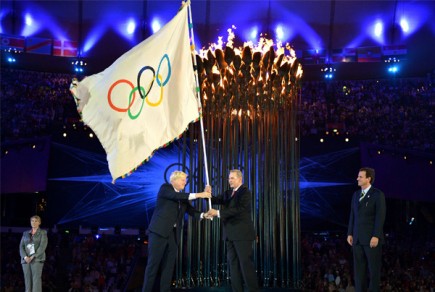
London hands over the Olympic Flag to the IOC.

John Ryan and Christer Ahl discuss a potpourri of Olympics Handball topics to include some top level analysis of the Women’s and Men’s competition, the competition format, NBC’s TV/Web production and the earlier podcast interview with the U.S. 1972 Olympic team.  The podcast also includes a brief discussion on the recent IHF Super Cup in Qatar.

post

AUDIO: Interview with Ben Teitelbaum: Co-Director of Team Handball Documentary, “Home Court”

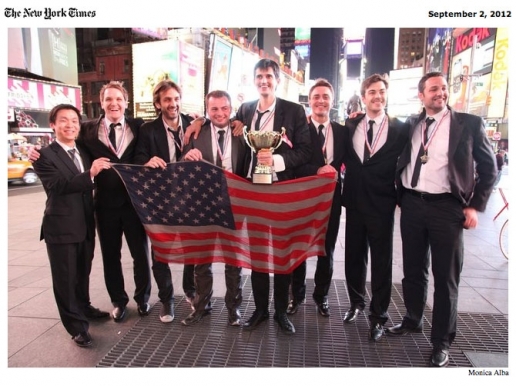
New York City Team Handball Club players pose with their latest national title trophy in Times Square

A new documentary focused on the current U.S. Club National Champions, the New York City Team Handball Club, is in the final stages of editing.  The film focuses on the multi-cultural aspects of the team which includes expats from all over the world.  In this 30 minute interview, Co-Director, Ben Teitelbaum discusses the film and its genesis.

New York Times (1 Sep 2012):  Unified, in America, by an International Sport

“Home Court” Official Website:  http://handballfilm.com/

New York City Team Handball Club Website: http://newyorkcityteamhandball.com/

THN Commentary from 2009 on Team Handball Related Movies: https://teamhandballnews.com/2009/12/in-search-of-a-handball-invictus/

post

Why Weren’t the U.S. National Teams at the London Olympics?: Part 4: A lack of funding: Where are the sponsors and donors?

If only it were so easy to get substantial funding from these sources.

In part 3, I provided an overview of USA Team Handball’s funding since 1993 and some background as to why the USOC has decreased funding since the 96 Olympics.  Continuing with the theme of funding sources, in this part I look at why the sport hasn’t received much in terms of funding from sponsors and donors.   (Links to Part 1, Part 2)

Sponsors:  As the concept of a “sponsor” might mean different things to different people, I’ll define it as any company that contributes funding to USA Team Handball for the promotion of their product.  (Note:  This is significantly different from the concept of a donor (discussed later) for which there is nothing expected in kind.)

Companies with Handball Specific Products:  There are a number of products that are directly related to the sport of Team Handball.  The obvious products include balls, goals, nets, flooring, shoes and stickum.  Companies with make these products have an incentive to sponsor USA Team Handball since the use and promotion of these products by the Federation is pretty much guaranteed to reach almost everyone in the U.S. that would consider buying these products.  Over the years, USA Team Handball had had a number of sponsorship agreements with companies that make these products, but I don’t have access to the documentation which shows how substantial these agreements were.  In recent years, USA Team Handball did score a $50,000 sponsorship deal with SnapSports (a maker of floor courts), but I wouldn’t be surprised, however, if in most instances the primary benefit was simply equipment being provided for national team use.  (Side note:  Another item, worthy of a lengthy discussion are TV rights and that will be covered in the next installment.)

So, first the good news:  USA Team Handball can pitch to these potential advertisers its phenomenal market reach.  Seriously, if you advertise on USA Team Handball’s webpage, you are probably going to reach nearly 100% of the U.S. Handball market.  But, now the bad news:  The number behind that 100% is probably in the neighborhood of around 500 people.  If these companies do the math, and they generally have people that really do the math (if they want to stay in business), this means that the dollar figures behind these sponsorships isn’t going to currently amount to much.

Companies with Sports Related Products:  There are a number of sports related products not specific to Team Handball that also might find merit with a sponsorship relationship with USA Team Handball.  The most obvious item is team uniforms, but other items such as protective undergarments could come into play.  These sponsors, however, are also pretty aware of the relatively few numbers they will reach through USA Team Handball.  USA Team Handball has generally been pretty successful in finding a uniform sponsor, although it’s not clear how much funding these deals brought in.  If the U.S. could find more success on the court and qualify for the World Championships and convince a U.S. network to air a few national team matches the uniform contract would certainly increase in value.

Companies with Generic Products:  There’s nothing to prevent Coca-Cola, Chevrolet, or some other random company from joining the USA Team Handball sponsorship family.  Well, nothing other than the same argument:  They’d be paying to reach only a few potential customers.  Still, despite this USA Team Handball has had some success in this area in the past.   If companies with Team Handball specific products have taken a pass on advertising with USA Team Handball, you might wonder why on Earth some other random company would give it a go?

The answer generally falls into a couple of categories.  First, some companies want to get aligned with the Olympic movement in any way possible and USA Team Handball can provide an entrée for doing so.  The most striking example was a substantial sponsorship (reportedly around $1M) from the Weather Channel during the 96 Olympics timeframe.  I don’t the full specifics of how this came to pass, but I suspect that the Weather Channel, based in Atlanta, wanted to join the Olympic family and was either coaxed or steered in USA Team Handball’s direction.   I’ll never forget the bizarre juxtaposition of seeing USA Team Handball promotional ads being aired in between weather forecasts and contemplating just how many people watching even knew what they were seeing.  Unfortunately, enticing these companies usually requires being in the Olympics which has proven problematic in recent years.

The second category generally requires someone in the company having an affinity to Team Handball.  How else to explain USA Team Handball’s current sponsorship from Grundfos, one of the world’s leading manufacturers of water pumps?  This Danish company clearly has an affinity to the sport because the likelihood of a USA Team Handball follower also having a need of a water pump is probably pretty small.  In many respects, the distinction between this sort of sponsor and a straight up donor is pretty negligible.

Donors:  If a sponsor provides money with the intent of promoting their product, a donor is someone or some company providing money with no real expectation of profit or promotion.  Donors support a charity, a movement, or a sports federation because they believe in the cause.   I don’t know how much money has been donated over the years, but I suspect that with the exception of Dieter Esch’s fairly recent generosity it hasn’t amounted to a whole lot.

Much like a presidential campaign there’s two ways to accumulate significant funding from donations.  You can either get a few people to contribute a lot or you can get a lot of people to contribute a little.

The millionaire donor:  During the Olympics, sports columnist Jack McCallum whimsically suggested that some altruistic millionaire should take it upon himself to fund USA Team Handball.

Not the first time somebody has come up with that idea as it is the simple solution to the big funding problem.  It seems somewhat silly, but it is at least conceivable.  After all, a lot of millionaires have purchased sports franchises and then bought players to win regardless of how much it costs their bottom line. The team becomes essentially a toy for them in the big scheme of things.  And even outside of professional sports, Paul Allen of Microsoft fame and T Boone Pickens have respectively, turned the Oregon and Oklahoma State NCAA Football teams into top programs.

From that perspective why not spend money turning around an Olympic sport?  The funny thing is, is this is sort of what happened to USA Team Handball on a smaller scale when Dieter Esch bankrolled the Federation from 2008-2010.  I say, “sort of” because Mr. Esch’s generosity had its limits, somewhere perhaps between $500K and $1M.  While his generosity was substantial, we would need Mark Cuban dollars for a full and complete turnaround.  And while I wouldn’t count on this happening, if there ever is someone with idle cash and a love for the sport, I sure hope USA Team Handball is ready to pounce with a pitch that will close the deal.

In the mean time, USA Team Handball could still make inroads with more donors being willing to contribute substantial, but still sizable donations.  Indeed this was the strategy behind the $50K cost for a Board of Director’s seat that Mr. Esch implemented.  And this was how Grundfos was brought into the fold.  Problem is, though, that more companies and businesses did not follow suit.  This could have been a salesmanship problem, but perhaps it’s more of a product problem.

Salesmanship Problem or a Product Problem?

One of the things that I’ve found amusing in online forums or in postgame discussions at the bar are critical comments directed at USA Team Handball for not raising more funds and/or being content to live off the USOC.  As if incompetence and laziness were the only things keeping us from going out in to the backyard to pick corporate checks off the fundraising tree.

I don’t have full insight into how much effort USA Team Handball put into fundraising over the years, but it clearly appears to have been a priority of the last GM and Board President.  Unfortunately, while they made good progress in establishing relationships with several European entities significant funding streams didn’t materialize.  Maybe they were simply bad salesmen, but I would assess their lack of success more to the bitter truth that there is little present value with the product of USA Team Handball.

It’s true that there are some incredible salesmen that can seemingly sale anything to anyone.   But in the midst of a struggling world economy even the Billy Mays of the world are going to come up short if the product doesn’t cut it.

So, given this currently reality how can we convince potential donors and sponsors to step forward and provide more funding to USA Team Handball?  Two answers:

1) Sell the future.  While the present value of USA Team Handball is paltry, the potential future value is exceedingly bright.  A nation of 308 Million people and only around 500 dedicated followers?  A sport tailor made for Americans?  For a long time sponsors and donors couldn’t see that potential future or thought it was a pipedream, but a number of developments have occurred in recent years to start turning some heads.  (To be discussed in the next installment)

In order to sell that future, however, USA Team Handball is going to have to convince the sponsors, donor and international partners that a clear plan is in place to make that future happen.

2) Improve the current product.  Of course, this is obvious, but it’s important to note that is not necessarily fully aligned with National Team performance.  No, the goal here is to improve the product from the viewpoint of potential sponsors and donors.  This means a number of things, but more than anything it means turning 500 dedicated followers into 5,000 and then 50,000 and then more.

So that wraps up the discussion on sponsor and donors.  In part 5, I further elaborate on some of the reasons the sport of handball is so little known in the U.S.  
post

Apropos the Olympics – Part 9: The refereeing in handball brings more concerns than reassurance

British referees Battlett and Stokes had a game during the Olympic tournament


In two pre-Olympic articles, I commented on refereeing. First I noted that the group of referees nominated for London was almost completely lacking in Olympic experience, and then I previewed the issues and instructions that would need to be discussed with the Olympic handball referees to get them to maintain a correct and uniform line. It now seems inevitable that I offer some comments on my observations and evaluation.

Although I watched, through high-quality TV broadcasts or live streaming, 49 complete games and 15 at least half games (making me miss only 12 games of 76), which provides me with a very solid basis, it is of course conceivable that the official IHF evaluation will differ somewhat from my own informal effort. But I am reassured to know that the IHF Referee Commission, strongly supported by the Coaching and Methods Commission, has collected a wealth of information to be able to come up with a solid analysis in due course.

I noted in my article about the nominated group of referees that this is group that I have reason to trust as a serious and honest team, who will do their utmost to handle the games with integrity and to protect their own reputation as unbiased officials. Nothing that I saw from London makes me modify that evaluation in the slightest. To the extent that, in some games, the refereeing may have given the impression of being a bit lop-sided, it was more a result of an inability to recognize, in that particular game, that one of the two teams was much more cynical than the other, in terms of acting outside the rules. And if they did not get caught, some unfairness may have been created.

From a technical standpoint, it was clear that the areas of emphasis, which the referees heard about from the IHF before the start of the event, and which were basically also the ones that I commented on a month ago, were indeed the ones creating the main challenges during the Olympics. This is obviously not because the referees ‘refused to listen’; it simply confirms that there are some specific aspects of the game that always tend to be the more difficult ones and that, despite the reminder and the support from the IHF, these will still be the ones that cause problems and lead to criticism.

It may be frustrating to point it out, but the key issue was most likely the frequently shifting line in individual punishments. There were tendencies to differences between referee couples, but also for the same couple from one game to the next. Even more awkwardly, there was a general trend towards more leniency as we moved toward the later stages of the event and, similarly, the referees sometimes became too soft and ‘diplomatic’ during the critical final stage of a game. Also, direct 2-minute suspensions and direct ‘red cards’ were used too sparingly.

In many games it seemed that the players on the offense could do nothing wrong, as almost all the decisions went against the defenders. And unfortunately, this did not quite match the reality, so it led instead to an escalation of the methods by the desperate defenders. But in individual games, it was suddenly turned around so that all the attention seemed to be on infringements by the attackers. Of course, this tended to cause confusion.

As so often in the past, many of the problem situations occurred around the 6-meter line. Often this was in the sense that a ‘wrestling’ or ‘shoving’ match was taking place, without any action from the referees. And another issue involved the well-known trend of ‘detecting’ defenders inside the goal-area and awarding a 7-meter-throw, even when this was not really the situation. It would be a major break-through if, one day, one could get a consistently more accurate observation by the referees about this.

And the final realization was that too many of our top referees are not used to, and comfortable with, refereeing women’s matches. So precisely in the Olympic Games, which is the only time when we have simultaneous men’s and women’s competition, it was noticeable that the judgment of body contact in the women’s games often was flawed or at least inconsistent.

This year’s Olympic handball tournaments may not have been of the absolute top level that one might have hoped. But the speed, dynamics and physicality were nevertheless sufficient to make observers begin to wonder if we have reached the stage where it is beyond the capacity of TWO pairs of eyes to register everything that is happening on the court. Or alternatively, what are the scientific methods that have not yet been tried, in the area of helping the referees to maintain the concentration, focus, recognition and interpretation that is needed?

More generally, most of the referees in London will also by appearing in the Men’s World Championship in just five months time. On the basis of the observations now made, will the IHF, in collaboration with the continental federations, be able to apply the resources needed to follow these referees in the meantime, offering feedback, mentoring and practical advice? As I have commented, these referees are not ‘beginners’, but they also are not ‘ready’ in the sense that can be left to their own devices. They constitute a key resource for our elite handball, who need and deserve constant support and nurturing!

post

Apropos the Olympics – Part 7: The British deserve the blame!

their gift to mankind...


In connection with their hosting of the Olympic Games, the British have been very quick and proud to use a lot of media articles to proclaim that they are the ones who ‘invented’ a large proportion of the sports in the Games and a whole lot of other sports as well. The lists vary from source to source, but they often include sports which some other countries have been in the habit of claiming as theirs.

Most people are ready to accept that soccer/football originated in Britain, but the lists generally also tend to include archery, badminton, boxing, field hockey, rowing, sailing, swimming, table tennis, tennis, track & field and water polo. If you disagree, please do not blame me; I am just passing on the consensus of British media! Of course, they also want to take credit for some (currently) non-Olympic sports, such as cricket, croquet, golf, rugby and squash. I think they probably also have the rights to some other strange things such as netball.

But they are quite prepared to accept that, by contrast, other countries deserve the credit for a small number of Olympic events, such as the U.S. inventions of basketball, volleyball and triathlon. Similarly, they are willing to admit that the Germans seem to be the ones who started gymnastics. And in some footnotes there are references to the competing claims for the obscure sport of handball from Denmark and Germany. The British seem quite content not to have anything do with that ‘un-British activity’.

And yes, this confirms what I have always noted, both in conversations with British friends and with people from around the ‘Anglo part’ of various continents: it is really the ‘fault’ of the British that our revered handball has had such a scattered emergence around the globe. In Africa, for instance, it is very clear that North Africa and some francophone countries on the West Coast keep dominating, together with the special case of Angola. By contrast, I remember asking government officials about handball during visits to Kenya and Ghana, former British colonies, and I was met by a blank stare.

The same fate was generally bestowed upon Commonwealth nations in Asia, so this is why handball has always had this awkwardly polarized situation in Asia, with strongholds around the Persian Gulf and in China, Japan, and Korea. India is only recently beginning to participate in handball, but at a very modest level. Similarly, the Australians were, and mainly remain, handball novices when they were hosting the Olympic Games in the year 2000.

Another interesting twist involves the French overseas ‘regions’ of Guadeloupe, Martinique and Reunion, which you could say have amounted to ‘secret weapons’ for France in the international competition, producing world-class talents such as retired stars Richardson and Abati, together with current top players Dinart, Narcisse and Sorhaindo. I bet the British team would not have minded having some reinforcements like that on their team in the London Olympics.

The early starters in PanAmerica were Canada and USA in the north and Mexico and Argentina in Latin America. But this certainly had nothing to do with a British (or Spanish) influence. Migration and contacts related to specific ethnic groups provide more of an explanation. As I noted in one of my recent articles, the lack of immigrants from regions with handball background to this day remains a handicap for handball in the U.S., compared with the steady and natural inflow of newcomers who have grown up with soccer. So when we ponder this reality, let us remember that, essentially, the blame for handball’s difficulties in the U.S. really lies with the British and their lack of appreciation for handball…

As a ‘footnote’, while it has been very nice to see the enthusiasm of British spectators for a sport which has no background in their country, and while the preparations and competitive spirit of the British handball teams were admirable, there are already signs that handball in Britain may not be able to count on a sustained boost in the aftermath of the Olympic Games. Quite surprisingly, it was already reported shortly before the start of the Olympics that the participation of the British women’s team in the upcoming World Championship qualifying had been cancelled. And now we are finding media reports to the effect that the government is already bringing the British handballers down to earth after their Olympic excitement. Much in line with the situation in the U.S., the government has declared that funding will only be provided for sports with genuine chances for an Olympic medal!!!

post

Why weren’t the U.S. National Teams at the London Olympics?: Part 3: A lack of funding

Since the 96 Olympics the bottom line for USA Team Handball has been trending down.

In Part 1, I provided some top level analysis as to why our current national teams didn’t qualify for the London Olympics- we’re simply not very good.  In Part 2, I addressed the challenges USA Team Handball has had in finding and developing athletes.  In Part 3, I tackle the current lack of funding, some potential sources of additional revenue and why the U.S. has struggled to raise more funds.

It doesn’t take long for anyone observing the state of Team Handball in the U.S. to come up with a number of potential solutions as to how things could be turned around.  Very few of those solutions, however, come free and even the lowest cost options require some level of funding to implement.  It can be amusing to hear or read these would be solutions and then do some back of the envelope cost analysis to quickly determine that  the first year of implementation alone would bust the entire U.S. budget for the last decade.

Just how lacking is this “Lack of Funding?”

So, just how cash strapped is USA Team Handball?  I don’t have all the financial details, but the U.S. Government’s tax reporting requirements do provide a pretty good window of the trend that have occurred in the past two decades.  Using the Internal Revenue Service (IRS) Form 990s that are available through different online resources, I was able to do some forensic analysis.   For each year, the first number is the amount listed on USA Team Handball’s Form 990s in regards to “gifts, grants and contributions received.”  The second number is the contribution amount listed in U.S. Olympic Committee (USOC) Form 990s as being granted to USATH.

Year       Total Contributions         USOC Grant
1993       $841,615
1994       $1,396,152
1995       $1,204,365
1996       $1,383,813
1997       $867,116
1998       $585,000
1999       $563,152
2000       $741,322
2001       $652,364              $510,000
2002       $614,930              $379,000
2003       $547,091              $487,561
2004       $458,621              $354,237
2005       <<N/A>>             $281,620
2006       <<N/A>>             $3,184
2007       <<N/A>>             $500
2008       $489,150              $0
2009       $974,612              $238,268
2010       <<N/A>>             $335,552
2011       <<N/A>>              $283,202

First, a few notes regarding the data above:

– I couldn’t find USOC Form 990s prior to the year 2000.
– From 2006-2008 there was essentially no USA Team Handball Federation due to the USOC’s decertification of the Federation.  During that time period, however, the USOC took over many of the responsibilities of the Federation.  It would be interesting to see what it cost the USOC to run Team Handball during that period, but those numbers aren’t available.
– The USOC fiscal year is the same as the Calendar year while USA Team Handball’s Fiscal Year is from 1 July to 30 June.  In other words 2009 data is actually from 1 July 2009 to 30 June 2010.
– Reportedly, there was a number of accounting problems with USA Team Handball’s 2010 Form 990 and I think that is why it hasn’t been filed yet.
– There are several other items that I could have listed in the table to include total revenue and total expenses.  With few exceptions, however, total revenue and expenses track very closely to the total contribution number.  In other words, almost all of USA Team Handball’s revenue has been in the form of grants and USA Team Handball expenses have matched that revenue.  (Although, based on reports of debt problems this is probably not true for the 2010-2011 timeframe.)
– The Form 990 does not require the filing organization to fully break out where the contributions come from and for what amount.  This is why I include the USOC reporting of grants to Team Handball.  Additionally, it appears that older versions of the form don’t clearly delineate between grant and sponsorship funding.

While there are a lot of limitations with this data, it does provide a pretty good indication of the downward trend in funding.  Certainly from the high water mark (around the 96 Olympics) to the demise of the Federation in 2006 there’s a significant drop in funding.  And not surprisingly, there was a corresponding drop in performance on the court with the U.S. not coming anywhere close to qualifying for the 2000 and 2004 Olympics.  Aside from the drop in national team performance the lack of funding undoubtedly exacerbated USA Team Handball’s management/leadership problems leading to the Federation’s eventual decertification by the USOC.

With the establishment of the new Federation in 2008 there was an uptick in funding, but this uptick was mostly attributable to the generosity of Dieter Esch.  USOC funding from 2009 to 2011 has ranged from $238K to $335K, still far below reported figures from 2000-2004 and surely below grants provided during the 1996 Olympics timeframe.  With Dieter Esch deciding to turn off the spigot in 2010, USA Team Handball is reportedly back to a budget in the $300-500K range.

It can be debated as to just how much USA Team Handball needs in terms of funding to field competitive teams, but few would argue that $300-500K is sufficient.  Certainly, if $1.3M budgets were required in the 1996 timeframe to be “respectable” in Atlanta, then probably at least that much (adjusted for inflation) is needed today.  And not to mention, there’s a whole lot more than just national team budgets to consider.  How do you also pay for development and the interests of the membership at large.  And marketing, staff salaries, etc, etc.  Really, to do things right you probably need more like $5M.

So, Where’s the “Mo Money” Going to Come from?

So, if it’s so obvious you need more money, why you just craft a plan and go get it.  Right?  If only, it was so easy.  On the plus side, it is fairly obvious what the potential sources of additional revenue are, it’s just that convincing those sources to actually cough up the bucks is easier said than done.  What follows is a list of the potential sources, why they haven’t contributed as much as maybe they should and some top level assessment as to what it’s going to take for them to change their minds.

USOC:  For decades the USOC has been the main funding source for USA Team Handball.  This funding has varied over the years at times probably pushing the $1M mark at the high end and bottoming out to zero at the low end.  (It would be interesting to see more definitive financial data going back to the 1970s and adjusted for inflation, but that information is not readily available.)   In more recent years it has been around $300K.  So what happened?   Why the dramatic decrease in funding support?

The simple answer is that since the 96 Olympics the USOC has increasingly decided to base their funding decisions on what a sport’s chances for getting a medal are.  With the U.S. not being coming close to a medal in 96 and clearly no chance of medalling on the horizon it’s easy to see how Team Handball is going to come up short when competing against the likes of Swimming and Gymnastices.  Even worse as a team sport the costs of fielding a competitive team are pretty substantial and the return on investment can only be one medal in each gender.  The bitter reality is that no matter how you slice and dice it, if you’re trying to maximize medals for the least cost, investing in Team Handball is a fool’s errand.

Might the USOC, however, rethink its current medal emphasis?  I can think of a number of other factors that should be considered when the USOC makes these decisions.  Those factors include Federation need, potential TV audience and health/fitness for the nation as a whole.  In each of those areas USA Team Handball scores pretty high.  “Need” certainly doesn’t need to be explained.  As witnessed by the buzz from the recent Olympics it should be even clearer to USOC reps that the sport is tailor made for TV.  I’m obviously biased, but I don’t think it should be lost on anyone that the dynamics of attractive Team Handball match is inherently more entertaining than watching an arrow hit a target or boat crews rowing their oars back and forth.  Finally, with obesity becoming an increasing health concern the prospect of thousands of youths running up and down the court is a selling point that the USOC will/should at least listen to.

While these are factors that the USOC appears to consider, the goal is still clearly gold, silver or bronze.  And as long as that’s the case the best USA Team Handball can probably hope for is probably around $500K/year, an amount which is more in line with the funding levels of some of the other minor Olympic sports.

But the USOC isn’t the only game in town, in Part 4 I’ll review why funding has also been lacking from international entities, sponsors and other sources of potential revenue.

post

Apropos the Olympics – Part 6: Would an ‘under-23’ limit be good for handball?

not even the younger French players Accambray and Barachet would be eligible for an 'under-23' team


As most of you are likely to be aware, the IOC and FIFA have worked out a special deal under which the Olympic football tournament is essentially available only to players under the age of 23. Three players per team are allowed to be above that age. This particular rule came into effect in 1992. In 1984, the previous prohibition against participation by ‘professional’ players was lifted, and the rule for 1984 and 1988 limited the participation on European and South American teams to players who had no previous World Cup experience, whereas no such limit existed for the rest of the world. The 1984 ruling was disliked, inasmuch as it created an inconsistency between countries, so this led to the change in 1992.

The reason behind the current rule is that FIFA absolutely does not want the Olympic tournament to compete with FIFA’s own World Cup, while on the other hand the IOC really does not want FIFA to withdraw from the Olympic Games. So this is what causes IOC to allow this unique compromise. It has led to relatively interesting Olympic football tournaments, with a considerably more balanced strength between continents, as compared with the World Cup. African nations have benefitted in the past, and now in London we saw a final between Brazil and Mexico, while Korea and Japan played for the bronze medals. In other words, not one single European team, including the host country, managed to qualify for the semifinals, but the quality of the tournament was still relatively good.

Among some of our readers, it raised the question whether a similar arrangement could be feasible, beneficial and allowed also in handball, and I decided to get the reactions of a number of handball friends from around the world. From a U.S. perspective, it had been suggested that some form of age limit would lead to a ‘more equal playing field’, with better opportunities for non-traditional handball nations. Similarly, it was suggested that in such countries one could hope that this kind of rule could spur an increased emphasis on youth development in handball. And the benefit for the traditional handball powers in handball would be that it would remove the Olympic Games as an additional burden in the competition calendar, which in Europe already entails four other major events in every four-year period. Right now we hear top club teams in Europe complaining that many of their players are coming back tired from London.

But, not surprisingly, I have quickly been overwhelmed by skepticism or, more bluntly, sharply negative reactions during my inquiry. It appears that, as one could sense from the enthusiasm with which even the most experienced players seem to embrace the Olympic opportunity, that this would absolutely not be the way in which the top players would want to have their burden reduced. They would instead want to cut back on World Championships or continental events. Moreover, there is no expectation that the IOC would ever be prepared to discuss such an arrangement for handball. Football is unique in its power base to ‘get away with’ such an arrangement, and IHF would probably be told that if the best players were not be made available, then the IOC would be happy to drop handball and replace us with some other sport(s).

Moreover, as many have noted, the level of a handball tournament for, say, ‘under-23’ would be so vastly inferior to a full-strength tournament that handball would ‘shoot itself in the foot’ from an image and PR standpoint, under the hypothesis that the IOC would allow it. And it is clear that if one looks at the quality of the World Junior Championships, and also reviews what players would in fact remain on the Olympic rosters from London, then the depletion would really be quite dramatic. The top teams in the Olympic soccer tournament had emerging stars who knew how to dazzle the crowds, but we could not count on the same situation in handball.

Several of my sources even doubted the premise that there would be more of a ‘nivellation’ between continents and nations. In fact, I heard the suggestion that the traditional handball countries would be even more likely to have the upper hand if one moved down in the age brackets. And indeed the results from recent years of Junior World Championships seem to confirm such an assumption, especially on the women’s side. To the extent that the ‘other’ continents may have seemed to have had a relatively better chance on the men’s junior side, this is in fact more related to a deliberately more generous allocation of slots to the other continents. So, all in all, the notion of an age limit clearly seems to fail to create any enthusiasm!

post

Apropos the Olympics – Part 5: American novices reacting to handball on TV

Also a handball novice may easily get excited during a game, as demonstrated here by the 'outspoken' Swedish King


As I mentioned in my first post-Olympic comments, I spent time during the second week of the Games in the company of Americans sports fans watching handball on TV. Almost without exception, it was their first opportunity to get familiar with our sport. So it entailed an opportunity to do some ‘preaching’ and explaining, while also listening to often quite amusing comments from the handball novices around me.

The comments included a mixture of the type of reactions that I have constantly encountered during my soon 40 years in the U.S. and some more surprising observations. Generally speaking, handball met with the approval of the people around me, and their reactions showed that this was not just the result of politeness. As often happens, people got excited even without having any prior knowledge of the teams and without being able to appreciate the fine points. “This is such a typically American sport”, was a comment that I have become used to over the years. And “why are we not good at this”, is then the obvious follow-up question.

What people tended to appreciate was the amount of physical contact, especially the fact that this is very much part also of the women’s handball. “This would be something for women who like American football”, was one comment, and “it is nice to see a ball game where you can be successful without being extremely tall”, was the reaction of someone watching the Koreans. Having a goalkeeper, instead of just a basket, was a feature that some viewers felt added a dimension. And the continuous action, without a lot of time-outs, met with approval, as did the existence of the ‘advantage rule’, which some recognized from soccer.

It was also seen as helpful that the structure and action of the game is so straight-forward that it is easy to follow and enjoy also for a beginner. As someone commented, you can easily anticipate when a critical moment is coming up so that you have to focus a bit extra. But then some felt a bit lost in their appreciation for what constitutes an ‘offensive foul’, and I had to admit that the referees did not always manage to show the desired consistency. Similarly, I got comments to the effect that “the decisions about when to give a 2-minute punishment seemed a bit capricious”. This came from basketball or icehockey fans, who are more used to the notion that ‘a foul is a foul’.

Several of my ’emerging handball fans’ seemed to assume that an Olympic sport such as handball “surely already was well established in the U.S.” and that it was their ‘fault’ for not having gotten to know it before. But they assumed it must be a relatively new sport at the Olympics, such as BMX or beach volleyball. They were astonished when I explained the longstanding traditions in Europe but also the comparatively feeble evolution in our country.

Someone offered the astute reflection that “of course soccer has a huge advantage, because so many of our immigrants these days bring that sport with them, while that does not seem to apply to handball”. I also heard the observation that the name ‘handball’ is a problem and ought to be changed. I gently reminded that this might not be so appropriate for Americans to suggest, considering our stubborn insistence on confusing people by referring to a certain sport as ‘football’ although 98% of the ball handling is with the hands… Others noted that the size of the court is a handicap, “as it does not fit into school gyms and would discourage schools from picking it up”. But ultimately, some of my new recruits noted that “as usual, it is likely to be a matter of money and good management”. Perhaps it will one day appear that at least one of my fellow viewers turns out to be a major philanthropist with a weak spot for handball…!

post

I want my, I want my, I want my HBL: Can somebody get me a good Univision Deportes Contact?


Could this Spanish language sports channel be the new American home for the German Bundesliga?

The German Handball Bundesliga (HBL) 2012-13 season is set to begin this Friday night with Grosswallstadt hosting Melsungen.  Unfortunately, the My Sports Germany channel did not the renew the rights for the HBL, so American viewers planning to get their handball fixing watching the world’s best professional league in their living room are probably out of luck.  Or are they?

According to some email correspondence I received from The Sportmans Media Group (the TV rights distributor for the HBL) the Univision Deportes Network (UDN) now has the rights to broadcast the HBL in the U.S. via their relationship with Televisa Deportes Network (TDN).  As I understand it, TDN is only available in Mexico, while UDN is available in the U.S.   And UDN can and does broadcast a lot of TDN content.  Mostly soccer from what I can tell.

I would like to know whether the UDN will (or could be convinced to) broadcast the HBL this season.  (Heck, even if they show one match a week at 2:00 A.M, I’ll be happy.)  Unfortunately, I haven’t been able to find an email contact on the UDN website and some shout outs on Twitter and Facebook have been unanswered.  Not too surprising as they were in English except for the word Balonmano (Handball in Spanish).

So my plea out there to any of our Spanish readers with a little bit of patience and persistence.  If you can track down the right point of contact at Univision to discuss the possibility of balonmano being broadcasts on their network it would be very greatly appreciated.  And if Univision agrees to advertise with Team Handball News, we will compensate you for your efforts.

If you have some good leads please send me an email at john.ryan@teamhandballnews.com

post

Apropos the Olympics – Part 4: Women’s Handball

Bojana Popovic, literally head and shoulders above the rest of the players in the final


You may recall that my main reaction to the men’s handball competition was one of disappointment. Unfortunately, I must say very much the same thing about the women’s tournament. In fact, the similarities are quite amazing. The 2008 champions, on the women’s side Norway, managed to defend the title without really impressing anyone while doing so. Just like in the case of the men, it happened because none of the other team’s showed their normal strength, which would have been enough to deserve to win and to manage to do so. Just like the French men, the Norwegian women were on their way to disaster in the quarterfinal, but their opponents kindly let them off the hook!

The main difference was perhaps that the final for the women had more real drama and excitement, in comparison with the men. Once they managed to qualify for the final, it was not surprising that the team from Montenegro would put up a real fight for the gold. In fact, they were a bit unlucky in losing the final, and it is my background in refereeing that inhibits me when it comes to explaining why I think so… Women’s handball in Montenegro is perhaps the best parallel to men’s handball on Iceland. The population is twice that of Iceland, moving towards 700.000, but the pool of talented handball players is small.

The focus in Montenegro is on team sports, but football and basketball are clearly ahead of handball, and even volleyball is a strong rival for athletes and spectators. But in recent time it is handball that has given the headlines. Buducnost won the EHF Champions League just a few months ago, and now Bojana Popovic, their perennial world-class player led them to the silver in the final match of her career. She had previously won World Championship bronze with Yugoslavia in 2001 and five earlier Champions League titles for Danish clubs. Montenegro hardly looked like a team for the final in the early going. They lost to both Brazil and Croatia, before they managed to tie Russia. But the breakthrough came in the quarterfinal, where they knocked out the equally tough and combative French team, one of the favorites.

The Koreans are always giving priority to the Olympic Games, so they tend to build up their team in four-year cycles. This time, the team showed many of their traditional strengths in terms of speed, energy and tenacity. But somehow they never looked as sturdy as their colleagues from the past, so their style combined with injury problems seemed to make them run out of steam after they knocked out Russia in the quarterfinals. Talking about Russia, their veteran coach Trefilov urged them on during the games in his well-known loud and ‘desperate’ style. But this time his team did not respond to his emotions and efforts. At times they seemed to play in ‘autopilot’ fashion, without their usual spark. So Trefilov was bitter afterwards, announcing his retirement and predicting a bleak future for Russian women’s handball. Indeed, handball is a much more modest sport at the national level in Russia than their international achievements over the years would suggest.

The Spanish team never looked like a candidate for the gold. They were solid and consistent, just as their performances in recent years have suggested, with a third and a fourth place in the 2011 and 2009 World Championships. But there seems to be some ingredient missing that would get them to the top. By contrast, Brazil lived up to the expectations that they might be the ‘dark horse’ this time. They had the advantage of fielding a team that has been playing together for a while now, also through the agreement with the Austrian club team Hypo. They seemed ready and determined to battle for a medal and the performance in group play was impressive. While they lost to Russia, the wins against Croatia and Montenegro were enough to put them at the top of the group standings. They appeared to be riding this wave initially in the quarterfinal, having an amazing 15-9 lead against Norway after about 38 minutes. But it seems they got carried away, suddenly feeling too confident and losing concentration. After too many mistakes and a seemingly casual attitude, they lost the game they almost had won.

Finally, before the event, one of the discussions involved the lop-sided draw resulting from the strange seeding. Who would be the two teams, among six strong ones, who would not make the quarterfinals from the ‘group of death?’ Not so unexpectedly, this fate was shared by Denmark and Sweden. In the past year, Denmark’s women had suddenly but clearly come down from their traditional level, missing out on a medal in 2011 and not being very impressive in the preparation games this year. Sweden got a direct path to London, not because of their performance in 2011 but as runner-up in EURO 2010. But there were doubts about their team strength that now became confirmed. It seems that Sweden may need to rely on reinforcements from a new crop of talents, the winners of this year’s junior world championships.

post

Apropos the Olympics – Part 3: Naïve rules and formats create invitation to manipulate

Questions were raised: how desperately did Norway try to win the final group game against Spain!?


Most people who follow sports might have expected that there would be frequent headlines about doping during the Olympic Games. And indeed there were some instances, although some of them involved revelations that dated back to previous Olympic Games. Testing methods have now improved, although they always seem to lag behind the skills of the perpetrators and the experts helping them. But this meant that some samples that had been kept since previous Games were now tested and led to positive results. But the number of new cases during the competition in London thankfully seemed smaller than expected.

Instead, anyone who followed the Olympics must have heard about the stories that seemed to create such outrage and astonishment: athletes who manipulated the rules to gain an advantage. Of course, much of this depends on the nature of the respective sports. In handball and football, for instance, players will constantly and intentionally use methods that go beyond the rules, in the hope that the referees will allow them to get away with it. What goes on, literally below the surface, in waterpolo is perhaps best not to discuss. And a small nudge in an 800-meter race or sneaky move in a bike race seem to part of the normal competition.

But it is very different, when someone is accused of intentionally trying to gain an advantage by not winning a game or by causing something within the rules that is meant to force the judges to do something that is in their favor. To make it worse, some of the athletes do not seem to be the slightest reticent about openly telling the world afterwards about what they did, that it was intentional, and what they hoped to gain. In such cases, it is hard to know whether someone’s admission of guilt is really desirable… However, what is also sad to see is that, in many instance, naïve or thoughtless rules and competition formats play into the hands of those who want to get an unfair advantage, In other words, in many cases the problem could have been avoided if they sports federation had been a bit smarter.

The case that has received the most publicity is that of some badminton players who conspicuously tried to outdo each other in avoiding to win the game between them. The situation was that it was known to both the doubles teams involved that they would get an easier opponent in the next round if they lost the game. So it became a ‘game of chicken’, in the sense that both teams were guilty of action that was intended to make them lose points and then the game as a whole. The judges and the spectators were furious but helpless. But afterwards, because of the public outrage and the image problem, the players were kicked out of the tournament; and now after the Games, they have been given a more drastic suspension than the worst doping offender.

In team sprint cycling, a team fell behind from the start, whereupon one of the members fell intentionally and caused a restart under the rules. Moreover, he openly admitted afterwards that this had been part of their plans all along. The team went on to take advantage of the restart. In another case, the real issue was more a bureaucratic mistake, but it became a hot topic as it involved a gold medal winner in a high-profile event. One of the favorites in the 1500m race for men had also been entered in the 800m competition. But when he realized that this might be too much for him and reduce his chances in 1500m, his federation forgot to withdraw his entry. So to avoid disqualification he was forced to come out ready to start; but when he limped off the track during the first lap, the jury members got incensed and wanted to get him thrown out of the Games. A medical certificate, friendly or honest, resolved the matter, and his start in 1500m was rescued; whereupon he showed his class and won the gold medal!

Women’s football attracted attention, as in one of the groups the teams seemed to calculate that it was better to be a runner-up than a group winner, in order to have a supposedly easier path afterwards. With much less attention, there was some talk about the same thing possibly having happened on the final day of group play in women’s handball. Speculation was heard about a calculation on the part of the defending Olympic champions Norway, that it might be just as well not to fight too hard to win the final game, as a defeat might get them a less experienced opponent in the quarter-final. Of course, such an accusation would be very awkward, giving the virtual impossibility of ever showing what the intentions were. But then the topic lingered a bit, especially after Norway did win the quarterfinal.

As I see it, in the cases of badminton, football and handball, the real problem is related to the competition format. So for me it is an absurdity to punish the badminton players in the way that has now happened. Speculation about the advantages of not always winning a game or using the strongest line-up in a particular game happens routinely in many sports throughout all levels of competition. The job of a federation that wants to reduce the likelihood of such gamesmanship and the negative PR that goes with it, is to ensure a tournament format and schedule that reduces such opportunities. I know from experience that, precisely in the Olympic Games, the individual sports federations do not have free hands in the same way as in a World Championship. But some flexibility surely does exist.

And there may also be conflicting considerations. In handball it is clear that a format with groups of six will be more likely to create situations where manipulation may be tempting. The chances of having meaningless games, or games where neither team cares much about winning, are greater. The issue is to keep such games at a minimum, through smaller groups or more emphasis on direct-elimination games. This might lead to fewer games for the weaker teams, but (unlike the situation in a World Championships) this might be tolerable in the Olympics. It may also be preferably to use a draw to determine opponents when moving from groups to the next stage, rather than relying on a predetermined format. And of course, it does not help if, as in the case of handball this time, the draw and the seeding were knowingly flawed from the beginning, with one stronger and one weaker group for both the men and the women…

post

Apropos the Olympics – Part 2: What is the meaning of it all?

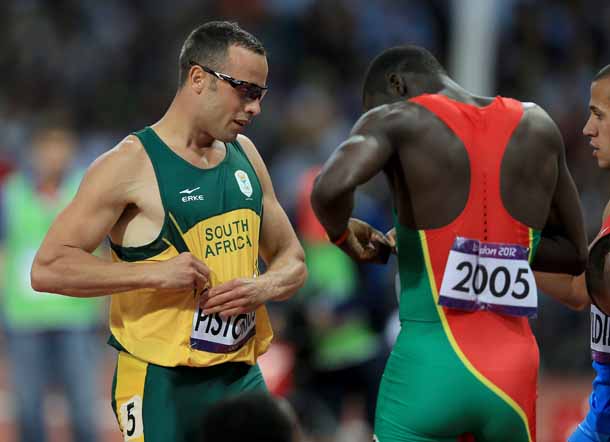
INSPIRATIONAL moment from the Olympics: Winner of 400m, James from small nation of Grenada, exchanging bibs out of respect for double amputee Pistorius who made it to the semifinals


During many Olympic Games, the format and scheduling of the TV broadcasts by NBC and their counterparts have caused a sometimes irritated debate about what the Games are all about: are they a pure sports event, should they be seen as news reporting, or are they primarily a show/entertainment. Many viewers want to see the events in detail as they happen, without too many background stories. Others want to see the key moments of the competition, combined with the underlying ‘human interest’ stories. Yet others see it simply as an entertaining alternative to less exciting summer programs on TV. Now, of course, it is possible to view it in any way you want, assuming you can get instant news through the internet and, as was now the case from London, ‘live streaming’ from any event that you want to follow in detail. So you do not need to depend on the main NBC show that comes many hours later and is very much a show.

Then there is the question of ‘for whose sake’ do we have the Olympics. Are they organized in order to enable athletes to have an opportunity to display their abilities and to gain fame and financial benefit; or do not these athletes already have sufficient events in their respective sports? Sometimes one gets the impression that the Games are held to provide the host country/city an opportunity to show off their ability and to draw a larger than usual number of visitors from abroad. More awkwardly, one also senses that the Games serve largely as a chance for sponsors and other advertisers to gain a captive audience, and that the commercial interests overwhelm the sports considerations.

If one follows the media coverage, one could almost get the impression that it is a fight between nations, albeit it in a less friendly format, to show their power and compete for global dominance. More than anything else, the table with the medal count is what stands out. Of course, this is discouraged by the International Olympic Committee, which at one point refused to release information about the official medal count. (The IOC Charter even emphasizes that it is supposed to be a competition between athletes and not between countries). But this does not work, as media simply then would do the work themselves, moreover in several conflicting versions. Personally I am ‘sick and tired’ of this focus. For me it would be more appropriate to have countries compete on the basis of accomplishments in education, health care, technology, governance and other more fundamental aspects of life.

But it seems inevitable that countries, both the largest ones in the world and the small, emerging ones, will want to use the Olympic Games to show off. It even goes quite far in terms of efforts to ‘recruit’ athletes to reinforce the population. Many countries attract immigrants and refugees, in which case a change in nationality is natural and the acquisition of a star athlete is incidental and unquestioned. But there also seem to be some countries, including the 2012 host country where, perhaps due to lingering colonial traditions or simply a financial edge, systematic efforts are made to find reinforcements in time for the Olympics. Immigration laws sometimes seem designed to facilitate such methods. One prime example in London was a female participant in triple jump, who now participated with her third nationality in four Olympic Games. It seems that globalization also tends to create a ‘mercenary corps’ of athletes. Ironically, this is in a sense what fits the notion I mentioned from the IOC charter, but unfortunately it fits even better with the actual nationalistic fervor that countries display.

My own ideas may be ‘old-fashioned’, but as you will have understood, I do not care to see the Olympic Games as a venue just for top athletes to increase their market value, for countries and their National Olympic Committees to show off, or for global conglomerates to do far-reaching advertising. For me the main consideration is to have the Olympic Games serve as a source of INSPIRATION. This could mean many different things. It could obviously involve the inspiration for young, budding athletes to make the effort to become future stars. But it could also involve the notion that it simply encourages a broader participation in sports and physical activity instead of less healthy alternatives. It could provide illustrations of how a determined and sustained effort can lead to remarkable achievements. It can show how handicaps and a difficult living environment can be overcome. (I do not much admire a ‘dream team’; I cheer the ‘underdog’ who is able to defeat the odds). And it can remind us that fair play and a sporting spirit do not need to be sacrificed in the pursuit of medals and results. So for me, the Olympic Games can (and should) be a source of inspiration that goes well beyond the world of sports.

post

Men’s Gold Medal Match: Live Chat

I’ll be leading a live chat during the Gold Medal match which starts at 10:00 AM, Eastern time.  It looks like NBC is only go air parts of the match live on the NBC Sports Network, so I’ll start of f with the NBC webstream, then switch to traditional TV when it becomes available.

I’ll have a microphone, but won’t use it when the TV broadcast is up.  Everyone who joins the ustream feed will be able to ask questions and comment via text.

Ustream Link: http://www.ustream.tv/channel/team-handball

NBC Weblink: http://www.nbcolympics.com/liveextra/video-watch.html?video=men-medal-matches-placements-gold