post

Move over Fatsis, Scott Van Pelt is the new mainstream media Handball King

ESPN's "Home for Handball"

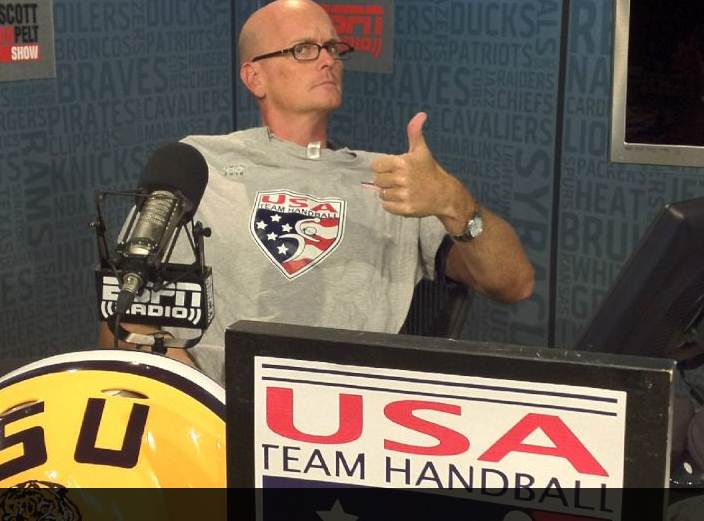
For several year’s NPR’s Stefan Fatsis has proudly worn the mantle as Team Handball’s #1 mainstream media proponent and fan.  But coming on strong and aided by the nationwide blowtorch that is ESPN Radio is Scott Van Pelt, who’s show airs from 1:00 – 4:00 PM, Eastern Time.  Van Pelt and his crew talk about the sport daily and he’s now even sporting USA Team Handball gear.  A shout even to Ulrik Wilbek.  Who’d a thunk it.

But with such a mantle also comes great responsibility. All one has to do is look at early morning offering on any of the ESPN family of networks and quickly conclude that if ESPN wants to be the “Home of Handball” there’s plenty of room to start broadcasting.  Or at the very least get some broadcasts on ESPN3 or ESPN Live or whatever ESPN is now calling their webstreaming channel.  Hey, it’s been done before as the 2009 World Championship final was broadcast online at ESPN360.  I was also told a couple of years ago that ESPN was sitting on the rights for the Liga Asobal, the Spanish Professional League.  Finally, the EHF Champions League is there for the taking if ESPN wants it.

So Scott Van Pelt:  Are you up to the challenge? Are you going to continue to talk Handball after Sunday?  Are you going to shepherd the broadcasting of the sport at ESPN?  Or are we going to spend another 4 years waiting until Rio?

Scott Van Pelt Show Website:  http://espn.go.com/espnradio/show?showId=scottvanpelt2009

Link to show podcasts: http://sports.espn.go.com/espnradio/podcast/archive?id=3028618

Scott Van Pelt Twitter: https://twitter.com/SVPshow (Note the current moniker)


post

Audio: 1972 Olympians reflect on the Munich games and more

72 Team Handball Olympians (From left to right: Vinny Dicalogero, Rick Abrahamson, Dennis Berkholtz, Jim Rogers and Joel Voelkert

This past weekend members of the 1972 Men’s Olympic Team Handball squad gathered in Las Vegas for their 40 year reunion.  Vinny Dicalogero, Rick Abrahamson, Dennis Berkholtz, Jim Rogers and Joel Voelkert sat down with me to reminisce about their “glory days.”  How the team was formed, how they prepared for the games, their qualification tournament in front of a packed house in Elkhart, Indiana, their experiences in Munich and their thoughts about what’s happened with Team Handball in the U.S. in the past 40 years.It’s an hour long, but well worth the history listen.  I suggest you use it as your sound track while watching the 2012 Olympics online.

1972 Results

Group Play (0-3)
USA vs. Hungary 15:28 (8:16)
USA vs. Yugoslavia  15:25 (9:11)
USA vs. Japan 16:20 (9:9)

Placement 13-16th place
Semi: USA vs. Spain 22:20 (8:11)
Final: USA vs. Denmark 18:19 (6:12)

Overall Placement: 14th out of 16 teams


post

Men’s Quarterfinal Matchups: Croatia is the new favorite

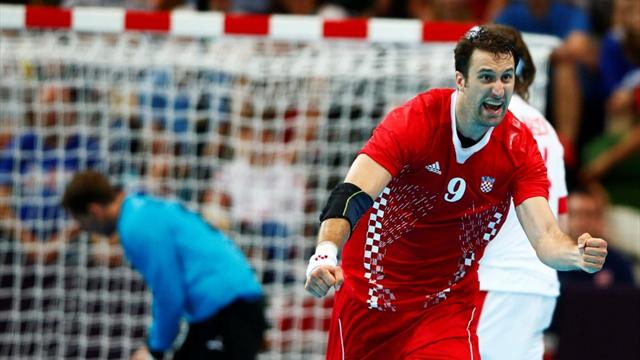
Igor Vori and Croatia should easily advance to the semis

Here are the matchups for the Men’s quarterfinals on Wednesday.  Handicap (point spreads) are in parentheses

Upper Bracket
Iceland (-3)   vs. Hungary
Denmark (-2.5) vs. Sweden

Lower Bracket
France (-2) vs. Spain
Croatia (-7.5) vs. Tunisia

Updated Odds

Here are the updated odds for the 8 remaining teams to win it all:

Croatia: 1.8 to 1 (Pre-tournament: 5.5 to 1)
France:  2.8 to 1 (2 to 1)
Denmark: 4 to 1 (3.5 to 1)
Spain: 11 to 1 (5 to 1)
Iceland: 14 to 1 (19 to 1)
Sweden: 39 to 1 (40 to 1)
Hungary: 50 to 1 (40 to 1)
Tunisia: 2000 to 1 (550 to 1)

Worth noting:  Croatia is the new favorite and they clearly played the best in group play.  Assuming France survives Spain the oddsmakers seem to think that the semifinal between France and Croatia might be the real final.  Denmark is favored out of the other bracket, but Iceland may again be the surprise team.

Link to NBC schedule of online games: http://www.nbcolympics.com/online-listings/sport=handball/index.html

(Note:  If you are time shifting, be careful not to scroll down to far if you want to avoid seeing who’s in the semifinals.)

Personal note: 4 quarterfinal knockout matches to watch.  Time to head into the time shifting tank.  No twitter, facebook and email reading for this fan!

post

Women’s Quarterfinal Matchups: Norway, Russia, Brazil and Korea in the “Bracket of Death”

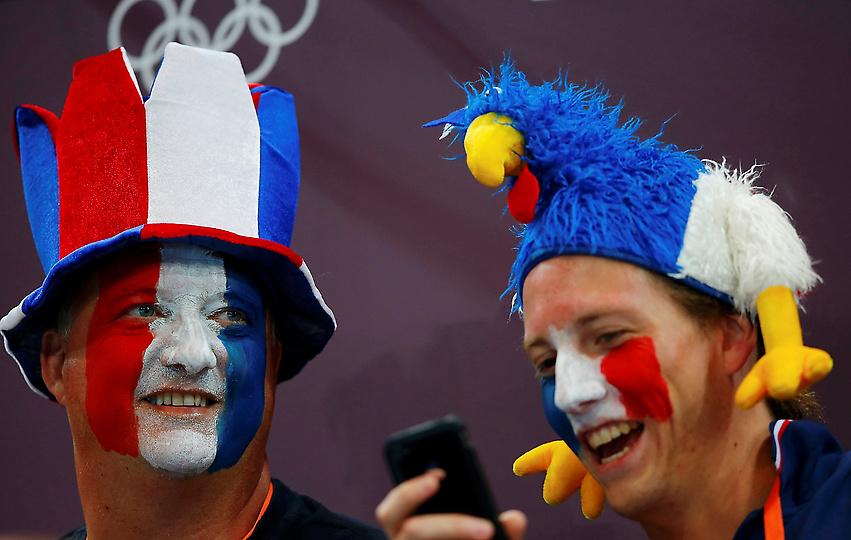
Chouette! We've avoided the Bracket de la mort!

Here are the matchups for the Women’s quarterfinals on Tuesday.  Handicap (point spreads) are in parentheses

Upper Bracket
Brazil vs. Norway (-1.5)
South Korea vs. Russia (-1.5)

Lower Bracket
Croatia (-.5) vs. Spain
Montenegro vs. France (-1.5)

Badminton tactics?: Conspiracy theorists are accusing Norway of some badminton-like tactics after their 25-20 loss to Spain in their final group play game.  A win would have placed Norway in 2nd place and set up a quarter final show down against Russia.  Norway and Russia have been the top two women’s teams in recent years and they were the oddsmaker’s top two pre-tournament favorites.  Norway’s loss, however, dropped them to fourth place and they will now play surprising Brazil.  Brazil has been playing well, though, so who’s to say whether that really is a better matchup.

Updated Odds: Here are the updated odds for the 8 remaining teams to win it all:

France:  2.5 to 1 (Pre-tournament odds: 6.5 to 1)
Norway: 2.75 to 1 (1.75 to 1)
Russia: 4.5 to 1 (3.5 to 1)
Brazil: 14 to 1 (50 to 1)
South Korea: 14 to 1 (50 to 1)
Montenegro: 19 to 1 (7.5 to 1)
Spain: 20 to 1 (34 to 1)
Croatia: 20 to 1 (75 to 1)

Worth noting:  France is the new favorite, partially due to their strong performance, but also due to a very favorable bracket.  The next four teams (Norway, Russia, Brazil and South Korea) will now battle each other in the “bracket of death”.

Link to NBC schedule of online games: http://www.nbcolympics.com/online-listings/sport=handball/index.html

(Note:  If you are time shifting, be careful not to scroll down to far if you want to avoid seeing who’s in the semifinals.)


post

AUDIO: NBC’s Dawn Lewis on the Olympics so far

Surprising Brazil wins their Group; Up next defending champion, Norway in the Quarterfinals

Women’s Group play has just concluded and the Men have just one more round of games.  NBC Commentator and 1996 Olympian Dawn Allinger Lewis discusses the upcoming women’s quarterfinals and the men’s results so far.  Podcast length is 15 minutes.

post

Why aren’t the U.S. National Teams at the London Olympics?: Part 2: Where do you find and/or how do you develop great Team Handball players?

Targeted recruiting for national teams or grass roots development? Or Both? And why is it so hard?

In Part 1, I provided some top level analysis as to why our current national teams didn’t qualify for the London Olympics.   This analysis simply looked at our current team and compared that team to former U.S. Olympic teams and our current Pan American competition.  That analysis highlighted that our current teams are lacking in the following areas: 1) Raw athletic talent, 2) Conditioning, 3) Individual technique/skills, 4) Team cohesion/experience, 5) Coaching strategy/preparation.  In this second part I start to look at the underlying reasons for failure.

The Underlying Reasons:   A complicated web they weave.

I’ve been asked a number of times over the years, just why the U.S. isn’t any good in Team Handball.  I usually reply with “How much time do you have and where should I start?”  As I started to map out the reasons on paper in a systematic way it became even more clear to me just how complicated it is as all of the reasons are interlocking in multiple ways so there is no clear root cause to failure.  In short, there is no straight line cause and effect like the old “For want of a nail” proverb by which if we just solve this one thing we’ll become a great handball nation.  Perhaps, some reasons like the lack of funding or lack of marketing exposure come close, but there is no “silver bullet” guaranteed to solve all the problems.

So, with that little diatribe in mind I would like to highlight 4 major underlying reasons worth further discussion.  Those 4 reasons are:

1) A lack of good handball athletes
2) A lack of marketing/awareness
3) A lack of funding
4) Ineffective leadership/management

Underlying Reason #1:  A lack of good handball athletes

Perhaps the most obvious shortcoming to the U.S. National teams relates to a distinct lack of athlete with both the raw talent and technical skills to compete at higher levels.  There are two basic solutions or paths to address this problem:

1) Targeted Recruitment: You can recruit some good raw athletic talent and have a dedicated and intensive training program to build up their technical skills
2) Grass Roots:  You can develop broad based grass roots programs to increase the number of players in this country and out of those greater numbers some good athletes with strong technical skills will emerge.

Over the years the U.S. has tried both approaches to varying degrees of success.  In a series of articles I wrote 3 years ago, “A Framework for Creating USA National Team Success” Part 1, Part 2, Part 3, I provided an in depth review of some of the problems with each strategy and proposed a hybrid model for implementation.  Here is a somewhat shortened version of that analysis.

Targeted Recruitment:  The obvious solution?

With the Olympics going on various media observers have been watching the Handball matches and have been zeroing in on the Target Recruitment strategy.  All we need is NBA D-League players or mediocre NCAA talent from the Big Sky conference and train them up a little.  Even USA Team Handball is in the act taking the more modest approach of 1 (all we need is just 1) athlete from each NCAA conference.

It’s easy to see why so many people immediately come up with this strategy as one only has to watch the teams currently playing in London and assess that there are indeed thousands, if not tens of thousands of athletes in the U.S. with the raw athletic talent necessary to compete.  But, it’s just not that simple as there are a number of further underlying reasons:

1) Recruitment of the great raw talent athlete is only feasible when those athletes run out of other options:  Many observers fully realize this and that is why the more credible back of the napkin analysis focuses on athletes that aren’t going to make the big time.  Problem is you need to convince those athletes that they aren’t going to be the next D-Leaguer that isn’t going to make the NBA.

2) More athletes have more “other” options:  Not too many years ago the options for former NCAA athletes were pretty limited making an Olympic handball career an interesting possibility.  This is not as true anymore, particularly for basketball athletes who have a lot more options in Europe.  This article highlights how things have change over the years.

3) Older players are more likely to have “life issues” emerge:  Most great raw talent athletes at least having the option of playing their chosen sport in college.  This means the youngest athletes will be in 22-23 age range.  Certainly from a physicality standpoint this age is not a tremendous problem, but with each passing year athletes will inevitably have “life issues” play a greater and greater role in their overall psyche.  The possibility of marriage, needing to start a career or just waking up some morning and deciding that this training isn’t any fun anymore will come into play.

4) The Olympic carrot is less of a tangible reward:  In the past a USA Team Handball recruiter could confidently wave the Olympic carrot in front of a would be player.  Certainly at the 84 and 96 Olympics there was automatic qualification.  The competition in the Pan American region, however, is now much stiffer and some athletes will be less enticed when they realize that participating in the Olympics is far from a guarantee.

5) Lack of funding:  And right now the USA Federation has nowhere near the funding necessary to establish a credible training program for these would be recruits.  The programs in the 80s and 90s provided room and board, overseas travel opportunities and a small stipend.  With the other reasons outlined above even that model might not be sufficient enough to recruit the players needed.

Grass Roots:  Too hard and it takes too long?

While it’s not the solution du jour, Grass Roots strategies have garnered more weight at other times.  All we have to do is copy what soccer has done (or lacrosse, or rugby, or ultimate Frisbee) and then the sport will be popular in this country.  It’s not so simple and in this post I explained why.

Perhaps the biggest proponents to this strategy are the many expats who remember how they learned the sport at younger ages in their home country.  If we could do it in Elbonia then we can do it in the USA.   Grass Roots takes time, but it’s clearly the way to go if we want to have sustained success.  If you have thousands and thousands playing the sport, you will have great players that bubble up to the top and they will be doing so at age 18, not age 25.  But it’s not easy to develop these broad based programs.  Here are some of the reasons why.

1) Starting up a team sport from scratch isn’t easy:  Team Handball is a team game and you need a lot of players in order to have a good training environment.  We can probably quibble about just exactly how many are needed, but at least 10 is probably a good number.   Then, of course, you have to add the challenge of convincing people who’ve never played a sport before to suddenly decide to devote time and money to it.  The internet and Olympic telecast make such recruiting easier, but as anybody who’s ever started a club knows this is painstaking, unglamorous work.

2) Gym space is needed:  Finding a gym to play in can be a challenge as many in the U.S. were built for smaller basketball courts.  And then all those basketball leagues have to be contended with.  The cost of gym rental can be a crippling blow to new clubs which lack the numbers to share the costs.

3) The tyranny of distance:  The U.S. is a big country.  Even if a good club program is started in one particular city, that club often has to travel considerable distance to play another club.  This means that for real grass roots efforts to succeed that one club in a city often isn’t enough.  This is why to a certain extent that there is a little bit more concentration and development on the East Coast where the population has a bit more density.

4) The dominance of basketball: Team Handball is its own game and has similarities with a number of sports.  Still, it should be obvious that there is a great deal of similarity between the two games.  Not every good basketball player could be a good team handball player (and vice-versa), but there is a massive number of players that could choose either.  Basketball was invented in the U.S. and it’s our national indoor sport.  That’s not going to ever change and those would be athletes at younger ages are almost always going to select hoops over handball.

5) The physicality of team handball:  Team Handball can be a rough sport to play and it’s probably better suited for athletes in their teens.  Accordingly, it’s at a handicap compared to other sports like soccer where there is less injury, or at least the perception of less injury.

6) The pressure to succeed now: It’s a given that Grass Roots programs will not lead to immediate success.  In fact, you could argue that it will take at least 10 years to see any success translated to our national teams.  Meanwhile the USOC, a primary funding source for USA Team Handball, requests a yearly High Performance Plan which is supposed to outline how Team USA is going to win medals when the reality is that even qualifying at this point would be a tremendous success.  This pressure has always existed, so it’s not surprising that funding choices have often been made towards supporting National Teams rather than Grass Roots efforts.  And then when those National Teams have only moderate success (if even that) the Grass Roots proponents out in the sticks have complained, if only you had given me the resources I need, I would have developed several athletes that could make your national teams.

7) Lack of funding:  But, again the reality is that even if USA Team Handball zeroed out all funding for USA National Teams there still wouldn’t be enough seed money to support Grass Roots programs on the scale that is necessary.  Sure, it could be argued that these programs should be self-sufficient, but with the challenges outlined above assistance is needed to better enable success.

The Answer?

When you start to add up the underlying reasons it becomes fairly clear that both strategies have a lot of hurdles standing in the way of success.   As I noted in my framework series there are elements of both models that have merits, so that’s why I think some sort of a hybrid approach stand the best chance of success.  And I say best chance, because there are some other underlying reasons that would have to be resolved before any plan to field better teams has a good chance at success.  Those other areas include a lack of funding, a lack of exposure/marketing,  and yes, a history of ineffective leadership/managemen.  In Part 3, I first address the historical lack of funding.
post

Some excitement while we wait for the quarter-finals

the British are beginning to catch on


There have been many games, both men and women, of high quality and with plenty of emotion. But it cannot be helped: the format of the handball competition makes you wait for the quarterfinals. In several games, it has been easy to get carried away with the drama and the closeness in the result, until it occurs to you that it is almost impossible to anticipate whether the result in fact has much importance. And this is obviously very clear to the teams, which means that those who have already gained a few points show that they feel it is possible to be a bit relaxed in certain games. And after four days on the women’s side and three games for the men, we already have some clarity. To some extent this is related to the skewed draw of the groups.

In one women’s group, it may seem we have a top trio, who have beaten each other and will end up in the sequence Russia, Croatia and Brazil, if they can win their final group games. But the key match-up here is Russia-Montenegro, where a win for Montenegro would suddenly send the Russians to fourth place, while Brazil would win the group. Even if this were not to happen, it seems one must regard Brazil’s performance as particularly positive after their disappointment in the World Championship half a year ago. And there was clearly special excitement in the game where Croatia managed to beat Russia. It should also be noted that Angola and Great Britain are already out of the running.

In the other group, the tougher one, France has seemed to be the more solid team, also in a physical sense. Some may have been surprised by the Korean, but then they forget that it is Korea’s traditional specialty to come with a cohesive team precisely to the Olympic Games. By contrast, Sweden has been the real disappointment; four straight losses so far, but above all some really uninspired performances. Today’s final game was Denmark’s ‘battle for survival’ against rivals Norway. The game was dramatic, shifting between a narrow lead for Norway and a tied game. Norway scored the winning goal in the final seconds, and this means that Denmark will now join Sweden on the sidelines when we get to the quarter-finals. Frankly, this really fits the Danish performance both earlier in week and in recent time. They are not at their usual level.

The men’s ‘group of death’ has Croatia and Denmark at the top with three straight wins. Tomorrow’s game between the two is likely to determine the group winner. Denmark has not tended to make it easy for themselves, but towards the end of each game they have come through. Spain and Hungary have showed good form but without consistency. The disappointment so far is Serbia; they have looked very solid in a couple of games, but then suddenly they lost their strength and composure. Finally, Korea’s men follow the pattern of being less competitive then their women counterparts.

The other men’s group has come out as expected so far. The key game for advancement to the quarterfinal will be Argentina vs. Tunisia on the final day. Great Britain will try to ‘complicate’ things by getting a point or two against Tunisia tomorrow. Among the three traditional powers, Sweden has been the weaker partner so far. Like the women, they have not shown much fighting spirit. So it will be up to France and Iceland to settle the top two positions tomorrow.

It has really been impressive to see how the British spectators have taken to handball, showing up in large numbers and with great enthusiasm, despite the lack of success for their teams. And then, of course, each one of the other teams has had their contingent of boisterous supporters. So the atmosphere in the Copperbox Arena has really been great!

post

Why aren’t the USA men’s and women’s national teams at the 2012 Olympics?: Part 1: The simple analysis

Brazil scoring one of their 50 goals in their 50-10 victory over the USA last year at the PANAM Games. The USA will need to get a lot better if it wants to qualify for the Olympics.

I’m in the process of updating the Frequently Asked Questions (FAQ) page and as this is easily the question of the moment, I thought it worthwhile to answer it.   In this first part, I simply review the qualification competition and analyze why the U.S. came up short.

Why aren’t the USA men’s and women’s national teams at the 2012 Olympics?

The simple answer:  They didn’t qualify (and they didn’t even come close).  There are two paths to qualification for the USA; either via the World Championships or the PANAM Games.  It’s a somewhat complicated process and the details are at these links (Men’s 2012 Qualification, Women’s 2012 Qualification).  By far, the simplest and easiest way for the USA to have qualified would have been to win the Handball Tournament at the PANAM Games.

At the 2011 PANAM Games the women finished 8th out of 8 teams, failing to win a single match.  In pool play they lost to the eventual winner and Olympic qualifier, Brazil by a score of 50-10.  There’s no way to sugar coat such a loss as it means that Brazil basically scored at will.  In their other 4 games the women were more competitive, but still lost by an average of 7 goals. (Details on PANAM Games Women’s Tournament)

The men fared slightly better and finished 7th out of 8 teams.  In pool play they lost 36-19 to the eventual winner and Olympic qualifier, Argentina.  Their other pool play and placement matches were relatively close.  They lost by 5 goals to eventual 4th place finisher, the Dominican Republic and lost by 1 goal to both Mexico and Canada.  In the 7th place game they managed to beat winless Venezuela by 4.    These margins of defeat make it abundantly clear that there was no realistic scenario by which either the men or women could have qualified for London. (Details on PANAM Games Men’s Tournament)

Why weren’t the U.S. teams more competitive? The U.S. has never been a world power, but in the 80s and 90s, the U.S. fielded competitive sides that were able to earn qualification to the Olympics.   What happened?  Why the lopsided scores?  As this is just the first of two parts, I’ll first give the direct causes of failure.  In thinking about how to best capture this I came up with 5 key areas that factor into how good a team is.  These 5 key factors are:

1) Raw athletic talent
2) Conditioning
3) Individual technique/skills
4) Team cohesion/experience
5) Coaching strategy/preparation

So here’s my assessment of our current national teams and where they stand, both in comparison to their current competition and USA teams of the 80s and 90s.  (Side Note: If this assessment comes across as a cranky old timer who thinks former USA teams walked on water, let me be clear on a couple of things.  I, personally was a border line national team player on a team that only was able to eke out a win and a draw in my 12 International Game; And those were against Canada.  Translation:  I am a has been, that never was.  Going further, no USA team has ever been good enough to beat the top teams of Europe in World Championship or Olympic competition.

1) Raw athletic talent.  If you can jump higher, throw harder and move quicker than your opponent you will have a distinct advantage.   For many years, U.S. teams compensated for their lack of technical skill with superior athletic talent drawn from our sizable population

USA Women:  With the Women’s team, I would assess that only one player (Jennifer Fithian) to have the type of raw talent that would compare with our former Olympic teams.  Karoline Borg comes close and would “have a chance” to make the roster, but mostly based on her strong technical skill.  Against current PATHF competition they are totally outgunned by Brazil.  The gap with the rest of PATHF, however, isn’t as bad, but they still are at a disadvantage.

USA Men:  The men’s team is a bit stronger in this department.  Clearly backcourts Gary Hines and Adam El Zogby have the raw talent.  (Although, Hines would have to play wing instead of back.)  From what I’ve seen Jordan Fithian may have the raw talent, but it’s not as clear cut.  The rest of the roster is filled with some decent talent, but in a competitive environment for roster slots comparable to the 80s and 90s most would come up short.  Against their current competition in PATHF, however, they only have a slight handicap against Argentina/Brazil and have better raw talent than the other also-rans.

2) Conditioning.  Team Handball is a physically demanding game and if athletes are out of shape it can make a big difference.   Former USA Olympic team might have come up short technically, but rarely were they out hustled.

USA Women:  The U.S. Women’s team was clearly lacking in this area and this certainly played a role in the final score line of their matches.

USA Men:  The USA Men seemed to be OK in this department.  Although, perhaps a little better conditioning could have helped the team to overcome some rough patches in close matches.

3) Individual technique/skills: While Team Handball is a relatively easy game to learn, it can be a challenging game to master.  Despite extensive full time training (often for several years) former USA Olympic teams were always outmatched in this area by European teams.  In the 80s and 90s it was a rare occurrence for a USA team to be technically outmatched by their PATHF competition, but several PATHF nations have since made significant gains in training and development.

USA Women:  On the women’s side, arguably only one player, leading scorer and Swedish-American, Karoline Borg, has fully mastered the finer points of the game.  Several other players have made significant progress, but still have a ways to go in this department.  The current USA team is technically weaker than our former Olympic teams, but this is due to substantially fewer training opportunities.  And slippage against PATHF competition is also attributable to improved training in development in those nations.

USA Men:  Several players, primarily dual citizen athletes, are pretty sound technically.  Gary Hines is arguably the most technically developed American player that didn’t also have the benefit of training as part of a fully established USA residence program.   The American born players aren’t as strong technically for the same reasons mentioned in the women’s section.

4) Team cohesion/experience.   Team Handball, as the name indicates, is a “team” game.  How the different individual players combine their talents to form a cohesive team can make all the difference.  Additionally, teams that have played together for years have a distinct advantage in that the players are familiar with each other’s moves, strengths and weaknesses.  Former USA Olympic teams were very cohesive in that they trained and, in many instances, lived together for several years.  USA teams in the past also had the advantage of periodic overseas trips for competition.

USA Women:  The core of the USA Women’s team is a pretty cohesive unit having trained together at Cortland University from 2004-2007.  Since 2007, however, there have only been a few training camps prior to competition for World Championship or Olympic qualification.  There is no comparison to the advantages that former USA teams had in this area.  Additionally, several PATHF programs now have regular training and overseas trips for competition.

USA Men:  The Men’s team is even more handicapped in this department as players often met each other for the first time at the short training camps prior to competition.  The team has done as good as job as can be expected in this department, but they are clearly lacking opportunities to play together as a team.  This has put them at a distinct disadvantage against several PATHF foes where those teams have played dozens of games together.

5) Coaching Strategy/Preparation.  A good coach can make any team a little bit better with good X’s and O’s strategy during the match and by preparing his team with a good scouting report on the opposition.  USA Olympic teams in the past had full time coaches and in most instances they were experienced European coaches with good track records.

USA Women/USA Men:  Both the current men’s and women’s teams do not have permanent head coaches.  Instead coaches have been hired prior to competition.  It’s difficult to assess the performance of these coaches without being more closely involved in the program.  Additionally, as part time coaches with inadequate resources it’s difficult to find great fault with their efforts. In terms of the PATHF programs, Brazil has had full time European coaches in recent years and I suspect that Argentina and Chile’s coaches also receive more consistent support from their federations.

Summary

It’s possible that a team can compensate for a weakness in any of these areas.  I’ve seen superior raw athletic talent trump weak technical skills and I’ve also seen the reverse happen.  I’ve seen inexperienced teams do well with a good coach, and again I’ve seen the reverse as well. But, if you are at a disadvantage in all 5 areas (Women) and 4 out of 5 (Men) there’s simply no way you can expect anything but poor results.

Of course, there are a number of obvious steps that could be taken to improve in all of these areas.  If you need better raw talent, then do a better job of recruiting.  If your players are technically weak, well then train them to be better, etc., etc.,   All of this, however, is easier said than done.  In part 2, I’ll tackle the underlying reasons as to why the USA has struggled to field better teams and qualify for the Olympics.

post

Olympic handball: first impressions

No major surprises in the early going


John Ryan took the risk of offering some forecasts before it all started; I will now try to make it a little bit easier for myself by commenting after all the teams have played one game each. Of course, it is not always so easy to judge a lot from the very first game, because ‘nerves’ or other reasons for an untypical start may make it misleading. But some facts remain: for instance, the IHF’s weird seeding methods clearly have created one exciting and one more boring group for both the men and the women.

John did not seem so optimistic about our PanAmerican representative on the women’s side, viz. Brazil. But they cannot be so bad when they defeat Croatia despite seemingly trying every method to ‘give the game away’. — Russia almost seemed to have the same mindset, but they were able to hold off Angola even though the game was tied 10 minutes before the end. Should we believe that the Angolans are better than expected and could cause trouble for, say, Croatia or Montenegro? — It is unlikely that many of the British spectators understood how surprisingly respectable the British team effort was in the 19-31 loss against Montenegro. At times they looked quite good, but in many situations their relative lack of experience did them in. Lost balls, crazy shots and other mistakes were costly. But they are clearly not going to be an embarrassment.

In the other group, the revelation was that the Koreans seem to follow their tradition of always coming extremely well prepared and focused on the Olympic Games. They had no problems in taking charge of the game against Spain. — Denmark and Sweden played a rather mediocre game, where Sweden squandered a three-goal half-time lead through an absolutely miserable second half. It is difficult to see any of these two teams as a medal candidate, especially after having watched the final game of the day. — Here Norway and France, all in all, played a game at a higher level, with a fast pace and strong individual performances. The final result, 24-23 to France, does not really explain what happened. Norway gave away the game in the early going by falling behind 1-6. This was too big a handicap. At one stage in the second half, however, the Norwegians seemed to explode into an incredible comeback. But all they managed to do was to get the goal difference more respectable. Who knows, perhaps these two teams will meet again sometime next week.

In Men’s group A, the ‘easy’ one, Iceland and Argentina had the morning game, which evolved into a ‘run and gun’ battle. The goalkeepers had a tough task, but a key performance was provided by Icelandic back-up Gudmundsson. Olafur Stefansson was perfect from the 7-meter line. In the end, their greater accuracy and experience allowed Iceland to pull away, to the delight of their fans which included the country’s President. — Tunisia showed some glimpses and cannot be taken lightly, but it is clear that Tej, Hmam and Meganneh are getting on in age. The new revelation was tall, 21-year old Jallouz, an ‘Abalo type’. In the end, Sweden’s very diversified offense was enough, especially combined with a strong effort from Mattias Andersson in goal and an alert Doder. — The British team could have had a gentler draw; France as opponents in the opening game must feel a bit overwhelming. But the Brits kept it to 5-8 during the first 15 minutes, before the French team, without playing their best line-up, turned up the pace and got 21-7 at half-time. The second half continued much in the same way and led to a final result of 44-15.

The Koreans did not have the stature or strength to match up well against the forceful Croatians. It is probably premature to judge after just this game, but one wonders if perhaps this is the moment of a Croatian comeback, where the younger generation teams up successfully with Balic/Vori/Lackovic. — Spain-Serbia turned out to be as thrilling as one had expected, at least for about 55 minutes. After Hombrados unexpectedly had had to enter to replace an injured Sterbik, the Serbs had pulled away to a four-goal half-time lead. But then it was back and forth between a tied game and a narrow lead for Serbia in the second half, until two alert interceptions and fast-break goals seemed to demoralize the Serbs. From 18-20 it went to 24-20 in favor of Spain in six minutes. The game was not exactly elegant; instead it was characterized by wrestling, clumsy offensive fouls and technical mistakes. — In the third match in the ‘group of death’ we had Denmark against Hungary. This also tends to highlight a duel between Mikkel Hansen and Laszlo Nagy, but that duel today became anticlimactic. Hansen was overshadowed by several teammates, especially Mogensen and Eggert. Nagy was mostly noticed for being benched after two 2-minute suspensions, and then at the very end two costly turnovers. After 15-20 minutes the Danish ‘machine’ had gotten warmed up and a deficit was turned into a half-time lead 13-10. But in the second half the Hungarians soon caught up. The result was 25-25 shortly before the end, but then the Danes scored the final two goals of the game.

post

What if handball had been in Sochi 2014 instead of London 2012?

this could really make the Winter Games more exciting


When I now, for the first time in 20 years, plan to follow the Olympic Games through television and the internet, instead of as an IHF official, it really occurs to me: there are so many other interesting sports, and handball has a tough competition. That was not an issue during my IHF years, when the Olympic Games for me mostly meant total immersion in handball, almost seeing it as two parallel world championships for men and women. And apart from the Opening Ceremony, there was not much time and opportunity for anything else.

So now it clearly occurs to me what an imbalance we have between the Summer Games and the Winter Games. Of course, it is a matter of personal taste, but in the Winter Games there are not so many sports that catch my attention. Of course, if you are a fan of ‘movement’ on snow and ice you will disagree, but the variety just is not there. I enjoy the icehockey, especially as these days all the best players tend to be there. But being a spectator of, for instance, curling, ski-jumping and cross-country skiing almost puts me to sleep. Some of the other sports have their exciting moments and performers. By contrast, now that the TV/internet coverage is so good, in the Summer Games I have a hard time figuring out my choices, even with the help of taping set up on two TV sets. My handball watching will have to suffer….

So how about the idea of trying to ‘even out’ the size of the two games and the assortment of sports. If you think of it, very few of the sports in the Summer Games really have to take place in the summer; in fact, most of them are sports that normally have their season in fall/winter/spring. This of course tends to apply to the indoor sports, not just handball/basketball/volleyball, but also for instance, badminton, fencing, wrestling, boxing, and swimming. On the other side, one would have to agree that track & field, sailing/rowing/canoeing, cycling and equestrian work better in the absence of snow and ice. But, mischievously, would it not be exciting to imagine, for instance, triathlon in the winter.

More seriously, it would seem feasible to switch at least half a dozen sports, like the team sports handball, basketball and volleyball, together with some individual ‘power sports’, such as boxing, wrestling and judo!? Apart from the viewpoint of TV/internet audiences worldwide, it would also seem to provide better balance in terms of the work of organizers and media, and the convenience for spectators. It seems that the problems that come with having 11.000 athletes at one huge event (compared with about one fourth of this number in the winter) are really a bit much. And very few countries and cities can realistically handle something of this magnitude.

Also, the current size of the Summer Games creates almost a ‘zero-sum’ situation regarding the desire of including new sports, adding events to existing sports or adding the number of athletes per event. This can only be done through the elimination or reduction of some sports. And handball is suffering the consequences. In the typical discriminatory fashion, not so long ago we had to accept a limit of 8 women’s teams compared with 12 men’s teams. Now we have grown gradually to 12+12, but the price has partly been that we must accept that only 14 players are allowed per squad. This is of course a handicap when teams are used to 16 players in a World Championship. So most teams had difficult choices to make and now some of them additionally have a dilemma due to injuries and illness, because they have no margins.

Of course, as the IHF President has been heard suggesting, for handball there might be a further incentive for moving our (indoor) handball to the Winter Games. We see with some envy that volleyball has two variations in the Summer Games, both the traditional indoor format and the beach volleyball. As beach handball is growing in popularity, it might soon be realistic to think of it as an Olympic sport. But in the current circumstances, with the ‘zero-sum’ situation I mentioned for the Summer Games, it seems rather impossible to imagine that beach handball would get the opportunity, as a second variation of an existing sport, ahead of the many new sports that are pushing hard to be considered. But if the pressure was relieved by switching sports, including indoor handball, to the Winter Games, then the odds might become more favorable.

In the past, the idea of expanding the winter games to include sports requiring large indoor arenas would have been rather unrealistic. In the days when St. Moritz, Cortina, Lake Placid, and Albertville were the typical kind of host cities, it would have been impossible to allow for many more athletes and the construction of major arenas. But this is no longer an issue, because recent organizers have included Vancouver and Turin, and Munich was a strong candidate for 2018. So it should always be possible to find organizers that have both the facilities required for the traditional (outdoor) winter events and the resources and infrastructure to handle some indoor sports in addition.

It would be interesting to get your reactions!

post

NBC Posts Handball TV Schedule

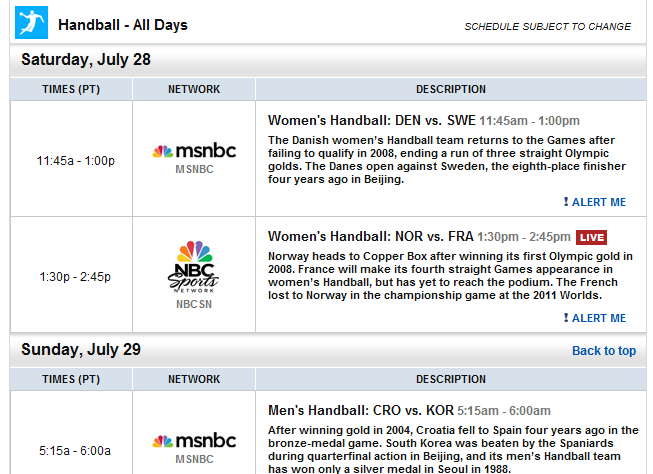
Note: The key words are "Schedule Subject to Change"

American residents can now see what their TV viewing options are for Team Handball as NBC has posted their tentative TV schedule.  You can find the schedule by clicking here:  http://www.nbcolympics.com/tv-listings/index.html# And then clicking “TV Schedule by Sport” and selecting “Handball.”   (Also, depending on whether you’ve accessed the site before, you may need to answer a few questions to sign in.  The good thing is that they will adjust the schedule to your local time.)

According to the posted schedule, there will be at least part of 1 handball match shown every day and the matches will be broadcast on either MSNBC or the NBC Sports Network (formerly known as Versus).  You may want to check your current programming packing with your cable of satellite TV provider to see if you have those channels.  MSNBC is available with most lower tier packages, but you may have to upgrade to get the NBC Sports Network (I did with Dish Network).

Of course, NBC will also be live streaming every single match, but you’ll need to sign up and verify that you have cable or a satellite TV package.  The link to the live streaming schedule is here: http://www.nbcolympics.com/online-listings/sport=handball/index.html In terms of “On Demand” viewing (i.e., replays after the live showing) it remains to be seen as to what is provided and how soon after the match it will be available for viewing.  In 2008, NBC provided options for delayed viewing, but you had to be careful if you wanted to watch it without first finding out the score.

Also, don’t be surprised if there are some changes to the schedule in terms of what’s shown on TV.   It’s best that you check the online listings every day or so to see if there are any changes.


post

The Olympic Referees: what do we hope to see from them?

This is where most of the action is...


A few days ago, I wrote about the unusually young group of referees who will be handling the Olympic handball. I noted that they, of course, have been in several IHF events before, so they should have a clear a sense for what the IHF, and especially the teams, want to see from them. And they have been selected on the basis of showing a certain ability to live up to the expectations placed on them.

The IHF Referee Commission always takes great care in connection with the Olympic Games to provide the referees with all the necessary instructions regarding important rules issues and interpretations. But it should be noted that the focus is on reminding the referees about points of particular importance and on giving feedback about the aspects which have led to less satisfaction in recent World and Continental Championships. What must not happen is that the referees are given ‘new’ instructions or any advice that would suggest major changes in interpretations or procedures. On the contrary, the teams must be able to trust that they are not encountering any surprises when the event starts.

Even beyond that, the real objective should be to get all the referee couples on the same wavelength, so that there are no differences in interpretations and styles between couples or from one game to another. We do not want ‘robots’ out there, and their personalities are not supposed to be ‘erased’, but consistency is the key word.

Consistency also means applying the rules in the same way from the first moment of a game to the last. For many years now, it has been emphasized that serious fouls early in the game must be identified and handled firmly. If a foul deserves a direct 2-minute penalty or even a disqualification, then it is not an excuse that it is (‘too’) early in the game and that all the yellow cards have not been ‘used up’. Similarly, the rules do not change in the final, critical moments of a game. The referees must show courage and avoid the temptation of becoming ‘diplomatic’ in those situations, meaning that they overlook infractions or penalize too softly. We do not want to see that the team which is more cynical or ruthless than their opponents gets an advantage.

In some recent events, including EURO 2012, there was a general sense that the handling of offensive fouls had been a week point. The most common problem was that such fouls were ‘invented’, meaning that offensive fouls were called even if the confronting defender was moving, or if there was a sufficient path between two defenders. But the opposite mistake also happened: clear offensive fouls were not detected, especially away from the ball. More generally, action away from the ball requires strong attention. Players are very ‘smart’ in realizing when they can more easily get away with something without being caught. Especially the struggle between attacker and defender on the 6-meter line is critical. It is necessary to take action to put a stop to the ‘wrestling’ and to detect who was the instigator.

There is always an inclination to give too many hints, so that the overall message becomes diluted. Therefore I will not comment on other aspects of a technical nature. But I really do want to finish by emphasizing the role of our referees in maintaining a positive atmosphere and creating a good image for our sport. This involves maintaining sufficient discipline, with a clear line (for both coaches and players) between spontaneous reactions and systematic protesting and provocations. Similarly, the faking of injuries and the general attempts to mislead the referees (and provoke the opponents) by falling or screaming in a dramatic way must be brought under control.

I emphasized in my earlier article that we need referees who have the physical capacity to match the speed and the physicality of the game. But I also noted that, ideally, this should be combined with experience. And while experience can be important for the ability to judge body contact etc., it is perhaps even more important in the context of handling the relations with the players and coaches and even for the self-control of the referees. Yes, we want quick reactions and good instincts, but we also need the ability to stay cool and to avoid impulsive actions and decisions. Let us hope it works out!

post

AUDIO: Conversation with NPR reporter Stefan Fatsis

Uber Fan Stefan Fatisis (#17) acquired this Team Handball jersey from Club VfB Fallersleben last year while visiting Germany

Stefan Fatsis is without a doubt the biggest mainstream sports reporter/proponent of Team Handball in the United States.  A regular guest on National Public Radio’s All Things Considered, if there’s a possibility to work in a tidbit of news about the sport Stefan finds a way.

With the Olympics coming up Stefan was curious as to the state of the sport in the USA and what do expect in terms of the upcoming Olympic competition. Our conversation covers these topics and more and lasts about 38 minutes.

Stefan Fatsis Website:  http://www.stefanfatsis.com/

Hang Up and Listen Podcast: http://www.slate.com/articles/podcasts/hang_up_and_listen.html (Stefan is one of the hosts on this weekly sports podcast)

Wall St Journal (25 Aug 2004): A Game We Ought to Play: http://online.wsj.com/article/SB109338095139999984.html

New York Times (9 May 2009): Team Handball Has It All, Except an American Interest: http://www.nytimes.com/2009/05/10/sports/othersports/10cheer.html

THN (26 Dec 2011) Analysis of the Hang Up And Listen crossover athlete Team Handball All Star Teams: https://teamhandballnews.com/2011/12/tim-tebow-future-american-team-handball-star/
(Includes link to the podcast that discusses the teams)