post

EURO 2012: Tafatt och ynkligt

This illustrates my heading and the impression that some of the teams have given


I clearly need to explain this heading. It is John Ryan’s fault… He cannot follow the web casts live but one or two days late, at which time he wants to be unaware of the results. But both of us get automatic e-mail where our headings of posted articles are shown. So I figured that I needed to use Swedish to avoid ruining things for the poor guy… So if you now wonder what the two words in the heading mean, the answer is roughly ‘helpless and meek’! Unfortunately, several of the games yesterday and today made me feel that this was a good way of describing many players or entire teams. Yes, the games were in some cases close in terms of result, but the quality was not much to boast with.

The first ones who come to mind in deserving my description were the French team and many of its stars and veteran players. Sooner or later it had to happen that their impressive string of gold medal performances would come to an end but, please, not in this way! In the end they seemed lethargic and indeed helpless today against Croatia, just like against Hungary earlier. And it did not have to happen. During the middle of the game they seemed to turn it around and had a three-goal lead after a weak start. But when it mattered at the end, they just collapsed and seemed to give up. There was even open quarreling between coach Onesta and some of his key players.

The Swedes do not this time have a team of the same caliber as in their periods of greatness or even like one year ago. So perhaps they could not do much better. But what is frustrating to see is the lack of initiative, determination and fighting spirit. Serbia was a tough opponent yesterday, but the Swedes did not manage to put up a real fight. And a bit of the same was noticeable today with the Icelandic team. Despite some good efforts by the likes of Gustavsson and Palmarsson, there was no real team cohesiveness and no spark. Can it be that teams which already have an Olympic qualifying slot secured do not really manage to get up for the final games of a European Championship when they seem to be out of contention for the medals??

And then came today’s puzzling performance by the Hungarians, another team with a place secured in the Olympic qualifying, But today they had a chance to put themselves in a good position to gain a semifinal slot. And nevertheless, they did not get anywhere near the level that they have showed in some of the previous games. They are really like the ‘Dr. Jekyll and Mr. Hyde’ team of this tournament. Quite generally, it also makes you start wondering about a general lack of impact from the coaches during the games. These are, for the most part, well-known and highly paid coaches who should have the skills and the experiences to make major adjustments during a game and, at least, to ensure that their players are sufficiently motivated and up for the game.

So having sounded so negative until this point, let me conclude on a more positive note or two. We have seen a number of very close games and the spirit on the court in terms of sportsmanship and a general avoidance of dangerous fouls and provocations has been noticeable. The players are often showing a good deal of respect for each other, the coaches are for the most part on a good behavior, and the referees have contributed in a constructive way. They have generally been consistent and able to draw the line in the right place. Let us now hope for a thrilling finish of EURO2012 with a continuation of the good sportsmanship!

post

Macedonia’s greatest fan is an American diplomat!

Macedonian star player Kiril Lazarov visits with Ambassador Reeker in Skopje

Not many persons have heard of Philip T. Reeker in connection with handball – except in FYRO Macedonia, where he is an idol of the handball federation and the national team. The reason: he served as the U.S. Ambassador in Skopje during the period 2008-11, where he became substantially involved with the handball activities. So for fanatic Macedonians it was not a surprise when he showed up in Nis, dressed in the Macedonian team shirt and eagerly cheering on his favorites.

Philip Reeker is currently the Deputy Assistant Secretary of State, with responsibility for the Balkan region. As he noted in an interview, therefore it should not be regarded as a diplomatic ‘faux pas’, when he was observed supporting the red and yellow team, for instance in their crucial battle against the Czech Republic. It now remains to be seen if he can finagle his schedule in such a way that he can move on the Belgrade and follow the main round games as well…

But the question obviously arises: how did he get so familiar with handball? As he notes, he is frustrated that the sport is so insignificant here at home in the U.S., so this is certainly not where he picked it up. The explanation is that he got hooked on handball during an earlier tour as the Deputy Chief of Mission in Budapest. As we all know, Hungary has really strong handball traditions and activities. Perhaps, just perhaps, there is also some good influence from his wife; he is married to Solveig Johnson Reeker from Minnesota and, as the name suggests, unmistakably of Swedish or Norwegian descent.

As it seems Ambassador Reeker is currently Washington-based, could one hope that he would be prepared to get involved in helping promote handball also in his home country? Perhaps it would be a good idea for the USATH to try to establish contact with him. I doubt that he could convince Secretary Clinton to siphon off some budget money for a project to strengthen the standing of the USA handball teams in the world, but would it not be nice if he and his wife could fit in an appearance as guests at the U.S. National Championships in Minneapolis this spring!? And in that case there is little doubt as to which one of our traditional clubs he would be supporting: the D.C Diplomats, of course…

EHF Video: Interview with American ambassador and handball fan Philip T Reeker:   http://www.youtube.com/ehfeuro#p/u/18/y4aavnZyuEM

EHF Video: Macedonia fan support: http://www.youtube.com/ehfeuro#p/u/59/3-Xhzb28hxE


post

African Championship: Tunisia’s men and Angola’s women have the tickets for London; celebrations also in the Netherlands!

London welcomes Angola and Tunisia


The medal games were played in Rabat today with rather expected results. Algeria did not manage to perform another miracle. Tunisia dominated the men’s final from the beginning, and after a half-time lead of 12-6, the final result was 23-20 in Tunisia’s favor. This means that Tunisia has qualified directly for the Olympic Games, while Algeria gets the place in a qualification tournament. Most likely this will be in a group hosted by Denmark, as Denmark hardly is going to secure Olympic tickets in the ongoing EURO2012. The bronze medal game was easily won, 29-15, by Egypt against the home team Morocco. This means that the Egyptians will join Tunisia and Algeria in the World Championships in Spain in January 2013.

Angola lived up to the expectations on them, but it was not an easy game. It was tied 12-12 at half-time and the Tunisian women put on an impressive performance with a team that has much less international experience. The final result was 26-24 in Angola’s favor. It was the eighth consecutive African Championship for Angola since 1998! So Angola will yet again appear in the Olympic Games, while Tunisia gets Africa’s place in a qualification tournament. They will face Denmark, Russia and the Dominican Republic in Denmark. Not an easy task… The bronze medals were won by the Democratic Republic of Congo who defeated Algeria 33-24.

The Angolan victory was a cause of celebration also in the Netherlands! As we have previously explained, Angola had already secured a special slot in a qualifying tournament on account of their strong showing in the recent World Championships. As they will no longer need that slot, this place will instead be filled through a ‘chain reaction’. Montenegro will move over to the slot that was reserved for Angola, and the Netherlands did indeed get the opportunity to qualify for London by taking over the original spot of Montenegro. We hope the Dutch will think of an appropriate way to show their gratitude!

The complete rankings were as follows:

MEN: 1. Tunisia, 2. Algeria, 3. Egypt, 4. Morocco, 5. Senegal, 6. Angola, 7. Cameroon, 8. Dem. Rep. of Congo, 9. Congo, 10. Cote d’Ivoire, 11. Gabon, 12. Burkina Faso.

WOMEN: 1. Angola, 2. Tunisia, 3. Dem. Rep. of Congo, 4. Algeria, 5. Cameroon, 6. Congo, 7. Cote d’Ivoire, 8. Senegal, 9. Egypt, 10. Morocco.

post

EURO 2012: Nordic meltdown and French fiasco

Not one of the proudest moments for Nordic handball; the same goes for Russia and France


The groups in the preliminary round were completed today, and the main round starts tomorrow. The format used by the EHF makes for a combination of excitement and anticlimax. They start out with 16 teams and one of the two purposes of the group play is ‘simply’ to reduce the field down to 12. Moreover, at any given point in time, Europe tends to have about 10-12 really strong teams, so the weeding out of the more marginal teams, such as the Slovaks, does not often create much excitement. But this time we had thrillers at the end. And then the fact that the teams which advance bring with them the points from the games that they have played against each other, this means that every game means a lot even when teams already know they will advance.

For instance, yesterday, Denmark-Poland was a really important game, even though both teams were already through. Based on the form showed in recent time, the Danes may have been favorites against a Polish team that seemed to have stagnated in recent time and were missing key players. And Denmark seemed to have the upper hand, but in the end they basically gave the game away. So now they are still in the main round, but in practice virtually without chances of being one of the two teams out of the six in their main round group who will go to the semifinals. What is worse is the impression that, in the games they lost, the Danes really seemed to be lacking in mental strength and fighting spirit. They looked intimidated in the game against Serbia. By contrast, the Serbs are through with the maximum four points and seem to be a great shape.

In the parallel group, one could write the same thing about the Swedes as about the Danes. They lost a point against the Macedonians, after having grumbled about the impact of the fanatic crowd. And then they seemed to be strangely optimistic prior to the final game against Germany, despite the fact that the Germans really had been ‘boxed’ in with a desperate need to win. A loss for Germany might have meant elimination yet again in a major Championship, while the win against Sweden means that they instead are through with full points just like the Serbs. The listless Swedish performance, both on the court and in terms of coaching, obviously was the cause of a major frustration in handball Sweden. And the Czechs had to pack their bags, despite the strong start with a win against Germany.

In today’s matches in Group D, we had a ‘triangle drama’ between Norway, Iceland and Slovenia. The latter two played each other, and somewhat surprisingly, after mediocre play earlier, Slovenia came through. In fact, they almost went as far as to knock out Iceland, leading 34-30 just before the end. But two late goals by Iceland rescued their advancement, although they, just like Sweden and Denmark, will move on with zero points. Norway did not manage to surprise Croatia and, although they almost ‘got in through the back-door’, in the end they had to accept elimination. What now has caused some controversy is that Slovenia seemed to ‘give away’ the last two goals for Iceland, with the reasoning that the 34-32 and the elimination of Norway instead of Iceland now gives Slovenia the advantage of bringing two points to the main round. A smart way of taking advantage of the regulations or unsportsmanlike?

Finally, in Group C we had what is undoubtedly the biggest surprise. Even after France lost against Spain, most observers had seen them as a medal contender. But that has now become almost impossible after today’s surprising defeat against Hungary. Sure, Hungary is unpredictable and had already staged a great comeback against Spain, but in the game today we saw a French team that was really ‘helpless’ and resorted to individual efforts rather than their usual team play. Karabatic was just a shadow of his usual self. So while France is still in the tournament, they are not bringing any points to the main round. And next they will have to face Slovenia and especially Croatia, who both will have great crowd support. It should be noted that the Russians joined their Nordic neighbors in the ‘meltdown’; they are out!

Most of us will now start speculating about which teams will go through to the semifinals, but as far as Teamhandballnews is concerned, I will leave that task for John Ryan…

post

European Championships: Sorting out the dominoes for Olympic Qualification Tournaments

Where nations place at the European Championships will have cascading repercussion on Olympic Qualification Tournament seeding

In addition to crowning a champion of Europe, the European Championships (EC) will also finish the sorting out of which nations will still have a chance to qualify for the Olympic Games at 3 upcoming Olympic Qualification Tournaments that will be played 6-8 April.  Additionally, the final ranking will also determine which nations will host and which nations will play in each tournament.

As it currently stands the three tournaments are:

1) Denmark (Host), Hungary, Europe #2, Africa #2
2) Spain (Host), Iceland, Brazil, Europe #3
3) Sweden (Host), Croatia, Japan, Chile

However, as Denmark, Spain, Sweden, Hungary, Iceland and Croatia all have a good chance of securing the European automatic qualification slot it’s pretty likely that this current composition won’t hold up.  As it stands only 3 nations (Brazil, Japan and Chile) are locked into a tournament, but even those nations can’t be sure where and against whom they will play.

To further explain let’s break down the ramifications for each of the participating nations

France:  Already directly qualified as the World Champion; France’s final ranking doesn’t count in determining the placement of any other nation.

Denmark, Spain, Sweden, Croatia, Iceland and Hungary:  These nations placed 2nd to 7th at the 2011 World Championships and have already secured an Olympic Qualification Tournament bid.  If any of these nations win the EC or place 2nd to France they will directly qualify for the Olympics and won’t have to play in an Olympic Qualification Tournament.  Should that happen the nations that placed behind the EC Direct Qualifier each move up one spot based on their final ranking at the WC.  This is where it gets a little convoluted for each of these nations as moving up isn’t necessarily a good deal in terms of who you will play against in an Olympic Qualification Tournament.  Breaking it down further here’s the impact of shuffling a spot for each of these nations.

Denmark:  Can’t move up.  They either get the EC Direct Qualification spot or host tourney #1
Spain: Moves from hosting Tourney #2 to hosting Tourney #1
Sweden: Moves from hosting Tourney #3 to hosting Tourney #2
Croatia: Moves from participating in Tourney #3 to hosting Tourney #3
Iceland: Moves from participating in Tourney #2 to participating in Tourney #3
Hungary: Moves from participating in Tourney #1 to participating in Tourney #2

As we’ve pointed out numerous times before, as long as Europe dominates the world of Handball the seeding of these tournaments doesn’t make any sense because the lowest seeded tournament (Tourney #3) only has two European participants.  (Translation:  Unless there is an epic upset by Japan or Chile the two European nations assigned to Tournament 3 are going to the Olympics.  It’s good to be in Croatia or Iceland’s shoes.  Not so good to be in Sweden’s)

Poland:  Poland placed 8th at the 2011 WC, so they have 3 ways of qualifying for the Olympics.  They can 1) win the EC, 2) earn an Olympic Qualification Tourney slot (should Denmark, Spain, Sweden, Croatia, Iceland and Hungary win the EC direct qualification slot) or 3) earn the Europe #2 or Europe #3 slot

Serbia, Slovakia, Germany, Czech Republic, Macedonia, Russia, Norway and Slovenia:  These nations have 2 ways to qualify.  They can either 1) win the EC or 2) earn the Europe #2 or Europe #3 slot.  As the WC qualification slots take precedence over the EC qualification slots there is a sort of mini-tournament among the nations in this group.  In other words, whichever 2 nations place the highest amongst this group will earn the #2 Europe and #3 Europe slots.  (The only exception to this would be if one of these nations wins the EC; at which point Poland would no longer have a WC slot and would join the group competing for an EC slot.)

The first step for these nations will be to make it out of the preliminary rounds.  Once that goal is accomplished their goal will be to finish as high as possible in their Main Round Group.  Of course, the goal will be to advance to the semifinals, but barring that success it’s pretty likely that a 3rd place finish will qualify a nation for an Olympic Qualification Tourney.  A 4th place or even a 5th place may suffice as well or at least set up a 7th or 9th placement match against a nation from the other group for the last Europe slot.

In this regard, the nations in Main Round Group I (Groups A and B) have a distinct advantage over the nations in Main Round Group II (Groups C and D).  This is because Group I has only 3 nations (assuming Poland moves up) that have already qualified via the WC results, vice Group II which has 5.  So by default, the worst one of these nations can place in Group I is 4th.  Projecting results is never safe, but this is why the match between Germany and the Czech Republic is so critical, as could be the matches those nations might play against Serbia in the Main Round.


post

European Championships to have FREE Webstreaming via YouTube

Every Match of the European Championships will be available on YouTube


In the last episode of Handball Talk we hinted that a big announcement concerning viewing options for the European Championship would be forthcoming.  And a big announcement it is as viewers around the world will be able to watch every match, free, live and on demand via the world’s #1 online video delivery system: YouTube

Long time readers of Team Handball News are fully aware of the highs and lows that Handball fans around the world have experienced in regards to webstreaming.  At times it has been Handball Nirvana as fans that previously had no viewing options were suddenly able to watch every match of a major tournament.   Conversely, at times it has been Handball Hell with fans paying a subscription for poor quality webstreams, horrendous audio commentary and non-existent customary service.

It remains to be seen how the YouTube option will work this time around, but showcasing Handball for free on the world’s best known webstreaming platform is an experiment worth trying.

A few notes on the YouTube webstreaming and upcoming matches:

Availability:  The following countries (Denmark, Norway, Sweden, Finland, Germany, France, Belarus, Russia, Israel, Croatia, Iceland, Slovakia, Bulgaria, Czech Republic, Romania and Spain) will be geoblocked from live broadcasts.  According to the EHF website, however, there will be no restrictions for on demand viewing after the match.

On Demand:  For fans that can’t watch live, the EHF has indicated that video of full matches will be available on demand.  It is not clear, however, how soon after completion that the match will be posted for viewing.  Additionally, I have requested that the EHF YouTube interface refrain from posting final scores and pictures of celebrating teams, lest they ruin it for those fans that like to watch oblivious of the outcome.  Hopefully, this sensible request will be met, but be prepared to click on the links with a piece of paper to shield you from too much information.

Audio Commentary:  The EHF will have veteran broadcasters, Paul Bray and Clayton Lewis, providing commentary for some of the matches

Match Schedule:  I strongly recommend that you download the following schedule for reference the next two weeks:  http://www.ehf-euro.com/fileadmin/ehfeuro/EChM2012/Downloads/Match_Schedule_Mens_EHF_EURO_2012_.pdf

(Match times are local for Serbia which is 6 hours ahead of the U.S. East Coast)

Two Key Early Matches:

Sunday, 15 January, 1720 CET, Germany vs. Czech Republic
These two nations are top contenders for the 2 European slots that will be awarded for Olympic Qualification Tournaments.  This match could be pivotal to Olympic Qualification and with the bulk of the Czech team playing in the German Bundesliga these players all know each other well.

Monday, 16 January, 1815 CET, France vs. Spain
This match may set the tone for the rest of the tournament for these two teams.  France is the favorite to win it all and Spain was the only team to blemish France’s record at last year’s World Championships.  (They played to a 28-28 draw)  The loser of this match may very well have to win out if they want to advance to the semifinals.

EHF Announcement (11 Jan 2012): http://www.eurohandball.com/article/014514/Live+streaming+on+YouTube

EHF YouTube Channel: http://www.youtube.com/ehfeuro


post

Uproar caused by Qatar’s plans to ‘buy’ a new national team for 2015

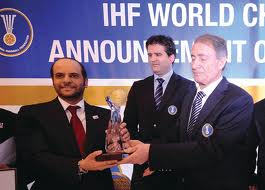
IHF president congratulates Qatar as host for 2015


I was present a year ago, when the announcement was made that the IHF Council had decided to award the hosting of the 2015 Men’s World Championship to Qatar. France had hoped to gain those rights and expressed disappointment in many ways. From one journalist came the question: “for what purpose do they want to be the host; after all, everyone knows that the countries who fight to become organizers are typically top medal contenders who want to improve their chances to win the gold by playing at home!”. I responded, half-jokingly, “do not worry, because by 2015 perhaps Qatar will have managed to acquire a strong team”.

A little bit I had in mind the habit of teams from the Middle East to make a mockery of the ‘Super Globe’, the event touted by the IHF as ‘the World Championship for clubs’, where they borrow prominent players from other clubs on short-term contracts in order to become suddenly competitive. But I was also aware that the IHF eligibility regulations allow a player to change from one national team to another, after a change in citizenship and three years of ‘quarantaine’., i.e. not playing for the former country in an official competition.

This has worked to the advantage of, for instance, Germany and Spain in recent years, when key players from Eastern Europe were naturalized. Germany and Spain do not exactly have a shortage of young, talented players who could work their way into their national teams, but there was no outcry when these actions took place. And going further back, the systematic approach of the Austrian women’s team to acquire a team full of stars from the Balkans and the former Soviet Union barely tended to cause some mild irritation or indignation, when the Austrian team became a bit ‘too strong’ through this method.

But these developments never caused an outcry from handball countries, demanding that the IHF change its regulations and prohibit such changes in eligibility, more along the lines of the strict rules of FIFA. However, now suddenly, when the issue involves Qatar, the protests can be heard. Is the situation somehow different because it involves a non-European country, moreover a country with seemingly unlimited resources to build up an image as a prominent country in the world of sports, especially through the organization of major events, including the football world championship in 2022!?

I fully appreciate that one can have different views on this special way of building a national team. But I think there needs to be some consistency. Why have there never been any complaints about this IHF regulation before, until now suddenly Qatar openly states its intention to take advantage of it in a systematic and large-scale fashion? Why were the traditional handball powers asleep or silent until now? Being European-born, I fully appreciate the strong excitement caused by the victories and defeats of the respective national teams. Even if most of the star players from around Europe play for club teams outside their ‘home’ countries almost the entire year, it is a big deal when they come and play for their country of citizenship, with flags and anthems reflecting the feelings of nationalism. But please be consistent!

We are right now at a critical moment apropos this issue. I mentioned about a three-year waiting period. This means that players taking part in the European, African or Asian Championships this month cause themselves to be ineligible to play for a another country in the early part of 2015 when the World Championship in Qatar is scheduled to take place. So when we have now seen, just as in the case of the recent Women’s World Championship, that some top players have declined participation due to sudden injuries or a lack of motivation, then the speculation is beginning. Are they perhaps instead ensuring their ability to transfer in time for 2015?? This is really creating an awkward atmosphere!

And there have even been suspicions quietly expressed to the effect that the IHF Council or Congress, both dominated by the non-Europeans, might come up with the idea to shorten the waiting period to, say, two years, thus making all the top players available for transfers even if the played in the top events this month. I will refrain from taking a view on this speculation. Instead I will say that this is one more issue where the traditional handball powers in Europe, to my taste, tend to take a very passive or naïve stance. You are entitled to protect your interests and have your views on what is fair and proper, but then you must be prepared to be proactive and handle things in a political, strategic and coordinated fashion. Indignation and uncoordinated protests is not the way to go…

post

Handball Talk (Episode 4)


John Ryan and Christer Ahl discuss several topics to christen the New Year.  Highlights include:

– A review of the Women’s World Championships

– Some predictions on the upcoming Men’s European, Asian and African Championships

– The Big Apple tournament and why this unique event isn’t better promoted in the USA

– The apparent “holding pattern” the USA Team Handball Federation is currently in.


post

London 2012 – what to expect

Lord Coe and Minister Hunt during PR visit with school children


During a holiday visit to London, I took the opportunity to look for indications that the Olympic Games are only seven months ago. Amazingly, it was absolutely impossible to find any Olympic souvenirs, a sharp contrast to the situation in previous Olympic cities at the corresponding time. But I did have a chance to catch glimpses of existing or emerging venues and, above all, the New Year’s period caused a major spike in media coverage.

Lord (Sebastian) Coe, former champion runner over 800 and 1500 meters, now Chair of the London Organizing Committee, and Jeremy Hunt, Minister of Culture, Media and Sport, were constantly appearing in TV and newspaper interviews. As always in connection with the Olympic Games, there are major differences in public opinion regarding the propriety of spending so much money and creating such upheaval for a one-time event. And to put it mildly, the world economic situation and the competition for resources have changed drastically since 2005, when London was awarded the rights for 2012.

So there have been voices suggesting very strongly that London should yet again, just like in 1948 right after World War II, inevitably find it necessary host what was then dubbed the ‘austerity Olympics’. In other words, everything from arena construction, infrastructure improvements and events such as the Opening Ceremonies should be scaled back; London should not try to compete for the sought-after label ‘best ever’. But both Minister Hunt, on behalf of the government, and Lord Coe for the Organizing Committee (LOCOG) see it differently.

They understand the arguments, but they really feel that a world-class event, in the eyes not just of participants and spectators but especially as observed by the vast TV and other media audiences around the world, is just what Britain needs at this point in time. And they are not talking just about the prestige and PR involved in showing the rest of the world what Britain can do, both as an organizer in sports and also in terms of culture, history and creativity. So the aim is to “make an extraordinary statement” and there is a sense that “people in Britain would not really forgive us if we did not make the absolutely most of this moment”.

Indeed, Hunt sees the Olympics as an event that, notwithstanding the enormous investments and expenses, could have the positive economic impact of being a key factor in avoiding a double-dip recession. It is also emphasized that the LOCOC budget of around US$ 3.5 billion is essentially based on private capital being raised. The government’s share is a more ‘modest’ US$ 9 million, apart from the traditional guarantee that any losses must be covered. Of course, this does not convince and quiet all skeptics.

On the basis of a sad history from many previous Olympic cities, there is a special concern about the ‘white elephant’ phenomenon, i.e., the all too common experience that huge stadiums and a vast spectrum of other arenas will become decaying and unused monuments to wasteful one-time spending. London, learning from its predecessors, is trying to take measures to counter this trend. Similarly, there are worries that London will feel obliged to outdo Beijing and others in putting on an ‘absurdly’ lavish and expensive Opening Ceremony. After all, this is often the measuring rod for the Olympic hosts.

It is also somewhat ironic, after the heavy criticism of the Chinese government for its cynical evacuation of citizens, through bull-dozing of entire neighborhoods, to make room for facilities and roads, that similar comments can now be heard in London. There is hope that, on balance, the development in dilapidated areas of East London will have a positive long-term effect, thanks to major new construction of housing, infrastructure especially in the form of public transportation, and major shopping centers. But the reality also seems to be that those who have been evicted from the areas of low-income housing now find it difficult or impossible to acquire new affordable housing.

As always, it is easy to speculate ahead of time, and the actual impact will not really become clear until much later. We can only hope that the optimists in Britain will turn out to be proven right.

post

Air Force Basketball (Two Lessons for USA Team Handball): Lesson 1) Any Program Can Rise from the Ashes

After 24 straight years of no winning seasons the 2003-04 Air Force Basketball team came out of nowhere to post a 22-7 record, a conference championship and an NCAA tourney bid. Could something similar happen for USA Team Handball?

Anyone who has followed the sport of Team Handball in the United States knows that the national teams have had their ups and downs.  Without a doubt it’s been more “downs” then “ups” and it’s safe to say we’re currently in a down phase.  We struggled to even win one match at the PANAM Games and have fallen behind nations like Mexico and Uruguay.  Maybe the bitter reality is that it’s just too hard for the USA to field respectable teams, let alone winning
teams that can compete for medals at an Olympics.  Maybe, but maybe not…

Perhaps just as moribund or disappointing for many years had been the Air Force Academy Men’s Basketball Program.  There are a lot of challenges to fielding a top college basketball team at a military service academy.  These challenges include height restrictions, academic requirements, and a military regimen which severely limits the players that can be recruited.  With the exception of the David Robinson years at Annapolis, no service academy team had ever had great success and Air Force’s high water mark for a long time was the mid 1970’s when several teams posted modest winning records.  Two major reasons for those successful seasons were Tom Schneeberger and Bob Djokovich, who later went on to be Olympians in Team Handball at the 1984 Olympics.

Following Schneeberger and Djokovich’s graduation in 1978, Air Force had 24 straight losing seasons and about the only positive thing that that could be said about the program was that the players tried hard and never gave up, no matter how far they were behind.  Many games played at the Academy resembled church halls in which you could literally count the fans in the stands.  Experts and longtime followers of college basketball all agreed: It was just too hard to win at Air Force.

Then in the year 2000, Air Force hired Joe Scott, a former Princeton player and coach who outrageously thought differently about the whole, you just can’t win at Air Force mentality.  Things at first didn’t seem to be much different.  The team’s record the first 3 years were 8-21, 9-19, and 12-16.  They showed steady progress and I noticed that they weren’t getting blown out quite as often against better teams.   Still, I had my doubts that they could ever get over the hump for a winning season.  Sure they might have been able to win some games against weak non-conference foes, but they still couldn’t beat the top schools (BYU, New Mexico, UNLV) in the Mountain West Conference (MWC).

Then in 2003-2004 a funny thing happened.  Somehow Air Force started winning those games against the teams that had always beaten them.  Somehow, someway, the laughingstock of the MWC won the Conference with a 12-2 record.  My goodness, they even made the NCAA Tournament for the first time in over 40 years!  The tomb that had been Clune Fieldhouse had overnight become one of the toughest and loudest places to play in the country.  There was some nice commentary at the time about what a great turnaround this was, but to those few who actually followed Air Force basketball closely through the years those kind words never even came close to conveying the miracle that had just occurred, seemingly out of nowhere.

How on earth had this happened?  My analysis (from my own observation and others) is that there were four major factors in this incredible reversal of fortune:

1) Better recruiting. Whether it was luck or persistent effort by the coaching staff, Air Force was able to find 5-7 talented players who could play at a high level.  These players were by no means NBA quality players, but they were good players that could compete athletically against their competition.  Through the years, Air Force had always had 1 or 2 players with that talent level.  Heck, I’d argue that a couple of those players were individually even better than the talent that Joe Scott assembled.  But, those players had no supporting cast and opponents keyed on them.  Being able to put 5 good players on the court all at one time made all the difference.

2) A system that stymied opponents.  And that system was the so called Princeton offense which slowed down the game and relied on passing and 3 point shooting.  Air Force executed this offense to perfection and teams weren’t used to playing it.  That season Air Force was able to sneak up on opponents who weren’t sure how to defend it.

3) Opponents that were in “down” years.  The MWC would never be mistaken for the ACC, but on the whole it’s usually a pretty good basketball conference.  It was fortunate timing that the golden era of AF basketball coincided with just about every other side in the conference going through a down phase.

4) Players that simply believed in themselves and the system.  Sometimes teams lose just because of the names on their jerseys.  Losing begets losing and sometimes everybody (coaches, fans, officials, opposing teams) starts expecting a particular team will lose.  Changing such a culture or vibe is often easier said than done.  When such a change occurs, though, it’s usually because a committed group truly starts to believe in themselves and what they can do.

So, what are the lessons here that can be applied to USA Team Handball.  Let’s go with the 4 reasons behind Air Force’s turnaround and see if they can be applied to Team Handball.

1) Better Recruiting:  Nothing against the hard working men and women who are currently playing on our National Teams, but most of our current athletes are a step down in raw athletic talent when compared to their current competition.  This is particularly true for the women and partially true for the men.  And to be fair, it’s probably always been true with our National Teams to a certain extent.  The U.S. has often been a player or two short of being good enough to beat the good teams.  The need for better recruiting is a no brainer, but how do you go about it?  This will be a topic for part 2 of this series.

2) A system that stymies opponents:  Is there a Team Handball equivalent of the Princeton Offense?  For the most part national teams from the developing Handball nations have tried to emulate the successful teams in Europe.  They hire European coaches and the European coaches naturally seek to build a European style team.  There is, of course, some variance among the teams in Europe as some nations play a little more of a fluid game with fast breaks while others are more focused on defense and a half-court game.  So getting back to the question, I can think of only one example where a nation has developed a style of play or system that stymies opponents:  South Korea.  The South Koreans, particularly the women, play a helter skelter style of play which takes maximum advantage of their quickness and limits their size disadvantage.  This pretty much always gives the Koreans a slight edge when they play European teams because while they are accustomed to the European teams have to totally adjust their game.  Is it just a coincidence that the Koreans have also been the most successful non-European nation, even though the sport is
still a minor one in their country?  Maybe the U.S. should look across the Pacific instead of the Atlantic as it tries to develop its own style?

3) Opponents that were in “down” years.  Well, you can’t very well control what your competition is doing.  You can, however, take advantage of it.  Looking at the Pan American region it’s fairly apparent that the men’s teams are surging in quality while the women’s teams, with the exception of Brazil, are clearly in a down phase.  Starting from scratch, it’s entirely possible that the U.S. could put together a brand new Women’s team that could get 2nd place (qualifying for the 2016 Olympic Games) at the 2015 PANAM Games.  The Men could still qualify, as well, but their competition as it stands now is clearly tougher.

4) Players that simply believe in themselves and the system.  I can’t get into the psyche of our National Team players, but I suspect that both the Men’s and Women’s team have not fully formed the type of bond that only comes about through time and shared sacrifice.  They will need more matches and some stability in the program in order for this to happen.  And then they will need some matches where they play some teams close and see for themselves that they aren’t that far behind and where they need to get better.

So, if Air Force basketball can suddenly be successful after years of failure, I would argue that even USA Team Handball can turn it around.  It won’t be easy, though, and most importantly it’s not clear whether USA Team Handball will have the minimum resources needed to execute such a turnaround.  As the current budget stands now there is nowhere near enough funding to recruit, train and provide players a national team structure to allow them the
opportunity to succeed.  With adequate resources, though it could definitely happen.

In part 2 of this series, I’ll assess the feasibility of recruiting athletes with successful collegiate careers in other sports and transitioning them to Team Handball.  As the title implies, there’s an Air Force Basketball connection.

post

Tim Tebow: Future American Team Handball Star?

Tim Tebow: Current Right Back for Team Fatsis and future Right Back for Team USA

Drink a few beers in the evening after a Team Handball event and the subject inevitably comes up.  If you could field a Team Handball squad with athletes from other sports, who would you choose?  For a Handball fan this is the equivalent of “Superman vs. Batman” or “Ginger vs. Mary Ann.”  A debate that’s been held many times for which there’s no way to establish the right answer.  On Slate Magazine’s “Hang Up and Listen” Podcast, Dan Blake from Ithaca, NY posed that very question to co-hosts Stefan Fatsis, Mike Pesca, and Josh Levin.  (Take a listen from 6:38 to 11:15.)

Here are the teams that were compiled, some analysis of the players selected and an assessment as to who would win between Team Fatsis and Team Pesca.

Team Fatsis

– Matt Kemp (Baseball):  I’ll have to take a pass on this assessment, as I haven’t followed baseball much for at least a decade.  On paper, his basketball background would make a good combination.
– Chris Young (Baseball):  The baseball pitcher with a basketball background is a good combination for Team Handball.  The ability to throw a ball hard is not a readily discernible skill.  (i.e., you can’t assume that a great basketball athlete naturally has a great arm).  Young is 32, though, and I can’t tell if the relatively sedentary baseball life of a pitcher has settled in.  Side note, I saw a Russia-USA baseball game several years ago and the commentator was a broken record, “Vladimir Yobonski is another former Team Handball player…”
– Kevin Durant (Basketball):  An OK choice.  Basketball, more than any other sport, is very similar to Handball in the flow of the game and the skill sets needed.  That being said, not every great basketball player makes a great handball player or vice versa.  Basketball players with more finesse tend to struggle a little when they cross over to Team Handball.  Durant is no wimp, but I think he might have some issues with the greater physicality.
– Dwight Howard (Basketball):  A great choice. Physicality would, of course, not be a problem for Dwight Howard.  He’s a natural circle runner and would be a brick wall on defense.
– Tim Tebow (Football):  An inspired choice.  Tebow has the raw skill set to be an exceptional Team Handball player.  His ability as a crafty runner who can break tackles would translate well to Team Handball where the defense can be more physical (compared to basketball).  Oh, and he’s left handed.
– Michael Vick (Football):  Vick is an OK choice.  Clearly, has the Tebow like skills, but would this 31 year old have the motivation.  And Fatsis stumbled upon another left hander.  I guess he could be on the wing next Tebow on the right hand side.
– Tim Howard (Soccer): Soccer goalies don’t necessarily transition well to Team Handball.  They have the basic concept of being a goalie, and, in particular understand the importance of positioning the body at the right angle.  But, there are some dramatic differences. Most notably, soccer goalies rarely stop a shot with their feet, an absolutely critical skill that they have to be taught.  Not to mention the size of the goal is much smaller and they will face more shots in 5 minutes then they’ll see in an entire soccer match.

Subs
Baseball (Carl Crawford, Jacoby Elsberry, Joe Mauer, Austin Jackson, Grady Sizemore)
Basketball (Lebron James, Chris Paul, Jimmer Fredette)
American Football (Cam Newton, Jake Plummer
Analysis:  I won’t go into detail on these subs, but suffice to say Lebron James and Cam Newton would be phenomenal players.  Chris Paul and Jimmer Fredette might be good players at Center Back or on the wing.

Team Pesca

– Julius Peppers (Football):  Peppers’ size and basketball skills demonstrated at North Carolina would, make him a great selection 5 years ago, but at age 31 he would be less likely to excel.
– Jason Pierre-Paul (Football):  Pesca’s best choice.  Pierre-Paul is a phenomenal athlete that only started playing football seriously 5 years ago.  He would pick up the sport very quickly.  Heck, you could probably start him as a defensive specialist at a top club in Europe with a year of dedicated training
– Tony Gonzalez (Football): Another football player with college basketball experience.  But at 35 years of age he would not adapt well to the new sport.
– Rob Gronkowski (Football): Yet another tight end for the Pesca squad.  At age 22 he should be able to handle the up and down nature of the sport fairly well.
– Derrick Rose (Basketball):  An exceptional athlete, Rose would definitely be a top notch Handball player.  He doesn’t appear to have played many other sports, though, and may not adapt quickly to a new sport.
– Kevin Garnett (Basketball): While Garnett is a great basketball player he is the type of athlete that would not excel in Team Handball at the same high level.  There are a few 7 foot handball players, but the nature of the game limits the benefit of such lofty height.  Generally, these players are very effective over the top shooters, but are less effective one on one and struggle on defense.  Garnett’s also 35 years old.

Josh Levin’s Picks (Levin didn’t pick a full squad)

Rajon Rondo (Basketball):  A good choice.  I could see him as an effective Center Back.
Robert Griffin III (Football):  An outstanding selection.  This 21 year 0ld with smarts, world class speed and great arm strength would be a tremendous 1 on 1 player.  Think Daniel Narcisse (only an even better athlete).
Tayshaun Prince (Basketball): An OK choice.  I’m not sold that he would be a great player and at 31 years old he’s showing a little age.

Team Fatsis vs. Team Pesca

Just looking at the starting lineups, the advantage is clearly Fatsis.  First off, Pesca didn’t even choose a goalie, but setting that aside Team Pesca is too old and is sorely lacking in quickness.  In particular, you can’t have converted tight ends playing the wing.  Matt Kemp and Michael Vick would have a field day on the fast break.   Midway  through the first half, the bulky football players would really be huffing and puffing and Derrick Rose would probably be angrily urging them to show a little hustle.  Meanwhile Team Fatsis, led undoubtedly by a cheerful Tebow would still be motoring along.  It would only get uglier in the 2nd half.   Another aspect that Fatsis probably stumbled upon is having a few left handers on his squad.  This would make a dramatic difference on the right side of the court.  I’m guessing we’re  looking at an ugly score line, perhaps 35-22.

Tim Tebow: Future American Team Handball Star?

The Tebow story has been fascinating to follow this year.   For those who don’t follow American Football, Tim Tebow is a quarterback for the Denver Broncos, who’s open religious displays have made him a polarizing figure.  Additionally, there had been great debate as to whether this great college player could become a great professional player.  This season he started out on the bench, but midway through the season he became the starter and led Denver to several  improbable, crazy comeback victories. In short, there are  Tebow lovers and Tebow haters.  And as someone who has rooted religiously against the Denver Broncos for almost 30 years, you can probably guess which side of the debate I fall under.  Still, even a Tebow hater like me has to begrudgingly accept that he is a tremendous athlete with undoubtedly strong skills as a leader/motivator.  That being said he’s got no long term future as an NFL quarterback.  I think that will become apparent to all (even Tebow himself) after a couple of seasons.  Is it conceivable that this unconventional QB will then seek other opportunities off the mainstream, even ones without a big pay day?  After all, the Broncos, have already had one quarterback, Jake Plummer, retire early to play handball (albeit, the wrong one). Tim Tebow, Olympic Athlete, leading American Team Handball to the promised land.  Even I can get on board with that.

Slate:  Hang up and Listen Year End Podcast: http://www.slate.com/articles/podcasts/hang_up_and_listen/2011/12/hang_up_and_listen_s_special_.year_end_call_in_show_.html

THN (11 Nov 2010): America’s most famous handball player talks about his legacy https://teamhandballnews.com/2010/11/america%e2%80%99s-most-famous-handball-player-talks-about-his-legacy/