post

Olympic Qualifying Day 2: Only 1 Olympic ticket left to be punched


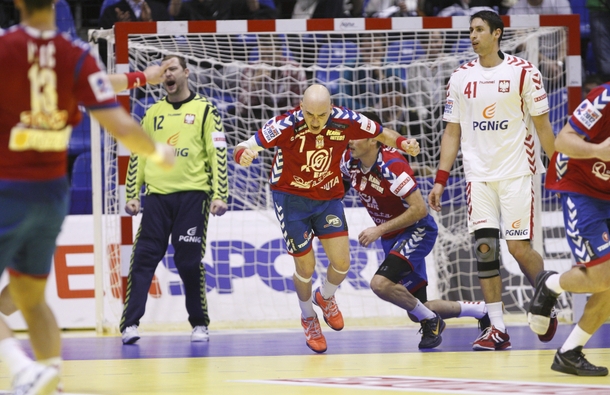
Nikcevic's fast break goal in closing seconds bails out Serbia

Five of the six remaining Olympic bids are now known as victories by Sweden, Hungary, Croatia, Iceland and Spain on Saturday made their qualification a mathematic certainty.

Only Tournament 1 has any major suspense left as Serbia and Poland’s 25-25 draw means that both those teams still have hopes of qualifying.  A tight affair throughout it appeared that Poland was pulling away when they secured a 25-22 lead with just under four minutes remaining.  But Poland did not score another goal for the remainder of the match and Serbia’s Ivan Nikcevic’s fast break goal with 5 seconds left brought the game level at 25-25 all.

In Tournament 2, Hungary fought off a pesky Brazil side for a narrow, 29-27 win.  The win assured that Hungary will advance to London.  In the second match, the home team, Sweden held off Macedonia for a 27-23 win.  The big difference was Right Back, Kim Andersson who delivered 3 straight goals from long range around the 52 minute mark to erase any Macedonian comeback hopes.  Hats off, though to the Macedonians players and fans.  With the exception of Lazarov, they have a pretty significant talent gap compared to the Swedes and Hungarians.  And without question, they’ve got the best fans.  Whether they traveled in force or were made up of resident emigrants living in Sweden they pretty much eliminated the home court advantage.  I’ve never seen that done on the road like that before in European handball.

Tournament 3 was no surprise as Croatia and Iceland had easy victories over Chile and Japan.

Scenarios for Sunday

Tournament 1 current standings

Spain 2-0-0 4 Points
Poland 1-1-0 3 Points; +1 GD
Serbia 0-1-1 1 Point; -3 GD
Algeria 0-0-2 0 Points

Serbia and Algeria will play the first match on Sunday and while Algeria was able to give the Poles a tough match it’s hard to see Serbia not winning by at least 4 goals.  With a victory by that many goals Serbia will have the goal differential needed to take 2nd in the group should Poland lose to Spain in the second match.  And  Poland will then need to draw or beat Spain in order to qualify for the Olympics.

And then the big question, especially for conspiracy theorists, will be just how hard will Spain play since they’ve already qualified?  Fortunately, for Serbia the Spaniards will not totally be without incentive as seeding for the Olympic draw is still at stake.  A first place in the group will put them on the same rank as World Champions, France, while 2nd place will pair them with Great Britain.  So, if Spain wins or draws tomorrow against Poland they will avoid France in group play at the Olympics.  Whereas losing means they will avoid Great Britain.  Of course, 4 teams advance out of Group Play at the Olympics, making the Olympic draw less paramount. So, the Spaniards will have a little incentive, but for the Poles it will be do or die which should make for an interesting contest.  At least the bookies think so, as the line for the match tomorrow is a pick-em.

Tournaments 2 and 3 are essentially over in that the Olympic participants are now known.  In tournament 2, Sweden and Hungary will play to decide who gets first and second, while in Tournament 3, Croatia and Iceland will do the same.  In terms of incentive for the Olympic draw these four teams will be split off into two performance rows (the 2 group winners will be paired as will the 2nd place qualifiers).  Croatia is probably the strongest of the four teams, so the Sweden-Hungary winner can probably expect to be paired with Croatia, assuming they take care of Iceland.
post

Olympic Qualifying: summary of first day

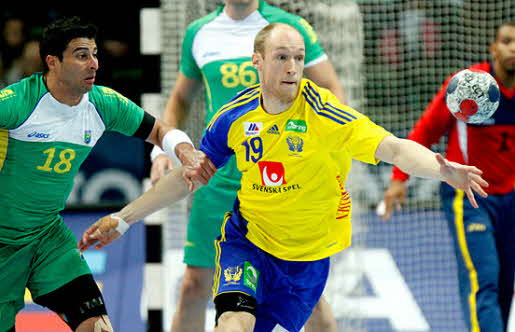
Sweden-Brazil on the opening day in Goteborg


The first day of games in the three groups did not offer any real surprises. Perhaps some will think that Algeria and Brazil offered more resistance than expected, but the opponents were most likely prepared for a battle. Here are some observations, based on web reports and input from people who were present:

Sweden did manage to win against Brazil with 25-20, but it was not an impressive victory. The attack was characterized by mistakes and the defense leaked. So the goalkeepers Palicka and Sjostrand deserve a lot of credit. The result was 16-16 at one point in the second half, but then came the decisive Swedish move to 20-16. Sweden had success with fast-breaks but they were a disastrous 1 for 5 from the 7-meter line. Brazil were hampered by very erratic shooting from distance. The conclusion is that Sweden must play much better to have a comfortable time against FYRO Macedonia tomorrow.

This was also confirmed in the Hungary-FYROM matchup, where the Hungarians fell behind from the beginning and did not manage to assert themselves until some strong shooting from oldtimer Carlos Perez gave them a chance to pull ahead late in the first half. From there on they managed to maintain a slim lead. The final result was 28-26 for Hungary, after some drama near the end, when FYROM had a chance to tie the game. Hungary got a large number of 2-minute suspensions, but despite good efforts by playmaker Mojsovski, FYROM did not manage to take advantage. This game may well turn out to have been the critical one in the group.

Poland seemed to get a solid start against Algeria, but soon they found themselves behind and the half-time score favored the Algerians, 16-13. Szmal had started the game without much success, so a switch to Wichary may have been decisive. And then, during a ten-minute period early in the second half, the experienced Polish team got the game under control with a partial score of 9-2. From there on they were never really threatened, and with the Jurecki brothers showing the way, they built the lead to 28-22, before Algeria managed to score the last five goals of the game for a 28-27 final result. Poland’s strength was in efficient scoring from the 6-meter line and the wings, while the Algerians undermined their cause through some wild shooting.

Spain is in what seems to be the toughest group, but at least they have home court advantage in Alicante. The Spanish team had also made rather confident statements ahead of time, suggesting that they are simply too good a team to miss out on the Olympics. But the game against Serbia turned out to be just as difficult as the strong performance of Serbia in EURO 2012 would suggest. The half-time lead for Spain was 11-10, after a nervous start from the home team and a gradual comeback. In the second half it was very close until a few minutes from the end, and Serbia had the lead a couple of times. Ilic was the outstanding scorer for Serbia, although some of the goals came from the 7-meter line. The Spanish scoring was more evenly spread, but the tradition held up, with many successful fast-breaks and a lot of shots attempted from the wings.

If from the game Croatia-Japan one first noticed the half-time result, 16-14, one may have begun to wonder. But a closer examination shows that the Croatians had a 12-6 lead before they relaxed. And in the second half there was never any doubt. The home team pulled away to 28-17 and kept up their concentration to the end. The final result was 36-22. It was telling that 47 of 51 shots from the Croatians were on target, with Cupic and Horvat as the top scorers. Alilovic and Losert had an easier time as no less than 18 of 53 Japanese shots were blocked or went wide. It just is not enough to score eight goals from distance in international competition.

It had been generally assumed that Chile is the weakest one of the teams participating in the qualifying. Against this background, a final victory for Iceland with 25-17, after 12-7 at half-time does not seem so overwhelming. But Iceland in fact had the lead by 20-9 and 24-12, so the win really came more easily than the final result suggests. One factor was that Chile had far too many turnovers, and they also failed to take advantage of a large number of Icelandic 2-minute suspensions. Sigurdsson dominated the scoring for Iceland with ten goals, many of them on fast-breaks. Chile also allowed too many penetrations on the 6-meter line. None of the Chileans managed to score more than two goals.

It would not be a complete surprise if all the groups are decided on the second day, causing the games on Sunday to be meaningless. But let us hope that we get at least one unexpected result tomorrow! At least it is difficult to see Poland as clear favorite against Serbia, and perhaps the Swedish group will also see an upset…

post

Men’s Olympic Qualification Tournaments: The Final Pieces to the Puzzle

Can Kiril Lazarov and Macedonia qualify for its first Olympics?

This weekend the final 6 slots for the Men’s Olympic Handball Tournament will be awarded.  Three tournaments, each with 4 nations will play a round robin tournament with games on Friday, Saturday and Sunday.  Here’s a breakdown of those tournaments:

All times are Central European Time/ Handicap point spreads for Friday’s matches in parentheses

Tournament 1 (at Alicante, Spain)

Friday 6 April
17:30: Poland (-7) vs. Algeria
20:15: Spain (-4) vs. Serbia

Saturday 7 April:
17:30: Serbia vs. Poland
20:15: Algeria vs. Spain

Sunday 8 April:
17:30: Serbia vs. Algeria
20:15: Spain vs. Poland

Host Spain is the clear favorite to advance and is a pretty good bet to win all 3 of their matches.  Algeria is the outsider team and will probably lose all 3 of their matches.  This means Saturday’s Serbia-Poland match could very well decide who will advance. The two teams met in January at the European Championships with Serbia winning 22-18.  But that match was in Belgrade, Alicante should provide a neutral setting.

Tournament 2 (at Gothenburg, Sweden)

Friday 6 April:
14:45: Hungary (-1.5) vs. FYR Macedonia
17:00: Sweden (-10.5) vs. Brazil

Saturday 7 April:
13:45: Brazil vs. Hungary
16:00: FYR Macedonia vs. Sweden

Sunday 8 April:
14:45: Brazil vs. FYR Macedonia
17:00: Sweden vs. Hungary

Host Sweden is the favorite, but they struggled in January at the European Championships enroute to a disappointing 12th place finish.  During Group play Macedonia and Sweden drew 26-26 on the first day of play, a performance that was an early indication of how nearby Macedonia would ride their pseudo home court advantage in Serbia to a 5th place showing and a slot in this qualification tournament.  The other European side Hungary placed 8th in Serbia and will also be looking to advance.  Brazil, the Pan American entrant will likely lose all three of their matches, so it will likely come down to head to head performance amongst the 3 European sides.  With Sweden a slight favorite, the Hungary-Macedonia match on Friday afternoon could be the big decider in terms of 2nd place and who ends up in London.

Tournament 3 (at Varazdin, Croatia)

Friday 6 April:
18:00: Croatia (-9) vs. Japan
20:15: Iceland (-14.5) vs. Chile

Saturday 7 April:
16:00: Chile vs. Croatia
18:15: Japan vs. Iceland

Sunday 8 April:
15:30: Japan vs. Chile
18:00: Croatia vs. Iceland

Barring a huge surprise from either Japan or Chile it’s all but preordained that Croatia and Iceland will advance.

(Editor’s note: If you find an internet video feed for these matches be sure to post the link at our Facebook page)


post

Wislander, Balic, Lavrov and Camilla Andersen have London stations named after them

which is your favorite station?


Unlike my story about IHF uniform policies, dated April 1, this is a story that you can believe: London Transport has come up with the great idea of honoring as many as 361 prominent Olympic athletes by temporarily naming all of their Underground (‘Tube’) and Overground stations after them, in connection with the Olympic Games this summer. Clearly it is a matter of prestige to have been included in the group of the 361 to be selected in this manner.

Handball is not a sport with great traditions in Britain, but we managed to get at least four of our best known former (and, in the case of Balic, probably continuing) Olympians selected. Naturally, this could cause a debate about other noteworthy handball players having been left out, even if the choice was limited to athletes who have had an impact in the Olympics. Perhaps there could have been room for a representative of the French and Norwegian gold medalists in 2008 or a Gatu, Horvat or Turtjina from the 1970s.

It is not surprising that the list is dominated by the ‘big’ Olympic sports, such as swimming, boxing, gymnastics, basketball, and especially track & field. Football is less represented, as the names in football, like a few other sports, reflect the non-Olympic status of athletes from certain sports during long periods. It seems that those who decided about the list at least tried to avoid discrimination by gender or nationality. In fact, there is no information available about who was involved in the selection process, so we do not know if federations had any role at all.

Efforts have been made to group athletes together by sports. The entire ‘District’ and ‘Circle’ lines are dedicated to runners, e.g., Carl Lewis, Wilma Rudolph, Usain Bolt, Marlene Ottey, Michael Johnson, Herb Elliott, Maria Mutola, Emil Zatopek and, of course, Sebastian Coe, the boss for the entire event in London 2012. The jumpers got placed on the ‘Metropolitan’ line, among them Beamon, Boston and Fosbury. Edwin Moses has been used as the diplomatic choice for the Wimbledon station; it might have been too controversial to pick a particular tennis player for that. But Nadal, Federer, Agassi, Graf, Becker, the Williams sisters and several others appear in other locations.

Michael Phelps has received a special location of honor, at the Stratford station, which is the stop for the Olympic stadium and area. Muhammed Ali (a.k.a. Cassius Clay) got the international station near Stratford. Swimmers also include Dawn Fraser, Johnny Weissmuller, Kornelia Ender, Ian Thorpe and Matt Biondi. Boxers include Teofilo Stevenson, Laszlo Papp, Sugar Ray Leonard, Michael Spinks, Joe Frazier and several others. The gymnasts feature Olga Korbut, Nadia Comaneci and Mary Lou Retton.

‘Dream teams’ in basketball have left a mark, and the names at the apex of the ‘Northern’ line look impressive: Bird, Barkley, Ewing, Jordan, Bryant, James but also old-timer Oscar Robertson. The women’s group includes Cheryl (Miller) and Sheryl (Swoops). But American women also come through in football: Hamm, Wambach, Scurry and Chastain each got a station, as did Brazilian Marta. On the men’s side we go from Hungarian legends Puskas and Kocsis to current stars such as Messi and Tevez.

I do not think we should take the choices and the omissions too seriously, but surely you agree that this is a pretty smart way to be reminded about great Olympic moments and performers from the past!

post

Uniforms, again: can you believe it!?

and it will make it easier for the referees also...


I hope the IHF will not be upset that I reveal some new information before they have had a chance to announce it. But I think it is relatively harmless, so I will go ahead and use my inside information. The issue involves a new policy regarding uniforms that will need to be reflected in both the Playing Rules and in the Competition Regulations. In order to give teams a chance to adjust in preparation for the 2012-13 season, when the new policy will become effective, the IHF is planning to announce it very soon.

As most of you know, for many, many years we have had frustrating situations both in championship events and at the grassroots level, when the two teams have come to a game with uniform colors that are too similar, or when there have been some problems with the colors of a goalkeeper. And it has often been frustrating for the referees to try to anticipate what colors to use for a specific game. I can also recall all the technical meetings in championships where a lot of time was spent on discussing and agreeing on the colors for each game. So, quite wisely, the IHF has decided that something needed to be done to make everything simpler and clearer.

Amazingly, as the U.S. influence on world handball has not been very great over the years, it seems that the ideas for the solutions have come from the sports scene in U.S.A. Of course, here like in all other parts of the world, the teams and their fans have really strong feelings about the traditional colors of their teams. But they have come to accept that, in a very systematic way, they must be used to the reality that their teams essentially use different colors for the home and away games. This principle is what is now being adopted by the IHF for handball globally. The result should be that, for each game, both teams will know which uniform to wear, without any discussions or confusion.

Quite interestingly, it seems to have been easy to reach agreement on the basic principle, but the specific method apparently required some discussion. In a nutshell, the question was: should the IHF follow the NBA, the NHL or perhaps the NFL? Let me explain to those who do not follow these events so closely: in the NBA, the home team plays in light-colored uniforms and the visitors in dark uniforms. In the NHL it is the opposite. And in the NFL the home team always uses its favorite colors (light or dark) and the away team must adapt.

In the end it seems that the IHF opted to follow the NHL approach, requiring the home team to wear dark colors (primarily red or blue or a combination of the two, such as stripes or purple). The visitors then wear white or possibly light yellow or grey. The reason was that the home team fans like to wear their team colors in some way, and it makes for a more colorful and spectacular scene if they can wear strong colors. I did not mention green. That is because this color has been reserved for the goalkeepers. It may cause some irritation with some teams that green has eliminated as a choice, but it was seen as more important to achieve complete standardization for all goalkeepers.

And the referees? Well, here it is apparently back to all black! This may not be appreciated by some flamboyant referees who have become used to looking a little bit like ‘peacocks’ in recent years. However, I guess the IHF saw it as almost the only practical solution. If they had asked me, I might have suggested that ‘zebra’ stripes would be better. Not because I think it is such a great design, but simply because it would have created a better contrast to dark blue.

Personally I support the overall change. I do not know if it comes primarily from the rules side under Manfred Prause or from the competitions side under Leon Kalin, but I congratulate those who came up with the idea. It is likely that some teams will complain initially, perhaps especially the teams who have long traditions with green uniforms. But surely they can find ways to use green in a logo or in the trimming of a uniform in another basic color. Clubs like THW Kiel may also not be happy, as neither white nor black can be used at home, and any thoughts about returning to stripes must be forgotten. But I am confident that Kiel’s star qualities extend beyond their uniform colors. Perhaps a strong pink or dark orange color would suit them!?

Both I myself and the IHF would certainly welcome YOUR views on this new approach!

post

Beach uniforms: is handball out of touch?

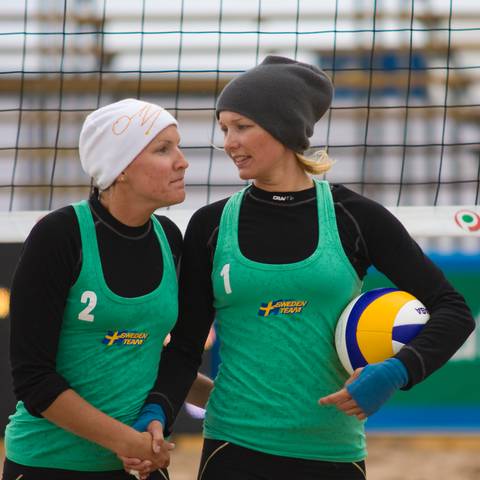
In frosty countries like Sweden, it has always been necessary to allow special uniforms on the beach!


I just recently wrote about uniforms, although the context then was the issue of the head scarf. I noted that our handball rules are amazingly vague as to what constitutes a proper ‘uniform’. So among other things, I was asking if we could interpret the rules to allow the beach style bikinis in indoor handball (assuming, of course, that they had enough room for player numbers)…

Little did I know that we would now suddenly have reason to raise the issue of the bikinis required for women players in beach handball! I had listened to John Ryan’s podcast and chats with some members of our USA beach handball team, and I was a bit amused when I heard that they seemed to have difficulties in figuring out how to put on their bikini uniforms. And I remember only too well that, in the supposedly liberal or emancipated Scandinavian countries, there had been major protests when the IHF made it mandatory for the women to use bikini-style uniforms. They thought this was insulting. But part of the IHF ‘excuse’ was that it simply followed the example of beach volleyball.

So I was now a bit surprised to read a few days ago that beach volleyball has decided to stop making the bikinis mandatory. In fact, the obligation has really been to wear a bathing suit, so one-piece bathing suits have already been allowed for the women. But now, not just on an experimental basis, but for all the official competitions, including the 2012 Olympic Games, there will be flexibility. It will be permitted to use shorts and a top, with or without sleeves, as an alternative to the bathing suit. In fact, the wording seems to suggest that one could, for instance, combine a bikini top with shorts.

This may now raise questions for beach handball: will we be ‘ahead’ of everyone else by continuing to insist on bikinis, or will we be ‘behind’ in the sense that we are (in a sport essentially managed by men!) forcing the women to wear something that they may not like to use? This is of course a matter of ethics and equal treatment, and that is the consideration that I personally see as the most relevant one. But then I am sure that other observers will argue more cynically that we must not overlook the aspects of PR and ability to attract spectators and sponsors. Indeed, some media comments already suggest, apropos the decision of beach volleyball, that “this sport, which in itself is boring, will lose its glamour and ability to gain attention, if the bikini uniforms are not part of the spectacle in the beach setting”.

It will be interesting to see if the decision in beach volleyball will cause a reaction in the IHF, and I would also be curious to know how current and potential beach handball players and spectators look at it! Would you want handball to follow the example of volleyball?

post

VIDEO: March Madness: Team Handball Style

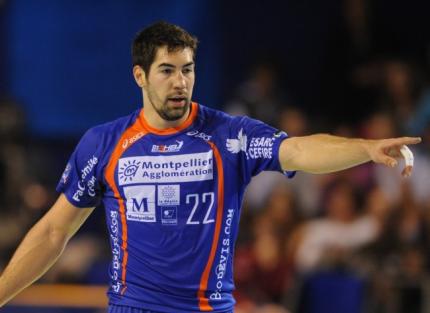
Can Nikola Karabatic lead Montpellier to an upset over Barca?

I may have declared myself America’s #1 Team Handball fan, but even I can’t resist the lure of America’s NCAA Basketball Tournament.  It’s kind of hard to explain to Europeans, but this tournament is kind of like a knockout National Cup tournament on steroids.  Played over 3 successive weekends it totally captures the imagination of the American sporting public unlike any club event in Europe.  Everybody fills out a bracket for the 64 teams to compete for bragging rights and/or money.  Inevitably a little club or two knocks out a big club rendering predictions futile.  It is simply an awesome event, but as much as I’d like to see European Handball adopting something similar I won’t hold my breath waiting for that to happen.

Instead, I’ll make do with watching the Champions League Round of 16 over the next couple of weeks.  The 16 teams that advanced out of the Group Stage have been paired off and they will now play a 2 game aggregate goal playoff.  The lower seeded teams host the first match and the higher seeded teams host the return leg.  A definite advantage as those teams will know how much they need to win by in front of their home crowd.

At the EHF’s webstream platform, ehfTV.com, some of these matches will be available live and all of them should be available for viewing on-demand a day or so after the match is played.  As I’m still immersed in the NCAA tournament the on-demand feature is my preference and catching up with the Champions League is great on Mon-Wed when the tournament is dormant.

The EHF has already posted a great summary of the 8 pairings and what to expect, so I’ll simply reiterate that there are two great showdowns (Montpellier-Barcelona and Berlin-Hamburg) worth watching.  Normally, this type of matchup wouldn’t appear until the quarterfinals or the final four, but both Montpellier and Hamburg stumbled in Group Play resulting in a 4th place seeding.

In particular, I’m really looking forward to the Berlin – Hamburg showdown.  These two sides have already played each other twice this season with Berlin winning 26-25 in Berlin and Hamburg winning 24-23 in Hamburg.  With neither side having a realistic shot at catching 1st place Kiel this Champions League double-header takes on extra importance as a trip to the final four in Cologne is one thing they can still hope for this season.

Montpellier – Barcelona could also be interesting.  Montpellier is undefeated and 8 points clear of Chambery in the French league, so for all practical purposes continuing on in the Champions League is the only interesting thing left for them to do this season.  In Group Play they lost a lot of close games and slipped all the way to 4th place in the Group of Death.  One sure indication of what they can do when they play well is their 24-23 victory in Kiel.  Barcelona will surely be wary of Karabatic and company.

EHF Preview of the first stage for the round of 16: http://www.ehfcl.com/men/2011-12/article/14682/Prepare+for+the+knockout+stages%21

Tips on watching

To watch the matches without finding out the scores ahead of time, I’ll try and post direct links to the videos below.  You can also find the videos with the ehfTV (full matches) link provided.  I suggest you use this link instead of going directly to the efhTV home page.  I say this because  you’ll have a better chance of not finding out the final score of the match.  Despite countless pleas for a different webpage design the EHF still likes to post all kinds of videos and smiling player interviews tend to reveal the outcome of matches.  Even with the direct links to the actual matches, though, you would be wise to either have a sheet of paper available to kind of glaze over your eyes as there are annoying links at both to the top and right hand side to these sorts of videos.  Once you start the video and click full screen, though, you are safe from harm.

With 16 matches you probably won’t have time to watch them all.  Accordingly, I suggest you focus on the Berlin-Hamburg and Montpellier-Barca showdowns.

On paper, some of the other pairings should be one-sided affairs.  For instance, I’m guessing that Kiel had little problem with Wisla Plock, but I could be wrong.  So just in case, I’ll check out that match using the sliding bar at the bottom to check the score throughout the match to make sure that Kiel didn’t unexpectedly stumble in the first leg.  I’ll do the same thing for Madrid and Copenhagen as well.

The other 3 matches (Leon-Veszprem, Kielce-Koper, Metalurg-Zagreb) should be more evenly matched, but I don’t think these teams are strong final four contenders.  I’ll probably skim through these matches as well, just in the interest of time.  I will say, though, that it’s usually entertaining to see the enthusiastic crowd at Macedonia’s Metalurg.

One final point:  Make sure you write down the scores of the first leg matches, so you’ll know what that means in terms of aggregate for the final match.  Also, keep in mind that the 2nd tiebreaker is away goals scored, as it wouldn’t surprise me at all if this doesn’t come into play in at least one of these pairings.

ehfTV (Full Matches): http://www.ehftv.com/ehfcl/men/2012/search/video/full-match/ (use this link to avoid final outcomes)

1 vs. 4 Seed Matches

Berlin vs. HSV Hamburg
(18.03.2012) http://www.ehftv.com/ehfcl/ec/cl/men/2011-12/video/002260
(25.03.2012) http://www.ehftv.com/ehfcl/ec/cl/men/2011-12/video/002266

Montpellier vs. FC Barcelona
(18.03.2012) http://www.ehftv.com/ehfcl/ec/cl/men/2011-12/video/002262
(25.03.2012) http://www.ehftv.com/ehfcl/ec/cl/men/2011-12/video/002250

Wisla Plock vs THW Kiel
(14.03.2012) Video: http://www.ehftv.com/ehfcl/ec/cl/men/2011-12/video/002244
(18.03.2012) http://www.ehftv.com/ehfcl/ec/cl/men/2011-12/video/002263

Kadetten Schaffhausen vs.  BM Atletico Madrid
(15.03.2012) Video: http://www.ehftv.com/ehfcl/ec/cl/men/2011-12/video/002259
(25.03.2012) http://www.ehftv.com/ehfcl/ec/cl/men/2011-12/video/002265

2 vs. 3 Seed Matches

Leon vs Veszprém
(17.03.2012) http://www.ehftv.com/ehfcl/ec/cl/men/2011-12/video/002245
(25.03.2012) http://www.ehftv.com/ehfcl/ec/cl/men/2011-12/video/002267

Kielce vs RK Cimos Koper
(18.03.2012) http://www.ehftv.com/ehfcl/ec/cl/men/2011-12/video/002247
(24.03.2012) http://www.ehftv.com/ehfcl/ec/cl/men/2011-12/video/002248

HC Metalurg vs. Zagreb
(18.03.2012) http://www.ehftv.com/ehfcl/ec/cl/men/2011-12/video/002246
(24.03.2012) http://www.ehftv.com/ehfcl/ec/cl/men/2011-12/video/002249

IK Sävehof vs. AG Kobenhavn
(18.03.2012) http://www.ehftv.com/ehfcl/ec/cl/men/2011-12/video/002261
(24.03.2012) http://www.ehftv.com/ehfcl/ec/cl/men/2011-12/video/002264

THN (17 Mar 2010): EHF Champions League Format: More tinkering needed. Why not a field of 64?: https://teamhandballnews.com/2010/03/ehf-champions-league-format-more-tinkering-needed-why-not-a-field-of-64/


post

New generation in charge of Russia’s men’s team

a legend hands over the 'A' card


For a long time now, Russian men’s handball has been synonymous with Vladimir Maksimov, but after the ‘modest’ results in EURO 2012 the 66-year old decided that it was time to retire permanently. After a good career as a player, which included the gold medals in the 1976 Olympics, he was coaching the men’s national team during a very successful period. Indeed, one could say that the Russians were a dominating team in the 1990s, becoming both World Champions and European Champions, with the gold medals at the 2000 Olympics as a culmination.

But thereafter the Russian machine sputtered, despite bronze medals in 2004 and the insertion of several talented younger players. In fact, Maksimov already gave way briefly for other coaches twice, but he was almost immediately brought back again. In recent years, it was common to hear Maksimov get the blame for the decline, and there was whispering to the effect that he had ‘outlived himself’ as a coach at the top level. But I think it is also fair to say that many international critics were misled by the earlier successes and have not realized that handball is in fact not really a major sport in Russia, with unlimited resources and a steady supply of large numbers of players at the youth level.

If anything, Maksimov probably got too little credit for getting so much out of a difficult situation. He was heard lamenting that the promised support had not been forthcoming despite the many successes that he and his teams had brought to Russian sport. And he had a personal image of a ‘big grunting bear’ who was not very approachable, and this may also have brought him less appreciation than he deserved. In my experience, he was always very serious and respectful in dealing with people around him. It may have seemed he was tough on his players, but he was always sportsmanlike and never got into the habit of provoking or complaining in a conspicuous way. At the most, a resigned gesture or a wry smile could be seen, when he wanted to get agreement with his opinion of a decision from the referees.

Several former top players had been mentioned as candidates to replace Maksimov. One of the most familiar faces (or should I say wing spans) was that of Dmitri Torgovanov, the former world-class pivot who is now coaching St. Petersburg HC. Other rumors suggested that Alexander Rymanov or Nikolai Tsigarev might be the anointed one. But a few days ago it was announced that the Russian Handball Union had voted in favor of Oleg Kuleshov as a narrow winner over Rymanov. Apparently, as is the process in Russia, what is now missing is the formal endorsement by the Ministry of Sports.

The 37-year old Kuleshov had a strong career as a player, doing no less than 123 international matches for Russia. He was on the Olympic team in 1996 and 2004, but he missed out on being part of the gold medal squad in 2000. At the club level he spent many years playing for SC Magdeburg, including the season when they won the EHF Champions League. He has recently been a coach for HF Springe, a top team in the 3rd Bundesliga. He would be expected to bring in a new group of coaches and managers to work with him, creating a new leadership generation in charge of the Russian men’s team. Let us see of this will turn the recent decline around!

post

What constitutes a proper ‘uniform’ in handball?

leaving aside the political aspects, the safety of the player and the opponents is the main consideration


Last week, the International Football Association Board (IFAB), the rules-making body in football announced a turnaround in its previous opinions on the matter and declared that it was supporting a change that would allow women to wear a head scarf (hijab) in football competitions. It is expected that the final approval by FIFA will be given in July, following a final check of health and safety aspects by FIFA’s medical advisers.

The matter had been pursued vigorously in recent time by Prince Ali of Jordan, who became FIFA Vice-President and a member of the FIFA Executive Committee through a surprising election result in the Asian Football Confederation a year ago. From the vantage point of handball, it could be observed that a number of Muslim countries previously had wanted to pursue the issue across a spectrum of different sports, and that there was considerable discomfort among the decision-makers in the individual sports, including football and handball. Accordingly, the matter was referred to ASOIF, the organization for summer Olympic sports, in the hope that a standardized approach might evolve.

While waiting for results, there were some informal ‘experimentation’ or exceptions, especially in the world of Asian football and handball. In the meantime, it had also become a practice in women’s handball that at least long sleeves and pants would be used in handball, something that the IHF also quietly begun to accept. And in 2010, without any public debate, there was suddenly wording introduced in the handball rule book to the effect that head scarves are allowed, in analogy with headbands, as long as they are made of soft, elastic material. (It may seem that elasticity makes sense for headbands, but it may not really be desirable for head scarves; here instead, the method of fastening may be more relevant).

Of course, the issue has tended to be much more of a political ‘hot potato’ rather than a technical rules issue in recent decades. Around the world, one finds a wide spectrum of habits and opinions: the wearing of hijabs in public is mandatory, or it is forbidden in certain settings or it is left up to each woman to decide. Similarly, it has been seen alternatively as an issue of women’s rights and opportunities to participate in sports, or an indication of suppression. The reasons for hesitation in the world of sports has been the notion that the wearing of a hijab is a religious manifestation, something which is generally forbidden in sports rules, but the success of Prince Ali seems based on the argument that it should be seen as a cultural expression and therefore permissible.

But what it does bring up in handball is a more mundane and practical matter, a shortcoming that I touched on not so long on ago when commenting on the ‘conflict’ regarding the desire on the part of AG Copenhagen to wear sleeveless shirt in the EHF Champions League. The matter was amicably resolved, but it gave me a chance to joke about the need for ‘uniform’ tattoos, in the absence of sleeves. The point is that, in comparison with other sports, handball is amazingly silent as to what actually constitutes a ‘uniform’. It seems that, by definition, there is nothing that should require a more clear and precise definition than what goes under the name ‘uniform’… But I cannot point any fingers, because I have been involved in IHF rules matters for several decades, and it never occurred to me or anyone else to see the need for a clearer definition of something that everyone seemed to understand!

The rule book does not even talk about shorts vs. long pants, and shirts are only mentioned indirectly in the sense of being the place where you put the player numbers. So no wonder that it was the EHF advertising regulations and not the playing rules that were at issue in the case of AG Copenhagen. And the rules point out that the teams must wear different colors, but it is in fact not quite clear what should carry those colors. And for instance, are bikinis from beach handball allowed in indoor handball? Are long socks or panty-hose OK and do the colors matter etc? Is there a basis for prohibiting a skirt or a kilt? At least it is spelled out that players must were sports shoes, so playing barefoot or in regular dress shoes is not acceptable.

The rules have a more specific focus on objects that are prohibited or must be covered. The concept of taping or covering involves, for instance, rings, earrings, body piercing. It is also explicitly stated that head protection and face masks are illegal, as are watches, bracelets or necklaces. But if one goes back to the question of head scarves, where the reality is that handball is generally ahead of football, perhaps it would be advisable to follow FIFA’s detailed determinations and/or have a special review in the IHF of what type/size of scarves should be accepted; and especially how they need to be attached (Velcro?) to avoid that they keep falling off, get tangled up, or risk having a ‘strangling effect’. One does not want to over-regulate, because controversies at a new level is the last thing one would want, but it is necessary to consider the safety of all the players and also to facilitate for the referees.

Finally, the focus on the general definition of ‘uniform’ seems to suggest that the IHF might be well advised to come up with some clarifications or a more precise text in the next rule book.

post

IHF Super Globe becoming more serious

it seems the IHF COC must have put their 'thinking caps' on...

In a commentary two years ago, prior to the 2010 IHF Super Globe event, I made the point that while the Super Globe could be viewed as a nice PR event for handball, it was totally wrong for the IHF to insist on treating it as some kind of official world championship for clubs. The main reason for my criticism was that the IHF was allowing clubs to make a mockery of the competition by permitting an abuse of the IHF transfer regulations, under which the weaker clubs (typically from Qatar and Lebanon) could reinforce their teams by borrowing world-class players for a couple of weeks. Some teams had as many as eight such additions, totally dominating their teams, together with a famous coach also borrowed for the event. By contrast, all the teams from the other continents, including the Europeans, the Brazilians and the Australians came with their normal squads.

Accordingly, I am now pleased to report that, however belatedly, the IHF and its Commission on Organizing and Competition seems to have come to the same insight. At least they have taken a step in the right direction by limiting the number of ‘guest players’ to a maximum of three per team. Perhaps this ‘compromise’ will allow for less embarrassing results for the teams making use of the arrangement, while at the same time preserving the integrity of the event for those team who participate with their own players. The Super Globe will this year again be held in Doha, Qatar, during the period August 27 to September 1.

THN (16 May 2010): The IHF Super Globe: Fine as an all-star event, but not as a serious competition: https://teamhandballnews.com/2010/05/the-ihf-super-globefine-as-an-all-star-event-but-not-as-a-serious-competition/


post

Handball Talk (Episode 6): Pan American Beach Handball Championships in Uruguay


USA's Diva Desai takes a shot against Uruguay

John Ryan talks with USA Team Handball General Manager, Dave Gascon, Women’s Coach, Dede Piankova and  USA players, Diva Desai and Erin Kizer from Montevideo, Uruguay, the site of the Pan American Beach Handball Championships.  Included is a discussion on why the USA decided to participate in this tournament, how the game differs from the court version and where Beach Team Handball might fit into the big picture as the USA seeks to further develop team handball in the USA.

The women play their final game on Sunday at 1645, US East Coast Time: http://www.handballtv.blogspot.com/

Highlights of the women’s game against Uruguay are also available on the Day 1 video starting around the 17:00 minute mark.


post

Issues regarding seeding for Olympic handball tournaments

Please explain what Denmark did to deserve to be punished!?

The real purpose of this article is to emphasize that it is possible to combine clear principles with a little bit of practical judgment and that, above all, there should be no room for prestige in the handling of important matters. Moreover, as I noted in a recent posting, there is considerable room for improvement in the communications functions of the IHF. What is then causing me to offer these comments? Well, it is an issue that somehow IHF has preferred to keep rather hidden, namely the principles and procedures for the seeding of the teams that qualify for the men’s and women’s handball tournaments.


The seeding may be of considerable importance in placing a team in a group that is easier or more difficult, in terms of gaining one of the four top places (out of six) that give a place in the quarter-finals. When the concept of pre-Olympic qualifying tournaments was introduced for 2008, there was some controversy about how the seeding of teams qualifying directly for Beijing and those taking the route through qualifying groups should have been handled.

Accordingly, the IHF decided to review the issue and they reached agreement through a decision in the Council and the Executive Committee in 2010! But they ‘forgot’ to announce the decision… So it only became a public issue in the last couple of weeks, following the EURO 2012, when the European champion Denmark found out about their situation with respect to seeding. They were not happy and they told IHF so. As a result, IHF was not just unhappy, but tried to combine a factual announcement with a response to Denmark in the IHF web site. The explanation was mostly unclear and incomplete, and there as an anger directed at Denmark that seemed improper for a public statement. So what was then the specific issue?

The IHF had decided that the “top four teams in the 2011 World Championship should be given priority“. This would involve France, Denmark, Spain and Sweden. But as only France was an automatic qualifier for London, the indirect way of prioritizing the other three teams was to say that the winners of the three qualifying groups where these teams would normally be placed as hosts would benefit from seeding as teams 2-4 for London. Then would come the runners-up from the three qualifying groups as seeds 5-7 (which would quite possibly be the teams placed 5-7 in 2011), with the host Great Britain inserted as No. 8 (the kind of special treatment that the hosts tend to get). And that would leave the four continental champions for seeds 9-12. Personally, I find this quite logical and sensible!

However, all the people involved in the IHF decision-making overlooked one possibility, namely that one of the seeds 2-4 (or 5-7) might in fact ALSO become continental champion. This was the case with Denmark. So, because the IHF did not have (and did not hasten to insert) a supplementary clause to cover this special situation), they simply placed Denmark as a number 9 seed, as the champions from the highest ranked continent. In other words, having explicitly stated that Denmark as silver medalist in 2011 should be given priority with ranking number 2, the IHF in fact punished Denmark for also having won the European Championship. Having said above that I could fully support the IHF’s basic principle, I am even more firm in saying that this kind of misguided application, totally lacking in common sense and fairness, simply should never be allowed.

In a special clause, Denmark should have been allowed to keep seed number 2, with all the other teams moving down one position. I cannot imagine that anyone would find this unfair or improper. But now instead we have a situation where Denmark is moved down seven positions, and all the teams that were behind Denmark in the 2011 World Championship and in the EURO 2012 will be ahead of Denmark if they advance from their qualifying group. This includes, for instance Serbia (beaten by Denmark in the final of EURO 2012 and 10th in 2011) and even more conspicuously Poland. The only reason Poland was given a slot in a qualifying group for London (after having finished 9th in EURO 2012 and 8th in 2011) was precisely that Denmark no longer needed their slot because they qualify directly as European champions.

So, while I do not know exactly how Denmark argued their case, I fully understand why they wanted to appeal their situation to the IHF. Of course, after the rather insulting statement from the IHF on its web page, I could have foreseen that there would now be far too much prestige involved, and that if the IHF seriously wanted to listen to the Danes, they would never have used such a tone in public. But DHF president Bertelsen nevertheless went to Basel to meet with Moustafa today. As Bertelsen explains it, Moustafa was sympathetic and told him that he would ask the IHF Competition Commission (which was/is meeting in Basel) to review the matter. This left Bertelsen rather optimistic, he told Danish media.

But Bertelsen did not even get more halfway home before he found that the final IHF decision was negative. And to make it even more absurd, supposedly the impression was given that the final word was that of the Competition Commission. Anyone who knows the inner workings of the IHF knows that a Commission does not really ‘decide’ anything, it recommends. The real decision is taken by the President possibly after consultation with the Executive Committee and/or the Council. In other words, if the President genuinely had wanted to support Denmark’s claim, he would have asked for the support of the Executive or Council. It would not happen that the Commission ‘overrules’ him. So when Bertelsen expressed satisfaction that the IHF President had at least listened to him, perhaps Bertelsen was diplomatic; more realistically, he might have had reason to be upset that the IHF President made him waste a trip to Basel… Because clearly there was no intention to change the initial decision!

IHF Announcement on seeding:  http://www.aipsmedia.com/index.php?page=news&cod=7390&tp=n (Note:  This announcement has been removed from the IHF Webpage)

post

VIDEO: Pan American Beach Handball Tournament to be webstreamed live

The venue for the Pan American Beach Handball Championships in Montevideo, Uruguay


The Pan American Beach Handball tournament starts tomorrow, 1 March, in Montevideo, Uruguay.  5 men’s teams and 5 women’s teams are participating.

The event will be live webstreamed at this site: http://www.handballtv.blogspot.com/

The USA women will be participating and this is their schedule for their round robin matches

Thursday, 1 March
USA vs Uruguay, 8:45 PM (Local), 5:45 PM (U.S. East Coast)

Friday, 2 March
USA vs Paraguay, 10:00 AM (Local), 7:00 AM (U.S. East Coast)
USA vs Argentina, 6:15 PM (Local), 3:15 PM (U.S. East Coast)

Saturday, 3 March
USA vs Brazil, 6:15 PM (Local), 3:15 PM (U.S. East Coast)

Complete Schedule: http://www.panamhandball.org/index.php?option=com_joomleague&func=showPlayground&p=35&pgid=16