post

Asian Men’s Championship: Half-way through the preliminary round

The Logo of the 15th Asian Men's Championships


Somewhat in the shadow of EURO 2012, the Asian Men’s Championship got underway in Jeddah, Saudi Arabia few days ago. The Championship also serves to qualify the top three teams for the 2013 World Championships. Ten teams participate, initially playing in two round-robin groups of five teams. Japan and Korea are the only participants from East Asia. So far, there have been no real upsets. Korea and Japan have been place in what might be a tough group with Kuwait and Iran. The home team, Saudi Arabia, appears to have a more favorable draw, with Qatar as the most prominent opponent.

The positions in the groups, after each team has played two out of four games, are as follows: Group A: Japan and Korea 4 pts, Kuwait 2, Iran and Jordan 0; Group B: Qatar 4 points, Saudi Arabia 3, UAE 2, Bahrain 1 and Uzbekistan 0.

post

EURO 2012: A Fairy Tale ending when the Danes keep their cool

Yes, the Danish 'fairy tale' tournament got a happy ending!


A week ago I wrote about a ‘Nordic Meltdown’; this was after Denmark had lost against Serbia and Poland in group play, joining the other Nordic teams in having a very poor start of EURO 2012. A year ago, I wrote an article which I illustrated with a famous picture from a Hans Christian Andersen story. When Denmark today kept their cool against a strong Serbian team and surrounded by a fanatic home crowd, winning the European title, then it is again appropriate to talk about a Danish fairy tale of the best H.C. Andersen style.

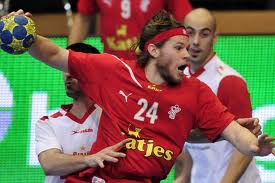
Denmark deserved this victory after five straight victories in the main round, in the semi-final and today. They also played a concentrated and strong game today and they have a resourceful team: a top-rate goalkeeper, a strong defense, good wing players and several options for the long-distance shooting. Mikkel Hansen was the hero in many games, but when he had an off day, then Rasmus Lauge stepped forward. And they were able to prevail both in high-scoring shoot-outs and in defensive games like today, where the result was 21-19 after a modest 9-7 at half-time.

Serbia had Ilic, Vujin, Vuckovic, goalie Stanic and several other really impressive players. In many games they were ‘carried’ by the crowd support. But today it somehow seemed the pressure and the expectations made the Serbs more nervous than their opponents. Nevertheless, after I saw them in the World Championship a year ago, I never hesitated about predicting that they would be in the final here, and they will certainly be a team that has good chances of remaining at the very top for a while.

The bronze medal game was the kind of anticlimactic game one sometimes gets when two frustrated teams cannot mobilize the right motivation. Croatia managed slightly better than Spain and won the bronze medals through a 31-27 (13-12) victory. During the first 35 minutes, Spain managed to come back every time when Croatia tried to pull away, but later in the game the energy was not there for such come-backs.

The final was played in a very positive atmosphere, with no incidents involving the spectators and a very sportsmanlike atmosphere on the court. The player showed mutual respect, and the referees, Abrahamsen/Kristiansen (Norway), displayed a nice calm control and a good consistent judgment.

Finally, the victory for Denmark also had the implication that they are directly qualified for London and that Poland gained the remaining slot in an Olympic qualifying tournament, taking over Denmark’s slot on account of their ranking in last year’s World Championship. There will be ‘chain reactions’ in the composition of the three qualifying tournaments in April as follows: Group 1: Spain, Poland, Serbia, Algeria; Group 2: Sweden, Hungary, Brazil , FYRO Macedonia; Group 3: Croatia, Iceland, Japan and Chile.

post

TV Options for this weekend: Try Team Handball

If the NFL Pro Bowl is the highlight of your TV sport watching weekend you have nobody to blame, but yourself.

Well, it’s that dreaded weekend between the NFL Conference Championships and the Super Bowl.  Two weeks of hype is bad enough, but foisting this farce of a game (the Pro Bowl) on the viewing public adds insult to injury.  I suppose you could watch 20 different NCAA Hoops matchups or the Australian Open.  But, if you’re looking for something a little different this is a great weekend to try Team Handball courtesy of the European Handball Federation (EHF) and YouTube.

The European Championships are wrapping up this weekend in Belgrade, Serbia with matches on Friday and Sunday.  It’s been a fabulous tournament with many twists and turns, and the final four is set to begin.   Friday’s matches take place in the evening in Europe, so unless you’re not working or have a lenient boss it will be tough to take in the matches live in many other parts of the world.

Never fear, though, as the EHF has been posting the complete matches for fans to watch at their convenience.  As soon as they are available we’ll post a link to the video.  This should help to avoid finding out the score, but you’ll still need to be careful for extraneous information like chatter in the comment box.

Friday’s Matches (All Times are U.S. East Coast)

Live Feed:  http://www.youtube.com/watch?v=_6qQZKTxdL8

9:15 AM Slovenia vs. Macedonia (5th Place Match)
This match is for 5th place and a guaranteed spot in an Olympic Qualification Tournament.  These two teams were not expected to place in the top tier of this tournament, but both sides have ridden their “home crowd” advantage as fans from the nearby nations have crossed the border in large numbers to cheer their teams on.  Why, there are so many scarlet and gold fans in the arena one could even think they were in Hilton Coliseum.  Accordingly, Macedonia is a 1 goal favorite.

On Demand Broadcast:  1st Half / 2nd Half

11:45 AM Denmark vs. Spain (Semifinal #1)
Spain waltzed through their group with their only blemish a draw against Hungary.  Denmark, however, lost two of its first 3 matches and looked to be all but eliminated heading into the main round.  They took care of business, though, winning their last 3 matches.  Those wins and a timely assist from Poland beating Germany let them slip in the backdoor.  Spain is a half goal favorite.

On Demand Broadcast:  1st Half / 2nd Half

BE FOREWARNED:  Requests to the EHF to remove video pictures (Smiling players and previews for Sunday) that may give away the score have been ignored.  To avoid finding out the outcome have a sheet of paper ready and click full screen immediately.

2:15 PM Croatia vs. Serbia (Semifinal #2)
Since the breakup of the former Yugoslavia, Croatia has had far greater handball success than its neighbor Serbia.  Croatia may have a better pedigree, but this match will be in Belgrade and you can be certain that the home crowd will be loud and vocal.  It goes without saying that there’s still some strain in the relationship between these nations which fought each other not that long ago both on and off the court.  For a sense of that strain, check out the Once Brothers documentary that’s periodically replayed on ESPN.  This game is expected to be another tight affair with Croatia favored by a half goal.

On Demand Broadcast:  1st Half /2nd Half


Sunday’s Matches (All Times are U.S. East Coast)

8:30 AM Bronze Medal Match
Bronze medal matches are often meaningless, but these two teams will have something to play for as the winner automatically qualifies for the 2013 World Championship while the loser will have to slug it out in Group Play over the course of next season.  A few weekends off are definitely worth fighting for.  (Editor’s note:  Correction; As Spain is hosting the 2013 WC, the other 3 semifinalists have already qualified.  In other words the match is indeed now a meaningless third place match.)

On Demand Broadcast:  1st Half /2nd Half

11:00 AM Gold Medal Match
Not a whole lot needed to be said here.  The winner takes the European title and directly qualifies for the 2012 Olympics.

On Demand Broadcast:  1st Half /2nd Half


post

EURO 2012: Teams hoping for the last Olympic chance must watch as others decide their fate

Denmark's march from meltdown to miracle; will they go all the way?

To some extent, the final main round day became a bit anticlimactic, as three teams had already secured their places in the semi-finals. But there was still a lot of drama. Mainly this involved the Germany-Poland game, a match-up between rivals that is always emotional even when very little is at stake. But today this game could have meant that Germany would have been in the semi-final. They started out poorly and it did not seem promising. But in the middle of the second half, they went from 25-29 to 31-29 through great determination and will-power. However, in the end they went down 32-33, a bitter finish for a team that had to struggle without having any strong performances from veteran players to rely on.

Poland could then maintain their hope for a couple of hours, even if I suspect they did not have much faith in the chances of the Swedes to upset a determined Danish squad. And miracles did not happen. Denmark had a relatively easy time in defeating Sweden 31-24. So this means that Denmark obtained the remaining semi-final slot. Considering that they had to achieve this through three straight wins after having begun the main round with zero points, their turnaround is really quite remarkable. Poland then had to lower their ambitions and hope for at least a chance to go on to Olympic qualifying.

At the same time, Spain had been saving some energy, using some reserve players after already having their place in the semi-finals. But they still managed to pull out a win against Slovenia with 35-32, largely thanks to good goalkeeping and good shooting. This now sets up two intriguing semi-finals: Spain against Denmark and Serbia against Croatia. And it meant that the final games of the day, Serbia vs. FYRO Macedonia and Croatia vs. Hungary, had absolutely no importance in the standings for the Serbs and Croats who could instead be forgiven for looking ahead to the huge battle between the two of them on Friday. Unfortunately, serious incidents in the streets of Novi Sad have already suggested that the Croats will be up against more than the Serbian team on the court; they will be reminded of their ‘lack of popularity’ among many of the locals.

However, the two final games today did have a great importance for the final tickets to the Olympic qualifying tournaments. Hungary already have such tickets, and they could at best be aiming for 5th place this week. But by winning the game, they could prevent Slovenia from moving on and instead give Germany a chance to be in a qualifying tournament. . Talk about watching helplessly while placing your faith in others. The Slovenians would of course have to hope that Croatia play to the best of their capacity and win the game.

In the same way, the Polish team had to hope that the Serbs would not be good neighbors and allow the Macedonians to get two points. Because this would give the Macedonians a qualifying chance and move the Poles down to fifth place in the group. So what happened in the end?? Let me end the suspense and explain that, not unexpectedly, both Croatia and Serbia took it a bit easy. Croatia mostly rested their star players but, they still managed to gain a tie 24-24. This was enough to allow Slovenia to keep the third place in the group. Serbia allowed their key players, top scorer Ilic and goalkeeper Stanic, to rest. They still kept the game even almost until the end, but then the more motivated Macedonians pulled away and won 22-19. In other words, the Macedonians got the third place and also the chance to be in an Olympic qualifying tournament.

Germany will now go home disappointed. For Poland there is still a chance, as the complicated format has one more twist. Basically, the best two teams in EURO2012 who have not previously secured a spot will now get in through their result here. This means Serbia and the winner of the 5th place game between Slovenia and FYRO Macedonia, as the other three semifinalists are already qualified. However, if one of these three teams (Croatia, Denmark or Spain) were to win the Championship, then they will be directly qualified for London, and their place in a qualification tournament is freed up for Poland who were the team next in line from last year’s World Championship. Should instead Serbia become European champion, then both the winner and the loser of the 5th place game go on to the Olympic qualifying. I hope IHF and EHF have made this sufficiently challenging for you to follow!

Finally, as John Ryan has commented earlier, there is also the issue of more or less difficult qualifying groups. Sweden is currently sitting in a comfortable position, playing at home against Croatia, Japan and Chile, with two teams going on to London. But, should either Denmark or Spain become champions, then Sweden would move ‘up’ in the ranking and instead host a slightly less comfortable group with Hungary, Brazil and the winner between Slovenia and FYRO Macedonia. After their shaky performance this time, this is not so reassuring for the Swedes.

Breaking it down, here are the four possible tournament compositions:

If Serbia wins the EC
1) Denmark (Host), Hungary, Slovenia/Macedonia Winner, Algeria
2) Spain (Host), Iceland, Brazil, Slovenia/Macedonia Loser
3) Sweden (Host), Croatia, Japan, Chile

If Croatia wins the EC
1) Denmark (Host), Poland, Serbia, Algeria
2) Spain (Host), Hungary, Brazil, Slovenia/Macedonia Winner
3) Sweden (Host), Iceland, Japan, Chile

If Denmark wins the EC
1) Spain (Host) Poland, Serbia, Algeria
2) Sweden (Host), Hungary, Brazil, Slovenia/Macedonia Winner
3) Croatia (Host), Iceland, Japan, Chile

If Spain wins the EC
1) Denmark (Host) Poland, Serbia, Algeria
2) Sweden (Host), Hungary, Brazil, Slovenia/Macedonia Winner
3) Croatia (Host), Iceland, Japan, Chile


post

EURO 2012: Tafatt och ynkligt

This illustrates my heading and the impression that some of the teams have given


I clearly need to explain this heading. It is John Ryan’s fault… He cannot follow the web casts live but one or two days late, at which time he wants to be unaware of the results. But both of us get automatic e-mail where our headings of posted articles are shown. So I figured that I needed to use Swedish to avoid ruining things for the poor guy… So if you now wonder what the two words in the heading mean, the answer is roughly ‘helpless and meek’! Unfortunately, several of the games yesterday and today made me feel that this was a good way of describing many players or entire teams. Yes, the games were in some cases close in terms of result, but the quality was not much to boast with.

The first ones who come to mind in deserving my description were the French team and many of its stars and veteran players. Sooner or later it had to happen that their impressive string of gold medal performances would come to an end but, please, not in this way! In the end they seemed lethargic and indeed helpless today against Croatia, just like against Hungary earlier. And it did not have to happen. During the middle of the game they seemed to turn it around and had a three-goal lead after a weak start. But when it mattered at the end, they just collapsed and seemed to give up. There was even open quarreling between coach Onesta and some of his key players.

The Swedes do not this time have a team of the same caliber as in their periods of greatness or even like one year ago. So perhaps they could not do much better. But what is frustrating to see is the lack of initiative, determination and fighting spirit. Serbia was a tough opponent yesterday, but the Swedes did not manage to put up a real fight. And a bit of the same was noticeable today with the Icelandic team. Despite some good efforts by the likes of Gustavsson and Palmarsson, there was no real team cohesiveness and no spark. Can it be that teams which already have an Olympic qualifying slot secured do not really manage to get up for the final games of a European Championship when they seem to be out of contention for the medals??

And then came today’s puzzling performance by the Hungarians, another team with a place secured in the Olympic qualifying, But today they had a chance to put themselves in a good position to gain a semifinal slot. And nevertheless, they did not get anywhere near the level that they have showed in some of the previous games. They are really like the ‘Dr. Jekyll and Mr. Hyde’ team of this tournament. Quite generally, it also makes you start wondering about a general lack of impact from the coaches during the games. These are, for the most part, well-known and highly paid coaches who should have the skills and the experiences to make major adjustments during a game and, at least, to ensure that their players are sufficiently motivated and up for the game.

So having sounded so negative until this point, let me conclude on a more positive note or two. We have seen a number of very close games and the spirit on the court in terms of sportsmanship and a general avoidance of dangerous fouls and provocations has been noticeable. The players are often showing a good deal of respect for each other, the coaches are for the most part on a good behavior, and the referees have contributed in a constructive way. They have generally been consistent and able to draw the line in the right place. Let us now hope for a thrilling finish of EURO2012 with a continuation of the good sportsmanship!

post

Macedonia’s greatest fan is an American diplomat!

Macedonian star player Kiril Lazarov visits with Ambassador Reeker in Skopje

Not many persons have heard of Philip T. Reeker in connection with handball – except in FYRO Macedonia, where he is an idol of the handball federation and the national team. The reason: he served as the U.S. Ambassador in Skopje during the period 2008-11, where he became substantially involved with the handball activities. So for fanatic Macedonians it was not a surprise when he showed up in Nis, dressed in the Macedonian team shirt and eagerly cheering on his favorites.

Philip Reeker is currently the Deputy Assistant Secretary of State, with responsibility for the Balkan region. As he noted in an interview, therefore it should not be regarded as a diplomatic ‘faux pas’, when he was observed supporting the red and yellow team, for instance in their crucial battle against the Czech Republic. It now remains to be seen if he can finagle his schedule in such a way that he can move on the Belgrade and follow the main round games as well…

But the question obviously arises: how did he get so familiar with handball? As he notes, he is frustrated that the sport is so insignificant here at home in the U.S., so this is certainly not where he picked it up. The explanation is that he got hooked on handball during an earlier tour as the Deputy Chief of Mission in Budapest. As we all know, Hungary has really strong handball traditions and activities. Perhaps, just perhaps, there is also some good influence from his wife; he is married to Solveig Johnson Reeker from Minnesota and, as the name suggests, unmistakably of Swedish or Norwegian descent.

As it seems Ambassador Reeker is currently Washington-based, could one hope that he would be prepared to get involved in helping promote handball also in his home country? Perhaps it would be a good idea for the USATH to try to establish contact with him. I doubt that he could convince Secretary Clinton to siphon off some budget money for a project to strengthen the standing of the USA handball teams in the world, but would it not be nice if he and his wife could fit in an appearance as guests at the U.S. National Championships in Minneapolis this spring!? And in that case there is little doubt as to which one of our traditional clubs he would be supporting: the D.C Diplomats, of course…

EHF Video: Interview with American ambassador and handball fan Philip T Reeker:   http://www.youtube.com/ehfeuro#p/u/18/y4aavnZyuEM

EHF Video: Macedonia fan support: http://www.youtube.com/ehfeuro#p/u/59/3-Xhzb28hxE


post

African Championship: Tunisia’s men and Angola’s women have the tickets for London; celebrations also in the Netherlands!

London welcomes Angola and Tunisia


The medal games were played in Rabat today with rather expected results. Algeria did not manage to perform another miracle. Tunisia dominated the men’s final from the beginning, and after a half-time lead of 12-6, the final result was 23-20 in Tunisia’s favor. This means that Tunisia has qualified directly for the Olympic Games, while Algeria gets the place in a qualification tournament. Most likely this will be in a group hosted by Denmark, as Denmark hardly is going to secure Olympic tickets in the ongoing EURO2012. The bronze medal game was easily won, 29-15, by Egypt against the home team Morocco. This means that the Egyptians will join Tunisia and Algeria in the World Championships in Spain in January 2013.

Angola lived up to the expectations on them, but it was not an easy game. It was tied 12-12 at half-time and the Tunisian women put on an impressive performance with a team that has much less international experience. The final result was 26-24 in Angola’s favor. It was the eighth consecutive African Championship for Angola since 1998! So Angola will yet again appear in the Olympic Games, while Tunisia gets Africa’s place in a qualification tournament. They will face Denmark, Russia and the Dominican Republic in Denmark. Not an easy task… The bronze medals were won by the Democratic Republic of Congo who defeated Algeria 33-24.

The Angolan victory was a cause of celebration also in the Netherlands! As we have previously explained, Angola had already secured a special slot in a qualifying tournament on account of their strong showing in the recent World Championships. As they will no longer need that slot, this place will instead be filled through a ‘chain reaction’. Montenegro will move over to the slot that was reserved for Angola, and the Netherlands did indeed get the opportunity to qualify for London by taking over the original spot of Montenegro. We hope the Dutch will think of an appropriate way to show their gratitude!

The complete rankings were as follows:

MEN: 1. Tunisia, 2. Algeria, 3. Egypt, 4. Morocco, 5. Senegal, 6. Angola, 7. Cameroon, 8. Dem. Rep. of Congo, 9. Congo, 10. Cote d’Ivoire, 11. Gabon, 12. Burkina Faso.

WOMEN: 1. Angola, 2. Tunisia, 3. Dem. Rep. of Congo, 4. Algeria, 5. Cameroon, 6. Congo, 7. Cote d’Ivoire, 8. Senegal, 9. Egypt, 10. Morocco.

post

EURO 2012: Nordic meltdown and French fiasco

Not one of the proudest moments for Nordic handball; the same goes for Russia and France


The groups in the preliminary round were completed today, and the main round starts tomorrow. The format used by the EHF makes for a combination of excitement and anticlimax. They start out with 16 teams and one of the two purposes of the group play is ‘simply’ to reduce the field down to 12. Moreover, at any given point in time, Europe tends to have about 10-12 really strong teams, so the weeding out of the more marginal teams, such as the Slovaks, does not often create much excitement. But this time we had thrillers at the end. And then the fact that the teams which advance bring with them the points from the games that they have played against each other, this means that every game means a lot even when teams already know they will advance.

For instance, yesterday, Denmark-Poland was a really important game, even though both teams were already through. Based on the form showed in recent time, the Danes may have been favorites against a Polish team that seemed to have stagnated in recent time and were missing key players. And Denmark seemed to have the upper hand, but in the end they basically gave the game away. So now they are still in the main round, but in practice virtually without chances of being one of the two teams out of the six in their main round group who will go to the semifinals. What is worse is the impression that, in the games they lost, the Danes really seemed to be lacking in mental strength and fighting spirit. They looked intimidated in the game against Serbia. By contrast, the Serbs are through with the maximum four points and seem to be a great shape.

In the parallel group, one could write the same thing about the Swedes as about the Danes. They lost a point against the Macedonians, after having grumbled about the impact of the fanatic crowd. And then they seemed to be strangely optimistic prior to the final game against Germany, despite the fact that the Germans really had been ‘boxed’ in with a desperate need to win. A loss for Germany might have meant elimination yet again in a major Championship, while the win against Sweden means that they instead are through with full points just like the Serbs. The listless Swedish performance, both on the court and in terms of coaching, obviously was the cause of a major frustration in handball Sweden. And the Czechs had to pack their bags, despite the strong start with a win against Germany.

In today’s matches in Group D, we had a ‘triangle drama’ between Norway, Iceland and Slovenia. The latter two played each other, and somewhat surprisingly, after mediocre play earlier, Slovenia came through. In fact, they almost went as far as to knock out Iceland, leading 34-30 just before the end. But two late goals by Iceland rescued their advancement, although they, just like Sweden and Denmark, will move on with zero points. Norway did not manage to surprise Croatia and, although they almost ‘got in through the back-door’, in the end they had to accept elimination. What now has caused some controversy is that Slovenia seemed to ‘give away’ the last two goals for Iceland, with the reasoning that the 34-32 and the elimination of Norway instead of Iceland now gives Slovenia the advantage of bringing two points to the main round. A smart way of taking advantage of the regulations or unsportsmanlike?

Finally, in Group C we had what is undoubtedly the biggest surprise. Even after France lost against Spain, most observers had seen them as a medal contender. But that has now become almost impossible after today’s surprising defeat against Hungary. Sure, Hungary is unpredictable and had already staged a great comeback against Spain, but in the game today we saw a French team that was really ‘helpless’ and resorted to individual efforts rather than their usual team play. Karabatic was just a shadow of his usual self. So while France is still in the tournament, they are not bringing any points to the main round. And next they will have to face Slovenia and especially Croatia, who both will have great crowd support. It should be noted that the Russians joined their Nordic neighbors in the ‘meltdown’; they are out!

Most of us will now start speculating about which teams will go through to the semifinals, but as far as Teamhandballnews is concerned, I will leave that task for John Ryan…

post

Algeria shocks Egypt, removing their chances for the Olympics

Proud Algerians qualify for the final


The semifinals for both men and women were played today. On the men’s side, most people expected to see Egypt and Tunisia move on to the final ‘as usual’. And even the format of the Championship seemed to support that. After Egypt and Algeria had battled to a draw when playing in the same group, today they met again in the semi-final under a schedule that seemed designed to keep Egypt and Tunisia apart until the final.

BUT, there will be no such final. Algeria managed to win 26-25, despite a 12-14 deficit at half-time. So Algeria showed that the 34-34 in the group game was not a fluke. There is now absolute euphoria in Algerian handball circles, judging from their main handball web sites.

While Egypt and Tunisia have recently been the main rivals in men’s handball, perhaps the most intense rivalry in sports general, and certainly in football, is precisely Egypt-Algeria. In 2009, there were riots, literally, when they had to play each other in play-off games for the World Cup in football. It led to diplomatic tensions, and Egypt backed out as a host of the 2010 African Championship in handball rather than having to host the Algerian team. And the history of tension in sports goes back much further and is too long to explain here.

One would imagine that there is now a state of shock in Egyptian handball. It would have been bad enough to lose in the final and have to play in one of the qualifying groups for the Olympics, but one doubts that they had expected to miss out completely on the chance to be in the Olympics. For many years, Egyptians have had their faith in handball as the sport that one day would give them an Olympic medal in a team sport. It seems likely that Egypt will still be able to win the bronze medal game against Morocco and thereby qualify for the 2013 World Championships, but that will not provide much consolation.

On the women’s side, we will tomorrow see the expected final between the perennial winner Angola and the up-and-coming Tunisians. The latter beat Algeria 27-24 in a tight game, while the Angolan women crushed the Democratic Republic of Congo, 39-19. So Angola and Tunisia will fight for the direct tickets to London. In the perhaps unlikely event that Tunisia would win, then the Angolans would get a special slot in a qualifying tournament on account of their ranking in the recent World Championships , and it seems that the bronze medal winner would then get Africa’s ‘number two’ slot in the qualifying.

post

EHF uses technology (and ethics code) to support their referees

EHF Referee Chief Andorka using the new system during the game


During many years at the IHF and PATHF, I was frustrated with the primitive methods used during games for the recording of relevant situations for post-game feedback to the referees. Essentially the ‘equipment’ consisted of a notepad and homemade full-court and half-court diagrams to facilitate quick recording of game situations that I needed to remember. Knowing the extent of the technology available to coaches and players, I found this really annoying, as a correct and clear feedback to the referees is so critical for their continuous learning.

But not so many years ago, we introduced a software system in the IHF, so that notes during the game could be limited to the exact time of the relevant situations, as that would enable us to go to the game DVD afterwards and retrieve and save the necessary game segments or situations. This, however, typically requires a long night’s work in the hotel room after a long day of intensive work with the referee and then during 2-4 games. Moreover, it would depend on immediate access to the game DVDs, something that often failed, and it did not allow for an electronic transfer of the material after it had been used in the feedback session.

However, in collaboration with the European office of FIBA (the International Basketball Federation), the EHF last year tested a much more modern and efficient approach in connection with the European Youth and Junior Championships. It involves an Online Platform and an Observer Program. This does not just expand the scope and speed of the capturing of situations but also the quality, because it is based on real-time footage. It means that the video clips can be prepared and ready immediately at the end of a game. And for the referees it is possible to receive the clips electronically for self-evaluation from their own games, and for learning from the games of their colleagues.

The approach is based on the concept of a ‘Digital Scoresheet’. Sorting and filing of clips can be done under different categories along several different dimensions. So it is possible to be very systematic and focus on specific problems and issues in a very efficient manner. This saves a lot of preparation time, but it also can make you tie in the observations to the specific guidelines and emphasis that have been provided prior to an event.

Clearly, while the distribution of the resulting material may need to be controlled by the responsible federation, in this case the EHF, there is afterwards no reason for any limitation in the dissemination of this valuable material. So referees at the national and local levels can easily be given access. Unfortunately, the reality is that not all national federations have first-class referee observers and instructors, and not all of them have the technical resources needed to set up systems of their own. Therefore it could be of tremendous help well beyond the small group of elite referees.

The only thing that is now missing is a political/financial arrangement between the EHF and the IHF, so that the IHF could also share in this system. For obvious reasons, the IHF Referee Commission is enthusiastic about it, not the least for its own immediate tasks during major events. But it could also become a fantastic asset for federations and referees worldwide. So I do hope that the IHF leaders will see fit to move ahead promptly with the necessary agreements.

Finally, on a slightly different issue, and apropos the parenthesis in the heading for this write-up, the EHF introduced another new twist in the pre-Championship preparations of the referees. During their meetings before the EURO2012 got underway in Serbia, the referees were required to take an oath, in a similar way to what one representative of all the judges is doing at the opening ceremony of the Olympic Games, regarding their determination to carry out their job in a fair and sportsmanlike way and in accordance with all applicable rules. This is a very nice idea. But it makes me suggest that, as part of the opening ceremony, the same thing should be done by, or on behalf of, all the players and team officials as well!

post

EURO 2012: More losers than winners!

Spain started out impressively


This may sound like a strange headline, a mathematical impossibility. Surely there must be the same number of winners and losers. But what I mean is that during the first two days, with the first game for each team, there were not so many teams winning their games by doing a great job. Instead, and by contrast, there were several teams that seemed to give away a point or two unnecessarily, by playing without the necessary stability. Admittedly, this may be explained by ‘opening day nerves’ and the reality that the teams have not yet found their rhythm.

For the same reason, it may be very risky to make any firm predictions on the basis of the opening games. But it seems that there may be a smaller number of really strong teams than the pre-event media discussions had suggested. For instance, Group D has been talked about as the ‘group of death’, but yesterday’s games may suggest that Croatia, who did not play great, is lucky by actually not having such a tough opposition. The Croatia-Iceland game yesterday seemed to be a pale copy of the great battles these two teams have fought in recent years. Now it was the goalie, Alilovic, who ‘woke up’ and rescued Croatia at the end.

Some may have seen the defeat of France against Spain as an upset, but in our podcast recently I suggested to John Ryan that France might be in for a bit of a struggle. And Spain seems to have built a solid team, with impressive contributions from some of the newer members of the team. Hungary and Russia seemed to try to outdo each other in efforts to lose their game; in the end, neither one succeeded.

I had talked about Germany as the most unpredictable team. Against the Czechs, they showed themselves from their worst side, leaderless and listless. They will need to come back strongly today against the Macedonians, who are frantically supported by thousands of spectators. Nevertheless, the Swedes did not really have a good excuse for dropping a point against Macedonia.

It had been my prediction that Serbia would do well, not just because of home court advantage but because they have a really talented team. They won convincingly against Poland, although the Poles were hampered by having a couple of key players, including goalkeeper Szmal, missing. Now the Serbs got an injury that may constitute a handicap in today’s key game against Denmark. Make sure to catch that game on EHF’s YouTube broadcasts if you can.

Finally, it may seem premature to talk about the 2013 World Championships. But the EHF just finished up the first round of their qualifying process. France as defending champions and Spain as hosts are of course already qualified for 2013. In addition, the best three of the other 14 teams in EURO2012 will qualify directly. The remaining eleven teams will be paired up together with seven qualifying winners in a ‘knock-out competition’ for nine slots in a few months. The seven qualifying winners this past weekend were: Austria, Portugal, Montenegro, Netherlands, Lithuania, Bosnia/Herzegovina, and Belarus.

There was some excitement in the final round. Perennial power Switzerland played well in the final game in the Lithuania, having a seemingly insurmountable lead; but in the end they only managed a tie, which was not enough. Traditional top team Romania could afford to lose by three goals in the final game in Belarus, but they lost by five so that meant an early exit. Portugal surprised somewhat by defeating Ukraine both home and away, and the Bosnians had tight double victories against Greece.