post

The younger referee generation: promising, but support and hard work needed

The overall impression is that the referee performances were rarely the focal point during the recent Junior and Youth World Championships.  This is always a good sign.  And perhaps the broad acceptance from the teams was primarily an indication of honest refereeing without any biases.  So it is rewarding to see that an effort that started in a serious way only 6-7 years ago (the IHF’s Global Referee Training Program) has already produced so much.  The IHF clearly now has a good talent pool from which one can draw in coming years.

But as I have been commenting on earlier occasions, there are risks involved in relying heavily on young and relatively inexperienced referees, and it is easy to become too optimistic and move them up the ranks too fast.  The principle is correct:  there are all kinds of reason why a major rejuvenation was needed and the game needs younger and more athletic referees than we had at the elite level in the past.  The demands of the modern game make it necessary.  But, this does not mean that maturity and experience have become unimportant, and this is ‘the other side of the coin’.  With such a focus on younger referees, special efforts are needed to offset the inherent disadvantages, and this is not an easy or quick process.

In the world championships in Greece and Argentina, the referees generally showed a good understanding of the game, they positioned themselves well, and they seemed to know what to look for.  The interventions typically came at the right moment.  They were particularly good at being alert to technical faults etc.  However, the decisions in some key respects sometimes showed a lack of stability and consistency.  In other words, they observed fouls, but they did not always take the right decisions regarding punishments, and they did not manage to maintain a clear line regarding 7-meter decisions.  These are of course critical situations in the game.

Regarding the 7-meter decisions, there was sometimes a strange mixture of giving unwarranted 7-meter throws, when the defender was clearly not inside the 6-meter line or when the attacker did not even have full control of ball and body, and situations where a 7-meter throw was clearly necessary but not given.  This inconsistency would seem to be primarily related to inexperience, in the sense that the right instincts and the right focus have not yet been fully developed.   This is an area where observers and instructors can provide a lot of help, and where referees who aspire to higher levels must work hard to acquire the necessary stability.

When it comes to the application of punishments for excessive fouls, it was more of a one-sided problem.   The referees reacted in the right situation, but then they seemed to become hesitant or to lack the necessary confidence, as the punishments often were missing or not strong enough.  They seemed to ‘forget’ the clear instructions under the 2010 rule book to be much more ready to give direct 2-minute suspensions or disqualifications, instead of ‘using up the yellow cards first’.  Even the young players in the junior and youth events have developed the habit of using careless methods or excessive force.  In fact, their eagerness and lack of experience may make them more prone to overdoing it. 

There were numerous games where the playing style from both teams was quite physical throughout, yet both the TV broadcasts and the match reports showed that the punishments in some cases were amazingly few.  One would get the feeling that it was not so much a matter of having the ‘wrong calibration’ or understanding of IHF’s instructions.   It sometimes looked more as the result of a lack of mental strength, and reluctance to face up to the consequences of unpopular decisions.  One needs to have a good deal of understanding for this.  It does take time to build up the maturity as a person and as a referee, so that the necessary tough action comes instinctively, without hesitation.  But it is far from impossible, and I can myself observe and enjoy the strong progress made by young referee couples whom I have followed from their early days under the auspices of the IHF’s programs.

Here again, the ‘maturing process’ needs to be speeded up with the help of strong and consistent support from competent observers and instructors.  There are no difficulties in finding the necessary educational material and, above all, the relevant video support to make absolutely clear to the referees what is expected from and to give them the feeling of complete backing when they take the correct action.  Positive feedback, and of course a strong correlation between actual performance and future assignment are critical components.  The pressure to improve must be strong and constant.

Unfortunately I have the sense that the constant and determined follow-up of the young IHF referees is rather lacking.  It is clear that adequate support is in most cases not available at the national level, so the IHF must stay involved on a continuous a basis.  But the impression is that once the good efforts have been made to recruit new talents and to bring them up the first step to an initial IHF event, then it seems that the young referees are left too much to their own devices.  To some extent it may be an issue of conflicting priorities, in the sense of insufficient personnel and financial resources, something that the IHF clearly would then need to change.  At least I do hope that the need for this ‘fostering’ and mentoring effort is fully understood!  These referees need to keep maturing and improving, because in a few years they will be needed at the more senior levels where the demands are even higher…
post

US says no to 2020 Olympics Bid: No free ticket for U.S Team Handball until 2028?

2012 London Olympic Tickets: 2028 might be the soonest we'll see Summer Olympic tickets with a U.S. City .


The U.S. Olympic Committee (USOC) recently announced that the U.S. will not put in a bid to host the 2020 Olympics.  Still stinging from two back to back losses (New York’s 2012 and Chicago’s 2016 bid) the determination was made that the USOC needed to first renegotiate the revenue sharing agreement between the USOC and IOC.  The USOC currently receives 20% of the IOC’s Global sponsorship deals and 12.75% of the U.S. TV rights.  Several members of the IOC Executive Committee aren’t too happy with this arrangement as their nations don’t get any of this money. And as these are the same guys that vote for host city the calculated decision was made to not compete until that issue is resolved.

This decision to forgo 2020 could very well mean that the U.S. might not host a Summer Olympics until 2028 at the earliest.  This is because there is already some strong talk of Denver, Reno and other cities putting together a bid for the 2022 Winter Olympics.  There’s no guarantee that a U.S. bid would win, but assuming that the funding differences are worked out, I’m guessing the U.S. would be the odds on favorite.  A successful 2022 bid then would make a 2024 bid in the same country a very unlikely prospect.  Which means that 2028 could be the next realistic opportunity for a U.S. based Summer Olympics and the automatic qualification it provides for team sports.

So, if you’re a U.S Team Handball athlete with Olympic dreams it should be pretty clear now that the only way you’re likely to fulfill that dream is to earn it via qualification.   17 years is a long time to wait unless, you’re around 12 years old now, an extremely durable athlete or a goalie.

For the U.S. Federation this reality means that  in addition to no qualification, there will be no host city looking to give the sport a boost like Atlanta did in the 1990’s.  At least not until around 2021 when the U.S. might be gearing up for a 2028 bid.  It also means no easy sponsorship deals (relatively easier, anyway) as an ancillary benefit to hosting either.  And it goes without saying, that there will be plus up from the USOC. (In past Olympics, the USOC has provided more funding as while they know medaling is unlikely, they still want to put forward a respectable performance on home soil.  Not to mention the fact, that they’ve got more sponsorship funding to throw around anyway.)

But while this is a blow, it at least makes long range planning simpler.  For instance, there’s certainly no need to factor in Olympic host city prospects into your resident program location decision.  And it makes it very clear that the only way to move way forward is with a better team and overall program.  This may seem like an obvious reality no matter where the Olympics is located, but I saw firsthand how guaranteed qualification for Atlanta 1996 resulted in at least some level of complacency in the 1990’s.   It’s human nature to ease up a bit and even great teams get a little concerned that not having to worry about qualification might make them a little soft in terms of preparation.  On the other hand, if you know that you’ve got to win to qualify, that all but guarantees greater effort.  And for the foreseeable future Olympic qualification will either mean PANAM Games Gold or knocking off two European teams in a qualification tournament.  Anything less will mean staying home.

Associated Press (22 Aug 2011): US pulls out of bid for 2020 Summer Olympics: http://sports.yahoo.com/olympics/news?slug=ap-usoc-no2020bid


post

World Youth Championship: The Danes again!

Denmark-Spain: a strange but exciting final

If someone thought that Denmark’s strength in handball is primarily on the women’s side, then the results in the three men’s world championships in 2011 surely must make people realize how strong also the Danish men’s handball is.  After a second place in what I described as a ‘dream final’ in the senior championship back in January, Denmark got the silver medals also in the recent junior championship.  And today, the Danes crowned a wonderful year for men’s handball by winning the gold medals in the youth final against Spain.

In fact, the results from the three championships really paint an interesting and convincing picture regarding the current concentration of strength in the world of handball.  The three medal winners today, Denmark, Spain and Sweden, each took a step up in comparison with the senior event, where they ended up in that order behind the winners France.  In other words, exactly the same semifinalists.  But there is more to it: all of these four countries were also in the quarterfinals in the junior championship; moreover, Egypt and Germany were at least in the quarterfinals in both events. 

The four matches today were played in an unusually fair and peaceful atmosphere.  Perhaps the early starting time for the 7th place game Germany-Croatia may have contributed to a ‘sleepy’ affair despite the 29-28 score.  Egypt won the 5th place by also winning by one goal, 25-24 against Switzerland.  In the bronze medal game, Sweden came out of the starting blocks with energy and determination.  France managed to come close in the end, but the Swedes held off and pulled away again for a 28-24 victory.

The final had a really strange chronology.  Spain played convincingly in the first half and had a 17-13 lead.  But the second half saw a remarkable combination of a strong Danish defense and a sudden helplessness on offense by the Spanish team.  They did not score a goal for the first 18 minutes of that half.  Of course, the Danes scored just four goals during that same phase, so they only managed to reach a tie at 17-17.  Then Spain regained a lead by two goals, but Denmark got the last three goals of the game, which was enough for a 24-22 win.  A remarkable fact:  Spain had no 2-minute suspension whatsoever; Denmark had only two and one of them was for an incorrect substitution.  When did that last happen in a final!?

IHF experts and media reporters have commented on the high level of play throughout the Championship.  They have emphasized the speed and the technical skills.  But I think it is also fair to say that the speed and eagerness of these young and not so experienced players may have had something to do with strange ‘swings’ in the score line in a large number of games.  Several consecutive goals by one team were often followed by a similar success by the opponents.  Wild shots and failed passes accounted for some of this, as did the common tendency in this age group for individual players to try to do too much on their own.  Nevertheless, they created a lot of excitement, and it is only regrettable there was not more of an international TV coverage available.

AUDIO: USATH Press Conference

Christer Ahl provided a good summary of yesterday’s press conference, but for even more insight check out the full audio of the press conference now available on the USA Team Handball website.  In particular, I found the discussion towards the end concerning finances and training in the U.S. vs. overseas interesting.  The audio clocks in at a little over an hour.

USATH (18 Aug 11):  Audio from the Men’s national roster announcement:  http://usateamhandball.org/news/2011/08/18/audio-from-the-men-s-national-team-roster-announcement/44212

(Note:  The audio is a wma file (vice mp3) which will may not be compatible with some computer and mp3 players.  You also may need to download/save the file first before opening to play.)


post

USA Men’s Team getting ready for PanAm Games

Adam El-Zoghby fit for fight again

The squad for Guadalajara was announced today, in connection with a presentation and interview opportunity via a conference call.  There were no surprises.  Head coach Darrick Heath noted that all the players he had wanted for the squad were available, except that back-up goalkeeper Ivan Ignjatovic cannot make himself available at the training stage and is now an alternate.  In any case, the limit of 15 players (as compared with 16 for other IHF events) meant that Heath had opted to go with two goalkeepers instead of three.

It is certainly good news that Adam El-Zoghby has been declared fit for fight after his unfortunate injury in the qualifiers against Canada last December.  He will even be able to fit in some games with his Egyptian club team Al Ahly, before it is time to join the squad in the training camp that will precede the travel to Mexico.   This camp will, as in the case of the women, take place in Lake Placid.  It might have been more ideal to have it in Colorado Springs, as preparation for the high altitude in Guadalajara, but apparently handball did not rank high enough to get this wish accommodated by the USOC.

The training camp and the time after arrival in Mexico will not include the opportunity for any practice games.  The focus will be on intra-squad scrimmages.  Coach Heath indicated that he has a pretty clear idea of who will be his starting seven in the PanAm Games.  But he also felt that he now has a lot of players at his disposal with both talent and valuable, continuous match experience from clubs in Europe, so he feels that they will be able to hit the ground running.  He also commented on special efforts to achieve the all-important cohesiveness on the court.  Moreover, film studies of the key opponents from Mexico and the Dominican Republic will constitute a high priority in the preparations.

While it will be tough to match up favorably with perennial powerhouses Argentina and Brazil, both Darrick Heath and USATH General Manager Steve Pastorino viewed it as a realistic goal to fight for the third place.   There is really a whole bunch of teams who see themselves being in contention for that spot, not just because it might be as high as they realistically can hope to climb, but because that third place brings with it the eligibility for the IHF’s qualification tournaments next spring for the final slots in the 2012 Olympics.

Apropos the hypothesis of reaching the third place, Steve Pastorini indicated that while there is no special funding for these qualification tournaments, the money to ensure such participation simply had to be found.  The team members were already substantially out of pocket in connection with the qualification games against Canada and the ‘last chance’ tournament in Guatemala.   While they now have to set aside more than a month for training and for the event in Guadalajara, at least they will have their travel costs and related expenses paid.  (Ed.: The players on the Canadian men’s team are being asked by the Canadian Olympic Committee to pay several thousand dollars each as a contribution to the expenses for their participation in Guadalajara).

When asked to describe the overall financial situation of the USATH at this point, Steve Pastorino used the telling word ‘precarious’.  He noted, without getting into details that, following the recent severe cut-backs in staffing, ‘some of the remaining staff’ were now operating on a volunteer basis.   Contrary to the hope which was expressed previously, that part of the amounts cut in the funding from USOC during 2011 might be restored, Steve suggested that it might instead be more realistic to expect a further cut of 20% in 2012.  The budget submission from the USATH for 2012 is currently being prepared.

Steve Pastorino implied that USOC seemed to want to ‘have it both ways’, by stating that they would insist that funding be used for development and grassroots activities, while at the same time using the lack of results on the part of the national teams as the main rationale for the reductions in funding.  He appeared to suggest that the emphasis on medals as the only thing that matters is just getting stronger.  This dilemma is, of course, not a new one to handball in the U.S.  It remains to be seen how the USATH leadership intends to deal with this situation, presumably in collaboration with its membership.

The link to the USATH press release, including the roster: http://usateamhandball.org/news/2011/08/17/men-s-national-team-roster-for-pan-american-games/44121?ngb_id=42

post

Important question to debate: sleeveless or with sleeves?

should tattoos also be uniform?

Several media reports suggest that a ‘dispute’ has arisen between the European Handball Federation (EHF) the Danish top club AG Copenhagen.  It is all about the missing sleeves!  AG Copenhagen played in sleeveless shirts last season in Danish competition.  They would very much want to do so also in the 2011-12 Champions League, but the EHF does not agree.  The EHF has a contract with key sponsor Velux regarding the advertising rights for the sleeves of the player shirts.  Similar contracts are normal also in IHF competition and undoubtedly in many national leagues.

Of course, the EHF is entitled to have such contracts and to have special regulations for the Champions League which all the teams that want to participate are required to respect.  So unless there is some ‘loophole’ under those regulations, or unless some compromise solution can be found, it seems that AG has no choice.

But it raises the interesting question: how far could or should a federation go in requiring a specific uniform design.  If you ask players or spectators in today’s handball, they will all say that the norm is to play in shirts with short sleeves.   This is different from when I started in handball some 50 years ago, when the standard was long sleeves for the players (and also for the referees) in indoor games.  BUT, the fact is that the official worldwide playing rules do NOT provide any guidance or any restrictions whatsoever.

The playing rules simply talk about a ‘uniform’, as if it is universally understood what this means, or as if teams have the right to decide what they mean by a uniform.  There is not even a mention of shirt and shorts; the only specification involves sports shoes, and of course the colors and the numbers of the uniforms.  In fact, the only dispute or issue I can remember is the desire raised by Muslim women’s team regarding permission for uniform designs that match their religious concerns.

So clearly the playing rules do not require that player shirts have sleeves, or that the sleeves should be short.  Teams cannot be prevented from wearing sleeveless shirts (in ‘basketball style’), unless the organizing federation has introduced a regulation that specifically or implicitly (through agreed space for advertising) requires it.  But my interest is not in interfering in the ‘dispute’ between EHF and AG.

Instead I want to raise the issue, what do we think should be the norm in handball?  Has the time come to change universally to the habit of playing in sleeveless shirts?  Does it look more ‘athletic’ to use shirts without sleeves?   Are there any esthetic considerations?  Do we want to continue to market handball as something different from basketball by virtue of insisting on sleeves?  Etc. Etc.

I am interested in opinions from all of you; although I must say that on this issue I would really give more weight to what the players themselves think.  What makes them more comfortable?  I suspect that, as is often the case, there will be an inclination to resist change, but perhaps the players would soon find a sleeveless shirt more comfortable.  The only opinion that I myself would venture is that it would not look so attractive to see a mix, meaning one team with sleeves and the opponents with sleeveless, or some players on a team with sleeves and others sleeveless.  But perhaps that is an old-fashioned way of looking at it…  Opinions, please!

post

Argentina successful as organizer but not on the court

It tends to guarantee more excitement until the very end of the preliminary round, when one uses the format of the Youth World Championship, with only two teams from each group qualifying for quarterfinals.  This compares with the format of four teams from each group qualifying for 1/8-finals as in the recent Junior Championship.  However, today’s final matches in the groups became mostly anticlimactic, as the pairs of qualifiers where already known in three of the four groups.

Group A had a much more dramatic finish, where the Swedish team started the day with a slight edge over the three rivals from the Balkans.  In the first game, Croatia and Serbia tied 22-22, which eliminated Serbia but left Croatia hoping for the ‘right’ result in the subsequent Sweden-Slovenia game.  Sweden could here afford to lose by three goals and still win the group.  They were behind by four goals late in the game but managed come back and tie the game at 30-30.

This means that Slovenia missed out on the quarterfinals in a dramatic fashion and just barely avoided sliding down to fourth place in the group.  This almost happened, as Sweden missed a clear scoring chance in the final seconds.  On the other hand, if Sweden had ‘refrained’ from scoring their last goal, they would have helped keep Slovenia in the semi-finals.  Talk about intrigue!  Sweden will now play against Egypt in one quarterfinal, while Croatia will face France, with these match-ups becoming clear after France defeated Egypt and won their group. 

Germany and Denmark had already advanced from their group, just like Spain and Switzerland in the neighboring group.  The Swiss coach indicated he desperately wanted to win against Spain, to avoid playing the supposedly superior German team next.  The Swiss did their part by winning by one, after scoring five straight goals at the end!   Denmark-Germany played their game immediately after the Spain-Switzerland game, so there was some speculation in the media that it would create an opportunity for some ‘gamesmanship’, in terms of being able to ‘choose’ the next opponent.  Germany beat Denmark more easily than expected, after having pulled away early.  This means that the remaining quarterfinals will now have Switzerland-Denmark and Spain-Germany.  I can only hope that people will refrain from thinking that Denmark took it easy or that Spain somehow gave up towards the end…. 

The quarterfinals will be played on Wednesday, as will the first round of the placement matches for 9th-12th, 13th-16th and 17th-20th.  Hosts Argentina, who had undoubtedly hoped to find themselves in the quarterfinals, will now have to fight for 9th place, initially by trying to beat Korea.  The Koreans, who had earlier played Russia to a tie, in their final group game managed to edge the Russians in the ranking with one goal’s margin.  The remaining combatants for the 9th place are Slovenia, and Brazil who managed to beat Qatar in the final group game despite a poor start.  This sets up the possibility of an Argentina-Brazil battle for 9th (or 11th…) place; not great for PanAmerica, but at least a little bit better than in the Junior World Championship.

This means that Russia finds themselves, just like recently at the Junior event, in the bottom region, something that cannot be very reassuring during a period when their senior national team is well below their usual level.  Tunisia came in last in their group, a sharp contrast to the superb performance of their team in the Junior category.   Should we expect a strong fight between Gabon and New Zealand in an effort to avoid the very last place of the Championship?

Finally, there seems to a widespread view that Argentina has done very well as an organizer of this event.  In fact, there are reports that they feel so encouraged by the experience that they may want to apply for the right to host another World Championship soon again.  Similarly, there are some unconfirmed rumors that Canada might be bidding for the opportunity to host the Men’s Youth Championship in 2013.

post

VIDEO: Men’s Jr. World Championship Semifinals and Finals available “On Demand”

Egypt and Germany played a semifinal match that's worth a second look.

The Men’s Jr. World Championships concluded on Saturday and the IHF and Greek organizers have made the full matches available for “On Demand” viewing.  The video quality is pretty good and one can only hope that better quality video is a trend that will continue for other online viewing options such as the EHF Champions League.

VIDEO Link: http://www.laola1.tv/en/int/ihf-juniors-wch-thessaloniki/video/273-1647-.html

IHF Junior World Championships Website: http://www.ihf.info/IHFCompetitions/WorldChampionships/MensJuniorWorldChampionship/XVIIIMensJuniorWorldChampionship2011/tabid/5683/Default.aspx


post

Canada at the Jr. World Championships

Canada's Daniel Audette in action vs. Hungary at the Jr World Championships

The Canadian Men’s Jr. Team participated at the International Handball Federation (IHF) Junior World Championships in Greece.  They placed 22nd out of 24 teams with an overall record of 1-0-6.  In Group Play they were not competitive, losing by an average score of 20-47.  In consolation play they fared better beating African representative Benin and losing to Chile in an overtime penalty shootout.  Casper Bilton, who plays club handball in Denmark, led the team in scoring for the tournament with 36 goals.  Alexandre Touzel was the 2nd leading scorer with 21 goals.

The IHF website and French handball website, Handzone, have a couple of feature articles on the team and it’s noted that each player had to pay around $10,000 (Canadian dollars) to participate in qualification competition in Venezuela and the final tournament in Greece.

Handzone Article:”Tough learning for Canada” http://www.handzone.net/asp.net/main.news/news.aspx?id=55715

IHF:  “Canada: Our boys are fantastic”: http://www.ihf.info//MediaCenter/News/NewsDetails/tabid/130/Default.aspx?ID=722

There’s also some pretty good footage from the match against Chile available on Youtube.

Video Highlights (Canada vs. Chile): http://www.youtube.com/user/GreeceHandball2011#p/u/18/cWWxNNj8FV8

Commentary:  While the results for the Canadian team weren’t the best, from an American perspective it’s worth noting that are neighbors to the North were still able to put together a team of 19 and 20 year olds to participate in it.  Judging by the footage of the Chile match this was a credible team that knows how to play handball.  Not to mention the fact that a few of these players are already contributing members of their senior national team.

At this point in time I think the U.S. would be hard pressed to put together a similar team.  Other than our collegiate programs at West Point, Air Force and North Carolina we only have a few other players scattered around the country and a few based in Europe.  I doubt also, whether we have very many players willing to shell out around $10,000 to play.  In short, our talent pool is thinner and without some European transplants we may have well lost to Benin and Chile by 10 goals.  But, I could be wrong about this.  Perhaps we should start a yearly competitive series for Junior and Youth teams against Canada at Lake Placid/Montreal in the Summer months to find out.

Canada Results (Group Play)
Portugal 17:49 (5:25)
Sweden 20:40 (10:20)
Hungary 21:42 (9:19)
Iran 24:45 (16:25)
Spain 17:54 (11:27)

Consolation Play
Benin 23:22 (12:12) (Crossover 21-24th place)
Chile 26:27 (10:11) (Match for 22nd place)

Canadian Roster: http://www.ihf.info/files/CompetitionData/119/pdf/CAN.pdf
Canadian Cumulative Stats: http://www.ihf.info/files/CompetitionData/119/pdf/CANTOTAL.pdf


post

Handball and Basketball at the Beach

Venice Beach Handball (foreground) and pickup basketball (background)

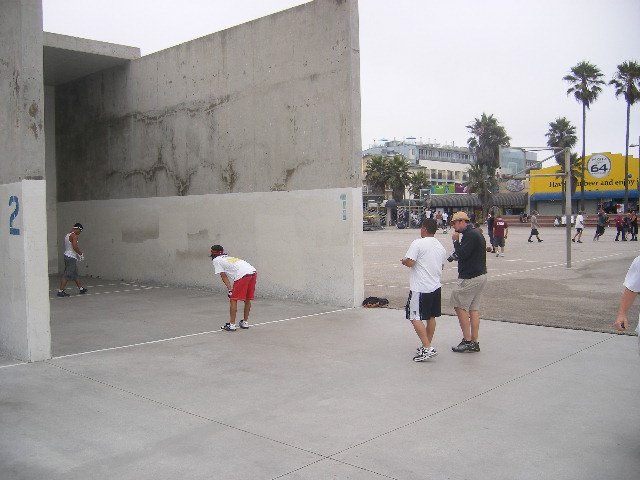
The Ryan family was vacationing in Santa Monica for a few days and one day we decided to take a stroll south towards Venice Beach.  Venice Beach is an iconic location featured in numerous movies and TV shows for its skateboarders, weightlifters and Southern California ambiance.  Also part of that scene are the Handball and Basketball courts near the pier.  While watching those two sports being played simultaneously a couple of whimsical thoughts crossed my mind….

1) What’s funnier, a) the fact that many Europeans are puzzled and somewhat insulted that most Americans have no clue as to what their “handball” is or b) the fact that most Americans have no clue about the Handball the rest of the world plays?

It never fails to amuse me the confusion that almost always ensues when an American and European meet and the topic of conversation turns to Handball.  As one who has witnessed and participated in this comedic dance I’ve seen it play out in a number of different ways.  I’ve seen Europeans absolutely bewildered; even angered that their beloved sport can’t even be comprehended by an American who can’t figure out how 7 people get in such a tiny space.  I guess if they traveled to Venice Beach and seen the hundred or so people watching and playing this version of Handball they’d get the picture.  Not to mention the several thousand casual observers who stroll by and witness this sort of spectacle here and in other regional locales around the U.S.  Team Handball has an increasing awareness quotient in the U.S., but it should be readily apparent to all, that there’s a reason why to most Americans our “Handball” is at best “the other handball” and more likely, the “unknown handball.”  It shouldn’t be this way, but make no mistake that’s the way it is.  There are a lot of folks to pin the blame on in regards to this reality, but it stands to reason that no one would benefit more from a campaign to change this reality than the Europeans trying to make a living playing, managing and promoting the sport.  So yes, the answer to my question is that it’s funnier that Europeans are puzzled.

2) It’s not practical to play pick-up Handball and the fact that you can play pick-up basketball has inevitably led to its ever increasing popularity.

As a middle aged athlete with diminished skills I watched the basketball games being played and immediately assessed that I could step right in and play.  One of the games I’d probably have dominated and in the other I’d been a role player.  I wasn’t about ready to step in and play, but if I wanted to I could.  Which, of course, is the beauty of pick-up basketball?.  Just about anywhere in the U.S and increasingly the rest of the world, it’s possible to find a game at your level in which you can just walk right up and start playing.  Whereas, as far as I know, there’s nowhere in the world that you can do that for Handball.  There are a number of reasons why that’s true.  Here’s a few:

– Handball’s a rough game.  Accordingly, you generally don’t want to play with just anybody.
– Handball’s a young man’s game.  Once you get north of 40 years old Handball gets to be pretty hard in terms of recovery.  This is true in basketball, as well, but based on personal experience it’s manageable.
– You got to have 14 people to play the game the way it’s meant to be played.  You can sort of make do with 12 and you can scrimmage on a half side of the court, but it’s a poor, unsatisfactory compromise. And 2 of those 14 better be legitimate goalies.  Whereas in basketball, even 2 on 2 can be fun.
– “Call your own” officiating in basketball is problematic; in Handball it’s even worse.

This whimsical thought is not meant to validate the concept that basketball is a superior sport.  No, just to merely point out the obvious:  The great sport of Handball has got some limitations when it comes to casual, spur of the moment participation.


post

Junior World Championship lives up to expectations

Over the years, the IHF has tried two different approaches for the format of play following the preliminary groups.  It has been more common to create main round groups for the top three from each group, but the method that it being used this time, with a ‘knock-out’ competition, starting with1/8-finals after the groups, has also been tried before.  It is difficult to claim that one format is clearly the best one.  Knock-out matches create excitement for the spectators, but may be a bit capricious and unfair to the teams.   Main round groups are often very intriguing, but on some occasions they can be boring because the top positions are clear prior to the final matches.

One could say that it depends on how evenly matched the teams are on each occasion.  If one can identify four-five superior teams, the knock-out approach may have an edge.  But this time, it seems that the event is unusually full of strong and interesting teams, and it might be a shame that some of them will be out of contention after only one more game.   I will come back to the match-ups for the 1/8-finals and beyond, but first I want to offer some comments on the group play.

In Group A, not many may have realized that the very first match between Slovenia and Tunisia would be the group final.  But after the played it each other, they have gone on to dominate a strong group, leaving Norway and France to fight for the third place, and with Serbia somewhat surprisingly missing out on the knock-out stage.  Tunisia has been an interesting team to watch.  Yes, they often play a rough and undisciplined defense, but they display speed, technique and shooting power to make up for it.  Perhaps one expected more from France, given their well-known emphasis on finding and educating young talents to step in at the senior level.  But their win today against Slovenia may be the start of something, even if of course Slovenia had nothing to play for.

Denmark was not unexpectedly the clear winner in Group B, where the main fight was for places 2-5.  Greece started out in a nervous fashion, showing inexperience, but they recovered and came in second.  Algeria and Qatar were more consistent and played an interesting style of handball.  It will be nice to see how they fare against European opponents in the 1/8-finals.  Argentina must be seen as a disappointment, considering the strong showing of their senior team half a year ago.  Here they seemed a bit thin and ‘lost’ at times. On the final day, they had to sit and hope for a miracle in the other games, but this did not happen.

Germany moved calmly through their first four matches, but still had to handle a ‘group final’ against Egypt on the final day.  In the end, Germany overcame also this obstacle, and this meant that Egypt’s ‘unnecessary’ loss against Russia in the very first game moved them down to third place.  Brazil dutifully beat Benin and a technical but ‘thin’ Korean team to make it to the 1/8-finals, but they were not able to match up fully with the top three teams over 60 minutes. 

In Group D, it became clear that Portugal, Spain and Sweden were very evenly matched and in a class by themselves.  Spain won the group, and on the final day we saw Portugal narrowly beat Sweden and grab the second place.  But watch out for a Swedish team wanting revenge in their next match.  My earlier prediction regarding the fourth and final place in the knock-out competition turned out to be justified, when Iran surprisingly clearly beat a very pale Hungarian team.  It seems that Hungary was the most negative surprise of the event, notwithstanding the frustrations of Argentina and Serbia.

The tournament now continues with the 1/8-finals on Sunday.  The pairings are as follows and the sequence of the matches also indicates which winners will play each other in the quarter-finals and semi-finals:

Denmark-Norway,    Sweden-Russia;        Greece -Tunisia,  Spain-Brazil;;

Egypt-Portugal,   Slovenia- Qatar;         France-Algeria,  Germany -Iran

It seems that the group winners appropriately were rewarded by generally getting less scary opponents.             The ‘2 against 3’ games are harder to predict.   I believe a lot in Tunisia but they get to face the home team;  Portugal may be in for a particularly tough time.  Sweden-Russia is probably the game that is the hardest one to predict, and France-Algeria is a traditional rivalry.  Looking beyond that round, it is intriguing to see that a final between Spain and Germany is theoretically possible.  But several other teams will try to ruin that, and my Scandinavian friends will surely complain if I do not mention them.  I have not been able to watch Slovenia but they seem to be tough, and how would it be if a tournament that started with Slovenia-Tunisia would finish with the same pairing!

post

2011 PANAM Games Draw: Results and Analysis

The Groups have been drawn for the Men’s and Women’s Team Handball Competition at the PANAM Games.  Both the Men’s and Women’s tournament formats start with round robin play in two groups of 4 teams.  The top two teams from each group advances to the semifinals while the bottom two teams play for 5th to 8th place.

The Gold Medal winners for the Men’s and Women’s tournament earn an automatic ticket to the 2012 Olympics in London.  The 2nd place and 3rd place men’s team earn berths in Olympic qualification tournaments Spring 2012.  The 2nd place and possibly the 3rd place women’s (TBD based on 2011 WC results) will win tournament berths as well.

Men’s Draw

Group A: Brazil, Chile, Canada, Venezuela
Group B: Argentina, Dominican Republic, Mexico, USA

Analysis:  Brazil and Argentina are clear favorites to win their groups and to eventually play each other in the Gold Medal Game.  The rest of the participants with the possible exception of Venezuela have realistic aspirations of making the semifinals.  Chile, which took 3rd place at the 2010 PATHF Championship last year and played respectably at the 2011 WC (their draw against Slovakia was a major surprise) is probably the next strongest team.  They will be challenged in Group A by Canada for the second slot.  At last summer’s PATHF Elite Championship, Chile easily defeated Canada 36-25 during Group play

In Group B, the Dominican Republic, Mexico and the USA will battle it out for second place.  Based solely on recent PATHF competition results the Dominican Republic appears to be a slight favorite having finished 1st at the PATHF Div I Championship in 2009, 8th at the PATHF Elite Championship in 2010, and 1st at the Central American and Caribbean Championships in 2010.  Meanwhile, Mexico placed 4th at the Div 1 Championship in 2009 and 3rd at the Central American and Caribbean Championships.  The USA only returned to International competition last December, where they lost to Canada on aggregate goals scored in a home and home 2 game series.  This past spring at the 2nd Chance PANAM Games Qualification tournament the USA drew Uruguay and easily defeated Venezuela.

In terms of head to head competition, the Dominican Republic beat Mexico 35-32 as the 2009 Div championship and the USA has played neither team in several years.  One can extrapolate, on paper anyway, that the USA’s results against Canada and Uruguay (two teams that have played the Dominican Republic close in recent years) means that the USA and the Dominican Republic are roughly on the same level.

Women’s Draw

Group A: Brazil, Dominican Republic, USA, Uruguay
Group B: Argentina, Mexico, Puerto Rico, Chile

Analysis:  As with the men, Brazil and Argentina are clear favorites.  In Group A, the match between the Dominican Republic and Uruguay will likely decide who advances with Brazil into the semifinals.  And these two evenly matched teams know each other well having played to a draw during group play at both the 2009 and 2011 PATHF Championships (just this past June). The USA has only returned to international competition recently and struggled to beat an inexperienced Canadian side to secure the North American slot.  The USA Women are improving, but they are significant underdog to makes the semifinals.

In Group B, Chile (3rd place at the 2009 PATHF Championship) should be favored over Mexico and Puerto Rico.  This past June, at the 2011 PATHF Championship Chile defeated Mexico, 26-22 in Group Play while  Puerto Rico and Mexico may be evenly matched.  At last summer’s Central American and Caribbean Games, Mexico beat Puerto Rico in round robin play, but then Puerto Rico beat Mexico in the Semifinals 24-21.


post

Legal issues – EHF and HBL

In the interest of Fair Play

The European Handball Federation recently announced the introduction of a new internal legal system effective July 1.  Having seen reasons to criticize both procedural aspects and the results of the decision-making in some cases in recent years, I now congratulate the EHF to this necessary and important action.   When questions are raised about the adherence to correct procedures and about apparent mismatches between the nature of an illegal action and the severity of the punishment, then the entire system may lose its credibility.

The EHF legal system will now have a lower level with the name ‘EHF Court of Handball’ (replacing the misleading concept of Arbitration Tribunal).  This Court will deal primarily with competition-related cases (while the EHF Office will serve as first instance for administrative and transfer matters).  The exception regarding competition matters involves those events which are played in a tournament form, and where therefore decisions typically need to be taken from one day to the next, by the Disciplinary Commissions or Delegates responsible at the site.

An ‘EHF Court of Appeal’ constitutes the second level, for all matters (except during a European Championship tournament where a Jury plays that role).  In addition, there is an arbitration mechanism, ‘on top of’ or outside the two bodies just mentioned.  It is external to the EHF and completely independent, even though it has been established by the EHF Congress.   Very specific rules apply for the dispute resolution of this body, and in a sense it is, for EHF issues, an entity somewhat similar in nature to the Court of Arbitration for Sport (CAS).  Perhaps it will serve the purpose of avoiding that matters escalate to the formidable level of CAS…

An important component of the new legal system is the introduction of new Legal Regulations, a List of Penalties and a Catalog of Administrative Sanctions.   My review of these documents suggests that the EHF now has in place a very solid basis for handling especially the often very sensitive and highly publicized issues involved in the EHF competitions.  There are reasons to believe that a more effective and speedy resolution can be reached, without worries about major inconsistencies.  The structure for penalties seems generally appropriate, with scope for quite substantial action in terms of both suspensions and financial repercussions in serious cases.

Of course, as the prescribed penalties for each type of situation are normally expressed either as a very broad range or in the form of a minimum, the key will be the early precedents when the new system is beginning to be applied.  A tendency to be very soft and regularly choose the lowest punishments possible would send a very undesirable signal.  The provisions will not in themselves serve as a deterrent; they require that the decision-makers have some courage.

The German Handball Bundesliga (HBL) has just come out with a somewhat surprising new regulation at the start of the new season.  In recent years, there has been an unfortunate tendency in the direction of increasingly frequent and ‘uninhibited’ criticism against referees, on the part of coaches and players in a very public manner.  This has contributed to a negative atmosphere, not just in the individual case but more generally in the co-existence between teams and referees.  It has also tended to have an effect on how spectators and the general public understand what is permissible in terms of similar actions.

Accordingly, the HBL is now, quite appropriately, finding it necessary to focus on new regulations for this kind of situations.  Clearly, the intention is to avoid the spontaneous and public negative reactions, for instance in a press conference, right after the game.  Team representatives should have a chance to calm down and perhaps review video recordings and be more certain of the facts before speaking up.  So it is now forbidden for players, team officials and club representatives to express themselves in public regarding referees or other match officials in any way whatsoever within 48 hours of a game.

As has been noted in the media, perhaps one needs to introduce some further clarifications or at least make sure that new regulation is applied with some common sense.   An excessively literal or bureaucratic application might backfire.  It would hardly seem to be punishable if a coach or player spontaneously praises a referee when meeting right after the game.   And the definition of what is meant by public expressions is not really very clear.   Similarly, if someone comments on a game of another team that they witnessed, should this be covered etc?   So the intention is laudable, and personally I am certainly in favor of offering more protection for the referees, but the success may depend on the details of the interpretation of this new idea.