post

VIDEO: PANAM Games day 1 match highlights

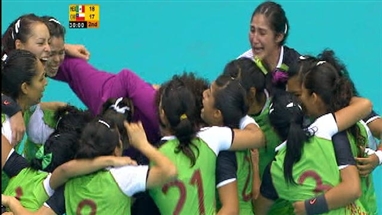
Mexico celebrates after a key 18-17 victory over Chile

The terra.com platform has two minute highlight videos of all of yesterday’s matches.  Here’s the direct links for Saturday’s games

Group A
Brazil – USA 50-10 http://deportesus.terra.com/rumbo-a-2012/videos/0,,338686.html
Dominican Republic – Uruguay 24-24 http://deportesus.terra.com/rumbo-a-2012/videos/0,,338747.html

Group B
Argentina – Puerto Rico 35-26 http://deportesus.terra.com/rumbo-a-2012/videos/0,,338713.html
Mexico – Chile 18-17 http://deportesus.terra.com/rumbo-a-2012/videos/0,,338757.html

Mexico scored a penalty shot with 15 seconds to secure the victory over Chile.  This result might very well put Mexico through to the semifinals, although Puerto Rico might have something to say about that.  The Dominican Republic – Uruguay draw assures that every second of their upcoming matches against the USA will be hard fought.  The USA, of course, can still qualify for the semifinals by beating those opponents, but should they slip up and fall behind, the key tiebreaker for a Dominican Republic-Uruguay tie in the standings will be overall goal differential.

The Men’s competition starts today (Sunday, 16 October) and team USA takes on the Dominican Republic at 6:00 PM USA Central Time


post

AUDIO: Post game interview with US Women’s Coach, Chris Cappelmann

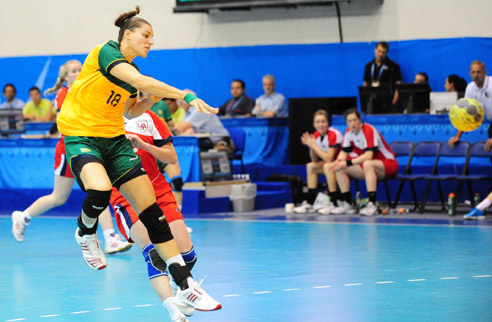
Brazil scores 1 of their 50 goals in all out blitz of Team USA

Tournament favorite Brazil totally dominated the USA in all phases of the game, enroute to an easy 50-10 victory.  Coach Chris Cappelmann discusses the match and what’s ahead for Team USA at the PANAM Games.

USA Team Handball: USA Women fall to Brazil in opener: Http://usateamhandball.org/news/2011/10/15/usa-women-fall-to-brazil-in-opener/45004?ngb_id=42


post

PANAM Games Open: Online video quality looks promising

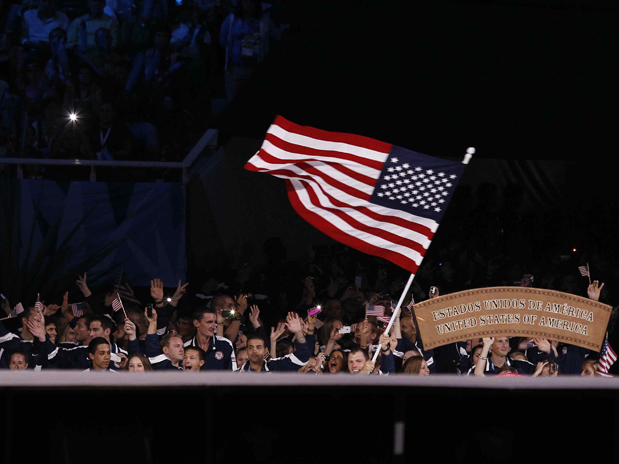
Team USA at the PANAM Games Opening Ceremonies

The PANAM Games have officially started with the traditional opening ceremonies in Guadalajara, Mexico.  The festivities were shown live at www.terra.com and at www.espn3.com .  Several Handball athletes can be seen in the ESPN3 replay:  http://espn.go.com/watchespn/player/_/source/espn3/id/264854/size/condensed/ (Team USA enters the stadium at the 43:15 mark)

The terra.com website claims that they will have 12 channels in operation during the games and I was able to get a pretty decent video stream when sampling the videos they had available on demand. Hopefully, the same quality will be available for the matches

Terra.com on demand videos:  http://deportesmx.terra.com.mx/rumbo-a-2012/videos.html

Canadian Delegation clip: http://deportesmx.terra.com.mx/rumbo-a-2012/videos/0,,338518.html
USA Delegation clip: http://deportesmx.terra.com.mx/rumbo-a-2012/videos/0,,338568.html

The USA women are scheduled to play against tournament favorites Brazil on Saturday, 15 October at 1:00 PM, (Guadalajara Local Time) which is the same as U.S. Central Time.  (This is 7 hours behind for most Europeans.)  If I find a Direct Link, I’ll post it and the USA website has indicated that they plan on having an open webchat running at the same time.

post

USA Teams arrive in Guadalajara

Can Team USA keep a low profile and advance under the radar into the semifinals?

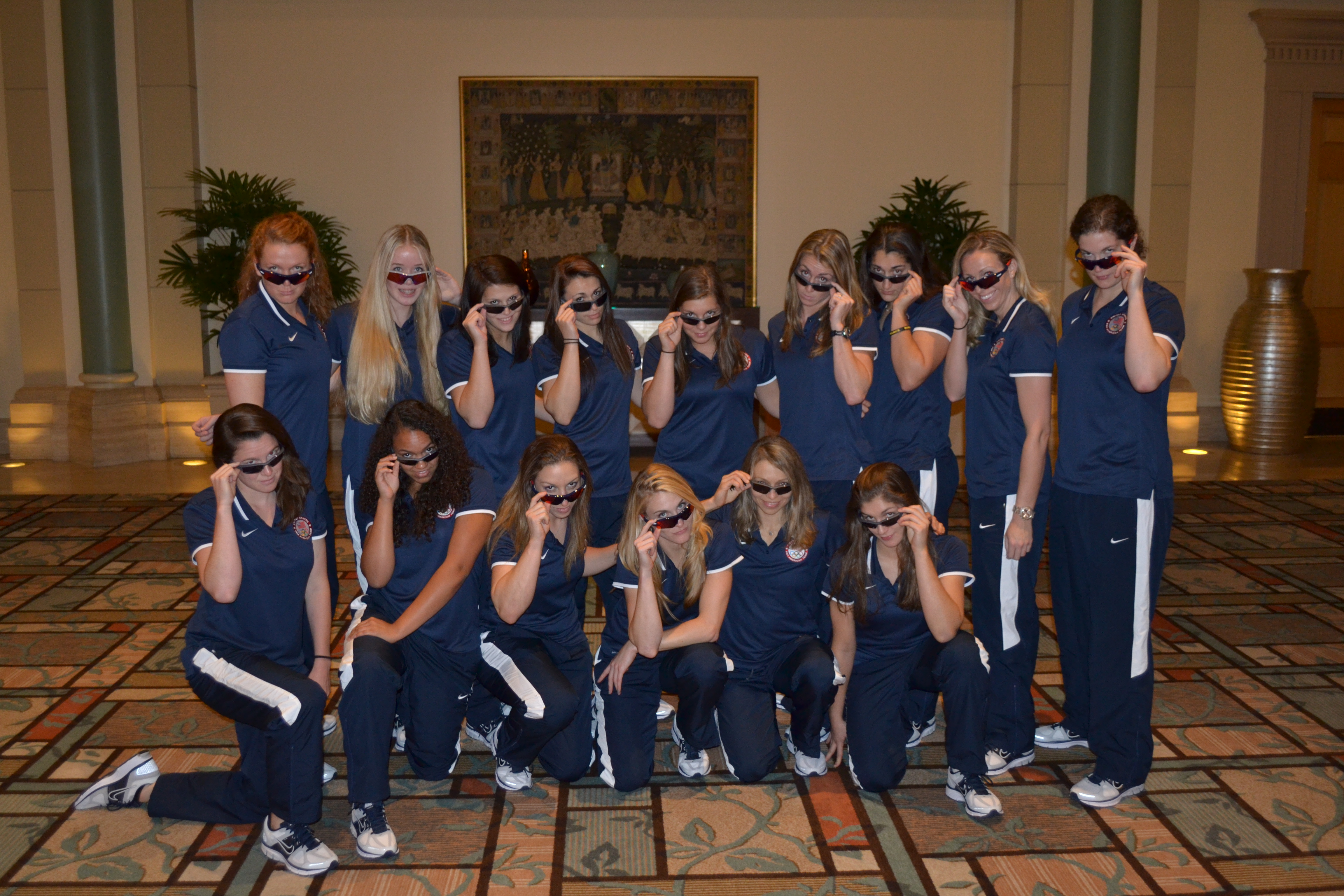
The USA Men and Women have arrived in Guadalajara for the Pan American Games.  I spoke briefly last night with USA Women’s head coach, Chris Cappelmann and he indicated that they’ve been please so far with the welcome and accommodations.  Part of that welcome was an offer to have a friendly scrimmage with the Mexican Women’s team yesterday.  The result was a 21-21 tie, which is a far cry from the results the last time the two teams played back in 2008 at the Pan American Team Handball Federations (PATHF) Div I Championship.   At that event the USA women lost twice to Mexico by scores of 31-23 and 33-14.  There are few holdovers from the USA roster from those defeats, however, and I have no clue as to what changes may have taken place in the Mexican roster as well.

The Women’s Tournament gets underway this Saturday with the USA Women taking on tournament favorite, Brazil in Group play.  Coach Cappelmann indicated that there were some plusses and minuses to playing the tournament favorite.  On the minus side it will be tough to meet the Brazilians in their first fully competitive match.  On the plus side, though, this scheduling will allow them to observe their other group rivals, the Dominican Republic and Uruguay prior to playing them.  The Men won’t have that luxury, though, as straight out of the gate on Sunday, they will have a key match vs the Dominican Republic.  With both sides knowing little about each other, how fast the teams can respond tactically could prove pivotal in that first match

Over the next two weeks, we plan to have several interviews with the Men’s and Women’s team coaches and players.  In particular, we’ll shoot to have audio podcasts of the interviews posted as soon after the match as possible.  For those that can’t wait to get their handball fix, be sure to check out the USA Federation and the Mundo Handball website, which has several articles on all the teams participating in the tournament.

Mundo Handball: http://www.mundohandball.com/

PANAM Games Schedule: http://usateamhandball.org/news/2011/09/12/pan-american-games-schedule/44549?ngb_id=42

post

Reunion Island: The French Handball Iceland due East of Madagascar

Just in case you were wondering, here's where you can find Reunion Island.


An ehfTV video has got me thinking that it’s a great time for a post on two of my favorite areas of study: Geography and Handball.  The subject video highlights top German side Kiel’s summer trip to Reunion Island in Travelogue fashion.  Apparently this team building trip to Daniel Narcisse’s home has put them in good stead so far this season.

As one who likes to think of himself as a “maphead” I’ll have to admit that before I lived in France I knew very little about France’s overseas Departments and Territories.   I knew of Reunion Island, however, because many years earlier my curiosity had been piqued by the talented Jackson Richardson.  Who is that Rasta looking Frenchmen with the American sounding name?

That investigation eventually led me to an atlas to find out just where the heck this Ile Reunion was.  Located in the Indian Ocean due East of Madagascar this French outpost is about as far away as you can get from the U.S.  That’s not an exaggeration as Reunion Island is almost an “antipode” of the Western U.S.  In other words if you start digging a hole straight through the center of the Earth, you’ll eventually come out in the Indian Ocean not far from this unlikely French Iceland.

French Iceland?  Well, while I doubt that Handball is a part of the culture on Reunion Island to the same extent it is in Iceland, there’s no denying this island of 800,000 souls has produced two of the world’s best players ever- Jackson Richardson and Daniel Narcisse.  We can debate where those two gentlemen rank among the all-time greats; top 10? Top 20? Top 50? But, it’s undeniably remarkable that this remote outpost can lay such a claim.

Why Reunion Island? How did this happen? Well, if anything this result is indicative of France’s effort to integrate all of its outlying Departments and Territories into France proper.  In an American context, Reunion Island and the departments of the Caribbean/South America Guadeloupe, Martinique and French Guiana are France’s versions of Hawaii.  Those “Departments” have full representation in France’s State Assembly, in much the same way Hawaii is our full fledged 50th state.  And while those Departments have their own culture quite a bit of effort is expended to make sure those citizens also realize they are French just as much as someone growing up in Paris.  And one of those efforts is financial aid in the sporting department.

I’m not certain as to exactly what is provided, but it’s clear that sports are well organized as athletes from these departments are well represented on French National teams in several sporting disciplines.  In addition to Richardson and Narcisse, Joel Abati, Didier Dinart and Cedric Sorhaindo are recent products of the overseas departments.  And those are some of the most notable players.  There are also plenty of talented player playing for French Club teams.

If one’s perspective is to look at these French outposts as part of France, this representation is only somewhat remarkable.  Sure, these parts of France are over represented in terms of their relative population, but this is true in other countries and in other sports.  For instance, there’s a preponderance of ice hockey players in the U.S. from Minnesota and very few from Texas.  There are more beach volleyballers from California then there are from Illinois, etc., etc.

But, if one’s perspective is to compare these French outposts to their non-French neighbors the difference is night and day.  I’m guessing that a Reunion Island Department level all-star team could beat every national side in sub-Saharan Africa with the possible exception of Angola.  They certainly could easily handle any nation with a coastline on the Indian Ocean.  In the America’s, Guadeloupe and Martinique would probably give Cuba a run for the money in a Caribbean championship.  They would be a notch below Argentina and Brazil, but I bet you those sides a battle would be in the hunt for the top 3 spots at any of the recent Pan American Championships.

So, are these handball success stories a model to follow or are they just interesting anomalies to the Handball geography of the world which is overwhelmingly centered on Europe?  Well, in one sense they do in fact demonstrate that the sport can become popular in some unlikely locales.  Unlikely in that these Handball hotbeds are surrounded for the most part by other countries where the sport barely even exists.  But such popularization doesn’t come cheap or easy.  More than anything it’s a minor testament to the soft power and financial investment that Mainland France has projected onto these far flung dominions.  There’s almost no movement for independence in these islands for a number of reasons.  France has treated these citizens well, made them feel French to a great extent and developed their internal infrastructure much more so than could be expected on their own. And one small aspect of that infrastructure is ready access to gyms, coaching and equipment for the sport of handball.

But, there’s no denying the significant impact of this investment to the Handball world, particularly to France.  Imagine their national side for the past decade without players like Richardson, Abati, Dinart, Narcisse and Sorhaindo.  They’d still be good, but I don’t think we’d be talking about the same number of World and European titles.

ehfTV Inside the Game Video: http://www.ehftv.com/video/001806

post

EHF Game of the Week: Veszprem at Kielce (Live webstreaming with English language commentary)

Slawomir Szmal will be in the goal as Kielce hosts Veszprem

The EHF Champions League is back for the 2011-2012 season with the first weekend of Group play.  Out of the gate, Polish Wild Card qualifier, Kielce, hosts perennial Hungarian champions Veszprem in a Group B showdown.  Kielce is a two goal favorite.

Veszprem at Kielce (-2) (ehfTV: Sunday, 2 October: 3:00 PM CET, 9:00 AM (U.S. East Coast))
Live Broadcast link:  http://www.ehftv.com/ehfcl/ec/cl/men/2011-12/live/high/001779
On Demand Broadcast Link:  http://www.ehftv.com/ec/cl/men/2011-12/video/001779

Group B could be interesting this year as it may be a legitimate Group of Death with each of the 6 clubs having realistic expectations of earning one of the top 4 slots.  Veszprem, Madrid (formerly Ciudad Real) and Chekov have pretty much always advanced out of Group Phase.  Berlin and Kielce are relative newcomers, but they clearly have the talent and expectations to do the same.  Only Danish side, Bjerringbro-Silkeborg, can be considered an outsider, but they surely have the pedigree to win a few matches.

The Kielce-Veszprem match will be the only one with English commentary, but there are several other matches worth checking out like Chekov(-1.5)-Berlin, Montpellier (-4.5)-Leon and Szeged-Kiel (-6.5).  The EHF has a handy page with the links to all the video streams and most of the matches are available “on demand” a few hours after they are completed.  To see what’s available for viewing click on the video link at the top of the page and then select the full match option for viewing.  On Monday, if you want to catch up you can watch the 25 minute weekly highlight show.  Great lunch time viewing at work if your office allows it.

EHF Preview of Week 1 matches:  http://www.ehfcl.com/men/2011-12/article/14214/Raise+the+curtain%21

ehfTV broadcast schedule: http://www.ehftv.com/schedule

Note to American viewers:  It appears that the MHz Network is not broadcasting Champions League matches this year.  We’ll update you if this changes or another network picks up the TV package


post

German Federation and Bundesliga striving for stronger cooperation

Last weekend, the German Handball Federation (DHB) celebrated its Congress.  It appears to have taken place in an atmosphere of both continuity and important efforts to achieve change.  The continuity was reflected in re-elections in all the key positions, including the continuation of Ulrich Strombach as President.  But a new spirit seems to be emerging, both in the relations between the DHB and the Bundesliga (HBL) and in the attitudes involving the cooperation between clubs and national teams.

A new contract between DHB and HBL regarding cooperation for the next several years was signed on the occasion of the Congress.   This contract specifies the number of days that players are to be released for national team duty in each year.  The DHB has also undertaken to support the wishes of the HBL to reduce the number of ‘big events’ in each four-year cycle from five to four; currently there are two World Championships and two European Championships in addition to the Olympic Games.

Heiner Brand, who has now been appointed Sports Manager of DHB after resigning as coach from the men’s national team, also presented his ideas for a more systematic approach in bringing young talents into a common German vision for the national teams at all levels.  The two national team coaches for men and women, Martin Heuberger and Heine Jensen, expressed appreciation for the support from clubs in connection with recent events.

As regards Germany’s role on the international scene, interviews with Ulrich Strombach reflected a wish for a stronger German position in the management and development of handball.  Strombach also commented on the need for the IHF and EHF to become more generous in sharing the revenues from the big events, after the principle of compensation was recently introduced but at a rather modest level.  Strombach also caused a stir with a notion that it should not be taken for granted that the top countries would be satisfied with a participation in European Championships unless conditions are improved.  He noted that separates events involving more frequent encounters between the top teams might be a very attractive alternative…

post

IHF President mocks and jeopardizes the world of handball

the motto of someone whose role models are Mubarak and Blatter...

A few weeks ago, I wrote about the nasty implications of the IHF decision to fire its respected Head of the Anti-Doping Unit, Professor Hans Holdhaus.  Of course, there had never been any suggestions that Holdhaus did not have the necessary competence.  On the contrary, he was in a sense doing his job too well, something that scared the IHF President.  By that I mean that Professor Holdhaus had carefully and consistently followed the requirements of the World Anti-Doping Agency (WADA) that all the affairs of an Anti-Doping Unit must be kept entirely separate and confidential in relation to its sports federation, in this case the IHF.

This is the type of requirement that is natural in all other federations but is too dangerous and unacceptable to a ‘control freak’ such as the IHF President.   His despotic way of running the IHF requires full control over everything, as ‘he knows best’ and has the right to decide everything.   It is one thing that the IHF Executive, the IHF Council and the global handball family amazingly tolerate this state of affairs in other matters, but in the area of anti-doping it simply must not happen.  And this is not just a matter of principle. 

As I mentioned in my previous article, it also has serious practical implications.  A surprise test was announced at the start of the Pre-Olympic handball event prior to the Olympics in Athens, fully in accordance with WADA procedure but unbeknownst to the IHF President.  The effect was that half of the Egyptian team was suddenly skipping the game, hiding in the stands, to avoid the risk of being tested!

In a ‘normal’ federation, the President goes out of his way to show that he is not influencing the Anti-Doping efforts and is unaware of its operations.  In the IHF, the President has now gone out of his way to show that he does not care about WADA rules, he does not care about the image of the IHF, he does not care about the image of the IHF Anti-Doping Unit, and he does not care about how his own behavior appears to the rest of the world.   Why do I say this? 

Well, the IHF has just announced that as its new Head of Anti-Doping it has hired a compatriot of the President, a fellow-Egyptian.  This is not to cast any shadow over this gentleman’s competence or honesty.  But after the IHF President converted himself to a full-time employee with a constant presence at the IHF Office, and after he fired the previous IHF Managers to make room for his long-time Egyptian side-kick as the new Managing Director and controller of all the daily activities, he is now hiring an Egyptian as the person in charge of the most sensitive and supposedly most confidential position of the IHF.

 How could anyone ever trust his motives for this decision?   How could anyone have any doubts about the terrible image that this creates?  How could anyone believe that the President is not simply doing this to show that ‘he does not really care what anyone else thinks’!

post

Coaching by Phone?

yes, they know everything, but they may still need some occasional advice

The handball rules limit very clearly how many team officials (coaches, manager, medical staff) are allowed to be on the bench during the game.  In some way, this may imply that these four individuals are somehow supposed to manage on their own as a team, without the support from anyone located elsewhere.  Although I am more inclined to think that the main reason for the limitation is really a practical one, to avoid a crowd in the bench area and to enable the match supervisors to have an easier time in controlling the action, in terms of players substitutions, discipline etc.

On the other hand, we have sometimes given the impression that contact with other members of team management is inappropriate, as there tend to be some concerns if one of the teams manages to place an entire delegation in the first spectator row behind the team bench.  This is often considered as something to be avoided or prevented, especially if one does not have a similar situation for both teams.  It is the kind of unfair advantage for the home team that, at least optically, may cause some reactions.

But is it really realistic and meaningful in these modern times with sophisticated, wireless communication to suggest that the four persons on the bench must work in isolation from everyone else?  Should it be forbidden for a coach to have occasional or constant phone contact with an assistant sitting higher up and having a different perspective of what is happening on the court?  And would it somehow be necessary to prohibit the use of laptops or other devices with the scope for constant messaging or access to stored information throughout the game?

The rules in the 2010 rule book do not deal with these issues, because nobody has really focused on the implications of modern technology.  So any prohibitions, if they were to be found necessary or desirable, would have to be introduced as new legislation.  But personally I must say that this would be a highly questionable move.   It is difficult to imagine that inequity could become an issue, because surely the necessary equipment is cheap and easily available to both/all teams.  And it is not likely that such methods would ever create any disturbance.  So why fight against modern trends!

In fact, from my vantage point, with easy access to NFL, NBA and NHL games live and on TV, I observe that it is an established practice to take advantage of whatever technology that might be useful and available.  Coaches in the NFL are constantly working through headphones, and instant overview photos of the previous game situation are obtained and studied eagerly.  NHL coaches constantly rely on observations from someone up in a booth etc.

And just hypothetically, if one nevertheless wanted to establish some prohibitions, how could one possibly imagine an effective and evenhanded enforcement?  Do we need to add an extra official near the benches, who sneaks around and tries to detect illegal equipment…?   But I know that handball people are sometimes more conservative than one might imagine.  It seems that the IHF is right now thinking about the issue, and I will be interested in their conclusions.   But in the meantime I would be happy to get the reactions from our readers:  is the use of communications equipment on the team benches an issue?  Should it be restricted or should we just ignore it?

post

Sleeveless or not: the ‘cool and dry’ compromise solution

NO, not quite this look...

A few weeks ago, I commented on the ‘dispute’ between the EHF and AG Copenhagen, regarding the team’s strong desire to play its matches in the upcoming Champions League season in special, sleeveless shirts.   EHF requires all the participating teams to wear a standardized advertising, precisely in the spot that does not exist on a sleeveless shirt.  I commented that the global playing rules do not prescribe that player shirts must have sleeves, but that the EHF of course is entitled to have its specific requirements as a condition for participation.  So I noted that “unless some kind of compromise solution can be found, it seems that AG has no choice”.

 Lo and behold, a simple compromise has now been reached between the EHF and AG.  A statement along the following lines can today be found on the EHF web page:   The EHF Head of Competitions, Markus Glaser, informed that ‘following positive and constructive discussions, the new shirt design retains the unique look of the AG vest, with the addition of an attached white undershirt with the sleeves showing the competition’s official logo.’

Soren Colding, CEO of AG was reported as expressing great satisfaction with the solution, which will also be ‘keeping the players cool and dry when they play’.   I can only add that it is indeed nice when cooler heads prevail and that the EHF and its clubs can keep their powder dry for more important battles… Let us now just see what fantastic results these shirts will help AG achieve in the Champions League.  Perhaps it means they will have something special ‘up their sleeves’!

post

Gazette Telegraph reports on USA Team Handball financial struggles

The Gazette Telegraph highlights a funding fight between USA Team Handball and the USOC. Is USA Team Handball the guy in the water?

This past Tuesday, the Colorado Springs Gazette Telegraph posted an article highlighting USA Team Handball budget woes and the decline in funding grants the Federation has received from the USOC.  For those that follow the sport closely, the controversy regarding what funding the USA Federation receives or doesn’t receive from the USOC is a long standing issue.  What was striking to me (and others), however were some of the quotes in the article which called out the USOC.

Here’s a sampling of the article:

The USOC is primarily “going to fund sports that are going to win medals in London,” Pastorino said, maintaining that “there ought to be some credit given for building a long-term development program, a grassroots program, to get us to our ultimate goal. … The message we got this past winter completely counteracted that.” He claims the USOC told NGBs, “Forget about what we said in 2008. Medals talk. Make do with less.”

My reaction was, “Wow, looks like General Manager, Steve Pastorino was even more forthcoming then he was at the Press Conference a couple of weeks ago.  He must have had a follow up interview with Brian Gomez, the Gazette Telegraph reporter.”  Email follow-up with Steve Pastorino, however, indicated that this had not been the case, and the article quotes were based on the press conference from a couple of weeks ago.  And sure enough, a review of the press conference audio shows that those quotes are transcribed pretty accurately.  (You can hear for yourself (see below).  At around 44:20.  Christer Ahl asks the financial related questions.)  In the context of an hour long press conference covering a lot of topics the comments were significant; in the context of a short newspaper article that focused on financial issue, though, they were even more so.

As I highlighted before, these financial troubles weren’t new “news” for most American Team Handball followers.  Christer Ahl’s follow up article on the press conference had already touched on many of the key points from the press conference and Christer and I were both a little surprised with the candidness of some of Steve Pastorino’s comments regarding USOC support.

But, while Team Handball News might be a significant player in the Team Handball world we are, but a bit player in the sporting world (although, it should be noted there are a significant number of Colorado Springs visitors to our site).  What we report reaches a smaller audience.   The Colorado Springs Gazette Telegraph isn’t the New York Times either, but Colorado Springs is still a decent sized city, and most importantly it’s the home of USOC HQ.  You can bet that every single USOC executive read the article with interest and a little frown as it doesn’t paint the USOC in the best light.  Additionally, the story has also been picked up by other outlets like MSNBC and Sports Business Journal Daily.

It remains to be seen if there’s any fallout from the article.  If there is, it can’t be because there’s anything incorrect in terms of content.  I’ve had my disagreements with how USA Team Handball has spent the money it’s received from the USOC and other sources, but you’ll find no disagreement from me regarding the inadequacy of the paltry sum Team Handball receives in comparison to other sports.   For some time I’ve been working on a series of articles which breaks down just how inconsistent, non-transparent and arbitrary the USOC process is.  Looks like it’s time to dust off the draft, clean it up and post it.

Colorado Springs Gazette Telegraph (30 Aug 2011): USA Team Handball in financial fight with USOC: http://www.gazette.com/sports/fight-124178-financial-handball.html

THN (18 Aug 2011): USA Men’s Team getting ready for PANAM Games: https://teamhandballnews.com/2011/08/usa-mens-team-getting-ready-for-panam-games/

THN (19 Aug 2011): AUDIO: USATH Press Conference: https://teamhandballnews.com/2011/08/audio-usath-press-conference/

THN (3 Jan 2011):  The Budget Shell Game: https://teamhandballnews.com/2011/01/the-budget-shell-game/


post

The numbers look good, but what more is there to it?

Some time after the IHF Congress a few months ago, an old handball friend congratulated me because he had noted “the tremendous growth in PanAmerican handball”.  I did not quite understand what he was talking about, so he clarified that he heard about the huge number of new IHF member countries from PanAmerica which had been approved by the IHF Congress.  I decided to investigate the good news!

Soon I found that there had indeed been no less than 14 new member countries approved, and that eight of them were from PanAmerica.  But I must admit the list made me puzzled.  Of course, after all my years of involvement in the PanAmerican Team Handball Federation I am aware of the longstanding sense of frustration that handball has not caught on in the majority of the large number of countries in Central America and the Caribbean.  The contrast with football has been obvious and irritating.  I recently saw the list of match-ups in the football World Cup qualifying and I found, for example:  Grenada-Belize, Antigua & Barbuda-Curacao, and Surinam-Cayman Islands, with referees from St. Lucia, Barbados and Dominica. Quite impressive, because it is evidence of serious activity.

And now I found that the eight new IHF member countries were:  Antigua & Barbuda, Bahamas, Belize, Cayman Islands, Dominica, Grenada, Guyana, and British Virgin Islands.  In other words, a grouping rather similar to that in football.  This sudden development intrigued me, so I spent some time contacting friends from these and neighboring places in the Caribbean.  Essentially, I was met by confused and puzzled responses.   Some helped me find my way to media indications that a handball federation was indeed registered, but virtually nobody managed to point me to any indications of handball activity.

Of course, I am aware that the requirements for establishing a federation are rather modest.  You need to be able to fill out forms explaining the structure of the federation, naming the people running it, accounting for the number of clubs and players (often at the youth level, and sometimes more in beach handball) etc.  And naturally the establishment of a federation is a first step to really make our sport take root, so there is certainly nothing wrong about having a structure in place to spread the word, to recruit players and to try to obtain some financing for a limited level of competition and education.   This is the reality of how to go about spreading our often unknown sport, slowly but surely.

BUT, I am really intrigued about what the plans of the IHF and particularly the PATHF are, now that these eight countries have been added to the membership.  It would have been normal to find some kind of proud media announcement, together with an indication of the general plans to help these countries with some kind of jump start.  After all, they are in a region where travel costs do not match those of Greenland teams going to Chile, and they could even be collaborating with each other in a synergetic effort to create competition and interest.  And both IHF and the PATHF should be able to provide material and teachers at the grassroots level to train players, coaches, referees and administrators.

I am raising the question with some degree of apprehension or even suspicion, because I have experienced in the past that the efforts often have fizzled out, once some brand new federations, without any handball traditions, have been signed up.  The countries have been left to their own devices and one has almost had the impression that it was mainly a ‘numbers game’.  In other words, it looked good to be able to show that the continent’s handball was growing.  And here I am not picking particularly on Panamerica and PATHF;  the trend has been the same everywhere.  Where the suspicions enter the picture is when the time comes for an IHF Congress.  IHF dutifully(?) provides the poor new members with the help they need to attend.  And these new and uninformed members are then in the hands of continental bosses when it comes to understanding how to use voting power, how to be loyal members of the continent, and how to show their gratitude to the existing regime.

So my point is: I wish the eight new member federations every success.  I hope to see them matching the level of activity from football, both at the grassroots level and in regional competition, in a not too distant future.  Indeed, I just regret that this is happening now, after my PATHF involvement is finished, because just perhaps I could have been of some help if it had happened some years ago.  But the progress will clearly not come about with the external support that I mentioned about above.  These federations will need a lot of help, so I hope the IHF and the PATHF will be serious about that this time.  Again, I am looking forward to hearing about the plans for an efficient and sustained effort!

post

Serious concerns after IHF dismisses its Head of Anti-Doping

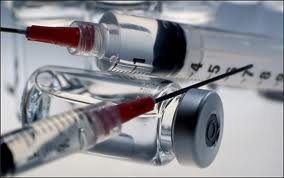
The International Handball Federation is required to abide by all aspects of the World Anti-Doping Code.  This involves, inter alia, educational programs, testing as prescribed by the Code, and taking appropriate measures on the basis of test results.  It clearly also entails strict adherence to the formal procedures under the Code, which includes issues such as complete confidentiality regarding planned testing efforts and strict privacy rules regarding all data pertaining to testing.

The standard procedure for a federation such as the IHF is to establish a specialized and separate Anti-Doping Unit (ADU), in a completely compartmentalized way and separate from the normal administration of the federation, so that all the necessary confidentiality can be ensured.  Financial resources and professional staffing has to be provided for the ADU.  The IHF has had such an ADU since 2006, all the time under the leadership of the Austrian Professor Hans Holdhaus, who has been supported by one specific assistant, seconded from the IHF staff.  The well-known competence and integrity of Holdhaus has served as a guarantee in WADA and IOC circles that the IHF would be in compliance.

The IHF President has indeed been heard to proudly talk about this status of compliance.  Behind the scenes, the reality has been different.   In 2009, as was reported by John Ryan for Teamhandballnews at the time, the IHF in fact refused to provide the necessary financing for the ADU, so that for instance out-of-competition testing became impossible.  Holdhaus and most of his colleagues on the IHF Medical Commission wanted to resign over this issue, but the IHF President came to his senses under the threat of IOC intervention.  Already back in 2005, the IHF President arranged for the dismissal of the person who was up for re-election as President of the Medical Commission at that time, essentially as a result of disagreements over anti-doping matters (see the final paragraph below).

What now happened in March 2011 was that the assistant of Holdhaus was summarily fired, as she correctly refused to pass on confidential ADU information to the IHF office manager Khalifa, the IHF President’s loyal crony, who acts as his whip and his eyes and ears on all matters and all people at the IHF Office.  (As a separate matter, numerous other IHF staff have resigned or been dismissed under the joint Moustafa/Khalifa regime).  The excuse subsequently presented was that it would be dangerous not to have anyone else aware of the information that the ADU assistant possessed…  That this notion completely flaunts the clear WADA rules apparently was unimportant.

The next episode was when Professor Holdhaus was scheduled to appear at the IHF Office to prepare and coordinate the arrangements for the anti-doping control at the recent Junior and Youth World Championships, together with some other pending ADU matters.  At the last moment he was informed that his presence in Basel was not wanted.  When requesting an explanation from the IHF President for this strange situation, he was simply told that the IHF President did not want to talk with him  – ever again!  When Holdhaus wrote to the IHF to note that he could not carry out his job in this fashion, in return he received a curt letter thanking him for his service!

Shortly thereafter, Holdhaus received a call from the IHF medical person who supervised the doping tests during the Junior Championship.  Apparently, the organizers did not accept to carry out the prescribed number of tests and referred to an agreement with someone in the IHF office.  Holdhaus dutifully tried to intervene but was unable to achieve anything.  Instead, a few days later, he was summarily dismissed from the IHF after 20 years of valuable service.

It now appears that the IHF President tries to pretend that nothing important has happened and that WADA compliance remains ensured.  It seems that the person now nominated is one of the only two on the medical side who has remained totally loyal to the IHF President, including the refusal to take a stand during the 2009 dispute.   He and the other remaining loyalist are also the ones designated to supervise doping tests at the IHF events.  Nobody who knows the situation will have any illusions about the notion that the compartmentalization and confidentiality of ADU matter will remain intact.   It could easily be expected that the IHF President will have the unlimited, but prohibited, access that he has shown in the past that he wants.

It remains to be seen whether the IOC and WADA will react.  Professor Holdhaus has simply informed them that he is no longer involved with the IHF.  It is also important for the rest of the international handball family to be alert and draw its conclusions.  The risk for serious repercussions for our sport is obvious.   The European Handball Federation (EHF) is rumored to have drawn the conclusion that it must now establish its own ADU, for its massive competition system, rather than relying on the IHF.  Indeed, it appears that the EHF has anticipated all along that it could come to a situation where the IHF could not be trusted; the recently established EHF regulations for punishments contain a remarkable phrase: ‘The IHF Anti-Doping Regulations apply to any EHF competitions, unless they are inconsistent with the WADA Anti-Doping Code’.  This is really telling, but it seems that the implicit suspicions were fully justified!

It would also not be surprising if suspicious people, also in the absence of any evidence, started to wonder about coincidences.   At a time when the IHF Anti-Doping Chief is removed from any influence over the Junior and Youth World Championship, the Egyptian teams were having remarkable successes at both events.  I surely hope that there is no connection at all, but the mere suspicions would be very bad for our sport.  And people would remember the situation at the 2004 pre-Olympic handball event, where testing was suddenly announced, unbeknownst to the IHF President and the participating teams.    After a verbal fight, where the IHF President tried to cancel the testing, half of the Egyptian team suddenly pulled out of the game before it started…  This was the key to the IHF President getting the then President of the Medical Commission ousted at the next opportunity.