post

Brackets set for the Women’s World Championships

Surprising Angola sends Germany to the President's Cup

Preliminary Group play has concluded at the Women’s World Championships in Brazil.  Below are the respective matches/brackets for the “Round of 16”.

Quad 1
1B vs 4A Russia vs Iceland   (Sunday, 11 December, 1430)
3D vs 2C Sweden vs France (Monday, 12 December, 1430)
Quad 2
1D vs 4C Denmark vs Japan (Monday, 1715)
3B vs 2A South Korea vs Angola (Sunday, 1430)
Quad 3
1A vs 4B Norway vs Netherlands (Sunday, 1715)
3C vs 2D Romania vs Croatia (Monday, 1430)
Quad 4
1C vs 4D Brazil vs Cote d’Ivoire (Monday, 2000)
3A vs 2B Montenegro vs Spain (Sunday, 1715)|
(All times are local.  Sao Paulo is currently (GMT -2 hours) or 3 hours ahead of the U.S. East Coast.)
The winners of these “Round of 16” matches will play the other winner from their quad in the quarter finals on Wednesday, 14 December.   The semifinals will then be played on Friday, 16 December with the winner of Quad 1 playing the winner of Quad 2 and the winner of Quad 3 playing the winner of Quad 4.
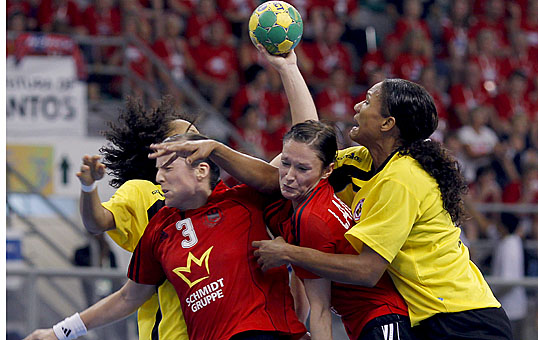
The biggest news from preliminary group play is probably Angola’s 25-22 victory over Germany.  The win gave Angola a 2nd place finish and sent Germany into the President’s Cup (AKA, the little kid’s table) with all the other 5th and 6th place teams.  Also, of note, while Brazil finished in first place for their group, they had to come from behind for 34-33 victory over 5th place Tunisia.
Livesport.tv:  Video highlights: http://www.livehandball.tv/page/Home?WT.mc_id=aff140
(Sign up to watch the rest of the tournament for $25.)
post

World Championship: no real spark yet, except for Brazilian comeback against France

Chana Masson - incredible 67% save rate against France


Unless one is a fanatic follower of one particular team, chances are that the Women’s World Championship has failed to generate a lot of enthusiasm in the early going. Thanks to numerous media reports in participating countries, and especially through high-quality broadcasts provided by livehandball.tv on the internet, I have been able to follow developments quite well, and in my opinion the event seems a bit ‘flat’ compared with the Women’s Championship two years ago. To some extent, this had been anticipated, due to the unusually large number of top players who are missing, either due to injuries or because the simply did not want to participate.

But the pressure on the women’s players does not seem to be much recognized by the IHF (or the EHF for that matter). It is easy to organize conferences and talk, talk, talk about what needs to be done to get the women’s handball to catch up with the men’s side. But action somehow seems more difficult. While arrangements were reached to provide compensation for the release of players and insurance coverage for possible injuries, in connection with the Men’ Championship last January, the IHF Executive quite demonstratively ruled against such measures for this Women’s Championship. It seems the clubs and the federations have to protest more loudly…

A further reason for the lack of excitement is predictability in most groups and many individual games, due to the large number of mediocre teams mostly from non-European countries. The global competitiveness does not yet match that on the men’s side. And the system used this time, having the initial group play followed directly by 1/8-finals, instead of the approach with Main Round groups, may well backfire. After a number of boring group matches, I think people will miss the chance to see a large number of really competitive matches in a Main Round.

But there are some exceptions from the predictability and boredom. Group A in Santos has really been hard to figure out. Prior to the final day, only China is out of the running, but the Chinese have swung between 1-goal losses and disastrous 27-goal deficits. The other teams seem capable of beating each other without any logic. While Norway and Montenegro are through, Angola and Germany have a vital game tomorrow, and Iceland should have a good chance of advancing.

In the other groups, there tend to be clear separations between top and bottom. In Group B, Russia seems to live to up their role as favorites and Spain have done well. Korea will advance but it does not look like the dominant team of recent decades. In Group D, the European powers of Croatia, Denmark and Sweden are sorting out the top three places. Not unexpectedly, Argentina and Uruguay find themselves at the bottom. So it may well be that Cuba in Group C is in fact the second-best PanAmerican team.

But Cuba still is way behind Brazil. As I have noted earlier, they are quite realistically a medal candidate, or even a team for the final if they can avoid having Russia in their path. The experience gained through club play in Europe, together with a very systematic build-up has led to an ability to handle tough situations from both a mental and a tactical standpoint. Romania is the team that has suffered the most from injuries, and it is not clear just how good the French are this time. But they did have a seven-goal half-time lead before Brazil, led by their goalkeeper, closed things down in an absolutely amazing second half. This certainly looks promising for the home team!

post

Women’s World Championships: Russia, Norway and everybody else

Watch every match live: http://www.livehandball.tv/page/Home?WT.mc_id=aff140 ($40 for a complete subscription)

The Women’s World Championships got underway in Sao Paulo, Brazil last night with the host team easily defeating Cuba, 37-11.  As I don’t follow the Women’s game as closely as the Men’s I won’t pretend to have very many keen insights as to how these games will unfold.  Recent history does suggest, however, that Russia and Norway are the top two teams to beat and that’s exactly the odds set in the online sportsbooks. Following Russia and Norway, France, Montenegro and Romania are modest underdogs, while Denmark, Sweden, Spain, Germany, Brazil, South Korea and Croatia could all be classified as conceivable longshots. The odds on the remaining teams suggest that there is not a realistic path to a title

Here are the best odds available for the 24 participants

Russia 1.75 to 1
Norway 3 to 1
France 6 to 1
Montenegro 10 to 1
Romania 14 to 1
Denmark 34 to 1
Sweden 34 to 1
Spain 39 to 1
Germany 40 to 1
Brazil 50 to 1
South Korea 50 to 1
Croatia 100 to 1
Angola 500 to 1
Netherlands 500 to 1
Tunisia 699 to 1
Iceland 749 to 1
Japan 749 to 1
Argentina 1000 to 1
China 1000 to 1
Ivory Coast 1000 to 1
Kazakhstan 1000 to 1
Cuba 1999 to 1
Australia 2999 to 1

Format Changes and Breaking Down the Groups

The format for this year’s tournament is a significant departure from previous championships in that there are no Main Round Groups after Preliminary Group Play.  Instead the top 4 team from each of the 4 Preliminary Groups will play a 16 team knock out tournament.  This should provide for some interesting jockeying of positions as teams look ahead to try and figure out potential quarter and semifinal opponents.  With that in mind here’s how the oddsmakers see the four groups

Group A
Norway .55 to 1
Montenegro 2.3 to 1
Germany 8 to 1
Iceland 250 to 1
Angola 500 to 1
China 500 to 1

Norway is the clear favorite, but Montenegro is seen as a realistic threat.  Germany is pegged for 3rd, while Iceland, Angola and China are expected to battle for the fourth slot.

Group B
Russia .2 to 1
Spain 6.5 to 1
South Korea 9 to 1
Netherlands 150 to 1
Kazakhstan 1000 to 1
Australia 1499 to 1

Russia is the prohibitive favorite and the Spain-South Korea match should determine 2nd-3rd.  Netherlands is pegged for 4th.

Group C
France 1 to 1
Romania 1.6 to 1
Brazil 3 to 1
Japan 199 to 1
Tunisia 199 to 1
Cuba 999 to 1

This group is projected to be a 3 way battle for first between France, Romania and Brazil.  I think the oddsmakers discounted Brazil a little too much and it wouldn’t surpise me much if the home court advantange propelled Brazil to a first place finish in this group.  (Going further, 50-1 to win the whole tournament seems like a pretty good deal if you ask me.)  For all three contenders in this group securing first place is pretty important for improving your prospects of reaching the semifinals.  Second place in the group means a likely quarterfinal vs Russia and third place will likely mean taking on Norway.

Group D
Sweden 1.5 to 1
Denmark 1.75 to 1
Croatia 2.75 to 1
Argentina 500 to 1
Ivory Coast 500 to 1
Uruguay 1000 to 1

Group D pretty much mirrors Group C with Sweden, Denmark and Croata battling it out for first.  And as with Group C, a first place finish is important if you want to avoid Russia and Norway in the quarters.
Breaking out the placement into Round of 16 Quads

For reference, here’s how the brackets will align based on oddsmaker projections on winning each group.  Of course, anything can happend and should Russia or Norway slip up in Group play it could really make things interesting in the last round of matches.  Some teams might even theoretically benefit from losing.

Quad 1
1B vs 4A Russia vs Iceland
3D vs 2C Croatia vs Romania

Quad 2
1D vs 4C Sweden vs Japan
3B vs 2A South Korea vs Montenegro

Quad 3
1A vs 4B Norway vs Netherlands
3C vs 2D Brazil vs Denmark

Quad 4
1C vs 4D France vs Argentina
3A vs 2B Germany vs Spain

Link to PDF Schedule (Entire tournament): http://www.ihf.info/files/Uploads/Documents/10071_match_schedule.pdf

Link to schedule and results: http://www.ihf.info/IHFCompetitions/WorldChampionships/WomensWorldChampionships/WomensWorldChampionship2011/FixturesandResults/tabid/5821/Default.aspx

post

Being an elite referee can be (too) stressful and lonely

Stress is good up to a point but it can become overwhelming


Just recently I wrote about the tragic and fatal accident of the Methe brothers. This event quickly caused speculation about the stressful existence of top referees. A few days later, there was the sad story of the Bundesliga football referee, Babak Rafati, who was found by his linesmen, just barely alive, after having tried to commit suicide hours before their game in Cologne. Here, of course, the speculation really took off quickly: did it happen for personal or family reasons, or was it related to the refereeing? Precisely to put a stop to such awkward speculation, Rafati bravely went out with a press statement soon after he was in shape enough to do so. Here he made it clear that the depression leading to his action was indeed caused by the stress of the refereeing.

In his statement, Rafati referred to the constant fear of making a major mistake and the pressure caused by the scrutiny in media. This had begun to affect him in his personal life to such an extent that even small problems started to seem insurmountable. It should be noted that Rafati had progressed to the level of international (FIFA) referee, but that his performances in the last couple of years had caused him to be rated lowly in unofficial media rankings, involving the opinions of players. Moreover, he had recently been informed by the German federation that he would be removed from the FIFA list in 2012.

During my many years in international handball, I always took a special interest in the psychological aspects of refereeing and their personal situation. Perhaps this came naturally to me, given my professional career in personnel management and international recruitment. As I see it, this field is considerably ignored, as regards both the ability of referees to handle the pressure during the games and the way the task can impact their personal life. The focus tends to be on technical skills, rules knowledge, fitness, and social skills in the handling of the teams. At the most, one tends to evaluate the courage in the decision-making during the game. But the job takes a toll that can have a heavy impact away from the games. So the personal strengths and characteristics of the elite referees become critically important.

The causes of stress

Whether you are talking about handball or football (or similar sports), there are several reasons for this: 1. the games at the top level have become much more demanding due to their intensity and complexity – so it is much tougher to avoid mistakes; 2. through TV and technology, with replays, close-ups and slow motion – so the mistakes become clear not just to a few players but to thousands of spectators and millions of viewers; 3. it is no longer ‘just’ a matter of pride and prestige to win matches and championships, because enormous amounts of money are involved — so a mistake that effects the result can have huge consequences. Talk about pressure…!

While it may sound strange to an outsider, the pressure may not typically manifest itself primarily during the game; because then the referee is fully concentrated and immersed, so the task may seem more concrete and manageable, and the extraneous worries may be less obvious or immediate. The adrenaline is flowing and the physical action and the excitement of being part of the game may overshadow everything else for the moment. Indeed, the duration of the game is likely to be the most satisfying part of the overall situation of the referee.

Instead, the anticipation of an important game, the determination to be optimally prepared, and the sense that one may never feel sufficiently prepared, may be factors that create real pressure. Similarly, the self-doubts, the second-guessing after a game, even in the absence of any problems or controversies, may be what prevent a conscientious referee from having peace of mind. If one then adds reactions to criticism, whether justified or not, from media or team representatives, the pressure can really mount.

With very rare exceptions, our elite referees in handball (and for the most part in football) are not professionals in the sense that they do not have any other job. So apart from family responsibilities, they must also handle the refereeing in competition with their ‘real’ job and career. Indeed, there is then a risk for a negative influence in both directions, between the refereeing and the job/family. I will not sidetrack too much into this topic, and in fact I am not necessary arguing that professional referees in handball or football is the way to go, at least not until the number of games would fully justify it (as in NHL/NBA). (Also, giving up another career for a risky refereeing career might become an additional stress factor, and an exclusive focus on the refereeing might not be the right kind of approach for everyone).

But there is a major handicap that is normally overlooked: elite teams and also top-level individual athletes have an impressive support structure, consisting of a coaching staff, administrators, physicians, physiotherapists, psychologists, nutritionists etc etc. Normally, none of that is directly available to the elite referees on an ongoing basis, so they must deal with all their different forms of preparations and their pre- and post-game concerns alone. The only burden sharing they can count on is with their partner (or assistants, in football). [By the way, this is a strong reason why the system of ‘fixed couples’ (or teams) is so important at the top level].

There is another important comparison that may not always be so obvious: the teams have the advantages of playing half of their games at home. Not just does it reduce travel for them, whereas for the referees every game is an ‘away’ game. But it also has its psychological advantages. The home crowd provides a strong and loud support for the team and the players they adore. Clearly, this is a special thrill and boost. By contrast, the best our referees can hope for is to go unnoticed or to find a reluctant tolerance for their efforts. But more likely they have to be prepared for the wrath and the insults of a partisan crowd! Similarly, successful teams and players get to experience the satisfaction of winning, but there are no similar rewards for strong referee performances.

What needs to be done

At this point, perhaps some readers will wonder why I go to such length in painting a negative picture. Or you may wonder how it is possible to recruit referees for this kind of ‘torture’. But the reality is, of course, that refereeing, to some extent precisely because of the difficulties, has its rewards. Referees thrive on the challenges and are proud of how they overcome them! It is not an occupation for masochists. So I am not asking you to feel sorry for them! But my objective is in part to
create a more widespread appreciation for some of the problems. And even more important, while most of the challenges are an inevitable part of the job, the typical lack of an adequate support structure is neither inevitable nor excusable!

The elite referees are such a vital part of the game and contribute in such an important way that they clearly both need and deserve strong support, not just for their sake but for the sake of the game. We need them, moreover in top form, and we cannot have a large attrition after we have managed to recruit and train suitable persons. Part of the problem is that most educators and administrators in refereeing do not have all the specialized skills needed. So most national federations have neither the personnel nor the resources to acquire the added expertise.

This means that for what is essentially a relatively small and select group of elite referees, the international federations (IHF in the case of handball) and the continental federations, who are the ones who really depend on this group of referees, simply must assume the responsibility for putting in place the necessary support structure. This involves much closer contacts and monitoring, modern support with technical and physical preparations, but also continuous access to expertise on psychological and social aspects. Generally speaking, a network is needed that creates a sense of making the referees part of a team, not just on paper or as a cliché but in a very practical sense. The national federations and clubs are fully capable of taking care of their teams; now it is time to take care of the referee team!
post

AUDIO: Handball Talk (Episode 2): British Success and Referee Challenges

John Ryan and Christer Ahl discuss two topics in this latest edition of Handball Talk.  First up is a brief discussion highlighting the great strides the British Women’s program is making in their run up to the 2012 Olympics in London.  Then in the wake of the recent tragic death of the Methe brothers in a car accident we discuss some of the challenges European referees have in terms of balancing their officiating careers with their family and professional lives.

THN (25 Nov 2011): Good British performance in Olympic test event: https://teamhandballnews.com/2011/11/good-british-performance-in-olympic-test-event/

THN (11 Nov 2011): World class referees killed in traffic accident en route to Bundesliga game: https://teamhandballnews.com/2011/11/world-class-referees-killed-in-traffic-accident-en-route-to-bundesliga-game/


post

Good British performance in Olympic test event

Great Britain scores against Angola


The preliminary round of the women’s Olympic test event was completed today in the main handball arena for the Olympic Games. These test events generally do not matter much in terms of results, and the main thing is to check that everything in the arena, including the technical staff, seems to be functioning in a way that holds out promise for an impeccable show in the ‘real’ event nine months from now.

However, on this occasion, with the Olympics taking place in a country without handball traditions, there was a special interest in observing how competitive the team of the home country might be. In the build-up for the Olympics, the British team has made remarkable progress in recent years. While there is clearly no expectation that either one of the teams, women or men, will be in serious competition for the medals in August 2012, it is always important to feel that the home teams are capable of putting on respectable performances.

And the British women offered a pleasant surprise in the opening game two days ago. They played Angola, African champions in recent years and normally competitive also in World Championships. The Brits were not timid and took the lead in the early going. They managed to stay even throughout the game, but it looked ominous when they were behind by two goals 10 minutes from the end. But four straight goals, combined with a strong goalie performance, allowed Britain to win by 22-20.

Yesterday, Angola beat Austria by 35-33, so the British objective today was to avoid a worse result than a one-goal loss. However, the performance today was not equally inspired, so the more experienced Austrians could win comfortably by 31-23. This meant that Austria and Angola qualified for the semi-finals, while Great Britain will play for fifth place against Slovakia tomorrow. The other semifinalists are China and Poland, who played to a 30-30 tie against each other and both beat Slovakia.

While many among both media and spectators seemed to have a rather confused idea of handball at the start of this event, one can hope that both the good showing of the British team and the seemingly good performance of the event staff have now helped create some added interest in the Olympic handball tournaments. And it seems that the home crowd will not have to worry about embarrassing results.

post

Play the Game – Developments in Sports in the Middle East

A less sinister issue: Iran and Turkey with different ideas about proper uniforms


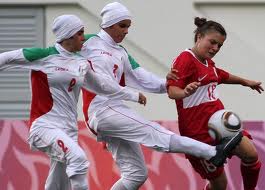
In the past, issues related to sports in the Middle East have often tended to focus on the impact of religion and culture on the opportunities for athletes. In particular, the impediment for aspiring women athletes have been the subject of discussion, from outright prohibitions to the complications caused between the mismatch between traditional garb and the prescribed uniforms in different sports.

There have also been reasons to discuss political aspects, including strife or tensions between different Muslim countries or in their relations with Israel or with East Asia, the latter given the importance of continental Asian competitions. But over the past year, I have had reason to write articles about the impact on sports during the uprisings in Tunisia and Egypt, both of which are prominent handball countries, and about the outright persecution against athletes during the political protests in Bahrain.

It was therefore with great interest that I looked forward to the theme of Sports in the Middle East on the agenda of the ‘Play the Game’ conference. To some extent it was a letdown, as some key speakers cancelled, but this was made up for by the presence of an engaging and knowledge speaker in the person of James M. Dorsey, a Singapore-based scholar who also has a great blog. I can really recommend the blog (mideastsoccer.blogspot.com), where James combines his intimate knowledge of the region with a great passion for soccer and other sports. My search efforts on the web have been greatly facilitated by the discovery of his site, and some of the tidbits below have been provided by him.

Apropos Bahrain, James has followed through on the sad situation where, among others, a major soccer star by the name of Alaa Hubail remains jailed (and apparently tortured) for no clear reason, after his brother and other friends have been released. It is also intriguing that Bahrain was drawn against Iran in the preliminary rounds of the qualifying for the 2014 World Cup in soccer. After all, one of the stated fears on the part of the Bahraini government is of course the potential Iranian influence over the Shiite population in Bahrain. (Iran easily won the home game, and the game in Bahrain resulted in a tie; Iran is through to the next round, while most likely Bahrain will be eliminated).

In countries where the population is suppressed, one of the few types of groups that could emerge as strong, determined and well-organized are the fanatic supporters of the top soccer teams. This has been particularly obvious in Egypt, where these groups played a strong role in the initial uprising and now again when in recent days Tahrir square again has become the scene of massive protests and violence. This connection has repeatedly caused the military to undertake crackdowns against the fan clubs and to cancel matches that could be suspected to fuel the flames.

Qatar has of course been in focus after the FIFA decision to award the 2022 soccer World Cup to this country with an almost surreal plans to construct a huge number of air-conditioned stadiums to deal with the +50 C (122 F) temperatures. These plans now seem to have been dismissed as unsustainable by the architect charged with designing them. At the same time, major protests from large global trade unions, such as ITUC, have become a new concern. It is well-known that 90% of the work force in Qatar consists of imported workers who live and work under extremely difficult conditions. The charge from the ITUC uses labels such as ‘modern-day slavery’.

The current uprising in Syria also has elements of politics mixing with sports. It seems that successes in soccer is such a propaganda tool, that the cynical Syrians are now accused by their Lebanese neighbors of blatant cheating in international games at the junior level. In a desperate effort to have better results, apparently the Syrians did not hesitate to insert a large number of ineligible over-age players in their line-up. A somewhat more sinister story involves the family of their young national team goalkeeper, from the town of Homs, which has been a focal point for the uprising. The goalkeeper has emerged as protest leader, after his brother and several friends were killed by government troops.

Finally, Israel has often been found in the center of conflicts in sports, when its teams and athletes have received a less than friendly reception in other countries, or when certain Arab countries have forfeited games rather than having to play against Israel. But now it seems that internal politics is having an impact. A small number of soccer teams in Israel consist primarily of non-Jewish Israeli citizens, typically of Palestinian origin. Some of the players are good enough to make it to Israeli national teams at different levels. But now there has been legislation introduced in the parliament, under which this would not be allowed, unless these non-Jewish players declare allegiance to Israel as a Jewish state, and furthermore sing along in the Israeli national anthem which talks about a Jewish state and about ‘free people in the land of Zion’.

Yes, sports can indeed be (mis)used as an effective weapon in politics!

post

Play the Game: Doping – many aspects and differing perspectives


In the recent ‘Play the Game’ conference, I took the opportunity to follow some of the lectures and discussions in the area of anti-doping, just as I tend to follow the media debates that tend to flare up when some prominent case has emerged. This does not in any way make me qualified to comment on an expert basis, but I did find several aspects quite interesting and intriguing also for a mere observer.

It has always seemed to me that anti-doping discussions have focused on a few specific topics: how can the testing keep up with continuously emerging new methods of doping and concealment, how strict should the world of sport be in its attitude of generally prohibiting performance through doping, and how severely should one punish those who are caught. But additionally aspects have emerged.

Nevertheless, the most fundamental question seems to remain, both on grounds of principle, and due to difficulties in consistent enforcement: are there reasons to rethink and suggest that certain forms of doping should be allowed and, if so, on the basis of what criteria would one draw the line? It seems there will also be people who suggest that stimulants that are readily available, and therefore would make it possible to retain a ‘level playing field’, should be allowed as long as they do not fall in the category of creating major health risks. Or one would go even further, arguing that the individuals should be allowed to decide for themselves in weighing risks against advantages. To some extent, it mirrors the debate about taking steps towards legalizing certain drugs in the society as a whole.

Of course, many will then say that it is not enough to ensure a level playing field. The positive side of sports is to see what the human body and mind can achieve without stimuli. Moreover, in some sports, where part of the interest in not just in fair competition here and now but also in historic comparisons, doping makes it impossible to see how skills and abilities improve over time. Many argue that, for instance, many of the old world records, achieved in earlier days of inadequate control, now render the performances of top performers, for instance in track and field, uninteresting because they cannot match the old results.

Some of the arguments involving ‘civil liberties’ do not just concern that basic right to choose; they also affect the entire process of testing and fair treatment. Here one general problem is related to the reality that, although testing methods constantly improve, the experts who work on making the use of doping impossible to detect always seem to be one step ahead. This may happen because of new drugs or because of methods that help mask the use of drugs. It is suggested that this makes the drug testing too capricious and therefore inherently unfair, both to the individual and between individuals competing with each other. This was recently highlighted also when it was found that contaminated meat could lead to positive test results, something that provided excuses in the case of a number or Mexican soccer players and created serious concerns in connection with the PanAmerican Games in Guadalajara.

The reliability of testing also becomes an issue from legal and civil liberties standpoint, in the sense that testing methods may have become much more accurate and sophisticated, but the processes in the handling of test materials and test results continue to rely on human intervention, with an inevitable scope for both manipulation and honest mistakes. This means that cases of positive findings may lead to legal battles that effectively undermine the overall anti-doping efforts and also create doubts in the minds of the general public.

Finally, while It may be realistic to establish fairly clear and consistent ‘punishment catalogs’ for different types of doping violations, there will be always be an element of differences in circumstances that requires a subjective judgment to be applied. Perceived inconsistencies will then become yet another reason for those who want to question the overall fairness and moral underpinning of the anti-doping efforts. It becomes even more complicated if the spectrum of international sports federations attempt to follow WADA regulations and determine punishments accordingly, only to find that the IOC wants to apply a separate policy of keeping violating athletes out of the Olympic Games for periods that may not match those of the initial sanctions. In a recent ruling, the Court of Arbitration for Sports determined that this approach violated principles of avoiding double punishment. IOC and WADA will now need to rethink.

All in all, it clearly appears that the overall issue of anti-doping efforts is becoming more complex and therefore more controversial, well beyond the debate about the underlying moral and philosophical aspects. In some ways, scientific progress may add to the complexities rather than being helpful, and the increased focus on human rights and legal considerations makes for a much more difficult atmosphere in all the forms of decision-making. Legitimate concerns are pitched against other fully justified considerations. It is a sad distraction that is not helpful to the focus on other aspects of sports, but it is an issue that cannot be dismissed and will not go away.

post

USA Team Handball’s Esch – Pastorino era comes to a quiet end

Dieter Esch and Steve Pastorino have resigned from their positions with USA Team Handball

In the past couple of weeks both the USA Team Handball Chairman of the Board of Directors (Dieter Esch) and General Manager (Steve Pastorino) have submitted their resignations.  Jeff Utz, will reportedly take Esch’s Board role, while Dave Gascon has taken Pastorino’s GM position on an interim basis.  It was a quiet, unceremonious departure for two key players who led the federation from its rebirth in 2008.  Here’s a brief look back at those 3 years and what may have led to their departure.

Initial Promise and Optimism

Nearly 3 and a half years ago I first had the opportunity to meet Dieter and Steve at the USA Team Handball Summit in St Louis.  This summit was essentially a kick off meeting for the new federation and a chance for a few long time followers of the sport to share thoughts and ideas with the newcomers who were looking to move the organization forward.  Looking back on my notes I’m struck by the mixture of skepticism and optimism from that meeting.  I had my doubts, but based on decades of mediocrity (at best) and failure, it was clear in my mind that a fresh look from new players just might have a chance at taking the sport to another level in this country.

The Great Recession and Grand Plans go Awry

About 3 months after the summit, however, the collapse of Lehmann Brothers and the U.S. Financial Markets signaled that the boom was over and that the USA was in the midst of an economic downturn it hadn’t seen since the 1930’s.  This Great Recession can’t be blamed for all of USA Team Handball’s problems, but it was a huge contributing factor.  Certainly the grand scheme for Board Members to use their contacts and powers of persuasion to get individuals and businesses to donate and become sponsors went out the window overnight. In hindsight it’s fairly clear that the new federation was slow to realize that plans for increased revenue weren’t going to materialize.  A large staff with regional directors was gradually let go and funding for development efforts were scaled back.

USOC Support Doesn’t Meet Expectations

In the interim period between the decertification of the old federation and the establishment of a new federation, the USOC managed Team Handball.  Not desiring to actually run an Olympic sport, the USOC wanted out and sought the establishment of a new federation.  Seemingly out of nowhere, Dieter Esch came into the picture with promises to finance the establishment of the new federation.  This was not an inexpensive endeavor and reportedly it was mostly paid for with his personal funds to the tune of around $750K.  Rightly or wrongly, I’m guessing that Mr. Esch had expectations that his own personal commitment and the federation’s efforts to develop the sport would be recognized by the USOC and that USA Team Handball would receive grant funding similar to other Olympic sports.  Reportedly there are other factors that led to his decision to step down, but I suspect that the lack of USOC support is a pretty significant one.

As the GM, Pastorino had become increasingly vocal in regards to the lack of USOC support.  Most notably in a press conference prior to the PANAM Games he called out the USOC for not giving more credit and support to sports that are building a long term development program.  And not too long after the Colorado Springs Gazette Telegraph (the hometown paper of the USOC) posted an article highlighting those comments, USA Team Handball posted an announcement indicating that they were accepting new applicants for the GM and Technical Director post.  With the timing of that announcement along with the GM position being advertised as an unpaid volunteer, Pastorino’s resignation can hardly be seen as a surprise.

A Note of Thanks

I’m planning a follow up post that will be a more thorough post-mortem on the past three years.  For now, though, I’d like to say thanks and at the same time address some peanut gallery comments that I have received/heard over the past 3 years regarding Steve and Dieter.

Some folks have at times questioned Steve Pastorino’s motives and commitment to the sport.  To them, he was the outsider with no clue about handball only interested in collecting his six figure salary.  While I sometimes disagreed with the decisions the federation has made in the past 3 years, at no time whatsoever did I have any inclination that Steve wasn’t committed to moving the sport forward in this country.  In all my dealings with Steve he was the consummate professional, always willing to listening to critiques and new ideas to further develop the sport.

If one Googles Dieter Esch a whole host of negative information will show up concerning past business dealings.  Accordingly, some have intimated that it’s only a matter of time before he takes our sport for a ride.  Well, I can’t speak to pre Handball dealings, but I will speak to the past 3 years.  At no time have I seen any credible shred of evidence regarding nefarious financial plundering of the Federation.  To the contrary, it’s quite clear that Mr. Esch has personally donated a substantial amount of money with no plausible path to personal financial gain.  Sure, we could argue that those funds could have been spent differently, but no one has ever donated more money to the sport in this country.  No one even comes close.  Additionally, you can throw out the he’s just a millionaire argument as I would speculate that there are also very people who have contributed a comparable percentage of their net worth to the sport.  On top of the funding and maybe of more importance are the numerous doors in Europe he has opened for future opportunities in the U.S.  It remains to be seen if the new Federation can follow through, but thanks to his efforts there’s now a fighting chance.

So, both Steve and Dieter are moving on and I wish both of them well.  Thanks for re-establishing the federation and starting the USA on a path towards greater development and National Team success.  Hopefully, you will both be able to look back one day with pride that you played an important role in starting something special.

THN (19 Jun 2008): USA Team Handball Summit (My Personal Notes): https://teamhandballnews.com/2008/06/usa-team-handball-summit-my-personal-notes/

THN (4 Sep 2011): Gazette Telegraph reports on USA Team Handball financial struggles: https://teamhandballnews.com/2011/09/gazette-telegraph-reports-on-usa-team-handball-financial-struggles/

USATH (11 Nov 2011): Esch resigns as USA Team Handball Chairman: http://usateamhandball.org/news/2011/11/11/esch-resigns-as-usa-team-handball-chairman/45425?ngb_id=42

USATH (8 Nov 2011): Steve Pastorino Blog: Hasta luego…: http://usateamhandball.org/blogs/steve-pastorino-on-handball/posts/3352-hasta-luego

post

IHF/Sportfive/UFA: will the evidence be found?

Follow the money...

In a recent article, I expressed the concern that there is not enough exposure of the wrongdoing in our sports federations. I noted that most people seem to think it is better for the image to ‘sweep things under the rug’ instead of dealing with the problems openly. But in the case of the IHF, it now seems that the Chief Prosecutor in Hamburg is ensuring that the there is more than enough publicity. The only question is what, if anything, the action and the publicity will lead to.


In January 2010, I published a comprehensive article following the revelations in the German magazine ‘Der Spiegel’ that IHF President Hassan Moustafa had obtained personal service contracts to the amount of 602.000 Euro from Sportfive, the marketing firm that obtained the TV rights from the IHF for the period 2006-09. While Sportfive and Moustafa argued that the contracts were genuine, in the sense that they required actual work to be performed by Moustafa, there were suspicions expressed to the effect that the money instead was simply a ‘kick-back’ to Moustafa, in return for the IHF decision (‘heavily influenced’ by him personally) to award the TV rights to Sportfive.

Of course, most observers noted that even a genuine contract for services would be highly improper, at a minimum creating a serious conflict of interest, moreover behind the backs of all the Executive and Council members of the IHF. Indeed it would understandably create suspicions among competitors of Sportfive regarding the possibility of manipulations in the IHF decision-making. Media representatives brought the matter to the attention of the IOC President Jacques Rogge, who offered a stinging rebuke by saying that he would never have tolerated such a behavior from an IOC member. Such a public condemnation is, of course, highly unusual and remarkable. Unfortunately, the reactions internally in the IHF did not deviate from the usual pattern of tolerance and subservience regarding the President’s autocratic and questionable actions.

But in the meantime, there had been a new twist in the situation regarding the TV rights for IHF events. Robert Mueller von Vultejus, the person responsible at Sportfive, had left and joined RTL’s UFA Sports Division, and suddenly UFA beat out Sportfive and obtained the contract for the 2010-13 period. While initially the main reaction was simply one of surprise, persistent rumors now started emerging that perhaps not everything in the bidding process had been above board. Of course, any such wrongdoing rarely causes some physical evidence to be left behind, and any revelations would typically have to be based on the testimony of eyewitnesses. And this in turn would be a rare development, especially if one is dealing with an organization characterized by despotism and a downtrodden staff.

The possibility that ‘issues’ may have existed with respect to both TV contracts, that with Sportfive for 2006-09 in the order of 30 Million Swiss Francs, and that with UFA for 2010-13 for about twice that amount, is now causing confusion and speculation on the part of media and other observers. Is the focus of the German authorities and this week’s police action in Basel and Hamburg mainly on the personal services contract coinciding with the 2006-09 TV contract, or is it perhaps rather on the 2010-13 contract and the suspicions of wrongdoing in that regard? The media reports and their sources seem to differ on that point.

As just noted, the money involved is substantial, and some reports suggest that the Prosecutor is mainly dealing with charges of ‘bribery and corruption in commercial transactions’, i.e., the way in which the personal services contract for Moustafa could be viewed. But other reports suggest that, apart from Moustafa’s role, the real focus is on UFA and Mueller von Vultejus. This would suggest a focus on the 2010-13 contract and that could be supported by indications that the police raid in Hamburg apparently also involved the offices of UFA and the residence of Mueller von Vultejus. One would hope that the German authorities would be prepared to shed light on these questions. While either focus is a matter of serious concern for IHF and for Moustafa personally, in all fairness the possible culpability on the part of Sportfive and/or UFA and specific individuals needs to be clarified.

There are media reports to the effect that ‘revealing documents’ have been found during the police raid. This is almost difficult to believe. It is hard to imagine that Moustafa would be leaving any incriminating documents where the police could legitimately be searching for them. Similarly, is it realistic that managers at Sportfive or UFA would be so naïve about any hypothetical wrongdoing? And, again, if the IHF bidding procedures were to have been ‘flawed’, it seems that witnesses, not paper trails, would be the only way of finding out. But as I think the world of handball deserves to know the truth, I certainly hope that the police raid will turn out to have helped bring about clarity.

Finally, while important questions remain to be answered and precise culpability still needs to be determined, it seems that the shift from earlier rumors and innuendos to a decision by the German prosecutor that there is a sufficient basis to undertake this week’s raids, raises the basic question: how can a continuation of the Moustafa regime be tolerated, no matter what is the precise outcome? Has not enough damage been caused to the image of handball? After all, remembering many other issues, such as the Olympic qualifying for 2008, have we not had enough?? In a few days the European Handball Federation (EHF) will have a major celebration of its 20th anniversary, an existence generally characterized by integrity and fair play. But is such an introverted or insular celebration enough? Does not the EHF also need to lead the fight for urgent change towards democracy, decency and transparency at the global level!?

Dradio.de (9 Nov 2011): World Handball President in the crosshairs of German prosecutor (German): http://www.dradio.de/dlf/sendungen/sport/1600894/

Tages Woche (11 Nov 2011): Raid in Basel – IHF President Moustafa is said to have plugged 602,000 Euros (German): http://www.tageswoche.ch/de/2011_44/sport/110548/Razzia-in-Basel-%E2%80%93-IHF-Pr%C3%A4sident-Moustafa-soll-602’000-Euro-eingesteckt-haben.htm

Sportcal (10 Nov 2011) IHF and Sportfive Offices Searched in Investigation into Moustafa’s ‘Commercial Transactions’: https://teamhandballnews.com/wp-content/uploads/Documents/IHFMoustafanov11.pdf

Associated Press (11 Nov 2011): Handball Federation President faces bribery probe: http://nbcsports.msnbc.com/id/45257835


post

World class referees killed in traffic accident en route to Bundesliga game

In Memoriam: Bernd and Reiner Methe

The world of handball today lost two highly respected members. The German referees Bernd and Reiner Methe passed away tonight, at the age of 47, as a result of a frontal collision, when they were on the way to handle the Bundesliga game between Balingen and Magdeburg. The game was of course cancelled after the shocked players and spectators learned of the reason why the referees had not shown up.

Bernd and Frank were top level referees together for well over 20 years, and had been at the service of the IHF and the EHF at numerous World and European Championships since 1998. Perhaps the highlight of their career was the assignment to the final of the 2010 Men’s European Championship. They were nominated for the Women’s World Championship next month.
The Methe twins were known and respected around the world for their competence, integrity and solid personalities. They were persons who could be trusted with the toughest games in the most difficult atmosphere. And they were great members of the circle of referees, both in their home country and internationally.

All of us who had the privilege of knowing Bernd and Frank will keep fond memories of our encounters with them. Our deepest sympathy goes to their wives, children and other family.