post

Junior World Championship lives up to expectations

Over the years, the IHF has tried two different approaches for the format of play following the preliminary groups.  It has been more common to create main round groups for the top three from each group, but the method that it being used this time, with a ‘knock-out’ competition, starting with1/8-finals after the groups, has also been tried before.  It is difficult to claim that one format is clearly the best one.  Knock-out matches create excitement for the spectators, but may be a bit capricious and unfair to the teams.   Main round groups are often very intriguing, but on some occasions they can be boring because the top positions are clear prior to the final matches.

One could say that it depends on how evenly matched the teams are on each occasion.  If one can identify four-five superior teams, the knock-out approach may have an edge.  But this time, it seems that the event is unusually full of strong and interesting teams, and it might be a shame that some of them will be out of contention after only one more game.   I will come back to the match-ups for the 1/8-finals and beyond, but first I want to offer some comments on the group play.

In Group A, not many may have realized that the very first match between Slovenia and Tunisia would be the group final.  But after the played it each other, they have gone on to dominate a strong group, leaving Norway and France to fight for the third place, and with Serbia somewhat surprisingly missing out on the knock-out stage.  Tunisia has been an interesting team to watch.  Yes, they often play a rough and undisciplined defense, but they display speed, technique and shooting power to make up for it.  Perhaps one expected more from France, given their well-known emphasis on finding and educating young talents to step in at the senior level.  But their win today against Slovenia may be the start of something, even if of course Slovenia had nothing to play for.

Denmark was not unexpectedly the clear winner in Group B, where the main fight was for places 2-5.  Greece started out in a nervous fashion, showing inexperience, but they recovered and came in second.  Algeria and Qatar were more consistent and played an interesting style of handball.  It will be nice to see how they fare against European opponents in the 1/8-finals.  Argentina must be seen as a disappointment, considering the strong showing of their senior team half a year ago.  Here they seemed a bit thin and ‘lost’ at times. On the final day, they had to sit and hope for a miracle in the other games, but this did not happen.

Germany moved calmly through their first four matches, but still had to handle a ‘group final’ against Egypt on the final day.  In the end, Germany overcame also this obstacle, and this meant that Egypt’s ‘unnecessary’ loss against Russia in the very first game moved them down to third place.  Brazil dutifully beat Benin and a technical but ‘thin’ Korean team to make it to the 1/8-finals, but they were not able to match up fully with the top three teams over 60 minutes. 

In Group D, it became clear that Portugal, Spain and Sweden were very evenly matched and in a class by themselves.  Spain won the group, and on the final day we saw Portugal narrowly beat Sweden and grab the second place.  But watch out for a Swedish team wanting revenge in their next match.  My earlier prediction regarding the fourth and final place in the knock-out competition turned out to be justified, when Iran surprisingly clearly beat a very pale Hungarian team.  It seems that Hungary was the most negative surprise of the event, notwithstanding the frustrations of Argentina and Serbia.

The tournament now continues with the 1/8-finals on Sunday.  The pairings are as follows and the sequence of the matches also indicates which winners will play each other in the quarter-finals and semi-finals:

Denmark-Norway,    Sweden-Russia;        Greece -Tunisia,  Spain-Brazil;;

Egypt-Portugal,   Slovenia- Qatar;         France-Algeria,  Germany -Iran

It seems that the group winners appropriately were rewarded by generally getting less scary opponents.             The ‘2 against 3’ games are harder to predict.   I believe a lot in Tunisia but they get to face the home team;  Portugal may be in for a particularly tough time.  Sweden-Russia is probably the game that is the hardest one to predict, and France-Algeria is a traditional rivalry.  Looking beyond that round, it is intriguing to see that a final between Spain and Germany is theoretically possible.  But several other teams will try to ruin that, and my Scandinavian friends will surely complain if I do not mention them.  I have not been able to watch Slovenia but they seem to be tough, and how would it be if a tournament that started with Slovenia-Tunisia would finish with the same pairing!

post

2011 PANAM Games Draw: Results and Analysis

The Groups have been drawn for the Men’s and Women’s Team Handball Competition at the PANAM Games.  Both the Men’s and Women’s tournament formats start with round robin play in two groups of 4 teams.  The top two teams from each group advances to the semifinals while the bottom two teams play for 5th to 8th place.

The Gold Medal winners for the Men’s and Women’s tournament earn an automatic ticket to the 2012 Olympics in London.  The 2nd place and 3rd place men’s team earn berths in Olympic qualification tournaments Spring 2012.  The 2nd place and possibly the 3rd place women’s (TBD based on 2011 WC results) will win tournament berths as well.

Men’s Draw

Group A: Brazil, Chile, Canada, Venezuela
Group B: Argentina, Dominican Republic, Mexico, USA

Analysis:  Brazil and Argentina are clear favorites to win their groups and to eventually play each other in the Gold Medal Game.  The rest of the participants with the possible exception of Venezuela have realistic aspirations of making the semifinals.  Chile, which took 3rd place at the 2010 PATHF Championship last year and played respectably at the 2011 WC (their draw against Slovakia was a major surprise) is probably the next strongest team.  They will be challenged in Group A by Canada for the second slot.  At last summer’s PATHF Elite Championship, Chile easily defeated Canada 36-25 during Group play

In Group B, the Dominican Republic, Mexico and the USA will battle it out for second place.  Based solely on recent PATHF competition results the Dominican Republic appears to be a slight favorite having finished 1st at the PATHF Div I Championship in 2009, 8th at the PATHF Elite Championship in 2010, and 1st at the Central American and Caribbean Championships in 2010.  Meanwhile, Mexico placed 4th at the Div 1 Championship in 2009 and 3rd at the Central American and Caribbean Championships.  The USA only returned to International competition last December, where they lost to Canada on aggregate goals scored in a home and home 2 game series.  This past spring at the 2nd Chance PANAM Games Qualification tournament the USA drew Uruguay and easily defeated Venezuela.

In terms of head to head competition, the Dominican Republic beat Mexico 35-32 as the 2009 Div championship and the USA has played neither team in several years.  One can extrapolate, on paper anyway, that the USA’s results against Canada and Uruguay (two teams that have played the Dominican Republic close in recent years) means that the USA and the Dominican Republic are roughly on the same level.

Women’s Draw

Group A: Brazil, Dominican Republic, USA, Uruguay
Group B: Argentina, Mexico, Puerto Rico, Chile

Analysis:  As with the men, Brazil and Argentina are clear favorites.  In Group A, the match between the Dominican Republic and Uruguay will likely decide who advances with Brazil into the semifinals.  And these two evenly matched teams know each other well having played to a draw during group play at both the 2009 and 2011 PATHF Championships (just this past June). The USA has only returned to international competition recently and struggled to beat an inexperienced Canadian side to secure the North American slot.  The USA Women are improving, but they are significant underdog to makes the semifinals.

In Group B, Chile (3rd place at the 2009 PATHF Championship) should be favored over Mexico and Puerto Rico.  This past June, at the 2011 PATHF Championship Chile defeated Mexico, 26-22 in Group Play while  Puerto Rico and Mexico may be evenly matched.  At last summer’s Central American and Caribbean Games, Mexico beat Puerto Rico in round robin play, but then Puerto Rico beat Mexico in the Semifinals 24-21.


post

Legal issues – EHF and HBL

In the interest of Fair Play

The European Handball Federation recently announced the introduction of a new internal legal system effective July 1.  Having seen reasons to criticize both procedural aspects and the results of the decision-making in some cases in recent years, I now congratulate the EHF to this necessary and important action.   When questions are raised about the adherence to correct procedures and about apparent mismatches between the nature of an illegal action and the severity of the punishment, then the entire system may lose its credibility.

The EHF legal system will now have a lower level with the name ‘EHF Court of Handball’ (replacing the misleading concept of Arbitration Tribunal).  This Court will deal primarily with competition-related cases (while the EHF Office will serve as first instance for administrative and transfer matters).  The exception regarding competition matters involves those events which are played in a tournament form, and where therefore decisions typically need to be taken from one day to the next, by the Disciplinary Commissions or Delegates responsible at the site.

An ‘EHF Court of Appeal’ constitutes the second level, for all matters (except during a European Championship tournament where a Jury plays that role).  In addition, there is an arbitration mechanism, ‘on top of’ or outside the two bodies just mentioned.  It is external to the EHF and completely independent, even though it has been established by the EHF Congress.   Very specific rules apply for the dispute resolution of this body, and in a sense it is, for EHF issues, an entity somewhat similar in nature to the Court of Arbitration for Sport (CAS).  Perhaps it will serve the purpose of avoiding that matters escalate to the formidable level of CAS…

An important component of the new legal system is the introduction of new Legal Regulations, a List of Penalties and a Catalog of Administrative Sanctions.   My review of these documents suggests that the EHF now has in place a very solid basis for handling especially the often very sensitive and highly publicized issues involved in the EHF competitions.  There are reasons to believe that a more effective and speedy resolution can be reached, without worries about major inconsistencies.  The structure for penalties seems generally appropriate, with scope for quite substantial action in terms of both suspensions and financial repercussions in serious cases.

Of course, as the prescribed penalties for each type of situation are normally expressed either as a very broad range or in the form of a minimum, the key will be the early precedents when the new system is beginning to be applied.  A tendency to be very soft and regularly choose the lowest punishments possible would send a very undesirable signal.  The provisions will not in themselves serve as a deterrent; they require that the decision-makers have some courage.

The German Handball Bundesliga (HBL) has just come out with a somewhat surprising new regulation at the start of the new season.  In recent years, there has been an unfortunate tendency in the direction of increasingly frequent and ‘uninhibited’ criticism against referees, on the part of coaches and players in a very public manner.  This has contributed to a negative atmosphere, not just in the individual case but more generally in the co-existence between teams and referees.  It has also tended to have an effect on how spectators and the general public understand what is permissible in terms of similar actions.

Accordingly, the HBL is now, quite appropriately, finding it necessary to focus on new regulations for this kind of situations.  Clearly, the intention is to avoid the spontaneous and public negative reactions, for instance in a press conference, right after the game.  Team representatives should have a chance to calm down and perhaps review video recordings and be more certain of the facts before speaking up.  So it is now forbidden for players, team officials and club representatives to express themselves in public regarding referees or other match officials in any way whatsoever within 48 hours of a game.

As has been noted in the media, perhaps one needs to introduce some further clarifications or at least make sure that new regulation is applied with some common sense.   An excessively literal or bureaucratic application might backfire.  It would hardly seem to be punishable if a coach or player spontaneously praises a referee when meeting right after the game.   And the definition of what is meant by public expressions is not really very clear.   Similarly, if someone comments on a game of another team that they witnessed, should this be covered etc?   So the intention is laudable, and personally I am certainly in favor of offering more protection for the referees, but the success may depend on the details of the interpretation of this new idea.

post

The battles of Thessaloniki

An earlier version...

Almost exactly 20 years ago, Greece hosted the Men’s Junior World Handball Championship in Athens.  Now the turn has come to the second city of Greece, Thessaloniki, a city of prominence both historically and in modern Greece.  Over the centuries, many important battles have been fought in the area.  Let us hope that the battles on the handball courts over the next two weeks will be less bloody, although I am sure that they will be dramatic enough.

 Handball has a rather modest existence in Greece, at least in comparison with football and basketball.  PAOK and Aris are great rivals from the host city in both those sports, and they have also had some success at the continental level.  However, the conspicuous lack of spectators (except when the home team was playing) during the opening days, suggests that handball in July is not a favorite activity of the locals.  And of course, they currently have more fundamental issues to worry about and more important things to spend their money on.

The Junior World Championship tends to be a very interesting event for many reasons.  You can see the players who will be the stars on their national teams some years from now.  And it is exciting to see how the traditional styles of the adult players from different countries can be recognized also among their young talents.  Moreover, for many of the players it is their first time in an intercontinental event, and you will see some interesting ‘cross-cultural’ clashes in terms of tactics, style, and mentality.  The 2011 event promises to be as thrilling as many of its forerunners.

It seems a bit premature to start picking favorites after just two games per team.  Moreover, the main conclusion is rather that there will be many heated battles in each preliminary group, as teams are fighting for positions for the ‘1/8-finals’, where teams from ‘neighboring’ groups will be playing 1-4, 2-3, 3-2 and 4-1.  So it is critical to try to gain one of the top positions in the group, and this will guarantee interesting match-ups until the end of the group play, even if in some groups the two teams that will be going to the ‘consolation round’ are already becoming known. 

In group A, there was the traditional battle between France and Tunisia today, and despite playing a careless style that caused many 2-minutes penalties, Tunisia was able to use a better scoring power to win rather easily in the end.  But Tunisia already lost against Slovenia, whereas France gained a point against a solid Norwegian team that today went on to defeat Serbia.  France may be living dangerously here if they do not improve.

Denmark is the likely favorite in group B, despite having to fight until the finish line in order to defeat Algeria.  The Algerians played with speed and tenacity today, after having had a rather modest game yesterday against the less experienced home team.  Argentina lost today against Qatar, but both teams have a good chance to advance to the 1/8-finals. I could see either Qatar or Algeria causing some surprises at later stage.  Newcomer Venezuela will find it hard to win a game here.

In group C it would be easy for Benin to feel a bit overwhelmed.  Here we have had battles today between perennial top teams Russia vs. Germany and Korea vs. Egypt, while Benin themselves tried to put up a brave fight against Brazil.  Germany played a smart and systematic handball against opponents looking like an old Soviet style team.  There is some special interest here in the sense that the Germans are coached by Martin Heuberger in his final effort with the juniors, before he takes over the senior German team.   Korea has a quick but small team, and after an 8-4 lead they got ‘outmuscled’ by the strong and physical Egyptians.  At half-time it was 13-13, but soon it went from 16-16 to 17-24.  It would be not be surprising if the Koreans join Benin in the consolation round.

Iran just might be able to fight successfully against Hungary on the final day of group play, if one judges from the results so far.  Sweden has been a bit slow in pulling away from Iran and Canada in their games, but in the end they won comfortably.  Spain seemed to be more convincing after an unexpectedly easy win against Hungary, but after today’s Hungarian fiasco against Portugal, perhaps the Spanish strength still remains to be tested.  The next two games, against Sweden and Iberian rival Portugal will tell us more. 

As John mentioned in his posting earlier today, we have webcasts of very high quality from Greece, but the crux is that you have to be available to catch the games live.   The more intriguing games tomorrow, in the early afternoon my time here in the Washington area, are Qatar-Algeria, Argentina-Greece and Russia-Korea.   Then, after a rest day on Wednesday, you will need to check the standings in each group to find your best match-ups for Thursday and Friday, but during a couple of time slots you may need to have two computers going!

post

VIDEO: Free Webstreaming of Men’s Junior World Championships

Argentina easily took care of PATHF rival Venezuela 31-17 on opening day of the World Juniors

The International Handball Federation is providing free webstreaming of the Men’s Junior World Championships in Greece.  Up to 8 matches per day will be shown live at laola1.tv from 17 to 30 July.

VIDEO Link:  LAOLA1.TV: http://www.laola1.tv/en/int/more-sports/handball/junior-world-championship/video/273–.html

Note:  Scroll to the bottom and select the match that you want to watch.  Central European Time (CET) is 6 hours ahead of the U.S. East Coast.  Also matches can only be watched live.  There is no “on demand” option.


IHF: Web Broadcast Schedule: http://www.ihf.info/IHFCompetitions/WorldChampionships/MensJuniorWorldChampionship/XVIIIMensJuniorWorldChampionship2011/News/NewsDetails/tabid/5688/Default.aspx?ID=702

IHF Junior World Championships Website: http://www.ihf.info/IHFCompetitions/WorldChampionships/MensJuniorWorldChampionship/XVIIIMensJuniorWorldChampionship2011/tabid/5683/Default.aspx

Official Junior World Championship Website: http://www.greecehandball2011.org/


post

Partille Cup: How can USA Team Handball best maximize this opportunity?

USA Girls in action at the Partille Cup

The USA sent two youth teams recently to participate in International Handball Federation (IHF) Olympic Solidarity Program and the Partille Cup in Sweden.  The Olympic Solidarity Program is an IHF funded program held to support developing handball nations and the Partille Cup is a massive youth tournament with club teams from all over Europe and the world participating.  While I think it’s great that a handful of young American players are getting this exposure to Handball, some of the ugly score lines from the tournament got me contemplating whether the USA is maximizing this opportunity.

Boys Team Results from Partille Cup

Olympic Solidarity Camp Friendly Games
USA National Team 26-22 China
USA National Team 44-29 Singapore

Pool Play (16 and Under)
USA National Team 7-32 OV Helsingborg
USA National Team 9-22 Kärra HF
USA National Team 16-14 BK Ydun
USA National Team 17-22 TV Birsfelden
USA National Team 9-19 HC Eynatten-Raeren

Knock Out Tournament
USA National Team 8-21 Elverum IL

Girls Team Results from Partille Cup

Olympic Solidarity Camp Friendly Games
USA National Team 10-18 Scotland
USA National Team 12-23 Scotland

Pool Play (15 and Under)
USA National Team 3-22 Vorup FB
USA National Team 4-28 Kungsängens SK
USA National Team 4-27 Skövde HF
USA National Team 1-27 Klaebu IL
USA National Team 4-30 Skedsmo HK 1

Knock Out Tournament
USA National Team 5-14 Röyken og Hurum Graabein

Results Overview

A quick assessment of the score lines show that the boy’s team had some measure of respectability.  They won their two friendly games against China and Singapore at the Olympic Solidarity Camp and compiled a 1-5 record in their Partille Cup games, with an average score line of 10-19.  The girl’s team results were more lopsided.  They lost both of their solidarity camp games to Scotland and were totally overwhelmed in every Partille Cup match losing their 6 games with an average score line of 4-25.  (Note:  These matches were 2X15 minutes, so to get a true picture you might want to multiply the scores by 2)

Top Prospect or Any Prospect?

While these score lines were ugly we shouldn’t make the mistake of thinking this was a wasted trip.  I’ve written before about lopsided scores and the benefits the learning experience provides to the losing team.  And in that commentary I was talking about much older teams.  The two teams sent to Sweden were far younger and coupled with the training at the Olympic Solidarity Program this event was surely worthwhile for every athlete that attended.  All that being said, however, I think USATH needs to be  more low key as to the composition of this “national team”.  This was clearly a developmental team and I would classify the participants as more any prospect then top prospect.

The play on words refers to the current youth focused effort established by the USA Federation: the Top Prospects program.  There are a lot of positive things about this program as it’s providing funding, curriculum and structure to different regions of the country.  There’s a clear application process and it may be presumptuous on my part, but I think if someone is motivated and takes the time to fill out an application they probably stand a good chance of getting some support to develop a local program.  In short, the Federation is providing much needed support and incentive to start new pockets of development throughout the U.S.

But, while what I’ve just described is all well and good it appears that the program is probably falling well short of its stated mission of identifying “talented” future Olympic Players.  I say this based partly on the ugly looking score lines from the recent Partille Cup.  While those poor results can be partially chalked up to the vastly more experienced European clubs I think a team of future Olympic athletes could use that superior athletic ability to keep the game a little more respectable.   This is especially true when you factor in that most of the clubs participating at the Partille cup are only drawing athletes from one small dot on the map, not an entire county or 300 million people.

But, then again the current reality is that the U.S. is probably working with a youth talent pool smaller than what many of those clubs are working with.  In fact, based on Federation articles written promoting the trip and tryouts a cynic might even assess that just about anyone willing to pay for airfare probably could have put on a USA jersey.

The challenges of identifying top young talent

But, even if USA Team Handball had thousands and thousands in the talent pool vying for Partille Cup spots, identifying the future Olympian at ages 15 and 16 is probably a futile mission.  Out of curiosity I checked out the USA Basketball website to see what kind of Under 19 and Under 18 rosters they’ve sent to assorted FIBA tournaments in the past 15 years.  I didn’t do an in-depth review, but the typical roster only had 1 or 2 players whose names I recognized and with a few notable exceptions (Carmelo Anthony and Chris Bosh) I didn’t see a whole lot of Olympians.  And this is for a U19 roster for a major sport where colleges spend hundreds of thousands of dollars recruiting and assessing potential high school prospects.  So, with all those resources being applied they are either missing some talented players or more likely those talented players are still developing as athletes.  And this is at ages 18 and 19!  If you look at ages 15 and 16 players like Michael Jordan (he got cut from his HS Varsity team as a sophomore) would never ever get selected.

Recommendations:  Focus on maximizing exposure

So, if you take into account that a sport like basketball can’t do a great job of identifying Olympic talent at young ages, it’s very unlikely that we’re going to do the same for Team Handball.  And if you couple that fact with the other challenges our sport faces competing against other more established sports, we need to make sure were maximizing the potential benefits of Partille Cup participation. And in my opinion, maximum benefit equals maximum participation.  With that in mind I have the following recommendations.

1) Maximize nationwide participation: The rosters for the Partille Cup had fairly heavy representation from only a few Top Prospect programs.  Notably, the girl’s team was mostly from New Jersey while the boy’s team was spread out a little better with 3 players each from Salt Lake City and Chicago.  I would argue that it would be better to further spread out that representation, so that only 1 or 2 players be allowed to participate from a local youth program.  Such a quota would give more players from clubs and Top Prospect programs exposure to the Partille Cup experience.

2) Limit participation to “one and done”:  Attending an event like the Partille Cup can be life changing for a young athlete.  It is a totally unique opportunity and has the distinct possible outcome of creating new Handball fans for life.  Attending the same event in subsequent years, however, will not have a significant multiplying effect.  Therefore, it would be far better to maximize the numbers of kids who get that opportunity.  Hence, my one and done proposal to ensure that as many kids as possible get that experience.  Undoubtedly, this will mean the official USA teams that are sent won’t be as strong, but results are really secondary at these ages. (A short side note here:  There’s nothing to prevent anyone participating or creating their own team to play in this event.  I’m simply talking about the teams that are getting resources from USA Team Handball.)

3) Come up with a new name for the team:  Since the criteria above will keep us from sending our best team forward the USA team should be given a name like “USA Select” or “USA Development Team”.  This is semantic, but in terms of promotion to the rest of the world it will help to at least partially explain ugly score lines.

4) Continue to promote the event:  My compliments to Kyle Hanson and the USATH staff for their regular reporting on this event.  This isn’t the first time a team from the USA has attended, but it’s the first time it’s gotten the exposure it deserves.  Future prospects will read those reports and target this as an event they want to play in.  Promotion is key to getting the word out and expanding the talent pool.


USATH:  Top Prospects Program Overview:  http://assets.teamusa.org/assets/documents/attached_file/filename/37770/Top_Prospects.pdf

USATH (18 Feb 11): 20 Athletes Converge on Colorado Springs for Youth National Team Selection Camp: http://usateamhandball.org/news/article/41031

USATH  (10 Jun 11): USA Team Handball youth taking on the 2011 Olympic Solidarity Program and Partille Cup in Gothenburg, Sweden: http://usateamhandball.org/news/article/42763

USATH (15 Jun 11): U16 Boys and Girls Rosters Named for Partille Cup: http://usateamhandball.org/news/article/42855

USATH (28 Jun 11): U16 Girls Training Camp in August at the Lake Placid Olympic Training Center: http://usateamhandball.org/news/article/43135

USATH (13 Jul 11):  Youngsters shine at Partille Cup:  http://usateamhandball.org/news/2011/07/13/youngsters-shine-at-partille-cup/43521

Partille Cup VIDEO: Olympic Solidarity Overview: http://partillecup.com/eng/index.php/home/webb-tv/?film=4407

USA Basketball (Under 19 History): http://www.usabasketball.com/mens/u19/history.html


post

Hypo and Brazil: from controversy to harmony

In Brazilian colors

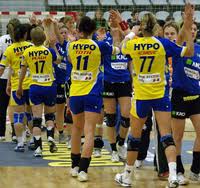
In connection with the 2009 Women’s World Championship, Hypo decided to make a point regarding the lack of compensation and insurance when releasing their club players to national teams.  They essentially used coercion to make the players refrain from joining their national teams, something that happened to hit the Brazilian national team particularly hard.  The whole situation caused a lot of controversy at the time, and Hypo even took the further step of taking the matter to court, challenging the IHF/EHF rights to demand that players be released.  Subsequent arrangements for compensation may have made it a non-issue.

In any case, Hypo has continued to have several Brazilian top players as key members of its team.  And for the 2011-12 season, it appears that it has gone even further.  According to reports both in Brazilian and European media, no less than eight players, i.e., half of the national team squad from Brazil will be under contract with Hypo.   Clearly, it must be beneficial for both Hypo and Brazil to have all these players together on a club team in this way.  The Austrian league does not offer much of a challenge, but Hypo will again be a major contender in the EHF Champions League and also tends to arrange other strong international competition for its team.

But this is not the entire extent of the Brazilian impact in Vienna!  Hypo and Brazil have signed a contract under which also the other members of the Brazilian squad will be able to practice with their colleagues on the Hypo team.   And the coach for the Brazilian team, Morten Soubak of Denmark, will be able to visit frequently to follow the practices and progress of his many players.  It appears that the financing of this whole arrangement is supported by the Brazilian Olympian Committee, in its efforts to assist strong candidates for Olympic success.

Indeed, with a World Championship soon to be hosted by Brazil in the Sao Paulo region, furthermore preceded by the Olympic Qualifying through the PanAmerican Games in Guadalajara, it is not an exaggeration to say that the next six months may be pivotal in the climb of the Brazilians towards the absolute top in the world.   Personally, I would not be surprised if they could shock the rest of the top teams and contend for a medal in the World Championship.  They have a highly talented team at this point in time, with athletes of a high caliber.  If one adds the advantage that comes from practicing and playing serious games together over such an extended period, this just might be what brings them up to the very top.

post

Is this behavior acceptable for a World Championship organizer?

Effective July 1, the European Handball Federation (EHF) introduced a new internal legal system, with a new structure and with a brand new List of Penalties.   This is a laudable effort, and I will come back to that in a separate article shortly.   But I bet that the EHF had never envisaged what kind of case would be the first disciplinary case coming up following July 1.

In early July, as is the practice of the EHF, a ‘Men’s European Open 19’ was organized in Goteborg, Sweden, parallel to the famous Partille Cup.  The emphasis is on the word ‘open’.  This enables the EHF to invite any interested nations, including, as has been happening before, non-European teams.  On this occasion, Qatar was offered the opportunity, something that clearly many other non-European nations envy them.

Key to the story then is that Israel is generally part of Europe in the world of sports, essentially to avoid the kind of situations that arose here.  And Israel did indeed participate in the event.  Moreover, the teams from Qatar and Israel were placed in ‘neighboring’ groups, with a risk that was foreseeable from the beginning that they might find themselves in the same group in the intermediate round.  This should have given the Qatari the necessary opportunity to consider the possible implications.

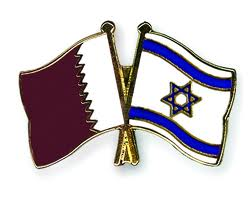
And what happened, of course, is that Israel and Qatar, together with Belarus and Portugal, came together in the next round.  Except that, when on July 7 the match was to have bee played, the Israeli had to wait in vain for their opponents.  I am not familiar with how the Qatari may have presented their explanations to the EHF and at what level their decision was instigated.  They were promptly penalized, not just through a default in this match but by being ‘kicked out’ from the rest of the event, prohibited from returning next year, and required to pay a fine.

Perhaps with that some will feel that the matter is finished, but I do not have that opinion.  We had a rather strange situation where Qatar voluntarily competed in an international event, but under the auspices of the EHF, not the IHF.  So the EHF, in return for its hospitality had to take on this issue, and the IHF was not having any formal role in the process.  I do not even know if the EHF in any way has specifically ‘reported’ the matter to the IHF.  Clearly the IHF is not showing any signs of dealing with the issue.

And such an issue would indeed be a hot potato for the IHF and its President.  I can testify that for years the handball of Israel has enjoyed a status of privilege at the highest level of the IHF.  Maybe it has something to do with Egyptian-Israeli relations.  (In fact, the tradition continues, in the form of an inexplicable nomination of ‘not very outstanding’ referees from Israel to a World Championship later this year…). 

A slightly similar situation happened in the past, when an IHF match delegate from Iran refused to accept an assignment in a World Championship game involving Israel.  On that occasion, the punishment was swift.  Of course, technically the culprit at that time was an individual IHF official, although one can imagine that the instructions came from ‘a higher level’.  Now we are talking about a decision involving a federation, Qatar, and its national team.  Clearly the responsibility rests with the federation and the highest sports and political authorities of the country.

Accordingly my question to the IHF and to the international handball family is:  how does this action square with the responsibility that Qatar has sought and been given, in terms of being nominated as the host for the 2015 Men’s World Championship???   Clearly, their infringement is not a minor one.  It goes very explicitly against one of the fundamental aspects of the IHF By-Laws, a clause stating that: “The IHF tolerates no discrimination on the basis of race, creed or political orientation.”  There is no credible alternative explanation for the failure of the Qatari team to take the court in the scheduled game against Israel.

So, can Qatar be allowed to remain the host for 2015 after this incident?   How can one trust that this country/federation will carry out all of its obligations?   How can one trust that all potential participants will be treated properly?  What would happen if the Israeli team somehow were to qualify for 2015?  As I see it, one should not accept reassurances from the Qatari, and then just wait and see.  In my personal opinion, what happened in Goteborg appears to have disqualified them as hosts of a World Championship!

post

Iceland’s women handball players breaking through internationally

EHF allows these weapons and uniforms???

As most people who follow international handball are well aware, it is never a surprise when the Icelandic men’s national team has success in World or European Championships.  But it has been more surprising that, in a country well-known for having a strong women’s emancipation, the Icelandic women handball players have not had many good showings internationally in the past.  However, it seems that a change is now coming.

Some thought that it was just a fluke that Iceland finally managed to qualify for the women’s European Championship in 2010.  This was achieved through a home-and-away qualification win against Austria.  It was suspected that this was perhaps more due to a temporary weakness in Austrian women’s handball, especially after Iceland went on to lose all its three matches in the group play in the European Championship.  But then one must note that the opponents were Russia, Montenegro and Croatia, and that the losses were not with really discouraging margins.

Nevertheless, it came as a bit of a shock when the result was announced from the Iceland home game in the qualifying against Ukraine last month.  Ukraine has really strong traditions on the women’s side; indeed the Soviet dominance during many decades in the past was largely due to the strength of the Ukrainians, led by the husband-wife team of Coach Turtchin and team captain and world-class player Turtchina.  So the 37-18 result was really remarkable.  And the Icelandic women seemed to have little difficulty in holding on in the away game, getting a 24-24 tie.

It was known that as a team seeded in the lowest performance row, Iceland had to expect to be drawn in a very tough group in the World Championship to be held in Brazil in December.  And it will certainly be tough.  Although four teams out of six will qualify from each preliminary group for the subsequent 1/8-finals, it would seem to require a miraculous performance from the Icelandic women in order to advance, now that we know the results of the draw.

The group, which will play its matches in Santos, is headed by Norway and also includes the new power team from Montenegro, the perennially strong African champions from Angola, Germany, and China.  Germany was almost a surprise qualifier after the disaster in the European Championship, so they will be determined to seek revenge.  And the Chinese women have come on strong after the surge in connection with the 2008 Olympics.  So to get ahead of two of these five teams will certainly not be easy. 

It should be noted that the upswing for the Icelandic women is not likely to be a temporary thing.  They had teams that in the ‘under-20’ and ‘under-18’ categories did really well in the qualifying stages, even if they failed to reach the final round in the 2011 European Championships.  In the younger category, they lost out on goal difference, having gained the same points as Spain and Croatia.  In the older category, they again lost again Spain and had a narrow defeat against Serbia, in a group played in Serbia.  So the clear impression is that there are many talent younger players making good progress towards the senior level.

If we then get to see the same fighting spirit from the women as the men traditionally have displayed, then the Icelandic team is likely to become a crowd favorite in Brazil and wherever they will be competing. We wish them the best of luck!

post

Ciudad Real is now Neptuno but plays in Madrid under the name Atletico!

Neptun(o) - larger than the world?

Last night it finally become clarified what will be the identity of the Spanish top club Ciudad Real in Spanish and EHF competition during the coming season.   On the basis of media reports, there was previously speculation of some kind of merger with football giant Real Madrid, as I commented in an earlier posting.   However, it has now been announced that the team will be appearing under the name of Real Madrid’s local rival Atletico Madrid instead.

I am chosing my words carefully, because it appears that we are talking about a one-year arrangement under which Atletico lends its name to the team of Ciudad Real.  But to make it more complicated, one should really say that the club Ciudad Real is now registered in Madrid as the club Neptuno.   And then Neptuno’s ‘senior’ team is allowed to use the name Atletico, which as I have commented earlier, has really proud traditions in the handball of Spain.

In this way, while the matches in the Spanish League and the EHF Champions League will be played in Madrid, possibly in Palacio de Deportes, the rest of the activities of the club Neptuno may well take place in the city of Ciudad Real.  So the players may continue to live there and and practice there, but when the time comes for the ‘home’ games, they will take their uniforms and travel to Madrid.

How this will be received in the city of Ciudad Real is perhaps not so certain.   Will the faithful fans travel with the team and continue to support them?   And whether the team will quickly be able to establish a fan base in Madrid is not so clear.  Presumably there is some dormant handball interest in the capital, so perhaps it will work out well.   By the way, it has not been mentioned whether the use of the name Atletico also means that the team will adopt the classic red-white stripes of Atletico…

Beyond this specific development, there is of course the more fundamental question of the economic viability of expensive, world-class handball in Spain.  Will the money be there to support top teams with highly-paid players from abroad, and will there be sponsors and resources that will allow some of the weaker team to stay alive?

There are also more systemic concerns.   The referees of the top league are still owed a large part of their remuneration from the 2010-11 season, and the Spanish Federation has had to step in to help out in the meantime.   This is only one reason why the situation between the Federation and the League is very tense. 

And the highest sports authorities of Spain are still having serious concerns about the whole idea of Spain being the organizer of the Men’s World’s Championship 2013.  Many of the planned host cities are having problems with the financing.   The Spanish Federation seems to have asked the IHF for a loan to bridge them over!  Who knows:  perhaps there is still a chance for France, the disppointed loser in the fight for the 2015 Championship, to get in ahead of Qatar by taking over 2013…

post

Brazil Women win gold with dominating performance

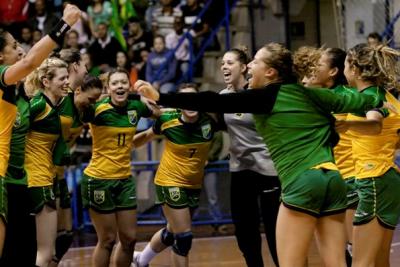
Brazilian women celebrate after easy win vs Argentina

Brazil easily defeated rival Argentina 35-16 on Saturday to win the Gold Medal at the Women’s Pan American Championships.  The contest was never in doubt as Brazil held Argentina scoreless for the first 13 minutes on the way to a 22-5 halftime lead.  Throughout the tournament, Brazil was clearly the best team with an average margin of victory of 19.2 goals.  The closest any team came was 15 goals by Cuba and Mexico in Group Play.

Looking ahead, the Brazilian women will be overwhelming favorites to win the Gold medal and Pan American Olympic spot at the PANAM Games in Guadalajara this October.  On top of that they also appear to be in good position for a breakthrough performance when they host the World Championships in December.  In 2009 they beat runner-up France in pool play, but then placed a disappointing 15th place after failing to qualify for the Main Round.  They’ve shown they can play with Europe’s best and with most of their roster now with several years of experience playing on top European clubs they know they have the talent.  Add the benefit of hosting the event a run to the semifinals is a distinct possibility.

With Brazil separating themselves from the rest of the pack it appears that the PATHF women’s team can currently be grouped as follows:

Tier 1:  Brazil
Tier 2: Argentina, Cuba
Tier 3: Uruguay, Chile, Dominican Republic
Tier 4: Mexico, Venezuela, Puerto Rico, USA, Canada

While it may be all but a foregone conclusion that Brazil will win Gold at the PANAM Games, the tournament does present an opportunity for teams to compete and show improvement against upper tier teams.  With Cuba not participating in the PANAM Games due to their decision not to play in the Central American and Caribbean there should be an interesting battle between the tier 3 (Uruguay, Chile and Dominican Republic) and tier 4 teams (Mexico, Puerto Rico and USA) for semifinal spots.  Beating Brazil and Argentina is not likely for those teams, but a bronze medal opportunity is certainly a possibility.


post

Brazil and Argentina meet yet again in a final; but Cuba causes the excitement

It happens quite often, when two semifinals are played one after the other, that great excitement is followed by an anticlimax.  This is what happened today in San Bernardo in the Panamerican Women’s Championship.  

Cuba had already offered a couple of great performances, but today they showed a tremendous determination and tenacity in the semifinal against the defending champions Argentina.  Early in the game, Argentina gained a 7-4 lead and a Cuban player was given a ‘red card’, so for the rest of the game they did not have more than eleven players available as compared with sixteen for Argentina.  But at least this is better than the seven they had in the first game of the event.  And their goalkeeper was putting up an absolutely spectacular performance.  So at half-time it was tied at 13-13 and the game continued to be close throughout the second half.   Cuba obtained a two-goal lead just before the end, but Argentina was able to tie the game at 28-28.

Double overtime followed.  Because after 5+5 minutes the score was 33-33.  And believe it or not, after an additional 5+5 minutes the scoreboard showed 38-38!  So on to a 7-meter shootout.  Here the more experienced Argentines finally managed to get the upper hand.  After the Cubans missed the third shot, hitting the crossbar, Argentina secured the win by scoring on both the fourth and the fifth throw.  In other words, the final result was 43-41.  Next after the Argentine team, perhaps the happiest ones were the Brazilian team.   They surely did not mind that their opponents in tomorrow’s final had to go through the drama of 80 minutes plus a shootout…   But the Cubans should be proud of their efforts.

In the second semifinal, Brazil had an easy time against Uruguay, just as expected.  The final result was 40-14!  When hosting an event and therefore having the right to choose a preliminary group, Brazil traditionally uses the tactic of taking the group with the stronger runner-up, in this case Cuba (or Chile) so that they can have an easier, safer semifinal…   So tomorrow we will have Brazil-Argentina in the final and Cuba-Uruguay in the bronze medal game.   All the four teams are already qualified for the World Championship.  In the 5th place game, Chile defeated the Dominican Republic by the score 28-22.  Mexico avoided last place by beating Venezuela 25-23, but both these teams will be relegated next time. 

Apropos my arguments yesterday about the tournament format:  I feel a bit sorry for Chile;  I think there are reasons to the believe that they are stronger than Uruguay and that they deserved to have a chance to be in the semifinal and, more important, in the World Championship.  But because of the format, they never got the chance to play against Uruguay.

post

Argentina, Cuba and Uruguay join Brazil at the Women’s World Championship

Cuba a nice surprise but Brazil seems stronger

After the completion of today’s matches in the preliminary round of the PanAmerican Women’s Championship, the teams qualifying from PanAmerica to the World Championship are already determined.  Argentina, Cuba and Uruguay will have to return to the Sao Paulo are in December.

Because Brazil is the host in December, PanAmerica will have a total of four slots, as Brazil does not count against the normal quota of three.  Therefore, as nobody has seriously expected Brazil to fail to reach the semifinals, it was generally assumed that placing first or second in the preliminary groups and thus qualifying for the semifinals would be enough for the other teams.  In fact, when I am posting this article, just before Brazil plays its final group game against Chile, I am still technically ‘speculating’.  But my assumptions would fail to be correct only if Brazil were to lose against Chile by 23 goals or more.  Should that happen, then I would politely suggest that Interpol would need to be asked to investigate.

Brazil won their group games against Mexico and Cuba as clearly as one would have expected.  Perhaps some had thought that Chile would be in contention for the second place.  But as John Ryan reported two days ago, Cuba shocked the Chileans in the opening match.  Having only 7 players available, the Cubans complete ‘steamrolled’ the Chileans.  And the Cuban women outclassed Mexico with 35-16 today, after having lost against Brazil yesterday.  Should we start speculating about Cuba having a good chance against the defending champion Argentina in the semi-final tomorrow!?  (It would have an impact on the seeding for the World Championship).

In the other group, Argentina did not really start out as champions.  They fell behind early and just barely managed to take the lead against Uruguay before half-time.  The final result was 21-14.  Then came a comfortably win against Venezuela, and today’s seemingly easy win against the Dominican Republic may suggest that Argentina has found the form.  The excitement in this group was set up with a draw (20-20) between Uruguay and the Dominican Republic yesterday.  After Uruguay won 43-27 against Venezuela after a nervous opening in today’s first game, they then had to rely on Argentina to win by at least five or six goals against the Dominican Republic.  But it seems the suspense came to an end early, as Argentina had 14-6 at half-time and then went on to win by 33-16.

We will come back on Saturday with a summary of the final results, and also an overview of the draw for the World Championship which will be undertaken immediately afterwards.   But the way this event evolved so far makes it impossible for me to refrain from mentioning an idea that I have tried many times to convince the PanAmerican leaders about.  The tournament format is always the same, with two groups of four and then semifinals and medal games.  And the situation with qualifying for the World Championship is always the same, with either three or four teams qualifying.

In other words, the real drama is not so much around the final, or even about which teams will play in the final, because almost always in recent years it has been Argentina-Brazil.  So it seems that every effort should be made to ensure that the next best teams really get a chance to be in the semifinals, rather than having one of them eliminated after the preliminary round by placing third there.  We know that the strength of the teams is unpredictable from one event to the next.  So the seemingly better approach would be to have the group winners go directly to the final, and to have the ‘crossovers’ between second-placed against third-placed and vice versa.  Then we would feel sure that we knew who were really the deserving teams in the number three and number four positions.  But perhaps Cuba will be the exception that proves me wrong tomorrow!  Until Saturday…