post

Women’s PATHF Championship Update: Iron Women Cubans demolish Chile with just 7 players


7 Iron Women from Cuba played all 60 minutes vs Chile

The 2011 Elite Women’s Pan American Team Handball Federation (PATHF) Championships are underway in Brazil with the expected favorites having little trouble in the first round of matches.  Of particular note, though, was Cuba’s 40-21 thrashing of Chile with only 7 players.  It’s not clear as to why the Cubans decided to have their team travel in two separate groups, but it’s clear they sent the right 7 players first.  The “Iron Women 7” arrived in Brazil on Tuesday and apparently didn’t take long to find their rhythm as the game was never in doubt.  Argentina, Brazil and the Dominican Republic also had relatively easy wins.

The top 3 teams (not counting Brazil- already qualified) will qualify for the World Championships to held later this December in Brazil.

Mundo Handball:  Cuba will play the first match of Pan American Championships with only 7 players: http://www.mundohandball.com/articulos/cuba-jugara-el-primer-partido-del-panam-solo-con-7-jugadoras

PATHF Twitter Feed:  https://twitter.com/#!/panamhandball (includes a live and taped video feed- Not the highest quality, but our compliments to PATHF for their efforts to provide fans with this option.)

PATHF Competition Page: http://www.panamhandball.org/index.php?option=com_joomleague&func=showResultsRank&layout=bydiv&p=28&Itemid=65

post

IHF President insists on undermining the refereeing at the World Championships

It is frustrating and disappointing to feel obliged to write yet again about a theme that I had hoped would be dead and buried.  But it is now ‘strongly rumored’ that the IHF President appears to insist on enforcing his personal and absurd ideas on the refereeing in the Youth and Junior World Championships.

I am talking about his persistence about splitting up well-established referees couples from around the world and suddenly using them in ‘mixed’ couples during the most important events for them and teams. 

As I have noted before, there is nothing ‘holy’ about the idea of permanent couples.  Mixed couples (or trios) function in basketball.  So even if the mutual familiarity and teamwork within the couple are critical for good performances of handball referees, it is theoretically possible that mixed couples could function in handball also.  But, this would be dependent on a worldwide agreement to change the current system, and instead start bringing up young referees in the habit of constantly changing partners.  In this way, they would be completely used to the method, if one day they were nominated to a World Championship.

However, we currently have a system under which referees around the world become used to a fixed partner, as they climb the career ladder up to the international level.  This means that they know each other and trust each other completely.  They have the same interpretations, and they know what to expect in each situation.  Clearly this facilitates quick and accurate decision-making in hectic moments.

Moreover, in recent years, the IHF and many continental/national federations have had their top referees use headsets and wireless communication to be in constant contact with each other.  This obviously depends on quick and easy verbal exchanges that would be totally undermined when two referees of different nationalities and native languages are put together. 

Again, if one wanted to experiment with an approach based on mixed couples, to investigate the desirability of a complete change in the future, then they are safe events where this could be done.  The reason why this is not happening is that no major handball federations are interested in the idea and that the IHF President has not had the courage to try to convince them.

But in any case it is obvious that this kind of experiment does not belong in a World Championship.  On previous occasions, when the IHF President came with the same idea, the participating federations joined together and refused to accept this inappropriate experiment.  One would hope that either this happens again, or that somebody can convince the President to stop the nonsense.  But I am not so optimistic.  The reason is that the President, as always, is sure that “he knows best” and that nobody can stop him…

post

Summer topics in Europe

Whenever someone has the resources and the determination to take new initiatives, it always tends to cause a stir, with both support and criticism.  Jesper Nielsen, a wealthy Danish businessman has the financial capacity to go against prevailing trends of cut-backs and economic worries in European club handball.  He is able, as an owner and sponsor, to keep two strong teams going, AG Kopenhamn and Rhein-Neckar-Lowen, but not without controversy.

OF course, it gives the European Handball Federation (EHF) some headaches, when the issue related to dual ownership comes up.  In theory at least, there seems to be some scope for manipulation, if clubs that are participating in the same event, such as the Champions League, are under the same management.  But there is also some agitation in Germany, where the R-N-L manager Thorsten Storm has criticized his boss for giving lower priority to the German club in favor of AGK.   Storm has expressed concerns that R-N-L has not been getting the resources and the attention that the club needs and deserves.  Instead, top players, such as Olafur Stefansson, are now moving from R-N-L to AGK.

And despite the excitement that the emergence of AGK has created in Denmark, there are very much mixed feelings about having the men’s league dominated too strongly by one team.  The financial status and the competitiveness of the Danish league are seen as depending on the excitement generated by a tough and close competition for the title and the top positions among several more or less equal teams.  And of course, a little bit of envy may also have something to do with negative reactions.

Moving on to Spain, perhaps a little bit of parity is on the horizon, after what has become known about the financial problems of the two totally dominating clubs in recent years, namely Ciudad Real and Barcelona.  We are probably only days away from a decision regarding Ciudud Real and a seemingly unavoidable move to Madrid.  But contrary to what I commented on in a recent article, it now seems that the best bet is a merger, not with Real Madrid but with football rival Atletico Madrid.  This of course offers an interesting twist, as in fact Atletico Madrid was a handball team with great traditions as the dominating club in the 1960s and again in the 1980s.  Famous coaches, such as the Domingo Barcenas and the current Federation president Juan de Dios Roman Seco combined with Spanish and international star players to gain numerous League championships and cup wins.

Barcelona’s triumph in the handball Champions League may have made it impossible for the football-focused club management to mistreat handball completely.  But a major budget cut-back seems already decided.  The expenses for the football team have sky-rocketed, due to both successful and disastrous player acquisitions.  It was noted that the net loss after the initial purchase and subsequent bargain sale of Ibrahimovic was in the order of 40-50 million Euros, which is much more than the entire budget for handball.  So now handball and basketball will be treated much less generously (and baseball is eliminated altogether), and what this might mean in terms of the ability to keep a generously staffed and paid handball team, with many international imports, is hard to predict.

The EHF has also had some concerns about developments in other ‘corners’ or Europe.  In most parts of the former Yugoslavia, there has been a strong interest in cooperating around a regional league, which would provide some interesting competition not just for the top clubs but also for those who miss out on the top EHF events.  Slovenian clubs seem to prefer to focus on their own league, and the top Hungarian clubs have also declined invitations.  Instead, Tatran Presov from Slovakia (who would need to win a qualifying group in order to be in the EHF Champions League) would like to take part.  Some interest also seems to exist in Poland, especially on the part of Kielce, who have a seemingly very strong team but stilled managed to miss the Polish title and the chance to participate again in Champions League.

However, it appears that the EHF has asserted its privileges regarding ‘cross-border’ competitions.  It would not seem possible to deny neighboring countries the chance to organize an exchange on an ongoing basis, but the intended participation of precisely Tatran, a non-neighbor of the Balkan countries, seemed to give the EHF a basis for stepping in.  Apart from this particular league, which had preferred to shed its ‘Balkan’ label, for the more flexible name ‘Southeastern Handball Association’, there are similar regional efforts among the Baltic countries and the BeNeLux, whose clubs rarely get very far in EHF competitions.  Apart from the principles involved, and the obvious reluctance to encourage rivaling events, it seems that the EHF also might have some concerns about the image issues that could follow from a potential lack of discipline, poor crowd control and shaky refereeing in some region.

post

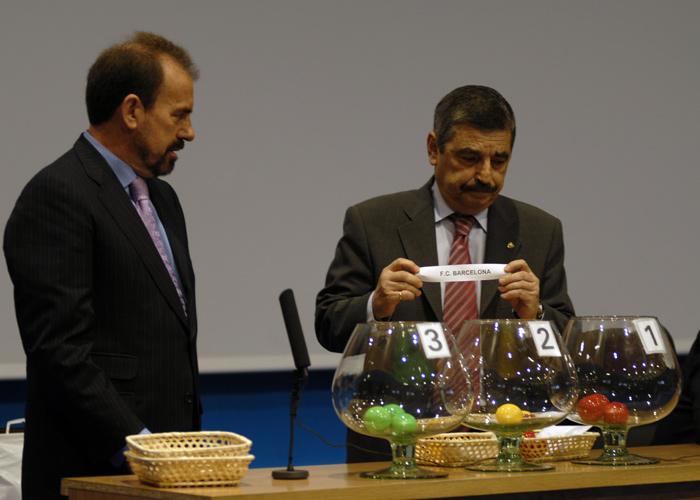
Is the draw more exciting than the event itself?

Is this when the medals are decided?

Of course I must admit that sometimes I have started speculating about an event when I have seen the result of the draw.   And it is of course legitimate to discuss what might happen, even if the event in question will not take place for another six months.  But sometimes the euphoria seems a bit excessive, and one almost gets the impression that the media create a hype to have something to get excited about and write about when there is no event currently going on.

But it then seems to go a bit far when team representatives are being interviewed, and much of the story is focused on bad luck in draw, or unfairness in the seeding even before the draw has been made, seemingly to create some excuses for the possibility of bad results when the event finally takes place.  Examples of this artificial excitement have been seen recently, during the month of June, when the draw for the Men’s European Championship in January 2012 took place, and when the seeding both for the Women’s World Championship in December and for the EHF 2011-12 Champions League were announced.

We all know that the preliminary round of the Men’s European Championship is always very tough, typically with 14-15 really strong teams out of 15.  So even of three teams from each group of four go on to the next round, it is critical first to have some relative luck with opponents in that first round, and then, when looking ahead, also with the teams placed in the neighboring group on the same half.  I cannot remember having such a unanimous sigh of relief as among the four teams in Group B:  Germany, Sweden, Czech Rep., and FYRO Macedonia.  They were in a sense insulting each other by talking excitedly about how lucky they had been.  I would not want to be the part of the team that fails to qualify from that group.  What possible excuses will they have?  Perhaps the bad referees…

By contrast, there has to be a ‘group of death’ in every event.  And if perennial champions France and recent bronze medal winners Spain are drawn in the same group, that certainly is enough,  And if you add Russia and Hungary to that mix, then one can understand if the optimism is not so great.  If one then, like France and Spain undoubtedly want to do, look ahead to the next stage, it is not exactly reassuring to know that three out of the group with Croatia, Island, Norway and Slovenia will be waiting there.  In Slovenia they talk especially about the game against Croatia, but in Croatia they seem to be more concerned about the tough battle they always seem to have against Iceland.

On the women’s side, the draw will not take place until July 2, when the PanAmerican Championship finishes.  But there has already been some grumbling about the caprices of how the teams have been placed in seeding groups.  The second category finds Kazakhstan mixed in with Denmark and France, while the unpredictable opponents from Angola and Brazil are on the third line.  Germany, who were a surprise qualifier against Hungary, after the dismal exit from the European Championship, now find themselves down on the fourth line together with Korea.  Which team from a higher level would want to see Korea being drawn into their group?  Finally, China and Spain have had to accept a fifth-level seed, but they are surely capable of causing surprises.  So the final draw will surely be a nerve-racking affair for the participants and their supporters.

Finally, the seeding of the men’s teams for the next Champions League has already created a stir.  First, of course, there was the issue of which teams would be allowed to compete for the wild-card entry.  For some reasons that are hard to understand, the EHF open mentioned five candidates for four slots, and then went ahead and left one team out without any clear criteria.  But perhaps Skjern on the men’s side were being ‘punished’ for the fact that their Danish compatriots Viborg were given a wild card chance on the women’s side.

As the draw is not directly based on the relative qualities and results of the individual team but rather on the rankings within the countries, there are some seemingly odd outcomes.  For instance, Chekhovski and Montpellier were placed in category 1, whole Ciudad Real and Kiel had to accept line 3.  And in between there are teams like Veszprem, Croatia and AG on line 2.  But the lack of grumbling may have been the effect of the EHF’s rules being clear, which they apparently were not for the Men’s EURO 2012. 

What makes the draw a little bit anticlimactic is that, just as was the case in 2010-11, there seems to be a demarcation between the top 16 team and the eight teams that will complete the groups.  In other words, it might not matter much for the better teams which group they are drawn in, because as long as four teams out six advance, there is not too much of a risk for them.  The risk is instead, for neutral observers who simply want some excitement, that again the whole group phase will be a long, boring ‘transportation stage’.  Let’s keep our fingers crossed for some surprises and unexpected thrills.

post

Ciudad Real Madrid: can that be for real??

A Real Dilemma

It is not exactly a secret that the overall economic situation in Spain is very shaky.  The country has allowed itself to live above its means for quite some time (just like in so many other countries, including the U.S.) so the situation is simply not sustainable.  Budgets have to be tightened, expenditures have to be reduced, and loans cannot easily be had.  In this context, spending money on ‘luxuries’ such as sports at the elite level, or on expensive forms of art and culture, is no longer so easy. 

So not long after we celebrated Barcelona’s Champions League successes in football and handball, together with top performances also by Real Madrid in football and Ciudad Real in handball, doomsday prophecies are beginning to be heard.   Of course, these top clubs may be the ones who can hold out the longest, whereas the smaller, less resourceful clubs are the ones who already feel the budget crunch.

It is almost too easy to find reports in Spanish media about handball clubs in the top league ASOBAL who have not been able to pay their players for several months and have debts to tune of a couple of million Euros.  Some clubs have been given an ultimatum and a deadline;  unless the debts are paid off, the clubs will be forced to move down from the top division.  This includes, among others, the traditional top club Granollers, which was the positive surprise of the past season, at least in terms of game performances.

There is not exactly a line of clubs waiting to take up positions that may become vacant.  Both the clubs that were relegated and those who narrowly failed to gain promotion seem unable to meet the requirements for a season at the top level.   In any event, some experts suggest that a consolidation into a smaller top division might be the healthiest approach in any case.

So what about the two top clubs, Barcelona and Ciudad Real?  One might not be ready to believe that Barcelona would have any financial problems.  But attracting the players needed to form such a strong team is an expensive affair, so the football section of the club incurred major losses.  There is now a decision that the previously generous support for other sports, such as handball, will suffer a major cut-back.   What this might mean for the handball team’s ability to retain and recruit star players is uncertain. 

But the situation seems even more acute for Ciudad Real.  This club is all about handball.  And it is a club from a small town with a very modest basis for a team at the international top level.  (Some people have mistakenly thought that it is a Madrid club, but Ciudad Real is a town of about 75.000 inhabitants, located 200km south of Madrid).  It has a rich history and was once prominent, but that was a few hundred years ago.  And its most famous personality, together with the club’s owner Domingo Diaz de Mera, is none other than Don Quixote…!  And now it has become known that the clubs totally dominant sponsor is backing out.

While some might think that this just means that Diaz de Mera will have to thrown in more of his own money, these days seem to be over.  In fact, there are instead reports about a merger with some well-known football club, initially Atletico Madrid.   And then suddenly there are indications that the football archrival in the capital, Real Madrid might also be interested.  Real already has a strong basketball section in addition to the football team.  Perhaps it seems that a club from Ciudad Real fits in better with Real than Atletico Madrid.  (As it happens, the football training facilities for Real Madrid are named precisely Ciudad Real Madrid…)

It will be interesting to follow these developments.  It may be that both Barcelona and Ciudad Real will be able to survive as the dominant handball clubs of Spain in some form.  But being dominant in a much shakier ASOBAL may no longer be such a good environment, and it may not translate into remaining dominant by European standards.  One topic of speculation, with different opinions attached, is that at least the ability to recruit well-known players from other countries may be substantially reduced.  While this may initially lower the quality, it would mean a major increase in opportunities for young Spanish players.  The beneficiary might then be the Spanish national team, and Heiner Brand’s concerns and ideas regarding Germany may end up being tested in Spain.  We will see how it all develops!

post

Icelandic handball still going strong

The real border line between America and Europe??

I am just back from a week of sightseeing on Iceland, but I also managed to fit in a handball game, namely the final European qualifying game between Iceland and Austria.  Moreover, I had the opportunity to meet with some of my old handball friends.

The game rather quickly became a bit anticlimactic.  Iceland needed to win the game in order to qualify, so there were some nerves involved prior to the game.  But soon it became clear that Iceland had regained some of that fighting spirit that seemed missing in the World Championship earlier this year.  Their defensive play, including the goalkeeping, was really solid and the Austrians became increasingly desperate.  The Icelandic team also managed to use their own chances very efficiently, so the final result 44-29 really reflected the action quite well.  The Reykjavik handball arena is rather small, with room for only 2500-3000 spectators; but a different way to look at it is that one percent of the entire population of the country was there to watch the game and cheer on their favorites frantically.

Iceland relied mostly on their experienced players.  Thirteen of the players from the World Championship were on the team, most of them at age 30 or above.  Only goalkeeper Bjorgvin Gustavsson (25) and Aron Palmarsson (20) have yet to acquire veteran status.  Three younger players who are still playing for Icelandic clubs had also been added to the squad, and they got a chance to get out on the court in the final minutes.

More generally, my Icelandic friends described a situation where the flow of new, young talents continues undiminished.  The ‘U-21’ team narrowly lost in their World Championship qualifying, having to play Serbia at their home court.  And the Icelandic league continues to remain competitive, at least among the top 4-6 teams, despite the fact that no less than almost 60 men’s players are enrolled in clubs abroad, with about half of them in Germany. 

I pointedly noted that we are seeing talented Icelandic athletes joining American universities on basketball scholarships;  does this in any way suggested that handball is losing its dominating position in Iceland?  My friends, who are obviously a bit biased, offered a somewhat joking explanation:  if a young talent absolutely wants to study in the U.S., then they reluctantly have to choose basketball;  or else the explanation is that they realize that they simply do not have the talent to make it to the top in handball…

The men’s champion of the 2010-11 season in Iceland was FH (from the Reykjavik suburb of Hafnarfjordur) who beat Akureyri (from the North Coast) with 3 games to 1 in the play-off finals, thus reversing the positions from the regular season.  FH will now participate in the qualifying round of the EHF Champions League.  The other two teams in the play-offs was the Reykjavik club Fram and HK Kopavogur.  The traditionally strong clubs Haukar and Valur finished next in line.

By the way, veterans Olafur Stefansson and Gudjon Sigurdsson are moving from Rhein-Neckar Lowen to AG Copenhagen for 2011-12, a move that has upset the Germans and has highlighted the complications arising from the fact that both clubs have the same Danish owner.  On the other hand, goalie Gustavsson is moving from Switzerland to Magdeburg.

Further to the remarkable feat of Icelandic handball to place so many players in top clubs abroad, one should also remember how many top coaches are working in exile.  Gudmundur Gudmundsson, Alfred Gislason and Dagur Sigurdsson may be the most prominent names due their work with top clubs in the Bundesliga, but one should also mention Thorir Hergeirsson who is in charge of the strong women’s national team in Norway.  In total, about 15 Icelandic coaches are active abroad.  By the way, I got some informal comments that the EHF punishment of Gislason had fallen well short of what had been expected in Icelandic handball circles.

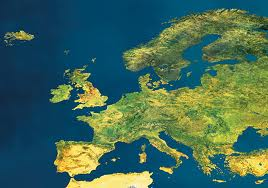
Finally, as some of our (Pan)American readers are aware, there has been an ongoing debate about the legitimacy of an IHF decision to assign Greenland to the PanAmerican continent.   But I got a clue during my visit that, in fact, the IHF may have had more of a tangible, scientific basis for this decision than what may have been understood.  If anything, the question might arise whether one should really consider Iceland as a part of PanAmerica as well. 

The photo at the top provides the clarification.  Iceland sits atop the ‘Mid-Atlantic Ridge’, which separates the North American and Eurasian tectonic plates;  these are moving apart in a process known as the ‘continental drift’.  This drifting is related to earthquakes and tremors, and perhaps also to volcanic eruptions.  Nowhere is this division as visible as some distance east of Reykjavik, in the area of Thingvellir, where the Icelandic Parliament was established in the year of 930.  So perhaps we should take some credit and argue that most of the Icelandic handball players should in fact be considered ‘American’!?  At least perhaps, apropos John Ryan’s recent articles on the topic, they might qualify for dual citizenship!

 P.S.  If you wonder why there is not one word about women’s handball above, that is because I felt that the belated but remarkable progress on Icelandic women’s handball at the international level warrants a separate article that will come soon!

post

Qualification Update

All but 3 teams have now qualified for the Women's World Championship in Brazil this December

The last two weeks included several qualification matches for the Women’s 2011 World Championship and the Men’s 2012 European Championship.  Both events will play a part in the eventual qualification for the 2012 Olympics.  To see which teams have moved closer towards a slot in London check our updated “Qualification Pages” on the right hand side of the page.

post

NBC buys Olympic Team Handball through 2020: Will they capitalize on that purchase?

A re-imagined home page for www.universalsports.com

On Tuesday, NBC outbid ESPN and Fox for the U.S. TV rights for the 2014, 2016, 2018 and 2020 Olympics for $4.38 billion dollars.  That’s $4,380,000,000, or as I like to say a lot of “zeroes”.   And part of that purchase is the right to broadcast the Team Handball competition at the 2016 and 2020 Olympics.  It’s highly doubtful that Team Handball factored into NBC’s winning bid, but that point is moot.  Regardless, they own Team Handball’s most prominent showcase in the U.S.  Which leads to a couple of questions:

Will NBC broadcast more Team Handball in the upcoming Olympics?

To NBC’s credit they pretty much web streamed every men’s and women’s match in 2008.  Broadcast TV options, however, were somewhat limited.  While more Team Handball was shown than ever before most of it was broadcast on the Life and Bravo networks.  True devotees could find it, but the “stumble upon” opportunity for new fans was pretty small.  With the recent merger of NBC and Comcast, however, NBC will have more channels to broadcast events like Team Handball and it wouldn’t surprise me if the packaging of sports like Team Handball, Field Hockey, sailing, etc is more consistent.  So, yes, I think we’ll get more coverage in London, Rio and 2020.

Will NBC broadcast Team Handball outside of the Olympics?

While it’s nice to get the Olympic stage every four years in the U.S., the bigger question is what will happen in between Olympics.  As anyone who follows Team Handball in the U.S. knows the sport receives very little exposure on TV.  Baby steps have been made like the Comcast broadcast of the Germany-Poland match in 2010, German Bundesliga matches on the My Sports Germany channel and the Mhz network’s broadcast of the EHF Game of the Week this past season.  All well and good, but again these options have limited market penetration and are more for the true devotees than potential new fans.  To really spur the sports growth in the U.S. a committed patron willing to showcase the sport on a major network is needed.  Will NBC be that network?

There’s at least a chance they will be.  Buried in the reporting of the NBC victory, was a small snippet (only reported in a few media outlets) that the contract allows for the creation of an Olympic Channel if NBC, the USOC, and IOC can come to an agreement.  You might recall that back in 2009 the USOC trumpeted the creation of an Olympic Channel agreement with Comcast (which was then a separate entity from NBC).  Less than a year later, however, the USOC sheepishly shelved the project due primarily to NBC and the IOC both expressing displeasure with the USOC going at it alone.

A year later the landscape has changed dramatically.  NBC and Comcast are now a merged company and that merged company has bought the Olympics through 2020. The USOC is playing nice with the IOC and is planning to renegotiate the USOC’s financial share of U.S. Olympic TV rights.

Moreover, NBC has shown just how well they can promote a low profile sport if they put their mind to it.  Back in February, I wrote an article profiling what they are doing for Rugby 7s with their annual World Series event in Las Vegas.  Just this past weekend they showed several hours of a collegiate rugby 7s tournament in Philadelphia on NBC, the Versus network, and the Universal Sports channel, which has a web streaming and
broadcast presence.  In fact, I would venture to guess that this Universal Sports channel will soon be rebranded the Olympic Channel.

And it doesn’t take much to imagine Team Handball getting a presence on this web page.  Hence, my doctored photo of their homepage.  While it might have been expensive for NBC to travel to Guatemala for a Team Handball qualifier there’s plenty of content available which would have minimum production cost.  The EHF Champions League, the German Bundesliga, the World and European Championships, next spring’s Olympic qualifying tournaments.  Throw in a few events where the U.S. is participating and you have a nice channel to complement the rugby, cycling, and swimming options.

I know you’ve heard this before so many times.  But, Team Handball will sooner or later have a place in the American sporting consciousness.  It won’t take up as much space as our major sports, but if there’s room for Rugby 7s, lacrosse, etc., there’s room for Team Handball.  Here’s hoping that NBC will see the light.

Broadcasting and Cable (7 Jun 11) Confirmed: NBC Universal Wins Bidding for Olympic Games: http://www.broadcastingcable.com/article/469360-Confirmed_NBCUniversal_Wins_Bidding_for_Olympic_Games.php

THN (9 Jul): Olympic TV channel set to launch after 2010 Olympics: https://teamhandballnews.com/2009/07/olympic-tv-channel-set-to-launch-after-2010-olympics/

THN (1 May 10): U.S. Olympic Channel venture officially over:  https://teamhandballnews.com/2010/05/u-s-olympic-channel-venture-officially-over/

THN (28 Feb 11): Promoting Team Handball in the U.S. (Part 1): Las Vegas Rugby 7s Tournament: Undoubtedly, a model to follow: https://teamhandballnews.com/2011/02/promoting-team-handball-in-the-u-s-part-1-las-vegas-rugby-7s-tournament-undoubtedly-a-model-to-follow/

THN (12 Mar 11): Promoting Team Handball in the U.S. (Part 2): How is Rugby getting promotion done right?: https://teamhandballnews.com/2011/03/promoting-team-handball-in-the-u-s-part-2-how-is-rugby-getting-promotion-done-right/

post

Bahrain and the situation of the athletes: do not think the problems are gone!

Partners in efforts to achieve change?

In recent weeks, much of the focus of the world has been on developments in Libya, Syria and Yemen.  By contrast, events in Bahrain have received comparatively much less attention.  One could easily be deceived to think that all the problems there are gone.  Then on June 1, the Bahraini government lifted its martial law decree, an action that was intended to signal an end to the violent crackdown against the Shiite opposition.  Conveniently, some people took this a sign that one could adopt a ‘business as usual’ attitude in the relations to Iran.

For instance, the Federation of Motorsports (FIA) quickly announced that the Formula 1 Grand Prix race that had been cancelled would now be reinstated in October, although there is some hope that the racing companies may not play along.  This may not be such a big issue for the racing world, but it certainly is a big deal for the Bahraini government.  This event is a matter of great pride for them, and very symbolic for their acceptance in the world of sports and business.  When I was visiting there, I was taken to the racing course, which for them is one of their most famous attractions. 

Both international observers and human rights activist within Bahrain have reacted with dismay.  Things are not suddenly back to normal, not even by Bahraini standards, just because of the June 1 decision.  Yes, a number of people have been let out of jail, many with physical and mental scars for life after brutal treatment.  A number of well-known athletes and sports journalists are among those who have been set free.  But many others remain in prison, like some national team players and top referees in handball and football, together with their counterparts in many other sports.

Of course, the Vice President of the Football Federation argued that those who remain in jail are not just protesters but criminals.  Accordingly, FIFA should have no business trying to inquire or get involved.  This football VP happens to be a prominent member of the ruling royal family, so he should know…  But my sources in Bahrain suggest that those who remain in jail are actually kept their almost as hostages or symbols, as a deterrent to the rest of the population.  Of course, as I have noted earlier, the regime has nothing to fear from entities such as IOC or FIFA.  Their habitual interference at the national level does not appear to extend to the countries or regions where the members of the ruling families are well entrenched in the IOC and international sports federations. 

On June 23, we are yet again supposed to have a global celebration of Olympic Day, a reminder to everyone around the world about the importance of the Olympic spirit.  This involves major sports and cultural events intended to ‘spread the Olympic ideals to every corner of the world’.  A map on the IOC web site shows that apparently no such events have been scheduled on the Arabian Peninsula.  Perhaps this is appropriate in the circumstances.  I have no disagreement with the notion of having an Olympic Day.  But perhaps it behooves the IOC also to set aside a special day in commemoration of those events and places where the Olympic spirit has been egregiously abused.

Clearly, just as I noted in my earlier article, athletes and sports officials are far from the only categories singled out for harsh treatment. What seems to me as especially outrageous is the persecution of medical doctors and nurses who lived up to their professional oath during the uprisings, treating people on both sides to the best of their ability, both in the streets and in the hospitals.  For their decisions to treat those who protested against the government, they are now imprisoned or mistreated in a highly targeted fashion.  Some of them are facing secret trials accused of treason.

So when President Obama met with the Crown Prince of Bahrain at the White House a couple of days ago, there were indeed serious matters to be discussed.  The U.S. government has been observed to tread very gingerly in the case of Bahrain.  And of course, it is ironic that the dialog was with the Crown Prince.  I am sure that he was delighted to back in Washington, despite the reasons and circumstances.  This is the place where he attended university and enjoyed the environment, as he enthusiastically told me some years ago.  And I am convinced of the veracity of everything that has been said about him as the member of the royal family who is a person of reason with a sense for democratic principles.  But he remains a ‘junior’ member of a family seemingly dominated by his retrograde uncle, the Prime Minister.  So it was appropriate, but nevertheless remarkable, that the Prime Minister’s attitude was openly subjected to criticism during the Crown Prince’s visit.

One can hope that both the open criticism and what is undoubtedly being conveyed behind the scenes will have some impact.  But it is naturally far too early to tell.  And in the meantime, representatives of the worlds of sports, business and politics would do well to refrain from prematurely resuming their affairs with the Bahraini regime.  On the contrary, it is necessary to keep up the pressure and show that their behavior is not tolerated.  At least there is a slight hope that this might have some positive effect for those still being persecuted!

post

Fatsis requests more Team Handball, ehfTV delivers!

Will German Coach Heiner Brand go out a winner?

There’s little doubt that NPR’s Stefan Fatsis, is America’s #1 mainstream media reporter Team Handball fan. Just this past Monday, Fatsis gave a shout out (starts at 58:15) to the USA Men’s National Team for their qualification for the PANAM Games and at the same time put out a plea for more Team Handball viewing opportunities. Well what Fatsis requests, the European Handball Federation (EHF) delivers. And in a big way starting on Wednesday with 2 critical European Championship Qualification matches webstreamed for free at ehfTV.com

European Qualification for Team Handball can often be a humdrum affair with top teams quickly distancing themselves from weaker teams in their group leading to inconsequential games in the final rounds. Not so in Group 5 this year as Austria, Germany and Iceland are locked in a 3 way battle for two spots. All three sides control their own destiny and the first pivotal match will be Austria hosting German Wednesday night.  Austria leads the group with 7 points and Germany is in 2nd place with 5 points. An Austria win would qualify Austria and put Germany in a dire straight as Iceland, currently in 3rd place with 4 points will likely knock off winless Latvia to move into in 2nd place with 6 points. Germany, in all likelihood will pick up 2 points from Latvia on Sunday as well, but then they will need an already qualified Austria to knock off Iceland in Iceland. So, translation: This is must not lose situation for Germany. (Also, based on goal differential for a three way tie, Germany would be in good shape with a draw)

But it’s also a key match for Austria, because they surely know that beating Germany in Innsbruck is going to be a whole lot easier then beating Iceland in Reykjavik. Should Austria lose to Germany the Iceland-Austria on Sunday will become a true elimination game with the winner punching a ticket to the EURO 2012 and the loser staying home.

The 3rd match has Lithuania hosting Spain. At first glance, this looks to be a showdown between two sides fighting for one remaining spot. And indeed both sides are level on 4 points. Only problem is that Spain is clearly a better side (they won the first head to head match in Spain 33-17) and Lithuania has to travel to Croatia on Sunday. So, even if Lithuania pulls off the upset, they’ll likely need Spain to lose again to Romania.

Handicap point spread in parenthesis

Wednesday, 8 June, 2011, 2015 CET (1415 US East Coast)
Germany (-1.5) at Austria
ehfTV On Demand: http://www.ehftv.com/ech/adults/men/2012/video/001751

AUDIO Commentary popup is below (Synch with the ehfTV video webstream)

Thursday, 9 June, 2011, 1845 CET (1245 US East Coast)
Spain (-6.5) at Lithuania
ehfTV Live Link: http://www.ehftv.com/ech/adults/men/2012/live/high/001750
ehfTV On Demand: http://www.ehftv.com/ech/adults/men/2012/video/001750

Sunday, 12 June, 2011, 1630 (Iceland Time) (1230 US East Coast)
Austria at Iceland
ehfTV Live Link: http://www.ehftv.com/ech/adults/men/2012/live/high/001752
ehfTV On Demand:http://www.ehftv.com/ech/adults/men/2012/video/001752

Subject to the on demand streams being posted in timely manner and the demands of the Ryan family household I will do an audio commentary of the Austria matches.

Stefan Fatsis article in NY Times (11 May 2009) Team Handball Has It All…: http://www.stefanfatsis.com/2009/05/11/team-handball-has-it-all/


post

Handball vs. football: part 2 – Champions League in Corruption: FIFA or IHF?

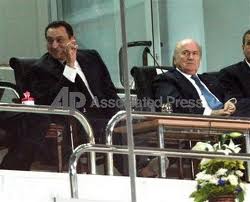
Mubarak and Blatter: unfortunate choices as role models for the IHF

My colleague John Ryan admits that he does not follow football very closely, so he may have missed much of the commotion leading up to the recent FIFA Election Congress, last year’s decision to award Russia and Qatar the rights to organize the 2018 and 2022 World Championships, and the last 30 years of constant accusations or rumors of rampant corruption.   So John is prepared to declare the IHF Champion of corruption and mismanagement.  I disagree:  FIFA is in a class by itself!  But our readers should feel free to weigh in with their opinions on this sordid comparison.

I have done my share of reporting about IHF power abuse and corruption, so I will only quickly remind about some of the stories here without repeating any details.  In 2008, the IHF President personally figured in a ‘less than flattering way’ in terms of personal involvement in the match fixing in the Asian qualifications for the Olympics.  Last year, media reported about a personal contract for the President to the tune of 600.000 Euro, in return for the awarding of the TV rights contract to Sportfive at the time.  Soon thereafter, persistent rumors were heard about illegitimate procedures regarding the awarding of the subsequent TV rights contract to UFA.  IOC President Rogge was reported to be less than pleased.

Then came the easy decision by the IHF Council to change the President’s status, from that of an elected official serving as a volunteer, to that of a full-time paid IHF employee at a salary in the order of US$ 500.000.  Neatly, this coincided with a proposal for the Council members to have their own remuneration quadrupled or more.  The two very competent office managers, the Head of Sports and the Head of Administration, were eased out and replaced by President himself and his long-time crony and compatriot as the persons running the IHF Office and supervising all activities.

First proposed for the postponed 2010 Congress and then again for the recent 2011 Congress, came a set of proposals for By-Law changes that would have legitimized a major power grab for the IHF and the President personally, at the expense of handball’s global stakeholders.  Fortunately, and almost surprisingly, there were enough alert Congress participants who saw through this attempt and managed to put a stop to it.  Virtually unchecked decision-making authority and control over the financial transactions would otherwise have been the result.  I understand John Ryan, if he feels that this list from just the last few years is ‘impressive’ enough to make the IHF a strong contender…

When looking at the record of FIFA one must backtrack a bit and provide some background.  Former President Havelange came into power in 1974, essentially through the ‘machinations’ of the then Adidas boss Horst Dassler, who was using his position in the world of sports business.  Dassler later also got his protégé Sepp Blatter into FIFA as the Secretary General.  Blatter soon began to cast his eyes on the presidency, and it became apparent that he had acquired the necessary ‘business acumen’ to achieve that promotion.  In the meantime, the sports marketing firm started by Dassler, ISL, had gained prominence, and it became a ‘helpful partner’ to FIFA, especially in the context of selling the TV rights for the World Cup.

Later on, in a major bankruptcy scandal and court case, it became clear that ISL, apart from getting commissions on contracts for TV and marketing rights, apparently had served as the middleman in the handling of bribes from deal makers around the world to senior FIFA officials to the tune of 140 million SwFrs.  While the IHF TV rights for a 4-year period of World Championships currently are in the order of US$ 80 million, the FIFA TV rights went from about US$1.2 billion in 2002 and 2006 to about 2.5 billion in 2010.  Other marketing rights were worth around US$ 1 billion.  So it is not surprising if the remunerations for a much larger group of FIFA executives dwarf those of the IHF Council members, and if the ‘expense accounts’ and outright bribes add up to rather astronomical amounts.  And of course, the President has an essentially unlimited account to spread around in continental and national federations for them to use for special projects…  But do not get the impression that the enormous revenue mainly goes to development in poor countries;  about half of the US$ 1.5 billion net profit from the 2010 World Cup was set aside for FIFA’s own administrative and operational expenses.  A nice state of affairs for an organization that Is legally recognized as a charity(!) and insists on total tax exemption wherever it organizes a World Cup.

Naturally, it is not surprising if virtually every member for a key position in FIFA is able to bring accusations against rivals and their supporters.  It is likely to be a hard job in FIFA circles to figure out who are the ones who do not have a skeleton in the closet.    And of course, the best chances of staying one step ahead in the FIFA power struggle is to make use of the various resources that come with the presidency and to hold on to that position. So the one person who seemed to be a plausible opponent in Blatter’s bid for re-election, Bin Hammam from Qatar, found himself being forced to withdraw and face a suspension at the last moment, following indications that money in support of his candidacy might been thrown around a bit too openly.  Remarkably, it also caused another notorious executive, Jack Warner from Concacaf to be caught up in the same affair, an amusing fate for someone always known as a Blatter crony.  There was then worldwide pressure for FIFA to postpone the election but, needless say, Blatter wanted none of that.  In a bizarre ‘press conference’ he dismissed any notion of a crisis.

In recent months, FIFA has also been plagued by suspicions and accusations that the Executive Committee’s voting last December regarding the hosting of the 2018 and 2022 World Cups may not have been above board.  Of course, some of the ‘dirt’ may have something to do with sore losers.  But the choice of Russia and Qatar as hosts will, almost by definition, bring up speculation that money or some other form of coercion may have played a role.  And several FIFA executives remain suspended after the discovery of clear evidence that bribes were solicited and/or received.  Some of those who lost out to Qatar in the bid for 2022 seem to feel some renewed hope, but it is difficult to prejudge if something as drastic as a new vote will be found to be justified.  At least it has caused a change for 2026 and onwards, in the sense that the entire FIFA congress will do the voting.

All in all, one could say that the amount of money involved in the legitimate and not so legitimate business transactions regarding FIFA are at a level almost beyond the imagination of the world of handball.  The complete cynicism surrounding the FIFA operations is also much more deep-rooted.  People shrug and talk about the ‘cost of doing business’.  Moreover, the big money, and the amount of PR and prestige involved in a football World Cup, inevitable bring in the really big names also in government circles.  Another major difference from the IHF situation, where the power abuse and soliciting of votes and favors is less overt and involves fewer people, is that in FIFA the corruption really seems to permeate the entire organization.  The IHF President does not conceal that the FIFA President is a close friend and role model, but I think he will have to admit to playing in a smaller league.

But the bottom line is that both organizations, each at their level, are affected by mismanagement and corruption to an extent that simply should not be tolerated.  So the question is what can be done.  FIFA’s Blatter perennially tries to convince the world, every time he has been re-elected, that FIFA will be able to get back on track on its own and through his leadership….  The latest gimmick for convincing people is to appoint a ‘solution committee’.  To lend credibility, Blatter seems to have in mind appointing Henry Kissinger, a known football fan, as the person in charge.  (After having once spent some time discussing handball rules with Kissinger at the Olympics, I know he also has a familiarity with handball, so perhaps he could do double duty…).

More seriously, I am more prepared to pick up on statement from IOC’s veteran and ‘truth sayer’ Richard Pound.  He commented in public last week that perhaps it would be time for the decent and dissatisfied football nations to withdraw from FIFA and establish an alternative.  As he noted, this has been done successfully before in other sports.  He really felt that the reputation of FIFA and of football as a sport was being damaged and that something needs to be done.  As is known, IOC does not interfere in such matters but expects the global family in each sport to clean up its own act.  And then it is up to IOC to recognize which is the entity that deserves to represent and manage the sport in an honest, democratic and effective manner.  Perhaps something to consider for those handball countries who really are the drivers, developers and revenue creators in our sport!
post

PATHF Second Chance Tourney: USA defeats Guatemala 38-24 to qualify for the PANAM Games

Team USA poses for a celebration photo after their 14 goal victory over Guatemala

Team USA easily defeated Guatemala 38-24 in the third and final match of the 2nd Chance tournament in Guatemala City, Sunday night.  Due to the USA-Uruguay, 23-23 draw the night before the USA needed to win by at least 8 goals to pull ahead of Uruguay on goal differential and first place in the tournament.

The win now means that the USA has qualified for the PANAM Games this October in Guadalajara, Mexico.  Eight nations (Brazil, Argentina, Chile, Dominican Republic, Venezuela, Mexico, Canada and USA) will vie for the 1 Pan American Olympic qualification spot for the 2012 Olympics in London.  Argentina and Brazil are the prohibitive favorites, but Team USA should compete for a  semifinal spot as the 6 teams below those two sides are more evenly matched.

Final Standings
1) USA 1-1-0 3 Pts 61 47 +14
2) Uruguay 1-1-0 3 Pts 43 35 +8
3) Guatemala 0-0-2 0 Pts 36 58 -22

USA Federation write-up: http://usateamhandball.org/news/2011/06/06/usa-men-qualify-for-pan-american-games-for-first-time-since-2003/42652

post

PATHF Second Chance Tourney: USA – Uruguay draw 23-23

23-23: A draw vs Uruguay means goal differential will be key for the U.S. tonight against Guatemala

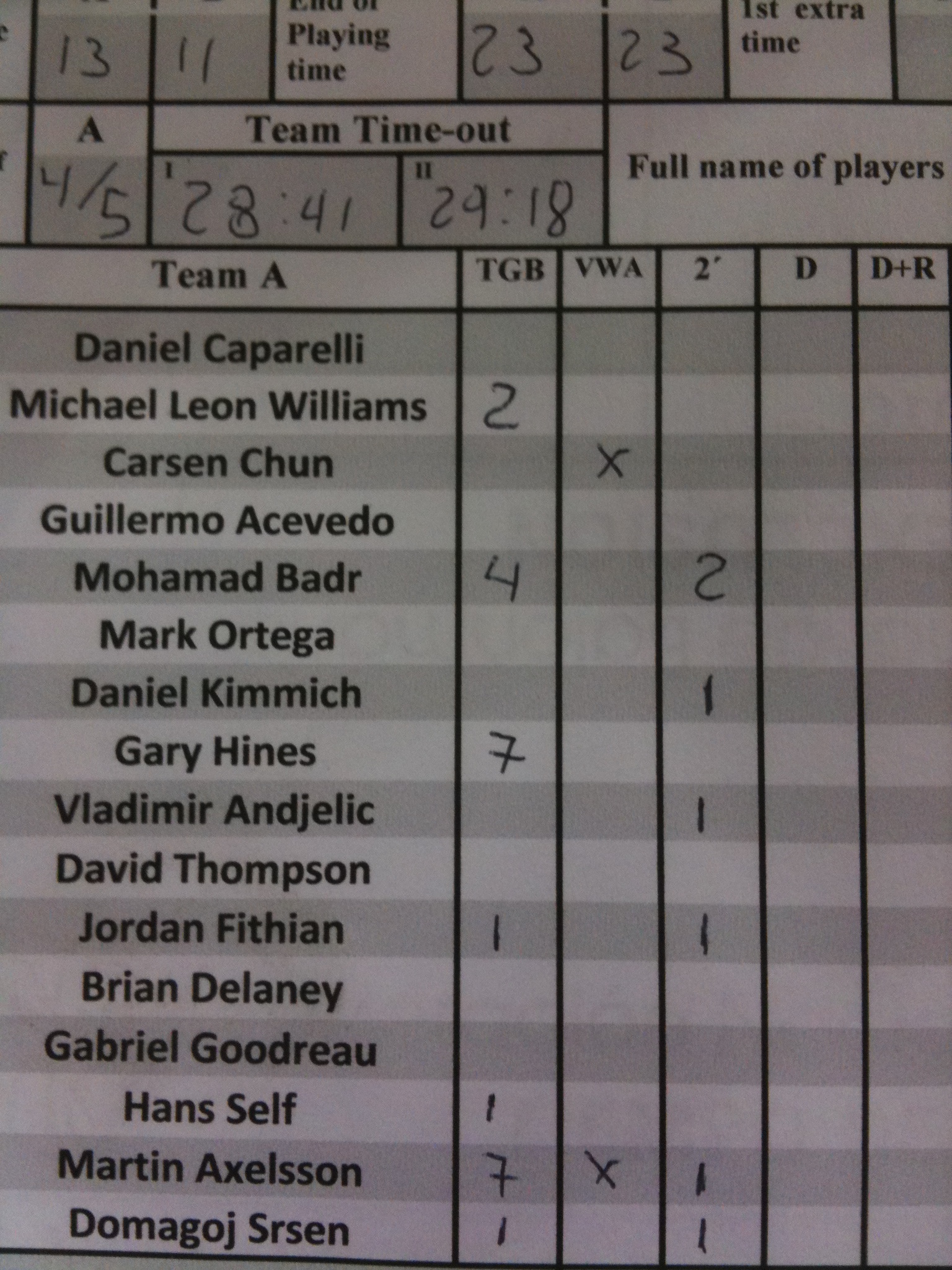
Game 2 of the Pan American Team Handball Federation (PATHF) 2nd chance tournament ended in a dramatic 23-23 draw.  According to a recap provided by USA Team Leader, Jim Thome, the match was a see-saw affair throughout with the largest lead being a 3 goal lead for the U.S.  The match was a physical affair with 15 two minute penalties being assessed (8 for Uruguay and 7 for the U.S.)

A further account of the match including the last minute is at the USA Federation site:  http://usateamhandball.org/news/2011/06/04/usa-ties-uruguay-in-second-chance-tournament/42643

Qualification for the PANAM games will now come down to goal differential in the final match between USA and Guatemala later today.  On Friday, Uruguay beat Guatemala, 20-12, so a 9 goal or more USA victory would put the USA at the top of the table.  A 7 goal or fewer win would see Uruguay qualify.  An 8 goal victory would revert to the next tie breaker, total goals scored, so the U.S. will be looking to score 21 or more goals in the match.

Guatemala cannot win the title, but as host, can play the spoiler.  For a young team playing in front of a home crowd against the big country to the North this will surely be a challenge they will relish.

Note:  I now plan to interview Mark Ortega after Sunday’s match.  Throw off is at 6:00 PM local (8:00 PM East Coast Time).  I will try to post the interview by 11:00 PM East Coast time.