post

USA Team Handball’s “Lack of Funding” and Why that May Soon be Changing

This is part of an ongoing series, “Charting a way forward for USA Team Handball” which is a series of commentaries exploring different initiatives to help move the sport forward in this country.

Recently USA Team Handball CEO, Martin Branick was interviewed on the Red, White & Glue podcast. One of the questions he was asked was, “Why does the USATH seem to suffer from a lack of funds?” Branick responded with this explanation:

“I think the number one thing that we always have to remember that’s different in the U.S. compared to well, every other country except the others is that Olympic sports in the U.S. are not government funded. Right. So there’s no government entity. There’s not a department of sports or a ministry of sports that supports all of these Olympic disciplines or non-Olympic disciplines. So we rely on the U.S. Olympic and Paralympic Committee as a private enitity, non-profit entity, we rely on private contributions and partnerships to fund our entire Olympic movement in the U.S. And, I think that’s one of the biggest differences is when you don’t have government funding you’re just subject to a different set of parameters in getting resources”

This explanation includes several true statements, but it’s also misleading. Here’s why:

  • The U.S. Olympic & Paralympic Committee (USOPC) is, indeed, not a government entity and the implication is that a U.S. Ministry of Sports would make different funding decisions. While it’s true that some countries (with a sport ministry) provide support more equally across all sports, it’s also true that that many countries (just like the USOPC) provide far less to their handball federation. Just ask any Canadian or British handball fan… And, this is not just a handball issue. For instance, I suspect that handball nations like Denmark and Germany shortchange less popular sports like baseball and rugby.
  • The lack of U.S. government funding support doesn’t mean the USOPC coffers are empty. On the contrary, the USOPC is flush with cash. The 2023 financial report shows $345M in annual revenue. There’s plenty of money to go round… the decision has simply been made not to “go round” to all the sports under their umbrella. (more on that topic below)
  • For the USOPC there’s also no real hardship in “relying on private contributions and partnerships.” The private contributions don’t amount to much, but the partnerships the USOPC have are first rate. These partnerships include Olympic sponsors and the biggest ticket item of all… the payments from the IOC as part of NBC’s TV broadcast rights.

So, what’s the answer to the question, “Why does the USATH seem to suffer from a lack of funds?”

The short answer is two fold:

  • The USOPC has decided to provide minimal funding support to USA Team Handball (compared to many other National Governing Bodies (NGB))
  • USA Team Handball has had minimal success in developing its own indpendent revenue streams

I’ll expand on this, but for anyone interested here’s more background on the “lack of funding” question. These commentaries were written several years ago, but not a whole lot has changed.

  • 2012 Series: Why Aren’t the U.S. National Teams at the London Olympics?: Link
    • Part 3: A Lack of Funding: Link
    • Part 4: A Lack of Funding: Where are the Sponsor and Donors?: Link
  • 2019: Charting a Way Forward for USA Team Handball: Link
    • What We Have: Finances (Part 1): USA Team Handball Revenue (Grants, Contributions and Sponsorships): Link
    • What We Have: Finances (Part 2): USA Team Handball Revenue (Membership and the Importance of Tracking that Data): Link

USOPC Decisions to Minimally Fund USA Team Handball

Before we tackle the question of USOPC support let’s first take a closer look at what USA Team Handball’s total annual revenue has been over the years. After all, if we’re going to talk about a lack of funding, it’s probably a good idea to understand what that funding level is.

I created this graphic in 2019 and there are now four more financial reports available on the USA Team Handball website. Here’s the annual revenue for those years:

  • 2018: $513K
  • 2019: $612K
  • 2020: $628K
  • 2021: $705K

There are some peaks and valleys with this chart, but the trendline since the 1996 Olympics has been in the $500-600K range. Contrast those amounts to the years leading up to the 1996 Olympics and you might well be wondering: WTF? (And, keep in mind… inflation is not even factored in on this chart!) What caused this sharp decline? As CEO Branick mentions later in the interview, the USOPC provides significantly more funding to sports that have better chances to win medals. It’s that simple.

What this chart demonstrates is that this was not always the case. USA Team Handball and other sports used to get a more equitable share of funding. But, after the 1996 Olympic Games the USOPC changed direction and decided to link funding to NGBs with the chances that NGB could produce medals. And, ever since USA Team Handball has been in a Catch 22 situation: Funding is tied to its chances of winning medals… It takes more funding to improve its chances of winning medals. A no win situation that saw the rich (swimming, track & field) get richer and the poor (team handball) get poorer. Or, at best move sideways.

This dramatic change in funding support from the USOPC, inevitably led to a significant decline in national team performance. This is because the lion’s share of funding had gone towards our national teams which for the most part consisted of cross over athletes that were trained with full time residency programs. Lacking the resources those programs closed down and the U.S. had to field national teams consisting of athletes coming from either its very small grassroots programs, its austere residency programs or, increasingly over the years, dual citizens growing up in other countries.

As a long time follower of handball in the U.S. I’m often amused with the athletes from the pre 1996 era not fully appreciating or comprehendng how the funding profile has changed so dramatically. While the level of support they received for their endeavors was modest, it comparatively was “Fat City” to the more austere support national team athletes have received for the past two decades. Old timers often jokingly referred to their experience as “Play handball. See the world.” To some extent that applies today… The athletes just have to pay for much of it out of their own pockets.

So, the simple short answer to the question, “Why the lack of funding?” at least in terms of “big brother” support provided is the USOPC decision to focus on supporting NGBs that can win medals.

USA Team Handball Stuggles to Develop Independent Revenue Streams

While funding provided by the USOPC is significant many federations also bring in significant revenue on their own from sponsporships and memberships. While it is, of course, desirable to develop such revenue streams it’s easier said than done. As I wrote in 2012 there is not a magical sponsorship tree where one can just pluck the dollar bills off of it.

If only it were so easy to get funding from these sources.

Finding sponsors and donors is very challenging for any minor sport. More could and should be done, but success is often contingent on other factors. For example, Verizon’s much bally hooed sponsorship was largely the result of their CEO (Hans Vestberg) coincidentally being a huge supporter of the sport. It was hoped that it would lead to more sponsors jumping on board, but that never materialized. Not yet, anyway.

This points to one harsh reality any minor sport needs to come to grips with: Sponsors are looking for a return on their investment. This “return” can’t always be neatly identified with specific metrics, but if your sport is virtually unknown and seldom seen it’s hard for a sponsor to see the cost benefit of sponsoring it. This means that better marketing to get handball better known is needed to help make the case to major sponsors.

A Change to the Funding Profile?

While USA Team Handball’s revenue profile has been mostly going sideways for the past 28 years I think there’s a strong possibility that will change over the next four years. And, of course, that reason is the 2028 Los Angeles Olympics.

It’s been a long time since the U.S. hosted an Olympics. The sports landscape has changed and is more splintered in terms of what interests people and how they watch or follow it. But… the Olympics are still a big deal. And, a hosted Olympics should still be a really big deal.

Even More Money to Go Around

While the USOPC has been very stingy with its funding for over two decades now it’s soon going to become really flush with cash. The sponsorship deals for LA should really help their top line and make it relatively painless to provide more help to the smaller federations. Further, a hosted Olympics should change their perspective for minor sports like team handball. When a national team doesn’t qualify for the Olympics it’s easy for the USOPC to decide not to provide funding. However, when a national team is guaranteed qualification…it’s not so easy to deny that team support. And, this is probably not said aloud… if a team might be perceived as a potential embarrassment on home soil it might even get more resources to help prevent that from happening.

Sponsors May Come out of the Woodwork

In theory, the next four years leading up the to the 2028 Olympics should be a gold mine of sponsor opportunity. There’s nothing like hosting an Olympics and it will be the closest to a sponsorship tree that our sport will ever have. In 1994, in the lead up to the 1996 Olympics in Atlanta, the Weather Channel (yes, the Weather Channel) stepped in to sponsor USA Team Handball with a million dollars. Even without inflation it’s still the biggest cash haul we’ve ever had. The weather channel even had a commercial they’d play periodically touting their support of USA Team Handball. (I still can’t hardly believe it) I like to think that a similar sponsor for 2028 will emerge, but it’s not guaranteed.

So if the funding profile is likely changing… should that also change USA Team Handball’s planning? If so, how? And, what could be done to possibly speed up the process? To get more funding sooner? I think there is an elegant solution on the horizon…
USA Handball Talk (Episode 17): March Madness Meets April Awesomeness

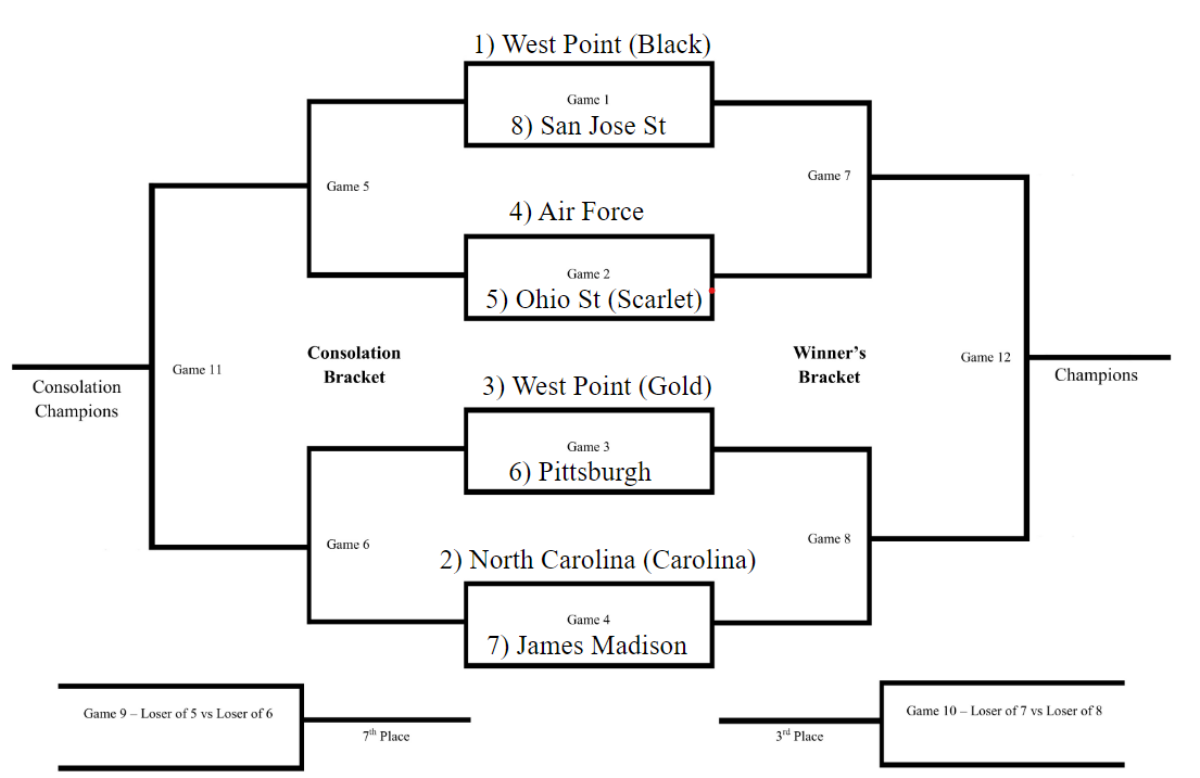
JD and John discuss the USA Men’s roster for the upcoming NORCA Championships, the College Women’s results and whether the College Handball Championships should change formats to an Elite Eight knockout format. results of last weekend’s Collegiate Handball Championships.

Here’s a summary with links to some of the items we discussed:

  • The Sportico Podcast: Link
    • We’ve copied their show opening and practice of giving a name for each episode
    • It’s a great podcast if you’re interested in sports business
  • The USA Team Handball roster announcement: Link
  • Collegiate Women’s Handball results: Link
  • A profile on the Women’s MVP, Ariane Clerc: Link
  • John’s proposed new format for College Nationals: Link

Watch on YouTube or listen/download the mp3 file at the top of the page

If you have any suggestions for future topics, a title for our podcast or have some intro music you would like us to consider please let us know on social media.


Don’t miss an episode:

  • Subscribe on YouTube: Link (Earliest Availability)
  • Subscribe to the podcast in iTunes: Link
  • Follow the Team Handball News podcast on Spotify: Link
  • Or use this RSS Feed to sign up for the podcast in your favorite podcast aggregator: Link

And, be sure to check out the podcast archive with interviews and great handball discussion going all the way back to 2006: Link

post

Collegiate Handball (Part 1): A New Format for College Nationals (Sometimes Less… is More)

This is part of an ongoing series, “Charting a way forward for USA Team Handball” which is a series of commentaries exploring different initiatives to help move the sport forward in this country.

Anyone who has ever asked me what I think should be done to improve handball domestically in the U.S. will get an answer that primarily revolves around collegiate handball. In 2014, I identified the main reasons I thought this was the case and I proposed several initiatives to improve collegiate handball. Some of them have even been implemented.

One initiative that hasn’t been addressed, however, was an initiative to “Upgrade the Collegiate National Championship and Promote it as USA Team Handball’s Premier Event.” Having attended the past two college nationals and a couple more prior to the pandemic I’m now even more convinced that we should take steps to make it happen.

Step one towards upgrading our collegiate championships would be doing away with the Weekend Tournament. Here’s why I think we need to move to a new format and why I think an Elite Eight would be a good alternative.

The Weekend Tourney… A Problematic Format

Because the U.S. is a big country and teams have to travel great distances to compete, the “Weekend Tournament” has become our primary format for handball competitions. Typically, this involves playing 4-5 matches over the course of weekend. Matches are often shorter (either 2×25 or 2×20 minute periods), but it’s still way too much handball in too short of time. Crimeny! The world’s best, full time professional handball athletes complain about two matches on back to back days. In the U.S. we have weekend warriors, who maybe even shouldn’t still be playing the sport, cramming 5 matches in 2.5 days. It’s silly, crazy or <insert your adjective here> with predictable consequences.

Those consequences are tired players. Tired players that can’t play as well as they are capable of and tired players who are more susceptible to injury. College age kids are younger and for the most part better able to handle such a demanding schedule, but I’ve seen enough Sunday morning handball that I can tell that it just looks and feels different than the matches played Friday night and Saturday morning. By Sunday many of the matches become more about a battle of endurance and attrition than anything else. And, I can tell… some players are just ready to go home especially if they are playing a consolation match with little on the line.

Proposed New Format: An Elite Eight with Consolation (3 matches/team)

The obvious solution from an aesthetic and player health standpoint would be to play a Final Four similar to a club final played in Europe. Four teams, two semifinals on Saturday and a Final/3rd place match on Sunday. But, while I really like the simplicity and marketing aspects of a Final Four I’m not sure it’s the right solution. After all, the collegiate championshps are a “collegial” event and it’s a great opportunity for athletes to interact with one another. Some colleges even tie club funding support to attending a National Championship. While limiting the final tournament to four teams would greatly simplify things it would also deny too many teams the opportunity to play in a final event.

So, if 2 matches over 2 days is too little and 4/5 matches over 3 days is too much I think the Goldilocks solution would be an Elite Eight (with consolation) played over 3 days. This would still have the simplicity/clarity of a Final Four while making sure each team gets 3 full length matches. Here’s how the 1st Division would have looked if we took the 5 D1 teams and the top 3 D2 from the 2024 Championships and seeded them 1 to 8.

While an Elite Eight knockout is simple and would require fewer match there are some drawbacks to this format. The biggest one, as anyone who follows NCAA March Madness knows is that there are no second chances. With group play you can recover from an earlier loss. With a knockout tourney your title chances could be over after your first match. While the inclusion of consolation matches means you can keep playing it’s still a bummer.

Match Timing

Another drawback would be some possible complications with the timing of the matches. Ideally, each team would play 1 match/day, but this would necessitate matches being played earlier on Friday and all teams taking another day off from school. Or alternatively, some teams would play two matches on Saturday. This could be a negative, though, in Sunday matches with one side (having played on Friday night and Saturday) being more rested than their opponent (having played two matches on Saturday).

Seeding

Finally, with no second chances it would be imperative that teams were properly and fairly seeded. After all, nobody wants to see the two best teams playing each other in the first game. Currently, the seeding process is limited by a lack of regular season structure in terms of college teams playing each other on a regular basis. It’s not that teams don’t want to play each other. It’s just that geography and a lack of coordination sometimes limits those opportunities. This could be addressed with the clear designation of some in-season collegiate tournaments or collegiate conferences as competitions that that will be used for seeding determination. Regional qualification matches could even be scheduled to help determine seeding.

Multiple Divisions and Size Limitations

The US Handball Union organized the 2024 Championship and decided to go with 2 Divisions. With two clear groupings of quality this was a decision that made sense and it was validated with fewer blowouts and as far as I know, no complaints from any of the teams. If there are enough teams an Elite 8 format could also work for D2. That said, in future seasons it may not be as clear cut where to draw the line between two divisions. And, how that line should be drawn. After all, if one looks at NCAA or high school sports divisions those divisions aren’t determined by the quality of the teams, but by other factors such as whether scholarships are awarded, stadium size and school enrollment. And, due to graduation and/or the arrival of key athletes the quality of collegiate handball teams can vary significantly from year to year.

Finally, at some point there is a breaking point of too many teams. (Or, there should be a breaking point.). At which point it will be necessary to reevaluate the concept of an “all comers” final tournament. The logical solution would probably be then to have regional qualifiers akin to what some NCAA sports like basketball have.

Too many collegiate teams would sure be a good problem to have. In the next installment I’ll discuss better promotion and presentation of the collegiate handball championships and how that could help fuel collegiate club growth.

post

USA Handball Talk (Episode 16): College Handball Groundhog Day

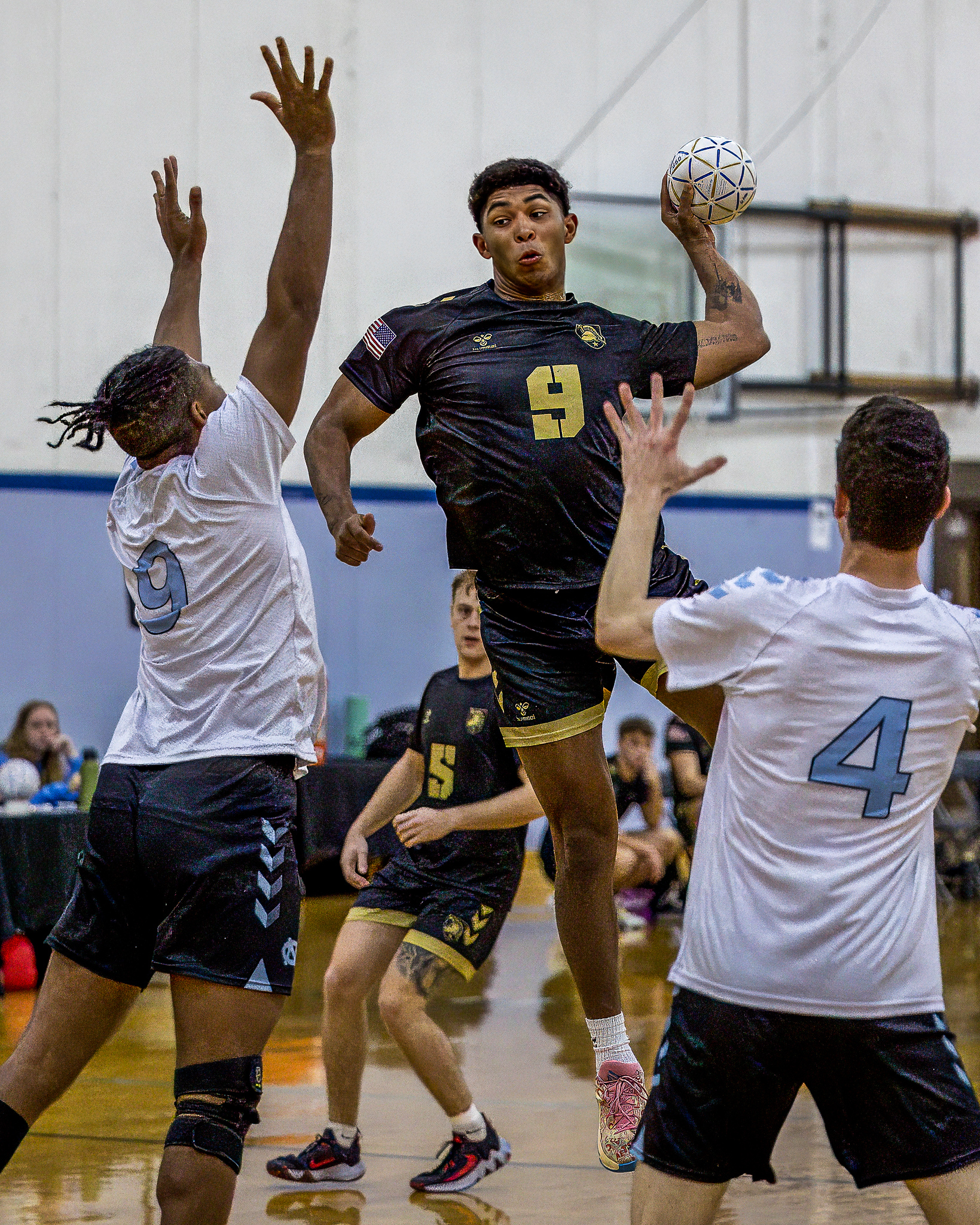
[MVP Gary Phillips led West Point Black to yet another title (photo: Rod Apfelbeck)]

JD and John discuss the results of last weekend’s Collegiate Handball Championships. Here’s a summary with links to some of the items we discussed:

The ongoing North American Beach Handball Championships:

  • The Ground Hog Day reference is from the 1993 movie starring Bill Murray: Link (One might think referencing such a classic movie wouldn’t be necessary, but you’d be surprised)
  • NORCA Beach Handball:
    • Streaming: Link
    • Full Results (IHF): Link
    • Note: Puerto Rico placed 2nd in both the Men’s and Women’s competition and qualified for the World Championships
  • 2024 Collegiate Handball Championship Results: Link
  • Commentary: Why just about any college could start a handball program and quickly challenge for a national title: Link
  • All Star Teams: Link

Watch on YouTube or listen/download the mp3 file at the top of the page

If you have any suggestions for future topics, a title for our podcast or have some intro music you would like us to consider please let us know on social media.


Don’t miss an episode:

  • Subscribe on YouTube: Link (Earliest Availability)
  • Subscribe to the podcast in iTunes: Link
  • Follow the Team Handball News podcast on Spotify: Link
  • Or use this RSS Feed to sign up for the podcast in your favorite podcast aggregator: Link

And, be sure to check out the podcast archive with interviews and great handball discussion going all the way back to 2006: Link

post

College Handball Nationals (Results Summary)

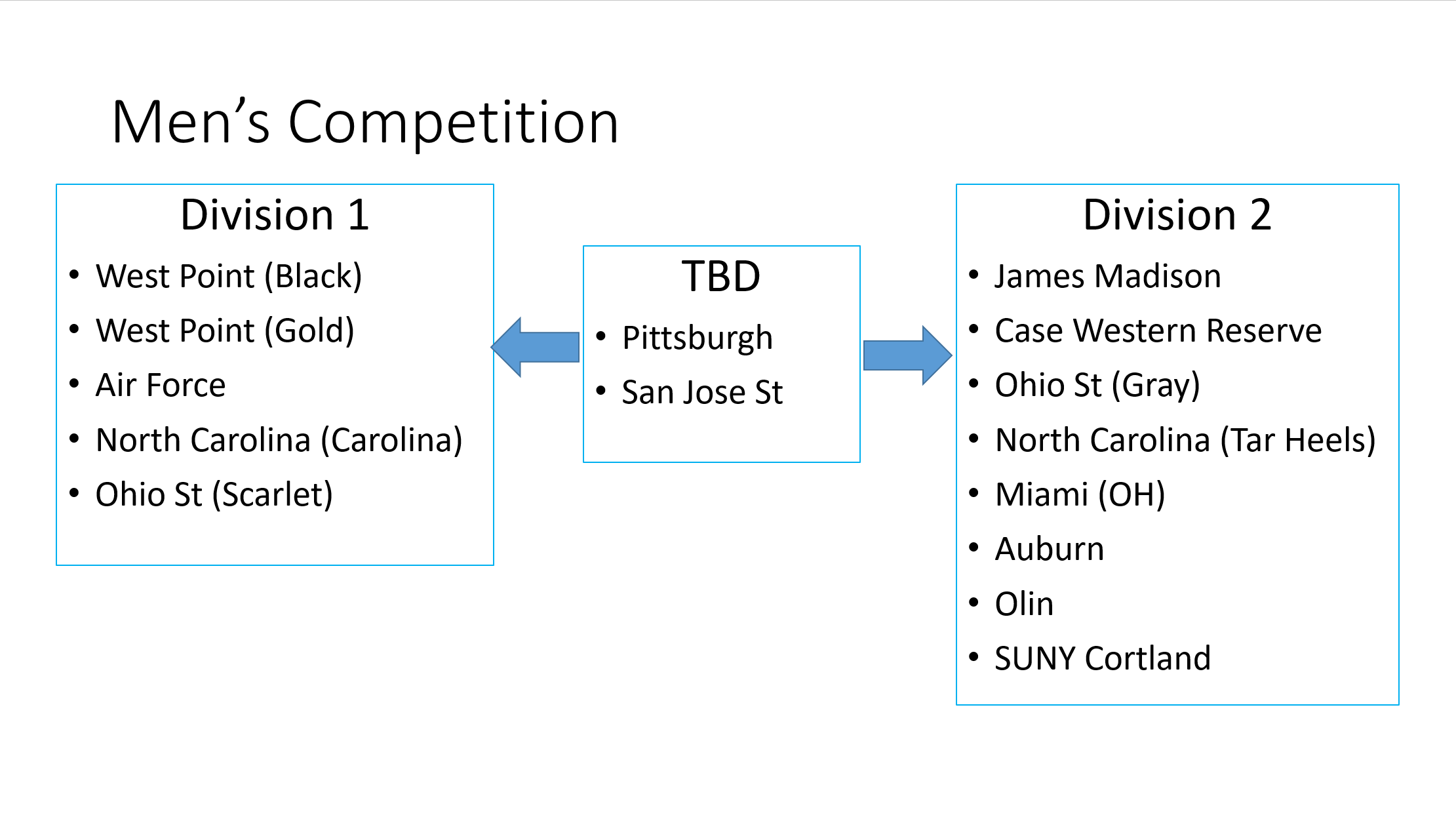
Based on records and result the team were split into two divisions. Five teams were identified for D1, but all D2 teams were given the option of playing an opening match vs a D1 team to “play in” to D1. Pittsburgh and San Jose St elected to play in, but lost their opening matches and were assigned to D2

Video Streaming

Matches were streamed on multiple platforms. For matches that were recorded on YouTube I have placed a direct link (see match results throughout) queued up to the start of the match. Matches recorded on Instagram, however, cannot be queued up and are generally only searchable (fast forward/rewind) on mobile devices.

  • Friday Matches on Court 1: Link
  • Saturday Matches on Court 1: Link
  • Sunday Matches on Court 1: Link

Play In Matches

  • North Carolina (Carolina) 29, Pittsburgh 16
  • West Point (Black) 38, San Jose St 16

Men’s D1 Competition

Group Play

  • Air Force 29, West Point (Gold) 28
  • North Carolina (Carolina) 17, West Point (Black) 26
  • Ohio St (Scarlet) 19, Air Force 33
  • West Point (Gold) 14, North Carolina (Carolina) 14
  • West Point (Black) 42, Air Force 22 Video
  • Ohio St (Scarlet) 26, West Point (Gold) 19 Video
  • Air Force 11, North Carolina (Carolina) 24
  • Ohio St (Scarlet) 16, West Point (Black) 29 Video

Note: Due to scheduling/time constraints a full round robin was not played. A draw determined that Air Force would be the one team to play all four teams and it was decided that West Point (Black) and West Point (Gold) would not play an intra-club match. With this alternate format match losses (instead of points) were used to rank the teams with the tie breakers being head to head results and the goal differential vs common opponents.

Standings

Note: Air Force beat both Ohio St (Scarlet) and West Point (Gold) to finish 3rd in the standings. Ohio St (Scarlet) Beat West Point (Gold) to finish 4th.

Matches to Determine Final Ranking

  • 4th vs 5th: Ohio St (Scarlet) 24, West Point (Gold) 31
  • 3rd Place: Air Force 32, West Point (Gold) 35
  • 1st Place: West Point (Black) 23, North Carolina (Carolina) 20 Video

Final Ranking

  • 1) West Point (Black)
  • 2) North Carolina (Carolina)
  • 3) West Point (Gold)
  • 4) Air Force
  • 5) Ohio St (Scarlet)

All Star Team

  • Gary Phillips, West Point (Black) (MVP
  • Jonathan Nwokeji, North Carolina (Carolina) (MVG)
  • Dominic Orsini, Ohio St (Scarlet) (Leading Scorer)
  • Jack Tierny, Air Force
  • Jackson Tumbarello, North Carolina (Carolina)
  • Sam Proctor, West Point (Black)
  • Ethan Flege, West Point (Black)

Men’s D2 Competition

Format

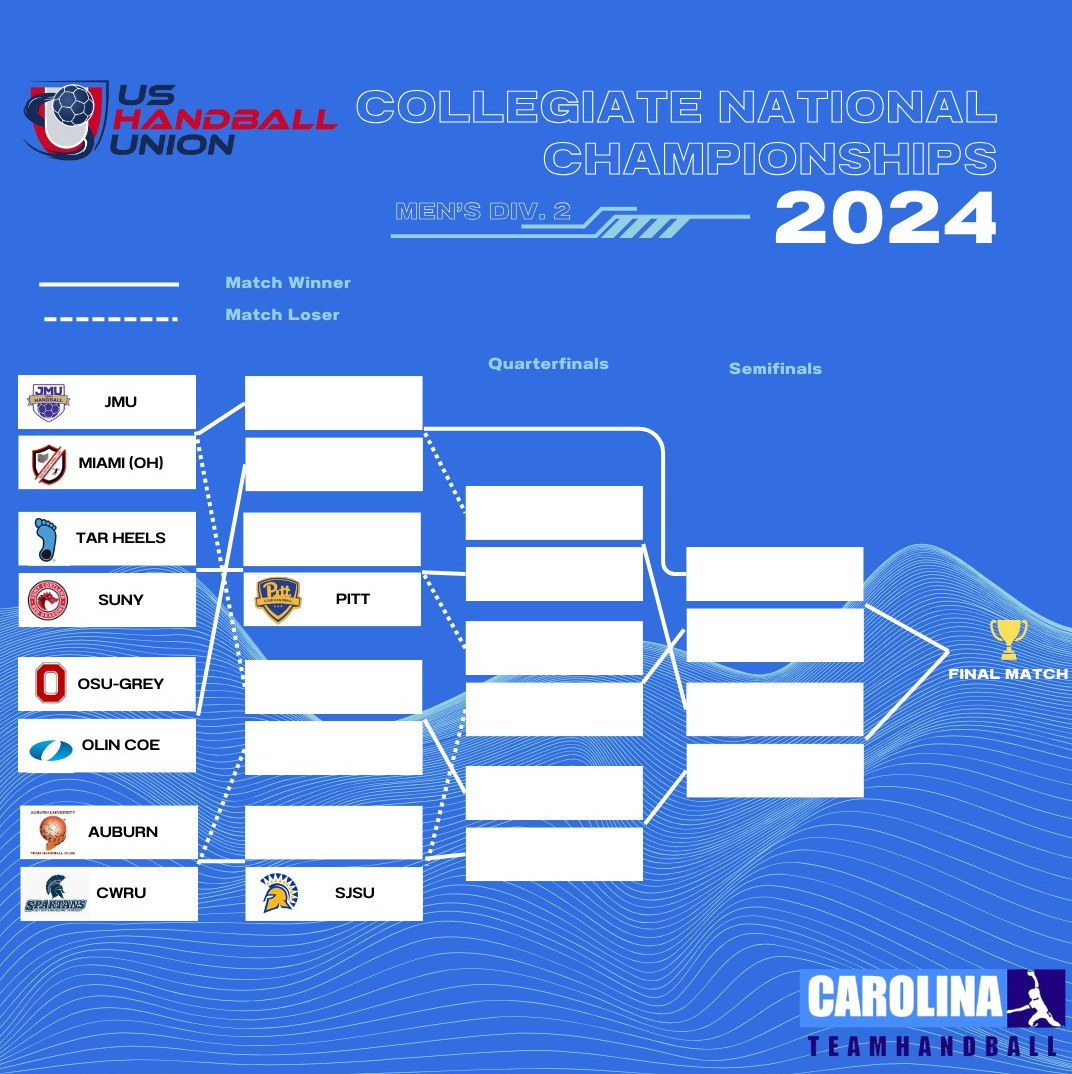
Division 2 played a modified knockout tournament with some matches eliminating the loser from the tournament and some matches keeping the loser in the tournament, but sending them to a more challenging match than the winner. The solid lines show where the match winners progress and the dotted lines show where the match losers progress. Matches where there is no dotted line are elimination matches. Depending on the stage of the tournament teams that were eliminated played additional consolation matches vs other eliminated teams.

Match Results (Main Bracket)

  • Match #1: North Carolina (Tar Heels) 27, SUNY Cortland 14
  • Match #2: Ohio St (Gray) 26, Olin 21
  • Match #3: Case Western Reserve 28, Auburn 19 Video
  • Match #4: James Madison 27, Miami (OH) 26
  • Match #5: Pittsburgh 17, North Carolina (Tar Heels) 18
  • Match #7: San Jose St 33, Case Western Reserve 18
  • Match #8: James Madison 22, Ohio St (Gray) 24)
  • Match #9: Miami (OH) 25, Auburn 22 Video
  • Match #10 (QF): Case Western Reserve 25, Pittsburgh 28
  • Match #12 (QF): North Carolina (Tar Heels) 17, James Madison 22
  • Match #14 (QF): San Jose St 35, Miami (OH) 29
  • Match #17 (SF): Ohio St (Gray) 17, Pittsburgh 24
  • Match #18 (SF): San Jose St 26, James Madison 33
  • Match #22 (1st Place): Pittsburgh 34, James Madison 23 Video

Match Results (Consolation)

  • Match #6: SUNY Cortland 25, Olin 23 Video (portion of 2nd half)
  • Match #11: Auburn 25, Olin 28 Video
  • Match #13: SUNY Cortland 27, Olin 22 Video
  • Match #15 (5th Place): Case Western Reserve 22, Tar Heels 20
  • Match #16: Auburn 19, Miami (OH) 29
  • Match #19 (9th Place): Olin 26, Auburn 21
  • Match #20 (7th Place): Miami (OH) 29, SUNY Cortland 19
  • Match #21 (3rd Place): San Jose St 33, Ohio St (Gray) 25

Final Ranking

  • 1) Pittsburgh
  • 2) James Madison
  • 3) San Jose St
  • 4) Ohio St (Gray)
  • 5) Case Western Reserve
  • 6) North Carolina (Tar Heels)
  • 7) Miami (Oh)
  • 8) SUNY Cortland
  • 9) Olin
  • 10) Auburn

All-Star Team

  • Joseph Kuo, San Jose St (MVP) (Leading Scorer)
  • Amit Kumar, Olin (MVG)
  • Joshua Ko, Case Western Reserve
  • Zachary Greenstein, Pittsburgh
  • Marcus Washington, Pittsburgh
  • Luke Bush, James Madison
  • Merrick Adams, James Madison

Women’s Competition (Check back for updates)

Group Play

  • Ohio St 21, West Point (Gold) 20
  • North Carolina (Carolina) 11, West Point (Black) 21
  • Ohio St 18, North Carolina (Tar Heels) 9
  • West Point (Black) 30, Ohio St 15
  • West Point (Gold) 11, North Carolina (Carolina) 18
  • West Point (Black) 33, North Carolina (Tar Heels) 3 Video
  • West Point (Gold) 18, North Carolina (Tar Heels) 3
  • North Carolina (Carolina) 19, Ohio St 19 Video

Standings

Note: Due to scheduling/time constraints a full round robin was not played. Ohio St played a full round robin and it was decided that both West Point and North Carolina would not play intra-club matches. With this alternate format match losses (instead of points) were used to rank the teams with the tie breakers being head to head results and the goal differential vs common opponents.

Note: North Carolina (Carolina) placed 2nd due to their superior goal differential in their common matches with Ohio St.

Matches to Determine Final Ranking

  • 4th vs 5th: West Point (Gold) 14, North Carolina (Tar Heels) 7
  • 3rd Place: West Point (Gold) 16, Ohio St 14
  • 1st Place: West Point (Black) 25, North Carolina (Carolina) 9 Video

Final Ranking

  • 1) West Point (Black)
  • 2) North Carolina (Carolina)
  • 3) West Point (Gold)
  • 4) Ohio St
  • 5) North Carolina (Tar Heels)

All-Star Team

  • Ariane Clerc, Ohio St (MVP) (Leading Scorer)
  • Becky Gonzalez, North Carolina (Carolina) (MVG)
  • Mathilde Mortensen, North Carolina (Carolina)
  • Savannah Weston, West Point (Black)
  • Maci Hodgins, West Point (Black)
  • Ksneyia Farrell, West Point (Black)
  • Sydney Rhuda, West Point (Gold)
post

USA Handball Talk (Episode 15): College Nationals Preview

US Handball Union Executive Director, Michael King joins the podcast to discuss this weekend’s College National Championships. Here’s a summary with links to some of the items we discussed:

Current News Items

  • The ongoing North American Beach Handball Championships:
    • Video (Live and On Demand): Link
    • Canada’s remarkable comeback vs Mexico: Link
    • Results:
  • USA Sr Men Friendly vs France on May 11th: Link

College Nationals Preview

  • The Men’s Tournament Divisions
    • Pittsburgh will play in D1 if they North Carolina Friday night; they will drop to D2 if they lose
    • San Jose St will play in D1 if they beat West Point (Black); they will drop to D2 if they lose
  • Tournament Schedule: Link

  • Men’s season record with college vs college matches in parentheses
    • D1
      • West Point (Black)  8-1 (5-0)
      • West Point (Gold)  9-5 (4-1)
      • Air Force 5-6 (0-1)
      • North Carolina (Carolina) 7-5-1 (5-2)
      • Ohio St (Scarlet) 19-0-1 (18-0)
    • TBD (Will play in D1 or D2)
      • Pittsburgh  13-7 (11-6)
      • San Jose St  0-0 (0-0)
    • D2
      • James Madison 9-6 (12-9)
      • Case Western Reserve 11-8 (10-7)
      • Ohio St (Gray) 9-14 (9-11)
      • North Carolina (Tar Heels) 3-10 (3-6)
      • Miami (OH) 7-16 (7-15)
      • Auburn 0-5 (0-3)
      • Olin 0-0 (0-0)
      • SUNY Cortland 0-0 (0-0)
  • D2 Format
    • Matches with 1 solid and 1 dashed line have both the winner and loser moving on in the bracket
    • Matches with just 1 solid line are “elimination” matches; the winner advances, but the loser is either finished or will play consolation matches
  • Women’s Teams
    • West Point (Black)
    • West Point (Gold)
    • North Carolina (Carolina)
    • Ohio St
    • North Carolina (Tar Heels)
post

Another New Podcast for Handball Fans

A new podcast, Red, White and Glue is now available for handball fans (see links at the bottom). It’s a production of the US Women’s National Team and it’s co-hosted by USA Women’s National Team Assistant Coach, Hendrik Schultze and national team left wing, Viva Kreis. Here’s my perspective on the new podcast.

A Rising Tide Lifts all Boats

Folks might not realize it, but Team Handball News had the first ever handball focused podcast. Yes, off and on, I’ve been doing podcasts since 2006. And, during that time I’ve seen other handball podcasts come and go. I suspect there are a couple of reasons for this. First off, it can be quite a bit of work. It especially was in the early days, but technology improvements have sure made it easier and easier to get an episode out. The second reason is that there’s not a very big market for English related handball content. There’s a market… it’s just a very niche market. My latest iteration with Ohio St coach, JD Orr, USA Handball Talk currently gets around 100 combined YouTube views/mp3 downloads. The Handball Hour currently has around 150 Patreon subscribers, but surely has a lot more listeners for its free podcasts. So, there’s an audience. It’s just not a huge audience.

So more often than not handball podcasters do podcasts because they like to talk about handball and share their views with others. Certainly that’s the main reason I do it. While some see “competition” as a negative I just see a great opportunity to hear views from others. And, I’m also a big believer in the saying that “A rising tide lifts all boats.” The more people talking about handball… the better it is for anyone doing a podcast,

An Opportunity to Refresh Old Content (e.g. Wall Handball)

When you’ve been running a handball website for 17 years you can often get the sense that just about every topic has been addressed multiple times and from multiple different angles. Case in point: The first podcast addresses the long standing semantic problem handball unfortunately has to deal with the U.S. Over the years I’ve addressed the handball semantic problem multiple times. Here’s a sampling:

So, while I might get annoyed with newcomers covering well trod upon ground… it’s just a little annoyed. After all, newcomers are coming into the sport all the time. They may not be aware that I’ve addressed something in the past, so it’s an opportunity to update the Handball FAQ and refresh old content.

A Catalyst for New Commentaries

Probably, of greater interest, though, for me and many readers will be any discussion on USA Team Handball plans. I’ll go out on a short limb and state that no one has thought as long and hard about USA Team Handball planning as much as I have. That could mean that I’m just some old guy who thinks he know everything. Could be… Although, over the years, I think my track record assessing different initiatives and what will likely happen is pretty solid.

Most recently, I’ve started some commentaries on the U.S. Women’s Team and the need to refocus the program as soon as possible on both expanding and improving the quaility of our very, very small talent pool.

USA Women’s National Team: What’s Next?

  • Part 1: Introduction: Link
  • Part 2: The Looming Decision Can’t Wait any Longer: Link

And, now there is an Official USA Women’s National Team podcast that surely will be discussing some of the same issues and concerns I have. This is an awesome development and I Iook forward to hearing what’s planned. I suspect the new podcast will tend to have a “positive, can do” approach to the many challenges USA Team Handball faces so it will provide a nice contrast to my more measured (OK… some would say critical) approach that we simply can’t do everything we might want to and that we really need to prioritize what we should do first.

It’s all good. Different perspectives are welcome. And, hearing some different perspectives will surely serve as a catalyst for me to write some new commentaries. Even better it might help serve as a catalyst for the USA Team Handball Board of Directors to start making some important resource decisions that are long overdue.

So welcome aboard fellow handball podcasters. The more, the merrier.

Red, White, and Glue: The U.S. Women’s National Team Handball Podcast