(The USA Team Handball Board of Directors should have addressed our Women’s National Team years ago, but even at this late date it’s justifiable to go forward with a Residency Program.. Yes. Even if it’s not sustainable.)
My previous commentary addressed my frustration with USA Team Handball seemingly never learning from the past and repeatedly trying the same things over and over. And, watching those efforts fail leaving nothing much to show for after they’d gone away.
However, while this is frustrating I also recognize that sometimes it can be the right course of action to start an effort even if the likelihood of it sticking around is near zero. Key word: “sometimes” and it only should be done reluctantly because the need is high and there aren’t any feasible alternative courses of action.
The Slow Moving Train Wreck
Probably nothing illustrates this better than the current state of our USA Women’s National Team just two years out now from playing in the 2028 Olympic Games in Los Angeles. Our Women’s team has been very uncompetitive for several years and has struggled to win matches even against low level peer nations. If the Olympics were being held this summer (instead of two years from now) I think our Women’s team would be looking at 20 to 30 goal losses. We’re talking very uncompetitive matches that would have both experienced handball followers and newcomers discovering the sport saying, “What the heck?”
Long time followers of this website know that this is a problem that I have been concerned with in one way or another for over a decade (Detailed 2019 evaluation). Four years ago I even briefed the USA Team Handball Board of Directors on the need for a new Strategic Plan and my “stomp your foot” slide (see below) pleaded with the Board to start making some conscious decisions to address the problem.
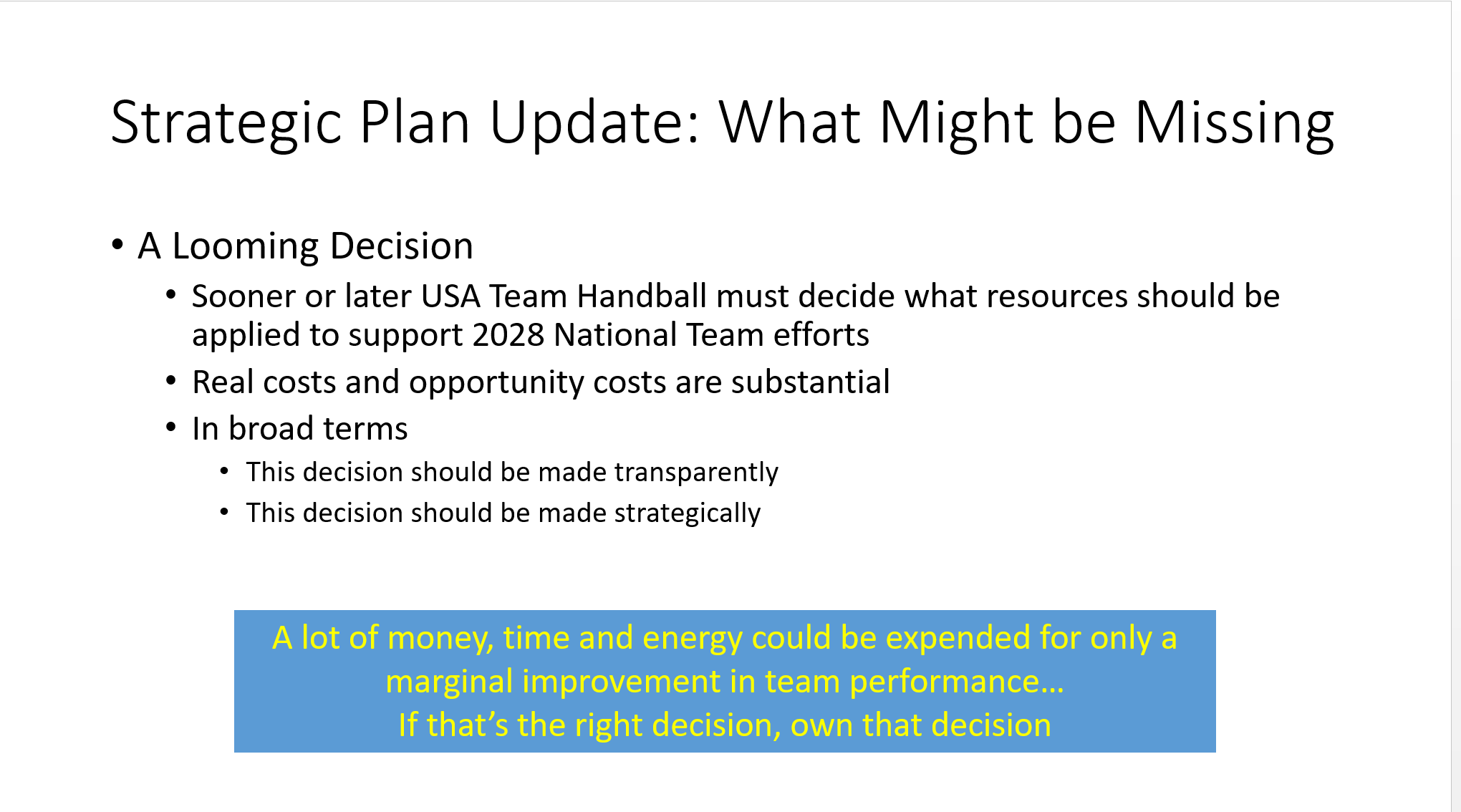
Alas… the Board was soon to become preoccupied with the U.S. Handball Union and it’s aftermath so nothing was really done. Inaction, unfortunately, was indeed the defacto decision.
Residency Program in Ft Pierce, FL: A New Sustainable Residency Program Model?
It’s no secret that despite personally participting and benefitting from a Residency Program that I’m not a fan of the concept. There are multiple reasons, but the biggest one is that they are very difficult to sustain. It takes substantial funding or subsidized support at an Olympic Training Center (OTC) to provide athletes with food, lodging and a stipend. Funding that hasn’t been available for decades.
But, even when more funding was available back in the 80s and 90s it was still a really, really questionable use of scarce resources. It would really be interesting to do a forensic accounting of USA Team Handball’s glory days. I don’t know what the numbers would be exactly, but rest assured the lion’s share of resources went towards a handful of athletes at the top of the pyramid. Grassroots development was an afterthought as new national teams were created from scratch over and over again. And, then funding support from the USOPC was slashed… and not only couldn’t we properly fund residency programs anymore we had little to show for in terms of grass roots development. The lost opportunity costs are truly staggering.
But, maybe this new residency program is somehow different? After all, look how how “sustained” is referenced twice in this announcement of the new program.
This collaborative effort positions the Treasure Coast as a growing hub for Olympic and international sport development, aligning higher education, public schools, and destination sports tourism around a shared vision for sustained national-level training that prepares athletes for the highest levels of global competition.
“This partnership reflects the kind of collaboration and support it takes to move American handball forward,” said Michael King, Chief Executive Officer of USA Team Handball. “A consistent training environment is always a prerequisite to success, but it is never a given—it requires cooperation, shared resources, and institutional commitment. Thanks to Indian River State College, Play Treasure Coast, and St. Lucie Public Schools, we move directly into a full preparatory environment. That step change allows our athletes to train with continuity and accelerate toward sustained international performance.”
Alas, it’s much easier to say something will be sustained, then to actually sustain it. So far, I see two basic problems with the latest residency program incarnation. First off, it appears to have many of the same funding challenges that plagued the programs at SUNY-Cortland and Auburn. Athletes are paying for room and board. Couple that with upending your life to move to South Florida and that limits the quality of recruits that will join the program. For more on this topic check out this 3 part commentary from 2015 on the problems with an austere residency program at Auburn. (Part 1 Part 2 Part 3)
And, this leads to the second problem. For this first time since the lead up to the 1996 Olympics in Atlanta we can honestly tell female athletes who have never touched a handball before that they have a legimate chance to be an Olympian. That is a powerful recruiting pitch that can offset the challenges of selling an austere residency program. I don’t know any of the athletes that have been recently recruited, but I did a little research on the cohort that recently traveled to Puerto Rico. Looking at their ages and background… I doubt that a single one of them would be making the sacrifices they are currently making if we didn’t have an automatic Olympic bid. And, in turn, this means come September 2028 the quality of recruits will take a nose dive.
Bottom Line: If you think this is some sort of new conceptual sustainable residency program… Well, as folks in the South like to say at places like Auburn, Alabama, “Bless your heart.“
It’s hard to see this program sticking around without substantially more funding. And, if more funding does somehow become available… I sure hope our Board of Directors fully considers other initiatives and whether they are better candidates for scarce resources. And, at the top of their list of factors to consider: sustainability
Ft Pierce Residency Program: A Valid Short Term Need…Even if it’s a Hail Mary
While the new Residency Program for the USA Program is not very likely to stick around I think a solid case can be made to still go forward with it. The logical question then is, “Why on God’s green earth would the #1 detractor of Handball Residency Programs be in favorite of doing a program yet again?
Answer: It’s “pretty much” the only way the USA Women can expand it’s meager talent pool and provide a handball crash course for newcomers to get them “sort of” ready for the 2028 Olympics.
I say “pretty much” the only way because, in theory, there are other ways. Qatar built a strong Men’s National team through naturalization. The U.S. has had naturalized citizens in other sports, but typically these athletes have become citizens through marriage or other standard processes. Manufacturing an entire team is just not something the U.S. would ever do, in my opinion. Another option would be to farm out athletes individually to top clubs in Europe where they could get top coaching and competition. However, that would take revitalizing and super charging a Forum Club Handball (FCH) support program for USA athletes that unfortunately no longer exists.
We could also debate whether other locations like Denmark (as GBR did before the 2012 London Olympics) or Los Angeles (copying the 1996 Atlanta strategy) would be better. They arguably are… but a different location is just a variation of the Residency Program concept.
And, I say “sort of” ready because two years is just not enough time to really get newcomers ready to effectively compete against the best teams in the world. If the program is done right I think it’s enough time to turn great athletes into decent handball players… but, not enough time to turn them into great handball players. There’s just too much too learn and certainly not enough time to garner the experience needed to be a great player.
All that said, it’s 4th and long, we’re running out of time and we don’t haven’t any good options. I don’t think we could tell the IHF and USOPC we can’t field a competitive team and decline our guaranteed Olympic slot. I also don’t think it would have been prudent to essentially go with our current talent pool and hope for the best. That might have saved money and allowed resources to go towards more sustainable efforts, but the Olympics is just too big a stage to field a team that will lose by 20-30 goals.
No. I think the right answer was to go with the Hail Mary pass to the end zone or as Scott Van Pelt likes to say a pitchy, pitchy, woo-woo play. We’re Americans. It’s the Olympics. We got to try something. Hey, sometimes it even works.
And, I’ll emphasize I’m not even talking about wins and loss. I will be ecstatic if the USA Women win a match at the 2028 Olympic Games. That’s not likely to happen with a 12 team field mostly comprised of the best European sides, probably Brazil, Angola and S Korea/Japan.
No, realisticaly I’m looking for “moral victories.” Of course, I hate that term, but it’s realistic. I’m shooting for losses with a scoreline of 10-19 goals. Maybe a single digit loss against some team. Playing a couple of teams close for a half. Back and forth sequences in every match where viewers can see a little potential. Where they can rationalize, “If the USA Women were only just a little bit more experienced” or “If we just had a couple more good players the results would be diffferent.”
Where some young American girls watching handball for the first time can envision a future playing the sport. Yes, indeed, that alone might just be worth the investment in a short term residency program in Florida.
While this logic applies for the USA Women, does it also apply for the USA Men? The short answer is no, but I’ll break down the long answer, next