USA Team Handball December 2013 Newsletter: Link
Handball-World: Link
Your independent news and commentary outlet for the Olympic sport of Team Handball
San Lorenzo has not managed to win the championship in Argentina since 2007, but now it happened again. A team with such a well-connected and powerful supporter should of course have a major advantage. And by playing 0-0 at Velez Sarsfield, they managed to hold off second-placed Lanus who also managed just a draw in the final round. Our congratulations go out to San Lorenzo and all their supporters, including my good friend and successor as PanAmerican referee chief in handball, Miguel Zaworotny, now the Managing Director in the office of the PanAmerican Handball Federation. But how about San Lorenzo also starting a section for handball, perhaps even a women’s team!?

Ceremonial handover at the IOC: Jacques Rogge (right) hands over the key to his successor Thomas Bach (left)
Bach, who turns 60 a week from now, has started out in a way which suggests that he quickly wants to try to put to rest the suspicions and concerns that surrounded his election. As I noted in some articles prior to the election, there had been concerns related to Bach’s background as a protégé of Horst Dassler, the former Adidas boss, who was seen as the ‘Godfather’ of the corrupt aspects of sports marketing and power brokerage. Similarly, the notion that Bach was being pushed by the well-known ‘puppet master’ Sheikh Ahmad of Kuwait did not go over too well in many circles in the IOC and elsewhere in the world of sports.
So in a situation where, after 12 years, many had become disillusioned by the lack of achievements by the departing IOC president, Jacques Rogge, Bach has come into office with a lot to prove. Bach has been seen by many as a traditionalist and as a defender of key aspects of ‘status quo’, for instance by perennially being the IOC spokesman on the topic of the IOC’s strong insistence on autonomy for the sports movement. So for those who are looking for change, there were concerns. Among the changes that people have been hoping for, one could mention the composition of the IOC and the secret and stodgy nature of its work processes, the criteria and processes for the selection of Olympic host cities, the composition of the program for the Olympic Games, and the increasing sense of corruption and bad governance in international sports federations (IFs) and National Olympic Committees (NOCs).
Clearly, the IOC is first and foremost a ‘machine’ in charge of organizing the Olympic Games, moreover, with the recognition that such complex mega-events require a strong focus on its business aspects and the related politics. To a large extent, the respective IFs have a major role in ensuring the proper technical and sporting execution of the Games. But the IOC, as Bach clearly realizes, also has to be concerned with the image and credibility of the Olympic movement. Attention must be paid to issues such as corruption and doping. And the IOC would frantically hope that uncomfortable aspects such as anti-gay laws, abusive construction practices and worries about freedom the press at the upcoming Sochi games would not come to the forefront. Similarly, worries about political protests and delays in the preparations for Rio 2016 are dark clouds on the horizon. So Bach appreciates that bidding and selection processes will be critical in the future.
The continued justification for the existence of some traditional sports on the Olympic program is a hot topic, considering the realization, as just confirmed by Bach, that there is really no scope for expanding the number of participating athletes. And at the same time, there is a claim from many emerging sports who want to get their chance, something which also coincides with the IOC’s awareness that a modernization is needed in order to retain the interest among the younger generations. So the experience of the Youth Olympic Games, where some experimentation has been used, could become important. But there is also a balancing act in the sense that sponsors and TV rights holders will continue to insist on prominence for the well-established ‘cash cows’ on the program. Bach now seems to try to find a new way out, by discussing fine-tuning focused on specific events within the different sports, rather than just looking at additions and deletions of entire sports in the program.
Finally, I think it would be too optimistic to expect that Bach will take a new stand regarding the scope and propriety for the IOC to monitor and affect governance and corruption issues in IFs and NOCs. First, one must again keep in mind that the IOC is mainly focused on organizing the Olympic Games. Second, the ability of the IOC to serve as a role model or ‘police man’ given its own weaknesses in terms of membership and procedures is limited, although Bach seems intent on increasing IOC effectiveness, transparency and attention to ethics. Third, the potential for major conflicts and a weakening of the IOC’s ability to carry out its core functions would be enormous, if the IOC started intervening in the internal processes of the IFs and NOCs.
Yes, there is a tremendous need for such a role, and the IOC is theoretically well-placed, given its position at the top of the ‘matrix’ of IFs and NOCs. But for such role one would really need a separate WADA-like entity. Just perhaps there is some hope that Bach eventually would come to that conclusion. After all, he has explicitly recognized that the insistence on autonomy of the sports movement is tenable only if good governance and adherence to ethical principles can be demonstrated! So let us see what he means with his somewhat cryptic slogan: ‘unity in diversity’!

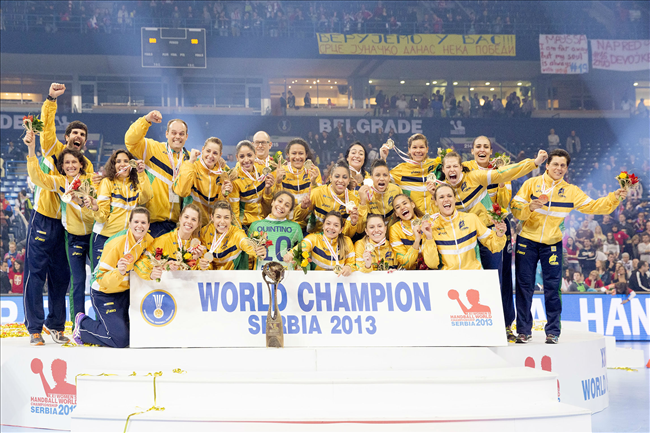
Brazilian goalkeeper Barbara Arenhart was almost unbeatable today, but perhaps Denmark will get the chance for revenge in a semifinal!?
It is discouraging to see that, year after year, we cannot find any newcomers from outside Europe among the top teams. Brazil, Angola and Korea are there, and Japan also qualified for the ’round of 16; simply because there were no more than 12 European participants. We now hear rumors that the budget of the International Handball Federation (IHF) could expect a major increase, due to very favorable TV rights contract with Al-Jazeera. Let us hope that finally this will ‘force’ the IHF to spend a more appropriate amount of resources on helping the federations which perennially seem to be next in line to move up and compete with the Europeans. Yes, the newest and weakest federations must also get more help, but for the sake of the image and credibility of handball as a global sport, the priority must be to expand rapidly the ‘middle class’.
We now had a situation where 13 games were won by a margin of at least 20 goals and another 14 games were won by 10 to 19 goals. This should not happen in an elite event. The average goal difference in a game was just about 11 goals! We saw results such as 51-20, 44-21 (twice) and 40-6. And we had a half-time result of 14-0, when the Paraguay team was held scoreless for 32 minutes by their Spanish opponents. By contrast, there were no ties, and only four games (out of 60) were decided by a one-goal margin.
But it could be argued that among the top four teams in each group, there was some excitement in the fight regarding the internal ranking, which determines the likely strength of the opponents in the ’round of 16′ and the path towards the medals. In Group A, France came out ahead, after probably having worried about each of their three pursuers. Montenegro has not shown the same positive spirit as when they won EURO2012, but they managed to come in second. Korea seems far from their old level of medal contenders. In Group B, the top three positions were settled in the very last group game, where Brazil shocked Denmark by grabbing a large early lead which they managed to maintain until the end. This meant that the Serbian hosts got the second place, while Denmark amazingly had to accept third place.
Group C went to the favorites from Norway, followed by Spain, Poland and Angola, even though the Norwegians never looked really convincing so far. In Group D, it was probably a surprise to some that an injury-plagued Germany would manage to beat all the three European opponents. But those teams generally seemed weaker than expected, and especially Hungary was a disappointing shadow of what they have shown during many years now. One gets the impression that it is difficult for many of the European teams to be in top form for a championship every year. Integrating new players and coping with injuries makes it tough.
This leaves us with the following match-ups for the ’round of 16′: in the top half we have Brazil-Netherlands, with the winner playing the winner of Spain-Hungary in the quarterfinal; similarly we have the pairings Denmark-Montenegro and Germany-Angola. In the bottom half, we have first Serbia-Korea and next to them Norway-Czech Republic; in the final quarter of the draw that leaves us with Romania-Poland and France-Japan. About half of these match-ups really would seem to suggest intensive battles. The old Olympic finalists from Denmark and Korea will have to watch out for the local favorites from Montenegro and Serbia. But I will now be brave and predict that in the semifinals we will have a revenge opportunity between Brazil and Denmark and then a repetition of the 2011 final between Norway and France. What Is your prediction?
Podcast: Play in new window | Download (Duration: 28:05 — 6.4MB)
Subscribe: Apple Podcasts | Spotify | RSS

An event that just keeps getting bigger and better. The 5th Annual Big Apple Tournament in New York City is scheduled for 28-29 December.
The New York City Team Handball Club is hosting its fifth annual Big Apple Tournament in New York City from 28-29 December at the Riverbank State Park. New York City Team Handball Club Bini Mustafa and I discuss the upcoming tournament, its evolution from modest beginnings and its potential future.
We also talk about the All-Star Game which will have American players including Gary “Hang Time” Hines, Jordan Fithian, Divine Jackson and Vladimir Andjelic taking on some of the world’s greatest veteran players including Pascal Hens, Goran Sprem, Michael Kraus, Marcin Lijewski and Magnus Wislander. The USA All Star Team will also be coached by USA Men’s National Team Coach Javier Garcia Cuesta.
Surely an event worth seeing if you’re anywhere near the New York metropolitan area.
(The podcast interview length is 28 minutes)
New York City Team Handball Facebook Page: Link

Sally Potocki, who plays for Dortmund in the German 2nd division has been a bright spot for the Australians at the World Championships.
Readers of my articles in recent years know that I am often praising the European Handball Federation (EHF) for organizing and running its business and its events in a professional manner, sometimes in contrast with what can be seen from the International Handball Federation (IHF). But you will then also have noticed that, on several occasions, I have seen clear reasons to criticize the EHF severely, typically regarding issues involving inappropriate distortions of the global playing rules or poor handling of situations where punishment of actions by players and coaches has been required.
One example is the EHF practice to go against the rules and give out automatic suspensions in situations where referees have given a disqualification (‘red card’) under the provision of the rules where they alone have the right decide that the infraction falls into a category for which NO further punishment is warranted. Another example is the feeble handing of grotesque cases of misbehavior of coaches, where the image of the EHF and of our sport is at stake, but where the EHF has found some excuse for letting the culprit escape with essentially a ‘slap on wrist’. Examples are the action of the Hypo manager Prokop who entered the court to stop a counterattack for the opponents, and the Serbian coach who held on to the shirt of a player on the opposing team on the court in a game in the 2012 European Championship. The latter situation was quite inappropriately turned into some kind of joke.
However, during the early stages of the 2013-14 season, the focus has been much more on the effect of questionable refereeing in the men’s and women’s Champions League and most recently in EHF Cup matches. There has been an abundance of games, especially in the men’s Champions League, where the referees have been unable to control to action sufficiently and where cynical players have ‘taken matters into their own hands’. As a result, many games have more resembled wrestling, rugby or American football, with players in piles on the floor and with a generally unpleasant atmosphere. Of course, this reality does not remain a secret, as the EHF-TV webcasts make the scenes available to handball fans around the globe. In some cases, the issue has been more an apparently deviation from the expectation of equal treatment of both teams, as instead one team, typically the home team, has been getting unwarranted favors.
And the problems have not been limited to the men’s Champions League. Very recently, a key game, Baia Mare-Thuringer, in the preliminary groups on the women’s side led to strong reaction both from the losing team and from web viewers. The refereeing was grossly one-sided, as a serious video analysis will easily confirm. Regrettably, the coach from the losing team was unable to refrain from accusations about bribery. This is a serious statement which cannot be permitted unless there is clear evidence. So now the EHF has to investigate both the refereeing and the rash words by the coach. And as a culmination, we just had the Zomimak-Aarhus game in the men’s EHF Cup, where incompetent referees allowed a level of outright violence that does not belong on a handball court. A Youtube video clip from this game has caused very negative propaganda worldwide.
It is clear that the EHF competition system is so large that the supply of competent referees may not quite match the demands. In comparison with the IHF and its handful of World Championships each year, the EHF must rely on a much larger pool, which includes older referees who were not able to qualify for the IHF level, referees discarded by the IHF, and young new EHF referees without much experience. But I have enough experience from referee nominations and enough up-to-date knowledge of the top referees used by the EHF (in part by following most of the Champions League games on the internet), so I can firmly state that the EHF should be able to do a MUCH better job of matching the available referees with the demands of the games in the different competitions. I can only speculate about the motivations for what is taking place, but I would label many of the nominations for the Champions League careless, cynical or experimental.
Even worse, a careful analysis makes you wonder about the presence of ‘geopolitical’ considerations, which sometimes seem to outweigh concerns about quality. Certain referees and referees from certain regions get puzzling assignments where they are ‘in over their heads’ or cannot resist the pressures from spectators, and certain teams seem to get ‘strange’ nominations. It makes you wonder both about the role of the entire Referee Committee in this regard, and the existence of ‘checks and balances’. And it gives the impression that, just as in the case of legal procedures (where a ‘hands off’ approach may be more understandable and appropriate), the EHF top management in the case of the management of the refereeing carelessly turns a blind eye to what is happening. Clearly, the impact is much too important both for the image of the EHF and for our sport overall.
In these circumstances, it is not surprising that it is being rumored that the IHF has found it appropriate to introduce a special effort to monitor and support the IHF referees throughout the year in their performances in their own respective continents. This has been a shortcoming over many years, especially as new recruits at the IHF level tend be younger and less experienced than in the past, so it is a topic that I myself tried to pursue during my IHF period. And it is now becoming more realistic, as the IHF Referee Committee is monitoring many continental events outside Europe and as it is possible to follow the top European events through web streaming and video. The IHF referees benefit from educational efforts and close supervision during the course of World Championships, but they need, and deserve, more continuous and systematic support. The IHF deserves credit for recognizing that.

The stadium in Sao Paulo was badly damaged irecently in a deadly accident during the final stages of construction
The two most sought after sports events in the world are the Olympic Games and the World Cup in football. Brazil will host the World Cup next year (so the draw for the groups took place yesterday) and then the summer Olympics in 2016. Clearly there are many reasons why countries go after these events: the prestige of being able to handle the event, the world-wide publicity and the hope for longer-term tourism revenues, and the domestic PR value and possible boost for the national economy. But when countries bid for these events, it is not uncommon to downplay the risks and the negative aspects, and many bidders do not care about the public opinion.
The reality is also that both events have taken on such proportions, due to the ‘ratcheting effect’ that flows from the desire to outdo previous organizers, the selfish demands of FIFA and IOC, and the sense that only a really spectacular event will create the PR effect that was sought. This means that not many countries have the resources and infrastructure to handle the burden, and some of those who do find it better to decline the opportunity. At the same time, it has become a matter of prestige for both IOC and FIFA to award the events to continents and regions which, for obvious reasons, have not had the opportunity before. This means that the need for major construction efforts in a difficult setting is becoming more common.
If then, like in the case of the World Cup, Brazil makes it a matter of prestige to spread the event to many more locations than is strictly necessary, and to include places that seem rather farfetched choices, such as Manaus in the Amazonas and Cuiaba near the Bolivian border, then that seems to be asking for trouble. Several completely new stadiums had to be constructed, whereas others amount to complete renovations of old structures. All the stadiums were supposed to be finished this month to provide some margin, but clearly this is not going to happen. Several have work left for the next few months, and the stadium in Sao Paulo, the Itaquerao, which is supposed to host the opening match, is of course now giving special reasons for concern after the deadly accident just a couple of weeks ago,
There is a race against the clock also as regards the arenas for the 2016 Olympics. The IOC is undertaking frequent inspections, and it has been a roller-coaster of gloomy predictions and more upbeat reports of good progress. There are concerns about many aspects of the infrastructure, such as the roads and the public transit, the scarcity of hotel accommodations, and environmental aspects. Worries about revenues from key sponsorships and the possibly of interference through public protests also remain. The IOC President is expected to show up and apply pressure in the next few weeks.
During the ‘Play the Game’ conference, senior Brazilian officials attempted to provide a sense of reassurance. What had especially raised questions among media and sports officials around the world was the increasing sense that large segments of the public in a football-crazy and sports-minded country such as Brazil had taken to the streets in often violent manifestations against the public expenditure, initially on the World Cup. In a country where there are widespread and deeply rooted concerns about poverty, public health, the failures of the educational system and the many shortcomings in the investments for basic infrastructure, there are many who doubt the wisdom of the massive one-time investments in sports facilities and directly related projects. “The country just cannot afford it, the priorities are all wrong, and there will never be a real return on these investments” is the basic complaint.
The Communications Director for the World Cup, Saint-Clair Milesi, tried to paint a different picture. He emphasized that the infrastructure improvements will be helpful also for the general public, even though massive road and telecommunications projects in the jungle and in the wetlands might seem to be something very different from a more systematic effort focusing on where the most acute needs exist. Milesi also noted that the public expenditure is surpassed by private investments that otherwise might not be forthcoming. And the representative from the Comptroller General in Brazil pointed to the savings that his office had been able to achieve in the contracting, and he noted that many projects had actually come in under budget. But such stories appear to do very little to appease the opposition, and it remains to be seen whether the final construction stages, and then the actual events, will avoid becoming a catalyst for social unrest and massive protests.
The Women’s World Championships starts today with host Serbia taking on Japan in the opening match at 1800 CET/ 1200 U.S. Eastern Time. The format for this year’s tournament is the same as last time with the 24 nations first being divided into 4 groups of 6 for round robin play through next Friday, 13 December.
The top 4 teams from each group will then move on into a 16 team knock out tournament, staring on Sunday, 15 December, culminating in the semifinals on Friday, 20 December and the Finals on Sunday, 20 December.
As a consolation a President’s Cup Tournament will also take place on 15 and 16 December for the 8 teams that place 5th and 6th in their groups and will rank order the teams from 13th to 24th.
Bookmaker Odds to Win the Championship
Here are the odds for each nation to win the Championship according to the sports betting site, bestbetting.com, which consolidates odds from multiple online betting sites.
Norway (1.75 to 1)
Montenegro (4.5 to 1)
France (5.5 to 1)
Serbia (12 to 1)
Spain (14 to 1)
Denmark (16 to 1)
Hungary (16 to 1)
Brazil (26 to 1)
Germany (33 to 1)
Romania (33 to 1)
South Korea (33 to 1)
Netherlands (80 to 1)
Czech Republic (200 to 1)
Angola (250 to 1)
Poland (250 to 1)
Tunisia (550 to 1)
Congo (1,000 to 1)
Algeria (1,100 to 1)
China (1,100 to 1)
DR Congo (1,100 to 1)
Japan (1,100 to 1)
Argentina (5,000 to 1)
Australia (5,000 to 1)
Dominican Republic (5,000 to 1)
Paraguay (5,000 to 1)
No real surprise that Norway, the defending 2011 World Champions, the 2012 European Championships runner up and the 2012 Olympic Champions is a strong favorite to retain their world title. Montenegro which won the 2012 European Championships and was the Olympics runner up is next in line at 4.5 to 1. As the tournament is being held right next door in Serbia they surely will have many fans on hand for their matches. Next up is France which is listed at 5.5 to 1. France was the runner up in 2011, but had a disastrous performance at the 2012 Euros placing in 9th place and a disappointing 5th place Olympic finish. These results led to the firing of longtime coach Olivier Krumbholz and his replacement with Alain Portes. Hosts Serbia, Spain, Denmark and Hungary are grouped together as mild longshots at odds from 12-1 to 16-1. Slightly longer, long shots include Brazil, Romania, Germany and South Korea at 26-1 to 33-1. From then on, the odds progressively lengthen with none of the remaining nations seen as having a realistic chance.
Rerun Tournament and European Outsiders
An interesting aspect of the tournament is that in many respects it is essentially a rerun of the 2012 European Championships that were also held in Serbia. Originally planned to be held in the Netherlands, Serbia was a last minute replacement for last year’s tournament. With many of the same venues being used there surely will be a sense of déjà vu for the European teams.
In regards to the non-European teams, again Brazil, South Korea and Angola will be the teams with decent chances to progress in the tournament. Brazil which hosted the 2011 tournament and placed a disappointing 7th probably has the best chance. South Korea is next and then Angola which has slipped in the eyes of the bookmakers. As 4 team advance from each group to the round of 16 a few other sides do have a chance of advancing out of Group Play. In Group B, China, Japan and Algeria will likely battle for the 4th place spot and in Group D, Tunisia is seen as a possibility to defeat the Czech Republic.
American Perspective
Fans in the U.S. and other parts of Pan America will surely be rooting for Brazil to make the top 8 as this will result in another 2015 World Championship qualification berth for the Pan American region. The U.S is rebuilding its national team squad and a top 4 finish at the 2015 Pan American Championship would seem feasible. Additionally, the U.S. will be casting its eyes on the performances of Argentina, the Dominican Republic and Paraguay as these sides along with Cuba are the teams to beat at the 2015 PANAM Games which serve as the qualification for the 2016 Olympics in Rio de Janeiro. Beating Brazil for the U.S. or any other Pan American for that matter is unlikely, but Brazil’s hosting of the Olympics means that another Pan American side will punch a ticket for Rio at that event.
Online Web Streaming: Link
As with the Men’s Championships this past January every match of the Women’s World Championship can be viewed at LiveSport.TV: Link (Blackout restrictions, however, do apply and vary from country to country.)
IHF World Championship Webpage: Link
Host (Serbia) Webpage: Link

The blue boxes represent the recruiting envelope for USA Team Handball National Teams. Where should the USA push the outside of the envelope? (Answer: In the direction of the green arrow; not the red arrow)
In Part 1 I provided some top level definitions to define the types of potential athletes USA Team Handball should recruit. In this installment I focus on the recruiting envelope or the athletes USA Team Handball can or should recruit.
As a former flight test engineer at Edwards AFB in California it should come as no surprise that one of my all-time favorite movies is “The Right Stuff.” The movie which depicts the lives of test pilots and the first astronauts popularized the phrase, “pushing the outside of the envelope.” The “envelope” refers to the flight envelope for an aircraft which is the combinations of speed and altitude an aircraft can fly during level flight. Every airplane has limits based on its engines, aerodynamic characteristics and the altitude that it’s flying. Inside the envelope the plane can fly. Outside the envelope is where the plane can’t fly. In theory, this envelope can be determined by engineers. In reality, however, it needs to be tested and that’s where the test pilot pushes the outside of the envelope by flying higher and/or faster than the paper design.
This graph depicts a flight envelope and you can perhaps see how I’ve adapted it to create a team handball recruiting envelope with “speed” and “altitude” being replaced with “raw athletic ability” and “age.” The blue boxes are the recruiting envelope. Inside this envelope are the athletes that USA Team Handball can or should recruit. But, just like a test pilot, USA Team Handball can push that recruiting envelope.
The “Should Recruit” Line
On the top left hand side of the recruiting envelope is the “should recruit” line. Above the line are athletes that should not be recruited because are either “too old to start,” have “insufficient athletic ability,” or in the worst case, both of those characteristics. Below the line are athletes that are should be recruited as they have the requisite athletic ability and enough time to develop into world class athletes. As previously discussed it certainly can be debated as to where these lines should be drawn, but such lines surely exist. I doubt that anybody thinks USA Team Handball should be recruiting 35 year old athletes or athletes that couldn’t earn a varsity letter in high school. It gets a little more muddled, however, when we started talking about athletes in their mid 20s with respectable athletic skills. Certainly, USA Team Handball could push the envelope along this line by recruiting older athletes or athletes with borderline athletic skills. Maybe there are some outliers that will stick with the program into their late 20s or early 30s to become productive national team members. Maybe there are some hard workers of modest athletic ability that will develop the requisite handball skills.
Historically, USA Team Handball has indeed pushed the envelope along this line. Why? Well, because if your talent pool is thin and you are limited in what you can offer prospective athletes it might be the only way to field a national team. Further, if you establish a residency program you need at least 14 athletes to conduct decent practices and scrimmage. It remains to be seen whether the current incarnation of U.S. National Team residency programs pushes this envelope line too much. Certainly, given the current state of the USA talent pool it won’t be too surprising if this line is crossed quite a bit to start out. As the program matures, however, crossing this line should become the rare exception.
The “Athlete Available” Line
On the bottom right hand side of the recruiting envelope is the “athlete available” line. Above the line are athletes that are readily available to be recruited since they are not currently competing in either high school or college athletics. Below the line are athletes that are unavailable because they are focused on high school or college athletics. But, are all of these athletes truly unavailable? Is this a solid line that can’t be crossed or can USA Team Handball push the envelope here to snag some quality athletes at younger ages?
The answer is that it can indeed be done. In fact, it has to be done if the U.S. wants to become more competitive. In particular, waiting for the best athletes to become available after their collegiate careers are over at age 22 will time and time again result in eventually losing too many of those athletes to “life decisions” to pursue other activities. This isn’t theoretical conjecture and anyone who’s followed the sport in this country can think of dozens of high quality players who bowed out of the sport in their mid to late 20s. More recently, I discussed this very issue with USA Team Handball Circle Runner, Jordan Fithian. He’s not totally bowed out, but some life issues precluded him from signing a contract with a Div 2 German Bundesliga side. (The relevant discussion starts around the 12:40 mark: Link)
It may not seem like a big deal to land a player at age 20 rather than age 22 or so, but those two years can make a world of difference on down the line. It can easily be the difference between keeping an athlete focused on handball for two Olympic cycles, vice 1. It could even change the calculus of a European club’s decision to offer an athlete a pro contract, and the U.S. actually keeping some world class players into their 30s. Additionally, for many young adults graduation from college represents a turning point in their lives. The thought process on future plans for many changes abruptly and the prospect of a handball adventure while appealing suddenly seems less practical.
Collegiate Athletes for Targeted Recruitment
But, how can top quality athletes be convinced to give up their collegiate careers for Team Handball? Well, in many cases they can’t be. In particular, it’s simply unrealistic to think that an athlete with a full ride scholarship to a Division I NCAA school could ever be convinced. Fortunately, though, the percentage of collegiate athletes that fall into that category isn’t as high as one might think. Many sports offer only partial scholarships and have rosters filled out with walk-ons with no scholarship. Breaking it down further, here are some categories worthy of extra focus.
Characteristics to Consider
While plenty of athletes fit these categories not every athlete should be targeted. Instead a little investigation is needed to further assess whether an athlete might be a good candidate. Some characteristics to consider are:
A Simple Investigation: Auburn Football
Last Saturday, nearly 88,000 fans poured into Jordan-Hare Stadium to watch Auburn upset Alabama in one of the more remarkable endings in college football history. In attendance were some of the current members of the USA National Team Residency Program which has been started on the campus there. But, might there also be some future handball players on the field or standing on the sidelines for the Auburn football team? Some athletes that fit the rough categories and characteristics that I’ve identified above?
Focusing on the QB and Tight End positions which I previously highlighted there might indeed be some candidates worthy of further investigation. Using the roster and depth chart of the Auburn football team and a little bit of internet searching I’ve identified a few prospects. To the best of my knowledge none of these athletes have played a single down for Auburn so far in their collegiate careers.
Who knows whether further investigation would lead to an assessment that they are strong candidates for USA Team Handball? Or, for that matter that their long shot bids for Div 1 participation materialize with a break out performance during Spring Football? Identification and recruitment inevitably leads to many, many dead ends. The good news is that this is just an assessment of 3 players on the 113 man Auburn roster. Surely, there’s a few more for consideration at other positions and at other sports and at other colleges.
But, a top level identification of potential recruits is just the first step. In the next installment I’ll address the challenges of identifying, recruiting and convincing athletes to give team handball a try.
During the conference in Aarhus which I attended a month ago, not surprisingly the reform process at FIFA was prominent on the agenda. It was the topic for a major plenary session and it caused several additional debates. As I noted in a couple of my own interventions, what happens in FIFA is extremely important well beyond the world of football. It is the dominating sport in the world, with more media exposure and supporter interest than any other sport, and there are vast amounts of money involved, both in the major international events and at the national level.
So the problems with corruption and terrible mismanagement of the operations and the vast resources of FIFA constitute a concern for the image of all sports and serve as a bad example and an excuse for many other sports, such as handball. It is disgraceful to hear the IHF president proudly talk about Sepp Blatter as a role model. Many of the perennial problems with FIFA involve abuse of power and bribery at a personal level among its top figures. The biggest scandal involved the FIFA marketing partner ISL, through which millions of dollars were paid in bribes to senior officials in FIFA (and the IOC). Former FIFA President Havelange, and Executive members Teixeira, Leoz and Hayatou were among the main recipients of illicit payments. President Blatter has somehow managed to ensure a lack of evidence against him.
In separate scandals related to the election of the FIFA Executive Committee and the bidding for the hosting of the World Cup, two other top figures Bin Hammam and Warner got caught more recently. But the corruption is much more widespread, and the far from democratic election procedures and the bribery-prone processes for the selection of World Cup hosts were always based on shady practices. The sudden idea of selection hosts for 2018 and 2022 at the same time caused the culmination of shenanigans and accusations. When Qatar and Russia, whose resources seemed to be as unlimited as their ambitions, came out as the winners ahead of the favored candidates, then ‘all hell broke loose’. And the notion of playing a World Championship in the heat of the summer was perhaps the real trigger for suspicions and protests.
So in 2011, FIFA found it necessary to establish, with great fanfare, a temporary Independent Governance Committee (IGC) to oversee the creation of a framework for good governance and controls. Some recommendations were already accepted at the FIFA Congresses in 2012 and 2013, and others are supposedly planned to follow. But the whole process has been controversial and the sincerity has been questioned. An intended key player, Transparency International, bailed out from the process almost at the outset, because they did not want to risk their reputation by ‘being involved in a process lacking in credibility’. The Chair of ICG, Mark Pieth, was initially enthusiastic and optimistic, but when he now spoke at ‘Play the Game’, just before his affiliation with FIFA is ending, he sounded rather more frustrated and said that ‘he had overestimated FIFA’s will for change’!
So what has then been achieved so far? A Code of Ethics and a supposedly independent Ethics Committee, with separate investigatory and adjudicatory chambers, have been established. The structure and resources are in place, and FIFA wants to note that the first investigations of misconduct have already been concluded with sanctions as a result. But the true power and real independence can only be assessed over the longer term. A revised Audit & Compliance Committee is now in place, with an experienced outsider in charge, and a confidential reporting mechanism (‘whistleblower hotline’) has been activated. Integrity checks for key officials have been approved. Apart from these structural aspects, FIFA also emphasizes that, for the first time, a woman has been elected (and two more women have been ‘co-opted’) to the Executive Committee. But observers note that, on a scale from 0 to 100, these measures only bring FIFA to about 50-55 in terms of overall good governance practices. Even if all the ICG recommendations one day were to be implemented, it would only bring FIFA to mediocre level of 70, i.e., just short of the rating for the IOC, not exactly a model of excellence in this respect…
Among the many ICG recommendations which have not been implemented, one could mention term limits for the Executive, a committee with external participation that would overlook FIFA compensation practices, salary disclosure, adoption of best-practice anti-corruption standards, guidelines for avoiding conflicts of interest, financial disclosures at all levels of FIFA and its members organizations, transparency in investigatory processes, and adoption of democratic procedures in FIFA election processes. These are of course rather fundamental aspects of good governance, and the observed reluctance among FIFA Executives, and particularly Blatter himself, to move ahead on these fronts is quite telling. Where does this then leave us, in an organization that remains under the firm control of a very tight ‘old boys’ network’ and with a president who does not wish to deny his interest in running for re-election yet again in 2015?
With the ICG recommendations left in the hands of these persons, who have shown no genuine interest in affecting major change, in reducing their personal enrichment, or in shedding light on past problems, how optimistic can one be!? There are many ‘skeletons in the closet’, for instance from the ISL scandal, and many FIFA Executives are likely to be desperate to keep the lid on. In fact, one of the main objections from Transparency International was precisely FIFA’s refusal to investigate unresolved problems from the past. Even the FIFA Communications Director, Walter de Gregorio, who was present in Aarhus and had a hard time in putting the right spin on matters from a FIFA perspective, admitted that “FIFA made a lot of mistakes in the past”. Can the reform process really be credible, if the decision-makers refuse to own up to these mistakes?
Handball fans have one more weekend of Champions League handball before a long dry spell starts. With the Christmas break and the European Championships taking place Week 8 won’t start until February. With 6 weeks in the books it’s pretty clear for the most part which 16 teams will advance to the knockout stages.
One exception, however, is this week’s Match of the Week between Celje and Zagreb as both sides are tied for 4th place in Group A. Zagreb won their first meeting, but Celje is a 2.5 goal favorite this Saturday in Slovenia. While neither of these two sides have a chance of making it to the final four this should be an evenly matched game between two sides seeking a ticket to the knockout rounds. The match will also include Tom Ó Brannagáin’s English language commentary.
Celje vs. Zagreb (Saturday,30 Nov 2030 CET/1430 U.S. Eastern Time)
Video: Link
(Note to U.S. residents: After a two week break beIN Sport will be rebroadcasting the Match of the Week on Wednesday, 4 December, 1700 U.S. Eastern Time)
There are a couple of other matches worth watching. In Denmark, Aalborg will host Flensburg in a match that could end up deciding who gets 2nd place in Group. Flensburg were able to turn the tables late in the match against Hamburg last week to strengthen their hold on 2nd place, but an away loss to Aalborg will drop them down to 3rd place. Flensburg won the first match between the two sides 31-27 but might have a little more trouble winning at Aalborg. Aalborg is led in scoring by the atypical Mads Mensah Larsen, who’s having a breakout season. Atypical for two reasons: he’s a Dane of African descent and more bulky and compact then your typical centerback. ehfTV has a nice Inside the Game feature on him: Link
Aalborg vs Flensburg (Sunday, 1 Dec 1600 CET/1000 U.S. Eastern Time)
Video: Link
The final, maybe interesting match to watch could be Minsk vs Paris. I say “maybe” because on paper Paris should have no problem with Minsk. But, Paris has been known so far this season to play down to the level of their competition. Paris won the first meeting between these two sides, 34-30, but the match was tightly contested until the very end. With the match in Belarus, Minsk could very well surprise again.
Minsk vs Paris (Sunday, 1 Dec 1700 CET/1100 U.S. Eastern Time)
Video: Link
I will replace the live video links with on demand video links when they are available at the ehfTV website. If you go to the ehf website yourself click on the side arrows to get to the “Full Match” page. A word of caution, however, the EHF sometimes posts match interviews with revealing titles like “Jicha scores the decisive goal,” so you might want to use a sheet of paper to mask the screen if you want to watch the matches oblivious to the outcome.
ehfTV Page: Link
EHF Week 6 Preview: Link (A written summary by Bjoen Pazen previewing all 12 matches): Link
Tom Ó Brannagáin’s latest blog post: Link
1) The IHF Trophy (Intercontinental Phase) is taking place in Monterrey, Mexico. The IHF Trophy is a development initiative of the IHF focused on providing youth competitions for developing nations. This final phase has the continental champions in competition against each other.
Mexico Federation Webpage: Link (Currently has standings, score sheets and links to video (live and on demand)
2) Nikola Karabatic seeks to collect incentive pay from his former club. Barcelona backcourt Nikola Karabatic is seeking payment of 58,000 Euro bonus that he is owed from his former club, Montpellier. Former players, Mladen Bojinovich and Mikael Robin are also seeking payment for bonuses as well. Karabatic was at the center of a betting scandal which saw Montpellier lose the first half of a match versus Cesson in 2011.
Handball World: Link
Mundo Handball: Link
3) Qatar announces roster for Asian Championships. Qatar has bolstered its roster with former French National, Bertrand Roine, Spaniard, Borja Fernández Vidal and Cuban Rafael Da Costa Capote
Handnews.fr: Link