post

Women’s Champions League final: a close battle but unattractive and unimpressive

tough and close but certainly not attractive!


We often write about the Men’s Champions League in Team Handball News, so I thought I would take upon myself to put the spotlight on the Women’s finals that were played today and last weekend. But I almost regret that I did so, because the experience was a disappointment. I have seen so many wonderful, high-quality women’s games over the years, in World and European Championships, the Olympic Games, but also in the European club competitions. So against this background these two matches were a real letdown, except for the excitement coming simply from the close result.

After having lost 27-29 in the away game a week ago, today Buducnost (Montenegro) managed to beat Gyoer (Hungary) by 27-25, so they won the title on equal goal difference but more away goals. Presumably Buducnost is a worthy winner, having won all the Main Round games and the semi-finals earlier, and it must be a special pride for such a new, small handball country to have a cup winner. But the lack of attractive and interesting handball really makes you wonder about the quality of the women’s club handball today. On the men’s side, the top club games are often of a better standard than many national team games, but this does not seem to be the case among the women.

In the first game in Gyoer (or actually in Veszprem), the home team looked more like a team, with several key players, while Buducnost depended totally on star player Popovic and goalkeeper Woltering. The small margin of victory depended partly on technical mistakes by Gyoer but unfortunately also on bad and ‘strange’ refereeing. A normal result from the first game might have put Gyoer sufficiently far ahead. In today’s game, the situation was somewhat reversed. Veterans Goerbicz and Palinger were the only stand-outs for Gyoer, but when Gyoer managed to neutralize Popovic this time, then a few other players stepped forward, notably Bulatovic and Miljanic. But the savior was probably Woltering.

However, despite a clearly acceptable referee performance, the main impression was the cynical and reckless action by home team players in many situations. For the most part this was detected and penalized, but Gyoer failed to take advantage. And it really made for a spectacle that at times looked more like ‘mud wrestling’ than handball. There were not many spectacular individual efforts (other than by Woltering), and many of the goals were more the result of poor defending and/or physical force. No technical sophistication could be noticed, perhaps apart from the rock solid 7-meter conversions by Goerbicz.

In the Cupwinner’s Cup, FTC from Hungary came out ahead, by winning twice by the same score, 31-30, against the winners in the Champions League from the past two seasons, Viborg from Denmark. The EHF Cup was won by Lada Togliatti (Russia), coached by Trofimov, against Zalau from Romania. Last year’s runner-up in the Champions League, Itxako from Spain, narrowly failed to make it to the semifinals this time, and now it seems the team is about to be dismantled. Money for club handball is not easily available in Spain these days, perhaps with the exception of the Barcelona men’s team.

Bottom line: women’s handball cannot afford to waste a propaganda opportunity in this way!
post

USA Team Handball selects Christian Latulippe as Men’s Head Coach for Pan American Championships

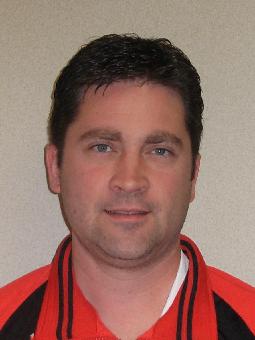
New USA Men's Coach: Christian Latullipe

USA Team Handball has posted the following update on their Facebook Page:

Staff Selection Committee Announces Choices

General Manager Dave Gascon today announced the long awaited selections of staff for the upcoming USATH Men’s National Team (MNT) as they will venture to Argentina for the Pan American Championships, which is also a qualifier for the 2013 World Championships in Spain.

“I am pleased to announce that our selection committee of Olympians Rod Oshita, Bob Djokovich, and Michael Lenard has selected Christian Latulippe as Head Coach, Michael Tilton as Assistant Coach, and Mariusz Wartalowicz as Team Leader for this event. I know the committee spent considerable time and effort evaluating all the candidates in order to provide us with the best possible selections. I am very impressed with the professional and thoughtful process with which they approached their responsibilities. USA Team Handball is grateful to them for their time and commitment to our Men’s National Team Program.”

The Pan Am Championships are scheduled for June 18-24, and although the timeline is not yet finalized, Gascon addressed the possible schedule. “Our tentative goal is to depart for Argentina June 10th and to try to get in a solid week of training before the tournament begins. The athlete selection process is being finalized and we hope to have a team selected around the 23rd of May.

We are hopeful that our newly appointed staff and the athletes will bond quickly and that the team will jell within the week. It will be quite intense,” said an optimistic Gascon. I expect our MNT Selection Committee will pick a great team to represent the United States for this important competition.”

Gascon has indicated he will ask for the assistance of 2011 Pan Am Games Head Coach Darrick Heath and Assistant Coach Wade Sutton, as well as former Pan Am Games MNT player Daniel Kimmich, to serve in some capacity on the selection committee. Latulippe, Tilton, and Wartalowicz will round out the panel.

This will be Latullipe’s second go round as a USA National Team Coach.  From 2004-2007, he was the coach of the USA Women’s Team and was instrumental in the setup and organization of the residency program in Cortland, NY.  In March of 2007, Latulippe, was abruptly replaced (fired, resigned, reassigned- take your pick) as coach shortly before key qualification matches for the 2007 PANAM Games.  Latullipe, a Quebecois Canadian, has been coaching club handball in France where he was recently the head coach of 2nd Division Women’s side, La Motte Servolex.   He also was the assistant coach for the Canadian Men at the 2011 PANAM Games.

The assistant coach, Mike Tilton, is the current West Point Men’s coach.

THN (13 Mar 2007): USA Women’s National Team Coach Resigns: https://teamhandballnews.com/2007/03/usa-women%E2%80%99s-national-team-coach-resigns/
THN (19 Mar 2007): USOC Statement on Latulippe Resignation: https://teamhandballnews.com/2007/03/usoc-statement-on-latulippe-resignation/
THN (22 Mar 2007): An Act of Desperation or Decisive Action?:  https://teamhandballnews.com/2007/03/an-act-of-desperation-or-decisive-action/
THN (18 Jun 2007):  USA Women:  What happened and what’s next?: https://teamhandballnews.com/2007/06/usa-women-what-happened-and-what%E2%80%99s-next/
Handzone (19 Feb 2012): La Motte-Servolex without Christian Latulippe: http://www.handzone.net/asp.net/main.news/news.aspx?id=56593
West Point Team Handball Website (Coaches): http://wpteamhandball.wetpaint.com/page/Coaches

post

2012 Men’s Pan American Championship: Apparently, the Field is Set?

The "Sports Almirante Browm" Arena, where apparently, the Men's Pan American Championship will be played in June.

The participants for the upcoming Men’s Pan American Championships have apparently been determined.  A total of 10 teams will participate in the event scheduled for 18-25 June in Buenos Aires, Argentina.  The field has not been drawn yet, but the performance rows apparently are:

1) Argentina, Brazil
2) Chile, Uruguay
3) Greenland, Canada
4) Mexico, Venezuela
5) USA, Dominican Republic

The teams will be drawn into two groups of 5 and the top two teams from each group will advance to the semifinals.  The Champion, runner-up and third place team from this event will also qualify for the 2013 World Championships, to be played in Spain next January.

The reason for the delay in establishing the field was apparently due to a combination of IHF concerns with the format and structure of the tournament.  The Pan American Team Handball Federation (PATHF) regulations had established a two tier qualification format, with a Division 2 Championship played in the Fall prior to the Elite (Division 1) Championship in the following Summer.  The top 6 teams from the previous Elite Championship qualified directly for the Elite Tournament while the remaining teams in the PATHF region first participated in the Division 2 tournament with the top two teams advancing to the elite tournament.

As we reported last fall, a decision was made at the 2011 PANAM Games to forego the established process in favor of a single, larger Elite Championships to be hosted by the winner of the PANAM Games.  (As a side note, readers should realize that the PANAM Games and the Pan American Championships are distinct, separate events.  The PANAM Games are held once every four years and serve as the qualifier for Olympic competition.  The Pan American Championships are held every two years and serve qualifier for Handball World Championships)

While in principle, the idea had some merit, it apparently came up lacking in terms of planning considerations.  Most notably, how many teams could participate in the bigger tournament and what would PATHF do if every PATHF nation wanted to come?  With the established regulations essentially being ignored the new structure was apparently implemented on the fly and apparently it had raised some concerns with the IHF.

COMMENTARY:  You’ll note the liberal use of the word “apparently” in this post, because, well, because there’s been no official announcement on the PATHF website in regards to this upcoming event.  Our information comes from the Mundo Handball website, which got the information from an Argentine website with a Spanish language interview with Miguel Zaworotny of the Argentine Federation.

As long time readers already know, the PATHF has an unfortunate track record in regards to both time communication and transparency when it comes to organizing competition events.  Nations have on numerous occasions gotten information late (or even not at all!) making it difficult to plan and schedule transportation requirements.  It’s also worth considering this decision to arbitrarily increase the size of the tournament this year in the context of the 2006 Championships.  Back in 2006, Canada was excluded from participating despite having placed 3rd in 2004 because they had not earned enough qualification points under the new regulations. Canada pleaded for a larger tournament, but those pleas fell on deaf ears.  The regulations had to be followed.  Flash forward, 6 years later and the iron clad regulations are apparently changed on a whim during the PANAM Games without fully considering the repercussions.

Reportedly, there is a PATHF meeting scheduled for today to address this upcoming championship, as well as, the format for upcoming events.  Here’s hoping “apparently”, will take some form of reality with a clear communique on the PATHF website in short order.

THN (27 Apr 2006):Canada’s Exclusion from the Men’s Pan Am Championships- Commentary: https://teamhandballnews.com/2006/04/canada%E2%80%99s-exclusion-from-the-men%E2%80%99s-pan-am-championships-commentary/

Mundo Handball (29 Apr 2012): Pan American Championship Adult Male: Confirmed participating teams:  http://www.mundohandball.com/Continentes/Panamerica/2012/panamericano-adulto-masculino-equipos.html

Mundo Handball (4 May 2012): Buenos Aires 2012: First and last Pan American Championship with 10 teams?:  http://www.mundohandball.com/Continentes/Panamerica/2012/buenos-aires-2012-ultimo-com-10-equipos.html

post

Red Card: A follow-up and a direct plea to the EHF

Just follow the rules!


Last week I expressed my strong concerns about how the EHF and some national federations illegally set aside what is prescribed in the playing rules regarding post-game suspension following disqualifications during games. Essentially, these federations explicitly violate the rules by not respecting the formal distinction between ‘red card WITH report’ and ‘red card WITHOUT report’. They do so by instigating disciplinary proceedings in cases where the referees have used their prerogative to classify a disqualification as one that is NOT to be causing a report and any subsequent action.
Despite my own frustrations with this issue, I was very surprised by the widespread reactions I got via e-mail and telephone calls, from representatives for leagues/clubs/players, referees, media and handball fans. They gave such strong support for my views and added important comments, so I have decided to follow up with a brief summary of the key concerns:

Leagues/clubs/players are seriously concerned about the inconsistencies and the unpredictability that follows from the illegal practices. This is just the opposite of what was intended by the clear distinctions in the 2010 IHF Playing Rules. I got comments that described the practice of setting aside the Playing Rules as a state of lawlessness that we do not want in the world of sports.

People were asking why it would occur to the EHF to do something like this and, of course, how the IHF could tolerate it. It was suggested that it must reflect a desire on the part of the EHF and other federations to ‘flex their muscles’ and demonstrate their perceived power in an inappropriate way. Several persons commented that, in an asymmetric way, it amounts to punishing more harshly than the rules prescribe.

The rules were changed in 2010, and the concept of ‘exclusion’ (causing a team to play shorthanded for the rest of the game) was removed. Instead, it was decided to introduce TWO separate categories of disqualifications: the ‘routine’ form, that is specifically not intended to lead to further punishment after the game; and then the category reserved for really dangerous/reckless fouls, for grossly unsportsmanlike conduct, and for the situations involving what we could call ‘last minute sabotage’.

The latter category, based on what the REFEREES decided, is the ONLY one that gives the responsible federation the authority to consider a further punishment on the basis of the referee report. It should be noted that it is NOT automatic that there should be a further punishment; the federation may decide that the ‘rest of the game’ disqualification was sufficient. It really could not be more clear-cut, and it is hard to see how the EHF and the other federations involved could have misunderstood. And it is equally hard to see where they think they get their authority from; it is really as illegal as it would be if a federation wanted to add a punishment to a player who received a 2-minute suspension or caused a 7-meter.

It was also pointed out that the illegal practice creates problems in the existing efforts (which are embraced also by the EHF itself) to ensure that the referees have the courage and good judgment to use the red card when it is appropriate, instead of backing off and letting it suffice with a 2-minute suspension. But several people now commented to me that referees become tempted to refrain from giving a ‘red card WITHOUT report’, because they fear that the federation will take upon itself to start a disciplinary process and perhaps give out a suspension, something that the referees know is illegal and unjustified by virtue of their decision to place the event in the ‘WITHOUT report’ category. This risk that the referees will feel pressure to avoid giving red cards is totally undesirable, and this cannot possibly be what the EHF and others are seeking to achieve.

So how about it, my many sensible and competent friends at the top of the EHF: HOW WOULD IT BE IF YOU WERE TO ANNOUNCE THAT, STARTING WITH THE 2012-13 SEASON, YOU WOULD ABANDON YOUR ILLEGAL AND UNDESIRABLE PRACTICES AND INSTEAD START FOLLOWING THE UNIVERSAL PLAYING RULES!?

post

AUDIO/VIDEO: Barcelona vs. Copenhagen

Can Thor (AKA Mikkel Hansen) and Copenhagen hold off Barca?

Last weekend, Copenhagen beat Barcelona, 29-23 in the first leg.  That showdown was the EHF’s match of the week with live English language commentary from Tom O’Brannigan.  The clash of these two titans in the second leg should probably be the match of the week again, but the pluralistic EHF decided that the Berlin-Leon match should get honors this weekend.  So, if you want audio commentary for this match you’re stuck with me.

Video Links are below.  Remember to have a sheet of paper handy to lessen the chance of seeing extraneous indicators of the final outcome

Copenhagen vs. Barcelona
(28.03.2012) http://www.ehftv.com/ehfcl/ec/cl/men/2011-12/video/002344

Leon vs. Berlin
(29.03.2012) http://www.ehftv.com/ehfcl/ec/cl/men/2011-12/video/002346

Koper vs. Madrid
(28.03.2012) http://www.ehftv.com/ehfcl/ec/cl/men/2011-12/video/002345

Zagreb vs.  Kiel
(29.03.2012) http://www.ehftv.com/ehfcl/ec/cl/men/2011-12/video/002347


Audio  Mp3 files are below.  You need to synch up the audio with the ehfTV video.  The first half audio starts at 5:20 on the EHF clock.  The second half starts at 48:00.


post

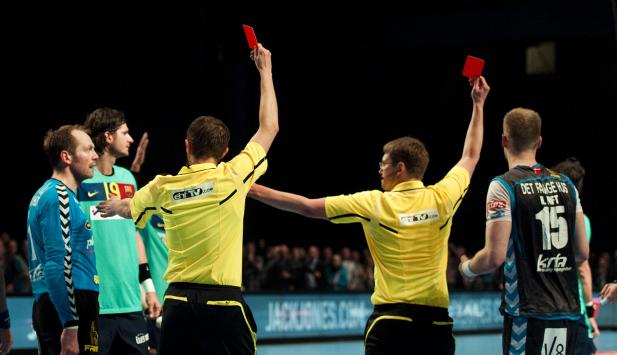
The consequences of a ‘Red Card’: ignorance or arrogance?

Typical red card 'without report' - so that should automatically be the end of it!


There have been too many instances recently, where a red card has led to post-match uncertainty, disputes and improper handling of the matter. Mostly, because these are the situations which are given more publicity, it involves EHF competition, but I have information that similar problems seem to exist in national federations, for instance in Germany. This is very regrettable, because players and clubs should be able to count on predictability and consistency; it is also largely unnecessary, because the basic IHF Playing Rules, which MUST be respected by all continental and national federations, offer both clarity and limits regarding the post-match handling of a disqualification (‘red card’)!

The 2010 playing rules make a very important distinction between the ‘basic’ disqualification due to a foul or unsportsmanlike conduct (rules 8:5 and 8:9 respectively) and the more dangerous fouls and serious conduct (rules 8:6 and 8:10 respectively) where the referees are required to send a report to the organizing federation regarding the disqualification. The important point here is that the referees are the ONLY ones, using their subjective judgment on the basis of existing criteria, who have the prerogative to decide if a foul falls under rule 8:5 or 8:6 and if a misconduct falls under 8:9 or 8:10. Moreover, this decision must be taken immediately by the referees at the time of the incident, and they are obliged to inform the team immediately, if their decision is to classify the action under 8:6 or 8:10.

This means that if the referees have given a red card and have concluded that 8:5 or 8:9 applies, meaning that no report is to be sent to federation, this is the END of the matter. The federation has NO right to override the judgment of the referees and take upon itself to decide about a further suspension. Indeed, one of the fundamental reasons for the distinction between ‘disqualification without report’ and ‘disqualification with report’ is precisely to avoid any uncertainty regarding the player’s status for future games and to prevent the possibility of capricious and inconsistent bureaucratic action. Presumably, it can only be ignorance or arrogance that causes the federations to ignore what the playing rules prescribe, and it is regrettable that the IHF turns a blind eye to these improper practices!

In those cases where there referees do submit a report, because a disqualification falls under rules 8:6 or 8:10, there are sometimes some misunderstandings, both among the responsible federations, and among the general public. The purpose of the report is to enable the federation to determine IF there should be further consequences and if so to what extent. In other words, a suspension is NOT automatic and mandatory just because a report has been filed. It is always up to the respective federation to apply its own principles, guidelines and procedures. Here they have a complete prerogative and are not under the jurisdiction of the IHF. Culture and traditions may impact the decision-making, and this may vary from country to country.

Of course, this does not mean that one does not want to see consistency and a clear logic in the decision-making WITHIN each federation. On the one hand, similar cases need to be treated in a similar way, so standardization is important. On the other hand, there must also be flexibility to make a distinction between cases that are not quite similar, or where the seriousness of the action varies, so one must guard against any tendencies to a ‘robotic’ decision-making. It also needs to be recognized that it is in fact difficult to compare and get consistency between entirely different types of cases. For instance, what is fair and consistent if one compares dangerous and reckless fouls that may lead to injuries, with grossly unsportsmanlike behavior that does not physically hurt anyone but may have a direct impact on the result of a game?

One particular situation, which unfortunately arises far too often, is the special case of illegally preventing the opponents from resuming the game or getting to a scoring chance during the LAST MINUTE of the game. Clearly, the reason why this, by definition, has been placed in the category of ‘disqualification WITH report’ is the desire to go as far as possible in discouraging this kind of cynical action, which is really bad for the spirit and the image of our game, especially if it does have its intended effect during the game. When the rule was introduced, attempts were made to tie the rule and the punishment not just to the ‘last minute’ but also to the notion of having a potential effect on the outcome.

Clearly there is a difference between situations where everyone knows that ‘the next goal will decide’, and situations where it is either impossible to know whether the next goal is so important or where it is clear that is UNimportant (and the action is really a case of sheer stupidity). It is also relevant whether the cynical player commits the action in a way that is at least physically harmless or whether the cynicism includes subjecting the player to physical danger. But despite these differences, the federations tend to be ‘on autopilot’ when giving out suspensions: for the EHF, one game seems to have become the standard. Here it would be appropriate to increase the length in those cases where the awareness of the impact was clear and/or there was reckless physical action involved. As it now is, many players and teams laugh at the ‘price’ of ONE game.

post

AUDIO: Interview with USA Team Handball Board of Director’s Chairman, Jeff Utz

USA Team Handball's Board of Director's Chairman, Jeff Utz

This past Thursday and Friday, I attended a Strategic Planning Conference in Salt Lake City.  There were 23 attendees including Board Members, athletes, club leaders and representatives from the USOC.  Several issues regarding the future of USA Team Handball were discussed and 4 broad areas were selected for initial focus:

1) Financial Stability
2) “Pipeline” Athlete Development
3) Promotion and Marketing
4) Governance and Management Structure

Following the meeting on Friday, I sat down with Jeff Utz, USA Team Handball’s to discuss the conference, the future of USA Team Handball and his role as Chairman.   The Audio is about 24 minutes and can be downloaded below.

post

Lessons for handball from NHL Stanley Cup and UEFA Champions League

Not the trend we want to see!


Wherever we are located, many of us are likely to be enjoying these two events, featuring enormously skilled athletes and very intense competition. But we are probably also groaning about many habits and incidents that detract from the overall experience, especially if we have a particular interest in refereeing and fair play. The impression is that we can consider ourselves comparatively lucky when we focus on rules and elite level refereeing in handball. But there are also indications of dangers and lessons to be learned.

The most conspicuous problem in the late stages in the regular season in the NHL and now in the play-offs is the total deterioration in the respect among players for the well-being of the opponent. Hard hitting and desperate methods can be both understood and tolerated, but an epidemic of actions which are either intentional or totally careless is putting many star players on the side-line with major injuries. Hits against the head, often causing long-lasting concussions, seem to be the ‘favorite’ method for the moment. The NHL tries to use suspensions as a deterrent, but there is no indication that this is really discouraging these actions.

Fortunately, we have yet not seen the quite same the cynicism in our recent, major events in handball. In our case it is more a matter of isolated incidents. But ‘flying elbows’ or fists to the face are dangerous actions that can far too easily occur in handball, especially if the referees are not alert and courageous, and if the federations to do not take such matters seriously enough.

In the case of NHL, I see a connection to another problem that I ‘desperately’ want us to avoid in handball. It is a tendency, or mentality, that may be relatively more common here in the U.S. What I am talking about is the attitude that in the play-offs, or in the final minutes of any game, “you should put the whistle away and let the players decide the outcome”. This has been more conspicuous than even in this year’s Stanley Cup, but to my mind it is totally misguided! First of all, it does not lead to fairness and a proper outcome if you ignore fouls and other violations. What simply happens is that the most cynical teams and players take advantage by being ruthless. Is this really what we want? And even worse, it creates an escalation on the ice/court so that finally there is a sense that ‘anything goes’ , with more and more dangerous action (including elbows to the head) and revenge fouls.

In the case of UEFA and Champions League, I want to focus on two issues. The first one involves ‘theater’, especially in terms of exaggerating the impact of a minor body contact or completing faking the existence of a foul from an opponent. In my opinion, football is getting worse and worse in this respect, mainly because there is too much tolerance for it. It creates major irritation between players, it leads to fouls and other forms of misbehavior, it creates a loss of respect for the referee. We really need to be careful in the handball and must be more prepared to take tougher action against such tendencies before these unpleasant habits become as common in handball as in football.

And then there is an issue related to an inherent advantage that we have in the handball rules, an aspect that we must take great care to protect and preserve. I am talking about the distinction between punishments for fouls and the restoring of a goal chance that has been illegally removed. It is terrible to see that football is not more rapidly dealing with the issue of ‘double punishment’ (penalty kick AND red card) for removing a clear scoring chance in the goal area. This is really unconscionable. But it also tells us that we in handball must take great care to make our referees understand the right situations for: 7-meter only; personal punishment but no 7-meter; both 7-meter and personal punishment. Another rules aspect that will not realistically change: in football the penalty kick depends simply on the position and not on scoring chance. This means that shirt pulling in the penalty area causes the referees to decide either to see what happens or to close their eyes. Perhaps this unsatisfactory effect should be remembered by those who think that we allow too much subjective judgment for the decision about a 7-meter in handball. I am sure that many football referees would love to have that prerogative!

post

Memo to IHF: Please add a web TV platform- I’ll gladly send you money

Do I really want to download the Sopcast platform? Yes, if I want to see whether Serbia or Poland qualifies for the Olympics.

Last weekend I had the unexpected treat of watching some great handball matches.  Sure, the Olympic Qualifying Tournaments had some real snoozer games where the outcome was all but pre-ordained, but there were also a few matches with very real drama and thanks to the Macedonian fans in Sweden, tremendous atmosphere as well.

“But, why was watching these matches an unexpected treat?” you ask.  Well, with the IHF’s apparent decision to only sell traditional TV rights to these matches and with no U.S. network buying I figured that it was about a 50-50 shot that I’d find a webstreaming video.  But even then, I also figured that it would be a poor quality picture, barely worth watching.  But, maybe those odd are improving or perhaps I’m getting a little savvier in finding viewable viewable webstreams, as last weekend I was able to watch Macedonia battle Hungary and Sweden and see Poland-Serbia battle to a 25-25 draw.

All well in good, I suppose.  Nothing like watching free handball on TV in the United States.  After all, just a few years ago, all anyone outside of the European continent could expect to do was read a computer generated translated summary of the match afterwards.

But, no, it’s not good enough.  I want more.  I want a better quality picture from a reliable source.   And, this should be music to the IHF’s ears– I’m willing to pay for it.   Heck, the word “free” is one of my favorites, but when you go to access the video from these fly by night websites, rest assured that they aren’t providing this service simply out of their love of handball.  With the video come advertisements and some level of access to your computer, especially if it requires some sort of platform download to watch the video.  Annoyingly, somehow my homepage was changed both for Internet Explorer and Google Chrome.  Sure, easy to fix, but now I’m wondering what else has found its way on to my laptop.

It really doesn’t have to be this way.  The IHF has provided webstream subscriptions for the World Championships and the forward thinking EHF even streams the Champions League for free.  Not to mention, the free European Championships streaming this past January.  The technology is there and there are a number of entities like Youtube willing to help.

If unofficial entities can webstream these matches, then very clearly it’s possible that the IHF could officially do so.  There’s simply no good excuse for this and the IHF should fix this in a timely manner.  Let’s say in time for the Women’s Olympic Qualification Tournaments coming up in May.


post

Olympic Qualifying: Serbia in and Poland out

All the participants on the men's side are now known


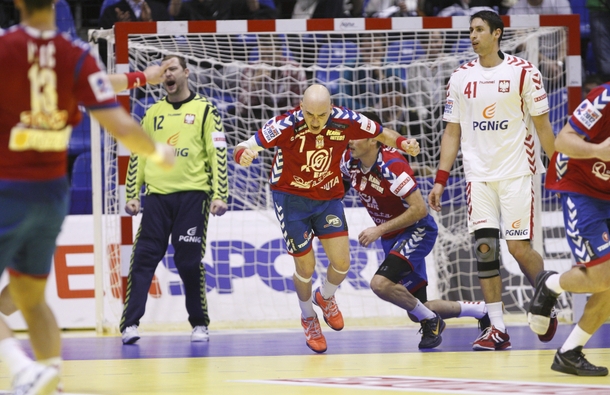
Before it all started, many of us surely found the qualifying groups rather predictable: Croatia and Iceland would have an easy time, Sweden and Hungary would be favorites but would have more of a struggle, and Spain should not realistically fail at home. And that is what we also could confirm last night. So today it all came down to ‘Serbia or Poland’. But this anticlimax, with only one place to be decided today, could have been avoided if the IHF had decided that, if two teams out of four will advance from each group, then it makes sense to have the teams seeded no. 2 and no. 3 play each other on the last day.

This would also have felt more fair and straight-forward. Now Serbia and Poland had to depend not just on their own performance but also on the attitude of two teams that already knew that they were in or out. This could easily lead to an issue of motivation that might have too much influence on the outcome. Poland had only defeated Algeria by one goal in a nervous game on the opening day. Today the Serbians knew that they could force Poland to gain at least a tie against Spain if they could beat Algeria with a margin of at least four goals. And they built a five-goal lead during the first 18 minutes, a lead which they then gradually increased in last part of the game. Vujin and especially goalkeeper Stanic were the key players today, in this comfortable 26-18 victory.

So Poland desperately needed to avoid a loss, while Spain could play in a more relaxed manner. And it very soon became clear that the pressure that goes with desperation was a handicap. But one should also emphasize that the Spanish team simply was too good today. From goalkeeper veteran Hombrados (who turned 40 during the weekend) to the strong defense and the very agile and powerful attack, the Spanish team looked superior throughout the game. An impressive start led to 4-0 and eventually 18-9 by half-time. Against a clearly demoralized Polish team, this was increased to a 14-goal margin close to the end, before the final score was settled at 33-22. Perhaps there is some sense of fairness in seeing Serbia qualify at Poland’s expense, because Serbia was the silver medalist in EURO 2012, while Poland was the last team to ‘sneak in’ and gain a place in a qualifying group, but I doubt that the Polish team will view it this way…

In other games today, Brazil saved the image of the non-Europeans by giving a very motivated performance and defeating FYRO Macedonia 28-27. The aggressive Brazilian defense caused the opponents to work hard for each goal instead of scoring easily from a distance. The teams took turns scoring in spurts of three to four goals but Brazil was mostly ahead throughout the game and deserved the victory. — Sweden clearly wanted to win in front of the home crowd, and a win would also yield what could be seen as a slight edge in the draw for the groups in the Olympics. The game was even, with Hungary enjoying a narrow 12-11 half-time lead, even though the Hungarians rested some key players. But Sweden showed will-power and turned a 20-21 deficit into a 26-23 victory during the final ten minutes.

Perhaps the Chileans had had some hope of finally confirming their nice impression from the 2011 World Championships. But although Emil Feuchtmann showed his strength with nine goals, the more balanced attack of Japan, combined with a tenacious defense, made the difference. Japan jumped to a 6-1 lead after 7 minutes, and thereafter they maintained a lead of at least four-five goals en route to a 33-26 triumph. — Iceland managed to stay very even with Croatia during the first half, which ended with 18-15 for Croatia. But during the second half there was really no doubt about the outcome. Croatia maintained a lead of about five-six goals throughout, although at the very end Iceland reduced to 31-28.

The implications for the seeding of the two groups in London are that the 12 teams will be placed as follows: level 1 – France and Spain; level 2 – Sweden and Croatia; level 3 – Iceland and Hungary; level 4 – Serbia and Great Britain; level 5 – Denmark and Argentina; level 6 – Korea and Tunisia. After the teams from all the other five levels have been drawn into two groups, Great Britain will be allowed to choose one of the groups. All the speculation is that Great Britain, unless they somehow want to avoid a confrontation flavored by ‘Falklands/Malvinas’, will choose the group that includes Argentina at level 5. This is in part because for Great Britain the chance to reach the quarterfinals clearly depends on the slim hope of beating the lower-ranked teams in their group.

So this is also what underscores the unfair treatment of World Championship silver medalists Denmark (as I have discussed in an earlier article), as they are bound to face four strong European teams in their group. And unless Great Britain voluntarily goes for a stronger opponent, it will also create suspense and inequities for the teams in level 1-3 and 6; from each level, one team would face Serbia + Denmark while one team will face Great Britain + Argentina!

Finally, after this criticism, credit should at least be given to the IHF for very efficient results service throughout the three game days.

Please note change from initial version: it appears that the IHF has changed the seeding for London to a more logical approach in one particular respect, compared with the version which they briefly published in February on the IHF web page. It has now been confirmed that Iceland (as a higher ranked team) is correctly at level 3, while Serbia is at level 4. By contrast, the mistreatment of Denmark remains. (I had initially reflected the previous IHF version which would have improperly put Serbia at level 3 and Iceland at level 4).

post

Olympic Qualifying Day 2: Only 1 Olympic ticket left to be punched


Nikcevic's fast break goal in closing seconds bails out Serbia

Five of the six remaining Olympic bids are now known as victories by Sweden, Hungary, Croatia, Iceland and Spain on Saturday made their qualification a mathematic certainty.

Only Tournament 1 has any major suspense left as Serbia and Poland’s 25-25 draw means that both those teams still have hopes of qualifying.  A tight affair throughout it appeared that Poland was pulling away when they secured a 25-22 lead with just under four minutes remaining.  But Poland did not score another goal for the remainder of the match and Serbia’s Ivan Nikcevic’s fast break goal with 5 seconds left brought the game level at 25-25 all.

In Tournament 2, Hungary fought off a pesky Brazil side for a narrow, 29-27 win.  The win assured that Hungary will advance to London.  In the second match, the home team, Sweden held off Macedonia for a 27-23 win.  The big difference was Right Back, Kim Andersson who delivered 3 straight goals from long range around the 52 minute mark to erase any Macedonian comeback hopes.  Hats off, though to the Macedonians players and fans.  With the exception of Lazarov, they have a pretty significant talent gap compared to the Swedes and Hungarians.  And without question, they’ve got the best fans.  Whether they traveled in force or were made up of resident emigrants living in Sweden they pretty much eliminated the home court advantage.  I’ve never seen that done on the road like that before in European handball.

Tournament 3 was no surprise as Croatia and Iceland had easy victories over Chile and Japan.

Scenarios for Sunday

Tournament 1 current standings

Spain 2-0-0 4 Points
Poland 1-1-0 3 Points; +1 GD
Serbia 0-1-1 1 Point; -3 GD
Algeria 0-0-2 0 Points

Serbia and Algeria will play the first match on Sunday and while Algeria was able to give the Poles a tough match it’s hard to see Serbia not winning by at least 4 goals.  With a victory by that many goals Serbia will have the goal differential needed to take 2nd in the group should Poland lose to Spain in the second match.  And  Poland will then need to draw or beat Spain in order to qualify for the Olympics.

And then the big question, especially for conspiracy theorists, will be just how hard will Spain play since they’ve already qualified?  Fortunately, for Serbia the Spaniards will not totally be without incentive as seeding for the Olympic draw is still at stake.  A first place in the group will put them on the same rank as World Champions, France, while 2nd place will pair them with Great Britain.  So, if Spain wins or draws tomorrow against Poland they will avoid France in group play at the Olympics.  Whereas losing means they will avoid Great Britain.  Of course, 4 teams advance out of Group Play at the Olympics, making the Olympic draw less paramount. So, the Spaniards will have a little incentive, but for the Poles it will be do or die which should make for an interesting contest.  At least the bookies think so, as the line for the match tomorrow is a pick-em.

Tournaments 2 and 3 are essentially over in that the Olympic participants are now known.  In tournament 2, Sweden and Hungary will play to decide who gets first and second, while in Tournament 3, Croatia and Iceland will do the same.  In terms of incentive for the Olympic draw these four teams will be split off into two performance rows (the 2 group winners will be paired as will the 2nd place qualifiers).  Croatia is probably the strongest of the four teams, so the Sweden-Hungary winner can probably expect to be paired with Croatia, assuming they take care of Iceland.

post

Olympic Qualifying: summary of first day

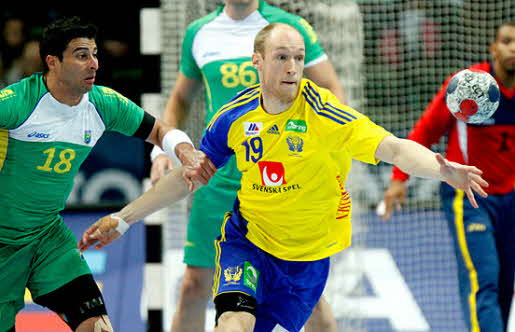
Sweden-Brazil on the opening day in Goteborg


The first day of games in the three groups did not offer any real surprises. Perhaps some will think that Algeria and Brazil offered more resistance than expected, but the opponents were most likely prepared for a battle. Here are some observations, based on web reports and input from people who were present:

Sweden did manage to win against Brazil with 25-20, but it was not an impressive victory. The attack was characterized by mistakes and the defense leaked. So the goalkeepers Palicka and Sjostrand deserve a lot of credit. The result was 16-16 at one point in the second half, but then came the decisive Swedish move to 20-16. Sweden had success with fast-breaks but they were a disastrous 1 for 5 from the 7-meter line. Brazil were hampered by very erratic shooting from distance. The conclusion is that Sweden must play much better to have a comfortable time against FYRO Macedonia tomorrow.

This was also confirmed in the Hungary-FYROM matchup, where the Hungarians fell behind from the beginning and did not manage to assert themselves until some strong shooting from oldtimer Carlos Perez gave them a chance to pull ahead late in the first half. From there on they managed to maintain a slim lead. The final result was 28-26 for Hungary, after some drama near the end, when FYROM had a chance to tie the game. Hungary got a large number of 2-minute suspensions, but despite good efforts by playmaker Mojsovski, FYROM did not manage to take advantage. This game may well turn out to have been the critical one in the group.

Poland seemed to get a solid start against Algeria, but soon they found themselves behind and the half-time score favored the Algerians, 16-13. Szmal had started the game without much success, so a switch to Wichary may have been decisive. And then, during a ten-minute period early in the second half, the experienced Polish team got the game under control with a partial score of 9-2. From there on they were never really threatened, and with the Jurecki brothers showing the way, they built the lead to 28-22, before Algeria managed to score the last five goals of the game for a 28-27 final result. Poland’s strength was in efficient scoring from the 6-meter line and the wings, while the Algerians undermined their cause through some wild shooting.

Spain is in what seems to be the toughest group, but at least they have home court advantage in Alicante. The Spanish team had also made rather confident statements ahead of time, suggesting that they are simply too good a team to miss out on the Olympics. But the game against Serbia turned out to be just as difficult as the strong performance of Serbia in EURO 2012 would suggest. The half-time lead for Spain was 11-10, after a nervous start from the home team and a gradual comeback. In the second half it was very close until a few minutes from the end, and Serbia had the lead a couple of times. Ilic was the outstanding scorer for Serbia, although some of the goals came from the 7-meter line. The Spanish scoring was more evenly spread, but the tradition held up, with many successful fast-breaks and a lot of shots attempted from the wings.

If from the game Croatia-Japan one first noticed the half-time result, 16-14, one may have begun to wonder. But a closer examination shows that the Croatians had a 12-6 lead before they relaxed. And in the second half there was never any doubt. The home team pulled away to 28-17 and kept up their concentration to the end. The final result was 36-22. It was telling that 47 of 51 shots from the Croatians were on target, with Cupic and Horvat as the top scorers. Alilovic and Losert had an easier time as no less than 18 of 53 Japanese shots were blocked or went wide. It just is not enough to score eight goals from distance in international competition.

It had been generally assumed that Chile is the weakest one of the teams participating in the qualifying. Against this background, a final victory for Iceland with 25-17, after 12-7 at half-time does not seem so overwhelming. But Iceland in fact had the lead by 20-9 and 24-12, so the win really came more easily than the final result suggests. One factor was that Chile had far too many turnovers, and they also failed to take advantage of a large number of Icelandic 2-minute suspensions. Sigurdsson dominated the scoring for Iceland with ten goals, many of them on fast-breaks. Chile also allowed too many penetrations on the 6-meter line. None of the Chileans managed to score more than two goals.

It would not be a complete surprise if all the groups are decided on the second day, causing the games on Sunday to be meaningless. But let us hope that we get at least one unexpected result tomorrow! At least it is difficult to see Poland as clear favorite against Serbia, and perhaps the Swedish group will also see an upset…

post

Men’s Olympic Qualification Tournaments: The Final Pieces to the Puzzle

Can Kiril Lazarov and Macedonia qualify for its first Olympics?

This weekend the final 6 slots for the Men’s Olympic Handball Tournament will be awarded.  Three tournaments, each with 4 nations will play a round robin tournament with games on Friday, Saturday and Sunday.  Here’s a breakdown of those tournaments:

All times are Central European Time/ Handicap point spreads for Friday’s matches in parentheses

Tournament 1 (at Alicante, Spain)

Friday 6 April
17:30: Poland (-7) vs. Algeria
20:15: Spain (-4) vs. Serbia

Saturday 7 April:
17:30: Serbia vs. Poland
20:15: Algeria vs. Spain

Sunday 8 April:
17:30: Serbia vs. Algeria
20:15: Spain vs. Poland

Host Spain is the clear favorite to advance and is a pretty good bet to win all 3 of their matches.  Algeria is the outsider team and will probably lose all 3 of their matches.  This means Saturday’s Serbia-Poland match could very well decide who will advance. The two teams met in January at the European Championships with Serbia winning 22-18.  But that match was in Belgrade, Alicante should provide a neutral setting.

Tournament 2 (at Gothenburg, Sweden)

Friday 6 April:
14:45: Hungary (-1.5) vs. FYR Macedonia
17:00: Sweden (-10.5) vs. Brazil

Saturday 7 April:
13:45: Brazil vs. Hungary
16:00: FYR Macedonia vs. Sweden

Sunday 8 April:
14:45: Brazil vs. FYR Macedonia
17:00: Sweden vs. Hungary

Host Sweden is the favorite, but they struggled in January at the European Championships enroute to a disappointing 12th place finish.  During Group play Macedonia and Sweden drew 26-26 on the first day of play, a performance that was an early indication of how nearby Macedonia would ride their pseudo home court advantage in Serbia to a 5th place showing and a slot in this qualification tournament.  The other European side Hungary placed 8th in Serbia and will also be looking to advance.  Brazil, the Pan American entrant will likely lose all three of their matches, so it will likely come down to head to head performance amongst the 3 European sides.  With Sweden a slight favorite, the Hungary-Macedonia match on Friday afternoon could be the big decider in terms of 2nd place and who ends up in London.

Tournament 3 (at Varazdin, Croatia)

Friday 6 April:
18:00: Croatia (-9) vs. Japan
20:15: Iceland (-14.5) vs. Chile

Saturday 7 April:
16:00: Chile vs. Croatia
18:15: Japan vs. Iceland

Sunday 8 April:
15:30: Japan vs. Chile
18:00: Croatia vs. Iceland

Barring a huge surprise from either Japan or Chile it’s all but preordained that Croatia and Iceland will advance.

(Editor’s note: If you find an internet video feed for these matches be sure to post the link at our Facebook page)