post

Apropos the Olympics – Part 5: American novices reacting to handball on TV

Also a handball novice may easily get excited during a game, as demonstrated here by the 'outspoken' Swedish King


As I mentioned in my first post-Olympic comments, I spent time during the second week of the Games in the company of Americans sports fans watching handball on TV. Almost without exception, it was their first opportunity to get familiar with our sport. So it entailed an opportunity to do some ‘preaching’ and explaining, while also listening to often quite amusing comments from the handball novices around me.

The comments included a mixture of the type of reactions that I have constantly encountered during my soon 40 years in the U.S. and some more surprising observations. Generally speaking, handball met with the approval of the people around me, and their reactions showed that this was not just the result of politeness. As often happens, people got excited even without having any prior knowledge of the teams and without being able to appreciate the fine points. “This is such a typically American sport”, was a comment that I have become used to over the years. And “why are we not good at this”, is then the obvious follow-up question.

What people tended to appreciate was the amount of physical contact, especially the fact that this is very much part also of the women’s handball. “This would be something for women who like American football”, was one comment, and “it is nice to see a ball game where you can be successful without being extremely tall”, was the reaction of someone watching the Koreans. Having a goalkeeper, instead of just a basket, was a feature that some viewers felt added a dimension. And the continuous action, without a lot of time-outs, met with approval, as did the existence of the ‘advantage rule’, which some recognized from soccer.

It was also seen as helpful that the structure and action of the game is so straight-forward that it is easy to follow and enjoy also for a beginner. As someone commented, you can easily anticipate when a critical moment is coming up so that you have to focus a bit extra. But then some felt a bit lost in their appreciation for what constitutes an ‘offensive foul’, and I had to admit that the referees did not always manage to show the desired consistency. Similarly, I got comments to the effect that “the decisions about when to give a 2-minute punishment seemed a bit capricious”. This came from basketball or icehockey fans, who are more used to the notion that ‘a foul is a foul’.

Several of my ’emerging handball fans’ seemed to assume that an Olympic sport such as handball “surely already was well established in the U.S.” and that it was their ‘fault’ for not having gotten to know it before. But they assumed it must be a relatively new sport at the Olympics, such as BMX or beach volleyball. They were astonished when I explained the longstanding traditions in Europe but also the comparatively feeble evolution in our country.

Someone offered the astute reflection that “of course soccer has a huge advantage, because so many of our immigrants these days bring that sport with them, while that does not seem to apply to handball”. I also heard the observation that the name ‘handball’ is a problem and ought to be changed. I gently reminded that this might not be so appropriate for Americans to suggest, considering our stubborn insistence on confusing people by referring to a certain sport as ‘football’ although 98% of the ball handling is with the hands… Others noted that the size of the court is a handicap, “as it does not fit into school gyms and would discourage schools from picking it up”. But ultimately, some of my new recruits noted that “as usual, it is likely to be a matter of money and good management”. Perhaps it will one day appear that at least one of my fellow viewers turns out to be a major philanthropist with a weak spot for handball…!

post

I want my, I want my, I want my HBL: Can somebody get me a good Univision Deportes Contact?


Could this Spanish language sports channel be the new American home for the German Bundesliga?

The German Handball Bundesliga (HBL) 2012-13 season is set to begin this Friday night with Grosswallstadt hosting Melsungen.  Unfortunately, the My Sports Germany channel did not the renew the rights for the HBL, so American viewers planning to get their handball fixing watching the world’s best professional league in their living room are probably out of luck.  Or are they?

According to some email correspondence I received from The Sportmans Media Group (the TV rights distributor for the HBL) the Univision Deportes Network (UDN) now has the rights to broadcast the HBL in the U.S. via their relationship with Televisa Deportes Network (TDN).  As I understand it, TDN is only available in Mexico, while UDN is available in the U.S.   And UDN can and does broadcast a lot of TDN content.  Mostly soccer from what I can tell.

I would like to know whether the UDN will (or could be convinced to) broadcast the HBL this season.  (Heck, even if they show one match a week at 2:00 A.M, I’ll be happy.)  Unfortunately, I haven’t been able to find an email contact on the UDN website and some shout outs on Twitter and Facebook have been unanswered.  Not too surprising as they were in English except for the word Balonmano (Handball in Spanish).

So my plea out there to any of our Spanish readers with a little bit of patience and persistence.  If you can track down the right point of contact at Univision to discuss the possibility of balonmano being broadcasts on their network it would be very greatly appreciated.  And if Univision agrees to advertise with Team Handball News, we will compensate you for your efforts.

If you have some good leads please send me an email at john.ryan@teamhandballnews.com

post

Apropos the Olympics – Part 4: Women’s Handball

Bojana Popovic, literally head and shoulders above the rest of the players in the final


You may recall that my main reaction to the men’s handball competition was one of disappointment. Unfortunately, I must say very much the same thing about the women’s tournament. In fact, the similarities are quite amazing. The 2008 champions, on the women’s side Norway, managed to defend the title without really impressing anyone while doing so. Just like in the case of the men, it happened because none of the other team’s showed their normal strength, which would have been enough to deserve to win and to manage to do so. Just like the French men, the Norwegian women were on their way to disaster in the quarterfinal, but their opponents kindly let them off the hook!

The main difference was perhaps that the final for the women had more real drama and excitement, in comparison with the men. Once they managed to qualify for the final, it was not surprising that the team from Montenegro would put up a real fight for the gold. In fact, they were a bit unlucky in losing the final, and it is my background in refereeing that inhibits me when it comes to explaining why I think so… Women’s handball in Montenegro is perhaps the best parallel to men’s handball on Iceland. The population is twice that of Iceland, moving towards 700.000, but the pool of talented handball players is small.

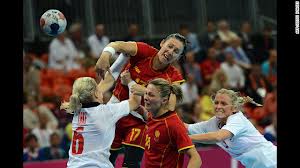
The focus in Montenegro is on team sports, but football and basketball are clearly ahead of handball, and even volleyball is a strong rival for athletes and spectators. But in recent time it is handball that has given the headlines. Buducnost won the EHF Champions League just a few months ago, and now Bojana Popovic, their perennial world-class player led them to the silver in the final match of her career. She had previously won World Championship bronze with Yugoslavia in 2001 and five earlier Champions League titles for Danish clubs. Montenegro hardly looked like a team for the final in the early going. They lost to both Brazil and Croatia, before they managed to tie Russia. But the breakthrough came in the quarterfinal, where they knocked out the equally tough and combative French team, one of the favorites.

The Koreans are always giving priority to the Olympic Games, so they tend to build up their team in four-year cycles. This time, the team showed many of their traditional strengths in terms of speed, energy and tenacity. But somehow they never looked as sturdy as their colleagues from the past, so their style combined with injury problems seemed to make them run out of steam after they knocked out Russia in the quarterfinals. Talking about Russia, their veteran coach Trefilov urged them on during the games in his well-known loud and ‘desperate’ style. But this time his team did not respond to his emotions and efforts. At times they seemed to play in ‘autopilot’ fashion, without their usual spark. So Trefilov was bitter afterwards, announcing his retirement and predicting a bleak future for Russian women’s handball. Indeed, handball is a much more modest sport at the national level in Russia than their international achievements over the years would suggest.

The Spanish team never looked like a candidate for the gold. They were solid and consistent, just as their performances in recent years have suggested, with a third and a fourth place in the 2011 and 2009 World Championships. But there seems to be some ingredient missing that would get them to the top. By contrast, Brazil lived up to the expectations that they might be the ‘dark horse’ this time. They had the advantage of fielding a team that has been playing together for a while now, also through the agreement with the Austrian club team Hypo. They seemed ready and determined to battle for a medal and the performance in group play was impressive. While they lost to Russia, the wins against Croatia and Montenegro were enough to put them at the top of the group standings. They appeared to be riding this wave initially in the quarterfinal, having an amazing 15-9 lead against Norway after about 38 minutes. But it seems they got carried away, suddenly feeling too confident and losing concentration. After too many mistakes and a seemingly casual attitude, they lost the game they almost had won.

Finally, before the event, one of the discussions involved the lop-sided draw resulting from the strange seeding. Who would be the two teams, among six strong ones, who would not make the quarterfinals from the ‘group of death?’ Not so unexpectedly, this fate was shared by Denmark and Sweden. In the past year, Denmark’s women had suddenly but clearly come down from their traditional level, missing out on a medal in 2011 and not being very impressive in the preparation games this year. Sweden got a direct path to London, not because of their performance in 2011 but as runner-up in EURO 2010. But there were doubts about their team strength that now became confirmed. It seems that Sweden may need to rely on reinforcements from a new crop of talents, the winners of this year’s junior world championships.

post

Apropos the Olympics – Part 3: Naïve rules and formats create invitation to manipulate

Questions were raised: how desperately did Norway try to win the final group game against Spain!?


Most people who follow sports might have expected that there would be frequent headlines about doping during the Olympic Games. And indeed there were some instances, although some of them involved revelations that dated back to previous Olympic Games. Testing methods have now improved, although they always seem to lag behind the skills of the perpetrators and the experts helping them. But this meant that some samples that had been kept since previous Games were now tested and led to positive results. But the number of new cases during the competition in London thankfully seemed smaller than expected.

Instead, anyone who followed the Olympics must have heard about the stories that seemed to create such outrage and astonishment: athletes who manipulated the rules to gain an advantage. Of course, much of this depends on the nature of the respective sports. In handball and football, for instance, players will constantly and intentionally use methods that go beyond the rules, in the hope that the referees will allow them to get away with it. What goes on, literally below the surface, in waterpolo is perhaps best not to discuss. And a small nudge in an 800-meter race or sneaky move in a bike race seem to part of the normal competition.

But it is very different, when someone is accused of intentionally trying to gain an advantage by not winning a game or by causing something within the rules that is meant to force the judges to do something that is in their favor. To make it worse, some of the athletes do not seem to be the slightest reticent about openly telling the world afterwards about what they did, that it was intentional, and what they hoped to gain. In such cases, it is hard to know whether someone’s admission of guilt is really desirable… However, what is also sad to see is that, in many instance, naïve or thoughtless rules and competition formats play into the hands of those who want to get an unfair advantage, In other words, in many cases the problem could have been avoided if they sports federation had been a bit smarter.

The case that has received the most publicity is that of some badminton players who conspicuously tried to outdo each other in avoiding to win the game between them. The situation was that it was known to both the doubles teams involved that they would get an easier opponent in the next round if they lost the game. So it became a ‘game of chicken’, in the sense that both teams were guilty of action that was intended to make them lose points and then the game as a whole. The judges and the spectators were furious but helpless. But afterwards, because of the public outrage and the image problem, the players were kicked out of the tournament; and now after the Games, they have been given a more drastic suspension than the worst doping offender.

In team sprint cycling, a team fell behind from the start, whereupon one of the members fell intentionally and caused a restart under the rules. Moreover, he openly admitted afterwards that this had been part of their plans all along. The team went on to take advantage of the restart. In another case, the real issue was more a bureaucratic mistake, but it became a hot topic as it involved a gold medal winner in a high-profile event. One of the favorites in the 1500m race for men had also been entered in the 800m competition. But when he realized that this might be too much for him and reduce his chances in 1500m, his federation forgot to withdraw his entry. So to avoid disqualification he was forced to come out ready to start; but when he limped off the track during the first lap, the jury members got incensed and wanted to get him thrown out of the Games. A medical certificate, friendly or honest, resolved the matter, and his start in 1500m was rescued; whereupon he showed his class and won the gold medal!

Women’s football attracted attention, as in one of the groups the teams seemed to calculate that it was better to be a runner-up than a group winner, in order to have a supposedly easier path afterwards. With much less attention, there was some talk about the same thing possibly having happened on the final day of group play in women’s handball. Speculation was heard about a calculation on the part of the defending Olympic champions Norway, that it might be just as well not to fight too hard to win the final game, as a defeat might get them a less experienced opponent in the quarter-final. Of course, such an accusation would be very awkward, giving the virtual impossibility of ever showing what the intentions were. But then the topic lingered a bit, especially after Norway did win the quarterfinal.

As I see it, in the cases of badminton, football and handball, the real problem is related to the competition format. So for me it is an absurdity to punish the badminton players in the way that has now happened. Speculation about the advantages of not always winning a game or using the strongest line-up in a particular game happens routinely in many sports throughout all levels of competition. The job of a federation that wants to reduce the likelihood of such gamesmanship and the negative PR that goes with it, is to ensure a tournament format and schedule that reduces such opportunities. I know from experience that, precisely in the Olympic Games, the individual sports federations do not have free hands in the same way as in a World Championship. But some flexibility surely does exist.

And there may also be conflicting considerations. In handball it is clear that a format with groups of six will be more likely to create situations where manipulation may be tempting. The chances of having meaningless games, or games where neither team cares much about winning, are greater. The issue is to keep such games at a minimum, through smaller groups or more emphasis on direct-elimination games. This might lead to fewer games for the weaker teams, but (unlike the situation in a World Championships) this might be tolerable in the Olympics. It may also be preferably to use a draw to determine opponents when moving from groups to the next stage, rather than relying on a predetermined format. And of course, it does not help if, as in the case of handball this time, the draw and the seeding were knowingly flawed from the beginning, with one stronger and one weaker group for both the men and the women…

post

Apropos the Olympics – Part 2: What is the meaning of it all?

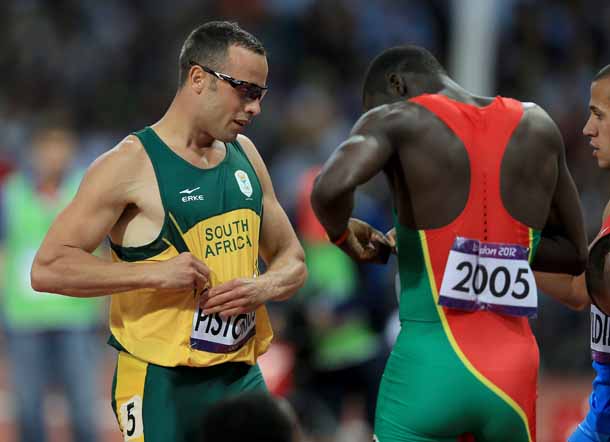
INSPIRATIONAL moment from the Olympics: Winner of 400m, James from small nation of Grenada, exchanging bibs out of respect for double amputee Pistorius who made it to the semifinals


During many Olympic Games, the format and scheduling of the TV broadcasts by NBC and their counterparts have caused a sometimes irritated debate about what the Games are all about: are they a pure sports event, should they be seen as news reporting, or are they primarily a show/entertainment. Many viewers want to see the events in detail as they happen, without too many background stories. Others want to see the key moments of the competition, combined with the underlying ‘human interest’ stories. Yet others see it simply as an entertaining alternative to less exciting summer programs on TV. Now, of course, it is possible to view it in any way you want, assuming you can get instant news through the internet and, as was now the case from London, ‘live streaming’ from any event that you want to follow in detail. So you do not need to depend on the main NBC show that comes many hours later and is very much a show.

Then there is the question of ‘for whose sake’ do we have the Olympics. Are they organized in order to enable athletes to have an opportunity to display their abilities and to gain fame and financial benefit; or do not these athletes already have sufficient events in their respective sports? Sometimes one gets the impression that the Games are held to provide the host country/city an opportunity to show off their ability and to draw a larger than usual number of visitors from abroad. More awkwardly, one also senses that the Games serve largely as a chance for sponsors and other advertisers to gain a captive audience, and that the commercial interests overwhelm the sports considerations.

If one follows the media coverage, one could almost get the impression that it is a fight between nations, albeit it in a less friendly format, to show their power and compete for global dominance. More than anything else, the table with the medal count is what stands out. Of course, this is discouraged by the International Olympic Committee, which at one point refused to release information about the official medal count. (The IOC Charter even emphasizes that it is supposed to be a competition between athletes and not between countries). But this does not work, as media simply then would do the work themselves, moreover in several conflicting versions. Personally I am ‘sick and tired’ of this focus. For me it would be more appropriate to have countries compete on the basis of accomplishments in education, health care, technology, governance and other more fundamental aspects of life.

But it seems inevitable that countries, both the largest ones in the world and the small, emerging ones, will want to use the Olympic Games to show off. It even goes quite far in terms of efforts to ‘recruit’ athletes to reinforce the population. Many countries attract immigrants and refugees, in which case a change in nationality is natural and the acquisition of a star athlete is incidental and unquestioned. But there also seem to be some countries, including the 2012 host country where, perhaps due to lingering colonial traditions or simply a financial edge, systematic efforts are made to find reinforcements in time for the Olympics. Immigration laws sometimes seem designed to facilitate such methods. One prime example in London was a female participant in triple jump, who now participated with her third nationality in four Olympic Games. It seems that globalization also tends to create a ‘mercenary corps’ of athletes. Ironically, this is in a sense what fits the notion I mentioned from the IOC charter, but unfortunately it fits even better with the actual nationalistic fervor that countries display.

My own ideas may be ‘old-fashioned’, but as you will have understood, I do not care to see the Olympic Games as a venue just for top athletes to increase their market value, for countries and their National Olympic Committees to show off, or for global conglomerates to do far-reaching advertising. For me the main consideration is to have the Olympic Games serve as a source of INSPIRATION. This could mean many different things. It could obviously involve the inspiration for young, budding athletes to make the effort to become future stars. But it could also involve the notion that it simply encourages a broader participation in sports and physical activity instead of less healthy alternatives. It could provide illustrations of how a determined and sustained effort can lead to remarkable achievements. It can show how handicaps and a difficult living environment can be overcome. (I do not much admire a ‘dream team’; I cheer the ‘underdog’ who is able to defeat the odds). And it can remind us that fair play and a sporting spirit do not need to be sacrificed in the pursuit of medals and results. So for me, the Olympic Games can (and should) be a source of inspiration that goes well beyond the world of sports.

post

Apropos the Olympics – Part 1: Men’s handball

As explained below, Hungary stopping Serbia may have been critical to the outcome of the men's competition


Some of you may have noticed that I left it to John Ryan to do all the reporting during the second week of the Olympics. The reason is that, after having been ‘glued to’ TV and computer during the first week, following almost all the handball games and a whole lot of other things, I went ‘undercover’ during the second week. I spent that time in Santa Fe, New Mexico, mostly to attend an opera festival, but also having the opportunity to follow some Olympic coverage among ordinary sports fans, who generally had little interest in handball (until I got to them…).

This gave me a slightly different perspective, especially after having been immersed in six previous Olympic handball tournaments as Technical Delegate, Referee Observer, Match Supervisor etc. But I have also tried to catch up, having already watched a dozen additional games after my return home. So I will now start a series of postings on different aspects, beginning today with some comments on the men’s competition. And I really appreciate the high-quality streaming provided by NBC which enabled me to follow games more closely than I ever did when being in attendance!

It was not a surprise that France won, and I am not going to say that they did not deserve it. But as I saw it, frankly, the overall quality of the men’s games was more modest than anything I can recall from many, many years of Championships. What I am saying is that there was no outstanding or dominating team and that at least six or seven teams had a real opportunity to dethrone the French, something which they all failed to do. Most of the top teams were simply not as strong as, for instance, in the 2011 World Championships. So in some sense, France won more ‘by default’. The best illustration may be that, in the quarterfinal against Spain, the French did not score their second goal until after 20 minutes; there should almost be a ‘rule’ disqualifying a team from moving on to become the ultimate winners after such a miserable performance, but the Spanish team accommodated them by collapsing!

The team that came the closest to taking advantage was the Swedes, a surprise silver medalist. I wrote earlier on that this might have been the chance for Croatia to return to the top position, and they also came close. But in the end it seemed that the newer generation did not get as much support from the Croatian old-timers as had been needed; in particular, Balic often seemed to be just a shadow of his old, dominant form. The Danes should have been a good bet to get a medal at least, given their strong showing in both the 2011 World Championship and in EURO 2012. But Mikkel Hansen did not show the necessary consistency, and if you get to play the rivals from Sweden in a quarter-final, then anything can happen.

The ones who must have felt particularly frustrated were the Icelandic handball fanatics, not just because handball matters so much to them and because they were the sensation in 2008. After all, they won their group by being the only team capable of beating France, but ironically that may have been their biggest ‘mistake’! It meant that, as group winners, they were bound to play a quarter-final against the Serbia-Hungary winner. And of course, to the horror of Iceland, the Serbs collapsed in that game as they had somehow done the whole week, leaving Iceland to face their nemesis from so many Championships and qualifying games in the past, the Hungarians. And sure enough, this became their stumbling block yet again, moreover after double overtime. My guess is that Iceland would have been able to handle both the Serbs and Swedes, so we were in a sense deprived of a repeat final Iceland-France, with a chance for the Vikings to seek their revenge from 2008.

What about the non-Europeans? Well, it was envisaged from the outset that Tunisia and Argentina would have to fight it out for a lone slot in the quarterfinals, and this is also how it worked out. From the early rounds, I had sensed that Argentina might have a chance to outsmart and outrun the Tunisians in that battle, as some of the Tunisian top players had looked just a tad slow. But it turned out that the more experienced Tunisians drove their opponents into losing their patience and normal rhythm, regrettably in part through cynical methods that were not sufficiently prevented or punished. There is no award for ‘dirtiest’ player, but Gharbi would surely have been a strong candidate. The Tunisians used the same approach in the quarter-finals against Croatia, but in the end it was not enough.

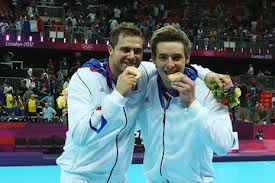
Returning to the French, what was it that helped them prevail in the end? Well, I was really put off by the totally unwarranted arrogance displayed at the award ceremony and in subsequent interviews. Their ‘Bolt imitation’ and their statements that they had shown the skeptics that the older players were not too old, were really misplaced. There was ONE veteran, goalkeeper Omeyer, who rescued them in the late stages, together with the emerging stars Accambray and Barachet. Yes, Narcisse and Fernandez sometimes had an impact through their experience, but especially Karabatic should refrain from taking too much credit.

Finally, if I describe the level of individual brilliance and team cohesiveness as generally lacking among the top teams, how come that there was still such a (justified) excitement both among the spectators in the arena and for the TV/internet broadcasts? Well, what combines with technical quality to make for excitement is of course the suspense that comes with closely matched teams and narrow wins. This was amazingly common, in the final group games and especially in the quarterfinals. Two of them were won by one goal, and in the other two games the two-goal margin was secured in the final moments. This trend continued in the semi-finals and the final. Of course, this aspect is particularly important given the large proportion of handball novices among the local spectators. So, all in all, good propaganda for our sport was created.

post

Men’s Gold Medal Match: Live Chat

I’ll be leading a live chat during the Gold Medal match which starts at 10:00 AM, Eastern time.  It looks like NBC is only go air parts of the match live on the NBC Sports Network, so I’ll start of f with the NBC webstream, then switch to traditional TV when it becomes available.

I’ll have a microphone, but won’t use it when the TV broadcast is up.  Everyone who joins the ustream feed will be able to ask questions and comment via text.

Ustream Link: http://www.ustream.tv/channel/team-handball

NBC Weblink: http://www.nbcolympics.com/liveextra/video-watch.html?video=men-medal-matches-placements-gold

post

Move over Fatsis, Scott Van Pelt is the new mainstream media Handball King

ESPN's "Home for Handball"

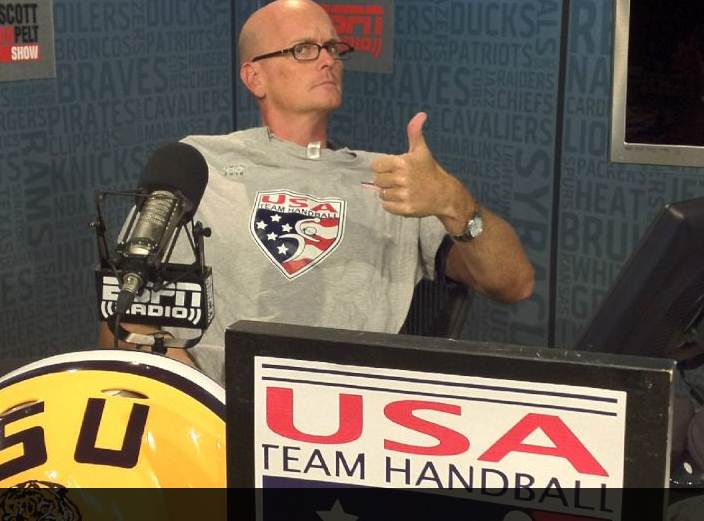
For several year’s NPR’s Stefan Fatsis has proudly worn the mantle as Team Handball’s #1 mainstream media proponent and fan.  But coming on strong and aided by the nationwide blowtorch that is ESPN Radio is Scott Van Pelt, who’s show airs from 1:00 – 4:00 PM, Eastern Time.  Van Pelt and his crew talk about the sport daily and he’s now even sporting USA Team Handball gear.  A shout even to Ulrik Wilbek.  Who’d a thunk it.

But with such a mantle also comes great responsibility. All one has to do is look at early morning offering on any of the ESPN family of networks and quickly conclude that if ESPN wants to be the “Home of Handball” there’s plenty of room to start broadcasting.  Or at the very least get some broadcasts on ESPN3 or ESPN Live or whatever ESPN is now calling their webstreaming channel.  Hey, it’s been done before as the 2009 World Championship final was broadcast online at ESPN360.  I was also told a couple of years ago that ESPN was sitting on the rights for the Liga Asobal, the Spanish Professional League.  Finally, the EHF Champions League is there for the taking if ESPN wants it.

So Scott Van Pelt:  Are you up to the challenge? Are you going to continue to talk Handball after Sunday?  Are you going to shepherd the broadcasting of the sport at ESPN?  Or are we going to spend another 4 years waiting until Rio?

Scott Van Pelt Show Website:  http://espn.go.com/espnradio/show?showId=scottvanpelt2009

Link to show podcasts: http://sports.espn.go.com/espnradio/podcast/archive?id=3028618

Scott Van Pelt Twitter: https://twitter.com/SVPshow (Note the current moniker)


post

Audio: 1972 Olympians reflect on the Munich games and more

72 Team Handball Olympians (From left to right: Vinny Dicalogero, Rick Abrahamson, Dennis Berkholtz, Jim Rogers and Joel Voelkert

This past weekend members of the 1972 Men’s Olympic Team Handball squad gathered in Las Vegas for their 40 year reunion.  Vinny Dicalogero, Rick Abrahamson, Dennis Berkholtz, Jim Rogers and Joel Voelkert sat down with me to reminisce about their “glory days.”  How the team was formed, how they prepared for the games, their qualification tournament in front of a packed house in Elkhart, Indiana, their experiences in Munich and their thoughts about what’s happened with Team Handball in the U.S. in the past 40 years.It’s an hour long, but well worth the history listen.  I suggest you use it as your sound track while watching the 2012 Olympics online.

1972 Results

Group Play (0-3)
USA vs. Hungary 15:28 (8:16)
USA vs. Yugoslavia  15:25 (9:11)
USA vs. Japan 16:20 (9:9)

Placement 13-16th place
Semi: USA vs. Spain 22:20 (8:11)
Final: USA vs. Denmark 18:19 (6:12)

Overall Placement: 14th out of 16 teams


post

Men’s Quarterfinal Matchups: Croatia is the new favorite

Igor Vori and Croatia should easily advance to the semis

Here are the matchups for the Men’s quarterfinals on Wednesday.  Handicap (point spreads) are in parentheses

Upper Bracket
Iceland (-3)   vs. Hungary
Denmark (-2.5) vs. Sweden

Lower Bracket
France (-2) vs. Spain
Croatia (-7.5) vs. Tunisia

Updated Odds

Here are the updated odds for the 8 remaining teams to win it all:

Croatia: 1.8 to 1 (Pre-tournament: 5.5 to 1)
France:  2.8 to 1 (2 to 1)
Denmark: 4 to 1 (3.5 to 1)
Spain: 11 to 1 (5 to 1)
Iceland: 14 to 1 (19 to 1)
Sweden: 39 to 1 (40 to 1)
Hungary: 50 to 1 (40 to 1)
Tunisia: 2000 to 1 (550 to 1)

Worth noting:  Croatia is the new favorite and they clearly played the best in group play.  Assuming France survives Spain the oddsmakers seem to think that the semifinal between France and Croatia might be the real final.  Denmark is favored out of the other bracket, but Iceland may again be the surprise team.

Link to NBC schedule of online games: http://www.nbcolympics.com/online-listings/sport=handball/index.html

(Note:  If you are time shifting, be careful not to scroll down to far if you want to avoid seeing who’s in the semifinals.)

Personal note: 4 quarterfinal knockout matches to watch.  Time to head into the time shifting tank.  No twitter, facebook and email reading for this fan!

post

Women’s Quarterfinal Matchups: Norway, Russia, Brazil and Korea in the “Bracket of Death”

Chouette! We've avoided the Bracket de la mort!

Here are the matchups for the Women’s quarterfinals on Tuesday.  Handicap (point spreads) are in parentheses

Upper Bracket
Brazil vs. Norway (-1.5)
South Korea vs. Russia (-1.5)

Lower Bracket
Croatia (-.5) vs. Spain
Montenegro vs. France (-1.5)

Badminton tactics?: Conspiracy theorists are accusing Norway of some badminton-like tactics after their 25-20 loss to Spain in their final group play game.  A win would have placed Norway in 2nd place and set up a quarter final show down against Russia.  Norway and Russia have been the top two women’s teams in recent years and they were the oddsmaker’s top two pre-tournament favorites.  Norway’s loss, however, dropped them to fourth place and they will now play surprising Brazil.  Brazil has been playing well, though, so who’s to say whether that really is a better matchup.

Updated Odds: Here are the updated odds for the 8 remaining teams to win it all:

France:  2.5 to 1 (Pre-tournament odds: 6.5 to 1)
Norway: 2.75 to 1 (1.75 to 1)
Russia: 4.5 to 1 (3.5 to 1)
Brazil: 14 to 1 (50 to 1)
South Korea: 14 to 1 (50 to 1)
Montenegro: 19 to 1 (7.5 to 1)
Spain: 20 to 1 (34 to 1)
Croatia: 20 to 1 (75 to 1)

Worth noting:  France is the new favorite, partially due to their strong performance, but also due to a very favorable bracket.  The next four teams (Norway, Russia, Brazil and South Korea) will now battle each other in the “bracket of death”.

Link to NBC schedule of online games: http://www.nbcolympics.com/online-listings/sport=handball/index.html

(Note:  If you are time shifting, be careful not to scroll down to far if you want to avoid seeing who’s in the semifinals.)


post

AUDIO: NBC’s Dawn Lewis on the Olympics so far

Surprising Brazil wins their Group; Up next defending champion, Norway in the Quarterfinals

Women’s Group play has just concluded and the Men have just one more round of games.  NBC Commentator and 1996 Olympian Dawn Allinger Lewis discusses the upcoming women’s quarterfinals and the men’s results so far.  Podcast length is 15 minutes.

post

Why aren’t the U.S. National Teams at the London Olympics?: Part 2: Where do you find and/or how do you develop great Team Handball players?

Targeted recruiting for national teams or grass roots development? Or Both? And why is it so hard?

In Part 1, I provided some top level analysis as to why our current national teams didn’t qualify for the London Olympics.   This analysis simply looked at our current team and compared that team to former U.S. Olympic teams and our current Pan American competition.  That analysis highlighted that our current teams are lacking in the following areas: 1) Raw athletic talent, 2) Conditioning, 3) Individual technique/skills, 4) Team cohesion/experience, 5) Coaching strategy/preparation.  In this second part I start to look at the underlying reasons for failure.

The Underlying Reasons:   A complicated web they weave.

I’ve been asked a number of times over the years, just why the U.S. isn’t any good in Team Handball.  I usually reply with “How much time do you have and where should I start?”  As I started to map out the reasons on paper in a systematic way it became even more clear to me just how complicated it is as all of the reasons are interlocking in multiple ways so there is no clear root cause to failure.  In short, there is no straight line cause and effect like the old “For want of a nail” proverb by which if we just solve this one thing we’ll become a great handball nation.  Perhaps, some reasons like the lack of funding or lack of marketing exposure come close, but there is no “silver bullet” guaranteed to solve all the problems.

So, with that little diatribe in mind I would like to highlight 4 major underlying reasons worth further discussion.  Those 4 reasons are:

1) A lack of good handball athletes
2) A lack of marketing/awareness
3) A lack of funding
4) Ineffective leadership/management

Underlying Reason #1:  A lack of good handball athletes

Perhaps the most obvious shortcoming to the U.S. National teams relates to a distinct lack of athlete with both the raw talent and technical skills to compete at higher levels.  There are two basic solutions or paths to address this problem:

1) Targeted Recruitment: You can recruit some good raw athletic talent and have a dedicated and intensive training program to build up their technical skills
2) Grass Roots:  You can develop broad based grass roots programs to increase the number of players in this country and out of those greater numbers some good athletes with strong technical skills will emerge.

Over the years the U.S. has tried both approaches to varying degrees of success.  In a series of articles I wrote 3 years ago, “A Framework for Creating USA National Team Success” Part 1, Part 2, Part 3, I provided an in depth review of some of the problems with each strategy and proposed a hybrid model for implementation.  Here is a somewhat shortened version of that analysis.

Targeted Recruitment:  The obvious solution?

With the Olympics going on various media observers have been watching the Handball matches and have been zeroing in on the Target Recruitment strategy.  All we need is NBA D-League players or mediocre NCAA talent from the Big Sky conference and train them up a little.  Even USA Team Handball is in the act taking the more modest approach of 1 (all we need is just 1) athlete from each NCAA conference.

It’s easy to see why so many people immediately come up with this strategy as one only has to watch the teams currently playing in London and assess that there are indeed thousands, if not tens of thousands of athletes in the U.S. with the raw athletic talent necessary to compete.  But, it’s just not that simple as there are a number of further underlying reasons:

1) Recruitment of the great raw talent athlete is only feasible when those athletes run out of other options:  Many observers fully realize this and that is why the more credible back of the napkin analysis focuses on athletes that aren’t going to make the big time.  Problem is you need to convince those athletes that they aren’t going to be the next D-Leaguer that isn’t going to make the NBA.

2) More athletes have more “other” options:  Not too many years ago the options for former NCAA athletes were pretty limited making an Olympic handball career an interesting possibility.  This is not as true anymore, particularly for basketball athletes who have a lot more options in Europe.  This article highlights how things have change over the years.

3) Older players are more likely to have “life issues” emerge:  Most great raw talent athletes at least having the option of playing their chosen sport in college.  This means the youngest athletes will be in 22-23 age range.  Certainly from a physicality standpoint this age is not a tremendous problem, but with each passing year athletes will inevitably have “life issues” play a greater and greater role in their overall psyche.  The possibility of marriage, needing to start a career or just waking up some morning and deciding that this training isn’t any fun anymore will come into play.

4) The Olympic carrot is less of a tangible reward:  In the past a USA Team Handball recruiter could confidently wave the Olympic carrot in front of a would be player.  Certainly at the 84 and 96 Olympics there was automatic qualification.  The competition in the Pan American region, however, is now much stiffer and some athletes will be less enticed when they realize that participating in the Olympics is far from a guarantee.

5) Lack of funding:  And right now the USA Federation has nowhere near the funding necessary to establish a credible training program for these would be recruits.  The programs in the 80s and 90s provided room and board, overseas travel opportunities and a small stipend.  With the other reasons outlined above even that model might not be sufficient enough to recruit the players needed.

Grass Roots:  Too hard and it takes too long?

While it’s not the solution du jour, Grass Roots strategies have garnered more weight at other times.  All we have to do is copy what soccer has done (or lacrosse, or rugby, or ultimate Frisbee) and then the sport will be popular in this country.  It’s not so simple and in this post I explained why.

Perhaps the biggest proponents to this strategy are the many expats who remember how they learned the sport at younger ages in their home country.  If we could do it in Elbonia then we can do it in the USA.   Grass Roots takes time, but it’s clearly the way to go if we want to have sustained success.  If you have thousands and thousands playing the sport, you will have great players that bubble up to the top and they will be doing so at age 18, not age 25.  But it’s not easy to develop these broad based programs.  Here are some of the reasons why.

1) Starting up a team sport from scratch isn’t easy:  Team Handball is a team game and you need a lot of players in order to have a good training environment.  We can probably quibble about just exactly how many are needed, but at least 10 is probably a good number.   Then, of course, you have to add the challenge of convincing people who’ve never played a sport before to suddenly decide to devote time and money to it.  The internet and Olympic telecast make such recruiting easier, but as anybody who’s ever started a club knows this is painstaking, unglamorous work.

2) Gym space is needed:  Finding a gym to play in can be a challenge as many in the U.S. were built for smaller basketball courts.  And then all those basketball leagues have to be contended with.  The cost of gym rental can be a crippling blow to new clubs which lack the numbers to share the costs.

3) The tyranny of distance:  The U.S. is a big country.  Even if a good club program is started in one particular city, that club often has to travel considerable distance to play another club.  This means that for real grass roots efforts to succeed that one club in a city often isn’t enough.  This is why to a certain extent that there is a little bit more concentration and development on the East Coast where the population has a bit more density.

4) The dominance of basketball: Team Handball is its own game and has similarities with a number of sports.  Still, it should be obvious that there is a great deal of similarity between the two games.  Not every good basketball player could be a good team handball player (and vice-versa), but there is a massive number of players that could choose either.  Basketball was invented in the U.S. and it’s our national indoor sport.  That’s not going to ever change and those would be athletes at younger ages are almost always going to select hoops over handball.

5) The physicality of team handball:  Team Handball can be a rough sport to play and it’s probably better suited for athletes in their teens.  Accordingly, it’s at a handicap compared to other sports like soccer where there is less injury, or at least the perception of less injury.

6) The pressure to succeed now: It’s a given that Grass Roots programs will not lead to immediate success.  In fact, you could argue that it will take at least 10 years to see any success translated to our national teams.  Meanwhile the USOC, a primary funding source for USA Team Handball, requests a yearly High Performance Plan which is supposed to outline how Team USA is going to win medals when the reality is that even qualifying at this point would be a tremendous success.  This pressure has always existed, so it’s not surprising that funding choices have often been made towards supporting National Teams rather than Grass Roots efforts.  And then when those National Teams have only moderate success (if even that) the Grass Roots proponents out in the sticks have complained, if only you had given me the resources I need, I would have developed several athletes that could make your national teams.

7) Lack of funding:  But, again the reality is that even if USA Team Handball zeroed out all funding for USA National Teams there still wouldn’t be enough seed money to support Grass Roots programs on the scale that is necessary.  Sure, it could be argued that these programs should be self-sufficient, but with the challenges outlined above assistance is needed to better enable success.

The Answer?

When you start to add up the underlying reasons it becomes fairly clear that both strategies have a lot of hurdles standing in the way of success.   As I noted in my framework series there are elements of both models that have merits, so that’s why I think some sort of a hybrid approach stand the best chance of success.  And I say best chance, because there are some other underlying reasons that would have to be resolved before any plan to field better teams has a good chance at success.  Those other areas include a lack of funding, a lack of exposure/marketing,  and yes, a history of ineffective leadership/managemen.  In Part 3, I first address the historical lack of funding.