post

No surprise: goalkeepers determine the fate of their teams

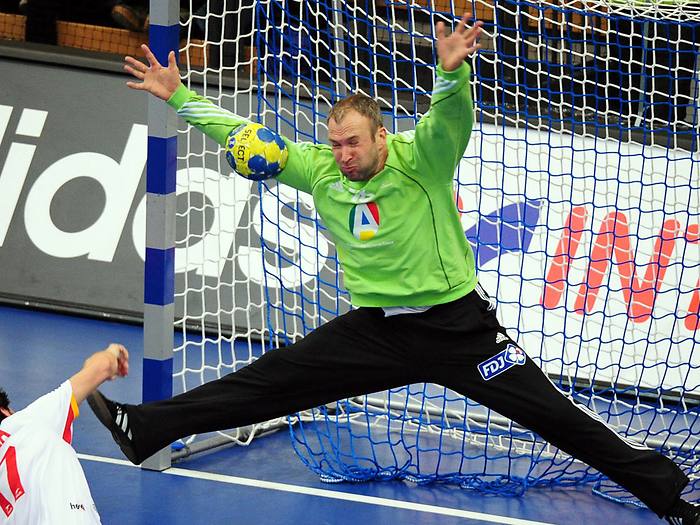
Thierry Omeyer’s key role in the successes of France is well-known.  And it is generally understood that a strong goalie performance can be the key to the outcome in any given game.  So it can be instructive to analyze the goalie performance of some of the top teams in the World Championship.

Most observers recognize that the goalkeeper coming closest to Omeyer’s steadiness and spectacular performances in recent years is Szmal from Poland.  This time he had less support than usual from his teammates, as Poland was hard hit by injuries both before and during the Championship.  Bielecki’s comeback is amazing, but he is not back to his dominant form.  Generally speaking, the Polish team at times looked heavy-footed and sluggish, and their final position as number 8 was rather telling.  But things would have been worse had it not been for Szmal’s fantastic performances in some of the games.

The most exciting young new goalie is undoubtedly Niklas Landin of the Danish team.  He may not yet be absolutely steady, as shown in the final, where he had been replaced in the early stages and then came back in and almost turned the game around single-handedly.  He has already been signed up by Rhein-Neckar-Loewen from the 2012-13 season.  It is interesting to note that both Szmal and Landin are part of the ‘stable’ of young and older goalies who are getting special training by the Swedish goalkeeper guru Claes Hellgren.

A big surprise was caused by the young Swedish goalie Niklas Sjoestrand, who is the second choice goalie for Barcelona but just barely made it onto the Swedish squad.  He narrowly beat out the veteran Beutler for the second slot and was seen as back-up for spot duty behind Mattias Andersson.  But some absolutely fantastic performances, especially against Poland and Croatia, quickly made him the top choice.  When other Swedish key players wavered or were injured, it was Sjoestrand who came through.  While he may not quite have matched Omeyer in the semi-final, he deserves credit for keeping Sweden in that game.

Another young Nordic goalie is Gustavsson from Iceland, who plays club handball in relative obscurity in Switzerland.  When he had top performances, then the Icelandic team looked almost invincible.  But when he was more ‘human’ then the team was a rather pale copy of the ‘viking’ style and attitude so often displayed in recent years.  The veteran Ege in goal for Norway had a similar Championship.  Being perhaps a bit more steady, he nevertheless oscillated between fantastic and more average.  What was noticeable in the case of both Norway and Iceland was the lack of a solid back-up in net.

A surprisingly mediocre goalkeeper performance may have contributed to the relative lack of success for Croatia this time.  By contrast, the surprising performance of Argentina, the only non-European team in the main round, has a lot to do with the amazing job of their goalkeeper Schulz, who has had an anonymous existence in the Spanish second division.  One would imagine that more lucrative offers in a fancier setting will now await him.

Spain started out in a rather feeble fashion in the earlier stages where they did not really look like a medal contender.  The whole team seemed mediocre and uninspired at times.  On paper, Sterbik and Hombrados should have constituted a strong goalkeeper combo, but it was not until late in the event that Sterbik finally showed his abilities and helped his entire team lift itself a couple of notches.  In particular, he was instrumental in securing a win in the bronze medal game.

Finally, another team with a strong combo was Germany.  Both Bitter and Heinevetter had games where they looked brilliant, although sometimes their top form seemed to hold up for only part of a game.  But one thing is clear, the final ranking of the disjointed and listless German squad could have been even worse without their generally strong goalkeeping.

post

Budget-conscious Swedes ‘sold’ part of the home court advantage

It has become increasingly common in recent decades that two countries join together and organize a World/European Championship.  But it is surely more unusual that the one and only organizer, in this case Sweden, more or less gives away home court advantage to one of the main rivals, Denmark.  This is what Sweden did, quite knowingly and for strictly financial/budgetary reasons, realizing that this might come back and haunt them on the court.

Malmö is located just some 20 minutes away from Copenhagen, just across the bridge.  But Sweden still had Denmark play both the preliminary round and the main round in Malmö, in front of crowds totally nominated by Danes.  And this even though Sweden knew that they would play in this group in the main round, after having started out with strong crowd support in Göteborg.  The fanatic Danes had even bought up most of the tickets for the main round in advance!

So it was really lucky for Sweden that the final match in the main round against Denmark was not a matter of managing vs failing to advance to the semi-finals;  instead it was ‘just’ a matter of avoiding France as an opponent in the semis.  Denmark won the game.  And then, can you imagine, the Danish fans had become so spoiled that they were genuinely upset and protested loudly when they realized that Sweden was finally using its privileges as organizer and the right to play the semi-final against France in the 12000-seat Malmö arena, while Denmark was ‘relegated’ to the 4000-seat arena in Kristianstad, 90 minutes further away from Copenhagen.

A frantic ticket swap effort ensued, both on the internet and outside the Malmö arena.  Danish supporters with tickets to Malmö now scrambled to find scarce tickets for their game, while peddling tickets to the Sweden semi-final in tough competition with the scalpers.  In the end, both teams really got overwhelming crowd support, but only Denmark managed to take advantage, beating Spain.

More generally, the Swedish way of organizing the event was indeed characterized by budget considerations and cost effectiveness.  Typically, the IHF and the organizer insist at the outset that “this will be the best Championship ever”.  And then the hope is that the IHF President will indeed use the key phrase ‘best ever’ in his post-event press conference.  But this time he pointedly chose a more modest label.

Certainly, the organization was not weak and error-prone.  The Swedes are experienced organizers of handball events, and they have the necessary infrastructure.  They know what it takes to put on events that are technically solid and offer all the services needed.  But the problem is that participants, especially the teams and the media, are used to being pampered in an unlimited manner, just for the sake of image and positive feedback.  Such extravagance is not the Swedish approach.

Instead the Swedes could point to having exceeded their budget estimates in all areas, including ticket sales.  And IHF could boast with a TV coverage to more countries and to larger aggregate audiences than ever before.  Of course, the number of tickets sold was not as huge as in Germany 2007 with consistently larger arenas. But the focus is more and and more on television coverage and an adaptation to ‘new media’.  The web cast coverage was a matter of special pride to the TV rights holder, UFA sports.

post

‘Dream final’ met the expectations

A couple of weeks ago I suggested that France-Denmark would be the most probable match-up for the final, and that this could be a ‘dream final’, if both teams played at their best.  The hope for such a ‘dream final’ came through.  After having demonstrated a convincing form in both the Preliminary Round and the Main Round, both teams were a bit below their best in the semi-finals which they still managed to win.  But in the final they  joined together in putting on real handball propaganda.

Most of the focus may now be on the remarkable feat of the French team in winning successive championships in 2008-11.  And one might want to discuss a bit further about the keys to this success.  But I would argue that we should now instead look ahead and note that we now have at least one other team that will make it tough to talk about France as the clear favorites in the Olympics in 2012 and the next World Championship in 2013.  The Danish team, and its situation for the next few years, has many of the same characteristics as the French one.

For me, the best way of describing the French team is that they have an absolutely remarkable framework of key players, into which it is possible to insert ‘role players’ and new young players who can help carry the team to success, even in the absence of top players such as Narcisse.   It was rather self-evident that Karabatic would be named Most Valuable Player of the Championship.  In several games, including the final, he ‘just’ stepped forward and secured a cushion for France with a couple of seemingly effortless goals.  And he gives his teammates on the offense benefit from the extra attention he is getting.   Of course, he has able support from his veteran colleague Jerome Fernandez, and Bertrand Gille is one of the very best pivots, but ‘specialists’ like Luc Abalo and Michael Guigou also get a chance to shine frequently.  But for me the remarkable thing is that this framework enables young players like Xavier Barachet and William Accambray to step right in and look the kind of stars that in fact they have not yet developed into being.  Also Sorhaindo and Honrubia played well in the earlier rounds.

Apart from Denmark, no other team seemed capable of successfully integrating new players in this way.  In particular Croatia, who in 2009 seemed to have several ‘almost stars’ ready to blossom, failed completely to provide good complements to the Balic-Vori axis. Sweden and Spain each had a good mix of old and young, but not with the same effect as France and Denmark.

But back to the French:  it is not all about offensive weapons of course.  Gille may in fact be more important, and ruthless, as a defender, and Fernandez was always a strong card on defense. Apropos ruthless, we also have Didier Dinart as a key component of the French defense, albeit with some signs of slowing down.  But behind them all is that guy Thierry Omeyer, who is unbeatable when he is at his best and pretty solid even when he is more human.  So for me, the issue for the next few years is if these relatively older defensive specialists will continue to hold up, and/or if France will be able to integrate new defenders in the same seamless way that they have integrated offensive specialists.  Even if the special French system for fostering new talents is remarkable or even unique, one might have some doubts.

I am surprised when I hear suggestions that the Danish silver medals were just a fluke or largely depended on strong crowd support.  These observers may not be aware that the Danish team was harder hit by injuries, both before and during the event, than really any other team and that, looking ahead, they are better placed than most other teams in terms of having young talents ready to step in.  Yes, like the French they have some older players who may not hang in there beyond 2012-13, but they have a ‘long bench’.  To my mind, what did them in was the fact that their pivot, Jesper Noeddesbo, was forced to play the whole event below normal capacity due to injuries, that Thomas Mogensen was unable to play and that, in the final, Gille’s cynical ‘knee to thigh’ on Kasper Soendergaard in the opening minutes, left the Danes with only one long-distance scorer, Mikkel Hansen.  This young players, incredibly enough dismissed by Barcelona not long ago, was superb but not as much of a threat as when having Soendergaard next to him.

For the spectators in Malmö, and for the world-wide TV and web audience, it is likely to have mattered the most that the finally brought together the two teams playing the most exciting style of handball.  Especially the quick movements of ball and feet, the fast pace, the strong shooting, the acrobatics or strong technique from many players, combined with spectacular goalkeeping, made for a really memorable final.  Even when the best teams make it to the final, the importance and emotions of the moment often prevent them from showing their best.  I have been to every World Championship and Olympic final for at least 20 years, and I cannot remember anything better. This is the kind of handball that shows our sport at its best.  Let us hope for a repeat in London in 2012 and in Spain in 2013!

post

Sweden 2011: Injuries cause uncertainties and perhaps room for surprises?

In recent time there has been much debate about the international competition calendar and the excessive pressure on the top players.  The risk for injuries and other health problems has been mentioned as a serious concern.  It seems that, based on reports from many of the participating countries in the upcoming Men’s World Championship, there are already an unusual number of key injuries to reckon with.  However, most coaches seem to take this in strides, noting that this is beyond their control and that back-up solutions always must exist.  But it may become a factor in the tight competition for positions in the main round and in the semi-finals.

On the day before my departure for Sweden, I will take the risk of offering some predictions, on the basis of reports from teams, media analyses, and some of my own speculation.  Starting with the group of the host country, which is generally viewed as the “easiest” one, I am not yet convinced that this will be another occasion where the home team excels.  Many Swedish experts and fans also seem to be skeptical.  The same doubts seem to affect the Polish team.  So apart from the game between the two, it seems that Sweden and/or Poland might be in for a surprise in one of the other group games.  The most obvious candidate for creating such a surprise might be Korea, who tend to be rather unpredictable on the men’s side.  I also would not be surprised if Argentina were to be able to upset one of their European foes.

The other group on the same half of the draw includes two of the strong favorites, Denmark and Croatia.  Personally, I would be not be surprised if these two teams do well both in the initial group and then also make their way through to the semi-finals.   There should then be an interesting battle for the remaining main round slot between Serbia and Romania.  The traditional powerhouse from Romania is trying to fight their way back to the top after many years in the doldrums.  It is likely to be a close contest but I would not mind seeing the Romanians be successful here.  There should be excitement also among the spectators in this group in Malmo and Lund, with a huge influx of Danish fans and a large pool of Balkan immigrants living in this part of Sweden.  I also hope that Australia get good crowd support for their traditionally tireless efforts against stronger opponents.

The “group of death”, as the now so popular concept is, clearly must be the label deserved by the group seeing the top Europeans from Germany, France and Spain taking on Egypt and Tunisia.  The French have been plagued by injuries, but I am convinced that their team is deep enough to do well, and Spain seems to have been able to prepare nicely without any distractions.  Then one wonders if all the concerns expressed by the German coach Heiner Brand are part of efforts to keep a low profile or indications of genuine problems.  If it is the latter, then the Germans may be the ones who have to worry about a surprise caused by one of the North African teams.  In any case, I am prepared to believe, which would not be a very brave or original prediction, that both France and Spain are in a good position to advance to the semi-finals.

In the group where the Nordic powers of Iceland and Norway seem set to dominate, I am this time more ready to put my money on the Norwegians.  Somehow I believe that they might be the “stealth” team having some success in the fight for a semi-final spot.  Hungary seems to be in a weaker position this time, in part due to injuries, and it is hard to know if they will be able to conquer their Austrian neighbors.  But I am not so convinced that Austria will be able to repeat their success from EURO 2010, now that they play away from home.  So perhaps the shock in this group might be that Brazil will be the team grabbing the third place!?

Anyway, as I pull out my boots and heavy winter coat, I must say that I really do look forward to this event.  It will be the first time in over 30 years that I will have the opportunity to experience a handball World Championship as a tourist and spectator, without the usual 18-20 hour workday and constant worries about the many aspects of the organization of the event.  I will now be able to sit back and relax, enjoying the performances of teams and individual players.  But I must admit that I will remain considerably interested in the performances of the referees and I do hope that this relatively young group of referees, many of whom are in a men’s World Championship for the first time, will live up to the expectations and contribute to a first-rate event with good PR for handball.

post

Puerto Rican referees held up under unusual pressure

Before we finalize the coverage of last week’s qualification matches between USA and Canada, there is one more aspect that must be captured and remembered: for these important games, the intention had been to bring up two referee couples, one from Brazil and one from Puerto Rico. They would then naturally handle one game each on each day. However, at a late stage, when no other options were available, the Brazilians had to back out, due to a serious health concern in the family of one of them. (We do hope that this situation is being handled with a satisfactory outcome!)

This meant that the Puerto Rican referees had to be put in the unusual situation of doing back-to-back games on both days. This is something that may seem easy and normal at the youth level, but it certainly is not the situation that one wants to put referees on a a high level and in crucial games. We did know that fitness would not be an issue for our Puerto Rican friends Enrique Perez and Jose Guzman, but their experience at the international level is quite limited, and games of this type can be very stressful. Nevertheless, Enrique and Jose graciously acceped this challenge.

Of course, this was without being able to anticipate the dramatic finishes on BOTH the men’s and the women’s side. Perhaps it would have been normal if ONE of the games would have ‘come down to the wire’ with a very close aggregate score in the final minutes. But who could have imagined that the first game, the women, would be decided on ‘away goals’ after a aggregate result of 44-44, and that then the men’s battle would finish with identical score for the home team in both games, so that overtime would be required.

I have rarely felt so sorry for a pair of referees as when the final seconds were ticking away and I could see the inevitability of at least 2×5 minutes overtime…. However, the referees took this extra challenge in strides and kept both themselves and the players under full control. In fact, this final one of their four games was quite probably their best performance. The atmosphere on the court remained very sportsmanlike until the very end. To a large extent, this was the effect of the ability of the referees to maintain concentration and a consistent line throughout the match.

We thank Enrique and Jose for their contributions to a great and exciting event, and we wish them much success in their endeavor to climb the career ladder as international referees!

post

USA-Canada – some further reflections

Once upon a time, more precisely on August 16, 1987, there was a fabulous women’s handball match played between USA and Canada. The match was the final in the PanAmerican Games in Indianapolis, and the result was 22-20 in favor of the home team. Until this day, it was probably the best women’s handball ever played between two PanAmerican teams. It is another story that, in terms of drama, it may have been overshadowed by the men’s final played a couple of hours later between USA and Cuba. Here the USA victory came in overtime, 34-32 after a fantastic battle. It was a special evening.

Yes, it is easy to become nostalgic when thinking back to such memorable events. And, somewhat unfairly, it is unavoidable to see last week’s USA-Canada encounters in the light of what happened 23 years ago. One begins to think about the trajectory for U.S. (and Canadian) handball that seemed realistic at that point, and one starts wondering about why we are where we are today. But I do not want to ruin the excitement from last week by looking back too much. Given the circumstances in which handball tries to make headway in the two countries today, there are several reasons to ‘view the glass as half full rather than half empty’.

I say this not just in the sense that each country got a team qualified for the 2011 PanAmerican Games, but because one could find some nuggets of hope for the future. The U.S women’s team may have had some luck in the sense that the Canadian opponents fielded many players who were brand new on the team and lacking in experience. Moreover, the Canadians did not even enjoy their traditional advantage in terms of physical strength and stature. But the U.S. team had to draw on several teenagers to combine with a number of older but not particularly experienced players. What made the difference in the end was some inspired goalkeeping in the second match (especially Natascha King) and some sudden ‘bomb throwing’ by Karoline Borg.

What do these two players have in common? Well, they are affiliated with well-known clubs in Denmark and Norway. So the idea of gaining experience abroad shows signs of promise, but the choice of setting has to be carefully thought out. And it is not enough to have just a small nucleus of well-trained players with serious match experience. Moreover, match experience is fine, but what really tends to do a team in is the lack of playing together as a team. Nothing else makes up for knowing each other on the court, having clear and well-established roles, and having familiar routines to fall back on in tight situations. This now has to be the key issue in preparing the team for the PanAmerican Games in October 2011. For instance, an abundance of tough practice matches next summer is a must.

Quite possibly the U.S. federation might have preferred to see the men’s team qualify, simply because the men’s team in some ways might be closer to be ready to do battle with the opponents in the PanAmerican Games. While the competition might be tighter on the men’s side, that are several other teams that depend even more on raw talent and physical strength. So the U.S. men’s team just might have the collective qualities and the individual stand-outs that could take a team to the semi-finals. There are not many other teams with a skilled trio such as Gary Hines, Adam El Zogby and Martin Clemons Axelsson. The crux would be to find reliable goalkeeping and good choices for complementary roles; and then again the team cohesiveness through opportunities to play together. One can only hope that the resources are available to allow this team to try to qualify through the ‘second chance’ tournament.

My colleague John has written several articles lately about the precarious state of the U.S. federation in financial terms and the resulting need for tough and controversial choices. The support from the USOC has been cut back etc., so the players have had to pitch in substantially. Believe it or not, the Canadians may still be somewhat envious, as they have no such support at all the next two years and will receive a meager $25.000 per year in government support the following three years. There is no equivalent of the U.S. Handball Foundation, and the national teams are totally self-funded, i.e., the players pay to play.

So perhaps it is against this background of shared sacrifices and a mutual respect that it was so refreshing to see the excellent spirit of sportsmanship last week. When the women have the slot decided on ‘more away goals’ after a tie in the aggregate score, and the final men’s game goes to overtime after identical wins for the home teams, then there are obviously serious battles on the court. But the fouls were typically caused by a flailing arm or a desperate lunge, not by a cynical tackle or nasty hit. And there were no tendencies to theatrics, protests or provocations. Congratulations!

Sweden prevents the ‘dream final’

For many years now, neutral observers of women’s handball might tend to describe Denmark-Norway as some kind of ‘dream final’ in a EURO event. (Of course, in a World Championship Korea tends to enter into the picture). And if a Championship is jointly hosted by Denmark and Norway, then it is not surprising if a lot of the media speculation has been about a possible final between these two teams. And for the most part, the results have been pointing in this direction.

But then came this strange ‘blip’ a few days ago, when the Norwegians lost on home court against Sweden. If at least it had been one of the ‘usual suspects’, i.e., Russia or Hungary, but Sweden…. So when Denmark and Norway now play each other, it will be on Saturday in the semi-final and not in the final on Sunday. Sweden gets to play another traditional handball power ‘in yellow and blue’, namely Romania, in the other semi-final.

In a neutral setting it would have been harder to mention a favorite but, playing at home in front of a fanatic crowd, the Danish team will be tough to beat. Indeed, it has caused strong reactions from many directions, when opponents and TV viewers have observed not just a strong positive support for the home team but also determined efforts to disturb the opponents. This kind of behavior may have become more and more ‘normal’ these days in many parts of the world, but I think the reactions are the result of a tradition and expectation that Danish crowds always seemed to be too sportsmanlike to behave like this…

Of course, it did not get better when the Danish coach did not seem to ‘remember’ that is clear considered illegal behavior, when he himself gets involved in agitating the crowd, and it also seemed it took a bit long for the EHF supervisors to remind him about it and stop the nonsense. If the ‘only’ effect is on the opponents, perhaps the whole issue is less drastic. (And in fact, the Norwegian players have shrewdly been heard saying that they look forward to the crowd behavior! True or not, that is of course the right attitude). But a major part of the problem is that some less ‘hardened’ referees may also become affected by the crowd. Clearly the game Denmark-Romania was a bad example of this effect.

Naturally, it is up to the EHF (and next month the IHF) to ensure that these events are handled by referees who have the experience and personality to ignore the crowd pressure as much as possible. But this is easier said than done. First, the world handball is currently undergoing a generation change in the top level of refereeing and, moreover, even the sturdiest of our elite referees can be made to hesitate for a moment. After all, as we sometimes conveniently forget, they are human beings! And a couple of moments of doubt or hesitation is all it takes in a close game.

So let us keep our fingers crossed for a weekend of pure handball propaganda!

EURO 2010 — that terrible and dangerous Norwegian food!

In my posting below from earlier today, I hinted at the possibility that the Swedish team might try to surprise the Norvegians; and I mentioned the rumors about stomach problems on the Norwegian side.

Well appararently it was more than rumors, as three Norwegian players were unable to participate today. So this is now a 'popular' explanation, when the Norwegians (including the King, who was present) try to understand how it could happen that the Swedish women left the Norwegians without a chance. The half-time score was 14-6, and the final result was 24-19 after the Swedes had an eight-goal lead at one point. This is likely to be the best, and most important, handball result for Sweden against Norway, since the union between the two countries was dissolved in 1905…

Of course, for the Swedes it is slightly amusing to hear about the stomach virus or food poisoning on the Norwegian side. Clearly that Norwegian food must be pretty bad and dangerous; probably the Swedish team escaped just by eating food brought from home or by going to McDonalds….

Women’s EURO 2010: Germany out – 7-goal advantage not enough

Today, when one half of the Main Round is starting, it may be appropriate to offer some comments on the preliminary round. A major women’s handball event in Denmark and Norway is always likely to cause a festive mood, especially if the home teams do well. And when we get to the semifinals in Denmark later in the week, it would be a major surprise if both host teams are not there.

The preliminary round started out in a way that made it look as if we would have predictable results and no particular excitement. But in the end, this is not how it came out. The heading already reveals the main story for those who have not followed events in their daily media. The last thing I read in a German web site before the start was that ‘getting to the semi-finals is fully realistic’. And while a loss against Sweden in the first game was a bit of a setback, the situation at the start of the last group match was highly favorable. Germany could afford to lose by 7 goals against the winless team from Ukraine and still move on.

But the German women collapsed completely. They described themselves as ‘statues’ and ’paralyzed’. In an incredible manner they managed to lose by 10 goals so they are out; not the normal image of German handball! But Ukraine, who had won a qualifying group ahead of the strong Romanians, suddenly showed some qualities. And the Dutch benefited also. They had just lost against Sweden, but with Ukraine advancing instead of Germany, the Dutch now bring two points into the main round.

The Swedish team may be seen as the main positive surprise so far, but now they face tougher opponents in the form of Norway, Hungary and France from the neighboring group. After three straight wins, they will have to fight to avoid three straight losses, as discussed by the more pessimistic experts in Sweden.

Norway ‘obliterated’ Hungary in what had been anticipated as a close fight for the top spot in the group. But especially the performance of the goalkeeper, Katrine Lunde Haraldsen, caused the Hungarians to become desperate. She allowed only 13 goals by the strong Hungarian, and had a save percent of 68 in the first half! Perhaps her playing for the Hungarian club Gyoer this season gave her an edge!? Today we will have Norway playing Sweden, and even the rumors of a major stomach bug in the Norwegian camp cannot prevent them from being the favorites; but who knows…

In the groups played in Denmark, the home team got solid wins against Serbia, Romania and Spain. This should put them in a good position, although they now face Russia and Montenegro, two of the overall favorites. Montenegro showed that their impressive run in the qualifying group was not a fluke, as they prevented Russia from getting revenge. But then the Croatians, who had lost against Russia, brought their Montenegrin neighbors down to earth with a narrow victory in the final group match. All in all, these results seem to play into the hands of the Danish team. Tomorrow’s match pitting Denmark against Russia will be decisive.

Denmark has indeed benefited from a tremendous crowd support. And this should help them a lot the rest of the way. By contrast, there was some embarrassment in Norway, where the first two group matches drew very thin crowds in the huge Lillehammer arena with 11.000 seats. Christmas shopping, school exams, and bad winter weather (in Norway!?) were mentioned as excuses, but many also blamed it on exorbitant ticket prices.

Finally, it seems that, generally speaking, the refereeing has not been a problem area so far. The mixture of the top women couples and a number of couples with substantial experience has been adequate. However, the difficult part of the event remains. And, apropos, ‘tremendous crowd support’, this can unfortunately affect the refereeing as well, not consciously but at least subconsciously. Let us hope that controversies can be avoided, so good luck to all the referees!

Bundesliga: how to ensure high quality referees

In ‘handball-world.com’ there was an article on December 3, which was at the same time worrisome and almost amusing. On the surface, it was primarily a statement from the referee chief Peter Rauchfuss in the German Federation (DHB), apropos a pronouncement from the German Bundesliga (HBL) boss Frank Bohman regarding the need for professional referees. http://www.handball-world.com/news-index.php?LID=1&GID=1&auswahl=28751

As I would have expected from Peter Rauchfuss, who is very experienced and always seems to demonstrate common sense, he points out how impossible or undesirable it would be to try to make a sudden switch to professional (= full-time employed) referees. He notes, among other things, that the demands of the refereeing function at the elite level require individuals with strong personal talents and important career experience, ideally with some managerial competence. Handball in Germany or elsewhere does not have a situation like in the NBA or NHL, where young referees with demonstrated talent can be recruited and built up for a solid long-term career situation, in a setting where the financial circumstances make it realistic to give up on an alternative professional career.

Regrettably, the HBL representatives seem to understand too little about the world of refereeing to help carry on a constructive debate. Statements which imply that the Bundesliga referees do not spend more time on refereeing and preparations than the time they spend on the court actually refereeing the HBL games show a totally unrealistic understanding and constitute an insult. But it is also clear from other statements that the issue of professional referees is really a ‘bogus’ issue. What really seems to be at stake is just one more aspect of the battle for power and prestige between HBL and DHB.

What HBL should appreciate is that they enjoy the benefits of strong traditions and a situation where DHB is one of the absolute top organizations in providing high-quality education and management of handball referees. Peter Rauchfuss and many of his colleagues are really first rate. What HBL instead might ask is if they contribute sufficiently to a situation where DHB, in its responsibility for refereeing from the HBL at the top down to the very bottom of the ‘pyramid’ in Germany, really needs solid resources to handle the specialized training and monitoring at the elite level, not just in terms of manpower but also for instance in terms of technology. But this is a very different matter from HBL suddenly wanting to seize control over an area where they do not have any particular expertise.

Not just HBL, DHB and German handball want high-quality refereeing in the Bundesliga. What goes on there is a major issue of propaganda for our sport globally. So, although I speak without knowing exactly what resources Peter Rauchfuss currently has at his disposal and how advanced his operations are in a scientific and technological sense, I am sure that there must be room for improvements. So clearly HBL could and should assume a responsibility for contributing, rather than focusing on power and prestige.

But the training of the existing referees is not the only consideration. The Bundesliga has become the strongest league in the world by having the resources, through its clubs, to recruit the very best players and coaches in the world. In a similar way, it would seem natural to reinforce the resources available to DHB and HBL by also utilizing top referees from outside Germany. Surely they are many IHF referee couples within easy reach who could surpass the quality of the bottom half of the group currently used by the HBL. It would be quite realistic for a dozen such couples to handle one or two games per month in the Bundesliga. Moreover, this would be logical, in the sense that the exodus of players from many countries to HBL has lowered the quality of the national leagues in those countries, to the point that it is detrimental to a number of top IHF/EHF referees who do not get enough real top quality matches in their own countries.

Citizenship and eligibility in an age of mercenaries

Handball.mforos and various Spanish sports media have reported about a situation that seems to have the potential for becoming increasingly common. With the steady trend for top players to move from handball countries without financially strong clubs and leagues to a number of countries where lucrative contracts and a comfortable living environment can be obtained, the strong sense of loyalty to one’s nationality seems to be diminished.

If one spends many years in a particular country, chances are that the loyalties can become a bit divided. Moreover, certain countries have much more flexible immigration and naturalization laws than others. Austria is one example, and the impact this had on women’s handball was obvious during extended periods. Players recruited to Hypo, especially from the Balkans, from ex-Soviet Union and from Hungary, soon found themselves in a position where they had met the legal requirement to become Austrian citizens and theoretically eligible for the Austrian national team.

Of course, as a way of maintaining some seriousness and to avoid having players switching national teams too often and too conveniently, the IHF and the EHF have regulations that require a reasonable gap. Players cannot just stop playing for one national team, and shortly thereafter, with a new nationality, show up in another event for another national team. But if players and federations have patience and do some planning, clearly there is still room for such changes. Of course, the reactions in the player’s native country are typically not entirely positive…

The probably best known case of ‘migration’ is that of the Belarus native Siarhei Rutenka. He moved to the club Celje in Slovenia, and soon obtained citizenship in accordance with the laws of that country. He most definitively became a valuable member of the Slovenian national team. But as so often happens these days, he moved on to Spain, in order to play for Barcelona. It did not take long for Spanish handball fans, and perhaps also for the Federation, to start ‘drooling’ about the prospects of having Rutenka switch nationality once again and eventually become eligible for the Spanish national team.

But it appears Rutenka developed other ideas. He obtained his Spanish citizenship, as Spain is another country with very easy requirements, but now it appears that he has become nostalgic to the point of ‘completing the circle’. In other words, he has also acquired a Belarus citizenship and really wants to play for the Belarus team, not for Spain. There is, however, one little twist to this, something that Rutenka might have overlooked after his experience with easy switches. He wants to stay in Barcelona, but there is no recognition of dual citizenship between the two countries, so he may be in danger of losing his Spanish citizenship. This in turn may have implications for his future options in terms of place of residence after his days as a handball players are over.

And now a somewhat similar case is beginning to cause frustration in Hungary. One of this country’s most popular and valuable players is Laszlo Nagy, another member of the Barcelona club team. It seems he has now made it clear to the Hungarian federation that they should not count on him in the future. So he might become the player soon eligible to reinforce the Spanish national team instead.

Cynicism and unsportsmanlike behavior — how far can it go!?

When you see this heading, perhaps you will find it to be of some consolation that this time I am not talking about incidents in handball. But what I will comment on involves a mentality that suggests that there is no reason why we would not have similar problems in other forms in our own sport. Perhaps the rules in handball do not lend themselves to quite the same behavior, but I am sure also we have some loopholes.

I should not really keep you in suspense any longer. My story involves football/soccer, and more specifically something that happened in a Champions League match between Ajax Amsterdam and Real Madrid, two of football’s most prestigious clubs, a little over a week ago. First I need to explain that in football, unlike in handball, a warning (a ‘yellow card’) is not necessarily wiped out or meaningless once the game is over. In football, whether under FIFA, UEFA or national federations, there are regulations which mean that if a player accumulates a certain number of yellow cards during a competition (or a segment thereof) , then he will be suspended for a match.

So late in the match I mentioned, there were two key players from Real Madrid who knew that if they received one more yellow card before the match ended, then they would be suspended in the next match. And as their team was leading 4-0 close to the end, and as the next game, the last one in the group play, was essentially meaningless, it would be preferable to be suspended for that meaningless match. If they instead played in that match and received another yellow card, they would be ineligible in the next, much more important game, namely the first round of the subsequent knock-out competition.

So, at their own initiative, or more likely at the instigation of their notoriously selfish and cynical coach, they caused (=forced) the referee to give each of them a yellow card for time-wasting, an absurd action in a game that their team had already won. The Amsterdam spectators and the TV commentators immediately understood what was up, and the players got the nasty reaction that they deserved.

But the saddest part came later. When media started criticizing the players and coach, the reaction was totally cynical. “There was nothing strange about it; this is what many players do all the time”, was one of the responses. The coach naturally denied any involvement but defended his players. “Of course we expect our players to behave in the best interests of the club”, was the comment of another team official.

And even worse: in response to newspaper and web reports, the ‘general public’ started weighing in. And I am talking about people with no particular sympathies for Real Madrid but just regular football fans. Most of the comments involved criticizing the media for “making a big deal about it”. Others saw it as a reaction of envy aimed specifically at Real Madrid. Yet others came up with the wonderful suggestion that “the players should be applauded for drawing their yellow cards through harmless action, instead of doing it by kicking the leg of an opponent”. And then there were some who criticized the referee “for not outsmarting the players and (illegally)refusing to give them the yellow cards that they had to be given under the rules”.

I can have some understanding for cynical and unsportsmanlike reactions expressed in the heat of the battle, at the moment something happens. But to find that ‘sports fans’ calmly, a day or two later, find it normal and appropriate to go out of their way to express such opinions, that tells me that regrettably these ‘sports fans’ have very little sense for what sportsmanship is all about, and it tells me that players and referees in any sport must expect to be treated and judged in that kind of fashion. If they act properly, then they must expect to be considered stupid or soft, but if they commit a ‘professional foul’ or an unsportsmanlike act that benefits the team, then they will be celebrated and considered smart.

Asian refereeing — good progress ruined by bad politics

In recent years, both some individual countries and the Asian federation finally began to realize that they had to change (some) of their old habits to avoid being left behind by the other continents in the area of refereeing. In particular, the traditional favoring of older, ‘over-the-hill’ referee couples in the continental competitions has gradually been outweighed by the IHF’s emphasis on bringing up new, talented referee couples through the IHF’s Global Referee Training Program.

Asia will now send two couples (Iran and UAE) of the new generation to the Men’s World Championship in Sweden next January. At least one other couple (KUW) is at about the same level. A handful of additional couples have shown promise in Junior and Youth World Championships. The only country not really contributing, certainly in relation to the perennial strength of their teams, is Korea. It seems they prefer to send their young talents into coaching instead of refereeing, an attitude that seems somewhat lacking in solidarity.

BUT, some other habits seem harder to change. I do not really want to go back and rehash the situation involving the Olympic qualifying in 2008, more specifically the atrociously biased refereeing in the infamous Korea-Kuwait match, where a Jordanian referee couple managed to set a record with 40 blatant errors in favor of Kuwait and 0 errors in favor of Korea. This couple was permanently barred, an action that I personally remember only too well as being criticized by the Court of Arbitration for Sport (CAS) as being too soft! But the reality is that, unlike a criminal court, the IHF does not have the jurisdiction to take any other action. The IHF decision and the reaction of the CAS were duly noted by the senior representatives of the Asian Handball Federation who were present at the time.

HOWEVER, when the reports from the Asian Games were beginning to come in a couple of weeks ago, I was not the only one who noted with astonishment that one of these Jordanian referees had been nominated and brought to the Asian Games by the Asian Federation. Presumably this was seen as a good opportunity due to the absence of IHF observers… Not just was this referee present with his new partner; they were also the only couple who consistently received games of major importance. This culminated with the bronze medal game for the men. A disgraceful demonstration by the Asian federation that they do not regret what happened two years ago, and that they do not care about the authority and decisions of the IHF. Perhaps one should even assume that the invitation to the Asian Games in Guangzhou was a way of thanking the Jordanian referee for following instructions two years ago???