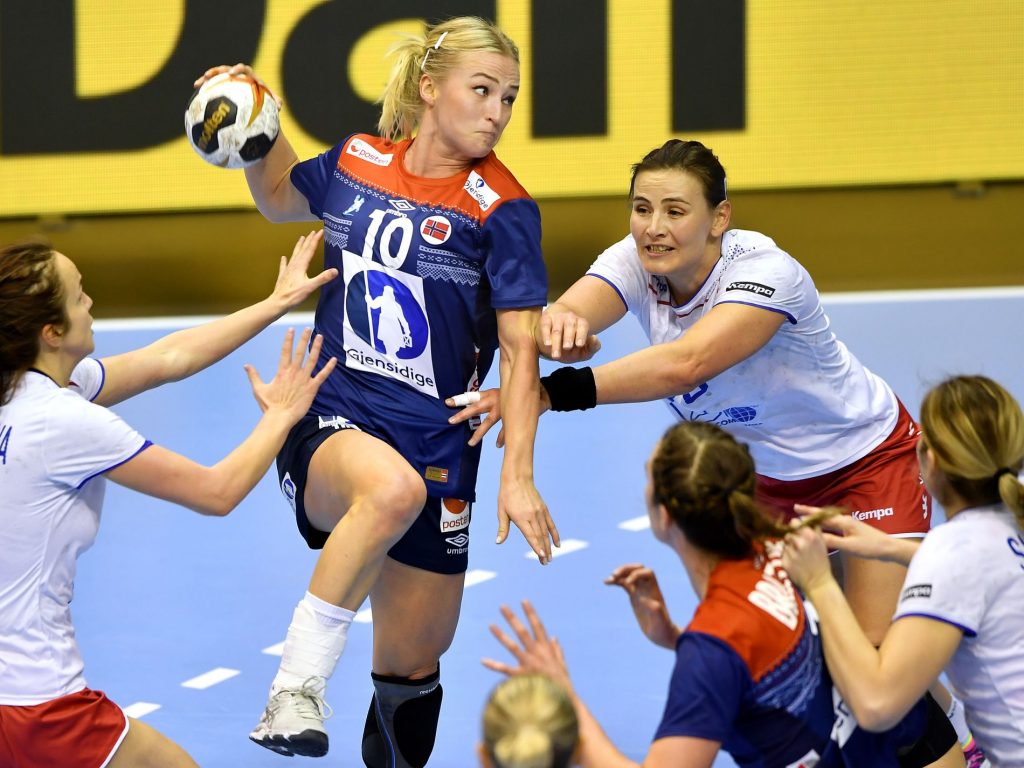
Hungary vs Romania: 1 of 3 “elimination” matches today in the last round of Preliminary Group play.
It’s the last match day for all four Preliminary Round groups at the 2019 IHF Women’s World Handball Championships in Japan. There are 3 types of matches today: Matches to determine who advances to the main round; Matches where the result will carry through to the main round; and matches simply for pride.
Note: 3 teams advance from each group and the matches between those teams carry through to the Main Round. Groups A and B will form Main Round Group 1 and Groups C and D will form Main Round Group 2.
Below are the times, odds and video links for all the matches.
Remember, if you find yourself geoblocked out of the IHF web stream this article has some tips that should help you find a way to watch: Link
Here’s the IHF preview for the day’s competition: Link
Friday, 6 December All Times Local (CET is -8 hrs / US ET is -14 hrs) Odds courtesy of William Hill
Note: Saturday is a rest day, so if you’re busy on Friday, you might want to consider saving some of these matches for viewing on Saturday.
Group A
Group A after 4 rounds
15:00 Serbia (-1) vs Slovenia Video Link 18:00 Angola (-12.5) vs Cuba Video Link 20:30 Netherlands vs Norway (-2.5) Video Link
Serbia and Slovenia will battle to see which side will advance to the Main Round. Angola and Cuba will play for pride. While the Norway – Netherlands result will carry through to the main round.
Side note: The Netherlands will be hoping for a Serbia win since they lost to Slovenia earlier in the week and would prefer to have the 2 points from their victory over Serbia
Group B
Group B after 4 rounds
15:00 Australia vs Brazil (-21.5) Video Link 19:00 Germany vs S Korea (-1) Video Link 20:30 Denmark vs France (-2.5) Video Link
Australia and Brazil will play for pride. Germany and S. Korea will look to get 2 points for the Main Round. While Denmark and France will play an elimination game to see who advances
Side Note: S Korea would prefer to see France win since they would pick up 2 points, vice 1 point since they tied Denmark. Germany would prefer a Denmark victory since they beat Denmark, but lost to France.
Group C
Group C after 4 rounds
15:00 Senegal (-5.5) vs Kazakhstan Video Link 15:00 Spain (-2) vs Montenegro Video Link 19:00 Romania vs Hungary (-2.5) Video Link
Senegal and Kazakhstan play for pride. Spain and Montenegro play for 2 points in the Main Round. Hungary and Romania play an elimination game.
Group D
Group D after 4 rounds.
15:00 Japan (-6.5) vs China Video Link (With Commentary from Paul Bray) 18:00 DR Congo vs Argentina (-4) Video Link 20:30 Russia vs Sweden (-3.5) Video Link (With Commentary from Paul Bray)
Only one match matters in Group D. Russia and Sweden will play for 2 points in the Main Round.
Want to watch the IHF Women’s World Championships? You’ve got options. NBC starting on Sunday. But, what if you want to watch other matches? Like today’s Serbia-Netherlands clash? Or, tomorrow’s elimination game between Denmark and France?
Starting this Sunday the NBC will be airing two matches on its NBC Olympic Channel every day for the remainder of the competition. This is unquestionably a good thing. Any time handball is broadcast on TV in the U.S. it exposes new fans to the sport.
But, for the
already dedicated handball fans it’s actually kind of a bummer. Why?
Because since the U.S. now has a TV contract we’re now geo-blocked out
of the free IHF Web Stream.
Yes, instead
of watching every single match like we’re used to we’re now limited to what NBC
decides to show.
Fortunately,
there’s a way around that and because I keep getting questions about how I am watching
all of those matches here is an in-depth tutorial on:
How to Watch Every Match of the IHF
Women’s World Championships (Live and On Demand)
Step 1) Determine if you are
Geo-Blocked
What’s a
Geo-Block? Well, this is a Geo-Block:
Essentially, what happens is that the IHF has blocked your computer’s IP address from accessing their online web stream. Most likely it is because your country has a TV contract for the handball event in question. For the World Championships the IHF has a contract in the U.S. with NBC. Hence, the Geo-Block for everyone in the U.S.
Step 2) If you are Geo-blocked, Get a
VPN service
VPN stands for Virtual Private Network and essentially it’s a way to access websites from an IP Address associated with another country. There are multiple companies that provide this service. I use Nord VPN and it costs $3.49/month. And, I can tell you without a doubt it’s the best money I’ve ever spent as a handball fan. I don’t use it to just watch the World Championships. I use it to watch the Champions League, German Bundesliga and Spanish Asobal league matches as well. Honestly, I don’t know why I didn’t get a VPN service years ago… except I do know why.
I was
hesitant due to some misconceptions regarding risk. As in, I don’t want to download some crazy
software that’s going to mess up my computer.
My mistake was to think VPN was just like the crazy fly-by-night websites
that pop up when you google things like “France-Germany Handball web-stream”. If you’re a handball fan you probably know
what I’m talking about and maybe you’ve made the mistake of downloading a “free”
video player.
DON’T DO THAT… There’s a good chance you are going
to regret it. I know have… Typically the
so called video player sucks and the video if it does show up is barely
watchable.
But, do go to a website like NORD VPN (there’s a banner ad in the top right hand corner of the Team Handball News website) and follow the instructions there.
What you end
up downloading is an extension for your web browsers. For Nord VPN there’s an app that you click on
where you can select a country to login from.
I’ve been using Canada since it’s close by and they are not geo-blocked.
Now connected to Canada… And good to go.
If you don’t want to use Nord VPN there are other options including Hola VPN. This is actually a “free” service, but not a VPN in the traditional sense. It’s a peer to peer service and you essentially agree to let users in another country use your IP Address. There are some risks with doing that, but I know that “free” is a big selling point.
Step 3) Resist the urge to wake up in
the morning and go through your social media feeds.
I know we
live in an instant gratification world and habits are habits. But, while one can still enjoy watching a match
if you already know how it ends, it’s just not the same as not knowing.
Not sure about that? Try this experiment: Tape this year’s Super Bowl; wait 4 hours; then check your Facebook, Twitter and Instagram feeds; then start watching the game from the opening kickoff. Can you even imagine doing such a crazy thing? Just imagine if that Super Bowl had been the Patriots-Falcons match featuring the “comeback”. So, if you wouldn’t dream of doing this for the Super Bowl, why on earth would you do it for a compelling handball match?
Step 4) Go to the Team Handball News
website for the daily “spoiler free” preview.
The location
for the Women’s World Championships (Japan) is pretty much perfect for delayed
match viewing. This is because most of
the matches are taking place while we are sleeping. However, the IHF Competition website (which
is actually a pretty good website overall) is not designed for spoiler free
viewing. Oh, it can be done, and I’ve
mastered how to do it.
And, you’re
welcome to try and duplicate what I’ve been doing every morning or you can
simply go to the homepage of this website.
(I typically have the video links loaded by 7:00 AM (US ET) every
morning.)
Step 5) Select Your Matches to View
and Viewing Style
With as many as 12 matches to watch there’s no way you can watch everything, so you’ve got to be selective. The daily preview has an overview of what the key matches are each day. What’s on the line in terms of qualification, etc. I also post the betting lines as they give insight as to what matches are supposed to be close and which matches are supposed to be blowouts. Finally, I highlight which matches have commentary from Paul Bray. It’s still enjoyable to watch matches without commentary, but having commentary makes it a bit better.
So, after I select which matches to watch I map out my viewing subject to how much time I have. Some matches warrant a full start to finish viewing. (France – Denmark tomorrow fits that category) while others are more of a watch a few minutes and then fast forward towards the end, just in case something crazy happens.
And, if you want to watch on the big screen all you need is an HDMI cable. The stream is of pretty good quality and should translate well to most TVs
Step 6) Repeat steps 3 through 5 until December 16th and Happy Handball Watching
Also, if you find yourself geoblocked out of the IHF web stream this article has some tips that should help you find a way to watch: Link
Thursday, 5 December All Times Local (CET is -8 hrs / US ET is -14 hrs) Odds courtesy of Bwin
Group A
Group A after 3 rounds of matches.
15:00 Cuba vs Slovenia (-15.5) Video Link 18:00 Serbia vs Netherlands (-2.5) Video Link 20:30 Norway (-9.5) vs Angola Video Link
Barring some major upsets it appears that Norway, the Netherlands and Serbia are likely to advance to the Main Round. This means that the result of today’s match between Serbia and the Netherlands will likely carry forward to the Main Round. Slovenia, can also still possibly qualify with a win over Cuba today and win vs Serbia on Friday. But, they will need to dramatically improve upon their performance in the last two matches.
Group D
Group D after 3 rounds of matches.
15:00 DR Congo vs China (-1.5) Video Link 18:00 Japan vs Russia (-7.5) Video Link (With Commentary from Paul Bray) 20:30 Sweden (-10.5) vs Argentina Video Link (With Commentary from Paul Bray)
Russia has already qualified for the Main Round and Sweden will also qualify with a win over Argentina. Japan will also likely qualify with a win over China on Friday. This means that the match between Japan and favored, Russia will likely carry through to the next round.
France was relentless in their 46-7 victory over Australia. But, for good reason. It’s all hypothetical now, but I’m not even sure that 39 goal beat down was enough.
Not Enough Hours in Day for the Blowout Matches
I’ve been watching a lot of IHF Women’s World Championship Handball the past few days. A lot. Easily the most I ever have, mostly due to the time difference with Japan and my adoption of time shifting. I wake up and I have 6 to 12 matches to watch at my leisure.
But, there aren’t enough hours in a day to watch everything and undermanned Australia taking on the big dogs in the Group of Death was pretty low on my priority list. Seriously, I suspect no handball minnow has ever been put into such a tough and utterly hopeless group.
Some Interesting Handball Math
As I was calculating the different scenarios for Group B this morning, though, I came to realize that there was a distinct possibility that France and Brazil could en up in a two team tie, level on 5 points. And, since they had played to a 19-19 draw the next tiebreaker to decide which team would advance to the Main Round was Goal Differential in All Games Played.
Alas, that scenario didn’t play out. France beat Germany and Denmark beat Brazil. Eliminating Brazil and setting up a winner take all match between France and Denmark to advance to the Main Round.
But… It could well have happened. And, if the matches had turned out differently today the Brazil – Australia match on Friday would have become bizarrely compelling.
Compelling, because Brazil would have had the challenge of beating Australia by around 45-50 goals to catch France on Goal Differential. The exact number of goals needed is speculation, because the results required didn’t happen. Going in to today’s matches France was at +37 and Brazil was at -12 for a total difference of 49. IF France had lost and Brazil had won that difference would have shrunk to at least 47.
That’s a lot of goals. Which got me thinking how did France get such a huge GD? And, of course, the answer is the 46-7 scoreline over Australia earlier in the week. Yes, someone on coach Olivier Krumbholz’s staff was way ahead of me on this possibility. So, out of curiosity I took a closer look at this game I normally would never have given a second thought to.
Not Your Typical Big Fish – Minnow Game
And, sure enough it was not your typical big fish – minnow match. (Hey, I’ve played a few of those and know exactly how they generally play out.) The big fish rests some of his starters for the games later that matter. The minnow plays hard, maybe hangs around a bit, but the scoreline gradually stretches to 5 goals… 10 goals… 15…. 20… at which point the big fish relaxes a little bit. Still plays hard… but, not super hard. Works on his set offense a little bit. Tries some different combinations. The minnow plays hard the whole match. Maybe even does a little bit better than one would expect because the other team is kind of in cruise mode. Depending on the size of the respective fishes the scoreline is typically in the 15-25 goal range.
Uhh… That was not this game. Not even close. France looked to score at every opportunity. They were relentless and really, really pushed the fast break even in the dying minutes of the match. The defense was also strong throughout as Australia only managed 7 goals in 60 minutes. A comprehensive beat down. 46-7. +39 goals. And, you know what. Credit to the Aussies… They played hard the whole way against the defending World Championships. If they hadn’t… I shudder to think what that final margin might have been.
Which leads to a very interesting hypothetical. France poured it on… just in case. An insurance policy. What if instead, it wasn’t a maybe. But, a no kidding, you must win by 50 goals. How would such a match play out?
Brazil is a bit older and not quite as capable in the run and gun mode as France and France won by 39. To get 11 more goals would require more creativity, essentially more risks. Some possibilities:
A basketball style full court press
Relentless marking of Australia’s two or three players (with more experience) to force their very inexperienced players into turnovers.
7 v 6 for the entire match
Shooting at the first possibility, even if it is kind of a crazy shot just to up the tempo
Would it work? I don’t know. Even more interesting would be Australia’s reaction. Suddenly, no longer playing a meaningless group play match, but now a match with real consequences. And, to an extent being a bit insulted. Pride would surely kick in. You gonna play crazy style against us… maybe will just slow this game down a bit.
Again, I don’t know how this would play out. It sure would have been something to watch though.
I can just picture it: French fans going wild and cheering on Australia as they cut the margin to 45 with a last second goal as the clock expires.
A 1-1-1 record is not where defending champions, France thought they would be at this point. Heck, with a loss to Germany today they will be in danger of not even qualifying for the Main Round.
It’s Match Day 4 for Groups B and C and it’s time to start separating the contenders from the pretenders.
Also, if you find yourself geoblocked out of the IHF web stream this article has some tips that should help you find a way to watch: Link
Wednesday, 4 December All Times Local (CET is -8 hrs / US ET is -14 hrs) Odds courtesy of Unibet
Group B
Group B (After 3 Rounds)
15:00 Australia vs S Korea (-27.5) Video Link 19:00 Germany vs France (-3.5) Video Link 20:30 Denmark (-2.5) vs Brazil Video Link (With Commentary from Paul Bray)
Germany has qualified for the the Main Round and South Korea will be in good shape as well, assuming they beat Australia. This means there’s a 3 team battle between France, Denmark and Brazil for the 3rd slot. Both the Germany-France and Denmark-Brazil matches have huge implications both for qualifying for the main round and likely in the main round standings.
Group C
Group C after 3 rounds
15:00 Romania vs Montenegro (-4.5) Video Link (With Commentary from Paul Bray) 15:00 Spain (-14.5) vs Kazakhstan Video Link 19:00 Senegal vs Hungary (-8.5) Video Link
Romania-Montenegro is the key match in Group C. A Montenegro win will qualify them for the Main Round and set up a battle vs Spain on Friday to win the Group. Romania is clearly not up to par this tournament having suffered a blowout loss to Spain and just beating Kazakhstan yesterday by 2 goals.
Can the undefeated German women beat Denmark for the first time in 19 years. 19 years? Really? Yes, Really
It’s Match Day 3 for all four groups at the 2019 IHF Women’s World Handball Championships in Japan. Below are the times, odds and video links for all the matches.
Remember, if you find yourself geoblocked out of the IHF web stream this article has some tips that should help you find a way to watch: Link
Here’s the IHF preview for the day’s competition: Link
Tuesday, 3 December All Times Local (CET is -8 hrs / US ET is -14 hrs) Odds courtesy of Sporting Bet
Group A 15:00 Netherlands (-22) vs Cuba Video Link 18:00 Slovenia (-5) vs Angola Video Link 20:30 Serbia vs Norway (-6.5) Video Link
The Netherlands should have no problem with Cuba. Slovenia had a disastrous 2nd half yesterday vs Norway and will hope to get back on the winning track vs Angola. Norway and Serbia is a battle of unbeatens, although Serbia has yet to play a challenging foe.
Group B 15:00 S Korea (-1) vs Brazil Video Link 19:00 France (-25.5) vs Australia Video Link 20:30 Denmark (-1.5) vs Germany Video Link (With Commentary from Paul Bray)
Group B is a pretty interesting group at this point with every team but Australia garnering at least 1 point in the first 2 matches. Both the S Korea – Brazil and the Denmark – Germany matches are worth checking out.
Group C 15:00 Hungary vs Montenegro (-1) Video Link (With Commentary from Paul Bray) 15:00 Spain (-8.5) vs Senegal Video Link 19:00 Romania (-9.5) vs Kazakhstan Video Link
The match worth seeing here is definitely Hungary – Montenegro. Hungary lost to Spain on Monday while Montenegro is 2-0-0, although those wins were over Senegal and Kazakhstan.
Group D 14:30 DR Congo vs Russia (-17.5) Video Link 17:00 China vs Argentina (-1) Video Link 19:30 Japan vs Sweden (-2.5) Video Link
Group D has 3 unbeaten teams (Russia, Japan, and Sweden) and 3 teams (DR Congo, China and Argentina) still looking for a win. This means that the Japan vs Sweden match will likely factor into the Main Round standings. If Japan is to have a shot at making the semifinals they need a win here. The China vs Argentina match will be interesting battle of relative continent strength between Asia and South America.
Tjaša Stanko poured in 12 goals for Slovenia in the their upset over the Netherlands on Day 1. Slovenia will likely need another performance like that on Monday vs Group A Favorites, Norway.
It’s Match Day 2 for Groups A and D at the 2019 IHF Women’s World Handball Championships in Japan. Below are the times, odds and video links for all the matches.
Remember, if you find yourself geoblocked out of the IHF web stream this article has some tips that should help you find a way to watch: Link
Monday, 2 December All Times Local (CET is -8 hrs / US ET is -14 hrs) Odds courtesy of Sporting Bet
Group A 12:30 Cuba vs Serbia (-15.5) Video Link 15:00 Angola vs Netherlands (-6.5) Video Link 20:30 Slovenia vs Norway (-6.5) Video Link
Serbia will look to stay unbeaten vs a Cuban side that will seek to improve upon their 31 goal loss to Norway. The Netherlands takes on Angola in a battle of two teams that lost on the opening day. The final match will have surprising Slovenia (upset winners over the Netherlands on opening day) taking on group favorites Norway.
Group D 15:00 Argentina vs Russia (-13.5) Video Link (With Commentary from Paul Bray) 18:00 AM DR Congo vs Japan (-6.5) Video Link (With Commentary from Paul Bray) 20:30 AM China vs Sweden (-16) Video Link (With Commentary from Paul Bray)
This group’s matches feature two likely blowout. Russia will be heavily favored against Argentina. Likewise, China will be longshot vs Sweden. Argentina gave Japan a good match on Day 1, but will face a much stiffer battle vs Russia. Congo played Sweden close for a half and will seek to give the hosts a battle.
France vs Brazil: 2 teams desperate to avoid going 0-0-2 to start the competition
With the 2019 IHF Women’s WC taking place in Japan handball fan in North and South America probably aren’t going to be able to watch very many matches live. Japan is 14 hours ahead of the U.S. East Coast and most matches take place in the wee hours of the morning. Even fans in Europe might be a little challenged with the 8 hour time difference. Certainly, during the week when folks have to work.
Of course, if you want to know the result of any match, social media and the IHF will quickly tell you who won and how.
But, what if you don’t want to know? What, if you prefer to watch without knowing who’s going to win?
Well, it’s not always easy to remain oblivious, but I’m going to try and help you do so with “Spoiler Free” links to match video. Along, with a few notes as to what’s on the line for that upcoming matches.
Also, if you find yourself geoblocked out of the IHF web stream this article has some tips that should help you find a way to watch: Link
Sunday, 1 December
Group B Brazil vs France Video Link Australia vs Germany Video Link S Korea vs Denmark Video Link (With Commentary from Paul Bray)
Both Brazil and France lost on the first day of competition. France to South Korea and Brazil to Germany, so both sides will want to avoid going 0-0-2. Australia will be huge underdogs to Germany while S Korea and Denmark will both try to move to 2-0-0 in the Group
Group C Kazakhstan vs Montenegro Video Link Spain vs Hungary Video Link (With Commentary from Paul Bray) Senegal vs Romania Video Link
Kazakhstan will be a big underdog vs Montenegro. Spain and Hungary both won their matches, so that is a battle of unbeaten teams. Senegal gave Montenegro a close game while Romania was blown out by Spain. Could be interesting to see whether Romania can bounce back.
Norway is currently without a major title and is missing key players. Yet… they are still the favorite. Can Stine Oftedal lead a short handed (for Norway) side back to a title?
The 2019 IHF Women’s World Championships start tomorrow (Saturday, 30 November) in Japan. Here’s some info on how to watch, what the odds are, and a few predictions on who will in it all.
How to Watch
IMPORTANT NOTE: I’ve updated these instructions slightly. Click here for the latest instructions: Link
In the U.S., the NBC Olympic Channel will be your TV option. This channel is available on most cable and satellite lineups, but you may have to pay a little extra to add this channel. As previously reported, it looks like they will not be showing any matches until the Main Round which starts on Sunday, 8 December. And, due to the the time difference (Japan is 14 hours ahead of the U.S. East Coast) all matches will be tape delayed until the afternoon.
Unfortunately, since the U.S. has a TV contract, the IHF web stream will not be available for U.S. residents. (The same is true for several other countries. This article lists which nations have a TV contract: Link If your nation is not listed, you should have access. Lucky for you Canada, Australia and UK)
IHF YouTube Page: Link Note: It sometimes takes a day or two for completed matches to be visible on the YouTube page.
IHF 2019 WC Competition Page: Link (Be careful to avoid scores!; or go to the home page of this site for the daily “spoiler free” link) Note to access match video follow these steps 1) Click Schedule 2) Click Date of Match 3) Click “View Details” for match you want to watch 4) Click “Live Steaming” in the menu at the top (Even though it says “live streaming” matches are also available on demand.)
Of course, there are other options available. As sure as the sun comes up tomorrow there will be dubious websites offering live streams of marginal quality. I wouldn’t recommend downloading anything from these sites or paying them anything.
One can also use a VPN service and login from a nation like Canada to access the IHF stream. I personally use VPN Nord, but there are multiple options. Hola VPN is even free, but you share bandwidth via peer to peer networks. I’ve used both and so far, so good. And, personally I don’t feel very guilty: Memo to Handball content owners: I will gladly pay for access to matches… should you decide to make that an option.
One final note on the time difference. Unless you are an insomniac or night owl it will be challenging to watch matches live. U.S. East Coast start times for the first week of preliminary matches will be 1:00 AM, 4:00 AM and 6:30 AM.
Tourney Format: The preliminary round consists of 4 groups of 6 nations. The top 3 of each preliminary group advances to the Main Round. Groups A and B form Main Round Group 1, while Groups C and D form Main Round Group 2. Matches from the Preliminary Round (among advancing nations) also count in the Main Round. The top 2 teams from each Main Round Group then advance to the semifinals.
Norway, the Netherlands and Serbia are the big favorites to advance. For a more in-depth preview check out Chris O’Reilly’s Group A preview at Stregspiller.com.
France and Denmark to advance and then a projected dogfight between Germany, South Korea and Brazil for the 3rd spot. Group B Preview: Link
When Groups A and B combine, Norway and France are projected to advance with Denmark and Serbia seen as outside possibilities.
This is projected to be the most competitive of the preliminary groups with 4 nations (Montenegro, Hungary, Spain and Romania) fighting for 3 spots. Group C Preview: Link
Russia, Sweden and Japan projected to advance in what surely is the weakest of the four groups. Group D Preview: Link
On paper, this looks to be a really interesting and competitive Main Round Group. Russia is heavily favored to advance, but the odds for the rest of the nations indicate that everybody else will have a legitimate shot at the 2nd spot.
Finally, the odds to win it all. On the (Un)Informed Handball podcast, the 3 Irishman (O’Reilly, Campion, and Kulesh) all pooh poohed Norway’s chances of winning it all. Too many players missing and disappointing results the past two tournaments. I must say there is some logic to that analysis, but they still have a lot of quality on their roster. And, the oddsmakers can’t be that wrong, can they?
According to the schedule all matches will be aired on a delayed basis. This is probably due to the competition taking place in Japan and therefore most matches starting in the early morning hours in the U.S. (Japan is 14 hours ahead of the U.S. ET). You might think that an early morning start time would make it ideal for a live broadcast in the U.S. since there would be no other sporting event airing at the same time. While this is indeed true that thinking neglects the reality that many sports channels including the NBC Olympic Channel air paid infomercials during the early morning hours. And, they would actually lose money if they broadcast live handball instead. While, delayed broadcasts are a bummer to dedicated handball fans, the plus side is that potential new fans are far more likely to catch a handball match in the afternoon than they are during the middle of the night.
Matches Truncated to
an Hour
More disappointing to the dedicated handball fan will be
what appears to be time shortened one hour blocks for each handball match to be
aired. Based on past experience this
means that about 15 minutes of match time will quietly disappear. Typically midway through the first half there
will be a commercial break and when the commercial is over the clock will have
moved forward several minutes. Halftime
is then shorted to a simple commercial break and then at some point in the
second half the clock will again quietly move forward again when it comes back
to the match. It’s done quietly, because
the announcers are from the live feed broadcast and they have no idea when NBC
is going to edit out the match. So, when
you look at the score and think to yourself, “Wait a second, wasn’t this game
tied a minute ago? Did I miss something?”
The answer is “You didn’t fall asleep, NBC just quietly moved the game
forward a few minutes.”
On Line Streaming?
As is almost always the case we likely won’t know about on line streaming options until the competition starts. This past January I was actually in Europe during the first week of the Men’s World Championship, but I got multiple reports of frustrated viewers in the U.S. that were geo-blocked out of the IHF web stream. Typically what happens is that any nation with a TV contract for the event is geo-blocked from the free stream. Yes, for years since the U.S. didn’t have a TV contract we got to see every match online for free, but this is now no longer the case. Some matches, however, were available live on the Olympic Channel web stream and this may be the case again this year. Another possibility could be that NBC makes a live stream available.
(Note: The NBC Olympic Channel and the online Olympic Channel are not the same entity. The Olympic Channel is available world wide and is tailored to viewers in each country. The NBC Olympic Channel is available only in the U.S. Some of the content overlaps, but they have different schedules.)
Olympic Channel Web Stream: Link NBC Web Stream: Link
And, then there’s a third option which I have used successfully in the past: Get a VPN service and then access the IHF web stream. Trust me, this is a far preferable and safer method than the various, nefarious pirate sites that typically pop up during these competitions. Not only do some of them take your money, the stream quality is typically poor with these sites. Also, another benefit to VPN… The EHF Champions League… Just sayin.
The preliminary matches start in the early morning hours on Saturday, 30 November. I will update streaming options as they become known.
Note: This is part of an ongoing series, Charting a Way
Forward for USA Team Handball (2019 Reboot): Link
Parts 1 and 2 of my review of U.S. clubs focused on Men’s clubs. Part 3 looks at our Women’s Club Programs.
USA Women’s Clubs: A Small Footprint
As a reminder here are the U.S. demographics from an earlier installment of this series.
Breaking this down further there are around 150-200 female handball athletes playing club handball in the U.S. And, of that 150 – 200 there are perhaps 60-80 that are American citizens.
The tables below (and the map above) further break down the Women’s club program in the U.S. that played at least 1 match last season.
The demographics are similar to the Men with most of the
teams being expat majority except for collegiate clubs and a couple of
geographically dispersed clubs (Rogue and Carolina Blue).
While similar, however, the overall total numbers of clubs are lower. Last season there were a total of 36 Men’s clubs that played at least 1 match (At-Large (21) and Collegiate (15)]. For the women, there was only a total of 12 clubs [At-Large (9) and Collegiate (3)].
Why Fewer Women’s Clubs?: Less Interest and…Surprisingly, More Opportunity (in Relative Terms)
An earlier article highlighted some of the inherent challenges with developing women’s handball. Those challenges include handball not being a “school sport”, a smaller pool of interested athletes (relatively to men).
This less relative interest is manifested in two ways. Overall, there are fewer women interested in playing sports competitively. Anecdotally, I think most people will agree this true, but there are also several studies that back up this view. For grades 3-12 roughly 8 million girls participate in organized sports compared to 12 million boys. I would suspect that these rates of participation continue in older ages and may even increase. Meaning all things being equal there are fewer women interested in playing a club sport like handball.
But, I would argue that when it comes to club sport’s interest in college all things are not even equal. And, this is somewhat bizarrely due the great equal opportunity requirements of Title IX which mandates equal participation rates for men and women. It hasn’t been fully realized, but the number of scholarship and participation opportunities for women is roughly the same as it is for men. Meaning that in relative terms NCAA collegiate scholarships for established sports dig deeper into the smaller women’s pool of available talent. This, in turn, leaves fewer women athletes left looking for a sports club outlet and the raw talent of those athletes also being somewhat lower.
So, with these handicaps it shouldn’t be a huge surprise that there are fewer women’s clubs, both with At-Large Clubs and Collegiate Clubs
This concludes the review of the demographic numbers for U.S. Clubs. Part 4 addresses some of the “why” behind these demographics. In particular, why clubs in the U.S. tend to be majority Expat.
Note: This is part of an ongoing series, Charting a Way
Forward for USA Team Handball (2019 Reboot): Link
Part 1 of my review of U.S. clubs focused on our At-Large Men’s club. Part 2 looks at Men’s Collegiate Club programs.
Collegiate Clubs: More Americans, Younger Americans, Plus Structural and Marketing Advantages
The initial review of Men’s club demographics clearly brings home the strengths of our collegiate clubs.
Rarely does a simple tabulation bring home reality so starkly. These clubs are likely 95-100% American and have an average age of 21.2 This is the one layer of our development pyramid that makes sense. Sure, we’d like for there to be even more college programs, but it’s a solid start. And, while a European might laugh at my declaration of “younger” players compared to our At-Large Clubs it is indeed substantially younger. Sure, we’d like more players at even younger ages, but as I will discuss in future installments, going younger can be pretty challenging due to the constraints of U.S. sporting structures.
College clubs are also the first strong transfer point for
athletes from other sports. This is
because there are a limited number of college scholarships available for major
sports and many quality athletes won’t make the cut. These athletes, in many cases will be looking
to continue their athletic careers and team handball presents a unique
opportunity.
Colleges also have many structural advantages in terms of
starting new clubs. For starters,
there’s a captive audience of potential athletes all conveniently located in
the same place. Most colleges also
encourage club activities and gym space for a handball court exists, even if a
handball club has to compete against other activities for its use.
Finally, collegiate clubs have built in branding associated
with their college. Maybe around 1,000
people in the U.S. have even heard of our At-Large Clubs like NYC and SF Cal
Heat. Whereas millions of Americans
immediately know what North Carolina Tar Heels and Ohio State Buckeyes
means. And, alumni of those institutions
are inclined to support clubs from their alma mater even if they don’t know a
whole lot about a sport like team handball.
Collegiate Club
Demographics
While the snapshot of college clubs from last year’s national championship provides a top level overview there are several other collegiate clubs in the U.S. Here, again thanks to Bryan Cothorn’s database, is an overview of every collegiate club that played at least 1 match last season (2018-19)
Some notes on this compilation
Last season the U.S. had 15 Collegiate Men’s that played at least 1 match. Seven of these 15 clubs fielded more than one team for a total of 22 teams that played at least 1 match.
The clubs highlighted in Green are discussed below
Upper Appalachian
Conference?
You never know sometimes how things will grow organically (from within/naturally), but for whatever reason a natural grouping of collegiate clubs has sprung up in Ohio, Pennsylvania, West Virginia, Maryland and Virginia. In fact, over half of the collegiate clubs last season (8 of 15 highlighted in the table in green) are located within those 5 states. These clubs are also relatively new and evenly matched. The engineer/program manager in me hates to jump right to solutions, but this appears to be a no brainer gift that should be capitalized on in some way. Not sure what I would call this conference, but the Appalachian Mountains do split the 8 schools. Perhaps the conference could be split into an East Division with Penn St, Johns Hopkins, Virginia and James Madison and a West Division with Cincinnati, Ohio St, West Virginia and Pittsburgh. Such a split would result in no more than a 5 hour drive within each division.
Sustainment: Always an Issue for Clubs where Players
Graduate every Year
Long time readers will surely remember seeing this grim map before
It’s a very stark reminder of the collegiate clubs of the
past. Clubs that surely started with
promise, took the court with dreams only to all die an untimely death a few
years later. There are multiple reasons
as to why clubs fold, but in most cases it can be attributed to a dedicated
coach’s departure or the graduation of a key cohort of seniors.
The data in the table can’t fully predict which clubs will
stay and which clubs will go, but the # of games played is a rough
indicator. If you can’t field a team to
play games chances are that your days as a club are numbered. For sure, a willingness to spend the time and
money to travel is literally and figuratively where the rubber hits the road. Of course, it’s just an indicator. For example, Texas A&M is a pretty solid
program and its limited number of matches is directly attributable to being
located in a handball desert.
Beyond Existing Clubs?
While there are only around 13 existing clubs dozens of colleges and universities play team handball as an intramural sport. In all likelihood, the handball being played is just a rough facsimile of the real game. Often the games are played with less contact and fouls being called like a basketball game. Which is not too surprising since such games are likely being played by athletes that have never played the game and officiated by refs who haven’t been trained. And, being intramural sports probably coached by a student who maybe played the year before.
This is nothing new, but good things can come from such intramural programs. The 1977 Air Force Academy club team went to the U.S. National Championships and spent the first day learning all sorts of new rules that they had been playing wrong and almost still came away with winning the tournament. (It doesn’t hurt to have several Div 1 basketball athletes and two future handball Olympians on your roster.)
Colleges with intramural programs are a great place to start. Even if they aren’t playing the game properly they are playing it and can be taught. Plus they are motivated and already have equipment (goals and balls). Although, I’ve heard sometimes alternative sized balls and goals have actually been used instead of the real thing…
College Development: Already being Worked
The IHF has already indicated that they will financially
support college development and a Working Group has been established to work
college development. According to an
August USA Team Handball Newsletter their very clear mission is to: “establish
a sustainable approach toward helping colleges and universities establish
collegiate team handball clubs.” A challenging mission, but a worthwhile one.
Next up: Part 3 will look at U.S. Women’s clubs both
At-Large and collegiate.
The first Team Handball News Collegiate Top 5 Poll of the 2019-20 season is out and, no surprise, Army- West Point is the unanimous #1 selection. The defending national champions are undefeated and have double digit victories over 3rd ranked West Virginia (31-18) and 4th ranked Air Force (40-28)
Last season’s 2nd place college club, North Carolina, is also undefeated, having racked up 6 wins on the way to winning the Tar Heel Invitational in October. Wins included victories over Virginia, Auburn and Carolina Blue Alumni Team.
West Virginia is ranked 3rd with wins over Ohio St (21-15) and Army’s 2nd Team (22-21) on their resume.
Air Force is ranked 4th and winless, but they played several competitive matches against At-Large Club teams at the Michael Lipov Tournament in Chicago.
Ohio St rounds out the top 5 with a 6-1 overall record. Their only blemish is aforementioned loss to West Virginia and they rebounded from that loss to take first at the Buckeye Fall Classic Tournament.
Just outside the rankings are Texas A&M, which has yet to play a match and Virginia. Also, of note and a potential candidate for the December rankings is Pittsburgh which picked up 3 wins this past weekend over James Madison, Virginia and Johns Hopkins. Spanish International student, Pau Sanchez and Cedric Humphrey reportedly were a pretty effective back court duo and led Pittsburgh to a 3 game sweep and the top of the Northeast Team Handball D2 South.
Below are the composite standing for all college teams