post

Handball News Summary (28 November 2013)

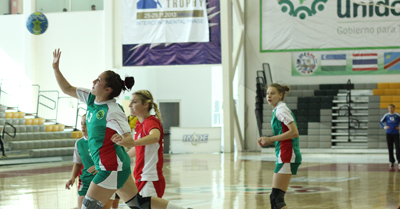
Canadian Women in action against Bulgaria.

Canadian Women in action against Bulgaria.

1) The IHF Trophy (Intercontinental Phase) is taking place in Monterrey, Mexico.  The IHF Trophy is a development initiative of the IHF focused on providing youth competitions for developing nations.  This final phase has the continental champions in competition against each other.

Mexico Federation Webpage: Link (Currently has standings, score sheets and links to video (live and on demand)

2) Nikola Karabatic seeks to collect incentive pay from his former club.  Barcelona backcourt Nikola Karabatic is seeking payment of 58,000 Euro bonus that he is owed from his former club, Montpellier. Former players, Mladen Bojinovich and Mikael Robin are also seeking payment for bonuses as well.  Karabatic was at the center of a betting scandal which saw Montpellier lose the first half of a match versus Cesson in 2011.
Handball World: Link
Mundo Handball: Link

3) Qatar announces roster for Asian Championships.  Qatar has bolstered its roster with former French National, Bertrand Roine, Spaniard, Borja Fernández Vidal and Cuban Rafael Da Costa Capote
Handnews.fr: Link

post

Moneyball Handball: Part 1: Broad Categories for Athlete Evaluation

AthleteEvalToplevel

The blue boxes are the target. Is the U.S. finding enough athletes that meet these age and athletic ability definitions?

In 2003, Michael Lewis wrote a book (recently turned into a movie) that revolutionized Major League Baseball (MLB), titled, “Moneyball: The Art of Winning an Unfair Game.” The book chronicles how the Oakland A’s, a small market team was able to use advanced statistical analysis to compete with MLB franchises with far greater resources.  The crux of their strategy was identifying players that were undervalued by other franchises and then strategically adding those players to their roster.

While the sport of Team Handball does not lend itself to in-depth statistical analysis, the subtitle to the book, “The art of winning an unfair game” immediately hit home to me as an American fan of the sport.  And the “unfair game” that is so self-evident is the challenge of identifying, convincing and training athletes into world class team handball athletes.  Team Handball in this country has paltry resources, practically no exposure and accordingly, a very, very thin talent pool to draw from.  How can the sport even begin to compete against other sports in this country like basketball and football for athletes?  Seriously, by comparison Billy Beane and the Oakland A’s have it way too easy in my opinion.

But, while it’s a difficult challenge it’s not entirely impossible.  Team Handball is a great game, fun to watch and play and with the carrot of being an Olympic athlete, the U.S. has found some diamonds in the rough. In most cases these athletes have been crossover athletes that decided to give Team Handball a try after their collegiate or high school athletic careers were finished.  Indeed, targeted recruitment of such athletes is the only viable solution if you want to improve national team performance in the near term.  I, and others, have repeatedly argued that it’s a short term solution with some major limitations and significant long term drawbacks, but that’s not the focus for this particular commentary.  The focus instead is how to make targeted recruiting work as well as possible.  In other words, how can USA Team Handball apply some Moneyball like tactics to get the best players possible?

Two Basic Axioms

Before, I delve into the details I’ll first postulate that there are two basic axioms in regards to the types of athletes USA Team Handball wants to recruit for national team consideration:

  1. USA Team Handball wants to recruit the best possible athletes to devote themselves to the sport
  2. USA Team Handball wants those athletes to commit themselves to the sport at the youngest ages possible

I think that few people would argue with the validity of these two premises.  The first one surely needs no further explanation.  And as far as the second axiom goes the desire to recruit athletes as young as possible relates to the time involved in learning the finer points of the game.  It can take several years to take raw athletic talent and turn it into handball talent.  The younger a player starts that process the sooner he/she will develop into a world class talent that can contribute to the national team.  And, in turn the more years that player will likely be able to contribute.

Defining the X and Y Axes 

Taking the two basic axioms into account it’s possible to graphically depict those two factors (age and raw athletic ability) along an X and Y axes:

X Axis (Raw Athletic Ability):  For illustrative purposes, I’ve depicted raw athletic ability from 0-10.  Defining a “10” is relatively easy.  Think Cam Newton, Lebron James or any number of professional athletes that if they chose to play team handball would be can’t miss world class players.  (OK, maybe there’s no such thing as a “can’t miss player,” but you get the picture.)  Defining the numbers down, however, is more challenging and way wide open for debate. For the purposes of discussion I decided to limit the pool of athletes to include only those that take their sporting endeavors fairly seriously.  In other words a “1” in this instance is not someone that doesn’t play any sports, but perhaps an athlete who was a minor contributor in high school.  Athletes from “5-9” are pretty good athletes, many perhaps the best athletes on their high school teams, but just not quite good enough to play collegiate sports at the highest level.  Athletes from “9 to 9.8” are closer to the top of the pyramid and were granted scholarships to Div 1 NCAA schools. Athletes in the “9.8 and higher” category are of the “can’t miss” variety and go on to pro careers.  I’ll be the first to state these numbers are arbitrary and the lines could be drawn differently.  In particular, if you want to really define the athlete population more accurately, the delineations that I start at “5.0” could start at “9.5” or even higher.  Additionally, many athletes develop sport specific skills that trump their limited raw athletic ability and allow them to compete in college.

Y Axis (Age):  Defining the age of athletes is pretty definitive. Unless, we’re talking about some Latin American baseball prospects, we know exactly how old athletes are.  There certainly can be some debate as to how much the age of an athlete matters, but there can be no debate that it matters.  For the purposes of discussion I broke the chart out into 4 distinct blocks of 4 years.  Conveniently, this delineates two fairly well defined periods of athletic endeavors for many athletes in the U.S.:  High School and college.

The Non Candidates 

As you look upon the X and Y axes several areas where USA Team Handball should not focus for target recruited can be readily identified.  I’ve grouped these would be potential candidates into the following categories:

Insufficient Athletic Ability:  The largest area of the chart is composed of athletes that simply do not have the raw athletic talent that will ever allow them to be productive and contributing members to USA national teams.  This may seem a rather cold indictment that doesn’t take into account an individual’s motivation and determination, but it is a reality for many, many athletes.  To be sure it’s not always easy to delineate where the line is.  While it may be easy when an athlete is a “1”, it’s not so easy when an athlete is a “6.5” and a real hard worker.

High School Athletes (with collegiate aspirations):  This area is composed of the top tier of high school athletes and virtually every future U.S. National Team players (with the exception of dual citizens) will spend their ages 14-18 playing high school sports other than team handball.  While it certainly would be desirable to get these athletes playing team handball seriously at these ages it is currently nearly impossible to do so.  Perhaps some pilot programs could be started, but it will be challenging to do so in the near term in significant numbers.

Collegiate Athletes:  This area is composed of athletes that have made collegiate teams and continue to play their primary sport from ages 18-22.  In most instances these athletes are on the higher end of the raw athletic ability scale (9-10).  The logic being that college teams are somewhat cold-hearted in their approach.  (i.e., they don’t waste limited scholarships on athletes with lower ability when they can get athletes with greater ability and potential.)  Again, while it would be nice to get these athletes to play team handball, they are largely unavailable until age 22 or so.  Perhaps it might be feasible if our residency programs could offer full ride scholarships and regular competition, but barring that it’s very unlikely a scholarship athlete would choose to abandon his/her current sport.

Pro Athletes:  This tiny sliver of athletes represent the elite of the elite.  It goes without saying that prying any of these athletes away is by and large Fantasyland.

Too Old to Start:  This area is composed of athletes that could have been great candidates for USA national teams, but have reached an age whereby it is increasingly unlikely that they will develop the requisite handball skills before their athletic skills decline or “life issues” result in them moving on to other endeavors.  It’s certainly debatable as to where this line should be drawn.  I’ve assessed that for high school cross over athletes that line should be drawn at age 23-24 and that for college cross over athletes it should be around age 25 or so.  Arguments can be made to draw those lines at younger or older ages, but lines should be drawn somewhere.

The Candidates

By the process of elimination there are then two small boxes where USA Team Handball should focus its efforts for targeted recruitment:

Post High School Cross Over Athletes:  This group consists of talented athletes who have not made collegiate teams in their chosen primary sport.  In many instances this was because they simply were not good enough to obtain a college scholarship.  Accordingly, these athletes will tend to fall a little lower on the scale of raw athletic ability.  While it would be preferable to get athletes further to the right of the scale those athletes will be harder to come by.  This disadvantage, however, can be offset by the younger age that they start focusing on team handball.  With more time to work with its possible that they will be able to offset their lower raw athletic ability with greater handball skills and technique.

Post College Cross Over Athletes:  This group consists of exceptional athletes who either weren’t good enough for a professional career or play a sport with limited professional options.  Historically, this is where USA Team Handball hasn’t gotten most of its top national team athletes.  Given enough time to develop and train these athletes the USA was able to field national teams that were competitive.

Theory vs. Reality

While I doubt that USA Team Handball has ever drawn lines on a graph or identified hard cut lines in terms of ages or athletic ability National Team rosters decisions have undoubtedly been made along these lines in the past.  All too often, however, circumstances related to a very thin talent pool have moved the lines too far to the left or the top of the chart.  In other words, USA Team Handball has often had rosters with too many athletes that were either too old or didn’t have sufficient athletic ability.  Comfortably ensconced in middle age I’ll declare that I myself, might very well have been in both categories during my short stint on the U.S. National Team.  For sure, I was in the upper left hand corner of the post high school crossover box.

And looking at today’s national team player pools I’ll generously assess that both the men’s and women’s teams are rife with players in that upper left hand corner of the crossover high school and college boxes.  Throw out the dual citizen athletes and it paints a pretty bleak picture.   And, if you add in that reality that Rio 2016 is a long shot at best and the more realistic focus is Tokyo 2020 then only a handful of athletes in our current player pool even have a realistic chance of being Olympians some day.

All of this points to a dramatic need to move from the upper left corner of the chart to the bottom right hand corner.  Younger and better athletes.  Duh, a no-brainer.  Easier said than done for sure.  In the next installment I’ll delve into some Moneyball Handball analysis and recruitment tactics, however, that just might make it possible.
post

VIDEO: Champions League Group Play (Week 6)

Vardar and Metalurg meet again in a Macedonian showdown.

Vardar and Metalurg meet again in a Macedonian showdown.

Week 6 of the Champions League is very much a rerun of Week 5.  This is because the same teams that played in week 5 will play each other again.  Only this time the matches will be played at the other team’s home court.  Since Skopje’s two club sides (Vardar and Metalurg) both play their matches in the same venue this week’s “Match of the Week” is even more of a deja vu event.  Last week Vardar was clearly the better team and Metalurg will need a much better performance if they don’t want to slip into 5th place in Group B.  Sunday’s match in Skopje includes Tom Ó Brannagáin’s English language commentary.

Vardar vs Metalurg (Sunday, 24 Nov 1800 CET/1200 U.S. Eastern Time)
Video: Link

(Note to U.S. residents:  beIN Sport, the U.S. TV rights holder has apparently made a programming decision to not broadcast the Champions League this week.  If you want to watch the match you’ll need to do so online at ehfTV.)

The other matches worth watching are again the same as last week’s.  The all German derby moves this week to Flensburg.  Last week Hamburg was clearly the better side winning 32-27 and the win put Hamburg 3 points up on Flensburg in the standings for Group D.  Even with a win tonight (Thursday) Flensburg will still be down a point due to their earlier draw against Naturhouse La Rioja.  But, perhaps Flensburg better be more concerned with simply holding on to second place.  Another loss to Hamburg could very well slip them into 3rd place behind Denmark’s Aalborg.  And with Flensburg travelling to Aalborg next weekend they could face a must win situation there to avoid a challenging Round of 16 opponent.

Flensburg vs. Hamburg (Thursday, 21 Nov 1900 CET/1300 U.S. Eastern Time)
Video: Link

The third interesting match will be Kolding’s visit to Kielce on Sunday.  Last week I postulated that if either Kiel or Kielce was going to slip up in Group B it would be on the road at Kolding.  And slip up Kielce did, losing 29-24.  Now a more confident Kolding side will try beating Kielce again this time in a far more difficult setting in Kielce.  One would think that Kielce will take care of business at home, but it will be interesting to see what happens.  And, if you’re a Kolding fan you might even start thinking bigger.  A win at Kielce would put Kolding in the driver’s seat to win the Group.

Kielce vs Kolding (Sunday, 24 Nov 1700 CET/1100 U.S. Eastern Time)
Video: Link

I will replace the live video links with on demand video links when they are available at the ehfTV website.  If you go to the ehf website yourself click on the side arrows to get to the “Full Match” page.  A word of caution, however, the EHF sometimes posts match interviews with revealing titles like “Jicha scores the decisive goal,” so you might want to use a sheet of paper to mask the screen if you want to watch the matches oblivious to the outcome.

ehfTV Page: Link
EHF Week 6 Preview:  Link (A written summary by Bjoen Pazen previewing all 12 matches)
Tom Ó Brannagáin’s latest blog post: Link
Audio of Tom Ó Brannagáin’s interview with Pascal Hens and Hans Lindbergh: Link


post

American Football and Team Handball (Part 2): The historical pipeline and positions to target


American Football to Team Handball:  Which positions are most likely to provide the best candidates to transistion to team handball?

American Football to Team Handball: Which positions are most likely to provide the best candidates to transition to team handball?

ehfTV recently had a profile on Danish Center Back, Rasmus Lauge Schmidt and his passion for American Football.  In part 1 I took a look at the development of American Football in Europe as an example of how an alien sport can develop in an unlikely place.  So much so, that there are even a few German players playing in the NFL. In this second part I take a look at the American Football to Team Handball pipeline and assess which football positions are the most likely to yield good team handball athletes.

An Historically Narrow Pipeline 

My investigation of Europeans making NFL rosters caused me to reflect a bit regarding U.S. National Team players that had crossed over from American Football to Team Handball.  While basketball has always been the most prominent cross over sport, there’s also been a few football athletes of note.  From the 70s and 80s, Joe Story, one of USA Team Handball’s best ever wings played wide receiver at then NAIA Willamette University. From my era in 80s and 90s, Olympian John Keller was a tight end at Div 1 North Carolina and Joe Fitzgerald played QB at Div 3, Ithaca College.  More recently, Mark Ortega played wide receiver at then NAIA Malone College and Lewis Howes played wide receiver at Div 3 Principia and Capital colleges.  Howes even played a season of professional football, albeit for the Alabama Vipers in the AF2, the former development league for the Arena Football League. (So, a minor league of a minor league, but hey, if you’re getting paid to play, you’re a professional and that’s saying something.)

Perhaps, I’m missing some notable football players that also crossed over to Team Handball, but it’s fairly clear that this pipeline hasn’t been much of a pipeline. More accurately it’s been a narrow pipe with just a trickle of water coming out. As someone who played 10 years of organized football, I’ll put forward two closely related reasons for this narrow pipeline. First off, the type of skills learned in football for the most part only tangentially apply to Team Handball. The blocking and tackling which are an integral part of the game have no application to Team Handball. And the passing and catching at the skill positions only tangentially applies. This doesn’t mean a football player can’t become a good handball player. Just means that very little that is learned in football training can be readily applied in a handball context.

Closely related to the first reason regarding minimal crossover skills between the two sports is the natural gravitation of athletes to sports where they are more likely to excel. Again, there are quite a few athletes that can excel at multiple sports, but whether it be their body type, arm strength, jumping ability, speed or hand-eye coordination there are aspects of every athlete that often steer them towards a particular sport. Accordingly, many of the athletes that naturally gravitated to football aren’t the type of athletes that would make great handball players.

Certainly, I don’t think too many people would argue that very few interior lineman on both sides of the ball have the makings of handball stardom.  Perhaps, there might be a few circle runners along the lines of  Hungary’s Gyula Gal, but that would be the exception rather than the rule.  To a lesser degree, linebackers, defensive ends and up the middle running backs are probably in the same boat, but if they totally reshaped their bodies they could maybe become decent handball players.  This leaves defensive backs and skill positions and indeed that’s where the U.S crossover players have come from.  And, if USA Team handball is interested in targeting football athletes I would argue that there are 2 football player positions worthy of specific targeting.

Pipeline Target #1: The Tight End

A while back, the Hang Up and Listen Podcast created all-star handball squads from pro sports and they selected several quarterbacks and tight ends for their teams.  Not exactly rocket science and as a former tight end I can attest that this is where the tall lanky guy who can somewhat reliably catch a football is placed.  What’s striking of late has been the successful and relative speedy transition of decent, but undersized college basketball centers into outstanding NFL tight ends.  Jimmy Graham of the New Orleans Saints is the best example and this video and article provide more detail on his conversion.  I have no idea as to whether Jimmy Graham could have been converted into a decent backcourt player, but I think with a couple months training plenty of teams could find room on their roster for him as a defensive specialist.  Train him for a year or two and he would likely be a pretty decent circle runner.

Unfortunately, I wouldn’t bank on USA Team Handball convincing Jimmy Graham to drop his multi-million dollar contract to play handball. What might be interesting, however, is investigating the 2nd and 3rd string tight ends currently playing collegiate football. Those players by virtue of their current spots on the depth chart have probably already assessed (accurately) that they aren’t going to the NFL or even the CFL or AFL. With 249 Div 1 (FCS and FBS schools) that’s roughly 500 athletes to investigate and recruit. It’s a numbers game, but chances are that some sliver of that targeted group would have both the interest and the raw skill to be great handball players. A Jimmy Graham (sort of in reverse) if you will. The decent college football player (not good enough for the NFL) who could be a great handball player. Or, even better, if we are interested in getting athletes at younger ages, the decent high school football player (not good enough for NCAA D1).

Pipeline Target #2: The Mobile QB

The other interesting position to target is the QB. For a number of reasons this has always been a position to target. In particular, as throwing is an inherent part of the position, generally a QB has a decent throwing arm and often a phenomenal one. The position also, perhaps more than any position in all other sports, requires a great deal of intelligence and quick decision making under pressure. What makes the position even more of a target today, however, is the evolution of the game to put more of a premium on QB mobility. The days of the pocket passer standing still looking for targets down field are waning. Instead, the QB that can also find holes and dodge tacklers is more desired. And without a doubt those skills translate well to team handball. Tom Brady and Peyton Manning might have made decent handball players, but there’s little doubt in my mind that Colin Kaepernick and Cam Newton would have been great handball players. (And as a short aside, one of USA Team Handball’s greatest players, Darrick Heath was a pretty good HS QB in that mold. Makes me wonder if he had been coming of age in 2013 whether he would have played football in college instead of hoops.)

But, again the idea of Kaepernick and Newton picking up handball is totally Fantasyland. Even the possibility of a failed NFL quarterback like Tim Tebow is an unlikely prospect as long as the carrot of the NFL is out there. No, realistically USA Team Handball needs to drop down a few levels in terms of expectation. Every college team keeps several QBs on their roster and amongst the 500 or so back up QBs there are surely some prospects worth considering.

But, how can USA Team Handball go about finding those would be converted tight ends and quarterbacks?  What sort of recruiting strategy should be implemented?  In the next installment I take a closer look at what I like to call “Moneyball” Handball.

Editor’s note: This article was updated to include Joe Story to the list of former college football players.

post

Handball News Summary (18 Nov 2013)

USA National Team athletes pose with Aubie, the Auburn University mascot.

USA National Team athletes pose with Aubie, the Auburn University mascot.

1) Austria’s Hypo eliminated from Champions League. This past weekend the Austrian women’s club, Hypo Niederösterreich lost to Germany’s Thüringer HC 34-25 and for the 2nd straight year failed to advance out of Group Play. The Hypo Club has 7 Brazilian National Team players on it’s roster and is coached by the Brazilian National Team Coach, Morten Soubak. This poor result calls into question the success and future of the unique relationship the club has with the Brazilian Federation.

Review of the Hypo-Brazil Relationship at Mundo Handball: Link
Christer Ahl assessment from 2011 on the Hypo-Brazil agreement: Link

2) Can the Cuban Men and Women qualify for 2016 Olympics? Ruben Gomez at Mundo Handball reviews their recent performance at the Caribbean Cup and assesses their chances for 2016.
Mundo Handball(Spanish) Link http://blog.mundohandball.com/2013/11/que-tiene-cuba-le-alcanza-para-llegar.html

3) USATH holds first Board Meeting since Dec 2012. The USA Team Handball Board of Directors met on October 14th and the minutes from the meeting have been posted on the Federation website. The minutes note that the Nominating and Governance Committee has selected 3 new independent Board Members. Further dialogue with CEO Matt Van Houten has indicated that they should be formally announced in the near future.
USATH October 14, 2013 Board Meeting Minutes: Link

4) Auburn holds welcome ceremony for USA Team Handball Residency Programs. Last Friday, the Auburn University Kinesiology Department and the Auburn Team Handball Club formally welcomed USA Team Handball and its Residency Programs to Auburn.
Auburn Team Handball Club Facebook photos of welcome event: Link

post

VIDEO/AUDIO: Metalurg vs Vardar

Cross town rivals Metalurg and Vardar meet in Champions League showdown

Cross town rivals Metalurg and Vardar meet in a Champions League showdown

This past Thursday night Skopje, Macedonian clubs Vardar and Metalurg fought for city bragging rights in a key Champions League showdown.  Always a tough place to play for visitors, this time around it’s a home match for both sides.  The video for the match is courtesy of ehfTV and my audio commentary is in the MP3 files below.

The first half segment has a synchronization count at 5:00 on the ehfTV clock in the lower left hand of the screen. Start the video and pause it at 5:00. Then open the MP3 file and when I start my synchronization count unpause the video.

For the 2nd half my synchronization count starts at 50:00

Metalurg vs. Vardar Video: Link

post

VIDEO: Champions League Group Play (Week 5)

Flensburg beat Hamburg at home last Sunday 31-29.  Will Flensburg return the favor this Saturday in a Champions League showdown?

Flensburg beat Hamburg at home last Sunday 31-29. Will Flensburg return the favor this Saturday in a Champions League showdown?

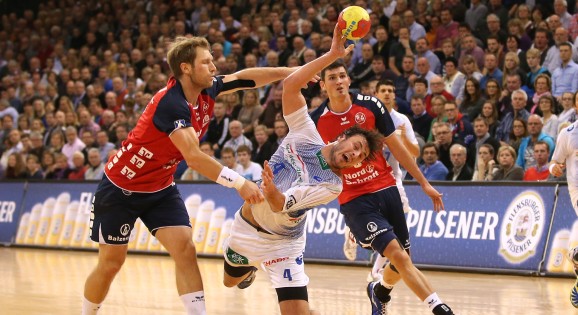
After a 3 week break the Champions League is now back for 3 consecutive weeks. This week’s “Match of the Week” has two top German sides (Flensburg and Hamburg) facing off in a derby to decide who will sit at the top of the standings in Group D. Hamburg currently lead the group with an unblemished 4-0-0 record while Flensburg is a point behind due to their draw in week 4 against Naturhouse La Rioja. Separated by 100 miles these two sides know each other very well. In fact, last year by some quirks in scheduling they ended up playing each other 7 times. So far this year, they’ve only met once with Flensburg beating Hamburg 31-29 last Sunday in an HBL matchup. Saturday’s match is in Hamburg and includes Tom Ó Brannagáin’s English language commentary.

Hamburg vs. Flensburg (Saturday, 16 Nov 1445 CET/0845 U.S. Eastern Time)
Video: Link

If you can’t catch the match live it will also be available later “on demand”.   (Note to U.S. residents:  It appears that beIN Sports, the U.S. TV rights holder, has decided to not broadcast this week’s Match of the Week.)

The other big match of the week is a showdown derby Thursday night in Macedonia, between Skopje’s Vardar and Metalurg clubs. Both sides have shown their worthiness in the Champions League this season as neither Barca or Paris were able to travel to Skopje and leave with a victory. This time around, however, there will be no overwhelming home crowd as both clubs will be represented at the Boris Trajkovski Arena. (Currently, I’m planning to do an audio commentary that you can synch up with the video and that will likely be available Friday morning.)

Metalurg vs Vardar (Thursday, 14 Nov 2000 CET/1400 U.S. Eastern Time)
Video: Link

The one other match I’ll be checking out this weekend is Kolding vs. Kielce on Sunday. Thanks to their victory in week 4 over Kiel, Poland’s Kielce is all alone in first place in Group B. In all likelihood, the winner of the Group will come down to the second Kiel-Kielce showdown, but if either of those two slides is going to slip up, the most likely place they’ll do so is their away match at Denmark’s Kolding.

Kolding vs Kielce (Sunday, 17 Nov 1700 CET/1100 U.S. Eastern Time)
Video: Link

I will replace the live video links with on demand video links when they are available at the ehfTV website. If you go to the ehf website yourself click on the side arrows to get to the “Full Match” page. A word of caution, however, the EHF sometimes posts match interviews with revealing titles like “Jicha scores the decisive goal,” so you might want to use a sheet of paper to mask the screen if you want to watch the matches obliious to the outcome.

ehfTV Page: Link

EHF Week 5 Preview: Link (A written summary by Bjoen Pazen previewing all 12 matches)

Tom Ó Brannagáin’s latest blog post: Link

post

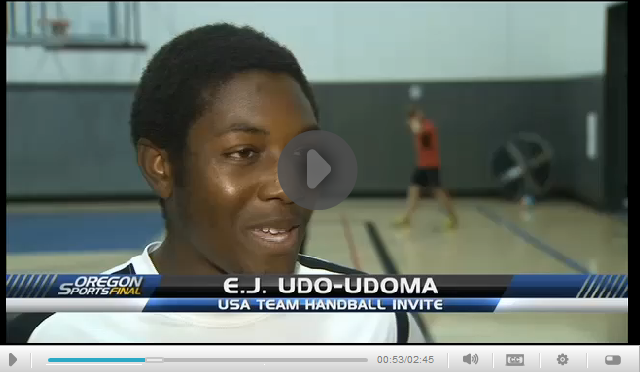
VIDEO: USA Team Handball prospect E.J. Udo-Udoma featured on Oregon TV


Team USA prospect E.J. Udo-Udoma

Team USA prospect E.J. Udo-Udoma

USA Team Handball National Team prospect E.J. Udo-Udoma was featured this past Sunday on Portland, Oregon’s Fox 12 News.  The video takes place at a Portland Sasquatch Team Handball club practice and includes interviews with Udo-Udoma and former national team player, Brad Dow.  Udo-Udoma is headed to Auburn where he will be joining the USA National Team Residency Program.

VIDEO:  Link

Portland Sasquatch Facebook Page:  Link

Commentary:  It’s great to see a couple of things:
1) It looks like USA Team Handball is picking up what appears to be a great prospect who’s only 20 years old and still has plenty of time to develop into a world class handball player.
2) It’s great to see a former national team player (Brad Dow) getting involved with a new club.  Who’s got next?  Or do I need to get on my soapbox again?:  Link

post

Handball News Summary (11 November 2013)

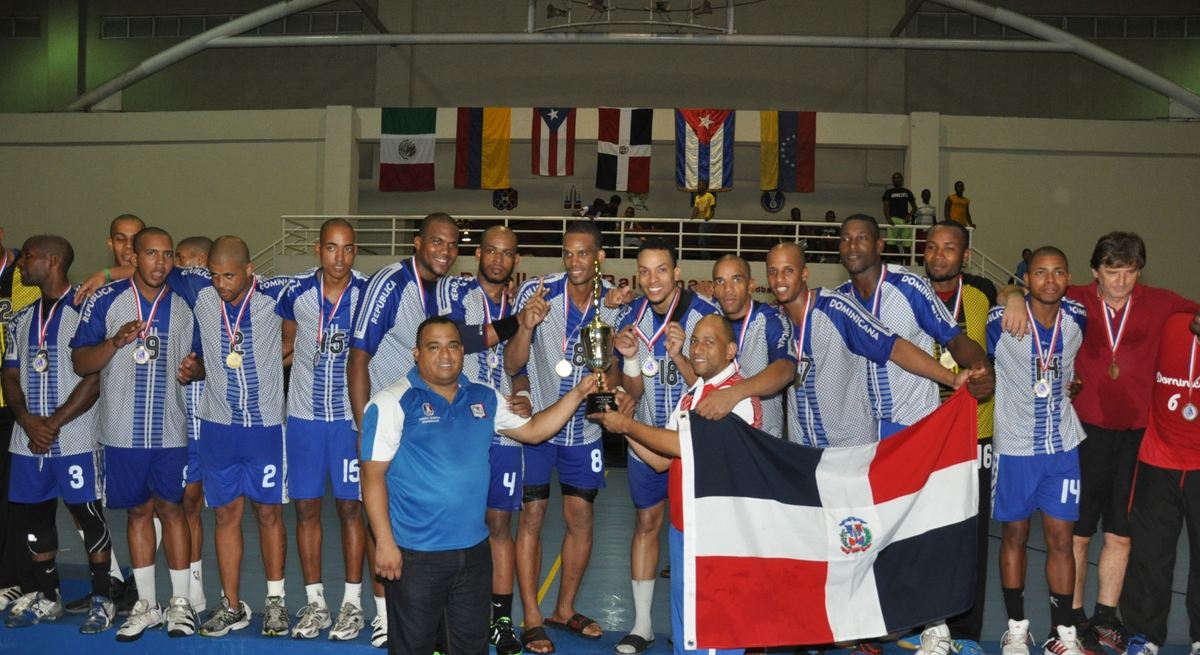
The Dominican Republic Men with the Caribbean Cup trophy.

The Dominican Republic Men with the Caribbean Cup trophy.

1) Caribbean Cup final results. This past weekend the Caribbean Cup ended with the Cuban women and Dominican Republic men taking first place. The Cuban women were particularly impressive with 2 wins over the host and World Championship bound Dominicans. The Cuban men were also competive, but lost to the hosts Dominicans 31-29.
Written summary at Handball-World: Link
Wiki page with results, match forms and video links (Mundo Handball): Link

2) Cuban player confirms desire to return to International Competition. In an interview on the Argentinian Handball podcast, Cuban Jorge Luis Pavan who currently plays for Naturhouse La Rioja in the Liga Asobal confirmed that Cuban players playing professionally in Europe who had previously defected are interested in again representing Cuba in international competition.
Handball de Primera (Spanish): Link

3) Cuban Rafael Capote to play in Qatar. Pavan’s club teammate, Rafael Capote, pending the results of a physical, will be transferred to Qatari club, El Jaish. Further speculation is that he may end up obtaining Qatari citizenship and playing for Qatar when that nation hosts the 2015 World Championship.
Mundo Handball (Spanish): Link

post

AUDIO: Christer Ahl presentation on IHF governance issues now available

Christer Ahl (2nd from left) and other panel members address "Sports Reform:  How to change the tone at the top?"

Christer Ahl (2nd from left) and other panel members address “Sports Reform: How to change the tone at the top?”

Last Wednesday Christer Ahl gave a presentation at the Biannual Play the Game Conference in Aarhus, Denmark. His presentation provides an overview of International Handball Federation (IHF) governance issues that have taken place in the past few years including the dramatic increases in compensation for the IHF President and Council and the controversy surrounding the awarding of World Championship TV rights.

Christer concludes his presentation with a number of key points including the need for outside monitoring of international Federations,  increased support to sports development and FIFA reform, as this Federation is unfortunately seen as a model for many other federations to follow.

The Despotic Regime of the IHF Just Continues
Written Presentation:  Link
Audio:  Link
– Christer’s presentation (15:00-29:00)
– Q&A session:  Questions directed to Christer
– Question regarding whistle blowers and good practices (120:00)
– Question regarding national federations roles in influencing International Federation governance (126:00)

Play the Game Conference (Video and Audio of all presentations):  Link

post

Caribbean Cup ongoing in the Dominican Republic

Copa-caribe

Caribbean nations are currently competing in the Dominican Republic.

The Caribbean Cup Handball Tournament started yesterday in Santo Domingo, Dominican Republic.  This tournament is the Caribbean region qualification event for next year’s Central and Caribbean Games in Veracruz, Mexico.  Nations participating in the Men’s tournament are the Dominican Republic, Cuba, Colombia, Puerto Rico and Mexico.  The Women’s tournament has the same nations, minus Mexico.  Haiti and Venezuela had indicated that they were going to participate, but pulled out shortly before the tournament.  The result of this is that the 4 qualification slots will automatically be awarded to the nations attending.  (Mexico had already qualified as host.)

In yesterday’s action, the Cuban Men returned to International competition in fine style with a relatively easy victory over Mexico, 31-22.  The second men’s match between the Dominican Republic and Puerto Rico was suspended due to water leaking on to the court and will be restarted later today.  The Dominican Republic was leading 5-3 after 11 minutes played.  In the sole women’s match the Dominican Republic women easily defeated Puerto Rico, 30-17.

Although the tournament will have no bearing on qualification it will serve as preview of next year’s Central American & Caribbean Games.  As the Central American sides are relatively new to handball in all likelihood the nations participating in this all Caribbean tournament will be the same ones fighting for the 3 PANAM Games slots next November in Mexico.  In particular, it will be interesting to see how well the Cuban Men and Women perform in this competition.

USA Team Handball followers might also get a good idea as to which 2 nations they might play against in the the 2nd chance qualification tournament in 2015 for the PANAM Games.  The 4th and 5th place nations from this region, the 4th place nation from South America and the U.S. will battle for the 8th and final spot for the 2015 PANAM Games sometime in early 2015.  (For more information on 2016 Olympic Games Qualification check the links on the right hand side of the page.)

For more information and to follow the Caribbean Cup competition check out the links below.

Standings and results Wiki (Mundo Handball):  Link


Live Stream and on demand highlights:  Link

post

USA Residency Programs hold first practice at Auburn

Team USA practicing at Beard–Eaves–Memorial Coliseum, on the campus at Auburn University

Team USA practicing at Beard–Eaves–Memorial Coliseum, on the campus at Auburn University

According to Facebook posts from National Team athletes Mark Ortega and Ashley Van Ryn, Team USA held their first practice yesterday at Auburn University.  Apparently, the program is just getting started with a few veteran athletes for the time being and will likely ramp up in the coming months.  This weekend there is a Women’s tryout and a joint Men’s/Women’s tryout is scheduled for December 9th:  Link.  Separately, a club program has also been started at Auburn.  This past weekend they had their first practice with both Men’s National Team Coach, Javier Garcia Cuesta and Women’s National Team Coach, Christian Latulippe helping out.  In theory, with their location and access to national team support the Auburn men’s and women’s clubs could very quickly become competitive on the national stage.

In terms of facilities, it’s hard not to be impressed with the gym USA Team Handball will be practicing in and hopefully staging future competitions.  The above photo posted by Mark Ortega shows the team practicing at the Beard–Eaves–Memorial Coliseum, a 10,500 seat arena that previously was the home for the Auburn University basketball teams.  In 2011 the Auburn basketball teams moved to the newly constructed Auburn Arena, making the old arena available for other campus activities.  While an older facility by U.S. standards it’s clearly an arena most nations and clubs in Europe would be thrilled to have for their handball teams.

(Editor’s Note (10 Nov 13):  Further investigation has revealed that Auburn University plans to demolish the Beard-Eaves Memorial Coliseum:  Link.  USA Team Handball CEO, Matt Van Houten has indicated, however, that Auburn has committed to providing alternative practice locations when that demolition occurs.)

post

Handball News Summary (4 November 2013)

Luc Abalo shows his dance moves.

Luc Abalo shows his dance moves.

1) Friendly match results. This past weekend saw many national teams playing friendlies in preparation for the European Championship, Africa Cup and South American Games. Here’s a composite summary mostly taken from several match reports at Handball-World: Link

Super Cup in Hamburg, Germany (Germany, Sweden, Poland, Egypt): Germany won all 3 of its matches and Poland edged Sweden for second place. Egypt lost all 3 and only managed to play Poland close.

Golden League in Oslo, Norway (Norway, Denmark, France, Croatia): Denmark and France won 2 of 3 matches, while hosts Norway and Croatia finished 1-2. Norway surprised Denmark with a 32-26 victory.

Tournament in Hammamet, Tunisia (Tunisia, Russia, Belarus, Brazil): A closely matched tournament with no game being won by more than 4 goals. Tunisia won the tournament with wins over Russia and Belarus and a draw against Brazil. Brazil had draws against Egypt (23-23) and Belarus (30-30) and lost narrowly to Russia (26-25)

Hungary – Spain: Spain defeated Hungary twice in Hungary, by scores of 30-26 and 29-24

Czech Republic – Serbia. In two matches played in the Czech Republic, the first match was a 29-29 draw and the second one was a 30-25 Czech Republic victory

Austria – Iceland. These two nations played two closely contested matches in Austria. Iceland took the first match 29-28 and Austria won the second match 33-32

Macedonia – Montenegro.  Montenegro edged Macedonia 29-28 in the first match and Macedonia won the second, 26-21.

Algeria: 4 wins vs Czech Republic Clubs: Link

Argentina: Argentina defeated French club, Ivry (34-29) and had a draw against Creteil (26-26)

2) Will Cuban players that previously defected be allowed to play for Cuba? Cuba recently change their laws to allow athletes to play professionally in other countries. Ruben Gomez of Mundo Hanball assesses the impact if those players return to the Cuban National Team
Mundo Handball: Link http://blog.mundohandball.com/2013/11/cuba-con-jugadores-profesionales-en.html

3) Luc Abalo “feels good”. In a video for the organization “Sports Without Borders” Luc Abalo does a James Brown impression..
Hand News: Link