post

Shuffling the Deck: Rethinking the IHF Olympic Qualification Tournaments

Shuffling the deck:  Rethinking the seeding of Olympic Qualification Tournaments

Shuffling the deck: Rethinking the seeding of Olympic Qualification Tournaments

Christer Ahl’s preview of the upcoming IHF Congress he noted that Japan and South Korea were proposing changes to Olympic qualification to add more slots for non-European nations.  As anyone who’s watched Olympic handball  knows with the exception of the South Korean women these tournaments have been very heavily weighted towards European nations.  And yes, that reflects actual relative strengths of the continents, but the optics of a mini European tournament on the Olympic stage are problematic.

I haven’t seen the exact proposals, but reportedly they would give Africa, Asia and Pan America 2 guaranteed slots each thus limiting Europe to a maximum of 6 of the 12 slots for the Olympics.  Christer concluded that this was going a bit too far and suggested that instead one of the 3 Olympic qualification tournaments be set aside for the non European nations.

This got me wondering just what exactly this might mean for the Olympic Qualification tournaments in terms of competition so I took a look at the 2012 tournaments and reshuffled them using Christer’s suggested compromise.

2012 Men’s Olympic Qualification (actual tournaments and results)

IHF Qualification Tournament #1
2nd at 2011 WC (Tournament Host): Spain
7th at 2011 WC: Poland
Europe (2nd place at 2012 EC): Serbia
Africa (2nd place at 2012 African Championships): Algeria

Results
1) Spain (3-0-0) 6 Points
2) Serbia (1-1-1) 3 Points +5 Goal Differential
3) Poland (1-1-1) 3 Points -10 Goal differential
4) Algeria (0-0-3) 0 Points

IHF Qualification Tournament #2
3rd at 2011 WC (Tournament Host): Sweden
6th at 2011 WC: Hungary
Pan America (2nd at 2011 PANAM Games):  Brazil
Europe (3rd at 2012 European Championships): Macedonia

Results
1) Sweden (3-0-0) 6 Points
2) Hungary (2-0-1) 4 Points
3) Brazil (1-0-2) 2 Points
4) Macedonia (0-0-3) 0 Points

IHF Qualification Tournament #3
4th at 2011 WC (Tournament Host): Croatia
5th at 2011 WC: Iceland
Asia (2nd at Asian Olympic Qualification Tournament): Japan
Pan America (3rd at 2011 PANAM Games): Chile

Results
1) Croatia (3-0-0) 6 Points
2) Iceland (2-0-1) 4 Points
3) Japan (1-0-2) 2 Points
4) Chile (0-0-3) 0 Points


2012 Men (with proposed alternative)

IHF Qualification Tournament #1
2nd at 2011 WC (Tournament Host): Spain
4th at 2011 WC: Croatia
6th at 2011 WC: Hungary
Europe (2nd place at 2012 EC): Serbia

IHF Qualification Tournament #2
3rd at 2011 WC (Tournament Host): Sweden
5th at 2011 WC: Iceland
7th at 2011 WC: Poland
Europe (3rd at 2012 European Championships): Macedonia

IHF Qualification Tournament #3
Pan America (2nd at 2011 PANAM Games) (Tournament Host): Brazil
Africa (2nd place at 2012 African Championships): Algeria
Asia (2nd at Asian Olympic Qualification Tournament): Japan
Pan America (3rd at 2011 PANAM Games): Chile

2012 Women’s Olympic Qualification (actual tournaments and results)

IHF Qualification Tournament #1
France (2nd at 2011 WC) Host
Montenegro (7th at 2011 WC)
Romania (Europe #2)
Japan (Asia #2)

Results
1) Montenegro (3-0-0) 6 Points
2) France (2-0-1) 4 Points
3) Romania (1-0-2) 2 Points
4) Japan (0-0-3) 0 Points

IHF Qualification Tournament #2
Spain (3rd at 2011 WC) Host
Croatia (6th at 2011 WC)
Argentina (Pan America #2)
Netherlands (Europe #3)

Results
1) Spain (2-0-1) 4 Points (+3 GD in head to head games vs Croatia and Netherlands)
2) Croatia (2-0-1) 4 Points (+0 GD in head to head games vs Spain and Netherlands)
3) Netherlands (2-0-1) 4 Points (-3 GD in head to head games vs Spain and Croatia)
4) Argentina (0-0-3) 0 Points

IHF Qualification Tournament #3
Denmark (4th at 2011 WC) Host
Russia (5th at 2011 WC)
Tunisia (Africa #2)
Dominican Republic (Pan America #3)

Results
1) Russia (3-0-0) 6 Points
2) Denmark (2-0-1) 4 Points
3) Tunisia (1-0-2) 2 Points
4) Dominican Republic (0-0-3) 0 Points

2012 Women (with proposed alternative)

IHF Qualification Tournament #1
2nd at 2011 WC (Tournament Host): France
4th at 2011 WC: Denmark
6th at 2011 WC: Croatia
Europe (2nd place at 2012 EC): Romania

IHF Qualification Tournament #2
3rd at 2011 WC (Tournament Host): Spain
5th at 2011 WC: Russia
7th at 2011 WC: Montenegro
Europe (3rd at 2012 European Championships): Netherlands

IHF Qualification Tournament #3
Pan America (2nd at 2011 PANAM Games) (Tournament Host): Argentina
Africa (2nd place at 2012 African Championships): Tunisia
Asia (2nd at Asian Olympic Qualification Tournament): Japan
Pan America (3rd at 2011 PANAM Games): Dominican Republic

Analysis

If one compares the actual tournaments that took place and the hypothetical tournaments that would have taken place a few trends can be discerned.  Here are the major impacts as I see it:

1) Every nation would have a shot at qualifying:  In theory, this was already the case, but in reality the prospect of any of the non-European teams knocking off 2 European teams at a tournament staged in Europe was pretty remote.  Intead those non-European teams would have legitimate chances with a tournament featuring evenly matched 2nd tier nations.  I suspect that Brazil and Algeria would have qualified in the Men’s tournament, but I wouldn’t have counted out Japan or Chile.  With the Women’s tournament I’m guessing that Tunisia and Japan would have qualified, but Argentina as the theoretical host would have been in the mix as would have been the athletic Dominicans.  And it goes without saying that any of the European sides could have envisioned themselves placing 2nd in the European tournaments.

2) Every nation would have a a very real possibility of not qualifying.   Conversely, those European nations would also face a very real prospect of slipping up and not qualifying.  Again, this was already the case, but pretty unlikely.  Most egregious are the 3rd qualification tournaments with 2 European and 2 non-European teams.  Those tournaments have been essentially glorified exhibitions that unfairly reward the 4th and 5th place WC qualifiers with all but free tickets to the Olympics.  With 4 European nations participating in the alternative setup even the host nations would have to be very wary of a slip up against 3 opponents each capable of beating them.

3) Tournaments worth watching:   A corollary of 1 and 2 above, from a fan perspective is that 3 tournaments with relatively predictable results would be replaced with 3 wide open tournaments.  Instead of perhaps 1 or 2 interesting matches among the 3 tournaments almost every match in the alternative setup will be competitive.  Heck, I would even bet that some of those tournaments would see a final day with every side still having a chance at qualification.  Talk about TV worth watching!

4) New nations qualifying for the Olympics.  Aside from the better qualification tournaments, opening up 2 spots provides an Olympic opportunity for nations like Japan, Algeria, Chile and the Dominican Republic.  Participating in an Olympics can provide a tremendous boost to the development of the sport in countries where the sport is less popular.  While, I’ve seen first hand how this boost wasn’t  sustained as much as I would have liked it to have been in the U.S. after the 84 and 96 Olympics it still was significant.  (For instance this website surely wouldn’t even exist.)  And while the U.S. example might not be a good one, take a look at what has happened in countries like Egypt, Tunisia, Brazil, Argentina and South Korea.  Creating more opportunities for more nations means more potential for making the sport truly global.

5) Two European nations would miss out.  Of course, this is the corollary to #4.  Is it fair to “punish” a better European side, perhaps a side that could beat the non-European side by 10 goals?  Should a professional player who’s devoted his/her life to the sport sit at home while an amateur player who’s played for a few years walks into an Olympic Stadium during the opening ceremonies?  It’s hard not to be sympathetic to the plight of those would be athletes.

6) The quality of the Olympic Tournament would decline.  Obviously, if you take out 2 of the top 9 nations of the world and replace them with 2nd tier nations the overall quality of the tournament will decline.  The question then becomes one of how serious of a decline would it be?   Realistically, at this point in time I don’t think any of the 2nd tier nations that would be capable of reaching the semifinals.  Whereas, the 8th and 9th European representative would have a legitimate outside chance of doing so.  So, we would be replacing a really long shot with just a long shot.   And there would likely be a couple more lopsided scores, but I think these 2nd tier nations are capable of playing competitively against the top nations maybe even getting an upset along the way.   In other words, losses of 5-10 goals instead of 20 goal shellackings.

Overall, I would argue that the benefits of  the proposed tweaking of the qualification system to allow more non-European nations outweigh the negative consequences.  As Christer suggested, balance is what’s desired.  Adding 2 non European nations seems about right at this point in time and it would help the growth of the game.


post

Handball News Summary (9 October 2013)

2014 African Championships Draw Results

2014 African Championships Draw Results

1) Draw results for African Nations Cup. Earlier today the draw for the 21st African Championships was held. Both the men’s and women’s tournaments will be in Algiers, Algeria from 15-26 January, 2014. The top 3 men’s teams and a TBD number of women’s teams will qualify for the 2015 World Championships.
Africa Top Sports (French): Link

Men
Group A: Tunisia, Egypt, Cameroon, Gabon, Libya, Senegal
Group B: Algeria, Morocco, Congo, DRC, Angola, Nigeria

Women
Group A: Algeria, Congo, Senegal, Cameroon
Group B: Angola, Congo, Equatorial Guinea, Tunisia

2) Speculation is rampant that Talant Dujshebaev will soon be the coach at Vardar Skopje.  Vardar abruptly dismissed coach Zoran Kastratovic earlier this week and with Dujshebaev’s son Alex playing with the club many are thinking he will be the next coach.
Marca.com (Spanish): Link
Video: EHF Google Hangout: Link  (Talant Dujshebaev’s future is debated for several minutes at the start of the discussion.)

3) Gudmundur Gudmundsson to be named new coach of Denmark. Gudmundsson who previously coached his native Iceland to the 2008 silver medal is expected to be announced as the designated successor to current coach Ulrik Wilbek. It’s also widely speculated that he will end his coaching duties with Rhein-Neckar at the end of the season.
Handball-World: Link

4) Lar Christiansen supplements his retirement income. Following in the tradition of Jim Palmer and Michael Jordan Christiansen is pitching men’s underwear.
Handball World :  Link

5) Diego Simonet on Canal+. French Channel Canal+ has a short video feature on the Argentine finding a home with French club, Montpellier.
Handnews.fr (French): Link

post

American Football and Team Handball (Part 1): Proof that an alien game can take root in unlikely places

Rasmus Lauge-Schmidt is a huge fan of American Football; How about finding and creating some American footballers who are fans of Team Handball?

Rasmus Lauge-Schmidt is a huge fan of American Football.  How about finding and creating some American footballers who are fans of Team Handball?

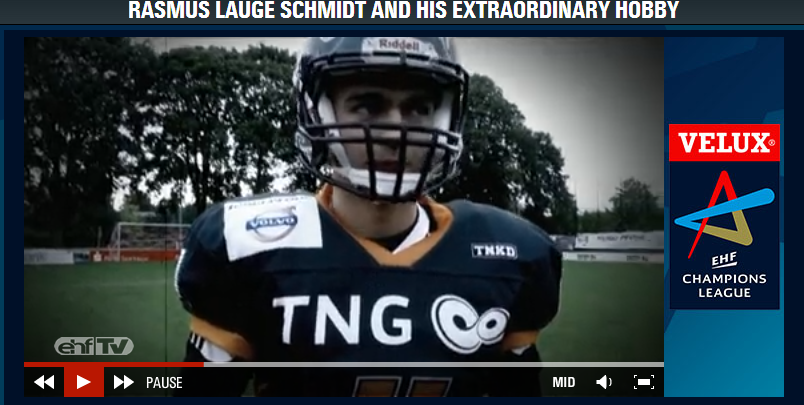
The ehfTV “Rewind” show is highlight show of Champions League action with a few interviews thrown in for good measure. Last week, as an American I did a double and triple take when I saw the “Inside the Game” profile with Kiel’s Danish center back Rasmus Lauge-Schmidt. The cause of the double take? The video shows Lauge-Schmidt practicing a bit of American Football in full pads.

It turns out that the 22 year old, Lauge-Schmidt is a huge fan of the National Football League (NFL), the professional football league in the USA. So much so that every Sunday night he watches from 7:00 PM until the early hours of the morning. (As a former resident of Europe, I can attest to doing the same thing; That time change certainly alters your NFL viewing clock.) I haven’t confirmed with Lauge-Schmidt, but I’m pretty sure that his fandom has been restricted to viewing and he’s never actually played the game. I suspect that the EHF set up a mock practice with the local club in Kiel to provide some good optics for the interview. After all, it can be a little boring to just watch someone talking. And the interview did get me thinking about the current status of American Football in Europe and some lessons that might be applicable to Team Handball in the U.S.

American Football popularity abroad

A lot of people in the U.S. are probably under the impression that the game isn’t played much outside of the U.S and Canada and while that’s certainly true to an extent, the sport is played in most European nations. I was first made aware of this many years ago when I stumbled upon a full contact scrimmage of the London Ravens in Hyde Park. Long time LA handball player, Mika Maunala, amused me with stories of playing QB in Helsinki and I had a German work colleague in Paris that played, by coincidence for the club in his hometown, Kiel. (Yes, ironically I was the bigger handball fan in my office.) Sure enough Lauge-Schmidt photo op was with the local club there, the Kiel Baltic Hurricanes.

It’s hard to fully gauge how popular a sport is from a few personal anecdotes, but clearly American Football is gaining a foothold in Europe. NFL broadcasts are readily available in most countries even if it’s usually with a cable outlet. In London the NFL now plays two regular season matches to sell out crowds of 80,000 plus at Wembley Stadium.  There’s quite a list of nations with leagues even if it’s uncertain as to the level of amateurism/professionalism, but at least some of the teams appear to draw decent crowds. The Hurricanes for instance drew 7,000 fans for a semifinal match recently. While that doesn’t even begin to approach a typical crowd at an NFL game the U.S. right now can only dream of a crowd approaching that for a handball match in this country.

Such a foothold wasn’t obtained through osmosis. Sure, it’s a great game to watch and generally when newcomers are exposed to the sport they become fans. Lauge-Schmidt is but one example. Virtually every expat I’ve met who’s emigrated to the U.S. has become a fan of the sport. (count my colleague, Christer Ahl in that category.)  There’s lots of sports that fall into that category and just like American Football generally newcomers to Team Handball like what they see when exposed. And that’s where the NFL is the difference maker as they do an absolutely masterful job of packaging and promoting the sport. Perhaps this can best be summed up by what I heard French basketball player Tony Parker say once in describing American sports production:  “They make every weekend of games seem like the World Cup.”  The pageantry, aesthetics and TV production involved in packaging the sport are simply unmatched. And the promotion is strategically planned both home and abroad. For years the NFL has cultivated a following. Even going so far to create an NFL developmental league there for several years. While that league eventually folded it surely played a key role in the sports development overseas.

Proof that foreigners can learn to play an alien game at the highest level

If there ever was greater proof staring the handball world in the face that it’s possible for a game totally alien to a country’s sporting culture to take root there is no better example than American Football in Europe. Sure, the sport isn’t as popular as many other sports, but think of all the crazy obstacles it’s overcome to reach the level of popularity it has. First off, there are probably only a handful of games more expensive to play. Unlike the typical school team in the U.S. with equipment handout on the first day of practice every player has to buy his own personal set of pads. Then think of the complexities of the game that have to be learned. The idiosyncrasies of the rules and the penalties might seem second place if you’ve watched it all your life, but coming in cold it’s pretty complex. Finally, think of all the unique skills like blocking and tackling that have to be taught and learned. Not to mention the concept of intricate play calling where every single player has to memorize responsibilities and formations for every single play. With all those obstacles to overcome it’s a wonder that the sport is played anywhere outside the U.S. and Canada.

Yet, amazingly the level of play has risen to the point where there’s now a trickle of foreigners getting recruited by American colleges and then eventually making it into the ranks of the NFL. Notably, there are now two established German players, Bjoern Werner and Sebastian Vollmer. Probably not household names back home, but with salaries of $2M and $4M respectively they make more on a yearly basis than anyone playing handball in the German Bundesliga. If Germans can learn to play American Football to the highest level it’s not so difficult to think that Americans can do the same with Team Handball. And while it has indeed happened in recent times, Americans (who learned the game in the U.S) haven’t ascended to anywhere near the highest levels in Europe. For instance, arguably America’s current best player, Gary Hines, plays for German 3rd Division side, HC Bad Neustadt.

Probably, for Americans to make the leap into the upper pro ranks in Europe, it will take a greater number of athletes picking up the game at younger ages. And then those athletes heading over to Europe at younger ages with enough time to further develop as players so that top clubs are interested in signing them.

Or, alternatively, some absolutely top quality athletes could be enticed to give Team Handball a try after their career with their first sport winds downs. In Part 2, I’ll take a closer look at this possibility with a focus on the American Football to Team Handball pipeline.

post

Handball News Summary (4 October 13)

Karabatic


1) The percentage of non-German players in the HBL is most pronounced at Center Back.  Handball Time magazine in Germany provides a detailed analysis of foreign participation in the HBL. Additionally, it’s noted that the percentage of foreign players in the HBL isn’t that different from other sports.
Handball World (German): Link

2) Barca with bargain season ticket plan. 73 Euros is all that is required to get a seat for every home Liga ASOBAL and Champions League match. For roughly the same price you can get tickets to 2 matches at Flensburg. If it wasn’t obvious before it’s totally self evident now that only a tiny fraction of Barca’s payroll is paid with handball related revenue.
Diario ASOBAL (Spanish) : Link

3) Arab Gulf nations stage first ever Women’s International Tournament.  Kuwait is hosting Qatar, Bahrain, Oman and the United Arab Emirates in a 6 day long tournament.
Arab Times: Link
Kuwait Times: Link

4) Nikola Karabatic supplements his income. The Stade Francais Rugby Calendar has a guest handballer gracing it this year. It’s the 3rd time Karabatic has posed for the promotional calendar.
Handnews.fr (French):  Link 

post

Handball News Summary (1 October 2013)

Kathy Darling on attack for French club, Le Pouzin

Kathy Darling on attack for French club, Le Pouzin

1) IHF to pay all travel costs for upcoming Women’s World Championships.  As Ruben Gomez at Mundo Handball noted this will enable non European teams to take that cost savings and apply it to additional prep matches in Europe prior to the World Championships :
IHF website: Link
2) Brazil wins Wheelchair Handball Championships
Mundo Handball (Spanish): Link
Official website: Link
3) Paris St-Germain star Mikkel Hansen won’t participate in a Danish National Team training camp.  Apparently, his club want him to rest a knee injury.
Handnews.fr (French):  Link
4) Pan American Team Handball Federation (PATHF) website upgrade.  The PATHF website has a new look and design with separate sections for North, Central and South America.
PATHF Website: Link 
5) German National Team coach suggests that HBL require clubs to have a minimum number of German players.  The complaint is that in addition to top level outside talent, mid-level non-German players are taking spots that would go to developing young German players.
Handball-World (German): Link
6) American Kathy Darling makes debut with French Club, Le Pouzin.  Darling scored 3 goals helping Le Pouzin to a 28-27 victory over Coach Latulippe’s former club, La Motte Servolex.
Le Pouzin website: Link
Pictures from match:  Link
post

VIDEO: Champions League Group Play (Week 2)

MOTW

This week’s “Match of the Week” has the two pre-season favorites in Group A facing off as Hungary’s Veszprem hosts Germany’s Rhein-Neckar Lowen. Last week Rhein Neckar escaped with a draw against Ukraine’s HC Motor Zaporozhye while Veszprem easily took care of St Petersburg. Veszprem is a 3.5 goal favorite. The Match of the Week is the ehfTV marquee game and includes Tom Ó Brannagáin’s English language commentary.

Veszprem vs. Rhein-Necker (Sunday, 28 Sep 1700 CET/1100 U.S. Eastern Time)
Video: Link

If you can’t catch the match live it will also be available later “on demand”. Further, U.S. residents with beIN Sport can also catch a retransmission on Monday, 30 September at 1700 (Eastern Time).

Other matches worth checking out this weekend include:

Dunkerque vs Wisla Plock (Saturday, 27 Sep 1600 CET/1000 U.S. Eastern Time)
France likes to think it now has the world’s 2nd best national league, but Dunkerque lost by 10 to Poland’s Kielce last week. This week they are at home against another Polish side which narrowly lost to Kiel the week before. The linesmakers have this match as a “pickem”
Video: Link

HC Metalurg vs Paris St Germain (Saturday, 27 Sep 1800 CET/1200 U.S. Eastern Time)
On paper, with its new signings and loaded roster Paris is a contenter for the title. So far this season, however, they’ve failed to impress. Last week they pulled ahead at home to beat Minsk 34-30, but the game was a lot closer than the final score. A road trip to Macedonia will be a good test for their mettle. Paris is a 3.5 goal favorite.
Video: Link

Aalborg vs Logrono (Sunday, 28 Sep 1700 CET/1100 U.S. Eastern Time)
Both these sides lost last week and are looking for their first win in the competition. Logrono (Naturhous La Rioja) is the other Spanish team (aside from favorite Barca) and I’ll be watching their performance to see just how far the Liga Asobal has slipped. Aalborg is a 2 goal favorite.
Video: Link 

I will replace the live video links with on demand video links when they are available at the ehfTV website. If you go to the ehf website yourself click on the side arrows to get to the “Full Match” page. A word of caution, however, the EHF sometimes posts match interviews with revealing titles like “Jicha scores the decisive goal,” so you might want to use a sheet of paper to mask the screen if you want to watch the matches oblivious to the outcome.

ehfTV Page: Link

EHF Week 2 Preview: Link (A written summary by Bjoern Pazen previewing all 12 matches)

Tom Ó Brannagáin’s latest blog post: Link

post

Handball News Summary (26 September 2013)

1) Interview with Wisla Plock’s Marcin Lijewski. ehfTV’s Tom Ó Brannagáin sat down with Lijewski prior to the match and touches on a number of topics: Playing with Hamburg, moving to Poland and who’s a better player: Marcin or is his brother Krzysztof.
EHF article: Link
Audio:
Link (30 minutes: Worth a listen)

2) AG Copenhagen to return in 2014? Owner Jesper Nielsen is signalling on social media that the short lived Danish powerhouse club could return next season
TV2.DK: Link
Christer Ahl commentary from 2012 on Copenhagen: Link

3) Fiji looks to introduce handball. If they can duplicate the success they’ve had with Rugby 7s perhaps another nation besides Australia could make the World Championships
Fiji Broadcasting Corp: Link


post

The Olympic Program (Is Handball Safe as a Core Sport?)

World Baseball/Softball Confederation officials react stoically as International Wrestling Federation officials celebrate behind them.  Could handball suffer the same fate in a future vote?

World Baseball/Softball Confederation officials react stoically as International Wrestling Federation officials celebrate behind them. Could handball suffer the same fate in a future vote?

Previously, we looked at the IOC votes for the 2024 Olympic host city and IOC Presidency.  This time around we look at the IOC’s decision to bring back wrestling and whether there are any implications to handball’s future.

Earlier this month at the IOC congress, the IOC held a vote to see whether wrestling, baseball/softball or squash would join 24 other disciplines to be part of the Core Olympic Program. The sport of wrestling had been in the Olympics since its inception and had been shocked by an earlier decision by the IOC Executive Council to be removed from the Program.  Suddenly on the outside looking in, wrestling cleaned up its act, enacted several reforms and easily won remittance by beating back baseball/softball and squash.  It was a disappointing defeat for the combined Baseball/Softball Confederation and they vow to fight on for inclusion in future votes.  Critics have cited baseball’s lack of popularity in many parts of the world and it had me wondering if handball could be susceptible to falling to the same fate.  Here’s my analysis, first taking a look at the popularity of the sport.

Handball’s world-wide popularity?

Measuring popularity is an inexact science. How could it not be? As popularity by definition is pretty much subjective.  There are some metrics that can be used to measure popularity.  Numbers of registered players, fans in attendance, numbers of TV viewing hours during the Olympics, number of mentions in local media and the number of countries with sports federations to name a few.  Some of these metrics, in fact, have been touted to claim that handball is the 2nd most popular sport in the world after soccer.  Which while it’s not usually explicitly stated is probably a team sport ranking claim as comparing sports like swimming and gymnastics to team sports is difficult.

While I’d like to think that I’m a pretty big handball fan and promoter of this great sport I’ve annoyed more than a few folks at different times by basically saying, “STOP!  Quit pretending that this European sport has a significant world-wide following.  It doesn’t, period.  In fact, even its European following in several European countries is nothing to write home about.”

Of course, the same sorts of things can be said about a lot of other sports.  Baseball for instance; In fact, I would argue that if one compares the popularity of baseball with handball you’ll find some striking similarities.

  • Both are primarily popular in one part of the world:  handball- Europe; baseball; North America.  Although baseball can make a case that the significant popularity of the sport Japan, South Korea and Taiwan actually shows a broader worldwide reach.
  • Both are mostly an afterthought outside of their strongholds.  Most Americans don’t even know handball exists.  Most Europeans only know baseball from Hollywood movies.  The rest of the world is a mixture of recognition.  Some regions (South America, North Africa) have shown some handball growth; Other regions are developing a greater interest in baseball (Australia, East Asia).

And continuing the similarity comparison further you’ll likely get the following reactions from the sports conscious fan in their respective popularity strongholds when asked about the merits of the other sport.

  • North American:  “Why is this handball sport in the Olympics?  I bet it was invented by Europeans just because they were tired of the U.S. whipping up on them in basketball.”
  • European: “Pffft. Baseball? This is the most boring sport ever invented and, as if, the world needs to add an American sport to the Olympic program.”

This isn’t conjecture.  I’m only paraphrasing actual commentary I’ve read or heard many times.  Each continent is largely ignorant to the importance of the other sport.  I’m guessing that many Europeans aren’t aware that the average individual salary of a Major League player ($3.2M) is more than the budget for most European club teams.  Heck, around 24 players make more all by themselves than the operating budget of Paris S-G (handball’s richest club).  Conversely, most Americans don’t know that handball exists.  Let alone that there are thousands of clubs at the professional and amateur level.

Is handball safe?

So, could handball fall victim to the same fate as baseball?  A regional sport tossed out in favor of some new up and coming sport.  A sport (with the exception of South Korea) that is totally dominated by one continent during Olympic competitions?  A sport like wrestling with its share of problems in recent years; questionable doping controls and allegations of match fixing?

Answer:  Handball’s safe and here’s why:

1) Europe is made up of roughly 50 countries and it dominates the IOC.  It’s common practice to compare the U.S. to Europe for a number of reasons.  They have a similar population, similar economies and both have a significant role in world affairs.  If you were to combine all of the countries into one United States of Europe you would essentially have a counterbalance to the U.S.  But, that isn’t happening anytime soon.

Sometimes, it’s good to be the big dog and throw your weight around.  In particular, the economy of scale that the U.S. presents is a big reason why everyone in the world watches American movies and listens to American music.  And when you present the world’s largest market for goods and services generally everyone is interested in grabbing a portion of that market share.

Sometimes, however, it’s not so good, and in many diplomatic circumstances the big dog can get outmaneuvered by a pack of smaller dogs.  And while the IOC is not a one country, one vote organization like the UN, there is a natural tendency to not let any one country have too many IOC voting members.  For sure, there is still some skewed representation, but the membership is spread around.  If the U.S. had somehow evolved into a patchwork of 50 nations (instead of states) with California and Texas competing under separate flags at the Olympics it’s probably safe to say that the IOC representation for that patchwork of nations would be far greater than the 4 IOC members the U.S. currently haves.  But, the U.S. is not about to split up into multiple nations anytime soon and with over half of the IOC members being from Europe it’s far less likely that a European sport will get tossed out.

2) Other sports are more vulnerable.  By almost any practical measure sports such as modern pentathlon and field hockey are more ripe for picking off the Olympic Program.  In terms of team sports field hockey (particularly men’s field hockey) is clearly more unpopular.  If it’s decided that a team sport needs to go because of the larger footprint (e.g. the number of athletes involved) it’s hard not to see that sport going first.

3) Friends in high places. With a German, Thomas Bach, at the head of the IOC, it’s hard to see handball leaving the Olympic Program.  Additionally, the reported power broker, Sheikh Ahmad Al-Fahad Al-Sabah of Kuwait is a fan of the sport even if that fandom might be viewed unfavorably due to his involvement in the controversial 2008 Olympic qualification match between Kuwait and South Korea.  With those individuals holding considerable power and influence it’s hard to see them allowing handball to suffer the fate of wrestling or baseball.

Safe, but be prepared

While handball appears to be in a safe zone it should be kept in mind that few would have thought the sport of wrestling was in any danger not too long ago.  Reportedly, a re-evaluation of the Olympic sports program is high on the agenda of new IOC President Bach.  And, the process to add a new sport failed to add one, so that will surely be looked at as well.  Shiekh Ahmad was even quoted recently stating, that the criteria for a sport’s consideration needs to be clearly defined.  Let’s hope that this is indeed the case and that the IHF places as a top priority making sure that handball scores high in that criteria.  For rest assured while handball right now may be primarily just a European sport the Olympics is the absolute best vehicle for making the sport truly global.  And while it might be a low risk that handball could be booted from the Olympics, the consequences of that low risk happening would be totally devastating to the sport’s chances for growth.

post

Handball News Summary (23 September 2013)

Required attire for French Club, Handbal Cercle Nimes

Required attire for French Club, Handbal Cercle Nimes

1) Week 1 of Champions League Group Play with some suprisingly close matches
EHF Champions League:  Link

2) Russian Women’s coach, Evgeny Trefilov,  returns.  He was dumped last year due to poor performances at the WC and Olympics.  His successor, however, didn’t even worse in failing to qualify for the 2013 WC due to a shocking 12 goal defeat to the Netherlands in Russia.
EFH Website:  Link
3) German club, Wetzlar, struggles.  The addition of Balic and Hombrados to the roster hasn’t paid huge dividends for this German club with aspirations.
Hand News (French): Link
4) The EHF considers potential changes to its European Championships format.  A task force is investigating a number of possibilities including the expansion from 16 to 20 or 24 teams
EHF Website: Link
5) Handball in Buenos Aires hits 10,000 registered players:
Mundo Handball: Link
6) Nimes women’s handball club players are now required to wear skirts.   Apparently management thinks this will boost attendance
Midi Libre newspaper Link
(Thanks to Mundo Handball for the initial tip: Link)
post

VIDEO: EHF Champions League “Match of the Week” returns

Wisla-Kiel

Just a reminder that Champions League Group Play has started and the first ehfTV Match of the Week is later today as Poland’s Wisla Plock hosts Germany’s Kiel.  Wisla Plock knocked off France’s perennial power, Montpellier in a wild card playoff to reach the group stage, now they will try to upend traditional German power, Kiel in week 1.  Kiel is a 2.5 goal favorite.

The match will be available live on the ehfTV web streaming platform today (22 September) at 1700 Central European Time or 1100 U.S. Eastern Time.   English language commentary will be provided by the always energetic, Tom Ó Brannagáin.

If you can’t catch the match live it will also be available later “on demand”.  Further, U.S. residents with beIN Sport can also catch a retransmission on Monday, 23 September at 1700 (Eastern Time)

Additionally, all of the matches of week 1 are available for viewing and without giving away details there are a few surprises.  Check out the links below:

Wisla Plock vs Kiel Video (On Demand): Link

All Matches (On Demand): Link  (Warning:  There currently isn’t a way to go directly to the On-Demand matches without being exposed to some content revealing the outcome of matches)

EHF Week 1 Preview:  Link (A written summary by Bjoen Pazen previewing all 12 matches)

Tom Ó Brannagáin’s latest blog post: Link

Google Hangout preview of the season:  Link

post

VIDEO: EHF Champions League Panel Discussion

This "expert" likes Flensburg.

This “expert” thinks its Flensburg’s turn.

The European Handball Federation (EHF) hosted a panel discussion earlier today on this season’s Champions League competition.  Team Handball News’ John Ryan, was part of the esteemed panel which also included handball journalists Björn Pazen and Grega Sever and the voice of ehfTV,  Tom Ó Brannagáin.

Video (EHF Champions League website):  Link
Video (EHF Youtube Channel): Link

post

BoD Election Results: Choi and Agoston Edge Rot in Low Turnout

BoD results

The official results are in for the recent election to determine the 2 new “General Membership” seats on the 9 member USA Team Handball Board of Directors.  Former National Team player Jennie Choi and Denver Team Handball Coach/Player, Attila Agoston edged Minnesota Team Handball organizer Craig Rot.

85 valid ballots from USA Team Handball members were received by the USOC Audit Team and each voter had to rank all 3 candidates in order of preference.  For each ballot the candidate that was ranked first received 3 points, the candidate ranked second received 2 points and the third place candidate received 1 point.

The overall point total for the 3 candidates was

Jennie Choi:  176 points (34.51% of overall points awarded)
Attila Agoston: 175 points (34.31% of overall points awarded)
Craig Rot:  159 points (31.18% of overall points awarded)

With the ranking system used for voting it’s possible that as few as 9 additional voters supporting Craig Rot could have tipped the scales in his direction.

Commentary:  Low turnout is a reminder of sport’s low profile

Only 85 out of a roughly 1,000 members of USA Team Handball bothered to cast a ballot in this election. A less than onerous process (print, scan and email a ballot) that took me roughly 5 minutes to complete.  Perhaps the low turnout can be chalked up to the quality of the candidates and an assessment by members that each of the candidates were qualified and would be capable board directors.  Certainly, that was my assessment when I found out who the candidates were and it was also my assessment after I had the opportunity to chat with each of them.  That being said I was still able to pick a preference even if I wasn’t overly concerned with the outcome.

Regardless of the reason for apathy there is no getting around the fact that 85 voters is a paltry number and a stark reminder of the low profile this sport has in this country.  At different points in time I’ve reflected on just how low a profile.  In this piece written last year I assessed that there were maybe only around 300 hard core fans in the U.S.  Certainly, there are a number of ways to demographically look at the sport in this country and depending on how you want to define fandom you can edge that number up.  For sure, thousands of Americans saw the sport on TV during the Olympics and liked what they saw.  Federation membership is also on the upswing with over a 1,000 dues paying members, many of them youth players.  A low number, but better than 300 or so it was just a few years ago.

In remains to be seen as to whether this low turnout is just a blip on the road to the sport’s greater awareness in this country.  With one of the two board members just serving a two year term, there should be another election in a couple of years.  With gains in overall membership the voter turnout should increase.  Additionally, two years from now one can anticipate that it will be more clear as to what Federation plans and programs are in place and executing.  Instead of dealing with hypotheticals there will be reality and a greater likelihood for candidates with differing viewpoints.  Yes, some mild controversy to get voters energized never hurts voter turnout.


post

Handball News Summary (16 September 2013)

Nico

USA’s Nico Mukendi this past summer at the Partille Cup.

1) The Handball Player’s Union criticizes the nomination process for the IHF Athlete’s Commission.
Handball-World (German): Link

2) Central American Qualifier for next year’s Men’s Pan American Championship Announced.  The tournament will take place this December in El Salvador. The L.A. Women’s team is also apparently planning to travel to El Salvador
Mundo Handball (Spanish): Link

3) Local newspaper reports on USA Men’s prospect, Nico Mukendi. Report indicates that he turned down football scholarship offers at Maine, Delaware and Old Dominion so that he could focus on team handball.
Hillsborough Beacon (New Jersey): Link