post

I “HEART” Flensburg

Bold Prediction Comes True.

Bold Prediction Comes True.

This past weekend Flensburg pulled off one of the more unlikely Champions League victories in the history of the sport.  On Saturday in the Semifinals they came back from a 6 goal deficit late in the 2nd half against highly favored Barcelona to send the game into overtime.  Following overtime they then knocked off Barca in penalty shots.  Then on Sunday against favored Kiel they came back again from a 6 goal lead, this time in the first half.  They then built a 4 goal lead and held off Kiel to win their first Champions League Title.  Going into the Final Four they were 10-1 underdogs; the afterthought team just happy to be there.  Who would have thought they could win it all?

Bold Prediction Comes True

Last September I participated in a Champions League Preseason EHF Google Hangout.    During the discussion the moderator noted that teams like Flensburg hadn’t even mentioned.  Seizing the moment, I put on my hat and boldly predicted, “I’ll go on record:  It’s Flensburg’s year.”  (The prediction is at 27:18 LINK)  A little while later we were asked to name our Final Four and I went with Barca, Kiel, Veszprem and Flensburg.

If you’ve ever been in the predicting business, you know how fraught with peril it is.  Listen to any Sunday talk show or sports radio show.  You’ll hear the politician or blabbermouth run for cover when asked to make a prediction.  Either that or they hedge their bets in a big way.  But, forced to make a prediction I used a little logic and a little bit of what I wanted to have happen and voila I nailed it.  And, this was way back in September…  Why it reminds me of the 1995 NBA playoffs when I made a little bet in Las Vegas on the Houston Rockets when they were down 3 games to 1 to the Phoenix Suns.  Or the time when I predicted that Troy Calhoun would some day become the Head Football Coach at the AF Academy… when he was still a cadet.  Alright, enough gloating.  In the dustbin of my memory there’s surely countless predictions that have been entirely and totally wrong.  Still, for sure, it is still incredibly satisfying to be so entirely and totally correct.

How did an American become a Flensburg Fan anyway?

But, if my bold prediction was partly based on wishful thinking, why on Earth would I be pulling for Flensburg anyway?  I’ve never stepped foot there.  I might never even visit that little city on the Germany-Denmark border.  I don’t speak German or Danish.  I’ve never seen the club play in person.  Why that particular club and not some other?  Heck, I lived in France and I’ve got no particular allegiance to any club there.  Why does this American wear his Flensburg hat all over town and why does he care?  Why did I have the biggest smile on my face yesterday afternoon as they hoisted that trophy?

As often is the case with fandom it’s a combination of historical circumstances, personality and perceived identification.  Here’s some elements as to why I’m a Flensburg fan:

Historical Context:  Back in 2005 as I was just learning about club handball in Europe I had the pleasure to witness the most oddly compelling and dramatic match I’ve ever seen in any sport, let alone handball.  This was the 2nd leg of the Montpellier – Flensburg match where Montpellier scored on a free throw with no time remaining to lose by “only 13” and advance on aggregate.  I wrote about this 9 years ago and I’m still shaking my head as I recall that match.  I was already a fan of handball, but that match really ignited a passion to follow the sport more closely.  It was also my first introduction to the Flensburg club.

An Iconic Star:  After you watch a team play quite a bit and see how individual players carry themselves on the court you start to identify with certain players.  Quite often you see a player’s demeanor, their ability to score in the clutch and their attitude.  If you identify with those characteristics you can’t help but root for those players and their team.  Such a player for me was Lars Christiansen.  Even though he hasn’t worn a Flensburg jersey in four years, some of my fandom surely still can be attributed to him.

Blue Collar Team:  Rightly or wrongly, I perceive Flensburg as a blue collar team of hard working players.  Don’t get me wrong they’ve got some world class players, but they are a notch down from the Barca’s and Kiel’s of Europe.  And, while they’ve got a few hired guns they just don’t feel like a mercenary team.  They play together as a team, not as a team of individual stars.  When they win as they did yesterday it has the feel of a real team celebration and a collective victory.

So, hats off to “my boys” from Flensburg.  Looks like I’ll need a 2014 EHF Champions tournament T-Shirt to go along with my hat.

But, if you want to know who’s going to the Final Four in 2015 and who’s going to win it all there’ll be no more freebies.  You’re going to have to subscribe to my betting service.

post

PODCAST: Interview with Handball Commentator, Paul Bray

Paul Bray, the dean of English language handball commentators

Paul Bray, the dean of English language handball commentators

If you’ve been watching the European Handball Championships online you’ve surely heard commentator Paul Bray’s distinct voice and delivery.  You may not be aware, though, that Paul has been a handball commentator now for 25 years.  Back in 2007 at the Handball World Championship in Germany I sat down to discuss his handball background and how he got started as a handball commentator.  We also talked a bit about the then nascent development of handball online web streaming.  Six years later with every match of the European Championships coming through with pretty high quality video and English commentary Paul’s predictions have come true. (Interview is 13 minutes)

Side note:  On many occasions in the past I’ve chastised the EHF for making it very difficult for fans to access on demand matches without first learning the outcome of the matches.  Dead giveaways in the past have included pictures with smiling players being interviews and trophy hoisting celebrations.  So far, with the nondescript Youtube channel it’s been fairly easy for a fan like me who can’t watch matches live to remain oblivious to the outcome prior to watching.  (Yes, in my little world I’ve got some key final main round matches to watch yet.)  Intended or not, thanks for doing this and here’s hoping there isn’t a change in the current posting strategy.

Euro 2014 Full length matches and highlights (on demand):  Link

post

VIDEO: Champions League Group Play (Week 7)

Mads Mensah Larsen:  Not your typical Danish Centerback.  Can he orchestrate an upset over Flensburg?

Mads Mensah Larsen: Not your typical Danish Centerback. Can he orchestrate an upset over Flensburg?

Handball fans have one more weekend of Champions League handball before a long dry spell starts.  With the Christmas break and the European Championships taking place Week 8 won’t start until February.  With 6 weeks in the books it’s pretty clear for the most part which 16 teams will advance to the knockout stages.

One exception, however, is this week’s Match of the Week between Celje and Zagreb as both sides are tied for 4th place in Group A.   Zagreb won their first meeting, but Celje is a 2.5 goal favorite this Saturday in Slovenia.  While neither of these two sides have a chance of  making it to the final four this should be an evenly matched game between two sides seeking a ticket to the knockout rounds.  The match will also include Tom Ó Brannagáin’s English language commentary.

Celje vs. Zagreb (Saturday,30 Nov 2030 CET/1430 U.S. Eastern Time)
Video: Link

(Note to U.S. residents:  After a two week break beIN Sport will be rebroadcasting the Match of the Week on Wednesday, 4 December, 1700 U.S. Eastern Time)

There are a couple of other matches worth watching.  In Denmark, Aalborg will host Flensburg in a match that could end up deciding who gets 2nd place in Group.  Flensburg were able to turn the tables late in the match against Hamburg last week to strengthen their hold on 2nd place, but an away loss to Aalborg will drop them down to 3rd place.  Flensburg won the first match between the two sides 31-27 but might have a little more trouble winning at Aalborg.  Aalborg is led in scoring by the atypical Mads Mensah Larsen, who’s having a breakout season.  Atypical for two reasons: he’s a Dane of African descent and more bulky and compact then your typical centerback.  ehfTV has a nice Inside the Game feature on him:  Link

Aalborg vs Flensburg (Sunday, 1 Dec 1600 CET/1000 U.S. Eastern Time)
Video: Link

The final, maybe interesting match to watch could be Minsk vs Paris.  I say “maybe” because on paper Paris should have no problem with Minsk.  But, Paris has been known so far this season to play down to the level of their competition.  Paris won the first meeting between these two sides, 34-30, but the match was tightly contested until the very end.  With the match in Belarus, Minsk could very well surprise again.

Minsk vs Paris (Sunday, 1 Dec 1700 CET/1100 U.S. Eastern Time)
Video: Link

I will replace the live video links with on demand video links when they are available at the ehfTV website.  If you go to the ehf website yourself click on the side arrows to get to the “Full Match” page.  A word of caution, however, the EHF sometimes posts match interviews with revealing titles like “Jicha scores the decisive goal,” so you might want to use a sheet of paper to mask the screen if you want to watch the matches oblivious to the outcome.

ehfTV Page: Link
EHF Week 6 Preview:  Link (A written summary by Bjoen Pazen previewing all 12 matches): Link
Tom Ó Brannagáin’s latest blog post: Link

post

VIDEO: Champions League Group Play (Week 6)

Vardar and Metalurg meet again in a Macedonian showdown.

Vardar and Metalurg meet again in a Macedonian showdown.

Week 6 of the Champions League is very much a rerun of Week 5.  This is because the same teams that played in week 5 will play each other again.  Only this time the matches will be played at the other team’s home court.  Since Skopje’s two club sides (Vardar and Metalurg) both play their matches in the same venue this week’s “Match of the Week” is even more of a deja vu event.  Last week Vardar was clearly the better team and Metalurg will need a much better performance if they don’t want to slip into 5th place in Group B.  Sunday’s match in Skopje includes Tom Ó Brannagáin’s English language commentary.

Vardar vs Metalurg (Sunday, 24 Nov 1800 CET/1200 U.S. Eastern Time)
Video: Link

(Note to U.S. residents:  beIN Sport, the U.S. TV rights holder has apparently made a programming decision to not broadcast the Champions League this week.  If you want to watch the match you’ll need to do so online at ehfTV.)

The other matches worth watching are again the same as last week’s.  The all German derby moves this week to Flensburg.  Last week Hamburg was clearly the better side winning 32-27 and the win put Hamburg 3 points up on Flensburg in the standings for Group D.  Even with a win tonight (Thursday) Flensburg will still be down a point due to their earlier draw against Naturhouse La Rioja.  But, perhaps Flensburg better be more concerned with simply holding on to second place.  Another loss to Hamburg could very well slip them into 3rd place behind Denmark’s Aalborg.  And with Flensburg travelling to Aalborg next weekend they could face a must win situation there to avoid a challenging Round of 16 opponent.

Flensburg vs. Hamburg (Thursday, 21 Nov 1900 CET/1300 U.S. Eastern Time)
Video: Link

The third interesting match will be Kolding’s visit to Kielce on Sunday.  Last week I postulated that if either Kiel or Kielce was going to slip up in Group B it would be on the road at Kolding.  And slip up Kielce did, losing 29-24.  Now a more confident Kolding side will try beating Kielce again this time in a far more difficult setting in Kielce.  One would think that Kielce will take care of business at home, but it will be interesting to see what happens.  And, if you’re a Kolding fan you might even start thinking bigger.  A win at Kielce would put Kolding in the driver’s seat to win the Group.

Kielce vs Kolding (Sunday, 24 Nov 1700 CET/1100 U.S. Eastern Time)
Video: Link

I will replace the live video links with on demand video links when they are available at the ehfTV website.  If you go to the ehf website yourself click on the side arrows to get to the “Full Match” page.  A word of caution, however, the EHF sometimes posts match interviews with revealing titles like “Jicha scores the decisive goal,” so you might want to use a sheet of paper to mask the screen if you want to watch the matches oblivious to the outcome.

ehfTV Page: Link
EHF Week 6 Preview:  Link (A written summary by Bjoen Pazen previewing all 12 matches)
Tom Ó Brannagáin’s latest blog post: Link
Audio of Tom Ó Brannagáin’s interview with Pascal Hens and Hans Lindbergh: Link


post

VIDEO: Champions League Group Play (Week 5)

Flensburg beat Hamburg at home last Sunday 31-29.  Will Flensburg return the favor this Saturday in a Champions League showdown?

Flensburg beat Hamburg at home last Sunday 31-29. Will Flensburg return the favor this Saturday in a Champions League showdown?

After a 3 week break the Champions League is now back for 3 consecutive weeks. This week’s “Match of the Week” has two top German sides (Flensburg and Hamburg) facing off in a derby to decide who will sit at the top of the standings in Group D. Hamburg currently lead the group with an unblemished 4-0-0 record while Flensburg is a point behind due to their draw in week 4 against Naturhouse La Rioja. Separated by 100 miles these two sides know each other very well. In fact, last year by some quirks in scheduling they ended up playing each other 7 times. So far this year, they’ve only met once with Flensburg beating Hamburg 31-29 last Sunday in an HBL matchup. Saturday’s match is in Hamburg and includes Tom Ó Brannagáin’s English language commentary.

Hamburg vs. Flensburg (Saturday, 16 Nov 1445 CET/0845 U.S. Eastern Time)
Video: Link

If you can’t catch the match live it will also be available later “on demand”.   (Note to U.S. residents:  It appears that beIN Sports, the U.S. TV rights holder, has decided to not broadcast this week’s Match of the Week.)

The other big match of the week is a showdown derby Thursday night in Macedonia, between Skopje’s Vardar and Metalurg clubs. Both sides have shown their worthiness in the Champions League this season as neither Barca or Paris were able to travel to Skopje and leave with a victory. This time around, however, there will be no overwhelming home crowd as both clubs will be represented at the Boris Trajkovski Arena. (Currently, I’m planning to do an audio commentary that you can synch up with the video and that will likely be available Friday morning.)

Metalurg vs Vardar (Thursday, 14 Nov 2000 CET/1400 U.S. Eastern Time)
Video: Link

The one other match I’ll be checking out this weekend is Kolding vs. Kielce on Sunday. Thanks to their victory in week 4 over Kiel, Poland’s Kielce is all alone in first place in Group B. In all likelihood, the winner of the Group will come down to the second Kiel-Kielce showdown, but if either of those two slides is going to slip up, the most likely place they’ll do so is their away match at Denmark’s Kolding.

Kolding vs Kielce (Sunday, 17 Nov 1700 CET/1100 U.S. Eastern Time)
Video: Link

I will replace the live video links with on demand video links when they are available at the ehfTV website. If you go to the ehf website yourself click on the side arrows to get to the “Full Match” page. A word of caution, however, the EHF sometimes posts match interviews with revealing titles like “Jicha scores the decisive goal,” so you might want to use a sheet of paper to mask the screen if you want to watch the matches obliious to the outcome.

ehfTV Page: Link

EHF Week 5 Preview: Link (A written summary by Bjoen Pazen previewing all 12 matches)

Tom Ó Brannagáin’s latest blog post: Link

post

VIDEO: Champions League Group Play (Week 2)

MOTW

This week’s “Match of the Week” has the two pre-season favorites in Group A facing off as Hungary’s Veszprem hosts Germany’s Rhein-Neckar Lowen. Last week Rhein Neckar escaped with a draw against Ukraine’s HC Motor Zaporozhye while Veszprem easily took care of St Petersburg. Veszprem is a 3.5 goal favorite. The Match of the Week is the ehfTV marquee game and includes Tom Ó Brannagáin’s English language commentary.

Veszprem vs. Rhein-Necker (Sunday, 28 Sep 1700 CET/1100 U.S. Eastern Time)
Video: Link

If you can’t catch the match live it will also be available later “on demand”. Further, U.S. residents with beIN Sport can also catch a retransmission on Monday, 30 September at 1700 (Eastern Time).

Other matches worth checking out this weekend include:

Dunkerque vs Wisla Plock (Saturday, 27 Sep 1600 CET/1000 U.S. Eastern Time)
France likes to think it now has the world’s 2nd best national league, but Dunkerque lost by 10 to Poland’s Kielce last week. This week they are at home against another Polish side which narrowly lost to Kiel the week before. The linesmakers have this match as a “pickem”
Video: Link

HC Metalurg vs Paris St Germain (Saturday, 27 Sep 1800 CET/1200 U.S. Eastern Time)
On paper, with its new signings and loaded roster Paris is a contenter for the title. So far this season, however, they’ve failed to impress. Last week they pulled ahead at home to beat Minsk 34-30, but the game was a lot closer than the final score. A road trip to Macedonia will be a good test for their mettle. Paris is a 3.5 goal favorite.
Video: Link

Aalborg vs Logrono (Sunday, 28 Sep 1700 CET/1100 U.S. Eastern Time)
Both these sides lost last week and are looking for their first win in the competition. Logrono (Naturhous La Rioja) is the other Spanish team (aside from favorite Barca) and I’ll be watching their performance to see just how far the Liga Asobal has slipped. Aalborg is a 2 goal favorite.
Video: Link 

I will replace the live video links with on demand video links when they are available at the ehfTV website. If you go to the ehf website yourself click on the side arrows to get to the “Full Match” page. A word of caution, however, the EHF sometimes posts match interviews with revealing titles like “Jicha scores the decisive goal,” so you might want to use a sheet of paper to mask the screen if you want to watch the matches oblivious to the outcome.

ehfTV Page: Link

EHF Week 2 Preview: Link (A written summary by Bjoern Pazen previewing all 12 matches)

Tom Ó Brannagáin’s latest blog post: Link

post

VIDEO: EHF Champions League “Match of the Week” returns

Wisla-Kiel

Just a reminder that Champions League Group Play has started and the first ehfTV Match of the Week is later today as Poland’s Wisla Plock hosts Germany’s Kiel.  Wisla Plock knocked off France’s perennial power, Montpellier in a wild card playoff to reach the group stage, now they will try to upend traditional German power, Kiel in week 1.  Kiel is a 2.5 goal favorite.

The match will be available live on the ehfTV web streaming platform today (22 September) at 1700 Central European Time or 1100 U.S. Eastern Time.   English language commentary will be provided by the always energetic, Tom Ó Brannagáin.

If you can’t catch the match live it will also be available later “on demand”.  Further, U.S. residents with beIN Sport can also catch a retransmission on Monday, 23 September at 1700 (Eastern Time)

Additionally, all of the matches of week 1 are available for viewing and without giving away details there are a few surprises.  Check out the links below:

Wisla Plock vs Kiel Video (On Demand): Link

All Matches (On Demand): Link  (Warning:  There currently isn’t a way to go directly to the On-Demand matches without being exposed to some content revealing the outcome of matches)

EHF Week 1 Preview:  Link (A written summary by Bjoen Pazen previewing all 12 matches)

Tom Ó Brannagáin’s latest blog post: Link

Google Hangout preview of the season:  Link

post

VIDEO: EHF Champions League Panel Discussion

This "expert" likes Flensburg.

This “expert” thinks its Flensburg’s turn.

The European Handball Federation (EHF) hosted a panel discussion earlier today on this season’s Champions League competition.  Team Handball News’ John Ryan, was part of the esteemed panel which also included handball journalists Björn Pazen and Grega Sever and the voice of ehfTV,  Tom Ó Brannagáin.

Video (EHF Champions League website):  Link
Video (EHF Youtube Channel): Link

post

VIDEO/AUDIO Wisla Plock vs. Montpellier


Wisla Plock's Muhamed Toromanović taking a shot vs Montpellier.

Wisla Plock’s Muhamed Toromanović taking a shot vs Montpellier.

France’s Montpellier and Poland’s Wisla Plock battled it out over two games to see which side would earn the right to play in the Champions League this season.  Montpellier won the first match at home, 29-27 this past Thursday.  On Sunday they traveled to Poland for the second leg.  The video for the match is courtesy of ehfTV and my audio commentary is in the MP3 files below.

The first half segment has a synchronization count at 3:00 on the ehfTV clock in the lower left hand of the screen.  Start the video and pause it at 3:00. Then open the MP3 file and when I start my synchronization count unpause the video.

For the 2nd half my synchronization count starts at 48:30

Wisla Plock vs. Montpellier Video: Link

post

The Dramatic Decline of the Liga Asobal

Spanish Exodus

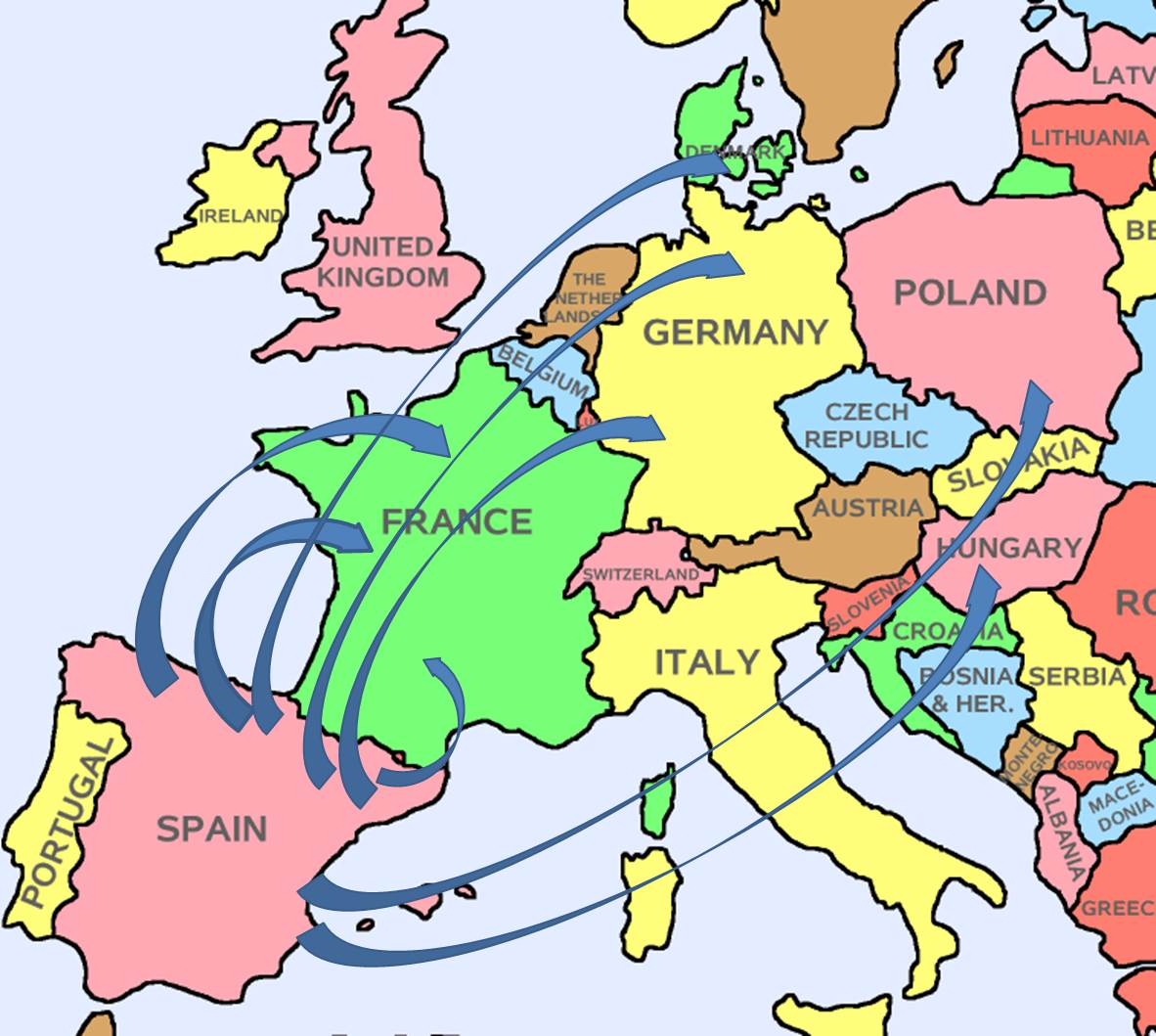
Player Exodus: Where 11 of 16 players from Spain’s 2013 World Championship Team will play their club handball this season
José Manuel Sierra, Paris (France)
Antonio García, Paris (France)
Alberto Entrerríos, Nantes (France)
Jorge Maqueda, Nantes (France)
Valero Rivera, Nantes (France)
Ángel Montoro, Toulouse (France)
Joan Cañellas, Hamburg (Germany)
Gedeón Guardiola. Rhein-Neckar (Germany
Julen Aguinagalde, Kielce (Poland)
Carlos Ruesga, Veszprem (Hungary)
Albert Rocas, Kolding (Denmark)
5 players (Arpad Sterbik, víctor Tomás, Dani Sarmiento, Viran Morros and Aitor Ariño) will remain in Spain and play for Barcelona.

The Spanish National Team player exodus  and Barca’s domination definitively show how this once mighty league has fallen on hard times.

The Great Recession has pretty much impacted in the entire world, but in Spain the crisis has been felt particularly hard.  Property value that once soared to record heights tumbled precipitously leading in turn to banking problems and soaring unemployment.  While a major sport like soccer has been able to weather the storm, handball clubs have had more trouble.  The first warning signs were reports of some of the bottom tier teams in the Liga Asobal not being able to make payroll.  This led to many 2nd tier professional players from other European countries deciding that they were better off playing elsewhere.  Only the two top clubs, Ciudad Real and Barcelona, were able to keep their top players, but then Ciudad Real started to show cracks in its finances with a sudden relocation/merger with Atletico Madrid in an attempt to stave off bankruptcy.  A move that merely postponed that reality to 2013.

Long Odds

With Madrid Atletico’s demise the Liga Asobal has gone from a marginally interesting two horse race between Madrid and Barcelonal to a ridiculously one sided coronation for Barca.  How ridiculous?  Well, the current odds of Barca not winning the Liga Asobal are 200-1.  Online sports books have even posted odds for second place since the mere thought of another side winning seems too remote of a possibility.  Yes, Barcelona is a great side and they are even the top favorite to win the Champions League, but barring a betting scandal (certainly a possibility with one recent roster addition) the only item of possible interest in the Liga Asobal is whether they will run the table with an undefeated season.  And, I haven’t seen the odds on that, but it wouldn’t surprise me if they aren’t something like 1-10.

For several years the Liga Asobal had been regarded along with Germany’s HBL as one of the two top professional leagues in the world.  One just had to look at the club rosters and point to the who’s who list of top players from other countries to see that the league was loaded with talent.  Jackson Richardson, Jerome Fernandez and Didier Dinart from France;  Ivano Balic, Mirza Dzomba and Igor Vori from Croatia; Tomas Svensson and Jonas Kallman from Sweden; Olafur Stefansson from Iceland; Mikkel Hansen from Denmark; Kiril Lazarov from Macedonia, Lazlo Nagy from Hungary and many more.  And surely Talant Dushebajev and his son Alex would not be Spanish citizens if not for the opportunities Spain provided for a talented handball player.  Yes, for many years, with few exceptions, the top players of the world had two options if the wanted to maximize their salary potential:  play in either Spain or Germany.

The Spanish Exodus

Now outside of Barca there’s only a smattering of foreign players in the Liga Asobal.  And many of these foreign players are actually lesser known talents from Latin America.  Even more telling is the exodus of Spanish National Team players to other leagues in Europe.  Previously, it was somewhat of a novelty to see a Spaniard playing anywhere else but Spain.  Now with Madrid’s demise it’s commonplace.  The map above highlights where 11 members of Spain’s January World Championship team are now playing professionally.  And this doesn’t include other notable players like Berlin’s Iker Romero and several 2nd tier players who’ve also left Spain in search of greener pastures.

Tax breaks and subsidies

When I first started following professional club handball 10 years ago I was puzzled as to why Spain rivaled Germany as the world’s top league.  The primary confusion for this American was simply a glance into the stands at the occasional Champions League match I saw played there and at a 30 minute weekly Liga Asobal highlight show.  With a few notable exceptions there were always more empty seats than fans in the stands.  A sharp contrast to the typical HBL match where the attendance was much stronger.  And even the typical match in France seemed to have more fans.  How do these Spanish Clubs pay higher salaries if they’re bringing in less revenue this Capitalist American wondered?

Insight into this answer came from another sport, basketball, where my club in France, Levallois had a professional team in the 2nd division.  As often is the case in Europe, there were usually a couple of Americans playing for the club and their salary was often a significant part of the club payroll.   One season an American playing for the club decided that he wanted more money, in the middle of the season, no less.  Being an uninformed American I assumed my club had two basic choices:  1) They could bow to the demand and pay him more; or 2) They could refuse the demand (after all, he signed the contract) and have a somewhat disgruntled player for the rest of the season.  But, this was France and the tax structure offered a 3rd choice:  They could pay his salary for the rest of the season and send him away; recoup the tax money on his remaining salary; and then use that money to hire another American for the remainder of the season.  And this is what my club did; Successfully, I might add as they moved up into the 1st division that season.

Further research and discussion with my teammates brought up a sore spot in regards to Spain.  The amount that Spanish sports clubs have to pay in taxes is a pittance compared to other countries.  And in some instances cities even provided substantial funds to clubs in the form of subsidies.  These tax breaks and subsidies were the primary reasons why Spanish clubs are were able to pay better salaries despite less revenue being brought in.  The chickens, however, have come home to roost as the financial crisis has resulted in a general collapse in municipal revenues and subsidies have dried up.  Further causing pain has been a decrease in fan discretionary spending causing significant revenue declines.  A double whammy if you will.

Barca Survives (or should I say thrive?)

So while the rest of the Liga Asobal crumbles around it Barca is still a shining beacon for Spanish Club Handball.  Arguably, they are the best team in the world.  How do they do it?  It’s certainly not due to an adoring fan base.  I don’t know how many times I’ve seen a Champions League match with the stands of the Palau Blaugrana half full (or worse) for an attractive match against a top club.  No, Barcelona Handball survives, or more accurately thrives, on the shoulders of Barcelona Football.  With a net worth of $1 Billion dollars the club can afford to throw a few millions at its handball club.  Why, it chooses to do so is less clear.  Perhaps it simply relishes the “mother club” aspect and the prestige of being the best in Europe in multiple sports.  The fact that it is an association with 170,000 members also surely has something to do with it.  It’s one thing for an individual owner to say, “I’m not going to keep spending money on this minor sport if it runs a net deficit year after year” and another thing for a collective to make such a decision.

The recession, however has even hit Barca football and the team has been running a debt in recent years.  Perhaps belt tightening will even hit Barca handball soon.  With the further weakening of its competition in the Liga Asobal, Barca could drop 3 or 4 name players and still run away with the title.  And they would still be competitive in the Champions League, just not a dominant player.

Who knows what the future will bring?  All I can say is that if anybody told me 5 years ago there would be more Spanish National Team players in France (then the reverse) in 2013 I wouldn’t have believed them.

post

Impressions from the IHF and EHF Junior and Youth Championships

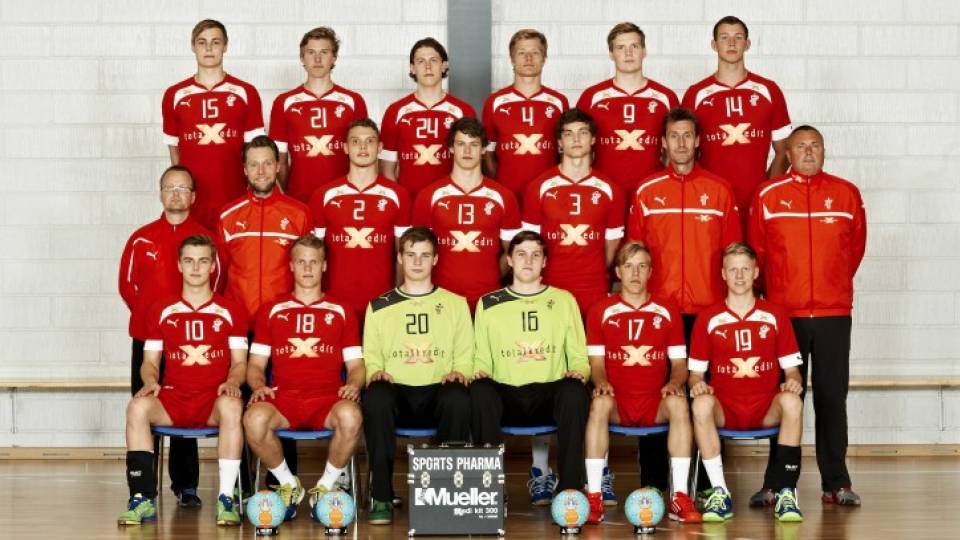
Danish gold medal winners in Youth World Championships

Danish gold medal winners in Youth World Championships

When teams and spectators are now getting ready to focus on the start of the new league season in Europe and the EHF club competitions, one may almost forget that the summer period is really full of activities for both the IHF and the EHF, with a focus on the younger age groups. This is of course in addition to the many outdoor youth events and the beach handball competitions.

For some handball fans, the youth and junior events tend to be relatively less interesting. The players are not yet so well known, the relative strength of the participating nations is not so predictable and varies from year to year, and the performances are more difficult to assess. But many of those aspects may be precisely what make these events so dynamic and attractive. It seems to me that there is a special delight in discovering new talents and speculating about their potential careers. And I am sure that scouts for top club teams also find this discovery process quite important. And now we have a much better opportunity to follow these events, thanks to live webcasts of reasonable quality.

For the young players who have already entered the pipelines of their respective national federations, these IHF and EHF championships have the potential of providing four straight years of international competition during their formative years. Even if their team does not qualify for the World or European Championships, there are qualifying rounds which also bring an intensive level of competition and exposure. Of course, these events also tend to put pressure on the young players, as could recently be seen at the men’s Youth (18 and under) World Championship in Hungary. While the clearly strongest teams did manage to find their way through to the medals, there was a sense of fatigue and general decline in quality in the final stages. Perhaps the format, which requires nine games for the medal teams, may have contributed.

In this Youth Championship, the tendency was the same as what I described some time ago from the Junior (20 and under) event. Only a handful of non-European teams were competitive, with Brazil taking ninth place, while Egypt and Qatar placed 14th and 15th. Moreover, the performances of most of the other non-Europeans were even weaker than in the Junior event. What will the IHF do to try to help remedy this situation? Just providing the opportunity to participate and then be really inferior is clearly not the answer.

The medal winners in the Youth event were Denmark, Croatia and Germany, with Spain, Norway and Sweden rounding out the top six. If one looks at the ‘combined’ results of the Youth and Junior events, it seems clear that the teams that currently are at the top among the adults also dominate in the younger categories. The semifinalists in the Junior event were Sweden, Spain, France, Croatia. Brazil ahead of Egypt were the prominent non-Europeans also in this event. Slovenia, Serbia and Hungary were among the top dozen in both events. The only ‘outsiders’ were the Netherlands and Switzerland who came in fifth and seventh in the Junior event.

While the women this year had their ‘internal’ European events, they should also get a few words. Russia, despite falling behind a bit in the senior women events recently, showed that there is no lack of talent on the women’s side, as evidenced by gold among the 19-year olds and silver for the 17-year olds. Denmark got bronze in both categories, with Norway and Romania also showing strength in both events. The real surprise was presumably the gold for Sweden in the younger event, where also Portugal exceeded expectations with a fourth place. The remaining medal winner was Hungary among the 19 year olds. So now it will be interesting to keep this year’s results and star players in mind, when we follow the senior teams in a few years!

post

VIDEO: Hamburg vs. Berlin in pivotal early season match

Hamburg's Hans Lindberg with a penalty goal against Berlin's Silvio Heinevetter.  The first match ended in a 30-30 draw.  Watch the 2nd match live on ehfTV this Friday at 1900 hrs CET (1500 hrs, U.S. East Coast)

Hamburg’s Hans Lindberg with a penalty goal against Berlin’s Silvio Heinevetter. The first match ended in a 30-30 draw. Watch the 2nd match live on ehfTV this Friday at 1900 hrs CET (1500 hrs, U.S. East Coast)

Live Video:  Match already played
On Demand Video:  Link

Hamburg vs. Berlin  Friday, 23 Aug 2013, 1900 CET (1300 U.S. East Coast)

The first leg ended in a 30-30 draw.  On line betting sides have Hamburg as a 2 goal favorite for the 2nd leg.

(Note:  As always, I will replace the live video link with the “on demand” video link when it becomes available.  Additionally, we will not post the score on the Team Handball News website for those interested in watching the match without knowing the result.)

————————————————————————————————————-

All too often in European club handball the early season is rife with matches of limited importance.  The upcoming IHF Super Globe which is a somewhat manufactured event is but one example.  But, this season the Champions League has a Wild Card playoff showdown between Berlin and Hamburg that is truly pivotal.  Both clubs are in the top 10 of Europe, both clubs have legitimate Champions League title aspirations and….

one of those clubs will be eliminated from the competition before the month of August is even  over. 

Instead of top shelf Champions League matches throughout the season, pivotal knockout matches next spring and a good shot at the Final Four, the loser will instead settle for the less prestigious EHF Cup.

Why are two great sides meeting so early you might ask?  Call it the Liverpool Rule.  Back in 2005 the Liverpool Football club won the UEFA Champions League, but finished to low in the English Premiership to qualify for the 2006 Champions League.  That’s right.  UEFA was in the situation of having the defending champions not even in the tournament.  Not wanting this to happen the rules were bent a little and Liverpool was allowed to play its way into the tournament through qualification matches.  Similarly, Hamburg won the EHF Champions League last year, but finished 5th in the German Bundesliga (HBL).  Normally, the top 3 German sides automatically qualify and the 4th German side plays its way in through a qualification tournament.  Hamburg, in fact, did that last year and even had to beat France’s Saint Raphael in overtime to make it into the main tournament.

I’m not sure if the EHF bent the rules or not, but it was determined that the fair way to resolve the situation this time around was to let last year’s fourth place team in the HBL, Berlin take on the 5th place team, Hamburg in a two game aggregate series.

Last night Berlin hosted the first match which ended in a 30-30 draw.   The match apparently was not without drama as Hamburg stormed to an early 12-6 lead, only to see Berlin go on a 6-0 run to tie it back at 12 all.  Towards the end of the match Berlin had a two goal lead, but let it slip to a 30-30 draw.  Berlin, may well miss those last two goals as this makes tomorrow’s 2nd match in Hamburg essential a one match, winner take all affair.  (In the event of another draw, away goals is the tiebreaker).

Here are some links from the EHF website with more information to get you up to speed

After match Report on Leg 1:  Link
Preview of playoff series : Link
Hans Lindberg Interview: Link

post

EURO 2014: the final slot comes down to goal difference between two traditional super powers

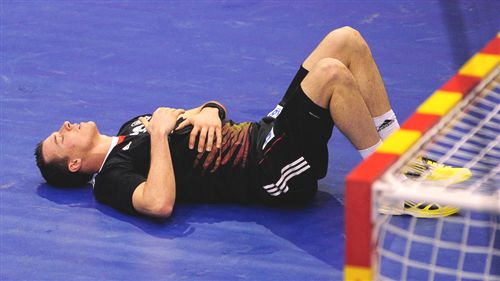
Another bitter moment for German men's handball

Another bitter moment for German men’s handball

Today there were three games of critical importance and I had the opportunity to watch the second half of each of them: Slovenia-Belarus, Austria-Russia and FYROM-Portugal. We often hear, from a European perspective, that the World Championship with its 24 team from all continents emphasizes quantity, whereas supposedly the European Championship with its 16 teams is more about quality. Sorry, but judging from today’s games it is all to apparent that at this stage Europe does not have 16 teams of high quality, so if a true elite event is what is wanted, then a reduction to 12 teams would be necessary. Today’s games, which gave four teams tickets to EURO 2014 were really mediocre. There may have been some drama, but the quality was lacking.

My heading refers to the fact that, prior to today’s game, the German team had to be almost completely resigned to the fate of not qualifying, following their loss to Montenegro earlier in the week, the third loss in four matches against two not so fantastic opponents. So they depended on a miracle today, with a tiny possibility that they might get the spot as the best one of all the third-placed teams in the groups. While Slovenia helped the German cause by almost giving away the game at home against Belarus, it would then have taken a nine-goal loss for Russia in Austria to open the door for the Germans. The Russians did lost by 25-30, but they were never quite on verge of conceding the large margin that would have caused a complete disaster for the Russian handball, after their women’s team got knocked out from the World Championship.

Instead it is now the fate of the proud German team to have another setback, following the failure to qualify for the 2012 Olympics. And this reinforces the concerns that coach Heuberger, like his predecessor Heiner Brand and many German handball fans, has expressed for a while: it does not help to have the superior league in the world, if the successful clubs use their wealth to contract world-class NON-German players, especially for the key positions. This means that both the established German players, and especially the young talents, get limited playing time and are shoved into the background, while all the non-Germans carry their teams and gain all the valuable experience. Of course, in a free-market situation, this is not something that the German federation could easily regulate. In fact, Heuberger was now concerned that the failure to qualify for the EURO 2014 would make the Bundesliga teams inclined to cut back on player availability for the national team, right when the build-up for the 2015 World Championship and, indirectly, the fight for the 2016 Olympics must be started.

In many of the other groups, most of the decisions had been taken before today. However, FYRO Macedonia grabbed a place in EURO 2014 by beating Portugal and joining undefeated Spain from their group. Equally undefeated France was joined by Norway from what seemed to be the easiest group. Similarly, Sweden and Poland had no problems against their opponents. From the German group, the Czech Republic followed Montenegro, and Croatia and Hungary met expectations in their group. As noted earlier, Belarus went through from their group, together with Iceland who finished the group at home against Romania. Perhaps the most remarkable thing about that match-up was that it constituted the farewell celebration for longstanding team captain Olafur Stefansson. Finally, in the group where both Austria and Russia managed to qualify, although Russia just barely as the best third-placed team, the group winner was Serbia. And then, of course, we have the host country (and defending champion) Denmark. The draw for the groups will take place on June 21, and EURO 2014 will open on January 12.