post

Why aren’t the U.S. National Teams at the London Olympics?: Part 2: Where do you find and/or how do you develop great Team Handball players?

Targeted recruiting for national teams or grass roots development? Or Both? And why is it so hard?

In Part 1, I provided some top level analysis as to why our current national teams didn’t qualify for the London Olympics.   This analysis simply looked at our current team and compared that team to former U.S. Olympic teams and our current Pan American competition.  That analysis highlighted that our current teams are lacking in the following areas: 1) Raw athletic talent, 2) Conditioning, 3) Individual technique/skills, 4) Team cohesion/experience, 5) Coaching strategy/preparation.  In this second part I start to look at the underlying reasons for failure.

The Underlying Reasons:   A complicated web they weave.

I’ve been asked a number of times over the years, just why the U.S. isn’t any good in Team Handball.  I usually reply with “How much time do you have and where should I start?”  As I started to map out the reasons on paper in a systematic way it became even more clear to me just how complicated it is as all of the reasons are interlocking in multiple ways so there is no clear root cause to failure.  In short, there is no straight line cause and effect like the old “For want of a nail” proverb by which if we just solve this one thing we’ll become a great handball nation.  Perhaps, some reasons like the lack of funding or lack of marketing exposure come close, but there is no “silver bullet” guaranteed to solve all the problems.

So, with that little diatribe in mind I would like to highlight 4 major underlying reasons worth further discussion.  Those 4 reasons are:

1) A lack of good handball athletes
2) A lack of marketing/awareness
3) A lack of funding
4) Ineffective leadership/management

Underlying Reason #1:  A lack of good handball athletes

Perhaps the most obvious shortcoming to the U.S. National teams relates to a distinct lack of athlete with both the raw talent and technical skills to compete at higher levels.  There are two basic solutions or paths to address this problem:

1) Targeted Recruitment: You can recruit some good raw athletic talent and have a dedicated and intensive training program to build up their technical skills
2) Grass Roots:  You can develop broad based grass roots programs to increase the number of players in this country and out of those greater numbers some good athletes with strong technical skills will emerge.

Over the years the U.S. has tried both approaches to varying degrees of success.  In a series of articles I wrote 3 years ago, “A Framework for Creating USA National Team Success” Part 1, Part 2, Part 3, I provided an in depth review of some of the problems with each strategy and proposed a hybrid model for implementation.  Here is a somewhat shortened version of that analysis.

Targeted Recruitment:  The obvious solution?

With the Olympics going on various media observers have been watching the Handball matches and have been zeroing in on the Target Recruitment strategy.  All we need is NBA D-League players or mediocre NCAA talent from the Big Sky conference and train them up a little.  Even USA Team Handball is in the act taking the more modest approach of 1 (all we need is just 1) athlete from each NCAA conference.

It’s easy to see why so many people immediately come up with this strategy as one only has to watch the teams currently playing in London and assess that there are indeed thousands, if not tens of thousands of athletes in the U.S. with the raw athletic talent necessary to compete.  But, it’s just not that simple as there are a number of further underlying reasons:

1) Recruitment of the great raw talent athlete is only feasible when those athletes run out of other options:  Many observers fully realize this and that is why the more credible back of the napkin analysis focuses on athletes that aren’t going to make the big time.  Problem is you need to convince those athletes that they aren’t going to be the next D-Leaguer that isn’t going to make the NBA.

2) More athletes have more “other” options:  Not too many years ago the options for former NCAA athletes were pretty limited making an Olympic handball career an interesting possibility.  This is not as true anymore, particularly for basketball athletes who have a lot more options in Europe.  This article highlights how things have change over the years.

3) Older players are more likely to have “life issues” emerge:  Most great raw talent athletes at least having the option of playing their chosen sport in college.  This means the youngest athletes will be in 22-23 age range.  Certainly from a physicality standpoint this age is not a tremendous problem, but with each passing year athletes will inevitably have “life issues” play a greater and greater role in their overall psyche.  The possibility of marriage, needing to start a career or just waking up some morning and deciding that this training isn’t any fun anymore will come into play.

4) The Olympic carrot is less of a tangible reward:  In the past a USA Team Handball recruiter could confidently wave the Olympic carrot in front of a would be player.  Certainly at the 84 and 96 Olympics there was automatic qualification.  The competition in the Pan American region, however, is now much stiffer and some athletes will be less enticed when they realize that participating in the Olympics is far from a guarantee.

5) Lack of funding:  And right now the USA Federation has nowhere near the funding necessary to establish a credible training program for these would be recruits.  The programs in the 80s and 90s provided room and board, overseas travel opportunities and a small stipend.  With the other reasons outlined above even that model might not be sufficient enough to recruit the players needed.

Grass Roots:  Too hard and it takes too long?

While it’s not the solution du jour, Grass Roots strategies have garnered more weight at other times.  All we have to do is copy what soccer has done (or lacrosse, or rugby, or ultimate Frisbee) and then the sport will be popular in this country.  It’s not so simple and in this post I explained why.

Perhaps the biggest proponents to this strategy are the many expats who remember how they learned the sport at younger ages in their home country.  If we could do it in Elbonia then we can do it in the USA.   Grass Roots takes time, but it’s clearly the way to go if we want to have sustained success.  If you have thousands and thousands playing the sport, you will have great players that bubble up to the top and they will be doing so at age 18, not age 25.  But it’s not easy to develop these broad based programs.  Here are some of the reasons why.

1) Starting up a team sport from scratch isn’t easy:  Team Handball is a team game and you need a lot of players in order to have a good training environment.  We can probably quibble about just exactly how many are needed, but at least 10 is probably a good number.   Then, of course, you have to add the challenge of convincing people who’ve never played a sport before to suddenly decide to devote time and money to it.  The internet and Olympic telecast make such recruiting easier, but as anybody who’s ever started a club knows this is painstaking, unglamorous work.

2) Gym space is needed:  Finding a gym to play in can be a challenge as many in the U.S. were built for smaller basketball courts.  And then all those basketball leagues have to be contended with.  The cost of gym rental can be a crippling blow to new clubs which lack the numbers to share the costs.

3) The tyranny of distance:  The U.S. is a big country.  Even if a good club program is started in one particular city, that club often has to travel considerable distance to play another club.  This means that for real grass roots efforts to succeed that one club in a city often isn’t enough.  This is why to a certain extent that there is a little bit more concentration and development on the East Coast where the population has a bit more density.

4) The dominance of basketball: Team Handball is its own game and has similarities with a number of sports.  Still, it should be obvious that there is a great deal of similarity between the two games.  Not every good basketball player could be a good team handball player (and vice-versa), but there is a massive number of players that could choose either.  Basketball was invented in the U.S. and it’s our national indoor sport.  That’s not going to ever change and those would be athletes at younger ages are almost always going to select hoops over handball.

5) The physicality of team handball:  Team Handball can be a rough sport to play and it’s probably better suited for athletes in their teens.  Accordingly, it’s at a handicap compared to other sports like soccer where there is less injury, or at least the perception of less injury.

6) The pressure to succeed now: It’s a given that Grass Roots programs will not lead to immediate success.  In fact, you could argue that it will take at least 10 years to see any success translated to our national teams.  Meanwhile the USOC, a primary funding source for USA Team Handball, requests a yearly High Performance Plan which is supposed to outline how Team USA is going to win medals when the reality is that even qualifying at this point would be a tremendous success.  This pressure has always existed, so it’s not surprising that funding choices have often been made towards supporting National Teams rather than Grass Roots efforts.  And then when those National Teams have only moderate success (if even that) the Grass Roots proponents out in the sticks have complained, if only you had given me the resources I need, I would have developed several athletes that could make your national teams.

7) Lack of funding:  But, again the reality is that even if USA Team Handball zeroed out all funding for USA National Teams there still wouldn’t be enough seed money to support Grass Roots programs on the scale that is necessary.  Sure, it could be argued that these programs should be self-sufficient, but with the challenges outlined above assistance is needed to better enable success.

The Answer?

When you start to add up the underlying reasons it becomes fairly clear that both strategies have a lot of hurdles standing in the way of success.   As I noted in my framework series there are elements of both models that have merits, so that’s why I think some sort of a hybrid approach stand the best chance of success.  And I say best chance, because there are some other underlying reasons that would have to be resolved before any plan to field better teams has a good chance at success.  Those other areas include a lack of funding, a lack of exposure/marketing,  and yes, a history of ineffective leadership/managemen.  In Part 3, I first address the historical lack of funding.

post

Why aren’t the USA men’s and women’s national teams at the 2012 Olympics?: Part 1: The simple analysis

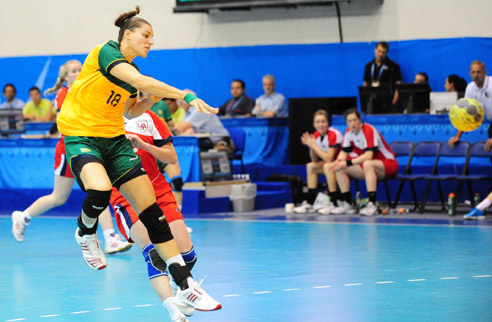
Brazil scoring one of their 50 goals in their 50-10 victory over the USA last year at the PANAM Games. The USA will need to get a lot better if it wants to qualify for the Olympics.

I’m in the process of updating the Frequently Asked Questions (FAQ) page and as this is easily the question of the moment, I thought it worthwhile to answer it.   In this first part, I simply review the qualification competition and analyze why the U.S. came up short.

Why aren’t the USA men’s and women’s national teams at the 2012 Olympics?

The simple answer:  They didn’t qualify (and they didn’t even come close).  There are two paths to qualification for the USA; either via the World Championships or the PANAM Games.  It’s a somewhat complicated process and the details are at these links (Men’s 2012 Qualification, Women’s 2012 Qualification).  By far, the simplest and easiest way for the USA to have qualified would have been to win the Handball Tournament at the PANAM Games.

At the 2011 PANAM Games the women finished 8th out of 8 teams, failing to win a single match.  In pool play they lost to the eventual winner and Olympic qualifier, Brazil by a score of 50-10.  There’s no way to sugar coat such a loss as it means that Brazil basically scored at will.  In their other 4 games the women were more competitive, but still lost by an average of 7 goals. (Details on PANAM Games Women’s Tournament)

The men fared slightly better and finished 7th out of 8 teams.  In pool play they lost 36-19 to the eventual winner and Olympic qualifier, Argentina.  Their other pool play and placement matches were relatively close.  They lost by 5 goals to eventual 4th place finisher, the Dominican Republic and lost by 1 goal to both Mexico and Canada.  In the 7th place game they managed to beat winless Venezuela by 4.    These margins of defeat make it abundantly clear that there was no realistic scenario by which either the men or women could have qualified for London. (Details on PANAM Games Men’s Tournament)

Why weren’t the U.S. teams more competitive? The U.S. has never been a world power, but in the 80s and 90s, the U.S. fielded competitive sides that were able to earn qualification to the Olympics.   What happened?  Why the lopsided scores?  As this is just the first of two parts, I’ll first give the direct causes of failure.  In thinking about how to best capture this I came up with 5 key areas that factor into how good a team is.  These 5 key factors are:

1) Raw athletic talent
2) Conditioning
3) Individual technique/skills
4) Team cohesion/experience
5) Coaching strategy/preparation

So here’s my assessment of our current national teams and where they stand, both in comparison to their current competition and USA teams of the 80s and 90s.  (Side Note: If this assessment comes across as a cranky old timer who thinks former USA teams walked on water, let me be clear on a couple of things.  I, personally was a border line national team player on a team that only was able to eke out a win and a draw in my 12 International Game; And those were against Canada.  Translation:  I am a has been, that never was.  Going further, no USA team has ever been good enough to beat the top teams of Europe in World Championship or Olympic competition.

1) Raw athletic talent.  If you can jump higher, throw harder and move quicker than your opponent you will have a distinct advantage.   For many years, U.S. teams compensated for their lack of technical skill with superior athletic talent drawn from our sizable population

USA Women:  With the Women’s team, I would assess that only one player (Jennifer Fithian) to have the type of raw talent that would compare with our former Olympic teams.  Karoline Borg comes close and would “have a chance” to make the roster, but mostly based on her strong technical skill.  Against current PATHF competition they are totally outgunned by Brazil.  The gap with the rest of PATHF, however, isn’t as bad, but they still are at a disadvantage.

USA Men:  The men’s team is a bit stronger in this department.  Clearly backcourts Gary Hines and Adam El Zogby have the raw talent.  (Although, Hines would have to play wing instead of back.)  From what I’ve seen Jordan Fithian may have the raw talent, but it’s not as clear cut.  The rest of the roster is filled with some decent talent, but in a competitive environment for roster slots comparable to the 80s and 90s most would come up short.  Against their current competition in PATHF, however, they only have a slight handicap against Argentina/Brazil and have better raw talent than the other also-rans.

2) Conditioning.  Team Handball is a physically demanding game and if athletes are out of shape it can make a big difference.   Former USA Olympic team might have come up short technically, but rarely were they out hustled.

USA Women:  The U.S. Women’s team was clearly lacking in this area and this certainly played a role in the final score line of their matches.

USA Men:  The USA Men seemed to be OK in this department.  Although, perhaps a little better conditioning could have helped the team to overcome some rough patches in close matches.

3) Individual technique/skills: While Team Handball is a relatively easy game to learn, it can be a challenging game to master.  Despite extensive full time training (often for several years) former USA Olympic teams were always outmatched in this area by European teams.  In the 80s and 90s it was a rare occurrence for a USA team to be technically outmatched by their PATHF competition, but several PATHF nations have since made significant gains in training and development.

USA Women:  On the women’s side, arguably only one player, leading scorer and Swedish-American, Karoline Borg, has fully mastered the finer points of the game.  Several other players have made significant progress, but still have a ways to go in this department.  The current USA team is technically weaker than our former Olympic teams, but this is due to substantially fewer training opportunities.  And slippage against PATHF competition is also attributable to improved training in development in those nations.

USA Men:  Several players, primarily dual citizen athletes, are pretty sound technically.  Gary Hines is arguably the most technically developed American player that didn’t also have the benefit of training as part of a fully established USA residence program.   The American born players aren’t as strong technically for the same reasons mentioned in the women’s section.

4) Team cohesion/experience.   Team Handball, as the name indicates, is a “team” game.  How the different individual players combine their talents to form a cohesive team can make all the difference.  Additionally, teams that have played together for years have a distinct advantage in that the players are familiar with each other’s moves, strengths and weaknesses.  Former USA Olympic teams were very cohesive in that they trained and, in many instances, lived together for several years.  USA teams in the past also had the advantage of periodic overseas trips for competition.

USA Women:  The core of the USA Women’s team is a pretty cohesive unit having trained together at Cortland University from 2004-2007.  Since 2007, however, there have only been a few training camps prior to competition for World Championship or Olympic qualification.  There is no comparison to the advantages that former USA teams had in this area.  Additionally, several PATHF programs now have regular training and overseas trips for competition.

USA Men:  The Men’s team is even more handicapped in this department as players often met each other for the first time at the short training camps prior to competition.  The team has done as good as job as can be expected in this department, but they are clearly lacking opportunities to play together as a team.  This has put them at a distinct disadvantage against several PATHF foes where those teams have played dozens of games together.

5) Coaching Strategy/Preparation.  A good coach can make any team a little bit better with good X’s and O’s strategy during the match and by preparing his team with a good scouting report on the opposition.  USA Olympic teams in the past had full time coaches and in most instances they were experienced European coaches with good track records.

USA Women/USA Men:  Both the current men’s and women’s teams do not have permanent head coaches.  Instead coaches have been hired prior to competition.  It’s difficult to assess the performance of these coaches without being more closely involved in the program.  Additionally, as part time coaches with inadequate resources it’s difficult to find great fault with their efforts. In terms of the PATHF programs, Brazil has had full time European coaches in recent years and I suspect that Argentina and Chile’s coaches also receive more consistent support from their federations.

Summary

It’s possible that a team can compensate for a weakness in any of these areas.  I’ve seen superior raw athletic talent trump weak technical skills and I’ve also seen the reverse happen.  I’ve seen inexperienced teams do well with a good coach, and again I’ve seen the reverse as well. But, if you are at a disadvantage in all 5 areas (Women) and 4 out of 5 (Men) there’s simply no way you can expect anything but poor results.

Of course, there are a number of obvious steps that could be taken to improve in all of these areas.  If you need better raw talent, then do a better job of recruiting.  If your players are technically weak, well then train them to be better, etc., etc.,   All of this, however, is easier said than done.  In part 2, I’ll tackle the underlying reasons as to why the USA has struggled to field better teams and qualify for the Olympics.

post

AUDIO: Conversation with NPR reporter Stefan Fatsis

Uber Fan Stefan Fatisis (#17) acquired this Team Handball jersey from Club VfB Fallersleben last year while visiting Germany

Stefan Fatsis is without a doubt the biggest mainstream sports reporter/proponent of Team Handball in the United States.  A regular guest on National Public Radio’s All Things Considered, if there’s a possibility to work in a tidbit of news about the sport Stefan finds a way.

With the Olympics coming up Stefan was curious as to the state of the sport in the USA and what do expect in terms of the upcoming Olympic competition. Our conversation covers these topics and more and lasts about 38 minutes.

Stefan Fatsis Website:  http://www.stefanfatsis.com/

Hang Up and Listen Podcast: http://www.slate.com/articles/podcasts/hang_up_and_listen.html (Stefan is one of the hosts on this weekly sports podcast)

Wall St Journal (25 Aug 2004): A Game We Ought to Play: http://online.wsj.com/article/SB109338095139999984.html

New York Times (9 May 2009): Team Handball Has It All, Except an American Interest: http://www.nytimes.com/2009/05/10/sports/othersports/10cheer.html

THN (26 Dec 2011) Analysis of the Hang Up And Listen crossover athlete Team Handball All Star Teams: https://teamhandballnews.com/2011/12/tim-tebow-future-american-team-handball-star/
(Includes link to the podcast that discusses the teams)

post

Did I drop an F-Bomb?

In case you were wondering, I didn't drop any F-Bombs

Virtually everyone who’s ever been interviewed knows that the article that ends up getting written never fully captures everything that was said.  And all too often this can result in bits and pieces of what’s said getting quoted without the context of the entire conversation.  Going further, when there is information from multiple interviews being interspersed with analysis from the author sometimes the final product might lead to some assumptions from the reader.

Case in point is the recent article, “A Handball Nation with a Basketball Problem” by Gregg Gethard at the classical.org, a somewhat eclectic sports blog.  I had a great conversation with Gregg, who has become a fan of Team Handball and is one of those Americans relatively new to the sport trying to fathom why the sport isn’t very popular in this country.  I definitely like some of his analysis, particularly the part about THN being the “go-to source for any and all people in the US interested in the sport”.

But, I’d like to clear up a few things, in particular this part of the article:

“Team sports got devalued and the USOC started to tie funding to performance,” said John Ryan, the editor of TeamHandballNews.com, the go-to source for any and all people in the US interested in the sport. “That’s the biggest factor which caused us to become weaker.”

The second is—to be frank— that no one who ran USA Team Handball for most of its history knew what the f*** they were doing.”

I certainly made the first point as I do suspect that the USOC devalues team sports in that they are a lot of investment for 1 potential medal.  And it’s hard to argue that we weren’t more competitive when the USOC provided us with more funding.  But, just because I’m directly quoted on the first point, don’t make the inference that the second point is a paraphrasing of something that I might have said in continuance.  I didn’t drop any F-bombs and I disagree with the point entirely. While, I’ve had my share of disagreements with Mike Cavanaugh over many years and Steve Pastorino more recently, I think they knew what they were doing.  Call me an apologist if you will, but the challenges this sport has faced are massive.  Sure, there’s been some highly questionable management calls in the past, but even a super manager would have had more than a few failures.  If it was a no-brainer easy task to turn the USA into a Team Handball nation it would have been done years ago.

And also this paragraph:

“Ryan says there are probably somewhere between 300 and 500 people in the US who care at all about the sport. And all of those people have seemingly at some point served on the NGBs board of directors. And very few of these people liked each other.”

First sentence me, second sentence either the author or perhaps, Bogdan.  (He, is indeed a firebrand)

Now that, I’ve been an interviewer in addition to an interviewee, I know how these sorts of things happen.  Interviews sometimes run together and sometimes as a writer you do see emphasis and what’s interestingly from a different perspective.  And while some of it is a little misconstrued it does capture a lot of the problems our sport has faced in this country.

And it reminds me that I should do a post on the very same topic.  Although, I’ve written about many of these issues separately, I’ll try to put together a more comprehensive summary in the next few days.  And since the media questions are starting to trickle in and every reporter wonders why the U.S. isn’t at the Olympics I might as well take the time to answer it.


post

Memo to the Main Stream Media: Please do your research prior to posting your Team Handball stories

Main Stream Media reporting on Team Handball is great for the sport's promotion in the U.S., but the analysis often comes up short


Like clockwork, every four years, there’s a bump in media coverage for Team Handball in the U.S. as reporters and columnists are exposed to the sport during the Olympics.  While this increased exposure is great for our sport, I can’t help but get a little annoyed sometimes at the inaccuracies and naiveté that often comes with these stories.

Case in point is the feature article that Sean Gregory did four years ago for Time Magazine.  Overall, it was a very positive piece.  So much so, that a line from the article, “The rest of the world knows that this Olympic sport is ripe for an American invasion,” is prominently still displayed 4 years later on USA Team Handball’s Facebook page (see photo).  But, when Gregory stepped beyond his initial discovery of the game and presented some 2 second analysis of how to make the U.S. National Teams competitive the article devolved into total nonsense.  I’m not certain as to whether this was intentionally done for effect, but I wrote this response commentary just to make it clear how impractical his solutions were.

So, a short memo to all the mainstream reporters out there Googling for more information about this great sport you’ve just discovered:  Please do your research and don’t hesitate to contact us for more information.
Greatest (and not so greatest) hits:  Mainstream Media reporting on handball

Boston Globe (25 Aug 2004): Bob Ryan:  Give handball a sporting chance

Time Magazine (14 Aug 2008): Sean Gregory: Hey, America, What About Handball?
THN (14 Aug 2008):  Time Magazine: Thanks for promoting Team Handball, but save us your naïve solutions

National Review Online (15 Aug 2008): Mark Corallo  : An All-American Sport
THN (16 Aug 2008): National Review Online does hatchet job on Team Handball
(OK. The National Review Online isn’t a major news outlet, but it’s notable that occasionally there’s someone that actually doesn’t fall in love with the sport.)

Washington Post (23 Aug 2008) D.C. Sports Bog: Dan Steinberg: A Morning Jolt of Icelandic Team Handball:
(A great summary with several links to the numerous articles written related to Iceland’s run to the gold medal game in 2008.)

New York Times (9 May 2009): Stefan Fatsis:  Team Handball Has It All, Except an American Interest
(Credit to Fatsis, the dean of main stream reporters who’ve written about the sport.  This article and his periodic promotion of the sport at NPR gets the facts straight most of the time)


post

A 2024 USA Olympics: What it could mean for USA Team Handball

Dallas, San Francisco, San Diego, New York, Chicago, Philadelphia: All potential destinations for USA Team Handball?

This past Tuesday the USOC announced that the U.S. would not submit a bid to host the 2022 Winter Olympics.  This decision signaled that the U.S. would likely shoot instead for a 2024 Summer Olympics instead.  With the USA last having hosted an Olympics in 1996 and perhaps more importantly having resolved their longstanding funding dispute with the IOC it’s hard not to see the USA being a pretty big favorite to win that bid.

The benefits of a USA hosted Olympics has for a struggling minor sport federation like USA Team Handball are hard to understate.  The biggest benefit, of course, is the automatic qualification hosting provides.  That reality has real tangible benefits in terms of recruiting, funding, and exposure.

Twelve years may seem like a long ways away, but this very real possibility of a USA Olympics will start to impact USA Team Handball sooner than you might think.   Let’s review the timing of how events might unfold backwards.  The IOC has selected the city 7 years out and the USOC has generally had a winnowing of the field:

2024 USA based Olympics
2017 IOC selects host city
2016 USOC selects candidate city for IOC consideration
2015 USOC narrows candidate cities
Now:  Cities start exploring the possibilities and forming Organizing Committees.

Some decisions and possibilities that a USA based Olympics might present:

USA National Championships Location:  Don’t be surprised if as soon as next year the National Championships are hosted in one of the candidate cities.  These cities will be looking for any angle to separate themselves from the competition and willingness to even host minor a event can be looked upon favorably.

Regional Training Center Location:  Don’t be surprised if a candidate city provides a little generosity in terms of incentives to become a home for one of USATH’s proposed Centers of Excellence.  Again, anything to look a little better than the competition.

National Training Center Location:  In 2016, when the U.S. candidate is chosen there will surely be plenty of talk as to whether USATH will relocate there as was done in Atlanta for the 96 Olympics.  The advantages in terms of sponsorship opportunities, host city support and the local buzz are significant.

Sponsorship Funding:  With the sport being played on USA soil there will be more companies looking to get their name tied in with the Olympics.   It gets a little crowded at USA Swimming, USA Basketball, etc, so USA Team Handball will get opportunities that would never materialize if there wasn’t a USA Olympics on the horizon

USOC Support:  The USOC ties most of their funding to the likelihood of medaling, but there’s also no desire for any team to be embarrassed on home soil.  No guarantees here, but more support from the USOC is likely.

Improved Recruiting Opportunities:  With each passing year, recruiting quality athletes will get a little bit easier.  Even today, a 15 year old athlete, if encouraged to do a little addition (15+12=27) might be a little more willing to stick with the sport.  As the Olympics approaches it will become even easier.  Around the 2021-2022 mark it will be remarkably easier to get great crossover athletes to try the sport.  (But, who knows, maybe by that time our improved athlete development programs will have us saying thanks, but no thanks, go try some other sport.)

So, there are some definite possibilities going forward, but we shouldn’t get too excited just yet.  As NYC 2012 and Chicago 2016 will attest there are no guarantees and the 2017 selection is still a long ways away.

3 Wire Sports: USOC: no for 2022, go (maybe) for 2024 or 2026: http://3wiresports.com/2012/07/03/usoc-no-for-2022-go-maybe-for-2024-or-2026/


post

Voice of the Celtics to be the voice of Olympic Team Handball

Mike Gorman and Dawn Lewis: NBC's broadcast team for team handball

NBC has released its list of announcers for the 2012 Olympic Games.  Former Olympian, Dawn Lewis, is back as the color commentator, but she will have a new partner in long time Boston Celtics TV announcer, Mike Gorman, doing the play by play. Gorman has been the voice of the Boston Celtics since 1981 and in addition to basketball he did the play by play for tennis at the 1992 Olympics in Barcelona.

Mike Gorman Wikipedia entry: http://en.wikipedia.org/wiki/Mike_Gorman

Bio at NBA.com:  http://www.nba.com/celtics/partners/broadcast/csn-mike-gorman.html


post

Audio: Pan American Championships Review with Coach Latulippe


Team USA singing Happy Birthday to Asst Coach Tilton's daughter

John Ryan discusses the USA performance at the recent Pan American Championships with Men’s Head Coach, Christian Laulippe.  A breakdown of all the games and a little discussion on the future of the Men’s Team.

Podcast length: 47:35

Video Link:  http://mmegatube.com/All/Videos/3379#.T-p-B7WJc4K

post

2012 Men’s Pan American Championships: Argentina Again


Argentina celebrates another gold medal victory against Brazil

The 2012 Men’s Pan American Championship have concluded with Argentina again taking the Gold Medal against arch rivals Brazil.  The match was a tight affair throughout and ended with a little controversy as Argentina scored late to make it 22-21 and Brazil had a little bit of time for one more attack except that Argentina’s Sebastian Simonet immediately grabbed the Brazilian player on the mid-court throw in.  Simonet was promptly red carded, but Brazil had no time left for a meaningful attack.  This was the 3rd straight victory over Brazil in a major PATHF event (2010 Pan American Championships, 2011 PANAM Games, 2012 Pan American Games.

In the 3rd place game, Chile easily dispatched Uruguay 36-27 to qualify for the 2013 World Championships.

In a consolation match for 7th place Team USA beat Mexico easily, 33-17.   Rickey Royal, Martin Axelsson and Vladimir Andeljic led a balanced scoring attack with 5 goals a piece.  The victory was a little bit of revenge as Mexico had beaten the USA last year at the PANAM Games 33-32.

Video of final minutes of Argentina-Brazil:  http://www.mundohandball.com/Continentes/Panamerica/2012/ARG-Campeon-Panamericano.html


post

2012 Men’s Pan American Championship (Update after Day 4): USA collapse in 2nd half ends World Championship dreams

USA on attack vs Greenland

Team USA lost last night to Greenland, 36-27, in what first glance might appear to be a relatively uncompetitive match.  Final scores can be deceiving, however, and this is certainly the case with this contest.  Going into the match the USA needed a victory in order to set up a showdown match for 2nd place in Group A vs. Chile this evening. And for about 38 minutes that looked like a distinct possibility.

At the break the USA and Greenland were knotted up at 15-15 and the USA started on a roll in the 2nd half and built up a 21-18 lead.  Following a Greenland timeout, though, the wheels totally fell off the wagon as multiple USA turnovers led to a wave of fast breaks and a 10-1 run for Greenland.  What had been a 21-18 lead was now a 22-28 deficit and the USA never really threatened from then on.

Team USA’s match tonight against Chile will likely have the air of a friendly scrimmage as Chile is all but mathematically locked into 2nd place and will probably rest some of their players ahead of a semifinal match against Brazil on Saturday.  Barring an unlikely Greenland loss to Venezuela the USA will play for 7th place against Mexico in a consolation pool on Sunday.

On demand video of matches: http://www.ustream.tv/channel/cahandball/videos

Tournament webpage: http://www.handballargentina.org/escuela/?p=2749

post

2012 Men’s Pan American Championship (Update after Day 3): USA with offensive outburst; Chile draws Argentina in dramatic finish; Brazil/Uruguay Advance

Chile with one last chance to break the tie vs Argentina

After 3 days of competition at the Men’s Pan American Championships in Argentina the dust has cleared somewhat.  Here’s a quick rundown.

Group A

USA:  Team USA was off on day 2, but came out firing on all cylinders on day 3 with a 43-28 victory.  The 43 goals was a far cry from the miserly 13 scored against Argentina on day 1.  The victory also shows improvement for the USA as the two teams met last year at the PANAM Games and the USA only came away with a 39-35 win in that contest. The win kept Team USA’s hopes of a semifinal berth alive, but upcoming are two much tougher foes, Greenland and Chile.  First up is Greenland (tonight at 7:00 PM, U.S East Coast time).

Greenland:  Two tough losses against Chile (28-31) and Argentina (18-24) have ended Greenland’s dreams of a return to the World Championship.  The best they can hope for now is 5th place

Argentina/Chile:  These two sides played to an entertaining 23-23 draw last night with both teams having a chance to win the match in the closing minute.  This is the second time that Chile has played Argentina close having narrowly lost to Argentina 26-25 in last year’s PANAM Games semifinal. The draw leaves both teams on top of Group A with 5 points each.  Argentina, however, has a +14 advantage in goal differential and has an advantage in terms of remaining opponents.  They play Venezuela tonight while Chile’s remaining game is vs. the USA on Friday.

Video: Arentina vs. Chile (Final minutes): http://www.youtube.com/watch?v=wSJe8ghguGY&feature=player_embedded#! (Courtesy of Mundo Handball and much better quality than the webstream feed)

Group B

Brazil/Uruguay: These two sides have already advanced to the semifinals with easy victories over Paraguay and Mexico.  They play tonight to see who will be seeded 1st and 2nd

Paraguay and Mexico: They play tonight to see who will play in the 5th place match and who will play for 7th.

Tournament webpage: http://www.handballargentina.org/escuela/?p=2749


post

2012 Men’s Pan American Championships (Day 1): Argentina dominates USA; Chile holds off Greenland

Greenland on defense vs. Chile

Argentina – USA

Host Argentina lived up to their mantle as pre-tournament favorite with a dominating 33-13 victory over Team USA.  The outcome was never in doubt as Argentina limited the U.S. to only 4 goals in the first half for an 18-4 lead at the break.  The U.S. can get some consolation in that the 2nd half was a more competitive 15-9 defeat and that they still control their own destiny for a ticket to the semifinals.  Team USA will need to shore up their defense and find more scoring, however, if they are to beat either Greenland or Chile.

Team USA Scoring: Gary Hine (3), Devine Jackson (3), Adam El Zoghby (2), Vladimir Adjelic (2), Rickey Royal (2), Martin Axelsson (1)

Chile – Greenland

In a key Group A showdown between 2 teams that have qualified recently for the World Championships, Greenland (2007) and Chile (2011), Chile pulled away from Greenland late in the 2nd half for a 31-28 victory.  Assuming that Argentina wins out, this victory puts Chile in the driver’s seat for 2nd place in Group A.

LINKS

Tournament homepage: http://www.handballargentina.org/escuela/?p=2749

Argentina Federation: USA vs. Argentina summary: http://www.handballargentina.org/escuela/?p=3014

Argentina Federation: Chile vs. Greenland summary: http://www.handballargentina.org/escuela/?p=3068

Video (on demand) Argentina vs. USA http://www.handballargentina.org/escuela/?p=3055

Team USA’s Lewis Howes Blog: http://handballjourney.com/


post

Pan American Championships to be live streamed

Good news for Pan American Handball fans: Every match of the upcoming championships will be live streamed

The Argentine Handball Federation web page has announced that all matches for the upcoming Men’s Pan American Championships will be live streamed from Buenos Aires.  The Argentine Federation has also set up a tournament homepage with links to standings, news and related video.  Most likely, these pages will provide the most up to date information on the tournament.

The tournament starts on Monday, 18 June with hosts Argentina taking on Team USA at 6:00 PM, Local Time (5:00 PM U.S. East Coast)

Tournament Homepage: http://www.handballargentina.org/escuela/?p=2749
Live Stream Homepage: http://www.handballargentina.org/escuela/?p=2828

USA Schedule (All Times: USA East Coast)

Monday, 18 June, 5:00 PM, USA vs. Argentina
Wednesday, 20 June, 6:00 PM, USA vs. Venezuela
Thursday, 21 June, 7:00 PM, USA vs. Greenland
Friday, 22 June, 5:00 PM USA vs. Chile
Saturday, 23 June (TBD)
Sunday, 24 June (TBD)


Commentary:  I’ll go along with Ruben Gomez’s commentary at Mundo Handball.  Webstreaming is becoming more practical and it should be standard practice for it to be provided at major PATHF tournaments.  I’m not so sure as to whether it should be mandatory yet, but we are rapidly approaching the point where such a requirement will make sense.

Mundo Handball: http://www.mundohandball.com/Continentes/Panamerica/2012/handballtv-panamericano-baires.html

Mundo Handball:  http://www.mundohandball.com/Continentes/Panamerica/2012/panamericanos-con-transmisiones-online.html