post

The zenith for the USA Women’s National Team

A happy bunch of U.S. players after their impressive win!

A happy bunch of U.S. players after their impressive win!

Some of you have given me feedback after my comments about the strong period of our U.S. National teams in the 1980s and into the early 1990s. I highlighted the remarkable success in the 1987 PanAmerican Games in Indianapolis, where our teams won very exciting finals on both the men’s and the women’s side. It is interesting to see that many of our handball players and fans today are quite unaware of the achievements at that time.

But for me personally, it is easy to single out one particular game as the absolute zenith on the women’s side, not simply because I was involved in the game as a referee (together with Bernie Iwasczyszyn) but because the result was really remarkable and created an echo in the handball world (even in those days without the help of the internet…). I am talking about the game where the U.S. team for the first (and only) time defeated the mighty Soviet women’s team. It happened at Gallaudet University in Washington D.C., in the preparatory stages for the 1988 Olympic Games. The Soviets, who in those days were normally unbeatable, were on a brief tour of the U.S., literally on their way to Seoul. They were dominated by players from the Ukraine and the club team Spartak Kiev, under the strong leadership of legendary (or infamous) coach Igor Turtjin, whose wife was also the team captain.

You might say that one should perhaps not make a big deal about a ‘friendly game’. But for the Soviets there really was never such a thing as an unimportant game. Not just was this a preparatory game for the Olympics, it was also a particularly prestigious game in front of a large group of Eastern European ambassadors and dignitaries, together with representatives of the U.S. State Department. Ordinary spectators may not have sensed it, but there was almost a ‘Cold War’ atmosphere surrounding this game, and Washington TV stations covered this ‘political’ event. (I could add that long afterwards, I met players, including Mrs. Turtjina, who confirmed that the reaction to the loss on the part of their Federation and the Sports Ministry was quite dramatic. This involved physical punishment and disciplinary action, and it seems the players never forgot it).

In any case, the Soviets were aware that their opponent would not be a pushover, so they went all out from the outset. But our U.S. team held up well to the early onslaught and established an effective game of their own. Neither team managed to pull away so it was a see-saw battle. The game was relatively physical, but above all it displayed strong technical skills and good tactics from both sides. As a referee I can remember many critical moments with small differences between success and failure, and Bernie and I also had some tough calls to make, under pressure mostly from the vociferous Turtjin, whose histrionics at the bench caught the attention of photographers and TV cameras.

Well, without going into further details, the game really came down to the wire. The home team gained an 18-17 lead close to the end, but the Soviets had a great chance to equalize which they failed to utilize. The U.S. team got the ball back, but one of the referees (yes, I confess) called an offensive foul with about 20 seconds to go, much to the irritation of the U.S. players and coaches. I guess there were many of us holding our breath, as the final Soviet shot bounced off the inside of the goal post and almost went in, as time expired. The celebrations were ecstatic on the U.S. side, while the anger and frustration was palpable at the Soviet bench. No, this was not a game that they wanted to lose. Their only small consolation later that evening came when we took them to a restaurant with the biggest steaks and the most enormous salad bar that they had ever see. When I met some of them years afterwards, this was what they preferred to talk about…

One would wish that this would be the kind of situation that a U.S. handball team with its supporters and spectators would have a chance to experience at some point in the future! And I would once again want to take the opportunity to congratulate all the players and coaches involved with this very special game 25 years ago!

post

EURO 2014: the final slot comes down to goal difference between two traditional super powers

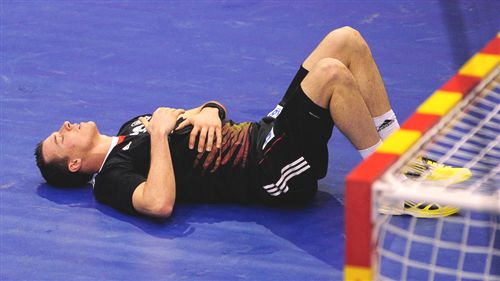
Another bitter moment for German men's handball

Another bitter moment for German men’s handball

Today there were three games of critical importance and I had the opportunity to watch the second half of each of them: Slovenia-Belarus, Austria-Russia and FYROM-Portugal. We often hear, from a European perspective, that the World Championship with its 24 team from all continents emphasizes quantity, whereas supposedly the European Championship with its 16 teams is more about quality. Sorry, but judging from today’s games it is all to apparent that at this stage Europe does not have 16 teams of high quality, so if a true elite event is what is wanted, then a reduction to 12 teams would be necessary. Today’s games, which gave four teams tickets to EURO 2014 were really mediocre. There may have been some drama, but the quality was lacking.

My heading refers to the fact that, prior to today’s game, the German team had to be almost completely resigned to the fate of not qualifying, following their loss to Montenegro earlier in the week, the third loss in four matches against two not so fantastic opponents. So they depended on a miracle today, with a tiny possibility that they might get the spot as the best one of all the third-placed teams in the groups. While Slovenia helped the German cause by almost giving away the game at home against Belarus, it would then have taken a nine-goal loss for Russia in Austria to open the door for the Germans. The Russians did lost by 25-30, but they were never quite on verge of conceding the large margin that would have caused a complete disaster for the Russian handball, after their women’s team got knocked out from the World Championship.

Instead it is now the fate of the proud German team to have another setback, following the failure to qualify for the 2012 Olympics. And this reinforces the concerns that coach Heuberger, like his predecessor Heiner Brand and many German handball fans, has expressed for a while: it does not help to have the superior league in the world, if the successful clubs use their wealth to contract world-class NON-German players, especially for the key positions. This means that both the established German players, and especially the young talents, get limited playing time and are shoved into the background, while all the non-Germans carry their teams and gain all the valuable experience. Of course, in a free-market situation, this is not something that the German federation could easily regulate. In fact, Heuberger was now concerned that the failure to qualify for the EURO 2014 would make the Bundesliga teams inclined to cut back on player availability for the national team, right when the build-up for the 2015 World Championship and, indirectly, the fight for the 2016 Olympics must be started.

In many of the other groups, most of the decisions had been taken before today. However, FYRO Macedonia grabbed a place in EURO 2014 by beating Portugal and joining undefeated Spain from their group. Equally undefeated France was joined by Norway from what seemed to be the easiest group. Similarly, Sweden and Poland had no problems against their opponents. From the German group, the Czech Republic followed Montenegro, and Croatia and Hungary met expectations in their group. As noted earlier, Belarus went through from their group, together with Iceland who finished the group at home against Romania. Perhaps the most remarkable thing about that match-up was that it constituted the farewell celebration for longstanding team captain Olafur Stefansson. Finally, in the group where both Austria and Russia managed to qualify, although Russia just barely as the best third-placed team, the group winner was Serbia. And then, of course, we have the host country (and defending champion) Denmark. The draw for the groups will take place on June 21, and EURO 2014 will open on January 12.

post

The field (and the groups) for the Women’s WCh now set

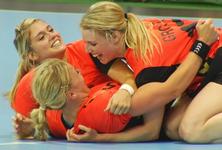
Yes, this is handball, but AFTER the game: the Dutch women celebrating their amazing win in Russia.

Yes, this is handball, but AFTER the game: the Dutch women celebrating their amazing win in Russia.

While much of our own focus in recent time has been on the PanAmerican qualifying for the World Championship next December, the rest of the world has also finished up their similar events. The final piece of the puzzle was the European qualifying last week, so now we had the draw today in Serbia for the World Championship.

The ‘other’ continents had already established their participation. Africa has four slots, because Angola, like Brazil for PanAmerica, earned an extra one. Their teams are Angola, Tunisia (who have progressed a lot in recent years), D.R. Congo, and Algeria. Australia is the ‘usual’ representative for Oceania. Asia has three slots, all of which were taken by East Asian teams: Korea, China and Japan. So after the PanAmerican contingency is now known to be Brazil, Argentina, the Dominican Republic and Paraguay, it was up to Europe to fill the remaining slots.

The European Handball Federation (EHF) generally takes an easy way out when it comes to World Championship qualifying. It is not a secret that the EHF would prefer to have this qualifying based directly on the results of the most recent European Championship, which is really the approach taken in the other continents. And is also seen as a burden for the teams, especially on the men’s side, if full-fledged qualifying through group play, which is the approach used for the European Championship, were to be organized.

So the current method is a compromise, under which the three medal winners (Montenegro, Norway and Hungary) are directly qualified together with the host country Serbia. The remaining participants from the previous European Championship then enter straight into a home and away ‘knock out’ competition together with the survivors from a qualifying event among the ‘lesser’ nations. This approach really depends a bit much on the luck of the draw, together with the caprices of playing just two games. So the losers tend to find it a bit of a ‘double whammy’, as their chances of coming back next time will depend mostly on the draw and the risk of encountering one of the top teams.

This time, as always happens, there were a couple of surprises. Sweden had been a perennial participant in World and European Championships for a number of years now, but this time they were weaker than usual and got kicked out by Poland. But the real surprise was the elimination of Russia, who found themselves on the outside for the first time in many decades. They seemed to have it all sewn up after an away win against the Netherlands, but the Dutch women shocked everyone with an amazing 33-21 victory in the return game. France had to struggle a bit, getting only a tie at home against Croatia, but they came back stronger in the away game. The remaining match-ups had a clearer outcome.

One might now have liked to see some really exciting groups after today’s draw for the World Championship, but I think most people will find the groupings rather boring and predictable. Presumably we will in the end be in for some surprise(s), but I would be hard pressed to speculate about one. The format is such that the four best teams in each group will qualify for the round of 16, with group winners each encountering a fourth-placed team etc. In almost every group it seems rather clear which four teams will advance, and only the internal ranking among them would then be the cause of some suspense. One might wish for teams such as Argentina or Tunisia to surprise a higher-ranked team, but for now it seems that the only battle will be in group B between rivals China and Japan. Here are the complete groups so that you can start your own speculation and possibly disagree with me:

A: Montenegro, Netherlands, France, Korea, D.R. Congo, Dominican Republic
B: Denmark, Brazil, Serbia, China, Japan, Algeria
C: Norway, Poland, Angola, Spain, Argentina, Paraguay
D: Hungary, Germany, Romania, Czech Republic, Tunisia, Australia

post

Women’s Pan American Championships: Team USA Results (A look at the numbers)

Hesser

Stephanie Hesser: The leading scorer for Team USA and one of the few bright spots for the team.

Overall Results

The 2011 Women’s Pan American Championships concluded this past weekend with fairly predictable results.  Brazil dominated the completion winning all 6 of their games by an eye popping average of 30 goals.  The Dominican Republic came the closest, losing by only 15 in group play.  The runners up, Argentina, lost by 23 in the Gold Medal, but can take some consolation in their 10 goal victory over the Dominican Republic in the semifinals.  That clear victory establishes that side as the 2nd best team in Pan America.  With Brazil already qualified as the 2016 Olympics host, Argentina should be favored to take 2nd place at the 2015 PANAM Games in Canada, where the Pan American slot for the 2016 Olympics will be awarded.

In terms of 2013 World Championships qualification, Paraguay was the surprise team joining Brazil, Argentina and the Dominican Republic as the 4 representatives from Pan America.  This is the 2nd time Paraguay has pulled off a surprise as they also qualified in 2007.

Pan American Championships Results Page:  Link

U.S. Results

Panamstats

The U.S. came away with a 1-5 record and took 8th place out of 10 teams.  Against their top opponents in pool play lost to Brazil, 44-10 and the Dominican Republic, 27-11.  Against the 3 teams that placed 5th (Uruguay), 6th (Mexico) and 7th (Venezuela) the U.S. lost by 13, 7 and 7 goals respectively, with the bright spot being that each of those matches were closely contested until those opponents pulled away in the 2nd half.  On the positive side, the U.S. did have a convincing 17 goal victory over Costa Rica, but this is tempered by the fact that the Central American debutantes lost all 5 of their matches by an average of 26 goals.

Individually, Stephanie Hesser, was the stand out player for the U.S. leading the team in scoring with 27 goals.  At 19 years of age, she was also the team’s youngest court player, so one can hope that she will continue to improve as a player for many years to come.  After Hesser, the U.S. had 5 other players with at least 10 goals in the 6 matches.  Those players are Megan Ballard (16), Julia Taylor (15), Kathy Darling (14), Tomuke Ebuwei (12) and Sarah Gascon (10).   Federation reports on the matches also indicate decent performances in the goal by Sophie Fasold and Freja Dobreff.

Video of several of the matches is available on the Pan American Team Handball Federation YouTube channel.  Although, the video is not of the best quality a sampling of several matches highlights some glaring weaknesses with the U.S.  In particular, the U.S. offensive attack lacks quickness and the team does not have any backcourt players with significant 1 on 1 scoring capability.  This lack of a scoring punch is most evident in the total goals scored against Brazil (10) and the Dominican Republic (11).  Defensively, the team does fairly well when it gets a chance to get set up, but offensive turnovers resulted in far too many fast breaks.  Finally, the 2nd half collapses against weaker foes, Uruguay, Mexico, Venezuela points to a lack of conditioning playing a role at the end of matches.

A Sideways Trend

Unfortunately, these poor results are nothing new for the USA Women.  Here’s a review of how the team has placed in Pan American competitions since 2007:

2007 Pan American Championships: 7th out of 8 teams
2007 Pan American Games:  Did not qualify
2009 Pan American Championships: Did not qualify
2011 Pan American Championships: Did not qualify
2011 Pan American games: 8th out of 8 teams
2013 Pan American Championships 8th out of 10 teams

(Note:  The Pan American Championship is held every 2 years and the top 3-4 teams qualify for the World Championships.  The Pan American Games are held every 4 years and the top team qualifies for the Olympics)

And here’s a comparison of 2010/11 and 2013 match results against the same nations:

vs Brazil (2011): Loss 50-10 (pool play)
vs Brazil (2013): Loss 44-10 (pool play)

vs Dominican Republic (2011): Loss 33-26 (pool play)
vs Dominican Republic (2013): Loss 27-11 (pool play)

vs Mexico (2011): Loss 29-27 (consolation semi)
vs Mexico (2013): Loss 30-23 (pool play)

vs Uruguay (2011): Loss 36-24 (pool play)
vs Uruguay (2011): Loss 30-23 (7th place match)
vs Uruguay (2013): Loss 30-17 (consolation semi)

vs Venezuela (2010): Loss 32-21 (PANAM Games Qualifier)
vs Venezuela (2013): Loss 36-29 (7th place match)

Chances for 2016 Qualification

Looking at that these numbers it’s hard to rationalize a dramatic upward trajectory that leads to qualifying for the 2016 Olympics.  Perhaps, if Team USA had been able to muster a semifinal berth or even a 5th place showing a decent case could be made that the team was on the verge of a breakthrough.  Instead, against the best sides it’s pretty evident that the U.S. is totally outclassed.  And, even against other developing nations, there’s a significant gap as the U.S. has been consistently on the losing side, albeit by smaller margins.  Yes, the U.S. was missing its leading scorer from the 2011 PANAM Games, Karoline Borg, but while she is a skilled player who would have helped steady the team I would assess her presence would simply resulted in some slightly more respectable score lines.

So, can the U.S. close the gap?  And more importantly, can it do so by July 2015 when the PANAM Games take place in Toronto, Canada?  Well, anything is possible.  But, as I pointed out previously a number of things would have to fall into place.  First and foremost, the player pool of talented athletes needs to expand dramatically and quickly.  And, if those athletes can be found quickly they would need a highly structured training environment supplemented with regular competition.  Can the players be found that quickly?  Does USA Team Handball have the funds or USOC support to set up a full-fledged (not an austere) Residency Program?  I don’t think the answers to either of those questions are “yes” and quite frankly, even if they were, two years is not a lot of time to work with.

Time to throw in the towel?

I most adamantly would never advocate telling an athlete to give up the fight in the heat of a competition.  And, I also would be reluctant to even diplomatically give such advice to an athlete that’s pondering their future.  I’ve been there and such a decision is a personal one dependent on a number of variables.  It’s not always a rationale or logical choice and it’s up to each individual to make that decision.

For organizations, however, decisions on the future should be made carefully, rationally, logically and firmly based on that organization’s goals.  And while it’s rarely a popular decision, throwing in the towel is sometimes the right decision.  Especially, if it’s not really giving up, but merely redirecting resources towards future success.

With those thoughts in mind, it should be clear that USA Team Handball should be developing a plan which is more focused on 2020 or even 2024 Olympic Qualification.  This means spending funds and man-hours on efforts that will that maximize the likelihood that younger and more talented athletes are found and developed.  In other words, athletes that just might be around 7 or even 11 years from now.  If one looks at the U.S. roster from the last event there are only 4 athletes that definitely fit that criterion:  Stephanie Hesser, Julia Taylor, Sophie Fasold and Freja Dobreff.

Youth isn’t everything, but it’s well known that every sports franchise takes an athlete’s current age into consideration before it signs a long term contract.  Older players can and do win (How about my San Antonio Spurs), but unless they are at the top of their game younger players will come along to gently ease them into retirement.  Not simply because they are younger, but because they are better.

I’ll close with one last telling statistic that should give any doubters further pause.  Argentina, which is clearly the team that the U.S. and any other wannabe Pan-American team has to beat for Rio, fielded a squad with an average age of 22.9 years.  Only 3 players on the U.S. roster were younger than average.

post

Greenland withdraws as host for PanAm qualifying – perhaps opportunity for USA to host?

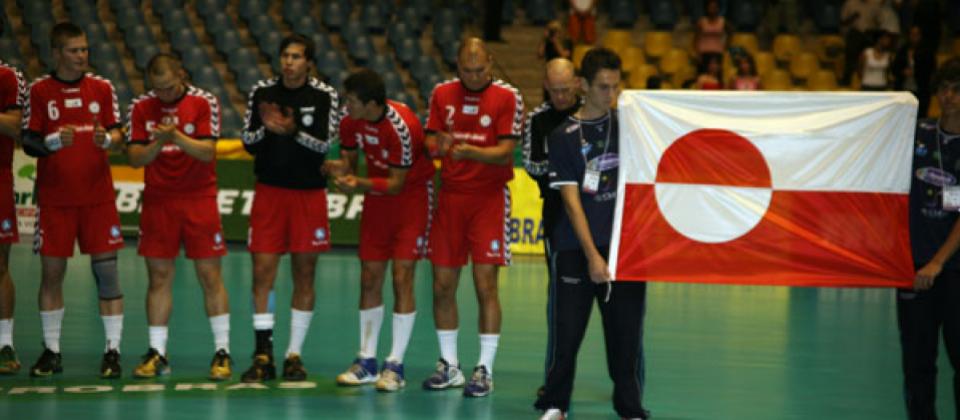
It seems the Greenland team may yet again have to travel...

It seems the Greenland team may yet again have to travel…

The North-Caribbean (NorCa) qualifying for the PanAmerican Championship for men has been planned to be hosted by Greenland in Nuuk in October. The 2014 PanAmerican Championship is, as usual, the event that in turn decides the slots from PanAmerica for the 2015 World Championship. However, judging from firm reports on the Facebook page of the Greenland Handball Federation, they have now reached the conclusion that the hosting of the NorCa event is unrealistic for financial reasons.

Handball is a dominant sport in Greenland, and one of the few sports where Greenland has participated with some success at the international level during the last 10-15 years. So there is a substantial amount of pride involved in the support for the Greenland national team and, up to a point, also a willingness to support it financially. Their federation has made it clear that the event would be viable as far as the local arrangements and expenses are concerned. The crux is obviously the exorbitant cost of having the teams from Canada, Cuba, Dominican Republic, Mexico, Puerto Rico and the U.S. find their way to Greenland. There are no easy routes and cheap tickets available, so a charter arrangement via Canada or Iceland would have been the only realistic alternative. But even this would involves expenses in the order of US$ 700.000.

In principle, the travel costs to such events are normally borne fully by the participating teams, but both the Greenland Federation and the PanAmerican Federation have always understood that an event in Greenland would only be viable if sponsors for the travel expenses could be found, as the potentially participating teams simply could not afford it. The International Handball Federation had apparently undertaken to support the endeavor with an amount somewhat below US$ 100.000, something which is an unusual gesture in the case of a continental event. (Of course, it is the IHF that has created the tough situation for Greenland by placing them in the PanAmerican continent…!).

But the support from the Greenland authorities will not be large enough, and the search for sufficient sponsorship in the business sector has apparently been unsuccessful, despite the realization that the event could create valuable PR for Greenland. So disappointed handball fans around Greenland, who had also tried to provide support on an individual basis, now seem to be resigned to the fact that the exciting plans must be scrapped. It must be frustrating also for the national team, considering that these players, just like the women, have frequently had to undertake travel to Argentina and Brazil for qualifying events in previous years. So it had only been fair, if they had now been able to play at home.

It may now seem that the decision by Greenland may open up an opportunity for the U.S. Federation. CEO Matt van Houten alluded to this in his recent interview with John Ryan. Presumably some amount of USOC support could be counted on for such an endeavor. It would be advantageous not just from a financial standpoint but also because it presumably would give an edge to our team. But there are clearly several hurdles that need to be overcome. One perennial problem in connection with intentions in the past to host such events has been the visa question. In other words, for some of the countries involved it has previously turned out to be difficult to obtain guarantees that all their players would be given visas to enter the U.S. Based on past experience, this could hypothetically apply to Cuba, Dominican Republic and Mexico. One would hope that this would not yet again become an insurmountable obstacle if our Federation were to move ahead with the idea of hosting the event.

THN (26 Jan 2007): Greenland Handball: A National Passion:  Link

post

AUDIO: Interview with USA Team Handball CEO, Matt Van Houten

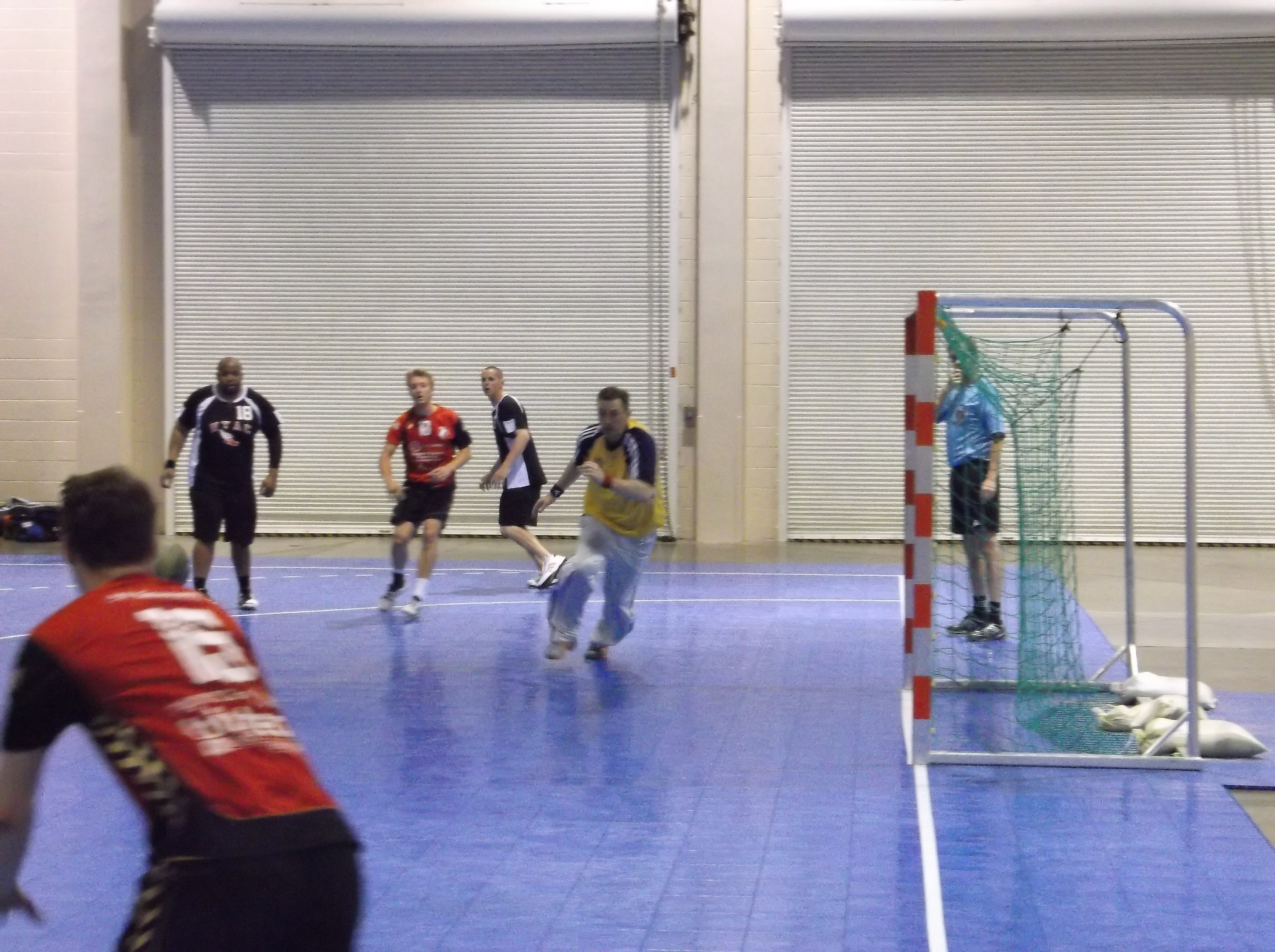
New York Athletic Club (NYAC) goalie and USA Team Handball CEO, Matt Van Houten, chases down an errant shot.

New York Athletic Club (NYAC) goalie and USA Team Handball CEO, Matt Van Houten, chases down an errant shot.

At the Club National Championships, Matt Van Houten, took some time out of his busy schedule to discuss several of the issues he’s been addressing as the new USA Team Handball CEO.  Topics included the new Federation By-Laws, the Board of Directors shakeup, Federation finances, National Team plans and Handball TV broadcasts in the U.S.  Interview length is about 38 minutes.

Here’s some links to topics that were discussed or alluded to during the interview:

Audio:  USA Team Handball Town Hall Meeting:  Link
Audio:  Interview with USOC’s Rick Adams:  Link
Audio:  Interview with Board of Director, Tomuke Ebuwei:  Link
USA Team Handball Corporate Documents (includes IRS Form 990s; most recent Form 990 covers from July, 1, 2010 to June 30, 2011):  Link
North America and Caribbean Qualification Tournament: Link (Plans are still TBD; Apparently Greenland is back as the tentative host)
The committees that were established after the April 2012 Strategic Planning Conference:  Link
My analysis highlighting concerns with USA Team Handball’s decision to hire full time National Team coaches and restart Residency Programs:  Link
beIN Sport: Link

post

The U.S. Nationals – the good and the bad

the 'good old days'  -- will we see them again any time soon?

the ‘good old days’ — will we see them again any time soon?

In 1975 I attended the U.S. Nationals for the first time, having moved over from Sweden the previous year. It was a bit of a ‘culture shock’, even though I had clearly expected things to be rather different from what I had been used to. The format of the event was quite small, but most of the teams showed handball skills. There were virtually no referees, and the few of us who had this as our main task had to handle a lot of games. Gradually, the Nationals grew in scope, to something roughly similar to what we have today, with two divisions on the men’s side and one relatively homogenous women’s bracket. The number of referees continued to lag in comparison, so the workload was really a bit too much. Both players and referees seemed worn out when the day of the finals arrived.

But two things stood out in those days of the 1970s and the 1980s. First, there was really a very special ‘family’ or ‘pioneer’ atmosphere. Perhaps this was simply because the players and officials had gotten to know each other, but it was undoubtedly also due to the often primitive conditions and the sense that we were fighting against the odds as true amateurs and beginners in a country focused on professional and big-business collegiate sports. When I compare with those days, it is entirely positive to notice that the family/pioneer aspect is still there. This was even noticed and commented on by our visiting world class referees from Germany, whose services had been offered by the IHF. They are used to a more hard-nosed and cold atmosphere from their games and tournaments in Germany and Europe, so they felt it was refreshing.

The second thing that was noticeable in the old days was the contrast between the ‘home-grown’ players and coaches and those with a handball background from elsewhere. As we moved into the 1980s and 1990s, the number of talented players with eligibility for our U.S national teams increased a lot, and this was also reflected in the strength and competitiveness of our national teams. And some of the medal round games in the national championships were high caliber match-ups with predominantly American players. So it seemed that the optimism from earlier years had been justified, and personally I felt glad and privileged to have been able to follow this progress. But when I looked around in Reno, I really started wondering. Because it seemed that while the number of ‘pioneer’ teams from around the country might have increased, the top-quality handball, the great handball moves, were mainly due to either the influx and influence of players from abroad or the instincts of players who used to be really good and now remained rather competitive. The match-up in the men’s ‘Elite’ final illustrates that.

So while it is entirely positive that the ‘family’ atmosphere of an annual rendez-vous is still there, is it not rather frustrating that this may in part be the result of a lack of progress over the last 20-30-40 years? Should we not have reached a stage of being more ‘business-like’, with a true ‘Elite’ event drawing spectators and media coverage? Was it just a blip on the chart when we were so competitive internationally and when the talent pool seemed to grow so quickly in the 80s and the 90s? Well, when I listened to today’s energetic and optimistic handball supporters in Reno, it was as if I heard their predecessors from the 70s and 80s all over again, and it was as if they were not even aware of what we once had but seem to have lost just as quickly! And how can it be that some of the stars from the 90s are still able to fight their way to the medals? Where are all the talents who were assumed to be coming up to replace the old-timers. And here we are again talking about the need for patience and a longer-term perspective…

Of course, I can only admire those who seem ready to do the dirty work of achieving change, whether they never knew the ‘good times’ or whether they did and are prepared to get back there again. And I do not want to compete with John Ryan’s great efforts to review systematically our past experience and to analyze possible strategies and methods for accelerating our progress despite the lack of resources. But I do get concerned when I hear the litanies and excuses that involve the impossible task of keeping up with our PanAmerican rivals. Of course the Brazilians and Argentines seem impossible to beat right now; but how come this happened considering that we ‘trampled’ all over them in the 80s and 90s? And look at the progress of Paraguay and Venezuela in the PanAmerican Championship that just finished: Paraguay qualifying for the World Championship with a base in handball that does not even match that of small region of our country! Venezuela being competitive despite the reality that handball did not exist in that country less than a decade ago! Could the Cuban coaches they borrowed really be that fantastic?

But do not take me for a whiner or a pessimist! I knew what to expect in Reno and I still enjoyed it. It is just that if someone had told me in 1975, or 1984, or 1993, that this is what it would look like in 2013, then I would not have been ready to believe them and I most likely would not have cared to hang in there. But then there is my fanatic interest in handball refereeing, the awareness that our small group of dedicated referees have a thankless task without many opportunities to improve throughout the year. So as long as my services are still wanted, I will try to offer my support and, yes, I will enjoy the family atmosphere. On the other hand, I am no longer bothering to speculate about what it will take, and how long it will take, before U.S. handball is at the top in PanAmerica again and competitive across the globe.

post

AUDIO: Interview with USA Team Handball Board of Director, Tomuke Ebuwei

USADR

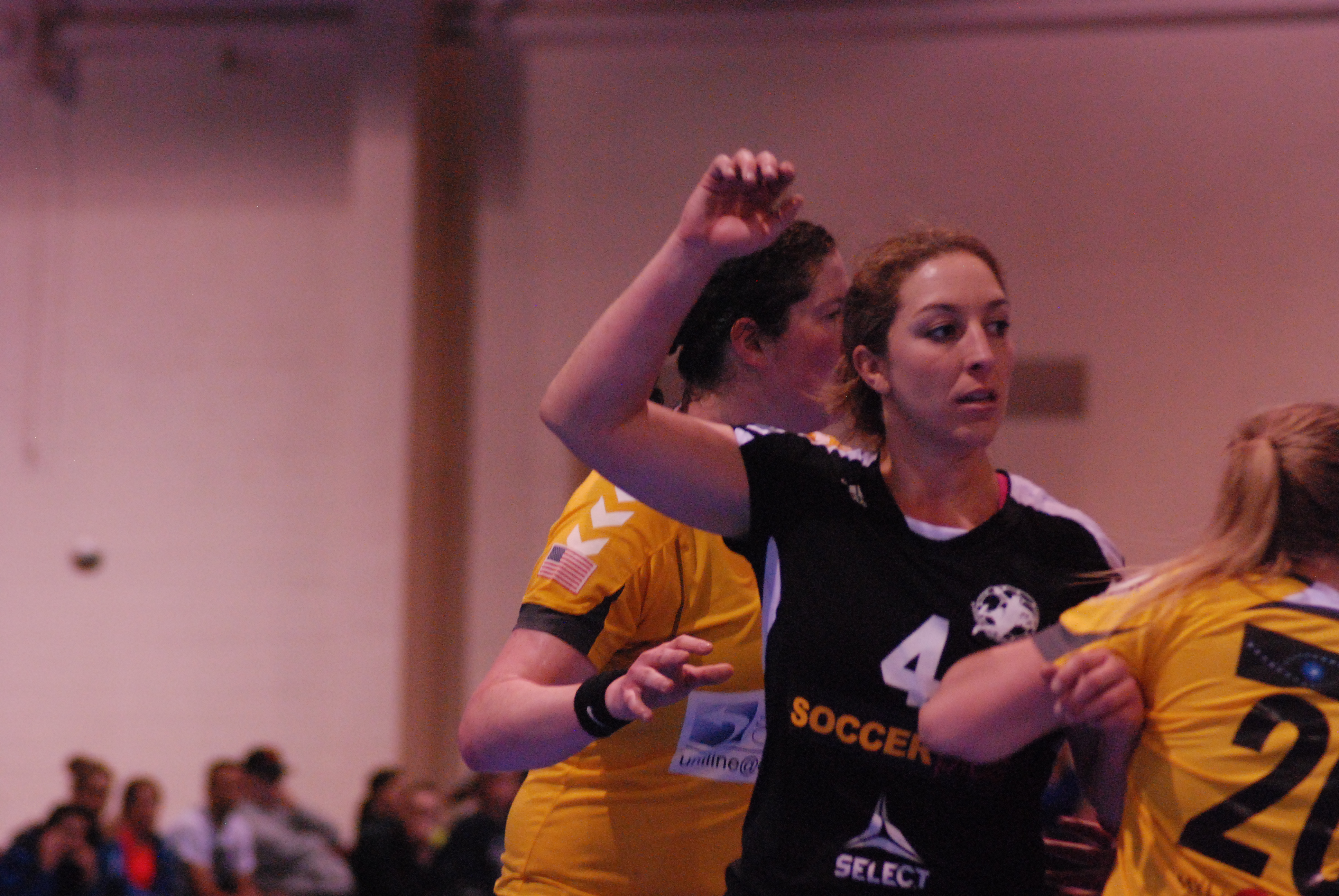
Tomuke “T” Ebuwei on defense against the Dominican Republic

During the U.S. Club National Championships I had the opportunity to sit down with veteran National Team player and USA Team Handball Board of Director, Tomuke “T” Ebuwie.  Topics of discussion included her role as an active athlete Board of Director and the recent shake up with the Board going from 9 to 4 members.  I also ask a pointed question regarding the Board’s failure to transparently post meeting minutes on the USA Team Handball website.  Audio runs approximately 21 minutes.

Board Meeting Minutes Page:  Link (The last minutes posted are from May of 2012)

Dec 2012 Board Meeting Minutes:  Link (These minutes were posted as a news item in Feb 2013 and are the only minutes posted in the past year)

post

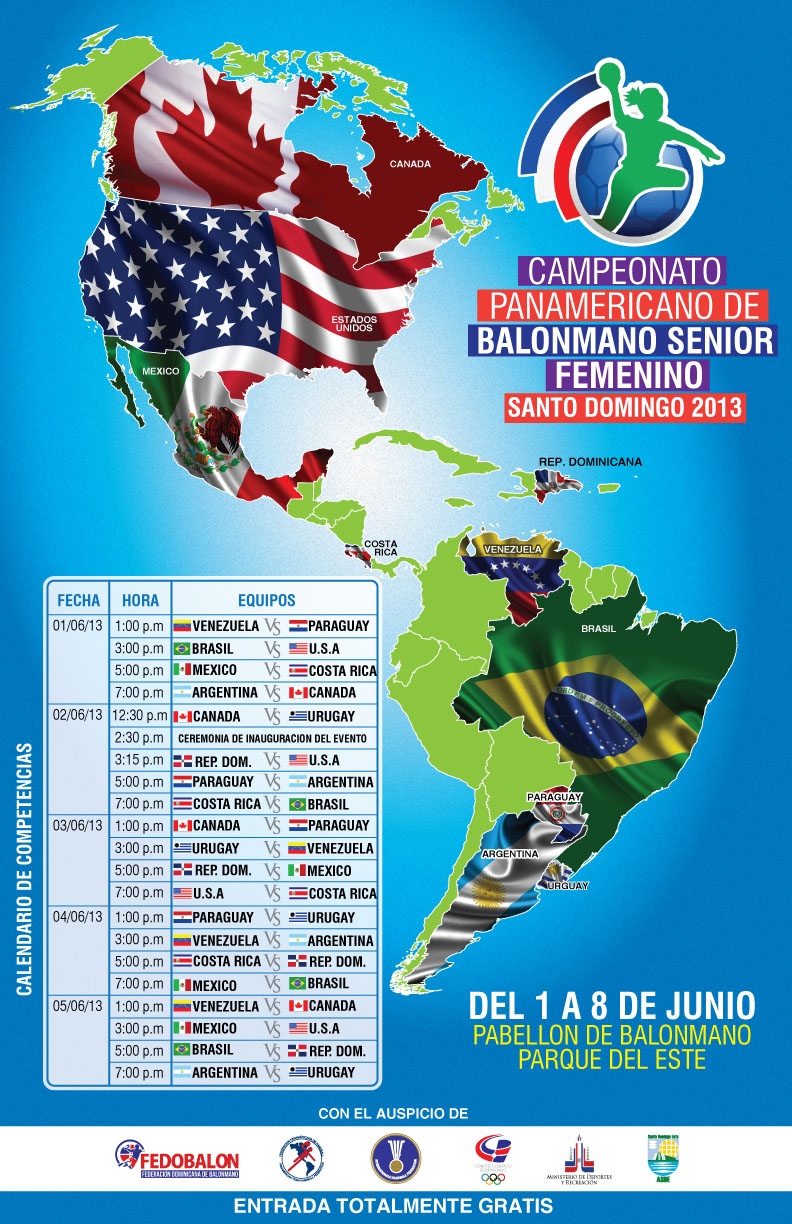
Women’s Pan American Championships: Quick Summary and Links

panfem13_afiche

Through 2 match days Group A seems fairly settled.  As expected, Brazil is the class of the group and is 2-0-0 after two easy wins over USA (44-10) and Costa Rica (59-7).  The Dominican Republic appears to be the second best side after it’s 27-11 victory over the USA, but that will likely be known for sure when they take on Mexico later today.  Team USA gets a solid chance for a victory when they take on Costa Rica at 7:00 PM (East Coast Time)

The picture in Group B is still a little muddled.  Argentina looks to be on course for first place with wins over Canada (37-14) and Paraguay (32-10), but there doesn’t appear to be a whole lot separating the other four sides.  Paraguay and Uruguay have a leg up due to their victories over Venezuela and Canada respectively, but that could change today as Canada takes on Paraguay and Venezuela takes on Uruguay.

Credit is due to The Pan American Team Handball Federation (PATHF) and the Dominican Republic Federation for providing steady updates to the competition.  Here’s some links to help you keep up to speed.

PATHF Competition site:  Link   (Includes links to rosters, score sheets and on demand videos for each match)

Dominican Federation Website:  Link  (Appears to be posting the scores first)

PATHF Web Stream Channel:  Link  (While the video quality certainly could be better, almost every match has been shown live)

post

Champions League Final Four: Video links and odds

ehfcl

The Champions League Final Four matches will be played this weekend.  On Saturday, Barcelona takes on Kielce in the first match and that’s followed by Kiel vs. Hamburg.  On Sunday, the losers play for 3rd and the winners play for the championship.  The odds makers are predicting a Barca-Kiel final.

Point spreads are in parentheses.  Game times are Central European Time.  (U.S. East Coast is 6 hours behind)

Saturday, 1 June

1515, FC Barcelona (-3)  vs. Kielce
Preview article:  Link 
On Demand Video:  Link

1800, Kiel (-2.5) vs. Hamburg
Preview article:  Link 
On Demand Video:  Link

Sunday, 2 June

1515, 3rd Place Match Live Video:  Link


1800, Championship Live Video:  Link

On Demand Video PageLink  (Be forewarned: The EHF often has photos of smiling players for the post game interview links.  If you don’t want to know the outcome have a sheet of paper handy)

Current Odds to win the Title
Kiel 1.15 to 1
Barcelona 1.4 to 1
Hamburg 9 to 1
Kielce 13 to 1

post

AUDIO: Interview with USA Women’s players Sarah Gascon and Stacy Self


Sarah Gascon talks about the upcoming Pan American Championships

Sarah Gascon talks about the upcoming Pan American Championships

At the U.S. Club Championships in Reno, I sat down with veteran Back Court/Circle Runner Sarah Gascon and newcomer Goalie Stacy Self to discuss the upcoming Pan American Women’s Championships.   The team is currently training in the Dominican Republic and they start the tournament on Saturday with a match up against defending champion Brazil.  (Audio is approximately 8 minutes)

post

AUDIO: Interview with USOC Executive, Rick Adams

Rick Adams, The USOC’s Managing Director, NGB Organizational Development

At the USA Team Handball National Championships in Reno, I had the opportunity to interview Rick Adams, the USOC’s Managing Director for NGB Organizational Development.  Topics discussed include the USOC’s level of support for Team Handball and what USA Team Handball needs to do in order to potentially secure more financial support from the USOC.  (Audio runs approximately 12 minutes)

USOC Profile Page for Rick Adams:  Link

USOC 2012 IRS Form 990: Link (pages 40-62 includes information on how much funding the USOC grants to sports federations and other oogranizations)

post

AUDIO: Interview with USA Team Handball’s Jordan Fithian

Team USA and NYAC Circle Runner Jordan Fithian (Photo courtesy of Clarke Ortega)

Team USA and NYAC Circle Runner Jordan Fithian

Last Saturday I sat down with USA National Team Player, Jordan Fithian, a 27 year old Circle Runner originally from Kansas.  Fithian, who played 3 years in Germany, played a key role in NYAC’s title run leading the team in scoring with 21 goals while also anchoring the defense.  The interview touches on a number of topics to include his and his wife Jennifer’s experience playing in Germany and his future with the national team.   (Audio is approximately 24 minutes)