post

Jean Brihault: a dialog with the new EHF President

Key figure in handball: EHF President and IHF Vice President


Considering Jean Brihault’s reputation and accomplishments over many years, it was not really a surprise that his ‘promotion’ from Vice-President to President at the recent EHF Congress got such overwhelming support. Nevertheless, as a friend and former colleague of Jean, an outstanding leader in our sport, who has always shown great integrity, I am very pleased to see him in his new role. Much to my delight, Jean kindly took the time to enter into a dialog with me about current EHF topics:

CA: Jean, first of all congratulations! Could you offer us your sense about the achievements and the spirit of the recent EHF Congress? What does it suggest to you regarding the working atmosphere you could expect during your initial mandate period as President?
JB: The Congress took place in a positive atmosphere. The elections and attribution of future championships certainly were top of the agenda in most people’s minds but this did not lead to tensions or antagonism. Other points must not be neglected concerning this Congress, in particular the very significant step made concerning female involvement in European handball (Cf. foundation of a Women’s Handball Board and vote of a motion on the promotion of gender equality). All of this seems to bode well for the future.

CA: There were this time vacancies in a large number of key positions; the ‘rumor’ is that the voting often tended to reflect geopolitical blocks; is this a correct impression and, if so, do you see this as something positive or possibly a matter of concern?
JB: I do not think that at the time of the voting itself the fundamental motivation was the geopolitical one. My impression is that, after a period of negotiation which put these “blocks” to the fore, there was a more open approach, especially after a meeting between the leaders of the “Nordics” on the one hand and the “Mediterraneans” on the other.

CA: When starting your first term, what do you see as the main challenges awaiting EHF as an organization?
JB: Clearly now the position of women in European handball and the status of female competitions is number one on the agenda.
Second, we have to work on a global competition schedule, bearing in mind the articulation with the other continents whose needs and wishes for worldwide competitions are different from ours. Top level European players are overloaded at the moment but the top European leagues also have to face their responsibilities in this regard.

CA: What do you see as the best ways in which you personally could contribute to the efforts of meeting these challenges?
JB: Simply by creating the best conditions for constructive dialogue between all those concerned and being an active participant in this dialogue. Any measure imposed from the top is bound to fail.

CA: The coming season brings a restructuring of your club competitions for men; what effects do you hope to see as a result of that?
JB: The merging of two competitions should make the new EHF cup more exciting for players and spectators and therefore more attractive for sponsors.

CA: What efforts do you envisage in the area of helping achieve newer or smaller national federations to achieve an expedited development?
JB: We already have many programs to contribute to the development of these “emerging handball nations” as they like to call themselves. I think that what we need at this stage is to help them better define their own needs in a global European context, contribute to the continuing education of those in charge on a national level and involve these nations as much as possible in existing competitions for national teams.

CA: You mentioned about the competition calendar which comes to mind particularly in an Olympic year; are there any specific ameliorations you hope to achieve in that area in the foreseeable future?
JB: I would only add that, given the rapid evolution of handball, not only in Europe, but throughout the world, we all have to be prepared to revise our competition schedules and not to consider that the competition structure which is valid at present should be “forever”.

CA: The EHF has made progress in the area of welcoming greater influence for leagues, clubs and players; what more might be important to achieve in that respect?
JB: The first results are extremely satisfactory. What we need now is to see the leagues and the players structuring themselves as efficiently as the clubs. This is the condition they have to fulfill if they wish to become a major contributor to the definition of EHF policies.

CA: You already emphasized gender equality; should we expect any further initiatives in this regard?
JB: This is a major issue for European handball. The two motions adopted by the Congress go in the right direction as well as the fact that 18% of the persons elected by the Congress were females. But is it not very telling that we can consider “18%” as a success?

CA: What impact do you see that the financial situation in Europe might have on handball, especially at the club level? Is there a risk for further polarization in terms of resources and team strength?
JB: This situation makes it more necessary than ever for the clubs to diversify their sources of income so that they may survive even if one suddenly disappears. What I am most afraid of is billionaires buying themselves a toy that they may tire of extremely rapidly.

CA: We hear more and more about match fixing as a threat, and the EHF has been proactive for some time now; how do you evaluate the risks, and what further measures from the EHF should we expect?
JB: Though one can never feel totally safe in this regard, the system and education programs we have set up as well as our cooperation with other European sport federations and the EU can be considered to offer reasonable protection.

CA: The EHF has decided to establish its own anti-doping unit; what trends do see in terms of the prevalence of doping in handball and the efficacy of the efforts to discourage and detect doping?
JB: In this regard, tests have been conducted by the EHF and by the various national anti-doping agencies for a number of years now. There seems to be no real use of performance-enhancing substances. What we find among average level young players (i.e. those we do not see in EHF competitions) is a use of drugs that corresponds to the consumption observed in their age group.

CA: You recently established a new set of legal regulations and procedures; are you satisfied that there is consistency in the resulting sanctions and conformity with the rules regarding the handling of player disqualifications ‘with’ and ‘without’ reports?
JB: I cannot give any informed answer on this point which is still under discussion among our specialists.

CA: Finally, how do you see the status of the current relations between the EHF and the IHF, and what do you hope to achieve in this regard in your new role?
JB: The EHF has always made its positions clear inside the IHF and this will continue. The IHF President is quite right when he says that for the future of handball it is essential that IHF and EHF should work “hand in hand” and this is my very sincere wish. This being said, the situation of handball differs from continent to continent and while showing understanding for others, we also have to expect support for a sport which has become of such importance in Europe and where European teams perform so well in world competitions.

post

Did I drop an F-Bomb?

In case you were wondering, I didn't drop any F-Bombs

Virtually everyone who’s ever been interviewed knows that the article that ends up getting written never fully captures everything that was said.  And all too often this can result in bits and pieces of what’s said getting quoted without the context of the entire conversation.  Going further, when there is information from multiple interviews being interspersed with analysis from the author sometimes the final product might lead to some assumptions from the reader.

Case in point is the recent article, “A Handball Nation with a Basketball Problem” by Gregg Gethard at the classical.org, a somewhat eclectic sports blog.  I had a great conversation with Gregg, who has become a fan of Team Handball and is one of those Americans relatively new to the sport trying to fathom why the sport isn’t very popular in this country.  I definitely like some of his analysis, particularly the part about THN being the “go-to source for any and all people in the US interested in the sport”.

But, I’d like to clear up a few things, in particular this part of the article:

“Team sports got devalued and the USOC started to tie funding to performance,” said John Ryan, the editor of TeamHandballNews.com, the go-to source for any and all people in the US interested in the sport. “That’s the biggest factor which caused us to become weaker.”

The second is—to be frank— that no one who ran USA Team Handball for most of its history knew what the f*** they were doing.”

I certainly made the first point as I do suspect that the USOC devalues team sports in that they are a lot of investment for 1 potential medal.  And it’s hard to argue that we weren’t more competitive when the USOC provided us with more funding.  But, just because I’m directly quoted on the first point, don’t make the inference that the second point is a paraphrasing of something that I might have said in continuance.  I didn’t drop any F-bombs and I disagree with the point entirely. While, I’ve had my share of disagreements with Mike Cavanaugh over many years and Steve Pastorino more recently, I think they knew what they were doing.  Call me an apologist if you will, but the challenges this sport has faced are massive.  Sure, there’s been some highly questionable management calls in the past, but even a super manager would have had more than a few failures.  If it was a no-brainer easy task to turn the USA into a Team Handball nation it would have been done years ago.

And also this paragraph:

“Ryan says there are probably somewhere between 300 and 500 people in the US who care at all about the sport. And all of those people have seemingly at some point served on the NGBs board of directors. And very few of these people liked each other.”

First sentence me, second sentence either the author or perhaps, Bogdan.  (He, is indeed a firebrand)

Now that, I’ve been an interviewer in addition to an interviewee, I know how these sorts of things happen.  Interviews sometimes run together and sometimes as a writer you do see emphasis and what’s interestingly from a different perspective.  And while some of it is a little misconstrued it does capture a lot of the problems our sport has faced in this country.

And it reminds me that I should do a post on the very same topic.  Although, I’ve written about many of these issues separately, I’ll try to put together a more comprehensive summary in the next few days.  And since the media questions are starting to trickle in and every reporter wonders why the U.S. isn’t at the Olympics I might as well take the time to answer it.


post

AG Copenhagen, a house of cards?

Can AG Copenhagen survive as a top club?


The main rising star in European club handball in recent years has undoubtedly been AG Copenhagen (AGK). Not that Denmark is a newcomer at the top level in men’s handball, but the collection of stars that suddenly was acquired for this newly founded club is at par with some very few top clubs in Germany and Spain. Indeed, AGK qualified for the ‘Final Four’ of EHF Champions League in 2011-12, where they narrowly lost to Atletico Madrid. AGK has at least a dozen absolute world-class players, so that even their second choice on each position would combine into a top team.

While there have been some hints about the financial status of AGK in recent time, it nevertheless came as a real surprise when the founder and main owner, well-known businessman Jesper ‘Kasi’ Nielsen announced that he was withdrawing from AGK and would be selling off his involvement. Officially, he indicated that he was doing so because of the ‘smear campaign’ against him in one Danish newspaper (Ekstrabladet). This is not seen as a very credible explanation by experts in media, academics, federation and other clubs. They point to the stories about severe financial problems and also note that Nielsen would never leave his creation if it was doing well from a business and investment standpoint. There are also indications that some of AGK’s smaller sponsors are pulling out.

It is pointed out that Nielsen has almost treated AGK as a toy, something to have fun with and to enjoy on the side of his real business, which has now ended up having really major problems. But it has taken absolutely enormous investments of money to buy all these top players and to pay their hefty salaries. And everyone knows that club handball, even at the absolute top level, is not really a money maker, at least not in Denmark. So the expectation is now that the managers and other key persons in the club are struggling to keep the club going, but that this soon will have to take place at a much more modest level. Perhaps the AGK can keep enough competent top players to remain a good club in Denmark but not a serious challenger at the European level. But if there is no money to pay the players, then the situation could become even more fragile.

From last year’s team AGK has players such as Mikkel Hansen, Joachim Boldsen, Olafur Stefansson, Snorri Gudjonsson, Henrik Toft Hansen, Niklas Ekberg, and goalkeepers Kasper Hvidt and Steinar Ege. New acquisitions for 2012-13 include Kim Andersson, Carlos Prieto and Fredrik Petersen. Clearly, some of these players cannot be kept. Transfer income and salary reductions are necessary. So there is of course great unrest among the players, who have not yet been paid their Champions League bonuses for last season and now have to begin to wonder who are the ones on the trading block. The top players, such as Hansen, would yield more but their departure would obviously hurt the team strength more. And a real problem is that there may not be any buyers. A quick check among some German top teams reveals that they consider their rosters set, so close to the start of the next season. They do not need more players, and they do not have money for more.

As some readers know, AGK is not the only club that has depended on Nielsen’s ‘generosity’. Rhein-Neckar-Lowen have had him as their main sponsor for some years. In fact, he was the owner, until both AGK and RNL qualified for Champions League and EHF ruled that two participants could not have the same owner. So Nielsen stepped down but remained a sponsor. While RNL’s financial situation and continued existence as a top team does not appear threatened, there are reports that Nielsen has unpaid contractual obligations to the team in the order of about 15 Million Euro, and that his house in Spain has been taken as a security, as he does not seem able to fulfill his contract. In other words, a real mess! People do not seem to doubt that Nielsen has essentially acted in good faith; he just has not been able to appreciate the ramifications of his extravagant spending. It will be interesting to follow the outcome.

post

Memo to the Main Stream Media: Please do your research prior to posting your Team Handball stories

Main Stream Media reporting on Team Handball is great for the sport's promotion in the U.S., but the analysis often comes up short


Like clockwork, every four years, there’s a bump in media coverage for Team Handball in the U.S. as reporters and columnists are exposed to the sport during the Olympics.  While this increased exposure is great for our sport, I can’t help but get a little annoyed sometimes at the inaccuracies and naiveté that often comes with these stories.

Case in point is the feature article that Sean Gregory did four years ago for Time Magazine.  Overall, it was a very positive piece.  So much so, that a line from the article, “The rest of the world knows that this Olympic sport is ripe for an American invasion,” is prominently still displayed 4 years later on USA Team Handball’s Facebook page (see photo).  But, when Gregory stepped beyond his initial discovery of the game and presented some 2 second analysis of how to make the U.S. National Teams competitive the article devolved into total nonsense.  I’m not certain as to whether this was intentionally done for effect, but I wrote this response commentary just to make it clear how impractical his solutions were.

So, a short memo to all the mainstream reporters out there Googling for more information about this great sport you’ve just discovered:  Please do your research and don’t hesitate to contact us for more information.
Greatest (and not so greatest) hits:  Mainstream Media reporting on handball

Boston Globe (25 Aug 2004): Bob Ryan:  Give handball a sporting chance

Time Magazine (14 Aug 2008): Sean Gregory: Hey, America, What About Handball?
THN (14 Aug 2008):  Time Magazine: Thanks for promoting Team Handball, but save us your naïve solutions

National Review Online (15 Aug 2008): Mark Corallo  : An All-American Sport
THN (16 Aug 2008): National Review Online does hatchet job on Team Handball
(OK. The National Review Online isn’t a major news outlet, but it’s notable that occasionally there’s someone that actually doesn’t fall in love with the sport.)

Washington Post (23 Aug 2008) D.C. Sports Bog: Dan Steinberg: A Morning Jolt of Icelandic Team Handball:
(A great summary with several links to the numerous articles written related to Iceland’s run to the gold medal game in 2008.)

New York Times (9 May 2009): Stefan Fatsis:  Team Handball Has It All, Except an American Interest
(Credit to Fatsis, the dean of main stream reporters who’ve written about the sport.  This article and his periodic promotion of the sport at NPR gets the facts straight most of the time)


post

World and Euro U-20 and U-18 Championships in full swing

Swedish successes on at least two fronts; here the women U-20


The Olympic years are always a bit hectic, when the IHF and EHF endeavor to ‘squeeze in’ their U-20 and U-18 Championships for one gender each. The IHF focus is on the women and the EHF has their two events on the men’s side. The two U-20 are about to finish up, while the Euro U-18 has just started and the IHF women’s U-18 will follow shortly after the Olympic Games. The crowded calendar is inevitable, but it means that perhaps these events get less attention than they deserve.

For me, it has always been interesting to discover some general trends: which countries are able to match their success at the senior level with good results for a new wave of young players, which ‘new’ countries seem to be on the verge of breaking through, and which U-20 teams are able to repeat successes from when they were U-18 two years ago. This year, it seems that there are not so many interesting discoveries, but I will attempt to pick out some highlights.

Tomorrow Friday, Sweden and France will play in the final for the World U-20 Championship for women. This is a nice continuation for Sweden after essentially the same group of players won the U-18 two years ago, where France placed fourth. The finalists at that time, Norway, are now in eighth place. Hungary and Serbia will play for the bronze medals, while Russia beat Korea for fifth place. For Sweden the success is a good sign, in a situation where some observers are skeptical about the senior team now getting ready to play in London. They did not do so well in the 2011 World Championships, and some of the players may in any case need to be replaced in a near future. So it is good to know that the succession seems secured.

Sweden is also virtually the only country that simultaneously is gaining a top position in both the women’s World U-20 and the men’s Euro U-20. In the latter event, the semifinals were played today, with Spain beating Sweden and Croatia beating the rivals Slovenia. Norway in the 5th place game and Germany in the 7th place game are no surprises, but that their respective opponents are Portugal and Switzerland may be more significant. (Portugal defeated Switzerland today with 45-44, after double overtime and 7-m-throws!) Right behind those top eight teams, there is a bunch of traditional powers: Denmark, Russia, Iceland and Poland.

It is a bit early to say much about the Euro U-18, as only two rounds of group play have been completed. It is interesting to note three of the teams that failed to qualify for this event: Hungary, Poland and Russia. In the early going, Sweden and Germany are ahead in one group where France is so far without points. (What happened to the famous ‘pipeline’ system in France)? Austria, the home team in this event, has taken advantage of comfortable settings and perhaps an easy group where they are now at the top. Denmark ahead of Serbia, and Germany ahead of Spain are the other teams with a good start, so that seems like a confirmation that top nations are doing well in this age category.

post

A 2024 USA Olympics: What it could mean for USA Team Handball

Dallas, San Francisco, San Diego, New York, Chicago, Philadelphia: All potential destinations for USA Team Handball?

This past Tuesday the USOC announced that the U.S. would not submit a bid to host the 2022 Winter Olympics.  This decision signaled that the U.S. would likely shoot instead for a 2024 Summer Olympics instead.  With the USA last having hosted an Olympics in 1996 and perhaps more importantly having resolved their longstanding funding dispute with the IOC it’s hard not to see the USA being a pretty big favorite to win that bid.

The benefits of a USA hosted Olympics has for a struggling minor sport federation like USA Team Handball are hard to understate.  The biggest benefit, of course, is the automatic qualification hosting provides.  That reality has real tangible benefits in terms of recruiting, funding, and exposure.

Twelve years may seem like a long ways away, but this very real possibility of a USA Olympics will start to impact USA Team Handball sooner than you might think.   Let’s review the timing of how events might unfold backwards.  The IOC has selected the city 7 years out and the USOC has generally had a winnowing of the field:

2024 USA based Olympics
2017 IOC selects host city
2016 USOC selects candidate city for IOC consideration
2015 USOC narrows candidate cities
Now:  Cities start exploring the possibilities and forming Organizing Committees.

Some decisions and possibilities that a USA based Olympics might present:

USA National Championships Location:  Don’t be surprised if as soon as next year the National Championships are hosted in one of the candidate cities.  These cities will be looking for any angle to separate themselves from the competition and willingness to even host minor a event can be looked upon favorably.

Regional Training Center Location:  Don’t be surprised if a candidate city provides a little generosity in terms of incentives to become a home for one of USATH’s proposed Centers of Excellence.  Again, anything to look a little better than the competition.

National Training Center Location:  In 2016, when the U.S. candidate is chosen there will surely be plenty of talk as to whether USATH will relocate there as was done in Atlanta for the 96 Olympics.  The advantages in terms of sponsorship opportunities, host city support and the local buzz are significant.

Sponsorship Funding:  With the sport being played on USA soil there will be more companies looking to get their name tied in with the Olympics.   It gets a little crowded at USA Swimming, USA Basketball, etc, so USA Team Handball will get opportunities that would never materialize if there wasn’t a USA Olympics on the horizon

USOC Support:  The USOC ties most of their funding to the likelihood of medaling, but there’s also no desire for any team to be embarrassed on home soil.  No guarantees here, but more support from the USOC is likely.

Improved Recruiting Opportunities:  With each passing year, recruiting quality athletes will get a little bit easier.  Even today, a 15 year old athlete, if encouraged to do a little addition (15+12=27) might be a little more willing to stick with the sport.  As the Olympics approaches it will become even easier.  Around the 2021-2022 mark it will be remarkably easier to get great crossover athletes to try the sport.  (But, who knows, maybe by that time our improved athlete development programs will have us saying thanks, but no thanks, go try some other sport.)

So, there are some definite possibilities going forward, but we shouldn’t get too excited just yet.  As NYC 2012 and Chicago 2016 will attest there are no guarantees and the 2017 selection is still a long ways away.

3 Wire Sports: USOC: no for 2022, go (maybe) for 2024 or 2026: http://3wiresports.com/2012/07/03/usoc-no-for-2022-go-maybe-for-2024-or-2026/


post

Not quite under the same conditions

In handball there is no doubt who is the super power...


Following the recent PanAmerican Championships, John Ryan interviewed Coach Christian Latulippe. Christian commented on the unequal circumstances, when it comes to competing successfully with the PanAmerican super powers Argentina and Brazil. He noted that for the USA national teams it seems necessary to recruit athletes well into their 20s, simply because we do not have a pool of talented teenagers from which the senior teams could be built. By contrast, on both the men’s and the women’s side, Argentina and Brazil have massive youth programs. The young handball players grow up getting used to continuous training with the help of competent coaches and frequent league games.

This year again, USA is participating with a team in the renowned Partille Cup in Sweden, the largest and foremost international youth competition. Personally, I am very happy to see this tradition continued, because I happened to be among those who helped getting Partille Cup started more than 40 years ago. But of course I feel sad when I see that after all these years we have yet to reach a level where we can seriously compete with the rest of the world. While the USATH keeps insisting that we have a boy’s team participating, despite the fact that the accompanying photo seems to indicate that this is a girl’s team, the Partille Cup web site provides a bit of clarity. Our team, which is described as the USA National Team, is in the Girls under-16 group.

They finished the group play on Thursday, with a fourth consecutive loss. They have played club teams from Sweden, Denmark, Germany and Iceland. While all these clubs are of modest quality at the senior level, it is more difficult to assess how good their 16-olds are. In any event, the average result in the four games was roughly 7-16, but they lost just 6-8 in their opening game which was against the second-weakest team in the group. In the consolation bracket, which is in the ‘knock out’ format, they play a local team on Friday. It should be added that together with Scotland, Kenya, China, Zimbabwe, India Benin, and a few other countries, USA is participating in an ‘Olympic Development Program’, in collaboration between the Savehof (the organizer of Partille Cup) and the IHF. This entails coaching assistance, training sessions and support in connection with the matches.

Brazil is not just a world-class team at the senior level. In Partille Cup, they are this year participating with an astounding 23 club teams in many age groups. Not only do they have club handball at the youth level; they take every opportunity to develop their skills and gain experience. What do you think this tells us about the prospects for USA to catch up at the pace we are moving!? And then to rub it in: the World Championship for Women in the under-20 category started out this week. PanAmerica has three participants: Brazil, Argentina and Uruguay. Uruguay has had one win in four games and Argentina had a one-goal loss against Sweden. But Brazil has been just outstanding. Despite a higher ranking, they got a tough group: Norway, Croatia, Netherlands, and Romania, plus ‘up and coming’ Tunisia. It seemed they would have a tough fight to advance. But with one day of group play left on Friday, Brazil is the only team in the entire Championship that has already won their group after four straight victories!

post

Historic decision in football/soccer regarding the use of technology and on the use of head scarves

Time to consider technology for handball


In its meeting today, the International Football Association Board (IFAB), the body that takes all decisions on changes to the universal FIFA playing rules, took some fundamental decisions. Regarding the issue of applying technology to ‘goal or no goal’ situations, it must be described as a remarkable turnaround over a period of just a few years. FIFA had previously agreed with the position so strongly held by, for instance, UEFA President Michel Platini, that the human factor, and therefore also human mistakes, must remain a part of the game. It had even been suggested that the occasional controversy about some critical mistake would be good for football… But after today’s situation, considering the worldwide exposure and influence of football, one could imagine that the debate about use of technology might pick up also in other sports such as handball.

It should be noted that the alternative (or possibly supplementary) approach of positioning assistant referees at the goal-line was formally approved as a permitted approach under the global rules. But the main focus was on the use of technology, and after extensive testing approval was now given for the use of two different approaches. One is essentially the system known from tennis (Hawkeye), with high-powered and appropriately positioned cameras being the key component. The other one is Goalref, a system based on having a computer chip inside the ball. This is the approach tested by the IHF, also during a Junior World Championship a few years ago.

It should be emphasized that while these methods, assistant referees and two forms of technology, are now officially permitted, they are not in any way mandatory. It was noted that the approach based on technology would currently have a price tag of US$ 150-250.000 for each field. Obviously, this would be realistic only at the elite level. But FIFA expressed the hope that the price would soon come down considerably and that other, possible less expensive, methods could be developed. The reliance on assistant referees also carries a cost. Perhaps more important than the match fees paid to them, there is the issue of removing experienced officials from the job as referees in their normal matches. In some countries, there have been concerns about assignments as assistant referees in UEFA matches making top referees unavailable as referees in their national league. Every method has its price.

In football, FIFA is frantically underscoring that there are no plans to extend the use of technology beyond the ‘goal or no goal’ situations. But many observers sense, probably correctly, that once the barrier has been broken and technology has been allowed, then there will be arguments for an expansion, perhaps to offside situations and decisions whether a foul took place inside or outside the penalty area etc.

In handball, we have discussed use of technology, for instance video review, for additional situations. The crux is to draw the line between situations that involve the observation of absolute facts (where technology might be appropriate) and the subjective judgment by the referees (where a further review must not be allowed). And there are matters of fact, where help by technology could be useful. If an error can be corrected immediately, rather than causing a formal protest after the game and a possible replay, much would obviously be gained. This could involve giving the wrong team the ball for a restart, not observing that a suspended player remains on the court, or forgetting to stop the clock in situations where it is mandatory. Other situations involving disputes about the playing time could also be included. But the key is to ensure that the normal flow of the game would not be negatively affected.

On a different but very sensitive issue, the IFAB also decided to give temporary approval for wearing head scarves in official competition under the FIFA rules. It was indicated that there is insufficient material to judge whether any health or safety issues might exist, so this is the reason why the approval is only temporary while experience is gained. The question of the exact design also remains to be settled. Clearly, while handball action takes place relatively more ‘around the level of the heads of the players’, with arms flailing etc, it is difficult to imagine that there are objective reasons for handball to have a different ruling from football on this point. Indeed, permission for head scarves was in fact ‘snuck into’ the IHF Rules in 2010, despite an earlier intention to wait for a common approach together with other sports. One would assume that the FIFA ruling now contributes to making head scarves a non-issue in handball for the future.

post

Voice of the Celtics to be the voice of Olympic Team Handball

Mike Gorman and Dawn Lewis: NBC's broadcast team for team handball

NBC has released its list of announcers for the 2012 Olympic Games.  Former Olympian, Dawn Lewis, is back as the color commentator, but she will have a new partner in long time Boston Celtics TV announcer, Mike Gorman, doing the play by play. Gorman has been the voice of the Boston Celtics since 1981 and in addition to basketball he did the play by play for tennis at the 1992 Olympics in Barcelona.

Mike Gorman Wikipedia entry: http://en.wikipedia.org/wiki/Mike_Gorman

Bio at NBA.com:  http://www.nba.com/celtics/partners/broadcast/csn-mike-gorman.html


post

Audio: Pan American Championships Review with Coach Latulippe


Team USA singing Happy Birthday to Asst Coach Tilton's daughter

John Ryan discusses the USA performance at the recent Pan American Championships with Men’s Head Coach, Christian Laulippe.  A breakdown of all the games and a little discussion on the future of the Men’s Team.

Podcast length: 47:35

Video Link:  http://mmegatube.com/All/Videos/3379#.T-p-B7WJc4K

post

2012 Men’s Pan American Championships: Argentina Again


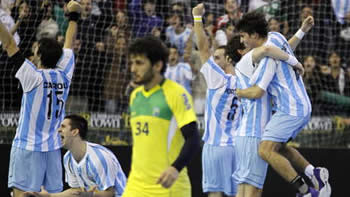
Argentina celebrates another gold medal victory against Brazil

The 2012 Men’s Pan American Championship have concluded with Argentina again taking the Gold Medal against arch rivals Brazil.  The match was a tight affair throughout and ended with a little controversy as Argentina scored late to make it 22-21 and Brazil had a little bit of time for one more attack except that Argentina’s Sebastian Simonet immediately grabbed the Brazilian player on the mid-court throw in.  Simonet was promptly red carded, but Brazil had no time left for a meaningful attack.  This was the 3rd straight victory over Brazil in a major PATHF event (2010 Pan American Championships, 2011 PANAM Games, 2012 Pan American Games.

In the 3rd place game, Chile easily dispatched Uruguay 36-27 to qualify for the 2013 World Championships.

In a consolation match for 7th place Team USA beat Mexico easily, 33-17.   Rickey Royal, Martin Axelsson and Vladimir Andeljic led a balanced scoring attack with 5 goals a piece.  The victory was a little bit of revenge as Mexico had beaten the USA last year at the PANAM Games 33-32.

Video of final minutes of Argentina-Brazil:  http://www.mundohandball.com/Continentes/Panamerica/2012/ARG-Campeon-Panamericano.html


post

2012 Men’s Pan American Championship (Update after Day 4): USA collapse in 2nd half ends World Championship dreams

USA on attack vs Greenland

Team USA lost last night to Greenland, 36-27, in what first glance might appear to be a relatively uncompetitive match.  Final scores can be deceiving, however, and this is certainly the case with this contest.  Going into the match the USA needed a victory in order to set up a showdown match for 2nd place in Group A vs. Chile this evening. And for about 38 minutes that looked like a distinct possibility.

At the break the USA and Greenland were knotted up at 15-15 and the USA started on a roll in the 2nd half and built up a 21-18 lead.  Following a Greenland timeout, though, the wheels totally fell off the wagon as multiple USA turnovers led to a wave of fast breaks and a 10-1 run for Greenland.  What had been a 21-18 lead was now a 22-28 deficit and the USA never really threatened from then on.

Team USA’s match tonight against Chile will likely have the air of a friendly scrimmage as Chile is all but mathematically locked into 2nd place and will probably rest some of their players ahead of a semifinal match against Brazil on Saturday.  Barring an unlikely Greenland loss to Venezuela the USA will play for 7th place against Mexico in a consolation pool on Sunday.

On demand video of matches: http://www.ustream.tv/channel/cahandball/videos

Tournament webpage: http://www.handballargentina.org/escuela/?p=2749

post

2012 Men’s Pan American Championship (Update after Day 3): USA with offensive outburst; Chile draws Argentina in dramatic finish; Brazil/Uruguay Advance

Chile with one last chance to break the tie vs Argentina

After 3 days of competition at the Men’s Pan American Championships in Argentina the dust has cleared somewhat.  Here’s a quick rundown.

Group A

USA:  Team USA was off on day 2, but came out firing on all cylinders on day 3 with a 43-28 victory.  The 43 goals was a far cry from the miserly 13 scored against Argentina on day 1.  The victory also shows improvement for the USA as the two teams met last year at the PANAM Games and the USA only came away with a 39-35 win in that contest. The win kept Team USA’s hopes of a semifinal berth alive, but upcoming are two much tougher foes, Greenland and Chile.  First up is Greenland (tonight at 7:00 PM, U.S East Coast time).

Greenland:  Two tough losses against Chile (28-31) and Argentina (18-24) have ended Greenland’s dreams of a return to the World Championship.  The best they can hope for now is 5th place

Argentina/Chile:  These two sides played to an entertaining 23-23 draw last night with both teams having a chance to win the match in the closing minute.  This is the second time that Chile has played Argentina close having narrowly lost to Argentina 26-25 in last year’s PANAM Games semifinal. The draw leaves both teams on top of Group A with 5 points each.  Argentina, however, has a +14 advantage in goal differential and has an advantage in terms of remaining opponents.  They play Venezuela tonight while Chile’s remaining game is vs. the USA on Friday.

Video: Arentina vs. Chile (Final minutes): http://www.youtube.com/watch?v=wSJe8ghguGY&feature=player_embedded#! (Courtesy of Mundo Handball and much better quality than the webstream feed)

Group B

Brazil/Uruguay: These two sides have already advanced to the semifinals with easy victories over Paraguay and Mexico.  They play tonight to see who will be seeded 1st and 2nd

Paraguay and Mexico: They play tonight to see who will play in the 5th place match and who will play for 7th.

Tournament webpage: http://www.handballargentina.org/escuela/?p=2749