Last month, I had the opportunity to attend and participate in the annual Play The Game Conference in Colorado Springs. The theme of this year’s event was Athlete Power on the Rise.
During a session titled The Global Challenge of Growing Grassroots Sports, I gave a short presentation entitled Building Grassroots for Niche Sports: An Insurmountable Challenge? My presentation touched on several themes I’ve written about over the past several years to include the reasons why USA Team Handball’s has historically, primarily focused on its national teams instead of grass roots development and the challenges of developing a sport outside of U.S. schools and colleges. I conclude that the challenges are indeed significant, but not insurmountable. And, that building grass roots for niche sports could be facilitated by the U.S. Olympic and Paralympic Committee (USOPC) modifying their funding philosophy to place more emphasis on grass roots and for the NCAA to be more innovative with the introduction of pilot programs to give non-traditional Olympic sports like handball a boost.
The presentation is embedded below and the audio from the session I participated is here: Link
My presentation starts at 29:25 and if you open a separate window you can follow along as I speak.
The other presentations are also interesting and worth checking out. Particularly, Top Farrey’s (Aspen Institute) presentation which highlights efforts to keep kids engaged in sports and Chris Snyder’s (USOPC) presentation on the American Development Model (ADM). The ADM was also the main topic of discussion during presentations at the Olympic Training Center. The ADM as presented seeks to address some of the shortfalls and challenges sports in America have in developing athletes. Addressing the practice of early age specialization and burnout, in particular were two areas of emphasis.
One can even see how the ADM could be eventually applied to team handball. Certainly, we could use a coordinated strategy for developing our virtually non-existent grass roots. That being said, many aspects of the ADM appear to be geared more for sustaining participation in established sports vice establishing participation for new sports. For sure, right now we can only fantasize about too many young athletes specializing in team handball and getting burned out from too much competition.
Play The Game Conference 2019: Link (This page contains links to all presentations and video and audio.)
Side note: Lots of
excellent discussion during the conference regarding pay for play for NCAA
athletes. All the more relevant since
the NCAA has agreed to review its policy for athletes to get paid for the use
of their likeness for marketing purposes.
At this past summer’s PANAM Games, 44 year old Sayed Shalaby was an important contributor for Team USA. His making the team at that age says a lot about his skill and determination. However, it also says quite a bit about our lack of depth at the back court position.
Note: This is part of an ongoing series, Charting a Way Forward for USA Team Handball (2019 Reboot): Link
Previously, I broke down our Sr National Team by our two best stocked positions, Goalkeeper and Circle Runner. In this installment I take a closer look at our thin back court and wing positions
Handball: It Takes a “Team” to Win, but it all Starts with a Solid Back Court
Anyone who follows handball learns pretty quickly that it’s
a true team sport. 6 court players working
together on offense and 6 court players and a goalkeeper working in tandem together
on defense. One great player can make a big
difference in a handball match, but not quite to the extent a great player can
in other sports like basketball or like a QB can in American football.
That being said if you’ve played the game or have become a
student of the sport, you know that you simply can’t have a great or even a
good team without a solid back court. The
reason for this is primarily geometric.
If one just looks at the layout of a handball court with a 6 meter arc
around the goal it’s obvious where the best place to shoot from is: It’s the center of the court. So, naturally that’s where you try to shoot
first. And, where the defense tries to stop
you first. Sure, teams score from the
wing a lot of the time, but that’s primarily because the defense has shut down
the center and, in turn, they’ve funneled the offense to the wing which is somewhat
less defended for a shot at a less desirable angle.
The ideal back court has 3 players (left back, center back
and right back) who can play the position well.
Players that can make 1 on 1 moves, pass the ball smartly and shoot from
9-10 meters over the defense. However, few
teams, have the ideal. Perhaps they have
a left back who has a great jump shot, but is just a so-so passer and can’t beat
the defense 1 on 1. Maybe they have an
undersized center back who is great 1 on 1, but can’t shoot from 9 very
well. And, then a left back who’s a
great passer who keeps the offense flowing, but is not expected to score
much. (There are multiple combinations
and this narrative is somewhat simplistic, but it should help provide context
for this discussion/analysis.)
But, what happens if you’re back court is subpar? If the defense figures out they can’t score
very effectively? Well, the middle of
the defense relaxes a bit and keeps a closer eye on the circle runner. The wing defenders figure out that they don’t
have to help in the center so much and keep better tabs on the wing. Pretty soon no one on offensive is getting a
decent shot and risky and riskier passes are made leading to turnovers. And,
then the game gets out of hand.
Can the same thing happen in reverse? Can solid back court players be hindered by
poor wing and circle runner play? Yes,
but not to the same extent. This, is
simply because play starts in the back court.
It’s possible for a team to “get by” with subpar wings, but you can’t “get
by” without a back court. How is this
reality often demonstrated? When coaches
decides to move a natural wing player to the back court… because the wing is actually
a better back court player. I don’t
recall such a move ever being done in reverse.
U.S. Back Court: Our Best in Years, but Still Very Thin in Terms of Depth
I’ll talk about all 3 positions with the insight that there
is some fluidity in terms of placement.
(e.g. with left handers being scarce some of our left backs have/will
found themselves playing right back)
Currently, the U.S. has three back court players that I
would assess as a rung above everyone else.
Those 3 are Ian Hueter, Abou Fofana and Gary Hines. Not surprisingly they also were the 3
athletes that played the bulk of the minutes at this past summer’s PANAM Games.
Fofana plays in the French Pro Ligue which is the 2nd
level of competition in France and arguably the 2nd best 2nd
Division after Germany’s HBL 2. Fofana
is clearly our best left back and has dominated some games against weaker
national team foes. Against, better
competition, however, at the PANAM Games his shooting percentage suffered. And, while our best left back, he actually
only sees limited offensive action with his club team, playing more on defense.
Ian Hueter, in my opinion is the linchpin of the offense and
one of the best center backs to ever play for the U.S. It’s not for his scoring acumen or his one on
one skills, but his passing and court sense. He makes the back courts on either side of him
way more effective. The U.S. has had better center backs, but no one so
accomplished at the age of 22.
Gary Hines is certainly one of the more athletic players the
U.S has ever had, but he has always been a bit undersized at back court. And while he’s gotten better at passing the
ball taking players on one on one is hard wired in his DNA. When he beats his opposition for a remarkable
goal I’m not one to complain, but when foiled by the defense as he was at times
during the PANAM Games it pretty much shut down any rhythm the U.S. offense
had. At 35 he’s got a lot of mileage on
him, but he’s still performing. Still, I
wouldn’t be surprised for him to move toward the left wing position as his
career winds down.
So, three solid back court players, and with Fofana and Hueter, plenty of room and time to improve. But, beyond those two it’s pretty thin. How thin? With multiple options available this summer for the PANAM Games, 44 year old Sayed Shalaby made the 14 player roster. And, while I was initially really skeptical of this roster choice he is indeed still a hell of a player with solid 1 on 1 and passing skills. Yes, while very definitely in the waning days of his career he was arguably the next best back court player available. And, when a 44 year old athlete is your nation’s 4th or 5th best back? Better than several players in their athletic prime? Make no mistake your national team lacks depth at the position.
The other listed back court for the PANAM Games was Sean
Zimber. A reliable player, but he might
be undersized to be more effective at the national team level. Reportedly, he is moving to Germany to play
some club handball and at 23 he does have time to improve.
Beyond the PANAM Games roster the pickings are thinner. At the recent tournament the men’s team
played in Ireland the primary back court options were Sebastian Wheeler, Amir
Seifert and Jonas Stromberg. To their
credit they stepped up and played effectively against Ireland and Great Britain. All three players are young (20, 20 and 18
respectively) so there’s room for growth, but I will be surprised if they
progress to the level that Fofana and Hueter are currently playing at. The same is true for the other backs that
have played for the U.S. at recent Jr and Youth competition. Good players, hard working players, decent
technical skills. All true. But, I don’t see them progressing to
substantially higher levels like the French or German 2nd
Division. Of course, I’m not a
professional scout, and even if I was I could still be 100% dead wrong.
Wings: Not as Strong as Desired, but Relatively a Lesser Concern
First, a Little Respect for the Wing Position: My earlier diatribe on the critical importance of the back court, no doubt, rubbed some wings the wrong way. Let’s be clear: Solid wing play is a critical component for good teams. Good wings that can fly on the fast break and finish shots can be the difference between winning and losing. And, for the most part the U.S. has wings that can get the job done.
At left wing, Sam Hoddersen has currently emerged as the
best U.S. option, but there are several other players that show promise. Those players include Asaf Bengozi, Amir
Seifert, Michael Lee and Nik Zarikos.
All 5 are playing in Europe and are 23 or younger. Add Gary Hines as an option and we’re in
fairly good shape. There’s a good internal
competition and excepting Hines, these player have room and time for
improvement. While, none of them are
spectacular players, they are reliable.
Worst case scenario: We have solid
play at left wing. Best case
scenario: One (or more) of these player
develops into a higher division caliber wing.
At right wing, the U.S. has gotten reliable, steady play from Ty Reed and Greg Inahara. The big question marks for these players, however, are their ages, 27 and 29 respectively. Reed is currently playing with Flensburg’s 2nd Team and his potential progression to higher level clubs is TBD. Inahara is living in the U.S. and his future plans are unknown. Beyond those two there are 3 players, Patrick Mulligan, Austin Koury, and Elyes Baltagi. I don’t see these players having the same skill level and potential as our cadre of left wings so there is a depth issue.
The other key aspect of the right wing position is that you pretty much have to be left handed to play the position with any effectiveness. This is where the small player pool really hurts the U.S. since only 10 percent of the world population is left handed. Heck, it sometimes is a problem for a big handball nation.
This concludes my in depth review of the U.S. National Teams. I’ll next take a closer look at the existing U.S. club structure and grass roots efforts.
Army’s Jeremy Spencer collides with the Air Force defense last night at the Air Force Academy.
USA Team Handball’s oldest rivalry match took place last night at the Air Force Academy with Army (West Point) coming away with a 40-28 victory.
The first half started slowly with both teams initially having trouble scoring in their set offenses. Air Force took their sole lead of the match (3-2) after 8 minutes of play, but Army scored 2 goals in quick succession to retake the lead. Air Force managed to stay with 1-2 goals for another 10 minutes, but the end of the half saw Army pull away for an 18-13 halftime score.
To start the 2nd half, Army used an aggressive 5-1 defense and point man Mike Turner rattled the Air Force causing several turnovers. The extra pressure resulted in a 5-0 goal blitz in just 3 minutes to open up a 23-13 lead. From then on the teams traded goals for the rest of the way with Air Force never managing to come closer in 10 goals.
Kendrick Thomas who led all scorers with 9 goals was pleased with Army’s performance, emphasizing that it was a big game for Army and that he hadn’t lost to Air Force and wanted to keep that tradition going.
Air Force, goalie and team captain, Austin Faulkner, was disappointed with the loss, noting the team seemed a bit tired from last weekend’s tournament in Chicago. And, that the 12 goal loss was a bit of a let down since they had actually played teams like NYAC and a club team from Minsk.
Both teams are gearing up for the season and a rematch at College Nationals is more than likely. For more on the match and Army and Air Force’s upcoming season click on the podcast link for the complete interviews with Army’s Kendrick Thomas and Air Force’s Austin Faulkner.
Scoring (Army): 40 Kendrick Thomas 9 Trey Neville 6 Ryan Thistlewood 4 Will Considine 5 Nathan Chillian 4 Mike Turner 4 Luke Windish 3 Rob Purdy 3 Matt Allgor 2
Scoring (Air Force): 28 Nathan Luther 5 Quentin Riddle 4 Mark Simpson 3 Grant Gardiner 3 Jackson Cole 3 Rich Vaughn 2 Will Walker 2 Bryan Brown 2 Kyle Grushtka 2 Tevon Miller 1 Emari Hill 1
Whatever the sport, whatever the size of a nation’s player
pool, there’s going to be variance in the quality of elite athletes
available. A huge nation can have a
couple of years where the talent is mediocre or a small nation can hit the jackpot
with a golden generation. Variance can
also appear in subsets by position. A
team with great court players could get saddled with subpar goalkeeping. Or, vice versa, a world class keeper could be
vainly fighting a gallant battle as his team struggles to score on the
offensive end.
Again, this can happen with huge pools or small pools. But variability is far more likely to happen
in small pools because… statistics. And,
make no mistake about it, the U.S. is dealing with a small pool meaning that
while things tend to trend toward the mean it should come as no surprise when
it doesn’t. That can be a good thing or
a bad thing. Relatively speaking here
are two positions where the U.S. is dealing with talent much better than one
would expect for such a small talent pool.
Goalkeepers: What a Deal: Our U21 Keepers are also our Sr Team Keepers
I don’t think too many people would argue with me that the
goalkeeper is the hardest handball position to learn. It requires not only the ability to react
quickly, but years of practice and competition to hone one’s skills and learn
the little tricks to stop a few extra shots per game. So, let’s talk about some incredibly good statistical
variance good fortune for the U.S:
Right now the #1 and #2 goalkeepers for the U.S. are both 20 years old.
It’s hard to understate what incredible good fortune that
is. In theory, these goalies, Rene
Ingram and Nicholas Robinson could be around for 10 to 15 years. Even 20 years. Of course, the career arc for goalkeepers is
quite a bit different from other positions.
There is a natural skill set for goalies in terms of quick reactions and
a general sense of awareness as to how react.
These are god given abilities that will become self-evident after a few
years of playing the game. But, then
over several years of training and game time experience the great goalkeepers
are separated from the good keepers. The
keepers that can take their skills to yet another level. Right now the U.S. has two good keepers aged
20 with the potential to be great. Below
them are several other keepers who are also solid and could surprise. Hendrik Schultze is pretty good. Alden Mezick is really good for someone who’s
never played in a regular competitive environment. However, those keepers and others are also older
than the keepers that are ahead of them when the natural order of things would
be the opposite.
This also presents a real challenging circumstance for any
current or yet to be discovered stateside goalie. And, in turn, anyone thinking about
recruiting some potential “diamond in the rough” goalies. Those would be goalies are starting with zero
or substantially less experience, are likely older than our top two goalies and
will be in inferior training environments.
Translation (as if one is needed):
They have little chance of cracking a national team depth chart. And, whatever little chance they would have
would require several years of dedicated training. All, for an unlikely, big maybe. Not a recruiting pitch I would like to make.
Circle Runner: A Real Log Jam
The U.S. has no fewer than 8 circle runners that I can make
a solid case for making a national team roster at a major competition in the
years to come. 4 of these 8 (Srsen,
Hueter, Donlin and Skorupa) have already played or are currently playing in
Europe at the 2nd Division or higher level. Pound for pound this is clearly our
strongest, best stocked position. Urrr….
Overstocked.
Talk about statistical variance! This overabundance is both crazy good luck
and bad luck. True, none of these guys
are playing with a Champions League club, but this is a solid group of
athletes. From a U.S. perspective
everyone under age 23 is on the all-time list of U23 circle runners. Christ, it is the list. Assuming natural progression as a player
every single one would have been a candidate for our Olympic teams of the
past. Problem is, however, is that teams
rarely play with more than one circle runner at a time, meaning really only 2
are needed on a national team roster and perhaps 3 if you want to have a
defensive specialist.
Further compounding this bad luck is that the circle runner is the easiest position to learn and, in turn, best suited to cross over athletes. As a former circle runner I don’t take offense with the “easiest to learn” description. It’s just a fact. Case in point. Here are two pretty good circle runner cross over athletes who’ve played at a pretty high level in handball nations where there are no shortage of athletes: Luka Karabatic (France) was primarily a tennis player until age 19 and Borja Vidal (Spain/Qatar) played basketball until age 24.
So, the one position where we could actually take gifted athletes (think non-NFL tight ends or non-NBA bruising power forwards) and turn them into handball players relatively quickly is already well stocked. Seriously, there maybe should be a temporary edict forbidding Americans living in Europe from playing circle runner. And, indeed, some of these athletes have been moved to the back court, especially for Jr and Youth competitions where the U.S. was lacking other options. It’s possible that they could continue that transition and develop into skilled back court players. It’s possible… But, in most cases there’s a reason they are playing circle runner with their club teams. It’s because that is where they are best suited.
So that’s the good news positions. In part 2, I’ll take a look at our back court and wing positions where we haven’t been so lucky in terms of variance.
The Current U.S. Women’s Player Pool: A hard working group, but in terms of high performance talent, the cupboard is mostly empty.
Previously, I provided top level overview of every American female handball player in the world (around 200 athletes). This part reviews the current women’s national team player pool, where they developed their handball skills and asks some philosophical questions about where the U.S. should go from here.
The US. Women’s Sr
National Team Player Pool
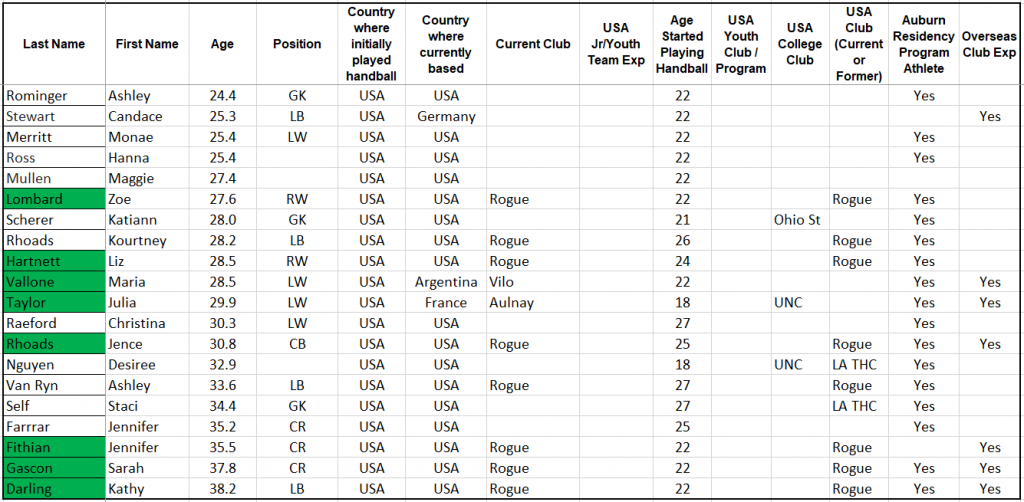
USA Team Handball lists 35 athletes as officially being part of its Women’s Sr Team Player Pool (The website indicates that it was last updated on November 14th, 2018).
There’s a lot of ways to group these athletes for analysis,
but I’ve chosen to highlight a few key data points.
Athletes are split in to two key cohorts (Americans that first played handball in another country/Americans that first played handball in the U.S.): I’d like to again emphasize that splitting these two groups is not meant to be divisive. Every one of these athletes is an American. That being said, any meaningful discussion of the U.S. talent pool has to recognize that the development of these two cohorts is significantly different. (For more insight into expat Americans read this series (Part 1, Part 2, Part 3)
Athletes are then listed by age
Athletes selected for the 2019 PANAM Games are highlighted in green
A few observations:
Compared to the U.S. Men’s player pool, the U.S. Women’s player pool has fewer (15 total) Expat Americans available
I would assess that in relative terms the overall quality of the U.S. Women’s expat player pool is a rung or two below that of the U.S. Men. Some respectable talent, but no one at the level of Ian Hueter, Abou Fofana or Rene Ingram.
5 expat Americans participated in the Auburn Residency Program. I would assess that the practice of sending European based players to the U.S. as highly questionable for a couple of reasons. 1) Quality training environments with regular competition are readily available in Europe. 2) If a player who has already been training for several years in Europe still needs extra refinement of their handball skills then they are likely not a strong national team prospect.
There is less participation (compared to the U.S. Men) in Youth and/or Jr national team competitions. This, however, is likely due to the reality that there are fewer women available and therefore it has been challenging to even field a roster.
U.S. Player Pool
(Americans that First Played Handball in the U.S)
(Note: The ages in the “age started playing handball” are estimates based on when and where athletes started playing.)
A few observations:
The 5 year Auburn Residency Program (2013-2018) accounts for 22 of the 35 athletes in the U.S. player pool. (17 stateside, plus 5 athletes that initially started playing handball in Europe).
Several of the athletes listed in this pool are not even playing handball on a regular basis. Some have shifted to beach handball while others simply don’t live anywhere near a handball club that they could practice with.
In terms of “diamonds in the rough” I would assess that only Jence Rhoads fits into that category. At age 30, however, she is clearly older (for her current level of handball skills development) than desired.
Only 4 athletes have any type of collegiate experience. This, however, is simply reflective of the reality that there are only 3 women’s college programs in the U.S.
Talent Beyond the Current
Pool
There are also several athletes that currently aren’t in the
U.S. Sr Team Pool. This would include all of our college athletes as well as
any athletes that participated in the recent IHF Trophy competition in Montreal. I don’t have the demographics for these
athletes, but having attended the last two collegiate championships and viewed
several IHF Trophy matches, most of these athletes are clearly a rung or two
below the current Sr National Team player pool.
What We Have: A
Mostly Empty Cupboard
With the U.S. Men it was relatively easy to assess the
handball skills and ages of athletes in the current player pool and to project which
athletes likely had a national team future through 2024. There was a natural grouping of athletes that
were a solid notch above the rest.
With the U.S. Women’s current player pool, however, I don’t see a similar grouping of athletes that are demonstrably better than the rest. Instead, I see a few stand outs and then a lot of mediocrity. While several athletes are either older or less talented than desired I could still make a case for virtually every athlete in the pool making a future roster.
But, “current player pool” is italicized for a reason. Because this pool consists mostly of athletes with modest raw talent and/or older athletes it’s not hard to envision new athletes with zero handball experience being trained up and quickly entering the player pool.
However, this sort of thinking is getting way ahead of the
methodology of
And, while it’s tempting to immediately start thinking of solutions to our empty cupboard of a player pool a lot of thought as to “What we want” is needed first. Because while the U.S. could recruit some quality athletes that have never played handball and provide them some intensive training to restock the cupboard some big questions need to be asked and answered first. Those questions are
Is a “quick fix” national team focus the best use of limited resources?
How likely is it that such a team will be able to beat Brazil at the 2023 PANAM Games to secure 2024 Olympic qualification?
Does it make more sense to focus on grass roots development with a timeline target of maximizing performance at the 2028 Olympic Games in Los Angeles?
Or, are the demographics and structure for women’s sport in the U.S. too challenging for a grass roots handball focus?
The Olympic Channel has a new documentary video profiling Didier
Dinart, the French Men’s National Team Coach and former player. It’s a great documentary that chronicles his
life from growing up in Guadeloupe, to moving to mainland France at age 16, to
becoming the Rock of the French defense to becoming National Team Coach. And, it does so with some great highlights of
France’s Olympic failures and successes and how he worked to improve his defensive
tactics. It also goes full circle with
his return to Guadeloupe and the christening of an arena named there in his
honor.
If you were to ask me who my all-time favorite handball
player is you might be a bit surprised with my answer: Didier Dinart.
But, then if you thought about it a bit. That I was a defensive specialist and lived
in France for five years you probably wouldn’t be surprised at all. Dinart redefined or maybe just simply defined
what a defensive specialist was.
Seriously, the handball dictionary, if such a thing were to exist would
have a little picture of Dinart next to the entry on defense specialist.
If one watches a handball match with a bigger picture view (i.e. not simply following the ball from pass to pass 100% of the time) Dinart’s greatness as a defender becomes obvious. No one matched his combination of strength and quickness. No one ever shut down (yes, shut down) a greater portion of the 6 meter arc. It was almost as if France had 6 and a half defenders some of the time. Yes, a lot of France’s domination in the 2000’s has been rightly attributed to Karabatic and Omeyer, but folks would be wise to add a 3rd player who also played huge role: Dinart.
In my opinion, if you want to talk about who’s the Greatest of All Time (GOAT) defender the discussion begins and ends with Dinart.
The Olympic Channel has two versions of the documentary.
Short Version: Link (9 minute) Extended Version: Link (27 minutes)
(Note: you can click on the icon at the bottom of the screen
for English subtitles)
Team USA and Hapoel Ashdod left wing, Asaf Bengozi.
It’s not very often that a U.S. player gets seen on ehfTV, but earlier this week, left wing, Asaf Bengozi did indeed get some screen time with his Israeli club team. Hapoel Ashdod was in the Czech Republic to take on Talent M.A.T. Plzen in 2nd round action of the EHF Cup. Plzen won both matches 32-23 and 26-21 to adance
Match 1 Video: Link (One of his goals is scored at around 35:00 on the ehfTV clock) Match 2 Video: Link
Bengozi scored 2 goals in the first match, but didn’t get on the score sheet in the 2nd contest.
Team USA’s top 4 players (my assessment) Ian Hueter, Abou Fofana, Rene Ingram and Gary Hines: 3 young guns who will likely be mainstays for the Men’s National Team for years to come and 1 ageless veteran. The demographics of these 4 players and the other 50 athletes that currently are part of USA Men’s Sr National Team Player Pool.
This is part of an ongoing series: Charting a Way Forward for USA Team Handball (2019 Reboot) In the last installment on the U.S. Men, I gave a top level overview of every American male handball player in the world (around 650 athletes). This part reviews assesses the current men’s national team player pool, where they developed their handball skills and projects which athletes will still be contributors in 2024.
The US. Men’s Sr
National Team Player Pool
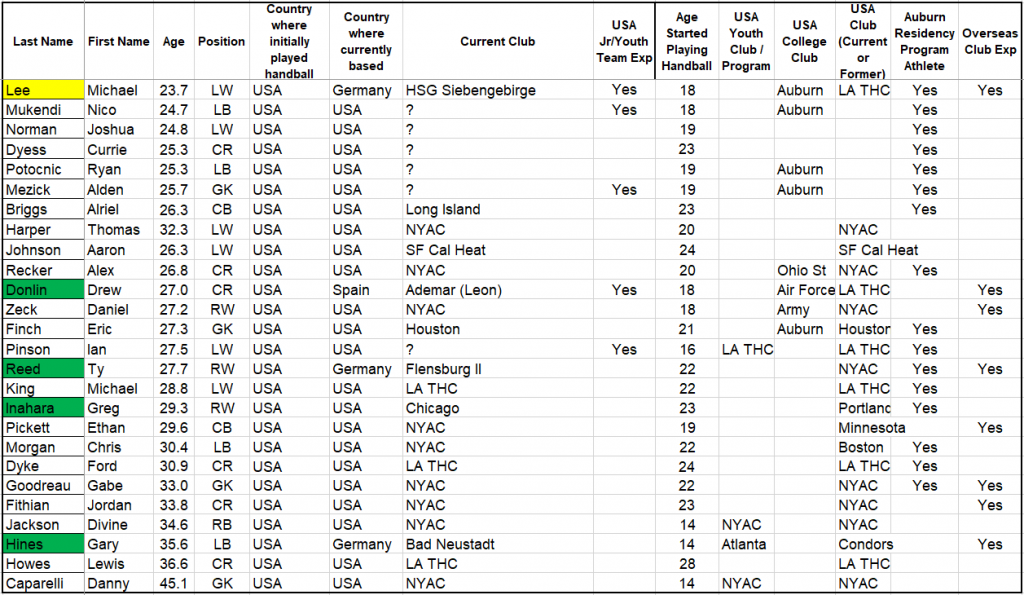
USA Team Handball lists 47 athletes as officially being part of its male Sr Team Player Pool (The website indicates that it was last updated on January 8th, 2019). In addition to that 47, I’ve added 7 athletes that in the past year have either played for the U.S. or have been listed on provisional rosters. (i.e., they probably should be on the list) This brings the overall total to 54 athletes.
There’s a lot of ways to group these athletes for analysis, but
I’ve chosen to highlight a few key data points.
Athletes are split in to two key cohorts (Americans that first played handball in another country/Americans that first played handball in the U.S.): I’d like to again emphasize that splitting these two groups is not meant to be divisive. Every one of these athletes is an American. That being said, any meaningful discussion of the U.S. talent pool has to recognize that the development of these two cohorts is significantly different. (For more insight into expat Americans read this series (Part 1, Part 2, Part 3)
Athletes are then listed by age
Athletes selected for the 2019 PANAM Games are highlighted in green
Athletes that I have assessed as potential candidates for Sr National Team selection in 2024 are highlighted in yellow: It goes without saying that my assessment (or anyone’s assessment for that matter) is going to have some errors. That being said, some of these assessments were not tough calls, but simply a logical projection based on current playing ability, years the athlete has been playing and their age.
U.S. Player Pool
(Americans that First Played Handball in Another Country)
A few observations
This is a solid core group of athletes and more importantly they are also mostly on the younger side.
Most of the younger athletes have participated in Youth and/or Jr national team competitions.
U.S. Player Pool
(Americans that First Played Handball in the U.S)
(Note: The ages in the “age started playing handball” are estimates based on when and where athletes started playing.)
A few observations:
A few “diamonds in the rough” have been discovered state side, but the overall numbers are disappointing.
Only a handful of these athletes have been on Youth and/or Jr teams. This is primarily due to to the athletes not starting to play handball until they were older.
The 5 year Auburn Residency Program (2013-2018) accounts for 17 of the 54 athletes in the U.S. player pool. (16 stateside, plus Sean Zimber who first played handball in Japan). Of that 17, I’ve assessed that only 4 athletes (Zimber, Lee, Reed and Inahara) have solid potential for making future rosters. Some of the Auburn athletes listed aren’t even actively playing handball anymore, so they will surely disappear when the pool list is updated. And, it should also be noted that both Reed (27) and Inahara (29) are also older (for their current level of handball skills development) than desired.
Only 8 athletes have come from the college ranks and 5 of those athletes were co-located with the Auburn Residency Program. The only college developed product with 2024 potential is circle runner, Drew Donlin, who first played handball at Air Force. And, Donlin (27) is also older (for his current level of handball skills development) than desired.
The outlier or the model to copy?: Gary Hines, at age 35 is still contributing and someone that I think has more years left in the tank. He is also arguably the very best stateside athlete to never have participated in a residency program. Is he a strange outlier or a model for development that should be studied and copied?
Talent Beyond the
Current Pool
There are also several athletes that currently aren’t in the
U.S. Sr Team Pool. This would include all of our college athletes as well as
any athletes that have participated on U.S. National Youth and Jr teams the
past few years. For this list I’ve
included all the athletes on our recent U21 World Championship team that aren’t
already in the player pool as well as a few prospects from our college and
youth programs.
Observations
The very best Jr players have already been identified and placed in the Sr Team talent pools
The players identified here are a few years away yet from Sr Team consideration
Nikolas Zarikos, is an interesting test case. To the best of my knowledge he is by far the youngest stateside American to move to Europe to play handball.
Putting it All Together
Overall, it’s pretty clear that based on “what we have” that the U.S. Men’s Sr National Team will be relying heavily on Expat Americans for the foreseeable future. Over the past several years we have developed only a handful of stateside prospects and in most cases these athletes have either been older and/or less athletically gifted than desired. Bottom line: Our stateside development strategies have not worked as well as we would like them too.
On the positive side of things we have a solid core of Expat Americans. With those athletes and a few supplemental stateside prospects we can put together a respectable side. A team that can battle Cuba and Greenland for a North American & Caribbean championship and qualify for a World Championship. But, can such a team beat Argentina, Brazil and even Chile for a PANAM Games title in 2023 and Olympic qualification? A much tougher ask and it’s doubtful that we can get there with “what we have.”
I know some folks might want to immediately jump to solutions. To start implementing plans that will change “what we have” to “what we want”. However, there’s still a lot more homework that needs to be done. Future installments will take an even closer at our Sr National Team talent by position and at our opposition.
Nationality Demographics at the U.S. Club National Championships this past May. American women accounted for just 12% of the athletes. And… Thanks to just one club from Alberta participating there were even more Canadians than Americans at our own National Championships.
Like men’s sports, the structure and organization of women’s sports in the U.S. is significantly different from the rest of the world. But, in addition to the differences in structure, there is another major difference: higher participation rates. The numbers of girls and women playing sports in the U.S. pretty much dwarfs that of the rest of the world with the possibility exception of Scandinavia, Canada and the Netherlands. There has always been some great traditions of girls playing sports in the U.S., but with the passage of Title IX legislation in 1972 there was a gradual and epic sea change in participation because… it was the law.
The rest of the world has seen this with our Women’s soccer
program. While the U.S. Men might be
respectable (even if we failed to qualify for the last World Cup) the U.S.
Women are steam rollers. It’s kind of
incredible when you think about it. When
I was a kid, soccer was an afterthought sport for both boys and girls. Little organization, few youth programs and
nobody cared. Now it is played coast to
coast by millions of kids. And, as a
result… we have a respectable Men’s national team and a juggernaut women’s
team. Yes, overnight the U.S. had more
girls and women playing than any other country.
And, this even includes European countries. As the U.S. is populated with a sizable number of European descendants it’s sometimes common for Europeans and Americans to think that the U.S. is pretty much like Europe except for that puritan aspect and, in some cases, a different language. This is often accurate, but not always. Case in point: Check out this NPR story about women’s soccer in France and the cultural struggle they’ve had to overcome regarding how soccer is for boys, not girls. And, that if you are girl playing, you must be tomboy. Seems rather quaint and old fashioned doesn’t it?
So, what does this Title IX thing mean in terms of international competition? If, (and this is a big if) the U.S. “cares” about a women’s sport, it’s pretty much a given that the U.S. will kick butt in that sport. And, by “care” I mean providing support to the sport in schools and colleges. Because if that happens we will have so many girls playing the sport that we can’t but help put together a great team. But, if a particular sport doesn’t have that Title IX support… Well, then chances are we aren’t going to be very good. Why? Because all of the “good” athletes will be playing the sports that get support.
And, that support is manifested in Middle School, High School and NCAA sanctioned sports. NCAA sanctioning is of particular importance due to the scholarship support that typically come with NCAA recognition. One does not have to look very hard to see a strong correlation between which sports the U.S. is not very good at and which sports aren’t NCAA sanctioned. And, while this is also true with Men’s sports the problem is further compounded for Women’s sports. This is because the overall pool of women athletes (for all sports) is smaller than it is for men. And, because Title IX has become a forcing function for equity there are simply more scholarship opportunities for women athletes. And, in turn, this means that there are fewer women athletes (lacking a scholarship) and therefore looking for a new sport like team handball.
The point of this diatribe: To help the reader understand why women’s participation numbers for team handball in the U.S. are dramatically smaller than men’s participation numbers. And, why improving female participation numbers might be even be more challenging.
Women’s Team Handball
Organizations and Activities in the United States
The structure of Women’s team handball in the U.S. is pretty
similar to our Men’s programs. Similar, but on an even smaller scale.
Training Centers:
A Training Center is a place where handball is taught intensively. Two common examples: A European style Academy and what the U.S.
has called Residency Programs in the past.
Currently, there are no handball training centers in the U.S., although
the youth program in Chicago has some elements of an Academy, albeit on a
smaller scale.
Clubs: There
are approximately 8 adult women’s clubs in the U.S. These clubs vary significantly in terms of
size, organization and level of play. Currently,
with the exception of Club Rogue every single one of these clubs is composed
almost entirely of expats living in the U.S.
And, Club Rogue, hardly fits the traditional definition of a club. It is simply a collection of current and
former national team athletes living in multiple locations that gets together a
couple of times a year for weekend tournaments.
Collegiate Clubs:
An important subset of clubs are collegiate clubs which are affiliated
with a college or University. There are currently
just 3 women’s collegiate clubs in the U.S. It should also be emphasized that collegiate
club sports are dramatically different from sanctioned NCAA sports. There are no scholarships and colleges
typically only provide top level support.
As athletes are college students, in most instances they are ages 18-23.
Youth Programs:
These programs consist of athletes in Middle School (ages 12-14) and
High School (ages 14-18). There are two
fairly well established programs in the U.S., one in San Francisco and one in
the Chicago. Approximately 10 girls are
participating in the San Francisco area and they play on teams that are
predominantly male. Approximately 20
girls are training in Chicago in preparation for the IHF Trophy tournament in
October.
Other Activities:
Team handball is played in Physical Education classes in hundreds, maybe
even thousands of schools. This handball,
however, is often just a rough facsimile of the game, taught by teachers
unfamiliar with the sport, for a few lessons and with a lot of rule
variants. There are also a number of
colleges with intramural programs.
(Intramural sports are lower level competitions where multiple teams at
one college play each other.) Again, the
handball that is played is often just a facsimile of the game we are all
familiar with.
USA Women’s Club
Demographics (2019 National Championship Snapshot)
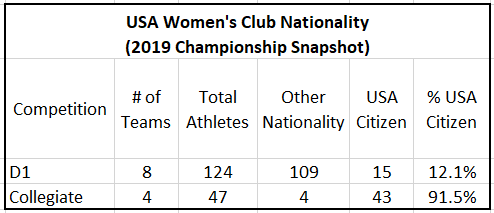
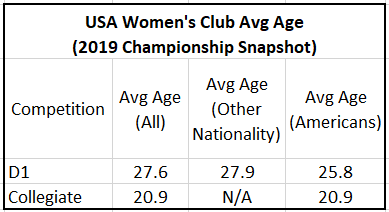
This past April and May the U.S. staged its Collegiate Club and Club National Championships. Unlike European countries there is no nation-wide league and these championship events played over only 3 days are open to all comers. A Canadian club from Alberta even participated and their attendance alone resulted in the strange situation of more Canadians than Americans playing at the U.S. national championships. This chart breaks down the total participants in these 2 events.
(Note: Citizenship
data in these tables relied heavily on roster names to assess nationality. Such an assessment surely is prone to error
as Americans don’t always have “American Sounding” names and conversely some
expats have deceptively “American Sounding” names. Overall, though I would assess that it’s a
pretty good ballpark data.)
A few obvious points from these tables.
An overwhelming majority of our Club National Championships participants are not U.S. citizens
An overwhelming majority of our College National Championship participants are U.S. citizens
The Avg age of participants at Club National Championships is several years younger than it is for the men. (I’ve got no hard data to back this up, but I bet it’s because women are a bit smarter than men when it comes to deciding when to retire from the physical sport of handball)
While this data is similar to the data compiled for the men, the total numbers are significantly smaller
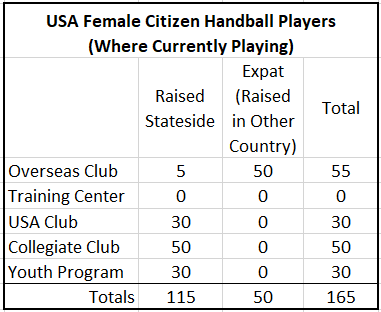
U.S. Citizen
Demographics (Female)
In terms of National Team planning it is, of course, a
necessity to focus strictly on U.S. citizen demographics. The following tables break out the citizen
representation from U.S. clubs and adds estimates for expat Americans playing
overseas and youth program participation.
These estimates were based on extrapolation of National Championship
data and National Team roster data. For
USA based numbers I added athletes based on known clubs that didn’t attend
nationals. For overseas numbers I took
the number or expat players that have played on Sr, Jr, and Youth rosters the
past 10 years or so (25 total) and doubled it, figuring that would
conservatively account for unknown or lower level players. Anecdotally, I would assess that the yearly
total is higher at younger ages and gets significantly smaller as players age
out. For the most part I tried to error
on the conservative side. The only
exception is that I did not pad this data with the inclusion of school Phys Ed
programs and college intramurals.
Key Points:
The number of active women’s handball players based in the U.S. is really, really small. Depending on one’s semantics it’s around 100 athletes (or maybe less)
Question: Should this stark reality be considered a “crisis”? And, if so what steps should be taken to address it?
Question: Or, does the phrase, “It is, what it is” apply here?
Because there are virtually no players being produced through grass roots it’s not hard to see why our women’s national team has relied on older athletes from other sports and expat players. The harsh reality is that we would be hard pressed to field a national team otherwise.
Question: Should the U.S. continue to recruit older athletes from other sports and then expend limited resources on training those athletes?
Question: Or should USA Team Handball “bite the bullet”, forgo a quick national team fix and address this huge discrepancy.
The only level of competition that is structured somewhat normal (right age; predominantly American) is our college championships
Question: Should we expend resources to further develop the women’s college game or does the overall lack of available, interested athletes suggest that efforts should be focused elsewhere?
This is meant only as
a top level analysis. In a future
article I will take a closer look at the U.S. Elite Player Pool and the
pathways for athletes to enter this pool.
Mike Cavanaugh, on the sidelines coaching Air Force
Earlier today, Mike Cavanaugh announced his professional retirement from USA Team Handball: Link
While he no longer will have an official capacity he will still be contributing to the sport as the coach of Air Force and, I would suspect in other ways as well. As long as I’ve been involved with the sport of team handball, there has always been one constant presence: Mike Cavanaugh. And, that’s literally true for anyone (and I mean anyone) involved with the sport in this country. Seriously, if you want to play the Kevin Bacon game for USA Team Handball you will be hard pressed to find anyone who’s not 1 degree of separation. Everybody knows Mike; Everybody.
And, virtually everyone in our small community has interacted with Mike in some capacity. Whether they were a national team player or someone who just discovered the sport and wanted to find out more information they’ve met Mike Cavanaugh. Some of those interactions were trivial, but some of those interactions were also pretty consequential.
On the occasion of his retirement I’ll share one such
consequential interaction. One that made
a big difference in my life.
Helping an
Athlete/Person Make the Right Decision
Way back in 1993 I was at one of those big crossroads points
we all face in life. I had just returned
from the World Championships where I had represented my country, playing the
sport I loved on the World Stage. Sure,
we hadn’t come close to winning a match, but for me personally it had still
been a great experience. In less than 2
years I had gone from being cut from an Olympic Festival team to starting on defense
for the national team. I was on cloud 9
with dreams of grandeur.
After returning from the World Championships I had an office visit with Mike and our then Head Coach, Vojtech Mares, where we talked about my future as a handball player. I was pretty excited. I discussed the possibility of getting a military assignment in Europe so I could play with a club there or simply leaving the Air Force altogether. I was 28 years old and my AF career wasn’t exactly setting the world on fire. (Leaving for several weeks at a time to go play a sport many had never even heard of just didn’t sit well with some of my supervisors.) The Olympics was also just 3 years away and since Atlanta was hosting we had already qualified. The residency program was moving to Philadelphia. I had even started to investigate Aerospace Engineering jobs in the area there.
This little office meeting could have gone a number of different ways. An average (at best) player could have been pumped up with praise. Encouraged to move to Philadelphia and pursue his Olympic dreams. And, from strictly a management stand point that would have been the thing to do. The Philadelphia set up didn’t have enough players. I was a marginal prospect, but a reliable one. I would have helped in terms of practice quality and who knows maybe I would continue to surprise and contribute in a meaningful way.
26 years later I don’t remember exactly what was said, but
it was a frank and open discussion. A
conversation, that didn’t overly encourage, but one that didn’t discourage
either. Fact based about what USA Team
Handball’s plans were and how I might fit in those plans. It was a conversation that started out as a
discussion about handball, but ended up as a discussion more about me as a
person and my future.
I had been skillfully and gently moved down from cloud 9. Still excited about the sport and what I had accomplished, but now in a position to be more thoughtful and analytical. To make a decision with my heart and my head. I did not move to Philadelphia and stayed in the Air Force. A decision that ultimately was best for me.
A Guy with a Lot of Friends and Very Few (in any?) Enemies
I suspect that I’m not the only person in our small handball
community that has a similar story they could tell. How Mike has influenced them and made a
difference in their life outside of the sport of handball.
What’s truly remarkable, when you think about it, is how we was able to maintain relationships. Think of all the controversial issues and sometimes downright crazy stuff that has happened over the years. All of the heated disagreements on how best to proceed. For sure, I’ve had my complaints and on more than one occasion have disagreed with what was decided.
But, despite all of those disagreements I’ve never had a bad interaction with him. Always professional; Always friendly (as much as possible); Always the diplomat. Maybe there are some folks out there that feel differently, but they are few and far between.
There are lots of ways to measure success. Wins and losses; Medals, money in the bank account, etc. But, if at the end of the day, you cannot even begin to count all the people you’ve had a positive impact on as a coach, as an administrator, as a friend, then count yourself lucky.
Thanks, Mike for all that you have done for the sport in
this country…
A Brief Diatribe on
American and European Sports Structures
When describing handball in the U.S., it’s important to
contextually to consider one’s audience.
Simple terms like club, schools, colleges, intramurals, leagues,
tournaments and championships can mean radically different things to a European
or an American.
Case in point, I’ll never forget a comical discussion I had with my French basketball teammates regarding what the NCAA basketball tournament was. This “knockout” tournament is a huge deal in the U.S. and was getting a little publicity in France since the son, Joakim, of a famous Frenchman, Yannick Noah, was playing in it. Why was this conversation comical? Because I couldn’t go one sentence without having to backtrack down a rabbit hole with further explanations. Here’s roughly how it went:
Me: So, it’s a tournament to determine the college national champion Teammate 1: What kind of a tournament? Me: Well, it’s a tournament where the top 64 teams keep playing each other until only 1 team is left Teammate 2: Oh, so like the Coupe de France. Me: Well, no it is just for college teams and it’s played over 3 consecutive weekends. Teammate 3: College teams? Huh, Why not the NBA and the 2nd division below the NBA. Teammate 4: No, Claude. They don’t have divisions in the U.S. College is their 2nd division. Me: Well, sort of, but not exactly. It’s our 2nd best competition, but the players are amateur and only get scholarships. Teammate
5: What’s a scholarship?
So… I could go on and on and the conversation actually did
for another 15 minutes or so, but it was really stretching my French speaking
skills. Still, even if I had been fluent
it would have been a huge challenge.
Also, the funny thing was that since by that time I had lived a few
years in France I fully understood why they had asked each and every
question.
It was also revelatory to me about all the expats I had
played handball with in the U.S. No
wonder they were so confused. Our
structures are so different in so many ways and what I’ve learned is that each
culture takes so many things for granted simply because… Well, that’s the way
it’s always been done.
So, if you’re wondering why the obvious is being explained, keep in mind I’m writing for two different audiences.
Men’s Team Handball Organizations
and Activities in the United States
Training Centers:
A Training Center is a place where handball is taught intensively. Two common examples: A European style Academy and what the U.S.
has called Residency Programs in the past.
Currently, there are no handball training centers in the U.S., although
the youth program in Chicago has some elements of an Academy, albeit on a
smaller scale.
Clubs: There are approximately 40 adult men’s clubs in the U.S. These clubs vary significantly in terms of size, organization and level of play. At one end of the spectrum is the New York City Team Handball Club with dozens of members, most of whom have played before in another country. At the other end of the spectrum are perhaps around 10 clubs that have maybe 5-10 dedicated players and are struggling to keep afloat. With few exceptions U.S. clubs are also simply adult recreational clubs. There are no youth teams progressively teaching more skills as athletes get older. The adult members do take the sport seriously, but practices are at most once or twice a week with competition limited to weekend tournaments. The one exception to this is North East Team Handball League.
Collegiate Clubs:
An important subset of clubs are collegiate clubs which are affiliated
with a college or University. There are roughly
13 Men’s collegiate clubs in the U.S. It
should also be emphasized that collegiate club sports are dramatically
different from sanctioned NCAA sports.
There are no scholarships and colleges typically only provide top level
support. As athletes are college
students, in most instances they are ages 18-23.
Youth Programs: These programs consist of athletes in Middle School (ages 12-14) and High School (ages 14-18). There are two fairly well established programs in the U.S., one in San Francisco with roughly 130 participants and one in the Chicago area with roughly 20 participants. The program in San Francisco is a school based competition while the Chicago program is focused around one athletic facility.
Other Activities:
Team handball is played in Physical Education classes in hundreds, maybe
even thousands of schools. This
handball, however, is often just a rough facsimile of the game, taught by teachers
unfamiliar with the sport, for a few lessons and with a lot of rule
variants. There are also a number of colleges
with intramural programs. (Intramural
sports are lower level competitions where multiple teams at one college play
each other.) Again, the handball that is
played is often just a facsimile of the game we are all familiar with.
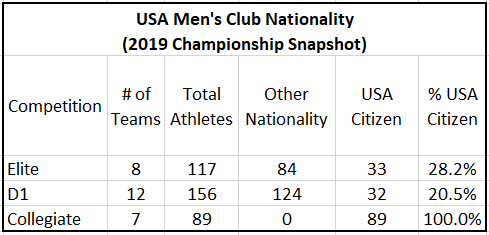
USA Men’s Club
Demographics (2019 National Championship Snapshot)
This past April and May the U.S. staged its Collegiate Club and Club National Championships. Unlike European countries there is no nation-wide league and these championship events are played over only 3 days and are open to all comers. 3 Canadian clubs even attended. This chart breaks down the total participants in these 3 events.
(Note: Club nationals
had 2 separate competitions: Elite and Div 1)
(Note: Citizenship data in these tables
relied heavily on roster names to assess nationality. Such an assessment surely is prone to error
as Americans don’t always have “American Sounding” names and conversely some
expats have deceptively “American Sounding” names. Overall, though I would assess that it’s a
pretty good ballpark data.)
A few obvious points from these tables.
A majority of our Club National Championships participants are not U.S. citizens (Only 23% of the combined total of Elite/D1 Male athletes were U.S. citizens)
A majority of our Club National Championships participants are over the age of 30
An overwhelming majority of our College National Championship participants are U.S. citizens
An overwhelming majority of our College National Championship participants are younger than 24 years old.
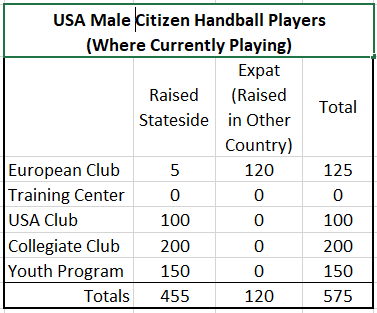
U.S. Citizen
Demographics (Male)
In terms of National Team planning it is, of course, a necessity to focus strictly on U.S. citizen demographics. The following tables break out the citizen representation from U.S. clubs and adds estimates for expat Americans playing overseas and youth program participation. These estimates were based on an extrapolation of National Championship data and National Team roster data. For USA based numbers I added athletes based on known clubs that didn’t attend nationals. For overseas numbers I took the number or expat players that have played on Sr, Jr, and Youth rosters the past 10 years or so (60 total) and doubled it, figuring that would conservatively account for unknown or lower level players. Anecdotally, I would assess that the yearly total is higher at younger ages and gets significantly smaller as players age out. For the most part I tried to error on the conservative side. The only exception is that I did not pad this data with the inclusion of school Phys Ed programs and college intramurals.
Key Points and Logical Follow On Questions:
Conservatively, there are less than 600 Male U.S. citizen handball players in the world. (It depends on one’s semantics, but it’s probably less.)
Question: Should USA Team Handball’s top priority be increasing this very, very low “total number”?
Stateside demographics clearly do not follow the traditional pyramid structure often seen with other sports (massive youth participation at the base and professionals/national teams at the tip.)
Question: Is not having a pyramid a problem?
Question: How should limited resources be applied to different levels of this would be pyramid
The only level with a competition that is structured somewhat normal (right age; predominantly American) is our college championships.
Question: Why is there some level of success at this level?
Question: Can this success be duplicated at other levels of the pyramid? Why or why not?
This is meant only as a top level analysis. In a future article I will take a closer look at the U.S. Elite Player Pool and the existing and potential pathways for athletes to enter this pool.
Five years ago I started a series of commentaries that considered different strategies for USA Team Handball to improve National Team performance. I did the series as a counterpoint to what I saw as some flawed strategic planning. Flawed planning and a lack of process that led to the setup of National Team Residency Programs at Auburn. Programs that were by almost any measure not very successful and have since been closed down.
But, as I pointed out in my critique there’s a basic truism regarding planning in that it is relatively easy to sit on the sidelines and critique a plan. Especially a plan tackling a really tough problem. So, I said to myself, if you’re going to critique something as flawed, you better come up with some alternatives. Hence the series highlighting the pros and cons of several different alternatives.
Flash forward several years later and it appears USA Team Handball is now in a position similar to where it was in 2012. Trying to figure out how to move forward. On a personal level it’s gratifying to see that some of the options I’ve identified such as a focus on college programs targeted for some sort of implementation. But, then I’ve also heard some top level ideas regarding water polo players transferring their talents and pro leagues starting up just around the corner that has alarm bells ringing loudly in my ears. I’m not saying such strategies can’t work (though I have my doubts), but, for sure, I’m wondering how well they stack up vs other possibilities.
I’ve also reflected on what I got right and what I got wrong
in the original series of commentaries.
As I’ve learned more about handball’s structure in Europe and the
changing dynamics in U.S. sporting structures it’s clear that some of the
options need to be tweaked. Further, on
a real positive note, outside organizations like the IHF, EHF and Europe’s top
professional clubs are now willing to provide resources, making some options a
lot more feasible.
Big Picture: Taking Stock of What We Have
One item I neglected in the original series was sufficient analysis as to what the current state of handball is in the U.S. How many people, or more importantly, how many Americans are playing the sport? How old are they? What is the level of play? How many American Expat players are there? For sure, we are all capable of anecdotal assessments, but impressions can be often clouded to reflect what we want to see. I’ve now done a real deep dive into the data and rest assured, it’s very telling data that should heavily influence any planning USA Team Handball does going forward.
USA Men’s National Team (Part 1: A Closer Look by Position- GK and CR): Link
USA Men’s National Team (Part 2: A Closer Look by Position- BC and RW/LW): Link
Demographics (Women)
American Citizen Female Athletes (Overview): Link USA Women’s Elite Player Pool (Overview): Link
USA Club Programs
Part 1: Understanding the USA Club Structure and At-Large Men’s Clubs: Link Part 2: Collegiate Men’s Clubs: Our Most American Competition with Opportunities for Growth: Link Part 3: USA Women At-Large and Collegiate Clubs: Link Part 4: Why there are so Few Clubs and Why the Rosters Mostly Consist of Expats: Link
Finances
Part 1: USA Team Handball Revenue (Grants, Contributions and Sponsorships): Link
Part 2: USA Team Handball Revenue (Membership and the Importance of Tracking that Data): Link
Big Picture: Taking Stock of What We Want to Be
While determining “What we want to be” might seem straightforward it’s really a tough question. In broad terms everyone wants to develop the sport and have successful national teams. How developed, though, do we want the sport to be? How successful is successful enough? Not to mention, the two overarching goals of development and national team success can sometimes be in direct conflict with each other.
Part 1: A review of the USA Team Handball Strategic Plan and National Team Targets: Link
Part 2: A review of USA Collegiate Development Targets: Link
Part 5: A review of the “Big, Hairy, Audacious Project: Link
Big Picture: How We Get There? (Or More Accurately, Can We Get There)
And, then just about everyone has different ideas regarding “How we get there.” So, how does one decide which option(s) are better? Answer: Very, very carefully after a lot of assessment in terms of cost, schedule, risks, SWOT (Strengths, Weaknesses, Opportunities, Threats), pros, cons, etc. And, after all that is done another question has to be asked for each option: Can we get there, from here?
Big Picture: Taking Stock of What We Want to Be… Urr,
Actually Can Be
This, of course, leads to the reality that “What we want to
be” and “What we actually can be” are often two very different things. One has either to find more resources, change
the time frame, or lower expectations.
(Or, in project management terms:
adjust cost, schedule or performance).
This is often “where the rubber hits the road.” Where decisions have to be made on how much
to spend and where. And, unless the
budget in unbounded there are going to be winners and losers. Some efforts will get funded and some won’t. That’s just the way it is.
If all this is done properly, in the end you should get a
nice flow chart where everything lines up.
The “How we get there?” matches “What we want” because we’ve tempered
expectations to match what actually can be done.
An Ongoing Series
As before I will be updating this page with links to analysis. First up, I will be tackling the “What we have” block in detail. Yes, the demographics of our National Team programs and clubs. Data which in stark terms shows just how minor our sport is in this country.