Charting a Way Forward for USA Team Handball (2019 Reboot): Introduction

A Not So Simple Process

Why a Reboot and Some Personal Reflection

Five years ago I started a series of commentaries that considered different strategies for USA Team Handball to improve National Team performance.  I did the series as a counterpoint to what I saw as some flawed strategic planning.  Flawed planning and a lack of process that led to the setup of National Team Residency Programs at Auburn.  Programs that were by almost any measure not very successful and have since been closed down.

But, as I pointed out in my critique there’s a basic truism regarding planning in that it is relatively easy to sit on the sidelines and critique a plan.  Especially a plan tackling a really tough problem.  So, I said to myself, if you’re going to critique something as flawed, you better come up with some alternatives.  Hence the series highlighting the pros and cons of several different alternatives.

Flash forward several years later and it appears USA Team Handball is now in a position similar to where it was in 2012.  Trying to figure out how to move forward.  On a personal level it’s gratifying to see that some of the options I’ve identified such as a focus on college programs targeted for some sort of implementation.  But, then I’ve also heard some top level ideas regarding water polo players transferring their talents and pro leagues starting up just around the corner that has alarm bells ringing loudly in my ears. I’m not saying such strategies can’t work (though I have my doubts), but, for sure, I’m wondering how well they stack up vs other possibilities.

I’ve also reflected on what I got right and what I got wrong in the original series of commentaries.  As I’ve learned more about handball’s structure in Europe and the changing dynamics in U.S. sporting structures it’s clear that some of the options need to be tweaked.  Further, on a real positive note, outside organizations like the IHF, EHF and Europe’s top professional clubs are now willing to provide resources, making some options a lot more feasible.

Big Picture:  Taking Stock of What We Have

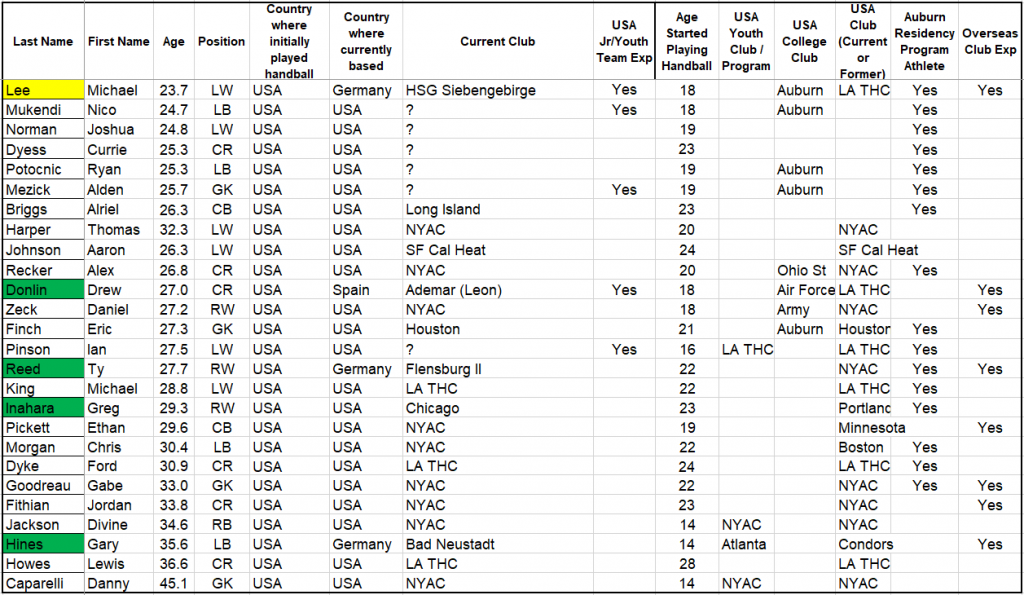
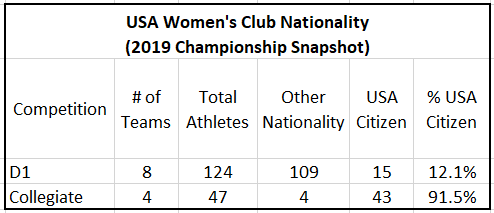
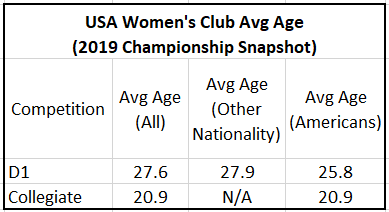
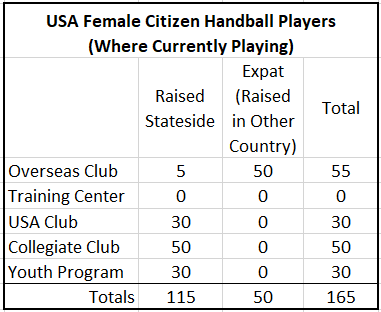
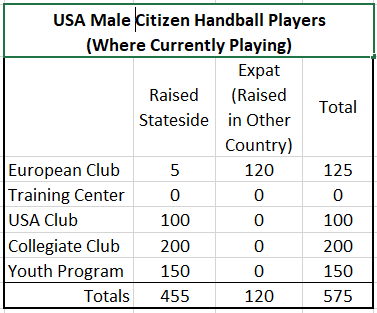
One item I neglected in the original series was sufficient analysis as to what the current state of handball is in the U.S.  How many people, or more importantly, how many Americans are playing the sport?  How old are they?  What is the level of play?  How many American Expat players are there?  For sure, we are all capable of anecdotal assessments, but impressions can be often clouded to reflect what we want to see.  I’ve now done a real deep dive into the data and rest assured, it’s very telling data that should heavily influence any planning USA Team Handball does going forward.

  • Demographics (Men)
    • American Citizen Male Athletes (Overview): Link
    • USA Men’s Elite Player Pool (Overview): Link
    • USA Men’s National Team (Part 1: A Closer Look by Position- GK and CR): Link
    • USA Men’s National Team (Part 2: A Closer Look by Position- BC and RW/LW): Link
  • Demographics (Women)
    • American Citizen Female Athletes (Overview): Link
      USA Women’s Elite Player Pool (Overview): Link
  • USA Club Programs
    • Part 1: Understanding the USA Club Structure and At-Large Men’s Clubs: Link
      Part 2: Collegiate Men’s Clubs: Our Most American Competition with Opportunities for Growth: Link
      Part 3: USA Women At-Large and Collegiate Clubs: Link
      Part 4: Why there are so Few Clubs and Why the Rosters Mostly Consist of Expats: Link
  • Finances
    • Part 1: USA Team Handball Revenue (Grants, Contributions and Sponsorships): Link
    • Part 2: USA Team Handball Revenue (Membership and the Importance of Tracking that Data): Link

Big Picture:  Taking Stock of What We Want to Be

While determining “What we want to be” might seem straightforward it’s really a tough question.   In broad terms everyone wants to develop the sport and have successful national teams.  How developed, though, do we want the sport to be?  How successful is successful enough?  Not to mention, the two overarching goals of development and national team success can sometimes be in direct conflict with each other. 

  • Part 1: A review of the USA Team Handball Strategic Plan and National Team Targets: Link
  • Part 2: A review of USA Collegiate Development Targets: Link
  • Part 3: A review of Fundraising Targets: Link
  • Part 4: A review of Marketing Targets: Link
  • Part 5: A review of the “Big, Hairy, Audacious Project: Link

Big Picture:  How We Get There? (Or More Accurately, Can We Get There)

And, then just about everyone has different ideas regarding “How we get there.”  So, how does one decide which option(s) are better?  Answer:  Very, very carefully after a lot of assessment in terms of cost, schedule, risks, SWOT (Strengths, Weaknesses, Opportunities, Threats), pros, cons, etc.  And, after all that is done another question has to be asked for each option:  Can we get there, from here?

  • Part 1: The Project Management Triangle: Link
  • Part 2: National Team Targets: Link

Big Picture:  Taking Stock of What We Want to Be… Urr, Actually Can Be

This, of course, leads to the reality that “What we want to be” and “What we actually can be” are often two very different things.  One has either to find more resources, change the time frame, or lower expectations.  (Or, in project management terms:  adjust cost, schedule or performance).  

This is often “where the rubber hits the road.”  Where decisions have to be made on how much to spend and where.  And, unless the budget in unbounded there are going to be winners and losers.  Some efforts will get funded and some won’t.  That’s just the way it is.

If all this is done properly, in the end you should get a nice flow chart where everything lines up.  The “How we get there?” matches “What we want” because we’ve tempered expectations to match what actually can be done.

An Ongoing Series

As before I will be updating this page with links to analysis.  First up, I will be tackling the “What we have” block in detail.  Yes, the demographics of our National Team programs and clubs.  Data which in stark terms shows just how minor our sport is in this country.

USA Team Handball CEO, Barry Siff, Interview (USA Pro League, National Team Tryouts and more)

USA Team Handball CEO, Barry Siff

Yesterday, USA Team Handball CEO, Barry Siff, was interviewed on the “Off-Center Sports” Show, on KWMR radio in Point Reyes Station, California, just North of San Francisco.  The interview is an hour long and covered a lot of territory. 

Interview: Link

Many of the usual things one might expect to hear, but also quite a few tidbits of interest.  Here’s a sampling of topics with quotes I found particularly interesting:

Water Polo Talent Transfer (3:42)

“You know water polo players are probably a great talent transfer type opportunity to get in to handball. And, I’ve seen some of those people get into it.  They just…  You just got to make sure they got legs and that they can run because this sport is very fast, very physical.

Dropping the “Team” from Team Handball (4:58)

“In fact, this week I’ve been talking with a few people about one of my goals is to eventually get our sport known as handball in the United States because it’s a little bit unusual.  It’s kind of like soccer and football.  You know, soccer is known as football around the world except for here.”

2019 National Championship Demographics (10:18)

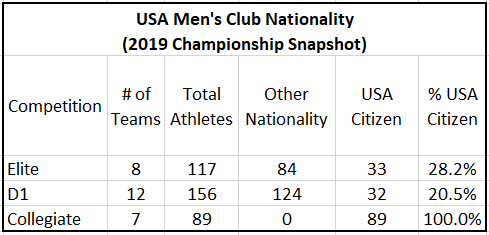
“But, most of those teams are populated by people who have moved here from Europe or other countries.  Played handball there and they joined the local club.  So, during that tournament which was in Myrtle Beach, the 2019 Championships someone said to me that 80% of the players were not born here in America.”  (You might be able to guess, who that “somebody” is.)

Big Sponsorship Announcement in the Near Future (15:42)

“We’re getting ready to announce our first big founding partner.  A big company that believes in our future and we’re talking to others.”

USA Pro League in 3 Years (22:15)

“And, then ultimately the goal in 3 years is to have a professional league here in the United States.  And, we’re working on that today.”

Bringing Team Handball Back to the Boys & Girls Clubs in Los Angeles (25:50)

“Right now I’m talking to the Los Angeles area and trying to get the Boys & Girls Clubs to start. Hopefully to do a pilot program down there in association with the growth towards the 2028 Olympics.”

More on the U.S. Pro League and a Major Objective for Staffan Olsson (47:10)

“Then ultimately, like I mentioned, we’ve got to plan to develop a professional league, but at the same time. I think it’s going to be easy, and I really do mean this.  I think it’s going to be easy to get a league, in concept, together.  We just got to have a couple hundred high level players here in the U.S.  And, that’s what Staffan Olsson’s major objective is as a High Performance Director is to figure out how we can develop a couple hundred great players, here in the United States to play professionally on television, on social media, on OTT networks, etc.”

National Team Tryouts in 3 to 6 Months (57:00)

“Staffan and I are talking about doing tryouts for our national team.  Open tryouts.  This will be both a marketing campaign, a media campaign, but also finding our amazing athletes out there and probably doing it, in I’m going to guess, probably southern California and New York.  I don’t know when.  Maybe it’s 3 months.  Maybe it’s 6 months.  But, find those diamonds in the rough who are amazing athletes.   Who we might be able to fine tune and give them the proper training, techniques, etc.  And, who knows they could be the next Olympian.”

USA Hires Handball Legend for High Performance Director

Staffan Olsson in his younger days. One of the best right backs of all time.

Former Swedish National Team Coach and Player, Staffan Olsson has been hired to be USA Team Handball’s new High Performance Director.  He is filling a vacant position that was previously held by Dave Gascon, who had performed the role on a volunteer basis from 2013 to 2018.

While the name, Staffan Olsson, has little meaning in the U.S., he is indeed a handball legend and is regarded as one of the best right backs of all time.  His coaching career has also been solid with stints as a co-coach of the Swedish National team and one of Sweden’s top clubs Hammarby.  Most recently he was an Asst Coach for one of the top clubs in the world, Paris Saint-Germain.

Three Primary Roles

The USA Team Handball write up lists three primary roles for him as High Performance Director.

1) oversee the management and direction of USA Team Handball’s national teams,
2) determine a pipeline of new athletes at the elite level, and
3) develop the training program for coaches and officials at various levels of the sport

The 1st role seem like a pretty good fit for Olsson.  It will be somewhat “different” to manage 3rd tier national teams like the U.S. instead of a premier national team like Sweden.  Different for sure in terms of budget, but familiar.  And, then developing training programs for coaches and officials will also be something he is well suited for except for maybe the starting from zero aspect that is often necessary in the U.S.

For sure, though, the most challenging role for the new High Performance Director will be to “determine a pipeline of new athletes at the elite level.” Why, the most challenging?  The U.S. currently lacks any significant grass roots development, meaning that there are very, very few elite athlete candidates available to enter any would be pipeline.  This reality has bedeviled USA Team Handball for decades.  In fact, I would argue that it’s an intractable problem that can really only be properly addressed after grass roots programs have been patiently and sufficiently built up. 

Maybe, however, there is some secret Swedish sauce that he will be able to apply to solve this problem in some other, quicker way.  Regardless, there’s little doubt in my mind that he will do a great job of looking after the players we have. Getting them good preparation for tournaments and helping them find clubs in Europe.

Me vs White Snake Back in 1993

It’s not very often that I get to pull the “Yeah, I played against him” card, but back in 1993 I indeed played against Staffan Olsson at the World Championships.  Why, as I wrote in this commentary back in 2016, I’ve even claimed to have shut him down after a few beers on more than one occasion.  Something tells me though, that just like USA Men’s Coach, Robert Hedin, he probably doesn’t even remember playing that match against the U.S.  When you play 358 International Games, some are surely forgettable.  Whereas when your resume is just 12 matches, you remember them all. 

Oh, and the White Snake reference?:  The U.S. Men’s team honored him with that nickname back in 93.  You see there was this band in the late 1980s… “Here, I go again on my own…”  In retrospect, his hair was long, but not that long.

USA Basketball with a Worst Ever World Championships: Does Anyone Still Think that Similar Athletes Can Lead us to Handball Greatness?

The USA Men’s Basketball National Team, humbled after a quarter final loss to France and a consolation loss to Serbia. They will play for 7th tomorrow vs the Czech Republic.

The U.S. Men’s basketball national team has one more game to play at the FIBA World Championships, but they won’t be playing for Gold, No, they will instead be battling the Czech Republic for 7th place.  It’s an ignominious end for the pre-tournament favorite, but really not that big of a surprise as the gap between the U.S. and the rest of the world has continued to narrow.  Plus, this wasn’t clearly wasn’t the best U.S. roster, as many stars simply decided not to participate.  This may seem strange to the rest of the world, but here in the U.S. it was no big deal as the only national team competition that matters is the Olympics.  Heck, the World Championships aren’t even on regular TV and matches could only be seen on ESPN’s streaming service.

What’s this Got to do with Handball?

Well, quite a bit from a U.S. perspective.  The reason being is that like clockwork, every four years during the Olympics some sports commentator discovers handball for the first time and immediately concludes that the U.S. should and could dominate this sport.  All we need to do is find some NBA players that can’t make our U.S. Basketball National Team and train them for six months.  As someone who follows handball closely I don’t mind the extra publicity and some new people discovering our great sport.  I really don’t, so let me be as diplomatic as I can be regarding such analysis:

IT IS JUST FLAT OUT, BAT SH** CRAZY

How crazy is it?  Think about it.  What just happened?  A team of NBA athletes playing a sport they have played their ENTIRE lives can’t win a title and will finish no better than 7th.  What on God’s green earth makes anyone think that a similar group of athletes are going to fare better in a sport that they’ve NEVER played before after 6 months, a year, 2 years, 4 years of training?

It is an opinion that is so blind to the reality of the professionalism of both sports that it is mind boggling.  I got some news for you would be problem solvers.  The two teams (Serbia and France) that just beat the U.S. in basketball also have pretty good handball teams and their roster is 100% full time professionals.  And, quite frankly the athleticism of their handball teams is pretty much the same as their basketball teams.  Heck, I love Nikola Jokic of Serbia as a basketball player, but sorry if you’ve seen him play you know full well that his “athleticism” isn’t what makes him such a great player.  What makes him great is his court sense and passing… Something he’s developed after years and years of playing basketball.  The sort of court sense a player like Nikola Karabatic has in handball.  Expecting someone who’s only played for a couple of years to compete against that level of experience is unfair.  Expecting newcomers to actually win…Really?

My Biggest Fear

I guess everything would be OK if views like this were simply the domain of sports writers and talk radio.  Misguided nonsense, but still great promotion for the sport.  I also think that transitioning athletes from other sports like basketball to team handball makes sense in the U.S.  But, such transitions need to be done smartly at the right age and with realistic expectations; As part of a comprehensive strategy to grow the game domestically in the U.S. 

Where I get nervous and real antsy is when such transitions are talked about in the context of our National Teams.  Folks that should know better start discussing variants of the “other NBA players” strategy.  Those variants typically involve bringing in athletes from a variety of sports and providing them dedicated, focused training.   The National Team Residency program concept is dusted off and tweaked.  This time it will be different…  And, this is my biggest fear: 

That the bulk of USA Team Handball’s resources will shift to finding athletes who’ve never played the game and training them, all with the goal of turning them into National Team athletes.

Can this be done?:   Yes, to a certain extent.  It’s been done before to varying degrees of limited “success”.  It would be tough today now that handball is way more professionalized, but it’s possible.  And, expectations would need to be tempered.

How long will it take?: Well, for sure not 6 months; 2 years?; 4 years? What quality of an athlete is going to sign up for that?

Can it be done on the cheap?:  No, for sure it can’t.  One just has to look at the Cortland and Auburn programs to quickly come to that conclusion.  Doing such an effort correctly will cost… a lot.

But, really, this is the question everyone should be asking:

Should it be done?:  And, this is the fundamental question our Board of Directors should be taking a real hard look at in the context of everything that needs to be done. 

  • Is it worth the cost?
  • What are the expectations?
  • Why is this “short term” fix a better use of resources than other programs that are focused on “long term” solutions?
  • What do we think such an effort accomplish at the end of the day?

Previous Commentaries regarding the “NBA Other Players” strategy and understanding that handball is a professional sport

  • Why a Residency Program at Auburn?: Reason #2: The U.S. had its Greatest Success with Residency Programs… True Statement, but that Success Occurred when Handball was only “Somewhat Professionalized.” Link
  • Could Lebron James Really become the the Best Handball Player in the World in Just 6 Months? (Part 1): Do I really have to Explain how Crazy that notion is? Link
  • Could Lebron James Really become the the Best Handball Player in the World in Just 6 Months? (Part 2): Why it’s just not Going to Happen; but what about Lebron Lite? Link

Podcast (Episode 60): Team USA’s Eric Finch

USA Goalkeeper, Eric Finch, before a friendly match in Germany.

Team USA’s Eric Finch joins the podcast.  We discuss his handball origin story, transitioning to beach handball, the residency program at Auburn, the collegiate game and how the U.S. might better train and develop athletes in the future.

Some big questions we discuss include:

  • Can a recruit brand new to handball make our current men’s team? How good of an athlete would it take? How long would it take?
  • Should the Men’s program target 18-19 year old’s or 22-23 year old’s?
  • Should the timeline focus for development be the 2024 or 2028 Olympiad?
  • Should the collegiate game focus on just one geographical area?
  • Does it make sense to have a different strategy for the Women’s National Team?

Links to some of the things mentioned in the podcast:

  • Interview with USA National Team player Ty Reed (now training with Flensburg in Germany): Link
  • The “Iceland Strategy”: Part 1; Part 2
  • Hang Up and Listen Podcast: Link (3rd segment discusses Nebraska’s rowing program and Title IX)

Expatica Americana (Part 3): Can a Small, but Determined Handball Nation be Competitive against Much Larger Sides? Can they Win a Title?

(The final scene from Hoosiers, my all-time favorite movie. A kid shoots baskets in the school gym in front of the huge photo of the school’s only state champions from years ago.)

Now that we’ve captured the demographics of our really, really small talent pool (Part 2), let’s take a deep dive into the likelihood of whether such a small cohort, properly trained and developed can be competitive against the big dogs.

I’ve seen a lot of movies in my life, but without hesitation or a second thought I’ll state that Hoosiers is my all-time favorite.  The movie tells the story of a small town high school basketball team that takes on the big schools and wins the 1952 Indiana State Title.  It’s certainly not the greatest movie ever made, but for sure no movie could better capture a time in my life and something that I was so incredibly passionate about:  Small town high school basketball.  I grew up in a different state (Iowa) and a different era (the 1980s) but it hits home never the less.  The film is fictional, but it drew inspiration from a true story, the 1954 Milan High School Basketball team. Even more impressive and less well known is the 1937 Melrose, IA team (where my grandmother went to school) which won with just 66 students in the school.

So, if a tiny high school with an enrollment of just 161 students can win a state basketball title beating schools 10 times larger, can USA Team Handball accomplish something similar.  Can U.S. National teams that are mostly Expatica America with a few stateside additions be competitive?  Win medals or titles?

Answer:  Yes, it’s possible.  Unfortunately, though, it’s just not very likely.

The Very Challenging Math Behind Small Talent Pools

So, why is the math so hard?  Well, because we are not talking about one small town vs several big cities (one at a time).  We’re actually talking about one small town vs several countries.  The equivalent isn’t Hickory High vs South Bend Central.  The equivalent is actually Hickory High vs an Indiana big school all-star team.  Yes, take the best player off South Bend Central and add 11 players from a selection of all the big schools in Indiana.  Jimmy Chitwood could still ball against that team, but his supporting cast would have been overwhelmed.  Maybe, good ol’ Hickory could still pull off one miraculous upset, but the next match would then be against the Illinois all-star team.  Again, anything is possible… But, it’s just not probable.

All things being equal the chances of a great athlete being born in a particular town or country are directly proportional to the size of that town or country.  The bigger the city, the bigger the country, well, then the better odds you’re going to have.  Of course, not all things are equal.  Raw talent is perhaps, but some towns, some countries can buck those odds with excellent talent identification and training.

Norway (Iowa), Iceland and the Faroe Islands

Case in point, I’ll bring up another less well known movie, “The Final Season” about Norway… Iowa.  Yes, a small town of 545 citizens that won 20 state baseball championships.  The school was so small their graduating classes were only around 25 students, but virtually every boy played baseball and they had a really good coach who produced several college/minor league players and 3 major leaguers.  And, because they were such a small school they only played two sports, baseball and basketball resulting in specialization that other big schools couldn’t take advantage of in 80s and 90s.

On a larger scale, the Iceland men have done roughly the same thing with handball over the years.  They almost always qualify for the World Championships and European Championships and they’ve qualified for 7 of 12 Olympic competitions.  The high water mark is their silver medal at the 2008 Olympics.  Quite an accomplishment for a nation of just 360,000 people competing against much larger nations.  And, make no mistake about it, even if handball is really popular in Iceland, meaning a far greater percentage of their youth athletes are going to take up handball they are still dealing with a far smaller player pool than most handball nations.

Then, there’s the Faroe Islands with just 52,000 people.  Handball is also popular there, but they’ve never come close to qualifying for the World Championships or European Championships.  They have, however, shown some real promising signs recently.  They won the first two IHF Emerging Nations Championships in 2015 and 2017.  And, this past summer their U17 National Team shocked the handball world by winning the first ever European Open Championship for this age group.  And, it was not a fluke, they clearly were the best team at this tournament, beating Norway, Spain, Hungary, Belarus and Sweden.  And beating hosts, Sweden, convincingly 36-29 in the final no less (Match video).  Holy crap, is leading scorer and Tourney MVP, Elias Ellefsen a Skipagotu, the Jimmy Chitwood of handball?

So, I don’t want to take anything away from the young Faroe Islands team.  Winning this tournament was a tremendous accomplishment.  No one is ever going to take that away from them.  But, are the Faroe Islands now on a path to future Sr. Team titles?  I’m thinking probably not.  The team that won that tournament is truly a team.  They’ve got some solid players, but I suspect as they move up to U19 and U21 tournaments the bigger nations are going to take advantage of their larger talent pool and will out talent them physically.  And, at the Sr National Team level with age restrictions removed?  Well, the gap will just increase.  I think the Faroes will be competitive.  Maybe, with the expanded format they will even have a shot at qualifying for the European Championships.  But, competing for titles?  Really unlikely, but believe me it would truly be awesome to be totally wrong here.

Golden Generations and the Team Photo on the Wall

The other way that towns and nations with a small population pool can have success is with the happenstance of a so called “Golden Generation”.  Every town is going to have a good player every 10 years or so, but if you get lucky you might get two or three good players born at roughly the same time.  Or maybe even hit the jackpot with an entire team.  Combine that with decent coaching, a bit of luck and well… you get to put a State Champion photo up in the high school gym or win a U17 European title.  Or even get Hollywood to make a movie about you.  It can and does happen, it just doesn’t happen very often.  That’s what makes it special or golden. 

Is the current crop of Handball American Expats a golden generation?  Having followed USA Handball pretty closely for 30 years or so, I could say “yes or no… depending on your perspective”. 

With the U.S. Men there is a solid core of young Expat players aged 20-23 that could be mainstays on our Sr National Team for a decade.  The U.S. has never had that many talented players at that age level. Ever.  Not even close.  (Heck, historically many of our national team players didn’t even start playing handball until age 22 or 23).  From a comparative historical perspective it’s clearly a golden generation.  But, if one wants to compare that same cohort to the talent of other handball nations it’s less golden.  More accurately, it’s a collection of players that one might expect to see in the German 2nd Division.  Such a team can be competitive and could win a NORCA title and qualify for the World Championships.  I’ve got my doubts, though as to whether they can beat Argentina and Brazil to qualify for an Olympics. And, as a side point that points to Expatica Americana having a Golden Generation: Historically I would assess that a 3rd or 4th division side is what we might usually expect from such a small pool of talent to draw from.

With the U.S. Women there are simply not enough Expats available to field a team similar to the men (e.g. mostly expats with a handful of stateside players to round out the roster).  On a historical basis, though, more expats then ever before are being used and they are playing keying roles. But unless there are a lot of expat players hiding out somewhere in Europe we won’t be contemplating an Expat first strategy with the U.S. Women anytime soon.

The Big Picture

It should be clear now that Expatica American is and isn’t.

What Expatica Americana is:

  • A key cohort of our national teams
  • A cohort that is very, very small in size
  • A cohort that will ebb and flow in terms of quality (sometimes dramatically)
  • A cohort that sometimes (all by itself) will allow the U.S. to put together a respectable national team

What Expatica Americana isn’t:

  • A cohort that all by itself is very, very unlikely to carry USA national teams to greatness
  • A panacea for the lack of stateside grass roots development

So, I would say that’s a pretty thorough overview of our Handball American Expats.  I’ve covered what it means philosophically, their demographics and what can be realistically expected from this key cohort both now and going forward.  Time to move on and think more broadly in terms of how the U.S. should strategically develop its national teams going forward.

Podcast (Episode 59E): Bill Bigham- USA Beach Handball’s Rep on the USA Team Handball Board of Directors

Bill Bigham at the 2016 Beach World Championships opening ceremony in Budapest
(Photo courtesy of Santiago Russo, Play Handball)

Bill Bigham has played a big role in the development of beach handball the past few years in California, but his involvement in the sport goes farther back to his days at the University of North Carolina and later as a member of the U.S. Men’s Team at the 2001 World Championships in France. In the podcast we discuss his handball journey, his new role as the beach representative on USA Team Handball’s Board of Directors and how beach handball should be viewed as a future revenue earner instead of another bill to pay.

Podcast (Episode 59D): NORCA Women’s MVP, Christine Mansour

Tourney MVP, Christine Mansour, vs Puerto Rico at the North American & Caribbean Championships this past July.

Christine Mansour has been playing beach handball for a little over a year, but she is already making her mark with the USA Women’s National Team. In July, she played a key role in the U.S. Women’s 1st place finish at the North American & Caribbean Championships and was recognized as the tournament MVP. In our short conversation we talk about how she got involved in beach handball, the women’s trip to Europe and the upcoming Beach World Games in October.

Podcast (Episode 59C): Alex Browne on Talent Transfer (Quidditch to Beach Handball)

Alex Browne: Quidditch to Beach Handball. (I still can’t believe I just typed that)

This past summer while visiting colleges with my rising high school senior the tour guides when talking about club sports opportunities were sure to mention the Quidditch club. Yes, quidditch of Harry Potter fame. Little did I know that it’s a real sport with at least five times as many people playing quidditch over team handball in the U.S., if not a whole lot more.

And, believe it or not, our Beach Handball National Teams have two talent transfers from the Quidditch ranks. Current national team members Missy Sponagle and Alex Browne have both represented the U.S. in international Quidditch before transitioning to Beach Handball. Yes, this sport is even formally organized, both nationally (US Quidditch), and internationally (International Quidditch Association).

Alex Browne was kind enough to chat with me about his quidditch experience and even take some gentle ribbing. (I’m thinking quidditch players are used to it and and accordingly have skin way thick enough to handle it.)

Podcast (Episode 59B): Ebiye Udo-Udoma (AKA- The Handball Ninja)

Team USA’s and RIP Handball’s Ebiye Udo-Udoma showing a little hang time in SoCal this past weekend.

Short interview with Ebiye Udo-Udoma at the Southern California Beach Handball Championships this past weekend. We discuss the ongoing tournament, the upcoming World Beach Games, Touch Rugby and the future of Beach Handball.

Ebiye on social media:

Instagram: Link
Facebook: Link
Twitter: Link

Podcast (Episode 59A): Beach Handball Pioneers

Mika Maunula and John Ryan: Beach Handball pioneers reunited at the So Cal Beach Handball Championships

25 years ago, Mika Maunula and I dragged a couple of handball goals onto the sand in Hermosa Beach, California to play what we thought at the time was beach handball. The sport has come a long, long way since those humble beginnings. In this short podcast discussion Mika and I trace the past 25 years and look forward as to what the sport might look in the future.

Note: U.S. Men’s Coach, Michael Hansen was listening in and didn’t concur with the timing of all our recollections. I suspect he’s probably right in some instances. Regardless, I think it’s a fairly accurate representation of the sport’s gradual evolution and rapid development the past few years.

Expatica Americana (Part 2): Understanding this “51st State” and its Handball Demographics

Expatica Americana: When it comes to handball our 51st State is Kind of Like the Faroe Islands.

In Part 1, I reviewed some definitions and addressed misconceptions that some folks might have with our Handball American Expats.  In this second part I take a closer look at the demographics of what in some respects is our 51st state.

The Demographics of Expatica Americana

Just exactly how many Americans don’t actually live in the United States?  Would you believe that number is 9 Million strong? According to this State Department document that’s how many there are.   I, for one was surprised at the sheer size of this number.  Put it this way, if Expatica Americana was a country in terms of total population it would rank 97th amongst the countries of the world.  Almost twice as big as handball power Denmark.  27 times bigger than always respectable Iceland.  If Expatica Americana was really a state (instead of an unofficial one) it would be ranked 11th in terms of population.  Why, it would even have 12 congressional districts and 14 Electoral votes.  Easily enough to swing an election in what would surely be a deep blue state.

From a handball development perspective, having 9 million Americans living in other countries where handball is possibly a more important sport is a good thing.  A certain portion of those living overseas will have kids and those kids will grow up in a handball environment.  Free development of players!

For a number of reasons, though, this population unfortunately is not roughly the size of New Jersey (8.9M) with kids from Hackensack to Newark playing the seven aside game with passion.

For starters, this 9 million number may not even be accurate.  Bewildering, it seems the U.S. government actually has no real clue as to how many Americans live outside the United States.  Or, if it does know, for security reasons they won’t say what that total is.  Other official and semi-official estimates put the total number at anywhere between 3-6 million.  Maybe it’s actually 5M or roughly the size of South Carolina.

The Demographics of Expatica Americana in “Handball” Countries

And, then, of course handball is mostly a European game with North Africa thrown in for good measure.  That draws down that number based on this compilation of multiple sources to around 1M or roughly Rhode Island’s size.  A small state, but that’s still 3 times the size of Iceland. 

Finally, however, we’ve got to further break down that number to separate the “just visiting” to the semi-permanent to permanent Expat Americans.  Because the reality is that there’s a big difference between moving to Europe for job/school reasons for a few years and moving to Europe and deciding to stay there.  To stay there and raise a family and potentially a handball playing American son or daughter.

I wasn’t able to find any hard data on how many Americans are doing that, but I’m going to suggest that number is only around 5% of the 1M, if that.  Taking that 1M down to 50,000.  1/12 the size of Wyoming, our least populous state.  The population of Casper, Wyoming or more appropriately in handball terms, roughly the population of the Faroe Islands. Pretty small, but even a small handball country like the Faroe Islands can rise up and win a major title.

The Real Demographics (Past)

But, maybe the prospect of a Faroe Islands size cohort isn’t even accurate.  Maybe it’s even a smaller pool of potential handball players.  Certainly, from an historical perspective it was a lot smaller.  If one looks back to the 70s, 80s and 90s there were only a handful of expats on our national teams.  I’ve been told that there were a few “naturalized” Europeans in the early days of USA Team Handball, but until Terje Vatne, who first played handball in Norway and who played for the U.S. in the 80s and 90s I don’t think there were any expat players. 

There could be a number of reasons for this.  First off, this was before the internet, so finding “handball American expats” was a lot more challenging.  Think about it:  An American playing handball in Europe wanting to play for the U.S. would first have to know that playing for the U.S. was even possible, then they would have to track down an address to mail a letter or call information to find the USA Team Handball phone number.  And, further complicating things would be the semantic issue of handball being a different sport in the U.S.  It’s comical to think about this earlier era and this problem, but make no mistake it was a real problem. 

Despite these handicaps, USA Team Handball did make attempts to find players and during my short stint with the U.S. National Team a couple of expat players got a quick tryout right before the 1993 World Championships.  Apparently, USA Team Handball sent a letter to European Federations inquiring about dual citizens and a Norwegian and Swedish player answered the call.  They showed up at our training camp in Finland a couple of weeks before the championship and they were both decent players.  I don’t remember their names.  The Norwegian was young (maybe 18) and a decent left back.  The Swede played center back and while a little undersized he had very good technical skills.  If he had been practicing with the team longer I think he probably would have made the team. 

And, that last sentence leads to a reality which surely limited dual citizen participation.  Namely, if you have a residency program where players are practicing and bonding together on a daily basis, bringing in some new players to take their spot on the roster is not good for team cohesion.   And, back in 1993 we were talking only 2 roster spots.  Today, with more and better quality expats available for the Men’s team such an issue has been rendered moot.  One just has to compare the Men’s national team roster from the 2018 North American Championship to the 2019 PANAM Games to quickly come to that conclusion.  And, while it’s quite appropriate to simply select the best players available, it becomes a more complicated decision if it also calls into question the validity of your national team development concept.

The Real Demographics (Present)

Which leads to a discussion of the current reality.  Exactly, how many expats does the U.S. have at its disposal?  Well, it’s relatively simple to add up the number of such players that have played for the U.S. Men’s and Women’s national teams. 

My unofficial tally is that there have been 48 expat men and 18 expat women that have been played for the U.S. Sr, Jr (U21) or Youth (U19) national teams in the past 10 years.  This number is surely not 100% correct as I may have missed a few names or mistakenly identified athletes as expats/non expats.  Here’s a couple of charts that further breaks down the data

Handball American Expats by Country

No major surprises here.  Germany, the country with the world’s most handball players and with several U.S. military bases, by far contributes the most athletes.  Scandinavia also has decent representation, although, one might think there might be more Danish-Americans lurking out there somewhere.  Israel’s representation at first glance might be surprising as handball is not a major sport there and the population of Israel is just 8M.  But, since there are such strong ties between Israel and U.S., there are 200,000 Americans living there to work with, roughly double the number of Americans living in Germany.

Handball American Expats by Birth Year

This table provides some insight as to the actual numbers of Handball American Expats that might be available to play for the U.S.  In particular, if one averages out the birth years (1995 – 2001), roughly 5 expats have been identified each year.  This is probably indicative of what might be expected on average since this covers the period of time for which more Jr and Youth competition opportunities became available.  For the women, there is less data to work with, but roughly 2 athletes by birth year appear to be available on average each year.

Of course, average means that some years there will be more and some years there will be less.  Further, I haven’t gotten into detail as to relative quality of these available athletes.  Having had more opportunities the past few years to actually see the U.S. Jr and Youth teams play, though, it’s clear that these athletes cover the spectrum.  Some have been high quality athletes that aren’t too far from making a European side, while others have been lower tier club players that have only been selected because there simply wasn’t much competition to make the team.

So now, that I’ve taken a closer look at the underlying demographics of our handball American expats, we’ve got a pretty decent handle on what this key cohort looks like.  In Part 3, I’ll look at the implications of this small talent pool and why it’s kind of like Hickory High, the fictional 1952 Indiana State Basketball Champions in the movie, Hoosiers.

Team USA’s Drew Donlin off to Good Start with Spain’s Ademar Leon

Team USA and Ademar Leon circle runner, Drew Donlin.

Team USA’s Drew Donlin has moved to Leon, Spain where he’s now playing for one of Spain’s top clubs, Ademar Leon.  It’s a significant step up from his last club, Dormagen, where he played for their 2nd team in the Oberliga, Germany’s 4th level of play.  Now with Ademar Leon, he’s practicing and playing with their 1st team which participated in the EHF Champions League last year.  And, making some significant contributions so far in the very early season.

This past weekend Leon played in the Viseu pre-season tournament in Portugal, where Donlin got playing time vs HBC Nantes and scored 3 goals and played solid defense vs Portugal’s SL Benfica.  Even getting a mention in the local paper for a surprise performance.

Donlin is not the only player from Pan America, with Chile’s Erwin Feuchtmann, and Argentina’s Gonzalo Carou and Federico Vierya also on the roster.  It’s probably not a coincidence that Argentina’s head coach, Manolo Cadena is also Leon’s head coach.  One might even assess that the PANAM Games served as a pseudo tryout for Donlin.

It’s early yet, but so far so good for Donlin in terms of his progression as a handball player.  At age 27, he might seem behind in terms of development, but he didn’t take up the sport until he was 18.  He played for Air Force for four years in college, but after graduation he didn’t have regular, consistent training until he joined Dormagen last year.  One could argue that experience wise he might be roughly the equivalent of a typical 20 year old circle runner in Europe.

It certainly will be interesting to track his play this season with Leon.  Leon had a disappointing season last year, placing 5th in the Liga ASOBAL, so they’ve dropped down from the Champions League to the EHF Cup.  Assuming Leon makes it to Group Play several of their matches should be on ehfTV.  And, several of Leon’s matches will also be on Andebol TV, including this past weekend’s matches.

Leon Noticas: Drew Donlin, reinforcement for the pivot of Abanca Ademar: Link

Ademar Website:  American Talent for Ademar Leon: Link

Video:  Leon vs HBC Nantes: Link

Video:  Leon vs SL Benfica: Link