post

VIDEO: Pan American Beach Handball Tournament to be webstreamed live

The venue for the Pan American Beach Handball Championships in Montevideo, Uruguay


The Pan American Beach Handball tournament starts tomorrow, 1 March, in Montevideo, Uruguay.  5 men’s teams and 5 women’s teams are participating.

The event will be live webstreamed at this site: http://www.handballtv.blogspot.com/

The USA women will be participating and this is their schedule for their round robin matches

Thursday, 1 March
USA vs Uruguay, 8:45 PM (Local), 5:45 PM (U.S. East Coast)

Friday, 2 March
USA vs Paraguay, 10:00 AM (Local), 7:00 AM (U.S. East Coast)
USA vs Argentina, 6:15 PM (Local), 3:15 PM (U.S. East Coast)

Saturday, 3 March
USA vs Brazil, 6:15 PM (Local), 3:15 PM (U.S. East Coast)

Complete Schedule: http://www.panamhandball.org/index.php?option=com_joomleague&func=showPlayground&p=35&pgid=16


post

VIDEO: Champions League Game of the Week (Kiel at Copenhagen)

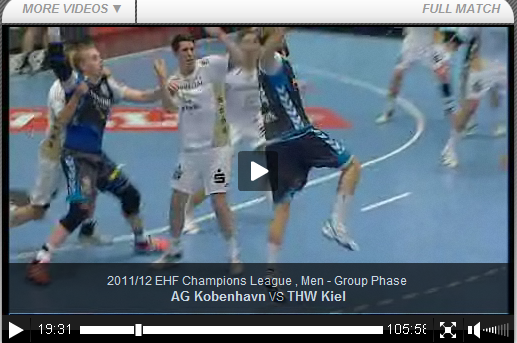
AG Kobenhavn vs THW Kiel: Who will make a statement?

I’ve been remiss in posting links to the EHF Champions League Game of the Week, but having sat down to watch the first few minutes of this match, I thought it was worthy of a reminder.  Quite often the Group Phase of the Champions League can be somewhat boring with most of the teams knowing who’s going through to the knockout stages.  Both Kiel and Copenhagen are in that category, but this match will decide who will place first in their group.  While both sides are likely to win their first knockout pairing, having a first seed in the quarterfinals can be pretty important as it means you will avoid the other #1 seeds.

But, in addition to the Champions League implications this match is interesting in that it’s an opportunity for both sides to make a “statement.”  Kiel has dominated the HBL this year with no losses and barring a monumental collapse they will win the title.  They’ve been less impressive, though, in the Champions League and a win in Copenhagen will make a statement.   And for Danish League leaders, Copenhagen, the same is true as they surely want to make it clear that they are every bit as much a contender as Kiel is.  So, a clash of titans worth watching and a taste of what’s to come in the knockout rounds.

Link to On Demand Video:  http://www.ehftv.com/ec/cl/men/2011-12/video/002111


post

Air Force Basketball (Lessons for USA Team Handball): Lesson #2) Blue Chip Athletes from other Div 1 Sports are harder to come by nowadays

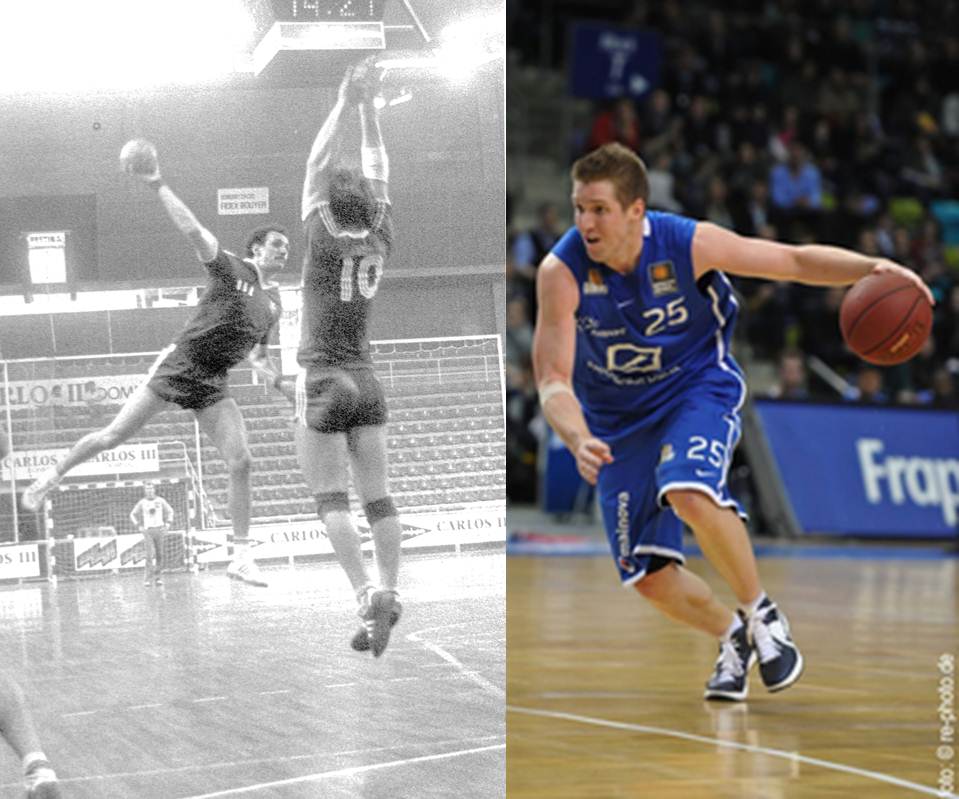
Post Academy sporting careers: Bob Djokovich, 78', with the USA National Team prior to the 84 Olympics and Jacob Burtschi, 07', with his current club, Germany's Fraport Skyliners

In the first part of this series I pointed out that if a downtrodden doormat like Air Force Basketball can execute a remarkable turnaround then it’s possible for USA Team Handball.  In part 2, I highlight how Air Force basketball athletes have contributed to our national teams through the years and what this means for USA Team Handball as it seeks to recruit “blue chip” athletes.

Another Olympics is approaching and I’ll bet you dollars to donuts, that we’re bound to see a few more mainstream journalists discover Team Handball and write a commentary or two about how it wouldn’t take much for the USA to be good at it.  Just get a few of our collegiate athletes to crossover to Team Handball after their career is over in their primary sport and it’s only a matter of time before this great sporting nation will be on the podium.  And it’s not just journalists which often conclude that this is the path to follow.  Here’s a quote from Interim USA Team Handball GM, Dave Gascon in a recent interview touting, A Change in Direction:

“We will no longer be the doormat of the Western Hemisphere.  Simply put, there are thousands of blue-chip American athletes who would love to represent the United States in international competition.  So while we are committed to a grass roots program to develop team handball with the youth our country, we are going to systematically go after those 400,000 NCAA athletes who go professional in something other than their scholarship sport after graduation.

Jeff and I independently came to the same conclusion that we would be foolish to not pursue our country’s best athletes who are in the last year of college or shortly after graduation.  Look, these are some of the most competitive people on the planet and most have nowhere to go to continue to compete at a high level.”

It’s easy to see why a lot of folks come to this conclusion, particularly when they look at the raw physical talent on the rosters of the world’s top teams.  Take for instance, Iceland, the silver medalist at the last Olympics.  They have some decent athletic talent, but they aren’t by any means physically imposing.  Heck, you could probably take any 1 out of 344 NCAA college basketball program in the U.S. and come up with a better crop of raw athletic talent; Doesn’t have to be Duke, Kentucky or Syracuse. Why, you could even take a mediocre (at best) program like Air Force and probably come up with the athletes you need to make a pretty good Team Handball squad….

And indeed, back in 1976 this hypothetical was exercised at a lower level when a group of cadets who played Team Handball intramurals at the Air Force Academy found out there was a club National Championship for the sport in the U.S.  An intramural all-star team was thrown together, composed largely of athletes from the Men’s varsity hoops team and this unknown team showed up at the Club National Championships.  The Air Force team, without the benefit of ever having seen how the game was supposed to be played quickly found out that the version of the game they had been playing in intramurals was only a rough facsimile of the real thing.  Still, they were hands down the most athletic and physically conditioned team at the 3 day tournament.  They adapted quickly and went on to take 2nd place, losing by two goals in the finals to a team that had several athletes on the USA’s 1976 Olympic Team.

So, if you can take a great group of athletes and overnight make them the 2nd best team in the country, I wonder what they might do at a higher level with a little bit more training.  Well, the Air Force team didn’t become the National Team, but after Graduating from the Academy in 1978 two of those players, Bob Djokovich and Tom Schneeberger continued to play handball and were linchpins of the 1984 Olympic Team, arguably the best national team the USA Men’s program has ever had.  If you put together a list of the all-time top American Team Handball players, those two are going to be very near the top of most everyone’s list.  And, I would argue that their handball accomplishments all by themselves means that Air Force Basketball has made the most significant contribution of any one NCAA sport/school to the sport.  (Note:  Another AF Hoops player, 1979 Grad, Randy Gricius, also played on the National Team for a while and would have likely played in the 1980 boycotted Olympics)

But since 1979, while the Air Force Academy has sent several athletes to the National Team there hasn’t been a single player that was part of the Men’s Varsity Basketball team program.  Why has that been the case for the last 33 years?

As an 87′ Grad who coached Team Handball at the Academy from 91-94 and also played service hoops with a couple of talented players I am in a fairly unique position to speak for the 80’s and 90’s decades.  The most glaring obstacle for getting collegiate basketball players to take up handball was a decision sometime in the 1980’s to discourage intercollegiates from playing intramural sports.  This shouldn’t come as a real surprise to anyone who follows NCAA sports nowadays.  Teams aren’t allowed to practice out of season, but players are expected, and most want to, to continue working to improve their skills.

For all practical purposes, though, this eliminated the introduction of the sport and the possibility of those athletes really taking a liking to team handball while still in college.  The only real chance to bring some of those athletes in was in the spring of their senior year after basketball season was over.  At the same time, however, the Academy club was becoming more organized and this meant that the club players even if somewhat less gifted athletically still had a solid year or two of experience on a collegiate player.  A basketball player or any other sport for that matter could join the club, but they would have a steep learning curve.  Not to mention the fact that they would be integrating into a team that had already been practicing together for a couple of years.

But, what about bringing in some of those athletes after graduation?  At that point their basketball options would be limited and even if they haven’t played handball you can’t graduate from the Academy without having seen the game played.  By happenstance, I had the opportunity to play organized service basketball with two former AF players of significant pedigree, Mark Slimko (89) and Chris Loll (95).  Both were about 6’5”, played forward and were team captains while at the Academy.  As a former player on the U.S. National team, I certainly did my best to talk up the sport with them, but neither showed much interest.  Either would have made a great Handball player and Loll, who was left-handed and had been a fairly accomplished high school baseball pitcher and football QB would have a lock.

Such a lack of interest, though, is not too surprising.  While some might jump at the chance to be an Olympian, the reality is that it’s far more likely that accomplished athletes in their early to mid 20s will be starting to think a little bit more about the rest of their life.  This was especially true since back then USA Team Handball couldn’t offer much more then modest dorm lodging, cafeteria food, a chance to travel and a modest stipend.  Being an Olympian has its appeal, but it you’ve already played at a fairly high level in front of large crowds against some top notch competition, toiling away in obscurity for two weeks of Olympic glory just might not be worth it.

Flashing forward to the 21st century and it’s pretty much the same story, except USA Team Handball doesn’t even have the resources for lodging, cafeteria, and a stipend.  Heck, without funding from the USA Team Handball Foundation national team athletes would even have had to pay for their own transportation to recent national team competitions.

To make matters even more challenging collegiate hoopsters now have far better opportunities to play professionally overseas.  This, of course, was always an option, but the conditions and compensation were less enticing.  Bob Djokovich, for instance turned down a modest offer to play for Red Star Belgrade.  Professional basketball in Europe has come a long way with salaries now even getting the occasional NBA caliber player to play in Europe.  From Sweden to Italy and from Spain to Turkey there are leagues looking for players and even players from less prominent colleges can make a comfortable living.  I saw this first hand in France as the over 35 recreational team I played for sometimes had our practices start after the 2nd Div Pro team at our club finished.  Each season there were a couple of Americans from lower tier Div 1 schools that had signed a contract and were living the dream:  An apartment in Paris, perhaps 40K Euros/year and playing basketball for a living.

To continue the Air Force basketball angle I tracked down Jacob Burtschi, one of the key players who helped orchestrate the revival I highlighted in part 1.  He’s now playing basketball for Frankurt’s Fraport Skyliners in the German 1st Division.  It’s not the NBA, but it’s one of Europe’s top leagues and he’s definitely enjoying the opportunity to play professional basketball.  Out of curiosity I asked him a few questions regarding Team Handball and the Academy.  He certainly had seen the sport being played in intramurals, but had not played it.  Now that he lives in Germany, he’s enjoyed watching the German Handball Bundesliga on TV.  And he further assesses that raw talent wise, he might even be a better fit for handball.  Having seen him play hoops, I’d have to concur with this assessment.  He’s a great basketball player, but he’s also got the prototypical handball build.  If he had played at the Academy 30 years ago chances are he would have taken up Team Handball.  Given the current opportunities he has now, though, there’s little hope that we’ll ever see him or other blue chippers like him take up the sport.

While it may be unrealistic to expect that thousands of blue chip athletes will drop everything to pick up team handball it is still indeed foolish not to try.  It will, however, not be easy and it will involve some targeted recruitment strategies and probably looking a rung or two below the true blue chip athlete.  In part 3, I’ll take a closer look at some of these strategies by examining the handball careers of a couple of would be Air Force basketball players whose hoops careers never materialized.

Colorado Springs Gazette Telegraph (26 May 2011): Air Force grad Burtschi gets experience playing hoops overseas: http://www.gazette.com/articles/burtschi-118667-hood-story.html

Colorado Springs Gazette Telegraph (26 Feb 2009): Gazette picks all-time Air Force men’s basketball team:   http://www.gazette.com/sports/career-48873-team-time.html
(Burtschi is in the starting lineup; Djokovich, Schneeberger and Gricius are reserves)

USA Team Handball (18 Jan 2012): A Change of Direction: http://usateamhandball.org/news/2012/01/18/a-change-of-direction/46210

 

post

Why not a Handball version of Linsanity?

Yoon and Miyazaki: How about a handball version of Linsanity

The sporting world discussion in the USA the last couple of weeks has been all about basketball player, Jeremy Lin, and how he has come out of nowhere to lead his team, the New York Knicks, to 7 straight victories.  Cut twice from two other NBA teams, he was pretty much the last player on the bench when injuries forced him into the starting lineup.  Given the opportunity to play he’s been averaging around 25 points a game, exciting fans and has become an overnight nation-wide sensation.  With a short name, “Lin”, the media has been having fun with clever headlines:  Linsanity, Lincredible, Linderella, etc.

What’s made the sport even more interesting and compelling is the fact that he’s an Asian American excelling in a sport at the highest level when Asians are often a rarity at any level.  Other then Yao Ming and a few other 7 Footers, there haven’t been a whole lot playing in the NBA.

As you might expect, the NBA has immediately seen the value in an unassuming Asian American star and the marketing has commenced in earnest.  One analyst has even projected that if Lin continues to play well the NBA will pocket an extra 80 million dollars this year.   And the marketing has become a world-wide phenomenon, with even the BBC’s World Have Your Say, discussing Linsanity.

It’s a shame that Handball doesn’t have some marketable Asian stars that they couldn’t promote the same way.  Well, actually they do have (or have had) the stars that could be promotable, but failed to fully capitalize on the opportunity.  Amazingly, the German Bundesliga’s all-time career scoring leader, Kyung Shin Yoon is a South Korean.  In 12 seasons from 1995 to 2008, Yoon scored 2,908 total goal averaging almost 8 goals/game.  This is a crazy, dare I say, “Yoonique”, anomaly in a league which is probably around 98% white European.     Yet Yoon, who continues to play in South Korea, is probably less known in his native country then Lin is now after two weeks of good play.

On a smaller scale, one of Japan’s best players, Daisuke Miyazaki, played a season in Spain’s Liga Asobal.  Miyazaki had a respectable season, but played in obscurity.  In Japan, he’s 10 times more famous for winning a Ninja Warrior style game show 3 times.

So, I would argue that a couple of opportunities to expand the reach of the game in Asia have been missed.  Yoon, who proved himself over several years, in particular, should have gotten more promotional push in his native country.  Perhaps it would never have been Linsanity, but at least some sizable segment of South Korea surely would have been compelled by one of their citizen’s starring in the world’s best league.

The lesson here is that in the future there will likely be new opportunities to promote non-European stars in Professional leagues and those leagues should be ready to take advantage of the possibilities.  Heck, one could go even farther and assess that they should be scouring China right now for a player that they can develop and promote.  With 1.3 Billion people surely there is a Yoon like athlete that could create handball’s own version of Linsanity.

THN (23 May 2008): 2,908 Goals: The Kareem Abdul-Jabbar of German Handball Heads Home and a Marketing Opportunity is Squandered:  https://teamhandballnews.com/2008/05/2908-goals-the-kareem-abdul-jabbar-of-german-handball-heads-home-and-a-marketing-opportunity-is-squandered/

THN (15 Jun 2010): Daisuke Miyazaki: The Ichiro Suzuki of Handball (or maybe the Kyle Rote Jr.): https://teamhandballnews.com/2010/06/daisuke-miyazaki-the-ichiro-suzuki-of-handball-or-maybe-the-kyle-rote-jr/


post

There is no “WE” when it comes to the global interests of Handball

Competing interests often keep Handball from growing in popularity

Christer Ahl wrote a commentary recently that addressed whether there are too many events like the European Championships on the quadrennial calendar for Handball.  In his view it all came down to the basic question:  For whom and for what purpose do we organize these Championships? And he does a pretty good job summing up the pros and cons along with the basic problems of an overly crowded schedule and the impacts to the players.  That being said he comes up short in a couple of areas that I’d like to further address.

The first area relates to Christer’s liberal use of the pronoun “we”.    In some follow up dialogue, Christer acknowledged that in the interests of time and space he used the word without defining contextually who the “we” was.  In broad terms Christer’s “we” refers to dedicated Handball enthusiasts who enjoy watching the sport and would like to see the sport become more popular.  This is probably a fairly large constituency even if there is no particular organization that directly speaks for these interests.  But, as you delve further into the article, Christer’s bias as an American and former IHF official with a very global view are pretty apparent.  Not to mention, he has a pretty sympathetic ear to the interests of the players.

When all is said and done, it’s pretty obvious that there is simply no “we” when it comes to Handball.  Instead it’s a complicated game of tug of war between competing organizations and interests with alliances that rotate back and forth based primarily (some would say, solely) on the best interests of those entities.  For the uninitiated here’s a primer on those entities.

IHF (International Handball Federation)
– Income sources:  World Championships, Olympics, TV rights and sponsorships
– Power and influence factors:  Controls two prime money making events and the legitimacy of an international federation

EHF (European Handball Federation)
– Income sources: European Championships, Champions League, TV rights and sponsorships
– Power and influence factors:  Controls two prime money making events and the represents the continent with the overwhelming greatest number of fans

Other Continental Federations (Africa, Asia, Pan America, Oceania)
– Income sources:  IHF grants, National Federations
– Power and influence factors:  These Federations to varying degrees have bundled national federations votes for IHF elections

National Federations (Europe)
– Income sources:  National Team competitions, National Club cup competitions, Government backing and sponsorships
– Power and influence factors:   These Federations control the national teams which are the primary products of the top revenue events

National Federations (Rest of World)
– Income sources:  IHF grants (often filtered down through Continental Federations)
– Power and influence factors:  These nations each have a vote in the elections for IHF positions and collectively they can out poll Europe

National Leagues
– Income sources:  Clubs, TV rights for league matches and sponsorships
– Power and influence factors:  These leagues represent the clubs in their leagues.

Top Handball Clubs
– Income sources:  Club matches and sponsorships
– Power and influence factors:  These top Handball clubs pay the bulk of the salaries for the World’s best players

Other Handball Clubs
– Income sources:  Club matches and sponsorships
– Power and influence factors:  While fewer top players play for these clubs these clubs provide the competition for the top clubs and are necessary for the National Leagues to function

Players
– Income sources:  Clubs, also additional minor compensation for national team events and sponsorships/advertisements
– Power and influence factors:  The players are the product.  Without the players there is no Handball

Now, I’ll be the first to state that this is a simplified summary of the different entities that collectively are involved in the Handball world.  It just scratches the surface and even within these different entities there are competing interests.  For instance the German Bundesliga competes against other national leagues and it can hardly be said that every European National Federation is on the same page on a number of issues.

About the only thing that all these different entities agree upon is that it indeed would be a good thing in Handball was more popular.  And I suppose all involved also like watching a good handball match.  But, it’s hard to see common cause going much further than that.  And as with many things in life and politics, these divisions pretty much all boil down to money and the reality that there is only so much money to be divided up.

If you take the specific question Christer asked, “For whom and for what purpose do we organize these Championships?” and ask each of those entities you’ll get a substantially different answer from every single one of them.  That’s because staging a European Championship or World Championship has a tremendous impact with pros and cons for each of these entities.  Changing the status quo, could radically diminish (or even eliminate) some of these organizations.

So, if the current state of affairs is that there is a tangled web of competing interests does that mean this status quo will be maintained on into the future?   Or is there a real potential for some radical change to the status quo.  For change that would increase the popularity of the sport and result in a better product for fans world-wide?

Yes, it’s possible and that will be addressed in a follow up commentary.   If you’re looking for a hint, look at the common thread inherent in each of these entities and then follow the money.


post

No Comment Necessary: USA TV Sports Network Programming during the EC Final

Through the Ice for Monster Pike. Really? Really!

In most European nations there is a Euronews channel that continuously updates and repeats every 30 minutes.  (It’s kind of like CNN’s Headline News, before CNN decided to change it into HLN.)  The last segment is a sometimes quirky 3 minute story devoid of voice over appropriately entitled “No Comment“.  Usually, there’s no comment, because, well because commentary would be superfluous.
In the spirit of “No Comment” I present to you the TV viewing options on all of the major nationwide Sports Channels in the U.S. this past Sunday morning at while the Men’s European Handball Championship Final was being played in Serbia.
NBC Sports Network
1100-1130 Babe Winkelman’s Outdoor Secrets “Through the Ice for Monster Pike
1130-1200 North American Fisherman “Lake of the Woods Houseboats”
1200-1230 The Bass Pros “Brush Piles, Windy Conditions, Enigma Reel”
1230-1300 Bill Dance Outdoors “It Just Ain’t So”
Universal Sports
1100-1300 Alpine Skiing: Men’s Super G World Cup from Garmisch-Partenkirchen, Germany
CBS Sports Network
1100-1130 Inside College Basketball (Encore presentation)
1130-1200 Inside College Baskteball (Encore presentation)
1200-1400 College Basketball:  New Hampshire vs. Vermont (Live)
ESPN
1000-1300 Sunday NFL Countdown
ESPN 2
0900-1300 Australian Open Men’s Final (Tape Delayed)
ESPN 3
1100-1300 Women’s Lacrosse: US National Team vs. Northwestern
ESPNU
1100-1200 Sports Center U
1200-1300 College Basketball Live
post

TV Options for this weekend: Try Team Handball

If the NFL Pro Bowl is the highlight of your TV sport watching weekend you have nobody to blame, but yourself.

Well, it’s that dreaded weekend between the NFL Conference Championships and the Super Bowl.  Two weeks of hype is bad enough, but foisting this farce of a game (the Pro Bowl) on the viewing public adds insult to injury.  I suppose you could watch 20 different NCAA Hoops matchups or the Australian Open.  But, if you’re looking for something a little different this is a great weekend to try Team Handball courtesy of the European Handball Federation (EHF) and YouTube.

The European Championships are wrapping up this weekend in Belgrade, Serbia with matches on Friday and Sunday.  It’s been a fabulous tournament with many twists and turns, and the final four is set to begin.   Friday’s matches take place in the evening in Europe, so unless you’re not working or have a lenient boss it will be tough to take in the matches live in many other parts of the world.

Never fear, though, as the EHF has been posting the complete matches for fans to watch at their convenience.  As soon as they are available we’ll post a link to the video.  This should help to avoid finding out the score, but you’ll still need to be careful for extraneous information like chatter in the comment box.

Friday’s Matches (All Times are U.S. East Coast)

Live Feed:  http://www.youtube.com/watch?v=_6qQZKTxdL8

9:15 AM Slovenia vs. Macedonia (5th Place Match)
This match is for 5th place and a guaranteed spot in an Olympic Qualification Tournament.  These two teams were not expected to place in the top tier of this tournament, but both sides have ridden their “home crowd” advantage as fans from the nearby nations have crossed the border in large numbers to cheer their teams on.  Why, there are so many scarlet and gold fans in the arena one could even think they were in Hilton Coliseum.  Accordingly, Macedonia is a 1 goal favorite.

On Demand Broadcast:  1st Half / 2nd Half

11:45 AM Denmark vs. Spain (Semifinal #1)
Spain waltzed through their group with their only blemish a draw against Hungary.  Denmark, however, lost two of its first 3 matches and looked to be all but eliminated heading into the main round.  They took care of business, though, winning their last 3 matches.  Those wins and a timely assist from Poland beating Germany let them slip in the backdoor.  Spain is a half goal favorite.

On Demand Broadcast:  1st Half / 2nd Half

BE FOREWARNED:  Requests to the EHF to remove video pictures (Smiling players and previews for Sunday) that may give away the score have been ignored.  To avoid finding out the outcome have a sheet of paper ready and click full screen immediately.

2:15 PM Croatia vs. Serbia (Semifinal #2)
Since the breakup of the former Yugoslavia, Croatia has had far greater handball success than its neighbor Serbia.  Croatia may have a better pedigree, but this match will be in Belgrade and you can be certain that the home crowd will be loud and vocal.  It goes without saying that there’s still some strain in the relationship between these nations which fought each other not that long ago both on and off the court.  For a sense of that strain, check out the Once Brothers documentary that’s periodically replayed on ESPN.  This game is expected to be another tight affair with Croatia favored by a half goal.

On Demand Broadcast:  1st Half /2nd Half


Sunday’s Matches (All Times are U.S. East Coast)

8:30 AM Bronze Medal Match
Bronze medal matches are often meaningless, but these two teams will have something to play for as the winner automatically qualifies for the 2013 World Championship while the loser will have to slug it out in Group Play over the course of next season.  A few weekends off are definitely worth fighting for.  (Editor’s note:  Correction; As Spain is hosting the 2013 WC, the other 3 semifinalists have already qualified.  In other words the match is indeed now a meaningless third place match.)

On Demand Broadcast:  1st Half /2nd Half

11:00 AM Gold Medal Match
Not a whole lot needed to be said here.  The winner takes the European title and directly qualifies for the 2012 Olympics.

On Demand Broadcast:  1st Half /2nd Half


post

European Championships: Sorting out the dominoes for Olympic Qualification Tournaments

Where nations place at the European Championships will have cascading repercussion on Olympic Qualification Tournament seeding

In addition to crowning a champion of Europe, the European Championships (EC) will also finish the sorting out of which nations will still have a chance to qualify for the Olympic Games at 3 upcoming Olympic Qualification Tournaments that will be played 6-8 April.  Additionally, the final ranking will also determine which nations will host and which nations will play in each tournament.

As it currently stands the three tournaments are:

1) Denmark (Host), Hungary, Europe #2, Africa #2
2) Spain (Host), Iceland, Brazil, Europe #3
3) Sweden (Host), Croatia, Japan, Chile

However, as Denmark, Spain, Sweden, Hungary, Iceland and Croatia all have a good chance of securing the European automatic qualification slot it’s pretty likely that this current composition won’t hold up.  As it stands only 3 nations (Brazil, Japan and Chile) are locked into a tournament, but even those nations can’t be sure where and against whom they will play.

To further explain let’s break down the ramifications for each of the participating nations

France:  Already directly qualified as the World Champion; France’s final ranking doesn’t count in determining the placement of any other nation.

Denmark, Spain, Sweden, Croatia, Iceland and Hungary:  These nations placed 2nd to 7th at the 2011 World Championships and have already secured an Olympic Qualification Tournament bid.  If any of these nations win the EC or place 2nd to France they will directly qualify for the Olympics and won’t have to play in an Olympic Qualification Tournament.  Should that happen the nations that placed behind the EC Direct Qualifier each move up one spot based on their final ranking at the WC.  This is where it gets a little convoluted for each of these nations as moving up isn’t necessarily a good deal in terms of who you will play against in an Olympic Qualification Tournament.  Breaking it down further here’s the impact of shuffling a spot for each of these nations.

Denmark:  Can’t move up.  They either get the EC Direct Qualification spot or host tourney #1
Spain: Moves from hosting Tourney #2 to hosting Tourney #1
Sweden: Moves from hosting Tourney #3 to hosting Tourney #2
Croatia: Moves from participating in Tourney #3 to hosting Tourney #3
Iceland: Moves from participating in Tourney #2 to participating in Tourney #3
Hungary: Moves from participating in Tourney #1 to participating in Tourney #2

As we’ve pointed out numerous times before, as long as Europe dominates the world of Handball the seeding of these tournaments doesn’t make any sense because the lowest seeded tournament (Tourney #3) only has two European participants.  (Translation:  Unless there is an epic upset by Japan or Chile the two European nations assigned to Tournament 3 are going to the Olympics.  It’s good to be in Croatia or Iceland’s shoes.  Not so good to be in Sweden’s)

Poland:  Poland placed 8th at the 2011 WC, so they have 3 ways of qualifying for the Olympics.  They can 1) win the EC, 2) earn an Olympic Qualification Tourney slot (should Denmark, Spain, Sweden, Croatia, Iceland and Hungary win the EC direct qualification slot) or 3) earn the Europe #2 or Europe #3 slot

Serbia, Slovakia, Germany, Czech Republic, Macedonia, Russia, Norway and Slovenia:  These nations have 2 ways to qualify.  They can either 1) win the EC or 2) earn the Europe #2 or Europe #3 slot.  As the WC qualification slots take precedence over the EC qualification slots there is a sort of mini-tournament among the nations in this group.  In other words, whichever 2 nations place the highest amongst this group will earn the #2 Europe and #3 Europe slots.  (The only exception to this would be if one of these nations wins the EC; at which point Poland would no longer have a WC slot and would join the group competing for an EC slot.)

The first step for these nations will be to make it out of the preliminary rounds.  Once that goal is accomplished their goal will be to finish as high as possible in their Main Round Group.  Of course, the goal will be to advance to the semifinals, but barring that success it’s pretty likely that a 3rd place finish will qualify a nation for an Olympic Qualification Tourney.  A 4th place or even a 5th place may suffice as well or at least set up a 7th or 9th placement match against a nation from the other group for the last Europe slot.

In this regard, the nations in Main Round Group I (Groups A and B) have a distinct advantage over the nations in Main Round Group II (Groups C and D).  This is because Group I has only 3 nations (assuming Poland moves up) that have already qualified via the WC results, vice Group II which has 5.  So by default, the worst one of these nations can place in Group I is 4th.  Projecting results is never safe, but this is why the match between Germany and the Czech Republic is so critical, as could be the matches those nations might play against Serbia in the Main Round.


post

European Championships to have FREE Webstreaming via YouTube

Every Match of the European Championships will be available on YouTube


In the last episode of Handball Talk we hinted that a big announcement concerning viewing options for the European Championship would be forthcoming.  And a big announcement it is as viewers around the world will be able to watch every match, free, live and on demand via the world’s #1 online video delivery system: YouTube

Long time readers of Team Handball News are fully aware of the highs and lows that Handball fans around the world have experienced in regards to webstreaming.  At times it has been Handball Nirvana as fans that previously had no viewing options were suddenly able to watch every match of a major tournament.   Conversely, at times it has been Handball Hell with fans paying a subscription for poor quality webstreams, horrendous audio commentary and non-existent customary service.

It remains to be seen how the YouTube option will work this time around, but showcasing Handball for free on the world’s best known webstreaming platform is an experiment worth trying.

A few notes on the YouTube webstreaming and upcoming matches:

Availability:  The following countries (Denmark, Norway, Sweden, Finland, Germany, France, Belarus, Russia, Israel, Croatia, Iceland, Slovakia, Bulgaria, Czech Republic, Romania and Spain) will be geoblocked from live broadcasts.  According to the EHF website, however, there will be no restrictions for on demand viewing after the match.

On Demand:  For fans that can’t watch live, the EHF has indicated that video of full matches will be available on demand.  It is not clear, however, how soon after completion that the match will be posted for viewing.  Additionally, I have requested that the EHF YouTube interface refrain from posting final scores and pictures of celebrating teams, lest they ruin it for those fans that like to watch oblivious of the outcome.  Hopefully, this sensible request will be met, but be prepared to click on the links with a piece of paper to shield you from too much information.

Audio Commentary:  The EHF will have veteran broadcasters, Paul Bray and Clayton Lewis, providing commentary for some of the matches

Match Schedule:  I strongly recommend that you download the following schedule for reference the next two weeks:  http://www.ehf-euro.com/fileadmin/ehfeuro/EChM2012/Downloads/Match_Schedule_Mens_EHF_EURO_2012_.pdf

(Match times are local for Serbia which is 6 hours ahead of the U.S. East Coast)

Two Key Early Matches:

Sunday, 15 January, 1720 CET, Germany vs. Czech Republic
These two nations are top contenders for the 2 European slots that will be awarded for Olympic Qualification Tournaments.  This match could be pivotal to Olympic Qualification and with the bulk of the Czech team playing in the German Bundesliga these players all know each other well.

Monday, 16 January, 1815 CET, France vs. Spain
This match may set the tone for the rest of the tournament for these two teams.  France is the favorite to win it all and Spain was the only team to blemish France’s record at last year’s World Championships.  (They played to a 28-28 draw)  The loser of this match may very well have to win out if they want to advance to the semifinals.

EHF Announcement (11 Jan 2012): http://www.eurohandball.com/article/014514/Live+streaming+on+YouTube

EHF YouTube Channel: http://www.youtube.com/ehfeuro


post

Handball Talk (Episode 4)


John Ryan and Christer Ahl discuss several topics to christen the New Year.  Highlights include:

– A review of the Women’s World Championships

– Some predictions on the upcoming Men’s European, Asian and African Championships

– The Big Apple tournament and why this unique event isn’t better promoted in the USA

– The apparent “holding pattern” the USA Team Handball Federation is currently in.


post

Air Force Basketball (Two Lessons for USA Team Handball): Lesson 1) Any Program Can Rise from the Ashes

After 24 straight years of no winning seasons the 2003-04 Air Force Basketball team came out of nowhere to post a 22-7 record, a conference championship and an NCAA tourney bid. Could something similar happen for USA Team Handball?

Anyone who has followed the sport of Team Handball in the United States knows that the national teams have had their ups and downs.  Without a doubt it’s been more “downs” then “ups” and it’s safe to say we’re currently in a down phase.  We struggled to even win one match at the PANAM Games and have fallen behind nations like Mexico and Uruguay.  Maybe the bitter reality is that it’s just too hard for the USA to field respectable teams, let alone winning
teams that can compete for medals at an Olympics.  Maybe, but maybe not…

Perhaps just as moribund or disappointing for many years had been the Air Force Academy Men’s Basketball Program.  There are a lot of challenges to fielding a top college basketball team at a military service academy.  These challenges include height restrictions, academic requirements, and a military regimen which severely limits the players that can be recruited.  With the exception of the David Robinson years at Annapolis, no service academy team had ever had great success and Air Force’s high water mark for a long time was the mid 1970’s when several teams posted modest winning records.  Two major reasons for those successful seasons were Tom Schneeberger and Bob Djokovich, who later went on to be Olympians in Team Handball at the 1984 Olympics.

Following Schneeberger and Djokovich’s graduation in 1978, Air Force had 24 straight losing seasons and about the only positive thing that that could be said about the program was that the players tried hard and never gave up, no matter how far they were behind.  Many games played at the Academy resembled church halls in which you could literally count the fans in the stands.  Experts and longtime followers of college basketball all agreed: It was just too hard to win at Air Force.

Then in the year 2000, Air Force hired Joe Scott, a former Princeton player and coach who outrageously thought differently about the whole, you just can’t win at Air Force mentality.  Things at first didn’t seem to be much different.  The team’s record the first 3 years were 8-21, 9-19, and 12-16.  They showed steady progress and I noticed that they weren’t getting blown out quite as often against better teams.   Still, I had my doubts that they could ever get over the hump for a winning season.  Sure they might have been able to win some games against weak non-conference foes, but they still couldn’t beat the top schools (BYU, New Mexico, UNLV) in the Mountain West Conference (MWC).

Then in 2003-2004 a funny thing happened.  Somehow Air Force started winning those games against the teams that had always beaten them.  Somehow, someway, the laughingstock of the MWC won the Conference with a 12-2 record.  My goodness, they even made the NCAA Tournament for the first time in over 40 years!  The tomb that had been Clune Fieldhouse had overnight become one of the toughest and loudest places to play in the country.  There was some nice commentary at the time about what a great turnaround this was, but to those few who actually followed Air Force basketball closely through the years those kind words never even came close to conveying the miracle that had just occurred, seemingly out of nowhere.

How on earth had this happened?  My analysis (from my own observation and others) is that there were four major factors in this incredible reversal of fortune:

1) Better recruiting. Whether it was luck or persistent effort by the coaching staff, Air Force was able to find 5-7 talented players who could play at a high level.  These players were by no means NBA quality players, but they were good players that could compete athletically against their competition.  Through the years, Air Force had always had 1 or 2 players with that talent level.  Heck, I’d argue that a couple of those players were individually even better than the talent that Joe Scott assembled.  But, those players had no supporting cast and opponents keyed on them.  Being able to put 5 good players on the court all at one time made all the difference.

2) A system that stymied opponents.  And that system was the so called Princeton offense which slowed down the game and relied on passing and 3 point shooting.  Air Force executed this offense to perfection and teams weren’t used to playing it.  That season Air Force was able to sneak up on opponents who weren’t sure how to defend it.

3) Opponents that were in “down” years.  The MWC would never be mistaken for the ACC, but on the whole it’s usually a pretty good basketball conference.  It was fortunate timing that the golden era of AF basketball coincided with just about every other side in the conference going through a down phase.

4) Players that simply believed in themselves and the system.  Sometimes teams lose just because of the names on their jerseys.  Losing begets losing and sometimes everybody (coaches, fans, officials, opposing teams) starts expecting a particular team will lose.  Changing such a culture or vibe is often easier said than done.  When such a change occurs, though, it’s usually because a committed group truly starts to believe in themselves and what they can do.

So, what are the lessons here that can be applied to USA Team Handball.  Let’s go with the 4 reasons behind Air Force’s turnaround and see if they can be applied to Team Handball.

1) Better Recruiting:  Nothing against the hard working men and women who are currently playing on our National Teams, but most of our current athletes are a step down in raw athletic talent when compared to their current competition.  This is particularly true for the women and partially true for the men.  And to be fair, it’s probably always been true with our National Teams to a certain extent.  The U.S. has often been a player or two short of being good enough to beat the good teams.  The need for better recruiting is a no brainer, but how do you go about it?  This will be a topic for part 2 of this series.

2) A system that stymies opponents:  Is there a Team Handball equivalent of the Princeton Offense?  For the most part national teams from the developing Handball nations have tried to emulate the successful teams in Europe.  They hire European coaches and the European coaches naturally seek to build a European style team.  There is, of course, some variance among the teams in Europe as some nations play a little more of a fluid game with fast breaks while others are more focused on defense and a half-court game.  So getting back to the question, I can think of only one example where a nation has developed a style of play or system that stymies opponents:  South Korea.  The South Koreans, particularly the women, play a helter skelter style of play which takes maximum advantage of their quickness and limits their size disadvantage.  This pretty much always gives the Koreans a slight edge when they play European teams because while they are accustomed to the European teams have to totally adjust their game.  Is it just a coincidence that the Koreans have also been the most successful non-European nation, even though the sport is
still a minor one in their country?  Maybe the U.S. should look across the Pacific instead of the Atlantic as it tries to develop its own style?

3) Opponents that were in “down” years.  Well, you can’t very well control what your competition is doing.  You can, however, take advantage of it.  Looking at the Pan American region it’s fairly apparent that the men’s teams are surging in quality while the women’s teams, with the exception of Brazil, are clearly in a down phase.  Starting from scratch, it’s entirely possible that the U.S. could put together a brand new Women’s team that could get 2nd place (qualifying for the 2016 Olympic Games) at the 2015 PANAM Games.  The Men could still qualify, as well, but their competition as it stands now is clearly tougher.

4) Players that simply believe in themselves and the system.  I can’t get into the psyche of our National Team players, but I suspect that both the Men’s and Women’s team have not fully formed the type of bond that only comes about through time and shared sacrifice.  They will need more matches and some stability in the program in order for this to happen.  And then they will need some matches where they play some teams close and see for themselves that they aren’t that far behind and where they need to get better.

So, if Air Force basketball can suddenly be successful after years of failure, I would argue that even USA Team Handball can turn it around.  It won’t be easy, though, and most importantly it’s not clear whether USA Team Handball will have the minimum resources needed to execute such a turnaround.  As the current budget stands now there is nowhere near enough funding to recruit, train and provide players a national team structure to allow them the
opportunity to succeed.  With adequate resources, though it could definitely happen.

In part 2 of this series, I’ll assess the feasibility of recruiting athletes with successful collegiate careers in other sports and transitioning them to Team Handball.  As the title implies, there’s an Air Force Basketball connection.