It’s a Boxing Day edition of USA Handball Talk and we take a deeper dive into the challenges the U.S. Women’s program faces. Discussion points include:
Why it will be tough for the U.S. Women to duplicate the success of the current U.S. Men’s team
Why there isn’t time now for a grass roots solution
Three different paths forward for the U.S. Women
The need for USA Team Handball to make a decision on the path forward
Why a decision to focus on transfer talent athletes will require a lot of planning
Why a transfer talent focus will need credibility and quality to successfully recruit athletes
Could a reality show documentary simultaneously fund a talent transfer program and provide great promotion?
We didn’t solve anything, but there was lots of great discussion and we addressed a lot of issues. Let us know if we missed any key issues that you would like to see us address.
Watch or listen/download the mp3 file at the top of the page
If you have any suggestions for future topics, a title for our podcast or have some intro music you would like us to consider please let us know on social media.
Don’t miss an episode:
Subscribe on YouTube: Link (Earliest Availability)
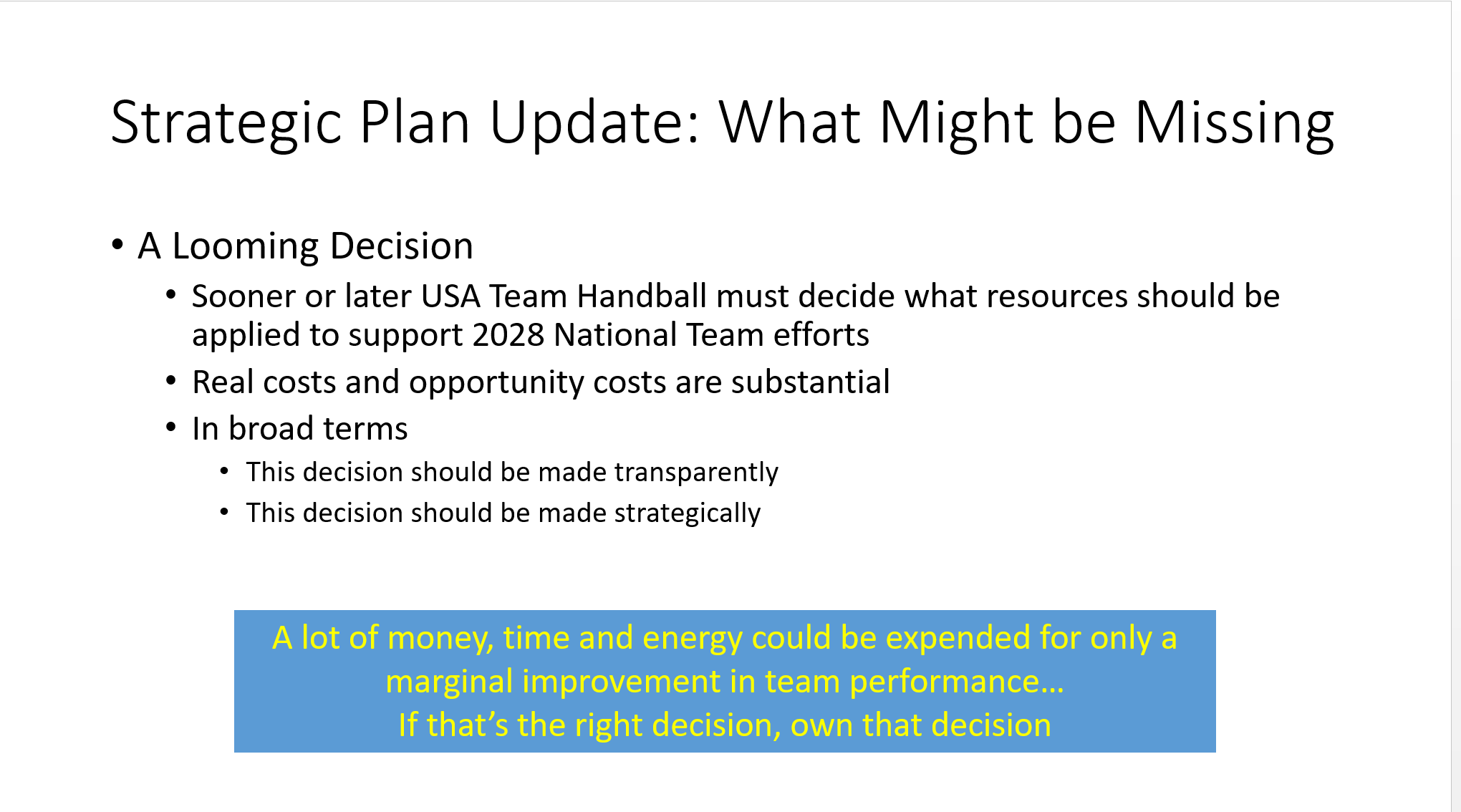
My final walk off slide in a presentation I gave to the USA Team Handball Board of Directors in October of 2022. This difficult and challenging decision shouldn’t be delayed any longer.
Decision Making Processes
Making decisions can be pretty hard especially when they impact a lot of people and have far reaching consequences. Inevitably, there are winners and losers and some unhappy people Sometimes making the decision can be so hard that people avoid making the decision altogether. Occasionally, delaying the decision is the smart move. This happens when the problem goes away or gets solved in some unexpected way.
But, more often than not, delaying the decision… ends up becoming a decision in and of itself. This is because inaction and the passage of time starts to eliminate posssible courses of action. Anyone who has ever been assigned a school project knows this. Start working on it early and you can consider the pros and cons of multiple courses of action. Why, you can even start over if something goes wrong. But, if you procastinate you end up with fewer choices and might even have to take a risky shortcut to get the project done on time.
The Big Decision: What Resources should be Applied to Support our 2028 Olympic Teams?
This is a broad and a pretty open ended way to identify a complex problem that needs to be decided. As I highlighted in the introduction (Part 1) to this series there are a lot of sub questions that have to be asked and answered before you can begin to decide the answer to the top level question. Partner related questions in terms of what is expected for U.S. performance. Philosophical questions regarding whether a special program should be started. Questions regarding the feasibility of “out of the box” solutions. And, on and on…
Inaction, the De Facto Course of Action?
Best that I can tell, no one is really tackling these questions. Not the board. Not the administrative staff. Not the coaches. Instead everything seems to be proceeding with a business as usual approach. I say “seems to be” because maybe there is a lot of work going on behind the scenes. But, if that is true it’s being done very quietly with little transparency. Here are some outward signs that point to to not much being done:
Lack of Board Meeting discussion: I listen in on board meetings and there’s no discussion of these topics or hints that it’s being discussed in Executive Session. Maybe there is in depth discussion and debate in the executive session. That new plans and initiatives are being reviewed, hotly debated and will be announced soon, but there’s little to suggest that is the case.
No website or social media posts discussing new initiatives. Website and social media posts regarding our national teams have been pretty much standard stuff highlighting training camps and competition. Newcomers to the sport are invited and encouraged to attend camps, but there doesn’t seem to be any organized and structured effort to effectively target and recruit new talents. Just an invitation (plea) to please show up if you’re so inclined. And, for sure there’s no talk of a realistic follow on training path for new athletes.
No discussion of National Team planning in the community talks forums. USA Team Handball conducted a series of “community talks” on a number of different topics, but the national team topic was simply a forum for current national team athletes to discuss how things could be done better. I’m not saying that such a discussion isn’t a good idea, but the lack of a broader topic to address national team planning implies that topic was either not worthy or something where community input wasn’t desired.
The U.S. Men’s National Team: Good Fortune Means a Relatively Easy Decision
Remember when I highligted that sometimes delaying the decision is the smart move? That sometimes the problem just goes away or is solved in some unexpected way? As I’ve highlighted on numerous occasions our men’s program has been gifted with a golden generation of dual citizens that has resulted in a competitive national team winning already capable of winning matches at a World Championships. They are also for the most part pretty young and this means we’ve already identified 95% of our Olympic team. This required no resources whatsoever being spent to identify and recruit new athletes. None! We essentially did no studying, no preparation and got a B+ for filling in our name on the test score sheet. This is crazy, good fortune for the U.S.
That said, all is not perfect. We may already have a competitive team that will not embarrass, but taking the next step and winning matches against top teams will be a huge challenge. While I think our current team can close the gap and pull off the occasional upset, I don’t think we can improve to the point where such wins are commonplace. And, I don’t think we’ll be able to add very many (if any) new athletes to the pool that will take us there in 4.5 years time.
In my opinion, to actually add some new athletes that could contribute to our current men’s national team in a relatively short period would require a very well resourced program with good training and competition opportunities. It would not be cheap and I would assess that even it were to be spectacularly succesful it might not change how well the U.S. Men ultimately perform in terms of wins and losses. In short, it would not be very cost effective and there are better ways USA Team Handball could spend resources.
So if a special program is not likely to have significant impacts, deciding the proper course of action for the U.S. Men is a pretty straightforward decision. Just keep on doing what we’ve been doing. Maybe there are a few tweaks here and there that could be implemented, but for the most part we should just count our lucky stars and focus on other challenges. Of course, that’s just my opinion. The USA Team Handball Board of Directors, the administrative and coaching staff should still review the pros and cons of alternative approaches and come to a conscious decision. They really should… But, if they don’t do that for some reason, the good news is that just “keeping on, keeping on” is probably (almost certainly) the right decision anyway.
The U.S. Women’s National Team: A Very Thin Talent Pool Means that it’s High Time to Start Making Decisions
Alas, the U.S. Women’s National Team is not the U.S. Men’s National Team. This was true when I wrote these assessments (Overall demographics, Women’s National Team player pool) in 2019 and it’s even more bleak as I write this in 2023. We have maybe 150 U.S. American citizen women world-wide that play handball. And, we have a dual citizen contingent on the women’s side, but it’s a smaller group and, as luck would have it, it’s not a golden generation.
As I wrote in part 1 the results the past 4 years have been dismal. For new context, this past summer Greenland beat the U.S. 27-12 at the NORCA Championships and Greenland just finished 32nd out of 32 teams at the 2023 World Championships losing all 7 of their matches by an average of 14 goals. On the positive side of things are U20 Women’s team just missed out on winning the NACHC IHF Trophy event and qualified for the Jr World Championships. Winning sure beats losing and I think there are a few athletes with potential, but this was also a pretty low level competition. Two years ago the U.S. and Mexico met for 31st place at the Jr World Championships. With 32 team fields now there are quite a few weaker teams in these competitions, but NORCA is probably still the weakest continent so this rematch could well happen again next summer.
I’ll just restate the really big disclaimers here. I’ve got no qualms with the efforts of our athletes. They are making big sacrifices and doing the best they can. The same goes for the coaches and the coaching they are doing. Again, they are putting a lot of effort into gettting the best performances they can from the athletes they have available.
The desire and effort are there, but there simply are too few athletes with the potential to compete at a much higher level. With the current athletes available this team can get better, but not a whole lot better. If nothing is done to fully address our very small talent pool, come LA 2028 we will field a very uncompetitive team. How uncompetitive? I won’t speculate fully, but we would be talking some really bad scorelines.
I’ve been around long enough to know that predicting the future is a somewhat perilous business. But, I don’t think this a very tough call. And, wow, I would be super happy to be totally wrong. If so, I will take full credit for the bulletin board material I’ve provided,
Intervention is Coming… Sooner or Later
It’s very unlikely, though, that we would ever get to the opening match in 2028 without some sort of intervention. This is because there will be steps along the way where progress or a lack of progress will be measured. In just two years time the USA Women, thanks to a promised wild card entry, are slated to compete at the 2025 World Championships. This will be a coming out party on the world stage that will hopefully show signs of progress and signs of promise. If, however, it doesn’t one could well see pressure being applied for USA Team Handball to… do something.
And, at the same time as we move closer to the Olympics interest from athletes looking for the chance to be an Olympian will more and more see handball as their opportunity. It’s always a hotly debated topic as to just how quickly a great athlete can be turned into a credible handball player. Inevitably, the discussion boils down to many variables such as the quality of the incoming athlete, the commitment of that athlete, and how that athlete would be trained. And, of course, the quality of the existing athletes that the would be new athlete would theoretically replace.
But, for context, as we discussed on a recent podcast, Katie Timmerman, a recent college graduate who played basketball for D-II, Concordia University, Irvine managed to play significant minutes for the U.S. national team after only a couple of training camps. A quick look at her career stats suggests a respectable career at the D-II level, but nothing to suggest an all star with overwhelming raw talent. And, nothing against D-II athletes, but on the whole, D-II competitions are a significant step down from D-I. In short, it doesn’t take a whole lot of imagination to speculate what might happen if we got 20 D-1 athletes to attend a training camp with the LA Olympics approaching.
I Vote Sooner
So, if intervention is coming sooner or later… I vote sooner. And, accordingly, spending the bulk of time and energy towards creating the structures to identify, recruit and train new athletes. Four and a half years is not a lot of time, but it is enough time to put together a decent competitive team. And, avoiding or delaying such a move might result in trying a quick fix in too little time.
It’s also feasible to a certain extent to take a multi-prong approach whereby the current athletes are trained up at the same time the search for more athletes takes place. But, only to a certain extent. For starters, resources aren’t unlimited and a concentrated effort focused on new athletes will take time and money. And, as I’ve alluded to if you’re focused on finding new athletes… what are you really doing with the athletes that you’re essentially trying hard to replace? It’s a mixed message at best and a conflict of interest at its worst.
Time for USA Team Handball Leadership to Step it Up: Make a Decision and Own that Decision
Of course, I don’t have a vote… just a voice. Over a year ago, I briefed the USA Team Handball Board of Directors on the need to update the organization’s outdated strategic plan. My final walk off slide highlighted a looming decision that the board would sooner or later need to take.
I don’t remember every word from my presentation, but I implored the board that this was a major decision that they had to weigh in on because the path chosen had such far reaching consequences for the organization. That it was an order pizza, tell the family you would be home late kind of discussion. And, that the right decision might not necessarily be the most financially prudent or least risky path.
Maybe the right decision is to say: “No, we are not going with an artificial solution that requires a lot of resources to convince people to play handball. We don’t have the resources and in the end it won’t change the outcome significantly enough to merit the costs involved. We’re going to go with what we’ve got.” To which I say: “That’s fine with me. Just make it clear that is what the board has decided and own that decision.”
If the decision is to take a half and half approach: Then explain why that has been decided and how limited resources can be effectively applied to each half. Again, own that decision.
And, if the decision is for an approach that focuses on new athletes: Articulate that decision and develop a plan to make it happen… And, own that decision.
I think everyone can see where I’m going here. Sometimes all a board of directors has to do is put their stamp on a fairly stable situation. Where the course of action is fairly obvious. (Like lowering membership dues to match a competing organization) And, sometimes a board needs to step in a make a major strategic decision: To choose which fork in the road to take.
The looming decision is no longer looming. It’s staring us right in the face: It’s time to make a decision.
What might efforts to broaden the talent pool look like? In future installments I’ll take a look at some possible options and the challenges associated with implementing them.
1996 Handball Olympian, Denny Fercho suffered a massive stroke a year ago and is making great progress with his recovery. Please consider a donation to help with his medical and therapy bills at this Go Fund Me Campaign: Link
A very brief recap of this past weekend’s IHandball Tryout and the Samala Cup
A review of the 2023 Jr Women IHF Trophy/NORCA Championship
A recap of the 2023 IHF Women’s Handball Championships
A discussion on the current state of the USA Women talent pool, how it will likely change as we get closer to the 2028 Olympics, and the apparent lack of a plan to take that future fully into consideration
Watch or listen/download the mp3 file at the top of the page
If you have any suggestions for future topics, a title for our podcast or have some intro music you would like us to consider please let us know on social media.
Don’t miss an episode:
Subscribe on YouTube: Link (Earliest Availability)
Ohio State Handball Coach, JD Orr and I are introducing a new podcast focused on handball in the U.S. In our first episode we cover the following topics:
The IHandball initiative in Columbus, Ohio which includes weekly matches and a U24 Developmental Team
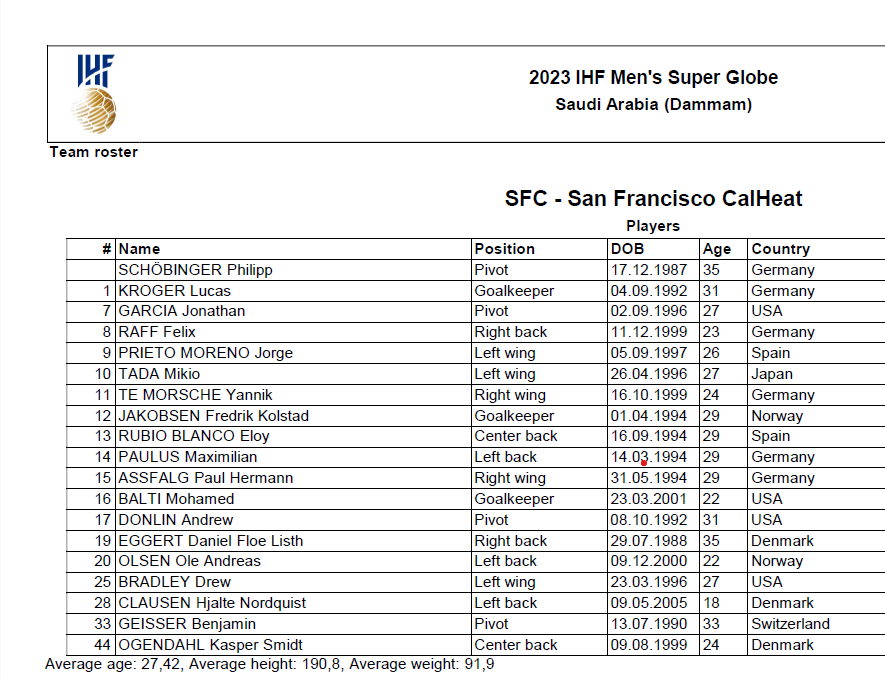
Commentary on the San Francisco CalHeat SuperGlobe roster: Link
Watch or listen/download the mp3 file at the top of the page
If you have any suggestions for future topics, a title for our podcast or have some intro music you would like us to consider please let us know on social media.
Don’t miss an episode:
Subscribe on YouTube: Link (Earliest Availability)
In the coming weeks I will be posting some commentaries that will assess our current athlete talent pools and what steps should be taken to broaden and improve those talent pools. While it’s been a few years since my playing days those experiences are still fresh in my mind and very much shape my perspective. As such, here’s a look at my unremarkable handball career on the fringes of the U.S. National Teamand how it’s relevant to our current national team talent pools.
Olympic Festivals: The Old Stepping Stone between Clubs and the National Team
There hasn’t been an Olympic Festival since 1995 so that means a lot of people either have no idea what they were or just an inkling that it was some sort of event where handball was played back in the day. While the latter is true it doesn’t quite do justice to how important Olympic Festivals were for both USA Team Handball and the athletes that played in them.
Basically, Olympic Festivals were like a mini Olympics for the U.S. with athletes representing teams from the North, South, East and West regions of the U.S. Pretty much every Olympic sport was played and then some. There was even a pretty decent opening ceremony with entertainment and an athlete march in to the stadium.
Aside from the pageantry they were 2 weeks long with a lot of training and matches. Rosters were 16 athletes and with 4 teams and 2 genders that was 128 athletes. And, it was entirely paid for by the U.S. Olympic Committee. That’s travel, room, board and attire for athletes, coaches and referees. That was quite a deal for NGBs like USA Team Handball.
And, Olympic Festivals were a really good deal for the participating athletes as they were a great opportunity to demonstrate your potential for national team consideration. Depending on the national team training/travel schedule the national team would participate so teams were typically a mixture of national team veterans, newcomers to the national team (often crossovers from other sports) and club athletes. So, if you thought you were national team material… you had 2 quality weeks of training and competition to demonstrate that.
Cut from an Olympic Festival Team and then Starting at the World Championships 20 Months Later… Never Let anyone Tell you that you’re not Good Enough
I’ve told this story more than a few times and it can be spun multiple ways. Here’s the persistence pays off, coaches don’t know jack, serendipity version.
After I graduated from the AF Academy in 1987 I was assigned to Edwards AFB in California and I played with the Condors club team that was then based in Ventura County. I used to make 4 hour round trips there for practices which seems crazy, but if you live in the middle of nowhere you get used to driving long distances. I was a solid club player and was selected for the 1989 and 1990 West Festival Teams. I did alright during the 89 festival and with the national team largely absent in 1990 I had my chance to really shine. I played pretty well in group play, but in the gold medal match I played a stinker of a game, missing several shots in a close match.
A year later when it came time for the 1991 tryouts I had premonition that maybe my handball career had played itself out. I was 26 years old and I had never been invited for a national team tryout. While I though I had potential and would do well given the opportunity, the powers that be clearly didn’t think so. And, my premonition was confirmed as I didn’t make the cut. I still remember driving home bitterly complaining of my non selection and at the same time contemplating what to do now that my Olympic dreams were over.
And, then a few months later I called up the Air Force Personnel Office to ask when, if ever, they were going to reassign me. At the time all personnel moves were on hold and I was expecting the same old, same old, “Sorry, maybe next year” response. Except this time, the response was, “Wait a second, what did you say your name was again?” followed by a shuffling of papers, and “Hey, you got orders to report to Peterson AFB in Colorado Springs in 45 days. You don’t know about this?”
Without knowing or requesting it the Air Force had decided to send me to where the national team residency program was. Not that I thought I would just show up and train with the national team, but it was nice to already know a few people where I was headed. Except that’s kind of what happened. The guys on the team said I should come to a practice and talk to the coach. Which I did. He was more than happy to have a decent, but not great athlete to round out the team. And, then I just kept coming to practice and getting a little bit better every day. And, over the course of 15 months I went from a warm body to practice against to starting on defense at the 1993 Handball World Championships.
A heartwarming story of perservance, serendipty and the reality that coaches that tell you that you’re not good enough don’t know what they are talking about. Just keep working hard and you’ll get there!
Every Athlete has a Ceiling: Here was Mine
(John Cusack on the 7th and a half floor in “Being John Malkovich.” In retrospect, I also had a low ceiling to work with.)
Well, that’s one way to spin it. Certainly, it’s the way I’ll tell it after I’ve had a couple of beers. While persistence is usually an admirable trait and it’s funny how important a role luck sometimes plays in the twists and turns of life… the reality is that the coach who cut me made the right decision. Far removed from that day and having watched and evaluated dozens of national team athletes over the years it’s pretty obvious to me.
I was a hard working, determined athlete with decent skills, but with limited future potential. Don’t get me wrong… I was pretty good at some things. Defending on the 6 meter line in a 6-0 defense, directing traffic and blocking long range jump shots… I think I did that as good or better as anyone I ever played with. But, playing the middle in a 3-2-1 with more ground to cover side to side? Not so good; adequate at times, but brutally exposed against quicker, world class athletes. (Read how HBL MVP, Michael Kallman exposed me) And, that’s just on defense. On offense, I was a good circle runner for a U.S. club, but on a national team level I never really got there for a number of reasons.
Don’t get me wrong… I had gotten better practicing regularly for 1.5 years in a structured environment. Good enough to start on defense at a World Championship, but I had now come really, really close to my ceiling as a handball athlete. I just wasn’t going to get much better. I didn’t want to believe it at first, but I eventually came to that conclusion with a little help. While, I could have gotten out of the Air Force and stretched my career a little longer in all likelihood it was just a matter of time before more gifted athletes would have beaten me out.
Small Talent Pools and How they Warp Athlete Ceilings
So what’s the point of this trip down memory lane? Well, it’s to illustrate how the size of a talent pool can really warp athlete ceilings. This is because your ceiling as an athlete isn’t just dependent on improving your abilities as an athlete. No… you can greatly improve your chances of success simply by choosing to compete against a smaller talent pool.
This is something that EVERY stateside handball athlete knows. And, this is because as far as I know EVERY stateside handball athlete has crossovered to handball only after they’ve reached their ceiling in a previously chosen sport. Not most athletes… EVERY SINGLE ATHLETE. This ceiling comes at different times for different athletes. Sometimes during high school, sometimes post high school and sometimes post college. But, make no mistake that ceiling comes for every athlete. Some folks play handball just for fun, but many athletes also see the smaller talent pool and they also see opportunity. Opportunity to play at a national team level and maybe even go to an Olympics.
For the most part, there’s nothing wrong with that. It’s actually a great carrot to bring more people into the game. Because while some folks start out looking for Olympic glory and vanish as soon as they figure out they can’t get there, others fall in love with the sport, stick around and help grow the game.
Where it starts to become a concern, however, is when the overall quality of the athlete talent pool is simply too low to field a “competitive” team in international competition. A national team can still be “competitive” with a few athletes (like me on defense in 1993) with low ceilings playing complimentary roles. But, when the bulk of the roster is populated with athletes with limited potential and the team is not competitive it’s really problematic.
In the coming weeks I will take a closer look at that problem and what should be done to address it. I suspect in doing so I may upset a few people. So be it. Hopefully, at least a few may now understand that I also know firsthand what it’s like to be told that you’re not good enough…
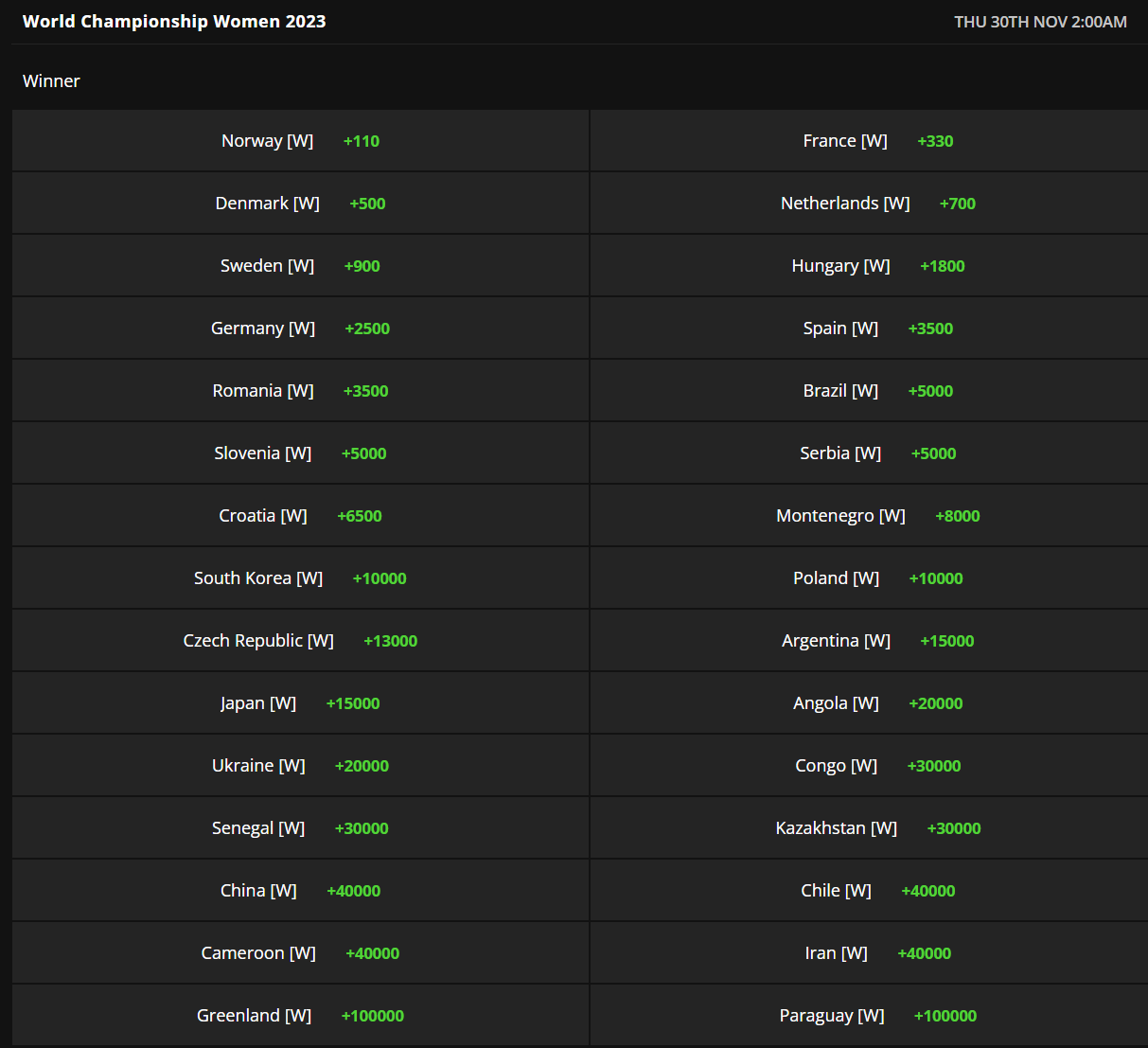
The 2023 IHF World Women’s Handball Championship will start this Wednesday, 29 November and will conclude on Sunday, 17 December. Here is some information on streaming, how to follow the tournament, and who the sports betting sites have favored to win the tournament and premliminary groups.
Streaming / TV
Your options for watch the 2023 Handball World Championships will vary depending on where you live. Some nations will be able to watch all the matches on the IHF YouTube Channel while other nations will have all or some of the matches available on a TV Channel and/or streaming to which the rights have been sold. This IHF article outlines how to watch in each nation: Link
Nations without a TV Contract: IHF Competitions YouTube Channel: Link
USA: ESPN will be airing up to 4 matches each day on their Watch ESPN platform which is accessible to anyone who subscribes to ESPN via Cable, Satellite or Streaming Service. (Important Note: This does not require an ESPN+ subscription. Further it will not be available on ESPN+. To watch the Handball WC you will need a traditional ESPN Subscription)
Watch ESPN can be watched on your TV, laptop or phone. Personally, I watch it via my ESPN app on my Roku, but there are multiple options. Typically, the first time you go to watch something, you will be asked to verify your account so have your username and password ready.
Matches are now being populated on the schedule page and can be found under the ESPN3 Channel. If past history is a guide ESPN will also add a handball logo and a 2023 WC logo to help find the matches. Additionally, matches will likely show up on the main page, but only a few minutes before the match starts.
Canada: There is no TV network so all matches should be available on the IHF YouTube page: Link (Note: This makes Canada a good VPN choice)
VPN: Based on previous WCs, a Virtual Private Network (VPN) will likely provide access to matches that are not available on ESPN. For more information on how to use VPN check this article out: Link
Spam Sites: You’ve surely seen the multitude of social media postings inviting you to watch the match on their “free” service. (These folks are relentless with their spamming) Don’t even bother with these sites. They typically will ask you to download a video player on your computer. Trust me… you don’t want that app on your computer and in all likelihood they won’t even have the match. Go with the provider in your country or VPN.
How to Follow the Competition
Competition Wikipedia Page: Link (For simple, easy to find schedule, results and standings Wikipedia is the place to go)
IHF Competition Page: Link (Official Stats and match summaries)
San Francisco CalHeat recently picked up the first ever USA and North American club victory in IHF Super Globe history as they took down the University of Queensland, the Oceania representive, 27-22. This was celebrated on the IHF and USA Team Handball websites as an historic first ever victory. Is it still historic if only a handful of the atletes are American citizens and only 1/3 of the athletes on the roster live anywhere near San Francisco? Maybe… but I can’t get very excited about it.
Before I explain fully why I feel that way I think it’s appropriate to identify a few caveats and a few realizations that I’m a bit of an old timer hyprocite. Here they are:
I doubt that SF CalHeat and several other U.S. clubs are breaking any IHF, NACHC or USA Team Handball regulations. (Maybe those regulations should be changed, but that’s a whole other issue.)
Boosting club prospects by bringing in mercenary athletes from other locales is nothing new. I’ve even done it myself, inlcluding the 2004 USA National Championships when I played for the Atlanta based Condors while I was living in France. (CalHeat is taking this practice, however, to new extremes)
I don’t blame athletes for jumping at the opportunity to play in an IHF Super Globe. Heck, I wonder how crazy recruitment would have gotten back in my day if a similar opportunity had existed.
A critique of this mercenary team doesn’t denigrate great CalHeat initiatives like their support to youth development
So with these caveats out of the way let’s take a deep dive into the roster
The SF CalHeat 2023 IHF Super Globe Roster
The information below was compiled from the official IHF Super Globe roster, IHF Super Globe stats, social media accounts, google searches and other sources. I’m not 100% certain as to where everyone lives and there might be some errors. (Translation: everything you find on the internet isn’t always accurate)
Left Wings
Jorge Prieto, Spanish, 3/8 shots <Lives in Spain, plays for CB Torrelavega>
Mikio Tada, Japanese, 1/4 shots <Lives in SF Bay Area>
Drew Bradley, American, 0/3 shots <Lives in SF Bay Area>
Left Backs
Ole Olsen, Norwegian, 13/34 shots <Lives in Norway, attended SF State for a semester>
Hjalte Clausen, Danish, 1/3 shots <Lives in Minnesota>
Max Paulus, German, 1/1 shots <Lives in SF Bay Area>
Center Backs
Eloy Rubio, Spanish, 6/16 shots < Lives in Spain, previously lived in SF Bay Area>
Kasper Ogendahl, Danish, 9/17 shots <Lives in SF Bay Area>
Righ Backs
Felix Raff, German, 22/42 shots <Lives in Germany, Plays for HSG Leinfelden-Echterdingen
Daniel Eggert, Danish, 7/13 shots <Lives in Germany>
Right Wings
Paul Assfalg, German, 7/11 shots <Lives in Houston>
Yannick Te Morsche, German, 0/4 shots <Lives in Germany, Plays for TuS Lintfort>
Circle Runners
Drew Donlin, American, 14/24 shots <Lives in Los Angeles>
Benjamin Geisser, Swiss, 10/17 shots <Lives in Switzerland, Played for St Otmar, now retired>
Jonathan Garcia, American, 2/3 shots <Lives in SF Bay Area>
Goalkeepers
Lucas Kroger, German, 22/92, saves <Lives in Germany, Lived in Miami previously>
Fredrik Jacobsen, Norwegian, 25/61 saves <Lives in Norway, Attended Cal Berkeley>
Mohamed Balti, American, 1/21 saves <Lives in SF Bay Area>
Takeaways
Here are some takeaways from this roster
22% (4 of 18) athletes have American citizenship. Complaints that some U.S. clubs have too many expats on their roster are nothing new. And, the U.S. is not the only country where this is a concern. German national team coaches have complained that there are too many foreigners on HBL rosters and that this is limiting the development of German athletes. Why even Kielce, who CalHeat played in group play, has just 47% with Polish citizenship on their roster. That said… Kielce is a professional team. I doubt very much that lower level, amateur clubs in Poland have rosters with a high percentage of foreign athletes.
33% (6 of 18) athletes live in the San Francisco Bay Area. Complaints that some U.S. clubs have only a limited connection to the city they claim to be from are also nothing new, but CalHeat has clearly taken this issue to a new extreme. While some athletes on the roster have a connection to San Francisco in that they lived there previously this is a tenuous connection at best. And, worse, I suspect that some athletes on the roster have never even set foot in San Francisco. Finally, for context… I’m guessing with a high degree of confidence that everyone on the Kielce roster lives in the Kielce area.
14% (13 of 96) goals were scored by San Francisco Bay Area teams. I highlight this stat as a proxy for the relative contributions of the local athletes vs the merenary additions. It’s an imperfect proxy, but nonetheless it points to the reality that without mercenaries this club would likely have lost to Queensland and would have been really clobbered by the other clubs participating. Further, such a team would probably have lost to the clubs at the NACHC Club Championships and would not have qualified for the IHF Super Globe in the first place. I can’t say for sure as the rosters are flexible and there’s nothing that prevents clubs from other nations also bring in mercenaries of their own. Again… I don’t think anyone is breaking any rules.
Minimal Promotional Value and Unintended Consequences
There are some common refrains I often hear when I point out the problems with initiatives like this. The most common one I hear is along the lines of, “Yeah, it’s not perfect, but it’s important to promote handball in the U.S.” There is a kernel of truth to this… but, just a tiny kernel. That’s because the promotional value is so minimal. Maybe a 1,000 people in the U.S. (already handball fans) are even aware that a U.S. club is participating in an International club tournament. I guess if the goal is to give the world-wide handball community the impression that great progress is being made by having a “handball club from San Francisco” taking on the rest of the world… Well, you can fool some, but people are smarter than you think.
And, in this case the consequences are more than just inadequate promotion. Indeed, if the goal is to support handball development in countries like the U.S. the IHF Super Globe is actually having a negative effect. This is because good intentions (providing amateur clubs with a mostly paid for trip to take on the world’s best pros) has had the unintended consequence of super charging the incentive for amatuer clubs to boost their roster with mercenaries. While a club might prefer to simply go with the local athletes that practice with the club on a regular basis… if they really want to win they’ll need to expand their roster with athletes that have nothing to do with local development.
Addressing Mercenary Teams
Addressing “merencary teams” might seem rather straightforward, but it’s more complicated than you might think. Broadly, there are 2 ways of discouraging clubs from acquiring mercenary athletes:
1) Legislate them away. Basically, this involves adding regulation requirements for citizenship and/or locality. Clubs in Europe have done this for many sports. Many countries had or still have rules that limit the number of American basketball players. Even handball has them as I know France limits the number of non-French citizens on lower level teams. Nationality enforcement can be done simply with a passport check. Locality restrictions, however are more challenging to determine and enforce. Years ago USA Team Handball tried to enforce this with athletes being requred to bring a utility bill with an address, but as I recall this was a short lived effort, probably due to enforcement challenges
2) Make it financially challenging. Anyone who has played club handball in the U.S. knows that some clubs have regular season rosters that get boosted with new talent at the National Championships. This was because athletes would fly in (sometimes even from Europe) just for the one tournament that mattered each year. A requirement was then added for athletes to have played in at least one regular season tournament prior to nationals. The added cost of an extra trip tamped down on some mercenary participation, but didn’t eliminate it. I suspect that the recent addition of the Super Globe carrot has resulted in at least some athletes deciding it was still worth the cost to play with a team far away.
A Simple Solution: Change the IHF Super Globe to a Professional Club Only Event
While the U.S. could take steps to discourage mercenary teams it wouldn’t prevent other nations from doing so. And, while the IHF or the NACHC could theoretically step in with regulations that would discourage mercenary teams on a continental level enforcing those regulations would be challenging.
In fact, I’m not sure if there are any NACHC regulations regarding Super Globe qualification team rosters. I’m sure there are IHF regulations, but I suspect they are somewhat vague and/or loose in terms of requirements. How else could one explain the CalHeat roster?
I think the best solution would be to simply change the IHF Super Globe to a professional club only event. An event limited to continental federations with professional clubs. Clubs where all the athletes on the roster are are under contract for some TBD minimal amount.
And, then if the IHF wants to foster development in emerging nations like the U.S. they could support inititiatives that are focused on developing the sport. Because this initiative while well intentioned is clearly not having that effect.
With the 2021-24 Olympic Quadrennium now over for the USA Men here’s a review of the 2023 PANAM Games competition and a quick look ahead to the next Olympics
2023 PANAM Games Review
Group Play Results
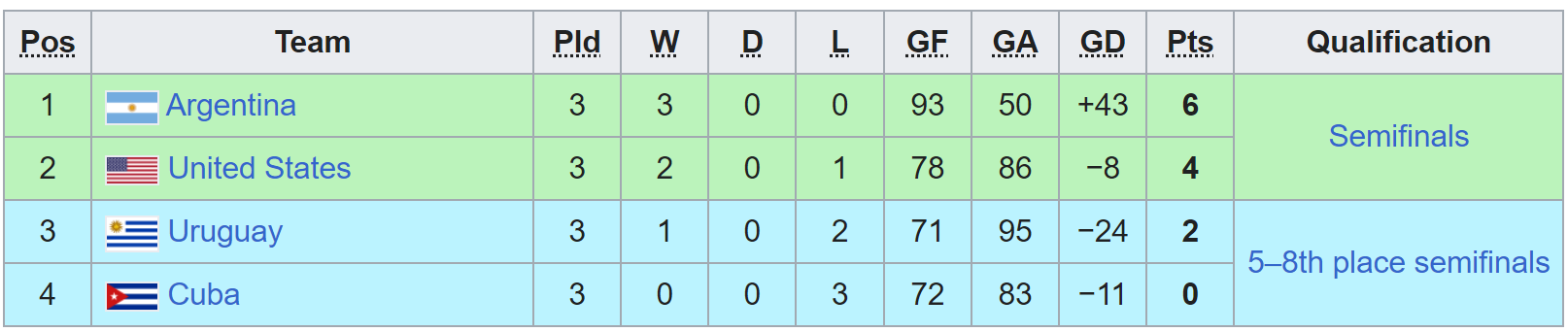
USA – Argentina 14-28 (10-11)
USA – Cuba 30-28 (17-14)
USA – Uruguay 34-30 (19-15)
The U.S. started their tournament with maybe their best half performance of the competition vs the eventual champions, Argentina. They even had a 3 goal lead with 6 minutes left in the 1st half before Argentina woke up to take a 10-11 lead at the half. Then, arguably the U.S. played their worst half of the tournament as Argentina outscored them 3-17 the rest of the way. Their match against NORCA rivals, Cuba was a really tight affair and Cuba even led 27-28 with 3.5 minutes to go before the U.S. closed out the match with a 3 goal run to win 30-28. The match against Uruguay was close most of the 1st half, but the U.S. broke out of a 13-13 tie with a 6-2 run to create a 4 goal gap that was the eventual margin for the final scoreline of 34-30. So overall, the U.S. lost to the big favorite, but took care of business against Cuba and Uruguay to advance to the semifinals
Knockout Phase
Semifinal: USA – Brazil 27-40 (13-23)
3rd Place: USA – Chile 27-28 (13-15)
I didn’t get to see these matches due to the PANAM Sports Channel’s decision to broadcast other sporting events taking place at the PANAM Games. I’ve no idea how that decsion was made, but it was truly disappointing because unlike most of the other competitions handball had an Olympic Games slot on the line. Based on the scorelines and the stats the match against heavily favored Brazil went according to expectations while the match vs Chile exceeded expectations as the U.S. took host team Chile down to the wire apparently missing a shot in the closing seconds to tie the match.
Here are a few notes on some individual performances:
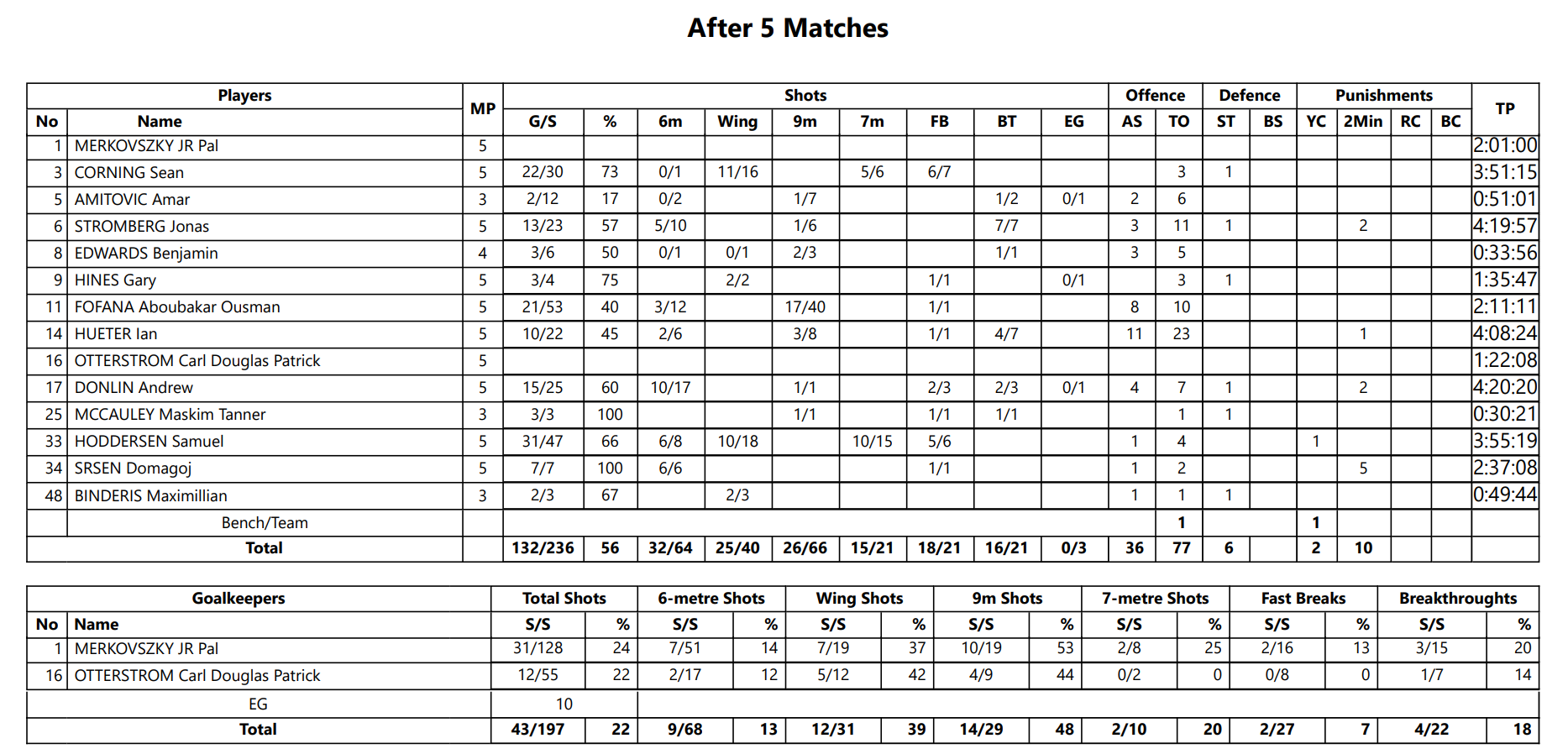
Wings: Sam Hoddersen and Sean Corning both had solid, consistent performances throughout the tounament. And, Hoddersen’s 13 goals on 16 shots vs Cuba is probably up there on the list of all time USA wing performances in an individual match
Backcourt: The U.S. struggled at times to get consistent scoring from all 3 backcourt positions. In particular, Abou Fofana’s shooting accuracy seemed to be either be on or off. When he was “on” and scoring on jump shots from 9-10 meters at a high percentage it changed the whole complexion of the U.S. offense, freeing up scoring options on the wing, circle and breakthough goals for the other backcourt players. But, when he was “off” it had a reverse effect as the team struggled to score in a set offense. Ian Huter, had a typical solid performance quarterbacking the team at centerback and Joey Stromberg, given his first real opportunity for extended playing time also played well at times.
Circle Runners: The tandem of Drew Donlin and Domagoj Srsen did a solid job of anchoring the defense, but Donlin’s shooting percentage of 60% (15 of 25) was significantly lower than than his 88% at the WC. Conversely, Srsen, who normally just plays defense was 7 for 7.
Goalkeepers: Both Merkovsky and Otterstrom had their moments, but their save percentages were lower than their World Championship performances and with the 5 U.S. opponents at the PANAM Games being weaker than the opposition at the World Championship expectations would have seen those percentages improve a bit.
The Key Missing Player: Not having Alex Chan on the roster was a big loss for the U.S. I think if he had been available the matches vs Cuba and Uruguay would have been more comfortable wins and maybe one more experienced backcourt option would have put the U.S. over the top in the bronze medal match.
Overall Assessment
Overall, it’s hard to be displeased with a 4th place finish. After all, it’s the best USA Men’s finish since the 2003 PANAM Games when the U.S. finished 3rd. And, while it’s hard to compare different eras, the teams the U.S. faced back in 2003 weren’t nearly as strong as the teams are today as Argentina and Brazil were just starting to improve to the level of play they have had for the last decade or so.
But, make no mistake… the U.S. is not to the level of Argentina and Brazil. Just as they did at the 2023 World Championships, the U.S. showed that they can compete with top teams, but the team lacks the depth and consistency to do so for a full 60 minutes. Beating a top tier team is now possible, but it’s perhaps around a 1 in 15 probability.
Conversely, the U.S. demonstrated that they are a notch above Uruguay and Cuba. Those matches, particularly, the one vs Cuba were closer than I would like, but in crunch time we took care of business. We didn’t beat ourselves and that’s a key step towards beating better teams in future competitions.
Finally, taking a team like Chile down to the wire on their home floor is a positive sign and a confirmation that the USA Men belong in the next rung below teams like Argentina and Brazil. Chile has qualified for the past 7 Handball World Championships and prior to the PATHF split to NORCA and SCAHC and the expansion of the WC to 32 teams they were the target team that had to be beaten to qualify for a WC. We are now at that level. The USA, thanks to an IHF decision granting us wild cards, doesn’t need to qualify for the 2025 and 2027 World Championships, but we clearly belong now anyway,
Looking Ahead to LA 2028
While most handball nations are constantly preparing their handball teams for the next event the U.S. has traditionally been very focused on Olympic competition. There are a number reasons for this different focus, but it’s primarily due to the increased emphasis on the Olympics in our country and the accompanying support from our Olympic Committee. In simple terms are Olympic Committee doesn’t really care much as to what happens in other competitions.
With Paris 2024 qualification now an impossiblity the focus turns to 2028 and the guaranteeed Olympic qualification that comes with it. And, although it’s 5 years away, I’ll just slightly modify what I’ve been saying for the past couple of years.
What I’ve been saying: We already know around 70-80% of the athletes who will make up our roster at the 2028 Olympics
What I’m saying now: We already know around 95% of the athletes who will make up our roster at the 2028 Olympics
In 2019 I took an in depth look at our National Team (Part 1Part 2) and I’ll hopefully/eventually get around to an update, but there are probably just around 25-30 athletes with realistic prospects of making a 2028 roster. Basically, it’s the athletes on the roster for the PANAM Games and 2023 Sr World Championshps and a handful of prospects from our Jr and Youth teams). And, for the most part it will be dual citizens who by happenstance have provided us with a golden generation by American standards. While there are plenty of athletes who have played either none or very little handball with the raw talent to become great players they don’t have the time and/or structure to realistically get to the level needed to beat out the athletes in our current talent pool.
While we have a solid group of athletes that will hopefully continue to improve I think it’s going to be challenging, however, to see a jump to the next level; to a team that can beat a top team like Argentina or Brazil 50% of the time. This is because our top athletes are just a rung lower in quality, we lack team depth and while we have some quality up and coming players there are not enough of them to do more than simply replace the attrition we’ll likely see as some of our athletes age out.
In terms of how well we’re likely to do at the 2028 Olympics we’re in for some tough competition. In all likelihood the weakest team we’ll face will be the Asian representative. In 2020 that was Bahrain. In 2024 it will be Japan. A team we could beat, but right now would be favored against us. And, then the rest would be Africa (Egypt?), Pan-America (Argentina or Brazil?) and the best European teams. To make a quarterfinal would likely require beating an Asian team and a top 10 team, probably from Europe. Can we do that? Anything is possible. But, I will say this with a high degree of confidence: We’ll compete. We won’t embarrass…and I won’t be shocked if we really push a top team to an upset or near upset. But, we could lose every match too.
There are multiple ways to look at this situation. On the one hand we all want to dream of the U.S. standing on the medal stand. But, on the other hand… most of us have seen U.S. teams that haven’t been very competitive. Qualifying for and winning games at the World Championships seemed like a real stretch not too long ago. Ask me ten years ago if I’d take our current team and its recent performances and I would have said, “Absolutely” with zero hesitation.
And, if you had told me that we would have such a team to cheer on without having to spend a penny on an artificial residency program that does nothing to develop the grass roots in this country… I would have been overcome with joy.
Yes, overall we should count our lucky stars that we are where we are with our Men’s program because while it maybe could be a little bit better it could be whole lot worse.
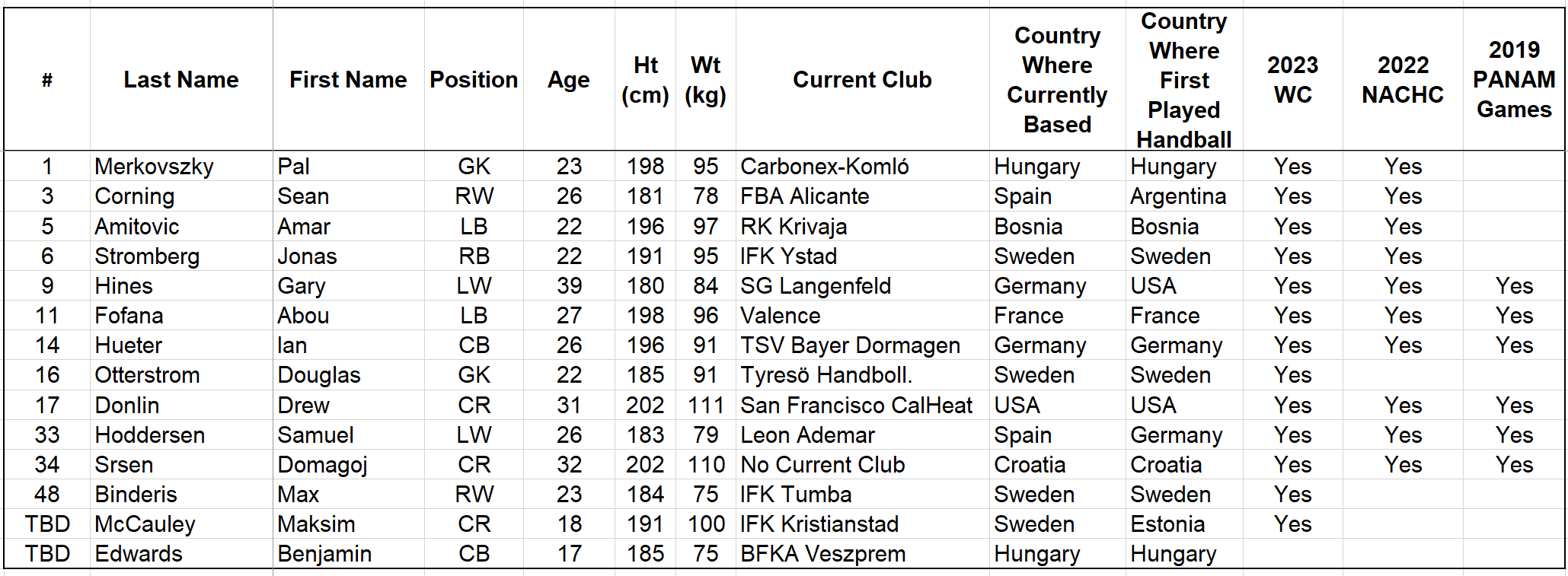
The Men’s PANAM Games competition will start Monday, 30 October and here’s a closer look at the U.S. Men’s roster and the competition. Here’s the roster compiled from previous tournaments and a recent USA Team Handball post.
USA Men’s Roster
The PANAM Games allows only 14 athletes on the official roster which is more restrictive than other recent tournaments which allowed as many as 18 athletes and up to as many as 6 alternates which could also be activated and dressed. The PANAM Games does allow for 2 alternates, but there are more restrictions for activating them and significant addtional costs for them to travel. As such, my understanding is that the U.S. has chosen to have only 14 athletes travel to Chile.
With the smaller roster size this meant that the coaching staff likely had to make some tough choices on who to keep and leave off the roster. As I review the roster by position, I’ll note some of the athletes that made the 2023 World Championship roster that are missing.
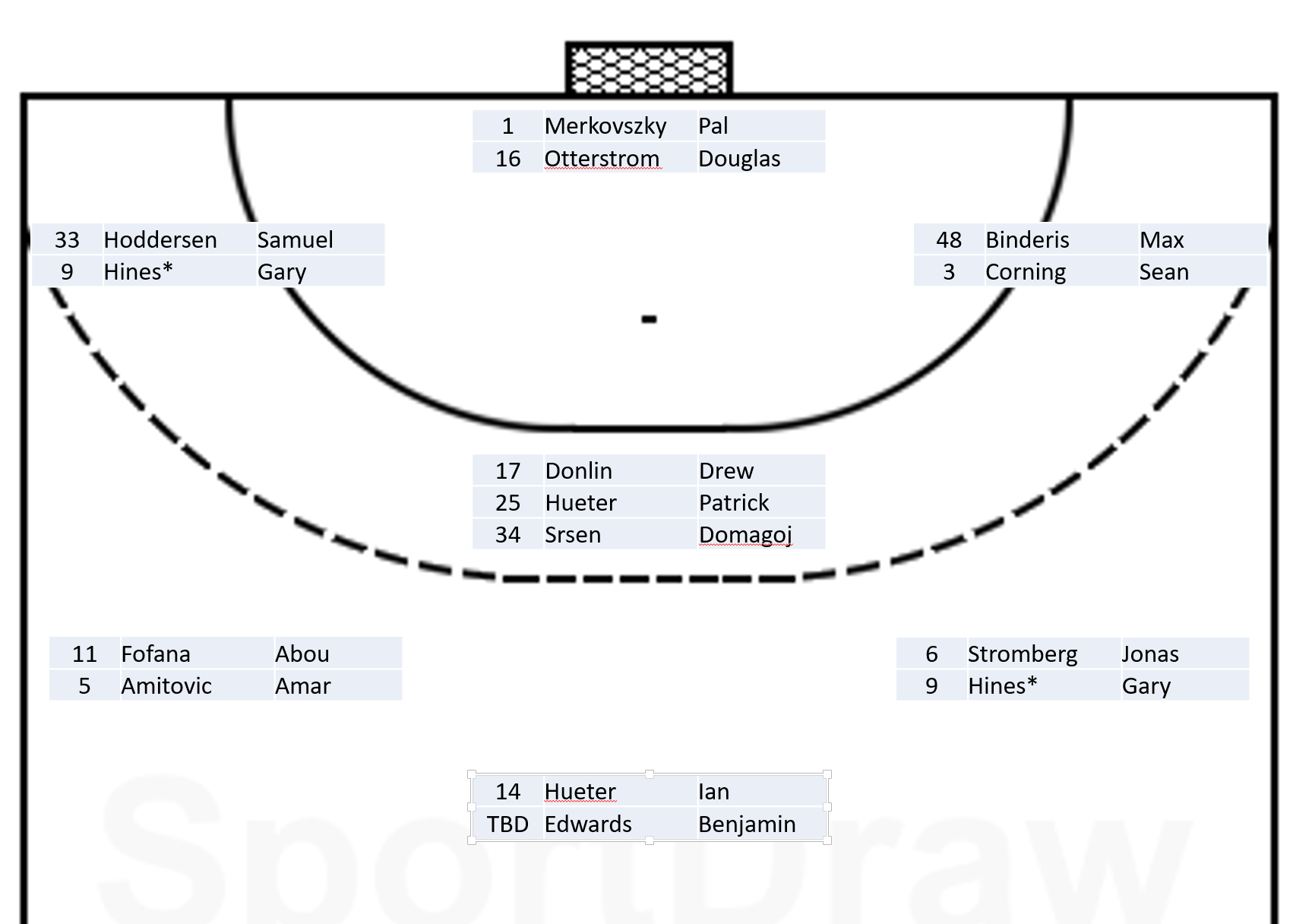
Goalkeeper: Pal Merkovsky who plays in Hungary’s top division is the #1 GK and will likely get the bulk of the minutes. Doug Otterstrom will be his backup and this suggests that he has moved ahead of Rene Ingram and Nicolas Robinson as the #2 GK.
Left wing: Sam Hoddersen has been a consistent and reliable performer at left wing. At the 2023 WC he was the 2nd leading scorer for the U.S. with 21 goals on 30 attempts. Gary Hines is also listed as a left wing, but I think he may see more time in the back court. Left off the roster was Nik Zarikos and he was likely left off due to the roster limitations
Left Back: Abou Fofana is the primary big shooter and U.S. success might well rest on him having a good tournament and a higher shooting percentage than his 41% at the WC. Amar Amitovic will also likely see a lot more playing time with the smaller roster
Center Back: As usual, Ian Hueter will be conducting the offense, but with scoring options more limited in the backcourt he may need to look to score more. 17 year old Benjamin Edwards is a recent roster addition and it will be very interesting to see what he can contribute at his first senior men’s tournament. Having seen him play this past summer at both the U19 and U21 it’s clear his future is very bright, but playing against grown men will be a challenge. Sorely missed will be Alex Chan, who was the U.S. leading scoring at the 2023 World Championships. USA Team Handball had no comment in regard to his non-selection, but Chan communicated with me that he’s had some issues with Passport renewal. He’s an experienced player who was another real threat to score against top competition. Without that extra option it will be a little tougher for everyone else to score. And, it won’t just be the goals we’ll be missing as he was also an effective passer that made the players around him better.
Right Back: Joey Stromberg is the only true right back on the roster, and, at times he’s shown promise. But, for the most part in recent competition, Coach Hedin has chosen to go with a right hander, either Alex Chan or Gary Hines at this postion. With Chan unavailable, it’s a great opportunity for Stromberg to step up. And, regardless we’ll also likely see Hines here as well. Perhaps even McCauley as he’s played backcourt for the U19 and U21 teams some.
Right Wing: With veteran Ty Reed stepping away from handball, this position will now be filled by Max Binderis and Sean Corning. Both have shown they are capable, but I don’t know if there is a clear #1 at this position now
Circle Runner: The U.S. has 2 big men (Drew Donlin and Domagoj Srsen) in the middle available and they will anchor a solid U.S. defence. It would be even more solid with real depth, but both Patrick Hueter and Paul Skorupa will be unavailable due to injury. Donlin will likely be the primary option on offense, but Srsen and Maksim McCauley will also likely see time here.
The Opposition and U.S. Outlook
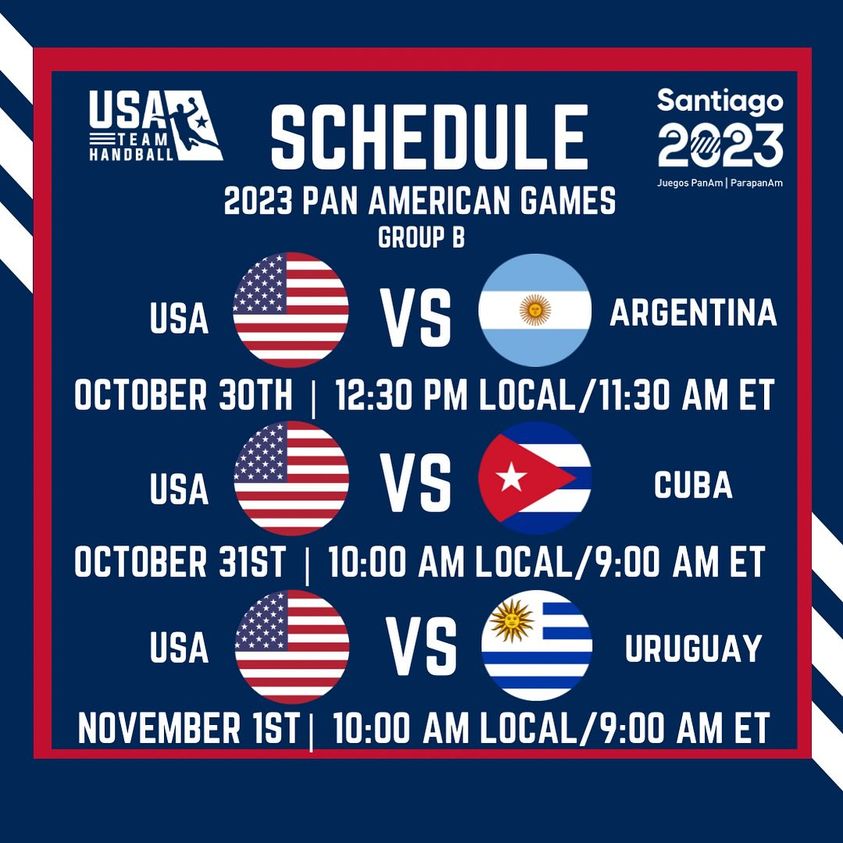
The U.S. is in Group B with Argentina, Cuba and Uruguay. Argentina is the clear favorite to win the group, but they are getting a little bit older and don’t seem quite as strong as they have been in the past. Star player, Diego Simonet has also struggled with injuries the past few seasons and has only played limited minutes this season with his club team Montpellier.
In all likelihood it should be a three team battle between the U.S., Cuba and Uruguay for 2nd place and a berth in the semifinals. The USA beat Cuba 32-28 at the 2022 NACHC Championship, but Cuba have improved since then, as demonstrated by their undefeated campaign at the 2023 Central American & Carribean Games. Uruguay had a disappointing 2023 WC campaign where they failed to win a match to finish 32 out of 32 teams. That said, they still have experienced players and won’t be an opponent to take lightly.
Something for NACHC fans to cheer for: The NACHC currently only receives 1 WC slot while the SCAHC receives 4 slots. Seems a little out of whack doesn’t it? Well, nothing would demonstrate that thought more than USA and Cuba victories over Uruguay (the 4th SCAHC slot team).
US Outlook?: Well, before I realized that Alex Chan would be unavailable I felt pretty good about a semifinal berth. The U.S. had shown it’s mettle at the WC beating other 2nd tier nations like Morocco and Belgium. Teams clearly better than Cuba and Uruguay. Why, it even seemed conceivable to think of a surprise upset over a somewhat weakend Argentina.
But, losing cogs (like Chan, P Hueter and Skorupa) in the wheel points to our lack of depth. We can still beat teams like Cuba and Uruguay… but, we’re no longer clear favorites to do so. Instead, I see a real dog fight and the U.S. will really need to stay healthy and have some players step it up yet another notch to make the semfinals. And, of course, it’s much harder to conceptualize a victory over stronger sides like Argentina or Brazil. But, then again, there’s a reason why the games are played on the court. The key is to make the semifinals at which point it will be a knockout tournament where in one match anything can happen.
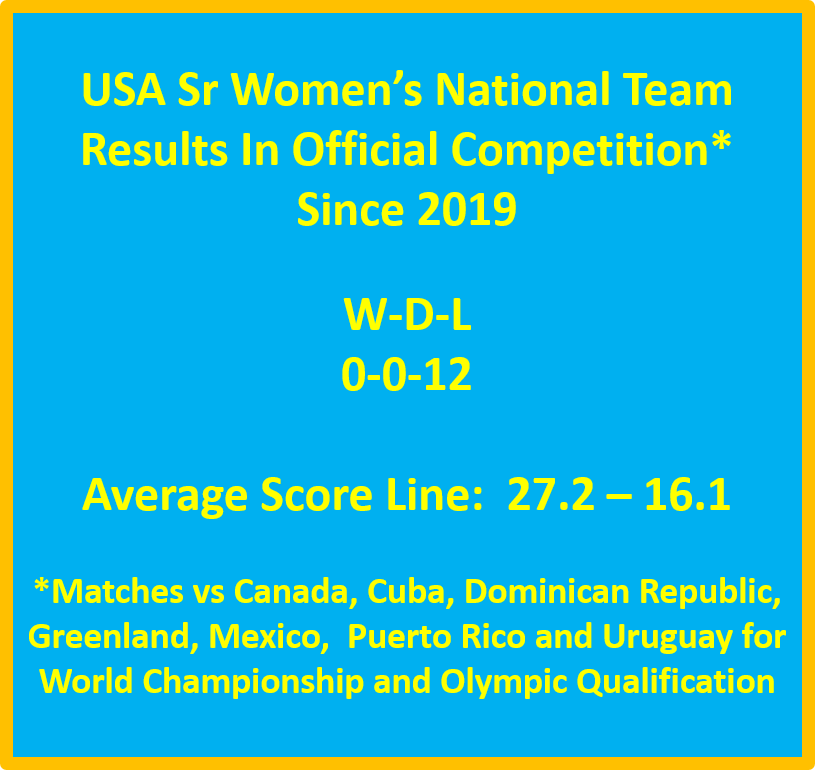
As the graphic indicates, since the 2019 PANAM Games the U.S. Women’s Sr National Team has not won a game in a major official competition. And, I’m not 100% sure, but I’m pretty sure we also haven’t won a friendly match either. Further, the scorelines have either been bad or downright ugly. We’re losing badly to peer nations (avg loss is 11 goals) in our hemisphere and getting totally clobbered (probably in the high 20s) by better competition. In short, over a two year period this has been the most uncompetitive team that the U.S. has ever fielded. The results starkly demonstrate this. It’s not even debatable.
A REALLY BIG DISCLAIMER
All that said, let me very clear about the following:
I don’t blame the athletes. They’re doing the best that they can and most, if not all, have made ENORMOUS sacrifices to represent their country. And, often they are paying to do so out of their own pockets. We’re talking thousands of dollars.
I don’t blame the “coaching” that the coaches have done. A coach works with the athletes they have to help them perform the best they possibly can. I’ve seen quite a few matches. As bad as things have been… they could’ve been worse. There were opportunities for things to go totally off the rails, but they’ve managed to keep the team fighing and competing under very challenging circumstances.
Management (or a Lack of Management) is the Issue
Of course, this situation is disappointing to anyone that cares about handball in the United States. For some old timers it’s hard to wrap their heads around the reality that the U.S. is so uncompetitive. That it’s commonplace now for the U.S. to lose badly to nations that we used to easily beat without even breaking a sweat. Others look at a clearly more competitive U.S. Men’s team and wonder why the U.S. Women can’t simply duplicate their success.
These top level assessments are pretty simplistic, but they do point to straightforward management strategies that have either worked in the past or are working today. (Well, “worked” to some extent.) Unfortunately, while the Keep it Simple, Stupid (KISS) strategy is often a smart way to go… it’s just not in this case. There are multiple reasons why the U.S. Women’s program can’t simply roll back the clock or copy the U.S. men’s “strategy.”
I won’t get into all of the management issues in this introduction. Quite frankly, there are just too many to capture in one post. This is a complex problem with a lot of moving parts. Heck, it’s not even easy to define what the “problem” is exactly. Sure, we want our Women’s team to perform better. But, what does “better” mean exactly? How much better? What’s the timeframe? And, at what cost?
And, that gets to the crux of the matter. As a close observer of all things handball in the U.S., if any of these questions were considered and defined it has been done so very quietly. Certainly, no plan or strategy has been publicly articulated. It’s one thing to watch our national team get beaten, but know it’s part of a structured plan to get better. It’s another thing to watch and get the sense that I’m watching a team thrown together by happenstance based on whoever happened to be available from our very, very small talent pool.
Burning Questions
So, I’m certainly not going to get to all the answers with this introduction, but I’ll try to identify some questions that need to be answered. Questions that I’ll address in follow-on posts.
Partner Related Questions
Does the IHF have a minimum performance expectation for the U.S. Women’s team? (i.e. Would the IHF actually consider not awarding the U.S. a slot for the 2028 Olympics?)
What might the IHF contibute to improve U.S. National Team performance prospects?
Will the USOPC increase funding and support to impove U.S. National Team perfomance at a U.S. hosted Olympics?
Philosophical Questions
Should the U.S. implement “quick fix” solutions to improve national team performance?
If so, how much funding and resources should be diverted from grass roots related efforts?
If the U.S. switches to a focus on talent transfer athletes who’ve never played handball how should it communicate this to current handball athletes that have made significant sacrifices?
“Out of the Box” Questions
Could a reality style documentary help fund and support U.S. National Team efforts?
Does it make sense to have non USA Team Handball organizations address ways to improve U.S. National Team performance?
If so, how should these organizations coordinate with USA Team Handball and it’s partners like the IHF and USOPC?
Dual Citizen Focus Questions
Why have efforts to find and recruit talented dual citizen handball athletes for the U.S. Women fallen way short of the U.S. Men?
How coud efforts related to dual citizen utilization be ramped up?
Competitive Performance Related Questions
How do we best define performance levels or how “competitive” our national team is?
How do we best define the peformance level of individual athletes and their potential to improve over time?
What metrics should be used to quantify and assess performance?
Why is our currrent national team performing at it’s current level of competitiveness?
Given the current talent pool, how much can our team improve over time?
Given a group of high quality raw talent prospects what performance level could they achieve over time?
Athlete Development Program Questions (Note: whether it’s called a residency program, development center, academy, or some other name this refers to any special effort to identify and train athletes for national teams.)
How successful can these programs be at identifying and training athletes to be national team athletes?
I’ve been quite a while since I commented on a number of handball related issues, but that’s about to change. Here’s why I laid low and why I’ll soon be speaking out on a number of topics. Sorry, in advance… This post is all about me, but it should provide some context as to where I’m coming from.
Having Opinions and Stating them has Consequences
Anyone who has followed this website for a few years knows that I’m usually not shy about sharing my opinions on handball related matters. (Here’s a broad sampling: Link) Some folks appreciated my commentaries simply because they jived with their views. And, a few folks appreciated my commentaries even if they conflicted with their views because they respected the thought process behind them. But, more often than not my commentaries were simply not appreciated. It didn’t matter how diplomatic I tried to be.
Case in point: Take a look at this commentary on Auburn University being designated an Olympic Training Center in 2015 (Taking Stock and Shaking My Head in Frustration: Can Someone Please Educate Me?). Minutes after this commentary was posted, I was immediately defriended on Facebook by a USA Team Handball Board Member. It’s not like I lacked the “social skills” to know that most folks don’t appreciate criticism. It’s just that I was more interested in trying to steer USA Team Handball in a different direction than I was trying to win friends. Especially in this instance, as I was 99% certain USA Team Handball was headed down the wrong path. A path with enormous consequences in terms of cost… and more importantly, lost opportunity costs.
If you choose to speak out on sensitive topics where people have a lot invested it has consequences. And, It doesn’t matter if, over time, it becomes very clear that your criticism was spot on. Trust me… it doesn’t. Posts like this led to me being being ostracized and if you are on the outside it’s hard to move the needle towards progress.
Toning Things Down and Moving the Needle
So, I toned thinks down and simultaneously waited for leadership to change. I still wrote commentaries, but also did more work behind the scenes to try and convince people. It’s not like I didn’t try and do this before, but with things not going well for USA Team Handball new leaders (and even some hold overs) were more receptive to new ideas. And, slowly, but surely, I saw the needle move. Here’s a laundry list of needle movements:
Handball being shown on ESPN (albeit the streaming services)
Of course, I wasn’t the only one advocating or making these efforts happen. But, make no mistake, I was the catalyst that got the ball rolling. And, yes, it was very satisfying to move the needle.
Working for USA Team Handball and Going Really Quiet
Why, in August of 2021, I was even hired to work for USA Team Handball. Granted, it was part time running the website and helping with social media, but it was a foot in the door. From my perspective, I figured that if I could ably perform this lower level position and demonstrate my vast working knowledege, I would get hired for a management position with some responsibility. When I was passed over for the High Performance Management position I gritted my teeth and kept my head down as best I could. When I was passed over for the Collegiate Director position… A position that might not ever have been established without my advocacy… I assessed that it was time to move on. <sigh>
I won’t go into details regarding my 9 month stint with USA Team Handball, but, I will say this: I’m confident that if I had been hired for either position I would have done a very good job… and it would have done wonders for me in terms of follow on opportunities.
My White Whale: The USA Team Handball CEO Position
And, I guess that gets to the crux of the matter. You can sometimes move the needle from the outside or as the bottom guy on the totem pole, but you know how you can really move the needle? By being the person at the top, setting the agenda for change and then being the person responsible for implementing those changes.
I know most people know me simply as a handball writer/blogger. Somebody with a bunch of ideas. But in my professional life I was an aerospace engineer who transitioned to program management. I was a pretty decent manager often working long hours on complicated defense projects. Sometimes I really liked what I was doing, but at other times it was less rewarding for me. Periodically, I would reflect on what it might be like to manage something else after I retired from the Air Force. Then, during my last military assignment in France, my passion for handball got super charged at the same time USA Team Handball was falling apart with decertification. It didn’t take much to contemplate that maybe I should consider combining by professional experience with my passion for handball.
Of course, my thinking was more along the lines of “some day.” After all, aerospace engineers generally have a more secure and better compensated career. But, when the opportunity presented itself I went for it. So here’s a short history of the past 15 years or so of CEO applications:
2008: I sent an unsolicited letter to the new USA Team Handball President, Dieter Esch. Steve Pastorino was hired without a formal search. In hindsight, I don’t think I was ready to move on from my aerospace career and Steve may well have been the best CEO we’ve ever had.
2012: I received a phone call with very life changing consequences asking me if I would like to interview for the CEO position and potentially start the job as soon as possible. The interview never happened, but it led to a family decision to move from Las Vegas to Colorado Springs anyway. Later in the year a formal selection process resulted in Matt Van Houten being selected. I had a preliminary phone interview, but was not one of the final candidates
2014: Following Matt’s resignation I sent an unsolicited package for consideration. But, the wheels were already turning to bring back former CEO, Mike Cavanaugh, who was hired without a formal selection process.
2019: Following pressure from the USOPC, USA Team Handball conducted a search for a new CEO. I was never interviewed and Barry Siff was selected
2021: After Barry Siff resigned, I had a short screening interview with the head-hunter company that was hired, but was never formally interviewed; Ryan Johnson was selected
2023: After Ryan Johnson resigned, I was reportedly considered for interim CEO, but then was never interviewed during the formal selection process; Martin Branick was selected
So, 15 years… 6 applications… 2 preliminary phone interviews… Never advancing to the final round… I think people are trying to tell me something. Not anything I didn’t know already. Here’s a 2020 interview with NYC’s Bini Mustafa where I ruminated on that very topic. Two failed applications later I’ve come to an even more stark, very reverse Sally Fields realization: “I can’t deny the fact… You don’t like me”
The Challenges Ahead
I guess, in the end, it pretty much boils down to the people doing the hiring and who they think is best suited to address the challenges they see ahead. I wasn’t privy to what the Board of Directors was thinking, but I suspect they were of two minds. With one faction seeing the position as a relatively straight forward, nuts and bolts job of ensuring USOPC compliance, organizing tournaments and providing our national teams with the best possible organization and resources to compete. And, then another faction seeing it first and foremost as a marketing and sales job of pitching the sport and bringing in badly needed funding. (Again speculation… I don’t really know)
From my perspective, both day to day operations and marketing/fundraising are pretty important. And, here’s the good news: I feel pretty comfortable with both getting done to at least “satisfactory” levels. Day to day operations will get done because those operations are indeed pretty straightforward. Don’t get me worng… there’s a lot of work involved, but it’s not complicated… just time intensive. As far as marketing and revenue generation goes (if the 1996 Olympics are a guide) performance here should improve simply because we have the 2028 Olympics coming. People that wouldn’t give USA Team Handball the time of day will soon be willing to talk to us. We can debate how well tasks actually get done, but with each passing month that we draw closer to the Olympics we should see improvement.
But, from my perspective… here’s the bad news: The important challenges USA Team Handball faces are not straightforward. And, while more revenue is needed it’s not a panacea. The next five years are a once in a generation opportunity; a true, transformational opportunity. But, we’ve been there before. Heck, we even had two hosted Olympics, just 12 years apart in 1984 and 1996… and, what did that get us?
Yes, a “field of opportunity” is in front of us, but unfortunately it’s full of land mines that could blow everything up and rabbit holes we could fall down and get lost in. To put it another way there are a number of major decisions looming that have been postponed, partially due to COVID and partially due to a natural tendency to essentially avoid choosing winners and losers. (Also, known as avoiding making people unhappy) Navigating this minefield won’t be easy and any chance of success will require vision, planning skills and an ability to effectively sort out what can be done and what should be done. Know how to help guide a board through a series of challenging decisions requiring hard choices.
Who’s the right person to lead that challenge? To give USA Team Handball the best chance of success? From my perspective, there’s zero doubt in my mind that my combined professional and handball related experience makes me the right person.
Getting a Life…
Alas, I’m not making the hiring decisions. For years I’ve joked that if I ever was put in charge of something handball related the only question people would end up having is, “Good lord! How could we have we kept someone with so much knowledge, so much experience, and so much passion down for so long?” It can be real rough to come to the realization that something you really want, something that you know you are really qualified to do… is just never going to happen.
But, seriously enough of the, “Oh, woe is me,” whining. As I tell friends and family I keep getting reminders that life isn’t so bad. On the news, I see people all over the world facing real life and death problems. In the U.S. many people my age are stuck in dead end jobs just to keep their health insurance. Instead, I’m retired with no real responsibilities. I never planned to retire in my 50s, but sometimes life gets complicated and plans change accordingly. Good thing, I’ve got a pension and did FIRE before it was a thing.
I’ve been doing a lot of hiking and contemplating life in general. Trying to figure out how to best use all my free time. I’m looking forward to some trips to Europe to see some handball halls that I’ve only seen on TV. And, I’m also considering some efforts to help foster the growth of collegiate handball and to sustain some fledgling clubs, lest they join the graveyard.
And, I will be writing some much needed commentaries on a variety of handball topics. Topics to include our Women’s national team, the US Handball Union/USATH situation, beach handball’s future, youth development, age based teams, media opportunities and more. I guess if I’m forever to be on the outside of the tent, I might as well not hold back. And, yes, I guarantee you… some folks are not going being to happy with what I write. But, maybe (just maybe) considering my track record (somewhere between Nostradamus and very good) of assessing handball in the U.S. people will listen. Yeah, I might still get to move the needle.
Buckle up handball fans. I think it’s going to get a little bumpy.
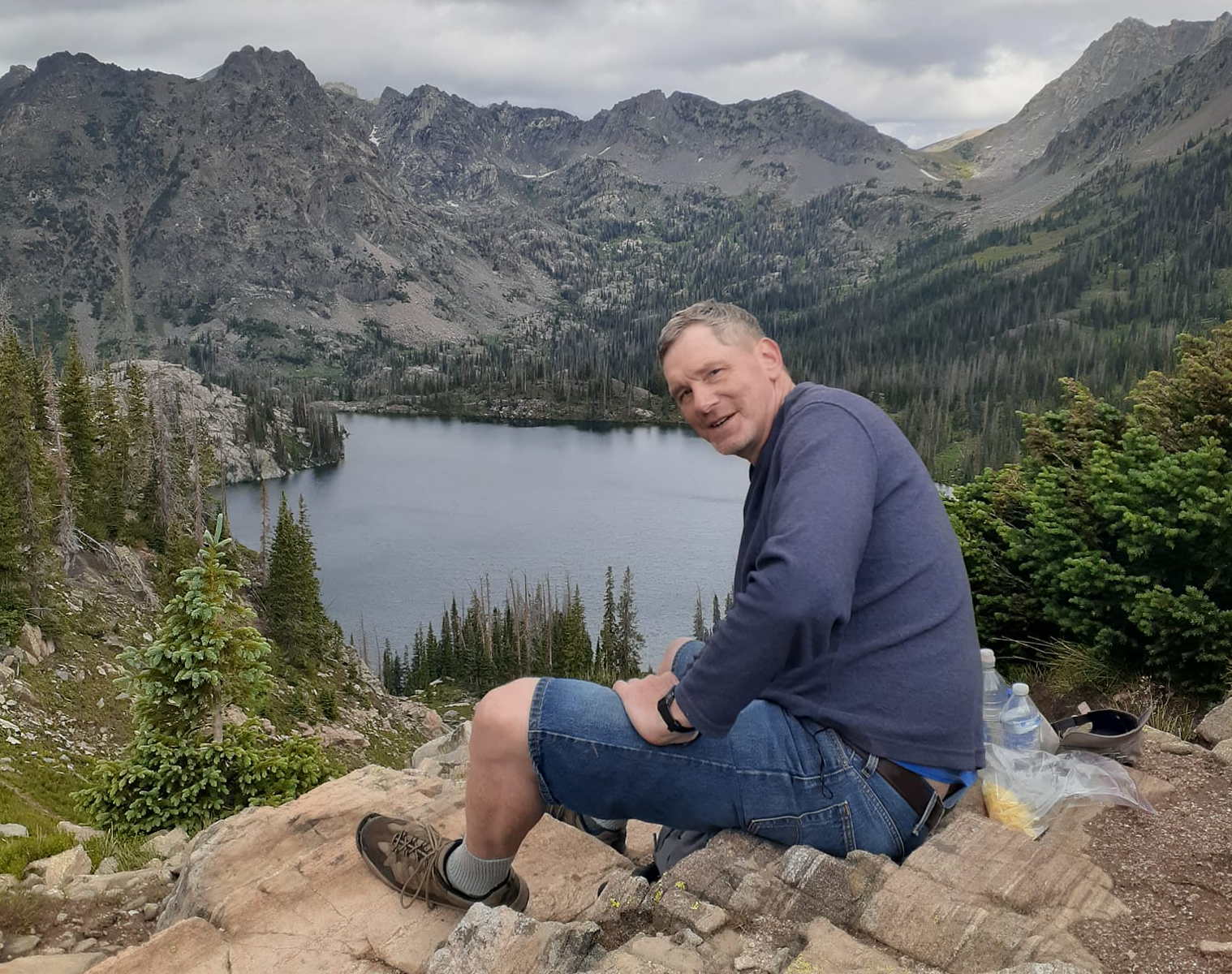
Getting a life and contemplating my future on the Zirkel Circle north of Steamboat Springs, CO this past summer
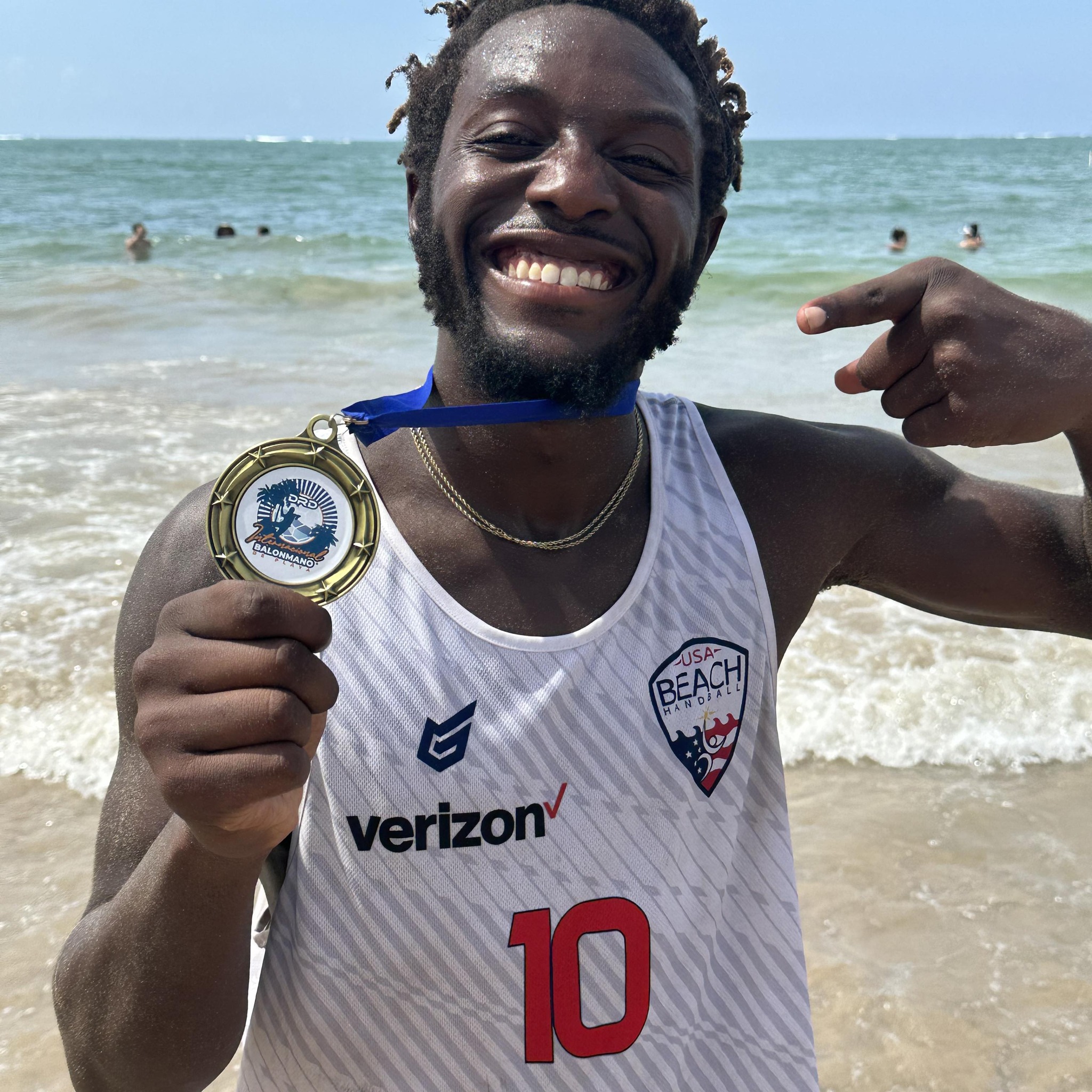
At the Southern California Beach Handball Championships I interviewed National Team athlete and USA Team Handball Board Member, Ebiye, Udo-Udoma. Ebiye, who has adopted the moniker, the Handball Ninja is well known in the beach community, both domestically and internationally.
We discussed the tournament, the state of beach handball and the challenges of getting beach handball on the Olympic Program given the IOC’s athlete quota that limits a summer games to no more than 10,500 athletes. I then throw him a bit of a curveball question, in that given this quota and the greater chances a USA beach team would have to medal: Should USA Team Handball consider the possibility of taking actions that could lead to an IOC/LA 2028/USOPC/IHF decision to swap beach for the traditional indoor game at the 2028 Olympics in Los Angeles?
The Southern California Handball Championsips were also the first ever US Handball Union event. Michael King, is the Executive Director of this new organization and we chat a little about the tournament and beach handball, but we mostly focus on the US Handball Union. We discuss it’s mission, why it was formed prior to discussion with USA Team Handball and whether a competing organization (in some aspects) to USA Team Handball can also be collaborative with USA Team Handball.
This interview was on Sunday, August 27th and I don’t know if there have been any new developments since then.