post

IHF Challenge Cup: Some numbers behind the results

Team USA’s Olivia Goncerz (#4), Lynn Hodderson (#11) and Anja Borg (#5) try to stop a Mexican attack.

The USA recently competed in an IHF Challenge Cup Tournament in Mexico from 7-11 November.  The Challenge Cups are an IHF initiative to give more playing opportunities for less developed handball nations.  A men’s under age 20 competition and a women’s under age 19 competition was held and the other nations participating were Mexico, Canada and Puerto Rico.  The USA Teams did not fare well overall.  The men placed 4th losing all four of their matches, while the women placed 3rd, managing a draw and a win against Puerto Rico.

Men’s Results

Group Play
USA – Mexico 23-33 (13-15)
USA – Canada 30-37 (17-19)
USA – Puerto Rico 30-35 (15-16)

3rd Place Match
USA – Canada 38-40 (19-20)

Roster/Place of Residence/USA Club/Scoring
Javier Galindo, Spain, 38 Goals
Orton Fofana, France 29 Goals
Connor Holt, West Point, 17 Goals
Alex Binderis, Sweden, 15 Goals
Andrew Donlin, Air Force, 12 Goals
Ian Pinson, LA THC, 6 Goals
Stefan Paunovic, Denmark, 3 Goals
Jerome Nohr, Germany, 1 Goal
Tyler Shukert, Minnesota, 0 Goals
Domenic Lapore, Salt Lake City, 0 Goals
Ryan Petersen, Cary HC, 0 goals

Goalies
Chris Hesser, Dynamo HC
David Brown, West Point

While it’s disappointing that the men didn’t win any games, the scorelines indicate that all four matches were competitive, with the half-time differentials all 2 goals or less.  A far better than last year’s Under 19 team which lost 60-8 to Argentina at the Pan American Championships.  The two leading scorers for the U.S. appear to have been dual citizen athletes, Javier Galindo (Spain) and Orton Fofano (France).  As they accounted for 55% of the U.S. offensive output, one can conclude that their addition to the roster was pretty pivotal to the U.S. respectable performance.  Other key contributors were Alex Binderis who lives in Sweden and two cadets, Connor Holt of West Point and Andrew Donlin of Air Force.

Women’s Results

Group Play
USA – Puerto Rico 29-29 (16-11)
USA – Mexico 23-14 (7-9)
USA – Canada 34-13 (10-18)

3rd Place
USA – Puerto Rico 34-27 (13-15)

Roster/Place of Residence/USA Club/Scoring
Anja Borg, Norway, 19 Goals
Stefanie Hesser, Dynamo HC, 18 Goals
Maja Storm, Germany, 13 Goals
Morgan Thorkelsdottir, Iceland, 12 Goals
Lynn Hoddersen, Germany, 9 Goals
Alana Steinarsdottir, Iceland, 6 Goals
Olivia Goncerz, Jersey Girls, 5 Goals
Sierra Thompson, Sweden, 4 Goals
Natalie Dabrowski, Jersey Girls, 2 Goals
Izabela Szymanski, Jersey Girls, 1 Goal
Essence Jones, LA THC, 0 Goals
Kamila Pawka, Jersey Girls, 0 Goals

Goalies
Sophie Fasold, Dynamo HC
Freja Dobreff, Germany

The USA Women fared better overall with a draw and a win against Puerto Rico, but the 34-13 pounding at the hands of Canada was a clear demonstration of a stronger Canadian youth program.  The U.S.  foreign resident scoring attack was even more pronounced for the women with 2/3 of the goals coming from overseas based players.

Commentary

I have mixed feelings about the benefits of these tournaments for our younger players.  On the one hand, I like to see the USA competing in international competition.  It’s a tremendous opportunity for those athletes and potentially a great motivating tool to encourage more athletes to take up the sport in the U.S.  But, if the bulk of the team is composed of athletes who already have great playing opportunities in Europe, then it’s less of an incentive for those U.S. based players.  But, then again if the U.S. had sent teams composed primarily of U.S. based players they would likely have suffered some truly embarrassing losses even in this challenge competition against other lower level handball nations.

On the whole, I think that the funding and resources expended to participate in these tournaments could probably be spent better on U.S. based development programs.  (Especially, if you factor in the transportation costs to send European based athletes to a tournament in Mexico.)  For example, a week long camp in the USA with multiple regional teams, similar to the U.S. Olympic Festivals of the past could perhaps be conducted with similar overall costs.  And instead of evaluating 15 athletes, the U.S. could evaluate maybe as many as 60 athletes, including some that can’t get released for a November tournament due to school and other sport commitments.  (It’s hard to fully calculate costs as there would be a lot of variables in terms of lodging and transportation.)

I’m probably not the first individual to think of such an alternative event.  The problem is, however, that the funding and resources for the IHF Challenge Cups comes from the IHF and the U.S. Federation simply can’t redirect that support somewhere else.   And as the IHF hasn’t always spent its funds very judiciously, I can’t complain too loudly at a program that is clearly attempting to spread the wealth even if it may be a bit misguided.

As a final commentary, I’ll point out that the Federation really needs to get their act together in regards to its reporting of an event like this.  A tournament where Americans (teenagers, no less) are representing their country should be a prime recruiting tool for athletes with daily reports and plenty of action photographs on the website and facebook.   Instead, the scores and results were never even posted.   As the saying goes, if a tree falls in a forest and no one is there to hear it, does it make a sound?

Related commentary

THN (3 May 2011) Commentary: USA Team Handball National Teams: Are there too many guys with short haircuts and accents? (Part 1: Military Athletes)

THN (10 May 2011): Commentary: USA Team Handball National Teams: Are there too many guys with short haircuts and accents? (Part 2: Dual Citizenship Athletes): 

THN (17 Jul 2011): Partille Cup: How can USA Team Handball best maximize this opportunity?

THN (7 Aug 2011): Embarrassing outcome for PanAmerica in Junior Championship:
post

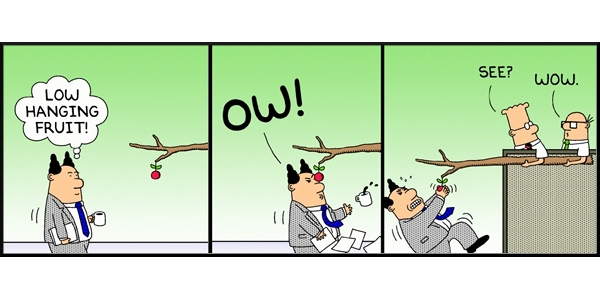
Low Hanging Fruit for the new USATH GM

No, these three apples can really be plucked easily.

As anyone who has followed the trials and tribulations of USA Team Handball through the years knows the sport has some huge challenges.  Rome wasn’t built in a day and it won’t be quick and easy to solve all of USA Team Handball’s challenges either.  New General Manager, Matt Van Houten, most likely already has a massively long checklist of things to do.  Some of these items may take years to fully address and it’s only a matter of time for a chorus to rise up and start complaining that nothing has changed.

Fortunately, however, there are a few items that should be relatively easy to fix.  Items that can be accomplished to show near term progress while the more difficult items are addressed.   Herewith, is the low hanging fruit:

1) FIX THE WEBPAGE

This hardly needs any explanation.  Not only has it been updated way too infrequently for over a year it is has been woefully lacking in substance and style.   Here are a couple of recent examples to highlight a few obvious problems.

  • Don’t post a one paragraph link to a bland IHF story on the upcoming challenge tournament.  Two USA youth teams are going to the tournament, but you wouldn’t know about it from this post.  Why not a story about some of those athletes and their ongoing preparation?  Or better yet, strongly encourage those athletes to blog about and during the upcoming event.
  • There was a major club tournament last weekend in Chicago.  Why not a photo and a story or at least a link to a site with all that information?    Heck, I’m guessing, if asked, Craig Rot would have done a nice little write-up of the whole event.
  • Find better quality photos.  The blurred “IHF trophy” block letters and the photo of the new GM just don’t cut it.
  • Finally, if a site has an audio interview with the new GM, wouldn’t it make sense to link to relevant content like that.

The need to fix the webpage simply cannot be understated as it is the all important, first impression for literally thousands of potential fans and players of the game.   Probably more than a few potential sponsors, as well.  USA Team Handball cannot afford to let folks conclude as this Orange County register reporter did during the Olympics, that the sport is not a priority and that our webpage looks like it’s hosted by Geocities.

2) Secure a sponsorship deal with U.S. TV networks currently broadcasting Team Handball

Yes, there are networks broadcasting the sport in the U.S.  In former USATH CEO Mike Cavanaugh and former USATH GM Steve Pastorino’s fantasy world they would have walked on to the job with this situation in hand.  Cavanaugh tried for years to secure a TV deal unsuccessfully and Pastorino finally was able to facilitate a deal with the MHz network.   The MHz deal is gone, but now two networks (beIN Sport and Univision Deportes) have chosen to broadcast the sport totally on their own.

As far as I can tell (multiple emails regarding this topic to the Interim GM and BoD President have not merited a response) there has been no dialogue between the Federation and these two networks on potential sponsorship of USA Team Handball.  The MHz Network had some sort of deal with the USA Federation, so I’d like to think these two entities would also jump at the chance of sponsoring the Federation in exchange for a little promotion on the USA website.

3) Post USA Team Handball’s financial data on the Federation website.

The Federation’s own by-laws state the following:

Section 17.5. Website.

USATH shall maintain a website for dissemination of information to its members. USATH shall post on its website its Bylaws.  Additionally, USATH shall post on its website its most recent annual financial statement and its most recent 990 Form filed with the Internal Revenue Service.

Yet, the latest and greatest information is the 2009-2010 IRS Form 990 and a bad link to the 2011 BoD approved budget (it goes to a Form 990).    As we are approaching calendar year 2013 it’s more than high time to post more current information.   Not only is it a requirement, it’s the right thing for a transparent federation to do.

And to be even more transparent, some explanatory documents which highlight what key financial decisions are being made, and why in greater detail would be highly appreciated.   As an example of what not do, just try to decipher the notes regarding finances in the last two board meeting minutes (Feb 2012, May 2012).  These explanatory documents would not have to be a detailed prospectus, but they should give members real insight as to how much funding is going to support the various programs, be it club development, national team trips or organizing the Club National Championships.

So, three easy tasks that hopefully can be checked off the To Do List.  In the coming weeks, I’ll try to highlight some of the more important and challenging tasks that will require some heavy lifting.

post

Flare-up on the issue of the workload and the divided loyalties of the elite players

Michael V. Knudsen of Flensburg and Denmark; who or what prevents him from playing in the World Championship?


Although I recently commented briefly on the apparent increase in injuries to top players, and the possible impact of the Olympic Games, the topic of the overload for the elite players has not caused major headlines. Yes, some clubs with Olympic players have commented on the difficulties in getting those players reintegrated when the new season was about to start, and there have been some suggestions that the increase in injuries could be related to the added workload, but I had really expected more of a boost to the debate about the competition calendar.

But now we have had a sudden signal that clubs and players may become fed up with the status quo and the lack of serious action on the part of those who have the main role in determining the calendar and thus the workload. With two different versions being presented, it became clear that Michael Knudsen from Flensburg and Denmark had been ruled out from participation in the World Championship next January. It had nothing to do with injuries. Rather, it was suggested (supposedly according to statements from Knudsen) that Flensburg had forced him to accept such a clause as a condition for having his contract extended. By contrast, Flensburg insisted that the decision was really initiated by the wishes of the player himself.

The news caused an outrage in Denmark, because Knudsen is a key player. It was also noted, on the one hand, that such a contract clause is not permitted under IHF regulations and, on the other hand, Knudsen was criticized for showing up at a Danish training camp if he was not going to be a team member in January. It would not be the first time that a player had been formally prevented from his/her club to participate in a World Championship. But it could really trigger a major debate about who has the prerogatives, the club or the national federation. It should be recognized that the players are really caught in between. They do not want to be forced to abandon their national team, if they do not have their own reasons for staying out. But, of course, they do not want to spoil the relations with their employer, the club, so it would always be possible to come up with a plausible explanation that nobody could formally criticize.

Essentially the issue is linked to two basic conflicts: first, it has been argued for a long time that it is just too much to have more than one major international championship per year. So in a sense it is the participation of handball in the Olympic Games that becomes the trigger. But as nobody suggests that this should be changed, then it is the pattern of having either a World Championship or a European Championship every year that is the crux. Compromises have been sought but with no result so far. The EHF does not really want to budge, and the IHF must protect the interests of all the other continents. The second issue is that, added together, games in the national leagues, the EHF Champions League and for the national teams simply add up to being a bit too much. (When one talks about the national team, this includes not just the Championships but the qualifying events leading up to them).

Martin Heuberger, the men’s national team coach in Germany, suggested recently that it would be fair and necessary to ‘shave off’ some portion of each of the three workloads. Of course, one could suggest that the top nations could have their burden reduced by entering at a later stage in the qualifying events, as compared with the model that is being played precisely this weekend. And, as I have done before, one could argue that the current Champions League model causes too many ‘unnecessary’ games for the participants. Or one could suggest, as Heuberger did, that the number of teams in the German Bundesliga should be reduced. Every year, essentially the same teams gain the top positions and then also play in the Champions League or the EHF Cup, while several other teams are clearly at a lower level. But Heuberger got the reaction from his own Federation that “it would really be difficult to deprive some teams of the chance to play in Bundesliga, and even the top teams want the extra income from a couple of additional home games”. Clearly, one could argue ‘forever’ how the reduction should best be achieved.

But the reality that most people overlook, when they propose one solution or the other as ‘the obvious one’, is that the situation is far from similar in all the top handball countries in Europe. The one thing that most of them have in common is that they attach a lot of importance to their national team, but even that may vary from country to country. In some countries there is relatively more interest in the EHF Champions League, and handball fans rally around the team that represents their country. But so far, it is much more common that the fans really care about their own club and everything else becomes secondary. However, that is very much related to the third dimension: many countries have a national league that, year after year, creates a strong interest on account of many evenly matched teams. But other countries, even some of the very best, have only one or possibly two dominating teams, so the league becomes unimportant. And then we have the unique case of Germany, who ‘has it all’. The Bundesliga has strong traditions, also among the smaller clubs, the national team is a matter of real pride, and they have at least six-seven teams in the EHF competitions.

So one of the reasons for reluctance in other countries to change things is that they primarily see the problem as one that is caused by the German situation. This has been quite clear from media comments and views expressed by fans. They are upset if a German club ‘interferes’ with the participation of a player on the national team in country X. And they do not have much sympathy for the ‘dilemma of the German clubs’. On the contrary, it reminds them that Bundesliga dilutes the quality of the leagues in many other countries. Perhaps the most interesting and astute comment I saw in recent time was along the following lines: ‘the problem is caused by Germany, where they have teams and players for an absolute elite league but still insist on adding many comparatively mediocre clubs that really belong in a lower league’. I can appreciate these arguments; and at least the strong divergence of views within Europe (and even more if one adds the top other countries in other continents) will make it really tough for the IHF and the EHF to achieve serious change.

post

VIDEO: 2 HBL Showdowns this weekend

Hamburg vs. Kiel this Saturday

The Champions League is on hiatus until mid November, but LAOLA1.TV is stepping into the void with two great matches in the German Handball Bundesliga (HBL) this weekend.  On Saturday, Hamburg hosts Kiel and on Sunday, Flensburg hosts Berlin. It’s early in the season and all 4 teams are bunched near the top of the HBL table.

Thanks to Berlin’s draw with them earlier this season Kiel no longer has their winning streak, but they’ve still got an “unbeaten” streak.  Hamburg has been decimated by injuries and will probably need some help from the “8th man” home crowd to knock off the defending champions.

Flensburg has stumbled a little bit in the early going and is currently in 6th place.  If they want to return to the Champions League next year, they’ll want to win this key home clash against 2nd place and unbeaten Berlin.  Both matches will be available live for viewing at LAOLA1.TV and one of these matches will surely be posted later as the “Match of the Week” for on demand viewing.

Saturday, 27 October 2012
Hamburg vs. Kiel  3:00 PM (CET)/9:00 AM (U.S. East Coast) Live Video Link

Sunday, 28 October 2012
Flensburg vs. Berlin 5:30 PM (CET) / 11:30 AM (U.S. East Coast) Live Video Link


post

Zut Alors!: A Team Handball reference on Saturday Night Live?

“Us French brothers, throw a handball like this.”

Famous French Def Comedy Jam performer, Jean K. Jean, made an appearance on Saturday Night Live a couple of weekends ago and did a riff on French and Belgian Team Handball.   Really?  Really!

The first part of the video is about the French reaction to the Lance Armstrong doping report, but around the two minute mark Jean talks about a recent France – Belgium handball match he attended.  Jean obviously knows handball as Belgium has long been a weak sister in European Handball.  The U.S. has even had had a few victories against them.

When I saw this sketch, I had to do a double, then a triple take.   “Hey,” I concluded, “Kenan Thompson really is talking about Team Handball and not the wall version.  He really knows the difference.”   Maybe the U.S. awareness quotient is holding steady at 10% if it can get a Saturday Night Live reference.   Who nows, maybe Kenan Thompson could even become for USA Team Handball what Stephen Colbert is for USA Speed Skating. Zut Alors!

Watch the video: Link

post

AUDIO: Handball Talk (Episode 8): Interview with USA Team Handball’s new CEO

Colorado Springs:                                                      The new home for USA Team Handball

USA Team Handball’s new CEO, Matt Van Houten, reflects back on his Handball career, his experience working with the USOC and some of his top priorities going forward.  One tidbit of news:  Van Houten will be performing his duties from Colorado Springs.

Running time is 37:27

post

USA Team Handball selects Matt Van Houten as new CEO

USA Team Handball’s new CEO, Matt Van Houten

Earlier today, USA Team Handball Board of Director’s President Jeff Utz informed Matt Van Houten that he has been selected as the Federation’s new Chief Executive Officer (CEO).

Van Houten is a former USA National Team goalie and has played club handball for West Point (89 grad) and the New York Athletic Club (NYAC).  In addition to his playing career he has served as USA Team Handball’s Athlete’s Advisory Council (AAC) representative and as the Chair of the USOC’s AAC, representing all Olympic athletes.

Van Houten’s professional career has been as a trial attorney and he currently is a partner with Holmberg, Galbraith, Van Houten & Miller in Ithaca, NY.

Editor’s note:  I have tentative plans to interview Matt this weekend.  If you have any questions you would like to ask the new CEO chime in on our Facebook page.


post

Oh Brother, where is the good news in handball these days!?

desperately trying to find something uplifting…


Perhaps we judge our readers incorrectly; perhaps you prefer scandals and bad news, just like most other media seem to assume if one judges from their typical coverage… But somehow we believe that you occasionally like some good, positive news in our reporting and analysis. So after having written a couple of articles about Karabatic and Montpellier, I was perusing other handball media, hunting for some interesting news item that I could develop and pass on to you. But if I wanted good news, then I was not really finding much, so I moved on to the pages of federations, leagues and clubs. Unfortunately, somewhat to my surprise, that moved me from bad to worse news….

First just a small update on Karabatic and Montpellier: while the team is doing rather poorly without their currently ineligible players, Karabatic has just been out on a ‘crying tour’ in the media, swearing to his innocence and complaining that he is prevented from doing his job of playing handball. In the meantime, the authorities have suddenly realized that, just as I mentioned earlier, it is awfully difficult to prove that a team lost on purpose; and now they have also discovered that the wording of the regulations in the French federation and league is such that it (stupidly) only refers to on-line betting and not to placing money with a bookmaker! But French sports fans have also expressed their views. In a recent survey, almost 50% indicated that the players should be banned for life(!) if they were to be found guilty. Last time I used the image above my article to show the Karabatic brothers in their uniforms with ‘brother’ on the chest. The latest is now that the ‘brother’ company has announced that they no longer wish to have their ‘brother’ printers and sewing machines associated with a team and a pair of brothers who may not be so good for their image. So the sponsoring has been cancelled!

Turning to the financial worries in Spanish handball, there are almost daily reports about how fragile the situation is for the clubs in the top league. Some of the clubs that were given a chance to step in for others who had been forced out are participating on a ‘semi-amateur’ basis, and almost all the other clubs (except Barcelona and Atletico Madrid) are in a tough situation. Players are concerned about their situation and look for opportunities elsewhere, and there are frequent complaints from the fans that the quality of the league has dropped off substantially. What a moment to be gearing up to be the host of the men’s World Championship in just a few months!

Germany is supposedly the stronghold both for handball and in terms of the overall financial situation. But below the surface there are issues. Anecdotes from the grassroots level, confirmed by academic studies, suggest that handball is finding it increasingly difficult to recruit children into our sport, as the tradition for handball is no longer as strong as it used to be, in part due to influence of immigration. Just like in the USA, immigrants do not typically bring a handball background, and they do not find it normal to look for activities through clubs. At the federation level, an important study is underway regarding the need for changes in structure, strategies and management. And in the meantime, the national team coach, Martin Heuberger is heard pleading for an easing of the burden on the top players. He talks about reducing the teams in the Bundesliga, fewer German teams in the EHF Champions league, and fewer games for the national team. But more games and more participation is what yields income, so what gives? Moreover, for the EURO 2014, the EHF is using a qualifying system that seems very appropriate in terms of ensuring fairness, but this also means more games for the top teams…

Apropos the Champions League, many of the expected top teams are struggling with the consequences of key injuries, one critical aspect in the debate about the intensity of the competition schedule. And there have been comments, in line with those I presented a year ago, that the format of the group play is not really ideal. Last year it became too predictable and boring, essentially with the excitement limited to the fight for fourth place in each group, while the top teams had to play a lot of mostly meaningless games. Perhaps there is a bit more turbulence this year, with some surprising results. Savehof’s win against Madrid yesterday was one example. And some teams have had the luck of benefitting from the absence of AG Copenhagen and the miseries of Montpellier. For instance, please do not try to tell me that the group topped by Kielce and Metallurg is really competitive. I have seen enough on-line broadcasts to know better. The consolation is that there are several individual games that are exciting to watch even if the final result is not so critical. But I agree with those who argue that a format with four groups of six teams does not make much sense (except for the ‘political’ reason of permitting 24 participants). But a long, long group play followed by a sudden knock-out stage does not seem logical…

post

Team Handball on TV in the U.S.: Back in Business!

Handball?, Handball?, Handball!: A simple keyword search yields an unexpected gold mine for this fan.

In the past few months I’ve lamented the demise of handball TV viewing options in the U.S.  First it was the German professional league (HBL) no longer being available on My Sports Germany.  Then it was my frustration with the networks that had bought the rights to the HBL and Champions League, Univision Deportes and beIN Sport, and their apparent decisions not to broadcast what they had purchased.

Then last night the first piece of good news;  An email from the EHF indicating that beIN Sport would be broadcasting Sunday’s Montpellier – Hamburg match on tape delay this Wednesday, along with “Rewind,” The Champions League highlight show.  I dutifully logged on to my Dish Network account and added beIN Sport to my list of channels.

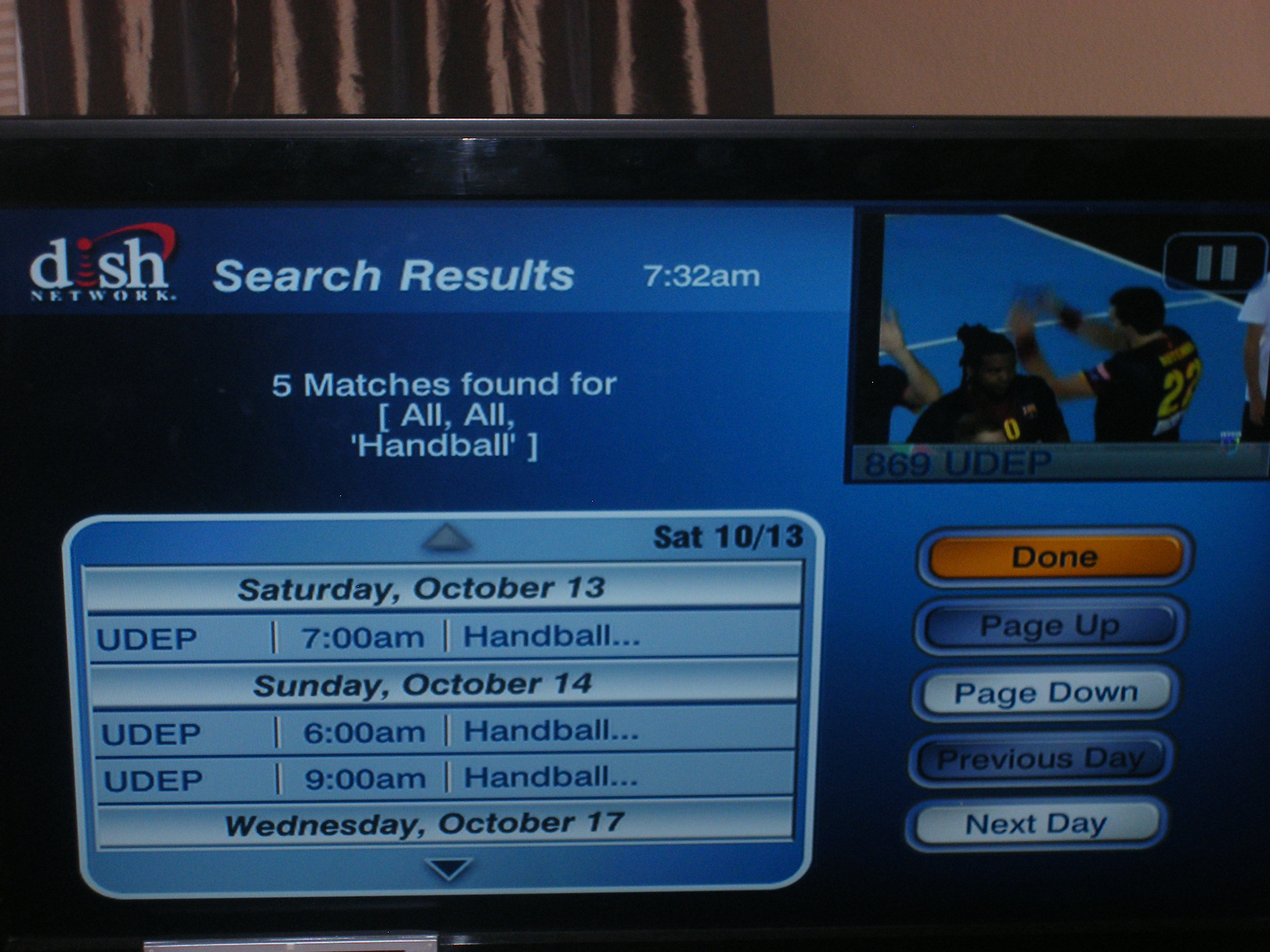
I wasn’t sure where beIN sport was on the channel guide so I typed “Handball” into the search engine so I could add the match to my DVR queue.  My jaw dropped as the unexpected result was some channel called UDEP showing a match on Saturday and two on Sunday!  It didn’t take me long to surmise that UDEP was Univision Deportes and that they too had joined beIN Sport in exercising their handball broadcast rights.

And a little further research really made my day as these 3 weekend matches were two more champions league matches (Barcelona vs. Minsk ; Madrid vs. Veszprem) and an HBL match (Kiel vs. Goppingen).  And, these matches are all being shown live.  This is almost too much good news for me to handle.  I guess I’m going to start complaining about how these channels are not in High Definition (HD).  Heck, why not?  If all my other wishes can come true, why not HD too?

In terms of promoting the sport in the U.S. there’s a little downside it’s that these channels are a bit off the beaten path and not currently available with many cable outlets.  As they do have some premium soccer content, though, there has been a clamoring in different parts of the country for cable companies to add them to their lineup.  And, surely a few Team Handball voices won’t hurt the cause either.  Below is some more information on how to get beIN Sport and Univision Deportes.

beIN Sport availability: Dish Network, Direct TV and Comcast  More information

Univision Deportes availability:  Dish Network, AT & T U-verse, Optimum and Verizon FiOS More information


post

Why weren’t the U.S. National Teams at the London Olympics?: Part 6: A lack of awareness and marketing: The Catch 22 TV paradox

Unfortunately, with very few exceptions this has been the Team Handball TV viewing option for Americans outside of the Olympic Games.

In Part 5, I highlighted just how few fans of Team Handball there are and how instrumental TV broadcasts could be in turning that around.  In this part I address the old Catch 22 paradox that has been largely responsible for keeping the sport off U.S. TV sets for years.  (Part 1) (Part 2) (Part 3) (Part 4)

As I reflected upon in the last installment, there is nothing more effective in tearing down the basic “awareness” problem in the U.S. than TV broadcasts of the sport.  The Olympics demonstrated that powerfully, but as the Olympics fades from memory, so unfortunately does Team Handball from the sports consciousness of Americans.  The obvious solution is to continue broadcasting Team Handball matches on TV outside of the Olympics, but standing in the way is the old “Catch 22” TV paradox:

Team Handball will be more popular if it is shown on TV more.  TV Networks will show more Team Handball on TV, but only if it becomes more popular.

Yes, unfortunately TV networks have decided they don’t much want to broadcast Team Handball on TV because it doesn’t have a built in audience ready to watch it.  And therefore, USA Team Handball can’t use TV to build up that audience.  Arggh!

But, is this truly a Catch 22? Or, are there ways to get around it?  Yes, there are and some other sports have found ways to out maneuver the Catch 22.  Basically, there are three ways to go about it:

1) A sport can get more popular first without the benefit of TV
2) A sport can convince a TV Network that it’s in their interest to get in on the ground floor and help further develop its growth
3) A sport can make broadcasts extremely cheap or even pay the TV Networks to show content

Here’s some top level analysis of these 3 solutions and why they haven’t been applied very successfully for Team Handball.

Getting more popular first without TV

As older Americans well know, 30-40 years ago soccer was shown on TV just about as often as Team Handball was.  In other words, it was pretty much never broadcast with perhaps the exception of the short lived glory years of the NASL and a quirky highlight show on Public TV called “Soccer Made in Germany.”  We all know that that is no longer true as pretty much every major soccer match played in Europe is now shown in the U.S. on some channel.  And it’s pretty clear that this increased TV exposure is directly related to increased interest from the public.  More people want to watch soccer, so the TV networks have responded.  And soccer isn’t the only example of this.  On a smaller scale lacrosse TV broadcasts have increased, but pretty much only as a result of its overall growth in the U.S. creating a growing audience.

So, if soccer and lacrosse can get more popular without TV, the USA Team Handball community should quit whining about no TV broadcasts and mimic what soccer and lacrosse have done.  Right?  Well, I suppose in theory one can make this argument, but it ignores just how deep a hole Team Handball is starting out in.  The soccer analogy is appealing, but as I wrote in this article several years ago, even a farm kid in Iowa growing up in the 70s and 80s knew that soccer and lacrosse existed.  And these sports had firmly established hotbeds in different regions of the country and were established NCAA sports.  In theory, it’s possible that we could copy the paths of these sports, but it has been (and would be) tough to match their success.  Not to mention the fact is it would likely take decades to get the growth needed.

Convincing a TV Network to get in on the ground floor and help out

It’s not definitive that TV networks will only broadcasts sports that have a large built in audience.  At different times networks have decided to give a little push and promote a less popular sport in the hopes that it will have a breakout hit.  Probably, the most prominent example was ESPN’s promotion of “extreme” sports through the creation of the X Games in the 1990s.  Sure, there were a lot of kids already skateboarding and snowboarding, but the organization of these events into sports was lacking.  As this article describes, the X Games were actually an internal ESPN idea which then had to seek out help from a pretty much non-existent sport structure to stage all these activities in a competition format.   And the rest is history.  A non-existent TV audience was immediately created and many of these sports have even found their way into the Olympics.

But, this success story was for individual, artistic sports.  What about a team sport example?  Staring Team Handball right in the face is the ongoing promotion of Rugby 7s by NBC. In a two part series (Part 1, Part 2), written in 2011, I highlighted the tremendous promotion the sport of Rugby is getting with NBC’s decision to broadcast the International World Series competition and now a collegiate competition.  It’s so easy to imagine how something like this would be an incredible boost to Team Handball.

And while Rugby does have a significantly larger following than Team Handball in the U.S. the sport hasn’t developed a large enough audience to support broadcasts.  No, NBC’s decision to devote significant resources to support and promote the sport is based on growth opportunities and in particular, the possibility of giving American football fans something to watch in the spring after the NFL season is over.

It’s also worth noting, that according to this interview with NBC Executive, Jon Miller, NBC contacted USA Sevens first to express interest in broadcasting the tournament.  In terms of convincing, it’s always easier to sell someone who’s already interested, vice cold calling.  The good news is that Mr. Miller and others at NBC know what Team Handball is, so maybe convincing them with still a little Olympics buzz around might yet be possible.

Make your TV broadcasts really cheap and/or pay for access

But, if you can’t convince the TV networks to help you promote your sport, you can always give them the TV rights for a reduced price or for free.  And, if they won’t take free you can really bite the bullet and actually pay them to broadcast your sport.  Ouch.   Really, we’ve got to pay networks to put on such a great product?  How can this be when there’s so much junk being shown on these networks.  Case in point, take a look at the fine viewing options that were available to American viewer at the same time the European Championship final was being played in January.  Why is this so?

Well, the reality is that free isn’t actually free when it comes to TV broadcasts.  In addition to the “rights” to broadcast, there are costs associated with production and distribution.  All those cameramen, cameras, sound crews and commentators aren’t free.  (Well, you can get commentators for free sometimes (like me), but then you’re really reducing your overall production quality.)

And then once you have the packaged product it has to find its way from the arena to the airwaves.  This isn’t free either and can cost several thousand dollars depending on the type of transmission.  Reportedly, when ESPN provided a webstream broadcast of the 2009 Men’s World Championship, the U.S. Federation reportedly had to pay $1,500/match for the satellite uplinks.  And that was for a live webstream, its surely more expensive for a broadcast like the Poland-Germany match a couple years ago.

The other little secret is that when a network fills airtime with repeats of fishing and hunting shows the reality is that the people that produce those shows actually pay to put them on TV.  They are for all practical purposes infomercials.  And while networks may prefer to show more traditional sports content that would probably draw a larger audience they are for the most part quite content to fill airtime and get a little money on the side.

Promotion is so important, however, that sports federations have often swallowed their pride and indeed paid to get their sport on TV.  It’s not an easy decision, particular for marginal sports like Team Handball.  Money to get on TV could also be spent in so many other ways.  It could pay for a team trip to Europe or help start a new club.  But, the counter argument is that maybe showing your national championship on TV will result in more players and fans.  Which could lead to finding better players and better sponsorship.  And, maybe, just maybe you could strike gold with some TV Exec seeing the light and deciding to produce and show the championship next year.

New distribution paths:  An end to the TV Catch 22?

There are, however, new developments with TV webstreaming that could very well throw the old TV Catch 22 out the window.  Heck, some would argue that the availability and quality of webstreaming already has.  If you’ve checked out the quality of the Champions League efhTV broadcasts this year, you know what I’m talking about.  Distribution via webstreaming is also cheaper and provides a path around the TV network gatekeepers.

As I write this in October of 2012, however, it’s too early to write off TV’s future.   I may be happy watching webstreams, but I’m a super fan.  To solve the awareness problem the sport needs to still be on traditional networks where new fans will be created.  Maybe someday, we can ignore the gatekeepers, but unless there’s an Apple iTV “earthquake” in the near future we’re probably stuck with the old TV Catch 22 for a while.  Where’s Steve Jobs when you need him?

So, to increase the sports awareness in the U.S. we need to convince TV networks to help promote the sport.  Or, we can simply pay the networks or make it easily extremely cheap for them to show the sport on TV.  How can a cash-strapped U.S. Federation make that happen?  The answer is a little assistance from European handball entities, who would also benefit greatly from turning the U.S. into a handball nation.  In Part 7 I’ll address why this hasn’t happened in the past, but why it’s starting to happen now.

post

The Karabatic and Montpellier saga – a follow-up

Am I my brother’s keeper? Nikola and Luka together on the court, and in court!


John Ryan has been a keen follower of the career of Nikola Karabatic for a long time now, so John is gearing up to offer his comments primarily from that perspective. In the meantime, as the story continues to develop, I will offer some further thoughts on some aspects of the surrounding framework.

Of course, the handball season has not come to a standstill for Montpellier (or for Paris-St.G who now has two of Montpellier’s players from last year). Montpellier played a league game in Toulouse yesterday and lost. They had to do that without the five players (the Karabatic brothers, Gajic, Prost and Tej) who had been released from police custody but were still being interviewed, and moreover had been prohibited from having contact with their teammates. Montpellier lost 29-34, drawing on a mixture of experienced players (Accambray, Mamelund, Hmam and Metlicic) together with a group of young talents. Manager Canayer commented after the game that it was remarkable to see that the crowds now applauded the depleted team, rather than treating them as the invincible villains. On Sunday, Montpellier has a home game in the EHF Champions League against Ademar Leon.

I should again emphasize something that does not seem to be clear in the many media reports around Europe: we are dealing with two really separate actions, the betting on their own game, which goes against the regulations of the French league, the French federation (and, for that matter, their counterparts in most other established handball countries), and the accusation that they lost the game intentionally. The betting is exclusively a matter for the handball/sports authorities, as this goes against their ethics codes and regulations, and it has nothing to do with French law which treats all citizens the same way. By contrast, I do not know of any federation that has a regulation explicitly dealing with the notion of losing intentionally; there may be some more vague expectation that a team should ‘always do its best’. And of course, losing a game, even if it is done intentionally, would not be a crime under French law, if it was not for the link to gambling. Because then you commit fraud against other bettors. The police is attempting to confirm the betting, as it provides evidence for the intention to lose the game, and then remains the more difficult issue of proving that the loss actually was intentional.

So the only excuse for the federation and the league, in their preference to wait quietly for the police to conclude their investigation, is that they prefer to have the police establish the evidence for the prohibited betting. Karabatic first had his lawyer admit to his own betting, then he used his facebook page to deny it, but now that denial has been removed. It seems the defense will be focused on what I noted a few days ago: the loss was plausible because of the many injured players, the betting was done by the family and friends who inevitably knew about the injuries and the fact that Montpellier had already secured the league title, and the notion that players who did not actually play in the game of Cresson somehow, by definition, could not be accused of manipulation. But the legal authorities are smarter than that. They understand that key players such as the Karabatic brothers could easily influence their teammates about how the game should proceed, even if those who played had not been involved in the betting. And now it may be getting worse, because media have just released the idea of suspicions regarding another game that Montpellier lost late last situation, against local rivals Nimes.

Going back to the responsibility of clubs, leagues and federations, it was interesting to see that the National Association of the French sports gambling syndicates issued a scathing accusation. They noted that, when sports gambling became legal in France, they had urged the federations and the clubs to collaborate with them in a special effort to educate and warn the athletes about the potential risks and consequences. However, the statement suggested that there had been no interest in collaboration on the part of federations and clubs. So it is really a considerable hypocrisy, when the federations now express great surprise and the clubs complain about the hardships caused by the loss of access to their expensive key players. I have suggested that the FCH, the umbrella organization for the top European handball clubs, could use its neutral but prestigious position to urge clubs across Europe to open their eyes to the dangers and to help coordinate an educational effort.

Finally, an interesting twist: after I wrote my initial article, it has become clear that most of the betting was in fact in the half-time result, not the final result. This is a concept known as ‘spot betting’, meaning that it involves some detail within the game rather than the final outcome. I wrote about this a few months ago, and I underscored the dangers of such betting. Because it may involve some aspect that has no real connection to the final result (such as who got the first yellow card, or who scored on the first 7-meter throw), it is more obscure and less likely to draw attention. It may even seem more harmless, because it has nothing to do with losing intentionally, but it could still involve big money and clear manipulation. And I noted that there is more scope for this in handball, compared with for instance football. Intentionally being behind by one goal at half-time in handball involves no real risk for a superior team, but the same thing in football is considerably more dangerous.

post

“Rien ne va plus!”: Karabatic and teammates betting that their own team would lose – but did they then lose intentionally?

Not surrounded by his usual admirers: Nikola Karabatic detained by police after his most recent match


Most handball fans have heard lots of stories about match fixing, in football and many other sports; but in handball, no, that could never happen! It is nice to defend your sport and your idols, but it is not so good to be naïve! I have written several times about match fixing, both the ‘traditional’ type where a team can afford to lose intentionally in return for a ‘favor’, and the more ‘modern’ one where the cause of the match fixing is related to betting. And I have suggested that is indeed naïve to think that handball is immune to such methods.

Now we have evidence about one aspect (forbidden betting), and the suspicions about the other part (losing intentionally) are being investigated by the police. And it does not involve some low-level match in some obscure corner of the handball world! It turns out to involve one of the most famous players in the world, Nikola Karabatic, and his teammates in Montpellier, a perennial top club in France and in European competition. Karabatic, several of his current and former teammates and a number of their family members, were detained by police directly at the end of their French league match against Paris, their new big rival, last Sunday. Montpellier was crushed in that match, 24-38, but that is now a side story and perhaps they knew what was coming…

At issue is a match late last season. Montpellier had secured the league title the previous week and now was facing an away game against lowly Cesson-Rennes who needed to win to be sure of avoiding relegation. Perhaps it was all along a match that would be risky for someone interested in betting. Montpellier could be expected to play without motivation. And on the evening of the match it became clear that six of their better players, including Karabatic, were injured. It is not clear if this fact was generally known, or if it was known only to the team. This is relevant, because such information, which is useful to bettors, is not allowed to be revealed by team members. But this is probably a minor issue by comparison.

What was not minor in terms of sports ethics and regulations in French handball was that Karabatic and several other players, through friends and family, decided to bet large amounts (although smartly in small installments) on both a half-time lead and a victory in the match for their opponents. What seems so absurd is that the amounts, which came during a small window of time and from just a few locations, were large enough to set off alarms in the monitoring system (and therefore close down the betting and alert the police) but that the potential gains were still rather modest for persons as wealthy as Karabatic and his colleagues. They certainly did not desperately need to take such enormous risks to win those amounts. But the fact that they were betting on their team to lose has been confirmed, so that is not in dispute.

However, that is a matter for French sports authorities and for the relations between Montpellier and the players. The club is now finding its strong image badly tarnished. And this is not because the club is being accused of anything. Indeed, not even the opponents who badly needed to win are suspected of having done anything improper to influence the result. But what remains as the issue that the French legal authorities are now pursuing, is the question as to whether the Montpellier players lost the match intentionally!? This amounts to corruption and could in principle result in prison terms if anyone is found guilty, as this would mean that a fraud was committed against those who innocently were betting in favor of Montpellier. They have the right to expect fair play and ‘may the best team win’.

But, as always will be the case in a situation like this one: how can you ever prove, in a legal sense, that a team is losing intentionally?? The result was 28-31 (12-15) and it was not exactly an absurd situation where Montpellier players started scoring against their own goalkeeper… They were the team without motivation, and they played without six important players! So the result is not really implausible and perhaps Cesson was ‘the best team’ that day.

But can one argue that the accused players really were able to play for 60 minutes without thinking about the money they would win if they lost the game? And did they really bet against their own team just to have some extra money as consolation if they lost the game? Yes, you and I can have our opinions, but how can you find legally binding evidence? There have been reports about phone-tapping and hidden cameras, but even if it seems stupid that the players took such risks, would they then in addition be so stupid that they spread around remarks about losing intentionally? It will be interesting to see the eventual outcome, but I would not advise a betting person to put any money on a guilty verdict…

I actually say that with a sense of regret. Not because I personally have any reason to see the players found guilty. Rather, I am concerned that the ability to lose a game intentionally in such a way that there is no legal evidence, is one of the inherent weaknesses in sports. Experienced players and, yes, experienced referees, can easily find ways of affecting the outcome of a game in such a subtle way that it does not leave strong suspicions, let alone formal evidence. As I see it, this means that we need to be much more alert and suspicious than we normally tend to be. We may never see ‘evidence’, but over time we should be able to recognize a pattern, and we should be able to find indications that may not hold up in a court of law but that would be enough under rules and regulations of sports to weed out the athletes, officials and teams who threaten to ruin our sports.

As the legendary French coach Daniel Costantini said yesterday: one must condemn players who are so stupid that they are ready to risk a world-class career for modest gains. They are no role models who deserve our respect. But what Costantini added is also astute and correct: all of us in the world of handball contribute to this situation by building up young, talented but often immature athletes into idols who feel that they are above it all, that they can do nothing wrong. Federations, clubs, fans, media can, and should, play a positive role in ensuring that it does not go that far. And part of that role is also to make sure that we are not so naïve about the risks and the problems that do exist!

post

VIDEO: EHF Champions League (Week 1): Madrid vs. Kiel

Goalkeeper Thierry Omeyer will guard the net for Kiel in Sunday’s clash vs Madrid

The EHF Champions League season is underway and the first game of the week is a rematch of last year’s final as the defending champion’s Kiel travel to Spain to take on runner’s up, Madrid.  Last year Kiel defeated Madrid, 26-21 in the final, but only a few weeks ago Madrid got revenge with their defeat 28-23 defeat of Kiel at the IHF Super Globe event in Qatar.  It’s only week 1 of Group Play, but don’t be surprised if the result of Sunday’s match and Madrid’s later visit to Kiel will be the only 2 matches that matter when it comes time to determine who wins Group B.  The oddsmakers expect a close match with neither side favored.

30 Sep (1800 CET; 1200 U.S. East Coast)
Madrid vs. Kiel Live Link

The match will have English commentary from Tom  Ó Brannagáin and will be available live and on-demand.  Here’s Ó Brannagáin’s blog writeup: Link

All the matches of the Champions League are available here:  Link

Note:   The EHF has modified their efhTV website to now include scores and standings.  Some folks might find this a great addition, but if you’re like me and don’t want to know the outcome of the matches before you watch them, you’ll want to immediately scroll down to the bottom of the page to avoid seeing this information.  Then you can slowly inch your way up to the video links.  The offending information is at the top of the page, just above the Group A video links.   As an aside, Christer has informed me that I am the only one in the world that does this.  Well, I’d like to think that there are a few others.  Perhaps 7 of us in total; or if you prefer, 1 in a billion.  Yes, even more rare than 1 in a million.