post

VIDEO: Champions League Game of the Week (Kiel at Copenhagen)

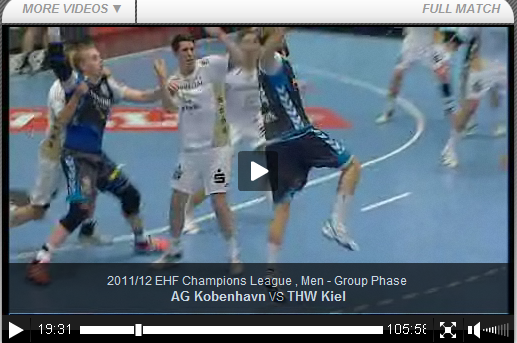
AG Kobenhavn vs THW Kiel: Who will make a statement?

I’ve been remiss in posting links to the EHF Champions League Game of the Week, but having sat down to watch the first few minutes of this match, I thought it was worthy of a reminder.  Quite often the Group Phase of the Champions League can be somewhat boring with most of the teams knowing who’s going through to the knockout stages.  Both Kiel and Copenhagen are in that category, but this match will decide who will place first in their group.  While both sides are likely to win their first knockout pairing, having a first seed in the quarterfinals can be pretty important as it means you will avoid the other #1 seeds.

But, in addition to the Champions League implications this match is interesting in that it’s an opportunity for both sides to make a “statement.”  Kiel has dominated the HBL this year with no losses and barring a monumental collapse they will win the title.  They’ve been less impressive, though, in the Champions League and a win in Copenhagen will make a statement.   And for Danish League leaders, Copenhagen, the same is true as they surely want to make it clear that they are every bit as much a contender as Kiel is.  So, a clash of titans worth watching and a taste of what’s to come in the knockout rounds.

Link to On Demand Video:  http://www.ehftv.com/ec/cl/men/2011-12/video/002111


post

Air Force Basketball (Lessons for USA Team Handball): Lesson #2) Blue Chip Athletes from other Div 1 Sports are harder to come by nowadays

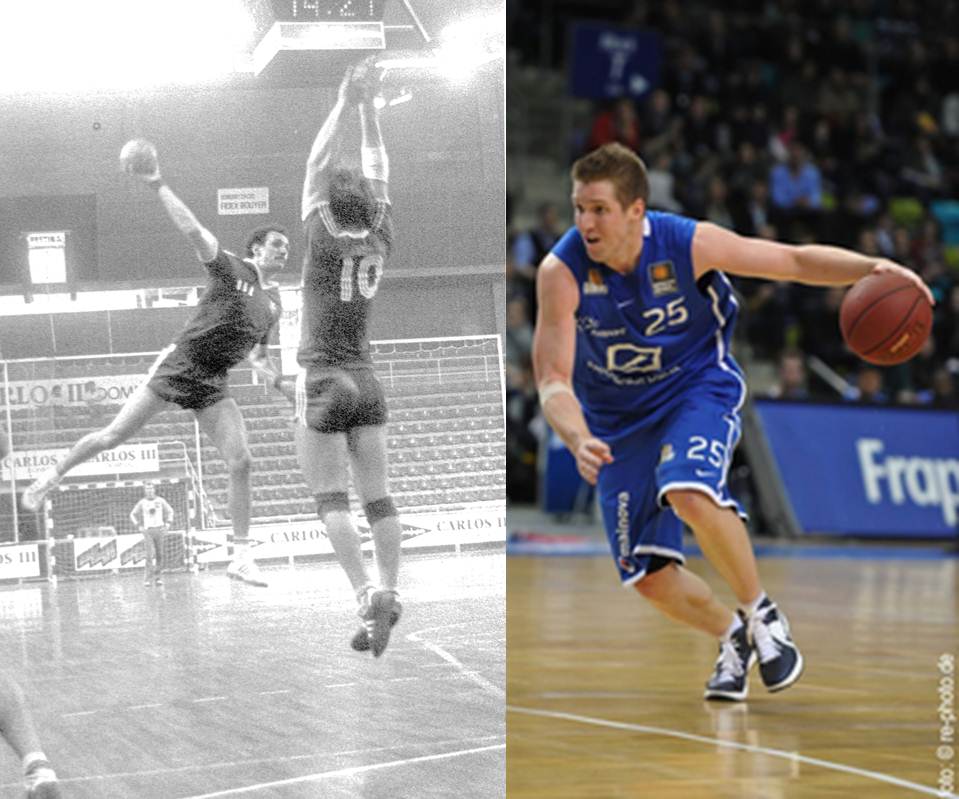
Post Academy sporting careers: Bob Djokovich, 78', with the USA National Team prior to the 84 Olympics and Jacob Burtschi, 07', with his current club, Germany's Fraport Skyliners

In the first part of this series I pointed out that if a downtrodden doormat like Air Force Basketball can execute a remarkable turnaround then it’s possible for USA Team Handball.  In part 2, I highlight how Air Force basketball athletes have contributed to our national teams through the years and what this means for USA Team Handball as it seeks to recruit “blue chip” athletes.

Another Olympics is approaching and I’ll bet you dollars to donuts, that we’re bound to see a few more mainstream journalists discover Team Handball and write a commentary or two about how it wouldn’t take much for the USA to be good at it.  Just get a few of our collegiate athletes to crossover to Team Handball after their career is over in their primary sport and it’s only a matter of time before this great sporting nation will be on the podium.  And it’s not just journalists which often conclude that this is the path to follow.  Here’s a quote from Interim USA Team Handball GM, Dave Gascon in a recent interview touting, A Change in Direction:

“We will no longer be the doormat of the Western Hemisphere.  Simply put, there are thousands of blue-chip American athletes who would love to represent the United States in international competition.  So while we are committed to a grass roots program to develop team handball with the youth our country, we are going to systematically go after those 400,000 NCAA athletes who go professional in something other than their scholarship sport after graduation.

Jeff and I independently came to the same conclusion that we would be foolish to not pursue our country’s best athletes who are in the last year of college or shortly after graduation.  Look, these are some of the most competitive people on the planet and most have nowhere to go to continue to compete at a high level.”

It’s easy to see why a lot of folks come to this conclusion, particularly when they look at the raw physical talent on the rosters of the world’s top teams.  Take for instance, Iceland, the silver medalist at the last Olympics.  They have some decent athletic talent, but they aren’t by any means physically imposing.  Heck, you could probably take any 1 out of 344 NCAA college basketball program in the U.S. and come up with a better crop of raw athletic talent; Doesn’t have to be Duke, Kentucky or Syracuse. Why, you could even take a mediocre (at best) program like Air Force and probably come up with the athletes you need to make a pretty good Team Handball squad….

And indeed, back in 1976 this hypothetical was exercised at a lower level when a group of cadets who played Team Handball intramurals at the Air Force Academy found out there was a club National Championship for the sport in the U.S.  An intramural all-star team was thrown together, composed largely of athletes from the Men’s varsity hoops team and this unknown team showed up at the Club National Championships.  The Air Force team, without the benefit of ever having seen how the game was supposed to be played quickly found out that the version of the game they had been playing in intramurals was only a rough facsimile of the real thing.  Still, they were hands down the most athletic and physically conditioned team at the 3 day tournament.  They adapted quickly and went on to take 2nd place, losing by two goals in the finals to a team that had several athletes on the USA’s 1976 Olympic Team.

So, if you can take a great group of athletes and overnight make them the 2nd best team in the country, I wonder what they might do at a higher level with a little bit more training.  Well, the Air Force team didn’t become the National Team, but after Graduating from the Academy in 1978 two of those players, Bob Djokovich and Tom Schneeberger continued to play handball and were linchpins of the 1984 Olympic Team, arguably the best national team the USA Men’s program has ever had.  If you put together a list of the all-time top American Team Handball players, those two are going to be very near the top of most everyone’s list.  And, I would argue that their handball accomplishments all by themselves means that Air Force Basketball has made the most significant contribution of any one NCAA sport/school to the sport.  (Note:  Another AF Hoops player, 1979 Grad, Randy Gricius, also played on the National Team for a while and would have likely played in the 1980 boycotted Olympics)

But since 1979, while the Air Force Academy has sent several athletes to the National Team there hasn’t been a single player that was part of the Men’s Varsity Basketball team program.  Why has that been the case for the last 33 years?

As an 87′ Grad who coached Team Handball at the Academy from 91-94 and also played service hoops with a couple of talented players I am in a fairly unique position to speak for the 80’s and 90’s decades.  The most glaring obstacle for getting collegiate basketball players to take up handball was a decision sometime in the 1980’s to discourage intercollegiates from playing intramural sports.  This shouldn’t come as a real surprise to anyone who follows NCAA sports nowadays.  Teams aren’t allowed to practice out of season, but players are expected, and most want to, to continue working to improve their skills.

For all practical purposes, though, this eliminated the introduction of the sport and the possibility of those athletes really taking a liking to team handball while still in college.  The only real chance to bring some of those athletes in was in the spring of their senior year after basketball season was over.  At the same time, however, the Academy club was becoming more organized and this meant that the club players even if somewhat less gifted athletically still had a solid year or two of experience on a collegiate player.  A basketball player or any other sport for that matter could join the club, but they would have a steep learning curve.  Not to mention the fact that they would be integrating into a team that had already been practicing together for a couple of years.

But, what about bringing in some of those athletes after graduation?  At that point their basketball options would be limited and even if they haven’t played handball you can’t graduate from the Academy without having seen the game played.  By happenstance, I had the opportunity to play organized service basketball with two former AF players of significant pedigree, Mark Slimko (89) and Chris Loll (95).  Both were about 6’5”, played forward and were team captains while at the Academy.  As a former player on the U.S. National team, I certainly did my best to talk up the sport with them, but neither showed much interest.  Either would have made a great Handball player and Loll, who was left-handed and had been a fairly accomplished high school baseball pitcher and football QB would have a lock.

Such a lack of interest, though, is not too surprising.  While some might jump at the chance to be an Olympian, the reality is that it’s far more likely that accomplished athletes in their early to mid 20s will be starting to think a little bit more about the rest of their life.  This was especially true since back then USA Team Handball couldn’t offer much more then modest dorm lodging, cafeteria food, a chance to travel and a modest stipend.  Being an Olympian has its appeal, but it you’ve already played at a fairly high level in front of large crowds against some top notch competition, toiling away in obscurity for two weeks of Olympic glory just might not be worth it.

Flashing forward to the 21st century and it’s pretty much the same story, except USA Team Handball doesn’t even have the resources for lodging, cafeteria, and a stipend.  Heck, without funding from the USA Team Handball Foundation national team athletes would even have had to pay for their own transportation to recent national team competitions.

To make matters even more challenging collegiate hoopsters now have far better opportunities to play professionally overseas.  This, of course, was always an option, but the conditions and compensation were less enticing.  Bob Djokovich, for instance turned down a modest offer to play for Red Star Belgrade.  Professional basketball in Europe has come a long way with salaries now even getting the occasional NBA caliber player to play in Europe.  From Sweden to Italy and from Spain to Turkey there are leagues looking for players and even players from less prominent colleges can make a comfortable living.  I saw this first hand in France as the over 35 recreational team I played for sometimes had our practices start after the 2nd Div Pro team at our club finished.  Each season there were a couple of Americans from lower tier Div 1 schools that had signed a contract and were living the dream:  An apartment in Paris, perhaps 40K Euros/year and playing basketball for a living.

To continue the Air Force basketball angle I tracked down Jacob Burtschi, one of the key players who helped orchestrate the revival I highlighted in part 1.  He’s now playing basketball for Frankurt’s Fraport Skyliners in the German 1st Division.  It’s not the NBA, but it’s one of Europe’s top leagues and he’s definitely enjoying the opportunity to play professional basketball.  Out of curiosity I asked him a few questions regarding Team Handball and the Academy.  He certainly had seen the sport being played in intramurals, but had not played it.  Now that he lives in Germany, he’s enjoyed watching the German Handball Bundesliga on TV.  And he further assesses that raw talent wise, he might even be a better fit for handball.  Having seen him play hoops, I’d have to concur with this assessment.  He’s a great basketball player, but he’s also got the prototypical handball build.  If he had played at the Academy 30 years ago chances are he would have taken up Team Handball.  Given the current opportunities he has now, though, there’s little hope that we’ll ever see him or other blue chippers like him take up the sport.

While it may be unrealistic to expect that thousands of blue chip athletes will drop everything to pick up team handball it is still indeed foolish not to try.  It will, however, not be easy and it will involve some targeted recruitment strategies and probably looking a rung or two below the true blue chip athlete.  In part 3, I’ll take a closer look at some of these strategies by examining the handball careers of a couple of would be Air Force basketball players whose hoops careers never materialized.

Colorado Springs Gazette Telegraph (26 May 2011): Air Force grad Burtschi gets experience playing hoops overseas: http://www.gazette.com/articles/burtschi-118667-hood-story.html

Colorado Springs Gazette Telegraph (26 Feb 2009): Gazette picks all-time Air Force men’s basketball team:   http://www.gazette.com/sports/career-48873-team-time.html
(Burtschi is in the starting lineup; Djokovich, Schneeberger and Gricius are reserves)

USA Team Handball (18 Jan 2012): A Change of Direction: http://usateamhandball.org/news/2012/01/18/a-change-of-direction/46210
 

post

IHF: the usual lack of transparency

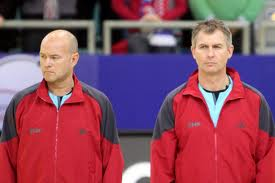
In this photo, Redondo (second from left) looked distraught long before the Championship started; did he anticipate what would happen?


In recent time the IHF has yet again confirmed its reputation for leaving the international handball world in the dark about its decision-making on important matters. Perhaps I should not be surprised, but I generally prefer to be an optimist and always want to hope for improvements. But the shadow of the IHF role models Mubarak and Blatter is evidently too deep.

During the recent Women’s World Championship in Brazil, fortunately the participating teams may not have realized so fully that the whole event was really nothing better than a ‘house of cards’ in terms of finances, marketing, accounting and administration. During the course of the event, the organizers ran out of money and could not handle the daily expenses so the IHF had to step in. There was very little revenue from ticket sales, as there were extremely few spectators, the budgeted sponsor income seemed to be quite lacking, and there was not even an adequately functioning host broadcasting company to serve the international TV audiences. The organizers are now substantially in debt to the IHF.

One might have hoped for something better, given that Brazil has had two IHF Council members, Manoel Oliveira, also President of both the Brazilian and the Panamerican Handball Federations, and Fabiano Redondo, President of the IHF Commission for Development and, in this case, also Director of the World Championship organizing committee. Brazil has hosted junior world championships in the past, as well as numerous Panamerican events, and both Oliveira and Redondo have participated in numerous IHF events as IHF officials and/or Brazilian representatives. So there would be no excuses for not understanding what was required.

Not surprisingly, this state of affairs did not go over well with the IHF leadership. So even if it has never been officially reported, and even if the IHF web page still shows Redondo as an IHF Council members and Commission President, it appears that the truth is he was ‘forced to resign’ already during an IHF Council meeting during the course of the World Championship. Presumably he was seen as the main person responsible, as the Director of the Organizing Committee; however, it has also been whispered that Oliveira should really take the main blame as the Brazilian federation president.

But, as some suspicious persons have been heard noting, perhaps IHF President Moustafa sees Oliveira as too valuable in the efforts to secure votes from PanAmerican countries. Who knows what the precise truth is? And that is precisely the point: handball federations, media and the ‘international handball family’ have the right to know about such important development. Not perhaps the gory details, but the main issues and considerations and the confirmation when a decision has been taken!

On a separate matter, the lack of transparency and good judgment has again become apparent. For any sports federation, the nomination of referees to a World Championship or, as in this case, the Olympic Games, is an important decision and announcement. In this type of situation, even the flawed role model FIFA tends to do a very credible job, with announcements that honor the nominees, provide background information about selection criteria, and explain the plans for preparation.

But in the case of the IHF, the ‘methods’ are different. If you have followed web sites of a number of sports media or national handball federations, you have been able to pick up the names of a handful of the couples nominated. And the IHF web page does indeed announce that a meeting has taken place where the decisions were taken, but apparently the method is to inform the nominees individually and to keep the overall decision a secret. Of course, given the prestige involved in such nominations, there is a great interest in the decision around the handball world.

There is always speculation about the reasons why a certain couple has been nominated and why another one has been left out. There can be differences of opinion about relative quality, but there are also understandable suspicions about favoritism, political manipulations and considerations related to image. For instance, will there be additional couples from ‘special countries’, will some referees ‘with connections’ be included ahead of others, how many women couples will there be, etc.? One would hope that the Referee Commission has been allowed to take a well-considered decision without any political pressure. But does not the IHF understand the simple fact that its careful concealed processes and its refusal to make public and informative announcement are bound to create suspicions even if there is nothing to hide??

post

Why not a Handball version of Linsanity?

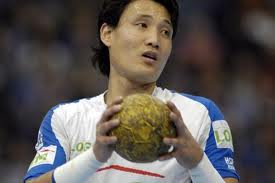
Yoon and Miyazaki: How about a handball version of Linsanity

The sporting world discussion in the USA the last couple of weeks has been all about basketball player, Jeremy Lin, and how he has come out of nowhere to lead his team, the New York Knicks, to 7 straight victories.  Cut twice from two other NBA teams, he was pretty much the last player on the bench when injuries forced him into the starting lineup.  Given the opportunity to play he’s been averaging around 25 points a game, exciting fans and has become an overnight nation-wide sensation.  With a short name, “Lin”, the media has been having fun with clever headlines:  Linsanity, Lincredible, Linderella, etc.

What’s made the sport even more interesting and compelling is the fact that he’s an Asian American excelling in a sport at the highest level when Asians are often a rarity at any level.  Other then Yao Ming and a few other 7 Footers, there haven’t been a whole lot playing in the NBA.

As you might expect, the NBA has immediately seen the value in an unassuming Asian American star and the marketing has commenced in earnest.  One analyst has even projected that if Lin continues to play well the NBA will pocket an extra 80 million dollars this year.   And the marketing has become a world-wide phenomenon, with even the BBC’s World Have Your Say, discussing Linsanity.

It’s a shame that Handball doesn’t have some marketable Asian stars that they couldn’t promote the same way.  Well, actually they do have (or have had) the stars that could be promotable, but failed to fully capitalize on the opportunity.  Amazingly, the German Bundesliga’s all-time career scoring leader, Kyung Shin Yoon is a South Korean.  In 12 seasons from 1995 to 2008, Yoon scored 2,908 total goal averaging almost 8 goals/game.  This is a crazy, dare I say, “Yoonique”, anomaly in a league which is probably around 98% white European.     Yet Yoon, who continues to play in South Korea, is probably less known in his native country then Lin is now after two weeks of good play.

On a smaller scale, one of Japan’s best players, Daisuke Miyazaki, played a season in Spain’s Liga Asobal.  Miyazaki had a respectable season, but played in obscurity.  In Japan, he’s 10 times more famous for winning a Ninja Warrior style game show 3 times.

So, I would argue that a couple of opportunities to expand the reach of the game in Asia have been missed.  Yoon, who proved himself over several years, in particular, should have gotten more promotional push in his native country.  Perhaps it would never have been Linsanity, but at least some sizable segment of South Korea surely would have been compelled by one of their citizen’s starring in the world’s best league.

The lesson here is that in the future there will likely be new opportunities to promote non-European stars in Professional leagues and those leagues should be ready to take advantage of the possibilities.  Heck, one could go even farther and assess that they should be scouring China right now for a player that they can develop and promote.  With 1.3 Billion people surely there is a Yoon like athlete that could create handball’s own version of Linsanity.

THN (23 May 2008): 2,908 Goals: The Kareem Abdul-Jabbar of German Handball Heads Home and a Marketing Opportunity is Squandered:  https://teamhandballnews.com/2008/05/2908-goals-the-kareem-abdul-jabbar-of-german-handball-heads-home-and-a-marketing-opportunity-is-squandered/

THN (15 Jun 2010): Daisuke Miyazaki: The Ichiro Suzuki of Handball (or maybe the Kyle Rote Jr.): https://teamhandballnews.com/2010/06/daisuke-miyazaki-the-ichiro-suzuki-of-handball-or-maybe-the-kyle-rote-jr/


post

Bahrain continues mistreatment of handball referees

Perhaps raising your hand is taken as an illegal protest!?


In our recent reports from the Asian Men’s Championship, we noted that Bahrain participated as if things are back to normal in the Bahrain Handball Association (BHA) and in the lives of their referees and officials. But this is most emphatically NOT the case. In a prominent report just a few days ago, the Bahrain Center for Human Rights (BCHR) dedicated a long, detailed exposition to the fate of the handball referees of Bahrain. As the BCHR’s headline indicated, “the local and international handball referees are victims of detention, torture and dismissal”.

This is the result of a governmental campaign, aided by the BHA, who gladly collaborated with draconian measures of the government and provided names, photos and other information about the referees and officials who were accused of participating in protests. The government tries to convince the world that most of the detained and dismissed persons are now leading their normal lives again and that the charges against them have been dropped. But the reality is that many of them are still in prison, and others are kept away from their earlier involvement in sports and their old jobs.

The BCHR internet posting reports about the individuals, essentially referees and their instructors and supervisors, who continue to suffer in the hands of the government and ‘their own’ Association. The list, with names and other details, confirms that a large proportion of the international, continental and top national level referees are affected. Moreover, what is not mentioned in the article is that the BHA has tried to force the remaining referees to pick up the slack and also combine into newly formed couples to keep the national league going and to give the impression that everything is running in the usual manner.

There is also a suspicion that it is a quite intentional and cynical decision to target the referees in this way. The top players and coaches are so well-known that their absence would be noticed, and the quality of the national team and the league would suffer. But the referees tend to be more anonymous, so the calculation appears to be that they can be punished more harshly without a strong public attention to their situation. Moreover, they do not have clubs and supporters who might stand ready to agitate on their behalf.

All this happens at a time when many observers outside Bahrain are misled to think that most of the problems that started a year ago are now over. This is especially the case after the government in Bahrain last November took the unusual step of accepting an investigation undertaken by a prestigious, international ‘Independent Commission of Inquiry’. Moreover, the findings of the Commission were published and the King made statements to the effect that there would be a serious follow-through on the recommendations through a ‘national commission’.

To some limited extent, positive action has been taken, but mostly in a forward-looking sense. In other words, there has been legislative action intended to ensure that those authorities who abused their position would no longer be in position to do so in the future. But this does not mean that it is tolerable to see that the situation of those who were already subjected to excessive or unjustified punishment are allowed to continue to suffer. While it is true that many prisons sentences have been cut short and that charges have been dropped in a number of cases, the indications of a continuation of capricious and despotic treatment are too numerous to ignore.

It is also sad to see international observers commenting on the situation in Bahrain out of ignorance or political convenience. Government statements are accepted at face value, Bahrain is given lower priority due to acute, serious events elsewhere, and in some countries there are special reasons for maintaining a positive façade in the relations with Bahrain. For instance, during a visit Bahrain, the U.S. Assistant Secretary of State for Democracy, Human Rights and Labor, Michael Posner, last week commented overwhelming in positive terms, focusing on action taken and giving relatively short shrift to the many things that still need to be done. The comments were offered in the context of an emphasis on “long-standing alliance”, “important partner” and on “both countries benefitting from stability and prosperity”.

February 14 is the anniversary of the start of the unrest a year ago. Let us hope that it will be marked by explicit steps in action in line with the recommendations of the Independent Commission of Inquiry, with respect to having charges dropped against all persons accused of offenses involving political expression and to having dismissed professionals and official reinstated. Finally, it continues to be a matter of serious concern that there are no signs of a willingness on the part of the International Olympic Committee to intervene adequately on behalf of suffering athletes and sports officials in Bahrain.

post

There is no “WE” when it comes to the global interests of Handball

Competing interests often keep Handball from growing in popularity

Christer Ahl wrote a commentary recently that addressed whether there are too many events like the European Championships on the quadrennial calendar for Handball.  In his view it all came down to the basic question:  For whom and for what purpose do we organize these Championships? And he does a pretty good job summing up the pros and cons along with the basic problems of an overly crowded schedule and the impacts to the players.  That being said he comes up short in a couple of areas that I’d like to further address.

The first area relates to Christer’s liberal use of the pronoun “we”.    In some follow up dialogue, Christer acknowledged that in the interests of time and space he used the word without defining contextually who the “we” was.  In broad terms Christer’s “we” refers to dedicated Handball enthusiasts who enjoy watching the sport and would like to see the sport become more popular.  This is probably a fairly large constituency even if there is no particular organization that directly speaks for these interests.  But, as you delve further into the article, Christer’s bias as an American and former IHF official with a very global view are pretty apparent.  Not to mention, he has a pretty sympathetic ear to the interests of the players.

When all is said and done, it’s pretty obvious that there is simply no “we” when it comes to Handball.  Instead it’s a complicated game of tug of war between competing organizations and interests with alliances that rotate back and forth based primarily (some would say, solely) on the best interests of those entities.  For the uninitiated here’s a primer on those entities.

IHF (International Handball Federation)
– Income sources:  World Championships, Olympics, TV rights and sponsorships
– Power and influence factors:  Controls two prime money making events and the legitimacy of an international federation

EHF (European Handball Federation)
– Income sources: European Championships, Champions League, TV rights and sponsorships
– Power and influence factors:  Controls two prime money making events and the represents the continent with the overwhelming greatest number of fans

Other Continental Federations (Africa, Asia, Pan America, Oceania)
– Income sources:  IHF grants, National Federations
– Power and influence factors:  These Federations to varying degrees have bundled national federations votes for IHF elections

National Federations (Europe)
– Income sources:  National Team competitions, National Club cup competitions, Government backing and sponsorships
– Power and influence factors:   These Federations control the national teams which are the primary products of the top revenue events

National Federations (Rest of World)
– Income sources:  IHF grants (often filtered down through Continental Federations)
– Power and influence factors:  These nations each have a vote in the elections for IHF positions and collectively they can out poll Europe

National Leagues
– Income sources:  Clubs, TV rights for league matches and sponsorships
– Power and influence factors:  These leagues represent the clubs in their leagues.

Top Handball Clubs
– Income sources:  Club matches and sponsorships
– Power and influence factors:  These top Handball clubs pay the bulk of the salaries for the World’s best players

Other Handball Clubs
– Income sources:  Club matches and sponsorships
– Power and influence factors:  While fewer top players play for these clubs these clubs provide the competition for the top clubs and are necessary for the National Leagues to function

Players
– Income sources:  Clubs, also additional minor compensation for national team events and sponsorships/advertisements
– Power and influence factors:  The players are the product.  Without the players there is no Handball

Now, I’ll be the first to state that this is a simplified summary of the different entities that collectively are involved in the Handball world.  It just scratches the surface and even within these different entities there are competing interests.  For instance the German Bundesliga competes against other national leagues and it can hardly be said that every European National Federation is on the same page on a number of issues.

About the only thing that all these different entities agree upon is that it indeed would be a good thing in Handball was more popular.  And I suppose all involved also like watching a good handball match.  But, it’s hard to see common cause going much further than that.  And as with many things in life and politics, these divisions pretty much all boil down to money and the reality that there is only so much money to be divided up.

If you take the specific question Christer asked, “For whom and for what purpose do we organize these Championships?” and ask each of those entities you’ll get a substantially different answer from every single one of them.  That’s because staging a European Championship or World Championship has a tremendous impact with pros and cons for each of these entities.  Changing the status quo, could radically diminish (or even eliminate) some of these organizations.

So, if the current state of affairs is that there is a tangled web of competing interests does that mean this status quo will be maintained on into the future?   Or is there a real potential for some radical change to the status quo.  For change that would increase the popularity of the sport and result in a better product for fans world-wide?

Yes, it’s possible and that will be addressed in a follow up commentary.   If you’re looking for a hint, look at the common thread inherent in each of these entities and then follow the money.


post

Some observations of the refereeing issues at the EURO 2012

Norwegian referees Abrahamsen/Kristiansen had a very solid EURO 2012 and confirmed this impression in the final


An event like EURO 2012, with a concentrated number of difficult games involving the best referees of Europe, is often a good opportunity to take stock of both the overall quality of the current level of refereeing and of the specific situations and problem areas that may warrant attention. Therefore, even if undoubtedly both Sandor Andorka and his EHF colleagues, as well as my former IHF colleagues paid close attention to the referee performances, I hope that they will not mind my offering some unsolicited input. In doing so, however, I should note that the internet opportunities this time were not ideal, as there were many parallel games and the ‘on demand’ feature for watching games afterwards mostly functioned rather poorly.

I have already commented that the quality of play in EURO 2012 perhaps was not as high as one had hoped, and that many top players sometimes seemed to lack their usual energy and motivation. But from a refereeing standpoint, it may have been more relevant that an unusually high proportion of the games were very close and exciting in terms of final results. Also, there was some added excitement in the sense that there was not just a competition for EURO medals but also for a chance to obtain one of the slots in an Olympic qualifying tournament. Also, the format of EURO, where results are carried over to the next round, means that there are very few games where the results have less importance. All this contributes to put pressure on the referees, as does the reality that there were really TWO home teams with loud and fanatic spectators, namely Serbia and Macedonia.

Possibly this may have contributed to the feeling I had that in many games some of our most experienced referees showed a hint of being overly ‘diplomatic’ or cautious. Of course, while we want our referees to be bold and confident, essentially ‘whistling for what they see’, without worrying about the reactions to their decisions, we do not want them to be robots or in an ‘autopilot’ mode. They need to take into account the ‘temperature’ of the game and their decisions in previous similar situations, so that they can maintain consistency and control. But we do not want them to look as if they primarily think of how they can avoid problems for themselves with their decisions. By this I mean the tendency to interrupt quickly instead of giving advantage or letting a situation develop fully; or the temptation to whistle ‘cheap’ free-throws for the attacking team, instead of taking a tougher decision to give a 7-meter or a 2-minute penalty, or alternatively a decision in favor of the defenders.

There was a clear indication that the referees, collectively, had been instructed to pay more attention to offensive fouls. I agree with this approach, as it creates more fairness and balance and encourages the defenders to avoid excessive, desperate methods. And I saw many excellent decisions. But such a focus can be a bit dangerous, if it cannot be implemented with full consistency. There were now situations where it was impossible to understand how the referees could find reason to decide offensive foul, and on the other hand also clear such fouls that were not detected. So the good intentions were somewhat undermined by the difficulties in maintaining a clear line.

Similarly, many of the referee couples demonstrated a very good sense for detecting passive play, in part by being alert to the situations where there were tactical reasons for a team to ‘hold back a bit’. But it does not then look so good when other couples seem more ‘blind’ to the tactics that they should be able to detect. The same applies to the irritating habit of some players in being theatrical, in attempts to mislead the referees. This may involve pretending to have been fouled or at least exaggerating the impact. It is not enough to avoid falling for this behavior; you must also show that you do not tolerate it and even punish it. Some referees did not handle this firmly enough.

The decisions involving personal punishments was clearly the main area where ‘diplomacy and caution’ entered into the picture. It becomes a bit too obvious, when the referees are very correct and systematic early in the game with the ‘yellow cards’ and the 2-minute penalties, but then later on, in the critical phase of a close game, they seem to close their eyes also in the case of dangerous and careless fouls. This may involve pushing against jumping or running players, or it may be related to ‘wrestling’ against the pivot on the 6-meter line. Players will lose respect for the referees if they see such situations where the courage is lacking.

Another temptation for ‘diplomacy’ exists when the referee does not really see if a defender is inside our outside the 6-meter line when facing a jump shooter. Somehow, it seems as if the referees find it easier(!) to give a 7-meter than to call an offensive foul. But I also think the referees (and perhaps the instructors) may ‘forget’ the wording of rule 6:2c: “entering the goal area does not mean just touching the goal-area line, but clearly stepping into the goal area”.

Finally, a specific situation where more work seems needed by both instructors and referees involves the shots from the wings. It is a situation where it is difficult to see clearly ‘who is doing what to whom’, but I also sense that clearer instructions are needed. The wing players more and more seem to be in the habit of getting (too) close to the defender, even intentionally trying to gain an advantage by causing body contact, rather than avoiding such contact. Often this is taken too far, and it causes an unfair disadvantage for the defender, or it leads to an unwarranted 7-meter decision. But sometimes it is just the opposite: the attacker does nothing wrong, and the defender seems to be passive with the arms down along the body, but a perfectly timed turn of the body makes the defender puts his shoulder into the shooter at the critical moment.

All in all, I do not have major concerns about the collective performances at EURO 2012, but I had probably hoped to see more consistency from one couple to another, and more convincing performances from the relatively more experienced couples. After all, most of the couples, although generally of a ‘new generation’, have already gained some experience from big events. But it is also a bit of the same situation as in the past: one or two problem areas from recent years are being handled better than before, but then instead some new situations (or supposedly resolved ‘old’ issues) are (re)appearing… The task of the referees is not easy, and neither is that of their instructors and observers!

post

Asian handball: Home team Saudi Arabia qualifies for World Championship; Korea wins gold

Kyung Shin Yoon leads Korea to victory

The key match-up on the final day was clearly the bronze medal game between Saudi Arabia and Japan. Much to the delight of the large crowd of fanatic supporters, the Saudis managed to win by the score of 24-20 and secured the qualification for Spain 2013. The critical phase of the game seemed to be the early part of the second half, where the home team pulled away by as many as seven goals and never allowed the Japanese to get close again.


It was in a sense anticlimactic, when later on Korea lived up to its pre-Championship role as a favorite by defeating Qatar in the final. The final result was as close as 23-22 (10-11), but Korea in fact had a four-goal lead late in the game. Veteran star Kyung Shin Yoon is reported to have used his skills and experience to make a big difference in yet another important game.

Japan seemed remarkably feeble in both the semifinal and in the bronze medal game. In the semi-final they allowed Qatar to move ahead with 32-23, before the Qatari relaxed a bit and the final margin was reduced to 33-28. The Koreans seemed to be in for a similar fate in their semifinal, after having been so solid in the group play. They were behind 15-21 with only 15 minutes left, but a sudden 11-2 turnaround for Korea led to an eventual 27-26 victory.

In the placement matches, Iran took 5th place after defeating Bahrain 25-20, and the United Arab Emirates narrowly defeated the disappointing Kuwaitis with 31-29 in the fight for 7th place. Finally, in the game that involved the teams who had lost all their games in group play, Jordan managed to get a victory in the end, beating Uzbekistan 32-30.

It is noticeable that China did not participate in the event. Perhaps the rather weak performances of both the men’s and women’s teams in the Olympic qualifying just a few months ago had convinced the Chinese authorities to withhold their support. In recent years, Thailand had started participating in Asian Championships, but more recently they have disappeared again. And then one wonders when India will be able to put together a competitive team.

So following this event and the Olympic qualifying back in December, we now have a situation where Korea has captured the Asia places in the London Olympics for both men and women, with Japan being in the qualifying tournaments for both categories in a few months time. In other words, no West Asian team will have a chance to be in the Olympics this time. But after today’s results, we have Qatar and Saudi Arabia joining Korea for the Men’s 2013 World Championships.

For a more complete overview of the picture regarding Olympic and World Championship qualifying, you are strongly recommended to use the links in the right-hand margin on our home page to go to the great overview pages that John Ryan always maintain updated; the best source anywhere for this kind of information in one convenient location!

More about Kyung Shin Yoon:  https://teamhandballnews.com/2008/05/2908-goals-the-kareem-abdul-jabbar-of-german-handball-heads-home-and-a-marketing-opportunity-is-squandered/

post

Schwenker and Serdarusic acquitted for now, but appeal already filed


There is now a verdict in the well-known case, where Uwe Schwenker and Zvonimir Serdarusic, former THW Kiel manager and coach, respectively, were accused of bribery, embezzlement and fraud. The accusation dates back to a Champions League final in 2007 between Kiel and Flensburg, where they supposedly would have used club funds for payments to the referees in the game, in an attempt to influence the outcome. The prosecutor had requested prison terms to the tune of 17-18 months, in addition to rather substantial fines.

The process lasted four months in the local court in Kiel, and 17 witnesses were called in. From a handball standpoint, it is important to note that, from the outset, there has been general agreement that the game actually was played, and refereed, in an absolutely correct way, without any indications of manipulation. This, of course, has always been an important conclusion as far as the referees, Baum and Goralczyk from Poland, are concerned. However, this in itself would obviously not constitute evidence against the possibility of an attempt to influence.

The court announced, on January 26, the verdict that Schwenker and Serdarusic had been acquitted. However, in doing so, the presiding judge specifically indicated that the reason for the decision was a lack of binding evidence. “The court is not convinced about the guilt of the accused; however, it is not convinced about their innocence either”, was the rather pointed statement. This seems to suggest that the evidence presented by the prosecutor had been found to be merely circumstantial.

The relief for Schwenker and Serdarusic did not last very long, however, as a few days later it was announced that the prosecutor had appealed the verdict. The lawyer of Serdarusic commented that “this should merely be seen as a routine procedure”. There is now initially a period during which the prosecutor must justify the appeal and the initial verdict must be further clarified by the judge. Thereafter, assuming that the appeal is not withdrawn, the federal court in Leipzig will decide whether it is inclined to hear the appeal. As some commentators have noted: ”the game may be going into overtime”…

post

EURO 2012: Crowd violence

Zarko Sesum, victim of his own 'fans', recovering in hospital instead of playing in the final


Whenever one discusses disturbances and violence in a large crowd, one has to take care not to accuse and judge everyone in the crowd. Typically, only a small proportion is responsible. But, of course, one can be justified in wondering why so rarely those who are innocent and abhor the violence do so very little to try to prevent or at least to report the guilty ones and get them punished.

Often the problems among a group of fanatic sports spectators reflect more general trends in the society as a whole. When the notion of ‘hooligans’ began in English football, it could easily be traced to the desperation and unrest among the participants also in their lives away from football. In many instances, politics and religion enter into the picture. Rivalries between specific clubs often take violent forms. And not surprisingly, a history of previous wars and civil strife will then often live on in the area of sports. So it is not strange if the Balkans becomes a notorious region, although it may require some explanation as to why specifically the Serbs have done so much to deserve the worst reputation.

Without getting too far off track, one can remember the violence from Serbian fans that caused a European qualification game in football between Italy and Serbia to be abandoned in 2010. And there was even an incident in the Australian Open in tennis in 2009, in connection with a match between Novak Djokovic from Serbia and a Bosnian-born player representing the U.S. It is also hard to remember any football game between bitter Belgrade rivals Partizan and Crvena Zvezda (Red Star) that has not deteriorated into a serious battle in and around the stadium. But the worst situations tend to arise in connection with Serbian-Croatian encounters.

I have seen, and even supervised, many of those battles over the years in international handball, for instance in strange locations such as Ismailia, Egypt, where not many team supporters had found their way. So there the atmosphere was as peaceful in the stands as on the court. In last year’s World Championship in Sweden, the authorities had to put on special security measures to keep the Serbian and the Croatian supporters separated. But the frustrating aspect is that the crowds are not able to observe and follow the example of the players, who typically go out of the way to maintain respect for each other on the court, also in a physical and intense match where a lot is at stake.

Already prior to the semifinal game in EURO 2012, there had been serious events involving Serbian hooligans smashing cars and beating up Croatians who were traveling peacefully from a match in Novi Sad towards the Croatian border. And severe beatings in the streets of Belgrade were also reported, although in some instances it was suggested that Croatian provocations played a role. So the Serbian police clearly knew what they were doing, when they already prior to EURO 2012 announced strict security measures for the spectators. Not just were fireworks, trumpets, whistles, flags and banners on posts prohibited; the same held true for perfume and deodorant containers, cigarette lighters, plastic bottles and coins. This caused surprised reactions from ignorant visitors.

But prohibition is one thing and enforcement is another. The presence of 5.000 police among 20.000 spectators did not help. During the Serbia-Croatia semifinal an object was thrown, with the apparent target of either the Croatian coach or the star player Ivano Balic. It still remains disputed what the precise object was, but perhaps it was ‘simply’ a coin. Nevertheless, instead of hitting a Croatian, it happened to hit one of Serbia’s own key players, Zarko Sesum, in the eye. He started bleeding profusely and had to be taken to hospital on an emergency basis. Initial reports even suggested that he might risk losing his sight on that eye. And his participation in the final was of course ruled out. It is ironic that Sesum’s club team is Rhein-Neckar Loewen in Germany, i.e., precisely the club of Karol Bielecki, who did lose his eye-sight in a game, although through a pure accident and not as the result of fan violence.

After the final, which Serbia lost against Denmark, the Serblan player Vuckovic expressed his frustration: “The stupidity of the person who threw the object may have been what cost us the gold medals, as it kept Sesum out of the game”. I am sure it would be too naïve and optimistic to think that this kind of result may have much of an impact in making the hooligans think and put a stop to the dangerous behavior. As I said at the beginning, it is too deeply rooted in what goes on in the society at large. One only wonders why the Serbian population tolerates this kind of situation, where inevitably all of them get to be perceived and judged as being afflicted by the same mentality as the hooligans!?

post

Asian Men’s Championship: Qatar-Japan and Korea-Saudi Arabia in semifinals


It required consultations of the tournament regulations and calculations of goal differences to determine the semi-finalists in Group A. Korea won all the four games while Jordan lost all their games. But the other three teams, Japan, I.R. Iran and Kuwait beat each other so that all of them gained 4 points. Japan could have secured their spot in the semi-final by gaining at least one point against Korea, but the Koreans won by 27-26. Nevertheless, Japan had the small margins on their side.

Japan had beaten Kuwait by 30-27 and lost to Iran by 27-25; but Iran lost to Kuwait by 28-27. This means that both Japan and Iran had an aggregate goal difference of +1 in these three decisive games, while Kuwait had -2. And then in the final tie-breaker, Japan won out by having scored 55 goals compared with Iran’s 54. The ironic thing is that Kuwait, who was already out of the running prior to the final group game against Jordan, could have indirectly helped Iran to get a semi-final slot by failing to defeat Jordan; but even a dispirited group of Kuwaitis ‘could not avoid’ winning by 3 goals.

In the other group, there was in a sense also a ‘triangle drama’, here between Qatar, Saudi Arabia and Bahrain. Qatar and Saudi Arabia tied 24-24, but while Qatar managed a narrow win against Bahrain, 27-26, the Saudis had only managed a tie 23-23 on the opening day of the event. So the ranking among the top three was Qatar 7 points, Saudi Arabia 6, and Bahrain 5. The UAE at least managed to defeat relative newcomer Uzbekistan.

After so many hard-fought games with either ties or narrow victories, it would now be logical to expect to have two extremely closely matched semi-finals: Qatar-Japan and Korea-Saudi Arabia. One might think that Korea would be favorites on the basis of both their traditional strength and their four straight wins in the group. But the combined goal difference against the three closest rivals was a mere +7. So unless Korea has saved their strength, maybe they will be in for a negative surprise. And at least the semi-finalists will be eager to avoid the fourth place, as that would mean missing out on the World Championship in January 2013.

The Saudis seem to be gaining monetary premiums from their government for each win, and the official web site hints about a huge bonus if they secure a medal. So perhaps that and the support of the home crowd will create the necessary incentive. Apropos home crowd, it has been interesting to note completely contradictory reports about the permission for women to be in the stadium and watch the games. One report proudly announces this remarkable progress, whereas another report vehemently denies any notion that women have been allowed to enter with the exception of a few women journalists. Perhaps we will eventually find some photographic evidence…

post

EURO 2012: Did we really need/want this event?

In EURO 2012, not all players and teams ended up in the position they had hoped for...


I am sure some of you will react and say: what kind of crazy question is that? But I think the question is justified, when we now try to draw broad conclusions from the event. Without becoming too ‘philosophical’, I think it goes back to asking the basic question: for whom and for what purpose do we organize these Championships?

Of course, the Danes will have a very simply answer: to show that we are the best! And the Serbs and Macedonians who secured places in the Olympic qualifying will be pleased (although one perhaps did not need precisely this kind of event for that purpose). The local spectators, mostly Serbs and Macedonians, certainly enjoyed the event, as did lots of TV and web case viewers. At least if their main focus was on close and thrilling games and not so much on enjoying top class handball.

But I would insist that the main group for whose sake one would arrange a EURO is the players, their teams and their federations. They want to display their skills, they want to beat their rivals and get medals or a good ranking, and they want to make good PR for the handball in their respective countries. But how often and at what points in time is it necessary and positive to organize this kind of Championship, and indeed the whole set of World and Continental Championships in a four-year period that also includes the all-important Olympic Games?

Clearly there is a balance between (1) having enough opportunities for the players to be in the spotlight and for the federations to create PR and revenue, and (2) the burden it places on the players, their employers (the clubs) and also the federations who must make every effort to present their teams in the best possible light. The participation in a EURO or a World Championship does not come without a sacrifice, in terms of ‘wear and tear’, new injuries or worsening of existing ones, empty periods for clubs and leagues, extended periods away from families etc etc.

It was clearer than on other occasions that this time there really were players who had to think hard: Should I deal with my nagging injury or should I risk playing? Should I make myself available (perhaps towards the end of a long career) even though I really would benefit from the time off? And what about those family obligations that I must give up on if I go away for a few weeks, considering how stressful my handball life is for my family also during the rest of the year?

It also seems that even if the players do make themselves available, even if they are not (or do not become) injured, the overall burden on them does show up in the sense that many of them actually are not in top form, or they are not totally motivated. Put differently, if these events come too frequently or at an awkward time, the teams and the players cannot do themselves justice and keep showing top skills, new moves, new tactics, and full effort in every game.

And in another way the national teams also have a more difficult time than the club teams who have their players available almost around the year. In their situation it is less difficult to lose old star players, to integrate newcomers, to modify tactics or to introduce a new style of playing. But for the national team coach, there are very limited opportunities to bring the players together and make them function as a team.

And it is especially bad when a national team, as inevitable happens, faces a ‘generation change’ or at least needs to integrate several new young talents into the collective. Not to mention when a new coach takes over a national team and needs to get his or her style and ideas reflected in the way a mix of veterans and newcomers should play. This kind of adjustment may be realistic over a 2- or 4-year period, but constantly from one year to the next, with a big Championship every year, plus then the Olympics!?

So, is it realistic, is it desirable to have five big events in a four-year period? I think a lot of the people affected will say NO. They will say that at least we do not want more than one event per year. Perhaps we should even go down to three events in four years (including the Olympics) as is the situation in football, where furthermore they do not even take the Olympics very seriously. Is anyone really complaining that we do not have a Continental or a World Championship every year in football?

Of course, I know that there is ‘another side of the coin’. While in Europe it might be easier to get acceptance for a reduction, given the high level and the importance attached to the continental championship, the ‘EURO’, the situation is not viewed the same way in the other continents. Argentina and Brazil cannot be blamed for getting tired of the routines and the predictability of their continental top event. And the current and very recent Championships in Asia and Africa do not generate enormous publicity and excitement throughout the continent. Moreover, for the top countries in each continent the ‘big deal’ is to have a chance to measure themselves against the Europeans.

If only one could come up with a model with a supplementary opportunity for these countries to have that exchange more regularly without ‘needing’ a World Championship or the Olympic Games three times in four years. And with the recognition that from Europe there are typically about 12 participants in any World Championship, could one then not cut back on the frequency of the EUROs? In any case, quite frankly, while 16 teams get to participate in the EURO, the reality is that one would be hard pressed to find more than 10-12 top rate teams on each occasion. Perhaps, it would be beneficial, instead, to have more exchange between the top dozen and the next dozen, instead of these one-time home and away qualifying games (like for the 2013 World Championship) that will soon come up.

Having attended the 2011 World Championship for men, and having now watched a lot of EURO 2012 games on the internet, I am getting more and more convinced that the current competition cycle contributes to a dilution of quality, as an important negative factor in addition to those mentioned above. I do not have a great proposal to offer, and I am not prepared to put myself in the middle of an agitated fight between legitimate European and non-European viewpoints, but something needs to be done!

post

No Comment Necessary: USA TV Sports Network Programming during the EC Final

Through the Ice for Monster Pike. Really? Really!

In most European nations there is a Euronews channel that continuously updates and repeats every 30 minutes.  (It’s kind of like CNN’s Headline News, before CNN decided to change it into HLN.)  The last segment is a sometimes quirky 3 minute story devoid of voice over appropriately entitled “No Comment“.  Usually, there’s no comment, because, well because commentary would be superfluous.
In the spirit of “No Comment” I present to you the TV viewing options on all of the major nationwide Sports Channels in the U.S. this past Sunday morning at while the Men’s European Handball Championship Final was being played in Serbia.
NBC Sports Network
1100-1130 Babe Winkelman’s Outdoor Secrets “Through the Ice for Monster Pike
1130-1200 North American Fisherman “Lake of the Woods Houseboats”
1200-1230 The Bass Pros “Brush Piles, Windy Conditions, Enigma Reel”
1230-1300 Bill Dance Outdoors “It Just Ain’t So”
Universal Sports
1100-1300 Alpine Skiing: Men’s Super G World Cup from Garmisch-Partenkirchen, Germany
CBS Sports Network
1100-1130 Inside College Basketball (Encore presentation)
1130-1200 Inside College Baskteball (Encore presentation)
1200-1400 College Basketball:  New Hampshire vs. Vermont (Live)
ESPN
1000-1300 Sunday NFL Countdown
ESPN 2
0900-1300 Australian Open Men’s Final (Tape Delayed)
ESPN 3
1100-1300 Women’s Lacrosse: US National Team vs. Northwestern
ESPNU
1100-1200 Sports Center U
1200-1300 College Basketball Live