Swedish-American Martin Clemens Axelsson and Norwegian-American Karoline Borg are key members of the U.S. National Teams
Your independent news and commentary outlet for the Olympic sport of Team Handball

Swedish-American Martin Clemens Axelsson and Norwegian-American Karoline Borg are key members of the U.S. National Teams
A few days ago, I attempted to provoke by asking if the Congress participants would turn out to be ‘yes men’, ready to accept the shenanigans of the President, or if there would be enough people ready to stand up and resist. I am now pleased to report that my expectations were too pessimistic. There were enough delegates with good judgment and courage, so the proposals for By-Law changes were essentially rejected on those points were the effect would have been to centralize more power with the IHF at the expense of all other stakeholders and/or to give the President more personal power and authority. These anti-democratic efforts were stopped. As I had strongly emphasized on several occasions over the past year, this was a crucial issue for the well-being and the further development of our sport, so I must confess that I feel a good deal of personal satisfaction.
I will not get into a lot of detail, now that the proposals have been defeated. But it is worth noting that the regulations that would have removed rights and instead placed constraints or requirements on continental/national federations, clubs/players, referees/coaches/officials and other stakeholder were dismissed. Similarly, the Congress rejected the proposal to give the President a number of specfic new prerogatives (‘having political resonsibility for the Head Office, sole responsibility for implementation decisions taken by the Congress, Council and Executive Committee, controlling all financial transactions, handling the relations between all IHF stakeholders etc etc.).
While it is a relief that there are, after all, enough representatives from among our global handball family who are beginning to realize that the President’s inclinations and methods are simply going too far, this does not mean that one can now begin to relax. On the contrary, this must be seen as just the first step in a broader and stronger effort to get the IHF back on the right track again, in a sound and democratic spirit, for the sake of the optimal development and success of handball. I will come back to this theme in a separate article next week.
Reports from the IHF Congress in Cairo suggest that the IHF President is finding it surprisingly difficult to obtain the 2/3 majority that he needs to get his By-Laws proposals approved. And, by some strange coincidence (?), at the same time the voting machinery is ‘malfunctioning’ and causing disputes! Two years ago, at the Election Congress in Cairo, the IHF President insisted on the utilization of electronic voting, instead of secret voting through paper ballots. With some hesitation on the part of the Congress participants, this was agreed, and this is now supposed to be the standard procedure.
But in the middle of today’s tense voting process, it appears that the electronic voting system did not function properly. Much to everyone’s amazement, the IHF President then asked the participants to agree to open voting. Why the simple method of secret voting with paper ballots could not be arranged was apparently not explained. But the Congress participants refused to accept the suggestion of non-confidential voting. So the President had to agree to try to get the electronic voting to function again. But now it is being reported that it was then discovered that the electronic voting was monitored in such a way, that the President could observe the voting of each participant! Of course this caused a major uproar.
At the moment when this is being written, it is not yet clear how the problems will be resolved and if/how the voting will continue. There is now a suspicion on the part of some Congress participants, that the IHF regime may quickly try to fly in some additional participants who have not yet been present at the Congress, all with the intention to obtain some crucial additional votes. Some people are also thinking back to the 2009 Congress in Cairo. In retrospect, is there now reason to wonder if the voting took place in a proper fashion at this time? And more generally, it boosts the suspicions as to why the President wants to organize criticial Congresses in locations where he might be in a position to ‘control the environment’ (short of preventing last week’s bombing in Marrakech)! IHF: such a wonderful ‘democracy’…!
There are different ways of showing courage or a lack thereof. There is nothing funny about terrorist actions that leave more than a dozen people dead, as happened just a few days ago in Marrakech, the site of the IHF Congress that is about to open. The attack was aimed at foreign visitors. Clearly this raises questions about the wisdom of going ahead with such a high-visibility event as an international congress, attended by several hundred people from around the world. No wonder that the IHF President quickly seemed eager to downplay the risks in public statements, instead emphasizing the determination of the Moroccan government, from the King down, to keep this a safe event.
That some member nations nevertheless announced their attention to cancel their participation is not what I suggest to be a lack of courage. This may indeed be a very prudent decision, in the face of the IHF insistence to go ahead and ignore the risks. It may have come too late, but the formal motion from Germany to adjourn the Congress and move it to the IHF Headquarters location of Basel at a slightly later date is absolutely reasonable. So it might be more an indication of a lack of courage that not a sizeable number of Congress participants joined forces with the Germans and demanded that safety must be the top priority.
But, as I have noted in the context of seemingly quiet acceptance of inappropriate proposals and actions by the IHF in recent years, courage in terms of standing up for important principles and common sense is hard to find in global handball circles. One conspicuous example, as I noted just a few days ago, is the EHF’s tactical decision to go along with the IHF regime’s proposed changes in the By-Laws. These changes were deemed totally unacceptable to the EHF just one year ago, but suddenly there is absolutely no fighting spirit left. The EHF points to one genuinely relevant concession that the IHF has made, namely regarding the rights to qualification events for World Championships and Olympic Games.
But beyond that, the EHF is really not credible in trying to point to additional reasons. The fact that the ‘EHF’ will not be obliged to change to ‘EHC’ when the IHF now insists on taking about continental CONFederations in the future is really impressive… Bravo! Congratulations, EHF to that great accomplishment!! But even worse is the nonsense that it no longer should be so dangerous to allow the President to take a lot of vital decisions on his own between Executive meetings and between Council meetings… How naïve can one be!? It now says that the Executive or the Council must ratify such decisions retroactively. But when we know that Council members are (almost literally) eating out of the hands of the President and that the Executive is so nicely loyal, what exactly does ‘ratify’ mean? I think ‘rubberstamp’ would be the better word. And who, other than the President, will even know about the decisions that should be submitted for rubberstamping?
So at least I see some courage, or at least a hint of ‘doing one’s duty’, when I see that 13 European federations have written to the EHF demanding a better explanation. Perhaps I find it too politely worded and not forceful enough in its tone. But at least it picks up on the right issues and it does amount to an attempt to ensure that a debate will be forthcoming. I am not optimistic about the effect, even though I hope others will join in, but at least it shows that there are some supporters of global handball who are willing to follow through on their convictions. Thank you for that!
Following my article a few days ago about the serious problems in the proposed IHF By-Laws, which are being placed in front of the IHF Congress delegates this coming week, I have received several questions along the lines: but how can it be that such terrible proposals seem likely to be accepted by the Congress? And similarly, how can it be that there is an increasingly lack of patience and acceptance for the Mubaraks of this world, and yet someone acting in the same autocratic and outdated manner continues to be tolerated as a head of an international federation?
There are several explanations, mostly variations on the same theme: it is possible for an organization to be democratic on paper but autocratic in reality. Especially, if a large proportion of those who are entitled to vote are far removed from the inner circles and systematically kept uninformed about how the organization is managed and what it is NOT achieving. Those voters can then be made to think that there is no need for change!
It has to be recognized that, outside Europe, handball is largely a new and rather unknown sport, being developed locally by people who have limited understanding for the history and the potential of handball, and also generally have a modest understanding of sports politics and international affairs. Only about a dozen of the more than 110 non-European member federations could be seen as strong and well-developed by global standards. Their representatives do not know more about the IHF rulers than they see in very limited media reports or by attending IHF congresses. Moreover, as they have their travel to the Congress paid or subsidized by the IHF, this also encourages a sense of loyalty or obligation.
It would not have to be like this. The IHF has continental federations, which are potentially in a position to have a very positive influence on their respective member countries. But instead of educating and integrating their voting members, ensuring an unbiased understanding of the issues that are being voted on, these continental entities and their elected bosses tend to act just as autocratically as the IHF regime, controlling and further isolating the individual members. They have enough clout to be able to direct the votes of huge blocks of votes from their continents, on the basis of the false assumption that they act in everyone’s best interest.
But the problem is that often these continental ‘middle men’ are acting or directing more on the basis of their personal interests than for the benefit of the individual member countries. While part of this tendency could be ascribed to human nature, it is exacerbated by the need for these continental bosses to stay on the good side of the IHF regime. Their positions are very well remunerated, in fact quite excessively so, and there many advantages inherent in remaining appointed to these positions, such as comfortable attendance at major events, a modest workload and quite a bit of prestige. In short, they cannot really ‘afford’ to lose their positions, so they are under considerable pressure to bring in the votes.
It is also worth pointing out that the continent of Europe is not without blame in this discussion. A few days ago, I mentioned about the ‘realistic’ but very cynical decision of the European Handball Federation to refrain from opposing By-Law proposals which they fully recognize are very bad for the world of handball. Similarly, some of the stronger member nations in Europe, whose traditions and knowledge of international handball easily enable them to distinguish between right and wrong, meekly stay on the side line, or even support the IHF regime, for selfish reasons or for fear of retribution.
In summary, it should not be surprising that conspicuously bad proposals can find support, even if they require the votes of a majority among some 160 countries.
Last weekend’s first leg had two great matches and two duds. The two duds were Hamburg-Chekov and Flensburg-Ciudad Real. Hamburg and Ciudad Real both won by 14 goals, so barring turnarounds of epic proportions those two sides will formally punch their tickets for the Final Four in Cologne this weekend.
The two great matches were Montpellier’s 29-27 victory over Rhein-Neckar in Germany and Barcelona’s 27-25 victory over Kiel in Spain. Montpellier’s victory in Germany was a mild surprise, so they will have the luxury of a two goal cushion at home. This, of course, means they will still advance if there’s a draw or they lose by 1 goal. If they should lose by 3 or more Rhein-Neckar will advance and in the event of a two goal loss the tiebreaker will be away goals. While the 2 extra goals provide comfort anyone who’s seen Rhein-Neckar play this year knows they are more than capable of a road win in France.
The other matchup, Kiel hosting Barcelona is also a 2 goal margin, but this time the away team has the cushion. The oddsmakers think it will go down to the wire as they’ve made Kiel a 2.5 goal favorite.
ehfTV will be broadcasting each of the matches live and will have English commentary with Tom O’Brannagain for the Kiel vs. Barcelona matchup. Subject to the availability of the ehfTV on demand stream and the demands of the Ryan family household, I plan to do an audio commentary of the Montpellier – Rhein-Neckar match. Hopefully, I’ll be able to post it Saturday afternoon in the states. Check back at the site for updates.
Match Schedule (Handicap point spread in parentheses)
Rhein-Neckar at Montpellier at (-1.5) (ehfTV: Saturday, 30 April: 5:00 PM CET, 11:00 AM
(U.S. East Coast)
On Demand link: http://www.ehftv.com/ec/cl/men/2010-2011/video/001619
Audio files are below
1st half commentary starts at 18:20 on ehfTV Clock
2nd half commentary starts at 66:30 on ehfTV Clock
Barcelona at Kiel (-2.5) (ehfTV: Sunday, 1 May: 6:30 PM CET, 12:30 PM (U.S. East Coast)
Live Broadcast link: http://www.ehftv.com/ec/cl/men/2010-11/live/high/001622
On Demand Broadcast Link: http://www.ehftv.com/ec/cl/men/2010-11/video/001622
There is also a televised tape delayed broadcast on the MHz Network in the U.S. at 4:00 PM (U.S. East Coast) on Sunday, 1 May. For information on how you can watch MHZ see this link: http://www.mhznetworks.org/mhzworldview/carriage/
Note: Chekhov-Hamburg is on Saturday and Ciudad Real-Flensburg is on Sunday. I recommend only checking the score halfway through the on-demand video, on the off chance that a miracle is taking place.
Audio recording links are below. Open the on demand video in one window and then click on the podcast link. I do a countdown of the ehfTV clock in the lower left hand of the screen. Pause the audio when I start the countdown and then play the video. Then unpause the audio when you get to the appropriate time on the clock.
About a year ago, I wrote several articles taking issue with the overall trend and many specific provisions in the IHF By-Law proposals that had been developed for approval at a Congress that in the end had to be cancelled due to the ash cloud that the ‘Viking Gods’ spread over much of Europe. When the IHF is now making a second attempt in Morocco next week, it is disturbing to see that neither the IHF regime, nor those who opposed the proposals a year ago, have seen fit to cause some of the most obvious improvements to be made.
Last year, there was a major battle between the IHF and EHF over both principles and details. Representatives of many member countries chimed in. There was some sense that perhaps the IHF would back off. But at this time it is clear that, after one specific concession regarding the rights to qualification events for World Championships and Olympic games, the EHF has indicated a readiness to ‘swallow’ the rest without a fight. I am prepared to conclude that this must be a tactical move, where the EHF recognizes the reality that they do not have the votes in the IHF Congress or the IHF Council and cannot do much more to influence other voters. In those circumstances, a continued battle might have negative repercussions.
This turnaround has caused an angry mood in a number of national federations in Europe, but there is not likely to be sufficient momentum for successful action. Moreover, the reality is that in many other federations voting at the Congress, there is very limited information about the relevant issues. So personally, I am also inclined to be pessimistic at this stage, but I will nevertheless provide below an overview of the major concerns with the IHF proposals. In doing so, I will focus more on principles and trends than on details.
But first I want to note the problem that the IHF has jumped into a focus on By-Laws, which is essentially a set of regulations regarding structure, decision-making processes and distribution of power, without bothering to focus on what appropriately should first be done. During my 32 years in the IHF, I kept wishing that there would emerge a widespread realization that an organization like the IHF desperately needs to have strong and clear goals and objectives, from which flow the strategies and methods by which the IHF would then pursue its goals. (Of course, such goals and strategies would thereafter be reviewed and updated on a regular basis). But such an exercise has never taken place. And it is indeed inappropriate to undertake a major effort to revise structures and processes in a vacuum, without knowing clearly what goals and strategies they are supposed to support.
One illustration of this problem is that the IHF’s main group of working-level entities, the Commissions, has essentially been left untouched in the By-Law Proposals. Here it is proposed that the ‘one size fits all’ approach will be maintained, despite the major differences in functions and tasks. Some have minor ‘backroom’ functions, while others have major operational responsibilities and even personnel management functions which are fundamental to IHF events. But their roles and their size/staffing have not even been considered, in part because of the missing focus on tangible objectives and strategies.
Instead, the main focus of the proposed changes is on a totally outdated and inappropriate trend of shifting power from all other stakeholders to the IHF. The IHF has always used a ‘top down’ style, but now there is a strengthening of this undemocratic approach, with a focus on the rights and privileges of the IHF and the duties and obligations of the continental and national federations. This is supplemented by admonitions that these federations and other stakeholders, such as coaches, referees, officials, players and staff must be ‘respectful and cooperative’, above all complying with IHF regulations and decisions. But there is essentially nothing said about what the IHF undertakes to do for the other stakeholders, except the decision-making of course…
One particular concern is the role of the Council. Ideally this should be a key decision-making body on a continuous basis, both on general policy issues and on major financial issues. Of course it should also have a major role in developing goals and strategies. But the proposal is for the Council to continue to have a rather vague or obscure role, at the mercy of the President and totally overshadowed by him and the Executive Committee. Moreover, the Executive Committee should really be the Council’s executive arm, answerable to the Council. But instead it is becoming more and more independent from the Council, acting mainly under the President’s personal supervision.
Within the overall trend of consolidating more influence and decision-making authority inside the IHF, there is also a move towards more personal power and autonomy for the President. Much of this has already been going on outside the By-Laws, but now it is being explicitly authorized. This would in any circumstances be undesirable and contrary to the best interests of any international organization that wants to reflect modern management principles and the increased degree of participation that is being sought around the world. But it is particularly inappropriate and dangerous at a time when the President has recently become a full-time official, constantly involved in all activities at Headquarters, and when the manager at headquarters is a long-time subordinate of the President. Moreover, it is being proposed that the Secretary General position be eliminated, and although the Treasurer position is retained, the control over all financial transactions is now explicitly proposed to be moved to the President personally. In other words, all ‘checks and balances’ are being completely eliminated.
Accordingly, all participants at the upcoming Congress are urged to vote against the proposals and to argue strongly among their colleagues for a united front against autocracy and centralization!
ehfTV Video Link: http://www.ehftv.com/ec/cl/men/2010-11/video/001618
Barcelona hosts Kiel in the the first leg of the quarterfinals.
Audio recording links are below. Open the on demand video in one window and then click on the podcast link. I do a countdown of the ehfTV clock in the lower left hand of the screen. Pause the audio when I start the countdown and then play the video. Then unpause the audio when you get to the appropriate time on the clock.
Note: 2nd half commentary start at the 52:53 mark on the ehfTV clock.
Well, while I might prefer a Super League with “Best of 5” playoffs, I certainly shouldn’t have too much to complain with the upcoming Champions League quarterfinal matches that start Thursday. The pretenders are all gone and each of the remaining eight clubs has legitimate aspirations for advancing to the Final Four in Cologne at the end of May.
Based on the betting lines, the oddsmakers have made Ciudad Real a significant favorite over Flensburg as they are favored to win by 2.5 goals tomorrow in Germany. In the other 3 matchups the home teams are favored to hold serve in the first leg. Rhein-Neckar is a 2.5 goal favorite over Montpellier and Kiel is a 2 goal favorite vs. Barcelona. Hamburg is expected to have fewer problems with Chekov and is a 5 goal favorite. All of the home teams will be hoping to build up a goal differential
cushion as they know that a difficult return leg on the road awaits them next weekend. Conversely, the visitors will be looking to steal a victory or at least keep it close.
ehfTV will be broadcasting each of the matches live and will have English commentary with Tom O’Brannagain for the Rhein-Neckar vs. Montpellier matchup. Subject to the availability of the ehfTV on demand stream and the demands of the Ryan family household, I may do some bonus audio commentary of the other 3 matches. Check back at the site for updates.
Match Schedule (Handicap point spread in parentheses)
Ciudad Real (-2.5) at Flensburg (ehfTV: Thursday, 21 April, 8:00 PM CET)
On Demand broadcast at ehfTV: http://www.ehftv.com/ec/cl/men/2010-11/video/001615
Audio link at bottom of post
Chekhov at Hamburg (-5) (ehfTV: Saturday, 23 April, 3:45 PM CET)
On Demand broadcast at ehfTV: http://www.ehftv.com/ec/cl/men/2010-11/video/001616
Audio link at bottom of post
Montpellier at Rhein-Neckar (-2.5) (ehfTV: Sunday, 24 April: 5:45 PM CET, 11:45 AM (U.S. East Coast) (With English language commmentary)
On Demand broadcast at ehfTV: http://www.ehftv.com/ec/cl/men/2010-11/video/001617
There is also a televised tape delayed broadcast on the MHz Network in the U.S. at 4:00 PM (U.S. East Coast) on Sunday 24 April. For information on how you can watch MHZ see this link: http://www.mhznetworks.org/mhzworldview/carriage/
Kiel at Barcelona(-2) (ehfTV: Sunday, 24 April: 7:30 PM CET)
On Demand broadcast at ehfTV: http://www.ehftv.com/ec/cl/men/2010-11/video/001618
EHF Preview of Quarterfinals: http://www.ehfcl.com/men/2010-11/article/13862/Last+steps+to+Cologne
Audio recording links are below. Open the on demand video in one window and then click on the podcast link. I do a countdown of the ehfTV clock in the lower left hand of the screen. Pause the audio when I start the countdown and then play the video. Then unpause the audio when you get to the appropriate time on the clock.
Two months ago I wrote about the coincidence that the Tunisian and Egyptian teams met each other in the preliminary round in the World Championship in Sweden, at a time when the public uprising was a reality in Tunisia, but had not yet started in Egypt. Little did I know that the third Arab country in the group, Bahrain, would very soon be similarly affected. And little did the Bahrainis know what would be in store for them, when they celebrated their first ever participation in the highest level handball event. They won their games against Egypt and Australia, much to the delight of all Bahraini handball fans.
When the public demonstrations started in Bahrain in February, undoubtedly somewhat inspired by events in Tunisia and Egypt, there were no early hints of violent clashes or a brutal response from the government. First of all, the demonstrators, in their quest for increased political freedom and economic equality, seemed to avoid serious confrontations, and the government showed restraint.
Bahrain is in many ways ‘caught in between’. It is located off the coast of Saudi Arabia, almost as a buffer directly across from Iran, a Saudi enemy. It has been ruled with iron fist for about 200 years by the royal family Al-Khalifa, who are Sunni Muslims, while the majority of the population at-large are Shiites, just like in Iran.
The royal family itself is clearly divided: the old ‘strong man’, the King’s uncle, has served as Prime Minister for 40 years in a retrograde and unyielding manner. But the Crown Prince is modern in his outlook, with an American education and a sense for the changes that are inevitable. I spoke with him at length during the 2007 World Youth Championship in Bahrain, and I noted his pride in the Bahraini educational system and the role of sports as a uniting force in the social fabric of his country.
So it was not surprising that the Crown Prince was at the forefront when the government appeared determined to reach out and achieve an appeasement. Reforms were promised and things seemed to calm down. But in sharp contrast to these conciliatory tones, and an earlier restraint by the military, it was becoming apparent that regime was nevertheless losing its patience with the continued manifestations of mistrust and dissatisfaction on the part of the people.
Reports of brutal and indiscriminate shooting by police and security forces, arrests and jailing were beginning to be heard through foreign media. The hard-liners, through the Prime Minister, were winning out, strongly pushed by the heavy-handed Saudi neighbors. The Saudis are obviously concerned about any gains for the Shiites (and indirectly for Iran) and do not want to have a democratic, constitutional monarchy next-door, as a ‘bad’ example for their own population.
Saudi troops were ‘invited’ across the causeway into Bahrain and participated in the violent quelling of any continued demonstrations and protests. The true intentions of the government were no longer concealed. In a TV broadcast on April 4, Prince Nasser, a 24-year old son of the King and also President of the Bahrain Olympic Committee, gave a merciless and hateful speech, stating that “everybody who had participated in protests would be punished; we are an island and there will be no escape”. Mass arrests were reported and groups well-known and popular to the people, such as artists and athletes appeared to be targeted. Handball players and athletes in other major sports started observing the arrests and jailing of their teammates and colleagues. Much larger numbers have been suspended from all sports activities and have been fired from their civilian jobs, according to Al-Jazeera.
From handball, where I have relatively more information, it is known that so far at least three of the players in the World Championship have been arrested and jailed (Ali Mirza, Mohammed Mirza and Jaafar Abdulqader). Among those who have met the same fate are one of Bahrain’s four international referees, council members of the federation, and several others. The message is clear: athletes and sports officials are being singled out; ‘we do not allow citizens who are athletes to express political views or to be disloyal to their government‘, was the gist of a message from one of Bahrain’s senior sports officials. In other words, when added to the TV speech of the president of the Olympic committee, it confirms that the beatings, arrests and jailing are not the punishment for violence or other crimes but simply the way of silencing the voices.
All this happens at a time when the International Olympic Committee (IOC) is proudly, and almost as a matter of obsession, using every opportunity to preach its insistence on the autonomy of the sports movement and the absolute prohibition against government interference in the managements of national sports federations. This of course comes in addition to the fundamental role of the IOC in protecting the rights of athletes everywhere to participate in their sports. But we do not hear any attempts on the part of the IOC to use its clout to speak up and condemn what is happening in Bahrain. It must be known to the IOC that athletes and sports officials are being severely punished for their ‘audacity’ as private citizens to express political beliefs, and as a minimum they are prevented from all participation in sports, not just on national teams but at the grassroots level.
The IOC (and federations such as FIFA and IHF) have been quick to step in and take punitive measures, suspending national Olympic committees and/or national sports federations, as a way of pressuring them into compliance with the fundamental principles of the IOC. Much to everyone’s surprise, this happened in the case of Kuwait last year, although (as I wrote at the time) the Kuwaitis more or less seemed to trigger the action for their own internal purposes. But perhaps it is otherwise more awkward for the IOC to interfere in a region from which it proudly and conspicuously ‘collects’ IOC members from the respective royal families, who are also the un-democratic regimes of their countries: the Crown Prince of Qatar, a Prince of Saudi Arabia, and a Sheikh of Kuwait (the nephew of the Emir)??
Such membership may in itself seem to fly in the face of IOC’s strong insistence on governmental non-interference in the management of sports. It seems that IOC should go out of its way to find its members from well outside these regimes. But let us at least hope that the IOC uses the public knowledge of what is happening in Bahrain as a basis for stepping in and taking strong action. In the meantime, Bahraini athletes and sports officials are being subjected to brutal treatment and are disappearing into the prison system.
Relevant Links
Video of celebrations when Bahrain qualified for the World Championship: https://teamhandballnews.com/2010/02/video-sensational-finish-wins-bahrain-tickets-to-sweden-2011/
Report in the Washington Post about government action targeting athletes: http://www.washingtonpost.com/sports/senior-sports-official-bahrain-suspends-150-athletes-officials-for-anti-government-protests/2011/04/18/AFRqIOzD_story.html
Report from the International Sports Writers’ Association, including an indication of the contents of the speech by the Bahraini president of the Olympic committee, in the subsequent link: http://www.aipsmedia.com/index.php?page=news&cod=5738&tp=n
Speech (in Arabic) by the President of Bahrain Olympic Committee, stating the intention to seek out and punish all demonstrators as enemies of the state: http://www.youtube.com/watch?v=8lTTgOWNf2A
Three TV videos (incl. CNN and Al Jazeera) on the recent developments in Bahrain:
http://www.youtube.com/watch?v=l5EeapnlzBw
http://www.youtube.com/watch?v=mc1vr18Eoa0&feature=related
http://www.youtube.com/watch?v=IZdyiK-Z5Do
List of current members of the International Olympic Committee: http://www.olympic.org/content/the-ioc/the-ioc-institution1/ioc-members-list/
Audio recording links are below. Open the on demand video in one window and then click on the podcast link. I do a countdown of the ehfTV clock in the lower left hand of the screen. Pause the audio when I start the countdown and then play the video. Then unpause the audio when you get to the appropriate time on the clock.
It may be a bit unusual to quote Shakespeare in a handball article, but the events in Denmark over the last couple of weeks match this heading taken from Hamlet. Alternatively, one could find an appropriate story by Hans Christian Andersen to describe it, or one could simply refer to it as a ‘soap opera’.
During the course of a couple of weeks, Denmark found that most of the players on its famous women’s national team were on strike, so that the coach Jan Pytlick had to nominate mainly players without national team experience for upcoming critical games. The reason was that the Danish federation had announced cuts in compensation to the players. Then an external mediator was called in to assist in negotiations between the Federation and the Players’ Association. The negotiations broke down, and the federation started talking about abolishing their national team. Then the process was restarted, and finally a resolution was reached so that all the top 35 women players are now back on board again.
In the meantime, there had been quarrels between star players who were on strike and accused former teammates of a lack of loyalty because they did not want to strike. Gender issues due to unequal pay for the men’s and the women’s team became an issue. The Players’ Association wanted to try to join the Danish Labor Unions, and the general public started weighing in, sometimes calling the players ‘spoiled prima donnas.’ The Director of the Danish Federation spoke out, denouncing some of the statements that had been made, but openly spoke of a strong lack of trust between federation and players that supposedly went back more than 30 years to his days on the national team.
It may seem particularly strange to have this kind of commotion in a traditional handball power such as Denmark, with strong men’s and women’s national teams taking turns playing a dominant global role over the years. And the Federation has given the impression of being solid and competent. Only the occasional wild stories involving Anja Andersen have tended to create some waves on the otherwise calm seas. In the end, it seems that there was also a realization that matters simply had to be resolved, considering the relatively short time remaining to the women’s World Championship (incl. the preceding qualification games) and the 2012 Olympics.
In one way, however, the underlying issue of reduced financial compensation should not have come as a total surprise to the Danish handball fans and to the national team players. For quite some time now, it has been openly revealed and lamented that most of the top Danish men’s and women’s clubs are on shaky ground financially. Only upstart AG Koebenhavn, with a wealthy boss, who is also the main owner of Rhein Neckar Loewen, is the exception. Moreover, experts on sponsoring accused the Danish federation of acting in amateurish manner, and information also seemed to come out to the effect that the troubles of the Federation were in part related to a surprisingly mediocre TV contract.
If one looks at the principles involved, it seems that players who are paid by their clubs on a full-time basis really have no excuse for asking for a duplication of salaries when nominated for the national team. At the most, there should be a clause for some form of performance-related bonuses when the team wins medals or qualifies for the Olympics. In such cases there may be a legitimate claim for getting some share of the additional revenue that their successes bring to the Federation. Of course, some of the top players may in fact be part-time employees only, and if so the situation is a bit different.
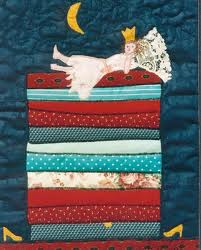
It seems that the players need to be sensitive to the economic realities of society at large, from which the world of sports is not immune. And there should be something to the old tradition that playing on a national team should be seen more as an honor than as an opportunity for extra income. If not, there is a clear risk that people will indeed see the players as fitting into H.C. Andersen’s scenario of ‘princesses who are so spoilt that they can be bothered by a pea also under a layer of 20 mattresses’. And the Federation, which in a greatly successful handball country such as Denmark is expected to be wealthy or at least very professional, must take care to avoid reminding the public of another H.C. Andersen story, the Emperor’s New Clothes, which as you know revealed an embarrassing nakedness underneath it all.
Several times during the World Championship last January, I got a reminder about something that makes me proud to be a life-long handball fan: despite constant physical contact, collisions at high speed and a format with attackers trying to penetrate a defensive wall, handball remains a very fair and decent sport, essentially free from fighting and without too many dirty tricks!
Perhaps we are so used to it that we simply take it for granted, but we really should be appreciative and also use it more as propaganda for our sport, in the tough competition for new players and new spectators. I talked with people about it in Sweden, both handball veterans and people who were more infrequent handball spectators; and the verdict was really unanimous: it is amazing how the players in a sport with so much intensity and physicality, and so much at stake at the elite level, can remain so fair and sportsmanlike.
During my life of involvement with handball, I have also been a soccer/football referee and an interested spectator in icehockey, basketball and American football. The mentality of icehockey appears to accept fighting or even support it as something positive. Tackling a player who is ‘blind-sided’ seems almost to be a matter of pride, and elbows to the head are flying in both basketball and icehockey. Only American football is a bit more comparable to handball as regards relative restraint despite the very physical nature. And in all these sports, it is more common to see altercations or unsportsmanlike actions after the play is stopped.
Perhaps it has something to do with the rules. The concept of a 2-minute punishment is a probably a more effective and meaningful deterrent than people in handball realize, when we compare with other sports. And personally I will always feel that the introduction of the ‘direct red card’ has been very important. I wish I could argue that it is related to superior refereeing, but also the other sports I mentioned have first-rate refereeing at the elite level. So I really believe it is primarily a matter of mentality and tradition.
I often hear from handball novices who are surprised that the game is played without the type of protective gear that is a normal part of other physical games. I do not think this is because the players are so much more resilient and capable of accepting physical punishment. It is more because the players trust that, despite the heat of the battle and the sometime unexpected collisions, there is a general level of mutual respect that in itself affords a measure of protection.
Some of you may ask: am I not going too far in defending and praising handball!? Yes, we have some players who are more cynical than others, both in their general methods and in their instincts in critical moments. And yes, there will always be situations in a game, depending on the result and time remaining, where a player will resort to desperate tactics. But overall I insist that we should be more proud of what is typical of our sport. I know that to some people, and in the media, violence may sometimes serve as an attraction, but I still think we have good reasons to use our traditions of combining intensity and physicality with non-violence as a real point of propaganda!