Spain’s Joan Canellas thinks today’s match vs Germany could go either way.
The 2020 Men’s European Handball Championships continues today with 2 matches each from Groups A, C and E. Here are the video links, odds and some predictions for those matches.
16:00 Croatia (-3) vs Belarus Match Video (On Demand): Link (No Commentary)
18:15 Montenegro vs Serbia (-.5) Match Video (On Demand): Link (No Commentary)
Croatia and Belarus both won their openers comfortably, so today’s result could very well count in the Main Round standings. Montenegro and Serbia will play what is likely an elimination match
Group C (Trondheim, Norway)
16:00 Latvia vs Netherlands (-1) Match Video (On Demand): Link (Commentary: Clayton Lucas)
18:15 Spain (-1.5) vs Germany Match Video (On Demand): Link (Commentary: Clayton Lucas)
Latvia and the Netherlands will both be gunning for their first ever European Championships while Spain and Germany play the match of the day. This result will surely count in the main round and the winner will even be well positioned to make the semifinals.
Group E (Malmo, Sweden)
16:00 Hungary vs Russia (-1) Match Video (On Demand): Link (Commentary: Paul Bray)
18:15 Denmark (-5) vs Iceland Match Video (On Demand): Link (Commentary: Paul Bray)
Group E has its first matches of the tournament. The matches will be played in Malmo, which is just across the bridge from Copenhagen so expect a good Danish crowd.
Betting Predictions
For this tournament we’ll be doing some betting predictions using an imaginary starting bankroll of a 1,000 Euros. Joining me is professional handball bettor, Samo Košmerl, from Slovenia.
John’s Pick(s): – Current Bankroll: 800 Euros – Yesterday’s Result: Norway (-7.5 goals) vs Bosnia; Wager 100 Euros to win 80. Lost 100 Euros as Bosnia’s GK, Buric was sharp in goal and Norway got off to a slow start resulting in just a 6 goal, 32-26 victory. – Today’s Pick: Germany (+190) money line bet to win vs Spain; Wager 100 Euros to win 190. Spain and Germany meet for a crucial match that will give the winner one foot into the semifinals. Spain’s Joan Canellas says it’s a 50-50 match. I concur and +190 is too good of an advantage to pass up on a match that I genuinely think could go either way.
Samo’s Pick(s): – Current Bankroll: 980 Euros – Yesterday’s Result: Czech Republic (+1) v Austria; Wager 100 Euros to win 90. Lost 100 Euros as Austria won 32-29. – Today’s Pick: Netherlands (-130) money line bet to win vs Latvia; Wager 100 Euros to win 79.36. I don’t like one man teams and Latvia is for sure one of them. Kristopans is an amazing player, but the European Championship is the best competition in the world and you need more than one player to win games in this tournament. I really like the Netherlands here; they are playing modern handball; they look like a team and I believe they will collect 2 points today.
Will Austria’s home court advantage see them through to the Main Round? Maybe, Maybe not. They face the Czech Republic in their opener today.
The 2020 Men’s European Handball Championships continues today with 2 matches each from Groups B, D and F. Here are the video links, odds and some predictions for those matches.
IMPORTANT STEPS TO FOLLOW FOR “SPOILER FREE” ON DEMAND VIDEO WATCHING: 1) Cover up the right half of your screen 2) Click on the desired “On Demand” video link 3) Watch the short advertisement 4) Click on the full screen icon in the lower right hand corner of the video 5) Enjoy the match “spoiler free”
Note: If you don’t follow these instructions you will be exposed to the menu on the right side of your screen that may include words like “Netherlands shocks Germany in Opener!” (I’m not saying that’s going to happen, just that if it did happen, you can bet there would be a headline stating that.) Also, remember that if you click out of full screen mode you should also cover up the right side since that menu will immediately appear.
Friday, 10 January All Times Local (CET) / US ET is -6 hrs) Odds courtesy of 10Bet
18:15 Czech Republic vs Austria (-1) vs Serbia Match Video (On Demand): Link (Commentary: Paul Bray)
2030 N Macedonia (-4) vs Ukraine Match Video (On Demand): Link (No Commentary)
Group D (Trondheim, Norway)
18:15 France (-7) vs Portugal Match Video (On Demand): Link(No Commentary)
2030 Norway (-7.5) vs Bosnia & Herzegovina Match Video (On Demand): Link (Commentary: Paul Bray)
Group F (Gothenburg, Sweden)
18:15 Slovenia (-7) vs Poland Match Video (On Demand): Link(Commentary: Clayton Lucas)
2030 Sweden (-5.5) vs Switzerland Match Video (On Demand): Link (Commentary: Clayton Lucas)
Betting Predictions
For this tournament we’ll be doing some betting predictions using an imaginary starting bankroll of a 1,000 Euros. Joining me will be professional handball bettor, Samo Košmerl, from Slovenia.
John’s Pick(s): – Current Bankroll: 900 Euros – Yesterday’s Result: Netherlands (+7.5 goals) vs Germany; Lost 100 Euros as Germany won 34-23 (It was a great bet for 45 minutes…) – Today’s Pick: Norway (-7.5 goals) vs Bosnia; Wager 100 Euros to win 80. With the home crowd behind them in Trondheim and a big match looming vs France on Sunday, Norway will seek to put away this game early.
Samo’s Pick(s): – Current Bankroll: 1,080 Euros – Yesterday’s Result Handicap Bet: Croatia (-5.5) vs Montenegro; Wager 100 Euros to win 80. Croat eked out a 27-21 win. Doesn’t matter how… They got it done. – Today’s Pick: Czech Republic (+1) v Austria; Wager 100 Euros to win 90. I don’t think home advantage + Bilyk will be enough for Austria. The Czech Republic is playing decent handball lately and they have a lot of quality with Kasparek, Zdrahala and Horak. Austria is without Hermann which is big blow imo. Half of the Austrian team is playing in Austrian league, while half of the Czech Republic players are playing in Germany. And there is huge difference between those two countries.
The 2020 Men’s European Handball Championships start today with 4 matches. Here are the video links, odds and some predictions for those matches.
IMPORTANT STEPS TO FOLLOW FOR “SPOILER FREE” ON DEMAND VIDEO WATCHING: 1) Cover up the right half of your screen 2) Click on the desired “On Demand” video link 3) Watch the short advertisement 4) Click on the full screen icon in the lower right hand corner of the video 5) Enjoy the match “spoiler free”
Note: If you don’t follow these instructions you will be exposed to the menu on the right side of your screen that may include words like “Netherlands shocks Germany in Opener!” (I’m not saying that’s going to happen, just that if it did happen, you can bet there would be a headline stating that.) Also, remember that if you click out of full screen mode you should also cover up the right side since that menu will immediately appear.
Thursday, 9 January All Times Local (CET) / US ET is -6 hrs) Odds courtesy of 10Bet
18:15 Belarus (-2.5) vs Serbia Match Video (On Demand): Link (Commentary: Clayton Lucas)
2030 Croatia (-5.5) vs Montenegro Match Video (Live): Link (Commentary: Clayton Lucas) Match Video (On Demand): Link
Group A starts with a match between Belarus and Serbia that might end up deciding 2nd place in the Group. Croatia is the favorite in the group and should have no problem with Montenegro.
Group C (Trondheim, Norway)
18:15 Germany (-7.5) vs Netherlands Match Video (On Demand): Link (Commentary: Paul Bray)
2030 Spain (-10.5) vs Latvia Match Video (Live): Link (Commentary: Paul Bray) Match Video (On Demand): Link
Germany and Spain are heavy favorites to advance from this group. If there’s going to be a surprise, though, in Group C it will probably take place today.
Betting Predictions
For this tournament we’ll be doing some betting predictions using an imaginary bankroll of a 1,000 Euros. Joining me will be professional handball bettor, Samo Košmerl, from Slovenia.
John’s Pick(s): – Current Bankroll: 1,000 Euros – Handicap Bet: Netherlands (+7.5 goals) vs Germany; Wager 100 Euros to win 79.36. The Netherlands will be debuting in the competition and have several players playing in Germany. They won’t be in awe and will play with an emotional high. They’ll keep it close, but is will slip away towards the end.
Samo’s Pick(s): – Current Bankroll: 1,000 Euros – Handicap Bet: Croatia (-5.5) vs Montenegro; Wager 100 Euros to win 80. The first match is always very important for Croatia and there should be a lot of Croatian fans in Graz. Montenegro is missing three very important players in Borozan, Vujović and Božović and I just don’t see them being even close to Croatia tonight.
Last January, Mikkel Hansen, led Denmark to a world title. It was the most dominating national team performance ever in a major competition. We probably won’t see that again, but even if they play a peg or two lower it should still mean a European Championship for them.
The 2020 EHF Men’s European Handball Championships start Thursday 9 January. Here’s some info on how to watch, what the odds are, and a few predictions on who will in it all.
How to Watch
All matches will be available for viewing on efhTV, the European Handball Federation (EHF) online web streaming platform. Availability, however, might be restricted in nations that have a TV network contract. Depending on how each contract is structured some matches on ehfTV might be geo-blocked in some countries.
In the U.S. the beIN Sports network has the TV rights and will be showing one match daily on a delayed basis starting Friday, 17 January at 8:00 PM (US ET). All matches will also be shown live on their web streaming platform beIN Sports Connect.
Some matches will also be shown live on their FREE channel, beIN Sports XTRA, which is available on the Roku Channel and “Over the Air” in 15 U.S. markets. More info: Link
Spoiler Free Links
As with other recent tournaments I will be posting links to the on demand videos for matches as they become available. And, I will be doing so with “spoiler free” posts. Hey, if you like watching games with the outcome known you’re more more than welcome to access other sites directly.
IMPORTANT STEPS TO FOLLOW FOR “SPOILER FREE” ON DEMAND VIDEO WATCHING: 1) Cover up the right half of your screen 2) Click on the desired “On Demand” video link in my daily preview post 3) Watch the short advertisement 4) Click on the full screen icon in the lower right hand corner of the video 5) Enjoy the match “spoiler free”
Note: If you don’t follow these instructions you will be exposed to the menu on the right side of your screen that may include words like “Netherlands shocks Germany in Opener!” (I’m not saying that’s going to happen, just that if it did happen, you can bet there would be a headline stating that.) Also, remember that if you click out of full screen mode you should also cover up the right side since that menu will immediately appear.
Tourney Format: The European Championships have expanded from 16 to 24 teams. This means that several teams that often just missed out on qualification like the Netherlands, Latvia and Switzerland were able to book at ticket. In the preliminary stage the 24 teams have been divided up into six groups of four nations each. Only 2 teams will advance from each group… meaning half the teams will be sent home in the first few days of competition.
After the preliminary groups the top 2 teams from Groups A, B and C will form Main Round Group I and the top 2 teams from Groups D, E and F will form Main Round Group II. The top two teams from Groups I and II will then qualify for the semifinals.
Group A’s matches will take place in Graz, Austria and one can probably expect good crowds traveling from Croatia and Serbia. Croatia is an overwhelming favorite to advance while Serbia and Belarus will likely battle for the 2nd slot. Stregspiller Group A Preview: Link
Group B’s matches will be in Vienna, Austria. This is arguably the weakest preliminary round group and appears to be set up to help ensure that one of the co-hosts, Austria, advances to the main round. Arguably, every side here stands a decent chance of making it to the Main Round… where they will be long shots to make the semifinals. Stregspiller Group B preview: Link
Group C will be played in Trondheim, Norway and will be the only group without a host country or nearby pseudo-host. Spain and Germany are big favorites to advance, but the Netherlands and Latvia both might have something to say about that. The Netherlands Men have been waiting a long time to make a statement in a major competition while Latvia’s Dainis Kristopans is one of the world’s best right backs. If things do play out according to plan the Spain – Germany match scheduled for Saturday will be huge as that match will carry over to Main Round play. Heck, that match might even decide who advances to the semifinals. Stregspiller Group C preview: Link
The top two teams from Groups A, B and C will make their way to Vienna for Main Round Group Play where on paper it will be a 3 way battle between Spain, Germany and Croatia for the two semifinal spots.
France and Norway are the favorites to advance but Portugal is an up and coming program. They even beat France 33-27 in a Euro qualification match. Which is a good thing in that they know they can topple France, but a bad thing in that sneaking up on France in the opening match seems unlikely. Barring a Portuguese surprise, the France – Norway match on Sunday, 12 January could have huge implications as it will carry forward into main round. France will be favored, but Norway will have the home crowd in Trondheim behind them. Stregspiller Group D Preview: Link
Group E will be played in Malmo, Sweden which is just cross the bridge from Copenhagen, so it will a pseudo home court advantage for Denmark. As if, the reigning World Champions need extra help. Iceland, Hungary and Russia will battle for the second spot. Stregspiller Group E Preview: Link
Group F will take place in Gothenburg, Sweden so the hosts are all but guaranteed to advance. Slovenia are solid favorites to be the #2, but Switzerland and Andy Schmid might have something to say about that. Stregspiller Group F Preview: Link
Main Round Group II will take place in Malmo and should be really entertaining and compelling to watch. Four teams, Denmark, France, Sweden and Norway will battle for the 2 spots and there will be multiple key clashes every match day.
The oddsmakers favor Denmark and I don’t see a whole lot of reasons to disagree with them not winning it. Last January’s performance at the World Championships was one of the most dominating ever by a national team. I’m not predicting such a repeat performance, but even if they take it down a notch they should still win.
For 2nd place I will go with France. Nikola Karabatic is showing some age, but he’s more healthy than he was last year. That, coupled with quite the stable of young talent should see the French improve upon recent performances.
For 3rd place I’ll go with Germany. Perhaps they lack the name star to lead them to victory, but a team effort particularly on defense could well see them through.
Captain America, Drew Donlin, playing for Leon Ademar vs FC Barcelona
It’s been quite the ride for Team USA’s Drew Donlin, from Minnesota to the Air Force Academy to Los Angeles to Germany and now Spain.
In September 2018 he was an alternate and a last minute call up for the U.S. National Team for the PANAM Games Qualification series vs Canada. Just 14 months later he found himself playing important minutes for his club, Leon Ademar, against FC Barcelona. Such a rapid rise is unprecedented for just about any handball player, let alone a U.S. National Team player who was born and raised in the U.S. and didn’t start playing the sport until he was 18.
On the podcast we discuss his handball origin story, USA Beach Handball competitions and how exactly he went from a national team alternate to playing against Barca in 14 months.
Player Profile Pages – Leon Ademar: Link – Liga ASOBAL (with current stats): Link – EHF: Link – USA Team Handball: Link
Drew Donlin Social Media – Facebook: Link – Instagram: Link
Total USA Team Handball Revenue since 1993. What we have and some reasons for optimism.
The previous parts of
this series have focused on our current athlete and club demographics. This part of the series will focus on USA
Team Handball’s current finances.
Big Picture
As you might recall from the introduction to this series I am addressing possible futures for USA Team Handball by first methodically capturing, “What we have.” I have covered quite a bit of ground, but haven’t focused on the lack of money and resources that pretty much underlie most of team handball’s small footprint and presence in the U.S.
It may be true that “Money isn’t everything”, but I think we
can also agree that, it’s still something.
And, that without money it’s very difficult to move forward with new
projects and initiatives. As one long
time handball follower put it to me succinctly:
“If there’s more money, there are morechoices. But, if there’s no money, there are no
choices.”
While, historically there has usually been “some money” it’s been pretty limited with the exception (to varying degrees) of support to national teams that have qualified for the Olympics. In recent years, the cupboard has been really bare. Fortunately, there are a number of developments that should help improve USA Team Handball’s financial situation. These developments include the 2028 LA Olympics, IOC pressure on the IHF to develop handball globally, and European pro leagues/clubs seeking to develop a U.S. market. Yes, after years of shrugging, Europeans are finally starting to realize the potential of a U.S. market and seem willing to do some things to make it happen. All told, this confluence of events could be a real game changer.
Yes, long time followers that accuse me of being an eternal pessimist I am truly optimistic that our financial picture will change.
But, while these numbers should change in the not too distant future, it’s still a worthwhile exercise to assess where we are starting from. Further, it’s important to also characterize the different sources of revenue. Where the revenue is coming from and where there are opportunities to improve revenue generation.
Publicly Available
Data
To assess USA the current financial situation I have reviewed USA Team Handball’s publicly available financial data. As a 501(c)(3) non-profit, USA Team Handball is required to file an Internal Revenue Service (IRS) Form 990 every year. Additionally, an audited financial statement is prepared on a yearly basis and both the annual audits and Form 990s are available on the USA Team Handball website. While great information this data, however, has its limitations. In particular, it’s top level data, so while it might be really interesting to break down revenue sources and expenses in greater deal, that information is not available. Additionally, the forms are typically posted around one year after the accounting period in question. So, if you are looking at a hot off the press Form 990 you will be reviewing data that is actually 1-2 years old. And, if it’s been awhile since the Form 990 has been posted you could be reviewing data that is 2-3 years old.
The data below comprises the last four available Form 990s,
covering the period from July 30, 2014 to June 30, 2018, so the data that is
from 1.5 to 5.5 years old. I have heard
that the IHF and USOC have kicked in some grant funding already, but it’s not
clear how much and for how long. While
this data doesn’t include those plus-ups it does provide a good baseline.
USA Team Handball’s average total annual revenue has been roughly $540K. For a U.S. Sport National Governing Body (NGB) this is a paltry amount that significantly limits what can be done. Compared to several other team sport NGBs it is an order of magnitude smaller. There’s a reason why for several years USA Team Handball has been pretty much a staff of one, plus coaches and a part team media specialist. Heck, in some years it’s not even clear whether the coaches have actually been paid. I have also heard rumors that at times there have been cash flow issues resulting even the CEO not being paid. It should therefore come as no great surprise that many national team trips for competition have been partly self-funded by the players participating.
So why has the revenue been so lacking? Let’s take a closer look at several sub-components of the top line number.
Grants and
Contributions
Historically, an annual grant from the USOPC has been the primary source of revenue for USA Team Handball. For the 4 most recent years of available data the USOPC has provided around $225K/year. As I’ve highlighted previously the annual USOPC grant used to be substantially more but has decreased over the years for several reasons. First, following the 1996 Olympics the USOPC began more closely tying financial support to medaling opportunities. With the U.S. being very unlikely to medal grant funding decreased. Secondly, the U.S. has failed to qualify for the Olympics since 1996 meaning there was no need to support national teams so that a “respectable” performance in the Olympic spotlight could be had. Finally, there have been general concerns with the management and performance of USA Team Handball. The 2005 decertification of USA Team Handball is a prime example of those concerns.
With the 2028 Olympics now on the horizon and with greater
engagement from the IHF, USOPC concerns seem to have been lifted. Reportedly the USOPC is now providing some
additional grant funding that is more in line with what other minor sport NGBs
are provided.
The U.S. Team Handball Foundation which was established with
left over funds from the 1984 Olympic Game has also been a consistent source of
revenue support, albeit on a smaller scale.
For the most recent four years they have provided roughly $34K/year
often in support of national team competition.
The IHF did not provide any grant support in the posted four
years, but reportedly they are now providing some grant funding to support
college development efforts. How much
funding and for how long, however, has not been officially reported. It would certainly be interesting to know,
but we probably won’t officially know until the 2019 Form 990 is released in
spring 2021.
Contributions are charitable donations that USA Team
Handball receives from individuals and have averaged $88K for the past 4 years. Considering the small base of supporters USA
Team Handball has to work with this is actually a fairly decent number compared
to other NGBs with much larger membership bases to draw from.
Corporate Sponsorship
Corporate Sponsorship highlighted in blue.
Corporate sponsorship is roughly $64K/year and this is, as one might expect, substantially lower than other NGBs. In short, “what we have” is pretty much next to nothing. There has long been an outcry that this was a direct result of management and salesmanship incompetency. However, as I pointed out in this 2012 commentary the reality is that sponsors are not in the business of charity and they want to see return on their sponsorship investment. With a very small membership base and no TV exposure it has been very difficult to make a strong business case in support of USA Team Handball sponsorship. There essentially has been no product to credibly sell to sponsors. So, in other words I would argue that it was more of a product issue than it was a salesmanship issue.
However, with some investment from the USOPC and IHF this
could be changing and we could actually have some products (e.g. a collegiate
club championship) on the foreseeable horizon worthy of sponsorship. Add in the promise of the 2028 Olympics in
Los Angeles and it’s becoming more possible to sell the future of USA Team Handball.
Further some personal relationships with a key handball proponent could make a difference. In October, USA Team Handball and the IHF met with Verizon CEO, Hans Vestberg, in New York. (IHF Writeup: Link) Vestberg is a former handball player and the former President of the Swedish Handball Federation and Swedish Olympic Committee, so he personally has an affinity for handball. Verizon is also one of the largest companies in the U.S. (16th on the Fortune 500 list) and already has major sport sponsorships with the NFL, NHL and NASCAR. The NFL deal alone is reportedly for $500M/year so one can easily envision some sort of deal (on a smaller scale) for USA Team Handball being announced in the near future.
So right now, sponsorship revenue is paltry. But, this could be changing very soon. For how much and for how long, again are the
big questions.
Next up: The assessment of current finances continues
with a closer look at events and memberships.
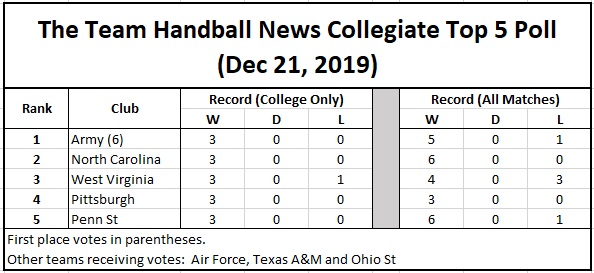
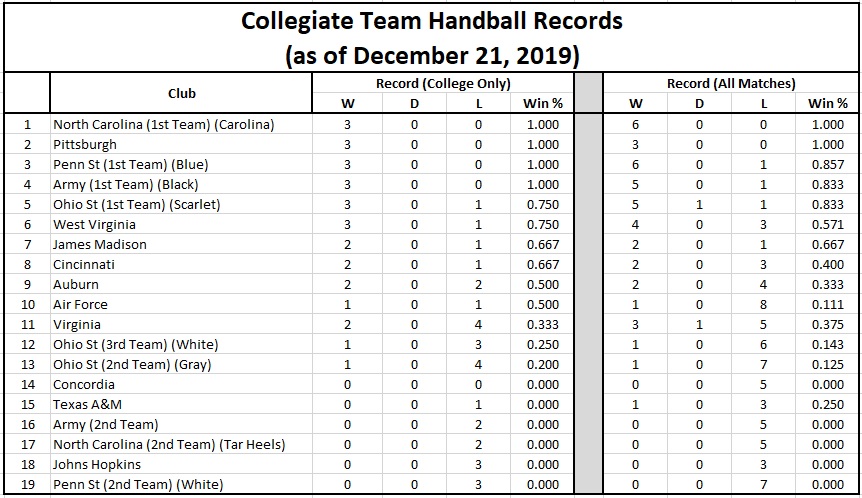
Pitt Team Handball sits atop the Northeast Team Handball League (NTHL) D2 South with a 3-0-0 record. That early season record has earned them a first ever appearance in the Collegiate Top 5 Poll.
The top 3 spots in the poll are identical from November. Army which has never left the first spot in the history of the poll picked up 2 victories in Northeast Team Handball League (NTHL) action over the Army’s 2nd Team, and NYC2, but suffered their first lost of the season to one of the top at-large clubs in the U.S.,NYC, 37-28. North Carolina and West Virginia played no matches since the last poll, but held on to their 2nd and 3rd place poll rankings.
Spots 4 and 5, however, have changed with Air Force and Ohio St dropping out of the top 5. Air Force picked up their first win of the season, a 23-21 win over Texas A&M at the Texas Cup, but their overall 1-0-8 record must look bad in the eyes of voters. Ohio St played only one match since the last poll, a 36-36 draw vs the Columbus Armada, but also slipped in the polls.
Joining the top 5 for the first time are Pittsburgh and Penn St. Pittsburgh’s 3-0-0 record has them sitting atop the NTHL D2 South. Pittsburgh has gotten good leadership from seniors Michael Lane and Brian Hoover and has benefited from a newcomer to the team, Pau Balcells Sanchez. Balcells Sanchez is just a Freshman, but is an international student from Spain and brings some European experience to the the team. The NTHL D2 South is the only de facto collegiate club conference (Pittsburgh, James Madison, Virginia, Johns Hopkins) and their next matches will be February 1st.
Rounding out the top 5 is Penn St with a 3-0-0 collegiate record and and a 6-0-1 overall record. Penn St competes in the NTHL D2 North where they currently have the 2nd best win pct in the league. These records may, however, look a little bit better than reality. In particular, the 3 collegiate wins are all over the Penn St B team, so it will be interesting to see how well the Nittany Lions fare at College Nationals later this year.
Detroit Handball Club Promotional Video: This new club effort is a good example of the challenges facing any new club effort in the U.S.
Note: This is part of an ongoing series, Charting a Way
Forward for USA Team Handball (2019 Reboot): Link
Parts 1, 2 and 3 provided an overview of Men’s and Women’s clubs in the U.S. It doesn’t take long to empirically determine that there aren’t very many clubs and that the few clubs we are for the most populated with expats. Here’s some context as to why this is so.
Starting a Club: Big Picture
It kind of goes without saying that all existing clubs at
some point in the past had to get started.
And, let’s make one thing clear up front. Starting a club is a huge undertaking. It takes organization skills. It takes resources (money). It takes time. (A lot of time) It takes determination. Either from one indefatigable person or a
village willing to put in quite a bit of effort.
It is not easy when structures are in place to facilitate
new clubs. It can seem like mission
impossible when no such structures exist.
For many people it might be the hardest thing they’ve ever tried to
do.
It should therefore come as no surprise that many folks take
initial steps to start a club, assess that it’s not going to be a walk in the
park and fairly quickly decide to punt.
That maybe they’ve got better things to do with their time and
money. I used to kind of look down at
those lazy talkers, but now older and wiser I sometimes think that maybe
they’re the smart ones.
Back in 2013 I highlighted some of the challenges from my own experience in helping to start two clubs. With mixed success I might add. And, yes I must admit failure is not easy for someone who is used to succeeding at a lot of different things. As one gets older, however, one gets smarter and a little bit more humble.
Here are the major hurdles that typically have to be
overcome on the way to starting a new club:
Hurdle 1) Recruiting
Players
When you’re starting a new handball club, the first step is
recruiting players. Anyone who has done
this knows that it is not as simple as posting a flyer or a Facebook post and
waiting for the players to simply show up.
It might sort of work like that for a short window during the Summer
Olympics every four years, but for the most part it involves working on your
sales pitch. For some this is a simple
task, but for others it requires really stepping out of their comfort zone.
Recruiting athletes is not easy and requires a lot of
salesmanship. Adults in their 20s are
busy starting a new career; perhaps in a significant committed
relationship. They’ve got competing
interests. A college student may be
focused on their studies or simply happy playing pickup basketball or jogging
as an outlet. Many people are simply not willing to make the time and money
commitment to a club.
And, keep in mind this sort of convincing/recruiting can be
challenging for a well-known sport that athletes are familiar with and
have
played before. Convincing/recruiting
people to play a sport they are not familiar with or have never
played before adds yet another layer of difficulty.
Yes, some folks, indeed, are interested in trying something new like handball. But, it’s a long path from checking out handball after you’ve seen it on TV to becoming fully committed to the sport. Typically, there’s a huge attrition rate as those new players discover that the sport is more physical and a whole lot harder to master than they thought it would be.
Thus, it should come as no surprise that U.S. clubs are
heavily populated with expats. Yes,
people seeking out… something they are familiar with and have played before
vice seeking out an opportunity to join some other club to do something totally
new. In a nutshell, this explains the
predominance of Expat clubs in the U.S.
Hurdle 2) Achieving
“Critical Mass”
Then there is the issue of “critical mass.” As in you really need around 16 athletes to have a truly viable club. Yes, a club can “get by” with fewer athletes. Heck, the mighty Condors once took 3rd place at open Nationals with just 7 athletes and one of them wasn’t really a goalie! (Iron Man Handball at its finest.) But, generally you want enough athletes to scrimmage at practices, for substitution in matches and to handle the natural attrition that occurs due to injuries and other commitments.
It goes without saying that achieving such critical mass is
much easier in big cities. Big cities,
where, you guessed it, there’s a healthy supply of handball loving expats
moving in and out every year. The bigger
the city, the easier such recruitment is.
It should come as no surprise, for instance, that one of the largest and
most international cities in the world, New York City, has such a strong and
vibrant club.
Achieving critical mass in smaller population areas can also
be done. It’s just that it’s much harder
and requires really strong commitment.
And, effective recruitment of stateside Americans to make up for the
shortage of expat players available. So,
a new club is always on the lookout for new athletes to get to the critical
mass needed to practice.
Hurdle 3) A Place to
Practice and Equipment (Balls and Goals)
Once you’ve got enough players it’s then possible to actually practice. But, of course, one can’t really practice without a gym, balls and goals. For the most part, this is a logistical hurdle that can be solved pretty easily with money. Balls and goals can be purchased or in the case of goals, built. Sometimes, USA Team Handball or some other organization can even come through with a donation. A gym to practice in can be a little more tricky. Depending on where the club is being started there may well be issues with finding a gym that’s big enough for a handball court and that can rented for practice at a reasonable cost. And, finding a gym that will allow stickum is also becoming tougher as well.
Which leads to another point: cost. Athletes brand new to a sport are often
reluctant to contribute to the logistical overhead associated with a club. This inevitably means that the fully
committed have to front a lot of these costs.
This can be problematic depending on the number of people willing to
contribute, as well as the financial situation of those people. For the most part, wherever there’s a new
club starting up, it’s a pretty safe to assume that somebody is paying out of
pocket to make it happen.
Hurdle 4) Finding
Opponents to Play
This hurdle is sometimes forgotten, but in the big picture
of things has to be considered. The U.S.
is a huge country and some clubs have better “geography” than others. For the most part this means not being “too
far” from other clubs. Ideally, being
able to drive to competition that is less than 5 hours away. Beyond that distance generally requires
flying for competition and finding enough athletes willing to do that can be
really challenging for a new club.
Changing the Sequence
of Club Organization
I’m sure some reading this have mentally noted that the
order of these hurdles can be altered.
In particular, finding a gym to practice (Hurdle) 3 can be moved
up. This, however, is a risky venture
because it’s not yet certain that the players needed will indeed get
successfully recruited. (You, don’t want
5 people playing catch in an empty gym you’ve rented out.) And, this creates a bit of an awkward chicken
and egg situation. As in, you need
players to practice, but you also need a gym and equipment for those players to
practice.
Insurmountable
Hurdles?
Finally, would be organizers have to also take a hard, critical overview of the overall situation. Are there just too many hurdles? Or, is one hurdle simply too high? The answer to these questions is sometimes yes. I know people like to think that “if there is a will, there is a way” and I guess that’s true to a certain extent. I mean some dynamic handball loving guy in Nome, Alaska could put his heart and soul into establishing a handball team there, but there would be some serious mountains to climb. No handball expats, limited population base and a flight to Vancouver or Seattle just to play some matches. It is theoretically possible that it could be done, it’s just not very unlikely.
A Current Example: Detroit Handball
I’ve been around a while and I’ve seen quite a few clubs
come and go, and even come back. And,
one can generally look at the location and the people behind the effort and
assess what their likelihood of success.
Recently, Joey Williams, has taken on the task of starting a new club in Detroit, Michigan. Joey has been a goalie on the Jr National Team and is pretty high on the “passionate scale” when it comes to handball, having attended a goalie camp in Croatia and trained in Denmark on his own dime.
As I highlighted at the beginning of this article it
generally takes someone pretty committed to take on the effort of starting a
club and Joey is nearly off the charts in that department. Failure in this instance won’t be for lack of
trying.
In terms of recruitment he’s been very active and has been using social media effectively. He’s done an Instagram Takeover of the USA Team Handball Instagram account and recently posted a short infomercial on the new club. “Critical Mass” has not been achieved yet, but generally that takes time.
Depending on how one defines the Detroit metropolitan area there is between 3.7M to 5.3M so that’s quite a few people to draw from. According to this list of metropolitan areas, Detroit is the 11 largest metro area in the U.S. (And, no surprise here: you’ll see quite the correlation between U.S. Handball club locations and the top end of this population ranking.) In fact, one might wonder why there hasn’t been a club effort in Detroit sooner. It’s hard to say for sure, but I would speculate that the economic downturn probably has something to do with it. And, in turn, I’m guessing that has resulted in fewer young expats with a handball background finding their way to the Motor City. Not to say there aren’t some there just that it might be fewer than other cities which are perceived as hipper.
In terms of geography and distance to other clubs Detroit is in pretty good shape. Chicago, Pittsburgh and Columbus, Ohio are within 5 hours drive. And, maybe the development of a Detroit club will spur development of a club program at the University of Michigan so that the Ohio St – Michigan rivalry can be extended to Team Handball.
In terms of logistics, there are a number of suitable gyms,
although they are still looking for one that will allow stickum. And, the capital outlay necessary for balls
and goals is still needed.
Taking into account all of these factors, I would put the
likelihood of a club successfully being established in Detroit as fairly high,
but with one huge caveat. And, that
caveat is that everything seems to be pretty much revolving around one highly
dedicated guy. If Joey can’t continue to
fully dedicate himself to the effort or has to move somewhere else there isn’t
enough of a club established yet to sustain what’s been started.
This is nothing new. In just about every instance of a club being established it has been due to the efforts of a few key (or even just one) individual. And, the same is true in regards to the folding of most clubs. Generally they have folded due to the departure of a few (or even just one) key individual. The clubs that stick around in most cases have been the ones that create a “village” of dedicated individuals that share the load.
If you want to help Joey Williams and the Detroit Handball Club they’ve set up a crowdfunding site. Check out that link and others below.
Detroit Handball Club – Crowdfunding Site: Link – Website: Link – Facebook: Link – Instagram: Link
This grainy screen capture shows the moment the ball contacted Spain’s Ainhoa Hernandez on the goalkeepers throw with 7 seconds left. (Source: Uniformed Handball Hour Tweet: Link)
The Netherlands beat Spain yesterday 30-29 in a compelling match that saw Spain fight it’s way back into the contest in the closing minutes. With 10 seconds left a shot is taken by Alexandrina Cabral and blocked by Dutch keeper Tess Wester. Dutch players streak down to the other end of the court and it appears that a well executed throw from Wester would result in a fast break scoring opportunity. But, Wester’s throw is blocked by Spain’s, Ainhoa Hernandez, and for a moment it appears the game is headed to extra time.
But, only for a moment as Hernandez is shown a red card and a penalty shot is awarded. Lois Abbingh steps up to the 7 m line and calmly scores the game winner as the clock expires.
What exactly was the foul that resulted in the penalty throw? Was it the correct call? And, are the so called “Last 30 Seconds” rules right for the game?
What exactly was the foul that resulted in the penalty throw?
The referee ruled that Hernandez improperly interfered with the goalkeeper’s throw. She did this by touching the ball prior to the ball having left the goalkeeper’s area. Normally, this would be awarded with a 2 minute penalty, but because the infraction occurred in the last 30 seconds of a game a red card and a penalty shot was awarded.
Rule 12:2 The goalkeeper throw is considered to have been taken, when the ball thrown by the goalkeeper has completely crossed the goal-area line. The players of the other team are allowed to be immediately outside the goal-area line, but they are not allowed to touch the ball until it has completely crossed the line (15:4, 15:9, 8:7c).
Rule 6:4 The ball is considered to be ‘out of play’ when the goalkeeper controls the ball in the goal area (12:1). The ball must be put back into play through a goalkeeper throw (12:2).
Rule 8:10 C) if during the last 30 seconds of a game the ball is out of play, and a player or team official prevents or delays the execution of a throw for the opponents, in order to prevent them from being able to take a shot on goal or to obtain a clear scoring chance, the guilty player / official is to be disqualified and a 7m throw is to be granted to the opponents. It applies to any type of interference (e.g., with only limited physical action, interfering with the execution of a throw such as intercepting a pass, interference with the reception of the ball, not releasing the ball).
Was it the correct call?
So, the rules are actually pretty clear. If a player interferes improperly with a goalkeeper’s throw in the last 30 seconds of a match than it’s a red card and a penalty shot.
What’s less clear, though, is whether this is actually what happened. I’ve reviewed this play multiple times and I can’t really tell whether or not the ball was touched by Hernandez inside the 6 meter line or outside the 6 meter line. And, what we are really talking about here is an imaginary plane at the 6 meter line that extends from the floor to the ceiling. Further the ball has to be 100% on the other side of this imaginary plane in order for the ball to be legally touched by a court defender.
Hernandez is fairly close to the line, but she also jumps straight up. It’s only her arms that are swinging forward as they go to block the throw. Are her arms forward enough at the point of impact for it to be a foul? Maybe… Probably? The video’s point of view is center court and it’s really hard to tell from that angle. Whereas the referee (one of the Bonaventura twins) that made the call was actually in a pretty good position to make that call, almost right on the 6 meter line with a perpendicular view.
Based on these circumstances I would go with her call rather than our crappy angle view of a fuzzy video replay. And, if VAR had been available to review this call I can’t imagine a replay official confidently overturning it.
So, the answer is: Yes, it probably was the right call. And, we don’t have sufficient evidence to suggest otherwise.
Are the so called, “Last 30 Seconds” rules right for the game?
This last question is simply opinion, and I’ll make both cases, though I’m really biased in terms of my own view.
Not right for the game: It’s pretty obvious that Fernandez didn’t intentionally interfere with the goalkeeper’s throw. And, this innocent foul resulted in a penalty shot to win the game. Handball is handball and we shouldn’t have different rules at the end of a match. What a horrible way to decide such a tight contest!
Right for the game: Hmm. Looks to me like this foul prevented what would likely have been a fast break goal to win the match. Good thing those last 30 seconds rules are in place. Heck, under those old rules Fernandez could have even entered the goalkeeper’s area and grabbed Wester’s arm to prevent the throw. And, all that would have happened is a red card. Why, some folks would have criticized her for not having done so to ensure the match was won.
As you might guess from my framing of the answers I’m a big proponent of the last 30 seconds rules. And, this advocacy goes back a long ways. At least 10 years. For the whole sordid history check out this podcast on the introduction of the last 30 seconds rules in 2016 with links to earlier articles on the subject. Podcast: Handball’s New Rules (Part 2): Link
The cliff notes version: 2 minute penalties are just simply an inadequate form of punishment at the end of a match. This is because the benefits of disrupting play and preventing the other team from scoring far outweigh the impact of losing one player for a few seconds. With increasing frequency players were taking advantage of this situation with deliberate fouls at the end of the match. Two minutes, red card, suspension in the next match… whatever dude… we still won the match.
The new last 30 seconds rules have put an end to this mockery of the game. For fans of Spain yesterday, those new rules might seem pretty harsh, but the players and coaches know those rules. There were no complaints at the press conference.
Maybe, one could argue that referees should be given the power to weigh player intent. To assess whether the intent was to illegally disrupt play or just to simply play defense. While Fernandez’s block may be an example of intent simply to play it doesn’t take much imagination to think of other examples where actual intent would be much harder to discern. Hence, I would think long and hard about granting referees such mind reading powers to decide match outcomes.
We’ll see what happens, though. Sometimes consequential calls in big matches like this have a way of changing the rules. But, if I had to bet, I’m thinking the more likely outcome will be this match serving as a lesson and reminder of what not to do in the last 30 seconds of a match.
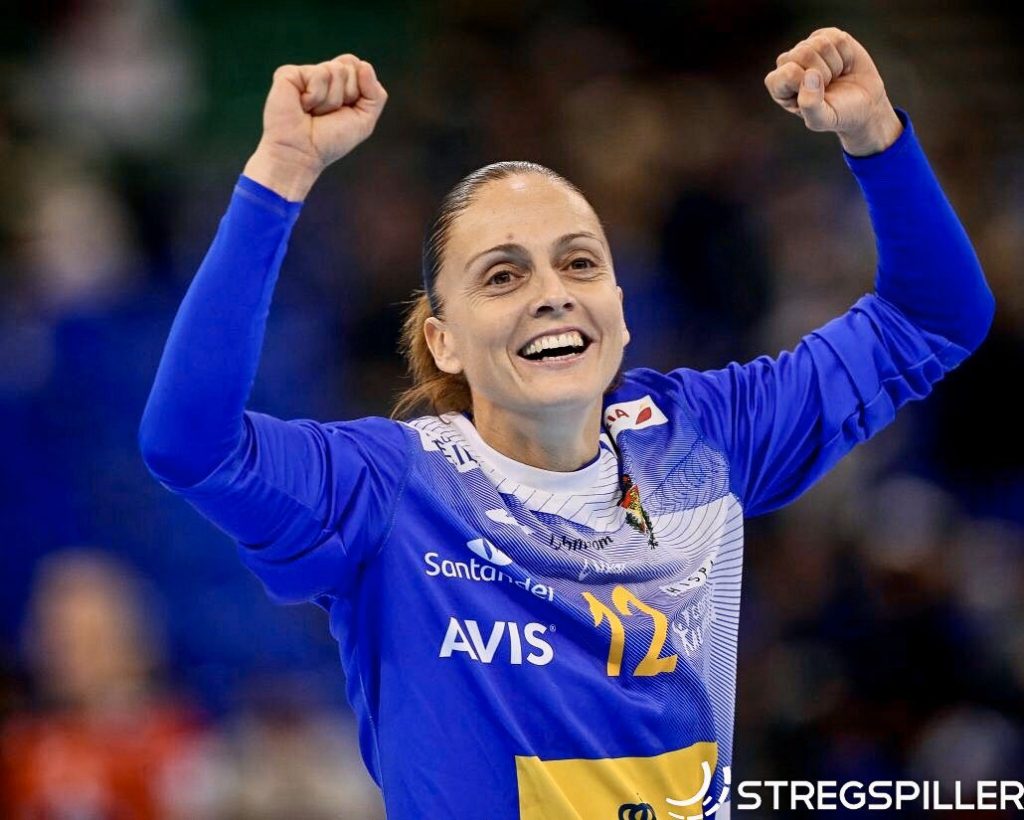
Goalkeeper, Silvia Navarro and Spain will battle the Netherlands for Gold. Both nations are hoping to secure their first world championship. (Photo: Stregspiller.com)
The IHF Women’s World Championships finish up on Sunday with bronze and gold medal matches. Both matches will be broadcast in the U.S. on a tape delayed basis on the NBC Olympic Channel on Sunday afternoon. Fans, that don’t want to wait, however, can watch the Olympic Channel Web Stream (either live or delayed). Both matches are also available on the IHF web stream, but depending on where you live you may need to use VPN.
Sunday, 15 December All Times Local (CET is -8 hrs / US ET is -14 hrs) Odds courtesy of Nordic Bet
NBC TV Schedule: Link How to watch the matches not on NBC: Link
17:30 Bronze Medal Match: Norway vs Russia (-1) (With Commentary from Paul Bray) – Match airs (delayed) in the U.S on the NBC Olympic Channel at 4:00 PM (US ET) – Olympic Channel Video Link (No VPN Required in U.S.) – IHF Website Video Link (VPN Required for some countries) – IHF Match Preview: Link
Hey, wait a second… Wasn’t this was supposed to the the gold medal match? It sure was. Both nations were favored in the semifinal, but came up short. Russia narrowly lost to the Netherlands, 33-32, while Norway played a lackluster match and was dominated by Spain, 28-22. Now playing for bronze it will be interesting to see how both teams respond after such a let down.
My money is on Russia and right back, Anna Vyakhireva. You wouldn’t know by looking at her short stature, 5’6″, but I think she might be the best women’s player in the world now. Certainly, the top passer. Check out this assist compilation: Link. Clever and quick she seems to play a role in most of Russia’s goals. Either by scoring, assisting or doing something that sets up the offensive opportunity one pass later.
20:30 Netherlands (-.5) vs Spain (With commentary from Paul Bray) – Match airs (delayed) in the U.S on the NBC Olympic Channel at 5:30 PM (US ET) on Sunday; Also airs on Tuesday at 10:30 PM (US ET) on the NBC Sports Network – Olympic Channel On Demand Video Link (No VPN Required in U.S.) (posted after the match) – IHF Website Video Link (VPN Required for some countries) – IHF Match Preview: Link
Well, anyone who predicted this as the final coming into the tournament is either a genius or lucky. The Netherlands was 16 to 1 to win the title and Spain was a 33 to 1 long shot.
Spain played consistently for the most part in the preliminary and main rounds, but seemed done for after their last main round match, a comprehensive 36-26 loss to Russia. But, thanks to Montenegro’s defeat of Sweden they got a backdoor entry into the semifinals. And, they didn’t look back. They broke open a close semifinal match (13-13 at halftime) with a dominating performance that shut down Norway offensively on the way to a 28-22 win.
The Netherlands also needed help just to make the semifinals. Fortunately, for them, Norway beat Germany, giving them a back door entry. And, like Spain, they took advantage of the opportunity given to them, beating Russia, 33-32. In doing so, they were also the first team to give the Russians a 60 minute game. The Netherlands have been very consistent in their major tournament performance with a semifinal berth in the last 3 WC, last 2 EC and the 2016 Olympics. But, while consistent they’ve yet to win a title. I’m thinking that may very well change with this World Championship.
Side note: While located in Europe, the Netherlands is not what one would call a “Handball Nation.” There are some clubs in the Netherlands, but it is not nearly as popular or as professional of a sport as it is in Germany, Denmark or France. And, their success may have elements from which nations like the U.S. can draw upon. For more on this topic check out this podcast from 2016
Podcast: Netherlands Women’s Handball: How their 10 year development plan has vaulted them into the world’s elite: Link
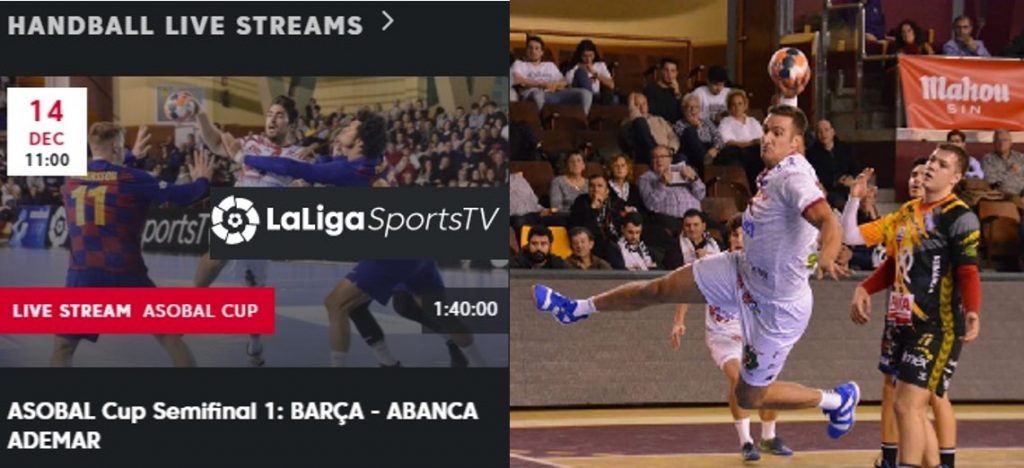
Drew Donlin and Ademar Leon Take on Barcelona at 1:00 PM (US ET)
It’s a rest day for the Women’s World Championships. It’s also one of the deadest Saturdays of the year for U.S. sports fans. The college bowl games haven’t started yet, so all that’s on TV is Army vs Navy and some college basketball.
However, there are other options, including an American handball player taking the court against one of the best handball clubs in the world. Really? (Yes, really). Drew Donlin and his club, Ademar Leon will be playing Barcelona at 1:00 PM (US ET) in the semifinals of the ASOBAL cup in Valladolid, Spain.
Dinah Eckerle and Germany must win in order to keep their Olympic hopes alive. (Photo: www.stregspiller.com)
Friday is a big day with two semifinal matches to be broadcast in the U.S. on a tape delayed basis on the NBC Olympic Channel. Fans, that don’t want to wait, however, can watch the Olympic Channel Web Stream (either live or delayed). All matches, including the placement matches, where Germany is in a must situation for Olympic Qualification are also available on the IHF website, but depending on where you live you may need to use VPN.
Friday, 13 December All Times Local (CET is -8 hrs / US ET is -14 hrs) Odds courtesy of Bet365
NBC TV Schedule: Link How to watch the matches not on NBC: Link
11:30 Serbia (-.5) vs Montenegro – IHF Website Video Link (VPN Required for some countries)
This match for 5th place between neighbors has only limited importance as both nations have definitely qualified for one of three separate Olympic Qualification Tournaments. The result of this match will just determine which tournament (#2 or #3) they will be placed in. As of now, it’s pretty uncertain as to which tournament will have a stronger field and present a tougher path to the Olympics meaning there isn’t a whole lot to play for beyond pride.
14:30 Germany (-1) vs Sweden (With commentary from Paul Bray) – IHF Website Video Link (VPN Required for some countries) – IHF Match Preview: Link
On Wednesday, both Germany and Sweden were in a position to make the semifinals. However, they both lost so instead of playing for a medal, they are now playing for 7th place. And, Germany, is now playing for Olympic qualification. Sweden, by virtue of their performance at the 2018 European Championships has already earned a slot for Olympic Qualification Tournament (Tourney #2).
However, Sweden also has something to play for as the winner of this match will be placed into Olympic Qualification Tourney #1. And, unlike tourneys #2 and #3 this tourney is highly desirable to be in since it will include only 2 European Teams fighting for the 2 Olympic slots. Nothing against Argentina and Senegal, but they will clearly be a less formidable foe than either Hungary or Romania. Translation: The winner of this match will qualify for the Olympics with at least 95% certainty.
17:30 Netherlands vs Russia (-3.5) (With Commentary from Paul Bray) – Match airs (delayed) in the U.S on the NBC Olympic Channel at 2:30 PM (US ET) – Olympic Channel Video Link (No VPN Required in U.S.) – IHF Website Video Link (VPN Required for some countries) – Olympic Channel Live Stream: Link – IHF Match Preview: Link
Russia has been on roll and very impressive so far in this tournament. Really, nobody has threatened them. On Wednesday they demolished Spain 36-26. No team has come closer than 7 goals. The Netherlands has played well, but still has three blemishes on their record. In the preliminary round they lost by 6 to Slovenia (which failed to make the main round end up in 19th place) Then in the Main Round they lost to Germany and Denmark, but still managed to squeak through to the semifinal with 6 points. They will need to step up their game if they are to have any hope of stopping Russia.
20:30 Norway (-3.5) vs Spain (With commentary from Paul Bray) – Match airs (delayed) in the U.S on the NBC Olympic Channel at 10:00 PM (US ET) – Olympic Channel Video Link (No VPN Required in U.S.) – IHF Website Video Link (VPN Required for some countries) – Olympic Channel Live Stream: Link – IHF Match Preview: Link
On paper this match should be more interesting than the first semifinal. Norway has played consistently with only a 30-28 loss to the Netherlands. Consistent, but they haven’t been overpowering teams the way Russia has. Spain has also played well, but the heavy loss to Russia and their collapse vs Sweden (a nine goal lead that ended as a draw) would seem to indicate that they are just one Norwegian run of several unanswered goals from being taken out of the match.
Germany will meet Norway in what might be a winner take all showdown for a semifinal berth.
Main Round Play conclude for both Groups today with 6 matches. Who will make the semifinals? Who will get a slot in an Olympic Qualification Tourney. Two of the matches are available in the U.S. on the NBC Olympic Channel. The rest are available on the IHF Website.
NBC TV Schedule: Link How to watch the matches not on NBC: Link IHF Daily Preview: Link
Wednesday, 11 December All Times Local (CET is -8 hrs / US ET is -14 hrs) Odds courtesy of Unibet
Main Group I
Note: Main Group I is pretty complicated in terms of projecting semifinal and Olympic Tournament qualification. So complicated, it got it’s own separate article: Link
15:00 S Korea vs Netherlands (-5) – IHF Website Video Link (VPN Required for some countries)
Any chance the Netherlands has of qualifying for the semifinals starts with beating S Korea first. They will need some help to slip into second place, but it’s possible. South Korea is simply playing for pride. A bit of a disappointing end for a team that did so well in the preliminary round.
18:00 Denmark (-2.5) vs Serbia – IHF Web Stream Video Link (VPN Required for some countries)
Serbia has an outsider’s chance of getting to the semifinals while Denmark can finish no better than 3rd. But, what’s on the line for sure: A chance at Olympic Qualification. The winner will at least finish 4th where they would play in the 7th place match for entry in an Olympic Qualification Tournament; the loser will do no better than 5th and their Olympic dreams are over.
20:30 Norway (-3.5) vs Germany – IHF Web Stream Video Link (VPN Required for some countries)
There are multiple scenarios at play, but by the time this match starts only three scenarios will be left. The most entertaining scenarios: Winner qualifies; Loser takes 3rd. I won’t get in to all the possibilities. It would take too long. For all the possibilities check out this Link
Main Round Group II
15:00 Spain vs Russia (-2.5) (With Commentary from Paul Bray) – Match airs live in the U.S on the NBC Olympic Channel at 1:00 AM (US ET) – Olympic Channel Video Link (No VPN Required) – IHF Website Video Link (VPN Required for some countries)
Russia is undefeated and has already qualified for the semifinals. With a win or a draw they will finish 1st. Spain can take 1st with a win and will take 2nd with a draw. They can also still qualify for the semifinals even if they lose, but it will depend on what Sweden does. If Sweden wins they would be level on points with Spain. And, since Spain and Sweden tied the next tie breaker will be GD in all matches. Spain is currently at +18 and and Sweden is at +12, so the combination of Spain’s loss and a Sweden win will need to be greater than 6 goals. And, then if it’s 6 goals exactly the next tie breaker is total goals scored. And, if that is tied… well then they will draw lots.
18:00 Japan (-2) vs Romania – IHF Website Video Link (VPN Required for some countries)
Not a whole lot to say about this match. Both teams are winless in Main Round play and this match is just for pride.
20:30 Sweden (-1) vs Montenegro (With commentary from Paul Bray) – Match airs live in the U.S on the NBC Olympic Channel at 6:30 AM (US ET) – Olympic Channel Video Link (No VPN Required) – IHF Website Video Link (VPN Required for some countries)
As previously discussed, Sweden may have a chance to pass Spain on goal differential and qualify for the semifinals. But, they likely will have their hands full just beating Montenegro. Regardless, the outcome of this match will determine 3rd and 4th place which actually means something. The 3rd place team will have a guaranteed entry into one of the Olympic Qualification tournaments, whereas 4th place in the group will face off against the other 4th place team in Group 1 for 7th place overall and the last slot for the Olympic Qualification tournaments.