post

EHF Game of the Week (Round of 16, Leg 1) Ciudad Real at Chambery

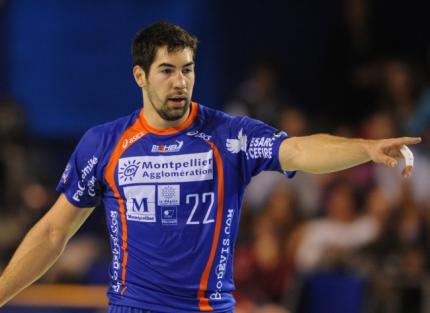
Chambery's young gun, Xavier Barachet.

The Champions League is back in a big way as Group Play is over and the Knock Out rounds are here.  For newbies, the Champions League knock out phase involves paired teams playing a home and away, 2 game series with the overall aggregate goal differential deciding who advances.  16 teams advanced out of the group phase and clubs were drawn based on their ranking in their Groups.  Below are the match ups for the first leg.  The lower seeded teams host the first leg and the higher seeds will host the second leg next week.  The handicap (point spread) betting line is in parentheses.

1 vs. 4 Seeds

Montpellier (-4) at Kadetten Schaffhausen (Thursday)
Ciudad Real (-3.5) at Chambery (ehfTV: Sunday, 5:00 PM CET)
Kiel (-4) at KIF Kolding (Saturday)
Chekhov (-4.5) at Sarajevo (Sunday)

Based on these betting lines each of the #1 seeds are expected to cruise to victory even though they are playing on the road.   The EHF Match of the Week with live English Language commentary has French side Chambery hosting Ciudad Real.  Chambery beat Barca at home during the Group Phase and surely will feel that it can do the same against Ciudad Real.

The match is at 5:00 PM (Central European Time), 11:00 AM (U.S. East Coast) on Sunday, 27 March. 

Live Broadcast link:  http://www.ehftv.com/ec/cl/men/2010-11/live/high/001553

On Demand broadcast at ehfTV:  http://www.ehftv.com/ec/cl/men/2010-11/video/001553

There is also a televised tape delayed broadcast on the MHz Network in the U.S. at 4:00 PM (U.S. East Coast) on Sunday 27 March. For information on how you can watch MHZ see this link: http://www.mhznetworks.org/mhzworldview/carriage/

2 vs. 3 Seeds

Valladolid at Hamburg (-5.5) (ehfTV: Thursday, 7:30 PM CET)
Flensburg (-1.5) at Pick Szeged (ehfTV:Saturday, 2:30 PM CET)
Rhein-Neckar Lowen at Zagreb (-1.5) (ehfTV: Sunday, 6:00 PM CET)
Veszprem at Barcelona (-5.5) (Sunday)

These matches should prove more interesting, with the marquee matchup being R-N L’s visit to Zagreb.  And remember with the 2 game aggregate scoring there is no such thing as “garbage time” at the end of the first game.  The home teams know they will have to travel next week and will want as big as cushion as possible.

(Important Daylight Savings Time note:  While North America is already enjoying an extra hour in the evening, Europe doesn’t start Daylight Savings Time until Sunday;  This means that there is currently only a 5 hour time difference between the U.S. East Coast and Central European Time.  So, for games on Thursday and Saturday, remember to subtract one less hour than you’re use to.

EHF Preview of Round of 16: http://www.ehfcl.com/men/2010-11/article/13787/Back+to+square+one

post

British Handball Update: Formal approval from the BOA, EHF funding and a victory over Italy

Great Britain captain Ciaran Williams on attack vs. Italy

The 2012 Olympics are about 17 months away and the British Handball Federation has had several small victories, both on and off the court, in the past few months.  First off, back in January the British Olympic Association (BOA) (GBR’s Olympic Committee) granted full approval for the British teams to participate in the 2012 Olympics.  Never a done deal, the BOA’s approval was contingent on British Handball making the case that the games would leave a “lasting legacy” for the sport and that the men’s and women’s teams could put forth a “credible performance.”  Some had even argued that no funding should be spent on a team with no hope of medalling.

Terms like “lasting legacy” and “credible performance” are wide open to interpretation, but few would argue that progress isn’t being made on both fronts.  Notably the European Handball Federation (EHF) has stepped forward with some funding support to British Handball.  Details were lacking in terms of how much funding, but it appears most of it will go toward the salary of a full-time handball development officer in London.  Such a position makes sense and is a win-win for British Handball and the EHF as both organizations would benefit greatly were Great Britain to become a Handball nation.

On the court itself, Great Britain is still a long ways from being on par with the other 11 nations that will round out the field in London.  The Men’s recent matches against Italy (a 33-24 victory) and Turkey (26-28 loss), however provide some hope.  Neither of those teams strikes fear into Europe’s top handball nations, but those are a couple of teams that likely would have beaten a British side by 10 or more goals only a couple of years ago.  Does that mean the Brits are on track for a credible performance in 17 months?  That, of course, depends on your standards.  Both the men and the women are likely to get beaten badly by the other European sides and will be fortunate to win any games.  But, it wouldn’t surprise me if they have stretches where they play credibly. 

The more important standard though, is clearly the “lasting legacy” one.  Non handball nations like Australia and the U.S. have failed to fully take advantage of the opportunity an Olympics can bring.  Let’s hope that Great Britain can break that trend and use 2012 as a stepping stone towards becoming a Handball nation. 

Eurosport.com (21 March 2011): GB handballers raring to go: http://au.eurosport.com/olympicgames/olympic-games/2012/gb-hanballers-ready-to-go_sto2714238/story.shtml

EHF (15 Mar 2011): EHF supports Olympic legacy in London: http://www.eurohandball.com/article/13762

The Economist (17 Mar 2011): Britain’s new Olympic sports: New balls, please: The host nation extends its sporting repertoire: http://www.economist.com/node/18396255?story_id=18396255&fsrc=rss

BBC (19 Jan 2011): Great Britain handball teams given 2012 Olympic nod: http://news.bbc.co.uk/sport2/hi/handball/9362374.stm

THN Commentary (25 Jan 2008):  Times of London Handball Article Misses the Goal: https://teamhandballnews.com/2008/01/times-of-london-handball-article-misses-the-goal/

post

Promoting Team Handball in the U.S. (Part 2): How is Rugby getting promotion done right?

Should a promotional event like the Poland-German Friendly in Chicago be turned over to a private entity?

In Part 1 of this series I provided an overview of the Las Vegas Rugby 7s tournament and what a boon it was for promoting the sport of Rugby in the U.S.  In part 2, I explore how Rugby is succeeding and whether something similar can be for Team Handball.

Before, I tackle how the Rugby community is promoting the sport in the U.S. it’s worth pointing out that the Team Handball community hasn’t been sitting idly by.  In fact, there have been 3 noteworthy events in just the past two years which sought at one level or another to promote Team Handball in a similar vein.  Two years ago, the French Professional League staged its League Cup Final Four in Miami, last summer the Polish and German National Teams played a friendly match in Chicago and for the past 2 years, New York City has hosted an All Star Game and tournament in conjunction with New Year’s Eve celebrations.  I attended both the French tournament in Miami and the Chicago friendly match and am familiar with the New York tournament, so I think I can say with some authority that each of these events succeeded in some areas, but failed in others.

The Miami event proved that professional club teams could be convinced to come to the U.S. and play competitive matches with a championship at stake.   This is roughly the equivalent of American forays into Europe like the NBA’s recent trip to London to play regular season games that count.  Unlike the NBA games, however, the French Miami experiment was a dismal failure attendance wise and was not shown on TV in the U.S. 

The Chicago event proved that National Federations could be convinced to play a match, albeit a friendly one in the U.S.  The attendance was respectable, but still less than desired.  There was also good promotion with regional broadcasts of the match to many parts of the country.  It wasn’t live on a major network, but it was still the first U.S. TV broadcast outside of the Olympics in 15 years. 

The New York Big Apple Tournament is a smaller scale event, but arguably has done the best job in terms of promoting a U.S. event, to the rest of the world.  This is demonstrated by its successfully packaging of tours to get Germany to cross the Atlantic and the Eurosport broadcast of the All-Star game in Europe.  All well in good, but for a number of reasons it’s not been designed to capture the attention of the citizens of New York.

In contrast to these attempts, the Rugby 7s event is running on all cylinders. 

Good Attendance:  25,000 for each day of a two day event
Atmosphere:  A festival like event with fans from across the country in attendance. 
TV exposure:  Broadcast to a world-wide audience including 5 hours on a major network (NBC) in the U.S.

So, how is Rugby doing it and why can’t we do the same thing for Team Handball?

1) Rugby’s larger USA fan base gives them a running start on ticket sales and courting TV networks.  I asked several informed rugby folks a fairly simple question, “How many people in the U.S. care (really care) about the sport of rugby?”  The answered varied, but around 100,000 seems like a pretty good estimate.  And, of course, this is a very subjective question anyway.  After all what does it mean to “really care”?  But, this is a base to work with and if you already got 10% of that 100,000 excited, that means there’s fewer folks that you need to convince to pay good money for a ticket.  Contrastingly the “really care” Team Handball number is somewhere in the 300-500 range.  This woefully small number means that anyone looking to fill seats for a U.S. based event has to “convince” almost everyone to buy a ticket.  Doable, but it adds an extra degree of difficulty the Rugby folks don’t have to deal with.

In terms of TV, it’s the same deal.  While at the tournament I had the opportunity to chat with John Miller, President Programming, for NBC Sports and Versus.  As you might expect, my pitch was, “Hey when are you going to do something like this for Team Handball.”  The answer, I got was positive in some respects.  He’s familiar with the sport (never a given in the U.S.) and has enjoyed watching it in person at the Olympics.  But, it was negative in that he expressed that the base for Team Handball was too small compared to Rugby and that Rugby also had the advantage of being similar to American Football.   For sure, our base is clearly smaller, but I think it’s only a matter of time before a major USA network climbs on board.  Team Handball is just too good of a product to be absent from our TV screens and it’s only a matter of time before the right decision maker realizes that.  For more on NBC’s plans for rugby be sure to check out the short audio interview at the bottom of the page.

2) Rugby’s International Federation, the International Rugby Board (IRB), is investing heavily to promote and grow the sport, both world-wide and in U.S.  Oh my goodness, how they are investing.  We are not talking Continental challenge cup tournaments and balls to Guatemala.  We’re talking about funding the entire World Series 7’s circuit with additional assistance to the local organizing committees and national teams participating.  We’re talking millions of dollars being pumped directly into USA Rugby, both to help run the Federation and to organize meaningful National team competition.  We’re talking a Federation produced TV and Radio shown world-wide to promote the sport.

These aggressive efforts are now starting to pay dividends.  And no more so is this evident than in the inclusion of Rugby 7s in the Olympics.  Sometimes I think the world handball community doesn’t realize how fortunate that the sport is already on the Olympic Program.  Despite the fact the IOC is top heavy with Europeans, I have serious doubts as to whether the IHF could even begin to mount a lobbying campaign similar to what the IRB has done in the past 10 years.  The IHF occasionally talks about promoting the sport, but its efforts are paltry compared to the IRB. 

But, perhaps it is unfair to compare the two Federations.  Undoubtedly, the money stream from the IRB world cup that is held every four years is substantially greater than the cash flow the IHF gets every 2 years for its World Championships.  Still, I’ve never seen the IHF present any type of a coherent strategy or plan to develop the game worldwide.  Rest assured if USA Team Handball got a little more help from the IHF, its job would be a lot easier.

3) An independent company, rather than the USA Rugby Federation is responsible for the Las Vegas 7’s Tournament.   Whether it was a prescient strategic move or simply a desire to lighten the workload, USA Rugby sold the 7s program several years ago to an independent company, USA 7s, LLC.  Accordingly, USA 7s, LLC is responsible for organizing, promoting and conducting the Las Vegas Tournament.  There clearly is a relationship with USA Rugby, but USA 7s is calling the shots.  A small full time staff is developing the brand, courting sponsors, engaging with TV networks and even developing new tournaments like the collegiate 7s championships later this spring. 

The benefit to USA Rugby is that they’ve been able to focus on other aspects of developing the sport and the 15s program.  Handing off the 7s program means there is one less thing on their very full plate.  Of course, that’s also meant a loss of control and a little bit of criticism from the USA Rugby community.  In particular, critics have pointed out that USA Rugby has sometimes taken a little bit too much credit for an event they’re not really running and that perhaps it shows that others (e.g. USA 7s, LLC) are doing more than the National Federation to develop the sport. 

This may sound a little familiar to some folks in the USA Team Handball Community.   Although, anything that’s been done independently to date, like the French Miami experiment and the Big Apple tournament have not been anywhere near as successful as the Las Vegas Rugby event.  If an event like the Germany-Poland friendly were formally sold off it would have the benefit of freeing up the USA Team Handball staff to work on the many tasks that there currently aren’t enough hours in the days to do now.  The Federation would lose control, but could still benefit greatly.  The fact that the USA 7s tournament has shown that it can work suggests it may very well be worth a try.   After all, if no one cares who gets the credit, a lot can be accomplished.

So, I’ve further highlighted how Rugby is making marketing inroads while Team Handball is trailing behind with fits and starts.  In part 3, I’ll further address what it will take to adapt the Rugby model and apply aspects of it to further promote Team Handball in the U.S.

THN (28 Feb 11) Promoting Team Handball in the U.S. (Part 1):  Las Vegas Rugby 7s Tournament:  Undoubtedly, a model to follow: https://teamhandballnews.com/2011/02/promoting-team-handball-in-the-u-s-part-1-las-vegas-rugby-7s-tournament-undoubtedly-a-model-to-follow/

THN (18 Apr 2009):  If You Build It, Will They Come?: https://teamhandballnews.com/2009/04/if-you-build-it-will-they-come/

THN (26 Jul 2010):  Miami and Chicago: Assessing two European Handball Ventures in America: https://teamhandballnews.com/2010/07/miami-and-chicago-assessing-two-european-handball-ventures-in-america/

THN (7 Jan 2011): 2nd Annual Big Apple Handball Tournament: A Definite Upgrade: https://teamhandballnews.com/2011/01/2nd-annual-big-apple-handball-tournament-a-definite-upgrade/

THN (3 Jul 2010):  USA Team Handball Development:  Why it matters: https://teamhandballnews.com/2010/07/usa-team-handball-development-why-it-matters/

post

EHF Game(s) of the Week: Barcelona at Celje (Live and with English Language Commentary) and Veszprem at Montpellier


Nikola Karabatic and Montpellier will battle Veszprem in a Group B showdown


Barcelona at Celje

OK, there’s only one official game of the week with live English commentary from Tom O’Brannagain.  That would be the Group A match between Slovenia’s, Celje and Barcelona.  With Barcelona locked into a third place seed, however, it’s debatable as to how good of match it will be.  Barca is clearly the better side but they won’t have any incentive to win.  Celje, on the other hand will be fully motivated as they are currently tied with France’s Chambery for the fourth place seed.  A win guarantees that Celje will advance, but they will also qualify if Chambery loses to Rhein-Neckar.  As the Chambery match starts 30 minutes ahead of time, don’t be surprised if there is some scoreboard watching in Slovenia.

The match is at 6:00 PM (Central European Time), 12:00 Noon (U.S. East Coast) on Saturday, 5 March.  Barcelona is a 3 goal favorite.

On Demand broadcast at ehfTV:  http://www.ehftv.com/ec/cl/men/2010-11/video/001451

There is also a televised tape delayed broadcast on the MHz Network in the U.S. at 4:00 PM (U.S. East Coast) on Sunday 6 March. For information on how you can watch MHZ see this: http://www.mhznetworks.org/mhzworldview/carriage/

Interview with Celje right wing Gasper Marguc: http://www.ehfcl.com/men/2010-11/article/13725/Margu%C4%8D%3A+%22As+big+as+the+universe%21%22

 Veszprem at Montpellier

The unofficial game of the week is clearly the Group B showdown between Montpellier and Veszprem for first place.  Veszprem won in Hungary 27-26, so Montpellier will need to win by 2 goals (or just 1 goal if they keep Veszprem under 26).  There’s a lot of incentive to finish first as the potential round of 16 opponents on the fourth rung are a significant step down from the third rung.  Not to mention the first seed opponents are also guaranteed not to meet each other until the Final Four in Cologne, thus avoiding a potential quarter-final pairing vs. Kiel or Ciudad Real.  Montpellier definitely has the edge here, but with Michael Guigou out and Vid Kavticnik questionable due to injuries, Karabatic will need to carry the load in this match. 

The match is at 5.30 PM (Central European Time), 11:30 Noon (U.S. East Coast) on Sunday, 6 March.  Montpellier is a 3 goal favorite.

On Demand broadcast at ehfTV:  http://www.ehftv.com/ec/cl/men/2010-11/video/001456

EHF: Interview with Veszprem backcourt player,Gabor Csaszar:  http://www.ehfcl.com/men/2010-11/article/13724/Cs%C3%A1sz%C3%A1r+to+steal+points+in+France

Audio recording links are below.  Open the on demand video in one window and then click on the podcast link.  I do a countdown of the ehfTV clock in the lower left hand of the screen.  Pause the audio when I start the countdown and then play the video.  Then unpause the audio when you get to the appropriate time on the clock. 

post

Promoting Team Handball in the U.S. (Part 1): Las Vegas Rugby 7s Tournament: Undoubtedly, a model to follow

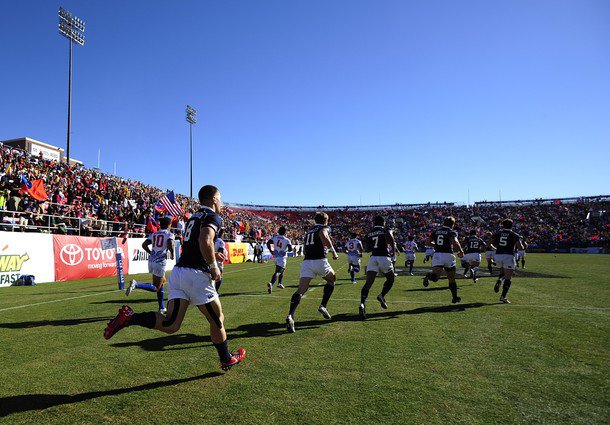
Team USA takes the field in front of 25,000 fans

As frequent readers are well aware, I’ve written a number of pieces on the sport of Rugby and how its challenges to develop in the U.S. are similar to that of Team Handball.  Both are sports with similarities with sports Americans already excel at and follow passionately (basketball for Team Handball; American Football for Rugby).  And both sports are very popular in parts of the world (Scandinavia, the Balkans and Germany for Team Handball; the British Commonwealth for Rugby) but are minor sports in the U.S.  And finally, both sports have passionate followers in the U.S., who dream that one day their sport will crack into the big time and become part of the American sports landscape.

I live in Las Vegas, a town full of dreamers, and a couple weekends ago I saw and heard firsthand how Rugby is maybe, just maybe, turning that dream into a reality.  It was the second year that the USA 7s tournament was held in Las Vegas as part of the International Rugby Board’s (IRB) World Series for Rugby 7s.  A crowd of around 25,000 attended each day of the 2 day event held at Sam Boyd stadium on the outskirts of Vegas.  This may not seem like much of a crowd, but I can attest that it’s more than the UNLV football team often draws and without doubt you’ll be hard pressed to see spectators anywhere having more fun.  The event has a party time atmosphere with expats from many nations dressed up in costumes or their nation’s colors.   Outside the stadium is a festival area with rugby drills for the kids, assorted booths with national food dishes.   And as it’s an all day event, let’s just say that if fans start drinking beer before noon most of them are going to be in a good mood come nightfall.

But aside from the festive mood onsite an even more important indication of Rugby’s growth was the presence of NBC sports at the event.  In all, 5 hours of coverage (much of it live) was broadcast over the airwaves to every corner of the United States and 17 hours of coverage was available to much of the nation via the NBC Universal Sports online platform.  I’m not an expert on TV broadcasting, but based on the equipment, numbers of trailers and personnel running around NBC didn’t cut any corners on their production.  TV coverage like this alone, isn’t going to turn the U.S. into a Rugby power overnight, but there’s no denying that nationwide exposure like this is a godsend to a niche sport.

Here are a couple of audio excerpts from NBC’s broadcast.  It doesn’t take much to imagine a Team Handball broadcast and the same type of Olympic advertisement for our sport.

[display_podcast]

From time to time I’ve gotten into verbal and written forum spats with members of the U.S. Team Handball community that pooh-pooh the importance of TV exposure.  The standard argument is that it’s a diversion of scarce resources (time and money) that would be better spent on grass roots development.  My counter argument is that it’s a numbers game and we sorely need new fans and players to support our grass roots programs and TV is the best way to grow those numbers.  Heck, you might even find a real gem of a player who takes a liking to a game he’s never seen before.  Last summer during the USA National Team – LA match in Chicago I whimsically made such a point on the Comcast broadcast.  Essentially issuing a challenge to anyone watching that if they think they can play this game better contact the U.S. Federation for a tryout.  For those of you who like to pooh-pooh the possibility of finding such a player, I suggest you check out this audio interview of Miles Craigwell, a former NFL player who saw a broadcast last year of Rugby 7’s, got in touch with the USA Rugby Federation and 8 months later started several matches for the U.S in Vegas. 

I’ll be the first to tell you that Rugby 7s is a much simpler game to learn than Team Handball, but we could still use a few more Miles Craigwells showing some interest in our sport.  And as I’ve argued many times before, we still need to have the grassroots programs in place.  Because, if you do your promotion well, you need to be ready to handle all those newcomers. 

But, are we doing our promotion of Team Handball as well as we could?  As I soaked in the enormity of this event for Rugby, I couldn’t help but contemplate “how is Rugby doing this?” and “why can’t something similar be done for Team Handball?”  In part 2 of this series I’ll tackle that very question.

Universal Sports (3 Feb 2011): Craigwell a football player turned rugby star: http://www.universalsports.com/blogs/blog=thescrum/postid=514632.html

The Economist (3 Feb 2011) Rugby in America: Worth a try: More and more Americans are being converted to the sport: http://www.economist.com/node/18070557?story_id=18070557&fsrc=rss

THN (11 Feb 2011): https://teamhandballnews.com/2011/02/nbc-to-broadcast-5-hours-of-7-on-7-olympic-team-sport/

post

EHF Game of the Week: Valladolid at Pick Szeged (Live and with English Language Commentary)

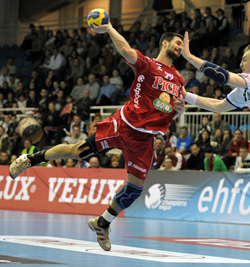
Szeged's Frantisek Sulc

Another Group C match is served up for this week’s game of the week.  Spanish side Valladolid travels to Hungary to take on Szeged.  Both sides are likely to advance to the round of 16, but still have strong motivation to win.  A win in Hungary would pretty much lock up second place for Valladolid and give them an outside opportunity to win the group.  Meanwhile, a Szeged win will qualify them for the round of 16 and put them in third place with a possibility of even moving up to second.

The match is at 6:00 PM (Central European Time), 12:00 Noon (U.S. East Coast) on Saturday, 26 February.  Valladolid is a 1.5 goal favorite

EHF Website interview with Pick Szeged’s Frantisek Sulc:  http://www.ehfcl.com/men/2010-11/article/13698/%C5%A0ulc%3A+%22Szeged+live+for+handball%22

Live Broadcast link:  http://www.ehftv.com/ec/cl/men/2010-11/live/high/001438

On Demand broadcast at ehfTV:  http://www.ehftv.com/ec/cl/men/2010-11/video/001438

There is also a tape delayed broadcast on the MHz Network in the U.S. at 4:00 PM (U.S. East Coast). For information on how you can watch MHZ see this: http://www.mhznetworks.org/mhzworldview/carriage/

post

USA Team Handball Announces New National Team Pool Criteria

USA Team Handball recently posted updated National Team Pool Criteria for prospective National Team players.  Some of the criteria appears to be simply a more structured rehash of criteria that has been previously used to assess and identify players.  There are the usual battery of physical tests and handball skills identified, but there are also some new requirements that caught my eye.

For instance, some basic minimums were identified in terms of matches and practices each year.  A relatively modest number of matches is required (15), but a fairly substantial number of practices are now required (48 court and 72 non court).  This may seem rather simple to our European readers, but I suspect that there are very few club teams in the U.S. meeting the 48/year requirement.

More noteworthy, is a requirement for senior players to relocate to designated Regional or National Centers of Excellence by June 1, 2012(#5, page 13).  Section 5 goes further to highlight that the process for selecting these locations is planned for the first half of 2011 and that preliminary plan is to re-establish a residency program (either walk-in or live-in).  As far as I know, this is the first written indication that USA Team Handball was going to take this significant step.  More details will hopefully be coming soon in regards to the specifics of such a program and how it will fit into the current practice of encouraging European Club participation.

Also added is a requirement off the court in terms of being an Ambassador for the sport with options to support development through recruiting, refereeing and fundraising.  An appropriate requirement, in my opinion, for a sport that needs as many people promoting it as possible.

But what really caught my eye, were the closing comments in the “Athlete Development Pipeline Model” document:

Finally, as uncomfortable, inconvenient and uncanny it may feel, there is absolutely no science based nor practice based evidence of a “fast track” for high achievers to become masters in their fields. To the contrary, as Malcolm Gladwell in his bestseller “Outliers” put it (sic): “researchers and practitioners in variety of fields have settled on what they believe is the magic number of for true expertise: ten thousand hours.”

“The 10,000 – HOUR RULE” sends very clear and strong message to us all involved in handball.  Handball must evolve into year around activity.

A table is then provided which tabulates what this mean in terms of 25 day month (assume you 4 or 5 days off) over a 12 year span (2.77 hours/day) or 16 year span (1.56 hours/day).    I’ll have a follow on commentary about the 10,000 hour rule.  But suffice it to say, this is a very telling stat that speaks volumes as to the historic lack of U.S. success and the challenge of developing handball experts who pick up the sport in their late teens.

USATH: Live the Olympic Dream: Tryout for Team Handball!: http://usateamhandball.org/news/2011/02/23/live-the-olympic-dream-tryout-for-team-handball/40313?ngb_id=42

USATH: National Team Pool Criteria:  http://usateamhandball.org/national-teams/national-team-pool-criteria

USATH: USA Team Handball Athlete Development Pipeline Model:  http://usateamhandball.org/assets/documents/attached_file/filename/38081/USATH_Athlete_Development_Pipeline_Model_Application_Guidelines.pdf

post

EHF Game of the Week: Chekhovskie Medvedi at Aalborg (Live and with English Language Commentary)

After a long layoff the Champions League is back with leg 8 of Group Play.  The featured match this week with English Commentary has Danish side Aalborg hosting Russian side Chekhovskie.  Chekhovskie is tied for first place in Group C with 11 points while Aalborg is in last place with 4 points.  Aalborg still can qualify for fourth place in the Group, but with only 3 matches to play they will need to start winning.  Chekhovskie is also highly motivated as they will want to move ahead of Spanish side Valladolid in their bid to win the coveted first seed heading into knockout play.

The match is at 4:50 PM (Central European Time), 10:50 AM (U.S. East Coast) on Sunday, 20 February.  Chekhovskie is a 3.5 goal favorite

EHF Website interview with left wing Timur Dibirov: Hungry for European handball:  http://www.eurohandball.com/article/013676/Dibirov%3a+%22Hungry+for+European+handball%22

Live Broadcast link:  http://www.ehftv.com/ec/cl/men/2010-11/live/high/001431

On Demand broadcast at ehfTV:  http://www.ehftv.com/ec/cl/men/2010-11/video/001431

There is also a tape delayed broadcast on the MHz Network in the U.S. at 4:00 PM (U.S. East Coast). For information on how you can watch MHZ see this: http://www.mhznetworks.org/mhzworldview/carriage/

post

NBC to broadcast 5 hours of “7 on 7” Olympic Team Sport

This weekend, one of the major USA TV Networks, NBC, will have an unprecedented 5 hours of live coverage of a 16 nation tournament for a relatively unknown Olympic team sport with 7 players to a side.  The sport is fast paced, features crisp passing, physical contact and high scoring.  Unfortunately, for us Handball fans, the 7 on 7 sport is Rugby 7s, not Team Handball.

My adopted home of Las Vegas will be hosting the 4th leg of the Rugby World 7s tour.  Rugby 7s is a modified version of Rugby that features fewer players per team (7 vs 15) and much shorter games.  The Rugby World 7s tour plays in 8 cities world-wide and tournaments are played out in rapid fashion over two days in a festival style setting.  Rugby successfully lobbied to get the 7 on 7 version of the game on the Olympic program and it will make its debut at the 2016 Olympics.

I’ll be attending the event and hopefully speaking with NBC and USA Rugby 7s executives and maybe see if we can convince them to do the same for Team Handball.  If you have time check out the event on TV this weekend and let me know your ideas are concerning a similar event for our sport.

Hollywood Reporter:  NBC, Universal Sports Bet on Rugby: http://www.hollywoodreporter.com/blogs/live-feed/nbc-universal-sports-bet-rugby-98136

NBC Rugby 7s Page: http://nbcsports.msnbc.com/id/35910886/ns/sports-rugby_7s

Live TV Coverage is Saturday, February 12, 3:30 – 6:00PM ET and Sunday, February 13, 4:30 – 6:00 PM ET

Additional Internet coverage is also available at http://www.universalsports.com/

post

USA Team Handball’s Egypt Connection

A strange twist of events resulted in USA Men’s National Team Captain, Mark Ortega, witnessing history in Egypt. Looking for a better training opportunity in preparation for the upcoming PANAM Games 2nd Chance tournament Mark moved to Egypt in January to train with fellow teammate Adam El Zogby’s club team, Al-Ahly, in Egypt. In two video reports, Mark chronicles Adam’s recovery from ACL surgery, life in Egypt and his search for a club to join. What starts as a handball travelogue seems starts to take a dramatic turn as protests in Egypt engulf the country. Video 2 ends with the protests starting and a discussion with a Cairo cab driver regarding their significance.

http://www.youtube.com/watch?v=nY6Rcpx9Xto&feature=player_embedded

http://www.youtube.com/watch?v=NCcmSYU6GNs&feature=player_embeddedUSA

http://www.youtube.com/watch?v=dmpPpey64_k&feature=player_embedded

Team Handball’s weekly report on athletes playing overseas reports that Adam El Zogby is continuing his recovery and is safe and sound in his apartment situated a little over a mile from El Tahir Square.

USA Team Handball: Mark Ortega Profile.
USA Team Handball: Americans Abroad Report.

post

2012 Olympic Qualification Update

We’ve updated the 2012 Olympic Qualification page to reflect the recent results of the Men’s 2011 World Championships.

https://teamhandballnews.com/2012-olympic-qual-men/

By winning the title France has joined host, Great Britain, in qualifying for the Olympics in London next year.  Ten spots in the twelve nation tournament remain to be awarded.  Four spots will be awarded to the Continental Federations (Europe, Pan America, Asia and Africa) and 6 spots will be awarded via 3 IHF Qualification Tournaments.

The IHF has decided to use the same format that was used for 2008 Olympic Qualification.  Three round robin tournaments (with 4 nations participating) will be plaayed from 6-8 April, 2012.  The top 2 teams from each tournament will qualify for the Olympics.  Teams will be seeded in these tournaments based on the recently completed World Championship results and the results of upcoming Continental Qualification events.

The nations that placed 2nd through 7th (Denmark, Spain, Sweden, Croatia, Iceland and Hungary) have qualified for IHF Qualification Tournaments.  The World Championships also decided the rank order of the different Continental Federations.  Europe by virtue of France winning the title is ranked as the top Continent.  Pan America is second (Argentina, 12th Place), Asia is 3rd (South Korea, 13th Place) and Africa is 4th (Egypt, 14th Place).  The most significant ramification of the Continental ranking is that Pan America, by virtue of Argentina being the sole non-European team making the main round, picked up an extra qualification tourney spot.

The current seeding for these tournaments is as follows

Tournament 1:  Denmark (Host), Hungary, Europe (2nd), Africa (2nd)
Tournament 2:  Spain (Host), Iceland, Pan America (2nd), Europe (3rd)
Tournament 3:  Sweden (Host), Croatia, Asia (2nd), Pan America (3rd)

It’s fairly likely, however, that this seeding will be altered by the 2012 European Championships as Denmark, Spain or one of the other European teams that finished 2nd-7th at the World Championships will be strong candidates to earn the European Automatic Qualification bid.  This will then set off a cascading effect in terms of which teams will play where.  For instance, should Denmark earn the European bid the placement of teams would change as follows:

Tournament 1:  Spain (Host), Poland, Europe (2nd), Africa (2nd)
Tournament 2:  Sweden (Host), Hungary, Pan America (2nd), Europe (3rd)
Tournament 3:  Croatia (Host), Iceland, Asia (2nd), Pan America (3rd)

Commentary:  As I pointed out 4 years ago, I think most observers would probably consider this format flawed in that it’s fairly certain that the Continental Championship Qualifiers in Tournament 3 will be weaker opponents  than the qualifiers in Tournaments 1 and 2.  Tournament 1 will likely have Germany, Norway, or Serbia as Europe 2 and then either Tunisia or Egypt as Africa 2.  The teams in tournament 2 are likely to be Brazil/Argentina and Germany/Norway/Serbia again.  Contrast that to Tournament 3 where the likely opponents include Japan and Chile/Cuba.   You can pretty much ink in Croatia and Iceland as qualifying out of that tournament.  So, it’s pretty clear that a 3rd or 4th seed is better than a 1st or 2nd seed.  Granted, Spain and Sweden will still likely qualify, but why should they get punished for doing better at the World Championship?

There’s a number of ways that the IHF could have fixed this.  The simplest would probably be a draw for tournament seeding using 4 ranks of 3 teams each.  That would at least even out the likelihood of getting a 3rd European team in each tournament.  Another option would be to rank order the 6 teams that qualify via Continental Championships based on how well they performed at the last WC.  Regardless, it’s clear that the current system is flawed.  It’s probably too late to fix it now, but I guess maybe there’s a chance the IHF could get it right for 2016.

post

Time Shifting: Why would I watch any other way?

I’ve written about this before, but it’s worth mentioning again.

I know it is Monday afternoon in Sweden and teams are gearing up for the second round of play for Main Round Group I.  Everyone’s also probably still talking about the Croatia – Sweden match on Sunday night.  But in my little private Handball World, it’s still Saturday evening and I’ve yet to scan through Spain – Norway to see if any of it is worth watching.

Yes, with 9 hours separating me from Sweden, it’s not practical for me to watch very many games live, but through the convenience of on-demand viewing at livehandball.tv I can watch whenever I want.  I know you old schoolers like the aesthetic of watching it live, but tell me old schooler what are your plans for this coming Wednesday and Thursday night?  Yes, while you and the teams are getting some much needed rest, I will be watch whatever pivotal matches remain in the Main Round at my leisure.  I’ll catch up with you in time for the Semifinals, although I may watch one Friday night and the second one on Saturday night.  Seriously, I must ask; Why would you watch anyway else?

And now for a short plug for livehandball.tv.  If you haven’t signed up yet, I would strongly suggest that you do.  They’ve lowered the price to $25 for the rest of the tournament and with the on-demand feature you truly can get your money’s worth.  I’ve been plugging my laptop into my TV via HDMI cable and I’ve been pretty pleased with the quality.  Mind you it’s not Hi-Def by any stretch, but it’s TV worth watching.

THN (23 Jul 08):  Extreme Time Shifting in the Desert or How I Hope to Watch Olympic Handball: https://teamhandballnews.com/2008/07/extreme-time-shifting-in-the-desert-or-how-i-hope-to-watch-olympic-handball/

post

Preliminary Round Wrap Up/Main Round Preview

Christer Ahl and John Ryan discuss the final preliminary round results and look ahead to the Main Round.    Again, we apologize for the sound quality.  Occasionally, there is a little echo on Christer’s end.

Also, our memories were a little short in regards to a few players and where they play.  After the fact here’s some info:

Danish Backcourt, Kasper Sondergaard, plays for Danish Club, KIF Kolding.

Iceland Goalie, Bjorgvin GÚSTAVSSON plays for Swiss Club, Kadetten

Argentina Goalie, Matias Schulz, age 28, plays for Badajoz in Spain’s 2nd Division.  Four other players for Argentina play in Spain’s Liga Asobal.  Sebastiean Simonet, 24; Diego Simonet, 21; Federico Vieyra, 22 play for Torrevieja. Gonzalo Caro, 31 plays for Ademar Leon.  It’s worth noting that not only are they playing in Spain’s top league, with the exception of Caro, they should be around a while.