Note: This is part of an ongoing series, Charting a Way
Forward for USA Team Handball (2019 Reboot): Link
Parts 1 and 2 of my review of U.S. clubs focused on Men’s clubs. Part 3 looks at our Women’s Club Programs.
USA Women’s Clubs: A Small Footprint
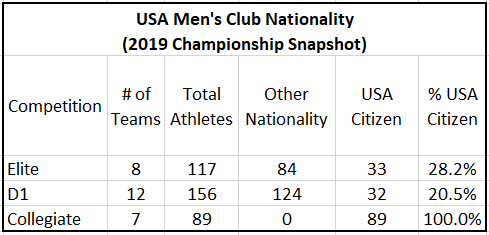
As a reminder here are the U.S. demographics from an earlier installment of this series.
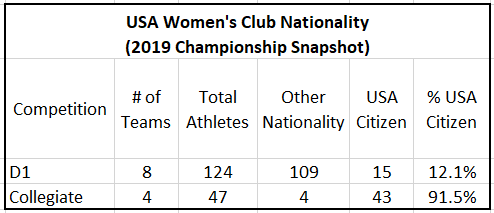
Breaking this down further there are around 150-200 female handball athletes playing club handball in the U.S. And, of that 150 – 200 there are perhaps 60-80 that are American citizens.
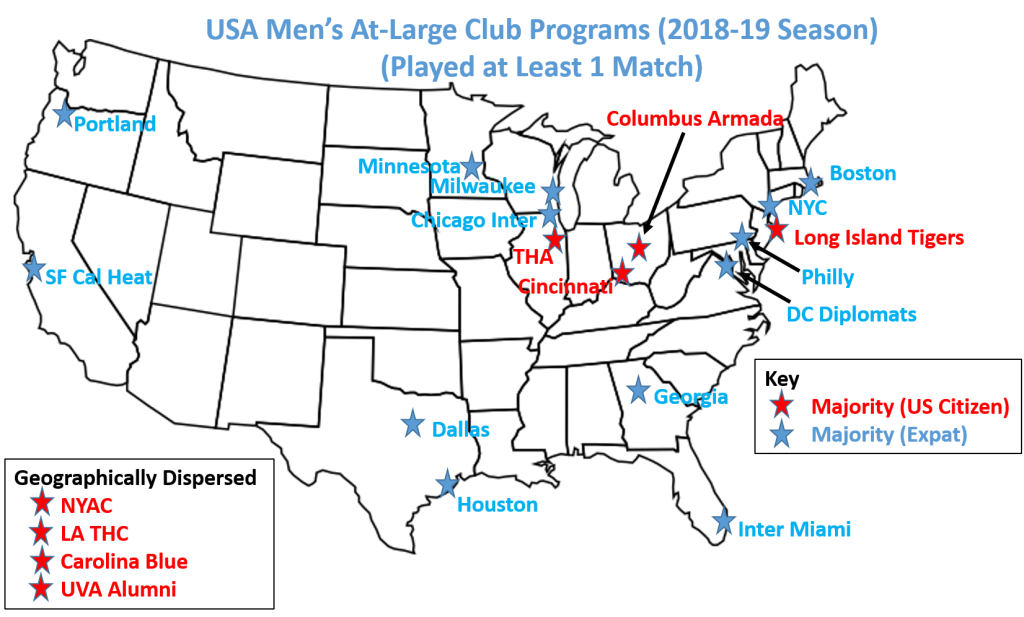
The tables below (and the map above) further break down the Women’s club program in the U.S. that played at least 1 match last season.
The demographics are similar to the Men with most of the
teams being expat majority except for collegiate clubs and a couple of
geographically dispersed clubs (Rogue and Carolina Blue).
While similar, however, the overall total numbers of clubs are lower. Last season there were a total of 36 Men’s clubs that played at least 1 match (At-Large (21) and Collegiate (15)]. For the women, there was only a total of 12 clubs [At-Large (9) and Collegiate (3)].
Why Fewer Women’s Clubs?: Less Interest and…Surprisingly, More Opportunity (in Relative Terms)
An earlier article highlighted some of the inherent challenges with developing women’s handball. Those challenges include handball not being a “school sport”, a smaller pool of interested athletes (relatively to men).
This less relative interest is manifested in two ways. Overall, there are fewer women interested in playing sports competitively. Anecdotally, I think most people will agree this true, but there are also several studies that back up this view. For grades 3-12 roughly 8 million girls participate in organized sports compared to 12 million boys. I would suspect that these rates of participation continue in older ages and may even increase. Meaning all things being equal there are fewer women interested in playing a club sport like handball.
But, I would argue that when it comes to club sport’s interest in college all things are not even equal. And, this is somewhat bizarrely due the great equal opportunity requirements of Title IX which mandates equal participation rates for men and women. It hasn’t been fully realized, but the number of scholarship and participation opportunities for women is roughly the same as it is for men. Meaning that in relative terms NCAA collegiate scholarships for established sports dig deeper into the smaller women’s pool of available talent. This, in turn, leaves fewer women athletes left looking for a sports club outlet and the raw talent of those athletes also being somewhat lower.
So, with these handicaps it shouldn’t be a huge surprise that there are fewer women’s clubs, both with At-Large Clubs and Collegiate Clubs
This concludes the review of the demographic numbers for U.S. Clubs. Part 4 addresses some of the “why” behind these demographics. In particular, why clubs in the U.S. tend to be majority Expat.
Note: This is part of an ongoing series, Charting a Way
Forward for USA Team Handball (2019 Reboot): Link
Part 1 of my review of U.S. clubs focused on our At-Large Men’s club. Part 2 looks at Men’s Collegiate Club programs.
Collegiate Clubs: More Americans, Younger Americans, Plus Structural and Marketing Advantages
The initial review of Men’s club demographics clearly brings home the strengths of our collegiate clubs.
Rarely does a simple tabulation bring home reality so starkly. These clubs are likely 95-100% American and have an average age of 21.2 This is the one layer of our development pyramid that makes sense. Sure, we’d like for there to be even more college programs, but it’s a solid start. And, while a European might laugh at my declaration of “younger” players compared to our At-Large Clubs it is indeed substantially younger. Sure, we’d like more players at even younger ages, but as I will discuss in future installments, going younger can be pretty challenging due to the constraints of U.S. sporting structures.
College clubs are also the first strong transfer point for
athletes from other sports. This is
because there are a limited number of college scholarships available for major
sports and many quality athletes won’t make the cut. These athletes, in many cases will be looking
to continue their athletic careers and team handball presents a unique
opportunity.
Colleges also have many structural advantages in terms of
starting new clubs. For starters,
there’s a captive audience of potential athletes all conveniently located in
the same place. Most colleges also
encourage club activities and gym space for a handball court exists, even if a
handball club has to compete against other activities for its use.
Finally, collegiate clubs have built in branding associated
with their college. Maybe around 1,000
people in the U.S. have even heard of our At-Large Clubs like NYC and SF Cal
Heat. Whereas millions of Americans
immediately know what North Carolina Tar Heels and Ohio State Buckeyes
means. And, alumni of those institutions
are inclined to support clubs from their alma mater even if they don’t know a
whole lot about a sport like team handball.
Collegiate Club
Demographics
While the snapshot of college clubs from last year’s national championship provides a top level overview there are several other collegiate clubs in the U.S. Here, again thanks to Bryan Cothorn’s database, is an overview of every collegiate club that played at least 1 match last season (2018-19)
Some notes on this compilation
Last season the U.S. had 15 Collegiate Men’s that played at least 1 match. Seven of these 15 clubs fielded more than one team for a total of 22 teams that played at least 1 match.
The clubs highlighted in Green are discussed below
Upper Appalachian
Conference?
You never know sometimes how things will grow organically (from within/naturally), but for whatever reason a natural grouping of collegiate clubs has sprung up in Ohio, Pennsylvania, West Virginia, Maryland and Virginia. In fact, over half of the collegiate clubs last season (8 of 15 highlighted in the table in green) are located within those 5 states. These clubs are also relatively new and evenly matched. The engineer/program manager in me hates to jump right to solutions, but this appears to be a no brainer gift that should be capitalized on in some way. Not sure what I would call this conference, but the Appalachian Mountains do split the 8 schools. Perhaps the conference could be split into an East Division with Penn St, Johns Hopkins, Virginia and James Madison and a West Division with Cincinnati, Ohio St, West Virginia and Pittsburgh. Such a split would result in no more than a 5 hour drive within each division.
Sustainment: Always an Issue for Clubs where Players
Graduate every Year
Long time readers will surely remember seeing this grim map before
It’s a very stark reminder of the collegiate clubs of the
past. Clubs that surely started with
promise, took the court with dreams only to all die an untimely death a few
years later. There are multiple reasons
as to why clubs fold, but in most cases it can be attributed to a dedicated
coach’s departure or the graduation of a key cohort of seniors.
The data in the table can’t fully predict which clubs will
stay and which clubs will go, but the # of games played is a rough
indicator. If you can’t field a team to
play games chances are that your days as a club are numbered. For sure, a willingness to spend the time and
money to travel is literally and figuratively where the rubber hits the road. Of course, it’s just an indicator. For example, Texas A&M is a pretty solid
program and its limited number of matches is directly attributable to being
located in a handball desert.
Beyond Existing Clubs?
While there are only around 13 existing clubs dozens of colleges and universities play team handball as an intramural sport. In all likelihood, the handball being played is just a rough facsimile of the real game. Often the games are played with less contact and fouls being called like a basketball game. Which is not too surprising since such games are likely being played by athletes that have never played the game and officiated by refs who haven’t been trained. And, being intramural sports probably coached by a student who maybe played the year before.
This is nothing new, but good things can come from such intramural programs. The 1977 Air Force Academy club team went to the U.S. National Championships and spent the first day learning all sorts of new rules that they had been playing wrong and almost still came away with winning the tournament. (It doesn’t hurt to have several Div 1 basketball athletes and two future handball Olympians on your roster.)
Colleges with intramural programs are a great place to start. Even if they aren’t playing the game properly they are playing it and can be taught. Plus they are motivated and already have equipment (goals and balls). Although, I’ve heard sometimes alternative sized balls and goals have actually been used instead of the real thing…
College Development: Already being Worked
The IHF has already indicated that they will financially
support college development and a Working Group has been established to work
college development. According to an
August USA Team Handball Newsletter their very clear mission is to: “establish
a sustainable approach toward helping colleges and universities establish
collegiate team handball clubs.” A challenging mission, but a worthwhile one.
Next up: Part 3 will look at U.S. Women’s clubs both
At-Large and collegiate.
The first Team Handball News Collegiate Top 5 Poll of the 2019-20 season is out and, no surprise, Army- West Point is the unanimous #1 selection. The defending national champions are undefeated and have double digit victories over 3rd ranked West Virginia (31-18) and 4th ranked Air Force (40-28)
Last season’s 2nd place college club, North Carolina, is also undefeated, having racked up 6 wins on the way to winning the Tar Heel Invitational in October. Wins included victories over Virginia, Auburn and Carolina Blue Alumni Team.
West Virginia is ranked 3rd with wins over Ohio St (21-15) and Army’s 2nd Team (22-21) on their resume.
Air Force is ranked 4th and winless, but they played several competitive matches against At-Large Club teams at the Michael Lipov Tournament in Chicago.
Ohio St rounds out the top 5 with a 6-1 overall record. Their only blemish is aforementioned loss to West Virginia and they rebounded from that loss to take first at the Buckeye Fall Classic Tournament.
Just outside the rankings are Texas A&M, which has yet to play a match and Virginia. Also, of note and a potential candidate for the December rankings is Pittsburgh which picked up 3 wins this past weekend over James Madison, Virginia and Johns Hopkins. Spanish International student, Pau Sanchez and Cedric Humphrey reportedly were a pretty effective back court duo and led Pittsburgh to a 3 game sweep and the top of the Northeast Team Handball D2 South.
Below are the composite standing for all college teams
Note: This is part of an ongoing series, Charting a Way Forward for USA Team Handball (2019 Reboot): Link
Previous installments in this series have focused on our national teams. This installment takes a closer look at U.S. clubs and how they are different from typical clubs in Europe.
Clubs: The Key National Team Building Block in “Almost” every Nation
Perhaps for European readers this title is self-explanatory, except for the curious notion of italicizing and putting the word, “almost” in quotes. As in, “What do you mean? How on Earth could you have a National Team without clubs underneath developing players?”
Well, I won’t regurgitate the history of U.S. national teams
for the last 40 or so years, but for the most part our national teams have been
comprised of athletes that have transitioned from other sports. Many of these athletes never even played handball
before they joined a National Team Residency Program. Some, had only a brief stint with a club
before they made the transition. And,
then only a handful have started as a youth and done the bulk of their initial
handball development as a club participant before eventually being identified
for the national team.
Of course, this has changed recently with the greater use of
expat Americans on U.S. National Teams.
Yes, the U.S. is now actually using the European Model more, but only
because many athletes are dual citizens who have lived most of their lives in
Europe.
U.S. Clubs: A Level of Play Substantially Lower than
other Handball Nations
Comparing the level of club play in the U.S. to clubs in Europe can be complicated and it depends greatly on your reference point. My point of reference is the one season (2002-03) that I played handball recreationally in France as a member of Levallois Sport Club, a suburb of Paris. It was the 2nd level of play in the Ile de France region. We practiced once a week and played one match every weekend. For reference, there are five levels of play at the national level in France. (LNH, Pro Ligue, NM1, NM3, NM3) and I was playing two levels below that, so in a sense I was playing in the… 7th Division.
And, here’s the eye opener that’s shaped virtually every commentary I’ve
written for the past 12 years.
The team I played for finished middle of the table in our
pool and I would assess that if I could transport that very same team to our
most recent U.S. National Championships we would beat every team except for Cal
Heat, NYC and NYAC and LATHC. Yes, a
middle of the road 7th division team in France would have been the 5th
best team at the U.S. Elite National Championships. Which then led to the following
conclusion. Sorry, if it sounds overly
negative, but that conclusion is… “What the hell are we thinking?”
Of course, this conclusion is way overly simplistic. There’s a lot of nuance and complications
with our existing structures that resulted in our “thinking” over the
years. Still…
U.S. Handball
Clubs: A Grouping of Handball People
that is Familiar, but Different
So, was the little club that I played for in France
radically different? Answer: Yes and No.
The practices were very similar to the ones that I with the Condors in
the late 80s; actually similar to practices I had with the U.S. National team. Handball is handball. Pretty much like basketball is
basketball. It’s just that the level of
play and intensity is different.
The camaraderie of the teams were also very similar. Teammates became friends through the shared
experiences of success and failure.
There’s a special bonding with sports teams and that’s pretty universal.
But, that’s pretty much where the similarities end. I’ve already described the comparative level
of play. And, while the 7th
Division in France is comparable to our open club championships one only has to
go up a couple of levels to find better teams.
Also, significantly different is the citizenship of the teams. I’m sure there were a handful of expats in
our little suburban Paris league, but there weren’t any teams that were 90%
expat. And, here’s an anecdote for you:
After one season I decided that my tired 38 year old body wasn’t equipped any
more for handball, so I played over 35 basketball for 4 years. In those 4 years as my club climbed up from
the 3rd Division to the 1st Division I played around 100
games against dozens of clubs. And, in all
that time I played “America’s game” exactly once against a fellow American.
Several things of note there: Very few expats, dozens of teams and I think the longest trip I ever took was around 45 minutes to a suburb on the other side of Paris. And, this was just for the over 35 team. Most clubs had multiple teams from 10 years on up. Some like my club even had a professional side sharing the very same gym for practices. It’s not hard to see how these clubs are the primary building block for developing sporting talent in Europe and much of the rest of the world.
Now, to state the obvious: There are no handball clubs like this in the U.S. Heck, I don’t know of any club for any sport in the U.S. that fits this profile.
Understanding U.S. Handball
Clubs
So, what exactly are handball clubs in the U.S. then? Well, to start there are two primary types of
clubs: At-Large Clubs (open to anyone)
and Collegiate Clubs (where members are also students at the same college).
At-Large Club
Demographics
Here’s the snapshots of the clubs that I presented in part 1:
As you can see our national championship participants were
mostly from other countries and a bit on the older side. With the aid of Bryan Cothorn’s excellent
database here is even broader overview of all the At-Large Clubs that played at
least one match last season (2018-19).
Some notes on this compilation
Last season the U.S. had 21 At Large Clubs that
played at least 1 match. Eight of these
21 clubs fielded more than one team for a total of 30 teams that played at
least 1 match.
The clubs are split into three main groupings:
13 clubs where the majority of the roster
consists of athletes who first learned to play handball outside the U.S.
4 clubs where the majority of the athletes are
stateside products and where a majority of the athletes live in one location
4 clubs where the majority of the athletes are
stateside products, but a majority of the athletes are geographically
dispersed.
The purpose of this grouping is not to be “divisive”,
but to provide insight as to “what we have” in terms of at large clubs. Any club we have in the U.S. is an asset that
contributes to the growth of the sport in the U.S.
The total number of matches played and whether a
club played at the National Championships provides some insight as to the
relative stability of the club. This is
because clubs that play a lot of matches and participate at nationals are
generally more established. Whereas a
club that plays just a few matches might be either a new club or a club that
might be having sustainment issues.
Analysis
Clubs serve many purposes and ends, but currently our At-Large Clubs have only a very limited relationship to our Men’s National Team. It’s true that 21 athletes in our current player pool played on At-Large Club last season, but only 2 of these athletes (Sayed Shalaby (NYC) and Greg Inahara (Chicago)) made our 2019 PANAM Games Team.
The training environment for these clubs varies dramatically. At one end of the scale is NYC which is a large club with several experienced players. I would suspect their practices are pretty competitive. At the other end of the scale are some of the newer clubs which may even struggle to practice or scrimmage. And, then there are clubs that are geographically dispersed and may never actually practice; simply gathering together a few times a year to play in tournaments.
Our At-Large Clubs currently have only a limited role in the development of players for future national team competition. There are multiple reasons for this.
Most clubs are essentially recreational clubs consisting of players who simply love to play handball. That is their primary focus and… there is nothing wrong with that.
There is little incentive for established teams to invest the time required to find and recruit new American players with little experience.
Most clubs do not practice regularly enough to develop new talent in a timely manner. Further, they may not be equipped with the requisite coaching knowledge required.
Two clubs (The Long Island Tigers and the Team Handball Academy (THA)) in this compilation could play a greater role in developing National Team prospects. However, the THA is not fielding a team this year and it’s future is in doubt.
Because our At-Large Clubs are recreational it should come as no surprise that most rosters are majority expat. There are simply more expat handball players in the U.S. who love the game and want to invest the time and energy to play the game recreationally.
The geography of the U.S. is a major handicap. Because these clubs are so spread out there is a significant amount of travel required to play matches. Some clubs pretty much have to fly for competition and virtually every other club has to drive significant distances. This adds to the level of commitment (time and money) required to play.
Our At-Large Clubs are a valuable resource for several reasons
They provide a competitive outlet for athletes that want to continue their handball careers
They provide quality competition for younger sides to play and learn from
They are the committed and more likely to be paying members of USA Team Handball, fans that will watch the sport on TV and purchase handball related merchandise.
They could, in some instances, provide the ground floor for future efforts. This could include manpower for development programs or the initial infrastructure and support base for a semi-pro club.
This overview was limited to Men’s At-Large Clubs. Future installments will take a closer look at collegiate clubs and Women’s clubs.
Last month, I had the opportunity to attend and participate in the annual Play The Game Conference in Colorado Springs. The theme of this year’s event was Athlete Power on the Rise.
During a session titled The Global Challenge of Growing Grassroots Sports, I gave a short presentation entitled Building Grassroots for Niche Sports: An Insurmountable Challenge? My presentation touched on several themes I’ve written about over the past several years to include the reasons why USA Team Handball’s has historically, primarily focused on its national teams instead of grass roots development and the challenges of developing a sport outside of U.S. schools and colleges. I conclude that the challenges are indeed significant, but not insurmountable. And, that building grass roots for niche sports could be facilitated by the U.S. Olympic and Paralympic Committee (USOPC) modifying their funding philosophy to place more emphasis on grass roots and for the NCAA to be more innovative with the introduction of pilot programs to give non-traditional Olympic sports like handball a boost.
The presentation is embedded below and the audio from the session I participated is here: Link
My presentation starts at 29:25 and if you open a separate window you can follow along as I speak.
The other presentations are also interesting and worth checking out. Particularly, Top Farrey’s (Aspen Institute) presentation which highlights efforts to keep kids engaged in sports and Chris Snyder’s (USOPC) presentation on the American Development Model (ADM). The ADM was also the main topic of discussion during presentations at the Olympic Training Center. The ADM as presented seeks to address some of the shortfalls and challenges sports in America have in developing athletes. Addressing the practice of early age specialization and burnout, in particular were two areas of emphasis.
One can even see how the ADM could be eventually applied to team handball. Certainly, we could use a coordinated strategy for developing our virtually non-existent grass roots. That being said, many aspects of the ADM appear to be geared more for sustaining participation in established sports vice establishing participation for new sports. For sure, right now we can only fantasize about too many young athletes specializing in team handball and getting burned out from too much competition.
Play The Game Conference 2019: Link (This page contains links to all presentations and video and audio.)
Side note: Lots of
excellent discussion during the conference regarding pay for play for NCAA
athletes. All the more relevant since
the NCAA has agreed to review its policy for athletes to get paid for the use
of their likeness for marketing purposes.
At this past summer’s PANAM Games, 44 year old Sayed Shalaby was an important contributor for Team USA. His making the team at that age says a lot about his skill and determination. However, it also says quite a bit about our lack of depth at the back court position.
Note: This is part of an ongoing series, Charting a Way Forward for USA Team Handball (2019 Reboot): Link
Previously, I broke down our Sr National Team by our two best stocked positions, Goalkeeper and Circle Runner. In this installment I take a closer look at our thin back court and wing positions
Handball: It Takes a “Team” to Win, but it all Starts with a Solid Back Court
Anyone who follows handball learns pretty quickly that it’s
a true team sport. 6 court players working
together on offense and 6 court players and a goalkeeper working in tandem together
on defense. One great player can make a big
difference in a handball match, but not quite to the extent a great player can
in other sports like basketball or like a QB can in American football.
That being said if you’ve played the game or have become a
student of the sport, you know that you simply can’t have a great or even a
good team without a solid back court. The
reason for this is primarily geometric.
If one just looks at the layout of a handball court with a 6 meter arc
around the goal it’s obvious where the best place to shoot from is: It’s the center of the court. So, naturally that’s where you try to shoot
first. And, where the defense tries to stop
you first. Sure, teams score from the
wing a lot of the time, but that’s primarily because the defense has shut down
the center and, in turn, they’ve funneled the offense to the wing which is somewhat
less defended for a shot at a less desirable angle.
The ideal back court has 3 players (left back, center back
and right back) who can play the position well.
Players that can make 1 on 1 moves, pass the ball smartly and shoot from
9-10 meters over the defense. However, few
teams, have the ideal. Perhaps they have
a left back who has a great jump shot, but is just a so-so passer and can’t beat
the defense 1 on 1. Maybe they have an
undersized center back who is great 1 on 1, but can’t shoot from 9 very
well. And, then a left back who’s a
great passer who keeps the offense flowing, but is not expected to score
much. (There are multiple combinations
and this narrative is somewhat simplistic, but it should help provide context
for this discussion/analysis.)
But, what happens if you’re back court is subpar? If the defense figures out they can’t score
very effectively? Well, the middle of
the defense relaxes a bit and keeps a closer eye on the circle runner. The wing defenders figure out that they don’t
have to help in the center so much and keep better tabs on the wing. Pretty soon no one on offensive is getting a
decent shot and risky and riskier passes are made leading to turnovers. And,
then the game gets out of hand.
Can the same thing happen in reverse? Can solid back court players be hindered by
poor wing and circle runner play? Yes,
but not to the same extent. This, is
simply because play starts in the back court.
It’s possible for a team to “get by” with subpar wings, but you can’t “get
by” without a back court. How is this
reality often demonstrated? When coaches
decides to move a natural wing player to the back court… because the wing is actually
a better back court player. I don’t
recall such a move ever being done in reverse.
U.S. Back Court: Our Best in Years, but Still Very Thin in Terms of Depth
I’ll talk about all 3 positions with the insight that there
is some fluidity in terms of placement.
(e.g. with left handers being scarce some of our left backs have/will
found themselves playing right back)
Currently, the U.S. has three back court players that I
would assess as a rung above everyone else.
Those 3 are Ian Hueter, Abou Fofana and Gary Hines. Not surprisingly they also were the 3
athletes that played the bulk of the minutes at this past summer’s PANAM Games.
Fofana plays in the French Pro Ligue which is the 2nd
level of competition in France and arguably the 2nd best 2nd
Division after Germany’s HBL 2. Fofana
is clearly our best left back and has dominated some games against weaker
national team foes. Against, better
competition, however, at the PANAM Games his shooting percentage suffered. And, while our best left back, he actually
only sees limited offensive action with his club team, playing more on defense.
Ian Hueter, in my opinion is the linchpin of the offense and
one of the best center backs to ever play for the U.S. It’s not for his scoring acumen or his one on
one skills, but his passing and court sense. He makes the back courts on either side of him
way more effective. The U.S. has had better center backs, but no one so
accomplished at the age of 22.
Gary Hines is certainly one of the more athletic players the
U.S has ever had, but he has always been a bit undersized at back court. And while he’s gotten better at passing the
ball taking players on one on one is hard wired in his DNA. When he beats his opposition for a remarkable
goal I’m not one to complain, but when foiled by the defense as he was at times
during the PANAM Games it pretty much shut down any rhythm the U.S. offense
had. At 35 he’s got a lot of mileage on
him, but he’s still performing. Still, I
wouldn’t be surprised for him to move toward the left wing position as his
career winds down.
So, three solid back court players, and with Fofana and Hueter, plenty of room and time to improve. But, beyond those two it’s pretty thin. How thin? With multiple options available this summer for the PANAM Games, 44 year old Sayed Shalaby made the 14 player roster. And, while I was initially really skeptical of this roster choice he is indeed still a hell of a player with solid 1 on 1 and passing skills. Yes, while very definitely in the waning days of his career he was arguably the next best back court player available. And, when a 44 year old athlete is your nation’s 4th or 5th best back? Better than several players in their athletic prime? Make no mistake your national team lacks depth at the position.
The other listed back court for the PANAM Games was Sean
Zimber. A reliable player, but he might
be undersized to be more effective at the national team level. Reportedly, he is moving to Germany to play
some club handball and at 23 he does have time to improve.
Beyond the PANAM Games roster the pickings are thinner. At the recent tournament the men’s team
played in Ireland the primary back court options were Sebastian Wheeler, Amir
Seifert and Jonas Stromberg. To their
credit they stepped up and played effectively against Ireland and Great Britain. All three players are young (20, 20 and 18
respectively) so there’s room for growth, but I will be surprised if they
progress to the level that Fofana and Hueter are currently playing at. The same is true for the other backs that
have played for the U.S. at recent Jr and Youth competition. Good players, hard working players, decent
technical skills. All true. But, I don’t see them progressing to
substantially higher levels like the French or German 2nd
Division. Of course, I’m not a
professional scout, and even if I was I could still be 100% dead wrong.
Wings: Not as Strong as Desired, but Relatively a Lesser Concern
First, a Little Respect for the Wing Position: My earlier diatribe on the critical importance of the back court, no doubt, rubbed some wings the wrong way. Let’s be clear: Solid wing play is a critical component for good teams. Good wings that can fly on the fast break and finish shots can be the difference between winning and losing. And, for the most part the U.S. has wings that can get the job done.
At left wing, Sam Hoddersen has currently emerged as the
best U.S. option, but there are several other players that show promise. Those players include Asaf Bengozi, Amir
Seifert, Michael Lee and Nik Zarikos.
All 5 are playing in Europe and are 23 or younger. Add Gary Hines as an option and we’re in
fairly good shape. There’s a good internal
competition and excepting Hines, these player have room and time for
improvement. While, none of them are
spectacular players, they are reliable.
Worst case scenario: We have solid
play at left wing. Best case
scenario: One (or more) of these player
develops into a higher division caliber wing.
At right wing, the U.S. has gotten reliable, steady play from Ty Reed and Greg Inahara. The big question marks for these players, however, are their ages, 27 and 29 respectively. Reed is currently playing with Flensburg’s 2nd Team and his potential progression to higher level clubs is TBD. Inahara is living in the U.S. and his future plans are unknown. Beyond those two there are 3 players, Patrick Mulligan, Austin Koury, and Elyes Baltagi. I don’t see these players having the same skill level and potential as our cadre of left wings so there is a depth issue.
The other key aspect of the right wing position is that you pretty much have to be left handed to play the position with any effectiveness. This is where the small player pool really hurts the U.S. since only 10 percent of the world population is left handed. Heck, it sometimes is a problem for a big handball nation.
This concludes my in depth review of the U.S. National Teams. I’ll next take a closer look at the existing U.S. club structure and grass roots efforts.
Army’s Jeremy Spencer collides with the Air Force defense last night at the Air Force Academy.
USA Team Handball’s oldest rivalry match took place last night at the Air Force Academy with Army (West Point) coming away with a 40-28 victory.
The first half started slowly with both teams initially having trouble scoring in their set offenses. Air Force took their sole lead of the match (3-2) after 8 minutes of play, but Army scored 2 goals in quick succession to retake the lead. Air Force managed to stay with 1-2 goals for another 10 minutes, but the end of the half saw Army pull away for an 18-13 halftime score.
To start the 2nd half, Army used an aggressive 5-1 defense and point man Mike Turner rattled the Air Force causing several turnovers. The extra pressure resulted in a 5-0 goal blitz in just 3 minutes to open up a 23-13 lead. From then on the teams traded goals for the rest of the way with Air Force never managing to come closer in 10 goals.
Kendrick Thomas who led all scorers with 9 goals was pleased with Army’s performance, emphasizing that it was a big game for Army and that he hadn’t lost to Air Force and wanted to keep that tradition going.
Air Force, goalie and team captain, Austin Faulkner, was disappointed with the loss, noting the team seemed a bit tired from last weekend’s tournament in Chicago. And, that the 12 goal loss was a bit of a let down since they had actually played teams like NYAC and a club team from Minsk.
Both teams are gearing up for the season and a rematch at College Nationals is more than likely. For more on the match and Army and Air Force’s upcoming season click on the podcast link for the complete interviews with Army’s Kendrick Thomas and Air Force’s Austin Faulkner.
Scoring (Army): 40 Kendrick Thomas 9 Trey Neville 6 Ryan Thistlewood 4 Will Considine 5 Nathan Chillian 4 Mike Turner 4 Luke Windish 3 Rob Purdy 3 Matt Allgor 2
Scoring (Air Force): 28 Nathan Luther 5 Quentin Riddle 4 Mark Simpson 3 Grant Gardiner 3 Jackson Cole 3 Rich Vaughn 2 Will Walker 2 Bryan Brown 2 Kyle Grushtka 2 Tevon Miller 1 Emari Hill 1
Whatever the sport, whatever the size of a nation’s player
pool, there’s going to be variance in the quality of elite athletes
available. A huge nation can have a
couple of years where the talent is mediocre or a small nation can hit the jackpot
with a golden generation. Variance can
also appear in subsets by position. A
team with great court players could get saddled with subpar goalkeeping. Or, vice versa, a world class keeper could be
vainly fighting a gallant battle as his team struggles to score on the
offensive end.
Again, this can happen with huge pools or small pools. But variability is far more likely to happen
in small pools because… statistics. And,
make no mistake about it, the U.S. is dealing with a small pool meaning that
while things tend to trend toward the mean it should come as no surprise when
it doesn’t. That can be a good thing or
a bad thing. Relatively speaking here
are two positions where the U.S. is dealing with talent much better than one
would expect for such a small talent pool.
Goalkeepers: What a Deal: Our U21 Keepers are also our Sr Team Keepers
I don’t think too many people would argue with me that the
goalkeeper is the hardest handball position to learn. It requires not only the ability to react
quickly, but years of practice and competition to hone one’s skills and learn
the little tricks to stop a few extra shots per game. So, let’s talk about some incredibly good statistical
variance good fortune for the U.S:
Right now the #1 and #2 goalkeepers for the U.S. are both 20 years old.
It’s hard to understate what incredible good fortune that
is. In theory, these goalies, Rene
Ingram and Nicholas Robinson could be around for 10 to 15 years. Even 20 years. Of course, the career arc for goalkeepers is
quite a bit different from other positions.
There is a natural skill set for goalies in terms of quick reactions and
a general sense of awareness as to how react.
These are god given abilities that will become self-evident after a few
years of playing the game. But, then
over several years of training and game time experience the great goalkeepers
are separated from the good keepers. The
keepers that can take their skills to yet another level. Right now the U.S. has two good keepers aged
20 with the potential to be great. Below
them are several other keepers who are also solid and could surprise. Hendrik Schultze is pretty good. Alden Mezick is really good for someone who’s
never played in a regular competitive environment. However, those keepers and others are also older
than the keepers that are ahead of them when the natural order of things would
be the opposite.
This also presents a real challenging circumstance for any
current or yet to be discovered stateside goalie. And, in turn, anyone thinking about
recruiting some potential “diamond in the rough” goalies. Those would be goalies are starting with zero
or substantially less experience, are likely older than our top two goalies and
will be in inferior training environments.
Translation (as if one is needed):
They have little chance of cracking a national team depth chart. And, whatever little chance they would have
would require several years of dedicated training. All, for an unlikely, big maybe. Not a recruiting pitch I would like to make.
Circle Runner: A Real Log Jam
The U.S. has no fewer than 8 circle runners that I can make
a solid case for making a national team roster at a major competition in the
years to come. 4 of these 8 (Srsen,
Hueter, Donlin and Skorupa) have already played or are currently playing in
Europe at the 2nd Division or higher level. Pound for pound this is clearly our
strongest, best stocked position. Urrr….
Overstocked.
Talk about statistical variance! This overabundance is both crazy good luck
and bad luck. True, none of these guys
are playing with a Champions League club, but this is a solid group of
athletes. From a U.S. perspective
everyone under age 23 is on the all-time list of U23 circle runners. Christ, it is the list. Assuming natural progression as a player
every single one would have been a candidate for our Olympic teams of the
past. Problem is, however, is that teams
rarely play with more than one circle runner at a time, meaning really only 2
are needed on a national team roster and perhaps 3 if you want to have a
defensive specialist.
Further compounding this bad luck is that the circle runner is the easiest position to learn and, in turn, best suited to cross over athletes. As a former circle runner I don’t take offense with the “easiest to learn” description. It’s just a fact. Case in point. Here are two pretty good circle runner cross over athletes who’ve played at a pretty high level in handball nations where there are no shortage of athletes: Luka Karabatic (France) was primarily a tennis player until age 19 and Borja Vidal (Spain/Qatar) played basketball until age 24.
So, the one position where we could actually take gifted athletes (think non-NFL tight ends or non-NBA bruising power forwards) and turn them into handball players relatively quickly is already well stocked. Seriously, there maybe should be a temporary edict forbidding Americans living in Europe from playing circle runner. And, indeed, some of these athletes have been moved to the back court, especially for Jr and Youth competitions where the U.S. was lacking other options. It’s possible that they could continue that transition and develop into skilled back court players. It’s possible… But, in most cases there’s a reason they are playing circle runner with their club teams. It’s because that is where they are best suited.
So that’s the good news positions. In part 2, I’ll take a look at our back court and wing positions where we haven’t been so lucky in terms of variance.
The Current U.S. Women’s Player Pool: A hard working group, but in terms of high performance talent, the cupboard is mostly empty.
Previously, I provided top level overview of every American female handball player in the world (around 200 athletes). This part reviews the current women’s national team player pool, where they developed their handball skills and asks some philosophical questions about where the U.S. should go from here.
The US. Women’s Sr
National Team Player Pool
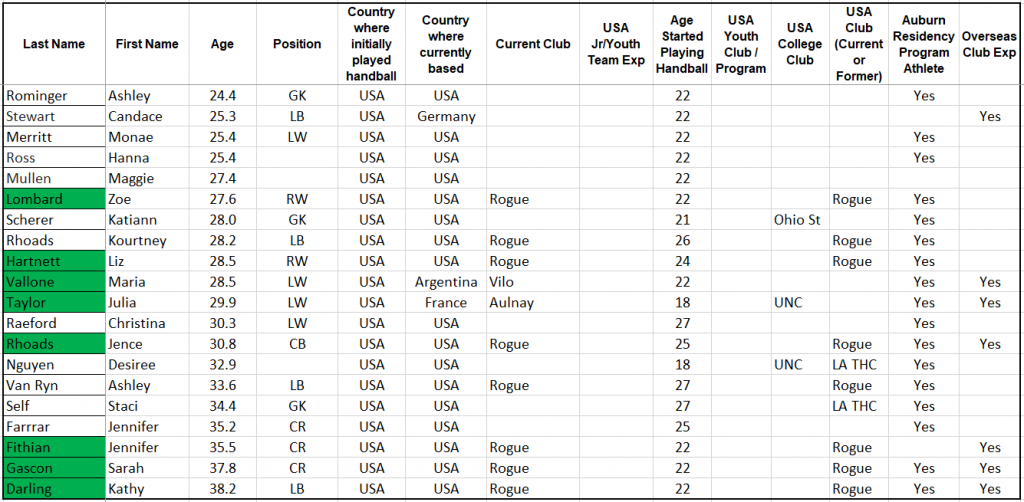
USA Team Handball lists 35 athletes as officially being part of its Women’s Sr Team Player Pool (The website indicates that it was last updated on November 14th, 2018).
There’s a lot of ways to group these athletes for analysis,
but I’ve chosen to highlight a few key data points.
Athletes are split in to two key cohorts (Americans that first played handball in another country/Americans that first played handball in the U.S.): I’d like to again emphasize that splitting these two groups is not meant to be divisive. Every one of these athletes is an American. That being said, any meaningful discussion of the U.S. talent pool has to recognize that the development of these two cohorts is significantly different. (For more insight into expat Americans read this series (Part 1, Part 2, Part 3)
Athletes are then listed by age
Athletes selected for the 2019 PANAM Games are highlighted in green
A few observations:
Compared to the U.S. Men’s player pool, the U.S. Women’s player pool has fewer (15 total) Expat Americans available
I would assess that in relative terms the overall quality of the U.S. Women’s expat player pool is a rung or two below that of the U.S. Men. Some respectable talent, but no one at the level of Ian Hueter, Abou Fofana or Rene Ingram.
5 expat Americans participated in the Auburn Residency Program. I would assess that the practice of sending European based players to the U.S. as highly questionable for a couple of reasons. 1) Quality training environments with regular competition are readily available in Europe. 2) If a player who has already been training for several years in Europe still needs extra refinement of their handball skills then they are likely not a strong national team prospect.
There is less participation (compared to the U.S. Men) in Youth and/or Jr national team competitions. This, however, is likely due to the reality that there are fewer women available and therefore it has been challenging to even field a roster.
U.S. Player Pool
(Americans that First Played Handball in the U.S)
(Note: The ages in the “age started playing handball” are estimates based on when and where athletes started playing.)
A few observations:
The 5 year Auburn Residency Program (2013-2018) accounts for 22 of the 35 athletes in the U.S. player pool. (17 stateside, plus 5 athletes that initially started playing handball in Europe).
Several of the athletes listed in this pool are not even playing handball on a regular basis. Some have shifted to beach handball while others simply don’t live anywhere near a handball club that they could practice with.
In terms of “diamonds in the rough” I would assess that only Jence Rhoads fits into that category. At age 30, however, she is clearly older (for her current level of handball skills development) than desired.
Only 4 athletes have any type of collegiate experience. This, however, is simply reflective of the reality that there are only 3 women’s college programs in the U.S.
Talent Beyond the Current
Pool
There are also several athletes that currently aren’t in the
U.S. Sr Team Pool. This would include all of our college athletes as well as
any athletes that participated in the recent IHF Trophy competition in Montreal. I don’t have the demographics for these
athletes, but having attended the last two collegiate championships and viewed
several IHF Trophy matches, most of these athletes are clearly a rung or two
below the current Sr National Team player pool.
What We Have: A
Mostly Empty Cupboard
With the U.S. Men it was relatively easy to assess the
handball skills and ages of athletes in the current player pool and to project which
athletes likely had a national team future through 2024. There was a natural grouping of athletes that
were a solid notch above the rest.
With the U.S. Women’s current player pool, however, I don’t see a similar grouping of athletes that are demonstrably better than the rest. Instead, I see a few stand outs and then a lot of mediocrity. While several athletes are either older or less talented than desired I could still make a case for virtually every athlete in the pool making a future roster.
But, “current player pool” is italicized for a reason. Because this pool consists mostly of athletes with modest raw talent and/or older athletes it’s not hard to envision new athletes with zero handball experience being trained up and quickly entering the player pool.
However, this sort of thinking is getting way ahead of the
methodology of
And, while it’s tempting to immediately start thinking of solutions to our empty cupboard of a player pool a lot of thought as to “What we want” is needed first. Because while the U.S. could recruit some quality athletes that have never played handball and provide them some intensive training to restock the cupboard some big questions need to be asked and answered first. Those questions are
Is a “quick fix” national team focus the best use of limited resources?
How likely is it that such a team will be able to beat Brazil at the 2023 PANAM Games to secure 2024 Olympic qualification?
Does it make more sense to focus on grass roots development with a timeline target of maximizing performance at the 2028 Olympic Games in Los Angeles?
Or, are the demographics and structure for women’s sport in the U.S. too challenging for a grass roots handball focus?
The Olympic Channel has a new documentary video profiling Didier
Dinart, the French Men’s National Team Coach and former player. It’s a great documentary that chronicles his
life from growing up in Guadeloupe, to moving to mainland France at age 16, to
becoming the Rock of the French defense to becoming National Team Coach. And, it does so with some great highlights of
France’s Olympic failures and successes and how he worked to improve his defensive
tactics. It also goes full circle with
his return to Guadeloupe and the christening of an arena named there in his
honor.
If you were to ask me who my all-time favorite handball
player is you might be a bit surprised with my answer: Didier Dinart.
But, then if you thought about it a bit. That I was a defensive specialist and lived
in France for five years you probably wouldn’t be surprised at all. Dinart redefined or maybe just simply defined
what a defensive specialist was.
Seriously, the handball dictionary, if such a thing were to exist would
have a little picture of Dinart next to the entry on defense specialist.
If one watches a handball match with a bigger picture view (i.e. not simply following the ball from pass to pass 100% of the time) Dinart’s greatness as a defender becomes obvious. No one matched his combination of strength and quickness. No one ever shut down (yes, shut down) a greater portion of the 6 meter arc. It was almost as if France had 6 and a half defenders some of the time. Yes, a lot of France’s domination in the 2000’s has been rightly attributed to Karabatic and Omeyer, but folks would be wise to add a 3rd player who also played huge role: Dinart.
In my opinion, if you want to talk about who’s the Greatest of All Time (GOAT) defender the discussion begins and ends with Dinart.
The Olympic Channel has two versions of the documentary.
Short Version: Link (9 minute) Extended Version: Link (27 minutes)
(Note: you can click on the icon at the bottom of the screen
for English subtitles)
Team USA and Hapoel Ashdod left wing, Asaf Bengozi.
It’s not very often that a U.S. player gets seen on ehfTV, but earlier this week, left wing, Asaf Bengozi did indeed get some screen time with his Israeli club team. Hapoel Ashdod was in the Czech Republic to take on Talent M.A.T. Plzen in 2nd round action of the EHF Cup. Plzen won both matches 32-23 and 26-21 to adance
Match 1 Video: Link (One of his goals is scored at around 35:00 on the ehfTV clock) Match 2 Video: Link
Bengozi scored 2 goals in the first match, but didn’t get on the score sheet in the 2nd contest.
Team USA’s top 4 players (my assessment) Ian Hueter, Abou Fofana, Rene Ingram and Gary Hines: 3 young guns who will likely be mainstays for the Men’s National Team for years to come and 1 ageless veteran. The demographics of these 4 players and the other 50 athletes that currently are part of USA Men’s Sr National Team Player Pool.
This is part of an ongoing series: Charting a Way Forward for USA Team Handball (2019 Reboot) In the last installment on the U.S. Men, I gave a top level overview of every American male handball player in the world (around 650 athletes). This part reviews assesses the current men’s national team player pool, where they developed their handball skills and projects which athletes will still be contributors in 2024.
The US. Men’s Sr
National Team Player Pool
USA Team Handball lists 47 athletes as officially being part of its male Sr Team Player Pool (The website indicates that it was last updated on January 8th, 2019). In addition to that 47, I’ve added 7 athletes that in the past year have either played for the U.S. or have been listed on provisional rosters. (i.e., they probably should be on the list) This brings the overall total to 54 athletes.
There’s a lot of ways to group these athletes for analysis, but
I’ve chosen to highlight a few key data points.
Athletes are split in to two key cohorts (Americans that first played handball in another country/Americans that first played handball in the U.S.): I’d like to again emphasize that splitting these two groups is not meant to be divisive. Every one of these athletes is an American. That being said, any meaningful discussion of the U.S. talent pool has to recognize that the development of these two cohorts is significantly different. (For more insight into expat Americans read this series (Part 1, Part 2, Part 3)
Athletes are then listed by age
Athletes selected for the 2019 PANAM Games are highlighted in green
Athletes that I have assessed as potential candidates for Sr National Team selection in 2024 are highlighted in yellow: It goes without saying that my assessment (or anyone’s assessment for that matter) is going to have some errors. That being said, some of these assessments were not tough calls, but simply a logical projection based on current playing ability, years the athlete has been playing and their age.
U.S. Player Pool
(Americans that First Played Handball in Another Country)
A few observations
This is a solid core group of athletes and more importantly they are also mostly on the younger side.
Most of the younger athletes have participated in Youth and/or Jr national team competitions.
U.S. Player Pool
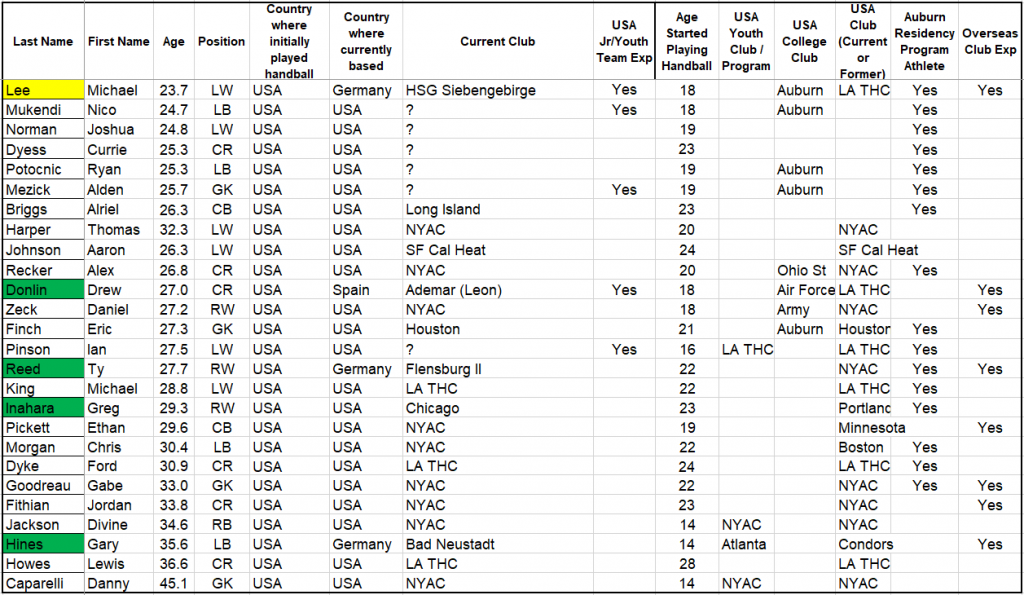
(Americans that First Played Handball in the U.S)
(Note: The ages in the “age started playing handball” are estimates based on when and where athletes started playing.)
A few observations:
A few “diamonds in the rough” have been discovered state side, but the overall numbers are disappointing.
Only a handful of these athletes have been on Youth and/or Jr teams. This is primarily due to to the athletes not starting to play handball until they were older.
The 5 year Auburn Residency Program (2013-2018) accounts for 17 of the 54 athletes in the U.S. player pool. (16 stateside, plus Sean Zimber who first played handball in Japan). Of that 17, I’ve assessed that only 4 athletes (Zimber, Lee, Reed and Inahara) have solid potential for making future rosters. Some of the Auburn athletes listed aren’t even actively playing handball anymore, so they will surely disappear when the pool list is updated. And, it should also be noted that both Reed (27) and Inahara (29) are also older (for their current level of handball skills development) than desired.
Only 8 athletes have come from the college ranks and 5 of those athletes were co-located with the Auburn Residency Program. The only college developed product with 2024 potential is circle runner, Drew Donlin, who first played handball at Air Force. And, Donlin (27) is also older (for his current level of handball skills development) than desired.
The outlier or the model to copy?: Gary Hines, at age 35 is still contributing and someone that I think has more years left in the tank. He is also arguably the very best stateside athlete to never have participated in a residency program. Is he a strange outlier or a model for development that should be studied and copied?
Talent Beyond the
Current Pool
There are also several athletes that currently aren’t in the
U.S. Sr Team Pool. This would include all of our college athletes as well as
any athletes that have participated on U.S. National Youth and Jr teams the
past few years. For this list I’ve
included all the athletes on our recent U21 World Championship team that aren’t
already in the player pool as well as a few prospects from our college and
youth programs.
Observations
The very best Jr players have already been identified and placed in the Sr Team talent pools
The players identified here are a few years away yet from Sr Team consideration
Nikolas Zarikos, is an interesting test case. To the best of my knowledge he is by far the youngest stateside American to move to Europe to play handball.
Putting it All Together
Overall, it’s pretty clear that based on “what we have” that the U.S. Men’s Sr National Team will be relying heavily on Expat Americans for the foreseeable future. Over the past several years we have developed only a handful of stateside prospects and in most cases these athletes have either been older and/or less athletically gifted than desired. Bottom line: Our stateside development strategies have not worked as well as we would like them too.
On the positive side of things we have a solid core of Expat Americans. With those athletes and a few supplemental stateside prospects we can put together a respectable side. A team that can battle Cuba and Greenland for a North American & Caribbean championship and qualify for a World Championship. But, can such a team beat Argentina, Brazil and even Chile for a PANAM Games title in 2023 and Olympic qualification? A much tougher ask and it’s doubtful that we can get there with “what we have.”
I know some folks might want to immediately jump to solutions. To start implementing plans that will change “what we have” to “what we want”. However, there’s still a lot more homework that needs to be done. Future installments will take an even closer at our Sr National Team talent by position and at our opposition.