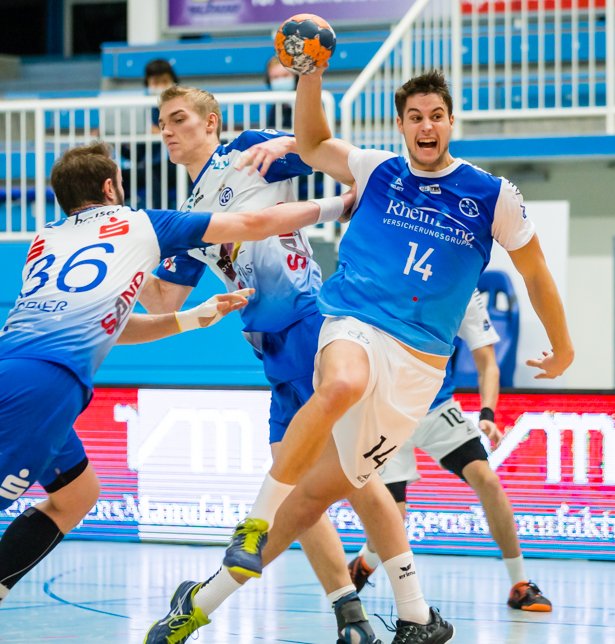
Ian Hueter and Dormagen take on Wilhelmshaven in a Boxing Day Matchup
Most of the pro leagues have shut down for the winter break, but the German Bundesliga marches on. Odds courtesy of Unibet.
American Athletes in Action
Germany HBL 2:
TV Wilhelmshaven vs TSV Bayer Dormagen (Pick em) (Saturday, 1930 CET): Link (VPN required; More info; What I use)
Ian and Patrick Hueter play for Dormagen. Dormagen had a huge win over VfL Lübeck-Schwartau on Wednesday and they have climbed the table to 4th place. Wilhelmshaven is in 12th place and 2 points will solidify their place in the standings. Dormagen has one more match to play and it’s a big one. On the 30th they will host 2nd place Gummersbach which is coached by the Icelandic legend, Guðjón Valur Sigurðsson.
Leipzig vs Flensburg (-2.5) (Sunday, 1430 CET): Link (VPN might be required; More info; What I use)
1st Place Flensburg travels to 6th place Leipzig. Flensburg needs every point to stay ahead of Kiel while Leipzig wants to move up in the standings for a shot at a European League slot for next year.
Would you like to be informed as to when handball can be streamed online? If yes, follow Team Handball News on social media for updates like this as well as breaking alerts for unplanned opportunities like the free HBL matches that seem to pop up from time to time.
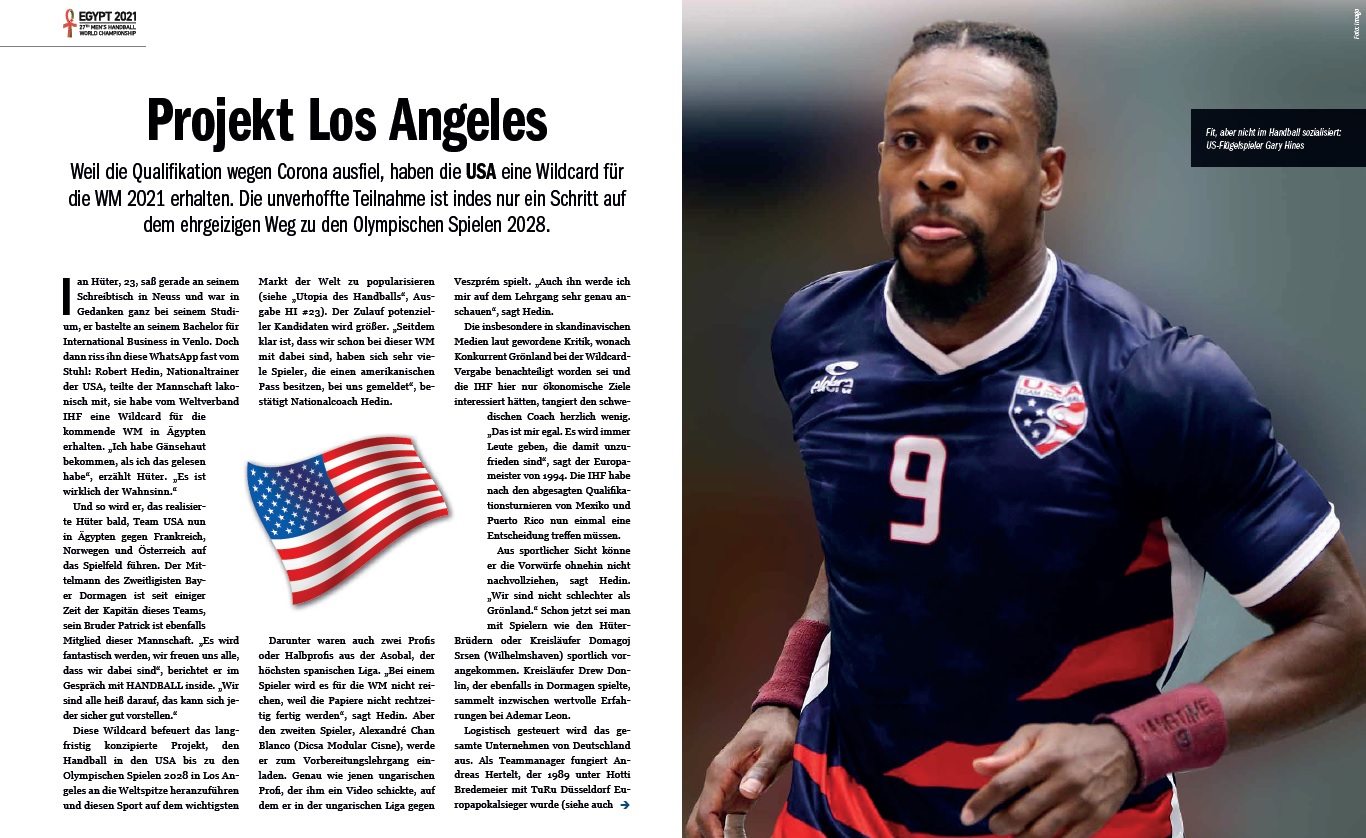
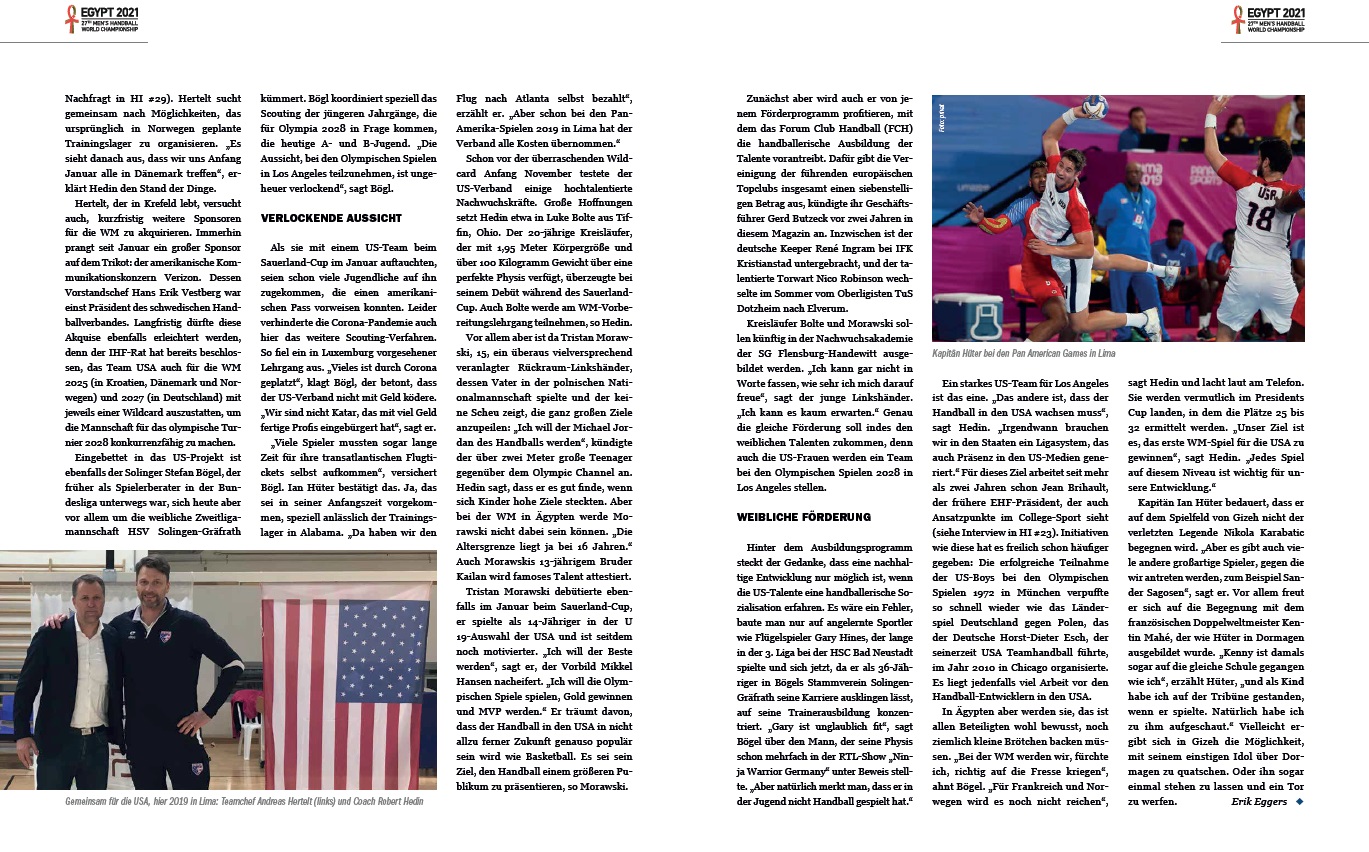
The following is an English translation of an article that appears in the latest edition of the German magazine, HANDBALL Inside
The Los Angeles Project
By Erik Eggers
Because qualification was canceled due to the Coronavirus, the USA received a wildcard for the 2021 World Championships. This unexpected participation is only one step on the ambitious road to the Olympic Games in 2028.
Ian Hüter, 23, was sitting at his desk in Neuss and was completely immersed in his studies. He is working on his Bachelors Degree in International Business in Venlo. But then his WhatsApp almost knocked him off his chair: Robert Hedin, the USA head coach, in short, informed the team that they had received a wild card for the upcoming World Championships in Egypt from the IHF. “I got goose bumps when I read that,” says Hüter. “That’s really sheer madness”!
And so he will, Hueter realized, soon lead Team USA onto the court in Egypt against France, Norway and Austria. The center back for second division Bayer Dormagen has been the captain of the team for a while and his brother Patrick is also a member of the squad. “It will be fantastic, we are all just happy to be part of it “, he reports in an interview with HANDBALL inside. “We are all nuts for it, everyone can easily imagine that.”
This wildcard fuels the long-term project to bring handball in the USA up to world-class by the Olympic Games 2028 in Los Angeles and to popularize the sport on the most important market in the world (see “Utopia of handball”, Inside Handball Edition # 23) . The influx of potential candidates is increasing. “Since it has become clear that we will be at this World Championship already, a lot of players with an American passport have contacted us,” confirms national coach Hedin.
Among them were two professionals or semi-professionals from the Liga ASOBAL, the top Spanish league. “For one of the two players the World Championship won’t be happening this time, since his passport won’t be ready in time,” says Hedin. But he will invite the second player, Alexandré Chan Blanco (Dicsa Modular Cisne) to the preparatory training camp. Another will be a Hungarian pro who sent Hedin a video of himself playing against Veszprém in the Hungarian league. “I will also take a very close look at him during the camp,” says Hedin.
The criticism, especially in the Scandinavian media, that Greenland didn’t get the wild card award because the IHF has was only interested in economic goals, has little effect on the Swedish coach. “There will always be people who are dissatisfied with it,” says the European champion from 1994. The IHF simply had to make a decision after the qualifying tournaments in Mexico and Puerto Rico were cancelled.
From an athletic point of view, he cannot understand the allegations anyway. Says Hedin, “In comparison, we are no worse than Greenland.” With players like the Hüter brothers or circle runner, Domagoj Srsen, (Wilhelmshaven), we have already made progress. Circle runner, Drew Donlin, who also played in Dormagen, is meanwhile gaining valuable experience with Ademar Leon.
The national team is logistically controlled from Germany. The team manager is Andreas Hertelt, who won the European Cup in 1989 under Hotti Bredemeier with TuRu Düsseldorf (see also questions in Handball Inside Edition #29). Hertelt is looking for ways to organize the training camp originally planned in Norway. “It looks like we’ll all meet in Denmark at the beginning of January,” says Hedin, explaining the current state of affairs.
Hertelt, who lives in Krefeld, is also trying to acquire additional sponsors for the World Cup on short notice. A major sponsor has been emblazoned on the jersey since January: the American communications company Verizon. Its CEO, Hans Erik Vestberg, was once the president of the Swedish Handball Federation. In the long term, sponsor acquisition should also be easier, because the IHF Council has already decided to provide Team USA with a wildcard for the World Championships in 2025 (in Croatia, Denmark and Norway) and 2027 (in Germany) in order to help the team be more competitive at the 2028 Olympic tournament.
Also embedded in the US project is Stefan Bögel from Solingen, who used to work as a player’s agent in the Bundesliga, but now is primarily responsible for the female second division team HSV Solingen-Gräfrath. Bögl specifically coordinates the scouting of the younger age groups who are eligible for the 2028 Olympics, today’s A and B youth (ages 16-19) players. “The prospect of participating in the Olympic Games in Los Angeles is extremely tempting,” says Bögl.
PROMISING OUTLOOK
When they showed up with a US team at the Sauerland Cup in January, many young people with a U.S. passport had already approached him. Unfortunately, the coronavirus pandemic prevented further scouting. A training camp planned in Luxembourg was canceled. “A lot has been destroyed by Corona,” complains Bögl, who emphasizes that the US association does not find players with money. “We are not Qatar, which has naturalized ready-made professionals with a lot of money,” he says.
“For a long time many players even have had to pay for their own transatlantic flight tickets,” assures Bögl. Ian Hüter confirms that. Yes, that happened in his early days with the program, especially during the training camp in Alabama. “We paid for the flight to Atlanta ourselves,” he says. “But for the PANAM Games in Lima in 2019, the Federation paid all the costs.”
Even before the surprising wildcard at the beginning of November, the U.S. federation was testing some highly talented junior players. Hedin has high hopes for Luke Bolte from Tiffin, Ohio. The 20-year-old pivot, who is 1.95 meters tall, weighs over 100 kilograms and has a perfect physique for handball, made his debut during the Sauerland Cup. Bolte will also take part in the Pre-World Championships training camp, said Hedin.
Most of all, however, there is Tristan Morawski, 15, a very promising left-handed backcourt whose father played for the Polish national team and who is not shy about aiming for very big goals: “I want to become the Michael Jordan of handball,” the over two meter tall teenager announced in conversation with the Olympic Channel. Hedin says he thinks it’s good when kids set high goals for themselves. But for the World Championships in Egypt Morawski will not be able to participate. “The age limit is 16 years.” Morawski’s 13-year-old brother Kailan is also assessed as having excellent talent.
Tristan Morawski also made his debut at the Sauerland Cup in January playing for the U.S. U19 team as a 14-year-old and has been even more motivated ever since. “I want to be the best,” he says, emulating his role model, Mikkel Hansen. “I want to play in the Olympics, win gold and be an MVP.” He dreams that handball will be as popular as basketball in the US in the not too distant future. It is his goal to expose handball to a larger audience, said Morawski.
Initially, however, he will also benefit from the support program established by the Forum Club Handball (FCH) to provide handball training for talented prospects. The association of the leading European top clubs is spending a total of seven figures on this, announced its managing director, Gerd Butzeck, in this magazine two years ago. The German goalkeeper René Ingram is now with IFK Kristianstad, and the talented goalkeeper Nico Robinson moved from the upper division TuS Dotzheim to Elverum this past summer.
Circle runner, Bolte, and Morawski are to be trained at the SG Flensburg-Handewitt Academy. “I can’t even put into words how much I’m looking forward to it,” says the young left-hander. “I can hardly wait.” Exactly the same development is intended for the female talents, because the US women will also have a team at the 2028 Olympic Games in Los Angeles.
FEMALE ADVANCEMENT
The idea behind the training program is that sustainable development is only possible if the US prospects are fully immersed in the handball environment associated with a top club. It would be a mistake to rely solely on athletes like winger Gary Hines, who played for a long time in the 3rd division at HSC Bad Neustadt and now, as a 36-year-old, is finishing out his career with Bögel’s home club Solingen-Gräfrath while concentrating on his coaching education. “Gary is incredibly fit,” says Bögel about the man who has already proven his physique several times on the RTL show “Ninja Warrior Germany”. “But, of course, you can tell that he didn’t play handball in his youth.”
A strong US team for Los Angeles is one thing. “The other thing is that handball has to grow in the USA,” says Hedin. “At some point we need a league system in the United States that also generates presence in the U.S. media.” Jean Brihault, the former EHF president, who also sees opportunities in college sport, has been working towards this goal for more than two years (see Interview in Handball Inside Edition #23: Translation). Initiatives like this have, of course, taken place in the past: The successful participation of the U.S. team in the 1972 Olympic Games in Munich fizzled out, as did as the international match between Germany and Poland, which the German Horst-Dieter Esch, who was in charge of USA Team Handball at the time, played and organized in Chicago in 2010. In any case, there is a lot of work ahead for the handball developers in the USA.
In Egypt, however, as everyone involved is well aware, they will have to set their sights quite a bit lower. “I’m afraid we will get kicked in the face really hard at the World Cup,” Bögel suspects. “It’s not going to be enough for France and Norway” Hedin says and laughs out loud on the phone. We will probably end up in the Presidents Cup, in which places 25 to 32 will be determined. “Our goal is to win USA’s first World Championships game,” says Hedin. “Every game at this level is important for our development.”
Captain Ian Hüter regrets he won’t encounter injured legend Nikola Karabatic on the Giza pitch. “But there are also a lot of other great players that we will be up against, like Sander Sagosen,” he said. Above all, he is looking forward to meeting the French double world champion Kentin Mahé, who was trained like Hüter in Dormagen. “Kenny even went to the same school as me then,” says Hüter, “and as a kid I stood in the stands when he played. Of course, I looked up to him.” Perhaps in Giza there will be an opportunity to chat with his former idol about Dormagen. Or even outplay him and score a goal.
Thanks to Erik Eggers for providing a copy of the article and to Christa Ingram who assisted with its translation.
A few notes:
Luke Bolte will not be taking part in the Pre World Championship training camp mentioned in the article.
Tristan Morawski is already training at the Flensburg Academy.
Pal Merkovszki, a GK for Gyöngyösi KK is the unnamed Hungarian player.
Analysis of the USA’s 20 man roster for the World Championships: Link
For more on the Forum Club Handball’s support to USA athletes check out this podcast interview with Andreas Hertelt: Link
Istres hosts Montpellier on Youtube Channel LNH TV... Would you believe me if I said saw these two sides play each other in a neutral site match in Florida?
It’s getting closer to the winter break, but there’s still a smattering of matches this week. Odds courtesy of Bet MGM.
American Athletes in Action
Germany HBL 2:
TSV Bayer Dormagen vs VfL Lübeck-Schwartau (Wednesday, 1930 CET): Link (VPN required; More info; What I use)
TV Wilhelmshaven vs TSV Bayer Dormagen (Saturday, 1930 CET): Link (VPN required; More info; What I use)
Ian and Patrick Hueter play for Dormagen. While many of the national leagues have shut down for Christmas, that’s not the case with Germany. In fact, Dormagen has yet another game scheduled for the 30th.
Granollers (-5.5) vs Nava (Tuesday, 1900 CET) Video Link
Would you like to be informed as to when handball can be streamed online? If yes, follow Team Handball News on social media for updates like this as well as breaking alerts for unplanned opportunities like the free HBL matches that seem to pop up from time to time.
Irun hosts Barcelona in a Liga ASOBAL battle at the top of the table. It could be the best chance for an ASOBAL foe to knock off Barca this season.
The Women’s European Championship wraps up this weekend, but at the same time, there’s still plenty of Men’s pro club action. Odds courtesy of Bet MGM.
American Athletes in Action
Germany HBL 2: TV Emsdetten (Pick em) vs TSV Bayer Dormagen (pickn (Friday, 1930 CET): Link (VPN required)
Ian and Patrick Hueter play for Dormagen. Dormagen hung tough with co-league leaders, Hamburg earlier in the week for most of the way, but ended up losing 32-26. They will be looking to rebound with 2 points vs Emsdetten, a team that is currently in the relegation zone.
You also might want to check out this video feature on the Hueter Brothers: Link (in German).
France Pro Ligue: Angers vs Besancon (Friday, 2000 CET): Link
Abou Fofana plays for Angers. Last weekend Angers had a dismal 28-20 loss to Sarrebourg, another struggling team at the bottom of the league table. On Friday night they get a chance to end the first half of the season on a positive note as they host Besancon a team just 4 points ahead of them in the standings.
Spain Liga Asobal: Huesca vs Leon (-1.5) (Saturday, 1800 CET): Link
Circle Runner, Drew Donlin plays for Leon. Should be a good battle between 4th place Leon and 5th place Huesca. <<Postponed due to positive COVID tests>>
A big challenge for Dormagen and the Hueter brothers on Tuesday
The 2020 EHF Women’s Handball European Championships is in full swing, but there’s still plenty of Men’s club action to watch this week as well. Here’s a summary of the next 3 days.
American Athletes in Action
Germany HBL 2: Hamburg (-3.5) vs Dormagen (Tuesday, 1800 CET): Link (VPN Required)
The Hueter brothers, Ian and Patrick play for Dormagen
Dormagen looked sharp last Friday, a 27-19 victory over Hamm-Westphalia. Now they travel to Hamburg to take on 2nd place Hamburg. A side with clear aspirations to move up to the HBL next season
Hungary K&H League: Gyöngyös vs Eger (Wednesday, 1800 CET): Link
GK, Pal Merkovszki, plays for Gyongyos
This will be the last game of the year for Gyongyos
Check out Merkovszki from this match earlier vs Komlo: Link
The Hueter brothers (Patrick and Ian) can be seen in action on Friday with their club Dormagen
Yes, the Women’s European Championship continues this weekend, but at the same time, there’s still plenty of Men’s pro club action. Odds courtesy of Bet MGM.
American Athletes in Action
Germany HBL 2: TSV Bayer Dormagen (pick em) vs Hamm-Westfalen (Friday, 1930 CET): Link (VPN required)
Ian and Patrick Hueter play for Dormagen. Dormagen had a disappointing lost last week and 2 points would put them level with Hamm.
You also might want to check out this video feature on the Hueter Brothers: Link (in German)
Hungary K&H League: HE-DO B. Braun Gyöngyös – Sport36-Komló 2020 (Saturday, 1800 CET): Link
Pal Merkovski plays in the #2 GK for Gyongyos.
France Pro Ligue: Sarrebourg (-1.5) vs Angers (Saturday, 1800 CET): Link Abou Fofana plays for Angers. If this was a U.S. league this battle between the last 2 teams in the standings would be meaningless. But, with a
Spain Liga Asobal: Leon (-2.5) vs Valladolid (Saturday, 1825 CET): Link
Circle Runner, Drew Donlin plays for Leon. Should be a good battle between 5th place Leon and 8th place Valladolid. Both clubs typically have aspirations for a European competition slot.
Other Matches this Weekend
EHF European Competitions: ehfTV
With the exception of some makeup games the European competitions will be off now until February. You might want to check out the Match of the week played earlier this week: Elverum vs Flensburg (English commentary)
The USA Men’s National Team Roster (By Age: Youngest to Oldest)
The 20 man roster ranges from 17 Jakob Rysgaard Christensen) to 36 (Gary Hines) and has a very young average age of 23.5. Five of the athletes (Jonas Stromberg, Amar Amitovic, Paul Skorupa, Rene Ingram and Nicholas Robinson) were on the U.S. Jr World Championships team and Pal Merkovsky was on the Hungarian Jr World Championship team.
Much has been said and written about the U.S. getting an unwarranted helping hand to participate in this championship. That the U.S. didn’t earn it’s slot. There’s some truth to that, but no one can argue with one of the rationales for the U.S. bid: That participating in this World Championship will help develop athletes in preparation for the 2028 Olympic Games.
It’s difficult to project out 7.5 years, but the bulk of this talented and youthful roster has a future with the U.S. National Team. We will be seeing several of these athletes in a U.S. uniform in Los Angeles at the 2028 Olympic Games. How many? I’m thinking 5, but it could be as many as 10.
U.S. Roster (By Nation Where Athletes First Played Handball)
The USA Men’s National Team Roster (By Country Where they First Played Handball)
All of these athletes are Americans, but the U.S. is a large nation with a global population. Estimates vary, but as many as 9M American citizens live in another country so it’s no real surprise that some of those 9M learned to play handball where they grew up. In fact, 85% (17 of 20) of the U.S. roster originally played handball in 13 different countries. Germany leads the way with 6 athletes while Denmark, France and Sweden have 2 each. Other nations: Bosnia & Herzegovina (1), Croatia (1), Egypt (1), Hungary (1), Spain (1).
(The fact that the U.S. has so many dual citizen athletes is sometimes seen as controversial, but it shouldn’t be. I addressed this reality and its implications for the U.S. National Team and the sport’s development previously in a series of commentaries Part 1, Part 2, Part 3)
In terms of the 3 U.S. athletes that were raised stateside, 1 athlete (Drew Donlin) first learned to play at a college club (Air Force), 1 athlete (Ty Reed) is a product of the former Auburn Residency Program and 1 athlete (Gary Hines) was a product of an Atlanta based youth program and the Condors club.
Only PANAM Games veteran, Sam Hoddersen, made the 20 man roster. I projected that Lukas Hansen would also make the cut, mostly based on the fact that he plays for a top division Danish Pro Club, Fredericia HK. I’ve heard there may be some issues with his passport, but I don’t know if that was the deciding factor or not. The fact that only 1 left wing was selected and 4 right backs were taken leads me to believe that we will also see a lot of Gary Hines at left wing as well.
USA Left Backs
It was pretty much a given that Fofana and Hines would be selected, but it was less clear who else might get selected here. I had chosen Seb Wheeler based in part on his PANAM Games Alternate selection last year, but the coaching staff went with Amar Amitovic.
USA Center Backs
Again, there was zero doubt that the Team Captain, Ian Hueter and newcomer, Alexandre Chan Blanco, who leads his Liga Asobal club, Cisne, in scoring would make the team, but I went with Amir Seifert as the 3rd option. The coaching staff decided to just take 2 center backs and have identified Michael Williams and Philipp Scholz as potential replacements.
Also, another factor to take into account. Chan and Hueter might both be worthy of starting and playing a lot of minutes. I won’t be surprised to see both of these athletes on the court at the same time with one of them moving to left or right back.
USA Right Backs
For me right back was the hardest position to project. The PANAM Games roster had no true right backs on its roster. A situation that was problematic at times. Now for the World Championships the U.S. will have 4 right backs. However, each of these athletes have question marks. Briffe played professionally in France, but hasn’t been able to play indoors in the U.S. due to the pandemic. Elzoghby played great for the U.S. back in 2010-11 but was less impressive in friendlies last year. Stromberg played well at Jr World’s, but is he ready for the Sr level? And, of course, the same is true for Christiansen who is just 17. (He must really have potential to be selected at that age). I suspect that the coaching staff (like me) is a little in the dark and will use the training camp to figure out who emerges from these 4 options.
USA Right Wings
I only projected Reed and Binderis getting selected here, but Nicolai Weber must also have impressed with his game film. Reed is the projected starter and I suspect the coaching staff will use the training camp to evaluate who will be the primary backup.
USA Circle Runners
The U.S. is well stocked at circle runner and I think these four athletes will all get significant playing time. And, we will likely see two circle runners playing on offense some of the time and on defense most of the time with one of these 4 also subbing in as a defensive specialist. Alex Binderis is the victim of a deep depth chart and was selected as an alternate.
USA Goalkeepers
Last year, I thought the U.S. was lucky to have 2 young, quality goalkeepers with a future. Now we have 3? And, the new addition, Pal Merkovsky, may even be better. That’s crazy good fortune. It should be a great training camp with all 3 GKs looking to impress the coaching staff. I know nothing about the other 2 GKs selected as alternates, but in this time of COVID, where multiple positive test results is a real threat, keeping extra GKs as alternates that can be called up is a wise move.
Previous Articles Assessing the USA Men’s Player Pool
The 2020 EHF Women’s Handball European Championships is in full swing, but there’s still plenty of Men’s club action to watch this week as well. Here’s a summary of the next 3 days.
Last Tuesday these two teams played to a draw in Austria. Leon will look to get 2 points at home in Spain Side note: Several players on the Fivers side will likely be part of the Austrian national team side that will the U.S. on 14 January at the World Championship
Tatran Presov vs IFK Kristianstad (-1.5) (Tuesday, 2045 CET): Link
Six matches on tap this week. Veszprem vs Kiel is the big match on Wednesday. If Kiel is going to make a run for a round of 16 bye they need to start that run with a victory here. On Thursday Paris S-G is pretty much in the same situation. They are a disappointing 3-0-3 in Group Play and a victory vs Group leaders Kielce could jump start a return to the top. No spoiler preview: Link
Szeged (-3.5) vs Meshkov Brest Brest (Wednesday, 1845 CET)
Nantes (-4.5) vs Motor Zaporozhye Wednesday, 2045 CET)
Elverum vs Flensburg (-3.5) (Thursday, 1845 CET) <<English Commentary>>
Liga Asobal
Liga Asobal: Nava vs Aranda (-4.5) (Wednesday, 2000): Video Link
Lidl Starligue
Creteil vs Chambery (-1.5) (Tuesday, 1900 CET) Link
The IHF and USA Team Handball have posted the 35 man provisional roster for the 2021 World Championships. Here are some break downs of the roster by age, where athletes first learned handball and by position.
USA Provisional Roster (Youngest to Oldest)
U.S. Provisional Roster (Youngest to Oldest)
The ages on the 35 man roster range from 16 to 36 with an average age of 23.9. This is surely one of the youngest teams every for the U.S. and this is due to quite a few younger dual citizens list on the provisional roster. Almost a third of the roster (11 of 35) are under 21 and could form the nucleus of a pretty decent Jr team.
USA Provisional Roster (Nation Where they First Played Handball)
U.S. WC Roster (Where they First Played Handball)
All of these athletes are Americans, but the U.S. is a large nation with a global population. Estimates vary, but as many as 9M American citizens live in another country so it’s no real surprise that some of those 9M learned to play handball where they grew up. In fact, 80% (28 of 35) of the U.S. roster originally played handball in 13 different countries. Germany leads the way with 7 athletes followed by Sweden with 5. Other nations: Denmark (3), France (2), Bosnia & Herzegovina (2), Croatia (2), Austria (1), Colombia (1), Egypt (1), Hungary (1), Israel (1), Norway (1), Spain (1).
(The fact that the U.S. has so many dual citizen athletes is sometimes seen as controversial, but it shouldn’t be. I addressed this reality and its implications for the U.S. National Team and the sport’s development previously in a series of commentaries Part 1, Part 2, Part 3)
In terms of the 7 U.S. athletes that were raised stateside, 3 athletes (Hamm, Kennedy and Donlin) are products of Collegiate Clubs, 3 athletes (Lee, Reed and King) are products of the former Auburn Residency Program and 1, Gary Hines, was a product of an Atlanta based youth program and the Condors club.
USA Provisional Roster (By Position)
I’ve broken out the provisional roster by each position listed for the athletes on the roster. I’ve also taken a stab at projecting the 20 man roster. As, often is the case, this was a relatively simple task for the first 15 or so, but much more difficult as one gets nearer the cut line. Further complicating the task are these factors:
Some of these athletes have never played for the U.S. before (and, I’ve never seen them play before).
Some of these athletes have been playing regularly and some athletes haven’t been playing at all due to the pandemic. This could clearly boost the chances of athletes who are already in game shape.
The coaching staff might factor in long term plans for the U.S. and this could give a boost to a younger player’s consideration.
Generally, rosters contain 2 at every position and then a couple of extra players. With an expanded 20 man roster it’s tougher to project which positions will take 3 or more athletes.
That said, here’s my depth chart at each position with the athletes in green getting my nod. Again, I’m flying somewhat blind here, but we’ll see how close I come. For sure, I don’t envy the tough, real decisions the coaching staff will have to make.
USA WC Roster (Left Wings)
Sam Hoddersen was a steady performer at the PANAM Games, but projecting the #2 is challenging. Lukas Hansen is an unknown quantity, but plays on the youth team for one of Denmark’s top clubs, Frederica. And, he’s even played a few matches for their pro team in Denmark’s top level of play. Michael Lee and Michael King were alternates For the PANAM Games and will also get consideration. Juan Felipe Zabala Carvajal plays for Inter Miami and I’m not familiar with his play. A further wild card: Gary Hines has shown that he can play this position as well.
USA WC Roster (Left Backs)
Abou Fofana is the projected starter at Left Back and Gary Hines will also likely play some there as well. Hines could also, however, ending up playing Right Back like he did at the PANAM Games or Left Wing as well. I see Seb Wheeler as the 3rd option here ahead of the other Left Backs listed.
USA WC Roster (Center Backs)
Ian Hueter is the key to the U.S. offense and has been playing well this season for his club team, Dormagen. Alexandre Chan Blanco is the biggest newcomer to the U.S. roster and leads his Liga Asobal club, Cisne, in scoring with 79 goals this season in 14 matches. He’ll play some at CB, but I’m thinking he might also be moved to RB as well. Certainly, he is in playing form and the U.S. will need to find a spot for him. I think Amir Seifert is the 3rd option here, but, a case could also be made for Aaron Hamm, who played at Jr Worlds. Also, Michael Williams makes a return after a long absence. He was a key player on the 2011 PANAM Games squad, but I haven’t seen him play since.
USA WC Roster (Right Backs)
Overall, I found this position the toughest to project. For the PANAM Games, coach Hedin chose to have Gary Hines play quite a bit of RB which was a bit out of position for him. In theory, none of these players could make the roster in favor of left backs and center backs moving over to right back. If, however the U.S. chooses to go with a left hander at this position, Benjamin Briffe is the most experienced option. He played a few years in France’s highest pro league, but he is currently living in the U.S., and thanks to the pandemic, he’s unlikely to be in game shape. Jonas Stromberg is an up and coming player that is showing progress and Adam Elzhoghby is another experienced option. There’s something to be said, as well, to having an Egyptian American on your roster at a WC that is played in Egypt.
USA WC Roster (Right Wings)
Ty Reed, currently training in Flensburg, is the obvious starter here, but it’s not clear who his back up will be. Max Binderis is a known quantity, but I have no idea as to pedigree of the newcomer, Nicolai Weber.
USA WC Roster (Circle Runners)
The U.S. has it’s most depth at the circle runner position so I see the U.S. taking 4 or even 5 players at this position. I’ve seen both Hueter and Donlin play several times this year and I give the overall edge to Hueter here. Donlin, however, has been making great strides while playing backup at Liga Asobal side, Leon, so he will see plenty of playing time. Domagoj Srsen is a bit of a question mark since he’s not actively playing. Still it’s hard to see a defensive specialist who’s played for Zagreb and Hannover not making an impact. Paul Skorupa edges out Alex Binderis, but I wouldn’t be surprised if both are taken.
USA WC Roster (Goalkeepers)
The U.S. goalkeeper situation is also fairly clear. Rene Ingram (IFK Kristianstad) and Nicolas Robinson (Elverum) were the U.S. GKs during the PANAM Games and are both training with Champions League clubs thanks in part to the Forum Club Handball. I haven’t seen Pal Merkovsky play, but he appears to be the backup GK for Gyongyos which is professional club that plays in Hungary’s top league. It will be interesting to see how he stacks up against the other two keepers.
Previous Articles Assessing the USA Men’s Player Pool
This Collegiate System doesn’t make much sense… It just doesn’t.
In Part 1, I highlighted the dramatic funding disparity between club and varsity sports. In Part 2, I review how much “Olympic Sports” cost Ohio St and why to a large extent American Football pays for everything.
There are a lot of ways one can classify or categorize the sports that are played at American colleges and universities. It can be confusing and sports are often lumped together in categories that can be misleading. Here are some of those categories and some basic definitions for them:
Revenue Producing Sports: These are sports which produce significant amounts of revenue and at many colleges they have a positive balance sheet.
Non Revenue sports: These sports do not generate much revenue and in most cases have a negative balance sheet.
Varsity Sports: These are sports that are managed and funded by a school’s athletic department
Club Sports: These are sports managed and partially funded by a school’s Student Services or Recreation Services department.
NCAA Sports: These are sports that are sanctioned by the NCAA. Schools choosing to participate in NCAA competitions are required to follow NCAA rules, particularly when it comes to recruiting and scholarships.
NCAA “Head Count” Scholarship Sports: These are sports where the NCAA requires every scholarship athlete to receive a “full ride” scholarship. (In other words everything is paid for.)
NCAA “Equivalency” Scholarship Sports: These are sports where “partial” scholarships can be awarded and split among the roster of athletes. Coaches can still choose to award full ride scholarships to some athletes, but this will then limit the number of partial scholarships available.
Olympic Sports: These are Olympic sports, but the definition is pretty fluid. Non varsity sports (which also happen to be Olympic) are usually not part of the discussion. Additionally no distinction is typically made as to what role these college competitions actually have in terms of developing athletes for Olympic competition.
These categories can overlap into some fairly complicated Venn diagrams, but I’ve tried to group them in terms of net revenue and their relevance to athlete development for future Olympic competitions. Remember this analysis is for just one college, Ohio St, and it was compiled using this publicly available data: link
Net Positive Varsity Sports
At Ohio St, and at most colleges, there are only two sports that generate significant amounts of revenue: American Football and Men’s Basketball. At Ohio State they are also way on the plus side and generated $55M and $14M respectively in 2019. And, as we shall see as we look at the rest of the categories they essentially pay for all the other sports that lose money.
Varsity Sports (Olympic: Primary Development Pathway)
These 21 sports are Olympic sports where college programs are the primary development pathway for future Olympic athletes. It can be debated somewhat as to how vital college programs are for each individual sport, but I think it’s fairly safe to say that the vast majority of the athletes in the sports listed above would not have been Olympians if these college programs didn’t exist.
Here’s some food for thought:
How much value is the USOPC and the individual sports National Governing Bodies (NGB) getting out of these programs at Ohio St? Well, if one divides the net revenue (-$27M) by the total scholarships (179.3) it amounts to roughly $150,000/year for each full scholarship athlete. Multiply that by 4 and that is $600,000 over 4 years of college education… all for 1 potential Olympic athlete. (Yes, if one wants to further divide by partial scholarships and walk on athletes (total 702) you’ll get a smaller number: $38,000/year or $153,000 over 4 years.) That being said, in most cases the top athletes with the most potential will probably have a full ride scholarship.
Keep in mind… that these college sports program cost the USOPC and the individual sports NGBs nothing. All of this development of athletes is “free” and does not come out of their budget.
And, this is just for one college. Ohio St is big college with a fine tradition and one of the largest budgets, but it’s still just one college. There are 130 large schools (D1 Football Subdivision Schools (FBS)). There are an additional 217 Colleges with sizable budgets (D1 basketball schools without a D1 FBS football program). And, then there are several hundred smaller colleges with sports programs, albeit with fewer or no scholarships.
All of this is paid by college football and to a lesser extent Men’s college basketball? How does that make sense? Did the players sign up for this?
Varsity Sports (Secondary/Very Limited Olympic Development and Non Olympic)
The 12 varsity sports above have only marginal or zero benefit in terms of the development of Olympic athletes. The reasons vary, but are mostly related to athletes turning pro without collegiate careers or in the case of gymnastics and synchronized swimming athletes become high level competitors without college training. And, then the last 4 sports listed aren’t Olympic sports. Baseball and softball will be back for Tokyo, but won’t be played in Paris. Lacrosse hasn’t been an Olympic sport since 1908 although they surely would like to get back on the Olympic Program.
A Side Note on Fuzzy Math
It should be noted that all of this self reported data from Ohio St should be taken with a grain of salt for multiple reasons. One big reason is the actual cost of a scholarship is open for a lot of debate. In most instances schools are not actually paying that full cost or losing out on the money that another non scholarship athlete would pay. Further, if one reviews the Ohio St database there’s some big accounting lines that aren’t associated with any particular sport. A whopping $75M (expenses) and $61M (revenue) is not explained or attributed to any individual sport. (See pages 15 and 16 in the report) I’m thinking one could probably actually attribute those costs if they really wanted to. As an example, how much time to you think the Athletic Director spends on football and synchronized swimming issues respectively?
Why this Crazy System?
If you ever live outside your home country, you’ll get the chance to see first hand how other countries do things and inevitably you’ll find yourself questioning how things are done back home. For me, personally, there were two big topical areas that came to mind. Health care and our sports structures. I won’t get into health care, but let’s talk a bit about how sports are organized in the U.S. and specifically, our college sports structure.
The European sports model is by no means perfect, but once exposed to it, it doesn’t take long for an American to compare it to the system they are familiar with… and start to scratch their head. Honestly, it’s pretty hard to look at the numbers above and defend this crazy system. Certainly it is impossible to do so from a fiscal viewpoint. Men’s football and to a lesser extent men’s basketball subsidize almost everything. That just doesn’t make any sense. And, worse the athletes playing those sports are not paid their market value and they have to become college students in order to play. Don’t get me wrong. Getting a college education is a good thing, but there’s no real reason it has to or should be tied to playing a sport.
So why do we have this crazy system? Well, if you do a little research you’ll discover that over time a system which made sense for amateur collegiate competitions gradually made less and less sense as two sports, American Football and Men’s basketball, grew into bigger and bigger sports with professional leagues. Instead of these sports becoming fully professionalized from age 18 and up, colleges hung on to these sports creating pseudo professional leagues which also became the de facto development competitions for the pro leagues.
At the same time other collegiate sports did not grow to the same extent, but since they were part of school athletic departments and the NCAA they were still provided substantial levels of support. This support was provided in part due to tradition and in part, due to NCAA requirements. Further, a U.S. law, Title IX required colleges and universities to provide equal opportunities in terms of sports and scholarships for women.
So essentially, over time we have created a system where hundreds of colleges in order to keep their cash cow revenue sports have agreed to fund dozens of other sports which are a net revenue loss.
A Crazy System, but it’s not All Bad
This system might seem a little crazy, but depending on where you stand it’s not all bad. More opportunities for women to play sports… That’s a good thing.
If you are involved with one of the dozens of sports propped up by this system it’s a great thing. If you are an athlete you have the opportunity to perhaps earn a scholarship and play in a well organized competition. If you are a high level coach there are multiple, good paying job opportunities. If you are part of the youth sports industry this system will help ensure that plenty of youth athletes will be interested in furthering developing their skills via sports clubs. If you are a sports NGB all of this development from youth to college is infrastructure that you don’t have to pay for. Indeed, it is often an additional source of revenue.
Of course, I know what supporters of these dozens of sports are saying as they read this. They are saying that their sport isn’t being propped up, but rather the demand from athletes was already there. That colleges are just responding to the growing demand from their sport.
I would argue, however, that they are exaggerating this demand in most cases. For sure, all sports have some level of intrinsic demand. Sports are fun and people play them just for fun. That being said most sports if they lost NCAA status, the great organized competitions that come with that status and, of course, the scholarships would see a significant decline in interest at all levels.
Different Tiers, Different Perspectives
Much has been written and said about how American football and men’s college basketball athletes should be paid for their efforts. After all they are bringing in revenue. Call these sports the top tier.
Much has also been written and said about the other NCAA sports that are in some cases now being cut from some schools. And, that these “Olympic Sports” are getting short changed. Call these sports the middle tier.
And, then there are sports like team handball and rugby with no NCAA status. Call this the bottom tier.
As a proponent of a sport in the bottom tier I can only look at the middle tier’s whining and say, “Give me a break! Good lord. You guys all lose money. Quit whining. You don’t realize how good you’ve got it.”
Here’s some food for thought for you:
Ohio St University (just 1 college) spends more on 33 sports than USA Team Handball does as a national federation. Yes, for the last several years the expenses for USA Team Handball has been around $500,000. Divide that in two for Men/Women and only Men’s Rifle and Women’s Pistol at Ohio State have a smaller budget.
NGBs which have an NCAA component typically receive more grant money from the USOPC than USA Team Handball does. Contemplate for a moment where those NGBs would be in terms of competitiveness and fiscal status if they didn’t have that NCAA component?
Finally, here’s something else that will have you scratching your head again. Quite a few scholarships are actually awarded to foreigners. In fact, in 2019 there were 3,455 international student athletes playing Division 1 sports. Roughly 12% of Division I. Yes, U.S. colleges are spending millions of dollars to develop foreign athletes; many that have gone on to win Olympic medals. How does that possibly make sense?
Time to start over? The pandemic has exacerbated the dramatic difference between Tiers 1 and 2 with some schools dropping some sports. But, maybe this just isn’t an issue between tiers 1 and 2? In part 3, I’ll discuss how the pie should be split more equitably between tiers 2 and 3.
Abou Fofana and Angers take on Billere Friday at 20:00 CET / 14:00 US ET. Watch the match live on Angers Facebook page.
Plenty of handball viewing options this weekend, including some Friday mid-day options for Americans with a long Thanksgiving weekend. Odds courtesy of Bet MGM.
American Athletes in Action
France Pro Ligue: Angers (-0.5) vs Nice vs Billère (Friday, 2000 CET): Link (What? Bet MGM is posting 2nd Div French betting lines? They sure are)
Left back, Abou Fofana plays for Angers. Currently in last place, Angers could really use a win vs 11th place Billere.
Germany HBL 2: Dormagen (-3.5) vs Groswallstadt (Saturday, 1930 CET): Link (VPN required)
Ian and Patrick Hueter play for Dormagen. 9th place Dormagen will try and make it 3 wins in a row against 14th place Grosswallstadt
Other Matches this Weekend
EHF European Competitions: ehfTV
It’s the calm before the storm this weekend as there are no EHF Women’s Champions League matches this weekend. Instead Women’s National Teams are getting ready for the Women’s European Championships which will start this Thursday, 3 December. However, there are plenty of on demand matches from this past week’s Men’s Champions League. Options include Barca v Kiel; Paris v Porto; and Veszprem v Aalborg
Toulouse hosts Leon in a key EHF European League match on Tuesday
Plenty of handball matches to watch the next 3 days. What’s also fun to think about: The switch to midweek means that American fans will be able to start a new Thanksgiving tradition on Thursday: Dual screen Champions League Handball/NFL viewing after their turkey dinner.
American Athletes in Action
EHF European League: Toulouse (-1.5) vs Leon (Tuesday, 2045 CET): Link
Were at the halfway point of the Champions League and that means we get return legs from last week’s matches. This is generally interesting in that we get to see how coaches make adjustments in the intervening weeks to fix problems or pile on with what worked last week. I’ll be watching to see if Flensburg can rebound from their surprise draw with Brest and whether Barca will have no problems with Kiel again. No spoiler preview: Link
Veszprem (-6.5) vs Aalborg Brest (Wednesday, 1845 CET)
Kielce (-5.5) vs Vardar (Wednesday, 2045 CET) <<English Commentary>>
Celje vs Nantes (-2.5) (Wednesday, 2045 CET)
Paris S-G (-5.5) vs FC Porto (Thursday, 1845 CET)
Szeged (-4.5) vs Elverum (Thursday, 1845 CET)
Barcelona (-3.5) vs Kiel (Thursday, 2045 CET)
Liga Asobal
Valladolid vs Irun (-2.5) (Wednesday, 2000 CET) Link
Aranda vs Angel Ximenez (-2.5) (Thursday, 1830 CET) Link
A discussion on the new North America & Caribbean Handball Confederation
In Part 1, I chatted with Marxwell Masauna Frederiksen and Jackson Howden about their handball backgrounds. In Part 2 we discuss the cancellation of the North American & Caribbean Championship and the IHF’s decision to give the U.S. the NACHC slot for the Men’s World Championships. We also talk about the future of the NACHC including the possibility of the roommates playing against each other, the NACHC getting more spots for the WC, the possibility of Greenland playing in the PANAM Games/Olympic Games, expansion of the Forum Club Handball (FCH) program to help other NACHC nations and the development of beach handball in Greenland and Canada. Beach Handball in Greenland?