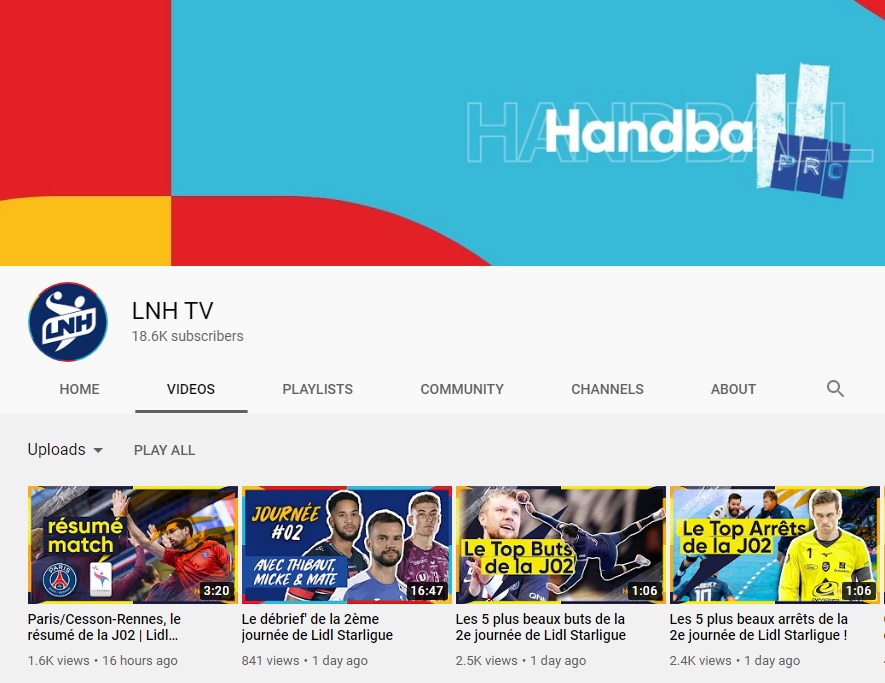
LNH TV: A great new online handball web streaming option
The EHF Champions League is taking a break this week, but will be back in action next Wednesday (14 October). In the meantime there’s plenty of great handball action, courtesy of the French and Spanish leagues that can be seen online. Here’s a rundown on where and how to watch.
French League (LIDL Star Ligue)
The top level of French Handball, the LIDL Star Ligue will be playing two match days this week and thanks to their new Youtube platform, LNH TV you can catch several matches online. Unfortunately, the more interesting matches tend to be on traditional beIN Sports TV channels in France and aren’t available for viewing. This means missing out on a lot of Paris SG, Nantes and Montpellier matches. Because of this, I’m thinking of adopting a 2nd tier French team. Perhaps Dunkirk? Or maybe Istres?
Spain’s top league, the Liga ASOBAL will be playing a midweek match day this Tuesday and Wednesday. Three matches (below) can be seen on the La Liga Sports TV Handball Channel. This viewing option used to require VPN, but currently there is no Geoblock. The Irun vs Leon match tomorrow should be a good battle between two sides that often fight for 2nd place behind Barcelona. USA National Team player, Drew Donlin also plays for Leon so you might consider adopting them as your favorite Spanish Side.
Tuesday, 6 October
Valladolid vs Cangas 20:25 (CET) / 14:25 (US ET) Link
The 2020-2021 EHF Champions League throws off this Wednesday and there are some important changes that handball fans will need to get used to.
Midweek Appointment Viewing
First and foremost, the biggest change will see all matches being played on Wednesday and Thursday. Whoa. Come Again? Champions League matches won’t take place on the weekend anymore?
Yes, that’s right. All matches will be on Wednesday and Thursday. And, further all matches will take place at two consistent throw off times. In Europe throw offs will be at either 1845 (CET) or 2045 (CET). That means these matches, depending on your time zone, will take place late morning to mid afternoon in the U.S. For reference on the east coast the first matches will throw off at 12:45 PM (US ET) and the second matches will throw off at 2:45 PM (US ET).
While some folks might whine at this change overall it’s a really smart move for the sport and the change in time won’t
Andreas Hertelt (on the right) with USA Men’s Head Coach, Robert Hedin (Photo: Markus Hausdorf)
Andreas Hertelt played 13 seasons in the German Bundesliga and represented his country in 10 international games. He has been a Team Leader for the U.S. Men’s National Team and he has been facilitating the placement of U.S. players with European clubs. On the podcast we discuss this program which is financially supported by the Forum Club Handball (FCH) and the U.S. players currently participating in it.
Don’t miss an episode: – Subscribe to the podcast in iTunes: Link – Or use this RSS Feed to sign up for the podcast in your favorite podcast aggregator: Link
And, be sure to check out the podcast archive with interviews and great handball discussion going all the way back to 2006: Link
Forum Club Handball: An organization quietly influencing handball behind the scenes.
Recently, I’ve fielded some questions regarding the Forum Club Handball (FCH). What is this organization and why are they helping the development of U.S. players.
Fortunately, a couple of podcasts were aired recently to help educate handball fans about the FCH. First, Xavier O’Callaghan was interviewed by Bini Mustafa on the Straight Handball Talk podcast and was asked about it. O’Callaghan was the President of the FCH and he provides a great top level explanation from a European perspective.
Then, on this Shootin’ Straight podcast I was also asked about the FCH. To answer that question, though, I first went on a bit of a diatribe to explain how U.S. and European pro sports are organized differently. This is because understanding those differences first is fundamental to understanding why there was a need for an organization (FCH) to represent Europe’s top clubs. I also elaborate on why it’s a “loose confederation” or forum and why initially the EHF was a bit wary of this upstart organization.
Side note: There was lots of great discussion on a variety of topics (U.S. challenges and college development are a couple) in the Shootin’ Straight podcast that’s worth checking out.
In part 2, I’ll take a closer look at the FCH’s support to U.S. player development
Things that make you go Hmm?: “Free” registration at an “ehfpayments” url.
<IMPORTANT UPDATE (3 July, 2020)>
The EHF has informed me that the answer to this question is “No. There are no plans whatsoever to change ehfTV to a paid subscription service. The misleading URL is a result of the switch to a new streaming partner which serves other entities that charge a subscription. The URL has been flagged for an update. The EHF, however, noted that handball fans will need to register and login to ehfTV to watch live matches. A small requirement, though, to watch the world’s best handball free.
<Original Article (Posted 2 July, 2020)>
ehfTV: The Best Thing Ever for Handball Fans in Far Flung Countries
Big things are a foot with the European Handball Federation (EHF). A new 10 year contract for TV and Marketing rights is now in full swing. The result: a revamped Champions League format, fresh new web pages and a new look ehfTV.
If you’re reading this article and are any kind of a handball fan you already know what ehfTV is. Why, it’s the best thing that’s ever happened to me as a fan of the sport here in the U.S. All of the Champions League matches, European Cup matches and even the European Championships available* for free viewing. Free! What a deal.
Are the Days of a Free Ride Coming to an End?
ehfTV is such a good deal that I’ve been wondering for years just how long it would last (Article from 2016). I mean we have to credit the EHF for being so forward thinking with this positive promotion of the sport, but they are a business and “free” generally is not a smart long term business move.
And, indeed in some countries the free ride ended a few years ago. There’s an asterisk on “available” and that’s because some matches are geo-blocked in some countries if the TV rights have been sold. That’s totally understandable. If I was a TV network owner I wouldn’t want the match being shown for free elsewhere. I would want viewers watching my channel.
But, it’s only understandable if the match can actually be seen in the country in question. In the U.S., beIN Sports (the previous rights holder) usually only aired 1 match a week on a delayed basis on Wednesday mornings. But, because they had a TV contract that match and many others were geo-blocked. This was extremely frustrating and forced handball fans like me to use VPN to watch matches on line. VPN is a less than desired workaround, but as a paying beIN Sports subscriber I had no moral qualms with using that alternative.
A New U.S. Network?
With a new 10 year contract kicking in there is now a chance for the EHF Champions League being seen on a new network. There are several possibilities that hopefully are being considered. NBC is a possibility and they’ve already shown the 2019 Men’s and Women’s on the NBC Olympic Channel. Other possibilities include Fox Sports, CBS Sports Network, TNT, 11 Sports or yes, a return to beIN Sports.
My preferred choice, however, is ESPN and specifically a combination of ESPN linear channels and ESPN+. As this earlier commentary highlight ESPN+ practically begs for a dedicated handball sub-channel: Link
Maybe Everybody Pays?
But, there’s another model that might at some point come into play. If you’ve checked out the new ehfTV platform you may have noticed that it invites you to register for free: Link
But… the url is for ehfpayments.streamamg.com. Yup. The “free” registration is at “ehfpayments”. Which is certainly a “Hmm” moment. As in, “Why would you call it that?”
Pure speculation on my part, but I can envision the EHF eventually transitioning ehfTV to a tiered service with some matches still being free, but adding a subscription to watch more matches and additional content.
Assuming such a subscription was reasonably priced this would actually be a good solution. Some matches on regular TV, some matches on free ehfTV and some matches on premium ehfTV. Actually I could get real used to that. HBL, LNH… are you listening?
For many years handball fans had limited options for getting their handball fix via podcasts. I started occasionally doing podcasts with this website back in 2006 and then the (Un)Informed Handball Hour arrived on the scene in 2017.
Now with many folks trapped at home and Zoom and other platforms making the task of creating a podcast a lot simpler there are now several podcasts to choose from. Here are four new options to check out.
Straight Handball Talk
This new podcast is the brainchild of New York City Team Handball Club’s, Bini Moustafa, and he has already dropped 24 episodes seemingly out of nowhere. The podcast features 1 on 1 interviews with a mix of U.S. and International handball athletes and personalities including some big names like Laszlo Nagy and Jerome Fernandez. The theme of the podcasts is the power of handball to connect people and create friendships through competition.
New York City Team Handball Club YouTube Channel: Link
Shootin’ Straight
Shootin’ Straight is a joint effort of Ohio State Coach and Columbus Armada GK, J.D. Orr, and Detroit Handball Club’s, Joey Williams. This podcast is broadcast live on Twitch on Saturday nights and also can be seen later via YouTube. As a weekly podcast they typically have a variety of topics and they’ve even experimented with some non-handball guests talking to get some feedback from other sports about how to grow handball in the U.S. Also, of note: as a live broadcast it’s even possible to interact directly with the hosts.
Shootin’ Straight (handballguy93) Twitch Channel: Link
Alberta Team Handball has been creating content for years on their social media channels, often with Video Logs (Vlogs) highlighting their overseas trips. Recently, they started a podcast with ATHF Director, Mike Nahmiash interviewing players like Greg Chauvet about how they got started with handball and playing in Europe.
While not branded as a podcast, San Francisco Cal Heat‘s Danilo Rojevic has conducted several interviews recently on Instagram. I enjoyed listening to his interview with Dallas Team Handball‘s Sascha Kiehne.
The death of George Floyd in Minnesota and the Black Lives Matter protests that have taken place all over the U.S., and even around the world have brought the issue of racial discrimination against African Americans in the U.S. to the forefront.
While for the most part overt racism has been practically nonexistent in USA Team Handball circles underneath the surface there have been issues at play that have likely kept African American participation numbers down.
Joining me to discuss this issue and more are 1996 Olympian, Derek Brown, former North Carolina coach and U.S. Jr National Team Asst Coach, Myles Bacon and NYAC/National Team player and USA Team Handball New York City Ambassador, Divine Jackson.
Here is some background information for some of the items that are discussed in the podcast:
USA Team Handball Diversity & Inclusion Data for Total Membership
USA Team Handball Diversity & Inclusion Data for National Team Athletes
Excerpt from USA Team Handball Newsletter (8 Jun 2020)
Link to the recent USA Team Handball Newsletter: Link
USA Team Handball’s Current Diversity & Inclusion Plan: Link (Note this plan was actually approved in 2017 and called for the formation of a Diversity & Inclusion Committee back then. It would seem that recent events have provided an impetus for getting this work started.)
Don’t miss an episode: – Subscribe to the podcast in iTunes: Link – Or use this RSS Feed to sign up for the podcast in your favorite podcast aggregator: Link
And, be sure to check out the podcast archive with interviews and great handball discussion going all the way back to 2006: Link
A Little History: Ambitious Targets that have become Increasingly Difficult to Meet
Since I’ve been following USA Team Handball the goal has always been to qualify for the Olympics. And, then once at the Olympics to medal or to reach the quarterfinals. Up until the 2000 Olympics these goals were perfectly reasonable. Qualification was expected. Indeed the only failure to qualify prior to 2000 was the Men falling short in 1992. Getting a medal was a bit of a stretch, but the 1984 Women’s team came close as a win over West Germany would likely have earned a bronze medal. (The U.S. lost 18-17)
But, since hosting (and automatically qualifying) for the Olympics in Atlanta in 1996, neither the U.S. Men or Women have come close to qualifying for the Olympics. There are multiple paths to Olympic qualification, but in practical terms for nations in North and South America it has meant winning the PANAM Games Handball tournament in the year prior to the Olympics. Neither the U.S. Men or Women have made it to the title game since 1995 and the few teams that we’ve made the semifinals it has resulted in a double digit loss. In 2007 and 2015 the U.S. even failed to qualify for the PANAM Games. (Historical PANAM Games Results: Link) Here is a summary of the U.S. performances since Handball started being included at the PANAM Games in 1987.
U.S. National Team Targets for the 2024 Quadrennial
Going forward, USA Team Handball appears to have similar targets. As a review here are the Strategic Plan targets for the National Team
Qualify for the IHF World Championships by 2024
Top 12 Finish at IHF World Championships by 2024
Top 2 finish at 2023 PANAM Games
Qualify for the 2024 Olympic Games
Additionally, there are some top level plans identified as potential ways to support achieving these targets:
Project France, whereby the U.S. National Team would compete as a team in a French league
Identifying up to 200 athletes new to handball and sending them to Europe for additional training. I’ll call this the Great Leap Forward Elite Player Pool Project.
Past Projections
Being the analytical type, I’ve done my best to project U.S. chances for Olympic Qualification for the past two quadrennials (2016 and 2020) and I’ve even already projected out to 2024. Here’s a summary of those assessments and when they were made:
March 2013: Assessment of U.S. Chances for 2016 Olympic Qualification: Link
September 2015: Assessment of U.S. Chances for 2020 and 2024 Olympic Qualification: Link
October 2017: Assessment of U.S. Chances for 2020 Olympic Qualification: Link
November 2017: Assessment of U.S. Chances for 2024 Olympic Qualification: Link
The cliff notes summary is that I’ve been pretty spot on with only a few things surprising me a bit. (i.e. Perhaps, I just might know what I’m talking about.)
Methodology for 2024 Quadrennial Assessments
While, reviewing my assessments, however, I noticed a couple of shortcomings. First, I didn’t fully characterize and define the “What We Have” starting point that USA Team Handball was working with. Perhaps it was obvious to some readers, but I’m not so sure. In particular, I don’t think key decision makers fully comprehended just how low of a starting point USA Team had been working with for years.
The second key shortcoming was the lack of actual targets and benchmarks to shoot for. This has now been rectified with the Strategic Plan. Again, it’s not a perfect document, but it does provide structure in terms of what we want.
Finally, I’m going to try and take a look at what happens to the “Can We Get There” if we change cost, schedule or performance constraints. Of course, we can’t always actually change them (the 2024 Olympics most likely will occur in 2024), but such analysis can provide further insight as to the feasibility and rationale for different projects
First up: A closer review of how feasible it is for the U.S. Men to qualify for the 2024 Olympics and other targets in the 2020-2024 Quadrennial.
Finding the Sweet Spot: High, but Achievable Goals
I spent quite a bit of time and energy reviewing “What We Have” and “What We Want” (Yikes: 17 articles!) But, that tedious process was really, really necessary. Sure, it’s a lot more fun to actually draw up the plans to move this great sport forward. Heck, that’s true with almost any planning process. Enough, already! Paralysis by analysis. Let’s get to work!
Problem is, though, if you don’t do that legwork up front you could well be drawing up plans that given your current situation simply aren’t practical. Or, you might be planning for something that doesn’t actually match your organization’s goals very well. Sometimes big projects will even take on a life of their own so much so that nobody can even remember what the original reason for them was in the first place.
All of those are big reasons why it’s necessary to closely look at “What We Have” and “What We Want” and determine how feasible it is to get from one to the other. Because if it’s not feasible that’s a major problem. And, that major problem can only be fixed in one way: By scaling back “What We Want”. Sure, it would be nice to magically change your “What We Have” starting point, but you can’t change your current reality. It is, what it is.
And, at the other end it can also be tough to lower your expectations. To downscale lofty goals. That’s no fun, either, but often that’s the only thing you can do. Otherwise you’re simply setting yourself up for failure. The fix, however, is not to come up with simple goals that can be easily met. No, the solution is to find the sweet spot of high, but achievable goals. Obtainable goals worthy of special effort that can genuinely move handball forward as a sport in this country.
The Project Management Triangle: Cost, Schedule and Performance
So, how does one determine whether it’s possible to go from “What We Have” to “What We Want”? For “projects” or project like efforts that assessment can be done through a review of the project plan. A “project” is defined as a temporary endeavor undertaken to create a unique product, service or result. In terms of USA Team Handball there have been a number of “endeavors” over the years intended to grow the sport or to produce good national team results. The Boys & Girls Club pushes in Los Angeles (1980s) and Atlanta (1990s and early 2000s) could be classified as projects. The various residency programs implemented over the years were projects typically focused on maximizing national team capabilities for the Olympic Handball Tournaments. Currently, efforts to grow collegiate handball, youth handball, improve near term national team performance and yes, the Big, Hairy, Audacious Project are all projects.
And, like any project they are constrained by cost, schedule and performance. What is often referred to as the Project Management Triangle. A project has an intended performance outcome, but only has so much money to spend and time to work with. And, if you want to alter one element of the triangle it’s a given that you have to change the other parts of the triangle in some respect.
A Test Case for Illustrative Purposes: Growing College Handball to 100 Clubs
Let’s take growing collegiate handball as an example. Let’s say our goal is to have 100 collegiate clubs by the end of the 2020. With currently only 15 Men and 4 Women’s clubs that’s pretty ambitious. Throw in the COVID-19 Pandemic and it seems pretty unlikely that we can meet our targeted performance (100 clubs) in the desired schedule (31 Dec 2020). Keep those constraints and you can only attack the problems with more money. I guess if we had $5M we could provide direct cash payments to 81 colleges to start college handball programs and hire 5 full time staffers to be 100% focused on this effort, but that doesn’t seem very practical.
This logically means scaling back schedule and/or performance. With the pandemic it’s not clear what the 2020-21 season will even look like and that could make starting new clubs pretty challenging. It’s debatable, but a better target end date would likely be May 2022 or May 2023. Further, some more work is probably needed in fleshing out a good target for performance (# of clubs).
Defining Performance: Clearly Defined Deliverables and Targets that can be Tracked and Measured
This leads to another aspect that requires some careful thought and consideration. Namely, a project plan with a schedule and clearly defined deliverables and targets. Simply having broad objective statements like “we want 100 college clubs” leaves way too much open to interpretation. Clear targets like “100 college clubs that contest 15 matches/year” are better along with other deliverables like a college handball start-up kit that will help get to the final project objective.
Competing Goals and Projects
It would be nice if USA Team Handball had just one goal and one project to worry about. Unfortunately, however, that has never been the reality and this has been most visibly displayed over the years by choices that have been made between grassroots development and national team preparation. There has never been enough funding to properly do both (or even just one) and in most cases, the “decision” has been made to focus on national teams. I’ve put “decision” in quotes because many times it’s not been clear as to whether a thorough decision making process to prioritize limited resources was used or whether the decision just happened by default.
I bring this reality up, because sometimes folks think that it doesn’t matter if we as an organization fall short of lofty, audacious goals. That such goals can serve as inspiration and we’re going to strive for our best regardless of whether we fall short… So, what’s the harm? Well… the harm is that there are competing needs and spending resources on an effort that is unlikely to succeed is highly questionable if there are other options with greater chances of success.
Can We Get There?: Determining Feasibility
The next parts of this series will assess the feasibility of a number of different efforts that USA Team Handball has started or plans to start in the near future. In particular, it will review “What We Have” and assess whether can feasibly get to to “What We Want” in terms of cost, schedule and performance.
Spoiler Alert: We are likely to fall short in almost every instance. Please don’t shoot the messenger…
England Handball has dropped a treasure trove of information that will be educating handball coaches, players and fans for years to come.
During the COVID-19 Pandemic England Handball Association (EHA) has been hosting a series of online handball webinars. Open to anyone who registered they’ve addressed a variety of topics to include handball in schools, 7v6 tactics and women’s handball. Unfortunately, while we were all stuck at home for the most part the past couple of months, it’s still not always possible to view these great seminars live.
The great news, however, is that all of these webinars are now available online at their EHA YouTube Channel or in the direct links below. Over 14 hours of handball coaching instruction. What a tremendous resource for years to come.
Offense Strategies
7v6 Attacking Model Based on FC Porto (Lecturer: Carlos Martingo, FC Porto Asst Coach and Portugal U18 Head Coach): Link
Positional Attack: Executing the Simple Stuff Well (Lecturer: Aksel Noergaard, Skanderborg Handball, Denmark): Link
Defense Strategies
Tactical Considerations of 6:0 Defence System (Lecturer: Paulo Pereira, Portugal Men’s National Team Coach): Link
Tactical Considerations of a 5:1 “Spanish Style” Defensive System (Lecturer: Danilo Gagliardi, Angola Women’s National Team Asst Coach, Youth Coach at 1o de Agosto): Link
Tactical Considerations of a 3:2:1 Defensive System (Lecturer: Scott Harrington, Head Coach, Sola Handball (Norway), Director, The Handball Academy): Link
Tactical Considerations of 4:2 Defence Systems (Lecturer: Ricardo Vasconselos, Great Britain Men’s Head Coach): Link
Tactical Considerations of 3:3 Defensive System (Lecturer: Bill Baillie, Women’s U17 and GB U19 Head Coach): Link
Goalkeeping
Goalkeeper Trends, Techniques and Practices (Lecturer: Mattias Andersson, German National Team and THW Kiel Goalkeeper Coach): Link
General Topics
Improving Decision Making (Lecturers: Bobby White, England Handball Head of Performance; Derek O’Riordan, Coach and Coach Developer; John Fletcher, Magic Academy, Coaching Wizard): Link
How and when to use Gamification within sessions (Lecturers: Russell Earnshaw, Magic Academy and Coaching Wizard; Matt Durber, England Handball Performance Coach): Link
Implementation of Video Analysis on Games and Training (Lecturer: Mark Hawkins, IK Vag Head Coach, Former Chinese Women’s National Team Head of Analysis): Link
Engaging Junior Players (Lecturers: John Pearce, U18 GB Men’s Coach; Mel Chowns, British Rowing Performance Advisor; Run Smith, FA Coach Mentor): Link
Overview and Analysis of Women’s Handball (Lecturer: Vera Lopes, Technical Director for Women’s Handball in Portugal): Link
Handball in Schools (Lecturers: Colin McGill, PE Teacher, Aylsbury Grammar School; Liz Roberts, Poole and England Handball; Stan Belinski, Trafford Handball Club): Link
It doesn’t take much imagination to envision a Handball version of this outstanding documentary.
Why, I Won’t Get on “The Last Dance” Bandwagon
No less than three handball podcasts have speculated recently on what should be the handball version of ESPN’s new documentary, “The Last Dance”. I understand that with the pandemic a lot of folks have binged all ten hours of this chronicling of the Michael Jordan led Chicago Bulls of the 1990s. However, despite being a huge basketball fan, I haven’t been one of them. Why? Two reasons:
1) I spent the better part of a decade rooting for them to lose. I can’t bring myself to watch 10 freaking hours celebrating their greatness. Seriously… Gag me.
2) I recently finished watching 20 hours of the best sports documentary I’ve ever seen: Basketball: A Love Story. I didn’t want it to end. The Last Dance would just be a letdown.
Basketball: A Love Story is actually 62 loosely connected mini documentaries covering multiple topics. Some, like a feature on James Naismith were strictly historical. Others like a segment totally devoted to “passing” were more reflective on specific aspects of the game. Some tackled more difficult topics such as the NYU point shaving scandal, the Latrell Sprewell incident and racism at Kentucky University. Others tackled great rivalries like the Celtics-Lakers and classic showdowns like Lebron’s Cavs coming from 3-1 down to beat Golden State. And, there are player profiles including a handball shout out from Dirk Nowitzki reflecting on his handball playing dad telling him that basketball was a game for girls. The mini-documentaries use a combination of interviews and archival footage to tell the story. And, pretty much everybody who is somebody is interviewed except Michael Jordan and Bobby Knight.
What appealed to me was the wide variety of topics and storytelling. A straight historical documentary covering everything would have been too dry and boring after a while. But, as it mixed history, social commentary and, at times, the whimsical I was always entertained. And, because they were mini-documentaries they only took the time needed to tell the story so they varied in length from 5 to 30 minutes.
Some stories were a trip down memory lane, reminding me of great games I had seen in the 80s and 90s along with interviews to provide little tidbits that I wasn’t aware of. Other stories were before my time, and that I only kind of/sort of new about such as the stories about the old ABA. One particular favorite was the bizarre story of the deal the owners of the Spirits of St Louis basketball club cut with the NBA when the two leagues merged. A deal that has netted the owners of that defunct club hundreds of millions of dollars for doing essentially nothing.
Handball: A Love Story
As I watched all 20 hours of this documentary I couldn’t help, but wonder about all the handball history and stories that I know absolutely nothing about. And, how, as far as I know, there is next to nothing available in written or video form that could educate me and others interested in learning about the heritage of the game. At least not in English. Case in point: Last year someone wrote an article about Holger Nielsen, arguably the modern day inventor of handball and it was the first account I had ever read about him. That’s kind of crazy when you think about it.
And, surely my lack of knowledge doesn’t stop there. There are surely dozens of mini documentaries that could be made about handball history, personalities and epic battles that took place over the years. Here’s a first cut of the stories I’d like to see in Handball: A Love Story.
History Focused
Origins: A story about handball’s beginnings
Field Handball
Bernhard Kempa and the Kempa play
1972 USA Olympic Team: Make the team… or head to Vietnam
Nation Profiles
Greenland Handball: The one nation where handball is #1
Iceland Handball: Pound for Pound: the top performing nation
French Handball: The dynasty of the 2000s
Sweden Handball: Benga’s Boys of the 90s
South Korean Women’s program
Club Profiles
Flensburg – Kiel: Handball’s top derby
Montpellier: The art of the two game aggregate comeback
Barcelona
Celje: Cradle of handball player development
Individual Profiles
Magnus Wislander
Erhard “Sepp” Wunderlich
Ivano Balic
Nikola Karabatic
Lars Christiansen
Hassan Moustafa
Claude Onesta
Aspects of the Game
Defense with perhaps a profile of Didier Dinart
Wings: Patience on the corners
Centerback Maestros
Controversies
2007 Olympic Qualification Kuwait – South Korea
Whimsical
The Sri Lankan National Team that disappeared
I realize I’m just scratching the surface… If you have some suggestions for topics and stories that should be considered please let me know on social media or via email at john.ryan@teamhandballnews.com
Bini Mustafa, the President of the New York City Team Handball Club has been taking advantage of the COVID-19 lock down to interview several handball personalities both in the U.S. and internationally. I was honored to be one of the personalities he chose to interview and it was great to have someone else ask the questions for a change. He through me a couple of curve balls so, in my opinion, it’s a pretty interesting interview.
Here’s a timeline of some of the highlights of our conversation
05:15 My handball origination story
11:30 Playing at the 1993 World Championships
13:50 Bini asks me, “Someone with a resume like yours, a background like yours… Why, are you not involved with the business of USA Team Handball?”
21:50 Bini asks me, “In your opinion, from the practical and tangible aspect of it, what will be considered truly a successful outcome for this new leadership?”
26:15 A discussion on the latest Pro League concept
32:10 Indoor soccer and why that might be the model for a pro handball league
35:10 How USA Team Handball might coordinate with a pro league
36:40 A discussion regarding handball on TV in the U.S.
40:50 The best thing that’s happened to me all year…
42:20 The financial arrangements for handball on TV in the U.S.
44:30 The problems with 3rd party agencies being responsible for selling TV rights in the U.S.
46:50 Why cornhole is on TV and handball isn’t
48:45 Why handball is headed to a better TV network (fingers crossed)
49:45 The reality handball show concept
52:55 Bini asks me, “If you had $10M to invest in handball how and where would you invest it first?”
56:50 The great advice USOPC Executive, Rick Adams, gave USA Team Handball at the 2012 Strategic Planning Session in Utah
59:15 Bini asks me, “Who’s your all time favorite U.S. Club?”
1:02:40 Bini asks me, “Who’s your all time favorite U.S. born player?”
My apologies for forgetting your name, Richard Jacobs!
1:06:50 Bini asks me, “Who is my favorite expat player in the U.S.?
1:08:50 Discussion on U.S. Nationals still taking place this year
1:11:40 Bini asks me, “Who I think is the best player in the world, currently?”
1:13:25 Bini asks me, “If you were to change one rule in handball what would it be?”
1:16:40 Discussion on adding a 13M line for two point goals
And, my interview is just 1 of 10 recently posted. It’s a diverse group that includes Carlos Prieto, Sayed Shalaby, Danilo Rojevic, Ljubomir Vranjes, Vladimir Bicvic, Julio Sainz, Mark Ortega, Gil Pires, Vid Kavticnik, Kim Ekdahl Du Rietz and Laszlo Nagy. That should keep you busy!
Charlie White: Ultimate Tag winner and USA Beach Handball Athlete
Earlier this week, Charlie White, won the Men’s competition on the premiere episode of Fox TV’s, Ultimate Tag. He joins the podcast to talk about that experience, how he got started with beach handball, how he and his teammates are coping with the COVID-19 pandemic and since he’s a game developer, whether handball will ever get a cool video game.
Ulimate Tag can be seen Wednesday’s on Fox and past episodes (including Charlie’s win) can be seen on Hulu or FoxNow.
Video
Charlie getting caught in the dome competition: Link
Don’t miss an episode: – Subscribe to the podcast in iTunes: Link – Or use this RSS Feed to sign up for the podcast in your favorite podcast aggregator: Link
And, be sure to check out the podcast archive with interviews and great handball discussion going all the way back to 2006: Link
<< Sponsors: Would you like to get the word out on your handball related product? Contact (john.ryan@teamhandballnews.com) for information on how you can sponsor the podcast. >>