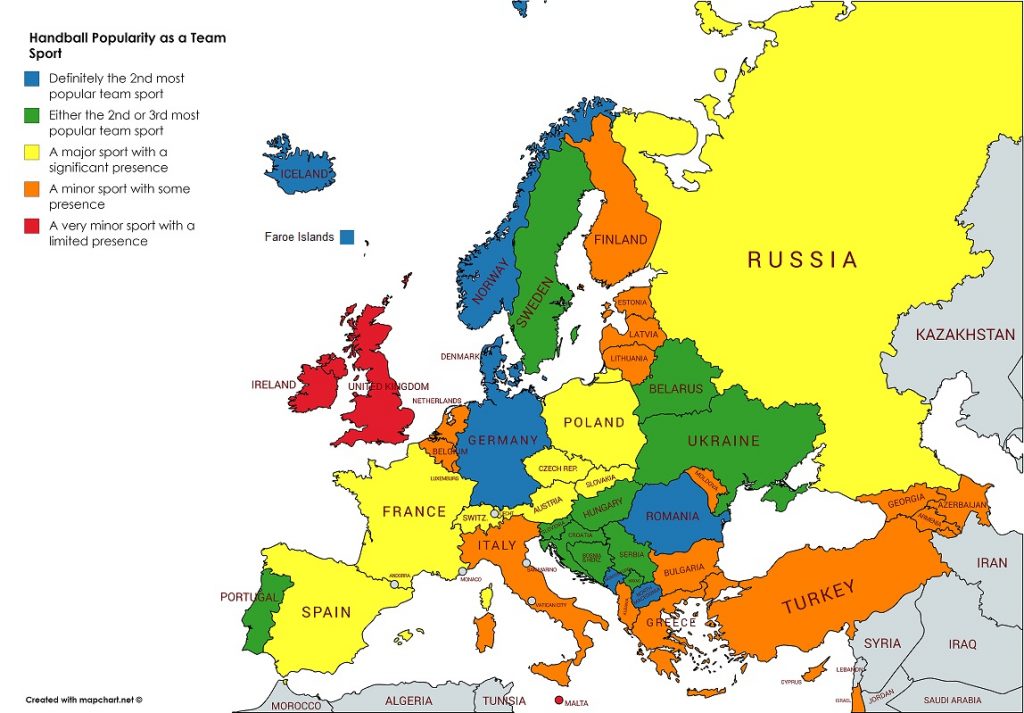
Where is Handball Popular? And, Just How Popular is Handball Compared to Other Sports?: Europe

Handball’s Popularity in Europe
  • This is part of an ongoing series. Check out these maps for other continents
    • Africa: Link
    • North America & the Caribbean: Link
    • South and Central America (In development)
    • Asia (In development)
    • Oceania (In development)

Note: This map was updated based on feedback on 31 March 2020: See paragraph at bottom for what the feedback was and why or why not the map changed

  • Where is handball popular?
  • How popular is handball compared to other sports?

Those are definitely a couple of questions that I’ve been asked quite a few times. In 2005 I tackled those questions in one of my very first blog posts. Back then it was often stated that handball was the 2nd most popular team sport. Well, it would be totally awesome if that were true, but alas it’s not… not even close. In fact, even in Europe where handball is most popular there are only a handful of countries where our sport definitely takes 2nd place.

Methodology (or the Lack of One)

As an engineer I generally prefer to deal with data as opposed to gut feelings and anecdotal information. For sure there are a lot of different criteria that one could use to measure popularity. Here’s a laundry list for you:

  • # of participants
  • # of registered federation members
  • # of clubs
  • Attendance at matches
  • Frequency of TV broadcasts and ratings
  • Existence of a professional league
  • The salaries of professional players
  • Interest in national team performance
  • Social media interest.

Each of those criteria have merit, but there are several problems.

  • This data is not readily available on a country by country basis
  • The accuracy of the data that is available is often suspect or open to interpretation
  • The relative importance of each criterion is wide open to debate

Bottom line: An exercise to carefully weigh all of these criteria in a systematic reliable way is pretty much impossible.

That being said in most cases it’s fairly easy to weigh all those criteria and to come up with a ranking of the top 3 sports in just about any country. And, a ranking that most objective sports fans of that country would agree on without a whole lot of debate.

There’s a couple of reasons why this is true.

  • In most countries there is one dominant team sport and that sport is football (soccer). Practically no one will even credibly argue against soccer’s dominance. So off the top, we’re now only talking about 2nd and 3rd place.
  • And, again in most (but, not all) countries, #2 is often pretty well established based on the criteria above. Even without hard numbers the answer is obvious to people that live there.

All this being said, there are some countries, however, where handball’s place in the pecking order is open to debate. A debate, for the reasons listed earlier is pretty hard to resolve. So, instead of resolving I’ve decided to use the lack of a resolution as a way to help classify the sport’s popularity.

Classification (Key)

Here’s a few notes on how I’ve classified popularity.

  • Definitely the 2nd most popular team sport:
    • Countries where handball is 2nd in a preponderance of the criteria
  • Either the 2nd or 3rd most popular team sport:
    • Countries where there could be a legitimate debate between 2 sports as to which is 2nd or 3rd
      • Example: In several Balkan countries depending on who you talk to either basketball or handball is 2nd
    • Countries where handball is clearly 3rd
      • Example: There’s a pretty strong consensus that the proper ranking in Sweden is 1) Football; 2) Ice Hockey; and 3) Handball
  • A major sport with a significant presence
    • Countries where the ranking becomes muddled from 3rd place on down, but handball is still clearly a major sport that captures significant attention
      • Example: In France few would argue with soccer being first and rugby being second, but 3rd place is less clear between basketball and handball. That being said, even if Handball is the 4th most popular sport it’s still is a “major sport with a significant presence.” This is clearly demonstrated by it’s pro league, attendance and national team
  • A minor sport with some presence
    • Countries where the ranking becomes muddled from 3rd place on down, but Handball is more of a minor sport with a small, but dedicated following.
      • Example: Greece has a national league and several club teams playing at different levels, but the level of play is below that of other countries. They have a national team that is competitive, but still a notch below nations where the sport is more established.
  • A very minor sport with a limited presence
    • Countries where the sport’s ranking is somewhat moot because it’s hard to compare perhaps the 6th or 7th most popular team sport. Overall, participation numbers are small and the sport is seen as a curiosity by most of the citizens of that country.
      • Example: Great Britain fits that definition pretty well. The sport is growing, but they have a ways to go move up in popularity.

A few more thoughts

  • There is a rough pecking order from top to bottom. Blue is top; Green is next, etc.
  • This isn’t a perfect representation. And, one could argue for even more gradation. For instance, one could take the nations in yellow and create a rough pecking order.
  • What about individual sports? If you really wanted to further complicate matters we could add Formula 1, UFC and Tennis. I didn’t want to go there.
  • A few tough calls
    • Iceland: I’ve seen a few Icelandic basketball players playing for USA colleges and read that the sport is making inroads there. There are even more registered basketball clubs than handball clubs in the country… Still, I’m not ready to say that handball has slipped to third in Iceland.
    • Portugal: I’m thinking that 5 years ago Portugal would have been orange, but now they’ve jumped to green? But, a couple of folks convinced me that it’s arguably #2 there. Could that be just a momentary blip due to a Euro 2020 high?

What do you think?

This compilation/depiction isn’t set in stone. It’s just one man’s opinion influenced by feedback. If I’ve missed the boat let me know via email or social media and I’ll reconsider updating the map.

Email: john.ryan@teamhandballnews.com
Facebook: Link
Twitter: Link
Instagram: Link

Also, I’ll be creating similar maps for the other continents and I could use some feedback on Africa, Asia and the Americas.

Update (31 March 2020)

After the initial posting on 29 March, 2020, I received a lot of great feedback. Based on this feedback I made a few changes.

What’s Changed and Why

  • Romania (Green to Blue): Several comments all pointed out that handball is a solid #2 as a team sport; In particular, women’s handball both at the club and national team level has a pretty high level of attention- Arguably, higher than even football.
  • Cyprus (Red to Orange): Handball is not a big time sport in Cyprus, but based on their solid performances in both IHF Emerging Nations and early round EHF Qualification matches the sport has more than a limited presence
  • Faroe Islands (Blue): This small, but proud handball nation was inadvertently omitted. Some have even suggested that handball might even be the #1 sport there. Based on feedback, however, from one resident who is also a huge handball fan, however, I’ve assessed that it’s close, but not quite there yet.

What Received a Lot of Feedback, but Stayed the Same

Some handball knowledgeable people pointed out some colors on the map that just didn’t seem quite right. While, I understood their points and even agreed with them to some extent I decided not to make a change, though, in several instances. More than anything the debate centers on the imperfect classification system which naturally leads to some reasonable disagreements.

  • Portugal should be moved to yellow… Especially if France and Spain are Yellow: It does look a little strange, but it shouldn’t be interpreted to mean that handball therefore is a bigger sport in Portugal than it is in those two countries. If anything it’s more reflective of the reality that France (rugby) and Spain (basketball) have strong #2 sports.
  • Netherlands should be yellow… Especially if their women’s team is now the World Champion: There’s no denying that the women’s team has been an incredible success, but I would argue that this success is more the result of a smart national team strategy making the most of a pretty small talent pool. Handball is still a fairly small sport there in terms of participation and national interest. That certainly could change and this map is not set in stone.
  • Why is Russia yellow… Handball isn’t as popular there as it is in other countries like France and Spain: Handball has certainly slipped in terms of popularity in Russia and I, for one, agree that it’s clearly more popular in many other countries depicted in yellow. However, it’s still an important sport there and it’s women’s team is still a force. And, if one looks at the countries in orange it’s also clear that handball is more popular in Russia than it is those countries.
  • Serbia should be yellow… Since handball has really slipped in popularity there: I got feedback from one Serbian that handball has slipped behind basketball, water polo and even volleyball. I’ll need more feedback, however, before I drop any Balkan state below green.

What We Want (Part 2): College Development: More College Clubs… and College Clubs Playing Handball at a Higher Level

World University Championships: This biennial event might be a great way to further develop our collegiate programs and track how well those programs are doing in terms of developing handball athletes.

This is part of an ongoing series: Link

Collegiate handball has been identified as a key focus area for developing handball in the U.S.  As such, several goals and objectives to move the college game forward have been identified both in the broader USA Team Handball Strategic Plan (drafted in 2018) and in a College Specific Strategic Plan (Feb 2018).

USA Team Handball Strategic Plan

A college and university initiative is identified on page 6.

D. Launch collegiate and university initiative.

  • i. Cultivate a competitive university club system across the United States.
  • ii. Target four geographies utilize the well-established collegiate club sports model.
  • iii. Create regional league competition.
  • iv. Host season ending Final Four event.

Target Outcome

  • Increase university club programs to 40 (4th Qtr 2020)

Appendix A

  • Appendix A references “Univ Teams” several times with targets for the number of teams
    • End 4th Qtr 2018:  14 (Accomplished:  15 Men’s Clubs /3 Women’s Clubs)
    • End 2nd Qtr 2019:  20 (Not Accomplished 15/3)   
    • End 4th Qtr 2019:  30 (Not Accomplished 15/4)    
    • End 2nd Qtr 2020:  35 (Not Accomplished 15/4)   
    • End 4th Qtr 2020:  40       
    • End 4th Qtr 2024: 100
  • There are several references to the selection and identification of new regions (Accomplished:  5 “hubs” (New York City, Boston, Chicago, San Francisco and Los Angeles) have been selected.
  • There are several references to the establishment of regional leagues in the 2018-2020 time frame.  (Not Accomplished:  There are currently no regional collegiate leagues.)
  • A Final Four tournament for top collegiate programs was identified for the 4th Qtr of 2019  (Not Accomplished)

Collegiate Strategic Plan (Feb 1st, 2020)

The Collegiate Strategic Plan was developed by a Collegiate Working Group and provides more detail on collegiate goals and objectives.  However, in my opinion, (similar to the more broad USATH Strategic Plan) it strays in some instances into what might more accurately be described as near term action plans.  Here is an over of the plan’s contents:

  • 2050 Vision
    • Team Handball is a sanctioned NCAA Sport
    • Scholarship sport that competes for the best athletes
    • Widespread media presence
    • Handball is a recognizable, established major sport in America
  • 2019-2022 College Strategic Plan Goals
    • 1) Create a comprehensive and streamlined starter pack to allow a college student to create a college handball program in a semester and supply a resource person. 
    • 2) Have sustainable clubs playing 15 games per season in 72 colleges, including 36 women’s teams.
    • 3) Have the structures and systems in place to grow participation of college club players by 400%.
    • 4) Assemble the necessary capacity to achieve the goals of this plan.
    • 5) Raise sufficient funds to achieve the goals of this plan.

In my opinion goals 1 and 4 are near term actions that will be implemented to support goals 2 and 3.  Goal 5 is probably more suited for a broader discussion on fundraising.   As I think they are more “strategic”, here’s a closer look at goals 2 and 3:

  • Goal 2: Have sustainable clubs playing 15 games per season in 72 colleges, including 36 women’s teams.
    • 2.1 Recruit colleges proximal to existing clubs
    • 2.2 Establish new clubs in locations with a concentration of colleges based on receptivity and leadership
      • 2.2.1 Achieve 40 colleges by end of 2020
    • 2.3 Provide competition structure leading toward a National Championship in order to enable the best teams in the country play each other
      • 2.3.1 Consider two-season structure to enable cross-regional competition
      • 2.3.2 Publish competition structure well in advance to enable maximum participation
    • 2.4 Develop and implement a path to ensure club succession and continuation of administration
    • 2.5 Provide support from USATH ambassador
  • Goal 3:  Grow participation of college club players by 400 percent
    • 3.1 Raise the profile of team handball
      • 3.1.1 In concert with USATH, develop and implement a comprehensive promotion plan to have handball recognized across the country 
      • 3.1.2 Offer resources for parents, coaches, athletes
      • 3.1.3 Focus on benefits of participation
    • 3.2 In concert with USATH, ensure a pipeline of athletes to join college clubs using the Athlete Development Model
    • 3.3 Support established clubs
    • 3.4 Provide pathway for athletes post college, e.g. national team, city clubs, coach, referee, volunteering

Discussion

In broad terms, I would assess that the overall goal of collegiate development is to:

  1. Increase the number collegiate athletes, clubs and leagues (Increase participation)
  2. Improve the level of collegiate play

Increase Participation

In terms of increasing the numbers of athletes, clubs and leagues several targets have been presented, but they could use further definition.  Here are some clear targets that I emphasized in bold face in the text above:

  • Have sustainable clubs playing 15 games per season in 72 colleges, including 36 women’s teams.
  • Grow participation of college club players by 400 percent

Of particular note, the text highlighting “playing 15 games per season”, seems to provide a benchmark for a club program.  Essentially, making the point that there’s a significance difference between a club that plays 15 matches and a club that holds a couple of practices and plays in one weekend tournament.  If that is the definition of a collegiate club it also decreases the # of clubs.  Using the 15 match requirement for the last two seasons, there would have been this many clubs

  • 2018-19 (9 Men/2 Women)
  • 2019-20 (7/3) (I used 10 matches as the season has been shortened)

Participation growth is not defined, but it would logically have a strong correlation with the growth of the # of the clubs.  Depending on the “start date” and the number of existing clubs at that point in time one can then project the number of clubs needed to obtain 400% growth.  As an example, the U.S. had 15 men’s collegiate clubs and 3 women’s collegiate clubs during the 2018-19 season for a total of 18 clubs.  400% growth would then be 90 clubs.  If one uses an average of 15 athletes per club, the total number of collegiate athletes for the 2018-19 season would be 18 clubs x 15 athletes for a total of 270 collegiate athletes.  400% growth would equate to 1,350 athletes by the end of 2022.  And, of course, participation could also be simply assessed by totaling up the annual number of collegiate USA Team Handball memberships from year to year.

Improving the Level of Play

In terms of improving the level of play I would assess that both documents could use more specific targets related to accomplishing this goal.  The USA Team Handball Strategic Plan mentions “Athletes identified out of University Programs” in a few places and references “pipeline development”, but there is not much “meat on the bones.”  The Collegiate Strategic Plan included several bullet points that point to improving collegiate competition, but lacks measureable targets.

Here, though are some potential candidates:

  • USA Performance in World University Handball Competitions: Link  (Actually participating would also be good. It’s doubtful that the 2020 Championship will take place, but 2022 could be a possibility.)
  • Numbers of collegiate athletes (Current/Former) on Youth (U19), Junior (U21) and Senior national teams
  • Numbers of collegiate athletes being identified for further development by International Clubs
  • Numbers of collegiate athletes transitioning to U.S. Clubs

I haven’t identified the actual numbers (and dates) that should go with these targets, but would suggest that the Board of Directors consider adding these targets (with dates/numbers) for future updates to the Strategic Plans.

That wraps up “What we want” for College development.  Part 3 will take a closer look at Fundraising and Marketing

2003 EHF Champions League Finals (Portland San Antonio – Montpellier): Remembering a Classic

(19 Year old Nikola Karabatic with one of his 11 goals in the first leg of the 2003 Champions League Final… Notice anything strange about this goal?)

The Coronavirus Pandemic has been a real bummer for sports fans everywhere.  No more live sports.  To fill the gap ESPN and other sports networks have been airing classic matches.

Handball is no different and last week I sent out a Twitter post asking for recommendations of classic matches that were available online and “Sharp Action” replied with a link to the 2nd Leg of the 2003 Champions League Final between Portland San Antonio and Montpellier.  And, then later someone pointed me to a great Spanish site (blog youtube) with the 1st leg of this classic final. 

  • 1st Leg (Spanish):  Link
  • 2nd Leg (Spanish):  Link
  • 2nd Leg (French): Link

What a gift!  What a trip down memory lane!

It’s hard to believe it was 17 years ago.  It seems like yesterday that I was watching these matches in with my 1 year old daughter “surfing” the coffee table in our Paris apartment.  Now she’s getting ready to graduate from high school.  (I guess it’s TBD as to whether she walks across a stage or just gets her diploma in the mail.)

Handball wise, it’s been quite an education.  I remember that it took me awhile back in the 2002-03 season to figure out that club handball was on TV in France and what the Champions League was.  Not to mention what the hell a “two match aggregate playoff” was.  There was no Final Four at the time and therefore the semifinal and finals were decided by the aggregate score of two matches, with one being played in each locale.

I’ve only rewatched the first leg in Pamplona and I won’t give any spoilers, but here’s a few contextual tidbits that might help you appreciate the match more:

  • Arguably, these matches are a bit of a coming out party for France’s big 3:  Nikola Karabatic, Didier Dinart, and Thierry Omeyer.  Dinart is generally considered to be the best defender of all time.  Omeyer is in the conversation for best all time GK and, of course, Karabatic may well be the handball GOAT.  Certainly, few would argue against the reality that he has been the GOAT for the 21st century.
  • Karabatic had just turned 19 years old at the time these matches were played.  I will never forget a few months earlier watching Montpellier and checking his (at the time) relatively short Wikipedia page and absolutely being floored to discover that he was just 18 years old and thinking to myself, “Holy crap!  How good is the guy going to be in a few years?”
  • Laughably, Montpellier coach, Patrice Canayer didn’t start Karabatic for this match.  To Canayer’s credit, though, he doesn’t leave much after he does enter the game.
  • Take a look at this goal by Karabatic: Link  (Notice anything unusual?)
  • Watch what Karabatic does at the end of the first half and think about how that might impact the final outcome.
  • Check out how Didier Dinart clogs up the middle on defense.  There ought to be some handball analytics that measure what an impact that sort of play can be on the final outcome.  You just don’t see many goals scored while he’s in the vicinity of the action.  It’s hard to measure that, but if you watch just him (instead of the ball) for a few minutes you’ll start to appreciate what a difference he makes.
  • The Spanish club, Portland San Antonio was a major presence in the Spanish League and was actually located in Pamplona.  Yes, the club was located there even if the club name by coincidence featured the names of two NBA franchise cities, which are not cities in Spain.  Best that I can tell, San Antonio is a neighborhood in Pamplona while Portland was the name of the cement company that was their sponsor.  They were also a casualty of the Spanish financial crisis that caused the dramatic decline in the Liga Asobal.
  • Be sure to appreciate Jackson Richardson’s skills both on offense and defense, but keep in mind that he was also almost 34 years old and was actually entering the tail end of a great career.
  • Portland San Antonio’s leading scorer for the match was a Belarussian, Mikhail Yakimovich, who also won a gold medal in 1992 for the Soviet Union.  He was also 35 years old.  Back in the day, Liga Asobal teams seemed to have quite a few players from the Balkans and the former Soviet Union populating their rosters and this is one of the reasons the league was once considered the best in the world.
  • The GK for Portland San Antonio, Vladimir Rivero, was originally from Cuba and tragically died a year later due to an aneurysm.  He played 191 international matches for Cuba.
  • It’s kind of quaint to see all the lines on the floor for basketball, volleyball, etc, but that was pretty commonplace until the EHF instituted requirements for standardized floors. 

Links to more classic matches you can see online: Link

Podcast (Episode 66) Former NFL Tight End, Gary Barnidge and the Infamous NFL – FTC Budapest Handball Match

Former NFL Player and newly converted handball fan, Gary Barnidge.

Earlier this month when the Coronavirus was just some issue China was dealing with a group of American NFL players (current and former) had a joint training session with Hungarian Club, FTC Budapest. Video of the match went viral as it seemed to provide what every handball fan wanted after the infamous, Jay Cutler, interview on Pardon My Take: Namely, a match between cocky, over confident NFL players and experienced handball players.

The reality, however, was significantly different. The NFL Players were part of the American Football Without Barriers, a non-profit group that uses sports as a tool to help disadvantaged children live healthy and fit lifestyles through the core values of physical fitness, wellness, and education. And, as the name implies part of that mission is conducting camps and spreading the gospel of American Football in places like Hungary.

Gary Barnidge, played eight seasons as a Tight End for the Carolina Panthers and Cleveland Browns and is one of the founding members of American Football Without Barriers. He joins the podcast to discuss their trip to Hungary, the growing popularity of American Football and what handball might learn from it, and, of course, their handball training with FTC Budapest.

What’s clear: Handball is harder than it looks and the sport has picked up some new and genuine fans from American Football.

Complete video of the entire training session: Link
Shorter video with match footage: Link

FTC Budapest Team Captain, Timuzsin Schuch

Don’t miss an episode:
– Subscribe to the podcast in iTunes: Link
– Or use this RSS Feed to sign up for the podcast in your favorite podcast aggregator: Link

And, be sure to check out the podcast archive with interviews and great handball discussion going all the way back to 2006: Link


The podcast was sponsored by Aspire Products, EMST150 Training Device. Check it out and don’t forget to use the promo code THN30 for a 30% discount.

What We Want (Part 1): Official Documentation and National Team Targets

This is part of an ongoing series: Link

A Bit of History (Sometimes Tilting at Windmills Actually Works)

Long time readers will know that I’ve linked to one particular commentary on several occasions. 

U.S. National Team Plans (Part 6): Federation Planning: Right Idea, Flawed Execution, Time to Right the Ship:  Link

Way back in 2012, the USOPC sponsored a Strategic Planning meeting in Salt Lake City and the outcome of that meeting was…  well, it was pretty much nothing.  Lots of fine discussion, but unfortunately no follow through.  No strategic plan was ever developed.  Not that I didn’t valiantly try to engage leadership, but such pleas fell on deaf ears.  Instead short term plans went forward without much thought in terms of the long term direction of USA Team Handball.  Or, if there was such “thought” it went totally undocumented.

I kept hammering away at this discrepancy every chance I could and eventually in 2018 USA Team Handball decided to draft a Strategic Plan.  I really don’t know whether my hammering actually contributed to that happening, but I like to think that it did.  Regardless that document exists and is available here: Link

I even participated briefly in the plan’s development.  Not as much as I would have liked, but at least I got to attend one meeting and influence its development.  Here’s a commentary on the plan that I wrote back in 2018:  Link

Note:  The Board of Directors met in October 2019 to review and update the 2018 document and I was informed in February that the Board is currently review the final edits on that update

In addition to this strategic plan a separate College Strategic Plan has also been developed:  Link

Background on Strategic Planning

When it comes to strategic planning there are often misconceptions as to what it is intended to accomplish.  First and foremost, strategic plans are intended to be… well, strategic.  They are not tactical.  This means that they look at the big picture and attempt to define what are the mid to long term goals and objectives and some top level actions that should be taken to achieve those goals and objectives.  It’s not a detailed plan of action but the guiding document used to develop such plans.  So, one shouldn’t complain if a strategic plan lacks the detail needed to go out in take specific actions.  In fact, it’s more appropriate to complain if a strategic plan is too detailed and solution specific.

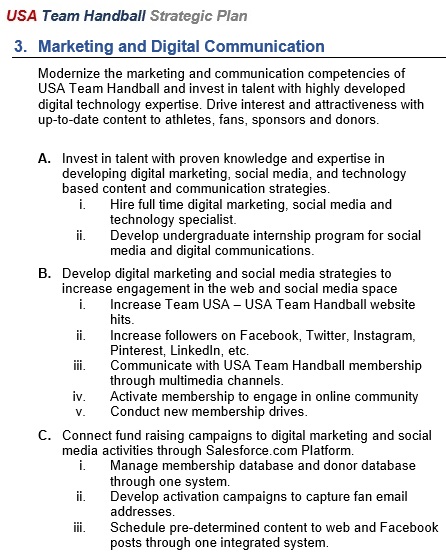
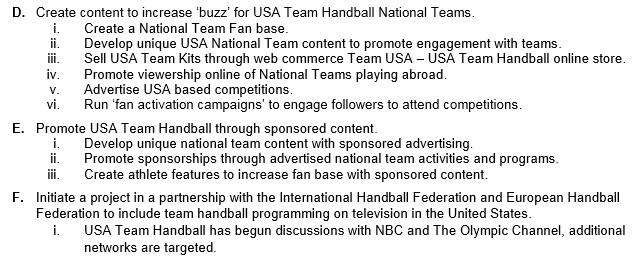
The USA Team Handball Strategic Plan (An Overview)

As I alluded to in my commentary that was written shortly after it was released I have some issues with its structure and content.  It’s too detailed (solution specific) in some instances and in some cases (youth development, beach handball) its discussion is too sparse.  Parts of the document also seem a bit misplaced in that some very near term actions (e.g. staff hires) are spelled out, making the document more of a plan of action, rather than strategic guidance.  As such, I’ve decided to distill the more strategic aspects of the document into some broad areas for further analysis.  Those areas are 1) National Team Performance; 2) College Development; 3) Marketing and 4) Fundraising

1) National Team Performance

National team performance is referenced in several areas of the document and is most closely associated with the fourth focus area, “Organizational and Competitive Excellence”.  Two items (C and E) are closely related to National Team Plans

C. Develop national team training and competition plan for Olympic, Pan American and World Championship Qualifications.

    • i. Set competition goals and objectives.
    • ii. Establish talent acquisition pipeline.
    • iii. Develop national team training schedule.
    • iv. Develop national team competition plan.
    • v. Determine national team training site

On the surface these items seem fairly straight forward, but the “devil is in the details”.   In particular, the U.S. has struggled in the past to simply define what a “talent acquisition pipeline” is, let alone establish one.  The brief mention of a “national team training site” also needs to be fully defined as the simple item is wide open to interpretation. On one extreme it could be a full blown residency program and on the other extreme it could simply be a location for the national team to train for a week or two prior to major competitions.

E. Initiate Project France

    • i. A project of USA Team Handball, International Handball Federation, and the France Handball Federation.
    • ii. The project places USA Team Handball athletes (together as a team) into the French Handball League for regular competition.
    • iii. The French Handball Federation has made an initial invitation for the team to begin competition in September of 2019.
    • iv.  National team athletes benefit through increased playing experience and competition.
    • v.  The national team program gains opportunity to develop as a unit and compete against international teams during national team weeks that are set aside in the European club system.
    • vi. Project France is seen as a recruitment tool for university level athletes interested in advancing their athletic careers.

I personally see a lot of potential with an overseas effort like this. Indeed, back in 2014 I outlined a similar concept. However, this is a very solution specific concept and it is very misplaced to include it as part of a strategic document.  For certain, it needs to be further assessed and compared with other possible actions before it is implemented.

Target Outcomes: 

On the right hand side of page 6 there are several very specific target outcomes related to National Team Performance.

  • Qualify for the 2019 PANAM Games (Accomplished: Men and Women)
  • Top 4 Finish at 2019 PANAM Games (Partially Accomplished: Women: 4th; Men: 6th)
  • Hire Technical Director (3rd Qtr 2019) (Accomplished: Stefan Olsson)
  • Begin “Project France” (3rd Qtr 2019)  (an effort that would see a U.S. team playing as a unit in a French league)
  • Qualify for the IHF World Championships by 2024
  • Top 12 Finish at IHF World Championships by 2024
  • Top 2 finish at 2023 PANAM Games
  • Qualify for the 2024 Olympic Games
  • Top 2 finish at 2027 PANAM Games
  • Top 6 finish at 2028 Olympic Games

I won’t go into detail as regards to the feasibility of these targets, but suffice to say some very realistic expectations were set for 2019, but the targets for the outer years are very ambitious.

Elite Athlete (Appendix A)

Appendix A provides additional detail and targets for select topics from year to year.  One target block is entitled “Elite Athletes” and it’s envisioned that both the Men’s and Women’s programs will have 40 athletes identified as elite and that the definition of elite athlete will continue to evolve, which I presume to mean that the elite will become more elite.  Additionally it’s desired to have a greater percentage of these athletes coming from our improving college programs.

That’s a top level review of USA Team Handball’s Strategic plan and a closer look at what’s desired in terms on National Team Performance. Part 2 will take a closer look at “College Development”

ehfTV Classic Matches

Stuck at home and looking for some handball to watch?  Here are some Classic Matches available on ehfTV that are available for viewing at any time. 

Note: There is nothing regarding the result/score of these matches for a reason.  If you haven’t seen it before it’s all new to you.

Classic ehfTV Matches

  1. 2014 Final Four Semifinal: FC Barcelona vs SG Flensburg: Video Link
  2. 2016 Women’s Final Four Championship Match: CSM Bucharest vs Gyor: Video Link
  3. 2016 Final Four Championship Match: Kielce vs Veszprem: Video Link
  4. 2017 Final Four Championship: Paris SG vs HC Vardar: Video Link
  5. 2018 2nd Leg R16 Veszprem vs Skjern: Video Link
  6. 2019 Final Four Semifinal: FC Barcelona vs HC Vardar: Video Link

Note:  If you know of a great match on ehfTV that should be added please email me at john.ryan@teamhandballnews.com or send me a Tweet.

Classic EHF CL Matches Available on YouTube

  • 2003 EHF CL Championship:  Montpellier vs Portland San Antonio 1st Leg 2nd Leg
  • 2009 EHF CL Championship: Kiel vs Ciudad Real:  1st Leg 2nd Leg

Classic International Matches Available on YouTube

  • 1980 Olympics Final: East Germany vs Soviet Union: Link
  • 2004 Olympics Women’s Final: S. Korea vs Denmark: Link
  • 2007 World Championships SF:  France vs Germany: Link
  • 2009 IHF World Championships Final:  France vs Croatia: Link

Great EHF Champions League Matches we’d like to see that are currently unavailable

  • 2004 1st and 2nd Leg Championship:  Celje vs Flensburg
  • 2005 1st and 2nd Leg QF: Montpellier vs Flensburg
  • 2010 2nd Leg QF: Montpellier vs Chekhovskie Medvedi
  • 2012 1st and 2nd Leg:  Fucshe Berlin vs Leon Ademar

Great International Matches we’d like to see that are currently unavailable

  • 2004 Olympic Games QF:  France vs Russia

Note:  If you know where these matches can be seen on line please email me at john.ryan@teamhandballnews.com or send me a Tweet

USA Team Handball Makes a Coaching Change for its Women’s Beach Handball Program (Some Questions Regarding Need, Timing and Process)

Former USA Beach Handball Women’s Coach, Juliano De Oliveira.

Earlier this week USA Team Handball announced the appointment of Lisa Dunn to be the new Women’s Beach Handball Head Coach and Michi Mensing to the Asst Coach position.  Left unsaid, however, was that Juliano De Oliveira, the Head Coach since 2016 had been “let go”, fired, or not renewed (pick your description). 

De Oliveira did get a mention though for having “laid the foundation for the program” and indeed that’s the case as he took the helm of a pretty much non-existent, dormant program in 2016 and under his helm it has been established as North America’s best Women’s Beach Handball side and one that is now respected on the world stage.

Here’s a review of what the U.S. Women’s team has accomplished in the four major tournaments they have participated in under his watch.

Juliano De Oliveira Coaching Record

2018 Pan American Championships
– Match Record: 2-4
– Games Record: Not Available
– Final Ranking: 6th out of 8 Teams

2018 World Championships
– Match Record: 1-8
– Games Record (Non Shoot Out Matches): 2-16
– Games Record (Shoot Out Matches): 0-0
– Points Differential (Non Shoot Out Matches): 213-338 (-125)
– Final Ranking: 14th out of 16 Teams

2019 North American and Caribbean Championships
– Match Record: 6-0
– Games Record (Non Shoot Out Matches): 12-0
– Games Record (Shoot Out Matches): 0-0
– Final Ranking: 1st out of 8 Teams

2019 World Beach Games
– Match Record:  2-5
– Games Record (Non Shoot Out Matches): 6-8
– Games Record (Shoot Out Matches): 0-2
– Points Differential (Non Shoot Out Matches): 224-240 (-16)
– Final Ranking: 10th out of 12 Teams

A review of these results makes it pretty clear there’s been some solid progress.   A team that wasn’t very competitive in 2018 turned it around in 2019.  A clear sign of progress was their dominating performance at the 2019 North American Championships.  A weaker field than the Pan American Championships the year before, but they left no doubt that they were the best team in the new Confederation. 

Arguably, more telling was the better performance on the world stage.  In two similar events (2018 World Championships and 2019 World Beach Games) the Final Ranking wasn’t much different (10th out of 12 vs 14th out of 16), but a closer look at the results reveals significant improvement.

In 2018, the women were 2-16 (Win Percentage of .111) in non-shootout games with an average point differential of -7/game.  Translation: most of the games were noncompetitive and essentially over in the first few minutes.  In 2019, they were 6-8 (.429) and the average point differential was 1/game.  Games were typically much closer and the U.S. had a shoot out loss to 6th place Argentina and they battled 3rd place and perennial power Brazil to a golden goal in one match. In consolation play they actually blew out some teams. 

To be clear, playing teams closer is still not winning, but make no mistake, it’s progress.

A Question of Need (Management Expectations)

Perhaps, however, management expectations were higher for U.S. performance.  For sure, it would have been nice to get out the consolation bracket and place higher, but it’s debatable as to whether that was a reasonable expectation for such a new program with some key players getting their first experience at a high level tournament. 

Additionally, while results in competition are important, there surely were other goals and objectives for the program.  I don’t know what was expected, but one can only assume those expectations weren’t being met.  Otherwise, if the team is making progress why make a change?

A Question of Timing (Why Now?)

The timing of the move also suggests that more was at play than just team results.  Otherwise such a change would logically have occurred right after the tournament in October rather than 5 months later.  Coaches everywhere know the drill.   If your team performs poorly and the season/tournament has ended they know that the “phone call” could well be coming.  The Monday after week 17 in the NFL is known as Black Monday for a reason.  Ask French Men’s Coach, Didier Dinart, what happens when you have one bad game (vs Portugal) at the European Championships.  You’re often shown the door.  That’s just how it works.  Results matter, but, Coach De Oliveira was not shown the door until several months later suggesting that the move was not directly related to competition performance.

A Question of Process

Personnel changes can be accomplished in a number of different ways, but a more open and transparent process might have been warranted.  In 2018, the U.S, advertised for the “court” Men’s Head Coach position and received dozens of applications and this process resulted in the eventual hiring of Robert Hedin.  A beach head coaching job is certainly less sought after, but a more open process would probably stifle any concerns that personnel changes were being quietly orchestrated behind the scenes.

Practicality for Practice

A majority of the athletes likely to make the U.S. roster currently live in Southern California. Having a coach co-located with those athletes facilitates instruction during practice. There, of course, can be training camps in other parts of the country, but such traveling can be expensive.

A Tough Coaching Change

Making a coaching change is rarely easy and with the U.S. beach handball community being so small it’s even tougher.  Everybody knows everybody really well and everyone knows that Coach De Oliveira has been there from the start, first as Assistant Coach for the Men’s Program and then as the first coach of the Women’s Program.  This past summer I saw firsthand the effort involved in setting up the Southern California Beach Handball Tournament.  It takes a village to stage such an event, but De Oliveira is a really big part of that village.  I can only assume that he’s also been a big part of everything else that’s taken place the last several years.  With all of that work done as an unpaid volunteer coach/organizer.

To make the determination that all that work plus steady progress in International competition just wasn’t good enough couldn’t have been easy.  To say thanks, but sorry your assistant coaches are better equipped to take the team to the next level, that’s got to be a very tough call.

The Road Ahead (Near and Far Term)

In the near term it’s all about the Beach World Championships, currently scheduled for 30 June – July 5 in Pescara, Italy.  (One can at least hope that the Coronavirus Pandemic will have subsided by then).  With likely a very similar, but now more experienced roster, I would have expected a better performance regardless as to who was coach.  In my opinion a great result would be top 8, 9th-12th would be OK, while 13th-16th would be a disappointment.  From a few social media postings it appears the athletes are motivated and they have recently met in Atlanta and San Antonio for training.  Even were planning to train in Southern California this weekend, but it has since been cancelled due to Coronavirus concerns.  I wouldn’t bet against dedication like that.  This side will rally around who’s ever coaching and come together for the best performance possible.

Beyond the World Championships this summer, however, some serious thought is needed as to what the long term strategy should be for Beach Handball.  The big inflection point will be the IOC’s decision on whether to include Beach Handball at the 2024 Olympics.  I think the odds are against it due to athlete quotas, but if does happen, we could have a seismic change in terms of the resources and focus that will be placed on Beach Handball.  One can even envision a residency program (perhaps at Chula Vista, CA) and an influx of talent that would make the U.S. a strong medal contender.

But, even if that doesn’t happen a strategy’s still needed.  In particular, there will be a need to consider steps to develop beach clubs, grow the elite talent pool and whether one geographic area should be selected for focused development.

(Note: I reached out to USA Team Handball CEO, Barry Siff, for more information regarding the coaching change, but he declined to comment.)

Team Handball News Collegiate Top 5 Poll (Mar 2020)

Air Force Moves Up to #2 in the Latest Poll

College Season Heating Up…but the Championship has been Postponed

Some recent matches have upended the Collegiate Top 5, but on the top of everyone’s minds is the recent decision by USA Team Handball to postpone the Collegiate National Championships. Originally scheduled for 3-5 April at Ohio State University the tournament has now been postponed due to concerns with the Coronavirus situation and Ohio State’s recent decision to suspend all “In-Person” classes until March 30th.

This is a shame because the championship was shaping up to be one of the most interesting and potentially wide open contests in years. Yes, Army- West Point, is still the odds on favorite, but several sides have stepped up their game and seemed poised to provide them a real challenge. Here are the result of the latest poll.

Army: Per usual, Army has had an outstanding season and is unbeaten in college play. They are also on track for a 2nd place finish in the Northeast Team Handball League behind NYC.

Air Force: Air Force was beaten soundly by Army in November 40-28, but in January at the Cal Cup, the margin was just 31-29. More recently, they went 5-0-0 at their own tournament and had an impressive 26-18 victory over previously unbeaten North Carolina. This victory (no surprise) vaulted them to #2 in the standings.

North Carolina: North Carolina has a 14-0-2 overall record and their top accomplishment this year was winning the Carolina Blue Cup. They’ve been a consistent performer, but the loss to Air Force dropped them to #3

Ohio State: Ohio State has a 10-1-1 overall record and in February they knocked off previously unbeaten Pittsburgh 31-19. This record and the key victory over Pitt has vaulted them to 4th place, but all their wins have come at home. It remains to be seen how well they can do against sides that play against tougher competition.

Army (2nd Team): Army’s 2nd team took 2nd place at the Carolina Blue Cup and this performance earned them a 5th place ranking. In the semifinals they shocked perennial power NYAC and in the finals they only lost, 31-29 to North Carolina. The only question mark? The roster for the side that played in Chapel Hill had some players who’ve also seen 1st team action this season. So, it was perhaps a better 2nd team side then the team that has played in other competitions.

Looking Ahead

Lots of questions marks remain regarding the evolving Coronavirus situation and it’s impact on sporting events. The USA Team Handball announcement even suggested that attendees hold off on making travel plans for the that the Club National Championships scheduled for 8-10 May in Detroit. Even if the Coronavirus concerns get resolve with students finishing up the semester in May and seniors graduating it could be very challenging to reschedule the college championship. Yes, it would certainly be a huge disappointment, but there’s a very real possibility that there won’t be any more college handball this season.

2019-20 College Records: Link

2019-20 Game Results: Link

Spain’s Copa Del Rey with an American Angle

Logrono’s Jr Scott and Leon’s Drew Donlin

This weekend 8 Spanish Club teams will meet in Madrid for the finals of the Copa Del Rey Cup. Of special interest to American handball fans will be the 2nd quarterfinal between Ademar Leon and Logrono La Rioja which will have one current U.S. National Team player (Drew Donlin) playing against a possible future U.S. National Team Player (Jr. Scott).

Leon and Logrono will play tomorrow (Friday) at 1615 CET / 1015 US ET. And, the match can probably be seen here in the U.S., but it might take a little planning/effort. (How to watch in the U.S.: Link)

Andemar Leon vs Logrono: Video Link

The winner of the match will face the winner of Barcelona/Granollers on Saturday in the Semifinals.

Copa Del Rey Tournament Bracket

Podcast (Episode 65): Air Force Invitational Interviews

During this past weekend’s Air Force Invitational I conducted several interviews and they are all featured on the latest podcast for download.

Interview 1) William Kennedy of Texas A&M and Moshe Mukori of Concordia College talk about playing for Dallas THC at this tournament and their efforts with their respective college programs.
– Video: Link
– Subscribe to the Team Handball News YouTube channel: Link (so, you don’t miss videos like the exciting end to the Championship Match: Link)

Interview 2) North Carolina’s Alex Laws discusses the Air Force – North Carolina match, the current state of collegiate handball and the challenges of recruiting athletes for the collegiate game. I also ask him a variation of the Jay Cutler challenge: Could a select group of UNC football and basketball players beat the Carolina Handball team?

Interview 3) Tournament MVP, Air Force Nate Luther after the Championship game, Air Force’s defense strategy and his evolution as a player over four years. And, also whether a group of AF football and basketball players could beat the AF Handball team

Interview 4) Air Force coach, Mike Cavanaugh, reflects on the tournament, the waning days of stickum, some of the challenges with roster integrity and the last time Air Force beat West Point. (Note: I was a bit confused regarding Air Force’s planned trip to the Netherlands over Spring Break; Their spring break is a different week from Ohio State, so it’s a separate trip.)

Don’t miss an episode:
– Subscribe to the podcast in iTunes: Link
– Or use this RSS Feed to sign up for the podcast in your favorite podcast aggregator: Link

And, be sure to check out the podcast archive with interviews and great handball discussion going all the way back to 2006: Link


The podcast was sponsored by Aspire Products, EMST150 Training Device. Check it out and don’t forget to use the promo code THN30 for a 30% discount.

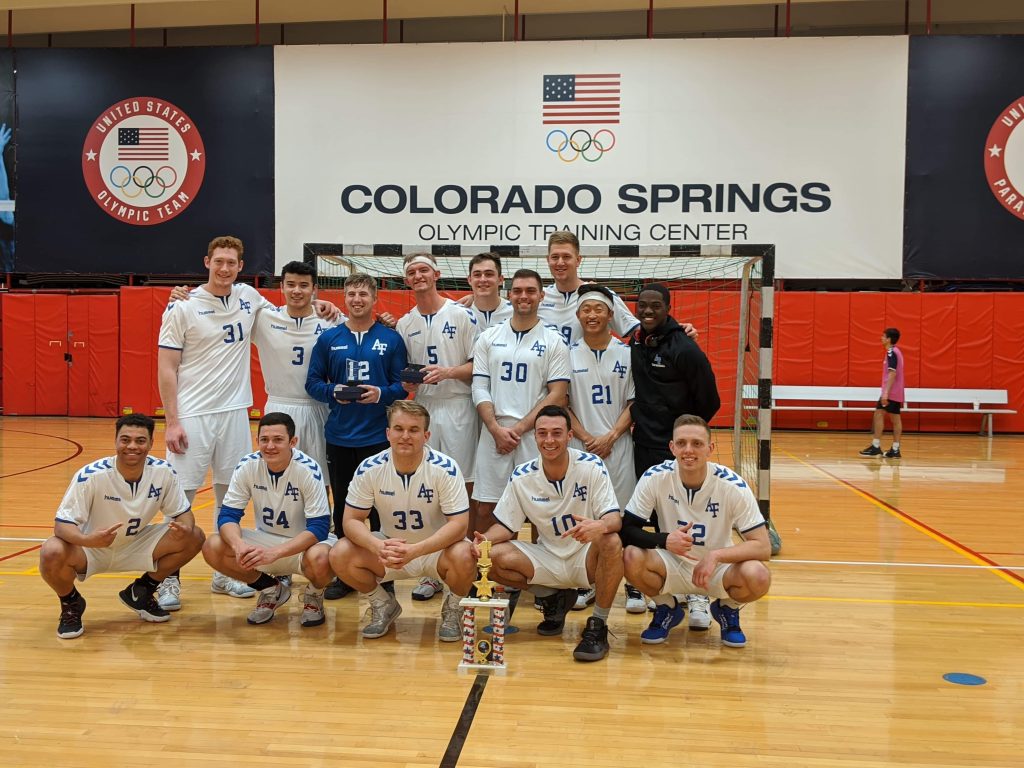
Air Force Knocks Off #2 North Carolina on Way to AF Invitational Title

Air Force on offense vs North Carolina this past weekend at the Olympic Training Center in Colorado Springs.

Air Force and North Carolina met this past Saturday in a key collegiate team handball showdown that will certainly have implications on the Top 5 Collegiate Poll and seeding for the College National Championships.

Coming into the North Carolina was undefeated with an 11-0-0 overall record and a 5-0-0 record in collegiate competition. Winners of the Carolina Blue Cup and a #2 ranking. Meanwhile Air Force had been in and out of the Top 5 and a far less gaudy 2-0-11 record, arguably against tougher competition.

Earlier in the day North Carolina lost to Dallas THC, 29-23, meaning that the pool play match between the two teams would also likely see who would make the championship match.

The match started out competitively with Air Force taking a two goal lead in the first ten minutes. Gradually, though, Air Force started to pull away from Carolina. To stem the tide, North Carolina used a somewhat unique 7 vs 6 attack with GK, Jack Moore leaving the goal and essentially playing center back. This strategy had mixed results offensively and Air Force failed to fully capitalize on several empty net opportunities. Regardless Air Force was able to extend their lead to 12-6, before North Carolina went on a mini 3-1 to close out the half and limit Air Force to 13 – 9 halftime lead.

The second half featured more of the same with Air Force gradually extending their lead and North Carolina never really threatening to get back into the contest. Air Force’s peak lead was 25-15 and the final score was 26-18.

Air Force used a variety of defenses including a pressure man to man defense which prevented North Carolina from ever getting into a comfortable flow. This defense along with an outstanding performance by GK Austin Faulkner limited North Carolina to just 9 goals each half.

Speaking with North Carolina leading scorer, Aaron Hamm, after the match he highlighted that it was a well deserved win by Air Force, but that they missed having their #1 GK Jared Floyd, who couldn’t attend due to a family emergency.

Air Force team captain, Austin Faulkner was pleased with the Air Force performance noting that North Carolina had beaten Air Force last year at College Nationals and the win was a big confidence booster for the club.

Air Force has no more stateside competition prior to College Nationals, but most of the team is headed to the Netherlands over spring break for a training camp.

Air Force Scoring
Nathan Luther 6
Kyle Gruzka 5
Richard Vaughn 5
Quinton Riddle 3
Anthony Sanders 3
Mark Simpson 2
Tevin Miller 1
Brian Brown 1

North Carolina Scoring
Aaron Hamm 8
Philip Schwarte 4
Alex Laws 3
Jack Moore 2
Joe Reinhardt 1

Tournament Results

Pool Play
Air Force 33 – 18 Air Force (2nd Team)
Dallas THC 28 – 20 Salt Lake City
North Carolina 30 – 24 Air Force (2nd Team)
Air Force 34 – 21 Salt Lake City
Dallas THC 29 – 23 North Carolina (Video Excerpt: Link)
Salt Lake City 27 – 26 Air Force (2nd Team)
Air Force 26 – North Carolina 18 (Video Excerpt: Link)
Dallas THC 36 – 22 Air Force (2nd Team)
Air Force – Dallas THC (Not Played)
North Carolina – Salt Lake City (Not Played)

Pool Play Standings

Note: The last 2 pool play matches were not played since they would have been meaningless matches between the same teams that would later meet in the Championship and 3rd place games. Instead a friendly was played between the Air Force 2nd Team and North Carolina’s reserves.

3rd Place
North Carolina 25 – 20 Salt Lake City

1st Place
Air Force 28 – 27 Dallas THC

This was an outstanding back and forth competitive match which saw tournament MVP, Nathan Luther score the decider in the closing seconds. Be sure to check out the video of last 8 minutes of the match: Video 1 Video 2

Awards
Top Scorer: Paul Assfalg: Dallas THC
Most Valuable Goalkeeper: Austin Faulkner
Most Valuable Player: Nathan Luther

Video of Awards Ceremony: Link

Euro 2020 Sports Betting Review and a Few Thoughts on Handball Betting

Amateur vs Pro Bettor…

A Handball Betting Experiment

During the 2020 Men’s European Handball Championships this past January I conducted a little betting experiment with “Samo”, a professional handball bettor from Slovenia. We each started the tournament with 1000 Euros and made a variety of wagers almost every day. My imaginary bank roll of 1,000 Euros took a 115 Euro hit, leaving me with just 885 Euros. Meanwhile, Samo fared considerably better, netting a profit of 860 Euros. That’s a solid return on investment.

Overall, most of our wagers were around 100 Euros. My W-L-D record was 7-8-1 (46.7%) and Samo’s was 12-4-1 (75%). Because we each had several bets that weren’t 50-50 point spreads these percentage don’t tell the whole story, but they tell a story. 50% is about one would get by throwing darts. 75% is doing pretty damn well. Historically, professional bettors are very happy with 55-60 %.

Side Note on My Personal Sports Betting History

Back in the day I was a much more active sports bettor. Frequent trips to Vegas and parents living there accommodated this hobby. For the most part I bet American Football and basketball and bet on the teams I liked when I thought they had a good line. I learned the hard way to never bet on my teams when I thought they would lose. Why? Well, it sucks to root for your team to lose. (I guess if I was more serious about my “hobby” I wouldn’t care.) Anyway, after awhile I decided to meticulously track my wins and losses. And, what did I find out? Well, I found I was right almost exactly half the time. Yes, there was a diminishing sine wave that would start at 60% to 40% and then over time dampen from 55% to 45% and so on.

So, I couldn’t stay above the magical 52.38% (The break even % with the Vegas house cut), but proved to myself that if the wager size didn’t get out of hand, it was pretty decent entertainment that wouldn’t break my bank. And, if you’ve ever been to Vegas during the NCAA basketball tourney with 16 games on Thursday and Friday for 12 hours of non-stop action and hundreds of people cheering, it can be phenomenal entertainment. (Trust me, if that experience is not your bucket list it should be.)

Anyway, the point of this personal history is to make it clear. Done right, there is nothing morally bankrupt about sports betting.

Wrong Handball Betting

Of course, handball betting can also be done wrong… very wrong. And, there can be no more troubling example than the 2012 Montpellier scandal. As new people in the U.S. are always discovering handball they may not be aware that one of the greatest handball players of all time, Nikola Karabatic and his brother Luka were found guilty of being a part of a match fixing scheme. I’m always a bit amazed at how handball can somehow sweep history like this under the rug, but swept it has been for the most part. Even more amazed that the penalties were so minor. Seriously, Shoeless Joe Jackson and Pete Rose would both be in the Hall of Fame if baseball adopted handball’s penalty structures.

Montpellier Scandal: Link 1 Link 2

Evolving Views on Sports Betting and a Way to Help Popularize Handball

For some perspective on the evolving situation check out my commentary from 2008 on sports betting. Yes, 12 years later the times are a changing big time. U.S. leagues are now talking to sports books. They are even signing data partnerships to ensure the integrity of the game. The Las Vegas Knights play in the NHL and the Las Vegas Raiders are joining the NFL. The NBA even wants a cut on sports bets made on NBA games! These moves were almost unthinkable 12 years ago.

Even more dramatic: Sports betting is legal now in 13 states. Christ, there are sports books in Iowa now for crying out loud. And, more and more states are allowing mobile betting from the comfort of your own home.

Further, there are now more interesting ways to bet sports now. The proposition bets on individual players used to be a Super Bowl only opportunity. Now it’s every game… And, even for handball. If you think a certain player is going to struggle to get his goals because the defense a team plays you can bet that. There are a ridiculous number of possibilities.

And, the possibility that handball betting could help popularize the sport in the U.S. shouldn’t be loss on anyone trying to grow the game in this country. During the Xavier O’Callaghan interview with Barstool Sports the subject of gambling on handball came up briefly. And, why wouldn’t they ask that question. The popular sports website is selling a 36% stake in the company ($163M) to sports betting company, Penn National Gaming, with an option to take that stake to 50%. Yes Barstool Sports is well on its way to becoming a gambling company with a website and podcasts.

In the not too distant future could we see the Barstool guys debating the line on Paris SG – Kiel? Or whether Mikkel Hansen will score more than 6.5 goals? Could be. And, make no mistake that could help popularize the game, big time.

My Favorite Handball Bad Beat

ESPN does Sports Center segment where they review the bad beats of the week. The bets you thought you had won only to lose in the end.

Well, watch the closing minutes of the Spain – Croatia match where I had Spain at -2.5 Link (at around 2:00:00 on the efhTV clock)

Two easy chances for Spain to win by 3 and one of those chances foiled by sportsmanship! Well, you know what they say… Losing a close bet is as almost as much entertaining as winning it.

Is the USA Team Handball CEO taking the Side of Jay Cutler and Pardon My Take? With a Few Caveats, It Sure Sounds that Way

USA Team Handball CEO, Barry Siff, on Play Sqorr TV: Is he really taking Jay Cutler’s side in the ongoing controversy? It sure sound like it and why that’s a bit concerning.

The recent remarks by Jay Cutler and others regarding handball being a sport that American athletes from other sports could easily learn and quickly dominate have stirred up a lot of controversy.  On one side is virtually the entire handball world, collectively scoffing at American arrogance and ignorance of the sport they love.  On the other side are Americans who’ve been watching American athletes dominate and perform so well in so many sports.  Let’s take a look at these two viewpoints with some quotes from the past few weeks.

Americans Just Dominate Viewpoint

Here’s a summary of quotes from the “Americans Just Dominate” side:

Jay Cutler, Former NFL QB
(28 January on Pardon My Take: Link)

“I do want to get a team together for the Olympics… I think it’s handball, but it’s basically like a little ball that you throw around and throw into a goal, so it’s like indoor soccer with a ball that you throw.  There’s a U.S. team, but I want to go and do that.  Just throwing missiles….  I guarantee it that we can put a team together to win gold.”

Domonique Foxworth, Former NFL CB
(30 January on ESPN’s Highly Questionable: Link)

“I’m sorry if this is disrespectable to handballers everywhere, but I’ve watched that game before… It’s not like this is soccer and it’s just not a big deal here.  I’m sure handball is a big deal somewhere…. You know who plays handball.  The people who couldn’t make it in soccer, couldn’t make it in football, couldn’t make it in basketball… So, I know it’s completely disrespectful to all handballers out there, but I don’t care… Me, Jay Cutler and Lebron will go win a handball championship”

Dan “Big Cat” Katz, Pardon My Take Host 
(7 February on Pardon My Take: Link)

“I mean it’s 100% true.  No offense to Handballists.  I’m sure you’re very nice people, but you play a sport that if we decided to stop playing all the other sports that that there would be a lot of guys better than what you’re doing.”

“Handball is not easy… It would take 3 months for U.S. pros to train and get acclimated.”

Handball World Viewpoint

And, here are some quotes from the “Handball world” side:

Ty Reed, USA Men’s National Team, Right Wing
(1 Feb on PlaySqorr TV: Link

“They’re very misinformed about the sport and kind of what the possibilities for American athletes are.”

“It’s a great foundation to have basketball, football, baseball; to have those skills, but, handball is a very unique game.  The athleticism isn’t really the problem.  It’s knowing the tactics of the game and making a positive result out of that.”

“You take Jay Cutler, Lebron, Patrick Mahomes, 3 other scrubs that don’t know how to play they’re going to lose by 30 to Argentina.  It’s not even going to be close.”

“They’ve been playing handball since they’re six years old and they know more about the sport than anybody picking the game up in their mid 20’s will ever know, including myself.  It sucks for me.  I’ve been over here 2 years now and I’m a beginner compared to these kids because I just don’t have the knowledge and experience that they do.  Athletically, Americans in general are very much superior to the general European players that are playing handball. The athleticism is not what’s in question.  The tactics and the execution of the game and their knowledge of the game couldn’t be further apart.”

Robert Hedin, USA Men’s National Team Head Coach
(12 February on the Team Handball News Podcast: Link)

“Funny to hear them talking about handball being so easy…  It would be difficult for them to score many goals against a good team.  No chance…”

“For them to score 5 goals in one half… It would be impossible.  Maybe if they had 2 or 3 years of training they could score 5 goals… but 3 or 4 months, no chance.”

“Because it’s not so easy, if you have never played handball…They are looking at it and they see that they are big athletes and good trained guys, but it’s not enough.  Talk about curling.  It’s another sport and it looks easy, but it’s also, really, really difficult.  Respect to every sports.  It’s not just to train for 3 or 4 months and think you can win.  It’s no chance.”

Xavier O’Callaghan, Former Player, Spain and FC Barcelona
(13 February on the Pardon My Take Podcast: Link)

In response to a question about whether Jay Cutler’s take is insane or has a little truth to it.

“He is insane… He cannot win an Olympic medal in 2-3 months… You have the potential to be amazing athletes to play in a high level, but it takes time to be professional (a very good handball player).  So, what I mean.  In the short term it is impossible.  Insane.  In the long term… It takes years. For sure…”

But, in another world, if Cutler was born in Barcelona could he be a professional handball player?

“Of course, and probably one of the best… But, he needs to understand the game. He needs to train every day.  So, it’s a matter of technique.  It’s not just the physical condition.  It’s the technique and the tactics.  You need to read the game.  To know when you have to move.  When to pass the ball.  When you have to shoot.  Those kind of things; you have to learn them.  It’s not a matter of 1, 2, 3 months.”

USA Team Handball CEO, Barry Siff, on the Controversy

Just when I thought the controversy was dying down a bit, USA Team Handball CEO, Barry Siff went on PlaySqorr TV and, to me, it sounded quite a bit like he is taking the side of Jay Cutler, Domonique Foxworth and Pardon My Take. (Minus, the overt arrogance, of course.) Review the quotes below and form your own opinion.

Barry Siff, USA Team Handball CEO
(21 February on PlaySqorr TV: Link

“When we do our tryouts later this year I think we’re going to shock some people in the type of athletes that we’re going bring onto handball and onto our team.”

“I know this is sacrilegious and I’m insulting a lot of people, but I don’t think it takes these 2, 3, 4, 5 years of learning all the nuances and techniques, etc…”

“I don’t think long term that well… I’m only going to be here through Paris, you know.  This is like my last stint of full time stuff.  And, you know, we got to get to Paris.  Long term, we’ve got to be really competitive in L.A., but, my personal goal is to have a team or two in Paris for sure.  And, the way to do that is through getting some of these athletes that we’re talking about.  These high, high caliber athletes starting to play right now.”

Not convinced?  Take a listen to this podcast back from last July

Barry Siff, USA Team Handball CEO
(23 July 2019) Babbitville Radio Podcast:  Link (at 34:45)

“The concept that I had in 2016 was to have a kind of Netflix, 30 for 30, whatever it is documentary building the next great America sport.  What we were going to do was track going out and having tryouts in New York, in LA, San Francisco and Chicago.  Having tryouts; bringing these athletes…”

“Our vision was let’s document building this team from scratch.  We were going to go out and get football players, basketball players, water polo players.  We were going to quietly build this team and then we were going to challenge USA Team Handball to a match.  Winner take all.  We win:  We take over the federation.  You win: We walk.”

“That was the idea.  I thought it was a brilliant…  We ran into political complications, you know, some other matters and we walked away from it.  But, I still feel that way.  I still feel like we can go out and we can make this media project that will bring interest to the sport.  We’ve got to get eyeballs. We’ve got to get people to see the sport.”

To me, as described, this proposed “challenge match” sounds remarkably similar to the Pardon My Take challenge. Again, form your own opinion.

Side Note:  The documentary concept also seems to be very similar to the Reality TV show concept that was discussed with USA Team Handball at around the same time in 2016.

Transfer Athletes to Handball?:  It can be done… with caveats

It’s pretty hard for me to be an objective neutral in this debate.  As someone who started playing handball at age 19 and only obtained a modest level of performance I’ve experienced firsthand how hard it is.  And, I’ve also seen how hard it is for athletes way more physically gifted than me.  Finally, I have spent an inordinate amount of time and energy assessing this very topic from virtually every possible angle.  Link 1  Link 2  Link 3 Link 4 Link 5 Link 6 Link 7

In short, the right question is not, “Can it be done?”  Actually, if you listen to the full interviews everyone on both sides thinks it can be done.  They just disagree on how long such a transition would take.  On one extreme is the viewpoint that it can done with a couple of months of training.  On the other extreme is that is takes 10 years and pretty much has to be done starting at age 15 or so.  And, the answer is further muddled by varying discussion as to what level of performance would be achieved.  (e.g. winning a gold medal to just needing to be able to beat Argentina and Brazil in a few years.

No, the right question is “Should it be done?”  And, that question can only be properly considered after asking and answering a lot of questions related to the specifics of the proposed talent transfer focused effort being planned.  Such questions like:

  • How long will it take?
  • How much will it cost?
  • What raw talent level of athlete is being targeted?
  • What are the target ages for those athletes?
  • What are the overall goals of such a short term focused effort? (How many athletes?  What level are those athletes expected to achieve?)
  • What is the likelihood that such goals will be achieved as a result of this effort?
  • What are the opportunity costs in terms of lost grass roots development?

Perhaps, all of these questions (and more) are indeed being asked and answered.  All, I know is that if the plan is to take athletes from scratch to World Class in 3 years (i.e.; in time to meaningfully contribute to 2024 Olympic Qualification at the 2023 PANAM Games) it’s not going to being easy or cheap.  My back of the envelope analysis is that probably the only way it could make sense would be for a reality TV show or a privately financed Pro League to pay for almost all or most of the costs.

Big Picture

If you’re like me, you are genuinely optimistic about USA Team Handball’s future thanks to recent developments like the Verizon Sponsorship, hiring of IPG 360 for additional promotion and the placement of U.S. players with top club teams in Europe.  CEO Barry Siff has also sure brought some positive “can do” attitude to USA Team Handball.  

But… positive “can do” attitude can only take you so far.  Unless sponsorship will soon exceed my wildest dreams USA Team Handball is still very resource constrained.  It just doesn’t seem practical at this point in time to start a major talent transfer effort.  Not when there are so many other worthy needs competing for resources.

Then again, I could be wrong.  I haven’t finished my assessment yet.  For sure, I’ll be tackling these sorts of questions in more detail as I work on the “what we want” section of this series: Link

Charting a Way Forward for USA Team Handball (2019 Reboot): Introduction