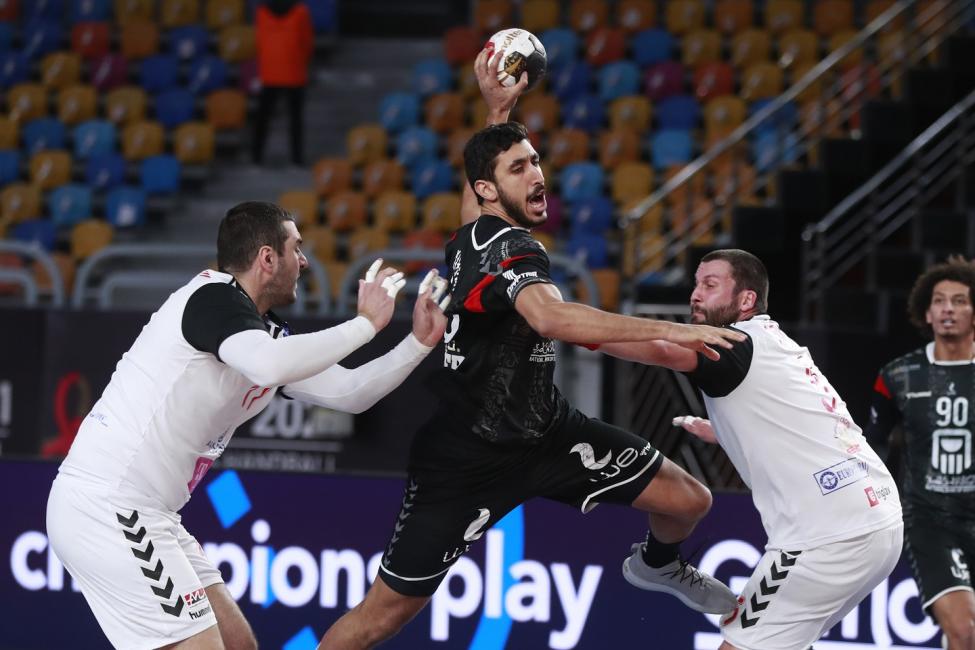
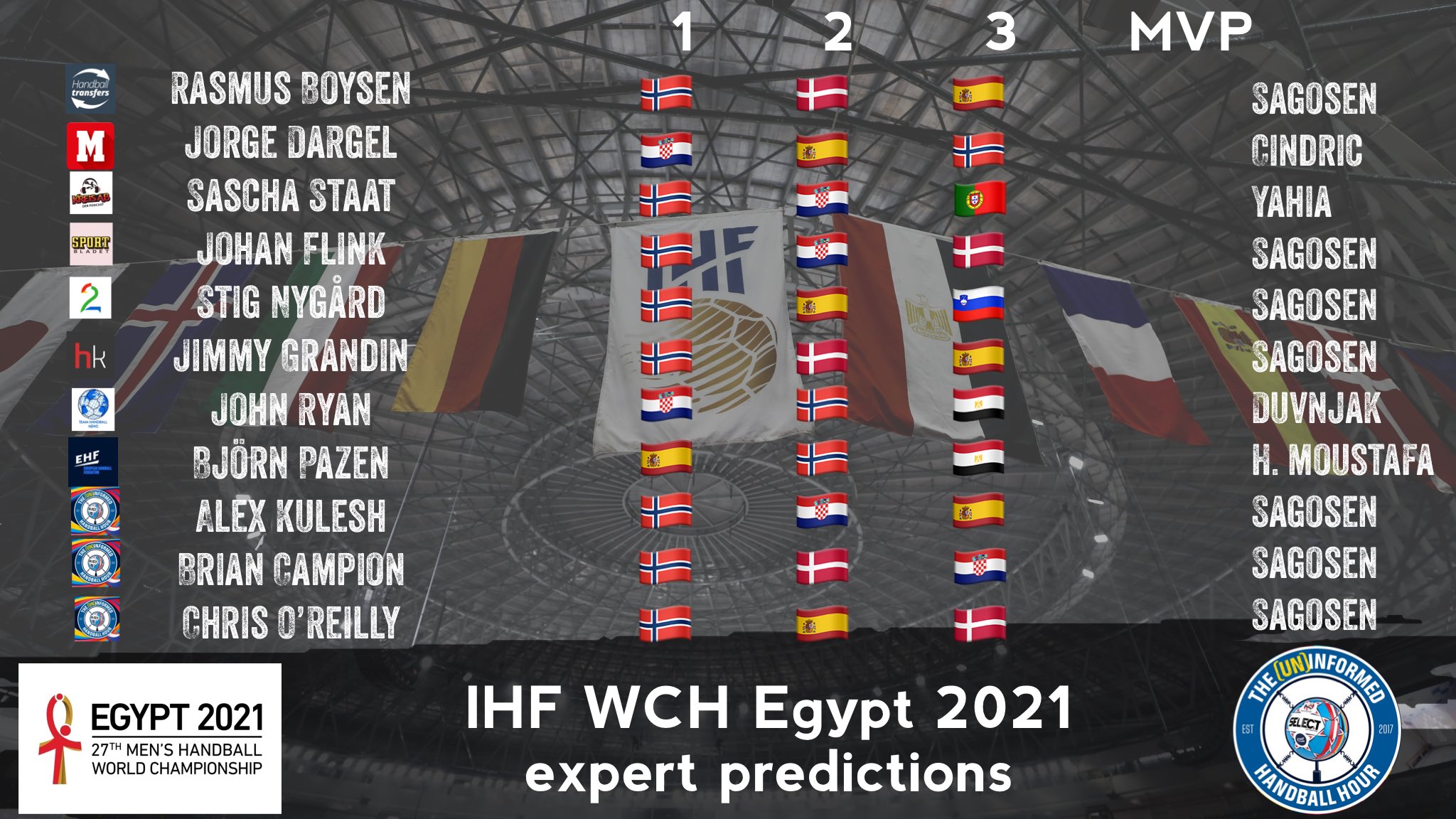
Are Yahia Omar and Egypt legit contenders? I think they are. We’ll know more later today when they take on Sweden.
All times are Egypt Local (CET is 1 hr behind; US ET is 7 hrs behind) Odds courtesy of Bet MGM or the Bet Rivers online sportsbooks.
If you want to watch the matches that aren’t available on ESPN+ check this article for how to watch geo-blocked matches on YouTube: Link
Group E
1900 Switzerland vs France (-6.5) (on ESPN+) (YouTube) w/English commentary
2130 Norway (-8.5) vs Austria (on ESPN+) (YouTube) w/English commentary
France is undefeated and has already qualified for the Main Round, but Switzerland is also likely through so this match result will carry through to the Main Round. Austria has yet to win a match, but a big upset vs Norway would probably qualify them for the Main Round.
The situation in Group F is identical Group E. Portugal is undefeated and has already qualified for the Main Round, but Algeria is also like through, thanks to their earlier come from behind defeat of Morocco. But, theoretically, Morocco could still qualify if they pull off a big upset over Iceland.
Group G is really straightforward. Chile and N Macedonia will play for third place in the Group with the winner moving on and the loser headed to the President’s Cup. (Chile will also advance with a draw). Egypt and Sweden will play for 2 pts that could be absolutely critical in the final Main Round standings.
Undefeated Russia should have no problem with a S Korean team destined for the President’s Cup while Slovenia and Belarus will play for 2 points in the Main Round.
Betting Predictions
For this tournament we’ve doing some betting predictions using an imaginary starting bankroll of a 1,000 Euros. Joining me will be, Sharp Action, a former professional handball player from France.
Odds are either from the Bet MGM or the Bet Rivers online sportsbooks.
John’s Pick(s):
Current Bankroll: $1,023
Yesterday’s Result: DR Congo’s Gauthier Mvumbi Prop Bet
Gauthier Mvumbi to score +2.5 goals (+123 or 2.23; Bet $100 to win $123); RESULT: Win; El Gigante came through with 4 goals yesterday vs Denmark
Today’s Pick: Egypt vs Sweden
Egypt (-1.5) (+110 or 2.1); Bet $100 to win $110
Egypt looked a little shaky in their first match vs Chile (winning by only 6, but blew out N Macedonia by 19. Sweden has been more steady, beating Chile by 15 and N Macedonia by 12. So, they each have taken care of weaker opposition and this is the first tough match for both teams. And, actually this match might even be a Main Round Group IV decider as Group H doesn’t look particularly strong to me. With so much on the line I just can’t see the hosts losing this one or it coming down to the wire.
Sharp Action’s Pick(s):
Current Bankroll: 1,155 Dollars
Yesterday’s Results: N/A
Qatar vs Japan: 1st half money line; Japan to lead at halftime (+155 or 2.55); Bet $100 to win $155; RESULT: Win; Japan led 16-15 at the break.
Today’s Pick: Algeria vs Portugal
Portugal over 31.5 goals (-117 or 1.85) Bet $50 to win $42.50.
I think it will be hard for Algeria to stop Portugal’s offensive firepower. Morocco’s GK Idrissi slowed Portugal down for 30 minutes, but it’s hard to see Algeria’s GK getting a similar performance. Also, both teams like to play fast breaks and push a higher pace.
Would you look like regular reminders of great handball web streaming options all season long? Quick alerts on matches that pop up on line?
Due to positive COVID tests Cape Verde had only having 9 players available so their match vs Germany was declared a forfeit. Cape Verde is hoping to get some negative test results and to fly in some more players in time to play Uruguay on Tuesday. Tuesday’s matches (Germany vs Hungary) and (Cape Verde vs Uruguay) will be the deciders for this Group.
Group B, as predicted, is very competitive. On Friday, Spain and Brazil played to a 29-29 draw while Poland beat Tunisia 30-28. Tunisia will likely need a win vs Brazil today if they want to go through to the main round. Spain will look to get 2 points vs a young Poland team.
Japan’s draw 29-29 draw vs Croatia is arguably the biggest shock of the tournament so far and sets up a pivotal game vs Qatar today. Croatia should have no problem with Angola today, but they just received some bad news on the injury front as Luka Cindric is out for the tournament with a groin injury
Group D
1900 Argentina (-2.5) vs Bahrain (on ESPN+) (YouTube) w/English commentary
2130 Denmark (-18.5) vs DR Congo (on ESPN+) (YouTube) w/English commentary
Argentina and Bahrain square off in a match that, on paper, should determine 2nd place in the group. Denmark should have no problem with the DR Congo, but fans still will want to tune in to see Congo’s Gauthier Mvumbi, who has become the cult hero of the tournament.
Betting Predictions
For this tournament we’ve doing some betting predictions using an imaginary starting bankroll of a 1,000 Euros. Joining me will be, Sharp Action, a former professional handball player from France.
Odds are either from the Bet MGM or the Bet Rivers online sportsbooks.
John’s Pick(s):
Current Bankroll: $900
Yesterday’s Result:
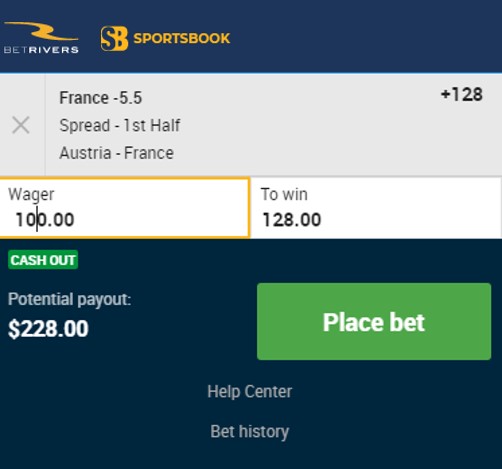
1st half handicap; France (-5.5) (+128 or 2.28); Bet $100 to win $128; RESULT: France led by only 4, 17-13; Lose $100
Today’s Pick: DR Congo’s Gauthier Mvumbi Prop Bet
Gauthier Mvumbi to score +2.5 goals (+123 or 2.23; Bet $100 to win $123
I had no intention whatsoever to make a wager today… but, then I saw this prop bet and couldn’t resist. Mvumbi was 4 for 4 vs Argentina in limited action and has now become an internet sensation. He’s surely going to get more playing time today and should have more opportunities to score. Denmark has also seen the videos and may pay him extra attention… but, so what? You can’t stop El Gigante. You can only hope to contain him.
Sharp Action’s Pick(s):
Current Bankroll: 1,000 Dollars
Yesterday’s Results: N/A
Today’s Pick: Qatar vs Japan
1st half money line; Japan to lead at halftime (+155 or 2.55); Bet $100 to win $155
I was impressed with Japan’s performance vs Croatia, even if Croatia’s level of handball and motivation was super low in that match. Japane played a simple but very efficient handball and were well prepared by Sigurdsson. They played at a high rhythm for 30 minutes and pushed fast breaks anytime they could, scoring 17 goals in that 1st half. Qatar on the other hand started slowly vs Angola with no clear game plan in attack, which lead to turnovers. I also noticed that Qatar didn’t always come back fast enough in defense. If they repeat this, Japan has a very good chance to be ahead at HT. +155 or 2.55 odds says that there is a 40% implied probability for Japan to be ahead at half time. I see it as a 50 50 at best, so I’m more than happy to take Japan at these odds.
Betting Prediction: I like France to put up a big half time lead vs Austria. We’ll see if my bankroll gets off to a good start.
All times are Egypt Local (CET is 1 hr behind; US ET is 7 hrs behind) Odds courtesy of Bet MGM
If you want to watch the matches that aren’t available on ESPN+ check this article for how to watch geo-blocked matches on YouTube: Link
Group E
1900 Austria vs France (-9.5) (on ESPN+) (YouTube) w/English commentary
2130 Norway (-7.5) vs Switzerland (on ESPN+) (YouTube) w/English commentary
The first matches for this group saw the two favorites play each other with France beating Norway, 28-24. Now the remaining matches we’ll see if either Switzerland or Austria can pick off a win against them. Switzerland beat Austria, 28-25, so they have a leg up in qualifying for the Main Round
Just like Group E, Group F saw the two favorites play each other last time around, with Portugal winning 25-23. Algeria staged a major comeback to beat Morocco 24-23, so they have the advantage in terms of advancing. This means that the Algeria – Iceland result will likely carry forward to the Main Round.
Egypt won their opening match vs Chile while N Macedonia was beaten handily by Sweden 32-20. If N Macedonia wants to take any points into the Main Round they’ll need to pull an upset vs the hosts today. Sweden are big favorites over a Chile team that put up a decent fight vs Egypt.
With S. Korea sending a B Team to this tournament it’s all but decided that Belarus, Slovenia and Russia are through to the Main Round. Belarus and Russia played to a 32-32 draw, so they each have 1 point. Slovenia and Russia will play what amounts to a de facto Main Round match while Belarus will have a scrimmage practice vs S. Korea.
Betting Predictions
For this tournament we’ve doing some betting predictions using an imaginary starting bankroll of a 1,000 Euros. Joining me will be, Sharp Action, a former professional handball player from France.
Odds are either from the Bet MGM or the Bet Rivers online sportsbooks.
John’s Pick(s):
Current Bankroll: $1,000
Yesterday’s Result: N/A
Today’s Pick: France vs Austria
1st half handicap; France (-5.5) (+128 or 2.28); Bet $100 to win $128
France shook off 2 disappointing results vs Serbia in European qualification play and put everything together for an impressive 28-24 win over Norway on the first day. But, France being France, will everything fall apart once again? Against a weaker foe, not too dissimilar to Serbia? I say nope… They may indeed go back to their old ways later in the tournament, but they won’t have any problems scoring early and often against an Austrian team that won’t be able to handle them one on one. Further compounding Austria’s problems will be their lack of backcourt scoring against France’s middle defense. France should cruise to a big first half lead much the way Germany did in Euro Qualification. I’m not saying France will lead 19-5 at the break like Germany did, but such a result wouldn’t totally shock me. In the 2nd half, however, with the game in hand, I’m not so sure as to what will happen in a game that will likely have no bearing in the Main Round. Hence, the first half bet.
Not much to say about these opening matches in Group A as they should both be uninteresting blowouts. Cape Verde might have been interesting to watch, but due to COVID their roster has been significantly weakened. To what extent is a bit of a mystery so a betting line hasn’t been posted.
Group B, on the other hand, is the most interesting Group in the tournament. Spain is the favored team in this group, but they will be pushed by the other teams.
Angola upset Qatar 2 years ago with a 24-23 win that essentially kept Qatar from going to the main round. This Qatar team isn’t as “beefed” up as it used to be, but they are still probably the 2nd best team in the group. Olympic hosts Japan takes on Croatia in the night cap.
Group D
1900 Argentina (-9.5) vs DR Congo (on ESPN+) (YouTube) w/English commentary
2130 Denmark (-9.5) vs Bahrain (on ESPN+) (YouTube) w/English commentary
Group D will be the featured group for ESPN+ viewers and the two group favorites take on the underdogs today. The IHF has reported a positive COVID test on the Danish team, and Danish sources report it is Emil Jakobsen.
Two great matches today as the Handball World Championships really get going.
All times are Egypt Local (CET is 1 hr behind; US ET is 7 hrs behind) Odds courtesy of Bet MGM
NOTE: Breaking News: ESPN+ will be airing two matches/day for the remainder of the tournament.
If you want to watch the matches that aren’t available on ESPN+ check this article for how to watch geo-blocked matches on YouTube: Link
Group E
1900 Austria vs Switzerland (-1.5) (on ESPN+) (YouTube) w/English commentary
2130 Norway (-1.5) vs France (on ESPN+) (YouTube) w/English commentary
The first match would have been Austria vs Team USA (sigh). The second match is the match of the day; Maybe the match of the entire preliminary round. France played Serbia twice in Euro 2020 qualification, losing the first match 27-24 and drawing the second 26-26. Both matches, needless to say were lackluster performances. Will they wake up for this showdown vs Norway?
Algeria and Morocco play in a match that will likely decides who advances to the Main Round. Portugal and Iceland play for the 3rd time in just 9 days as by coincidence they are also in the same Euro 2022 Qualification Group. Portugal won the first match in Portugal 26-24 while Iceland won the return leg 32-23. Iceland was actually down 12-13 at the half, but dominated the 2nd half by a 20-10 score. Can this momentum carry over for this third match?
Egypt won their opening match over Chile yesterday. Sweden and N Macedonia look to join them with 2 points. N Macedonia’s late entry means that 40 year old Kiril Lazarov will get the opportunity to play in 2 World Championships hosted by Egypt. Yes, he was there for the 1999 edition, I wonder how many retired players feel a little bit younger when they see him play and realize there’s still somebody around that they can say, “Yeah, I played against him.”
Belarus and Russia clash in a match with no political ramifications. Slovenia should have no problem with S. Korea especially now that I’ve just found out that they’ve sent their B Team to the World Championships.
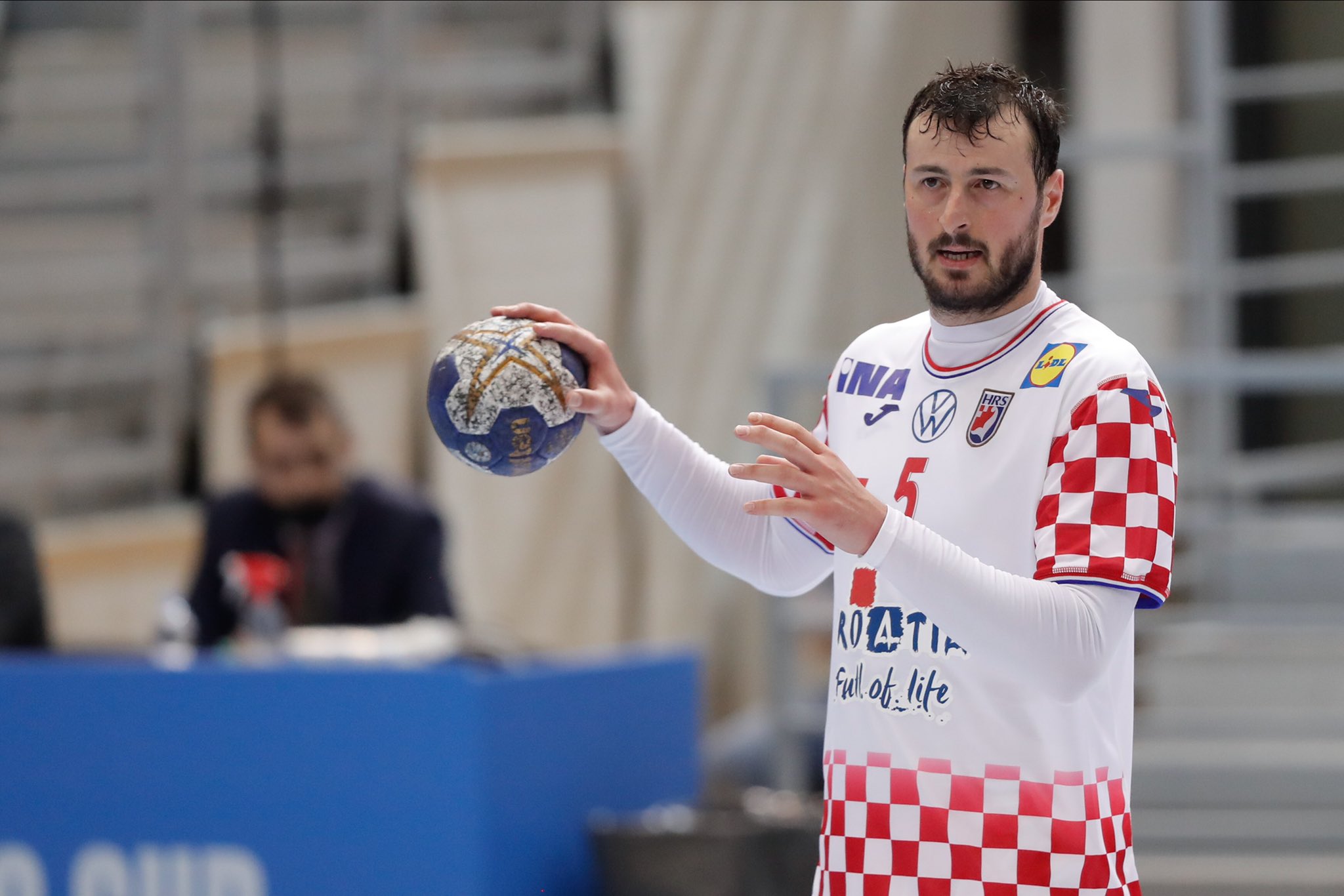
Croatia: Runners Up at the 2020 Euros they are my pick to win the title. They looked solid last week vs Spain, a 31-28 victory, despite missing some key players who should be back in time for the Main Round.
The 2021 IHF Men’s World Championships start today (Wednesday, 13 January) in Egypt. Here’s some info on how to watch, what the odds are, some links to previews and a few predictions on who will in it all.
How to Watch
How you watch the World Championship will depend on where you live and whether there is a TV contract there.
USA Web Streaming: In the U.S., ESPN reportedly will broadcast 31 matches on its streaming platform ESPN+. ESPN+ is available via several streaming platforms like Roku and Amazon Fire. However, the announcement regarding ESPN+ has been removed from the USA Team Handball website and ESPN+ has not updated their schedule to include handball matches. (I’ve been told that this is just a temporary development and I will update when I hear more.)
IHF 2021 Men’s WC YouTube Page: Link The IHF will be web streaming every match on YouTube, but these matches won’t be available if your country has a TV contract. This article lists every country that has a TV contract.
Pirated Web Streams: Of course, there are other options available. As sure as the sun comes up tomorrow there will be dubious websites offering live streams of marginal quality. I wouldn’t recommend downloading anything from these sites or paying them anything.
IHF YouTube Site (with VPN): One can also use a VPN service and login from a nation without a TV contract to access the IHF stream. I personally use VPN Nord, but there are other options available. Using VPN is not an ideal solution and I prefer to watch via a paid service like ESPN+. It doesn’t cost that much and you get a more reliable picture. But, if I can’t pay to watch… I don’t feel very guilty about using VPN. And, since some WC matches won’t be available via ESPN+ I will be using VPN to watch them. For more on how to use VPN read this article: Link
For the preliminary round the match schedule typically has 1 late afternoon match, 4 early evening matches and 3 later evening matches. In the U.S. the timing of those 3 viewing opportunities are 9:30 AM, 12:00 PM and 2:30 PM (US ET).
Tourney Format: The preliminary round consists of 8 groups of 4 nations. The top 3 of each preliminary group advances to the Main Round. Groups A and B form Main Round Group I, while Groups C and D form MR Group II, Groups E and F form MR Group III Matches and Groups G and H form MR Group IV. 4th place teams will play in the President’s Cup. Matches from the Preliminary Round (among advancing nations) also count in the Main Round. The top 2 teams from each Main Round Group will then advance to the Quarterfinals.
Preliminary Groups A and B / Main Round Group I
In Group A Germany and Hungary are the clear favorites while Cape Verde and Uruguay should battle for 3rd place. Spain is the big favorite in Group B while Brazil, Tunisia and Poland are relatively even and will battle for the other two slots. For a more in-depth preview check out Chris O’Reilly’s Group A preview at Stregspiller.com.
Spain is all a big favorite to win Group I while Germany and Hungary are expected to battle for 2nd place. Germany’s roster is missing several athletes that chose to not attend the Championship and it will be interesting to see how their replacements perform. Brazil is an outsider, but has been known to surprise in the past. A key factor, however, may be how much COVID has impacted their roster.
Preliminary Groups C and D / Main Round Group II
Croatia and Denmark are big favorites in Group C and D, respectively. I won’t be surprised, though, if Japan knocks off Qatar. With the Olympics coming up, I think Japan has extra motivation to be ready for this tournament. In Group D, I also see Bahrain as capable of beating Argentina.
Really hard not to see Denmark and Croatia advancing in this Group and I like Croatia to also beat Denmark, but that may depend on whether Karacic is healthy by the 2nd week of the tournament.
Preliminary Groups E and F / Main Round Group III
Both these Groups have 2 favorites and 2 outsiders. The favorites will battle for points to take into the main round, while the outsiders fight to avoid the President’s Cup. The Norway – France match starts the competition and could decide who wins Main Round Group III.
I like Norway to win this Group, but I won’t be shocked if France loses to Portugal which has their number in recent tournaments. The only thing that has me guessing is Portugal’s recent defeat to an Iceland team without Aron Palmarsson. It might well be a 3 way between those teams (France, Portugal and Iceland battling for that 2nd QF slot.
Preliminary Groups G nd H / Main Round Group IV
In Group G, it’s hard not to see Egypt winning, but I think late entry N Macedonia can pip Sweden for 2nd place. Sweden is the big favorite in Group H, but I think it’s actually a 3 way fight for the other 2 spots. Yes, S Korea could surprise here. They still have a chance to qualify for the Tokyo Olympics and they may be more ready than other teams because of that.
Egypt didn’t look particularly impressive in their opening match vs Chile, but I still think that hosting the tournament gives them the edge here. I also think Slovenia, which seems to be pretty healthy will join them in the Quarter Finals.
Odds to Win the Championship
Previews and Predictions
(Un)Informed Handball Hour Podcast (Part 1: Hipster Teams): Link
(Un)Informed Handball Hour Podcast (Part 2: Main Teams): Link
Team Handball News Podcast (Betting Focused Review): Link
Did I really think that the USA could beat Austria? Yeah, I did (with caveats)
Toma Rimac, joins the podcast and we take a deep dive into the betting odds for the upcoming Handball World Championships. This is a little bit different from your typical preview show as what might be a good bet is often different from predicting who will win. (Important Note: This podcast was recorded prior to all the COVID related developments on 12 January)
ESPN Broadcasting Handball in the U.S. Our handball world is about to change.
Yesterday, USA Team Handball announced that 31 matches of the upcoming IHF Handball World Championships will be broadcast on ESPN+, ESPN’s streaming platform. Pretty big news… Right? Actually, no, it’s not just “big” news.
In fact, It it the biggest and most important development in the entire history of team handball in the United States.
Long time readers of this website shouldn’t be surprised by my hyperbolic statement as I’ve been saying this in one way or another for years. Why friends will know that I’ve been espousing the critical need for more handball on TV since the late 1980s.
Most prominently, I’ve stated the following prediction several times: If handball were to be broadcast on a regular basis on a network like ESPN, virtually every statement discussing handball’s progress in the U.S. from that point forward would start with these words:
“Well, after handball started being shown on ESPN…”
Pick how you want to finish the sentence. Here are some possibilities:
Collegiate handball really took off with an expansion to several hundred clubs
Youth programs expanded in several cities feeding the collegiate programs
USA Team Handball had year on year membership growth of xx%; Along with accompanying increases in website visits and social media engagement
Merchandise sales of professional handball clubs in Europe gradually increased as more Americans became fans of the game
The quality of stateside play improved dramatically
The level of stateside talent making our national teams starting improving
One Marketing Objective Above All Others
As I highlighted in this commentary from last year getting more handball on TV more trumps all other marketing objectives for the sport… because it’s a true force multiplier that greatly improves the likelihood of better results in all other areas.
So after many years of frustration why are we finally celebrating such big news? As with many great successes it’s the result of a combination of things.
Better European Engagement: For starters the Europeans and the IHF have finally recognized the need for an American market and are starting to put some resources in place to make it happen. The handball world can bemoan the granting of a wild card to a USA team, but actual USA participation in the WC made it a more attractive TV product to ESPN.
Education on Finding the Right Network: Over time, through a variety of means, the key handball content owners now fully understand that not “just any ol’ network” will do for the U.S. market.
Better engagement from USA Team Handball: While I would have liked to have seen action sooner, I’ll just say I’m real pleased that it’s now taken place. Hats off to new CEO, Ryan Johnson, for helping to facilitate the finalization of this deal. In his first week on the job, no less.
Luck: Behind the scenes some connections were made that facilitated making this deal happen. And, most importantly, that good fortune was capitalized upon.
The Great Experiment Begins
So, will my prediction come true? Will every statement about handball in American now begin with a qualifier about whether is was before or after ESPN started broadcasting the sport?
Time will tell, but I’ve never ever been more optimistic about the future of the sport in this country.
Previous Articles/Commentary about Getting More Handball on TV in the U.S.
Why weren’t the U.S. National Teams at the London Olympics?:
Sep 2012: Part 5: A lack of awareness and marketing: One in a million? The 312 real fans of Team Handball in the U.S.: Link
Oct 2012: Part 6: A lack of awareness and marketing: The Catch 22 TV paradox: Link
Dec 2012: Part 7: A lack of awareness and marketing: The historic lack of European support: Link
Dec 2012: Part 8: A lack of awareness and marketing: Europe sees the light, but can’t quite figure out how to properly invade the U.S. market: Link
Dec 2015: 20 Team Handball Matches have been Broadcast the Past 2 Weeks on a U.S. TV Network: Few Know, Fewer Watch and No One Seems to Care: Link
Aug 2016: The Olympics are Over. Thanks for Watching. See you in 2020. How about Sooner?: Link
Feb 2020: ESPN Missed out on the English Premier League: Will they Miss the Boat for Handball Too?: Link
Everybody loves ehfTV… Just like Team USA this weekend you can check out preliminary group opponents France and Austria.
More 2022 European Championship qualification matches scheduled for ehfTV this weekend. Plus, quite a few Women’s club matches as well.
2022 European Handball Championships Qualification Wikipedia page: Link
All matches are at ehfTV All times are CET (CET is 6 hrs ahead of US ET) Odds courtesy of Bet MGM
Friday, 8 January
1815 CET Norway (-6.5) vs Belarus (Don’t be fooled by this betting line. Norway’s emergency squad lost to Belarus. 33-25 earlier in the week, but now Belarus isn’t sending the first team to Norway for the 2nd match.
Saturday, 9 January
1800 CET Spain (-1.5) vs Croatia (Unfortunately, postponed) 1900 CET France (-6.5) vs Serbia (I’m thinking there’s a Team USA watch party in Denmark for this one) 2000 CET Poland (-6.5) vs Turkey
Sunday, 10 January
1410 CET Latvia (-1.5) vs Italy 1700 CET Iceland (-1.5) vs Portugal 1810 CET Germany (-7.5) vs Austria (I’m thinking there’s a Team USA watch party in Denmark for this one) 2000 CET Bosnia & Hercegovina (-5.5) vs Estonia 2000 CET Slovenia (-8.5) vs Netherlands
American Athletes in Action
The U.S. Men’s National Team is in Denmark and will be playing friendlies vs Danish club teams. If any of these matches are available for viewing I will post web streaming links here.
Is the U.S. winless in World Handball Championship Competition? Maybe. It depends if you want to count B World Championships.
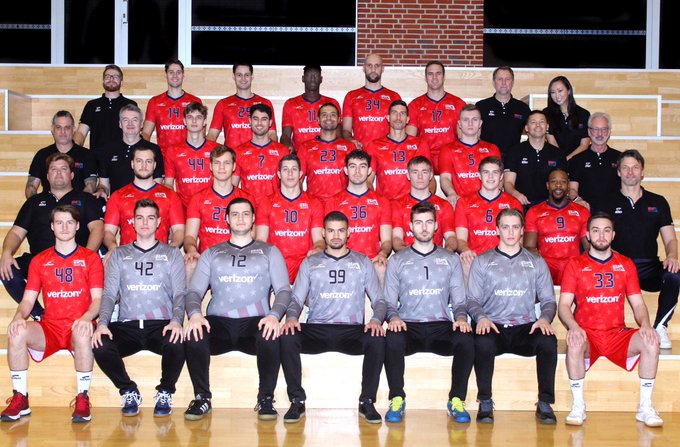
Next week the USA Men’s National Team will take part in the IHF Men’s Handball World Championship. It’s been 20 years since the U.S. last appeared in a Sr World’s Championships and the questions that keep cropping up are:
How well did the U.S. do in previous World Championships?
What’s the U.S. record in previous World Championships?
The short answer to the first question is “not very well,” but, the long answer is a bit more complicated due to the changes in the qualification paths, the number of participants and the competition formats the IHF has implemented since the first indoor championship was held in 1938. And, the answer to the second question is open for debate depending on what you count as a World Championship. The discussion below should help explain why answering these questions aren’t as simple as you might think they would be.
Changes in Qualification Paths (A, B and C World Championships)
Notwithstanding the complications COVID has caused with qualification for the 2021 World Championships, qualification for the World Championships is now fairly straight forward. Various continental federations are awarded a number of slots and continental championships are held to determine which nations will qualify for the final tournament.
But, this was not always the case. In fact, from 1976 to 1992 the IHF organized 3 separate World Championships designated as A, B and C World Championships. As you might assume the A Championship was for the top teams and the B and C Championships featured lower level teams. And, much like a European league there was relegation and promotion between the different championships. If one looks back at the nations participating in these various tournaments it’s not entirely clear how nations qualified for the different tournaments. The C World Championships just featured European teams and the same was true with the B World Championships until 1985 when nations from other parts of the world were added.
Presumably, the idea was to give nations like the U.S. an opportunity to get some quality competition on the world stage since only one nation from Pan America qualified for the A Championships. As you might expect the competition in B tournaments was a bit easier and this is reflected with the 6-0-14 record the U.S. compiled with its 3 participations in 1985, 1987 and 1992. Certainly better than the 0-0-25 goose eggs the U.S. has for its six A World Championship appearances.
Changes in the Nations Participating
It also should be noted that the number of participating nations has grown over the years. From 1964 to 1993, A World Championships featured 16 teams. From 1993 to 2019 the field consisted of 24 teams. And, 2021 will be the first time 32 teams will participate. In general, the fewer teams that participate in a World Championships, the stronger the overall field is.
Making the 16 team tournaments even more challenging was the inclusion of just one team from Africa, Asia and the Americas. It’s no real surprise that the U.S. failed to get a win in 1964, 1970, 1974 and 1993 against the European teams playing in these tournaments. I am a little surprised, however, that the U.S. couldn’t get a win vs an Asian side during these tournaments.
When the tournament was expanded to 24 teams that also should have given the U.S. a win or two, particularly at the 1995 WC just a year prior to the 96 Olympics where the U.S. picked up 2 wins and was fairly competitive against the European teams. Not sure what happened there… Although I did find out recently that Darrick Heath did not participate due to a contractual commitment with his club that precluded his fully participating in a National Team training camp. The 2001 WC was simply an overmatched team and they were undoubtedly the weakest team in that 24 team field.
Changes in Format
The final reason the U.S. hasn’t picked off a win at a World Championship yet is that with the exception of the 1993 tournament they’ve never played in a consolation or President’s Cup round. With the President’s Cup there are multiple matches against other teams that fail to make the Main Round and only the last place team goes home without a win. I could be wrong, but I don’t think the U.S. was the very worst team at every tournament they played in. If the President’s Cup format had been in place the U.S. in some of the earlier tournaments the U.S. would have picked off a win somewhere.
Should the B World Championship Matches Count?
Well, there are a couple of ways to look at this. One way is to go with the semantics of if you’re going to call something a “World Championship” then a win there counts. The counter to that argument is the “B” classification in front of it… As in, sorry, you’re not playing with the big boys, therefore it doesn’t count.
I tend to side with the latter argument. Yes, those B World Championships weren’t as weak as the “B” designation would seem to make it, but they were still “the little kid’s table” at Thanksgiving.
That’s not to say that those wins at the B World Championships are meaningless. On the contrary, they are documented proof that U.S. teams back in the 80s and 90s had a measure of respectability. We were clearly better than 3rd tier European sides, could beat 2nd tier European teams, and on a good day give the top teams in the world a bit of a scare. If one looks at the score lines at the 1985 B World Championships the U.S. was competitive in every match. Even played the 2nd half to a draw with the eventual tournament winner, E Germany.
These results suggest that the 85 B WC was the best ever U.S. performance and that the 1995 WC was the best “A” World Championship performance.
As one looks ahead to the 2021 campaign, one can hope for a similar distinction: A measure of respectability against the really good teams and hopefully a couple of wins in the President’s Cup against similar sides trying to prove themselves. And, probably most importantly, real signs of promise as to even better performances at future World Championships leading up to the 2028 Olympics.
Every World Championship Match the U.S. Has Played in
Here’s a compilation of every World Championship the U.S. has participated in and the score from every match played.
IHF Competition Archive: Link (PDF with all competitions through 2009)
1963 Men’s Outdoor Field Handball World Championship (Switzerland)
The IHF staged one more Outdoor Field Handball World Championship in 1966 and then discontinued the tournament. The 1963 Championship was the only outdoor world championship that the U.S. particiated in.
1964 Men’s Handball World Championship (Czechoslovakia)
Euro 2022 Qualification matches available for viewing on ehfTV this week.
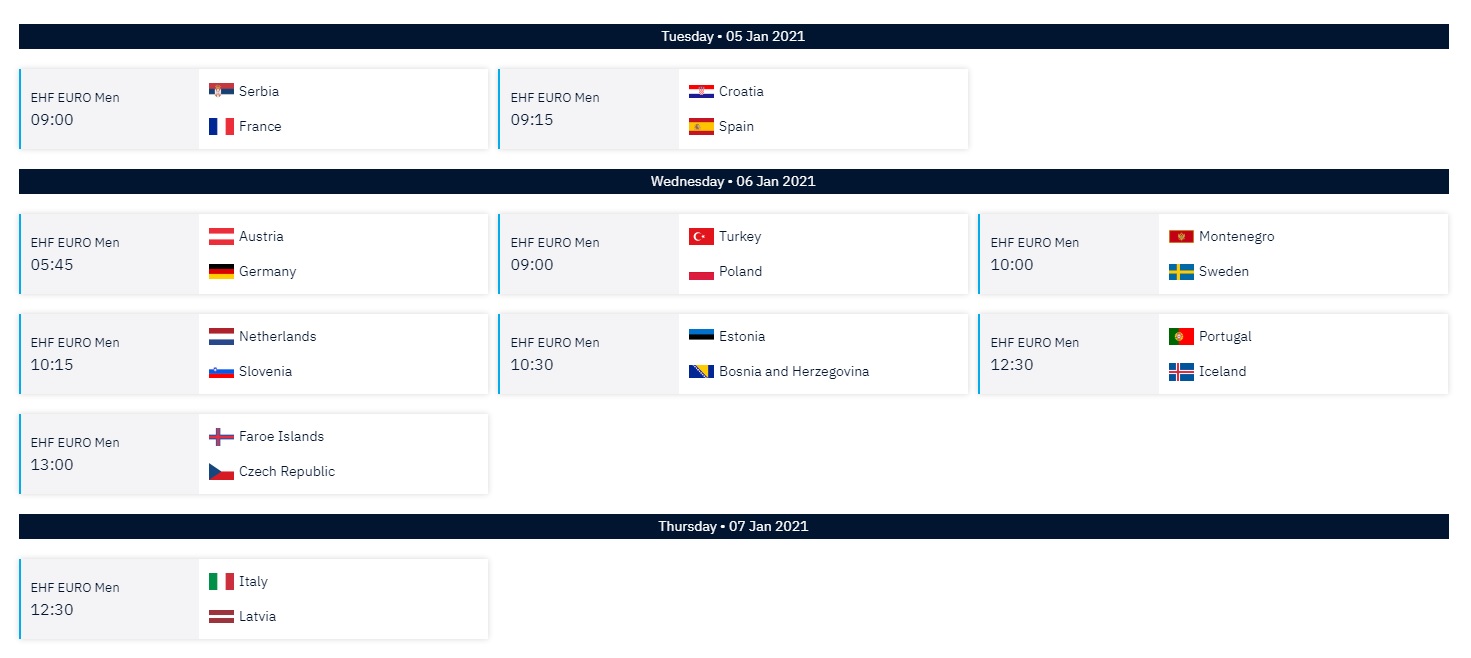
There’s not much happening on the club level this week, but there is a plethora of national team competition taking place. Normally, these matches would all be friendlies in preparation for the World Championships, but thanks to COVID-19 related postponements there are ten 2022 European Championship qualification matches scheduled for ehfTV this week with 7 more on tap this weekend.
2022 European Handball Championships Qualification Wikipedia page: Link
All matches are at ehfTV All times are CET (CET is 6 hrs ahead of US ET) Odds courtesy of Bet MGM
Tuesday, 5 January
1530 CET Belarus (-1.5) vs Norway (Don’t be fooled by this betting line. Due to COVID, Norway has sent the 2nd/3rd team to Belarus while the 1st team preps for the WC) 1700 CET Serbia vs France (-5.5) 1715 CET Croatia vs Spain (Slight Favorite)
Wednesday, 6 January
1345 CET Austria vs Germany (-4.5) (I’m thinking there’s a Team USA watch party in Denmark for this one) 1700 CET Turkey vs Poland (-2.5) 1815 CET Netherlands vs Slovenia(-3.5) 1830 CET Estonia vs Bosnia & Hercegovina (-3.5) 2030 CET Portugal (-2.5) vs Iceland
Thursday, 7 January
2030 CET Italy vs Latvia (-2.5)
American Athletes in Action
The U.S. Men’s National Team is in Denmark and will be playing friendlies vs Danish club teams. If any of these matches are available for viewing I will post web streaming links here.
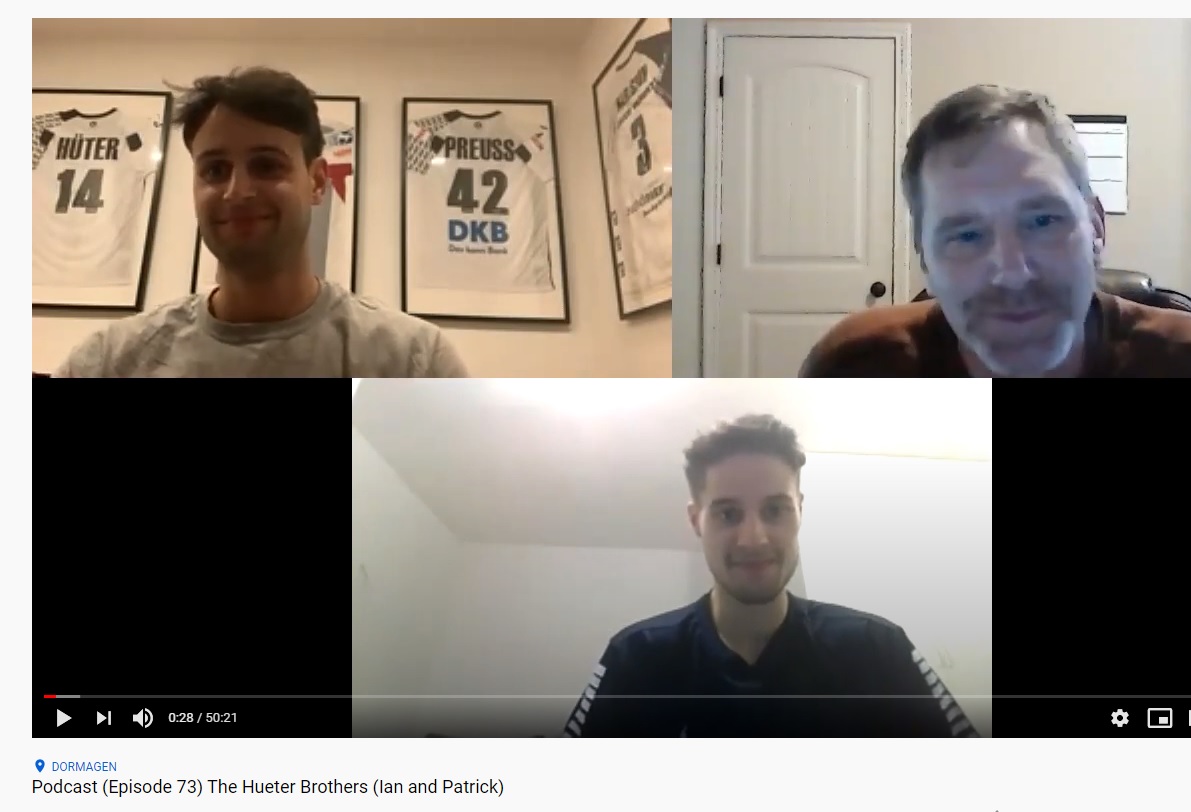
The Hueter brothers (Ian (center bottom) and (Patrick (left corner) are key members of the USA Men’s National Team.
There’s a long line of handball brothers playing for their country in international handball competition. France’s Bertrand and Guillaume Gille, Spain’s Alex and Daniel Dujshebaev, Poland’s Krzysztof and Marcin Lijewski, Argentina’s Diego, Pablo and Sebastian Simonet and Chile’s Emil, Erwin and Harald Feuchtmann to name a few. Why, even the U.S. had the Fitzgerald brothers (Joe and Tom) representing at the 1996 Olympics. Now added to this long line are Team USA’s Hueter brothers, Ian and Patrick.
Ian and Patrick join the podcast to discuss several topics to include their handball origins, connections to the U.S. despite mostly growing up in Germany, playing for TSV Bayer Dormagen youth teams and transitioning to the pro club, playing in the super competitive HBL 2, their recent contract extensions with Dormagen, Team USA’s upcoming training camp in Denmark and, of course, the upcoming 2021 World Championships.