The USA has released it’s roster for the upcoming 2023 NORCA Women’s Handball Championship that starts this Monday, in Nuuk, Greenland. The USA will face off against Greenland, Cuba, Canada and Mexico and the winner of the tournament will qualify for the 2023 IHF Women’s World Champions this December in Denmark, Norway and Sweden.
Here’s the roster from youngest to oldest
Unlike the U.S. men, the U.S. women’s roster is more evenly split between Americans who first played the sport stateside (11) vs another country (7). And, remarkably (for this old timer, anyway) 3 of those athletes are Juniors that first played the game in Mexico. This would have been inconceivable not too long ago and it speaks well of the development of the sport in that country.
The other interesting dynamic is that while the roster has a typical average age of 27, only a few athletes are near that age. Instead, it’s very top heavy at the two ends of the spectrum: younger, but inexperienced and experienced, but older.
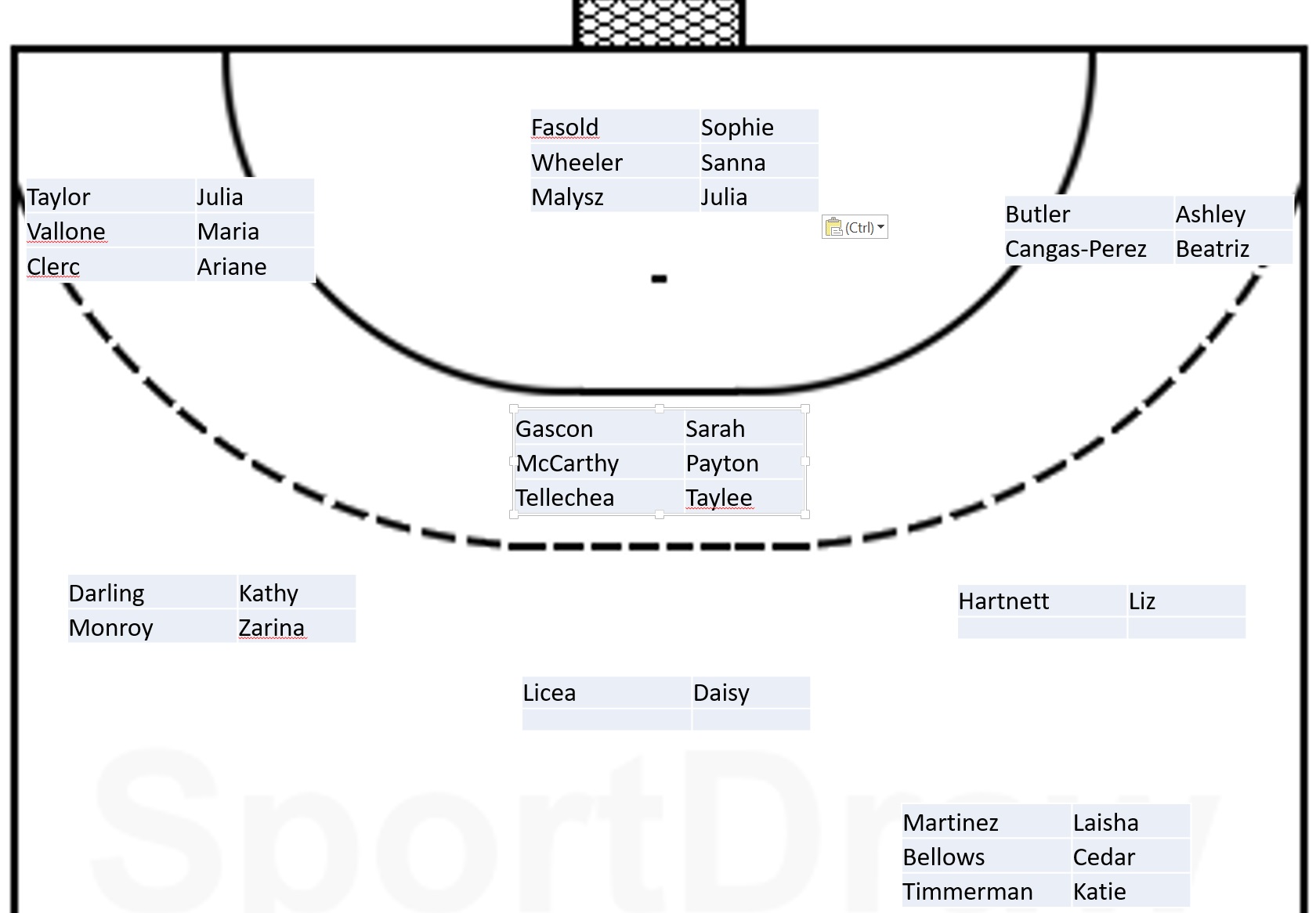
Here’s a schematic of how the the team might setup on offense. I say “might” because there’s some new athletes, some athletes that haven’t played in a while and a fair amount of guesswork involved.
Goalkeeper: Sophie Fasold plays for Vfl Oldenburg in Germany’s top division and is the clear #1 GK. Wheeler and Malysz will likely alternate as her backup.
Left wing: Julia Taylor and Maria Vallone are both experienced veterans and will probably share time. Vallone had an ACL injury and this will be her first official competition since the 2019 PANAM Games. Meanwhile, Taylor has often been pressed into the backcourt for the U.S. where she has been a bit out of position so she may be looking forward to a tournament where she primarily plays at the wing. It will also be interesting to see how newcomer, Ariane Clerc performs after a season playing for Reims-Champagne in France.
Left Back: Long time veteran Kathy Darling can still be an imposing force in the backcourt, but at 41 years of age 4 games of round robin play in 5 days may be a real test of stamina. Zarinna Monroy represented the U.S. at the 2022 Jr World Championships and will also likely see time at left back.
Center Back: A lot of guesswork here, but I suspect Daisy Licea may be the best option for the U.S. at center back. Last year playing for the Jr Women’s team she was at times the key player thanks to a combination of quickness and aggressive play to get the ball moving and the defense out of their comfort zone
Right Back: More guesswork… Liz Hartnett will play here and I won’t be surprised if Ashley Butler also sees significant minutes. Butler, however, is a big question mark as she hasn’t played for the U.S. since the 2019 PANAM Games.
The Unknown Backcourts: I know next to nothing about these three athletes: Laisha Martinez, Cedar Bellows and Katie Timmerman. Martinez plays in Mexico, Bellows has represented the U.S. in Beach Handball and Timmerman recently completed her collegiate basketball career at D2 Concordia University, Irvine.
Right Wing: Butler and Cangas-Perez should share time here. Cangas-Perez, is originally from Cuba and has played for the Inter Miami club team and Rogue in USA club competitions.
Circle Runner: Sarah Gascon is the veteran here and the other options are relative newcomers, Payton McCarthy and Taylee Tellechea. McCarthy plays for Ohio St and having played pivot for a short time I was impressed with her play at college nationals. Tellechea has previously represented the U.S. in beach handball, but is pretty new to indoor handball.
Outlook
The U.S. Women’s Sr National Team has not had much success of late as it hasn’t won a match in official competition since the 2019 PANAM Games. Part of the blame can be laid on COVID and limited opportunities to play, but fundamentally the U.S. has a very small pool of athletes to draw upon. And, by small we’re talking less than 150 U.S. Passport holding handball playing athletes world-wide.
Based on recent results (a two match series versus Canada last November) and a winless 2021 NORCA Championship the U.S. seems likely to go winless again and place 5th in this 5 team competition. That said, matches are decided on the court. Not on paper, based on past results. The U.S. has also had several training camps, have added some new players and the gap in talent to sides like Canada and Mexico is not overwhelming. If the U.S. can get some productive scoring from its backcourt players and play tough on defense wins against those teams are possible and would be a good sign of progress.
In terms of the overall tournament I suspect it will come down to the hosts, Greenland, and Cuba facing off in the Gold medal match with a World Championship berth on the line. Based on the 2018 Men’s PATHF Bronze Medal Match also held in Nuuk, also with a World Championship berth on the line that should be something to see with a full house of fans cheering on the home team.
The tournament starts today (Monday) with Cuba taking on Mexico and Greenland playing Canada. The U.S. starts their campaign on Tuesday with a match vs Canada at 3:30 PM US ET.
The 2023 USA Team Handball National Championships throw off Friday at 3:00 PM US ET at the Heminger Center on the campus of Tiffin University in Tiffin, Ohio. Twelve Men’s and 4 Women’s teams will be competing with matches taking place on Friday, Saturday and Sunday. Here’s a brief overview of the event:
Women’s Championship
The four women’s teams participating West Point’s 1st and 2nd teams, Ohio St and North Carolina. (The 1st team is identified as West Point-Black and the 2nd team is West Point-Gold). The four teams will first play a round robin which will be used to seed the teams for a knockout tournament with the Final being played on Sunday at 12 noon.
The teams are familiar foes as they are the same teams that participated in last year’s championships and they have already played each other several times this season. West Point-Black hasn’t lost to the other sides this season and is a strong favorite to defend their title.
Men’s Championships
Twelve Men’s teams will take part in the tournament and they have been drawn into four groups of three teams. The top two teams from each group will advance to the knockout tournament while the 3rd place teams will play in a consolation round robin group. Here’s a quick summary of the groups:
Note: West Point, Ohio St and North Carolina each have 2 team participating and a (1st) or (2nd) is used to initially define which is the designated 1st and 2nd team
Group A: Air Force, Tar Heels (2nd), SUNY Cortland: Air Force is the favorite to win the group with the Tar Heels likely to take second. Cortland is a brand new club playing in their first tournament so they will be looking to learn from these opening matches.
Group B: Ohio St-Scarlet (1st), West Point-Gold (2nd), Cincinnati: Ohio St-Scarlet narrowly lost to West Point’s 1st team in the championship match so they are the clear favorite to win the group. That said, they probably won’t want to overlook West Point-Gold which is the most competitive 2nd team in college handball. Cincinnati has not played Ohio St close this season so they are the likely 3rd place team
Group C: West Point-Black (1st), Ohio St-Gray (2nd), Auburn. Having won 14 straight titles it’s hard not to see West Point taking 1st place. Ohio St-Gray and Auburn will battle for 2nd place
Group D: Carolina (1st), Case Western Reserve University (CWRU) and Miami (OH): Carolina took 3rd place last year and is the favorite here. CWRU and Miami are relative newcomers and will face off for 2nd
U21 Players to Watch: 6 athletes represented the U.S. at the 2022 North American & Caribbean Handball Confederation Jr Championships (U21) where the U.S. finished 2nd and qualified for the World Championships this summer. Those athletes are
The 1993 World Championship team. 100% stateside raised Americans. There were 2 European based Americans, however, that attended our training camp, but didn’t make the squad. Oh, how times have changed… big time.
In Part 1, I took a whimsical look back at the 1993 USA World Championship team. This time I take a closer look at the composition of the squad and how we’ve gone from zero dual citizens to a roster that is around 80% comprised of Americans who first learned handball in another country. And why it doesn’t matter and, at the same time matters a lot.
Some Disclaimers
First things first… let’s getting something out of the way that I think I shouldn’t even have to. And, that’s a clear cut statement that just because I’m discussing the role of dual citizens on our national doesn’t mean that I think they shouldn’t be playing for Team USA. That is simply not the case. The more the merrier. The best American handball athletes should always make a USA Sr National Team roster.
And, it sure doesn’t mean that I think they are “second class” Americans or something moronic like that. In fact, having lived in France for five years that experience has led me to believe that in many respects an American living abroad is in some ways actually more “American” than a stateside American. For sure, they’ve likely thought more about their nationality and what it means than someone living comfortably in a sea of fellow citizens.
Finally, I think it also goes without saying that if you care about the development of handball in the United States you should really care about where the best American handball athletes are coming from. Because if only a handful of stateside based athletes can make a national team roster or even get invited to a training camp… it’s a very, very clear indication that handball in the U.S. needs better stateside development. That doesn’t mean you don’t cheer on the team… Just means you should be concerned with what it means to the bigger picture.
A Brief History of Dual Citizens playing for Team USA
Dual citizens, playing for the U.S. National Team is nothing new. In fact, in the very early days I think there might have been some foreign nationals residing in the U.S. that hadn’t even obtained U.S. citizenship playing for the U.S. Regardless, the U.S. took advantage of recent immigrants with handball experience to both start the initial development of the sport and to represent the U.S. in international competition.
Over time, however, U.S. sides became almost exclusively Americans that had lived in the U.S. their entire lives and had to be introduced to the sport. The primary exception usually were goalkeepers, but eventually even this highly specialized position started to see more stateside Americans earn roster spots.
When I played regularly in the 80s and 90s I knew of only two dual citizens that represented the U.S. Terje Vatne from Norway played backcourt and Mark Schmocker from Switzerland who played on our 1996 Olympic Team. Periodically, from time to time there were dual citizens that tried out for the team, but to my knowledge none of them made the team or chose to move to the U.S. (more on that later)
In the 2000s more dual citizens started to make U.S. rosters. Adam El Zoghby comes to mind as one of our early additions, but as we progressed through the 2010s to the 2020s this trickle eventually turned into a full fledged flood. The key turning point was 2018. In May of that year the U.S. finished 5th out 6 teams at the North American & Caribbean Championships. The team had only 2 dual citizen, including a 20 year old Sam Hoddersen who led the team in scoring playing out of position at center back. Just four months later, the U.S. had a new coach, Robert Hedin, and a few more dual citizens playing. With a backcourt trio of Ian Huter, Abou Fofana and Gary Hines they easily outclassed a Canadian side the U.S. had lost to in May. And, from that tournament on it’s been a steady progression of more and more dual citizens on the roster up to the 2023 World Championships where 20 of the 24 athletes seeing playing time were dual citizens.
The 1993 WC Training Camp
To further illustrate how things have changed I’ll share my own brief experience with a couple of dual citizens that tried out for the 1993 World Championship Team. Prior to the World Championships the U.S. National Team traveled to Finland for a two week training camp at the Finnish Olympic Training Center.
To be clear this “National Team” was also a “Residency Team” that was training together full time at the Olympic Training Center in Colorado Springs, Colorado. And, as the name implies not only training together, but also, with a few exceptions, living on the same floor in a dormitory environment. Such a situation inevitably creates a pretty tight team comparable in some respects to what one might experience in a military style boot camp. You practice together, you eat together, you watch TV together, you go out together at night. It’s very similar to the team environment an athlete experiences at a major tournament… except year round.
So, when we were told that two guys who we knew nothing about would be participating at our training camp the reaction was one of malaise, particularly for anyone who might not make the team. On the one hand our team clearly lacked depth and an athlete that could genuinely help us would be a nice addition. But, on the other hand, did we want to see one of our buddies get sent home after months and months of training together? Of course, not, but anyone who has ever tried out for a team understands that not making the cut sometimes is part of the process.
The two newcomers were from Norway and Sweden and they were decent players. (Note, after 30 years I don’t remember their names.) The Norwegian was a back court player with good skills, but was pretty young (~17) and just wasn’t ready to play with adults. The Swede was in his mid 20’s and a fairly accomplished Center Back. He had a slight build and wasn’t as good of athlete as the two athletes playing the bulk of the minutes at CB, but he was a good passer with a lot of experience. He wouldn’t have started, but possibly could have come off the bench depending on the circumstance. His making the team wouldn’t have resulted in cutting either of our two Center Backs, but would have instead taken a roster sport from some athletes training with us who were very new to handball.
In the end neither athlete made the final roster. I’m not sure what Coach Voitech Mares thought process was, but I suspect he assessed that the marginal benefit they would have provided was not worth disrupting the team’s cohesiveness. Yes, the old curse that sometimes requires an athlete trying out to not “just be a little bit better” than their competition, but “substantially better” came into play here. In the history of sports this situation has occurred for a number of reasons from contract cost, to age, even to race when the NCAA and NBA had unofficial limits on the number of African American they would have on their teams.
The Dynamics of a Residency Team Concept and National Team Selection
So, some folks might be shaking their head at the prospect of the best available athletes not making the team. But, one has to keep in mind what the U.S. was trying to accomplish then and at other times when the residency team concept was employed. The goal wasn’t to win now, but to try and develop a team that could win at some point in the future. Giving a roster spot to a dual citizen who wasn’t training with the team or willing to move to the U.S. to start training with the team was taking a spot from someone that was. Temporary benefit at the expense of potential long term gain.
And, this non-selection strategy wasn’t just reserved for dual citizens. At times stateside Americans who were playing in Europe were also excluded. I was gob smacked to learn recently that my 1993 WC teammate and current USA Asst Coach, Darrick Heath had not been on our 1995 WC team. The reason? He was playing professionally in Europe and his club would not release him early to come back to the U.S. to train. Yes, arguably our best player was denied a roster slot because our coach wanted him practicing with the team more. No wonder we only finished one spot higher, 15th in 1995. More recently at different times in his career, Gary Hines was not even contacted for his availability for some national team events. And, we’re not talking 38 year old Gary… we’re talking a much younger Gary in his prime.
The Demise of the Residency Team Concept?
For the past 15 years or so I have been a pretty vocal critic of the residency team concept. I’ve written several commentaries about why it never ever worked very well and why it’s even more unlikely to succeed today. I won’t rehash them all again. If you want you can read them here: link
But, regardless what one might think or believe about the merits of a residency team the quantity and quality of dual citizens the U.S. now has available for our Men’s National Team has rendered the question/debate moot. I guess we could spend a small fortune establishing a residency program, but what would be the point? If we could get the necessary funds (a big if), could find and convince quality athletes to participate (another big if), it would be a long, long road for them to even earn a roster spot with this current team. (yet, another big if) Seriously, just imagine the recruiting pitch to someone who’s never played GK before regarding what it will take to eventually get a roster spot. Such a pitch could only be successful if you have the morals of Representative George Santos.
Come Again? Why Did the U.S. have Residency Programs in the First Place?
Well, I can see how someone relatively new to handball or just a top level precursory understanding of U.S. sports structure would ask this question… The answer is quite simple.
Without a residency program of some sort, historically the U.S. would have struggled to even field a team, let alone a competitive team.
The reality is that handball is played by only around 500 to 1,000 people in the United States… and a sizable percentage of this 1,000 aren’t even American citizens. These commentaries from 2019 outline the demographics and are are representative of our current status. It might even be a little worse since COVID likely caused a retraction.
And, now that we don’t have a residency program I can state unequivocally that had the U.S. been forced to field a team without dual citizens we would never have qualified for the 2023 World Championships. We wouldn’t have even come close. I would assess that such a team would have finished last at the recent NACHC championships and would have lost every match by double digits to Greenland, Cuba and Mexico. Our U21 and U19 teams which recently qualified for the World Championships this summer would have also not qualified, but probably could have mustered a win against other very inexperienced teams.
Trading One “Artificial” Solution for Another
In some respects, the U.S. has simply traded one artificial solution (residency programs) for another (a team mostly comprised of dual citizens). Artificial in the sense that both solutions essential paper over the reality that there is very, very limited grass roots development in the U.S. The sort of grass roots that would help make handball a sport that mattered in the U.S. Real development that would have Americans playing the sport from coast to coast and athletes eventually making national teams the traditional way through schools and clubs, continuously playing at higher levels until they reach the top of the pyramid.
And, let’s be clear this is the development that everyone in the world-wide handball community really wants. It’s awesome to have a competitive team to cheer on, but it’s comical to hear or read commentary that sees the U.S. team pick up some wins and conclude that the U.S. is really developing handball now. Because while that may happen it’s certainly not happening yet.
And, while one might think that a competitive national team could help spur development stateside, the U.S. still has not figured out how to break into the national consciousness. Stateside there’s been very little buzz beyond our small handball community as ESPN has once again inexplicably done nothing to promote handball on its streaming platform.
A Really Good Deal
But, while a roster heavily dependent on dual citizens is an artificial solution that doesn’t really help stateside development it’s still a really good deal. And, this is primarily because dual citizens basically cost nothing to develop as those costs are paid by other nations and the clubs they play for. The U.S. can basically run this current national team as if it were a hidden little country in Europe, holding training camps periodically to help these individuals gel as a team. For a cash strapped federation with very little money it’s hard to fully quantify just what a really good deal that is. Well, you sort of can. Take all that money and time that would have been spent on a residency program over the next five years… and think of all the ways that money can now be spent on grass roots development.
And, make no mistake: without these athletes some sort of residency program would have to be developed. Why? Because we simply could not be competitive without one and the IHF will want to see a competitive team taking the floor in Los Angeles in 2028. It’s not clear how much funding would be available for such an effort, but some percentage of the overall budget would continuously be sucked into it. Otherwise… we might not be allowed to field a team at the Olympics, even if we are the hosts.
A Golden Generation
But, the U.S. didn’t just get a good deal. No, we pretty much have hit the jackpot with this current crop of dual citizens. I’ve hemmed and hawed a bit about whether it’s a “Golden Generation” but, not anymore. The depth in terms of quantity and quality is statistically way better than one could normally expect. This doesn’t mean we are going to start winning Olympic and World Championship medals, but we’ll be competitive for the next several years. Five years out we pretty much have 70-80% of our Olympic roster identified. Heck, it might be 100% identified. All provided at essentially no cost. This might not qualify as a Golden Generation for France or Denmark, but for the U.S. it clearly does. We’ve never had it so good.
Does it Matter or Not: Answer: Yes and No
So, if it’s not already obvious how one answers this question depends on your perspective and objective.
From a narrow national team perspective it doesn’t matter at all. The task at hand, whether you’re a coach or player is to go out and perform. For the U.S. that means to be competitive and to continuously work on improving. Depending on the competition that might mean winning a title or it might mean advancing to new heights. No one directly involved in near term preparation of our national teams should care where are athletes come from or how they got there.
However, from a big picture administrative and planning perspective it really matters. If very few stateside athletes are worthy of selection to our national teams that’s a very clear indication that there our stateside structures need work… a lot of work. The good news is that since nothing special is required to “create” a national team more attention can be placed on efforts to truly develop handball stateside. This is a monumental and complex task that won’t be easy and the Golden Generation is both a gift and a warning. It’s a gift in that it frees up a lot of resources (funds and manhours). But, it’s also a warning… Golden generations don’t last forever and we won’t always have such a talented group to bail us out. The time this generation buys needs to be used wisely.
Think that I’m exaggerating this Golden Generation we have? That either they aren’t that good or that we’ll always have a similar talented group available. Well, we just so happen to have a similar cohort that we can compare it to. The current dual citizen cohort for the U.S. Women is a very stark contrast as it is nowhere near the U.S. Men in terms of quality and quantity. And, that presents a lot of challenges. I’ll tackle those challenges next.
USA Team Handball released their final 18 man roster for the 2023 IHF Men’s Handball World Championships yesterday. Here’s a closer look at the roster:
Coach Hedin and his team had invited 24 athletes to their pre World Championship Training Camp in Trondheim, Norway and Gothenburg, Sweden. These are the 6 athletes that weren’t selected:
From my perspective there was only one surprise with the selection and that was the decision to select Nik Zarikos instead of Sean Corning. The two were not in direct competition as Zarikos plays left wing and Corning plays right wing, but apparently Zarikos, who has not been previously selected for a Sr team roster, impressed the coaching staff in camp. Corning had made the NACHC Championship roster this summer, but Max Binderis was not available for that tournament.
Overall, there was almost no change from the roster that would have participated in the 2021 World Championship, but had to withdraw due to several positive COVID tests. In fact, Zarikos is the only addition. Going back further, the core of the team from the 2019 PANAM Games is still there with 11 athletes from that team selected for this squad.
Here’s a schematic of the roster by position with a few notes:
Goalkeeper: Pal Merkovsky who plays in Hungary’s top division is the likely #1 GK and will likely get the bulk of the minutes.
Left wing: Sam Hoddersen, who led the USA in scoring this past summer at the NACHC Championships will likely start and will probably play most of the time. Gary Hines might also play some wing as well
Left Back: Abou Fofana led the U.S. in scoring at the friendly warm up tournament in Trondheim. In his club career in France, he’s actually been used mostly as a defensive specialist, but he’s starting to get more playing time in the backcourt and has scored 33 goals this season. The biggest question mark will be his consistency and accuracy on long range shots. Hines, 38, is the team’s veteran and he plays much younger than his age. His jumping ability his hard to miss and he may play some at left wing as well. Amitovic is less experienced, but played well at the NACHC Championships.
Center Back: Team Captain, Ian Hueter is the linchpin of the offense directing traffic and executing the attack. He does an outstanding job of getting everyone involved and his performance will be key to the U.S. having success in set offense attacks. Alex Chan, is also more than capable as he is leading the Liga ASOBAL in scoring with 100 goals in 15 matches this season. (Yes, this is not a misprint: an American is the leading scorer in Spain’s top league.) Although, he is a natural center back he will likely play right back much of the time. Although out of position he will keep the ball moving laterally and will still find ways to score
Right Back: As mentioned above, Chan will likely play quite a bit at right back. Backing him up will be a pair of left handed youngsters, 21 year old Joey Stromberg and and 19 year old Jakob Rysgaard.
Right Wing: Veteran, Ty Reed, will likely get the nod here with Max Binderis backing him up.
Circle Runner: The U.S. is well stocked at this position with four big dudes that can play the position: Domagoj Srsen, Donlin, Patrick Hueter and Paul Skorupa. On offense Donlin and Hueter will likely get the most minutes and Srsen, who previously played for Hannover in the German Bundesliga should start on defense, rotating with Alex Chan.
Roster by Age
Here’s a look at the roster from youngest to oldest. The average age of the team is 26.1 years old and is a good mix of veterans and relative newcomers. And, for anyone looking ahead towards LA 2028 a good portion of the roster will surely be available for selection 5 years from now when the U.S. hosts the Olympics.
Your options for watch the 2023 Handball World Championships will vary depending on where you live. Some nations will be able to watch all the matches on the IHF YouTube Channel while other nations will have all or some of the matches available on a TV Channel and/or streaming to which the rights have been sold. This IHF article outlines how to watch in each nation: Link
ESPN will be airing up to 4 matches each day on their Watch ESPN platform which is accessible to anyone who subscribes to ESPN via Cable, Satellite or Streaming Service. (Important Note: This does not require an ESPN+ subscription. Further it will not be available on ESPN+. To watch the Handball WC you will need a traditional ESPN Subscription)
Watch ESPN can be watched on your TV, laptop or phone. Personally, I watch it via my ESPN app on my Roku, but there are multiple options. Typically, the first time you go to watch something, you will be asked to verify your account so have your username and password ready.
Matches are now being populated on the schedule page and can be found under the ESPN3 Channel. If past history is a guide ESPN will also add a handball logo and a 2023 WC logo to help find the matches. Additionally, matches will likely show up on the main page, but only a few minutes before the match starts.
There is no TV contract so all matches should be available on the IHF YouTube page: Link
VPN
A Virtual Private Network (VPN) might provide access to matches that are not available on ESPN. For more information on how to use VPN check this article out: Link
Spam Sites
You’ve surely seen the multitude of social media postings inviting you to watch the match on their free service. Don’t even bother with these sites. They typically will ask you to download a video player on your computer. Trust me… you don’t want that app on your computer and in all likelihood they won’t even have the match. Go with VPN
Colton Strickler is a media representative for DNVR Rugby. In the first part of our discussion we focused on the Colorado XO Rugby Club that is focused on rugby training for crossover or “talent transfer” athletes from other sports. In the 2nd part I let Colton ask some handball newbie questions he has as a rugby guy. Then we discuss Major League Rugby (MLR), the relatively new pro rugby competition in the U.S. and the inherent challenges with starting a new professional league.
Some of the topics discussed during our Handball Q&A session
Did Jake Plummer play handball? Yes, but the wrong handball: Link
The semantic problems of handball/team handball: Link
How should a newcomer watch a handball match?
The success/failure rate for handball keepers
Where handball can be seen during the Olympics: Link
How handball is organized in Europe
Who is the Handball GOAT and who are the top players today?
Colton Strickler is a media representative for DNVR Rugby. The Colorado XO Rugby Club is a rugby club located in Glendale, Colorado that is focused on rugby training for crossover or “talent transfer” athletes from other sports. In just 2 years time this program has had 6 athletes sign pro rugby contracts with Major League Rugby, the relatively new pro rugby competition started in the U.S.
On the podcast we discuss:
Why Rugby’s experience is applicable to handball
The XO athlete that triggered this whole podcast: Link
Colton’s rugby background
Rugby talent transfer: Rugby 7s vs Rugby 15s
How the Colorado XOs got started
Colorado XO Recruiting Strategies
Sports the XOs target
The limited post collegiate options for American athletes
Colorado XO finances (generalities, not specifics)
How the Colorado XO schedule is a bit like Notre Dame football
While searching for that video, this video of former NFL quarterback Tim Tebow playing dodgeball and drilling Shaq also popped up.
In my opinion, this video supports what has been discussed for 10 years now. That Tim Tebow would have been a phenomenal handball player. I know, I know…it’s just celebrity dodgeball, but you can still see it. He’s got the arm (lefty), the moves and the mentality of a handball player.
Alas, he continued to believe that he had a future as an NFL quarterback. Then he gave baseball a try. I had thought he had finally resigned himself to being just a football commentator, but earlier this year he announced that he was going to give the NFL a try yet again, this time as tight end.
The intent of this page is to provide a consolidated location for 2020 Olympic Handball information that can serve both dedicated handball fans as well as newcomers just discovering the sport.
Olympic Handball Competition Schedule and Results:Link
Team Information (Official pages, previews, rosters and handy Wikipedia pages): Link
Hey, media person, just discovering handball: Think you’ve got a new idea on how the U.S. can win Olympic Handball Gold? Think again… Check out these articles dating back from 1996.
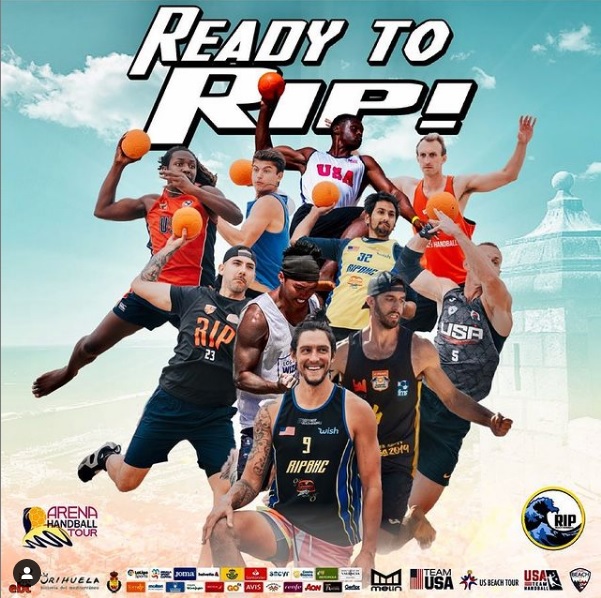
The Rip Beach Handball Club will be in action this weekend in Spain.
More information on where to find web streams for National Team, Professional Club and USA Competitions: Link
For regular updates on when and where handball matches can be streamed online follow Team Handball News on social media: TwitterFacebookInstagram
All times are CET which is 6 hours ahead of US ET. Odds courtesy of Bet MGM and/or OddsPortal.
American Athletes in Action
The Rip Beach Handball Club will be participating in the Orihuela, Spain stop on the Arena Handball Tour. Many of the athletes playing for Rip Beach are also members of the USA Beach Handball National Team. I will post the scheduled match times and results when they are available. They also will surely be available on Rip Beach Handball’s social media platforms
6th place Dormagen hosts 4th place Elbflorenz in the last match of a very long season. A win here would put Dormagen level on points (40) with Elbflorenz.
The Euro Cup is a tournament for the European nations that had already qualified for the 2022 European Championships and this make up match is a tune up opportunity for Olympic bound Spain and a chance for Croatia to start their rebuilding effort.
Ebiye Udo-Udoma and the rest of the U.S. Men’s Beach Team Handball squad will be in action several times this weekend.
More information on where to find web streams for National Team, Professional Club and USA Competitions: Link
For regular updates on when and where handball matches can be streamed online follow Team Handball News on social media: TwitterFacebookInstagram
All times are CET which is 6 hours ahead of US ET. Odds courtesy of Bet MGM and/or OddsPortal.
American Athletes in Action
The USA Beach Handball Men are participating in a tournament in the Canary Islands. On Friday and Saturday they play round robin matches. The top two teams will play for 1st while the the remaining 3 teams will play a mini round robin for places 3-5. (Note: Local Time for the Canary Islands is 1 hour behind CET)
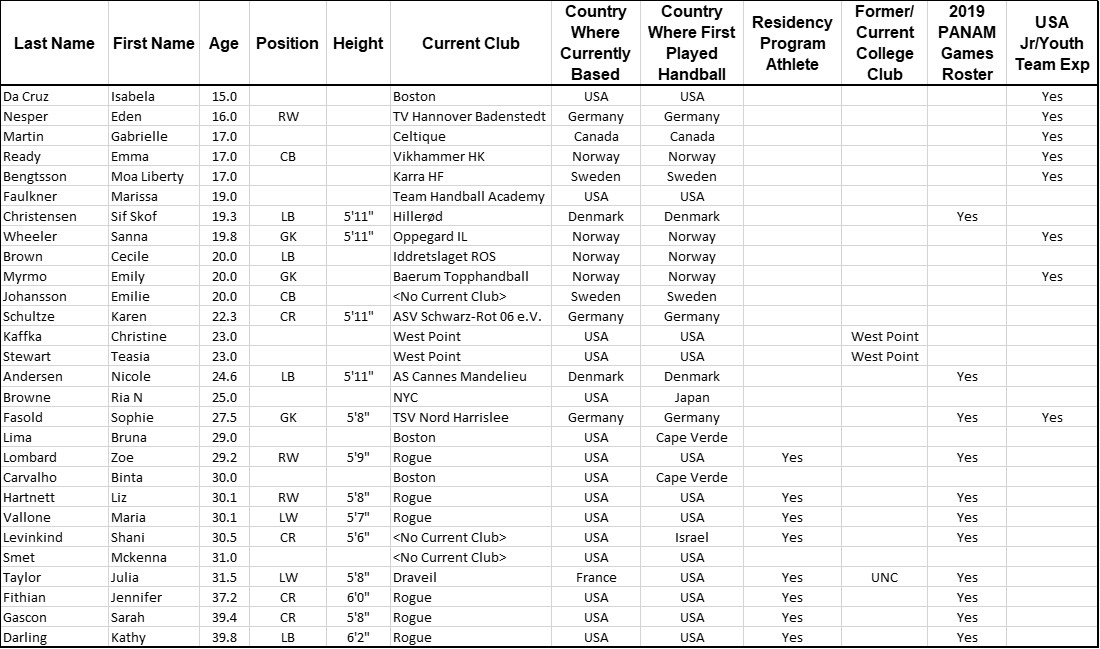
This past Wednesday, USA Team Handball released a preliminary roster for this summer’s North American and Caribbean Handball Championship. The roster lists 28 athletes and here’s a breakdown by age and where they first learned to play handball.
USA Preliminary Roster (Youngest to Oldest)
USA Preliminary Roster (Youngest to Oldest)
The ages on the roster range from 15 to 39 with an average age is 25.1. This is quite the range and is considerably more spread out then the typical women’s national team roster which is more bunched up with the bulk of the athletes in their 20s. For comparison, take a look at the rosters of the 24 nations at the 2019 IHF Women’s Handball World Championship
USA Provisional Roster (Nation Where they First Played Handball)
USA Preliminary Roster (Nation Where they First Played Handball)
All of these athletes are Americans, but the U.S. is a large nation with a global population. Estimates vary, but as many as 9M American citizens live in another country so it’s no real surprise that some of those 9M learned to play handball where they grew up. In fact, 57% (16 of 28) of the U.S. roster originally played handball in 8 different countries. Norway leads the way with 4 athletes followed by Germany with 3. Other nations: Cape Verde (2), Denmark (2), Sweden (2), Canada (1), Israel (1), Japan (1).
The fact that the U.S. has so many dual citizen athletes is sometimes seen as controversial, but it shouldn’t be. I addressed this reality and its implications for the U.S. National Team and the sport’s development previously in a series of commentaries Part 1, Part 2, Part 3)
In terms of the 12 U.S. athletes that were raised stateside, 3 athletes (Kaffka, Stewart and Taylor) are products of Collegiate Clubs, 6 athletes (Lombard, Hartnett, Vallone, Fithian, Gascon and Darling) primarily first learned how to play at a Residency Program (Cortland or Auburn University) and 3 athletes picked up handball either on their own or with a club (Da Cruz, Faulkner and Smet).
Final Roster Projection
My projection for the Final Roster is a mixture of logic and guesswork. The logic portion is primarily looking at the last major tournament roster (the 2019 PANAM Games) and penciling in any name from that roster that is also on the preliminary roster. Of course, just because someone made the team last time doesn’t guarantee that they will make the team again, but it’s usually a good starting point. Further strengthening this logic is the COVID-19 pandemic as it has somewhat frozen things in place since March 2020 with many athletes not even playing handball much since then. There are 11 potential returnees and assuming that 16 athletes will be allowed for this tournament that means 5 newcomers.
And, this is where some major guesswork is required as I am not familiar with many of the other names on the roster nor do I even know what positions some of them play. So, keeping this in mind here is a top level assessment of which athletes might make the final roster. To be clear, though, I’m not actually going to make any hard projections other than that I think all 11 athletes from the PANAM Games will make the final roster. I just simply don’t know enough about the newcomers.
Goalkeepers: Sophie Fasold was one of the 2 goalkeepers on the PANAM Games roster and the other GK, Bryana Newbern is not on the 28 player preliminary roster. Fasold has also been able to play a full season with her club team, Nord Harrislee in the German 2nd Division, so I think she will likely get the the bulk of the minutes. The coaching staff will have to choose whether they want 2 or 3 goalies on the roster and both Sanna Wheeler and Emily Mrymo have previously made Jr team rosters. Also, identified as a GK is McKenna Smet who is very new to handball.
Goalkeepers
Left Wing:Julia Taylor was the 3rd leading scorer for the U.S. at the PANAM Games and Maria Vallone was her backup. It would seem that these two spots are fairly locked in, but I’m not familiar with the other potential options.
Left Wings
Right Wing: Zoe Lombard and Elisabeth Hartnett were the U.S. PANAM Games participants, but they may be joined by 16 year old, Eden Nesper who played on the U.S. Youth team in 2019 and plays for both the U17 and U19 for her club team, Hannover Badenstedt in Germany. The Hannover U17 team won the Germany cup title this past weekend. She’s a capable player with a bright future, but that’s still a pretty young age to be playing against grown adults. It will be interesting to see what the coaching staff decides.
Circle Runner: Veterans, Sarah Gascon and Jennifer Fithian, should both make the roster and they will be joined by Shani Levinkind. Levinkind was selected to the PANAM Games roster, but did not participate due to injury. Karen Schultze, 20, plays in Germany and had previously been added to the player pool, so one can assume that she’s also a strong candidate. This position may seem to be set, but because there are some major question marks at backcourt some of these players might end up playing there instead of at circle.
Circle Runners
Backcourt (Left, Center, Right):While the other positions appear to be somewhat settled there are a lot of question marks as to who will be playing the three backcourt positions. Well, not all question marks. Left Back, Nicole Andersen, the 2nd leading scorer for the U.S. at the PANAM Games returns and will likely be called upon to assume a greater leadership role with the team. Also returning are veterans Kathy Darling and relative newcomer Sif Skov Christensen. And… that’s it, (as far as I know) when it comes to returning back court players.
Logically, this means some newcomers are probably going to be expected to play some really important minutes at the key backcourt positions. And, really not knowing these players means some major guesswork. I’ve heard some good things about Emma Ready and I’ve even played quite a few times vs her father long ago in California so perhaps she’s inherited some of his feisty quickness. Despite being just 17 she could be an option at Center Back. Cecile Brown and Emilie Johansson are also possibilities and as dual citizens perhaps they’ve gotten quite a bit of playing time despite their relatively young ages.
Backcourts
But, really for all I know several names on the roster that I haven’t even mentioned (see below) could well be the athletes the selection team goes with.
Roster Candidates (Unknown Position)
But, here’s one thing I do know: U.S. success or failure in Elgin this summer will likely hinge on these newcomers and their ability to make meaningful contributions at backcourt.
Roster Churn
Much of the above commentary focused on the likely returning players from the 2019 PANAM Games and some new gaps where newcomers will need to step up. So, for context I’ll highlight some players that were not on the preliminary roster and the contributions that will be missed.
First and foremost, center back Jence Rhoads, the U.S. leading scorer (24 goals in 5 matches) from the PANAM Games is not on the roster. Anyone who’s seen the U.S. play for the past several years knows that she’s developed some solid skills and has been the point guard directing traffic on offense, making the players around her more productive. Also, not returning are left back Julia Sayer and right back Ashley Butler. All told, those 3 athletes accounted for 44% (40 of 91 goals in 5 matches) of the live action goals scored at the PANAM Games. In terms of backcourt productivity they accounted for 74% (40 of 54 goals) of the backcourt scoring. Further limiting experienced options is the news that the long awaited return of right back Karoline Borg will be delayed due to pregnancy. Borg, age 30, plays right back for Aker Topphåndball in Norway’s top and league and had previously played for the U.S.
While these roster changes will impact the U.S. it’s more than likely that the U.S. won’t be alone with this problem as other NACHC nations are also surely encountering similar roster churn. Such change is inevitable and it will be interesting to see how successful teams are in integrating their newcomers and getting their teams ready after a long pandemic layoff.
Note: If there is any information in this table that is incorrect, drop me a line at john.ryan@teamhandballnews.com and I will update it.
USA Men’s Preliminary Roster prior to the 2021 WC: Link
Semifinal: TV Hannover-Bandstedt vs HC Erlangen (Saturday, 1715): Video Link
Eden Nesper (#44) is a Right Wing for Hannover; Nesper was named to the U.S. preliminary roster for this summer’s North American & Caribbean Championship
Hannover won 30-23 and will play in the first place match on Sunday.
1st Place Match: TV Hannover-Bandstedtvs HSG Blomberg-Lippe (Sunday, 1345): Video Link